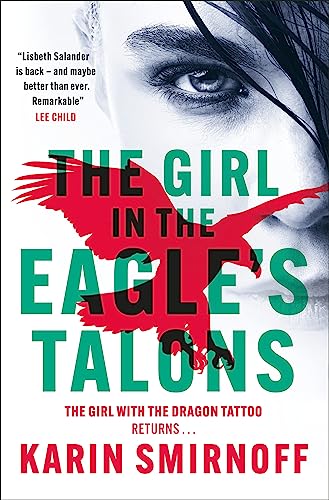
The start of the third trilogy featuring Lisbeth Salander and Mikael Blomkvist, and a new author. As indicated by the title, I read it in English – and… a new translator too. This time it’s a professional translator from Swedish to English. The English version keeps up The Girl… book titles, which are not of course direct translations of the original Swedish titles. In this case, it’s Havsörnens skrik, The Sea Eagle’s Cry – but weirdly, it’s a boy who finds himself in the titular, er, appendages.
Blomkvist is in the invented town of Gasskas in Norrbotten, a county in the most northerly part of Sweden. He’s there for his daughter’s wedding. To the head of the Gasskas kommune (district council/municipality). Who Blomkvist doesn’t like from the moment he meets him as he seems to be a bit of a chancer. Honest – but not the most transparent of politicians. Especially when it comes to a deal to build Europe’s biggest windfarm on land in the district. There are three companies in line to take a third each of the contract, but one wants 100% of it, a shadowy Swedish company run by a disabled psychopath who lives in a refurbished military bunker near Gasskas.
Lisbet Salander is in Gasskas because her half-brother’s daughter – previously unmentioned in the series, unsurprisingly – is about to go into care, and Salander is the only surviving relative. The daughter, Svala, is a genius like Salander, and also has the same genetic condition as her father which means she doesn’t feel pain.
The two narratives are connected. Svala’s mother is missing because she’s been kidnapped by the psycho millionaire. Blomkvist’s soon-to-be son-in-law is being threatened by the same psycho to give him the entire contract. The two stories intersect when Blomkvist’s grandson is kidnapped at the wedding.
There’s little that’s new here, except perhaps the setting: the Swedish north. Blomkvist is a bit more of a fogey than in earlier novels, and Svala fills more of Salander’s typical role than Salander does. The villains are almost caricatures – they even have a secret underground lair!
The writing is better than the Lagercrantz trilogy, although that’s hardly a high bar to clear. Everything is in present tense, which gives it more urgency, and often drops into choppy sentence fragments. It works, to an extent – although I don’t think the material is really strong enough for it, given everything is so clichéd.
This is the English prose, of course, so it seems the translator is much better. There were a couple of questionable choices: Systembolaget is referred to throughout as “the off-licence”, which may well be a UK term for a shop that sells booze, but Systemet is the state liquor monopoly chain, which is not quite the same thing. The word “Lapp” is used interchangeably with “Sámi”, even though it’s considered offensive, and it’s not always in dialogue or in the POV of characters who are prejudiced. And someone orders “a pizza salad”, but “pizza salad” is the name of a side-dish in pizza restaurants here (the indefinite article looks odd – like, you order a pizza and say “and garlic bread”, not “and a garlic bread”).
So, slightly better than the preceding three books, and makes good use of the series mythology. They are at least better than Dan Brown’s “weapons-grade bollocks” – and English is his first language! – but even for a commercial thriller this is near the bottom of the barrel.
And yes, I really should try reading the books in Swedish.
 It Doesn't Have To Be Right...