
Atlas Alone (2019, UK) is the fourth and final book of the quartet which began with Planetfall (2015, UK). It was followed by After Atlas (2016, UK), Before Mars (2018, UK), and then Atlas Alone. The first book is set at a colony on an exoplanet, founded next to an enigmatic and seemingly deserted alien city. The mission was led by the Pathfinder, who invented FTL and then promptly went looking for God – and found it in the alien city.
After Atlas is set on Earth after the Pathfinder had left. It starts out as a murder-mystery, but becomes a conspiracy thriller in which a technocratic cult based in a theocratic USA secretly builds a second ship based on the Pathfinder’s. Before Mars takes place at a base on Mars. The narrator spots clues which suggest all is not as it seems and she has been there before but cannot remember it.
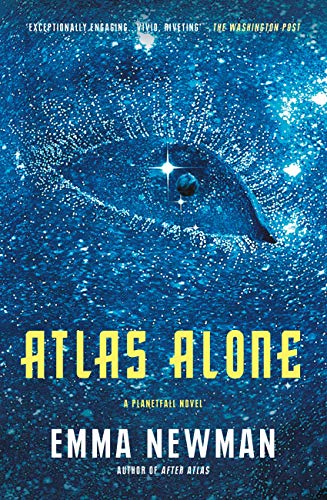
And so to Atlas Alone. Which takes place immediately after the events of After Atlas, but onboard Atlas 2, which is the second FTL ship. The ship is heading for the exoplanet where Planetfall takes place. It is staffed mostly by fundamentalist Christian Americans. And, as they left Earth, they killed everyone left behind with nuclear bombs. The narrator, Dee, is a last-minute addition to the thousands aboard, as is her friend Carl, the detective from After Atlas.
Dee is a gamer. An anonymous superhacker invites her to play a “mersive”, which proves to use details from her own life. The game ends with her finding a man about to destroy London. She suspects he is one of those responsible for the nuclear bombs on Earth, so she kills him. In the game.
Except he dies in real-life, and Carl is tasked with discovering how he died and who killed him. Meanwhile, Dee is offered a data analysis job by one of the senior crew, and then invited to team up with her new boss in another mersive, which again uses details from Dee’s background – thanks to the anonymous superhacker.
It’s not hard to figure out the identity of the anonymous superhacker, and it’s easy to sympathise with Dee’s mission to kill off the leadership of Atlas 2 once she discovers their plan to set up a God-fearing colony on the Pathfinder’s planet, with themselves as the gods and everyone else fearing them.
Perhaps back in 2019 when Atlas Alone was published, it might have felt a little implausible and OTT, but not now in 2026, with a cabal of apocalyptic Christian fundamentalists and paedophiles in charge of the US, secret police taking people off the streets and putting them in concentration camps, a president funnelling billions from the US Treasury into his own pockets, and a government that has long since lost touch with anything resembling truth.
Atlas Alone pulls a final bait and switch before ending, which, in hindsight, is probably the least satisfying part of the novel. But the book is a fitting end to the quartet, and if I thought its corporatised indentured slavery future Earth was a bit tired and banal these days, other parts of the world-building were much more interesting. But, on the whole, four books worth reading, although the first and third were the best.
 It Doesn't Have To Be Right...