Scott has written a number of excellent science fiction novels, although career-wise I suppose she’s a fairly common example of a US female mid-list genre author. Which happens to be a space where a lot of my favourite genre writers live. Mostly, however, I find her books variable. Shadow Man (1995, USA) is pretty good, as is The Kindly Ones (1987, USA). The Silence Leigh trilogy (1985 – 1987, USA) is fun. Mighty Good Road (1990, USA) is enjoyable if a little forgettable. I’ve not read all of her oeuvre, so there’s plenty left to explore.
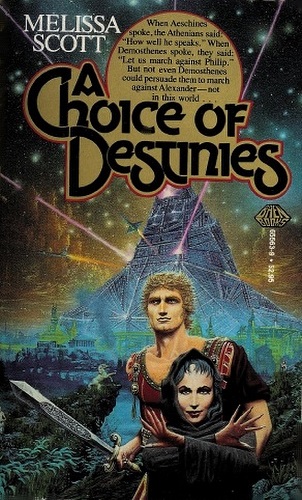
A Choice of Destinies (1986, USA) is straight-up alternate history. What if Alexander the Great had turned west instead east? In our world, he conquered land as far as the Indus, and his empire fell apart after his death at the age of 32. In Scott’s novel, the rebellion of the Greek League cities brought him back west, and then down to Naples, before eventually onto Rome, with whom he signed a treaty. He then fights Carthage, and defeats it.
The thing about alternate history is that its story rests on its difference to real history, and if the reader doesn’t know that real history then the difference is meaningless. There was a sf story, I forget who wrote it, in which Fidel Castro was a baseball player and not the president of Cuba. Apparently, he did at one time play for a baseball team in the US, but the writer had to explain this in an afternote for the story to make sense. Scott does something similar, interspersing her main narrative of Alexander’s life with sections set 1800 years later in a world in which Europe, north Africa and west Asia are part of an Alexandrian empire. The novel ends in a section set on Alexandria-in-orbit, a space station, in 1591 CE. I very much doubt Alexander’s empire would last nearly 2000 years – no other did, after all – nor that it would lead to space flight some 350 years earlier than real history.
A Choice of Destinies starts off well enough, but soon becomes little more than blow-by-blow accounts of Alexander’s battles, both actual and political. Those interested in Alexander the Great’s life will find more to enjoy here than the average reader of science fiction or alternative history. It’s a smoothly-written piece, and I’m going to trust Scott on her presentation of history, but it definitely begins to flag around halfway in. Despite which, the final scene, the siege of Carthage, seems rushed and incomplete. It’s as if Scott wanted to write a much longer novel, or perhaps even a series, but was contractually constrained to a single novel. One for fans.
 It Doesn't Have To Be Right...