
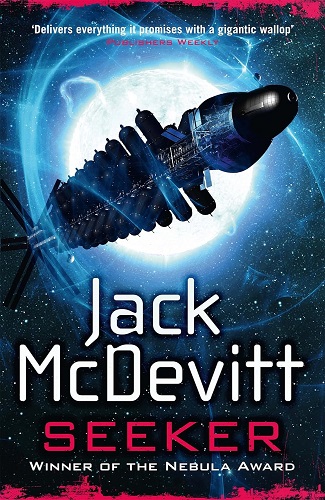
Seeker (2005, USA) is the final volume in the Alex Benedict omnibus I bought while it was on offer, and I still haven’t decided yet if I’m going to read further in the series. Because… they’re really bad, they’re terrible science fiction, but… they’re easy reads, you can polish one off in an afternoon, and there’s a certain fascination in seeing how poorly McDevitt builds his future federation. How the fuck this novel won the Nebula Award in 2006 is a mystery up there with, well, the commercial success of Oasis.
These stories are set nearly 10,000 years in the future, but you would never guess it. Houses have AIs, people travel between planets, cars fly, and, er, there’s probably a few other gizmos mentioned. But in terms of culture and society, McDevitt’s future resembles early twenty-first century USA – there are no characters, for example, with names that might seem out of place in present-day Los Angeles or New York. Having said that, there’s a single mention of “dark skin”, and even a paragraph on that old white sf bullshit by old white sf writers where all the races have interbred until everyone has “olive skin”. Homo sapiens has been around for over 100,000 years and we still have races. That’s not going to change in 10,000 years, even if McDevitt doesn’t like putting non-white people in his novels.
McDevitt mentions the Bataan Death March (I’ve met a survivor of this, by the way), and I still find it really bad craft where things that would be known to a late twentieth-century person are known to a twelfth-millennium person, but they know very little of the one hundred centuries in between, or even of events that happened a decade or so earlier.
The plot of Seeker – and I’m wondering if McDevitt borrowed the structure of his novels from Clive Cussler; certainly the conceit that they’re written by narrator Chase Kolpath, Alex Benedict’s pilot and assistant, is taken from Sherlock Holmes… An opening prologue describes a man trapped in a hotel after an avalanche – something else not solved after 10,000 years – and lamenting he never got to reveal the shocking discovery he and his wife had made.
Cut to the novel’s present, thirty-some years later. A woman – apparently they also have trailer trash 10,000 years in the future – offers Benedict an antique cup for sale. It proves to have come from the Seeker, a ship which disappeared in the 26th century after delivering a group of political dissidents to a colony world. The location of the world was never revealed, and the colony has been lost ever since. And become legend.
Of course, Benedict finds the ship. And the colony. As he and Kolpath investigate, Kolpath is assaulted by a man with a history of violent assaults on women – apparently not solved after 10,000 years – and then Benedict and Kolpath narrowly escape death when a shuttle they had planned to fly on is blown up by a bomb, killing all the passengers – something else not solved 10,000 years in the future.
I’m pretty sure you could rewrite Seeker and set it at the turn of the millennium. A lost historical colony somewhere in the Pacific, perhaps. A lost ship. Abandoned ships like the Marie Celeste were pretty common during the Age of Sail. Cussler has probably already written such a novel (his Iceberg (1975, USA) involves a lost ship mysteriously re-appearing, for example). It would be difficult to hide in the opening years of the twenty-first century the survival of a colony lost for hundreds of years, but I’m sure a creative author could figure something out. Such an author would not be Jack McDevitt.
 It Doesn't Have To Be Right...