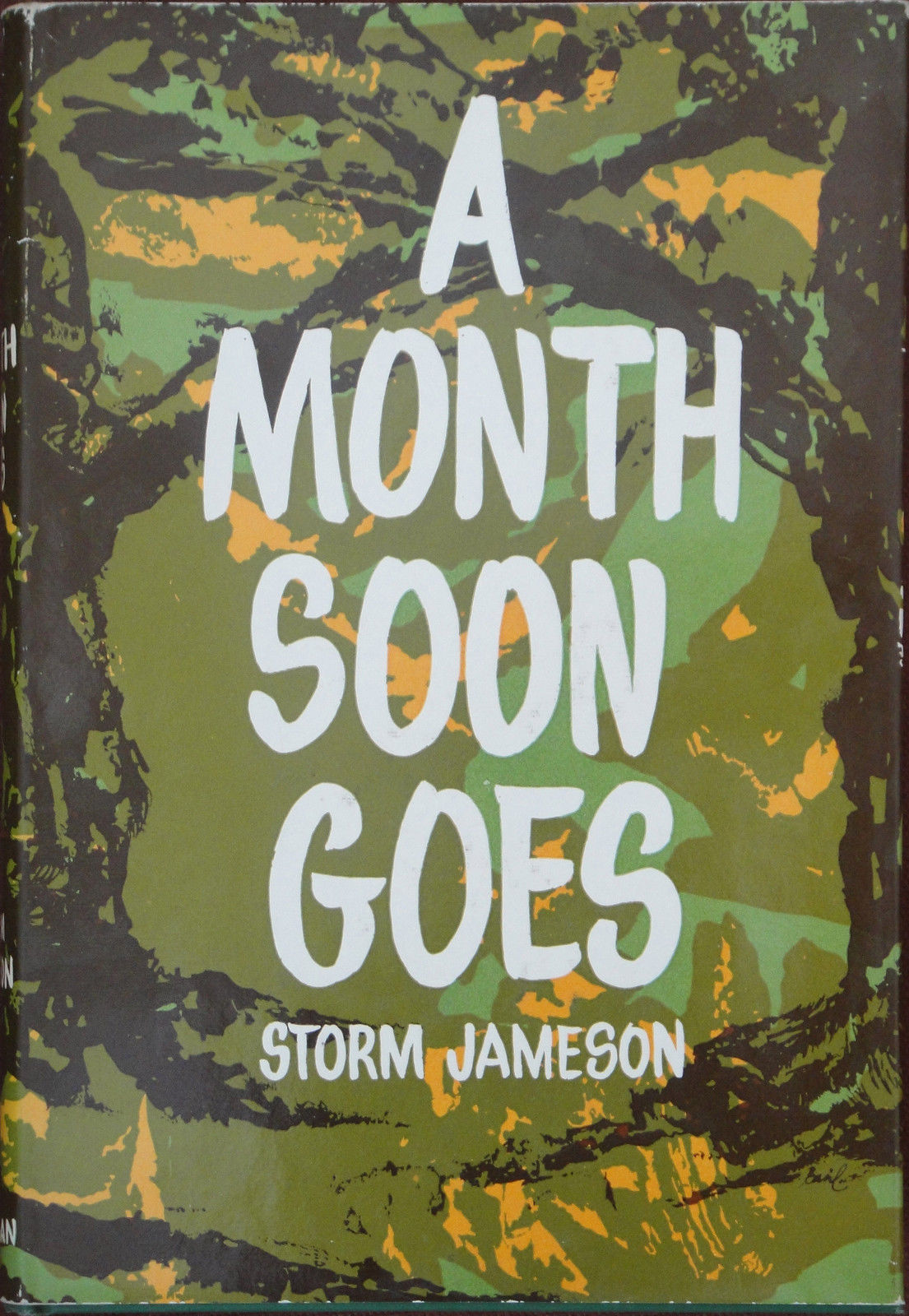
This is is the first book in my informal project to read as many postwar British women writers as I can, particularly ones that appear to have been forgotten. Storm Jameson was prolific and successful, writing around sixty books between 1919 and 1976 – fiction, criticism, biography and history. None of her books appear to be in print now. At least two of her novels, In the Second Year (1936), set in a fascist Britain, and Then We Shall Hear Singing (1942), about a Nazi invasion of an invented country, qualify as science fiction although I’m not aware of them being claimed by the genre. A Month Soon Goes (1962), however, is pure mainstream and, I believe, fairly typical of her oeuvre – though, of course, I will have to read more to say for certain.
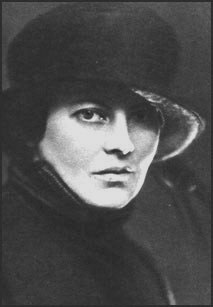
Storm Jameson
Sarah Faulkner is a celebrated diseuse – ie, a female artiste who entertains with spoken monologues – famous on both sides of the Atlantic. Her husband, Edward, is around twenty years older than her, so close to seventy when the novel opens. He lives in a ramshackle manor near the village of Callisfont, which is where Angry Young Man playwright Mark Smith is trying to write a follow-up to his successful debut. He chose the village because his grandmother was born there. Mark meets Edward, and is invited up to Callisfont House for dinner the following day. There, he meets Edward’s daughter, Harriet, who has just turned eighteen, Edward’s secretary, Medbourne, and a close friend of the family, the writer Arnold Hudson, who has not had a novel published in eight years. Mark holds all these in contempt – except Harriet, whom he considers little more than a child – but he becomes a frequent visitor to the manor, not just because the food is better than at the village inn but also because he gets on quite well with Edward. Mark’s complaints also sound somewhat familiar:
“Certain things are better. But nothing is changed. There are still nauseatingly rich people and poor people; power is still in a few hands, class is still a stumbling block, education crazily unequal, social equality a myth.” (p 13)
And then Sarah Faulkner turns up.
She has returned home after four years of touring, and it’s made clear she has been an absentee wife and mother for pretty much her entire adult life. She’s also been having an on-and-off affair with Arnold – and many other men. She brings two staff with her, a masseuse and a personal assistant. Sarah is quite a creation: charismatic, gloriously selfish, and completely aware of the power she has over people and unafraid to use it. She immediately begins making promises to Harriet, which she then later blithely goes back on – eventually deciding Harriet should be married off to a neighbour, a bluff and somewhat dim-witted member of the landed gentry in his forties. Harriet, of course, doesn’t want this. It is soon revealed that Sarah’s visit home has been prompted by her finances – she is notoriously bad at keeping the fortune her act earns her, and wants Edward to sell of a piece off his land to a developer. He refuses to do so. Meanwhile, Mark finds her compelling, Arnold comes to the conclusion he has been used, much like every man in Sarah’s life, and Harriet tries to get either her mother or Mark to take her away from Callisfont…
And then Edward dies in his sleep.
A Month Soon Goes is definitely the product of a writer with years, if not decades, of career behind them. The prose is polished to a fine gloss, the characters are drawn sharply, and the setting is equally well mapped out. The book does feel most like, however, a BBC Play for Today from the 1960s and 1970s, where every line of dialogue is a barbed insult or a put-down. Though it is set in 1958 – May and June 1958, to be precise, as the jacket copy states – a lot of the commentary still holds true today. Not just Mark’s complaint, mentioned above, of the corruption of the rich and entitled (the complicity of our political masters with corporation seems to be a twenty-first century development; but then the multinationals are the new aristocratic houses), but also some of Sarah’s comments on the role of women in society. While she recognises her lifestyle would be considerably more acceptable had she been a man, she’s also quite hypocritical and happy to marry Harriet off to a local squire (and only so she no longer has to take responsibility for her daughter). But then Sarah’s selfishness really is quite astonishing – she only gets away with because she’s so charming. Jameson, incidentally, doesn’t have to tell us this, it’s there in the way Sarah talks and behaves.
I wasn’t entirely sure what to expect when I started A Month Soon Goes. Something like Olivia Manning or Elizabeth Taylor, I thought. If this novel is any indication, then yes, Jameson is indeed a similar writer… although perhaps a tad more commercial than them. I certainly plan to read more Jameson – in fact, I’ve already ordered a copy of The Road from the Monument, also published in 1962, from eBay. Well, it was only 99p for a first edition…
And 2014 continues to be the year of the films and I continue to get my money’s worth out of Amazon film rentals. Seriously, would you find the movies I’ve been watching on Netflix? I think not. Annoyingly, this month I discovered that my “region-free” Blu-ray player isn’t actually region-free – well, not for Blu-ray discs, only for DVDs. And apparently unlocking them is a lot more difficult than it is for DVDs. So it looks like I’ll have to buy myself a new properly region-free Blu-ray player… But on with this instalment of films seen…
Again, films from 1001 Movies You Must See Before You Die are asterisked, although I’ve since found a rival list which actually has more films on it I’ve seen and which I think belong on such a list. And I’ve just checked the list the above links to, which is where I got the list I’m using from in the first place – and the bastards keep on changing it. They’ve added more 2013 films – and so must have dropped others to make room for them. So how exactly are you supposed to see all the films on the list if they keep on changing it? Argh.
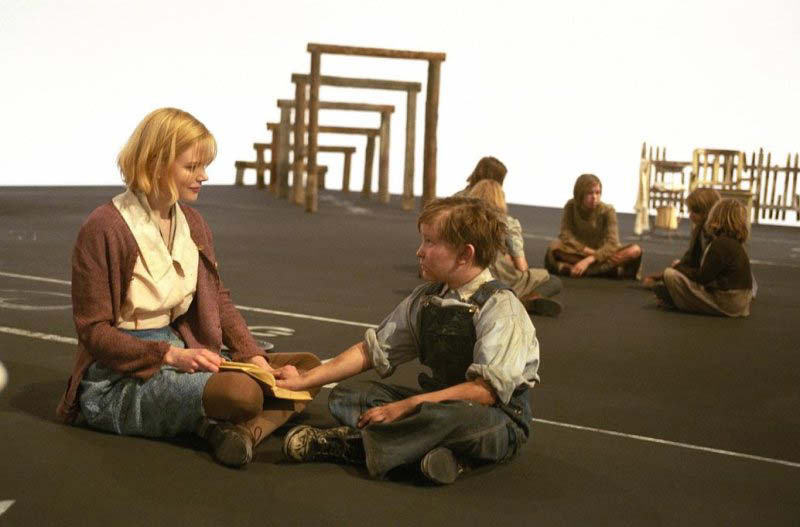
Dogville, Lars von Trier (20036, Denmark) Notable chiefly for being the film in which von Trier used black box theatre staging – ie, no scenery, just chalk lines with labels, and only a handful of props. Nicole Kidman plays the girlfriend of a mobster who runs away, seeks sanctuary in the titular small mountain town, where she performs everyday task as payment for sanctuary. But the tasks get more and more onerous, until she’s treated like a slave and then actually assaulted. I enjoyed the film up until the point where the violence started and Kidman was abused. It seemed… unnecessary. Von Trier had already made his point.
Whisky Galore!*, Alexander Mackendrick (1949, UK). This was based on a novel by Compton MacKenzie, who also wrote the screenplay, which was in turn based upon a real incident. In 1941, the SS Politician was wrecked off the coast of the Outer Hebridean island of Erisday, and the islanders looted it of its cargo of whiskey. In the film, the SS Politican becomes the SS Cabinet Minister, and Eriskay becomes Todday. There are a couple of sub-plots, including a romance, but the bulk of the film is concerned with the battle of wits between the islanders and the authorities over the missing whiskey. Mildly amusing. There is apparently a sequel, Rockets Galore! (1957), which sounds much more kind of thing (but at £145 for the DVD, I’ll not be buying it any time soon…).
The Blair Witch Project*, Daniel Myrick & Eduardo Sánchez (1999, USA) I’d managed to avoid seeing this for fifteen years, and would happily have done so for another fifteen… if it hadn’t been on the 1001 Films list and if I hadn’t found a copy for £1 in a charity shop. But at least I can now say I’ve seen it. The found footage concept might well have been fresh and exciting back in 1999, but it’s been used, if not over-used, so much since that you end up treating the film as if it were filmed normally. And in that regard The Blair Witch Project does not score well. It is mostly dull, the scares are driven chiefly by the reaction of the cast rather than the situation they’re in, and the ending falls completely flat. There were apparently nine million sequels, but I shall not be bothering with them.
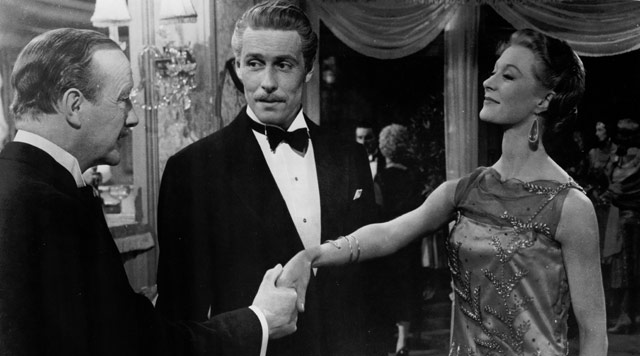
The Man Who Loved Redheads, Harold French (1955, UK) This popped up on one of those “people who bought this also bought…” things when I was buying a DVD and it was very cheap and looked mildly interesting, so I bunged it on my order… It’s based on a Terrence Rattigan play and is very silly for much of its length, but there’s a surprising and quite interesting twist at the end. A man spends his entire life seeking a lost love – a young woman he met as a teenager – and encounters women who look like her at various points in his life, all played by Moira Shearer. It’s all very terribly terribly – he’s in the Civil Service and a baronet or something – although one of Shearer’s incarnations is a shop girl and it’s played smartly.
The Gleaners and I*, Agnès Varda (2000, France), is one of those documentaries where the film-maker slowly inserts herself into the subject being filmed. It begins by studying people who hunt for edible vegetables among those rejected by farmers, such as potatoes that are too small, or too oddly-shaped to sell to their corporate masters… but it soon moves on to film homeless people in and around French cities. And as Varda involves herself with these people, so she begins to sympathise with them and their attitudes. I had not expected to like this, but I thought it really good. I think I’d like to see more films made by Varda.
The Great White Silence*, Herbert G Ponting (1924, UK) Scott took Ponting with him on his ill-fated expedition to the South Pole in 1910 as the expedition’s photographer, and this documentary was put together from the footage Ponting shot with a cinematograph. There is straight footage of Scott and his fellows as they leave New Zealand and sail to Antarctica, set up camp, and explore the surroundings. The footage of Scott’s fatal attempt on the pole itself is done using stand-ins as Ponting remained at the main camp with the rest of the expedition. There is also some quite effective model work. The whole is a fascinating, and quite affecting, record of Scott’s expedition. Apparently, it was not a commercial success at the time and Ponting died a pauper, but it has been subsequently re-evaluated and has taken its place as one of the great documentaries of all time. Recommended.
Wadjda, Haifaa al-Mansour (2012, Saudi Arabia) Not only is this the first film made in Saudi Arabia to be entered for international competition, but it was also written and directed by a woman, a Saudi national woman. That’s quite an achievement. The story, about a girl who rebels against societal expectations by demanding a bicycle, is perhaps nothing new but it’s handled well, the cast are uniformly good – especially Waad Mohammed in the title role – and it makes some pointed observations about Saudi society (so much so, in fact, I’m a little surprised the Saudi authorities allowed it – they’re not exactly known for their liberal tendencies).
Star Trek Voyager – Season 1 (1995) Having worked my way through all seven seasons of Star Trek: The Next Generation and Star Trek: Deep Space Nine, it was more or less inevitable I’d eventually find myself doing the same for Star Trek: Voyager. Initially, DS9 was considered the best of the franchises, but it seems time has been kinder to Voyager than it has to the other two. While Voyager’s set-up was just a reboot of the original Star Trek series, and its central casting all come out of, er, Central Casting, with their “back-stories” and “character conflicts”… But it actually hangs together quite well, and the format does give the series a lot more freedom in terms of story-of-the-week. But, of course, this is 1990s television drama, so there has to be at least one story arc… And Voyager falls back on the Trek staple of the omniscient aliens who, well, they’re only omniscient as far as the plot dictates, and then they’re not. Still, you don’t watch Trek for rigour, scientific or dramatic. Actually, I’m not sure what you do watch it for…
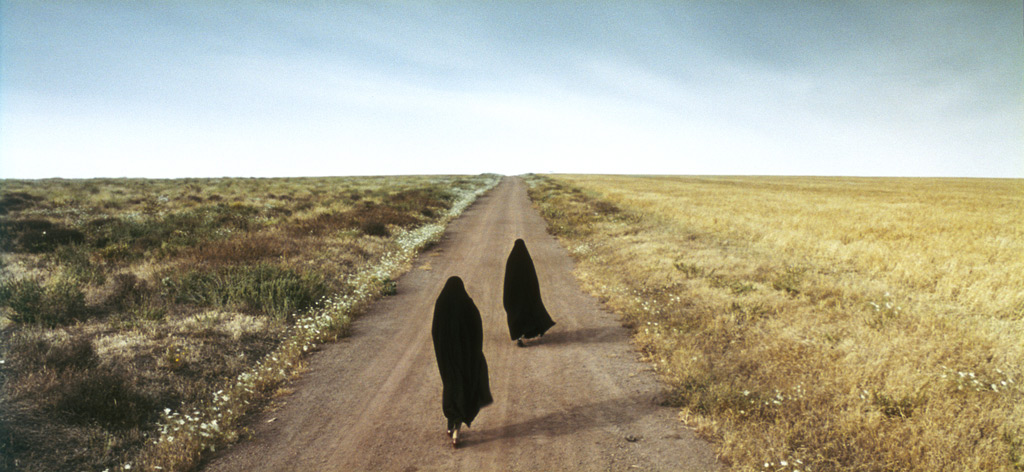
Women Without Men, Shirin Neshat & Shoja Azari (2009, Iran), is set in Iran but was actually filmed in Morocco, as director Shirin Neshat has been banned from visiting Iran since 1996. It takes place in 1953, during the US-led coup which put the shah back in power – which the Americans engineered because prime minister Mosaddegh has nationalised the Iranian oil industry. The film follows four women during this period, a prostitute, the wife of a general (ie, part of the secular elite), and an unmarried woman and her religious friend. It’s been likened to Haneke’s The White Ribbon, but I can’t see it myself. Yes, Women Without Men is an excellent film, although a recurring image of the women walking along a road in the open country seems more The Discreet Charm of Bourgeoisie than it does Haneke to me.
Suspiria*, Dario Argento (1977, Italy) I am not much of an Argento fan, I prefer Brava – though I’ve only seen a small handful of movies by either director. On the strength of this film, I see little reason to change my mind. It has its moments, and the mise en scène is… interesting, all Dutch angles and saturated colours and ersatz Expressionist set designs. A young woman joins a strange ballet school, but it appears to be haunted and lots of strange events occur, including a rain of maggots while the pupils are readying themselves for bed, a few gruesome deaths, and the frequent appearances of a mysterious heavy-breather. It was a fun film, but I’m a bit baffled as why it should be on the 1001 films list.
Festen*, Thomas Vinterberg (1998, Denmark). This is not a film to watch if you’re feeling misanthropic. A large and affluent Danish film gather at the country hotel they own to celebrate the sixtieth birthday of the patriarch. During the celebratory dinner, one of the sons accuses his father of sexually abusing him as a child, and of abusing his twin sister – who has committed suicide in the hotel shortly before the celebration. The family try to laugh off the son’s accusation, but as the weekend progresses the family begins to fall apart. This was the first film made according to the Dogme 95 rules, so it’s made entirely with hand-held cameras and natural lighting, which gives the picture a somewhat grainy look throughout. An excellent film.
Sweet Sweetback’s Baadasssss Song*, Melvin van Peebles (1971, USA) I may have an incorrect number of s’s in the title of this film, but I’m pretty sure I’ve got the right number of a’s. A young African American, Sweet Sweetback, working in a brothel is “volunteered” to be arrested as a suspect in a murder – they know he’s innocent, but the police need to arrest someone to appease the community, and plan to release Sweet a few days later for “lack of evidence”. But the police also arrest a Black Panther, who the police beat up, but he’s defended by Sweet and the two manage to escape. Sweet goes on the run, heading for Mexico, and en route has several adventures, including a run-in with a gang of Hells Angels. There’s a definite amateur feel to the film, but the use of montage was done extremely well – and not something you saw in films of that period.
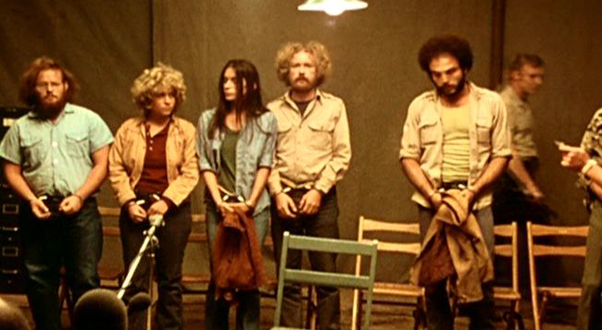
Punishment Park, Peter Watkins (1971, USA) Watkins is a documentary maker, and while Punishment Park is both fictional and more than forty years old, it could easily be a documentary of twenty-first century USA. Hippies, draft-dodgers and other political undesirables are taken out into the desert, charged and sentenced at a kangaroo court in a marquee tent, and then given a choice – a full sentence served in a federal prison, or three days in “punishment park”. This later requires them to cross 53 miles of California desert without food or water in three days, while being chased by armed police and National Guard. If they make it, they can go free. Despite, or perhaps because of, it’s faux-documentary presentation, this was a brutal film. A bit too talky in places, and some of the dialogue felt a little too… not staged, but not natural either, but the sort of dialogue where characters explain their thoughts and feelings and attempt to do the same for others – the sort of dialogue that only appears in fiction, in other words. Nonetheless, an excellent film, and was that really ought to be on the 1001 films list.
Man of Marble*, Andrzej Wajda (1976, Poland) I saw the sequel to this, Man of Iron, before I was aware of this film. But when Second Run – who I heartily recommend, they have released some amazing DVDs – released Man of Marble, I immediately bought a copy. I like Polish cinema, some of my favourite films are from Poland, and a number of directors I greatly admire are Polish… but Wajda was one I’d mostly missed out, for some unknown reason. I’m now rectifying that. The title of this film refers to a statue of a worker who became a national hero after breaking a record for laying the most bricks in a working day during the building of a new socialist town. A film student is making a documentary about him for her thesis two decades later, but what she discovers – that it was all created and managed as propaganda; and what prompted the hero’s later fall from grace – means it becomes increasingly difficult for her to make her film. Man of Marble follows both the film student and the brick-layer, swapping effortlessly between the two decades. Like Man of Iron, it felt like a television series edited into a single long episode, but with high production values; but that worked in its favour. I really liked this film. And I can’t disagree with its presence on the 1001 Films list.
Sometimes, when you’re working on a piece of fiction, and you’re wondering perhaps if this marvellous plan you have in your head and you’re trying to get down is a) achievable and b) not going to result in ridicule from all those who will read it… Sometimes, when you’re in that space, an artistic decision turns out to be just so right, you can’t help but feel it really is going to work after all. This has happened for all of the Apollo Quartet… and today I had my moment of serendipity for the fourth book, All That Outer Space Allows.
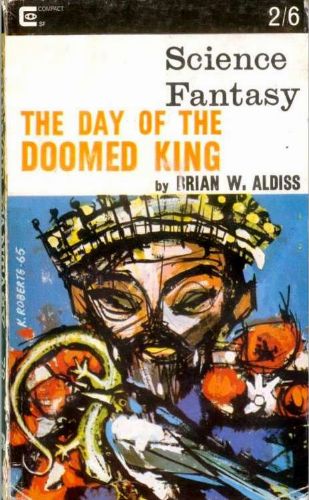
The protagonist of the story – it will be a short novel rather than a novella, around 50,000 to 60,000 words – is a science fiction writer, and she is married to a test pilot who is selected by NASA for the Apollo programme. For one scene, I needed the names of some women sf writers who had had stories published in 1965. One of the names I picked was Josephine Saxton – her debut, ‘The Wall’, appeared in the November 1965 issue of Science Fantasy. I wanted my protagonist to say something about the story after reading it, but I didn’t have a copy. Fortunately, it was collected in The Power of Time and I found a copy of the book on eBay. So I bought it…
The collection arrived the following day, I read ‘The Wall’… and discovered its central metaphor fitted in perfectly with the general shape of All That Outer Space Allows.
I love it when that happens.
On the other hand… I remember sitting in the Bijoux Bar in the Raddison Edwardian Hotel, Heathrow, the day after the launch of Adrift on the Sea of Rains, and describing to Maureen Kincaid Speller the plot of All That Outer Space Allows. Yes, even back in April 2012, I knew what it was about and what the title would be. But now I’m about a quarter of the way into writing it, and it’s shaping up somewhat differently to that original plan. For a start, it’s proving to more about science fiction, and the history of science fiction, than I had intended. It’s also going to be more of a work of imagination than the preceding three books, chiefly because I can find no direct documentation I can use to help me evoke the time and place. For example, I can tell you the average temperature on 1 April 1966 in Lancaster, California, was 66.8°F, but I’ve found only a handful of photos online of the city taken during that year. And, of course, astronauts wives are not as well documented as the astronauts themselves. I’m having to do my research by reading between the lines…
Yet more moving pictures watched by Yours Truly. The plan to watch those 1001 films before I die continues apace, although perhaps if the title of the list is to be believed I should slow down a bit… Nah. Once I’m done, I’ll just set about making a list of my own, or find another list – 1001 East European Films To See Before You Die, or something… (Incidentally, I’ve marked films from the 1001 films list with an asterisk.)
Silk Stockings, Rouben Mamoulian (1957, USA) Another Fred Astaire / Cyd Charisse musical, with a plot taken from an earlier film starring Greta Garbo, Ninotchka (1939) – yes, the “Garbo laughs!” film – about a Soviet envoy sent to Paris to bring back three missing attachés, only to be seduced by the decadent West herself – not its political freedoms, I hasten to add, but its lingerie. It’s all very silly, Charisse’s accent is not even remotely convincing, and most of the songs are forgettable. The three attachés are mildly amusing – especially Peter Lorre – but then they are played as clowns. Even as a Charisse/Astaire vehicle, this film fails on many levels. It’s as fluffy as candy floss and that’s what it’ll turn your brain into when you watch it.
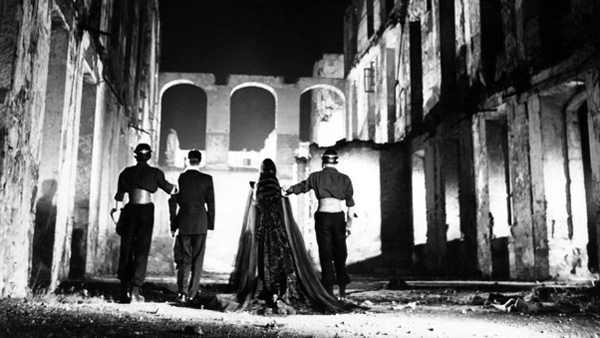
Orphée*, Jean Cocteau (1950, France) Cocteau’s re-working of the Orpheus myth works amazingly well, although it starts off somewhat dubiously, with rive gauche types in the Café des Poètes being all beatnik and full of themselves. But once the viewpoint settles on Orphée and follows him, with the princess, to the ruined chateau, and then the following morning back to his home and wife, Eurydice, the film starts to pick up… and pretty soon it turns fascinating. Some of Cocteau’s optical tricks are a bit feeble, even for 1950, but they’re effective all the same. I’d like to watch the other two films in the trilogy now, please.
Starship Troopers: Invasion, Shinji Aramaki (2012, Japan) I still think Verhoeven’s film was a superb treatment of Heinlein’s novel, and while the second Starship Troopers film was dull, the third at least made an effort at satire – it was, admittedly, cheesy as hell, and pretty ham-fisted, but in a good way. However, most people it seems only care about power armour and killing bugs, and think life is like the Vietnam War which was of course cool. They are stupid people, and this is a film made for them. It’s an all-CGI follow-on that uses the same characters and production design as Verhoeven’s masterpiece but has all the subtlety and intelligence of a FPS. It even includes a gratuitous female nude scene. In a CGI film. This is Starship Troopers for spotty oicks who really need to get out of their basements every once in a while.
Meet Me In St Louis*, Vincente Minnelli (1944, USA) Given that this film is set in St Louis, and all the characters are resident in the city, you have to wonder about the title. Teenager Judy Garland’s family is set to move to New York, but she fancies the boy next-door… so they sing a bit, the other kids get into a few scrapes, and eventually papa sees the errors of his ways and they all stay in St Louis. Yawn.
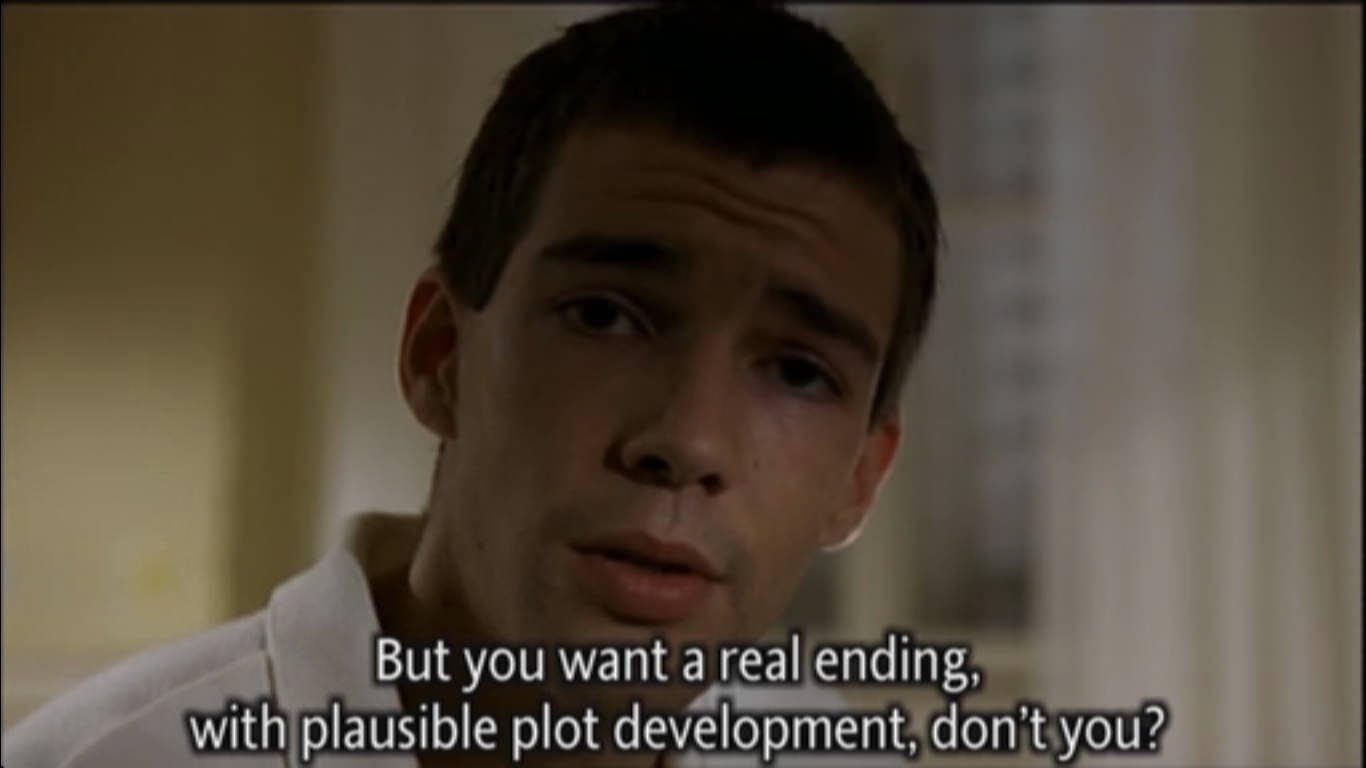
Funny Games, Michael Haneke (1997, Austria) I’ve had this for a while, and had tried watching it last year but had given up halfway through. Not because it was bad, but because it was too uncomfortable. I finally got around to giving it another go and managed to make it all the way through to the end – and it was still really uncomfortable. Mostly it’s the motive-less violence. The two young men who invade the family home are creepy, and their smug condescension only makes their violence even more unsettling. On the other hand, the moments when the film breaks the fourth wall are genius – although I remain ambivalent about the remote control rewind bit, as it seems a bit too much. Finally, if you’ve not watched any Haneke, why not?
47 Ronin, Carl Rinsch (2013, USA) Keanu Reeves in a CGI-heavy treatment of a story that’s so popular in Japan it is its own genre, Chūshingura. Reeves plays a half-Japanese, half-English man, who is treated like a lowly servant, but secretly happens to be a master swordsman. Or something. Apparently the film lost $152 million, making it second only to The 13th Warrior as the most expensive box office bomb ever. That takes real talent with such a well-known story, but I suspect Reeves’ presence helped.
Cat People*, Jacques Tourneur (1942, USA) I have no idea how this film ever got made – I mean, with an elevator pitch that goes “a woman thinks she’s descended from a race of people who turn into cats when sexually aroused”, it’s hard to imagine any producer, even back in 1942, greenlighting the movie. But then things were different back then – Cat People was written and produced by Val Lewton, who ran RKO’s horror unit, and he was given free rein providing the films did not exceed $150,000 each to make, and didn’t run longer than 75 minutes. Lewton’s supervisors, however, provided the films’ titles. I can’t actually remember much of the plot of the movie, although it’s considered a classic of its type.
Cave Of Forgotten Dreams*, Werner Herzog (2010, Canada/UK) Herzog’s documentaries are as odd as his fictional movies, but he has a real talent for picking fascinating topics. And so he does here: Chauvet Cave in France, site of the oldest cave-paintings so far discovered, some of them dating back 32,000 years. Admittedly, the film was doubly fascinating as I’d just finished reading Kim Stanley Robinson’s Shaman, which was itself inspired by the paintings in Chauvet Cave. And now that I’ve seen it, I want to get the Blu-Ray version.
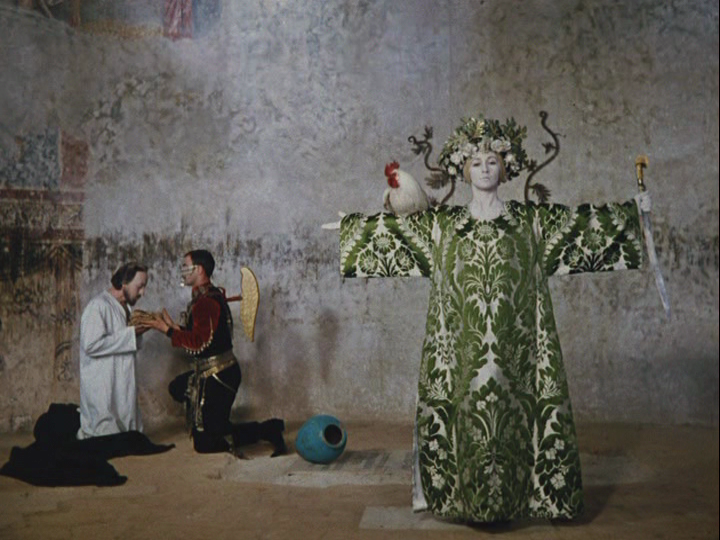
The Colour of Pomegranates, Sergei Parajanov (1968, USSR) This was a rewatch, and while the film is an astonishing spectacle, I still have no idea what it’s about. I’m also surprised it’s not on the list of 1001 films. Nominally about the life of eighteenth-century Armenian poet Sayat Nova, the film comprises a series of tableaux intended to represent episodes from his life (although Sayat Nova is actually played by a woman, Sofiko Chiaureli, who played a further five parts in the film). The Colour of Pomegranates is impossible to describe, you really have to watch it. After watching it for the first time, I bought the other three films by Parajanov available on DVD in the UK – Shadows Of Forgotten Ancestors, Ashik Kerib and The Legend of the Surami Fortress – but he made several more and they really ought to be made available too.
Nashville*, Robert Altman (1975, USA) I’ve never much of an Altman fan, perhaps because I came to cinema after the elements which made his films stand out had become commonplace, such as over-lapping dialogue, semi-improvisation and multiple narratives. The film follows the lives of various musicians in the titular town, most of which have somewhat clichéd story-arcs. Apparently, the actors all wrote their own songs, which probably explains why they’re so bloody terrible. I mean, I’m not a fan of country and western, but the music throughout Nashville is really bad. I’m puzzled why this film should make the 1001 films list but The Colour of Pomegranates doesn’t – in fact, Nashville is one of six Altman films on the list, so I guess the list-maker was a fan… although they don’t appear to be that much of a cineaste…
One type of fiction I enjoy reading as much as science fiction is British post-war literary fiction, but most of the authors of this type I know are male – Lawrence Durrell, Paul Scott, Malcolm Lowry, Angus Wilson, Kingsley Amis, etc. The only two women writers which fit my somewhat arbitrary definition of “post-war” – ie, started sometime in the 1930s or 1940s, active until the 1950s or 1960s – whose books I keep an eye open for are Olivia Manning and Elizabeth Taylor. (Although there are a few women writers who started writing later that I’ve read, such as Muriel Spark, Iris Murdoch and Bernice Rubens.)
Recently I decided it was time to remedy my ignorance of women writers of this period and, with the help of a few people on Facebook and Twitter, I put together a list of seventeen female authors who had books published between 1925 and 1969 (and one or two earlier than that). Two of the authors I’d heard of before – Stella Gibbons’ Cold Comfort Farm is a well-known novel, and I’ve seen the film adaptation; and I have the Women’s Press paperback of Naomi Mitchison’s Memoirs of a Spacewoman (but I was astonished while researching this list to learn how many books she’d had published). The remaining names were completely unknown to me. And, I hasten to add, my list is undoubtedly incomplete, even given that I excluded some writers because they weren’t published after WWII, or because they published exclusively in genre, either science fiction, fantasy or crime.
The plan is to read something by each of these writers – it’s unfair to describe them as “forgotten”, as several still have books in print, either as Penguin Modern Classics, Vintage Classics, Virago Classics, or even by small presses such as Persephone Books. A few, however, will require some patient hunting on eBay and ABEBooks. If I like what I read, I may well consider those writers alongside Manning and Taylor as ones whose oeuvres I plan to work my way through.
Elizabeth Bowen (1899 – 1973)
Born in Ireland, but married an Englishman – although the marriage was reportedly never consummated (but she did have numerous affairs). Her first book, The Hotel, was published in 1927, and her last, Eva Trout, in 1968. She wrote ten novels, a children’s book, and twelve short story collections. Many of her books are still available as Penguin or Vintage Classics. Eva Trout was shortlisted for the 1970 Booker Prize, but lost out to Bernice Rubens’ The Elected Member.
Lettice Cooper (1897 – 1994)
Grew up in Leeds, where she briefly worked for her family’s engineering firm, but she spent most of her adult life in London. I’m not entirely sure how many books she wrote – Wikipedia only gives a “Selected Works” listing a dozen books, beginning with her first, The Lighted Room (1925). She never married, was the book reviewer for the Yorkshire Post between 1947 and 1957, and was awarded an OBE in 1978 for her work as leader of the campaign to secure Public Lending Rights.
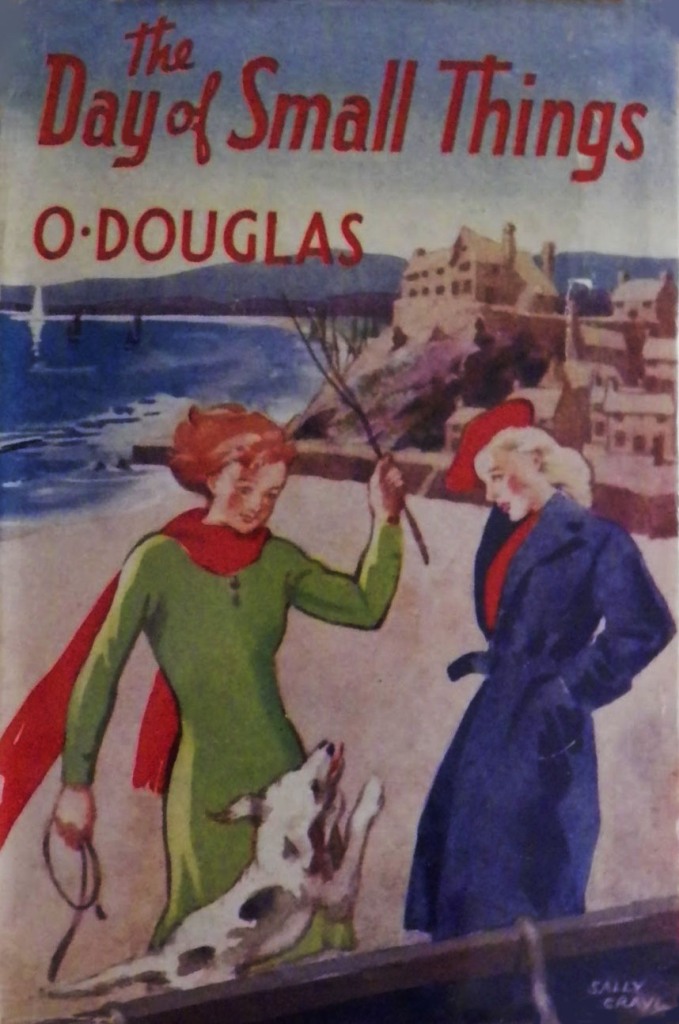
O Douglas (1877 – 1948)
The pen-name of a Scottish novelist, Anna Masterton Buchan, the younger sister of author John Buchan. Her first novel, Olivia in India was published in 1912, and her last, The House that is Our Own in 1940. She also wrote a dozen other novels, a memoir of her brother, and an autobiography. Her novels were mostly set between the wars in small Scottish towns and villages.
Susan Ertz (1894 – 1985)
Born in the UK to American parents, and spent much of her life shuttling between the two countries. She wrote twenty novels and two short story collections, beginning in 1923 with Madame Claire. Her last book was The Philosopher’s Daughter in 1976. Her novels are allegedly “sentimental tales of genteel life in the country” (according to Wikipedia). One, In The Cool of the Day (1960), was made into a film, starring Jane Fonda, Peter Finch and Angela Lansbury.
Pamela Frankau (1908 – 1967)
Born in London, the daughter of novelist Gilbert Frankau, she was extremely prolific, writing thirty-seven books between 1927 and 1968 (the last was published posthumously). Her novel, The Bridge (1957), which I’ve bought, has the following on the cover-flap: “The bridge spans the distance between this world and the next. A writer called David Nielson walks across the bridge, after the moment of his death. On the way, he meets his past selves, from the child he was, to the man who died in middle-age. He re-lives with each of them, a high moment in his life, a moment of adventure, sin and tragedy, unresolved then, awaiting his judgment now.”
Stella Gibbons (1902 – 1989)
Best-known for her first novel, Cold Comfort Farm (1932), she wrote a further twenty-three novels, three collections of short stories, a children’s book and four poetry collections. Her last novel, The Woods in Winter, was published in 1970.
Storm Jameson (1891 – 1986)
Born in Yorkshire, she moved to London and lived there for the rest of her life. She was married to the writer Guy Chapman, and wrote two sf novels: In the Second Year (1936), set in a fascist Britain, and Then We Shall Hear Singing (1942), about a Nazi invasion of an invented country (I’m not aware of these books being claimed by science fiction; perhaps they should be). She also wrote a couple of books under pseudonyms – two as James Hill and one as William Lamb. I have A Month Soon Goes (1962), which is “a light comedy with a chorus … Sarah Faulkner, celebrated diseuse, who has come home to rest after four years of touring in Europe and America…”
Rosamond Lehmann (1901 – 1990)
The daughter of the man who founded Granta magazine, her first novel, Dusty Answer (1927), apparently caused a bit of a stir with its frank depictions of schoolgirl sexuality. Two of her novels were made into movies, The Echoing Grove (1953) and The Weather In The Streets (1936). The latter novel sounds especially interesting – according to Wikipedia: “Stylistically, the novel uses techniques and forms that were pioneered by modernist writers such as Virginia Woolf and James Joyce, with a fragmented narrative style building up a complex interiority that helps us to explore subjects that were relatively taboo during the 1930s such as female sexuality”.
Naomi Mitchison (1897 – 1999)
Born in Edinburgh, and originally a scientist like her elder brother JBS Haldane, but with the outbreak of WWI she turned to nursing. She wrote over 90 books, and was made a life peer in 1964 with her husband, Labour MP Gilbert Richard Mitchison. Her novel Memoirs of a Spacewoman (1962) was in the Women’s Press sf series, and her The Corn King and Spring Queen (1931) is seen by many as the best historical novel of the twentieth century.
E Arnot Robertson (1903 – 1961)
The pen-name of Eileen Arbuthnot Turner (née Robertson). A journalist and film critic, she wrote eleven novels, beginning with Cullum in 1928 and ending with The Strangers on My Roof, published posthumously in 1964. She was known as a popular “middlebrow” novelist, and one of her early novels was adapted into a movie by Cecil D BeMille.
GB Stern (1890 – 1973)
Gladys Bronwyn Stern wrote around forty novels, several books of literary criticism, half a dozen plays and ten autobiographies. Like many of the women in this list, she lived in London for much of her life. The National Portrait Gallery holds four portraits of her, and her novel The Ugly Dachshund (1938) was made into a film of the same name by Disney in 1966.
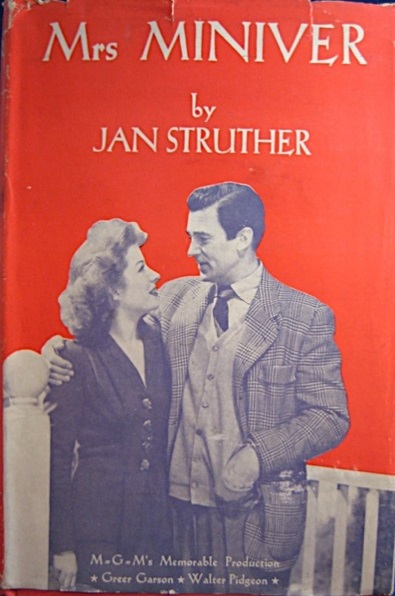
Jan Struther (1901 – 1953)
The pen-name of Joyce Anstruther, best-known for her character Mrs Miniver, who first appeared in a series of columns in The Times in 1937, were collected into book form in 1939, and made into an Oscar-winning film starring Greer Garson and Walter Pidgeon in 1942. She also wrote a number of hymns. In the 1940s, Struther moved to the US, where she remained until her death.
Hilda Vaughan (1892 – 1985)
A Welsh writer who began writing in 1925 with The Battle to the Weak and whose last novel was The Candle and the Light in 1954. She was married to the writer Charles Langbridge Morgan. Due to ill-health, she did not write anything for the last two decades of her life, although she did try to get her earlier novels re-issued – unsuccessfully. Many of her books are now back in print as she is considered a prominent writer of Welsh literature in English.
Rebecca West (1892 – 1983)
Born Cicely Isabel Fairfield, and described by Wikipedia as “widely considered to be among the important public intellectuals of the 20th century”, she wrote a dozen novels between 1918 and 2002 (her last two books were published posthumously). In 1947, Time described her as “indisputably the world’s number one woman writer”. She also wrote a lot of non-fiction, and was an active feminist and liberal. She was made a CBE in 1949 and then a dame in 1959 for contributions to British literature.
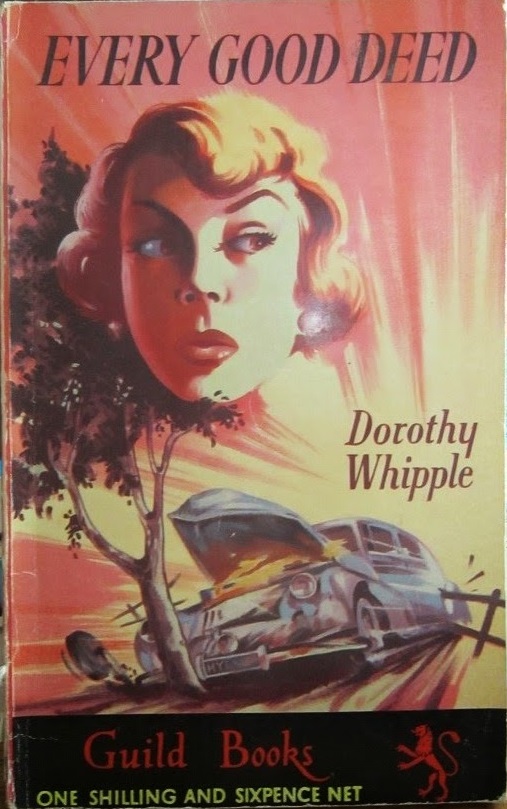
Dorothy Whipple (1893 – 1966)
A Lancashire-born and -based writer of some eighteen books and described by JB Priestley as the “Jane Austen of the 20th Century”. She was very popular in the 1930s, and two of her novels were made into films. Five of her short stories were recently broadcast on Radio 4 in The Afternoon Reading.
Antonia White (1899 – 1980)
Born Eirine Botting, she wrote a dozen books. She seems to have had a somewhat tempestuous personal life, having been married three times by the time she reached thirty, and spending a year in a public asylum. She was expelled from school at age fifteen for writing a novel, which she planned to give to her father, and which apparently featured characters indulging in bad behaviour. She did not write again until after her father’s death in 1924.
EH Young (1880 – 1949)
Emily Hilda Young wrote eleven novels between 1910 and 1947, and a pair of children’s books. In 1980, the BBC broadcast a television adaptation of some of her novels, chiefly Miss Mole (1930), under the title Hannah. Originally from Northumberland, she moved to London after the death of her husband at the Third Battle of Ypres, and moved in with her lover and his wife. She was a best-selling novelist in the 1920s and 1930s.
This will be, I think, a long-running project. I’ve already bought a couple of books on eBay – first editions, too, because first edition. And they proved cheaper than brand-new paperback editions from Amazon. I’ll also be keeping an eye open in charity shops. I’ll initially try one book by each writer, and see how that goes.
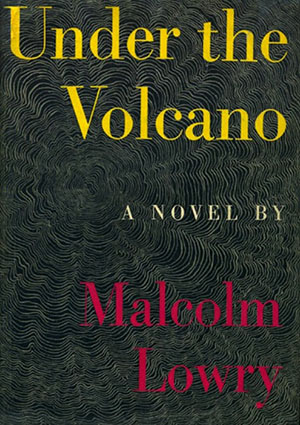
I fell in love with Malcolm Lowry’s fiction after reading the novella ‘Through the Panama’ in his collection Hear Us O Lord from Heaven Thy Dwelling Place (1961). While I’d been aware of his Under the Volcano (1947), a novel generally acknowledged to be a classic of twentieth century English-language literature, number 11 in the Modern Library 100 Best Novels in fact (ignore the readers’ list: only blatant ballot-stuffing or rank stupidity could put four books by Ayn Rand and three by L Ron Hubbard in the top ten), I had never actually read anything by him. But my father had three of his books – the aforementioned pair and Lowry’s debut, Ultramarine (1933); the two novels are in fact the only books Lowry saw published during his lifetime – and I took them for myself as I fancied giving them a try…
And now I have everything he wrote – a lot of which was published posthumously – some of it even in first edition (but not Under the Volcano, since first editions of it cost around £800).
But. ‘Through the Panama’, which first appeared in Paris Review in Spring 1960 – it’s unlikely Malcolm Lowry, who died in 1957, submitted it himself; it was more probably his wife, Margerie Bonner Lowry – features Malcolm Lowry’s fictional alter-ego Sigbjørn Wilderness, and is a complex mix of fiction, autobiography and meta-fiction. It’s an astonishing piece of work but, as I soon discovered when I read Ultramarine, Under the Volcano and the posthumous Dark as the Grave Wherein My Friend is Laid (1968), it’s actually more like a concentrated form of Malcolm Lowry’s approach to writing. Ultramarine was based on his experiences aboard a tramp freighter, aboard which he spent five months at age eighteen before starting at Cambridge University. Some of his experiences which appeared in Ultramarine also make an appearance – off-stage – in Under the Volcano, although reading the prior book is by no means a requirement for reading Under the Volcano.
But it’s in Dark as the Grave Wherein My Friend is Laid where really interesting things start to happen… You’ll have to bear with me for a bit as this is somewhat complicated… Malcolm Lowry started work on Under the Volcano while staying in Mexico in 1936, and finished it two years later. He left Mexico for Los Angeles, where he met his second wife, Margerie; and then spent the next eight years editing and rewriting the novel. It’s set in the Mexican town of Quauhnahuac, and covers the events of single day in the life of the Consul, Geoffrey Firmin, an alcoholic, whose divorced wife has just returned to him. In 1945, Malcolm and Margerie Lowry returned to Mexico (a return for him, anyway), and settled in the town of Cuernavaca. During this time, Under the Volcano was under consideration with a British publisher, and Malcolm was worried it might be seen as too similar to Charles Jackson’s 1944 novel, The Lost Weekend, the film adaptation of which, starring Ray Milland and Jane Wyman, and directed Billy Wilder, was proving a hit in the cinemas as Malcolm and Margerie travelled south from their home in Canada. The trip to Mexico proved successful both personally and professional – although Malcolm’s drinking did reach similar levels to those of his earlier visit to Mexico and those attributed to the Consul in Under the Volcano… However, while in Cuernavaca, Malcolm heard back from Jonathan Cape, who asked for substantial changes to be made to Under the Volcano before they would publish it… but Malcolm successfully defended his novel with a long and detailed analysis of it. Malcolm also took copious notes throughout the Mexico trip and, once back in Canada, he realised these were effectively a novel. So he set about turning them into one, and he worked on it on-and-off, until his death in 1957. The book was eventually edited by Margerie and published in 1968 as Dark as the Grave Wherein My Friend is Laid.
In Dark as the Grave Wherein My Friend is Laid, Sigbjørn Wilderness and his wife Primrose have returned to Mexico eight years after Sigbjørn left. He is awaiting news from a British publisher about his novel, The Valley of the Shadow of Death (which was actually the original title for Under the Volcano), and is worried that it might be rejected due to similarities to the novel and film Drunkard’s Rigadoon. The couple travel from Mexico City to Cuernavaca, which Sigbjørn now discovers has chosen to publicise that its name in Nahuatl is Cuauhnahuac, a fact he’d eight years previously taken great pains to uncover and had thought would “disguise” the setting of his novel. While in Cuernavaca, Sigbjørn explains the town’s relationship to the setting of The Valley of the Shadow of Death to his wife – she is familiar with the story as she typed up the manuscript – and begins drinking heavily, much like Geoffrey Firmin in Under the Volcano.
So what we have is Malcolm Lowry writing a novel in which he appears as Sigbjørn Wilderness, who is the author of a book Malcolm Lowry himself wrote, which is set in the Mexican town which is the setting of both Under the Volcano and Sigbjørn’s The Valley of the Shadow of Death, and this novel Malcolm Lowry has written is based upon Malcolm Lowry’s own return visit to the town where he wrote, and in which he set, his most famous work, Under the Volcano. Sigbjørn and Primrose also visit some of the nearby towns and villages, such as Oaxaca, Tlaxcala and Yautepec, and each place is seen in light of Sigbjørn’s previous time in Mexico and his fictionalisation of it in The Valley of the Shadow of Death. The same is also true of the people they meet, and their relationship to the characters in The Valley of the Shadow of Death. Some two-thirds of the way into Dark as the Grave Wherein My Friend is Laid, Sigbjørn hears back form his publishers – they want him to make substantial changes. Primrose persuades him to stick to his guns and defend his novel, which he does.
“Your book is regarded here as having potential importance and integrity.” His heart leaped, he almost shouted out to Primrose, who was as excited as he and waiting for the verdict in the bedroom, but – at this point, another letter fell out. It was the reader’s report, and he seized upon it. “The author has overrreached himself. This book will naturally call to mind the recently successful novel and film Drunkard’s Rigadoon…” (p179)
Malcolm and Margerie Lowrie at their Calle Humboldt villa
Structurally, Dark as the Grave Wherein My Friend is Laid is not so adventurous – it’s a linear narrative, beginning as Sigbjørn and Primrose fly south across the United States, and ending with Sigbjørn finally laying to rest the ghost of The Valley of the Shadow of Death, or perhaps of its inspirations and writing, which has haunted him throughout this visit to Mexico. But it’s the melding of real-life and fiction which I find so fascinating about the book. Under the Volcano was at least, on the surface, a straightforward act of literary creativity. While its settings and cast may have been inspired by Malcolm Lowry’s own time in Mexico during its writing from 1936 to 1938, it was still first and foremost a novel. (Which is not to say that it’s not partly autobiographical, as Malcolm Lowry had certainly done that before in Ultramarine.) But in Dark as the Grave Wherein My Friend is Laid Malcolm Lowry has fictionalised the autobiographical elements of his fiction, folding what was real in the invented back into an invented perspective of the real. And that I find a very interesting thing to do. It allows for a whole host of meta-fictional games to be played within the text – and Malcolm Lowry plays most of them: not just Sigbjørn commenting on The Valley of the Shadow of Death, which is effectively Malcolm Lowry himself commenting on Under the Volcano, but also Malcolm Lowry as author commenting on Dark as the Grave Wherein My Friend is Laid and on Sigbjørn Wilderness. Dark as the Grave Wherein My Friend is Laid can be enjoyed as a work of fiction without having read Under the Volcano, but it’s plain that reading Malcolm Lowry’s magnum opus first deeply enriches the Dark as the Grave Wherein My Friend is Laid reading experience.
Malcolm Lowry’s reputation waned after the publication of Under the Volcano, chiefly because he had nothing else published in the years following (and Under the Volcano had taken him nine years and two months to write). He became known as an “underground” writer, one admired only by the cognoscenti. After his death, Margerie Lowry kept his literary legacy alive, and saw to it that works he had never quite actually finished were edited and published… such as Dark as the Grave Wherein My Friend is Laid. There’s no doubt in my mind that he was one of the greatest English-language writers of the twentieth century.
My reading seems to have slowed a little over the summer, possibly because I’m trying to schedule my reading choices. Instead of just picking whatever appeals at that moment, I’ve put together a list which includes books I’ve owned for years and never got around to reading. And some of them, well, I’m not entirely sure why I bought them – probably because they appeared on a Clarke Award shortlist or something…
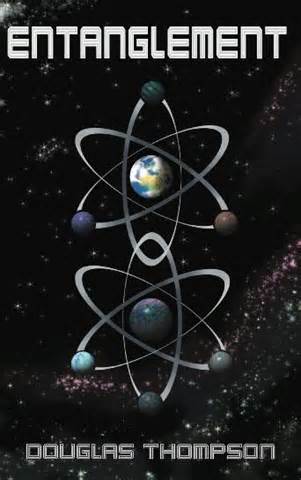
Entanglement, Douglas Thompson (2012) In the near-future, a form of matter transmission to exoplanets using quantum-entangled matter is discovered. A number of space probes are sent out, and a century or so later, once they’ve arrived, Earth starts beaming out astronauts to each world. The process, however, is neither as safe nor as certain as has been claimed. Its inventor is haunted by the subject of an early experiment – literally. Meanwhile, the various astronauts discover that the exoplanets are inhabited… Despite this description, Entanglement is far from hard sf – which is not to say it glibly makes up its various science-fictional elements out of nothing: the exoplanets named are all real exoplanets, and the teleportation process is given a creditable scientific gloss… But the various missions – each sort of presented as a short story in a linked collection – are more explorations of philosophical questions than they are surveys of exoplanetary landscapes or xenological biospheres. It’s an interesting approach, but sadly I found the book a little disappointing. I liked Thompson’s earlier Sylvow very much – and said as much in my Interzone review – but something about Entanglement just didn’t work for me. Nonetheless, Thompson is doing some good work and I intend to continue reading him.
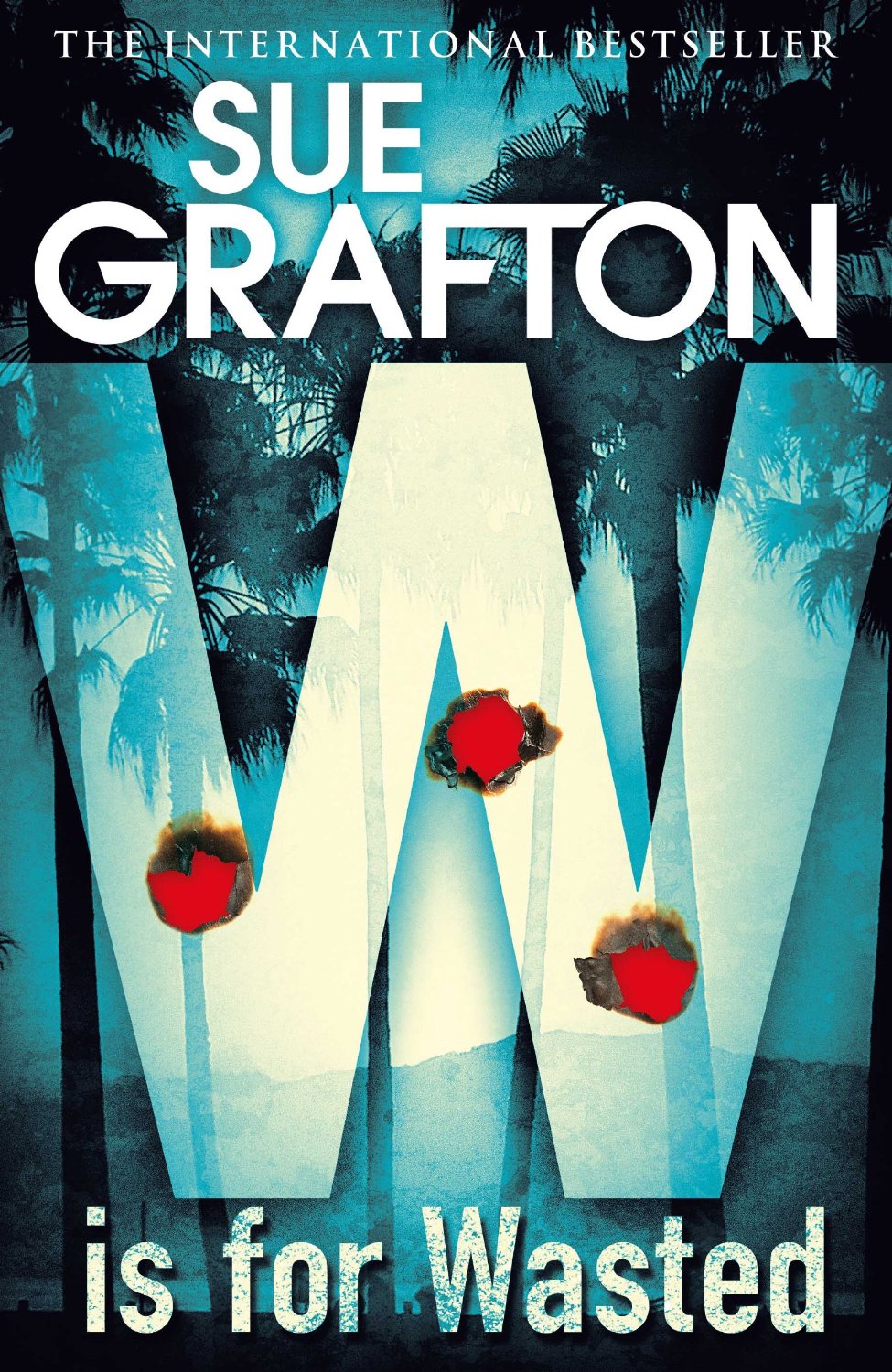
W is for Wasted, Sue Grafton (2013), is the latest in Kinsey Milhone’s alphabetical adventures. Only three more and they’re done. Or perhaps then Grafton will move onto AA for, er, Arsonists Anonymous. Or something. While the books in the series have chiefly been good solid private detective novels, there are three quite interesting things about them. First, the debut, A is for Alibi, was originally published in 1982, and Grafton has been careful to keep the internal chronology of the novels consistent. As a result, W is for Wasted is set in 1988. Kinsey Milhone has become an historical character. Secondly, the novels are all set in the invented Californian town of Santa Teresa, and with twenty-three books now set there it’s probably better-documented than many real towns in the state. Finally, the novels are framed as Milhone’s report of the case to her client, and usually end with “Respectfully submitted, Kinsey Milhone”. But in many of the cases – particularly the later books – she doesn’t have a client, but is drawn into an investigation often by being in the wrong place at the wrong time. Grafton also frequently breaks out of her framing narrative – and again this is something I’ve noticed becoming more prevalent as the series progresses – and she includes chapters in third person from the point of view of another character. Although the main narrative remains first-person from Kinsey’s POV, Grafton’s plotting obviously can’t remain limited to Milhone and still make sense to the reader. That strikes me as a weakness. I do enjoy the books, and I’ve no intention of giving up on them… but I wish Grafton would put more rigour into her novels.
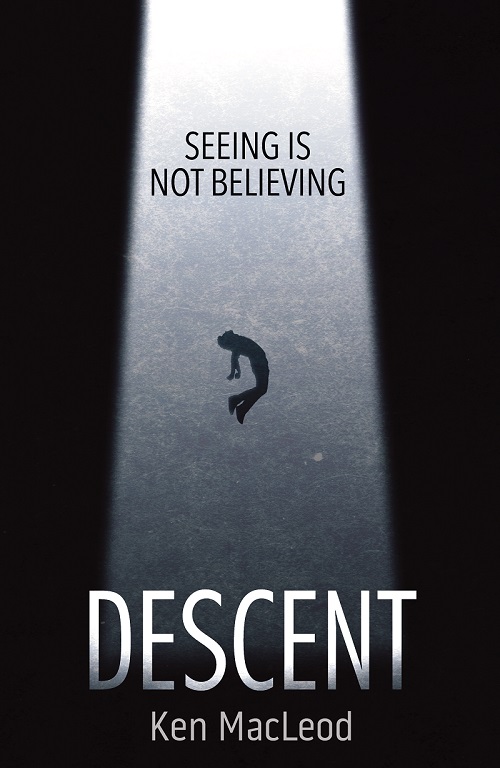
Descent, Ken MacLeod (2014) The cover art and strapline on this novel is somewhat misleading. It certainly misled me – I was expecting a novel on the psychology of alien abductions, especially since the novel opens with an incident which could be described as a close encounter (although the two teenagers involved are too sceptical to fully subscribe to it). However, as the story progresses it turns into a commentary on the machinations of government and corporations in a near-future Scotland suffering from an economic meltdown. And as a work of sustained near-future extrapolation, Descent is very good indeed. There’s also an idea the book plays with during its first half which MacLeod seems to throw away so he can focus his story on Scotland’s economic recovery, some random muscle-flexing by “securocrats” (secret apparatchiks), and the eventual redemption, emotional and career-wise, of bloke-ish narrator, Ryan. Which is a shame. I quite liked the idea of a genetic basis to the capacity to believe (or perhaps it’s just gullibility) – after all, as an atheist, I’ve often wondered what it is that makes other people believe in god (no, it’s not that I don’t believe in god, it’s that as far as I’m concerned there is no such thing as god). Still, at least MacLeod’s idea is better than the one Sebastian Faulks advanced in his novel Human Traces (see here). Anyway, much as I enjoyed Descent, I didn’t feel it had the science-fictional crunchiness Intrusion possessed, although in many respects it read like a more accomplished work.
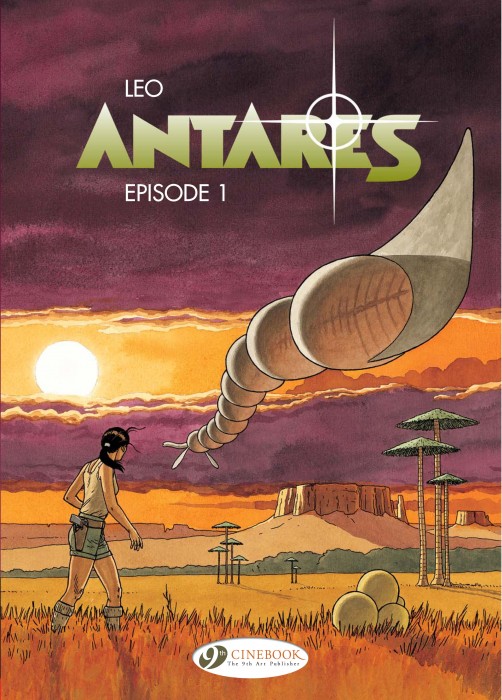
Antares Episode 1, Episode 2, Episode 3, Episode 4 and Episode 5, Léo (2007 – 2013) – well, that was annoying. I saw on Léo’s Wikipedia page that there were five books in the Antares series, so I waited until five had been published in English by Cinebook and then bought them… only to discover that the final episode ends on a cliff-hanger. Argh. The story continues on from Betelgeuse and features the same group of characters. Kim is having trouble settling on Earth – she doesn’t like that there’s so many people, and she doesn’t like her celebrity status. But when a multinational corporation sets up a colonisation mission to Antares and asks her to join it, she initially refuses. Eventually, she agrees, but en route she discovers that the mission was put together by a religious cult, and it’s one of those that treats women like chattel (the women must shave their heads and wear inflated coveralls to hide their figures so they don’t tempt the men, ffs). Once they land on Antares, things start to go wrong. The flora and fauna is lethal, the cultists have seized power, and the mysterious aliens from the earlier books are somehow involved. I do like this series of bandes dessinées but Léo portrays all his religious characters as complete misogynists and it feels a little one-note – especially when set against all the strong female characters in the series.
Irsud, Jo Clayton (1978), I read for review for SF Mistressworks. I was not impressed – see here. I have another four of these books on the TBR, and another two to track down if I want to complete the series.
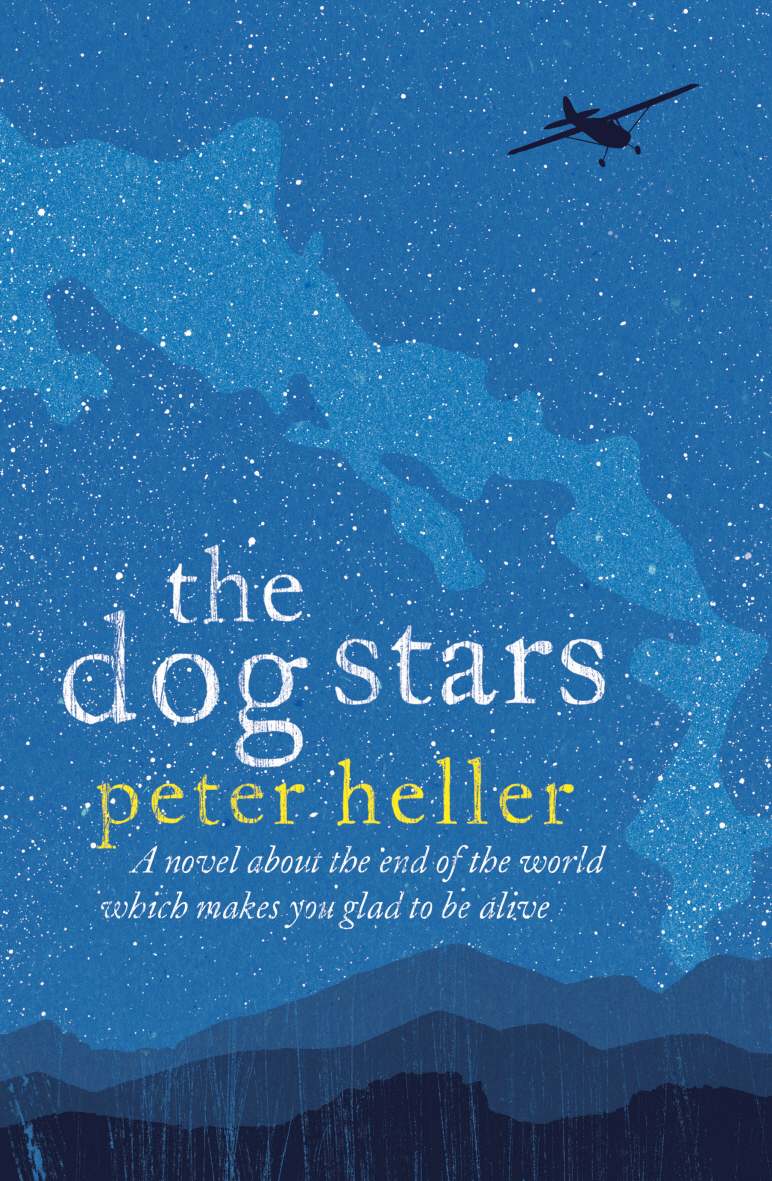
The Dog Stars, Peter Heller (2012), I picked up in a charity shop because it was shortlisted for the Clarke Award last year. And I’ll admit I’m somewhat puzzled it was shortlisted. A flu pandemic in the US kills off 99% of the population, and the remainder inevitably turn to survivalism, rape, murder and so on. As they do in post-apocalyptic fiction. The narrator, however, has it quite good – he lives at a small airfield, and has a small Cessna plane which he often flies, scouting out the area he shares with his gun-nut neighbour (they’re the only two people who live there). The narrator also suffered in the past from meningitis, and as a result the prose is written in a sort of lightly-fractured English, with many fragmentary declarative sentences. This serves no purpose in the story, it’s just an excuse for the prose style. And the gun-nut is basically a rip-off of Sobchak, John Goodman’s character, in The Big Lebowski. The first half of The Dog Stars comprises a series of incidents showing how nasty everyone is – and how few women remain. Then the narrator hears a radio message from some distance away, and decides to fly there to learn who broadcast it. En route, he stumbles across a blind box canyon, in which lives a man and his daughter. The narrator falls for the daughter. It takes something special to make a post-apocalypse novel notable and there’s nothing special in The Dog Stars.
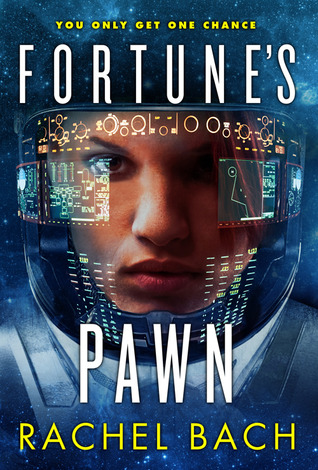
Fortune’s Pawn, Rachel Bach (2013). I’d seen a number of positive mentions of this space opera, so when I saw a copy going cheap at Edge-Lit, I bought it. But, well… the narrator is sort of fun, an ambitious mercenary who is very, very good at what she does – but her arrogance started to wear thin after a while. The power armour is handled well, and I quite liked the gentle references to the suits of armour of knights of old. The protagonist’s home world featured some nice touches, even if it didn’t really stand up to scrutiny – a technological feudalistic society with a king worshipped as a god? The rest of the worldbuilding is even worse. There’s the nasty lizard aliens, the comedy bird aliens and the enigmatic glow-in-the-dark squid aliens. Oh, and the love interest is some sort of technological part-alien superhero. Narrator Deviana is so ambitious, she leaves the mercenary brigade and takes a job as on board security for a free trader who seems to attract trouble. Yes, it’s all a bit like a role-playing game. Annoyingly, Bach only reveals what is blindingly obvious in this book, and I’m assuming the more interesting questions will be answered in the remaining two books of the trilogy. Which is annoying, as I won’t be reading them.
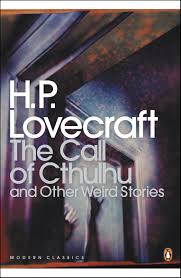
The Call of Cthulhu and Other Weird Stories, HP Lovecraft (1999). I’m pretty sure I’ve read Lovecraft in the past – in fact, I have a quite vivid memory of the cover art of a Lovecraft collection which, I think, I borrowed from Coventry City Library back in the early 1990s. It’s hard to be sure, given there’s so many different ways to pick up knowledge of his oeuvre and the Cthulhu mythos – I used to play the Call of Cthulhu RPG when I was at school, for example. Having said that, none of the stories in The Call of Cthulhu and Other Weird Stories seemed especially familiar. I’d always thought Lovecraft’s prose of poor quality, and despite a recent discussion on that subject, I suspect I may be revising my opinion. The early stuff is pretty bad – Q: when is a door not a door? A: when it’s a “panelled portal”; and Lovecraft had a bad habit of saying something is indescribable… and then going on to describe it. But by the late 1920s, his writing had improved hugely, and in stories like ‘The Call of Cthulhu’ (1928) and ‘The Shadow of Innsmouth’ (1931), he’d toned down his love of adjectives to great effect; and while he might still recycle his favourite words a few times too often, the less-is-more approach was certainly better at evoking eldritch horror. I have to admit, I enjoyed this collection a lot more than I’d expected. Happily, I bought all three of the Penguin Modern Classic Lovecraft books, so I have The Dreams in the Witch House and Other Weird Stories and The Thing on the Doorstep and Other Weird Stories, all in nice matching paperback editions.
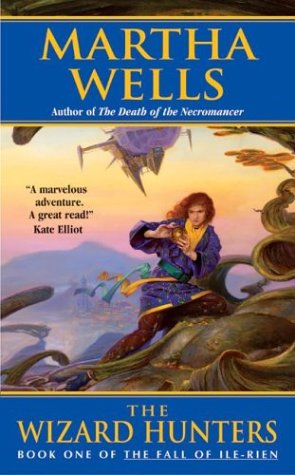
The Wizard Hunters, Martha Wells (2003). I bought this a few years ago for a planned reading challenge in which each month for a year I’d read the first book of a popular fantasy series and then write about it. I lasted six months before giving up. The Wizard Hunters, the first book of The Fall of Ile-Rien trilogy, I’d heard positive noises about, so I picked it as one of my twelve books. And it’s sat on my TBR ever since. Now that I’ve read it, I suspect I might have enjoyed it more if I’d read as part of reading challenge – it probably stacks up better against the other books I’d chosen back then, when I was a little more receptive to epic fantasy. Now, reading The Wizard Hunters I found myself mostly bored, and annoyed at how bad a lot of the writing was. Often I’d have to go back and reread something because Wells’ prose wasn’t clear enough – there was a line, which I now can’t find, of course, in which the main protagonist Tremaine shakes her head and then puts it to one side. Tremaine was, I admit, fun; as was her companion, Florian (a woman in the book, even though the name is masculine; but never mind); and I did like the mix of magic and early twentieth-century technology… But it took too long for the story get moving, the writing bounced from serviceable to bad, and there was far too much back-story the reader was expected to know. I won’t be, er, hunting down the sequels.
Nine months in and I’m still alternating genders in my fiction reading. I fully expect it to be 50:50 come 31 December. Admittedly, I still have a way to go before I have gender-parity on my book-shelves, but I’m always on the look-out for sf novels by women writers for SF Mistressworks and books by female literary fiction writers – especially post-war British literary fiction, such as that by Olivia Manning or Elizabeth Taylor, so if anyone has any suggestions for similar authors I’d be very grateful.
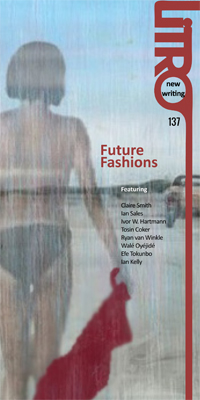
The September issue of Litro Magazine, #137, is out now, so if you’re in London pick yourself up a copy. Each issue of Litro is themed, and this month’s theme is Future fashions. Hence my story in the issue, ‘The Spaceman and the Moon Girl’, which is about Apollo astronauts and space age fashion designers such as André Courrèges, Pierre Cardin and Emilio Pucci. There’s also fiction and poetry by Ivor W Hartmann, Tosin Coker, Ryan Van Winkle, Walé Oyéjidé and Efe Tokunbo, plus an article on future fashion in cinema by Claire Smith.
2014 seems to be turning into the year of films. According to my records, I’d watched more films by the end of June 2014 than I had during all twelve months of 2013. Which is unfortunate, as I’m supposed to be a writer and a book reviewer, not a film critic. Oh well. Normal service will resume… soon, I hope.
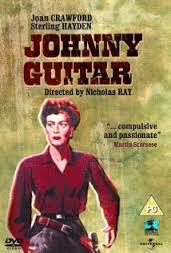
Johnny Guitar, Nicholas Ray (1954, USA) Sterling Hayden plays the title character, a gunslinger who has swapped his revolvers for a guitar. He drifts into town and poles up at a saloon owned by Joan Crawford, who proves to be an ex-lover. But it’s Crawford’s character who’s the focus of this film, not the eponymous musician. She’s banking on a planned railroad making her very rich. The town worthies aren’t happy with this – they think they should profit. So they drum up some citizen outrage on a pretext (the blatantly-wrong accusation that a regular of the saloon had held up the stagecoach), and good old Wild West “justice” subsequently ensues. This is one of those films where the plot is driven by a bunch of people behaving like complete shits for no good reason, particularly the character played by Mercedes McCambridge. An interesting twist on the Western genre, and Crawford plays a good part – but it’s still very Hollywood.
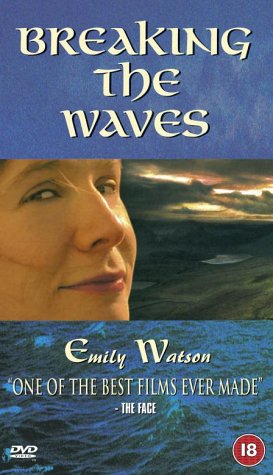
Breaking The Waves, Lars von Trier (1996, Denmark) I think this is only the second film by von Trier I’ve seen – and the first was Melancholia (2011), which looked beautiful but the climax was complete tosh. Like Melancholia, Breaking The Waves centres on a young woman, here played by Emily Watson. She marries a Norwegian oil rig worker, played by Swede Stellan Skarsgård, despite the reservations of her close-knit strictly Calvinist Highlands community. Soon after, Skarsgård is paralysed in an accident on the rig. Confined to a hospital bed, he persuades Watson to have sex with other men and then recount the details to him. Eventually, the village finds out about this… Watson is good, managing to convey a child-like simplicity and devotion to God which pretty much makes the story. The film is split into chapters, each of which opens with a well-known song from the 1970s, the decade in which the film is set… but there was something a little off about them, as if they were played by cover artists trying hard to sound like the original artists. It was slightly weird. Nonetheless, I think I’ll add some more von Trier to the rental list.
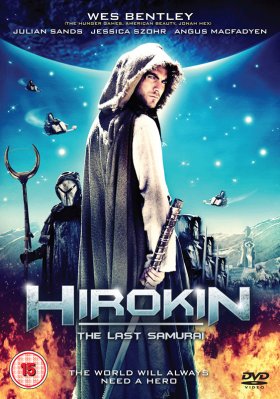
Hirokin : The Last Samurai, Alejo Mo-Sun (2012, USA) There was a trailer for this on a rental DVD I watched and it looked sort of interesting. So I checked it out, discovered it was a couple of quid on Amazon and bunged it on the end of an order. I was robbed. It really is truly dreadful. I should have guessed – it’s a sf film and it has Julian Sands in it. Though Sands has appeared in a number of good films, none of them were genre. In fact, his presence in a genre film is a good indication it will be shite. As this one was. The writer/director had obviously seen Dune and decided it needed more Star Wars in it. Sort of. On a desert world conquered by humans and ruled by evil dictator Sands, Wes Bentley plays a rogue human who takes up with one of the indigenous aliens – who look just like humans, except when they hold their hands up and you can see black veins on their palms. Anyway, Sands’ stormtroopers are searching for the aliens’ rebel leader and take Bentley’s partner prisoner. He has to fight to the death for her, but fails (she dies, not him). He sort of joins the rebels, learns how to fight samurai-style in the most ineptly-choreographed fight scenes I’ve ever seen, and then goes off to overthrow Sands. Or something, Watching this film, I could only wonder who’d been daft enough to invest it – people with far too much money… and either an appalling taste in films or a complete inability to recognise shite, obviously.
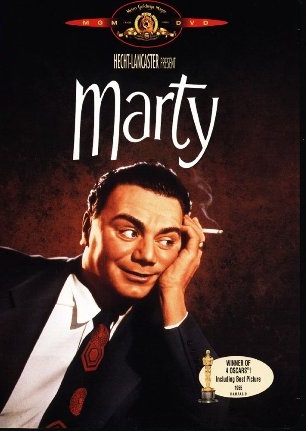
Marty, Delbert Mann (1955, USA) Ernest Borgnine plays a butcher who lives with his mother, but he’s getting on a bit and everyone tells him it’s time to get married. And I mean everyone. But he’s not had much luck with the ladies. One night at a local dance hall while on the pull, he bumps into shy schoolteacher Betsy Blair, whose date has dumped her after running into a much prettier friend. The two spend time together, and discover a mutual attraction. But afterwards, his mother tells Borgnine that Blair is not good enough and his friends tell him that Blair isn’t pretty enough. So even though he promised to call her the next day, he doesn’t. But then he changes his mind, and decides he liked her very much so it’s up to him and not his mother or friends. He calls her. (And they all lived happily ever after.) Marty won the Oscar for Best Film in 1955, and it’s a nice enough film, a well-observed drama with a good cast. Interestingly, Blair had been blacklisted for Communist sympathies, but her husband Gene Kelly lobbied for her to get the role, and he had enough clout in Hollywood to swing it.
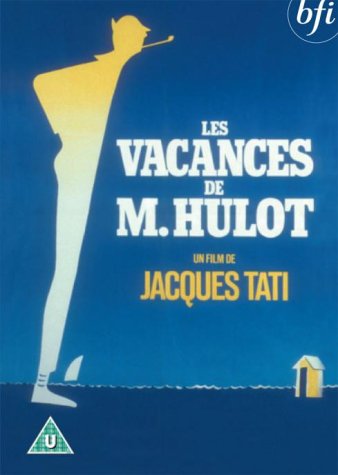
Les Vacances de M. Hulot, Jacques Tati (1953, France) My first Tati. The title character goes on, er, holiday. To the seaside. It’s sort of like Mr Bean, but the humour is more gentle and Hulot himself is a normal – if clumsy – human being. The plot is a series of set-pieces set in the town Hulot is visiting, most involving the other residents of the hotel in which he is staying. There’s an extended sequence with a horse and another with a shed full of fireworks… In fact, the more I think about the film, the more it strikes me how much of a rip-off of it that Mr Bean was. Although perhaps Mr Bean’s makers would claim it was an homage. Anyway, Tati’s is a good film and definitely worth seeing.
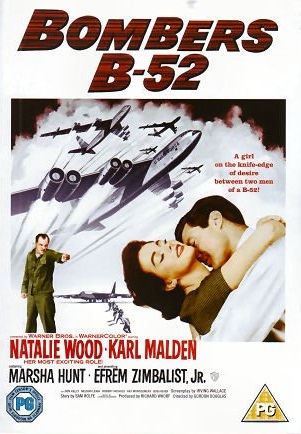
Bombers B-52, Gordon Douglas (1957, USA) I bet you can’t guess what this film is about. Go on, try. Yup, it’s about Boeing B-52 Stratofortress jet bombers. They first flew in 1955, and are still bombing the shit out of brown people even today. However, they’re complicated aircraft, and USAF clearly felt they might need more technical ground staff to keep them flying – hence Bombers B-52, starring Karl Malden, Efrem Zimbalist Jr and Natalie Wood. Zimbalist is an officer and a pilot, Malden is a tech sergeant and he hates Zimbalist. So when Zimbalist starts dating Malden’s daughter, Wood, Malden is understandably peeved. He decides to resign from USAF. But they’re getting these hot new B-52 bombers in and Zimbalist, who can’t understand why Malden hates him (neither, to be honest, do we), wants Malden to stay on. They go on a test flight, some fancy new equipment bursts into flames – bit of a design flaw there – and fills the B-52 with smoke. Everyone bales out, except Zimbalist, who’s piloting the aircraft. He brings it in to a safe landing. Meanwhile, rescue helicopters have found all of the crew except Malden. So Zimbalist steals a chopper and goes looking for him. And finds him. The two have to survive overnight in the wilds of California and become best buddies, and so Zimbalist is free to marry Wood. The end. There’s some good aerial photography in the film, though.
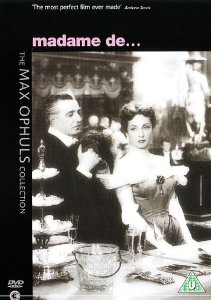
Madame De…, Max Ophüls (1953, France) This is around the third or fourth film by Ophüls I’ve seen and, I think, the best of them. The title character, whose surname is never given, is the wife of a French general and has a busy social calendar. To fund her activities, she sells a pair of diamond earrings given to her by her husband. She pretends to have lost them, but the jeweller to whom she sold them tells the general and he buys them back… and gives them to his mistress. But the mistress then sells them to pay off some debts, and they’re bought by an Italian count, played by director Vittorio De Sica, who then meets Madame de…, enters into a relationship with her, and gives her the earrings as a token of his love… The film is set, I think, around the turn of last century, and it’s the focus on appearances which drives the plot – and leads to its resolution. Apparently, Ophüls originally planned to shoot the entire film through reflective surfaces, such as mirrors, which would have been cool but the producers nixed the idea – which is not to say the end result is a disappointment. I’ve yet to fully appreciate Ophül’s films (unlike those of other directors mentioned in this blog post), but Madame De… is the first of his films I’ve watched which persuades me it’s worth seeing more of his movies.
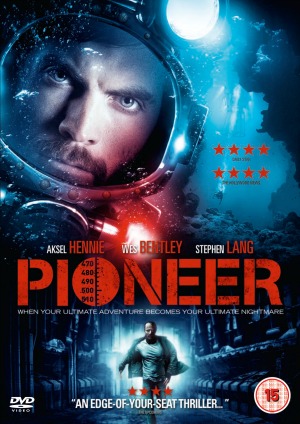
Pioneer, Erik Skjordbærg (2013, Norway) I’d been keen to see this film since first learning of it last year. But it had a stupidly limited release in the UK – my nearest showing was 8 pm on a single Friday night in Leeds, an hour away by train. The film is set in the early 1980s in Norway, just as the country is starting to develop its oil and gas resources. The Norwegians have accepted US help in putting together the saturation systems needed for divers to work at depth. But something goes wrong on a test dive, a Norwegian diver dies, and his brother, also a diver and present when the accident occurred, tries to figure out what’s going on… I was really looking forward to this movie since saturation diving is not a topic often covered in films. And the underwater photography in Pioneer is actually quite stunning… But the rest of the film felt like a routine thriller – Bentley glowers menacingly, Aksel Hennie bounces from mysterious scientist to mendacious politician to grieving sister-in-law… While the film certainly has that stark realism the Scandinavians do so well – and Hollywood does so badly – the plot does seem disappointingly ordinary. On the other hand, as far as I could tell its subject was handled accurately.
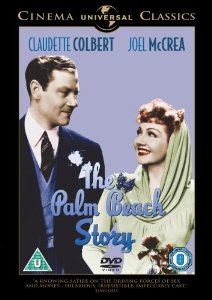
The Palm Beach Story, Preston Sturges (1942, USA) This has to be one of the silliest films I’ve ever seen. It definitely puts the “screwball” in “screwball comedy”. The film opens with a quick montage of shots which shows a man and a woman overpowering their twin brother and sister, who are about to get married, and taking their places at the wedding. Some time later, life isn’t so rosy, so hubby Joel McCrea decides to head south to look for work and be less of a burden on wife Claudette Colbert. She goes looking for him and manages to wangle a free ride on a train with a bunch of drunken hunting lodge-members… before being rescued by eccentric millionaire Rudy Vallée, who is very taken with her. McCrea then turns up, so Colbert pretends he is her brother… prompting Vallée to propose to Colbert – and Vallée’s ex-wife Mary Astor to propose to McCrea… Happily, there are those twins from the opening montage. While there’s plenty of fast-paced wit and snappy one-liners in The Palm Beach Story, the story is so ridiculous it spoils it all.
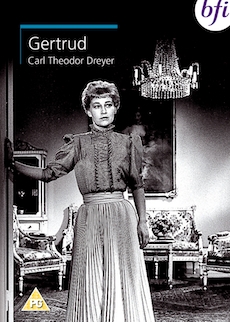
Gertrud, Carl Theodor Dreyer (1964, Denmark) This was a rewatch – I’d originally seen the film on rental DVD, but was later bought a copy of it and Ordet for my birthday. The film is based on a play from 1906 and Dreyer gives it a very theatrical staging. It’s his last movie, and on the strength of it I’m keen to see more. Nina Pens Rode, in the title role, is the wife of a prominent lawyer who is about to be given a position in government. But she wants a divorce – she even has a lover, composer and pianist Baard Owe. But the pianist has made another women pregnant and so cannot go with Gertrud. There’s a luminous quality to this film, one that’s emphasised by its staginess. Rode is especially good in the title role, dominating every scene she’s in with a quiet strength… as is clearly evident in the coda in which Gertrud looks back on the events of the film from thirty years later and sees no cause to regret her actions all those years earlier. A film that’s just bubbling under my top ten movies.
Captain America: The Winter Soldier, Anthony & Joe Russo (2014, USA) I’ve no idea why I continue to watch MCU movies, perhaps it’s just foolishness – I see the hype and promotion and stupidly believe it. Or something. To be fair, I did quite enjoy Captain America: The First Avenger, with its weird Nazi science and silly spoof of the title character. But this sequel is set in the present day, and despite the massive hype and the many positive murmurings I’ve heard, is just complete bobbins. It turns out that SHIELD has been controlled by Hydra, the Red Skull’s organisation from the first film, ever since Operation Paper Clip shortly after WWII. And no one ever noticed. In fact, the only reason Cap discovers this is because SHIELD tries to kill him. Even Nick Fury doesn’t know – and he created SHIELD! The Red Skull, of course, died at the end of the first film, but his chief scientist, played by Toby Jones, survived, and he’s now the brains behind Hydra. Well, not “brains”, as he’s uploaded himself into a load of 1960s mainframe computers. Which are located in a seemingly-abandoned underground computer centre at an old SHIELD base, an underground computer-centre that appears to have no security. Not very clever that. The rest of the film is some nonsense about an unkillable assassin, there’s more explosions and fight scenes than you can shake a very large stick at, and as the movie progresses you can actually feel your brain cells dying off one by one.
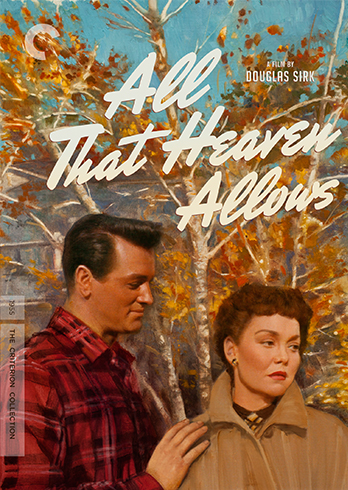
All That Heaven Allows, Douglas Sirk (1955, USA) My high opinion of this film is no secret. I love it so much, in fact, I bought the Criterion blu-ray edition, despite already owning it on DVD. So I was bit fucked off to discover that the blu-ray is region-locked. And unlocking my blu-ray player is going to involve some faffing around with firmware or something. Argh. So I watched the DVD edition packaged with the blu-ray instead. And… it really is a beautiful film. The more I watch it, the more I love it. It’s not just that it looks so good, but also that it’s a pitch-perfect satire of middle-class American society. The grown-up kids, who behave like actual kids, are spot-on – although the daughter’s beau, played by David Janssen, seems somewhat out of his depth – and the part where they buy their mother Jane Wyman a television set, as if that’s all she needs now she’s a widow, is pure genius. I’ve watched All That Heaven Allows two or three times in recent months – partly for research for Apollo Quartet 4, of course – and my appreciation remains undimmed. Even the hokey bits – the deer! – don’t turn me off. I love the film so much, I even tracked down a copy of the novel it’s based on – and it wasn’t easy to find.
So that was the new all-improved Fantasycon, and you know what? It was a bloody good con. The hotel was nice, if expensive, but it had an excellent real ale pub next-door and was five minutes walk from the city centre (and hence many fooderies). The company was convivial, and from what I heard the programme was successful. Okay, so the bar smelt of chlorine (which prompted me to start quoting Wilfred Owen at one point) and it was stinking hot in there on the Sunday; but at least the beer wasn’t massively expensive for a hotel (£4.40 a pint). My room was a single, and I’m just not used to sleeping in a single bed any more and nearly fell out of it a couple of times; but the room’s bathroom was enormous, almost as large as the room itself.
And speaking of bathrooms, the gents toilets on the ground floor were like something out of Hogwarts and quite amazing – tessellated floor, marble fitments and an enormous skylight above the centre of the room.
I spent most of Fantasycon chatting to people – old friends and new friends – in the bar and in the dealers’ room. It would be impossible to name them all, but I should definitely give a shout-out to Gillian Polack, the 2014 GUFF race winner, who had come all the way from Australia (albeit chiefly for Loncon 3, of course). I can’t recall much of what the weekend’s many conversations were about, but I remember getting a loud groan out of about a dozen people with the Saeed story one night.
The con ended with the British Fantasy Awards – congrats to all the winners – and I left for home not too long afterwards. That was a nightmare – unlike the very pleasant journey to York. A four-coach train from Edinburgh to Reading, so naturally it was packed solid and I spent the journey home standing. Fortunately, it wasn’t a long trip. The next government in power seriously needs to renationalise the rolling stock companies, and I don’t care if it means some of their rich friends end up out of pocket. In fact, I’d welcome it if they do.
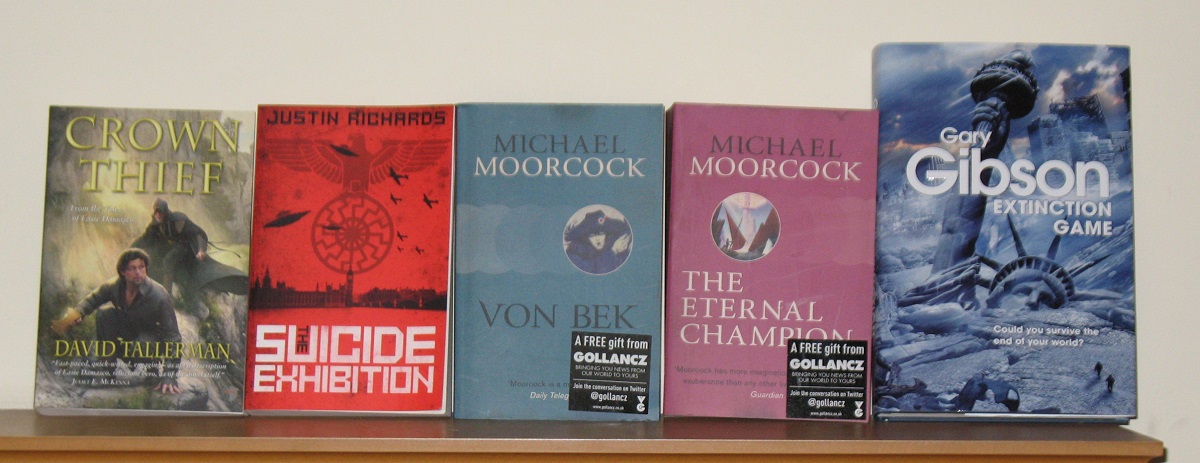
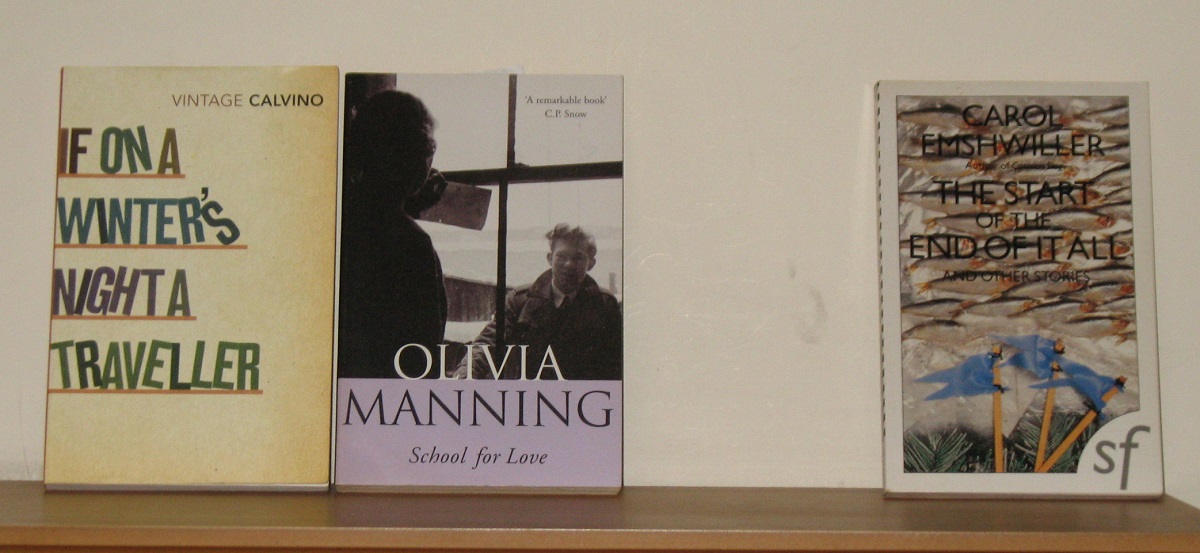
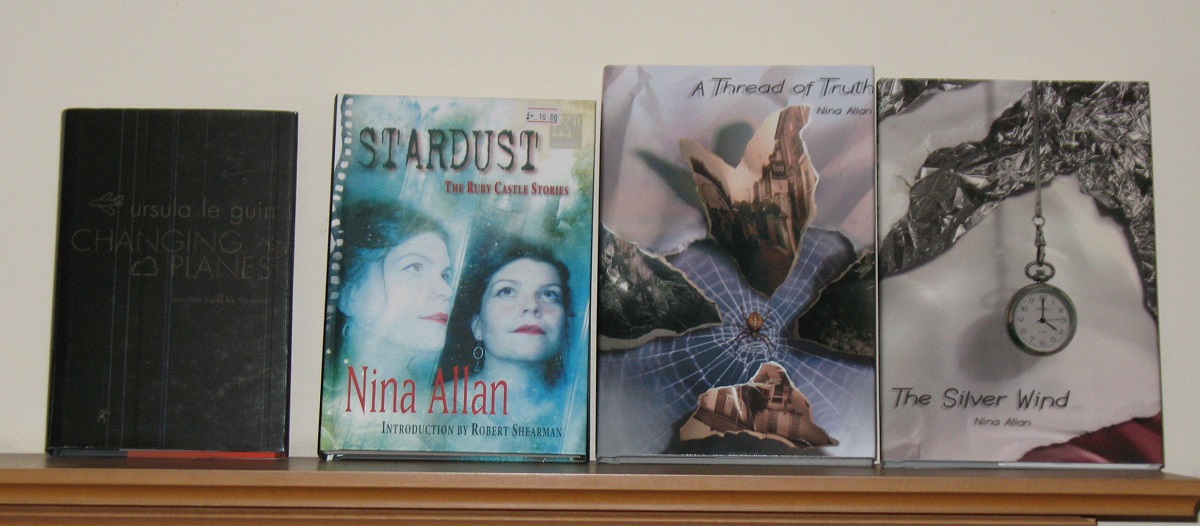
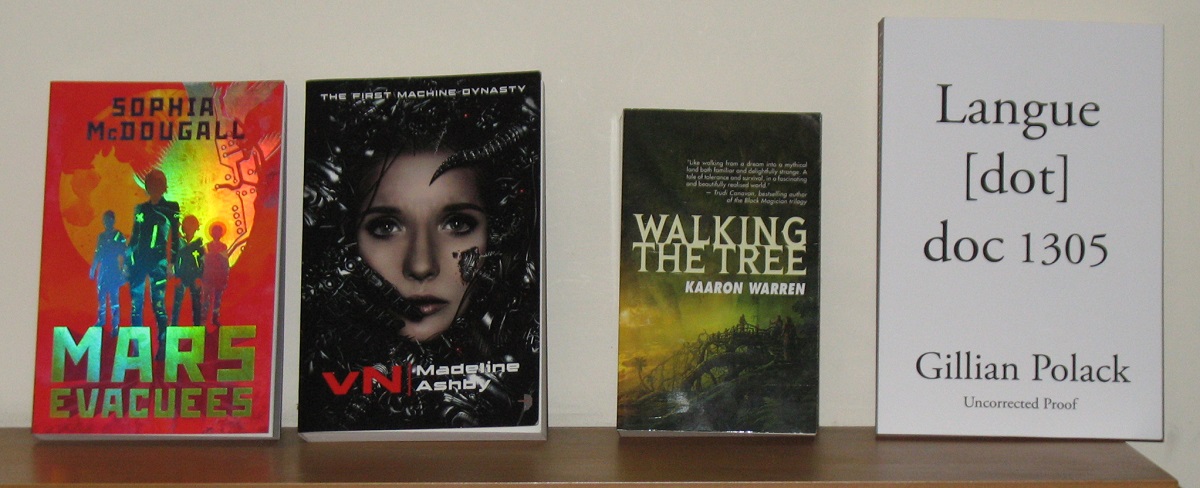
Finally, no con report would be complete without a list of the books I came home with. For the second con running, I managed to purchase books only by female authors. The books by male authors pictured below were all freebies – except for the Calvino, which I bought in Oxfam on Micklegate.
These were among the freebies available when you registered – although pretty much the entire Moorcock series was there, I already had most of them in the Fantasy Masterwork editions… but not The Eternal Champion and Von Bek (which weren’t in the Masterwork series anyway). David Tallerman is a friend and I picked up his book, Crown Thief, so he could sign a copy for me. Extinction Game didn’t appear on the freebie table until the Saturday, and I’d been intending to buy it so that saved me a bob or two. A dealer at the con was selling off a large stock of unwanted review copies all weekend for £1 each (and 50p on the Sunday), but after the dealers’ room closed for the banquet and awards ceremony, they dumped their remaining books in the hotel foyer for people to take for free – which is where I spotted The Suicide Exhibition, when my eye was caught by the Nazi eagle, flying saucer and black sun logo on the cover…
I decided to pick up some more of Nina Allan’s work and, fortunately, although not unexpectedly, both PS Publishing (Stardust) and Eibonvale Press (The Silver Wind and A Thread of Truth) had tables in the dealers’ room. Changing Planes I bought from the aforementioned dealer with all the review copies.
Next year’s Fantasycon is apparently back in Nottingham, but in the East Midlands Conference Centre rather than the horrible Britannia Hotel. I’m certainly considering going…








 It Doesn't Have To Be Right...