It Doesn't Have To Be Right…

… it just has to sound plausible


3 Comments

Moving pictures, #25

I catch up… then I get behind. But I’m staying reasonably on top of these posts for now… possibly because I’ve been rewatching Battlestar Galactica so I’ve not been watching movies all the time.
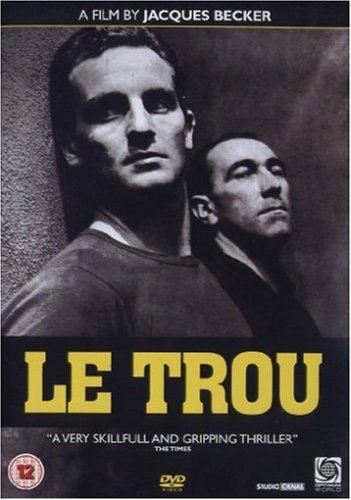
le_trouLe trou*, Jacques Becker (1960, France). As I was watching this, I kept on thinking I was watching a Robert Bresson film, because it could just as easily have made by him – in many ways, Le trou reminds me a lot of A Man Escaped, at least more than just “man escapes from French prison”. Which is pretty much the plot. A group of prisoners in a cell dig a hole in the floor, which leads them into the prison’s cellars. From there, they find their way into the sewers… except the sewer tunnel is blocked, so they must dig around the concrete plug blocking it. The story is based on a real prison escape and, in fact, one of the original escapees plays himself in the film (well, sort of, the names are all changed, although I’m not sure why). There’s a matter of factness to Becker’s direction, despite which the film remains too… personal, too readily creates a narrative from its cast’s back-stories… to come across as a documentary. It makes for an odd disconnect. True, Le trou can be watched as a work of fiction and, in fact, that’s probably the easiest way to watch it, and the way most people are likely to watch it. (I can’t remember if the film opens with text explaining it’s a dramatisation of real events.) It’s the opposite, I suppose, of the 1980s penchant for dramatising documentaries, making something with a fictional format of them.

city_girlCity Girl, FW Murnau (1930, USA). It’s the age-old story: farmer’s son goes to the big city to sell the corn harvest, meets a young woman, falls in love, marries her, doesn’t get the expected price for the corn, goes back home with new bride, but farmer is not happy – at the reduced price for the corn or the new wife. Things get worse. But then they realise the errors of their ways, and everyone lives happily ever after. While the cinematography and direction are up to Murnau’s usual standard, where this film really scores is in depicting life on a US farm in the late 1920s. The harvesting scenes are especially fascinating, because the technology used is sort of halfway between how you imagine it was done in the nineteenth century or earlier and how it’s done now. I do like Murnau’s films – they’re straightforward, the characters are well-drawn, if somewhat broadly so, and for their time they’re cutting-edge, which makes them interesting as historical documents. Murnau is also a good example of those German directors who crossed over to Hollywood and, you would like to think, caused Hollywood to up its game and produce serious films instead of endless variations on the Keystone Cops. It’s not as if Murnau was on his own – Lang, Lubitsch, Wilder, von Stroheim, Sirk, even Hitchcock, who cut his teeth in the German film industry. Not all of them stayed, of course. Lang’s last films were made in Germany (well, India – but they were German films), and von Stroheim retired to France. City Girl is by no means Murnau’s best – that would have to be Nosferatu or Tabu – but it’s still worth seeing. [dual]
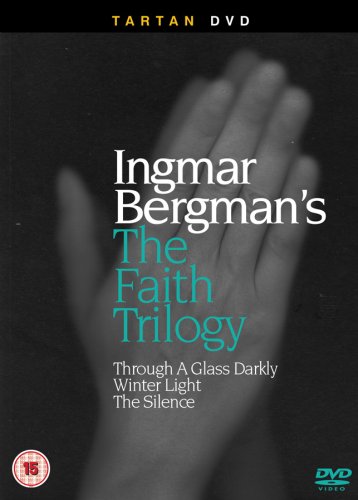
faithThrough a Glass Darkly*, Ingmar Bergman (1961, Sweden). Two couples – father, son, daughter and son-in-law – are holidaying on Fårö, a Swedish island in the Baltic (which Bergman loved so much, he ended up moving there). Father is a novelist and has just returned from working abroad. Daughter has been diagnosed with schizophrenia, but refuses treatment. Son-in-law is a doctor and is having trouble persuading father of the severity of his wife’s condition. And son is not happy about his father’s absences. If films were books, then Bergman’s movies would be literary fiction. And watching one of his films is like reading a polished literary short story, the sort that fifty years later is studied in schools. Even the stark black and white cinematography of Through a Glass Darkly feels like a deliberate choice to create a precise atmosphere, much as a writer crafts sentences. Bergman’s use of ensemble acting and a stable of actors only heightens the likeness: three of the actors in Through a Glass Darkly – von Sydow, Andersson and Björnstrand – were all part of Bergman’s stock company at some point in their careers. [0]
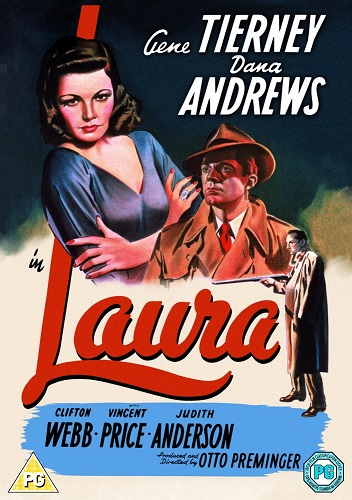
lauraLaura*, Otto Preminger (1944, USA). I had high hopes for this famous noir film – not just because of the genre or director, but also because it starred Gene Tierney, who appeared in several classic noir films. But… the film opens after Laura’s murder, with a detective trying to find out who the killer is. He interviews Laura’s patron, an effete newspaper columnist, and Laura’s boyfriend, a louche playboy. The detective learns so much about Laura that he begins to obsess over her… so he’s somewhat flabbergasted when he falls asleep in her apartment and she walks through the door. Turns out it wasn’t Laura who was killed, but one of her models (the body’s face had been destroyed by a shotgun blast, but since it happened Laura’s apartment they assumed it was her). Preminger directed some killer noir films, and Tierney was the epitome of a 1940s Hollywood femme fatale – no matter the role, she seemed to take into herself all the baggage associated with the character. I suspect this was due to the fact she wasn’t actually a very good actress. She had screen presence, certainly; but she never seemed especially convincing – not that it was a requirement at the time, cf Ava Gardner’s career – and the same is true in Laura. Tierney is more of a centre around which the story revolves, in which position she does quite a good job. But Laura the character is about as convincing as a unicorn, and the story of the film is not much better. Had I been putting together the 1001 Movies You Must See Before You Die list myself, I would have chosen a different Preminger noir film – Whirlpool, perhaps, or Fallen Angel. Not this lacklustre affair.

love+one+another+coverLove One Another, Carl Theodor Dreyer (1922, Germany). What an odd film. I say that having seen – and even liking – any number of odd films. I am, I admit, a fan of Dreyer’s films, and the more of his films I watch, and the more times I watch each of them, the more my admiration grows – but, let’s face it, most probably know of him only from his three Danish films of the 1940s, Day of Wrath, Ordet and Gertrud. But they’re products of the end of his career, and his earlier stuff is also very good (to be fair, The Passion of Joan of Arc is also pretty well known) but even so, the BFI aside, Dreyer’s entire oeuvre is not that readily available. He bounced around in his early years – working in Denmark, Norway and Germany… and it is the last country where this film was made. It’s based on a novel – Elsker hverandre by Aage Madelung from 1918 – and is set in Russia in the late nineteenth century.  The central character is a Jewish girl who experiences anti-semitism on a daily basis but falls in love with a Gentile, Sasha. When news of the affair surfaces, she is expelled from school and flees to St Petersburg to stay with her brother, who converted to Christianity. She becomes involved with underground revolutionaries and, against the backdrop of the Tsar’s pogroms against the Jews, she manages to get back together with Sasha, and they join the Jew fleeing Russia. Although set in Russia, Love One Another was filmed entirely in Germany. It is, in its way, as important an historical record as Eisenstein’s October: Ten Days That Shook the World, even though it’s fictional. (Apparently, some of the extras in the films were actual survivors of the Jewish pogroms in Tsarist Russia.) Worth seeing. [0]
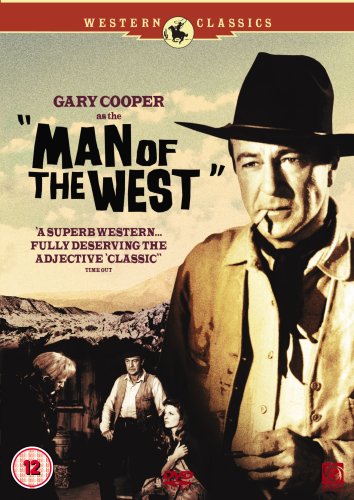
manf_westMan of the West*, Anthony Mann (1958, USA). I can’t help comparing this film with Shane, released five years earlier, and not to Man of the West‘s advantage. Gary Cooper plays a retired outlaw who, en route to Fort Worth by train to find a teacher for his small town’s new school, finds himself caught up with the outlaw gang to which he once belonged. He has a saloon singer and a con artist in tow, and tries to protect the two from the outlaws (led by his uncle), but only manages by reluctantly agreeing to help them rob a bank in Lassoo. But when he gets to Lassoo, it’s a ghost town and the bank has long since closed. Cue shoot-out. To be honest, Cooper makes a more convincing cowboy than Ladd did in Shane, and even though it’s been a dozen years since he hung up his black hat, at 57 he was probably a little too old for the part. But that’s a minor niggle. The photography is not as impressivas in Stevens’s film, but the story is at least not quite so… melodramatic. It feels like a Western from a later period. After watching Shane on rental DVD, I bought myself a copy of the Master of Cinema edition Blu-ray. I don’t think I’ll be doing the same for Man of the West, although a Masters of Cinema edition has been released.

phantom_libertyThe Phantom of Liberty, Luis Buñuel (1970, France). I rented this to test if my Theory of Godard could be applied to Buñuel, even though it had already failed several times. I have this theory, you see, that Godard’s films in colour are better than those in black and white – at least, the Godard fims I’ve seen which I like have all been in colour. But that’s not strictly true for Buñuel – I liked The Exterminating Angel a lot (black and white), but not Tristana or Belle du jour so much (both colour). I did like Buñuel’s The Discreet Charm of the Bourgeoisie (colour)… but did that mean I’d like The Phantom of Liberty… especially since it’s considered amongst his most surreal films (or rather, most experimental plot-wise)? The easy answer is… yes, I liked it; and no, it seems the theory only really applies to Godard. The Phantom of Liberty does not have a plot, it’s just a series of vignettes linked by characters, none of which are actually resolved. Some feel like failed comedy sketches – the Carmelite monks who play poker using holy relics as chips, Michael Lonsdale throwing an impromptu room party and then his wife dresses up in her dominatrix outfit and whips him on the arse, the dinner party where the guests sit on toilets at the table and shit but go to a private room to eat; others are not remotely comedic, such as the sniper in the Tour Montparnasse, or the police chief who gets a phone call from his dead sister. They are all, however, mostly surreal – like the emu that wanders through a man’s bedroom as he tries to sleep. On balance, I think The Discreet Charm of the Bourgeoisie the better film, but I did enjoy The Phantom of Liberty, and I plan to watch more of Buñuel’s films.

1001 Movies you Must See Before You Die count: 768

2 Comments

Moving pictures, #24

Onward with the movie posts…

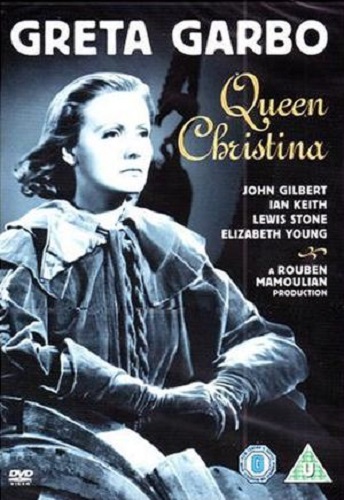
christinaQueen Christina*, Rouben Mamoulian (1933, USA). You know that thing about “Garbo laughs” and they used it as the tagline for Ninotchka, which was released six years after this one, but Garbo, who plays the title role in Queen Christina, does quite a good impression of laughter on a couple of occasions in this film. The title character is a real historical figure, queen of Sweden from 1632 to 1654, and she did indeed abdicate and convert to Roman Catholicism. But not, as the film would have it, for love. In the film, she’s out hunting one day when she comes across the Spanish envoy, whose carriage is stuck in a snow drift. She gives his servants advice on how to extricate the coach. Since she dresses as a man, the envoy mistakes her for one. And does the same later, when they meet at a nearby inn. Queen Christina, who is now actively pretending to be male, has taken the last room. The envoy demands “he” vacate it. They end up sharing and the queen reveals her gender – but not her identity. She saves that little surprise for when the envoy is officially introduced to her at the royal palace. The real Queen Christina was raised as a boy and was in a long-term lesbian relationship. She’d also been fascinated with the Roman Catholic Church from a young age. But when has Hollywood ever let history get in the way of a good story? Or their marketing, for that matter. I’m not entirely sure why this film is on the 1001 Movies You Must See Before You Die list. I didn’t see anything that was technicially or cinematically ahead of its time, and though it was enormously successful and popular in 1933, it doesn’t seem like anything particularly special these days.

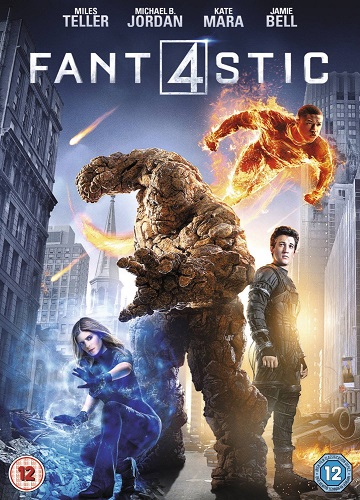
fantastic4Fantastic Four, Josh Trank (2015, USA). Given the success of the MCU films, it can hardly be a surprise that Hollywood is rebooting every superhero franchise it can in a desperate effort to keep the rights and find a moneyspinner. Spider-Man is about to see its fourth incarnation, and here’s the Fantastic Four, another iconic Marvel property, on its third incarnation (although the first was never actually released). Like the Spider-Man reboot, they’ve rolled back the ages of the heroes to high school, because twentysomething heroes were apparently fine for twentieth-century kids but in the twenty-first century it’s got to be totally about the kids. And if that wasn’t enough of a change, this film has completely rewritten the Fantastic Four’s origin story. True, the original, er, origin story – four rich twentysomethings build a rocket, go into space, get bombarded by cosmic rays and develop superpowers – was pretty daft, but try naming an origin story that isn’t completely ridiculous. In this new version, Reed Richards spends years developing a teleportation machine, is then recruited by the Baxter Foundation, and with the help of studly Latverian genius Victor von Doom, builds a full-scale model… except it’s not a teleporter, it’s a portal to another dimension. And it’s on a drunken trip there that the four get their fantastic powers… and Doom is left behind and turns into a metal man with awesome mental powers. The military weaponizes the four – except for Richards, who goes on the run. But eventually he is brought into the fold. This is a completely charmless affair, with a charisma-free cast. And where previously the Fantastic Four spent most of their time saving the world, here they’re just “military assets”, tools of US imperialism – and while superheroes are often just as destructive as the supervillains they fight, that change in mission is just downright offensive. Marvel adopts manifest destiny. If superheroes had always seemed a little fascist before, with this film they’ve openly embraced it. Happily, Fantastic Four tanked at the box office. Avoid.

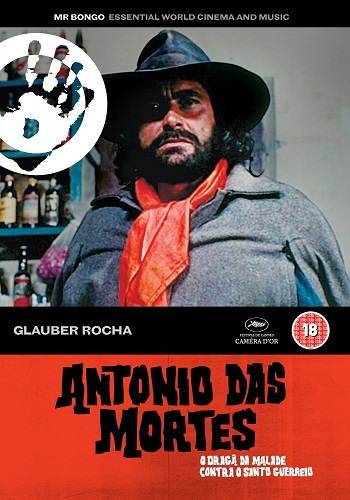
antonio_mortesAntonio das Mortes, Glauber Rocha (1969, Brazil). This is the third of Rocha’s Anotonio das Mortes trilogy (its origin title is actually O Dragão da Maldade contra o Santo Guerriro, “The Dragon of Evil against the Saint Warrior”), following on from Black God, White Devil (see here) and Entranced Earth (see here). Unlike the preceding film, this one is set in Brazil and not an invented country. The north-east of the country was once controlled by bandits called cangaceiros, the greatest of whom was Lampião, who died in 1938. But a new cangaceiro has appeared, accompanied by a young woman believed to be a saint, and a host of peasants. The blind coronel, the landowner of the town of Jardim de Piranhas, sends for Antonio das Mortes to kill the cangaceiro. Antonio fatally wounds the cangaceiro in a duel, but then suffers a change of heart and demands the coronel hand out his food reserves to the poor. The coronel refuses and orders Antonio killed… Antonio das Mortes is the only film of the three in colour, and Mr Bongo have done another slipshod job on it – the print is far from perfect, and the many folk songs on the soundtrack have French translations of their lyrics burned in. It’s also a less declamatory film than Entranced Earth, although not by much – the cangaceiro, for example, introduces himself by speaking in rhyme to the camera. And even much of Antonio’s dialogue is self-reflective. A lot of the violence is staged almost like a dance, which works well with the local folk songs on the soundtrack. The landscape appears much stranger in colour than it does in black and white, with some effective landscape photography that demonstrates just how huge and featurless is the region. I’ll admit I bought these films while under the influence after watching Entranced Earth, but I don’t regret the purchase. Not only are they very political films – the coronel in Antonio das Mortes is portrayed as over-entitled and completely lacking in compassion, and the stories of all three films centre on the common people fighting the ruling classes – but the tactic of playing the political elements flat and affectless and the cultural elements full of sound and colour is especially effective. Not to mention the over-the-top and hammed up violence. These films are very much folk-tales, but they’re colourful and political folk-tales. And I really like movies like that. Recommended. It’s a shame more of Rocha’s films aren’t available on DVD. [0]

femme_publiqueLa femme publique, Andrzej Żuławski (1984, France). I am, I admit, slightly puzzled by Żuławski’s success. After fleeing Poland in the early 1980s, the only place he could go and still make films was France. It’s unlikely he’d have fitted in to the film traditions of any other country. Because his films really are quite strange. Even La femme publique, which is an adaption of an autobiography by Dominique Garnier, in which she describes her arrival in Paris and attempt to break into cinema acting, and her subsequent domination by the director who hires her. In most hands, this would be enough for a story, but Żuławski, with Garnier’s help, decided to add in a subplot about plot to assassinate a Lithuanian archbishop… The end result is an intense drama that might or might not be a somewhat bonkers thriller, which manages not to lose sight of its story. Valérie Kaprisky plays the young actress who, despite having no experience, is cast by enfant terrible Czech director Francis Huster in his adaptation of Dostoevsky’s Demons. Through Huster, Kaprisky meets fellow Czech emigré Lambert Wilson, whose wife has recently disappeared (and proves to have been murdered). Kaprisky is convinced Wilson is the murderer, so she pretends to be his wife (his grasp on reality is shaky to begin with, and visibly deteriorates). Huster meanwhile seems to be involved in some sort of plot to brainwash Wilson into assassinating the archbishop. It sort of makes sense when laid out so baldly, but this is a Żuławski movie so the reality is somewhat different. The performances are intense to a degree that’s rarely seen in Hollywood films, and the story’s focus on the psychology of the major characters is also something not often seen in plot-driven Hollywood movies (never mind Hollywood’s mindless adherence to various screenwriting techniques, such as the three-act structure, McKee’s Story or Snyder’s Save the Cat!). I don’t know that I’d call La femme publique Żuławski’s best film as I still like Na srebrnym globie a lot – but it’s certainly the best-presented film on DVD. This Mondo Vision Signature edition comes in a fancy box, with a soundtrack CD, publicity photos and a booklet. Recommended. [1]

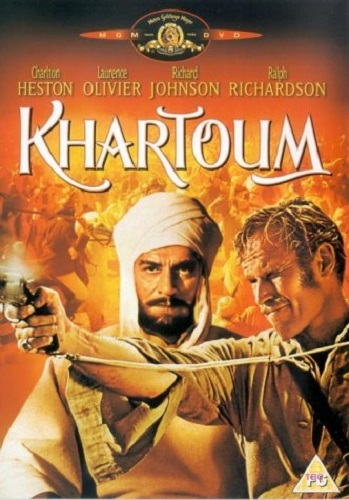
khartoumKhartoum, Basil Dearden (1966, UK). Remember when they used to open films with ten minutes of music, so you had time to buy your ice cream from the usher down at the front, and then they’d have an intermission so you could buy another ice cream or a box of Treets Poppets… or was that just in the UK? As the title of this film no doubt makes clear, it’s about the siege of Khartoum in 1884, when the forces of the Mahdi tried to capture the city from General Gordon, who’d been sent there by the British to evacuate the British and Egyptian population before the Mahdi attacked. The film is a typical historical epic of the period – not just that ten-minute entr’acte and a ten-minute intermission, but also a cast of thousands and big names playing the major roles no matter how inappropriately cast. I mean, Charlton Heston as Gordon is one thing (although apparently it was meant to be Burt Lancaster), and he at least attempts a British accent (albeit not very well); but Laurence Olivier as the Mahdi is just blackface. Khartoum was apparently filmed in Egypt and makes much of its locations – this is big-screen entertainment, and it makes sure you get what you paid for. And yet… it’s all a bit bland and unexciting – despite the battle scenes. Gordon was, by all accounts, an odd bloke – a drunkard, possibly queer, but also a gifted leader and tactician. He actually sounds quite interesting. He was lionised following his death in Khartoum, and it wasn’t until several decades later that his actions, or indeed his character, were questioned. Khartoum is pretty much the dictionary definition of a Sunday afternoon film – at least it was a decade or two ago – and that’s about its level. As history, it’s perhaps a little more reliable than the typical Hollywood movie; and as entertainment it’s very much of its time.

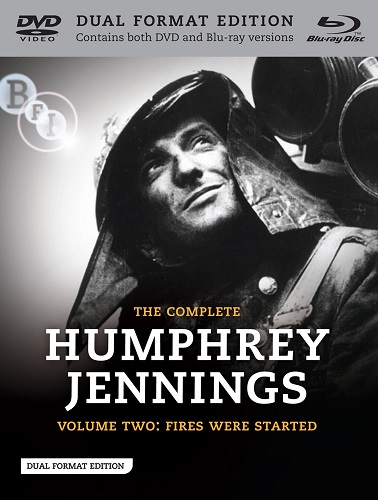
fires_were_startedFires Were Started*, Humphrey Jennings (1943, UK). This is the only Jennings film on the 1001 Movies You Must see Before You Die list, despite him being called one of Britain’s greatest film-makers. And he made thirty-two films, although most were documentary shorts. The BFI DVD case shown here contains five films, all from 1941 or 1943. Fires Were Started is about a London fire brigade, beginning with a new arrival to the watch, and following the watch members as they go about their duties. Although some of the film is reconstruction, and filmed at Pinewood Studios, it all looks very real (the fires, I think, are real fires – certainly the cast were actual firemen and not actors). I do remember that the firemen had their own bar and drank beer… until called out by an alarm. The technology also seemed surprisingly crude, especially when compared to the military technology of the time. But Jennings had a really good eye, and was especially effective at making his subjects seem likeable and sympathetic. The new member of the watch, for example, is university-educated, whereas the the current members are all working-class… but Jennings shows how accomodating both are toward each other and how well they work together. Fires Were Started is one of three collections of Jennings film released by the BFI. I quite fancy getting all three – um, maybe I should just wait until I’ve had some wine and do as I did for Glauber Rocha…

1001 Movies You Must See Before You Die count: 764


2 Comments

Moving pictures, #23

Another mixed bag, country-wise, this time. Four were rentals, two I bought. Two are also sequels. And one is silent, while another has only a music soundtrack.

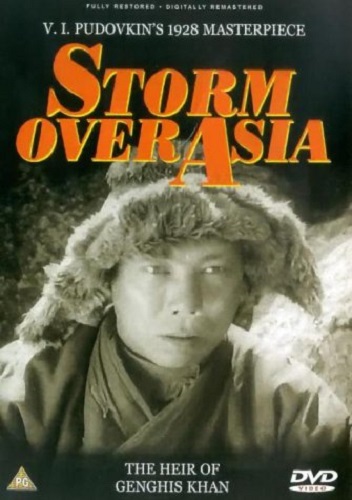
storm_over_asiaStorm over Asia*, Vsevelod Pudovkin (1928, Russia). Although cinema was in its infancy back before “talkies”, what a lot of people seem to forget – or don’t know – is that a lot of the cinematography of that time is often astonishingly good. Anyone who has seen Dreyer’s The Passion of Joan of Arc can’t fail to be impressed by the beauty of the Dreyer’s imagery. Storm over Asia, an early Russian film, is not one that was known to me – Eisenstein, yes; even Aelita, yes; but not this one… Which is a shame as it’s quite an amazing piece of work. It’s set in Mongolia in 1918. A Mongolian trapper is ripped off by a European trader, and runs to the hills after fighting the trader. He becomes a Soviet partisan, fighting against the British occupiers. They catch him and shoot him, but then discover he is a direct descendant of Genghis Khan. Fortunately, he’s still alive, so they patch him up and plan to use him as a ruler under their control. Of course, he turns on them. Hang on, I hear you saying, the British never invaded Mongolia; yes, they invaded lots of places over the centuries, but Mongolia wasn’t one of them. But this is a Russian film, and they were hardly likely to paint themselves as the villains (plus, the British had the advantage of being “capitalists”, which the villains of any Soviet film had to be, of course). Definitely worth seeing.

45_years45 Years, Andrew Haigh (2015, UK). It’ll be interesting to see how this film does on sell-through. Hollywood, indeed most Anglophone cinema, seems locked into chasing that young male demographic, as if they’re the only people who go to the cinema. But when you make films aimed at one group, you can’t be surprised when other groups stay away. But then I suspect older viewers are more likely to watch a new movie on sell-through than they are in the cinema. But are they going to bother doing that for shitty tentpole blockbusters like the MCU films? And are they going to spend money on all the merchandising crap, which isn’t there to sell the fillm as much as it is to convince fans that’s okay really to like such rubbish since the property is so ubiquitous they can’t be considered weird for liking it… Which at least can’t be said of 45 Years, which is about a married couple, and the title refers to the time they’ve been married. But a few days before a planned celebration of the event, the husband receives news that the body of an ex-girlfriend, who fell into a crevasse in a glacier back in the 1960s, has just been discovered… While this all happened before he married, he hasn’t been completely honest about what happened with his wife. This is a nice, understated piece, well-played by a high-powered cast. It’s already garnered a fistful of award nominations and wins, and deservedly so.

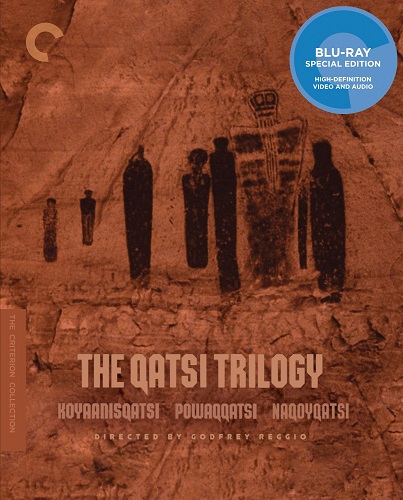
qatsiNaqoyqatsi, Godfrey Reggio (2002, USA). This is the third of the Qatsi trilogy, made some twenty years after the previous two films, Koyaanisqatsi and Powaqqatsi. Ironically, it’s the one that’s dated the most. That’s chiefly because at the time it was made CGI was not as high-quality as it is now, and it shows. Not just in the resolution or range of colours of the computer-generated graphics, but also in the imagination on display. Those earlier two films were pure cinematography – of places and people, with no special effects. And they remain as effective today as they did when they were shot. Also to Naqoyqatsi‘s disadvantage is its subject: technology and war. There’s a big emphasis on computer code, modelling and simulations, and virtual reality, which would have felt cyberpunk… if only the film had been released a decade earlier. While the concerns, and subjects, of the first two remain true to this day, much of the technology celebrated, and reviled, in Naqoyqatsi no longer exists. In parts, Naqoyqatsi reminded me of David Blair’s Wax, or the Discovery of Television Among the Bees from 1991 (I have a signed copy of the film on VHS somewhere), and in other parts of its two predecessors. I’m glad I picked up the set and so now have all three films… but going for the Blu-rays was probably a bit much. [A]

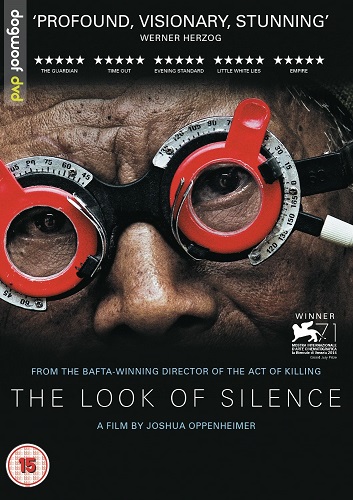
look_of_silenceThe Look of Silence, Joshua Oppenheimer (2014, Denmark). This is the follow-up to Oppenheimer’s earlier The Act of Killing, and covers pretty much the same topic: the Indonesian slaughter of “communists” during the mid-1960s after the military seized control. The conceit here is that the brother of a man who disappeared during those murders visits some of the killers as an optician examining their eyesight, and quizzing them about it while he does so. There’s a telling remark made to camera by one of the men who committed those murders, “Thanks to the Americans for teaching us to hate communists”. The fact that most of those killed weren’t actually communists is apparently irrelevant. The US made it plain that communists were legitimate targets, and it’s not like anyone was going to look too closely when the so-called authorities labelled someone a communist. After all, the US had done exactly the same itself back in the days of HUAC, albeit without the machetes and assault rifles and death toll. Later in The Look of Silence, there’s a clip from US network news show from the 1960s, and it pretty much approves of the death and mutilation of the so-called communists. It goes without saying that the events discussed in this film are horrible; and that it’s enraging the perpetrators not only survived, but prospered and continue to do so. It’s heartbreaking that one survivor’s only way to live with it is to consider it all past and gone, life has moved on. Because clearly justice has not prevailed. And it’s unlikely to ever do so. It would be all too easy to blame it entirely on the Indonesians, except that would not be strictly true. The West creates these situations and should take responsibility for them – except that would mean admitting they’d done wrong, that the corporations are no longer under control, or that capitalism doesn’t actually work.

evangelion_2Evangelion 2.22: You Can (Not) Advance, Hideaki Anno (2009, Japan). It would not be untrue to describe the plot of the Evangelion series as: giant alien creatures called Angels invade Earth (individually) and are fought off by giant cyborg creatures piloted by high school kids. Because, of course, there’s so much more than just that going on in there – that would be the Hollywood version. The Angels are these bizarre creatures, looking partly like something drawn by Moebius and partly like some nightmare doll. In Evangelion 2.22, there is now a squad of Evangelions, and the pilot of one is possibly the most irritating American character ever to appear in a film (which is quite an achievement). In fact, the existence of the squad means Evangelion 2.22 is a more action-packed film than Evangelion 1.11: You Are (Not) Alone, although like the first it’s parsimonious with the details of its setting, leaving much of the world-building a mystery. For example, it’s only on a visit to an aquatic research centre that the film explains that the seas really are red, and why. It’s a movie that requires several watchings – although that may simply because I have yet to learn the Way Of Watching Anime. One thing worth noting, however, is Evangelion 2.22‘s frankly bizarre score, which at times sounds like 1970s jazz/rock fusion – and seems weirdly anachronistic but is actually pretty good. Evangelion 3.33: You Can (Not) Redo is currently available on DVD and Blu-ray, and I’ll be picking up a copy. The final film was due for theatrical release in late 2015 but has been delayed. I can wait. [ABC]

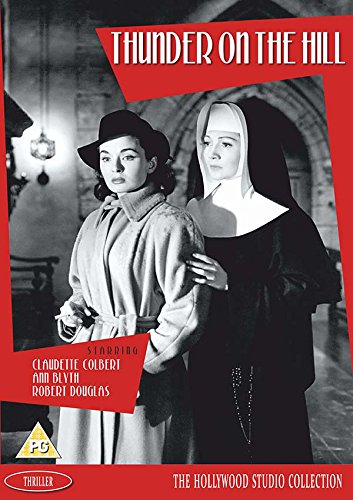
thunderThunder on the Hill, Douglas Sirk (1951, USA). My favourite film was directed by Sirk, and the handful of melodramas he made between 1953 and 1959, such as Magnificient Obsession, Written on the Wind and Imitation of Life, I rate very highly. But he also made a lot of quite frankly ordinary thrillers and dramas for Hollywood throughout the 1940s and 1950s. Thunder on the Hill is one of these. Shot in black and white and set in, of all places, Norfolk, it sees a group of people descend on a convent during a fierce storm. One of these is a convicted murderer, with rescort, on her way to prison, except, of course, she’s really innocent. However, the victim’s doctor – the murderer’s brother – is now doctor at the convent. Guess what happens. Claudette Colbert plays the lead and doesn’t make much of an effort toward a British accent; neither, for that matter, does Ann Blyth. Most of the supporting staff are actually British – so you get that odd disconnect where some of the cast clearly can’t be the characters they play because they have the wrong accents. This is pretty ordinary and forgettable stuff, and you’d be much better off watching one of Sirk’s melodramas.

1001 Movies You Must See Before You Die count: 762


Leave a comment

Triple-stacked

I’ve now got into the habit of dumping books at charity shops, or giving them away to friends, once I’ve read them, unless I have a specific reason for wanting to keeping them – such as, they’re part of a series I’m collecting; or, they were really difficult to find… Back in the day, it was: buy a book, read it, keep it. But space is finite and the desire for books is not. Some of the books below will be staying once they’ve been read, some will not. So it goes.

IMG_4150

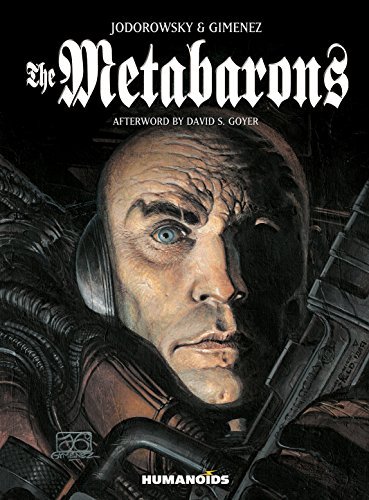
I bought the first couple of volumes of both these series a few years ago, and even bought the first volumes of The Technopriests in French… but for some reason, the series were never fully translated into English… until these omnibus editions appeared. Which I bought. I wrote here about The Metabarons; I have yet to tackle The Technopriests.

IMG_4151

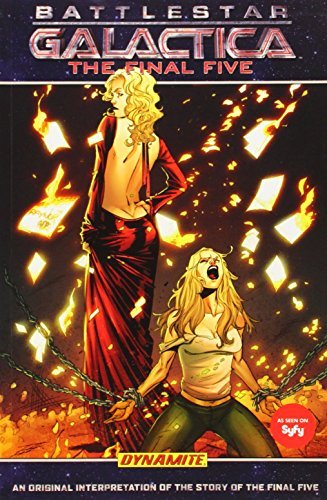
These two I bought to accompany a rewatch of Battlestar Galactica (I bought the ultimate edition on Blu-ray for a very cheap price on one of Amazon’s Prime Days). The Final Five I wrote about here – it’s confusing and not very good. Battlestar Galactica Vault I expected to be like the Alien Vault published a few years ago – lots of background info and concept designs… But it’s not. It’s just a straightforward history of the show, albeit well-illustrated.

IMG_4152

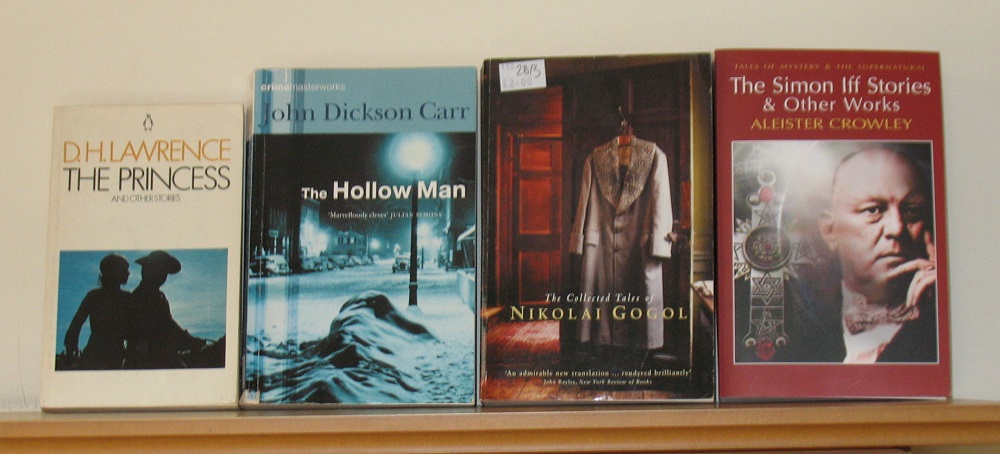
Some charity shop finds – except for The Princess and Other Stories, which I bought on eBay and which joins the other DH Lawrence Penguin paperbacks in that series I have. I hadn’t known Aleister Crowley wrote fiction, so I bought The Simon Iff Stories and Other Works to see what they were like. Sokurov references Gogol quite a lot in his films, so I picked up The Collected Works of Nikolai Gogol so I could follow them. And whenever I see a Crime Masterwork I’ve not read, even if they’re a bit tatty, I buy them – hence The Hollow Man – although I’ve been a bit slow about reading the half-dozen I’ve found so far.

IMG_4153

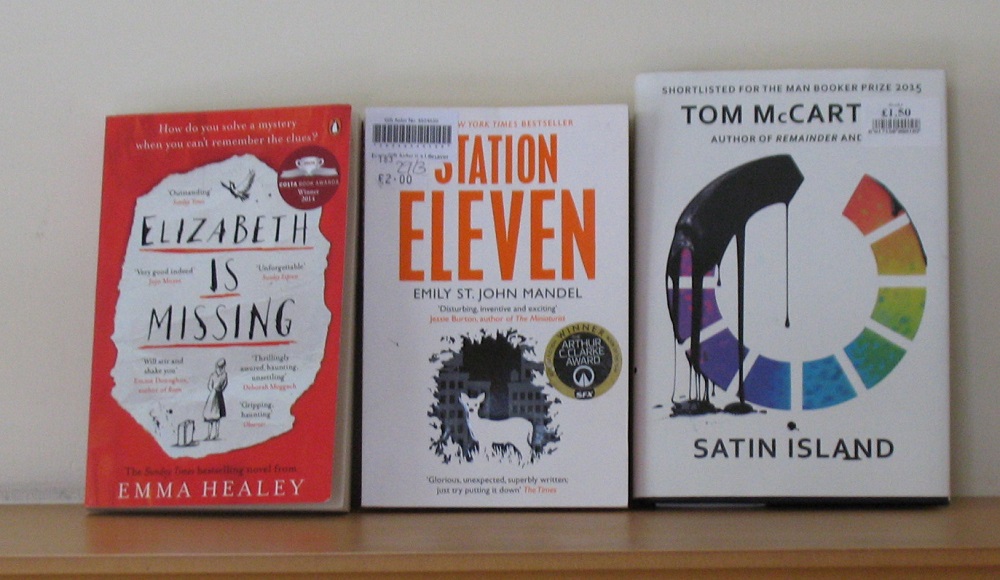
Even more charity shop finds, but more recent books this time. Satin Island was shortlisted for the Booker, Station Eleven won the Clarke. I’ve already read Elizabeth is Missing – I wrote about it here. I still can’t remember who recommended it to me and why.

IMG_4154

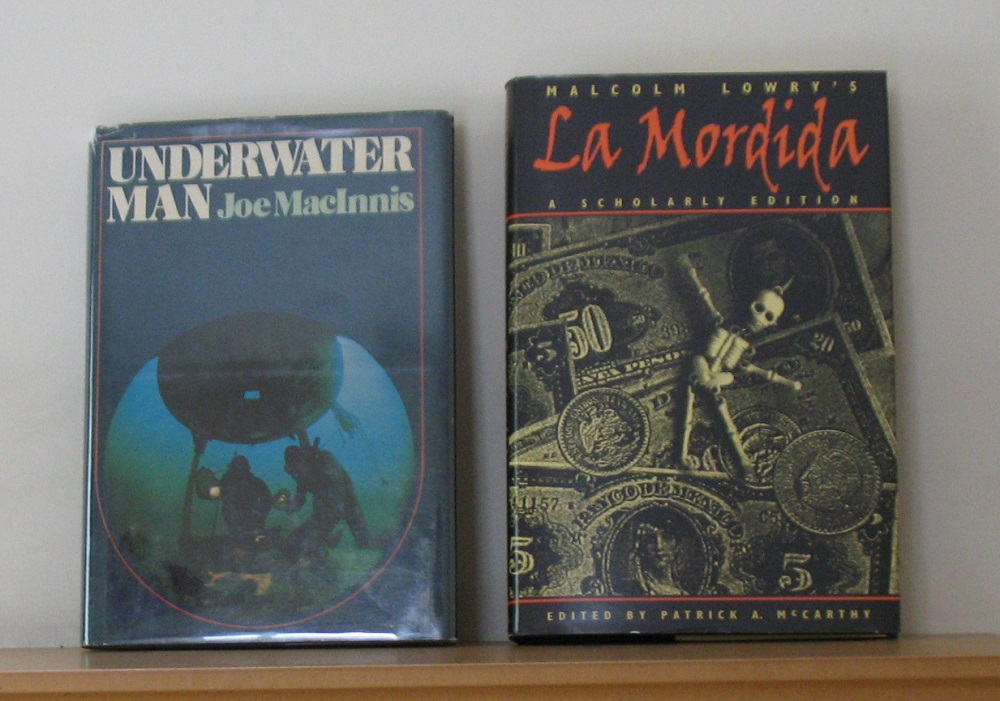
Underwater Man is the second of two Joe MacInnis books I bought (see here for the other), but it took a bit longer to arrive as the seller was in Canada. La Mordida is another scholarly edition of a Lowry work – it’s a draft of an unpublished novel Lowry wrote about a trip to Mexico in 1945.


1 Comment

Moving pictures, #22

Only one American film this time, and yes, that’s two Bollywood films. Which I can blame on the vagaries of the DVD rental services. Not that I didn’t enjoy them – in fact, the Guru Dutt was really good.

robot_overlordsRobot Overlords, Jon Wright (2014, UK). Robots have conquered Earth, although they insist it’s only tempoerary while they learn everything there is learnt about humanity. Meanwhile, everyone has an implant fitted in their neck and is nofined to their home – except for a volunteer force, who collaborate with the robots. Robot Overlords centres on a young boy whose RAF father went missing shortly after the invasion. Meanwhile, local volunteer force leader Ben Kingsley has designs on his mother, Gillian Anderson. But then the kids accidentally discover how to disable their implants… and that gets them involved with the local black market (although what they’re trading is a mystery, as no one appears to work anymore), as well as bringing them to the attention of the robots. Who, it turns out, in a completely non-surprise turn, have no intention of going and leaving Earth to carry on as before. The boy’s brother discovers he has a mysterious ability to control the robots, which sort of comes from nowhere. They find the father, hiding out with others in a tine mine, and there’s a Spitfire – WTF – which they use to dogfight the robots. Despite being a polished production, Robot Overlords is a story that probably seemed much better on paper than it actually is. The film only took £4,000 on its opening weekend and, distribution aside, it’s not hard to see why: it’s not very good.

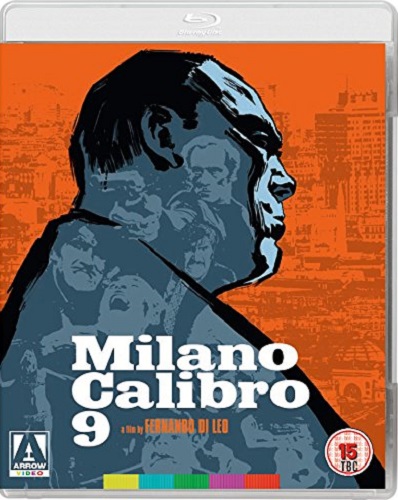
milanoMilano Calibro 9, Fernando Di Leo (1972, Italy). This is a pretty ordinary Italian thriller, except it has a great soundtrack – partly provided by Italian prog rock group Osanna. And it’s obvious right from the opening credits. A gangster is released from prison after serving three years. Everyone thinks he stole $300,000 from his old mob boss, the American (bizarrely renamed the Mikado in a dubbed version). He tries to convince them he doesn’t have themoney and he plans to go straight – but the police don’t belive him, the American doesn’t believe him, his over-acting nutjob ex-partner Rocco doesn’t believe him, and his girlfriend doesn’t believe him. Meanwhile, Rocco and the American are cleaning house by having couriers they suspect of theft actually pick up parcel bombs. And there’s a friend of the gangster who’s a hitman, and the American’s suspicion descend on him… which totally backfires. A pretty solid Italian thriller, very seventies, and with a great soundtrack. Worth seeing.

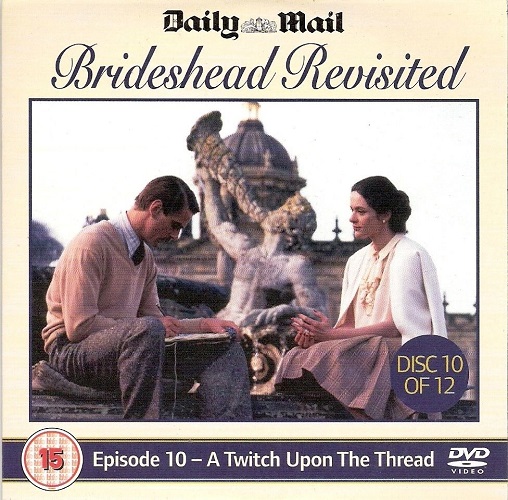
bridesheadBrideshead Revisited (1981, UK). Even now thirty-five years later, Brideshead Revisited is still remembeed as a notable British televisual event. It was a first in many respects, and proved far more successful than its makers had ever expected. Looking back on it from the twenty-first century. it’s not especially easy to understand why it proved such a landmark. Television has changed so much in the decades in between. Of course, a lot of the appeal rests on the source material, and Brideshead Revisited is generally reckoned to be Evelyn Waugh’s best work – and Waugh was a highly-regarded novelist for much of the twentieth century. The adaptation makes a good fist of presenting the time during which it’s set – it opens during WWII, then leaps back to the late 1920s, and the Oxbridge days of Charles Rider (Jeremy Irons) and Lord Sebastian Flyte (Anthony Andrews), before continuing on through the 1930s. Waugh was a horrible snob, and desperate to be accepted by the upper classes – and that’s pretty much what drives Brideshead Revisited. Which makes it even more surprising a hit. There’s that baffling British love of tales of upper class life from the early decades of the twentieth century, of course. But Brideshead Revisited did have a top-notch cast; and Waugh’s novel handled some weighty themes, which made it more or less intact into the adaptation. Having said all that, the Marchmains, indeed much of the cast, are pretty hard to care about. Waugh’s longing to be seen as an equal by people like the Marchmains is plain throughout, and that only makes the whole even less easy to like.  And yet… I did equite enjoy it. I just thought it was about a horrible bunch of people, and I was pretty indifferent to their fate.

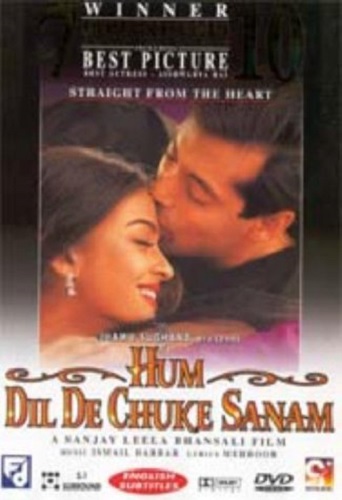
hum_dil_deHum dil de chuke sanam, Sanjay Leela Bansali (1999, India). A singer travels from Italy to India because he wants to learn at the feet of a master of Indian classical music. The master’s daughter is Aishwarya Rai. The singer and Rai initially take a dislike to each other – she chiefly because he has taken her room in the, well, it’s more of a palace than a house. Over several musical numbers, they fall in love. But her parents have arranged her marriage to the unmusical lawyer Vanraj. When the two lovers are discovered canoodling, the master sends away his student. Rai is married to Vanjay, but she is not happy. Eventually, Vanraj decides to reunite Rai with her Italian lover (actually, he’s Indian, although lives in Italy and has an Italian surname). So he takes her to Italy – well, to Budapest, which plays the part of Rome, Hungarian hoardings and street signs notwithstanding. But finding the boyfriend is not so easy, and during the course of their search Rai comes to realise she actually loves Vanraj. So when they do find the elusive singer, she tells him that she came looking for him but now she wants to stay with her husband. This is a Bollywood film, so there’s lots of musical numbers – and some of them are big. Huge, like stage shows. Even for a Bollywood film, Hum dil de chuke sanam felt somewhat OTT (although, to be fair, I’m hardly an expert as I’ve only see about half a dozen). It starts slow, but it definitely builds up steam; and by the time it was all over I could understand why it had proven so successful.

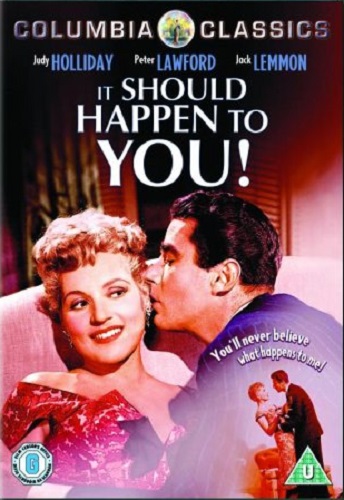
it_should_happenIt Should Happen to You!, George Cukor (1954, USA). I’m not sure why added this to my rental list, probably because I’ve enjoyed some Cukor movies and I do like me some 1950s rom com… Unfortunately, this one was a bit of damp squib. Although not originally written for Judy Holliday, it felt like a vehicle for her. She plays Gladys Glover, who moved to New York to make it but has so far failed to do so. So she spends her savings on a billboard on Columbus Circle – with her name in ten-foot high letters. However, that billboard is normally taken by the Adams Soap Company for their spring promotion. They contact Holliday, but she won’t give it up. They do her a deal – six billboards scattered around New York. She becomes a household name, Adams use her as a model, and so she makes it big. Meanwhile, Jack Lemmon (in his first role), who met her in Central Park right at the beginning and then was a bit stalkery, realises he can’t compete with playboy head of Adams Soap (Peter Lawford), so bows out. But Holliday realises she really loves him. There was some good footage of 1950s New York, but Holliday seemed a bit too laconic for the part she played, and the rags-to-riches tale felt a bit too well-worn.

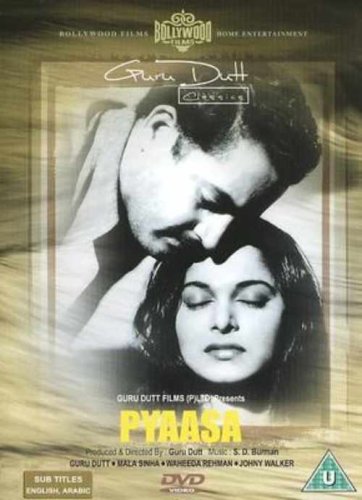
pyaasaPyaasa, Guru Dutt (1957, India). Producer, director and star Dutt plays a poet who can’t get published. He bumps into an ex-girlfriend from his school days who is now married to a big-shot publisher. The publisher hires Dutt as a servant and mostreats him, but then a beggar who dies under a train is mistaken for Dutt… and Dutt’s poetry becomes a posthumous success. His two brothers argue over the money his work now earns, and when Dutt reappears they refuse to recognise him. Eventually they see the error of their ways, but by then Dutt has had enough and walks away. I tweeted that this film “has been restored from vintage source for nostalgic appeal”, as per an on-screen notice in the opening credits. And certainly the transfer quality of the black and white print was not great (by comparison, Mother India – see here – released in the same year – was filmed in colour and a much better quality transfer). Despite all that, Pyaasa was probably the most interesting Bollywood film I’ve seen so far – in fact, I want to see more of Dutt’s movies. It wasn’t just that Dutt played a good part, but that the film seemed to address more interesting themes than your average Bollywood film, and appeared to be more of a drama than a melodrama. It still had songs and dance numbers in it, though.

1001 Movies You Must See Before You Die count: 761


1 Comment

Reading diary, #28
Occasionally, I read books. I am in fact supposed to be more of a literature fan than I am a film fan, but reading a book takes few days whereas watching a film takes only a couple of hours. Of course, if I were serious about my film criticism, I’d  be watching each movie a number of times with notebook in hand, ready to make insightful comments… instead of cobbling together a hundred words a week after watching the film while drinking wine… Still, at least I read sober. Not that I take notes while reading. But then I’ve never thought of myself, or called myself, a critic, I’ve always been a reviewer and that’s how I approach how I write about the books I’ve read. Which were…

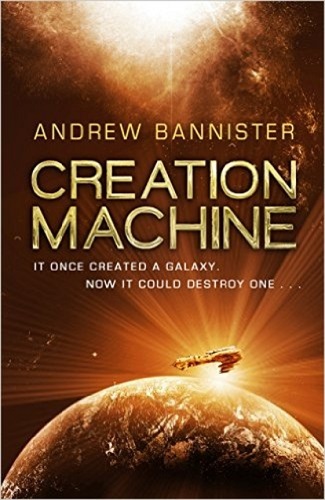
creation_mcCreation Machine, Andrew Bannister (2016). This one seems to be getting quite a push from Bantam (they were giving away free ARCs at Eastercon). First impression… well, it’s very Banksian. And that can’t be bad. The action takes place in the Spin, an “artificial galaxy”, although no real sense of the size or scale of this galaxy is apparent in the book. The heroine, Fleare Haas, who struck me as very much in a smiliar vein to Banks’s Lady Sharrow, is the daughter of the plutocrat who pretty much runs the Hegemony, the Spin’s most powerful government. She tried fighting against him in a breakaway army, but that ended badly. As the book opens, she’s a prisoner of an enigmatic ruin on one of the Spin’s worlds. She’s then rescued by an ex-colleague who is a cloud of nanobots (one of the novel’s more inventive elements), because she’s needed to prevent the Hegemony  from doing something stupid with a powerful artefact that may be left over from the machine that built the Spin. That artefact is currently in the hands of a brutal regime which occupies a handful of worlds in the centre of the artificial galaxy. It’s all very twenty-first century space opera, very readable, quite inventive, with a slight twist of Banks and a mordant, albeit far more sweary, wit… But it’s also a space opera universe in which capitalism runs everything, and slavery, torture and brutality seem the default setting… In fact, there are no redeeming features to the societies depicted in the Spin. And I have to wonder, why would someone write a book like this? It feels like an attempt to writer a grimdark space opera – but since I think grimdark is a horrible thing, I can think of no good reason why anyone would want to do the same in space opera. I suspect this book will do quite well, but I’ll not be bothering with the sequels.

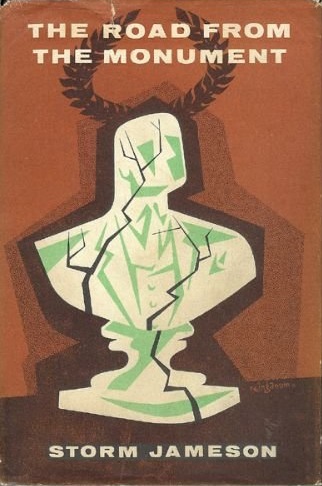
monumentThe Road from the Monument, Storm Jameson (1962). An odd book, and perhaps even more odd because Jameson is such a good writer. Greg Mott is a highly-regarded author, and the director of an artistic institute. He came from humble beginnings – his father was a destitute ex-seaman, and – the shame! – he graduated from Sheffield University – but he has made something of himself, a great man of letters, with important friends and acquaintances. I have to wonder if Mott were based on Evelyn Waugh, although Waugh went to Oxford. The Road from the Monument opens with the retirement of a public school teacher – he’s been there sixty years, wasn’t even qualified when he started, and has been paid a pittance throughout his tenure. The teacher spotted Mott’s potential early, and spoent his own money to put Mott through university. After leaving the school, he goes down to London to see what Mott has made of himself – and realises that Mott’s intelligence and wisdom pretty much skin-deep. He goes back gom edisappointed. The story then focuses on Mott’s second-in-command, Lambert Corry, his best friend at school, who went to Oxford, became a civil servant, rose through the ranks but then resigned to take up a position at the institute. Unlike Mott, he is not a successful author. Although the plot of The Road from the Monument is ostensibly about the scandal which hovers over Mott after he picks up a young woman while on holiday in Nice and gets her pregnant, it reads more like a poison pen letter from Jameson to the UK’s literary set. Most of the characters are writers of varying degrees of success, and James sticks the knife into every one. I tweeted a quote from the book while reading it, and it’s one of the mildest characterisations in the book of one of its cast: “they always gave him credit for honesty and integrity, the virtues of a moth-eaten writer. He got what he deserved – respect and neglect”. The upper class are also depicted as sociopaths (which I suspect they are, anyway; as are the plutocrats), and, in fact, no one in this novel is at all sympathetic… except perhaps the young woman who is made pregnant by Mott. Not a pleasant book to read (I’m not doing too well in that respect in this post), and Jameson does over-do the interiority… but she’s nonetheless a sharp writer, and I plan to further explore her oeuvre.

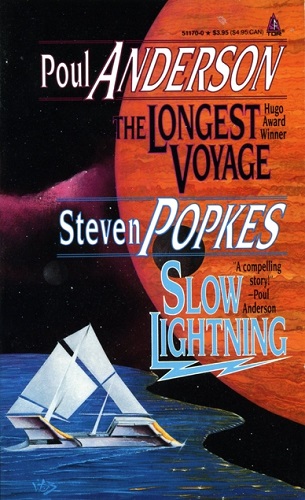
slow_lightningThe Longest Voyage / Slow Lightning, Poul Anderson / Steven Popkes (1991). Back in the late 1980s and early 1990s, Tor published a series of tête-bêche novellas, stretching to 36 books. By book #30, they’d dropped the tête-bêche format, and in fact dropped the whole double-novella thing at times, as this one is pretty much a short story followed by a short novel. Which are not at all related. And I have no idea why they were published together. Or indeed why they were published at all. ‘The Longest Journey’ originally appeared in Analog in 1960. It’s set on the moon of a gas giant, colonised by humans at some point but now they’ve regressed to a late mediaeval tech level. A Columbus-like figure sails across a vast ocean to a mythical land… and finds it is inhabited with people just like himself. They’re welcomed with open arms, trade agreements are drawn up… and then the explorer learns of a hermit and his ship that sails between the stars… This is the sort of sf story that used to appear by the hundreds back in the 1950s and 1960s. It apparently won the Hugo for best short fiction, which only goes to show the award was won by unremarkable stories even back then. ‘Slow Lightning’ is original to the double, and I’m baffled why it made it into print. It reads like half a dozen stories randomly stuck together because the author once heard the word “plot” and has a sort of vague idea what it might mean. It opens on a contemporary Earth after an alien, well, not an invasion. They came, they started trading, they pretty much overwhelmed the planet… and they turned Boston into an intergalactic port. A young orphan, whose parents died while settling an alien world, is now living with his aunt and her moody teenage son. With him he has Gray, a spatient, who is a sort of alien android thing but looks more like a six-legged rhino or something. The boy finds an alien egg in the wreck of a ferry on the bay shore. He decides to hatch it to see what comes out. Gray investigates as he’s worried what it might contain. The egg hatches, end of story. Except it isn’t. The plot now jumps back in time to the boy’s parents, to explain what they were doing and how they died, and how that ties in with the egg – which is sort of does but only peripherally. Anyway, they die, end of story. Except it isn’t. Because the story now jumps even further back in time to shortly after the aliens arrived, and describes the death of the boy’s grandparents, who were caught up in a turf war between the Boston authorities and a smuggler lord who married the boy’s grandfather’s sister. The whole thing reads like they might have been separate but linked stories, but the decision to publish them together, in reverse chronological order, was a mistake.

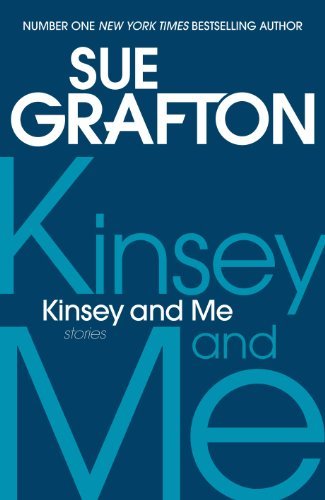
kinseyKinsey and Me: Stories, Sue Grafton (2013). I have been a fan of Grafton’s Kinsey Millhone almost as long as I’ve been a fan of Sara Paretsky’s VI Warshawski. I think Paretsky is the better writer, and Warshawski the better character, but Grafton’s Millhone still has her appeal. I especially like that Grafton decided Millhone would age one year for every two-and-a-half books, so her alphabet series – it’s up to X at the moment – is now historical fiction, given that it takes place in the late 1980s. Along the way, Grafton has banged out the odd short story, mostly for anthologies of female crime writers, and Kinsey and Me collects those, plus a series of stories about Kit Blue which appear to have been written as some sort of therapy on the death of Grafton’s alcoholic mother. The Millhone stories are entertaining but lightweight – although the constant need for Millhone to introduce herself gets a bit wearying over nine short stories. The plots pretty much follow the same formula: someone asks Millhone to investigate something, she does so, spots a single clue which reveals all is not as it seems, there’s a final showdown, and she reveals the clue and how it led her to figure out what really happened. The Kit Blue stories are uncomfortable reading because they’re plainly autobiographical, but it’s also hard to understand why Grafton made them public. Kinsey and Me adds nothing to the alphabet series, and even for fans it’s of only peripheral interest.

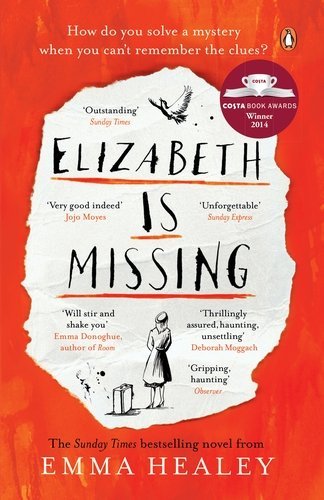
elizabethElizabeth is Missing, Emma Healey (2014). I spotted this in a charity shop and remembered that someone had recommended it, so I bought it. But I can’t recall who recommended it, or why – I suspect David Hebblethwaite. The protagonist, Maud, is in her eighties and suffers from dementia. Her best friend Elizabeth has gone missing – or, at least, so Maud thinks. In between Maud trying to find out what has happened to Elizabeth, she remembers the disappearance of her sister back in the late 1940s. It’s a clever idea, and it’s handled well. The big problem is the main character – Maud feels like an old person written by a young person. It’s small details. When you’re in your eighties, mortality looms large, but the word doesn’t appear anywhere in Elizabeth is Missing. Maud’s dementia is chiefly characterised by a lack of short term memory and an occasional inability to recognise things. The present day chapters alternate with ones set in 1946, which, of course, are told with perfect recall, and so add a spoiling note to the central conceit. It’s obvious from the start that Elizabeth isn’t really missing – or rather that there’s nothing sinister about her disappearance – but the 70-year-old mystery against which this is juxtaposed proves trivially easy to solve, and it come as a surprise no one figured it out at the time. Although generally well-written, and Healey’s choice of heroine has to be applauded, ultimately I don’t think Elizabeth is Missing quite succeeds. But it’s at least worth reading.

1001 Books You Must Read Before You Die count: 122


4 Comments

Moving pictures, #21

And back to more films from the US than elsewhere. Given that only half the films described below are rentals, I can’t claim the vagaries of their service as an excuse. Oh well.

cindrelac2Cinderella, Kenneth Branagh (2015, USA). I bought a Blu-ray of the animated Disney Cinderella and the cheapest version available was a double Blu-ray box set with the 2015 live-action version of the film, because, probably, the live-action needs a bit of extra help to sell. I mean, whoever heard of a live-action Cinderella? Okay, it was directed by Branagh, and it’s got stars like Helena Bonham Carter and Cate Blanchett and Stellan Skarsgård and Derek Jacobi in it… but given the number of princess films Disney churns out, my expectations were understandably quite low. And yes, the film takes a few liberties with Perrault’s story, chiefly in order to give the characters more of a background. The two leads – Lily James and Richard Madden – are also a bit bland. But… there were some quite clever references to the Disney animated version, Bonham Carter’s absent-minded Fairy Godmother was fun, and Blanchett was on good form. However, the choreography during the ball scene just looked silly, and spoiled for me what had been up until then good family entertainment. A better film than I’d expected, but nowhere near as good as the animated version (although in its favour, its mice are considerably less annoying). [ABC]

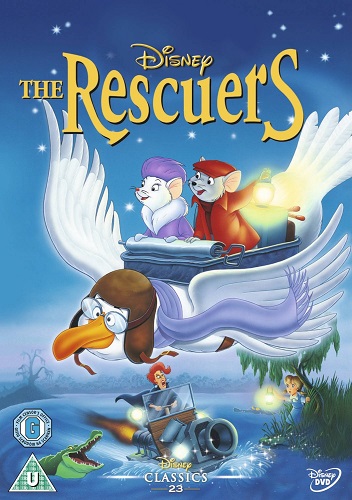
rescuersThe Rescuers, John Lounsbery, Wolfgang Reitherman & Art Stevens (1977, USA). I have a vague memory of this film’s original theatrical release. I can’t remember if I went to see it at the cinema, or if on a trip to the cinema my sisters saw it and I watched some other film. Watching it this time, 38 years later, very little seemed all that familiar. The seagull I sort of remembered, and Madame Medusa I think I remembered… But nothing else. Apparently, The Rescuers was instrumental in turning around Disney’s fortunes – they had not a successful film since The Jungle Book in 1967. I’m not sure I understand why – I can’t think of a weirder pairing for the main characters as Bob Newhart and Eva Gabor. And the animation looked a little crude and not very crisp when compared to Sleeping Beauty and Cinderella. I wasn’t that impressed. Amusingly, in 1999 Disney had to recall 3.4 million videocassettes of the second home video release because someone had spotted a photo of a topless women in the background of one of the shots.

hard_to_be_a_godHard to be a God, Aleksey German (2013, Russia). I’d heard a great deal about this film, and everything I’d heard led me to think I’d be much impressed by it. Not just that it was made by a Russian director, and made in that sort of very Russian style; or that it’s an adaptation of a novel by Boris & Arkady Strugatsky… Anyway, I bought the Blu-ray when it was released… and it sort of sat on the pile of films to be watched for six months or so before I finally decided to stick it in the player… An agent from Earth has infiltrated the society of another planet. The humans of the planet are anti-intellectual, and so are mired in the Middle Ages. The agent has taken the place of a local baron, and the local populace treat their nobles as god. On Blu-ray, the filth and squalour of the world German has created is visceral and obvious.  The film sort of meanders about, revelling in the awful conditions in which everyone lives, and the dumb laws under which they must survive (an old man is drowned upside down in shit, for example, for writing poetry – and being what the subtitles call a “smartypants”). It’s all very grim and very cheerless, but in a sort of weirdly unbelievable and implausible way. The cinematography is fantastic, the film’s commitment to its world is astonishing… but, even though I like slow cinema, this is not a film in which things happen at a particularly fast pace. I thought I’d like it more than I did, so in that respect it’s disappointing. But it’s definitely a film that stands numerous viewings, so I’m glad I bought a copy. [ABC]

black_godBlack God, White Devil*, Glauber Rocha (1964, Brazil). So I’d watched Rocha’s Entranced Earth – because it was on the 1001 Movies Must See Before You Die list, it was a rental, see here – and I really enjoyed it and I was a bit drunk, so I went and bought DVDs of Rocha’s three films, of which Entranced Earth forms the middle part of the trilogy. Black God, White Devil is the first of the three. Obviously, I was interested to see what I made of it. And… well, it’s not a very good transfer. I like that Mr Bongo are releasing hard-to-find non-Anglophone movies, but they don’t seem to put much effort into it. Happily, Black God, White Devil is a good film. A really good film. It has a bit of the Jodorowsky about it, and it works really well. A poor farmer has to flee when he kills his boss (after his boss insists the farmer carry the cost of the loss of the two cattle which died of snake bites en route to market). The farmer and his wife join St Sebastian, an apocalyptic preacher who suggests violence is necessary for redemption. Meanwhile, the government is getting worried about St Sebastian and his growing influence. So they hire bandit Antonio das Mortes to kill the preacher and his followers. Two are left alive to spread the word – yes, the farmer and his wife. And they in turn become bandits. I now want more of Rocha’s films, but the three I have appear to be the only ones that are available. Bah. [0]

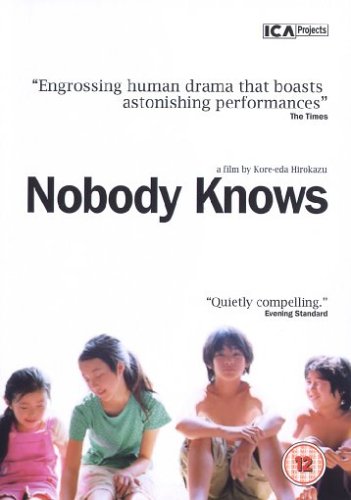
nobodoy_knowsNobody Knows, Hirokazu Koreeda (2004, Japan). This was recommended to me by David Tallerman, who has previously recommended anime films, but this is live action… although “action” may not be the right word. It’s a dramatisation of a true story. A woman with a twelve-year-old son moves into a new apartment. However, she actually has four kids – two are very young and are smuggled into the building inside suitcases, the other is eleven and turns up later. The woman continues to pretend she only has the one kid to her landlord. One day, she heads off to work… and never returns. She has abandoned her children. The oldest boy tries to keep the other children safe and fed, although what little money the mother left soon runs out. Then the utilities are cut off since the bills haven’t been paid. When the youngest girl falls from a stool, hits her head and dies, the three children bury her in a field near the airport. The film is played very flat, like a documentary, which has the odd side-effect of making the mother appear merely flighty instead of criminally negligent. Apparently, the real-life case was somewhat more gruesome – there were five children, not four; the youngest died after being assaulted  by friends of the eldest; and all were badly malnourished when discovered by the authorities (after a tip-off from the landlord). Another of the children also died – Wikipedia does not give the cause – and the body was found with the three survivors. The mother gave herself up when the case hit the news. Astonishingly, after she’d served her three year jail sentence, the mother was given custody of the two surviving girls.

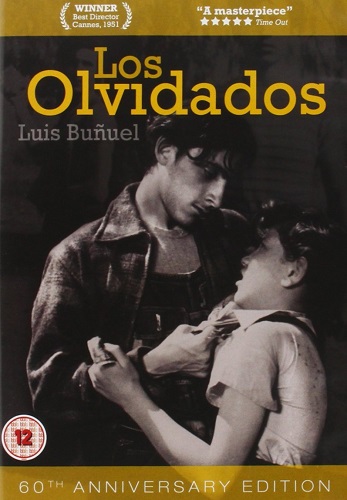
olvidadosLos Olvidados*, Luis Buñuel (1950, Mexico). The title refers to the forgotten kids and teenagers who live on the streets of Mexico City – although this is not a documentary. The teenage leader of a street gang escapes from juvenile jail, tracks down the kid who supposedly grassed him up, then beats him to death with a rock. A younger kid is witness but promises to say nothing. His mother persuades the kid to go straight and he gets a job as a blacksmith’s apprentice. But then the gang leader turns up and steals a knife. The kid is accused of the theft and sent to a progressive rehabilitation centre where, after a dodgy start, he seems to settle down. But then up pops the gang leader again, and he steals some money from the kid. They fight. During the fight, the kid tells everyone the gang leader is a murderer. The gang leader runs away. Later, he tracks down the kid and kills him. But the police are now after him – and they find him and gun him down. Shot in black and white, and in a social realist style, this is anything but a cheerful film. In fact, it’s really grim. To be honest, it didn’t much feel like a Buñuel movie, despite a bizarre dream sequence. To date, I’ve seen eight of Buñuel’s thirty-two films and only really liked two of them – The Exterminating Angel and The Discreet Charm of the Bourgeoisie, neither of which have that much in common. Much is made of Buñuel’s surrealism, or the surrealist elements of his films, and certainly the surrealism of the two I like is their major draw. But then I don’t see where Tristana, Belle du jour or Viridiana are especially surreal – and Un chien andalou and L’age d’or felt more like experimental films than anything else. An important director, undoubtedly, and one whose movies I will continue to watch – but I can’t say he’d make my top ten, or even top twenty…

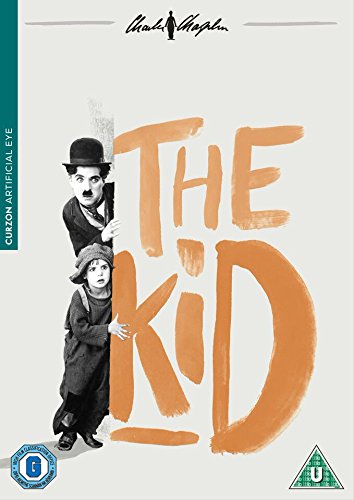
kidThe Kid, Charlie Chaplin (1921, USA). I thought this was on the 1001 Movies Must See Before You Die list, I can’t think why I put it on my rental list otherwise, but it’s not. Strange. Anyway, I watched it. The Kid is one of Chaplin’s most famous movies, and probably because of the title character. A woman has her baby stolen, it’s then left in an alleyway, where Chaplin finds it. He tries to get rid of the child, but fails… and so takes it home with him. The film then jumps forward five years, and the baby has grown into a little gamin, whom Chaplin’s tramp uses in his various cons. The kid throws rocks through windows, then Chaplin turns up with a pane of glass and is paid to replace the broken pane. There’s a scene where Chaplin is beaten up by a tough who’s wearing a bizarrely-padded jumper, and lots of Chaplin-like visual jokes… and a frankly bizarre dream sequence in which Chaplin imagines himself as an angel, the kid too, and everyone else who has appeared in the film, and the two of them fly along the street set… and then Chaplin wakes up.  He decides to track down the kid’s mother, and return him to his rightful home. Which he does suspiciously easily – mother and son are re-united as if it had been five weeks and not five years, and everyone lives happily ever after. I actually prefer the other Chaplin films I’ve seen to this one, yes, even Monsieur Verdoux.

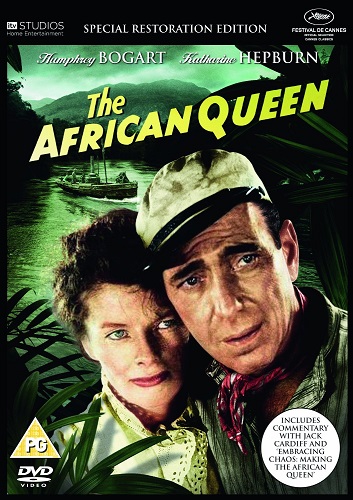
african_queenThe African Queen*, John Huston (1951, USA). Katherine Hepburn is the sister of a British missionary (Robert Morley) in German East Africa in 1914. Humph is the captain of the eponymous steam-powered river boat which regularly delivers supplies. WWI breaks out, the Germans burn down the missionaries’ village, Morley is killed, so Hepburn and Humph escape on the African Queen. They plan to follow the river to the lake at its end, and there destroy the German gunboat which is preventing the British from attacking. Along the way, they fall in love, sneak past a German fort which commands an excellent view of the river, fix a broken propellor, survive a trip through some fierce rapids… It’s all very adventuresome – but then it is adapted from a CS Forester novel. Hepburn and Bogart forever hover on the edge of parody; and half the time they feel like impressionists playing the actors playing their roles. It’s all very silly, and amazingly lightweight for a film that’s on the 1001 Movies You Must See Before You die list. In fact, I’m surprised it actually made the list. Huston is on there eight times, and some of the choices are baffling – Prizzi’s Honour? WTF? After early classics like The Maltese Falcon and The Treasure of the Sierre Madre (both also starring Humph), you have to wonder what happened…

1001 Movies You Must See Before You Die count: 761


7 Comments

Moving pictures, #20

A nice geographical spread this time, although only two films are from the 1001 Movies you Must See Before You Die list.

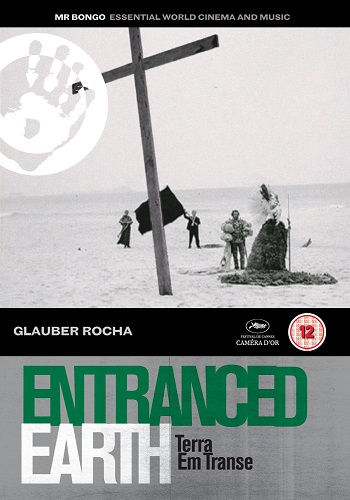
entranced_earthEntranced Earth*, Glauber Rocha (1967, Brazil). I watched this while drinking wine, as you do, and liked it so much I drunkenly went and bought it on Amazon, along with the other two films with which it forms a trilogy – Black God, White Devil and Antonio das Mortes. Oh well, these things happen. I’ve since watched it again – sober, of course – and… I still loved it. It’s a very political film, set in the invented country of Eldorado during an election, in which a journalist tries to decide between a conservative candidate and a populist candidate, both of which are corrupt. The narrative skips back and forth in time and place – it opens at the governor’s palace, but there are also scenes with one of candidates out meeting the public, as well as scenes of the other candidate ranting about the natural superiority of the upper classes. The journalist is also a poet, so we get to see some of his poetry as well. And there’s an astonishing series of shots from high up on a radio mast beside a villa built on the top of a mountain. Plus a hot jazz score. And I hate jazz. It’s clearly influenced by France’s New Wave, but not to its detriment. I loved it. A damn good film. A plot that’s all politics, a non-linear narrative… Great stuff. As I said earlier. Obvs. [0]

late_autumnLate Autumn, Yasujirō Ozu (1960, Japan). And speaking of buying films from Amazon, I’m pretty sure I was sober when I purchased this but I’d actually meant to buy An Autumn Afternoon, which is on the 1001 Movies you Must See Before You Die list, and not Late Autumn, which isn’t. Still, it’s Ozu and you can’t really go wrong with his films. Admittedly, I wasn’t all that taken with Tokyo Story, his most famous film, but I did like Floating Weeds, a later film, a great deal. And, having now watched Late Autumn, which I also liked a great deal, I think I ought to watch more of his films. Such as, er, An Autumn Afternoon. In tihs one, four middle-aged men turn up to the memorial service of a friend of theirs from college days, and decide to find a husband for the attractive daughter of their dead friend. It does not go well. Partly because the young woman does not want to leave her widowed mother alone, but also because the four blokes bungle their attempt at match-making. Late Autumn is a beautifully understated study of professional Japanese life. There are no theatrics, no histrionics, no need for special effects, just people going about their lives… and filmed with no pretensions by Ozu. [dual]

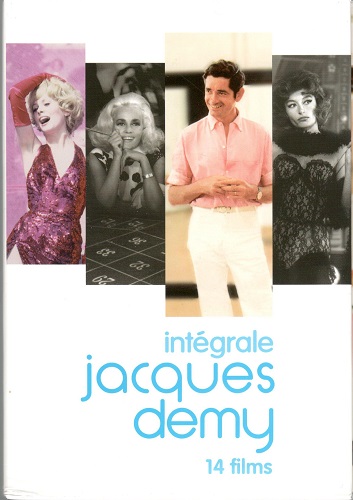
demyPeau d’âne, Jacques Demy (1970, France). Imagine a muscial version of Cinderella with Catherine Deneuve in the title role, only it’s not Cinderella it’s a story that’s a lot like it but a bit weird in places and, well, very Demy. But pretty much the same. Sort of. Deneuve plays a beautiful princess, whose father shows an un-paternal level of interest in her after her mother’s death. So she runs way to the woods, and with the help of magic appears as a poor and dirty servant girl when wearing the eponymous donkey skin. But the prince of a neighbouring country meets her (all his courtiers are red, whereas hers are blue), and wants to marry her. He has her ring – Cinderella’s slipper, in other words – and calls for every woman in the country to try on the ring so he can identify his one true love. Although the plot is pretty generic, the film is very Demy – the courtiers are completely coloured according to their court, so Deneuve’s retainers even wear blue face make-up; and, of course, there are songs, written by Michel Legrand, so if you’ve seen other Demy films you shold know what to expect. Mildly diverting. [2]

dancing_hawkDancing Hawk, Grzegorz Królikiewicz (1978, Poland). I really do like Polish cinema, butr I’m not entirely sure what to make of this one. Ostensibly, it’s the sotry of a self-made apparatchik, who rises high, only to lose it all in the end. But the opening shots depict his childhood during WWII, through much use of Dutch angles, weird shots and strange colour filters. And there’s an abrupt change to Polish realistic cinema, in that sort of TV drama style they do so well – I’m reminded of Wajda’s Man of Iron and Piestrak’s Test Pilota Pirxa – although that may just be the 1970s vibe. I should really wait until I’d rewatched this film before rewatching, but I’m getting a bit behind on my moving pictures posts… but perhaps I’ll write about it again after a rewatch. I will, however, note that I fancy getting that Królikiewicz box set… [0]

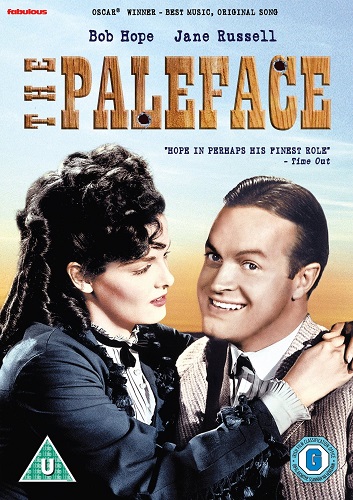
palefaceThe Paleface*, Norman Z MacLeod (1948, USA). There have been a number of films whose presence on the 1001 Movies you Must See Before You Die list I have found baffling, and none more so than this Bob Hope vehicle which manages to be mildly amusing and… well, that’s about all. My own list would include films others might find surprising, but I’d at least defend them; but there’s no documentation on the 1001 web site, so short of buying the actual book I’ve no way of knowing why this film makes the list. It certainly doesn’t deserve to – in fact, every other film in this post not on the list has a better claim to a place than The Paleface. Which may be slightly unfair, as there are plenty of films on the list which don’t belong on it. Bob Hope plays a dentist, and not a very sucessful one, whom Jane Russell decides to use as cover in her mission to travel eadt and discover who is running guns to the nasty Native Americans (who are, after all, trying to prevent their lands from being occupied by an invader; oh wait, the film doesn’t mention that).

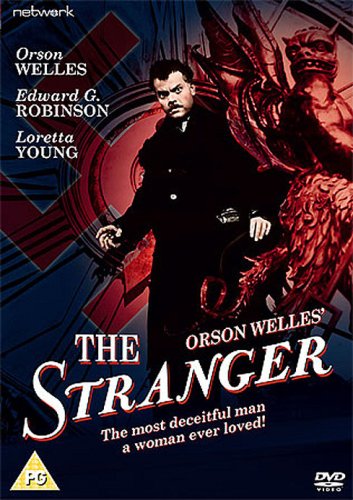
strangerThe Stranger, Orson Welles (1946, USA). A war criminal is released so he can lead a war crimes investigator to a bigger fish. He’s followed to a small US town, where the investigator becomes suspicious of one of the local pillars of the community (played by Welles himself). Apparently, te film is notable for a number of reasons – that Welles wasn’t the first choice of director, and that the film incorporates newsreel footage of the Nazi death camps (because the Americans of the time didn’t really think they ever existed; some still don’t). My admiration for Welles’s work has grown over the past couple of years, and although it’s all too easy to forget quite how ground-breaking Citizen Kane was when it was made, so it’s easy to forget that many of his later films weren’t as straightforward as they initially appeared. The Stranger is by no means a highlight of his oeuvre, it is in most respects a relatively straightforward thriller of its time, but there’s lots to like in the less obvious details – such as the characterisation of some of the cast. Welles was never as clever cinematically as Hitchcock, but he was cleverer in other ways. Worth seeing.

1001 Movies you Must See Before You Die count: 758


27 Comments

An honest vote is a wasted vote

It’s Hugo season once again. We’ve had the nominations and now we’re waiting for the shortlists to be revealed (which they will be on 26 April). This year, apparently, the award received over 4,000 nominating ballots, almost double last year’s 2,122 ballots (which was the highest number that had been seen since the award began in 1955). Of course, the big question is, how successful have the puppies been this year? They did well last year because the actual number of nominations needed to get a work onto a shortlist is surprisingly low. The short story category in 2015, for example, had 1,174 ballots spread across 728 works, and those on the shortlist received only between 132 and 230 nominations…

None of this should come as a surprise. The field is now far, far larger than it was when the award was created. There are so many novels and short fiction works being published in any one year it’s impossible to keep up. The Hugo awards claim to be for the “best” works, but voters can only nominate the best amongst those works they’ve actually read. And, of course, the term “best” has as many definitions as there are voters…

1953hugo.astounding.n4

Since I’m a member of next year’s Worldcon (in Helsinki), I was eligible to nominate works for this year’s Hugo Award. I didn’t, however. When the works I consider the best published in 2015, that I’d read, are likely to get no more than a dozen votes, there’s not much point in nominating. And I can be fairly sure of that as I nominated them for the BSFA Award, which has a much smaller pool of voters, and they didn’t make it onto the shortlists. But then, I know my tastes in genre fiction are out of step with most of the Hugo electorate’s – for example, while Kim Stanley Robinson is a writer I admire and whose novels I enjoy, I thought Aurora a weak book… but I appear to be in a minority on that. As for the authors who regularly make it onto Hugo shortlists (seriously, wtf? Redshirts was a better novel than 2312?).

Assuming most voters have only read a small portion of the eligible works, and that portion is likely different for everyone, then lots of works will get only a handful of votes each (this is more the case with short fiction categories rather than novels, of course). Which does sort of render the whole award pointless.

Assume instead that people vote for works not simply because – perhaps not even because – it was the work they thought best of those published in the preceding year. Perhaps they vote for a work because:

  • people they trust have told them the work is award-worthy
  • they’ve liked other things written by the person, if not this particular work
  • they like the writer (or their blog, etc)
  • they think the writer deserves an award (for any number of reasons)
  • the writer is a friend
  • the writer has helped them in their own writing career

Perhaps I’m being unfair, perhaps people really do vote for the story or book they think the best of the year (seriously, wtf? Redshirts was a better novel than 2312?). But I think people vote tactically, either consciously or unconsciously. If they’re part of a writer’s informal support network or fandom, then they’ll likely vote for that writer. If they hear lots of buzz about a particular work, they might well vote for that if they’re short on their ballot.

The Hugo Award is a popular vote award, it rewards popularity. It does not reward quality. Most voters probably don’t consciously vote tactically. Not unless they’re puppies. By definition, the puppy campaigns are overt tactical voting campaigns. And there’s not much difference between them and writers who mobilise their fanbases by writing eligiblity posts. It’s worth noting that John Scalzi has had to categorically state that he does not want to be considered eligible for a Hugo this year. When a writer has to do that, then you know your award is fucked.

I guess we’ll find out next week just what the future holds in store for the Hugo Award. It’s been useless as an indicator of quality for genre novels, or even as a barometer of the current state of the genre, for decades. On the other hand, there has never been so many people nominating for the award before. How many of those 4,000 are puppies? Or are they fans who have mobilised in order to combat the puppies? While it’s certainly true that the puppies have opened up the award such that the taste of the electorate has widened (the narrowness resulting from the success of the rabid puppies last year notwithstanding), having a couple of thousand new voters parachute in to  “save” the award from them is hardly going to shift the Hugo from the same old pool of favourites and writers du jour.

There is only one role in which the Hugo is still useful: it is a very public magnet for all the bad practices in which eligible nominees, their fanbases, or voting blocs might indulge. Similar stuff happens in local awards, of course – just look at the list of winners of any random provincial US sf award – but no one cares. They’re like those awards web sites invent so they can promote someone or other (who might have well paid for the privilege). Certainly the Hugo Award is run as fairly as a popular vote award can be run. Which doesn’t mean it’s not open to abuse. As was proven last year by the rabid puppies. But the infrastructure is not corrupt, and if the award results in any one year appear corrupt, it’s because the system is open to gaming… and, perversely, preventing that might well make the award more open to corruption.

I gave this piece a contentious title, but I have to wonder if it’s the only way voters can approach popular vote awards in the twenty-first century. If one of the great truths of our time is that the internet has allowed people to openly display their stupidity, it has also given “tribes” and “special interest groups” much more power in the domains in which they operate. The Hugo Award is a good example of this. It claims to be a world award, but has always been awarded by an electorate that is predominantly US-based, and the works it considers have been almost entirely published only in the US (eligibility rules for non-US works notwithstanding). Prior to the invention of the Web, its claim to world relevance was little more than a vainglorious boast, but since the award was chiefly limited to its country of origin it didn’t matter so much. Now its reach truly is global… yet it remains resolutely parochial in terms of the works and people it rewards. True, the Hugo electorate is self-selecting inasmuch as it costs money to vote (you have to buy a supporting or attending membership in the Worldcon, which gives you three years of eligibility), which at least means there’s nothing in the rules limiting votes to US residents… But that’s also a weakness, in that groups can “buy” votes. There’s an online “best science fiction list” somewhere in which several of L Ron Hubbard’s novels appear in the top ten – clearly the work of cultists, since Hubbard was a shit writer (and not even a very good inventor of religions). Even for a popular vote list, that’s pretty obvious vote-fixing.

I’m not going to make a call on what I expect to see in this year’s Hugo shortlists. I know which works I would have nominated, and I’ll be very surprised if any of them appear. I’m not even convinced Aurora. which I wouldn’t have nominated anyway, will make the grade. However, the one thing I can say with certainty about the Hugo Award is that it won’t bring to my attention works I had missed and would likely enjoy – something I’m happy to say the Arthur C Clarke Award and the Kitschies do quite successfully…


5 Comments

Reading diary, #27

Although I’ve been appending a count of books read from the 1001 Books You Must Read Before You Die list to these reading diary posts, I’ve not been making much of an effort to work my way through that list – certainly not to the extent I’ve been doing with the 1001 Films You See Before You Die list. Of course, reading a book requires more of an investment in time than watching a film, and I suspect there are fewer books on the book list of the sort I’d enjoy than there are films on the film list. Anyway, there are no books from the list in this post, although I do have about a dozen somewhere on the TBR. Just thought I should mention that.

bleeding_kansasBleeding Kansas, Sara Paretsky (2008). I am a big fan of Paretsky’s Warshaski novels – my mother took me to see Paretsky being interviewed by Val McDermid at the Harrogate Crime Festival last year – although it’s taken me a while to get round to reading her non-Warshawski novels. I read Ghost Country while at Bloodstock, a metal festival, last year, and thought it very good. Bleeding Kansas is… less good. It’s apparently based in part on Paretsky’s own teen years in Kansas, before she moved to Chicago; and, I suspect, although I rather hope not, based on the people she knew from that time. Because they are pretty much all mean-minded and prejudiced Bible bashers (is there any other sort?). Especially one family, who use their faith to justify all manner of bigotry and nastiness. The story focuses on Lara Grellier, the teenage daughter of one of the farming families in the Kaw River Valley. Her mother Susan is fascinated by a Grellier ancestor, who helped slaves during the Civil War, and survived several attacks by Quantrill and other pro-slavery “Border Ruffians” (the title of the novel refers to that period), but has a mental breakdown after the death of her son in Iraq. A lesbian Wiccan from Chicago has just taken over the dilapidated mansion of the local, deceased, gentry; and the Schapen family, mean-spirited relious types to a person, have accidentally bred a pure-red heifer which an apocalyptic Jewish sect from Chicago want in order to to rebuild the Temple in Jerusalem. Meanwhile, everyone else tries to get by, without being too hateful – at which they don’t always succeed – or too liberal, which would of course see them tarred and feathered and driven out of the county. I really don’t have any sympathy for people who think their religion excuses their appalling behaviour (I’m looking at you, North Carolina), and I’m really not interested in reading about such people. It’s to Paretsky’s credit that she’s even-handed in her treatment of her caste of bigots and idiots, but that does make you wonder why she wrote the book in the first place. Yes, Warshawski is a champion and plays a champion’s role, and that’s part of the character’s appeal – so it seems self-evident that to go against type would result in characters most of Paretsky’s readers are going find unlikeable, and so create a novel most would find a less-than-enjoyable read. The Amazon reviews, interestingly, seem evenly split among the stars ratings, on both UK and US sites.

heart_hunterThe Heart is a Lonely Hunter, Carson McCullers (1940). This is one of a pile of Penguin paperbacks from the 1960s I inherited from my father. Some of his collection I wasn’t interested in, but I kept many – including four by Carson MCullers: The Member of the Wedding I read a while ago but wasn’t that impressed; The Heart is a Lonely Hunter is her first full-length novel and probably her best-known work, and I liked it a great deal more; still to come are Clock Without Hands and a collection, The Mortgaged Heart. A pair of deaf and dumb men (referred to throughout as “mutes”; actually, one is only deaf, but speaks so infrequently everyone assumes he is unable to do so), live in a small town somewhere in Georgia in the 1930s. One of the two men becomes mentally ill and is sent away to an asylum. The other, Singer, moves into a boarding-house and becomes a sort of listening post for a variety of characters, who come to talk at him and relax in his company. There’s something obviously Christ-like about Singer, although McCullers never quite makes it explicit. The novel actually focuses on four of Singer’s “friends”: a teenage girl who loves music, a drunken labour activist, the widowed owner of a local café, and a black doctor who is a communist and preaches Marxism to his family at Christmas. I enjoyed this a great deal more, and thought it much better, than the earlier MCullers novel I’d read. There was apparently a film made of it, which changed the setting to the 1960s. Not sure how that would work…

bsg_final_fiveBattlestar Galactica: The Final Five, Seamus Kevin, Fahey, David Reed & Nigel Raynor (2009) I bought this to read while rewatching Battlestar Galactia from the beginning, because it professed to tell the back-story of its titular characters (the five of the Twelve Cylon “skin jobs” whose identities were not revealed until very late in the series). As is the case with most such tie-in graphic novels, the art is pretty awful. Unfortunately, the story doesn’t make much sense either. Perhaps I should have waited until I’d finished my rewatch before reading it, maybe then it would have made more sense. I can’t remember from my previous viewing of Battlestar Galactica if Earth was supposed to have an ancient technological society which then disappeared (leaving no evidence of its existence; strange, that…), or not. From what I do remember, the Galactica arrived at Earth in its prehistory – although there was another Earth-like world in there somewhere, although that planet destroyed itself in a nuclear war. Anyway, I was put off a bit by the generally bad art, and since my comics reading these days seems to be limited to translated bandes dessinée (I’m no longer interested in reading about fascists in tights), so I’ve probably lost the knack of reading US graphic novels. But maybe if I give The Final Five a go after I’ve watched all of Battlestar Galactica again… (I bought the Blu-ray ultimate collection, £100 off, in a recent Amazon Prime Day – it includes everything… the pilot mini-series, the webisodes, Caprica, the whole lot. Totally worth what I paid for it – and yes, I still consider Battlestar Galactica the best television sf series ever made, and among the best television series ever made of any genre.)

metabaronsThe Metabarons: 40th Anniversary Edition, Alejandro Jodorowsky & Juan Giménez (2015). The Metabaron bandes dessinée originally appeared between 1992 and 2003, and while the original Metabaron character appeared in The Incal in 1981, I’m still not sure how that works out to a “40th anniversary edition” in 2015. Anyway, it’s a nice hardback omnibus of all the Metabaron stories, so who cares? The story is framed as a story told by the robot Tonto to the robot Lothar, both of whom look after the Metabunker, the home of the last Metabaron, No-Name. The Metabunker is located in a deserted city-shaft on a deserted world, and No-Name is absent for much of the length of The Metabarons. There’s a reason for this framing narrative, but explaining it would constitute a spoiler, so… Tonto explains how the first Metabaron, owner of a marble planet, was forced to reveal the existence of the epiphyte, a substance which counteracted gravity, to the Emperor and Empress, and so became fabulously wealthy, and was given the title Metabaron. He was also a superlative warrior, and with his new-found enormous wealth set out to improve his skills and his killing technology. And also institute the various traditions which were carried down through five generations to No-Name: that there can only be one Metabaron, so the son (or daughter) must kill the father, and that part of the training involves some form of mutilation and replacement prostheses. Jodorowsky wrote The Incal after the failure of his Dune project, and some of his work on Herbert’s novel ended up in that bande dessinée. But there’s also a lot of Dune in The Metabarons – there’s a Bene Gesserit analogue, a pain test that copies the one undergone by Paul Atreides (but involves real physical damage), and even mentat-like advisors to the Emperor and Empress. There’s also stuff that’s pure Jodorowsky – such as the Emperor and Empress being succeeded by a pair of conjoined twins of different genders, the Emperoress. Some of it is a bit silly. The third Metabaron, for example, is Steelhead, so called because his father shoots off his head as a baby, but his mother manages to fashion a robotic one in time to save his life. Um, right. The artwork throughout is gorgeous, and the story is pretty much pure-strain space opera. Totally worth buying.

murphys_gambitMurphy’s Gambit, Syne Mitchell (2000). I read for review on SF Mistressworks. I forget where I stumbled across mention of this novel, and with a publication year of 2000 it only just sneaks into SF Mistressworks’s remit, but it looked intriguing enough for me to buy a cheap copy on eBay… which proved to be a bit tattier than expected. Ah well. Not a keeper anyway. As should be clear from my review here.

murder_lochMurder at the Loch, Eric Brown (2016). Eric is a friend of many years, although I wouldn’t read these books – Murder at the Loch is the third in the series – if I didn’t enjoy them. True, they won’t set the crime genre alight, and they might even be described as a bit “cosy”, but they’re fun undemanding reads, and it’s clear the author’s heart is in the right place. The stars are Donald Langham, a crime novelist, and his fiancée, Maria Dupré, a French immigrant, who works for his literary agent. The stories are set in the 1950s, which means the author doesn’t have to worry about mobile phones and the like generating so many plot contortions the story falls apart (in fact, part of the plot of Murder at the Loch involves the cast being cut off for several days at a Scottish castle, with no way to telephone for help). While the back-story makes mention of WWII – in fact, it triggers the plot in in this book – and there are number of small details which anchor the novel to its time and place, it does sometimes read a little like it takes place in a political and historical vacuum. But that’s a minor quibble. Langham and ex-army pal and now PI, Ryland, are called up to Scotland by their old CO, Major Gordon, who now runs a posh hotel in a renovated castle. Someone took potshots at him and a guest a couple of days previously, and he’s understandably worried. What follows is a fairly typical country house mystery plot, with a few twists. Sunk in the loch is a Dornier Do 217 from early 1945, and its presence is a mystery as the Germans had stopped bombing the UK by then. It was while attempting to salvage this that Gordon and his Dutch engineer were shot at. Also resident in the hotel, or turn up shortly after Langham and Ryland arrive, are Gordon’s Byroneseque layabout son, an aloof Hungarian countess, a German aircraft enthusiast, a retired academic investigating the castle’s ghosts, and the three staff, including a young woman who is more of a family friend. A snow storm cuts off the castle, the Dutch engineer is brutally murdered, and you can’t really get a more faithful implementation of the country house murder template than that. But if the identity of the killer isn’t all that hard to figure out, and the clues dropped along the way make the motive as plain as day, it’s all handled with a nice light touch and very readable prose. I pretty much read Murder at the Loch in an afternoon, and sometimes that’s the sort of book you want to read.

1001 Books You Must Read Before You Die count: 122