It Doesn't Have To Be Right…

… it just has to sound plausible


1 Comment

A kind of library

So I did the usual and went and bought me more books – mostly for the collection, but a favourite author also had a new novel out, and I went a little mad one evening after watching a film and purchased everything I could find by that film-maker…

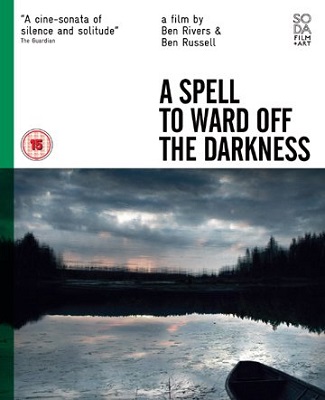
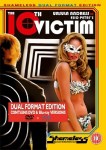
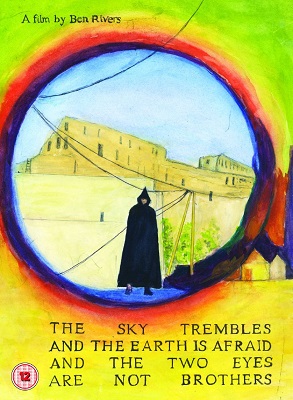
… which was Ben Rivers. The Sky Trembles and the Earth is Afraid and the Two Eyes are not Brothers (that’s the red one) was published to accompany the film of the same title. Ways of Worldmaking is about Rivers’s works. And then, on another night, fuelled by wine and Rivers’s Two Years at Sea, as I was writing about it for a Moving pictures post and comparing it with video art installations… and I remembered the excellent one I’d seen by Richard Mosse in the Hafnarhús site of the Reykjavik Art Museum last October… So I went looking online and found four books by Mosse. Both Richard Mosse  and Incoming were published to accompany a solo exhibition in the Barbican’s Curve gallery from February to April this year; the first was published by the Barbican, the second is signed. The other two books by him I found… well, Infra is $900 ($1000 for the collector’s edition), and The Enclave is $1050 ($2000 for the box set edition). A bit out of my range…

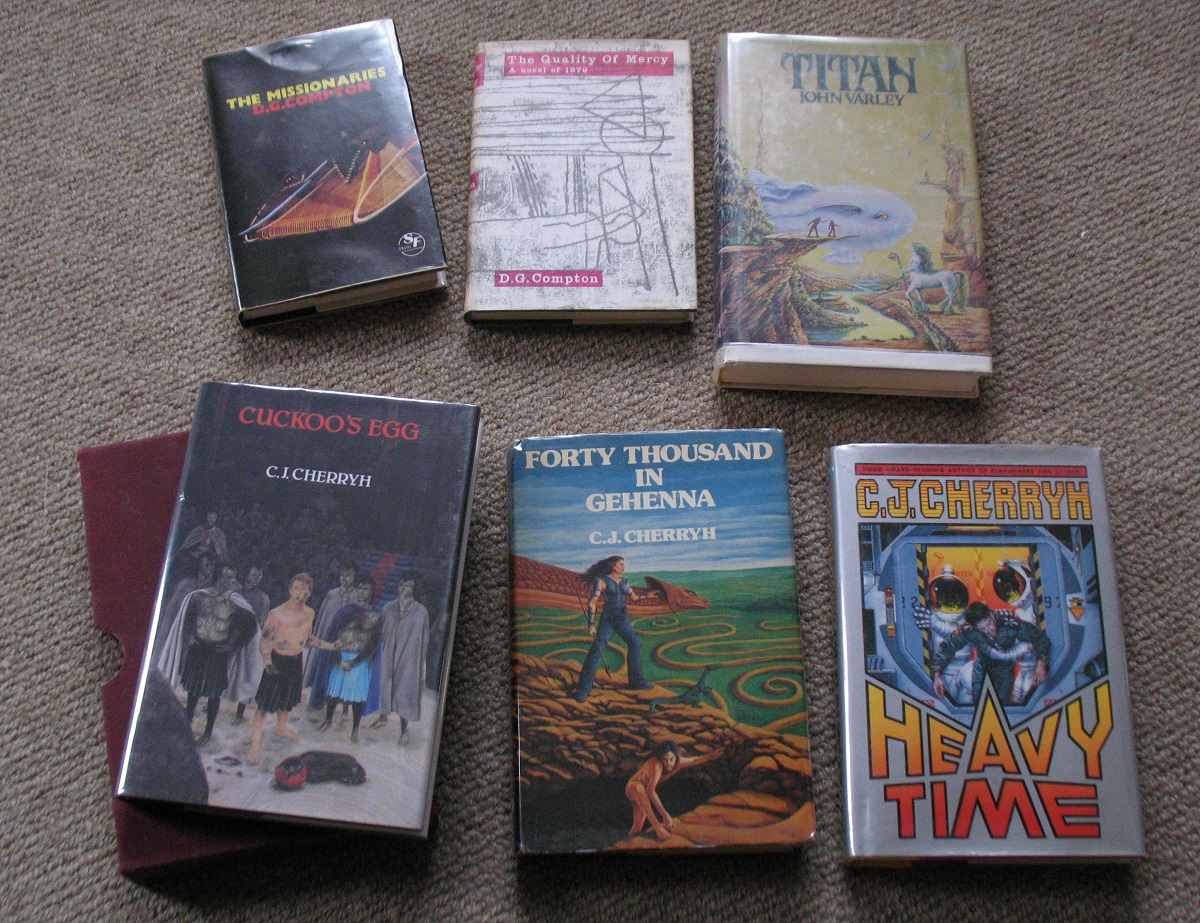
Some sf hardbacks for the collection. The Quality of Mercy was a lucky find on eBay. It’s really difficult to find a good copy, and I got it for a very reasonable price. I already have a copy of The Missionaries, but this was one was going cheap and in much better condition. Titan I bought for 10 euros from SF Bokhandeln’s stall at Worldcon75. It usually costs considerably more. Heavy Time is signed. Cuckoo’s Egg is signed and numbered – and the seller threw in Forty Thousand in Gehenna for free as he was trying to reduce stock (sadly, it’s not signed).

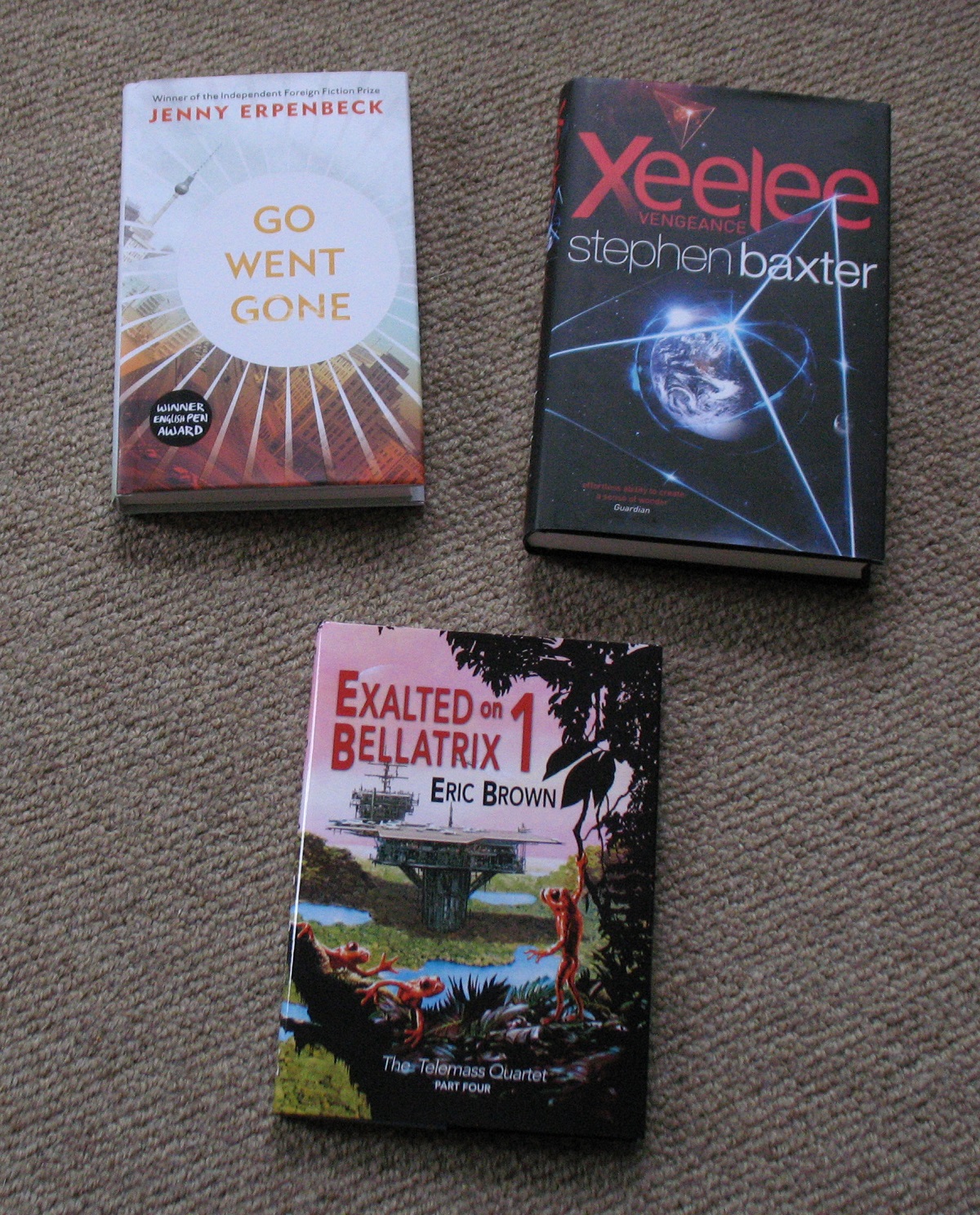
Some new hardbacks. Jenny Erpenbeck is a favourite writer, so I’ve been looking forward to Go, Went, Gone. The last Baxter novels I read were Proxima and Ultima and I thought them, to be honest, a bit juvenile. But he’s a hard habit to give up. Hence, Xeelee: Vengeance. If only he weren’t so fucking prolific… Exalted on Bellatrix 1 is, despite the title, the final book of Brown’s Telemass Quartet. They’re actually numbered in reverse, with the number referring to a planet of each novella’s eponymous star. Annoyingly, the other three use Roman numerals but this one doesn’t. Solid science fiction and typically Brownian – although the protagonist does come across as a bit creepily obsessive.

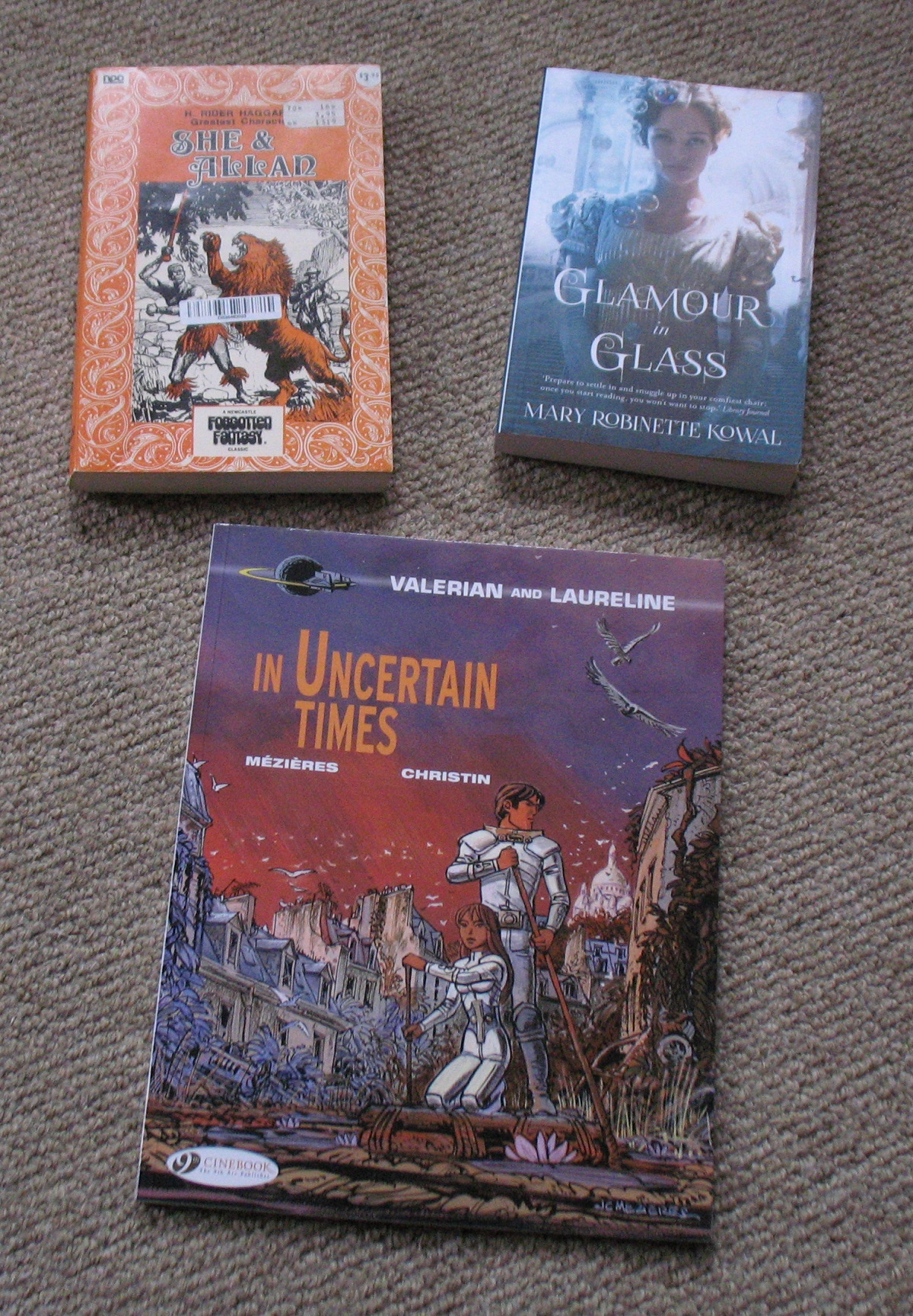
Two paperbacks and a graphic novel. Back in the 1970s, Newcastle Publishing issued a line of fantasy reprints, the Forgotten Fantasy Library. I’ve been picking them when I find them. She and Allan is the sixth book in the series. A recent Twitter exchange persuaded me to give Mary Robinette Kowal’s Glamourist Histories – or “lamourist histories”, as the spine has it – another go. Glamour in Glass is the second book in the series. Well, I do like Georgette Heyer’s novels… And In Uncertain Times is the eighteenth volume in the Valerian and Laureline series, and I see Cinebook are pushing them out at a much faster rate now, after the relelase of Besson’s film (which has apparently not done all that well, anyway).


1 Comment

Moving pictures 2017, #47

It happened again. I watched a film by a director, knowing nothing about him or his work when I put the disc in the player, and afterward went and bought everything by him I could find. The last time that happened, it was James Benning, an experimental film-maker (and very little of his extensive oeuvre is actually available on DVD). This time, it was Ben Rivers, an experimental film-maker… and he’s made only a handful of films.

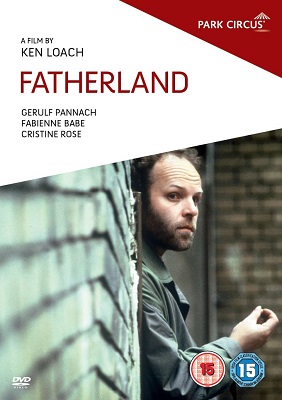
Fatherland, Ken Loach (1986, UK). This is not an adaptation of Robert Harris’s novel of the same title, which was anyway published in 1992, and when that was adapted for the screen by HBO, they did a terrible job of it (see here). Not that I can really see Ken Loach adapting Harris’s novel in the first place. This Fatherland is about an East German singer/songwriter who escapes to the West and tries to forge out a career on the other side of the Wall. It’s been called Loach’s “least-popular film” according to Wikipedia, and part of the blame has been laid at the fact much of the dialogue is spoken in German. To be honest, I thought its biggest fault was that it was dull, and the central character was not especially interesting. Some of his music, particularly towards the end, wasn’t too bad, a very German style of rock, which reminded me a bit of my time spent studying in Germany back in the early 1990s. You could never describe Loach’s movies as films in search of a point to make, if anything they’re more likely to be obvious points somewhat bluntly encoded in the form of narrative cinema. In this one, it’s the lack of artistic freedom in East Berlin brought about by political constraints versus the lack of artistic freedom in West Berlin created by capitalist constraints. It’s a tired argument, and a little ironic coming from a committed socialist iconoclast like Loach – after all, clearly neither politics nor capitalism has prevented him from making films like Fatherland. It is nonetheless a point worth making: capitalism does not equal freedom. And it’s even more true today, thirty years later. Sadly, lowering the cost of entry to content creation to next to nothing has not resulted in a great flowering of iconoclastic art but a near endless deluge of identikit extruded commercial product of low quality. No one wants acclaim, they want dollars. The first mistake these creators are making is in assuming art is not political. Art is politics. Their second mistake is in assuming that what the world needs is another piece of derivative shit put together badly by an amateur. Most professionals may produce derivative shit, but they know exactly how to package it. The sound of jackboots echoing from MCU and tentpole sf blockbuster franchises has drowned out the voices of political film-makers like Loach. A right-wing press which seeks to trivialise him hasn’t helped either. Loach is by no means perfect, but his consistency is certainly admirable.

The Sky Trembles and the Earth Is Afraid and the Two Eyes Are Not Brothers, Ben Rivers (2015, UK). All I knew about this film when I stuck it on my rental list was the unwieldy title, and that it was about a film-maker and a little bit meta. It sounded intriguing, although I didn’t have especially high expectations – that title, for one thing, it sounds like something you might find on one of those straight-to-streaming genre films you find buried deep down in Amazon Prime’s free movies… But it turns out the title is from a short story by Paul Bowles, author of the excellent The Sheltering Sky – and I really must read more Bowles, I have his The Spider’s House on the TBR – and indeed five minutes into this film, the protagonist, a film-maker, reads out the relevant section of Bowles’s story. The film then shifts to a (mostly) context-free documentary about the film-maker filming in Morocco’s Atlas Mountains with a cast of locals. As he becomes increasingly outrageous in his demands… Well, this is not a film in which things are explained, it’s almost as if plot is treated as an emergent phenomenon (um, I like that idea; it might be worth exploring…). In one sequence, the film-maker drives his Landrover through several villages while post-metal plays. There is no dialogue, there is no explanation. The sequence is several minutes long. It’s a narrative film which plays like a documentary for much of its length, in parts reminding me Kubrick’s Eyes Wide Shut, Pasolini’s Arabian Nights and Bertolucci’s The Sheltering Sky. But it’s also a movie about the film-making process, and how the film-making process changes the people involved, particularly those co-opted from the location.  The cinematograhpy is mostly excellent , with occasional shots that approach the beauty of Pasolini’s aforementioned film, and a few that drop into cliché. But there’s a distance to the whole, an almost clinical eye on the proceedings, which signals this is not narrative cinema designed to make money from ticket sales. I’ve said before on this blog that I really like video installations, and though their quality is wildly variable, I find something fascinating in the way they’re so defiantly unlike commercial narrative cinema, despite being the same medium, using the same tools, and making use of many of the same narrative techniques… The Sky Trembles and the Earth Is Afraid and the Two Eyes Are Not Brothers is much closer to narrative cinema than it is to video installation, but it manages to suggest it is something much closer to the latter. That’s one of the reasons why, after watching it, I bought everything by Rivers that was available on a certain humungous online retailer’s website.

Se Eu Fosse Você and Se Eu Foss Você 2, Daniel Filho (2006 and 2009, Brazil). The body-swap comedy is almost a subgenre in its own right, there have been that many films made with the premise. There are two main variations – husband/wife and parent/child. Se Eu Fosse Você – the title means “If I was you” – is a pretty straightforward Brazilian attempt at the former. Claudio and Helena are a happily-married and comfortably well-off couple, with a teenage daughter. He runs a small but critically successful, but now in danger of commercially failing, ad agency, she teaches a choir. A series of unlikely planetological events line up, lightning strikes, and the following morning the two have apparently exchanged bodies. Cue effeminate-acting man and butch-acting woman. Not to mention total confusion over their respective careers. Which, of course, all comes good in the end: he (ie, Helena) lands a major contract for a difficult lingerie client because “he” can put together a campaign that will appeal to women; she (ie, Claudio), on the other hand, finds the chosen choral music boring and livens it up a bit, to great success. Naturally, their rocky marriage is steadied, and Claudio’s business is saved. The sequel is set a couple of years later, and the marriage is once again wobbling, especially when Claudio decides a second honeymoon to Italy is out of the question as his business needs him. She throws him out, and he goes to stay with a friend, who is single and has less than progressive ideas about women. Which eventually results in one of those situations so beloved of marital drama films – he is standinging outside a nightclub, perfectly innocently, with a drunken female friend of his mate, when his wife spots him and assumes the worst. And then their daughter tells them she is pregnant. The father-to-be is a good catch, a millionaire’s son, but the family are very Catholic… so a wedding must be arranged quickly. And lo, the planets align once again, and bodies are swapped. She (ie, Claudio) is against the marriage, she (ie, Helena) is for it… The first film wasn’t great, and this one is much weaker. There is apparently a third film in the series. I won’t be bothering with it.

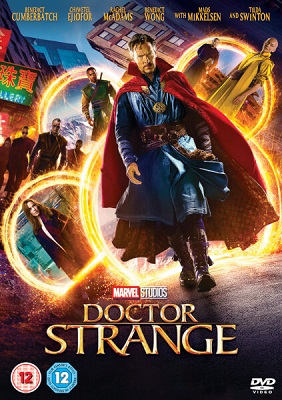
Dr Strange, Scott Derrickson (2016, USA). I don’t know why I continue to subject myself to MCU films. I think they’re awful, badly-made populist trash, and even the high-powered cast they hire can do little redeem them. Not that Benchmark Cummerbund is a good actor. But Tilda Swinton normally does better work than this. So, for that matter, does Mads Mikkelson. An arrogant womanising surgeon has his brilliant career cut short when he badly damages his hands in a crash in his supercar. In desperation, he turns to– I don’t know, for some reason, against all sense, he ends up in an invented Himalayan nation, where he’s taken under the wing of an Eastern mystic played by a white woman, and so becomes an occult agent of her organisation, but based in New York. There are some scenes that were ripped straight from Inception, there’s a lot of mumbo-jumbo that’s hard to swallow even in a MCU film, and Strange’s journey from arrogant shit to good person is actually closer to a journey from arrogant shit who is a neurosurgeon to arrogant shit who is a magician. There are also some effective special effects – see earlier mention of Inception – but it would be a poor MCU film that didn’t have zillions spent on its sfx (and yet, the one MCU film I think is halfway okay, Captain America, has probably the least overt sfx on screen of them all; perhaps that means something). Now that Amazon are closing down LoveFilm, I’ll no longer have access to as many rental films, and I used to bung populist crap on there to watch on a weekend night with a glass of wine or two… But since I never really liked them, I’m not entirely sure why I bothered. Now at least I won’t have to. (Incidentally, I see Amazon have listed this movie as “Marvel’s Dr Strange“, which is obvs to distinguish it from, er, Marvel’s other Dr Strange…)

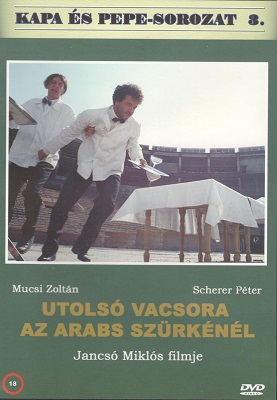
Utolsó vacsora az Arabs Szürkénél, Miklós Jancsó (2001, Hungary). And so the third of Jancsó’s Kapa & Pepe films, and I’m even more confused than I was before. The film opens with the two characters waking up on a statue on top of the Millennium Monument in Budapest’s Heroes’ Square after a heavy night of drinking. There are some scenes set in an abandoned half-built building, including several shoot-outs between the two main characters and various gangsters. There’s a punk band in silly costumes, and a woman being pleasured by several young men. There’s a troupe of dancers who perform a traditional Hungarian folk dance (judging by the costumes). And then Kapa and Pepe are in the USA, visiting Niagara Falls, where they bump into… Miklós Jancsó. And they’re surprised to see him because they thought he was dead – although I seem to remember he did re-appear in the first film, Nekem lámpást adott kezembe az Úr Pesten (see here), after he had died in that film… And I have no fucking clue what is going on in these films. There’s definitely an argument against the trappings of capitalist society, and its attendant ruthlessness and fascination with symbols of success, not to mention several discussions about death. The dialogue is thick with swearwords and the musical interludes bonkers. Lots of scenes are also set on high places – Jancsó obviously liked his crane shots – and some are just a little too high for my comfort. The second time I came to watch this film, the transfer seemed much lower quality than I remembered it. It’s definitely lower quality than the previous two films. Weird. I’m going to have to watch it again some time, though, that’s for sure. Um, in a previous Moving pictures post I wondered about doing a themed post… I usually write about six films per post; there are six films in the Kapa & Pepe series… There’s an idea. Although I may end up a gibbering wreck afterwards.

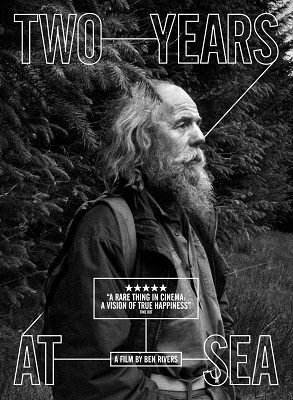
Two Years at Sea, Ben Rivers (2011, UK). Part of Rivers’s creative process is developing his 16mm film himself, in less than laboratory-like conditions. It makes the medium of his movies an artefact of the narrative, in much the same way that Aleksandr Sokurov, a favourite director, often distorts the picture of his movies, as in Mother and Son (see here) or Whispering Pages (see here). But while Sokurov deliberately distorts the image to produce a specific effect, Rivers allows the development process which turns the images captured by the camera into a record which can be viewed by anyone, to apply its own distortions. They are not, it has to be said, as overt – a graininess to the picture, the odd blink-and-miss-it flaw in the film… But the way Rivers shoots, or has shot certainly in this film, which is entirely black and white, also results in a slight flattening of the image, giving Two Years at Sea a look close to that of a photograph from the first half of the twentieth century. He also lets his camera linger for long moments on static scenes – although not to the extent James Benning does – which also reminds me of several Sokurov films (but I don’t think it’s a direct reference, more a commonality of approach). As for the plot… well, there isn’t one. Two Years at Sea documents a period in the life of Jake Williams, who lives in a beat-up house in the countryside in Scotland. The film makes much of his surroundings, watching clouds drift across hills, steam rise from forests, without telling us anything about Williams or his life. It is art, not narrative cinema. But, at 127 minutes, it’s too long to be a video installation. And besides, it’s partly fictional anyway, because it’s not an actual documentary of Williams and his life, never mind the sequence where his caravan floats up into the air… Which makes you wonder what Two Years at Sea is intended to be – for a video installation endlessly looped, well, 20 minutes is probably long enough, although I’ve a feeling Richard Mosse’s ‘Infra’ may be much longer… But over two hours is too long for a video installation, that’s cinema. But not cinema as it is commonly understood. I love this sort of stuff, so buying all of Rivers’s available output was a totally good call for me – and Two Years at Sea totally justified it. I will be following Rivers’s career from now on. And I thnk I might dig a bit deeper into video installations, instead of just relying on random visits to contemporary art museums during random visits to Nordic capital cities…

1001 Movies You Must See Before You Die count: 879


Leave a comment

Boxsets!

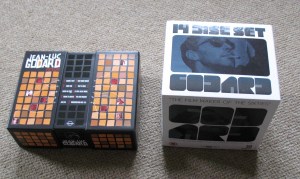
Well, not really. Only two box sets. And these days the word tends to be used more in reference to seasons/series of television dramas. My box sets are collections of films, and in this post, it’s the two by Godard…

Both the 10-DVD collection (French-published, but with English subtitles) and the 14-DVD collection were purchased from third party sellers on a large online retailer’s website. I’m currently working my way through the 10-DVD set. And I’m starting to really appreciate Godard’s movies.

Three Blu-rays. Nosferatu and Hawks & Sparrows / Pigsty I bought from eureka! during a recent sale. I also pre-ordered the new edition of Metropolis, but that has yet to arrive. Privilege I bought after watching it on rental because I wanted my own copy (see here).

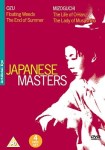
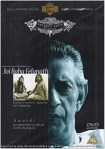
Actually, there’s another box set in this post: Japanese Masters, bought on eBay, which contains two films by Yasujiro Ozu – Floating Weeds and The End of Summer – and two by Kenji Mizoguchi – The Life of Oharu and The Lady of Musashino. I already have Floating Weeds, but The End of Summer is no longer available. Container is Lukas Moodysson’s experimental film. I watched it several years ago, but decided it needed a second try – so I bought a cheap copy off eBay. Joi Baba Felunath popped up on eBay and I thought it was a hard-to-find film but it turns out it’s in the Satyajit Ray Collection Volume 2. Oh well. And Footprints on the Moon I watched on rental, but I liked it so much I bought my own copy (see here).

A bunch of out-of-copyright films bought on eBay, of varying quality, both of the transfer and the film itself. I forget why I bought most of them, but they are: Sleep, My Love (forgettable Sirk thriller, see here), Black Tights (anthology film of ballet routines, terrible transfer), Beneath the 12-mile Reef (unmemorable Robert Wagner drama about sponge divers), The One-Eyed Soldiers (bad Euro-thriller set in invented Balkan country) and Long John SilverThe Secret of My Success (terrible sixties British comedy), and Criminal Affair (dreadful Italian thriller, directed by and starring one of the stars of South Pacific, another poor transfer too).


1 Comment

Wonderful wonderful– er, fantastic fantastic Copenhagen

So the big project at work that was supposed to end on September 1st… didn’t. A month before, they realised they weren’t going to hit the deadline, and so rebased all their plans. Which meant I was now free for the first weekend in September, the date of Fantasticon, an annual science fiction convention in Copenhagen. I mentioned it in passing to my boss, told her it was doable, if expensive, and she said go for it, I needed to use up some holidays anyway. Which is why, on pretty much a week’s notice, I booked a flight and a hotel room, and flew to Denmark to attend Fantasticon 2017.

I flew out on the Thursday night, as it was easier and cheaper than a Friday flight, although it meant an extra night in the hotel (which, er, wasn’t cheaper…). Usually, when I fly to Denmark, I go EasyJet, but this time I flew SAS, and it was a much better experience. I landed just after 9 pm, topped up my Copenhagen travel card, and caught the train from the airport to the city’s main railway station. My hotel was on Vesterbrogade, about 800 metres from the station. There are a lot of hotels on Vesterbrogade, which meant a lot of tourists, dragging their suitcases along the pavements, which were restricted because of roadworks. When I landed in Denmark, I’d switched my mobile back on and learnt I had two voicemails. Once I was in my hotel room, I listened to them. The first was from work; the second was from my bank… asking me to ring them on their fraud prevention line. I called them, demanding to know what was going on – they’d wanted to cancel my debit card two days before I flew to Helsinki for Worldcon75, but I’d persuaded them to hold off, and on my return they’d cancelled my card and sent me a new one… and now this new one had been compromised, even though I’d had it less than a week. I got a bit shouty. The bloke on the other end of the phone said, we haven’t left you a voicemail today, that one was from 16 August. Oops. It was an old message about my old card, and had got stuck in Vodafone’s voicemail system. I apologised for my outburst.

The view from my hotel window

Fantasticon 2017 didn’t start until 4 pm, so I had most of Friday free. I rang my sister, Kay, who lives just north of Copenhagen, and we agreed to meet up for lunch. I went for a wander in the Indre By, and managed to navigate my way to Faraos Cigarer, with a bit of help from my phone. I’d last visited there at Christmas, but the shop had greatly expanded. Downstairs had been English-language and upstairs Danish-language. Now, it was all English (there was a new Danish-language shop across the road), with novels and manga downstairs, and graphic novels upstairs. I met up with my sister outside the Rådhus, and we went looking for somewhere to eat. The first place, the waitress gave us a blank look when I asked what was dairy-free on the menu. She checked with the chef. I could have the salad. It seemed Copenhagen was going through a brioche phase and all sandwiches were made with bread that contained milk. We left. The second place we tried, the menu was just as unwelcoming, but the guy behind the bar (he appeared to be the only person serving) made an effort and produced two club sandwiches without dairy for us. Danish club sandwiches are not like club sandwiches in the rest of the world. They’re not triple-decker sandwiches with egg, bacon, chicken, salad, etc; they’re hot sandwiches containing chicken breast in curry mayonnaise, often with pesto. But then the Danish don’t call danishes danishes either. (They call them Viennese pastries.)

The Rådhus

After lunch I returned to my hotel to wait for the con to begin. At 3 pm, someone from the con posted on Facebook that the doors were open, so I made my way to Frederiksberg, 800 metres from my hotel in the opposite direction to the railway station, and the Serapion Order, the venue for Fantasticon. I was a bit early. I walked in and the only three people there were Sanna, Bende and Flemming, all of whom were involved in organising the con. (I’d met both Sanna and Flemming at Swecons previously.) So I checked out the venue until the opening ceremony started. More people began to arrive, including a few Swedish fans, Carolina, Thomas and Johan. There was also a Finnish fan at the con, Linn, who was a NOFF candidate. The opening ceremony consisted of Flemming welcoming everyone to the con, apologising that the GoHs – Nina Allan and Christopher Priest – had not yet arrived (their plane was landing as he spoke, he told us), and then mentioning several upcoming cons (including Icecon 2 next year and the worldcon in Dublin in 2019). Later that night, I sat through Jesper Stage’s entertaining, and very dry, talk on the economics of colonisation in fantasy and science fiction. The venue closed at ten. I left with Jesper Rugård, and as I hadn’t eaten since breakfast, we stopped at a posh burger place on Vesterbrogade. They actually had an allergy sheet for their menu.

The Serapion Order

The next morning, after a big breakfast (sadly, no gherkins), I headed to the Serapion Order about 11 am. I spent most of the day talking with friends, and attended two programme items – a GoH interview with Nina Allan, and a panel on the New Wave. The con was much busier than the day before – not just with day members, but half a dozen invited guests had also turned up to give talks or sit on panels. That evening the con laid on a buffet – they’d assured me there’d be some lactose-free food available, so I’d bought a ticket for it. In the event, the chef turned out to have a daughter who was lactose-intolerant, so he made everything using lactose-free ingredients. The dinner was excellent. Again, the venue closed at ten. Most people went home, but half a dozen of us – Jesper R, Lars, Linn, Sanna, Fia and myself – headed for a bar called the Mikkeller. It turned out to be just around the corner from my hotel. Fia, Sanna and me carried on until 1 am, before calling it a night.

Nina Allan interview

I didn’t bother with breakfast on the Sunday, and had a lie-in until 9 am instead. On my way to the con, I stopped in Irma, a supermarket, and bought a sandwich and a small bottle of orange juice with chilli, which proved to be horrible. I nipped to another supermarket, Fotex, to buy a sandwich and a drink at lunchtime. (It was the same sandwich both times, chicken and bacon, which was the only dairy-free one I could find.) I attended a panel on “Will the real science fiction please stand up?”, with both GoHs, which mostly discussed the Clarke Award and the Sharkes. At 4 pm was my only panel of the con, added at the last minute when I bought an attending membership, on “Manned space flight in the past and in the future”, moderated by Flemming, with Asmus Koefoed, Klaus Æ Mogensen, and myself. It was a bit of a free-form discussion – perhaps too free, I noticed Chris Priest nodding off in the front row at times, although apparently something we said has given Nina “the key inspiration for my next novel” (according to her blog).

The end of the con

Fantasticon 2017 ended after the closing ceremony. There was a dead dog party planned, but not in Frederiksberg near the venue. Instead, they’d booked tables at the bar used in previous Fantasticons in Valby, a ten-minute bus ride away. I’d planned to head straight for my sister’s, bus since I had a travel card, I decided I might as well have a couple of beers first. So I caught the bus with the rest of the fans. I also had some food while I was there (fish and chips! I go all the way to Denmark and I have fish and chips!). I left to catch the 19:44 train but, in a weird repeat of Worldcon75, I arrived on the platform just as the train was pulling away. Fortunately, it wasn’t the last one of the night, and I only had to wait ten minutes before another came along. If I’d caught the train I missed, I’d have changed at Østerport and arrived at Skodsborg at 20:39. But the train I actually caught meant I had to change at Copenhagen main railway station, and I got lucky with my connections, and actually arrived at Skodsborg 20 minutes earlier than the earlier train would have got me. Danish trains are good – covered in graffiti, bizarrely – but the timetable is a bit variable.

I spent the night at my sister’s, saw my brother-in-law and my nephews. I’d originally intended to stay a couple of days in Denmark after the con, but in the end booked a flight on the Monday night. And unfortunately, museums are closed in Copenhagen on Mondays. Plenty of people had told me the best coffee in Copenhagen is in Arnold Busck, a book shop, which I already knew, since I go there at least once every Christmas. People had also mentioned Fantask, Copenhagen’s first comics/sf shop, to me, so I dragged Kay there after we’d finished our coffees. I walked into the shop… and there was Sanna. I didn’t buy anything, however. Me and Kay ate lunch in Palæo, which sells grain-free food (most of which is also  dairy-free).

Fantask

After a couple of hours back at Kay’s, I caught the train to the airport. I got a bite to eat in the airport – these days airports are all about the shops, with far too few places to just sit down and relax. And it’s ridiculous shops too – Gucci watches, £50 pairs of tights, Victoria’s Secret… Yes, food, toiletries, books and magazines, these are all useful… but you have to wonder if some of the shops take in enough to cover their rent. And I’d much sooner have somewhere to sit. The flight back to the UK on a tiny aircraft, an 88-seater Bombardier CRJ900, was uneventful. Instead of relying on the vagaries of the British railway network at 9 pm at night, I’d pre-ordered a taxi from an online website. They’d emailed me the driver’s telephone number, and I rang him once I was through the e-passport gates. Manchester was, bizarrely, extremely humid. The minicab turned up 5 minutes later, and drove me home. I think in future, when I travel to Nordic cons, I might fly later in the day and take a taxi home. It was a lot less stressful.

It was all a bit sudden, but I’m glad I made it to Fantasticon. Jesper reckoned they’d had about 65 paying members over the weekend, and certainly the two rooms used for the programme were often only a quarter full. The venue, the Serapion Order – it’s some sort of Masonic order, with lodges throughout Denmark – was surprisingly good. A bottle of beer for only 25 Kr! (That’s £3.) I didn’t try any of the sandwiches they had for sale, but the buffet on the Saturday night was very good indeed. I met a bunch of Danish fans, not just the ones already mentioned, but also Knud, Jan, Klaus, and several others whose name I didn’t catch. It was also good to chat with Nina and Chris, although the con kept them busy over the weekend. The programme items I went to could have done with a little more preparation – and I include myself and the one I was on – but none were boring. A date hasn’t been set for Fantasticon next year, although it’s likely to be the first weekend in September. Nor have they decided on GoHs. But if I’m free that weekend, I’ll probably go again (but I’ll book everything well in advance so it’s not so expensive).

I’ve now been to conventions in four of the five Nordic countries, only Norway is left. True, the cons I went to in Finland were a Nordic con and a worldcon, so neither were actually Finnish conventions. But there’s always Åcon or Finncon. Swecon next year is back in Stockholm, at the Dieselverkstaden in Sickla. Assuming work doesn’t get in the way, I plan to be there – it’ll be my third Fantastika there. And, as previously mentioned, there’s going to be a second Icecon in Reykjavik in October next year. The first one was excellent, so I’m definitely up for that.


1 Comment

Moving pictures 2017, #46

A better mix of countries this time, including my first film from Lithuania. And, er, three French films. (The gap since my last blog post is because I spent the weekend in Copenhagen at Fantasticon. There’ll be a blog post on the con appearing here soon.)

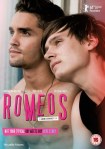
Romeos, Sabine Bernadi (2011, Germany). Not sure how I got sent this one. I added it to my rental list obvs. But I don’t recall why I added it to my list. I probably saw a trailer for it on another disc. Lukas is a transman, assigned to a nurses’ home for his national service/community service because his paperwork still has him as female. Through a friend – who knew Lukas before he transitioned – he meets a bunch of people, including Fabio. Lukas falls in love with Fabio, but can’t tell him about his situation. Which makes things a bit awkward. Like when they go for a picnic at a lake near Köln, and Lukas can’t strip down to his swimwear because he’s on hormones but has had no surgery. I’m not sure what to make of this film – it felt like a sympathetic portrayal to me, but I’m in no real position to judge. Lukas was played by a male actor, with prostheses, and he seemed convincing in the role. Although the plot revolves around Fabio’s reaction to the fact Lukas is a transman, Lukas experiences very little prejudice, and most of that is bureaucratic. The female nurse think his presence among them is all a bit of joke, and when he does move to the male dorm his reaction to their slobbishness is a bit of a cliché. I enjoyed it.

You Can’t Escape Lithuania, Romas Zabarauskas (2016, Lithuania). I rented this film because it was Lithuanian, and I’d not seen a film from Lithuania before. And clearly, from the title, it takes place in Lithuania. The film stars an actor playing the director, Zabarauskas, who helps a famous actor friend flee Lithuania after she has murdered her mother. But their road trip to the border turns all avant garde, with colour filters and long philosophical voiceovers in English. Meanwhile Denisas Kolomyckis plays Zabarauskas as an arrogant rich kid with a higher opinion of his own talent than anyone else – at a press conference, for example, he refuses to answer questions as he has not prepared answers, and instead monologues. And yet it all works. The avant garde felt a bit Malick-ish, which would normally be a big turn-off, but they didn’t outstay their welcome and they seemed to contrast well with the main narrative. An interesting film, if not a great one, and I suspect Zabarauskas might be a name to watch.

Personal Shopper, Olivier Assayas (2016, France). You never really know what you’re going to get with an Assayas film. I’ve watched a number of them and they’ve all been very… different. I wasn’t all that keen on his last one, Clouds of Sils Maria (see here), which also had Kristen Stewart in a lead role, but Personal Shopper is much better, despite being a less straightforward film. Stewart plays the title role, a personal shopper for a Dutch celebrity. Her twin brother died recently, and she has been trying to contact his spirit at his house in Paris, at the urging of the house’s new owners. On a trip to London to pick up clothes for her celeb, Stewart witnesses some ghostly events, and is contacted by an anonymous person by text. Then Stewart’s employer is murdered. The two stories feel unconnected: Stewart’s visions of her brother’s ghost, and the murder of her celeb. In fact, other than to ratchet up the tension, I’ve no real idea what the point of the murder is. The murderer is quickly identified, and captured by the police. The film’s focus is clearly on Stewart and her her “relationship” with her late brother.

Swiss Army Man, Daniel Scheinert & Daniel Kwan (2016, USA). See that quote from Empire on the DVD cover, “Hilarious”? That’s a fucking lie, that is. This film isn’t the slightest bit amusing – but you can imagine the director and screenwriter giggling like fratboys as they go through the script. It’s not typical fratboy humour, that’s true, more nerd fratboy humour. Still not funny, though. A man, Paul Dano, is marooned on a desert island. One day a dead body – Daniel Radcliffe – washes up on shore. When Dano notices that the corpse breaks wind frequently, he uses it like a jetski to escape the island. As he travels, he discovers the body is also good for catching a raintwater in its mouth, and that it is slowly beginning to talk. They reach the mainland, and begin making their way through the wilderness to civilisation, Dano dragging Radcliffe. As the film progresses, so Radcliffe becomes more sentient, and more useful. Dano discusses a woman he used to lust after on his daily commute, but he never had the courage to approach her. The two act out an invented romance between the two. This is the sort of the film whose story might be mildly amusing if told down the pub over a ten minutes or so after more than a few beers. But as a feature film, it sucks. The humour was juvenile at best, the attitude to women about the same, and by the tom the film finished, I was annoyed I’d wasted a spot on my rental list on it. Avoid.

Sauve qui peut, Jean-Luc Godard (1980, France). So my finger slipped one night while I was enjoying a nice glass bottle of Shiraz, and before you know it I’d gone and bought a 10-DVD box set of Jean-Luc Godard films and a 13-DVD box set of Jean-Luc Godard films. This is from the 10-DVD collection. I have a lot of time for Godard as a filmmaker, if not for some of his individual works. But I think he rewards re-watching, and I don’t think splashing out on a pair of his box sets was a waste of money. And yet… it’s not always easy to understand what he’s trying to achieve with a specific film. Technically, he’s never come across as more than proficient, although he uses slow-motion as a form of decompression in this movie and I think it’s among the first uses of it (for an especially good use of the technique see Dredd). But Godard’s drive to break film boundaries does sometimes render his movies an uncomfortable experience. Okay, so when he’s playing around with narrative structures, as in Film Socialisme and Goodbye to Language, or even Hélas pour moi, that’s one thing. But Sauve qui peut, which is apparently his return to “mainstream” film-making after a period of left-wing experimental films is… a bit borderline. It’s not that Huppert plays a sex worker in the third of its four stories, if only because Huppert is brilliant in everything – but that the acts of violence against women, or the scene in which a father at a kids’ football match discusses the sexual appeal of his young daughter… seem to serve no real narrative purpose. And the narrative itself is far from straightforward – I very much doubt Godard has read Story, and I suspect he would reject its philosophy anyway – as should any real artist, of any medium, mode or genre. But overall, Sauve qui peut feels like a film that knows where it’s going but isn’t entirely sure how to get there…

Tout va bien, Jean-Luc Godard (1972, France). An opening title card helpfully informs the viewer this film is set in May 1968, which was a period of great civil unrest in France. A group of striking workers at a sausage factory have occupied the offices of their employer, locking the manager in his office and preventing him from using the toilet. Also caught up in events is an American reporter (Jane Fonda) and her French husband. The set of the offices is designed like a doll’s house, with each room visible from an outside viewpoint, so the camera can move back and forth, taking one or more rooms at a time – the technique was first used in Jerry Lewis’s The Ladies Man (an excrutiatingly bad comedy from 1961). Tout va bien then moves outside the factory, and discusses the political and social context surrounding the strike, usually through direct addresses to camera. Fonda’s husband, Yves Montand, is a film director from the New Wave, who now makes commercials, and his reasons for doing so – as explained to camera – are clearly more for his own peace of mind than to inform the viewer. There are scenes of rioting, shoppers in a large supermarket, new construction work, all observed by either Fonda, Montand or both – in places, Tout va bien feels like Godard’s response to Truffaut’s Fahrenheit 451. I don’t know if Tout va bien qualifies as one of the “left-wing experimental films” mentioned above – it certainly qualifies as the former, but some of his other films feel to me more experimental. There’s a poetry and, perversely, an energy to the shots Godard frames, but the accompanying commentary is often banal. I don’t know if this is because we’re more cynical these days – and cynicism does seem incompatible with idealism, and the French were famously idealistic in May 1968… Time has not been kind to the observations made in Tout va bien, even if the sentiments still hold true for those of us who aren’t self-entitled self-rightous right-wing pricks = but the visuals are still striking, albeit chiefly because they’re very much of their time. A film worth seeing, and one that will stand up to rewatching, even though it’s a movie that could only have been made in the late sixties or early seventies…

1001 Movies You Must See Before You Die count: 879


Leave a comment

Moving pictures 2017, #45

Bit of a USA-fest this time. Not sure how that happened. Bit of a mixed bag quality-wise, however. Mars and the Pasolini I bought, but the rest were rentals.

Mars (2016, USA). This six-part mini-series for National Geographic – the National Geographic? – was apparently executive produced by Ron Howard, although I’m not entirely sure what that means he did. It depicts a serious attempt, in 2033, to set up a colony on Mars somewhere in the Valles Marineris. Six international astronauts are sent on a spacecraft funded by a consortium of private and public interests, with a base camp already set up remotely and awaiting their arrival. But their lander misses its assigned landing spot, and they have to trek across the Martian surface to the base camp. Which presents a problem, as they were supopsed to live in the lander until the camp was up and running. In fact, the Mars mission is just one long litany of disasters. None are serious enough to kill everyone, but it’s a bit like Apollo 13 every week, with something killing one or more of the colonists (a second mission arrives in episode 4, set four years after landing), or jeopardising the colony’s future. Clearly, they’re making the point that colonising Mars is a dangerous business – and judging by the Earth-set scenes, a hugely expensive business – but, like The Martian, the series is in danger of basing its entire narrative on manufactured jeopardy. Alongside this, or rather interspersed with this, is documentary footage about… SpaceX. Obviously, they provided some of the funding for the series. Elon Musk appears several times, discussing his dream of colonising Mars. The rest feels like a SpaceX infomercial. And yet… the production values are high, the Martian mission is convincing, the euro-cast are mostly good in their roles, and the end result is something which feels a good deal more plausible than The Martian. I’m not sure what I was expecting when I bought this, but it’s actually not that bad. One for those mostly interested in the topic, perhaps, but a good deal more intelligent than a certain feature film…

Suicide Squad, David Ayers (2016, USA). These are DC, right? Not Marvel. I get confused sometimes. One guy in tights looks much like another, one implausibly pneumatic woman looks much like another implausibly pneumatic woman. But the Joker is in this, and he’s from Batman, so I guess this must be DC. And, to be honest, when it came to reading comics, which I never did much as a kid, I tended to read Marvel more than DC. I still have a soft spot for the original Guardians of the Galaxy, for example (not the crappy rewritten version they made the crappy movie about). But I can’t say any DC hero, or villain, ever appealed me the same way. The Suicide Squad, a group of captured villains forced to work for a secret arm of the US government – like they need to do shit like that, when they have “security contractors” like Blackwater – includes a whole two villains I’ve heard of before, the Joker and Harlequin, and that’s only because they’re part of the Batman mythos. The rest are nobodies. And they’re all in prison. And then are taken out by the aforementioned secret government department, and sent to New York or maybe Chicago to fight the zombies created by an Ancient Egyptian sorceress or something who was, I seem to remember, one of the inmates, and who would not have been freed had they not freed them all to fight, er, her. I don’t know. Maybe that’s wrong. I zoned out during this movie because it was very dull. The cast had zero chemistry – Jared Leto’s Joker felt like a bad Halloween costume – and the plot was the usual nonsense about magical villain attacking metropolitan centre and needing to be defeated by superpowered forces. Suicide Squad does not have a good rep, and it’s easy to see why: it is not good. Watchmen is a better film; anything made by Zack Snyder is a better film (and it hurts to make that admission). This is, as Monty Python once said, one for laying down and avoiding.

Kal Ho Naa Ho, Nikhil Advani (2003, India). Bollywood has this knack – or perhaps it’s a philosophy – of turning even the most downer of stories into a film that will have the viewer smiling by the end. Kal Ho Naa Ho (the title means Tomorrow May Never Come) is a perfect example. It’s set in New York, not India. A young woman, Naina, has reached marriageable age but is not all that keen on marrying. Which is where Shahrukh Khan comes on the scene. But rather than present himself as a romantic rival for Naina, he encourages the relationship between Naina and her fellow MBA student, Rohit. And although there’s some initial confusion over who’s wooing who, it all gets sorted out with some singing and dancing, only for Khan to then reveal he’s terminally ill. I tweeted while watching this that the opening song sampled Roy Orbison’s ‘Pretty Woman’, and actually made a good job of it… and was surprised whem a Finnish friend correctly identified the film. I shouldn’t have been, of course – they watch more than just Kaurismäki up there, obviously – but most of the conversations I’ve had about Bollywood have been with Indian colleagues (I’m not sure which surprises them most: that I watch, and like, Bollywood films, or that I don’t like cricket…). Kal Ho Naa Ho was a really entertaining film. Either I’ve been very lucky with my Bollywood picks so far – and that seems unlikely, given I’ve watched several historical ones as well – but I’ve enjoyed more of them than I have recent Hollywood films – which is not to say there haven’t been a couple of stinkers, because there have; but on the whole, I’ve found Bollywood films I’ve watched in general considerably less annoying than recent Hollywood ones.

Hawks and Sparrows, Pier Paolo Pasolini (1966, Italy). There was a sale on the eureka! website, and a new – and more complete! – edition of Metropolis available for pre-order, so I embiggened my order of the latter with a couple of discounted titles… including this one. It’s early Pasolini. As should have become evident throughout this year’s Moving pictures posts, I’ve turned into a bit of a fan of Pasolini’s films, and while the sheer bizarreness of the costumes and settings of movies like Arabian Nights and Medea plugs into a long-running fascination of mine. I suspect I find his earlier movies – well, except for the Antonioni-esque Theorem – only to my liking because they seem like pastiches of Italian Neorealism, a cinematic genre of which I’m not overly fond. Hawks and Sparrows is about two itinerants who wander the Italian countryside looking for work and sustenance. En route, they meet a talking crow, who tells them of two Franciscan friars who were told to preach the Gospel to the hawks and sparrows. The friars eventually learn to understand the birds, but cannot persuade them to change their ways. This is all acted out in flashback, with Nanetto Davoli, Pasolini’s partner, and famous Italian comic actor Totò, as both the itinerants and the friars. (Totò turned out to be the illegitimate son of a Neopolitan noble, and was later recognised as a legitimate heir, so his real full name is a right mouthful: Antonio Griffo Focas Flavio Angelo Ducas Comneno Porfirogenito Gagliardi De Curtis di Bisanzio. Still wonder why we need the upper classes?) Hawks and Sparrows has its moments – there are some good comic scenes, and the joke which drives the plot is not over-played. It’s not the sort of Pasolini film I really like, but it’s worth seeing nonetheless.

Glory*, Edward Zwick (1989, USA). This I had marked down as one of those “chore movies” that I have to watch because it’s on the 1001 Movies You Must See Before You Die list but don’t expect to enjoy. And yet, I did enjoy it. I thought it quite good, in fact. Matthew Broderick, who manages to look fifteen throughout the film, despite playing a character in his twenties, a real historical character, is a Yankee captain who is put in command of the 54th Regiment Massuchusetts Volunteer Infantry, the first all-black regiment in the Union army. Although Broderick’s character takes his responsibilities seriously, everyone else seems to think it’s a bit of a joke. The POC characters in the regiment are all drawn a bit broadly, perhaps even as stereotypes, but they certainly make the point that that only difference between the 54th Regiment and any other regiment is skin colour. Given the current fuss about the Confederacy – they were fucking racist fucking slave owners, FFS, it has nothing to do with erasing history and everything to do with recognising historical crimes, because, let’s face it, and you’d have to be an evil piece of shit to say otherwise, slavery was a horrible crime and there’s no defending it. Glory I had expected to be well-meaning rather than good drama – which I don’t have a problem with, least of all with the topic it covers – but I was pleasantly surprised to discover that it actually manages to make a decent fist of its story. The 54th Regiment were, ultimately, a failure, but they led the way for many more all-black regiments, most of which went on to serve with distinction during the American Civil War. Glory is a well-made film, and while that’s not enough for it, for me, to make the 1001 Movies You Must See Before You Die list, it does cover an interesting incident in US history, and does it well, but, more than that, it covers a topic that should be more widely know. So, yes, I think it deserves its place on the list.

Arrival, Denis Villeneuve (2016, USA). If there’s one thing I’ve learned over the last few years, it’s that when social media praises a science fiction film, chances are I won’t be all that impressed. The reverse doesn’t always hold true – if they hate a film, I might like it, but I’ll probably agree with their take on it (or at least agree with their opinion of it, but for slightly different reasons). Arrival, as no doubt everyone knows, proved very popular in genre fandom. It even won a Hugo Award. So I had hopes for it (especially since LoveFilm had sent it to me just before I left for Finland, so I knew I had it waiting for me when I returned from Worldcon75). The story is adapted from a Ted Chiang short story, ‘Story of Your Life’. Chiang is a far from prolific writer whose fiction many people in genre are greatly enamoured of. He famously withdrew a novella from the Hugo because he didn’t think it was good enough. He must have a warped idea of the Hugos, then… And – unpopular opinion time – I don’t think he’s actually that good. His reputation is over-stated. And ‘Story of Your Life’ is not even one of his best stories. Or one that would seem obvious adaptation material. Which undoubtedly explains why the film is so poor. Ignoring the fact Villeneuve chose to frame, and shoot, it as warmed-over Malick (not a beneficial comparision, to my mind), the whole story is based on a conceit that simply isn’t justified by the narrative. The big reveal appears to be that the flashbacks are actually flashforwards, which only works because Amy Adams’s character is so poorly drawn the audience can’t tell the difference. The iconography used for the alien alphabet is effective, but doesn’t support the mid-film bolt-from-the-blue that it is not chronologically linear. In fact, there’s nothing in the film to support that except Adams’s voiceover. Am I surprised Arrival won the Hugo? No. The Hugo voters have notoriously bad taste in movies, and will vote for any Hollywood movie that looks like it possesses more than half a brain cell. It was, to be honest, the best film on the shortlist. But it was a piss poor shortlist.

1001 Movies You Must see Before You Die count: 879


3 Comments

Reading diary, #53

Apparently, I still read science fiction – or rather, most of my reading is still science fiction. Which is odd, given my opinion of the quality of much of it. But then two of the books below were rereads and by my favourite sf writer. Make of that what you will.

White Queen, Gwyneth Jones (1991, UK). I’ve been meaning to reread this book, and its two sequels, for a long time, but in the continual chase to main a positive TBR balance (ie, reading more books than I buy) I usually don’t find time for rereads. But then I agreed to write something about Jones’s aliens for a critical work, not just because I welcomed the opportunity to write about Jones but also because it would force me to do that long-put-off reread. And so it did. And… White Queen was not only better than I’d remembered it, but also a good deal nastier than I’d remembered. True, I’m a different reader now than I was twenty-five years ago – who isn’t? – when I last read the book. I can see how some of the characterisation was of that time… but it does read differently now. The word “whore”, for example, is thrown around a lot more than you’d find in a novel of the second decade of the twenty-first century. The characterisation also seems not as I remember it – the aliens are better drawn than the humans, basically. Some time hence, a decade or two, aliens land secretly on Earth. These are the Aleutians, so called because of their original landing place. They resemble humans, but have no noses, a single gender, and bio-technology based on “wandering cells” from their own individual bodies. Johnny Guglioni is an engineer/journalist, or eejay, (one of the novel’s less impressive neologisms), who has been infected with a virus which can degrade coralin, the “living clay” on which all modern electronics are based. He becomes involved with the Aleutians through Clavel, one of the three Aleutian “captains”, in an invented African country. Braemar Wilson is a tabloid television journalist who thinks Earth cannot survive an encounter with superior aliens, and who seduces Johnny as a means of gaining access to Clavel. Then the Aleutians reveal themselves to what they think is the world government, an international conference on women’s rights taking place in Thailand… The Aleutians are one of sf’s great alien races without a doubt, thoroughly convincing with the minimum of hand-waving. And the novel has plenty of the latter, as the plot soon congregates around a FTL drive, or instantaneous transportation method, invented by eccentric engineered genius Peenemunde Buonarotti, and which features in later stories and novels set in the same universe, notably Spirit and the stories in The Buonarotti Quartet. It seems an odd hook on which to hang the narrative up to that point, although it does handily lead into Johnny’s Christ-like redemption – and I have to wonder if that was the point of it all. It was Jones’s ‘Forward Echoes’, published in an issue of Interzone in late 1990 which made me sit up and take notice of Jones’s fiction (perversely, a revised edition of the story, ‘Identifying the Object’, in a chapbook collection of the same title, doesn’t give me that same jolt), and ‘Forward Echoes’ is about the first contact with the Aleutians in an African country. White Queen is an extension of it… and yet it’s not my favourite Jones novel, which is Kairos. But rereading White Queen after so long reinforced my admiration of Jones’s prose and made me realise how very very good she is at depicting the alien (and, on reflection, that ties in quite well to the fracturing of reality which is one of the strengths of Kairos). Jones is one of my favourite writers, and still, to my mind, one of the best science fiction writers this country has produced. And being at an age when rereading old favourites  usually ends up poisoning the well of my childhood, it’s heartening– no, it’s a delight… to discover my appreciation of Jones’s writing not only remains undimmed but has probably been strengthened.

Totalitopia, John Crowley (2017, USA). A new collection by John Crowley! Time for celebration. Except, well, this is a collection of essays and columns and a couple of stories, plus an unpublished piece of fiction… although, to be fair, I’ll pretty much take any Crowley I can get. (And I wonder when the Incunabula anniversary edition of Little, Big is going to appear, it’s been going on a decade since I paid for it). There’s a review of Paul Park’s fiction, focusing on his Princess of Romania quartet and his last “novel”, All Those Vanished Engines. Much as I admire Crowley’s fiction, for me Park is the best sf novelist the US has produced – although Crowley is more than qualified to write about him. The fiction is a little too Americana for my tastes – much as I love All That Heaven Allows, fiction that evokes a similar atmosphere leaves me cold. The columns are good, and while their subjects may not necessarily appeal, they certainly act as good inspiration for pieces I want to write myself – I really must write something about why All That Heaven Allows is my favourite film, for example; I mean, I listen to death metal, I write science fiction… and my favourite film is a 1950s melodrama. Go figure.

The Power, Naomi Alderman (2016, UK). This was the first of three books I took with me to Finland to read during the trip, and during whatever downtime I might have during Worldcon75. I pretty much finished the novel before the first day of the con was done. Which I suppose is a testament to its readability. I had high hopes for The Power. At one point, it seemed a serious contender for the Arthur C Clarke Award shortlist this year, and while the Shadow Clarke Jury ended up split on the book, and it never even got a look in with the actual jury, it did sound interesting enough to be worth a punt. But, oh dear. The central premise is brilliant: young girls develop the ability to generate electricity like electric eels, and the scaffolding to back it up is well-built (Alderman namechecks Peter Watts in her acknowledgements). But this is then used in service to a feeble cross between a transatantlic thriller and a BBC euro-thriller plot. There are three main narratives: a young woman in the East End of London, who witnesses her mother’s brutal murder, and ends up taking over her father’s gangster empire; the ex-athlete trophy wife of the Moldovan president, who desposes him and turns her country into women’s state; and an American orphan, who proves have the strongest power of all, and who starts up a religion with herself in the Christ role. The entire book is framed as a novelisation of “historical events” written a millennia or so later in a world in which women are the dominant gender. It’s not very subtle. I enjoyed the book, but I found it disappointing as the three narratives were such obvious ways of treating the concept, and made it all feel more like a techno-thriller than a commentary on its premise. I gave the book away after I’d finished. I hope the person I gave it to is more impressed than I was.

Retribution Falls, Chris Wooding (2009, UK). This was shortlisted for the Arthur C Clarke Award and was seen as an odd choice at the time. Having now read it, I’m even more mystified. It’s a steampunkish sf adventure story with 1970s sexual politics. And while one word in the preceding sentence qualifies it for the Clarke Award, the rest should have immediately disqualified it from the shortlist. The title refers to a semi-mythical town populated by pirates. Darian Frey is the captain of the Ketty Jay, a Millennium Falcon sort of equivalent in a world where there are powered aircraft who use an invented gas, aerium, to improve their lift. So they’re sort of a cross between zeppelins and aeroplanes, but are treated like steampunk spaceships. And it’s totally unconvincing. Then you have the crew, who are the usual bunch of RPG-session misfits (or Firefly-inspired character writing, which I guess is the same thing), who get inadvertently embroiled in a plot which reaches all the way up to the highest levels of society… Yawn. The book was, according to the author, written to be fun, which is fine in and of itself. But when the only two named female characters are a) undead and b) a ruthless pirate captain who turns out to be the jilted lover of the hero… Oh, and let’s not forget his current girlfriend, who’s been sent to a convent by her upper class father… All the other female characters are whores or nuns. Well, this is not a book that should have been published in the twenty-first century, never mind shortlisted for a major genre award. Seriously, what the fuck were they thinking? It’s not even like the plot is hugely original, as the way it unfolds is pretty much obvious from page one. Retribution Falls reads like a write-up of a dudebro session of a derivative RPG game. The genre is better than that, the Clarke is way better than that. Avoid.

Around the World in Eighty Days*, Jules Verne (1873, France). I have no idea if I’ve read this before – I don’t think so, but it’s hard to tell since I’ve seen versions of the films enough times over the decades to know the story. Except, well, they’re not the story. I don’t think any of the movies I’ve seen – I can think of two, off the top of my head, one starring David Niven and the other Steve Coogan – are at all faithful to the book. Yes, Phineas Fogg accepts a challenge to travel around the world in eighty days. Yes, he thinks he’s failed, only to discover that by travelling east he has gained a day. Yes, he has adventures along the way, and even rescues a young woman who becomes his wife at the end of the book. But in the novel, he meets her in India, when he rescues her from suttee. And I don’t recall a Scotland Yard detective on Fogg’s trail for much of his travels – he believes Fogg stole £50,000 shortly before leaving London. And the final section, in which a desperate Fogg, Passepartout, Fix and Aouda race across the USA to catch a ship to Liverpool… the big set-piece is driving a train over a damaged bridge at high speed so the bridge doesn’t collapse under it. Much of the prose is larded with geography lessons, and while Verne’s didactism is one of the more charming aspects of his novels, here it seems overdone. True, I’m coming at the book more than a century later, as a member of a society considerably better-informed about world geography, and a highly-educated member of that society with an interest in other countries… So much of the exposition was superfluous as far as I was concerned. Further, Fogg’s characterisation as unemotional and po-faced hardly made him a sympathetic protagonist. Perhaps Verne intended this so the reader would indeed think Fogg was the bank robber, but it only made him feel like he had zero depth. Unfortunately, I’m not convinced, from what I remember, that the film adaptations are especially superior. The book is, I suspect, the best version of the story. Which is a bit of a shame.

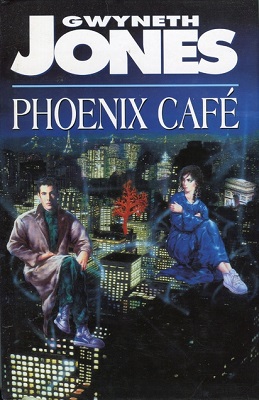
North Wind, Gwyneth Jones (1994, UK). I can’t remember if White Queen was initially presented as a standalone, I can’t remember when I first read White Queen if it was sold as the first book of a trilogy – although judging by the gap between it and North Wind, I suspect not. The story of North Wind opens a century later, long after all those mentioned in White Queen have died – although the Aleutians are, of course, serial reincarnators. Everyone now knows the Aleutians arrived in a generation ship – less of a hardship for serial reincarnators, obvs – and the events of White Queen have pretty much passed into legend, especially among the Aleutians, who remember it as a significant epic, The Grief of Clavel. The opening of North Wind turns the tables on White Queen, this time having a human rescue a naive Aleutian, rather than vice versa, when a backlash against the aliens takes place, and all but Bella, the “librarian”, among the Aleutians are killed in, again, Africa. Bella – “he” to himself and other Aleutians, but “she” to humans – is rescued by human Sidney Carton (the name explicitly taken from Dickens’ A Tale of Two Cities). Since White Queen, Earth has been embroiled in several Gender Wars – the Women are not all women, the Men are not all men; reformers and traditionalist are mentioned throughout as better labels – and this has made things more difficult for the Aleutians, and the halfcastes, who are humans who surgically alter themselves to resemble Aleutians, and consider themselves reincarnations (of, obviously, cultural icons of Jones’s own formative years, like Jimi Hendrix, who is of course also heavily referenced in Jones’s Bold As Love novels). In North Wind, Carton’s rescue of Bella, and her/his subsequent escape from his “care”, eventually leads into a hunt for Buonarotti’s mythical FTL drive… I couldn’t honestly tell you if North Wind is better than White Queen. I suspect the distinction is irrelevant. White Queen is a more memorable narrative, but it has the advantage of kicking off the series. North Wind has a more coherent narrative – but one of the strengths of the series, novels and short stories, is that a lack of narrative coherence is a side-effect of FTL travel, or rather, the narrative deliberately obfuscates in order to evoke the experience of FTL travel. I had forgotten how good this trilogy was, so I’m grateful for being prompted into rereading them. I should reread them more often, regularly perhaps. On the other hand, I had forgotten how badly Gollancz had served these books with cover art. Jones has recently rereleased the novels herself on Kindle, and she may well have updated them. Which is really annoying, as I’m not a fan of ebooks and would much sooner read hardcopy, paperback or hardback. Next up, Phoenix Café, the original 1997 Gollancz hardback…

1001 Books You Must Read Before You Die count: 131

Leave a comment

Moving pictures 2017, #44

Trying to maintain a varied diet of films to watch often means you find yourself watching something that doesn’t actually appeal. We all have our favourites, and we often stick to them, but I enjoy trying new things, discovering new favourites… even if you find some things you’ll know better to avoid in the future. Of the six films below, none I thought especially good. I prefer other films by Pasolini, I still have no idea what the Jancsó Kapa and Pepe films are about, and even the Herzog was far from one of his best…

The Decameron, Pier Paolo Pasolini (1971, Italy). This was the first Pasolini I ever saw. According to my records, I rented it in 2009, although I don’t recall why. It wasn’t until I watched the Pasolini segment of RoGoPaG (see here) late last year that I thought his oeuvre might be worth exploring. And then The Gospel According to St Matthew, which is on the 1001 Movies You Must See Before You Die list, appeared free to watch on Amazon Prime, and then I rented his other film on the list, Salò, or 120 Days of Sodom… And while I’ve sort of become a bit of a Pasolini fan, The Decameron is not among my favourites of his. Like his The Canterbury Tales, it’s an adaptation of some of the stories from a mediaeval story cycle, but Italian in this case rather than English. But in look and feel, it’s very similar (or rather, the other film is, as this one preceded it) and the humour is similarly scatological and earthy. So much so, in fact, that the film opens with a “tempo” in which Ninetto Davoli visits his long-lost sister (he thinks) only to be dropped into a latrine and is covered in shit, just so she can steal his money. Later, he finds himself imprisoned in the sarcophagus of a richly-dressed bishop in a cathedral. And so it goes. Another episode sees a man pretending to be deaf-mute in order to enjoy the sexual attentions of the nuns at a convent. The humour is broad, so are the points being made. And while the 14th-century source novel clearly influences the various tales, Pasolini’s own sensibilities, even back in the 1970s, are also on display. The stories are often crude, with a sense of humour even Talbot Rothwell would have shied from, but a celebration of the human condition still shines through. It’s hard to reach the end of a Pasolini film without feeling entertained or a little better about humanity in general. I don’t know that he was especially good at documenting humanity’s failings – to be honest, this box set has me totally confused as to what Pasolini was trying to achieve – but it’s difficult to finish one of his films without a smile. So props for that.

Margaret, Kenneth Lonergan (2011, USA). I’m not sure what persuaded me to add this to my rental list, but I wish I hadn’t. It was the first film I’ve seen by Lonergan, and likely to be the last. Anna Paquin plays a New York student, who one day distracts a bus driver as he’s pulling away, causing him to run a red light and run over a woman crossing the street. But Paquin is so self-centred, she has to make the accident about herself, and though she recognises she did cause the accident she doesn’t actually admit it until near the end of this over-long, overly narcissistic, very dull, three-hour film. When she learns the bus driver has not been fired, she badgers the woman’s estranged relatives into sueing the MTA for damages, insisting as one of the conditions they sack him. There is not a single likeable character in this film – even Lonergan himself, who plays Paquin’s divorced father, is needy and neurotic and snide. Jean Reno plays a South American businessman who is in a relationship with Paquin’s mother, and while he seems the most pleasant character of the lot, he’s portrayed as a bit of a simpleton, and the anti-semitic remarks that eventually see him pushed out of the family are totally manufactured. At 90 minutes, Margaret would likely have outstayed its welcome; at three hours, it was torture. Perhaps you have to be American to appreciate this film; I am not American; I thought it was awful. Avoid.

Anyádi s szúnyogok, Miklós Jancsó (2000, Hungary). I’ve still no idea what these films are about, although a theme common to both this and the first film in the series, Nekem lámpást adott kezembe az Úr Pesten (see here), appears to be suicide. This film – whose title apparently translates as “Mother! The mosquitos!”, although the subtitles definitely said, “Fuck the mosquitoes!” at one point – initially appears to be set in in a train museum, with Kapa and Pepe playing train drivers or train engineers. But like the first film, the story quickly changes, and though the two main characters continue to play themselves, they’re now in different roles. There’s also a band who apear at intervals and play rock, with help of assorted pieces of defunct industrial equipment and, I seem to remember, a drill. They’re not unlike Norway’s Hurra Torpedo. And there’s another scene which is apparently set really high up on something, a statue I think, as if Jancsó were trying to prove a point by including some vertiginous scenes – although perhaps it’s only me, someone who suffers from vertigo, who would even think to mention them. There’s a review on imdb.com which is less than helpful. It says, for example, “The comedy jacket of the story gives a cool atmosphere”, and does very little to actually explain what is going on. I feel their pain – because I have no idea either. Nonetheless, I’m glad I bought these six films and I hope one day to understand them.

Into the Abyss, Werner Herzog (2011, USA). Herzog is one of the most interesting directors of the twentieth and twenty-first centuries, and his documentaries are typically every bit as good as his feature films. But this one was a bit of a mis-step, I think. The topic is one that’s been over-subscribed in documentary films for decades, and Herzog’s straightforward yet off-kilter approach fails to make it interesting. Some of the questions he asks are a bit off-the-wall, and it’s clear the interviewees think so too, but… The subject is people on Death Row, two people, in fact, one of whom still maintains his innocence. Seriously, are there any people with more than two brain cells on this planet who need persuading that capital punishment is a bad thing? State-sanctioned murder is still murder. You can throw up as many examples of miscarriages of justice, or even bona fide monsters, but even that giant fairy in the sky so many people seem to think really exists, even he thinks it’s wrong. Into the Abyss is a series of interviews with two inmates on Death Row in Texas, and with those who know the inmates or were involved with their crimes, or their bringing to justice. But I don’t see the point of it all – granted, he’s preaching to the choir. But since the only argument that’s going to work on the pro-capital punishment crown is a nail-studded cluebat, I don’t see the point of documentaries like Into the Abyss, no mater how balanced, or how off-centre, the approach they take.

The Space Between Us, Peter Chelsom (2017, USA). The space between the two principals, the figures on the DVD cover art, is, well, space itself, ie, the space between Earth and Mars. Did you see what they did there? Clever, that. Asa Butterfield was born on Mars – his mother was the commander of the first mission to Mars, but happened to be pregnant at the time. NASA decided to keep Butterfield’s existence a secret. Sixteen years later, he is finally allowed to visit Earth. Which he thinks is great because he’s made a friend online, Britt Robertson, a spiky and clever, but good-hearted, foster kid, and because it also allows him to go looking for his father, whose identity he only knows from an old photo. Of course, NASA would sooner he stayed in seclusion at one of their facilities. But he escapes, goes and finds Robertson, and the two head across country looking for dear old dad. What is it with Hollywood films and their daddy issues? Can they please move past Misogynistic Pop Psych 101? Robertson is sparky, which is probably the new feisty; Butterfield is earnest and gauche. Gary Oldman phones in it. It’s a nice story, and they made a halfway decent fist of presenting a near-future which could send a mission to Mars and start a colony there. But it’s all too easy. Okay, I admit I watched this after seeing National Geographics miniseries Mars, but you might as well have changed Butterfield’s skin colour and you could have told pretty much the same story. Except, of course, white US audiences are more likely to sympathise with a star-crossed Martian than a star-crossed African-American. Oh, and the growing up on Mars so he has an enlarged heart is the sort of metaphor they beat out of you in the cheap writing workshops, the ones given by people better known for writing how-to books than actual books. Or screenplays, in this instance.

Secuestro Express, Jonathan Jakubowicz (2005, Venezuela). My first film from Venezuela. And despite being released in 2005, it was all a bit 1990s, to be honest. A young and well-off couple are kidnapped by three gang-bangers – this is a common thing in Caracas, it seems – who demand a ransom from the woman’s father. The young man escapes, leaving his girlfriend to the kidnappers’ mercy, but is later recaptured and killed. The father pays the ransom, the young woman is released. The film is shot in a very MTV-ish style, lots of cross-cuts, jittery cam, blurring and Dutch angles. The characters are introduced with stylised on-screen text bios. The acting is not all that good, although the female victim, played by Argentine actress Mia Maestro, is pretty good. If I’d seen this twenty years ago, I’d have been more impressed, and not just because, er, that was a decade before it was actually made.

1001 Movies You Must See Before You Die count: 878


3 Comments

Kiitos, Helsinki

This year’s Worldcon took place in Helsinki, from Wednesday 9 August to Sunday 13 August. It was called Worldcon75 (not the most original name, it has to be said), and the guests of honour were John-Henri Holmberg, Nalo Hopkinson, Johanna Sinisalo, Claire Wendling (although she bowed out due to illness and did not attend) and Walter Jon Williams. It was my second Worldcon – my first was Interaction, in 2005 in Glasgow. I didn’t go to Loncon 3, in, er, London in 2014, because reasons.

The trip did not start well. A couple of days before my flight, my bank rang to inform me my debit card had been copied and they were going to cancel it and send me a new one. “Oh no you’re fucking not”, I told them. I explained I was about to visit Finland and would need my card. We reached a compromise, and my card remained valid throughout my stay in Helsinki. Yes, I want my bank to protect me from fraud, I want them to make sure no one steals my money, but… this is the same bank that had previously cancelled my card because they sent a marketing letter to the wrong address and it had been returned with “not known at this address”. So, you know, precautions.

I had planned to take some copies of my books to Finland, so if anyone wanted copies I’d have some on hand to sell. And perhaps I’d buy lots of books at the con. So I decided to take a suitcase to go in the hold (I normally travel only with cabin baggage). I’d already started packing it…

… when I thought to check my ticket. And discovered I had check-in baggage for the flight to Helsinki, but not for the flight from Helsinki. Oops. I suppose I could have contacted Finnair and asked them to add check-in baggage to my flight home, but I suspect they’d have charged for the privilege. And no, I wasn’t intending to smuggle Oscar into Finland. Anyway, I put the suitcase away, and took my usual cabin baggage. And it’s just as well – I saw someone tweet the day after Worldcon75 that they’d not had check-in baggage on a ticket to Copenhagen and had been charged €200 for their suitcases.

The trip to Helsinki was uneventful: train to Manchester Airport, a ninety-minute wait until I boarded the aircraft, a Finnair 100-seater Embraer 190. There was no one I knew on the flight, although two female passengers were clearly heading to Worldcon75 as one of them was wearing a T-shirt advertising the con. After two and a half hours in the air, I landed at Helsinki-Vantaa Airport, passed quickly through the electronic passport control gates – I must look a lot like my passport photo as the gate took less than a second to admit me – and then walked what felt like kilometres to find the railway station.

The train which runs from Helsinki-Vantaa to Helsinki päärautatieasema (central railway station) runs on a loop, so it’s impossible to catch the wrong train. And the train is a lovely modern one, with plenty of space, and very quiet. There are flat screens which announce each station, and display the route, in Finnish, Swedish and English. My hotel for the duration of the convention was the Sokos Vaakuna, which is sited just across the road from the central railway station. I’d picked it because of its location and because the website described it as having a “functional design”. This latter proved to be something that looked like it belonged in 1970s Soviet Russia. I loved it.

After checking in, and having a quick shower, I caught the train – the same one which ran to the airport and back – to Pasila, the first stop on the line. It took five minutes (and cost 5 euros). From the station, it was a short walk, across a dual carriageway and halfway down a block to the entrance to Messukeskus, the convention centre where Worldcon75 was taking place. Even though I had landed at 3 pm, I was at the convention for 5 pm.

After registering, I decided to look for the dealers room, but went downstairs instead of up the ramp… and immediately spotted Tony Ballantyne and Chris Beckett enjoying a coffee at the café on the downstairs concourse. So I joined them…

And that was sort of how it went for the entire con: bumping into people I knew, in between arranging to meet up with people I knew. I remember saying that if there were 6,000 people at Worldcon75, and I could lay claim to knowing perhaps ten percent of them… I’d probably still keep on bumping into the same thirty or so people.

I later met up with Tobias Bodlund, who had his young son in tow, and the three of us headed into Helsinki for food. The convention pack included a restaurant guide, and from it we picked Zetor, which served Russian/Finnish agrarian food (or so said the guide). It was also apparently owned by a member of the Leningrad Cowboys. That no doubt explained the tractors and the stuffed cow. I recognised about a quarter of the people in the restaurant, which was a bit odd. I ordered the Karelian stew, which came with gherkins. It was very good. I also love gherkins. Afterward, I went straight back to my hotel and had an early night.

Members of Worldcon75 were given a travelcard for Helsinki, which meant the 5-minute train ride from the central station to Pasila cost me nothing. I don’t know if this is standard practice at worldcons, but it should be. I had one programme item on Thursday: Secrets in science fiction and fantasy. To be honest, I’ve no idea why I was picked for it. And after meeting my fellow panellists – Jane Anne McLachlan, Jennifer Udden, Kim ten Tusscher and J Sharp – I suspect the topic was someone’s suggestion and they put together a random selection of authors and agents. Jane Anne had prepared several questions, and we spent the panel answering them. I’m not overly keen on doing panels like that as it prevents a free-flowing discussion and can seem stilted. It seemed to go okay. Although someone did fall asleep in the front row. I bumped into Adrian Tchaikovsky, who had been in the audience, and he said he enjoyed it.

I spent the rest of the day sitting outside the Terra Nova Brasserie, which was the bar attached to the Holiday Inn, which was the hotel attached to the Messukeskus. I went for lunch to a nearby Nepalese restaurant, with Barbara, Tobias and his son, and we ran into Lennart there. The food was okay. That evening I headed into Helsinki with Will, Jen and a Finnish friend of theirs, and the Mexican restaurant we had planned to eat in was closed so we ended up in an Australian burger bar, which wasn’t bad. Eating in Helsinki was really good for me – I didn’t have to worry about menus, as they all featured lactose-free dishes. In fact, most menus featured meals that clearly had dairy in them, but were made with lactose-free versions of the dairy products. I’ve found you either eat well at conventions or eat badly. I usually eat badly. At Worldcon75, I ate well.

I returned to the con and stayed until 1:30 am, chatting to friends outside the Terra Nova or hanging out in the Winter Garden, where I met Shaun Duke and Paul Weimer in person for the first time. I ‘d been reliably informed trains to the central railway station ran all night. They don’t. During the week, that is. I got to Pasila station at 1:31 am. The last train left just as I walked up the ramp to the platform. The next train wasn’t until 4:18 am. So I walked back to Messukeskus, and jumped in a taxi. It cost me €18, which was less than I’d been expecting.
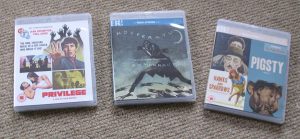
On the Friday, I met up with Berit Ellingsen, and we had a coffee in the Fazer Café on the Messukeskus concourse (it was the best of the food/drink venues in the centre). We’ve known each other for several years, but it was the first time we’d met up in person. There was another person at Worldcon75 who’d I only known online and never met IRL – but Michael Martineck and I have been friends for more than 20 years. We first met in an online writing workshop back in the 1990s. I’d gone for a sandwich in Fazer Café with Will Ellwood, while I tried to figure out how get Michael and myself both in the same place at the same time… when I turned round, and saw he was two places behind me in the queue. We spent most of the afternoon sitting outside the Terra Nova.

I’d arrange to go for dinner that evening with Gillian Polack. Tobias was up for it too, so I went off to find Gillian. She was sitting outside Fazer Café, talking to… Michael. “I didn’t know you two knew each other,” I said. They’d apparently met at a programme item, my name had come up in conversation, and they realised they both knew me. So the four of us took the tram into the centre of Helsinki, for dinner at Stone’s Gastro Pub. Which was very good. At one point during the tram ride, a guy came up to us and asked if he could sit with us and listen to our conversation. We said sure. I assumed he was just some random nutter on the bus. Later, I saw him at Worldcon75 – he was an attending member of the con.

Back at Messukeskus, I stayed until 3 am, caught the train back to the central railway station (they run throughout the night on Friday and Saturday night), and crossed the road to my hotel.

My second panel of the con was at noon on the Saturday, Mighty space fleets of war. When I’d registered at the con, I’d discovered I was moderating the panel, which I hadn’t known. I checked back over the emails I’d been sent by the con’s programming team. Oops. I was the moderator. The other two panellists were Jack Campbell and Chris Gerrib. As we took our seats on the stage, Mary Robinette Kowal was gathering her stuff from the previous panel. I jokingly asked if she wanted to join our panel. And then asked if she’d moderate it. She said she was happy to moderate if we wanted her to, but we decided to muddle through ourselves. The panel went quite well, I thought. We got a bit of disagreement going – well, me versus the other two, both of whom admitted to having been USN in the past. I got a wave of applause for a crack about Brexit, and we managed to stay on topic – realistic space combat – for the entire time. I’d prepared a bunch of notes, but by fifteen minutes in, I’d used up all my points. In future, I’ll take in paper and pencil so I can jot stuff down as other members of the panel speak. After the panel, I met up with Eric Choi, a Canadian sf writer who contributed to Rocket Science back in 2012, and we had a quick chat.

Last year, when I bought my membership to Worldcon75, a friend who lived in Helsinki suggested we meet up for drinks or food. I used to work with Melody Jane about ten years ago. I left the company, she left the country. On the Saturday evening, I returned to my hotel, to meet Melody Jane. No sooner did she arrive, then the heavens opened. Thunder, lightning, the lot. Even strong winds, which caused enough damage to close one of the train lines. We waited inside the hotel for about twenty minutes, but it obviously wasn’t going to stop. So we borrowed umbrellas from the hotel reception, and walked to Farang, an Asian fusion restaurant located in the Kunsthalle Helsinki. The food was excellent, and I had a really good time. After the meal, I headed back to the Messukeskus, and stayed until 3 am. After a thirty minute wait at the station, I returned to my hotel.

I’d been getting into breakfast around 8 am each morning, at the restaurant on the Sokos Vaakuna’s top floor. But for the Sunday, I decided to miss breakfast and have a lie-in. Around lunch-time, I went looking for some modern art museums. Happily, the Kiasma Museum of Contemporary Art was just around the corner from my hotel. Also happily, its collection features lots of video installations. I like video installations. Not all of them worked for me – one or two, the CGI was a bit crude, and they felt no better than Youtube videos. But the ones by Ed Atkins and Cécile B Evans were impressive. I also thought the one by Tuomas A Laitinen was very good. Coincidentally, it was all very science-fictional, with most of the pieces actually either based on science-fictional ideas or set in the future.

For lunch, I popped into the 24-hour supermarket in the basement of my hotel and bought myself a sandwich. After spending ten minutes puzzling out the ingredients in Swedish, I spotted it said lactose-free in both Finnish and Swedish on the front label. And then it was back to the con for last day…

… which ended with the Dead Dog Party. This is a tradition at cons: those staying for another night gather in the hotel bar and have an informal party. Because so many attendees had flown into Helsinki for Worldcon75, a lot of them – myself included – weren’t flying out until the following day. A group of us had planned to head into town for food, but that plan didn’t come together. Then we heard the Dead Dog Party was laying on a tex-mex buffet. We also heard it was packed and people were being turned away. We decided to give it a try, but unfortunately took a wrong turning and it took us three times as long to get the Sokos Pasila, where the party was taking place. So I was not in the best of moods when we arrived. And saw the queue for the bar. And the queue for food. But we joined the line for the buffet anyway. Tobias and I had just reached it – tortillas and taco meat – when it finished. We waited. The chef brought out something that looked a bit like chicken fajita. It was the “vegetarian option”. Quorn or tofu or something. It was vile. I went and asked for my money back. I also persuaded the others – Tobias, Michael and Ian McDonald – to try the bar we’d spotted opposite the hotel, the Ravintola Windsor. Ian bowed out, but we were joined by Stephen Vessels. We went there, it was quiet, we got beer, and we got food (I had kebab and chips, it was very nice).

After we’d finished our food, Michael and Stephen left. Then Tobias left, so I headed back to the Dead Dog Party. I chatted to Liam Proven for a bit, and the people he was with – one told me they’d overheard an American complain during the Closing Ceremony that the con had been “too Eurocentric”. By midnight, I was ready to head back to my hotel – the last train was at 12:30. But then I bumped into Sanna Bo Claumarch, a Danish fan, and joined her and Fia Karlsson and some young Swedish and Finnish fans, and ended up staying until 2 am. To get back to my hotel, I shared a taxi with Liam and a Finnish fan.

Will and Jenny were on the same flight as me back to Manchester, so we agreed to catch the train to the airport together. But by the time I’d checked out of my hotel, I couldn’t be bothered to hang around for another couple of hours, so I caught the train on my own, checked in, and waited in the airport for them. And for Tobias, whose flight to Stockholm was around the same time as our flight to the UK. And then, when I boarded the plane – another Finnair Embraer 190 – I discovered I was sitting next to Fran and John Dowd.

The trip to Finland finished in a nicely surreal fashion on the train from Manchester Airport, when the PA first insisted the train was heading to Manchester Airport, where it would terminate, and then repeatedly told us the next stop was Batley, despite the train going nowhere near Batley.

I had a great time at Worldcon75, met some really nice interesting people – not all of which I’ve named here, but also includes John-Henri, Daniel, Bellis, Edward, Jo Lindsay, Hal (Al), Ian W (there was a plan on the Sunday to get the four Ian writers together for a photo, but it never happened – perhaps it’s just as well as it may have caused a singularity or something), Hanna, (the) Anders, Johan, Brian, Jukka, Luke, Emil, Thomas, Christina, Jeremy, Kristin and Erik, and apologies if I’ve forgotten anyone – from a variety of countries (mostly Sweden, the UK and Finland, but also the US, Canada, France, Austria, Ireland, Australia, Poland…). True, I spent most of the four and a bit days sitting outside the Terra Nova, drinking beer and socialising with friends (in fact, the con drank the bar dry of beer several times.) As is usual for me, I went to no programme items – not even the Hugo Awards, and I couldn’t get into the Closing Ceremony – but I did wander around the dealers room a number of times. In the end, I bought a single book – a first edition of John Varley’s Titan for 10 euros (bargain!) – so I wouldn’t have needed my suitcase, after all.

Jukke Halme and his team can definitely be proud of the convention they put together. There were a few problems initially, as twice as many people had turned up as had been originally planned for, but the issues were quickly resolved. I’d certainly put Worldcon75 in my top five cons I’ve attended – and I’ve been going to science fiction conventions since 1989. And I loved Helsinki, it’s a great city. I wish I’d seen more of it, but I’d had to limit my time in Finland because dayjob. I want to go back.

And that was my worldcon.


Leave a comment

Expanding bookiverse

Things got a bit stressful a few weeks ago, so I coped by doing what I usually do in such situations: I buy more books. Also, there were a few authors with new books out that I wanted. So the collection has grown quite a bit this month…

I have absolute no idea why I bought Forever Amber. I recently watched the film adaptation by Otto Preminger (see here) and was not especially impressed. But when I looked up the book on Wikipedia and saw the lines, “The fifth draft of Winsor’s first manuscript of Forever Amber was accepted for publication, but the publishers edited the book down to one-fifth of its original size. The resulting novel was 972 pages long”, I was intrigued enough to look for a copy on eBay. Where I found a hardback for £2. The Unburied was a lucky find – a signed first edition for a reasonable price. I’ve been a fan of Palliser’s books for years but only recently started collecting them.

Some new books: The 7th Function of Language, The Essex Serpent and The Power (not shown) I bought in Waterstone’s a few Saturdays ago, before meeting up with friends for the Sheffield SF & Fantasy Social. I took The Power with me to Helsinki to read during the trip, and gave it away when I’d finished it. Lust was from a large online retailer. I decided it was time to read another book by Elfriede Jelinek – I read her The Piano Teacher a couple of years ago, and thought it very good.

I signed up for The Blaft Anthology Tamil Pulp Fiction Vol 3 on indiegogo back in June 2015. It only arrived last month. The rewards I signed up for included volumes 1 and 2, but reprints of Vol 1 have apparently been delayed so the publishers included Kumari Loves a  Monster as a “sorry, and please be patient”.
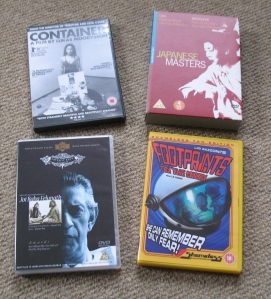
Xeelee: Endurance is a collection of stories originally published in 2015. This is the PS Publishing slipcased version, which was published only this year. The Massacre of Mankind, also by Baxter, is an official sequel to Wells’s The War of the Worlds. I’ve read several of Goss’s stories over the last few years, and was especially impressed by her ‘Cimmeria: From the Journal of Imaginary Anthropology’ in 2014, so much so I nominated it for the BSFA Award… but it didn’t make the shortlist. The Strange Case of the Alchemist’s Daughter sounds like more of the same.

New paperbacks by authors whose books I like and admire: John Crowley’s Totalitopia is more a collection of essays than anything else, The Rift is Nina Allan’s second novel (although I didn’t bother with the updated Titan Books version of The Race), Calling Major Tom is by a friend and has been getting good reviews, and The Switch, well, I’ve been buying and reading Justina Robson’s books right from the start, after being in a writing orbiter with her back in the 1990s.

The Gulag Archipelago – it’s only volume one, although it doesn’t say so – I found in a local charity shop. Cosmic Encounter I bought on eBay – it was very cheap, but the seller was a little optimistic in their description of its condition.

And last but not least, a pair of bandes dessinée: Orphan of the Stars is the seventeenth volume of the Valerian and Laureline series (I was surprised to discover recently they’re publishing a novelisation of Luc Besson’s film adaptation; er, what?), and Fog over Tolbiac Bridge is the latest by Jacques Tardi to be published by Fantagraphics. I wrote about both of them here.