It Doesn't Have To Be Right…

… it just has to sound plausible


3 Comments

Moving pictures 2018, #18

I managed to crack off a few from the 1001 Movies you Must See Before You Die list recently. So to speak. And ended up with an unexpected entry on my best of the year list…

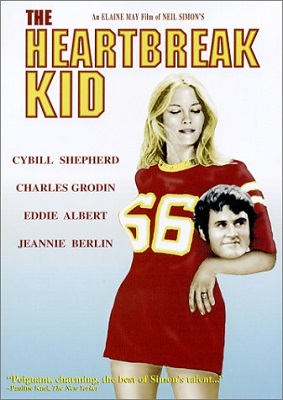
The Heartbreak Kid*, Elaine May (1972, USA). I think I’ve said before that some of the picks for the 1001 Movies You Must See Before You Die are, quite frankly, baffling, and this is certainly one of them. There you are on your deathbed, and you’re thinking about the movies you wished you’d got around to seeing… and a smug comedy about a man who abandons his wife on their honeymoon to run off with a younger, and WASPier, woman, with no guarantee of a relationship, can hardly be near the top of the list. True, this is a Neil Simon script, although I’ve never really understood his appeal, and a female director, and it’s a very American Jewish story but… Charles Grodin is an up-and-coming sporting goods salesman in New York. Like every young man his age, Jewish or Gentile, his life revolves around relationships with women. He meets a young woman, also Jewish. They get married. And go to Florida for their honeymoon. Where Grodin meets Sybill Shepard. He splits with his wife and follows Shepard back home to Minnesota, declares his undying love, and eventually persuades her father to let him marry her. At which point he realises he has given up his life and culture for something he never really understood and cannot relate to. And, to be honest, it’s hard for the viewer to care. The story is so universal the Jewish elements seem almost irrelevant. They could, in fact, have applied to any self-identified cultural group in the US. True, the Minnesotans’ (#NotAllMinnesotans…) antisemitism is laid bare as the plot unfolds – and the fact of its existence likely comes as little surprise to anyone who watches this film. It’s like the old bloke at bus stop who complains that there were no black people in the UK when he was growing up. He’s a racist; he’ll always be a racist. That’s hardly a twist ending.

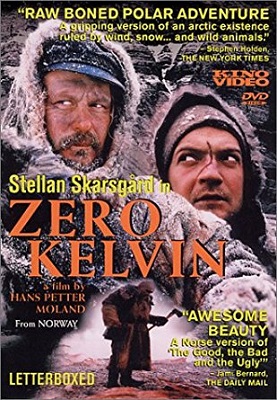
Zero Kelvin*, Hans Petter Moland (1995, Norway). This is much more like a candidate for the 1001 Movies You Must See Before You Die list, a Norwegian film set in the 1920s and filmed in the Arctic Circle. A poet in Oslo signs a contract to assist a pair of trappers in Greenland. He ships out there, and meets them – one is a taciturn scientist-type, the others is a rough-and-ready alpha male type. The poet and the alpha male type do not get on very well. The former is friendly with the dogs, the latter mistreats them, because, he claims, if your life depends on them then they’ll respond better if they fear you. A common excuse used by psychopaths. Their – er, the poet and the alpha male, that is, not the dogs – relationship has its ups and down, partly mediated by the scientist. And embalming alcohol. But it all goes horribly wrong, as things do, and their hut burns down, the scientist dies, and the two head off across the arctic waste to the nearest settlement. It’s all pretty intense stuff, and the scenery – it was filmed on Svalbard – is astonishing. After The Heartbreak Kid, this is definitely a film that belongs on the 1001 Movies You Must See Before You Die list. And Stellan Skarsgård as the trapper is on top form. Worth seeing.

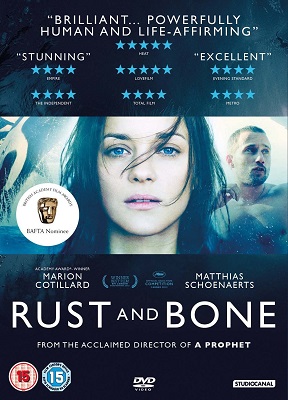
Rust and Bone, Jacques Audiard (2012, France). I’m pretty sure I stuck this on my rental list after seeing a trailer on another disc. Having now seen it, I wonder what it was in the trailer which persuaded me to add it to my list. It’s good film, there’s no doubt about that, the sort of dysfunctional romance the French do so well (in fact, they’re probably the only country to have made a genre of it; indeed some French directors have made entire careers out of it). Matthias Schoenhaerts is a single father with a young son, a drifter and unemployed, who ends up in Antibes. Where he gets a job as a bouncer. Marion Cotillard is a trainer at a marine world, working with orcas. She likes to go out dancing, but gets into a fight at the night-club where Schoenhaerts works. He intervenes, and ends up driving her home. Soon after, there’s an… accident at the marine world, and Cotillard loses both her legs. Her life falls apart, and just about the only person who doesn’t reject her is Schoenhaerts. She accompanies him as he tries to make money bare-knuckle fighting, and thanks to his support she starts putting her life back together. It is, as I said, very French. A well-acted drama, with two good leads, and if not a cheerful story then a well put together one.

Science Fiction Volume 1: The Osiris Child, Shane Abbess (2016, Australia). I’ve no idea where I came across mention of this movie, but I hadn’t known it was Australian until I came to write this. Certainly there are no clues in the film, and all the cast speak with American accents. I have to wonder about that title, however. Science Fiction Volume 1? Although it was apparently retitled Origin Wars in Ireland. For, er, reasons. But that original title has to be a hostage to fortune. I mean, this is bog-standard space opera – in science fiction terms – although the film-makers have done a good job in realising it on screen. A pilot for an off-world military contractor finds himself trapped on Earth when his fighter is shot down, and he must travel to a nearby city to rescue his young daughter. He is captured by an escaped convict, and the two form an unlikely alliance. And there are these genetically-engineered creatures from the prison the guy escaped from, which are out to kill everyone. The Osiris Child‘s biggest problem was that it couldn’t decide what it was: The Force Awakens or a Mad Max movie. It tried for both. It didn’t help that the villains of the story – the genetically-engineered creatures – looked like something out of Dark Crystal. Having said that, there was nothing bad about it. It felt like a mostly unoriginal sf novel that was quite well-written. The special effects were good, the mise en scène effective, the acting quite good… but it all added up to bits and pieces seen before. The director had tried to mix things up by adding a prologue and epilogue, making the film’s main narrative a flashback, but it didn’t quite work. All the same, I’ll keep an eye open for Volume 2.

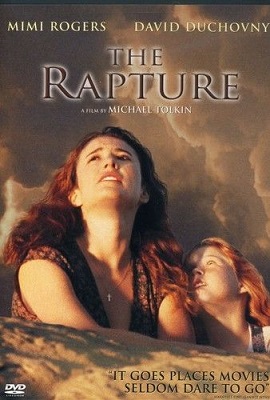
The Rapture*, Michael Tonkin (1991, USA). Mimi Rogers plays a telephone operator who enlivens her humdrum existence by picking up couples with her partner and engaging in sex. But then one day she is accosted by a pair of earnest young Christian door-knockers, and converts. She converts acquaintance David Duchovny, and the two marry and move away and have a little girl. Some years later, Duchovny is killed when an employee goes postal, so Rogers and kid move to a national park and start living rough. But, convinced the Rapture is near, Rogers kills her daughter. But she cannot kill herself, so she is arrested and put in jail. So far, so humdrum. There are countless stories about people finding God, losing God, finding Him again, losing him again, whatever. And it’s dull as shit. Especially to an atheist. Despite Rogers’s excellent performance, and the generally well-made nature of The Rapture, I’d have written it off as a well-played but uninteresting drama that failed to make a cogent point, except… Tonkin takes it all the way. He totally commits to his concept. The actual Rapture takes place, and Rogers ends up wandering a strange empty wasteland. Her daughter tries to persuade her to forgive God, but she refuses. It’s not unknown for films to take a sudden turn in the final act which totally redeems what has gone before. And, to be fair, the title was probably a big clue. But I hadn’t actually expected it, and it really did make the movie. I suspect it deserves its place on the 1001 Movies You Must See Before You Die list. Worth seeing.

Dunkirk, Christopher Nolan (2017, UK). I’m not a Christopher Nolan fan. I thought Memento was brilliant, but nothing by him since has impressed me. Interstellar, his film most likely to appeal to me, looked fantastic in parts, but was a horrible mess. Having said that, he’s the nearest thing Hollywood currently has to an auteur, and is successful and powerful enough to pretty much pick his own projects and do them the way he wants to. Which brings us to Dunkirk, a film I had every intention of avoiding. In these days of Brexit, the last thing I wanted to watch was some luvvie-heavy depiction of past glories as some sort of motivational mandate for our current economic death spiral. But I ended up watching it anyway. And it is completely brilliant. Seriously. It has no plot. It’s just the day of the BEF’s evacuation from the beaches of Normandy in mind-numbing and brutal detail. Yes, there are luvvies in it, but not that many; and they don’t have character arcs or narratives, or even overplay their parts. But it’s all so solid on the details – you have guys on fishing boats wearing ties! It doesn’t need to editorialise about the events, they are their own commentary. I don’t how much of the audience were familiar with the actual events, although I suspect most thought of Dunkirk as some sort of British success, which in actual fact it was the final indignity of a failed campaign by the British Expeditionary Force in France. It’s nothing to be proud of. Our army was so badly prepared, they fled in retreat. And we had to use fishing boats to rescue them. “Dunkirk spirit” means failing so badly we have to rewrite history in order to make it a victory. Nolan stitches together a variety of tales from the evacuation, and presents them in convincingly accurate detail. He’s not making a point about Dunkirk and British spirit. He’s just showing what happened. There’s no through-line. I tweeted while watching Dunkirk that it may well be the film of the early twenty-first century as it’s pure spectacle, with no story just pure historical voyeurism – and given the present fad for finding narratives in current affairs, that’s refreshingly contrary. Oh, and the film looks absolutely gorgeous too. I might even invest in my own copy on Blu-ray…

1001 Movies you Must See Before you Die count: 899


4 Comments

The con in the north

I think Harrogate is the furthest north in England the Eastercon has ever been. Certainly, it’s the most northerly Eastercon I’ve attended. Blackpool, Manchester and Bradford are in the North, but still south of Harrogate. York and Leeds, also south of Harrogate, were before my time. And Glasgow, of course, is in Scotland.

More recently, I’ve been attending conventions much further north – in Sweden, Denmark, Finland and Iceland. But that’s by the by. Follycon 2, this year’s Eastercon, took place at the Majestic Hotel, which is a huge Victorian hotel that has seen better days, in Harrogate. And now that it’s all over… I’m not entirely sure if it was a good Eastercon or a bad one.

Majestic Hotel to the left, Premier Inn straight ahead

The venue was large, with plenty of room to sit down and chat and have a drink. The layout had been knocked about in the past, resulting in odd staircases that appeared to go nowhere, and a poky reception that actually had the main entrance on hotel’s rear, and an original entrance hall which boasted a nice mural above the dado but felt more like a space without a purpose – at least, normally; during the con, it was the main social area. And since there were programme rooms on either side, you’d get a throng crossing it whenever programme items ended. Having said that, the service was occasionally appalling, and I heard a few stories about delayed meals.

View of the Majestic from my hotel room

However, the Majestic is literally a stone’s throw from Harrogate town centre, so it was a quick walk to plenty of good places to eat. So I ate well during the con. Which is unusual for me. I can recommend Major Tom’s Social on the Ginnel, off Parliament Street, which serves pizza – including two vegan ones – and craft ale. There’s also a good all-you-can-eat Chinese restaurant on Cheltenham Crescent, although it’s not a buffet – and the concept of all-you-can-eat from a menu did confuse a couple of members of our dinner party…

(I wasn’t actually staying in the Majestic, but in the Premier Inn, which was pretty much next-door. My room was large and comfortable – it had a chaise longue! – and the staff, sorry, “team”, were helpful and attentive. The breakfast was also pretty good.)

Then there was the con’s programme. It pretty much had something for everyone, not that I attended any items. Well, other than the one I was on, about AI, which went quite well. There were a couple of other panels I’d liked to have seen, but they seemed to fall at times when I had other plans, like lunch. I heard mixed reports from those who did attend panels, although most people seemed to have enjoyed them.

I no longer attend conventions for the programme – I haven’t done for years – even if I always promise myself I’ll see more of the programme, make more of what’s offered over the weekend. Instead of just sitting in the bar and chatting to friends. Which is pretty much what I did. There was a good real ale bar, which helped. And one of the two bars – the Regency Lounge – was more like a gentleman’s club, with panelled walls and leather(-ette?) armchairs (and peeling plaster above the dado). It was a good place to socialise.

The dealers’ room – I remember when they used be called book rooms – was poor. The usual small presses, a few self-published authors, jewellery and T-shirts… but no secondhand books. I can understand why dealers no longer bother – if they’re not making a profit, or even covering their expenses, then it’s not worth it. But it is disappointing.

No description of the hotel would be complete without a mention of the gents’ toilet near the dealers’ room. It was enormous. There was even a bench at one end for people to, er, sit down. It had seen better days, but was still pretty impressive.

The infamous gents’ toilets

The BSFA Award ceremony took place during Follycon. I usually attend this, but didn’t bother this year. It was pretty much a done deal. I’d expected Nina Allan’s The Rift to win – it’s a very good book and a worthy winner – although I thought Anne Charnock’s Dreams Before the Start of Time slightly better. But Charnock took the short fiction award for her novella, The Enclave. Which is also very good. Although I think the category was reasonably open. Best artwork went to Jim Burns, who must have a garden shed full of BSFA Awards by now, for the cover of a novel published by NewCon Press (who also published The Enclave), jointly with Victo Ngai for illustrations for a JY Yang story on Tor.com. The non-fiction award was won by Paul Kincaid’s book Iain M. Banks, which was the most likely winner of a strong shortlist… and has also been shortlisted for the Hugo. During recent years, books, novellas and artwork published by NewCon Press have regularly appeared in the BSFA Award shortlists. True, the BSFA is a small organisation, and it takes only a handful of votes for a work to be nominated… and probably not many more for it to be shortlisted. I suppose, the same might be said of PS Publishing and the BFS Awards.

But then I think popular vote awards – and the term “popular vote” is a total misnomer – are neither popular nor useful. Like the Hugo Awards, the shortlists for which were announced over the weekend. And, ho hum, the same old faces. It’s good the puppies appear to be a spent force, but all that means is we’re back to the old way of doing things, ie, a small group of writers dominating the shortlists. It’s telling the Hugo Award shortlists (voted for by fans) and the Nebula Award shortlists (voted for by pros) often have considerable overlap. Authors, especially popular authors, bend awards out of shape. I’ve said it before, and each year it proves my point.

But the Hugo shortlists… Jemisin is the new Card, the new Bujold, the new Willis… The Broken Earth trilogy is good, but not so good it contains the best genre books published three years in a row.  I’ll read the third book, The Stone Sky, as I’ve read the first two books of the trilogy. And I’ll read Kim Stanley Robinson’s New York 2140 too, as I’ve been a fan of his books for many years. But I’ve zero interest in the rest of the shortlist. I suspect Jemisin will win, which will be  disappointment, as it’s a safe choice, but neither do I want any of the others to win. And, to be honest, I could say the same for the short fiction categories. Once upon a time, they were dominated by the Big Three print magazines – Asimov’s, Analog and F&SF – but a new Big Three of online magazines now rules the roost – Tor.com, Clarkesworld and Uncanny. But then, at a time when the short fiction is notoriously vast, it only takes a few extra votes to get a story onto the shortlist. I guess we’ll find out later in the year exactly how few votes it takes to be on the short story shortlist.

Oh well. It’s not that I can’t get excited about the Hugo Awards, because I haven’t been for years. Even back in the day, the tastes of its voters never really aligned with mine.

Anyway, I left Harrogate on Monday morning, once the trains to Leeds were running – as the British weather had managed to  bollix the service. Now our railways are privatised, they are so much better, honest guv. (When will it be okay to punch a Tory? Their entire ideology is built on dangerous lies which have a habit of doing the exact opposite to their claimed benefits: trickle-down, home ownership, privatisation, low taxes, Austerity, Brexit… One Tory even went on record saying he doesn’t think rented accommodation needs to be “fit for human habitation”! There’s a Tory who deserves a fucking good kicking.)

Anyway, I left Harrogate on Monday morning, once the trains to Leeds were running. I had a fun weekend. I ate well – always a surprise at cons, for me – and I saw some friends I don’t usually get to see (except, perhaps, at Eastercons). I had some good conversations with various people. But, as I remarked to Mike Cobley on the Sunday, we’d made the tactical mistake all those years ago of making friends with people who no longer attend cons. And from what I’ve seen over the past couple of years, young writers, ones that weren’t previously fans who attended cons, prefer to hang out with each other and their publishers. It’s not like UK cons have never been cliquey, but it does seem more marked these days. I don’t see that happening at Nordic cons – although that may well be because Nordic fandom is smaller and they all know each other. Having said that, UK fandom these days – or rather, that subset of it comprising writers and editors and critics – is entirely London-based, and us up here in the provinces can’t generate enough critical mass to get another scene going and sustaining itself.

The fact the Eastercon often takes place in the North means nothing.


Leave a comment

Moving pictures 2018, #17

After a month of watching mostly television series – the first three seasons of Game of Thrones, a season of Rebecka Martinsson, the latest series of Endeavour and Shetland… – I had expected my movie consumption to slow down a bit. But it doesn’t appear to have done so. So I’ve got three or four of these to post before I’m caught up. I know, I know… I promised this year wouldn’t be repeat of last year, with just posts about the movies I’d watched – it was even a New Year’s Resolution, FFS – but I still find myself consuming lots of films… On the plus side, SF Mistressworks is up and running again, and I’m back reviewing for Interzone. Now I just have to start writing some critical posts, and maybe even write some of that made-up stuff, you know, fiction

Annihilation, Alex Garland (2018, USA). I read Vandermeer’s novel last year, but never bothered with the two sequels, even though they made a nice set. To be honest, it’s not a novel I would have thought open to a film adaptation, so when news that it was indeed being turned into a movie surfaced, I was surprised. And… it’s turned out to be a bit of a Marmite movie. It’s not the book, although that’s not necessarily a bad thing. It dials back on the much of the strangeness, which is also not necessarily a bad thing. It remains strange, and its “Shimmer”, the film’s version the book’s “Area X”, does much the same job. There’s something about it all which reminds me a little of Apocalypse Now or Embrace of the Serpent, but that may be just the fact it’s an exploration story. On the plus-side, Annihilation has an all-female cast, and it’s presented as perfectly normal, and more films should be like that.

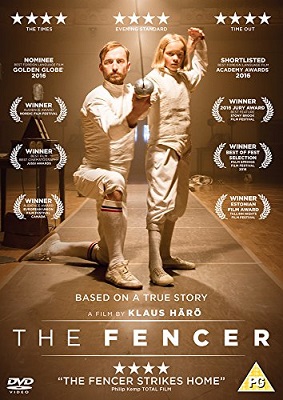
The Fencer, Klaus Härö (2015, Estonia). This was apparently based on a true story, a teacher who upset the authorities in Leningrad and so moved to Estonia, where he ended up teaching kids, many of them orphaned by the Nazi occupation, how to fence. So it’s a bit like Dead Poets Society (I still cringe every time I hear “O Captain! My Captain!” after that film), which I suspect is just one version of a story that goes back considerably farther – Goodbye, Mr Chips, anyone? – perhaps even to ancient Athens or Rome. Anyway, by teaching these kids in 1950s Estonia how to fence, the hero gives them self-respect and ambition, and also jeopardises his own freedom. Because they want to enter a competition in Leningrad, but if he returns there he’s likely to be arrested by the secret police. You can guess what happens. It’s apparently based on a true story, an Estonian hero from the days of Soviet occupation. Not a bad film.

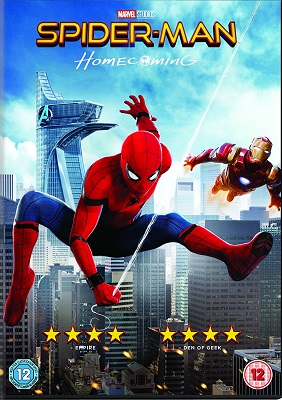
Spider-Man: Homecoming, Jon Watts (2017, USA). Spider-Man, Spider-Man, just as annoying as a teenager can, er, be… It was certainly refreshing to see a Spider-Man re-re-re-reboot aimed at the actual demographic matching Peter Parker’s rather than that of the people who remember reading him when he debuted in a Marvel comic… Peter Parker has been on a mission with Iron Man, but now it’s back to school and he can’t wait to be called up again to help out the Avengers. Except they never call. Meanwhile, Michael Keaton sees his lucrative contract to clean up alien tech after The Avengers (AKA Avengers Assemble!) taken over by a shadowy government department. So he becomes the Green Goblin. I think. He flies, and he’s sort of evil. Oh, and he’s the father of the girl Peter Parker really fancies and wants to take to the prom. I hate that: when the girl you fancy has a supervillain for a dad. Total bummer. To tell the truth, I hated the selfie video opening of Spider-Man : Homecoming, but really enjoyed it once the film had settled down into its story. The third act, unfortunately, was the usual MCU bollocks, which was a shame. But overall I enjoyed it and I hadn’t really expected to.

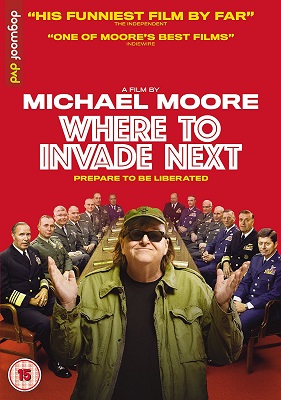
Where to Invade Next, Michael Moore (2015, USA). See there on the DVD cover where it quotes from a review, “his funniest film by far”… because of course it’s fucking hilarious pointing out that the US is a completely fucked-up country run for the benefit of a rich handful on the misery of millions – which is pretty much also what the Tories want here, and have been driving the UK toward. Moore visits half a dozen European (and one African) countries and investigates one of their social policies, interviewing ordinary people and asking how they feel about it. He does this as part of a running joke about “invading” the country, because the US military hasn’t actually won a war since WWII. The countries he visits are: Italy, to learn about paid holidays and maternity leave; France, for school dinners; Germany, employee rights; Portugal, decriminalisation of drugs and abolition of the death penalty; Norway, the prison system and rehabilitation; Slovenia, free university education; Finland, which has the best pupils in Europe; Tunisia, women’s rights, free healthcare and abortions for women; and Iceland, the role of women in business and government. None of this stuff is difficult to understand, but apparently Michael Moore had to make a film about it so that Americans would get it. I remember some moron from the US tweeting something like “hate speech laws are immoral and public healthcare is imprudent”. FFS, it’s the twenty-first century.

Anna Boleyn, Ernst Lubitsch (1920, Germany). The title alone should be enough to indicate what this film is about. Lubitsch does a silent version of Henry VIII’s marriage to Anne Boleyn. (Why “Anna”? I don’t know.) Emil Jannings plays the king and Henny Porten the title role. The story seems to stick reasonably closely to the historical record, although the depiction of Henry VIII follows the usual bullshit portrayal of a carousing fat man, who enjoyed wine, women and hunting, and not the despot he really was. They say he killed more people during his reign than any other English monarch. Much as we Brits – well, English, but I don’t really think of myself as either – like to think well of Henry VIII for breaking the power of the Roman Catholic Church in the UK, let’s not forget he only did it because he was a serial adulterer. Although, to be fair, the Roman Catholic Church has hardly been a force for good throughout the centuries, so booting them out was a good thing. A shame Henry VIII didn’t go the all the way and ban religion altogether.

Attraction, Fyodor Bondarchuk (2017, Russia). Commercial cinema in Russia has been churning out some solid sf blockbusters in recent years – not to mention films about its space programme – and Bondarchuk is a name known to me. His The 9th Company from 2005 was a good film about Soviet troops in Afghanistan; and 2008/2009 Dark Planet (AKA, The Inhabited Island) was an interesting adaptation of the Strugatsky brothers’ Prisoners of Power, which was annoyingly cut by almost half in its English-language sell-through release. Attraction has been described as YA, and perhaps it is, although it doesn’t feel much like YA properties such as Divergent or Maze Runner. An alien spaceship crashlands in a suburb of Moscow, the local youth take advantage of the alien tech thrown off during the crash, while the military tries to control the situation. One of the aliens – they only look alien in their armour, they’re really human underneath – is attacked on a scouting mission, escapes, and is helped by a young woman (it stands to reason he’s a cute guy). And, ho hum. The alien ship rebuilds itself – it attracts water to itself, for, I think fuel. See what they did there… attraction. The film looks good, the sfx are impressive, the cast are, er, attractive, and it’s all very Russian. You could watch worse. But I hope Bondarchuk’s next movie is better than this.

1001 Movies You Must See Before You Die count: 896


Leave a comment

Moving pictures 2018, #16

Sometimes, when I come to write these Moving pictures post, I wonder why the hell I chose to watch the films I did. True, some are rentals, and so it pretty much depends on what Cinema Paradiso happen to send me (and, of course, what was going through my head when I put them on my rental list). Which is certainly true of two of the films in this batch. But some of the others… It’s not so much that I choose to watch these films, just the weird variety of them within the half dozen. And this lot are a little stranger in that regard than most of my Moving pictures posts…

Skidoo, Otto Preminger (1968, USA). Preminger is not generally known for his comedies, and there’s a reason for that. At least, there is if Skidoo is any indication. Jackie Gleason plays a retired mobster, married to Carol Channing. He’s asked to perform one last hit for mob boss Groucho Marx, on his old pal Mickey Rooney, currently in Alcatraz. Gleason is also worried about his daughter, who has dropped out, turned on and tuned in with John Philip Law amd his tribe of hippies. Meanwhile , a pair of Marx’s enforcers put pressure on Gleason, and Channing tries to lift this by seducing one of them, Frankie Avalon. While in Alcatraz, Gleason uses the high tech provided by an imprisoned hippy to contact Rooney, but then decides he can’t kill him. There’s a particular type of comedy film which sets up completely implausible situations – a mobster in prison to kill a confederate – and then fails to deliver on them due to a change of heart by the principle. It’s almost a law of comedy. Which does not necessarily make it funny. And if there’s one thing Skidoo is, that’s… not very funny. I mean, Preminger knew his stuff, he’d been making films since the 1930s, and he had a star-studded cast in Skidoo – not just those already mentioned, but also Frank Gorshin, George Raft, Peter Lawford, Burgess Meredith, Cesar Romero and Slim Pickens (but no female stars, other than Channing, which is disappointing, especially for 1968). The whole thing is so horribly dated – in its targets, its sensibilities, its comedy… I’m frankly not surprised Skidoo is not readily available on sell-through in the US or UK. Eminently missable.

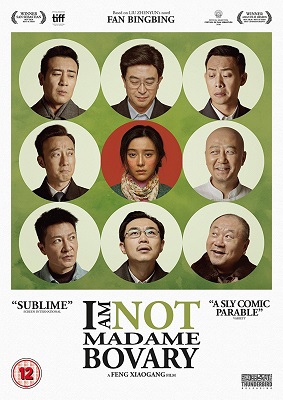
I am not Madame Bovary, Feng Xiaogang (2016, China). A husband and wife in China divorce so that they can purchase a second property – as couples can only own a single property – but instead of remarrying as planned, the husband marries another woman. Incensed, the ex-wife reports him to the authorities and demands they nullify the divorce so she can properly divorce. Um, yes. They point out she is already divorced. The ex-husband meanwhile has been spreading lies about her sexual history. The ex-wife keeps after the authorites over the years, being bounced from one official to another, gradually working her way up the ladder. Her campaign is fruitless, and sees her briefly sent to a “re-education camp”. After her husband dies, she settles in Beijing and opens a noodle shop. Eventually, she reveals the divorce had been concocted to get around the one-child policy and had nothing to do with buying property. But during the divorce proceedings, she miscarried. This is a long film, 137 minutes, and bizarrely presented in a variety of formats, most often a circular aperture in the centre of the screen. I’ve no idea why Feng chose to present his film like that, it doesn’t add anything to it. I’m a big fan of contemporary Chinese cinema – although perhaps not so much the CGI-heavy historical epics they’ve been churning out for the past dozen years, but certainly the scaled-back, often documentary-like, dramas of the Sixth Generation directors. Feng is not Sixth Generation, but has been making films since the mid-1990s, and very successfully. I am not Madame Bovary is a film made by a film-maker who knows his craft – I’ve seen his earlier The Banquet (see here) and thought it good – so despite being slightly disappointed with this one, I think I’ll stick some of his other films on my rental list.

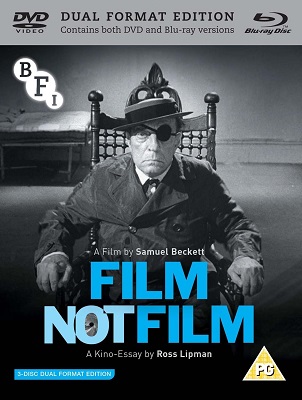
Film, Alan Schneider (1965, USA) / Film, David Rayner Clark (1979, UK) / Notfilm, Ross Lipman (2015, USA). Film is Samuel Beckett’s first and only foray into cinema. It’s 24 minutes long, shot in black and white, has little or no dialogue, and stars Buster Keaton. It opens with a shot of a wall somewhere in New York. A figure, keeping its face from the camera, scurries alongside the wall, eventually entering a tenement and then a sparsely-furnished room. He performs a series of actions, then sits down in a chair, looks at some photographs, tears up the photographs, and then reveals his face to the camera. I’m not actually familiar with Beckett’s oeuvre – I know of Waiting for Godot, but I’ve never seen it – or of his career, to be honest. I know he wrote several novels, and I’ve been meaning to try one for years, but I came to Film completely cold. And… I like experimental/avant garde cinema. I’ve seen works by Maya Deren, Stan Brakhage, Bruce Baillie, Ernie Gehr; I’m love the films of James Benning and Ben Rivers; I’m currently exploring the oeuvre of Pere Portabella; and the modern artform which appeals to me most is the video installation, and I’m a fan of works by Ed Atkins, Richard Mosse, Cécile B Evans and Tuomas A Laitinen… But Film does come across more as a laboured exercise in re-inventing the wheel. Beckett had no experience at film-making, nor was he that well-versed in the medium. He was a playwright, who later adopted television as his preferred medium. The core of Film is the relationship between O (the object, Keaton) and E (the eye; ie, the camera), and it’s all about what they can see. So Keaton spends his time in his room covering items which might “see” him, such as a painting, or the window. And when the screen projects what O sees, it does it through a gauze filter so it looks different to E. It’s hardly sophisticated stuff, and Beckett’s plodding working through of the concept is slightly painful to watch. But. As Beckett’s first and only attempt at cinema, it’s a fascinating experiment. Even more so when watching the BFI’s 1979 version, which was based on Beckett’s original script (and not the heavily-revised one used for the 1965 original), and starred Max Wall, a well-known comedic figure in the UK at the time… Having said that, Ross Lipman’s two-hour documentary on Beckett and his Film, Notfilm, is worth the price of admission alone. Lipman digs into Beckett’s career, the origin of Film, and Beckett’s production of it. It’s fascinating stuff, especially since Film is so unsuccessful a work from so successful a creator. I’m tempted to pick up a copy of this for myself.

The Millionairess, Anthony Asquith (1960, UK). My mother found this in a charity shop, and passed it onto me after she’d watched it. A comedy with Peter Sellers and Sophia Loren, directed by Anthony Asquith. Sounded like solid entertainment from the sixties. But… oh dear. If I said the song ‘Goodness Gracious Me’ was spun out of this film – the two stars performed it, in character, although it doesn’t appear in the actual film – then that should tell you all you need to know. Sellers plays an Indian doctor, and it’s the sort of offensive caricature that was once considered amusing and that Benny Hill more or less built a career upon. But Benny Hill was considered passé and offensive back in the late 1980s – one of the UK’s biggest comedy exports at that time and no one would show him on British TV. And rightly so. Loren plays a wealthy widow, who cannot remarry unless her prospective husband can turn £500 into £15,000 in three months, which I would have thought in 1960 ruled out pretty much everything except crime. But never mind. After various unsuitable suitors, she happens upon Sellers, a selfless Indian doctor. She decides he’s the one for her. But he tries to get ot of it by claiming his mother set a challenge that his bride-to-be must survive for three months on 35 shillings (that’s 420p, or 7 crowns or £1 and 15 shillings, or 1 and two-thirds guineas… all of which is about £37 in 2017 money). Loren bullies a pasta factory owner into letting her take over, modernises it and turns it highly profitable by replacing all the staff with machines. Sellers, meanwhile, can’t even give away his £500. But never mind, they get together in the end. The Millionairess was a massive hit on its release, but it really doesn’t play well today. To a twenty-first century viewer, it’s tasteless and not at all funny. And, to be honest, I never really understood Sellers’s appeal. Missable.

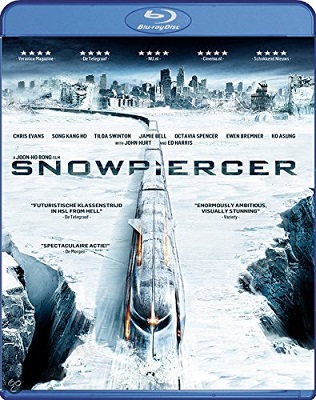
Snowpiercer, Bong Joon-ho (2013, South Korea). People raved about this when it was released five years ago, but since it’s never had a UK release on sell-through I’d never managed to see it. Until now. And I can’t honestly see what the fuss was all about. Some fifteen years in the future, the earth is uninhabitable, frozen solid from pole to pole after failed climate engineering to combat global warming (huh, I had a story published in 2010 based on that premise). The remnants of humanity live aboard a train which circles the globe, although I’m not sure how they cross the oceans – I assume they’re completely frozen over and so safe to lay a track upon. Anyway, the train’s society is a microcosm of the sort of neoliberal libertarian capitalist bullshit societies so beloved of science fiction. At the front end of the train are the elite, who live in comfort with all their needs met. And at the rear of the train are the “scum”, the proletarians, who are treated worse than slaves, fed on protein blocks made from insects, and brutally punished for the most minor of offences. When Chris Evans realises that the elite’s guards ran out of bullets years before, he leads a rebellion, and he and his fellow scum fight their way toward the front of the train, eventually confronting the train’s designer and leader of its society, Wilford, played by Ed Harris. Who reveals that the rebellion was engineered in order to cull the scum population as resources aboard the train are limited. Wilford asks Evans to replace him as leader, but Evans then discovers that scum kids are being used as replacement trains parts, so he kills Wilford. Oh, and it turns out the earth is thawing, so the train won’t even be needed soon. Snowpiercer looks very impressive, and the performances throughout are very good. But the tired old bollocks story just completely turned me off. In a closed environment like the train, survival is so precarious that any set-up which might lead to the environment being damaged, as in, for example, a rebellion, is just dumb. So wildyl unjust stories are just disasters waiting to happen. They’re clearly unsustainable. And only an idiot, or a sf writer, would consider building one. If Snowpiercer was trying to make a point about capitalism and capitalist societies, I didn’t care. I live in an unjust society, and while I’m no means near the bottom of it, I don’t need heavy-handed fables like Snowpiercer to tell me it’s unjust. By all means use fiction – written or cinematic – to depict such societies, but violent overthrow, followed by a deus ex machina, make for boring, and pointless, stories. Snowpiercer looked very nice – as well it might, given the amount spent on it – but I really wasn’t interested in its story.

1001 Movies You Must See Before You Die count: 896


4 Comments

Reading diary 2018, #5

Bit of a cheat this one, as most of the books are either short or graphic novels – well, one graphic novel, two short collections, and a novella. One has also been shortlisted for the BSFA Award.

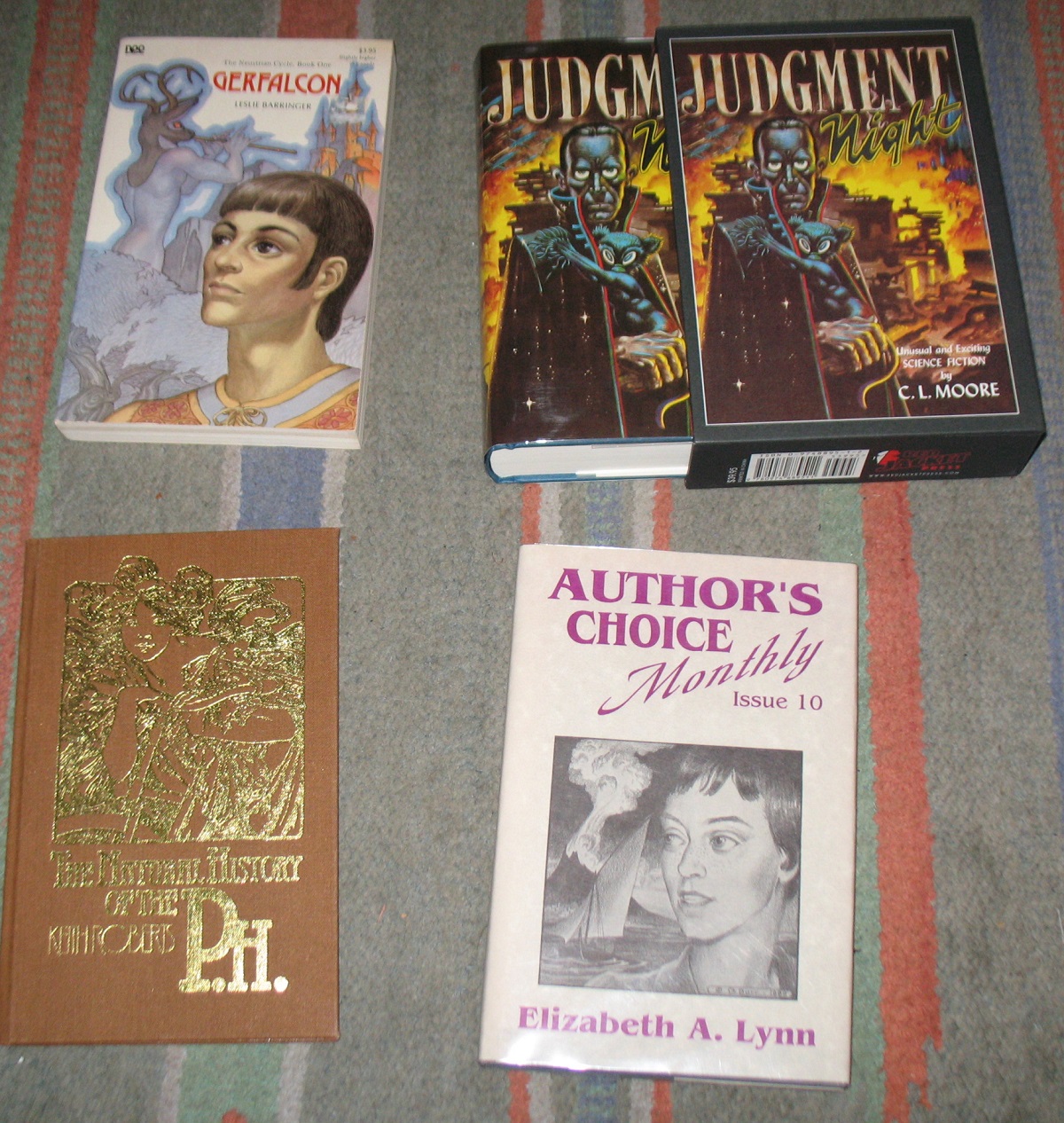
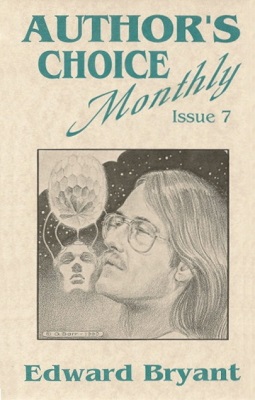
Author’s Choice Monthly 7: Neon Twilight, Edward Bryant (1990 USA). I had one of my semi-regular outbreaks of completist-itis, and since I owned about half of the Author’s Choice Monthly issues, I decided I needed to have the rest. A full set. Even though many of the authors in the series I’m far from a fan of. Like Mike Resnick. Ed Bryant I knew nothing about. The name rang a vague bell, but if I’ve read anything by him in the past, I don’t recall doing so. Bryant’s introduction explains he’s better known as a horror writer, although he did write heartland sf once – and it’s three of the latter stories which are collected here. All three are set in the same space opera universe – the first story he set there, a later one when he decided to use the setting for a commissioned story, and a third written specifically for this short collection. They are… okay. The stories are set in some sort of interstellar polity – it’s all a bit vague – in which disputes are settled through ceremonial wars, in which mercenaries in fighters battle each other. And those who survive, and have the highest kills, become popular heroes. The second story was written for an anthology set in Fred Saberhagen’s Berserker universe, so the mercenaries have to fight off a giant machine intelligence bent on killing everyone. And they do it using the previously unknown telekinetic powers of one settled world’s indigenes. The whole fighter/mercenary thing takes some swallowing, because there’s nothing remotely plausible about using fighters in space combat, despite their prevalence in science fiction. The whole folk hero thing doesn’t really parse either – after all, who remembers the aces from the Vietnam War? From any war? These Author’s Choice Monthly have proven to be very much of variable quality. But they’re a set, so I’m going to buy them all and read them all, damn it. Even if they’re crap.

The Obelisk Gate, NK Jemisin (2016, USA). Do I need to explain that this is the second book in Jemisin’s Broken Earth trilogy – preceded by The Fifth Season and followed by The Stone Sky – which, like The Fifth Season, won the Hugo, and I wouldn’t be at all surprised if The Stone Sky also won the Hugo this year… Making it the only trilogy to ever win the Hugo for all three instalments in consecutive years. Which says more about the Hugo Awards, to be honest, than it does the books. Social media these days is completely fucking useless for finding out what’s worth reading – and the Hugo Award never has been – as it’s all tribalism and self-promotion, but I’d heard enough rumbles about The Fifth Season to prompt me to buy it when it was £1.99, and I was pleasantly surprised enough (see here) to stick this second book on my wishlist. And so was given it as a Christmas present. It is a truth universally acknowledged, to borrow a phrase, that the second books of trilogies are generally the least satisfactory. After the tricks Jemisin had used in The Fifth Season, I had, to be honest, expected more of The Obelisk Gate. It is pretty much a straight follow-on. However, where the best part of the first book was its time-stacked narratives, that’s a not a technique that can be continued once revealed. The Obelisk Gate doesn’t even try. It’s a linear narrative covering events chronologically following on from The Fifth Season. It rings a few changes – which are to its credit – inasmuch as it introduces a separate narrative for Essun’s daughter, who was abducted by her father and proves to be an extremely powerful orogene; and it also breaks its narratives with first-person sections which directly address the reader whose narrator is not initially obvious. The worldbuilding is basically more of the same from the first book. The level of brutality remains high, although much of the invention was frontloaded in the first book. This is good solid genre fiction, a cut above the average, which can be read as both science fiction or fantasy. Are they the best two genre fiction novels published in 2015 and 2016? Of course they’re not. The Fifth Season probably deserved its Hugo – and certainly did given the shortlist – but The Obelisk Gate‘s Hugo was not so deserved (although, given the rest of the shortlist…). I’ll certainly read The Stone Sky, and I hope it picks up a bit after The Obelisk Gate – although I suspect that since the shape of trilogy is now becoming so much clearer, it won’t do. The strength of The Fifth Season was that its shape was there to be discovered. But we shall see.

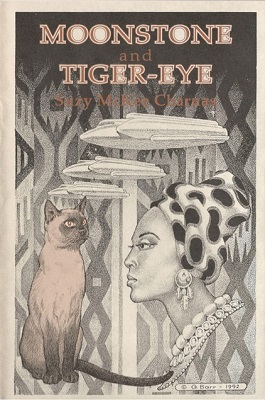
Author’s Choice Monthly 29: Moonstone & Tiger-Eye, Suzy McKee Charnas (1992 USA). There are only two stories in this collection, both technically novelettes (I say “technically” because novelette is the most useless fiction category on the planet and we should really stop using it). The first, ‘Scorched Supper on New Niger’ I first read in Women of Wonder: The Contemporary Years, and I liked it enough to moan that Charnas had never revisited the setting. It was apparently her first piece of short fiction, since she’d only written, and was known for, novels prior to it. On reread, I’m less enamoured of ‘Scorched Supper on New Niger’. It’s heartland hard sf/space opera, the sort of stuff Cherryh, among countless others, is famous for, written in the first person, with an engaging narrator. But. The use of Nigerian culture feels a bit heavy-handed. It’s good to see something other than middle America as a cultural template in a science fiction story, but when you make use of someone else’s culture it has to be done very carefully. Her female narrator also has agency. In 1980, when this story first appeared, that wasn’t very common. The setting is all a bit identikit – Nigerians notwithstanding – and it’s still a shame Charnas never revisited it. The second novelette is ‘Evil Thoughts’, from 1990. A woman and her younger significant other have moved into a new house. Mushrooms keep appearing on their lawn, and the crazy lady just up the streets, with two yappy dogs, tells her they are “evil thoughts”. And the woman destroys the mushrooms, so the evil thoughts have nowhere to go… The story doesn’t make much of its conceit, and seems more concerned with the anxieties of the woman caused by other people’s thoughts on her having a younger partner. Disappointing.

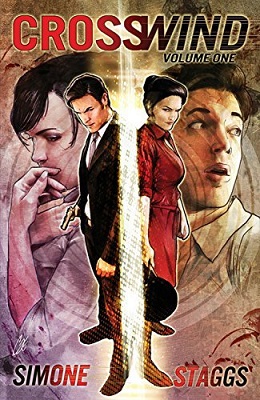
Crosswind Volume 1, Gail Simone & Cat Staggs (2018, USA). Juniper is a Seattle housewife who is abused by her husband. Cason is a hitman for a mob boss in Chicago (I think), who seems somewhat more thoughtful and intelligent than is common for the breed. For reasons explained later, the two magically swap bodies. Cason finds himself in Juniper’s body; Juniper is now a male hitman. It’s hardly an original conceit – there’s a novel from 1931 which has exactly the same premise! – and it’s been used plenty of times since, both in cinema and written fiction. Simone and Stagg have bought a modern sensibility to the story, inasmuch as they were careful to consult trans readers in order to depict their characters’ experiences in an appropriately sensitive way. And yet… they marry this with a brutal mobster plot. Certainly, represent trans people as accurately and sensitively as posssible, but why do we need to have a story which features domestic violence and mobster brutality? Those earlier body swap stories? They were comedies. In Crosswind, it’s good the way the two principals adapt to their new situation… But I could have done without the clichéd violence – and using violence, by “Juniper”, to resolve the chauvinism she’d been experiencing? I’m not sure that’s a good message: woman experiencing chauvinism, can only be resolved by a man taking over the woman’s body and behaving like a man? Disappointing.

Exit West, Mohsin Hamid (2017, Pakistan). I’d not even heard of this, although I suspect it would have eventually come to my notice, when I saw it on the BSFA novel shortlist. Which was a surprise. No one I knew on social media had been talking about it. Who were the people who nominated it, enough of them for it to make the shortlist? Which, okay, might only have been half a dozen, given how poorly subscribed the BSFA is these days, and how few people bother to engage with the awards. Anyway, I picked up a copy, and pretty much read it on a train journey to and from Leeds. And… It’s good. It’s very good. In an unnamed Middle East city which is clearly modelled on Damascus, Saeed and Nadia meet. She wears an abeya from neck to toe although she is not religious; he does not believe in sex before marriage. A developing relationship in an Islamic society, in which moderates and fundamentalists coexist, is first upset by civil war, and then by the appearance of doors, existing doors, which now miraculously lead to doors in other, richer and Western, nations. And so refugees flood through them, and there’s no controlling them because they are never en route, or passing through somewhere else. Saeed and Nadia take advantage of this, and first move to Mykonos, and then to the UK, and finally to San Francisco. The premise is not thought through especially well, and the various Western nations’ responses to an unstoppable wave of refugees seems implausibly, well, accommodating – especially the UK, given the UK’s current policy of handling immigrants, as set out by Thereas May when she was Home Secretary, not to mention the whole Brexit fiasco… But Hamid focuses his story on the relationship between the two principals. On the one hand, Exit West makes an obvious point. And it’s a beautifully written novel – I really do like Hamid’s spare explicatory prose. But Exit West simply presents its premise, which doesn’t really hold up to scrutiny, and never really interrogates it. Nor does it really interrogate the West’s response to immigrants, especially unannounced or unwanted ones. If you want to read a novel which does an excellent job of commenting on that, then read Jenny Erpenbeck’s Go, Went, Gone. It is the much superior novel. But Erpenbeck wasn’t shortlisted for the BSFA Award – unsurprisingly, as her novel is not genre – amd Hamid was, and both tackle a subject important to our time. Much as I liked Exit West, I didn’t think it entirely successful. It’ll be getting the third slot on my BSFA Award ballot.

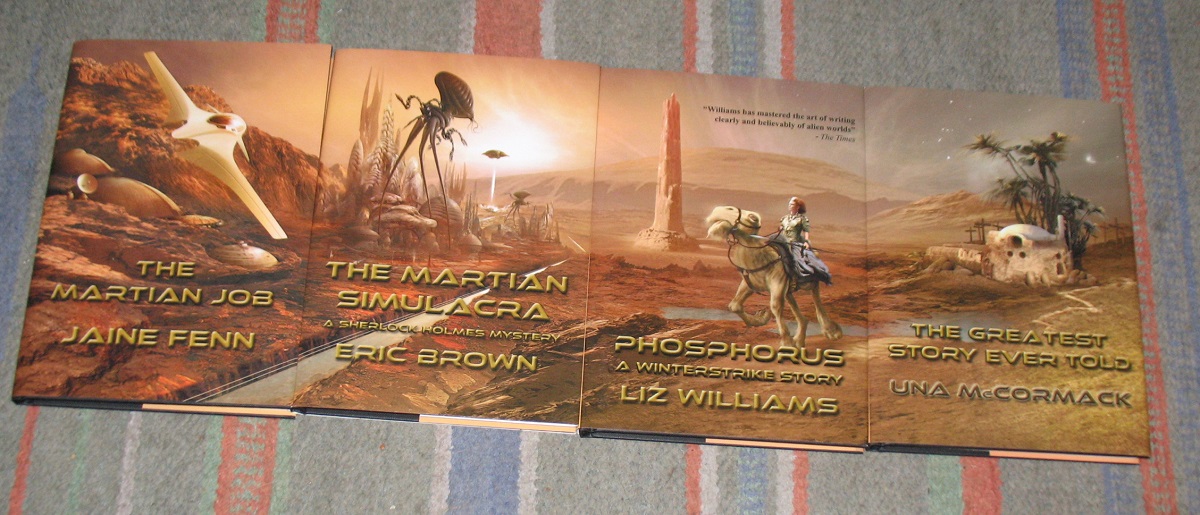
The Martian Job, Jaine Fenn (2017, UK). The title is a deliberate nod to the famous British 1960s movie, and the story even uses its own variant of Michael Caine’s famous line. But the plots don’t map precisely, nor the set pieces, and Fenn’s novella certainly ends in a completely different fashion. The famous car chase through the streets of Turin in Minis becomes a race through the tunnels of old Martian colonies in “tunnelbuggies”, and, yes, there’s a heist which kicks it all off… Lizzie Choi is a corporate administrator for one of the most powerful companies on Earth, the Moon and Mars, in a future doiminated by the Chinese. She has a criminal background, but walked away from it. Unfortunately, when her brother dies on Mars, she’s named as next of kin by her mother, currently in prison on the Moon, and so the company find out about her chequered past. Which results in her travelling to Mars to finish off the job her brother had begun: stealing the Eye of Heaven, the largest opal ever found and the property of her ex-employers. It’s all first person, and Choi is an engaging narrator and very much at the centre of the action. The Martian Job does a lot of things well, which mostly means deploys its tropes with assurance – not that any of the tropes are especially original. The references to The Italian Job are fun, but little more than easter eggs. The ending isn’t much if a surprise – it’s optimistic and well primed. This is solid feel-good sf, which might well be about a crime and feature criminals, but is not gratuitously brutal or right-wing. It’s a pleasure to read.

1001 Books You Must Read Before You Die count: 131


1 Comment

Moving pictures 2018, #15

The best thing about watching a wide variety of films is finding one you would not normally watch and loving it. It has happened several times. I would not be a fan of James Benning’s films if I’d not watched his Deseret because it was on the 1001 Movies You Must See Before You Die list. I would not be a fan of Ben River’s movies if I’d not stuck his The Sky Trembles and the Earth is Afraid and the Two Eyes are Not Brothers on my rental list on a whim. And two films in this batch… well, one I purchased a copy of my own; and the other, I went and bought a collection of the director’s films on eBay (because it’s apparently deleted and not available from a certain online retailer).

The Lure, Agnieszka Smoczyńska (2015, Poland). I’d seen approving mentions of this but knew almost nothing about it. I suspect I may have mentally filed it as a Polish version of The Shape of Water. If I did, then I did it a huge disservice. It is way better than anything Hollywood has produced. I’ve described it to friends as a horror-musical mashup set in the 1980s featuring a pair of carnivorous mermaids in a Polish nightclub. Which pretty much sums it up. But does not quite get across how fucking good it is. Two mermaids meet a rock band on the beach, and return with them to the nightclub where they perform. They become backing singers and strippers. One of the mermaids falls in the love with band’s bassist, and has her tail surgically replaced with legs, which means she loses her singing voice. But he marries another woman, and the mermaid turns into sea foam – because she had to eat him before daybreak if she wanted to live – and the other mermaid rips out his throat in revenge… And a summary of the plot doesn’t quite get across how beautiful this film looks, how amazingly appropriate is the 1980s music, and how bonkers the whole mythology surrounding the mermaids really is. I think this is going to make my best of the year list. I’ve already bought my own copy. You should definitely see it.

Pulp, Mike Hodges (1972, UK). It’s a Michael Caine film but it nonetheless sounded like it might be worth watching – which is not entirely fair, of course, as Caine has made some good films during his long career, like Get Carter. And director Mike Hodges too has made some good movies during his careers, such as, er, Get Carter. And, um, Flash Gordon. Whatever. It’s a team that has produced good stuff in the past. So it’s a crying shame Pulp is so bad. It has its moments, and it’s by no mean badly made, but… Any film that relies on voiceover needs to seriously think about the story it is telling. In part, the voiceover is baked into this story, as the lead character, played by Caine, is a successful pulp writer and he frames the events of the film, in which he is an unwitting protagonist, as a pulp narrative starring himself. He is in Malta to ghostwrite the autobiography of a mysterious celebrity. This involves taking a coach tour to some ruins, where he is contacted by a representative of the celebrity… and also meets a would-be assassin who is later mysteriously murdered. The celebrity proves to be Mickey Rooney, an actor famous for playing gangsters and with Mob friends and connections. At his birthday party, Rooney is killed, but everyone else thinks it’s one of his practical jokes. Some of Rooney’s Maltese associates, it transpires, did something very bad years before on a hunting trip, and they were afraid Rooney would reveal all in his autobiography. I wanted to like Pulp so much more than I did. The setting – Malta – looks very nice. The plot is pure noir – and just in case you didn’t realise, Caine describes what’s going on in pulp-style throughout – and the central mystery is satisfying. But it all felt like a comedy that had no jokes: sort of tonally wrong, neither actual noir nor a murder-mystery. Missable.

Amuck!, Silvio Amadio (1972, Italy). I do love me some giallo, although I prefer the thriller giallo to the horror giallo – and I admit it’s a bit of a grey area with giallo as to which is which. The titles don’t help. Nor, in fact, do the names of directors. I’ve been using as my yardstick, and it’s probably not a good one, the presence of Barbara Bouchet in the cast. She made a lot of Italian films, many of which were giallo, and many of which are actually not bad. True, she’s not in Footprints on the Moon, which I have an inexplicable love for, but she’s in Milano Calibro 9, The Red Queen Kills Seven Times, Don’t Torture a Duckling, The Black Belly of the Tarantula and… Amuck! The original title of this film, Alla ricerca del piacere, translates as “In pursuit of pleasure”, and it was also released as Hot Bed of Sex, Maniac Mansion and Leather and Whips. Although, since giallo has a habit of being inappropriately titled in the US market, they should not be taken as indications of the story. Nor indeed should Amuck!. Bouchet plays the new secretary to louche novelist Farley Granger. His last secretary disappeared under mysterious circumstances, and Bouchet is there undercover to find out what happened to her (they were lovers). It turns out the previous secretary had died during a bout of sex with Granger, his wife, and their brutish manservant. And now that Bouchet knows, they have to get rid of her… The plot summary probably tells you all you need to know about this film. I must admit I quite like that these gialli are slowly being made available in the UK – on several labels – as they’re always entertaining. Call it a guilty pleasure.

Vampir Cuadecuc, Pere Portabella (1970, Spain). I think I saw mention of this tweeted by Second Run, who I follow as they are an excellent label, and thought it was a Romanian vampire film or something, so of minor interest. But I bunged it on my rental list anyway. I got a lot of things wrong. It’s not Romanian, it’s Spanish. It’s also an experimental film, shot on the set of Jess Franco’s Count Dracula, starring Christopher Lee and Herbert Lom. But it’s no fly-on-the-wall documentary. Portabella haunted the set of Count Dracula, and shot his own footage – but it’s all in stark black and white, and the soundtrack consists of loud experimental music comprising hums and noise. I loved it. I loved it so much I hunted online for more by Portabella and found an OOP collection of twenty-two of his films (including Vampir Cuadecuc), which I promptly ordered. There is no way to describe Vampir Cuadecuc that makes sense, or in any way prepares you for the experience of seeing it. Just go and watch it.

The Beyond, Hasraf Dulull (2017, UK). After a couple of abortive attempts to watch films on Amazon Prime I ended up on this one, which had the advantage of an interesting premise. But with cinema, it’s all in the presentation. And the originality of the premise is often considered secondary, if not ignored. The Beyond does indeed have a quite good central conceit, and it treats it well. It just fails a little in the execution. Which puts it in a strange position – do you admire it for what it tries to do, or criticise it because it fails to meet what you expect it to do? Its story is straightforward enough in sf terms. An anomaly appears in Earth orbit and sucks an ISS astronaut into it. The scenes set in orbit are handled convincingly. Then mysterious spheres appear all over the earth, hovering in mid-air. Investigation of the anomaly reveals a world just visible through it, and so the US repurposes a black defence programme to create cyborg soldiers, Human 2.0, to create astronauts to explore through the anomaly. The programme does not go well when the first volunteer dies. The best qualified person turns down the chance to join the programme, but is eventually persuaded otherwise when it transpires she’s just about the only possible choice. What happens on the mission through the anomaly is left mostly unexplained, but what the astronaut brings back does cause earth to re-evaluate the purpose of the alien spheres. The whole thing is framed liked a documentary, with talking heads and interviews with those involved. The special effects are generally of a high-quality. If anything lets the film down, it’s the acting, which often doesn’t quite manage to hit that difficult line between acting and acting-as-if-in-a-documentary. Given all the really shit independent sf films available on Amazon Prime, The Beyond came as a pleasant surprise. Worth a punt.

American Guerrilla in the Philippines, Fritz Lang (1950, USA). I’ve been trying to watch all of Lang’s films but, like many other directors of his generation, such as Wilder, Preminger, Sirk, who moved to Hollywood from Germany, they were happy to cut their cloth to whatever was needed. Despite that, they still managed to produced classics, often while constrained by the studio. But not every film they made was good, or in any way remarkable. Some of them were likely done for the money, and the director’s investment in the project came down to nothing more than simply being professional about it. Of course, old school directors of that type tended to put their own stamp on whatever material they worked on, but, to be honest, I couldn’t see anything in American Guerilla in the Philippines which struck me as especially Lang-ian (Lang-isch?). I mean, without knowing the director, could anyone have said it was by the same guy as the director of Metropolis or Man Hunt or While the City Sleeps? American Guerilla in the Philippines has US Navy MTB ensign Tyrone Power stranded in, well, the Philippines during WWII. In his attempts to rejoin the fighting, he ends up helping the resistance in the Philippines. There’s an initial attempt to sail to Australia, which fails. And, of course, there’s a love interest, the French wife of a local planter. As WWII films go, there’s nothing notable about American Guerilla in the Philippines, except perhaps the fact it was filmed on location and uses a lot of local talent in supporting roles. Otherwise, it’s your usual self-aggrandising US war film, although perhaps a little more open than most to the contribution of others (although, of course, it would still like the viewer to believe the US single-handedly liberated the Philippines from the Japanese). Yawn.

1001 Moies you Must See Before You Die count: 896


4 Comments

Moving pictures 2018, #14

I’ve been having trouble recently getting invested in some of the films I’ve been watching. But there have been a couple of notable exceptions. Some nights I want a movie that doesn’t require much in the way of thought, but it doesn’t always work out that way. Or I choose badly. On the one hand, I want to watch as widely as possible; on the other, sometimes some of the films I’m drawn to can be a bit of a slog. A couple here were not very good, despite the names attached to them. Another was a straightforward melodrama but happened to be about a subject that interested me, so I liked it. And one was the latest film by a favourite director. In other words, the usual mixed bag…

How the West was Won, John Ford, Henry Hathaway & George Marshall (1962, USA). I’ve known of this film for many years. Who hasn’t? It’s one of those Western titles you see mentioned everywhere, even if no one you know seems to have actually watched it. I last came across a mention of it in reference to McLintock! (see here), so when I found it on Amazon Prime, I decided to give it a go. And now I have watched it. And it is… epic. In other words, it has pretty much everyone in it. Unfortunately, it’s also the bullshit narrative the US likes to believe about its invasion of the North American continent – and it’s pretty much an invasion by most definitions of the term. The movie opens with Karl Malden and his family travelling west to settle in the wide open lands in that area. They bump into fur trapper Jimmy Stewart, who falls for one of Malden’s daughters. But the trip doesn’t go as planned, and some of the family die while rafting on a river. The film follows the remainder of the family over a couple of generations as they head west and infiltrate the capitalist infrastructure which has implanted itself in the new territories. One of Malden’s daughters, Debbie Reynolds, marries a gambler, played by Gregory Peck, who turns his talents to investment, and so becomes a serial millionaire. This only happens after she’s spent time as a showgirl. Then there’s George Peppard, who joins the US Army with dreams of glory, inadvertently saves the lives of Generals Grant and Sherman, but returns home to discover his mother has died. How the West was Won pretty much features everyone, and part of the fun of watching it is identifying the stars (Jimmy Stewart’s wig is especially bad). But as narratives of colonisation of the West go, it’s pretty much up there with history textbooks that claim the US single-handedly fought and won WWII. This is not a film to be used to teach kids their heritage. Not unless it’s one of those US schools where the teacher is licensed for concealed carry and the students get an AR-15 on graduation. But the US prefers the Hollywood version of its history because, of course, it makes them out to be hardy pioneers instead of brutal conquerors… Cinematically, the film has its moments, but to be honest you’d have to be pretty incompetent to make Monument Valley look boring, and none of the directors attached to this film could be accused of that. There are better western films, even ones with a somewhat tenuous link to actual history, such as Shane or Rio Bravo, but which have better cinematography  or make more of a meal of the scenery. How the West was Won feels like a textbook for a specific, and long since discredited, view of US history. It’s a well-made film, and it looks quite lovely in places. But it’s a piece of historical hokum and should be watched with that in mind.

Spacewalker, Dmitry Kiselev (2017, Russia). I had this on my rental list, but then went and bought it by accident. Like you do. Fortunately, I remembered to remove it from my rental list. The Russians have produced a number of films in recent years about their space programme – Gagarin: First in Space (see here), Salyut-7 (see here), and now Spacewalker, this last about Alexei Leonov’s spacewalk in 1965, another Space Race first by the USSR. For all that the US likes to trumpet its space achievements, the USSR beat its hands down until Apollo. And even now, US astronauts have to use Russian Soyuz spacecraft to travel to the ISS because there is no human-rated US spacecraft currently in service. Ahem. Spacewalker opens with a MiG-15 being flown by Leonov in trouble with its jet engine on fire – and it was nice to watch a film in which a MiG-15 was played by an actual MiG-15 (although I suspect it was mostly CGI) – and because he’s a complete nutter, he goes into a steep dive to put out the fire, manages to pull out in time, and lands the aircraft. So he’s not a natural fit for the Soviet cosmonaut programme when they start, but he has his champions and is recruited. When he’s picked for the first spacewalk, he trains with Belyayev, but Belyayev breaks his leg during a parachute jump. Leonov campaigns hard for Belyayev to be kept as mission commander, and succeeds. The mission is depicted pretty much as it happened. Leonov had no troubled making the spacewalk, but experienced real trouble getting back into the Voskhod spacecraft. It’s all presented with the same degree of verimilitude of the aforementioned films. It’s like Gravity has opened some sort of floodgate. And I for one welcome these films, with their convincing depictions of actual real space exploration history, and if it’s Russian self-aggrandising instead of American, so what? It’s real history and it’s fascinating. And okay, I do love me some Soviet sf films, and these are are not Soviet although they cover Soviet history. But they’re accomplished pieces of work and the equal of, if not better than, anything Hollywood has produced. Worth seeing.

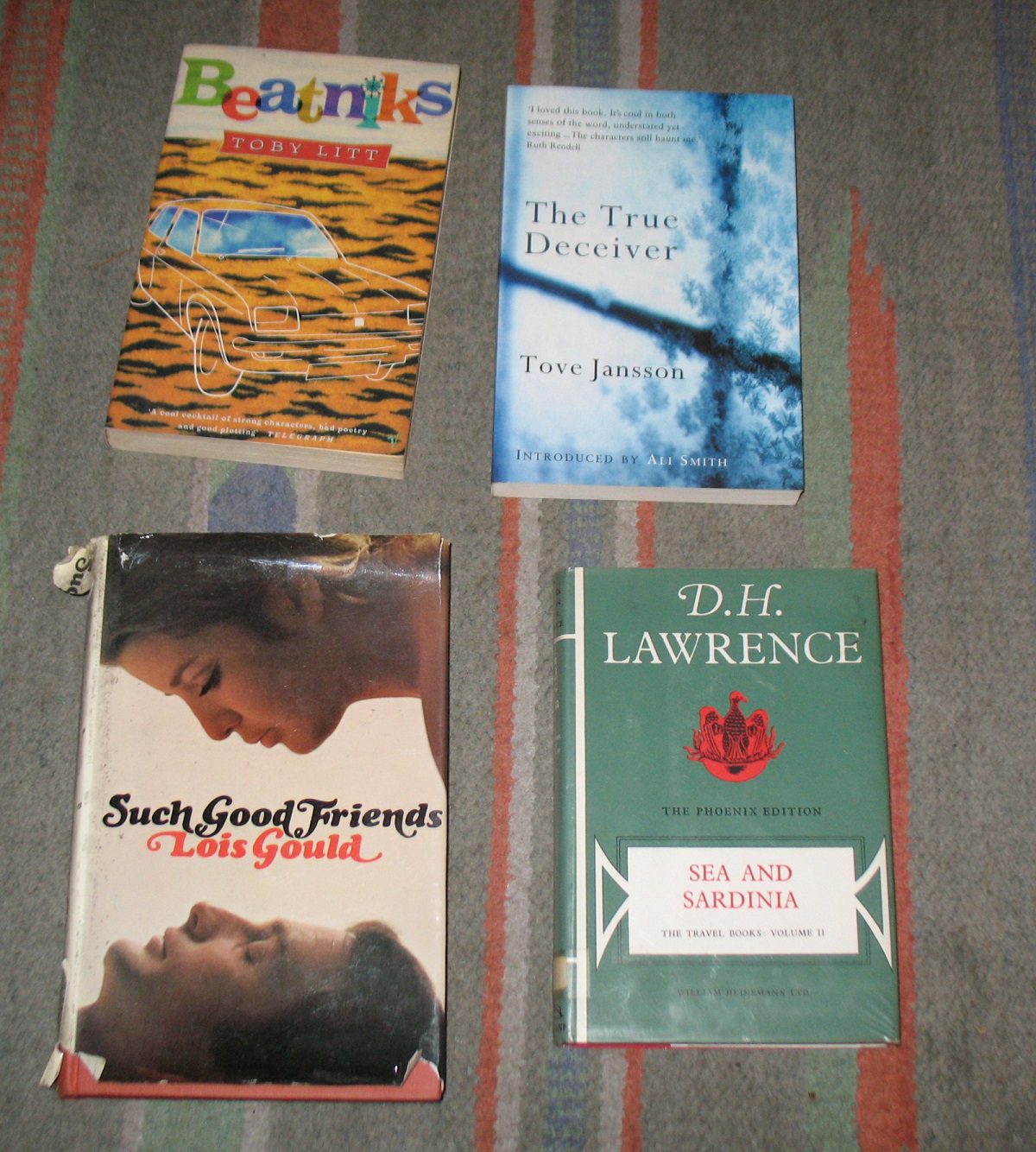
Such Good Friends, Otto Preminger (1971, USA). I’ve been working my way through Preminger’s oeuvre, and three of his later films were released recently on Blu-ray in a collection in the US but unavailable here. And since I have a multi-region Blu-ray player… Of course, now I own them, they’ll probably be released in the UK… and cost less. Although maybe not. A lot of classic movies newly-released on sell-through in the US don’t get UK releases, and Preminger is better-known for his 1940s and 1950s noir films than he is his late 1960s / early 1970s melodramas and comedies. And having now seen the three films in this collection, I can understand why. Such Good Friends is based on a novel by Lois Gould. In it, a successful children’s author goes into hospital for a minor operation, but the doctors bungle it, and bungle every subsequent attempt to fix the medical problems they’ve caused. The film did not start well. The main character, player by Dyan Cannon, goes to a publishing party with her husband, and Burgess Meredith, playing a famous author, is present; and for some reason, she imagines him naked, which Preminger actually shows on film. And then the plot goes into its litany of hospital fuck-ups and… It’s a well-made film but not an especially good one. For a start, it’s a comedy but it’s not at all funny. It’s based on a novel by Lois Gould, and after watching the film I went and did some drunk ebaying and bought the book. I have done this before – watched a a bad adaptation of a novel, and gone and bought the novel. I have no real interest in reading Gould’s book, but now I have a copy I probably will. It did at least sound better than the film. We shall see.

Spies Kill Silently, Mario Caiano (1966, Italy). Released under the titles Le spie uccidono in silenzio and Los espías matan en silencio, this was an Italian-Spanish thriller set in… the Lebanon. I watched it because I visited Beirut during the early 1970s, and I wanted to see if I’d remembered anything of the city. I hadn’t. I now wish I could not remember anything of this film. The daughter of prominent scientist is mysteriously murdered in a hotel swimming pool in Beirut. An American agent is called in to investigate the case, because there have been a series of unexplained deaths of notable scientists. It’s all a plot, of course, by one particular scientist, to take over the world. This involves brainwashing people to do his bidding, so his assassins can be literally anyone. The secret agent goes undercover, with an antidote to the brainwashing serum, but the scientist spots this and really brainwashes him. Which was a bit of a twist to the formula. But it all comes right in the end. And I was probably too young to form any lasting memories of Beirut when I visited to the city, so nothing in the film struck a chord. And it was a pretty crap film as well.

Hurry Sundown, Otto Preminger (1967, USA). Preminger apparently bought the rights to the novel from which this was adapted before it was even published. For $100,000. Later, quizzed on how much he’d paid, and perhaps embarrassed at how poorly the film had been received, Preminger replied to a reporter’s “how much did it cost?” with “seven ninety-five”. This was taken to mean $795,000. Preminger had actually meant the book’s cover price, $7.95. The story is set in 1946 Georgia. A share cropper has just returned from fighting, and discovers that his cousin has been buying up land as part of a development deal. There are only two unsold parcels of land left standing in his way – the ex-GI’s, and that of another  ex-GI… who happens to be black. This was during the days of segregation and all the white people in the film – with the exception of the white ex-GI and his family – are horribly racist. Worse, however, the film was made in 1967, in Lousiana due to union reasons, and the members of the production were shot at, and the swimming pool of the motel where they were staying was bombed. Because the cast and crew were integrated. I mean, a film set in 1946 about segegration made 21 years later is the target of hate cimes. That’s beyond irony. That’s the US. Fucking racists. The book, Hurry Sundown, did not prove to be the mega-bestseller Preminger had hoped, although it was certainly epic at 1,046 pages. It now appears to be long out of print. And the film didn’t do very well either. I’m not surprised. It’s not a good film. Michael Caine plays the cousin, a Southern entrpreneur, and he’s not a good fit for the part; Jane Fonda plays his wife. John Phillip Law, who looked great but didn’t have much in the way of acting chops, plays the ex-GI, and Faye Dunaway his wife (and she reportedly hated working with Preminger). Diahann Carroll plays the local teacher who stands up for the black ex-GI (played by Robert Hooks, who was apparently in Star Trek 3) , and she’s always worth watching. But for a late 1960s movie, none of this works, and it all feels like a story that has nothing new to say about the US’s appalling record on race relations. It was not successful, and justifiably so. Fortunately, I was not so drunk watching it that I ebayed a first edition copy of the 1,046 page novel on which it was based…

Mountains May Depart, Jia Zhangke (2015, China). Jia is perhaps the most celebrated of the Sixth Generation of directors from China, and with good reason. Which is not to say the othe directors are bad. They are in fact very good. But Jia is especially good. And Mountains May Depart is his latest film, again starring his wife, Zhao Tao. The film is split into three sections. The first is set in 1999, and it’s familiar territory for Jia – a mix of documentary and drama, in which the lines between the two are blurred. The film opens in 1999 with a love triangle. Zhao is love with a coalminer. but marries an entrpreneur as China embraces capitalism. They have a son, named Dollar. The second section is set in 2014. The two are separated and Dollar visits Zhao and she tries to get him to recognise her as his mother, and not her ex-husband’s new wife. The final section is set in 2025, in Australia. Dollar is now a university student, and his father is bitter and collects guns. I’ve seen comments comparing Mountains May Depart to Sirk, but I can’t see it. When I think of Sirk, I think of films packaged as women’s pictures but which cleverly subvert and critique women’s role in society (not all of Sirk’s films, obviously). Jia’s film is more a critique of Chinese society and its response to capitalism, and, in the final section explicitly, to the Chinese diaspora. True, the central character is a woman, Zhao, and her life provides the focus of Jia’s commentary. Not all of it worked for me. There weren’t enough Australian accents in the section set in Australia for a start (they mostly sounded American). The middle section is probably the best of the the three, with Zhao trying to make sense of what her life has become. Like Jia’s other films, it has that semi-documentary feel – a difficult trick to pull off in the 2025 section, which is probably why it doesn’t quite gel for me. On balance, I think some of Jia’s earlier films are better, although he remains a favourite director. Which is not to say Mountains May Depart is a bad film – it’s a bloody good film, but it’s not Jia’s best.

1001 Movies You Must See Before You Die count: 896


1 Comment

Moving pictures 2018, #13

It’s been one of those months where I’ve not felt like being too choosy of a night when I get home from work and plop myself down in front of the telly. The advantage of rental DVDs is that I’ve thought about what to rent, and when it arrives I’ve no choice but to watch it. Which is not true of streaming. Then, it’s usually watch ten minutes of a film, decides it’s shit, do the same to another, and another, and another… and eventually end up watching something that is only a degree above shit. Or watching something that won’t be too taxing brain-wise. Which usually ends up generating ire, and so taxing the brain anyway…

The Death of Stalin, Armando Ianucci (2017, UK). If Ianucci’s comedy has usually been amusing, his targets have also been a bit, well, obvious. And who is the most obvious target for political satire on the planet? Er, after Trump, that is. And, er, Putin. And maybe Thatcher. And maybe the last half-dozen US presidents. Okay, historical political figures. That are not Hitler. Well, that would be Stalin. Obviously. A figure who was praised, then revered, then feared (most right-wingers think this is the same thing), and in recent years is becoming bafflingly revered again. The Death of Stalin covers the days up to  Stalin’s death, the handover of power to Malenkov, and the subsequent struggle for supremacy among the Central Committe members, which eventually saw Khrushchev prevail. The committee members – Beria, Molotov, Mikoyan, Kaganovich, as well as those previously mentioned – are played like foul-mouthed, well, children, almost. And General Zhukov comes across like a cross between Flashheart and Roy Chubby Brown. Which means that in among the back-stabbing and brutality, there’s some good humour. Admittedly, most of it you’re embarrassed to be amused by, because, well, there’s political satire and then there’s depicting politics as schoolyard bullying games. Although, to be fair, that’s pretty much what Tory politics in the UK is these days. And the difference between the Central Committee as shown in this film and the Tories are little more than: better suits, a lack of firing squads, and plummy accents. Worth seeing.

Murder on the Orient Express, Kenneth Branagh (2017, UK). Of all the things the world needed, another remake of Murder on the Orient Express was not at the top of the list, or indeed anywhere on the list. It’s a hugely contrived novel, in which racist caricature Belgian Hercule Poirot, tries to solve a murder on a train with a limited cast of suspects, only to discover they were all guilty. It’s by no means Christie’s best novel, and the story is so well-known it’s impossible to ring changes on it without destroying it. But director Kenneth Branagh found a way to make it different. CGI! He creates an Orient Express that is almost cartoonish in its hyper-reality. The train on which Poirot is travelling is derailed by an avalanche in a giant mountain range in Croatia. While waiting to be rescued, a first-class passenger is brutally murdered, and Poirot is persuaded to solve the crime. Everyone else in first class has a secret, and it all links to the kidnap and murder of an American industrialist’s daughter years before – a crime plainly modelled on the Lindbergh kidnapping. Branagh has trouble playing a Poirot distinctive from Suchet’s, and plumps for a Kaiser moustache to distinguish his take on the character. The rest of the cast are drawn broadly, which is no real surprise as they’re just mannequins to pin motivations for the crime onto. And everywhere there is CGI. Lashings of it. More CGI than the remastered Star Wars trilogy. And it ruins the entire film. A plot so ludicrously contrived needs realism to anchor it and lend it plausibility, not Middle-Earth scenery  and a Belgian detective with the martial skills of Captain America. One to avoid.

The Battle of San Pietro*, John Huston (1945, USA). As the asterisk indicates, this is on the 1001 Movies you Must See Before You Die list. It’s a wartime documentary, made by a famous Hollywood director, which may be surprisingly honest for a wartime documentary… but I can think of no good reason why this one should lauded above others. Is it fair to overlook other directors for creating wartime propaganda, no matter how well made – such as the Archers’ The Volunteer (starring Ralph Richardson!), or however many WWII propaganda films Frank Capra made – or must they be brutally honest to be acclaimed? On the other hand, you have films like Rossellini’s Paisà, which is a dramatic retelling, but no doubt far more accurate than any government documentary film. Not to mention the likes of Vittorio De Sica’s Two Women (see here), in which a mother attempts to save her child in war-torn Italy. The Battle of San Pietro comprises battle footage, interviews with soldiers, fly-on-the-wall footage of soldiers relaxing, and crude animation intended to explain the course of the battle. Despite being real, it was all a bit dull, to be honest. I much preferred The Volunteer, even if it was shot to recruit people for the Fleet Air Arm…

World without End, Edward Bernds (1956. USA). After Satellite in the Sky (see here), I had expected similar of this film which shares the same disc. It shares only its year of release, and its, er, science-fiction-ness. It’s a US film, for one thing. A trip to Mars, the first every spaceflight (yeah right). goes awry when the rocket is accelerated to great velocity, but not apparently at sufficiently high G to squish them, and the crew blackout and wake up in… the future. The year 2508, to be precise. Two hundred years after a nuclear war devastated the earth and mutated spiders so they’re now huge monsters. The astronauts stumble across an underground city of human survivors – if this sounds a little familar, Beneath the Planet of the apes was released 14 years after this one. The underground men are all impotent wimps, but the women are attractive and more than happy to find themselves being visited by real men. Satellite in the Sky had its flaws, but it was so much better than World without End. True, World without End is a B-movie, and quality sort of didn’t go with the territory. I’ve seen a bunch of them in my time, and while this one was better made than most, it was just as rubbish. Bad science fiction, with no Avro Vulcans.

Baahubali 2: The Conclusion, SS Rajamouli (2017, India). Baahubali was an experience. The film was so epic it was released in two parts, and it makes Lord of the Rings looks like a soap opera. There is twisting the material to suit the refashioned story, or even the director’s agenda, but Baahubali provides more moments of laugh-out-loud OTT action for the sake of sheer action than any other film I have ever come across. There’s the scene where the cows with their horns on fire stamped through the bandit army. Or the scene where Baahubali’s army is catapulted over the walls of Mahishmati using palm trees. I kid you not. The title character has been named heir apparent to Mahismati, a declaration that is unpopular with his stepbrother, Bhallaladeva, and his mother, the Rajamata Sivagami. Baahubali is sent off to tour the kingdom undercover with master-at-arms slave Kattappa. They witness an attack by the princess of a neighbouring kingdom. Baahubali falls in love with her, and follows her back to her kingdom of Kuntala. He pretends to be mentally challenged, although his cover is blown when bandits attack the kingdom and he fights to defend it. Then there’s the confusion over which prince of Mahismati will marry the princess of Kuntala… which leads to Baahubali being demoted from heir apparent, and then exiled. Which is why he and Bhallaladeva end up going to war. The ending neatly leads back into the beginning of the film – ie, the framing narrative in which Baahubali’s son, played by the same actor, defeats Bhallaldeva – by having Sivagami see the error of her ways and run from Mahishmati, but dies saving the life of the son. Both Baahubali films were entertainment turned up to eleven. I’ve never seen aything like them. But then, when you take the OTT action of a fantasy film and marry it with the OTT drama of a Bollywood film – well, Tollywood film, in this case – well, then you’ve got… something like this. I thoroughly enjoyed it. I’m tempted to get my own copy.

The Man Who Saved the World, Peter Anthony (2014, Denmark). Back in the twentieth century, there was this thing called the Cold War. The USSR and the USA wanted to bomb the shit out of each other with nuclear bombs, but never did because it was all a plot to keep their military-industrial (or, in the case of the USSR, military-political) complexes in profit. But the technology was clunky and not entirely reliable. Which is not surprising. What is surprising, however, is that the system should break in such a way that it appeared to be displaying a US nuclear missile attack on the USSR. Fortunately, the military officer in charge disbelieved the evidence presented by all the high technology of which he was in charge, and chose to disregard the indicated attack. Which proved to be a glitch. And so WWIII was averted and, post-glasnost, said officer travelled to the US and met a bunch of celebs – including Kevin Costner! – as “the man who save the world”. I don’t believe a word of it. It’s not how computer systems operate. The documentary includes a re-enactment of the fake nuclear missile attack, and you have to wonder how a bogus signal from one, or more, radar stations translated into such a convincing report of an attack that a Soviet officer had to actively distrust the systems for which he was responsible. The film is not helped by the feeling that the bulk of the encounters in the US are set up. The man who allegedly saved the world is probably really no more than a footnote in the history books, and what is most interesting is how it happened rather the man who made the right decision, or his subsequent attempts – or attempts by others – to capitalise on his one moment of common sense. I wanted to like The Man Who Saved the World more than I did, but it never quite convinced me.

1001 Movies You Must See Before You Die count: 896


2 Comments

Moving pictures 2018, #12

I’ve finally managed to reduce the number of US films seen since 2001 to less than half. Okay, so it’s currently around 49.6%, but that’s still less than 50%. Also true, the nation from which I’ve seen the next highest number of films is the UK (14%), followed by France (8%), Germany (3%), Italy (3%) and Japan (3%). Out of a total of 4130 movies. I’m still keen on seeing films from countries I’ve not seen films from before, especially African nations. I mean, Nigeria has the third largest film industry on the planet but Nollywood films are really hard to find in the UK. Sadly, no new nations here – it’s my third Icelandic film, my sixth and seventh Senegalese films, and my thirteenth Argentinean.

Colobane Express, Khady Sylla (1999, Senegal) No sign of any volume 5 from ArtMattan’s Great African Films, but given that their website was very much 1990s, I’m not holding my breath. (I once came across a website which included the United Arab Republic in its address dropdown list – the UAR lasted from 1958 to 1961, so it even predates the Internet.) Which is a shame, as there are few enough channels for films made in African nations to make it through to Western audiences. I’m a big fan of what cinema I’ve seen from there and would welcome seeing more. But it’s getting difficult to find anything other than films by names known on the festival circuits. I’ve said before that Nollywood, Nigeria’s film industry is the third biggest on the planet, but none of its output is readily available on DVD in the UK (at least not in the obvious places – and while I recognise that the ready availabilty of Bollywood films is likely a result of the size of the Anglo-Indian market, and that many of the companies servicing it are Indian… I don’t understand why the same arguments don’t seem to hold true for Nollywood). Anyway, Colobane Express is Senegalese and set in the capital, Dakar. Aboard a bus. It’s a documentary about the service offered by the bus, which is a typical example of its type in the city – privately operated minibuses covering express routes, in old but brightly-decorated vehicles – but using actors as passengers, to tell stories about their lives and their use of the bus. It’s an effective piece of film-making, deeply rooted in its setting and yet universal in its concerns. It’s an easy film to like.

La Boleta, Andrés Paternostro (2013, Argentina). This was on Amazon Prime as The Lottery Ticket, but I looked it up and it wasn’t a US film so I stuck it on my watchlist. It was, I discovered, Argentinean. And Argentina has produced some excellent thrillers. La Boleta, however, is more of a comedy-thriller. A man is in a dead-end job and about to be demoted, his wife has left him and taken the kids and is demanding support… and there’s no way out, so he attempts suicide, which fails. But he hallucinates that he goes to heaven and is given a winning lottery ticket number by God. So once he’s been released from hospital, he buys a ticket with that exact number… but is mugged on his way home by two not-very-clever youths. He tracks them down to a barrio, and discovers they’d mugged him against orders on their way back from delivering a message to the rich father of a young woman they had kidnapped. And it all sort of escalates from there. It’s all completely implausible and daft, but it was also fun. And it played clever with the lottery ticket – an obvious maguffin – which drove the plot but didn’t resolve it. This is no Nine Queens, but from the poster alone it’s not trying to be. But it was a fun film, with a feel-good ending that still managed to take you by surprise. Worth seeing.

Searching for Sugar Man, Malik Bendjelloul (2012, Sweden). In the late sixties/early seventies, a US folk singer called Rodriguez released two albums which pretty much sank without trace. Except in South Africa. For some reason, his first album, Cold Fact, hit a chord with Afrikaner youth, and when the albums were pressed under licence in the country, they went on to outsell Elvis Presley. But no one knew anything about Rodriguez – South Africa was under sanctions, and since in the US Rodriguez was blindingly obscure, visitors from there were no help. There were rumours he had committed suicide on stage because of his poor sales – either shooting himself or setting fire to himself. When his two albums were rereleased on CD in South Africa, it prompted a journalist to investigate Rodriguez’s past… only to learn that he was alive and well and living in Detroit and working demolishing houses. As a result, he toured South Africa several times very successfully, although his life never actually changed. The big stumbling block in Searching for Sugar Man is understanding why Rodriguez became so huge in South Africa. He was not a great artist – very Dylanesque, although a better singer, but I can think of several artists or groups from around the same time who I personally might have thought better, such as Fat Mattress or Eire Apparent. But something about Rodriguez’s material struck a chord in South Africa’s youth, and as they grew older so they carried that love through into the twenty-first century. A love of which he was completely unaware. Which tells you more about the music industry than it does Rodriguez’s music or South Africa’s taste in music. It all felt a bit too good to be true – as, in fact, did Rodriguez himself – and critics have pointed out he had a successful career in Australia during the 1970s, not that the South Africans knew… but the film does it part feel like it’s playing up the story to South Africa’s advantage, rather than giving an honest account of a 1960s folk singer whose career unexpectedly developed second wind in the early 2000s. Still worth seeing, nonetheless.

The Silent Monologue, Khady Sylla (2008, Senegal). The DVD cover explicitly likens this to Ousmane Sembène’s Black Girl (see here), in which a young Senegalese woman is taken back to the France with the family she works for as a nanny, only to discover she is effectively a domestic slave, trotted out to bolster her employers’ liberal credentials. The Silent Monologue is that of a servant girl, but she remains in Dakar, and her employers are Senegalese. But she is from the country, and they are affluent middle-class city-dwellers. Sembène’s film was explicit in its commentary, condemning the French exploitation of Senegal and its people, and white people’s dehumanising of black people. Sylla’s target is closer to home, and more nuanced – although to be fair, it’s unlikely nuance would have worked on Sembène’s target audience. But certainly with both this film and Colobane Express Sylla is directly addressing Sembène’s Black Girl, by both updating his story and turning the focus on women. Sylla, who was also a novelist and known in France for Le jeu de la mer, made only four films, none of which are much more than an hour in length. If her cinematography was nothing to shout about, her viewpoint certainly needs to be more widely disseminated.

The Oath, Baltasar Kormakúr (2016, Iceland). After giving up on three or four movies I’d found on Amazon Prime – some of the stuff on there is so bad I doubt it would even be shown on US television! – I stumbled across this Icelandic thriller, written, directed and starring Baltasar Kormakúr. It’s by no means an original story, but it’s handled well, and Kormakúr makes sure all the details add up. The eighteen-year-old daughter of an eminent surgeon has moved in with her boyfriend. Who is a drug dealer. When the surgeon realises her daughter is on drugs, he tries to separate her from her boyfriend, but neither are having it. So he spies on the boyfriend, witnesses him taking a shipment of drugs, later breaks uinto his apartment, leaves the drugs on display and calls the police. But they won’t arrest the boyfriend because anyone could have left the drugs. And now the boyfriend is after the surgeon to pay for the money lost because the drugs were seized by the police. (The one logical flaw in the story: the dealers would demand the money from the boyfriend, they wouldn’t care about the surgeon.) The surgeon decides to retaliate, but it all goes horribly wrong. Kormakúr plays a man convincingly driven to extreme measures, although the ease with which the characters resort to violence feels contrived. Yes, people – no, not “people”, men – will throw punches outside the pub of a Saturday night, but contriving for someone to be arrested, resorting to kidnap and murder… It’s stuff that only happens in films. Even in Iceland. But if you’re going to watch it happen, then why not in Iceland instead of some random US city? Worth seeing.

Satellite in the Sky, Paul Dickson (1956, UK). I wasn’t sure if this was a US B-movie or a spaghetti sci-fi when I bought the DVD from a seller on eBay. So when it opened with a shot of an Avro Vulcan prototype taking off, followed by some aerial footage, I sat up and took notice. For one thing, it meant the film was British; for another, the Vulcan was a pretty damn cool aeroplane. And then the Folland Midge makes an appearance as a prototpye supersonic fighter… Sadly, those opening shots are it, as the film is actually about a flight to space, in a rocket that probably owes little too much to the one in When Worlds Collide. The spaceflight is intended to be scientific only, but at the last minute the MoD (although it was probably still the Ministry of War in 1956) takes over and the mission is slightly changed: the rocket will now deposit a nuclear satellite in orbit. So, of course, that’s the bit that goes wrong. Well, other than the female journalist – Lois Maxwell! Miss Moneypenny!- stowing away. Anyway, the nuclear satellite’s retro rockets fail and it ends up stuck to the rocket by natural magnetism (um, yes). So they have to go out in the spacesuits and push it away from the rocket before they can return to earth. True, 1956 was half a decade before the first actual man in space, but you’d have thought by then they’d have got the science sorted out. For most  films of the period, I’d not consider that an issue, but this is one that makes of point of opening with shots of an Avro Vulcan and a Folland Midge. It’s saying it’s up there with the latest British aviation engineering. So it’s a disappointment it turns into standard 1950s space bollocks. It hits all the obvious plot points, although it does have the stowaway – Lois Maxwell! Miss Moneypenny! – instrumental in saving the rocket, despite her intitial hostility to the programme. This is a film very much of its time, and though it makes a good fist of its story, it’s still enormously dated. One for fans, I suspect. Or fans of the Vulcan.

1001 Movies You Must See Before You Die count: 895


1 Comment

Reading diary 2018, #4

A mixed bag this time around, although I’ve used that excuse before. I read what interests me. If I’m swayed by fads, it’s for one book or two. I read books by friends – but I have a lot of friends who write a variety of types of fiction. Which doesn’t always mean that I automatically like it. The one thing I demand is quality of prose, and I’m happy to read books from any genre that is well-written. The only problem is that different genres seem to rate prose differently. Which is bollocks. I’ve seen reviews of YA novels rate the writing as “excellent” when it’s barely functional. If it’s not up there with the classics, then it’s hardly good. If your book is still admired for its prose 100 years later, then it might be considered excellent. Otherwise, shut the fuck up.

The Ghost from the Grand Banks, Arthur C Clarke (1990, UK). Of the Big Three sf writers of the last century, I read more Heinlein than I did Clarke or Asimov. The last I always thought a piss-poor writer, and for some reason Clarke never clicked with me. You’d have thought he would, given he tackles the sort of subjects I enjoy in my sf, and he was very much the hardest, in sf terms, of the three. So you’d also think The Ghost from the Grand Banks, which is about something that has interested me for the past few years, would go down well. It didn’t. The title refers to the wreck of the Titanic, and the novel is basically a rewrite of Cliver Cussler’s Raise the Titanic!, without the implausible thriller-type histrionics, or exclamation mark, and with a series of lectures on, er, Mandelbrot Sets instead. Clarke even has a dig at the film adaptation of Cussler’s novel. The centenary of the sinking of the Titanic is rapidly approaching, and two groups of people decide to raise the wreck to mark it. Since the wreck is in two parts, they’ll each raise one part using different methods. A British consortium plans to use glass spheres to float the forward part of the wreck, and a Japanese-American group will freeze the stern part in an iceberg, which they will then shoot to the surface using rockets. This is a book that revels in its use of future technology, and yet manages to get most of it wrong. It’s an occupational hazard of near-future sf, I admit, but most such novels are written such that they’re readable years later. Clarke didn’t appear to care. And perhaps with good reason: he’d sell boatloads, and if the book was out of print 12 months later, he had plenty of other properties pulling in the cash. It’s not that Clarke stinted on his research, more that it all feels re-used – as if he’d done it for another project and decided to get extra mileage out of it by writing this novel. Which is pretty bad. The characterisation is paper-thin, the plot is obvious, the science is mostly incidental, and the computer technology described is completely off-base… Not one of Clarke”s best. Missable.

A Calculated Life, Anne Charnock (2013, UK). This was Charnock’s debut novel, but I’ve jumped about a bit in reading her books, having read her latest most recently. However, she doesn’t stray from her shtick, so I’d a good idea what to expect. A Calculated Life provides the setting of Charnock’s novella, The Enclave, which is good, but suffers from not knowing the setting, as revealed in A Calculated Life. A flaw I have now rectified. In the near-future of A Calculated Life, which seems to be set after some sort of climate crash as Lancashire now has a Mediterranean climate, “simulated humans” are relatively common in the workplace. They’re force-grown, and genetically-engineered for certain traits. The main character of A Calculated Life is Jayna, one such simulated human. She works for a private company in Manchester, predicting economic and social trends based on seemingly unconnected events. She is very good at it – much better than “bios” and earlier models of simulants. But driving her ability is an obsession to learn as much as possible about people… and so she begins to secretly break out of her carefully prescribed life. This involves several trips to an enclave, as sort of working class suburb of Manchester which the government has pretty much abandoned – a sort of a cross between a ghetto and a barrio. Charnock paints a convincing portrait of a late-twenty-first century Britain which has responded to a drop in population due to climate change (rather than due to Brexit, although climate change will inevitably follow). The world-building is very low-key – and if only more sf writers did it so – to the extent it takes a while to figure out what is what. There’s enough that is the same, and enough that’s very different, to keep the reader comfortable as they slowly learn what’s what. The writing is good, clear and neither showy nor flashy, but this is not a long novel, only 208 pages. It does make it feel a little insubstantial. It’s good, but, happily, each new book by Charnock is better than the last. Her most recent, Dreams Before the Start of Time, will be getting the #1 slot on my ballot at the BSFA Awards (I’m especially happy it made the shortlist). Charnock is proving to be a name to watch, although I think she has something much more substantial than what  she was written so far yet to deliver. If you’ve not read her yet, why not?

The Assassinators, Philip Boast (1976, UK). Back in the late 1990s/early 2000s, I read four books by Boast that were sort of deep history occult/religious thrillers set in and around London: Resurrection, Deus, Sion and Era. I really enjoyed them. But as far as I could discover, they were the only four books like that Boast had written (and Era, published in 2000, was his last). His other novels appeared to be historical fiction, also set in and around London. But recently I stumbled across mention of his first novel, The Assassinators, described as a straight-up thriller. So I found a cheap copy on eBay, bought it, and… Um, it’s not very good. The writing is pretty poor, in fact. A self-made millionaire decides the world is over-populated and it will lead to catastrophe in a decade or two. So there needs to be a cull – in fact, the UK’s population needs to be reduced to around thirty million. So he arranges to poison the water supply in Merton Regis, a south coast town mostly populated by OAPs (I think I’ve been there, but it was called Eastbourne; horrible place). The plan, of course, does not go as, er, planned. The thugs he hired to poison the water tank screw it up. They put the poison in successfully enough, but leave clues which lead back to the industrialist. Whose wife has also learnt of the plan and is against it, straining their already-strained marriage. Meanwhile, the industrialist has vivid dreams about a post-apocalyptic wasteland caused by a nucealr war brought on by his plans to cull the world population. The Assassinator is not a great book, and in places reads like it’s set much earlier than its publication date – by at least a decade or two. I still like Boast’s last four novels – and I ought to reread them one of these days – but this was an inauspicious start.

Devices and Desires, E Arnot Robertson (1954, UK). I already have a novel by a British postwar novelist titled Devices and Desires. That’s by Susan Ertz and it was published in 1972 (see here). Robertson’s book predates it by almost two decades… but it’s also the sort of story that would have been told two decades earlier. Hebe is a thirteen-year-old girl who, with her father, helps refugees cross Europe post-WWII. The book opens in Bulgaria, where they are helping a group of four refugees cross through Macedonia into Greece – during the Greek civil war – and so onto France and Spain. But Hebe’s father is accidentally shot by andartes – Greek resistance fighters – and so she is forced to lead the group on by herself. After entering Macedonia, they stop for food at a remote farm, and end up staying for several days. In fact, it gets easier to stay than to continue on. But when a “helobowie” – a Greek expat returning to his home village to show off his new-found affluence – turns up, it attracts the attentions of the andartes, and only Hebe and one of her refugees escape. Hebe is reluctant to accept help, because any well-meaning aid agency will immediately send her to a “displaced persons” camp, and she has her own plans. I had no real idea what to expect when I bought Devices and Desires. Robertson was a name on a list of postwar British women writers I planned to work my way through – I’m already a fan of a few, such as Olivia Manning and Elzabeth Taylor – and I admit I picked Devices and Desires because it shared its title with that Ertz novel. But. I liked it. It paints a vivid portrait of the Balkans, it’s careful to set out all the various factions as objectively possible, and it shows a pragmatic, but compassionate, attitude to the problem of refugees. Though it’s set in the decade following WWII, in lands still suffering from the war’s effects, both politically and economically, there’s little in it that dioes not apply today. Refugees deserve our compassion – and ours more than anyone else’s, since we’re the ones causing the refugee crisis in the first place. It’s quite simple: if you don’t want brown people flowing across your borders, don’t bomb the shit out of their homes or keep the various factions in their wars supplied with weaponry and ammunition. It’s a problem with a very simple solution. Unfortunately, that solution means multinational companies foregoing profits. Which will never happen. Devices and Desires is at least set post WWII, and during a civil war precipitated byt the invasion of Greece, and the withdrawal of the invading forces. Robertson’s prose is very much of her time, but I like that style of prose. Hebe is a likeable and sympathetic protagonist. Devices and Desires is not the most gripping novel ever written – it can be slow in places, and the interiority occasionally overwhelms the plot – but the characterisation is assured and the setting is described well. I’m tempted to try more by Robertson. Which was the whole point of reading postwar British women writers in the first place.

Dun da de Sewolawen, Christina Scholz (21018, Austria). I was completely clueless reading this until I later discovered that it was based on the language invented by French prog rock band Magma. When I looked them up, I had a brief moment of déjà vu… and I wondered if it had all been explained to me beforehand but I’d forgotten. If so, I had, er, forgotten. But my ignorance actually enahnced the reading. I found out about it afterwards, and that was interesting. Anyway. the story is a sort of Le Guin-esque coming-of-age piece, which partly uses the world and language of Magma. It’s set on a world colonised by humans, but which had previously be inhabited by a long-dead race. And the humans are slowly integrating some of the culture ofthat long-dead race – through the artefacts they discovered – into their own culture, most noticeably words from Magma’s made-up language, Kobaïan. The writing is polished – had I not known, I’d never have guessed English was not the author’s first language – and most of the unfamiliar terms are parseable from context. It’s a simple enough story, told in first person, that uses unfamiliar vocabulary to add a gloss of strangeness… but what makes it for me is that the strangeness exists independently of the story’s world. It is googleable. It was something I used when writing the Apollo Quartet, that as much as possible “invented” in the three novellas and one novel had an independent existence outside the story. You could look them up in Wikipedia. And that’s true here of Kobaïan and its concepts. For me, it gives an added dimension to the prose. And that pushed Dun da de Sewolawen from a nicely-written Le Guin-esque sf story to something a bit more than that. It also made me want to listen to anything by Magma. Which I have yet to do.

1001 Books You Must Read Before You Die count: 131