It Doesn't Have To Be Right…

… it just has to sound plausible


6 Comments

Challenges

My 2007 reading challenge was to read one of my favourite sf novels each month. Done that. (I’m currently in the middle of Samuel R Delany’s Dhalgren, the last of the twelve, but I’ll have it finished by the end of December.) For 2008, I thought about doing the same for my favourite non-sf novels… except I couldn’t think of twelve favourite mainstream books. There’s The Alexandria Quartet, Lawrence Durrell… The Master Mariner, Nicholas Monsarrat… How Far Can You Go?, David Lodge… The Right Stuff, Tom Wolfe… and… Gah. That’s about it. There are others I’d like to reread – Anthony Burgess’ Earthly Powers, for example – but I don’t know that I like them enough to call them a favourite.

So, I came up with a different cunning plan. In 2008, each month I will read a book by a classic and/or literary author I have not read. (This is where bookmooch has come in really useful.) So far, I have Marcel Proust, Ernest Hemingway, Patricia Highsmith, Joseph Conrad, DH Lawrence, Katherine Mansfield and Virginia Woolf. I also want to try, but have yet to pick up books by, Ayn Rand, James Joyce, Vladimir Nabokov, Ford Madox Ford, and Wyndham Lewis. And, er, someone else. I suspect that list might change as the year progresses.

Sometime during 2008, I also might try watching one of my favourite films each night over a fortnight. Science fiction one month, non-sf the next month. And these films would be:

Alien, dir. Ridley Scott [1979]
Delicatessen, dir. Jean-Pierre Jeunet & Marc Caro [1991]
Brazil, dir. Terry Gilliam [1984]
Dune, dir. David Lynch [1985]
Fahrenheit 451, dir. Francois Truffaut [1966]
Sky Captain & the World of Tomorrow, dir. Kerry Conran [2004]
Solaris, dir. Andrei Tarkovsky [1972]
Star Trek: the Motion Picture, dir. Robert Wise [1979]
Until the End of the World, dir. Wim Wenders [1991]
Starship Troopers, dir. Paul Verhoeven [1997]

Divine Intervention, dir. Elia Suleiman [2002]
To Catch A Thief, dir. Alfred Hitchcock [1954]
Sliding Doors, dir. Peter Hewitt [1997]
Man Bites Dog, dir. Belvoir, Bonzel & Poelvoorde [1992]
Rosencrantz & Guildenstern Are Dead, dir. Tom Stoppard [1990]
Das Boot, dir. Wolfgang Petersen [1985]
Lawrence of Arabia, dir. David Lean [1962]
No End, dir. Krzysztof Kieslowski [1984]
The Right Stuff, dir. Philip Kaufman [1983]
Leningrad Cowboys Go America, dir. Aki Kaurismäki [1989]

Oh, and I have to read at least one book from space books collection each month, and review it on my other blog.


3 Comments

The Year in Question: 2007

best adj. those albums, films or books I enjoyed, appreciated or admired the most during the year

It’s that time of year again, when I look back over the books I read, the films I watched, and the albums I bought and listened to. And then I pick the best five from each medium. For me, one of the interesting aspects of this exercise is that each year I find myself picking some authors, directors or bands new to me – proving that I’m not solely focused on stuff that I know I like.

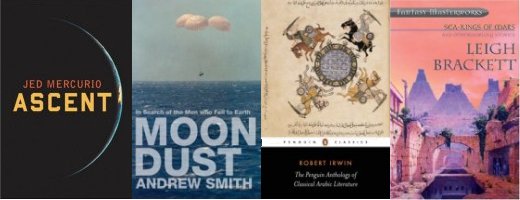
For example, of this year’s five books, four authors were new to me – and two of them sparked off “enthusiasms” (which is what I call it when I find myself buying loads of books on a subject because I’ve found that initial book so fascinating). After reading The Penguin Anthology of Classical Arabic Literature, I went and bought a bunch of books on mediaeval Arabic literature. And Moondust rekindled my boyhood interest in the Space Race, leading to the purchase of several autobiographies by astronauts…
Music too includes two bands new to me in 2007. New to everyone, in fact. It’s their debuts that I’ve chosen on my best of the year. And in films, only one is by a director whose work I like a great deal. I watched the others because of their story… although one not only was picked as a best of the year but also became a favourite film.

Books
Ascent, Jed Mercurio (2007)
A review of this in a daily newspaper piqued my interest – a novel about a cosmonaut in which, the reviewer complained, the level of detail was so dense it made the book a difficult read. The subject matter appealed to me, and the reviewer’s comments reminded of a complaint often levelled at science fiction by mainstream critics. So I bought a copy of Ascent, read it, thought it very good, and decided it was indeed science fiction and that the reviewer in the newspaper was a bit of a twit. I blogged about it here.

Moondust, Andrew Smith (2005)
I freely admit I was a space nut when I was a kid. I had posters of astronauts and launch vehicles on my bedroom walls. Around the age of 11, I discovered science fiction, and my interest in real spacemen began to wane. However, reading Ascent reminded me of that childhood interest. I dug out the few non-fiction books on the subject I still owned, and then went hunting for more recent works. And found Moondust. This is not a book about the Apollo programme, or the Space Race; it is a book about the nine surviving men (of the original twelve) who walked on the Moon. It is about how that experience changed them, and how they coped – or failed to do so – on their return. It’s also about how we feel about those men and their achievements. In one telling scene in the book, Smith goes to see Dick Gordon (Apollo 12 CMP) at a Star Trek convention. Gordon is sat alone in a corner of the signing room, while long queues stretch before the tables of TV actors. Gordon, a man who really went to the Moon, is ignored. I know which person’s signature I would treasure more…

The Penguin Anthology of Classical Arabic Literature, Robert Irwin (1999)
I bought this on a whim – saw it on the shelves of my local Waterstone’s while I was looking for a copy of TS Eliot’s The Waste Land, and decided to buy it. I had no idea what to expect. Like most people (I suspect), my idea of classical Arabic literature meant… 1001 Nights. And that’s despite growing up in the Middle East. I soon learnt there is a wealth of literature from the mediaeval Arab world, mostly epic poems. Irwin’s commentary is entertaining and educational. As mentioned earlier, after reading this book, I hunted down some more books on the subject. I also read The Middle East by Bernard Lewis shortly afterwards, to get a better idea of the historical context.

Sea-Kings of Mars, Leigh Brackett (2005)
This collection is No. 47 in the Fantasy Masterworks series – which is odd, because Brackett writes science fiction. It’s a type of sf no longer popular – planetary romance. I think that will change soon, however – if only because of the John Carter of Mars film currently in pre-production at Pixar. Whatever the future of swashbuckling amongst ancient ruins on Mars or the jungles of Venus, Brackett was the best writer to work in planetary romance, and this collection contains all her best works. Brackett was a better writer than her choice of material suggests, and it shows in these tales.

The first four picks for this list were easy. The fifth one was… Well, I reread my favourite sf novels during the year, but they don’t count. I also read a lot of very good novels – L Timmel Duchamp’s Alanya to Alanya, Alastair Reynolds’ The Prefect, Eric Brown’s Starship Summer, M John Harrison’s Nova Swing, Emil Habiby’s The Secret Life of Saeed the Pessoptimist, Andreas Eschbach’s The Carpet Makers… but I can’t pick one above the others. So instead, I’ll finish up with two excellent anthologies:-

The New Space Opera, Gardner Dozois & Jonathan Strahan (2007)
Does just what it says on the tin. Admittedly, New Space Opera is no longer new, and at least one story in this anthology fits no known definition of space opera (the Kage Baker one; and she can’t do Brit characters, either), but this is still a strong anthology with some good stuff.

Text: Ur, Forrest Aguirre (2007)
This is allegedly a themed anthology, although the only common link between the stories that I could see was that they were mostly experimental. And, as is the nature of experiments, some succeeded and some failed. Toiya Kristen Finlay’s ‘The Avatar of Background Noise’ was probably one of the best pieces of short fiction I’ve read this year.
Albums
MartridenMartriden (2006)
Although death metal arguably began in the US, I’m not that big a fan of the US style – well, except for Morbid Angel and Nile. I much prefer the North European variety. Martriden, however, are a bit different. There’s some NWOBHM and some progressive metal mixed in with their melodic death metal. This debut EP is only 4 tracks, but I’m looking forward to the album (The Unsettling Dark, due for release in March 2008).

The Lucifer PrinciplePitch Black Dawn (2007)
A new Dutch band, The Lucifer Principle play NWOBHM-influenced death metal. There are some great tracks here: ‘Soul Saviour Throat Cut’ has some excellent shredding, and ‘Burn’ goes funky in the middle eight. It didn’t take long for this album to become a favourite.

Fall of the LeafeAerolithe (2007)
They split up. Bah. Fall of the Leafe release this great album, and six months later they disband. I can understand why they were an acquired taste, and perhaps not all that popular. But I liked their extreme metal-influenced sort of goth Finnish metal, and this last album was their best to date. Since it seems every band on the planet is reforming at the moment, perhaps they’ll decide to get back together. I hope so.

Dark TranquillityFiction (2007)
The last three albums from Gothenberg stalwarts Dark Tranquillity had been… a little disappointing. Fiction is a welcome return to form. Many of the songs are a little… unsettling, inasmuch as they don’t progress in quite the way you’d expect. In some respects that makes Fiction a more experimental and progressive album that it first appears. The band have said they deliberately retrenched when it came to writing Fiction. Which makes the final result even more remarkable.

MithrasBehind the Shadows Lie Madness (2007)
This band’s last album was in my top five last year, and this year’s release is even better than that one. There’s more spacey ambient strangeness, more insane drumming and guitarwork. The most annoying thing about this band is that it only has two members, and they’ve yet to settle on a line-up for live perfomance. I’d go see them if they toured. I think they should tour.

Some honorable mentions:
NahemaHThe Second Philosophy (2006)
When an album by a band I’ve never heard of features a sticker quoting resemblances to Opeth and Dark Tranquillity, there’s no way I’m not going to buy it. Except, NahemaH don’t actually resemble either of those two bands. So when I first listened to The Second Philosophy, I was disappointed. But I kept returning to the CD because I suspected it would be a grower. And so it was. A couple of months after purchasing it, it became a favourite.

Rotting ChristTheogonia (2007)
These Greeks play a fierce style of black metal that sounds somewhat similar to old-style Swedish death metal acts like Bloodbath. I’m not a big fan of black metal but this album I thought was excellent from the first listen – aggressive and otherworldly.

Rise to AddictionA New Shade of Black for the Soul (2007)
I saw these live at Bloodstock, and they gave one of the best performances of the weekend. The album is heavy groove metal, with some excellent guitarwork, infectious riffs and anthemic choruses.

Films
Divine Intervention (dir. Elia Suleiman, 2002)
See here for all you need to know about this film.

Children of Men (dir. Alfonso Cuaron, 2006)
I read the PD James novel on which this film is based many years ago, and was not impressed. James’ ridiculous protestations that it wasn’t sf impressed me even less. But Cuaron has turned an ordinary book into an excellent film. The opening scene is indeed a shocker, but unlike Swordfish (which also features a shocking explosion in the opening minutes) Children of Men does not turn into some sort of implausible wish-fulfilment action-adventure. It’s a solid gritty near-future film that transcends its origins.

The Prestige (dir. Christopher Nolan, 2006)
Here’s another book I read when it was published. But then I’ve been a fan of Priest’s writing since the publication of The Glamour. But when I first read The Prestige, it never occurred to me that it was filmable. Christopher Nolan, however, has managed it. Some of the subtlety of the novel might have been lost, but this is still an excellent film.

Black Book (dir. Paul Verhoeven, 2006)
I’ve always enjoyed Verhoeven’s films. And yes, Starship Troopers is a great film. Hollow Man, which followed it, wasn’t as good. When I heard Verhoeven had returned to the Netherlands to make a film, I guessed I wasn’t the only one hoping we’d see a return to the Verhoeven of The Fourth Man, Soldier of Orange and Katie Tippel. Black Book is perhaps not as good as those three titles, but it’s pure Verhoeven through and through. And Carice van Houten is superb in the lead role. There’s none of that Hollywood silliness, either.

Fahrenheit 451 (dir. Francois Truffaut, 1966)
And conversely, I’m hardly a fan of Truffaut – I found both Jules et Jim and Les Quatre Cents Coups somewhat dull. I’m not a big fan of Ray Bradbury’s fiction either, and have never really understood his great popularity. And yet, I thought this film was superb. I only bought it because it was going cheap in a sale, I’d never seen it, and it’s considered one of the great sf films of the 1960s. And when I watched it, this happened.

An honorable mention:
From the Earth to the Moon (1998)
It’s not a film, it’s a miniseries. About the Apollo programme. I’d never seen it before, but bought it because of my newly rekindled interest in the Space Race. Each episode covers an Apollo mission, but the writers have cleverly found a story set in and about it. This is no documentary, it’s proper drama. But it is also technically accurate.

5 Comments

Having Plenty – Rereading Favourites, November 2007

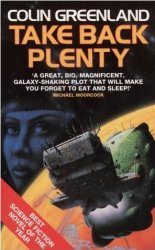
It’s been a fun exercise rereading a favourite sf novel each month this year, although there have been disappointments. But there have also been pleasant surprises – such as Colin Greenland‘s Take Back Plenty.

I remember the buzz when the novel was published back in 1990. It “reinvented” space opera. Arguably Iain M Banks had done that three years earlier with Consider Phlebas, but Take Back Plenty was different. Colin Greenland‘s novel was a reworking of – and homage to – pulp sf tropes. Mars was habitable and had canals. Venus was habitable and had jungles. There were aliens everywhere.

Certainly the book was successful. It won both 1990’s BSFA Award and 1991’s Arthur C Clarke Award.

In brief, Take Back Plenty is the story of Tabitha Jute, captain and sole crew of the barge Alice Liddell. While on Mars, she inadvertently causes a near-riot, and is subsequently fined by the authorities. She doesn’t have the money to pay the fine. Fortunately, she meets up with Marco Metz, leader of the cabaret act Contraband, and he contracts her to take him and his band to Titan. First, they stop off at Plenty, an alien artefact orbiting Earth. It had been built by the alien Frasque, but they’d been booted out of the Solar System by the Capellans – highly advanced aliens who’d bootstrapped humanity into space, and now kept everyone sealed within the orbit of Pluto.

Of course, Contraband isn’t really a cabaret act and Tabitha is forced to flee Plenty with the members of the band. They crash-land on Venus, are rescued by pirates, and then delivered to the Capellans. And to say anymore would give away the novel’s resolution.

I’d forgotten how good the writing is in Take Back Plenty. Here’s part of the description of Venus:

“The coral reefs of Erebus rise in great jagged spires from the sticky sea. Etched, eroded ridges spiral and veer, running for ten, twenty kilometres through smoke-black water. Where they meet they throw up frozen, warty explosions of barbed knots and clusters of mineral teeth. On these serrated edges the medusas, globs of muscular mucus as wide as tabletops, hang stranded and expiring, thrown up by tempests that rend the glutinous, tideless waves. The cliffs of the coral are thickly stained with their ichor.”

Plot-wise, perhaps, Take Back Plenty is slightly less successful. The setting – the pulp-populated Solar System – is a great deal of fun. But poor Tabitha seems to spend much of the story being chased from A to B. She has very little control over the plot. The ending too reeks of old sf serials. The cavalry arrive, there’s a sudden reveal and subsequent explanation, and it’s all over. While all the clues have been set, it does feel a little too pat.

However, there is one nice post-modern touch to the novel. Take Back Plenty is clearly a narrated fiction. There are even authorial interventions. But the identity of the narrator is kept secret until the end of the novel – and makes perfect sense within the confines of the plot. It’s not hard to figure out, but it does add an extra dimension to the narrative.

As do the conversations between Tabitha and Alice, the Alice Liddell‘s AI persona. In these, Tabitha tells stories of her past – which serve to entertain, to explain her background, and to help map her character. It’s an effective technique.

Unfortunately, in retrospect Take Back Plenty seems a bit of a one-off. Yes, there were a further two books – Seasons of Plenty and Mother of Plenty – forming a trilogy. Colin Greenland also “reinvented” the planetary romance with Harm’s Way in 2000. But during the 1990s, it seemed no one else mined pulp sf for tropes. Instead, we had Banks-style widescreen space opera, or Alastair Reynolds‘ hard sf space opera. No one leapt on Colin Greenland‘s bandwagon…

… until recently. In the last couple of years, there have been a few books by US authors which are based on and around old pulp sf tropes. A sort of return to the old sf action-adventure paradigm of the early Twentieth Century. Interestingly, while some have put a modern spin on this inasmuch as they provide a contemporary scientific rationale for their tropes, none have put a post-modern spin on it in the same fashion that Colin Greenland did. To my mind, that makes Take Back Plenty more interesting as it’s privileging story not setting. It’s probably also worth pointing out that Consider Phlebas is still in print, but Take Back Plenty is not. And given the recent interest in re-imagining pulp sf tropes, perhaps it’s time for a new edition. Or perhaps it should be included in the SF Masterworks series?

I have my copy, and I’ll be reading it again. Take Back Plenty is definitely a book that will remain a favourite.


1 Comment

Buy this Book?

It’s not very often I post responses to something I’ve read on other blogs – in fact, this might well be the first time. But sometimes, it’s the only thing to do.

First, here’s an excellent piece from the Kenyon Review on book reviews, which makes some interesting points about customer reviews on Amazon. The author is careful not to say, however, that those who struggle to understand novels by Joseph Conrad or Toni Morrison should probably look to themselves and not blame the writer. If they don’t like a book, and can articulate why – then, fine. But to not like it because they don’t understand it? That’s not useful information.

And from the sublime to the ridiculous: Dave Hill (novelist) celebrates the imminent demise of the hardback on the Guardian blog. According to him, “Literary fiction even has its very own format to signal that it’s a cut above the vulgar crowd – the hardback edition, which conventionally precedes the paperback by a year.” So the loss of the hardback format is good because “the ‘literary’ demarcation stinks” and, further, “plenty of so-called literary fiction is overrrated”.

This is complete rubbish. First, the hardback is not limited to literary fiction. In fact, books of all genres are published in hardback. Even Harry Potter. And second, plenty of fiction from other genres is overrated. Such as Harry Potter

There is also a certain amount of prestige attached to being published in that format, rather than as a “paperback original”. But that’s hardly surprising – they’re more expensive to produce, and correspondingly priced higher. So publishers will only do that for those authors they expect to sell well. Or perhaps the publishers want to signal to the market that an author is something special. Irrespective of genre.

I have several hundred science fiction hardbacks on my bookshelves, and quite a few of other genres. I like hardbacks. They’re more… substantial objects than paperbacks. They last longer, too. Unhappily, British publishers these days tend to use glued bindings, and not stitched – which most US publishers still use – so modern hardbacks are not as hard-wearing as older ones. And because they’re longer-lasting, hardbacks are more collectible. I recently read John Jarmain’s Priddy Barrows, first published in 1944. Sixty-three years ago. I could find only two copies on the Web. I wonder how many I would have found if it had been published only in paperback? Some of the hardback books I own are now worth substantially more than they were on publication – and they’re weren’t published more than half a century ago…


6 Comments

Forgotten Classic… or Just Forgotten?

After reading some poems by John Jarmain in Return to Oasis: War Poems and Recollections from the Middle East 1940 – 1946 (see here), I wanted to read more. I hunted down a copy of his book of poems – titled, of course, Poems – on Advanced Book Exchange, and purchased it. I also learnt he had written a novel, Priddy Barrows, published the year before his death. This proved even rarer than Poems, with only two copies available on Advanced Book Exchange… and all the other hits on the Web leading back to one or the other of those two.

Anyway, I bought one of the copies.

And now I’ve read it.

The title, Priddy Barrows, refers to a school for handicapped boys located on the edge of the Mendips and run by a Napoleonesque headmaster called Captain Nelson Hayes. The novel recounts the events of a year in the lives of the people connected with, or living near, the school. Gerald Trested is one such. He sold his bookshop in London to come and teach at Priddy Barrows is set in the late 1930s – Nelson Hayes fought in the Great War – but there is something about the story which makes it feel as though it were set earlier. The novel is not a typical beginning – middle – end sort of story. Trested’s arrival at the school is not the start, nor is his eventual breaking of his engagement with Linda Ysaye the end. Having said that, nearly every character in the novel does undergo some form of story-arc, each of which intersects as the characters’ lives intersect. (The exceptions are the Turls, who end the book pretty much as they began it.)

I wanted to read Priddy Barrows after reading Jarmain’s poetry. So it was Jarmain’s use of language which had attracted me – was his prose as good as his poetry? And the answer is… yes and no. In parts, Priddy Barrows prose is very good indeed. Unfortunately, the whole book has been presented in a weirdly old-fashioned style, with paragraphs comprising single sentences, punctuated by semicolons and colons rather than full stops. It makes for an odd reading experience. Here’s a good example of the prose – it shows both the odd punctuation, and Jarmain’s strength as a descriptive writer:

They were the skaters who came up from Wells and the vale to this frozen pond in the old mine working: they played the headlights of their cars on the ice, white upon the black, and waltzed and laughed and cut patterns in their little ring in the saucer of the black frozen abandoned hills. Their lights cross-crossed closely over the circle of ice, and spreading beyond it were swallowed in the huge blackness which they could not penetrate; their cries and their gliding movement were to Luke, looking down on them from the distant barrow, like the brief hectic activity of human life as a god might see it: their fixed swift motion within the little lit compass of the ice was perfectly self-centred; nothing existed for them of the grave-strewn dark immensity of the hills beyond the beam of their lights.

Another aspect of the novel which impresses is the handling of the central relationship between Gerald Trested and Linda Ysaye. Linda dominates the relationship inasmuch as she is certain of what she wants. But the tentativeness Trested initially displays is later revealed to be apathy. He is handled sympathetically, although his story leaves him in an unsympathetic position of his own making. I suspect the journeys taken by the characters in Priddy Barrows may in themselves be classical allusions, but if so they were beyond me. The novel’s dénouement, however, throws all that has gone before on its head. Which sort of reminds me of Lawrence Durrell’s The Avignon Quintet.

Coincidentally, Durrell is a writer I very much admire for his descriptive prose and use of language. For example, the two images described below I find very striking:

A white sailing boat lay like a breathing butterfly against the white mole.
(from The Dark Labyrinth, Lawrence Durrell)

and

In that clear hard enamel air the human voice carried so far that it was possible to call and wave to her from the top while she walked the Plaka streets below.

(from Tunc, Lawrence Durrell)

So, is Priddy Barrows a forgotten classic? Sadly, no.

Even for its time, it’s written in a strangely old-fashioned style. And the plot, comprising as it does a knot of character stories – each of which seems to flit between Brontë, Austen and Dickens – only makes the novel feel more old-fashioned still. Jarmain has a fine eye for landscape, he draws his characters with skill and economy (although rendering Vowles’ Somerset accent phonetically is a bit annoying), and at times his prose displays a wonderful turn of phrase. But Priddy Barrows is a debut novel, and it promises more than, sadly, Jarmain ever had the chance to deliver.

Yes, I will read the book again one day. And I wouldn’t be surprised to discover that I like and appreciate it more after that reread.


1 Comment

They went with songs to the battle…

Today is Remembrance Day, so it seems entirely appropriate that I post a poem by John Jarmain.

Tel-el-Eisa
Tel-el-Eisa is Jesus’ hill,
Or so they say:
There the bitter guns were never still,
Throwing up yellow plumes of sand by day
And piercing the night across.
There the desert telephone’s long lonely line expires,
Ends with a tangle of looping wires
And one last leaning cross.

Jarmain, a World War II poet, was killed by a mortar round in Normandy in 1944. His collection, Poems, was published posthumously in 1945. I now have a copy – bought from a seller on abebooks.com. The collection’s back cover blurb describes Jarmain as having “an original vision and a lyric voice”, and I’d very much agree with that. There are some wonderful poems in the book and they deserve to be much better known.


1 Comment

Ten Years Later…

Novacon is an annual convention run by the Birmingham SF Group, which takes place over the first weekend of November. The last one I attended was Novacon 27 in 1997. Ten years ago. Back in those days I would go to two or more cons a year - typically the Eastercon and Novacon. When I moved to the Middle East, I could only return to the UK for a single con each year - and chose the Eastercon, on the entirely sensible grounds that more of my friends would be at it. After returning to live in the UK, I didn't bother with any conventions for a couple of years... until the 2005 Worldcon in Glasgow. And since then, I've been happy with just one convention a year, the Eastercon.

But, for some reason, I decided this year to also attend Novacon. Which this year took place in Willenhall.

Travel problems soured my visit to Fantasycon, and that was only a 40-mile train journey. This time I was travelling around 100 miles - and I'd have to change trains at Birmingham New Street. Foolishly, I'd thought that earlier screwed-up trip was just a one-off. But it seems the British rail network imploded some time during the past couple of months. My train to Walsall was delayed by thirty minutes - in fact, only local trains were actually running on time. As it was, I still managed to arrive in Walsall at the correct time. Fortuitous connections at Birmingham New Street, I think.

The hotel where Novacon 37 was taking place proved to be one of those low flat modern ones, situated just off a motorway junction. The rooms were laid out along a corridor which mapped out a square. The entrance to this square was at one corner. Naturally, I was given the room furthest away, on the corner diagonally opposite. After dumping my bag, I headed for the bar...

If this year's Eastercon in Chester felt like a two-day convention stretched out over three days, then Novacon felt as though it were exactly the right length. I chatted with various people on the first night - including Guest of Honour Charles Stross - before attending the Opening Ceremony. Later that evening, they brought out the free wine, free books and free food for some book launches and signings. I don't actually recall what was being launched, or who was signing. I do vaguely remember deciding I'd had enough and staggering off to my room around midnight. The next day I was told I'd actually left at ten o'clock.

As usual, I was up early the next morning. Unsurprisingly, I had a bit of a hangover. Breakfast wasn't bad - although the Quality Hotel keeps their plates dangerously hot. You can't hold one unless you wrap a dozen paper napkins around your hand. I spent the day in the bar, but I no longer recall the topics of conversation. At four o'clock, Andy Remic gave a reading from his new novel, War Machine, published by Solaris. He stood with his back to a window, and through the window I could see an expanse of grass and at its far edge some twenty metres way a line of trees. Every now and again, a pair of squirrels would leap across a gap in the trees - and only just make it. One squirrel, in fact, missed completely, and only saved itself from plummetting to the ground by grabbing the other squirrel's tail. It was a little distracting. Andy's book, incidentally, is militaristic sf, and if the excerpt he read is any indication it should be a good read.

Around half past seven, a gang of eleven of us went out for a curry. This entailed a ten-minute drive in two taxis. The food wasn't bad - although a couple of those present disagreed. Back at the hotel, we sat around, drank a bit more and generally complained about how knackered we were. I lasted until midnight before going to bed.

On the Sunday, I attended my second programme item of the con. Which makes Novacon 37 something of a record-breaker for me. I typically spend cons in the bar, only attending book launches, author readings, or awards ceremonies. But this time, I actually sat through a full sixty-minute panel discussion. The topic was 'The New Optimism in British Science Fiction'. The panel comprised Eric Brown, Ian Watson, moderator Catherine Pickersgill, GoH Charles Stross and Andy Remic. An interesting discussion, although I don't recall any real conclusion being reached.

Throughout the weekend, I went for occasional wanders about the dealers' room. Which was surprisingly big for such a small con. Among the 17 books I bought were Outpost Mars by Cyril Judd, and its "spiced up" Beacon Books version, Sin in Space (see here for my comments on the Beacon Books version of AE van Vogt's Undercover Aliens; I plan to do the same for Sin in Space). Most of the others were obscure paperbacks, bought for a couple of quid, by the likes of Colin Kapp, David J Lake, Rudy Rucker, Lin Carter, and Barry N Malzberg. I also picked up copies of Time Pieces and disLocations, short story collections edited by Ian Whates. And Andy Remic's Quake and Warhead, both of which he signed for me.

Since Eric Brown and myself were both heading north, we decided to travel together. Tony Ballantyne dropped us off at Walsall station at 3 o'clock (thanks for the copy of Divergence, Tony). I didn't arrive back home until 7:30. The train from New Street was packed solid, and forced to take two diversions because of work being done on the lines. In the old days, you could blame a single company - British Rail - for screwing up your journey. Now it's the fault of half a dozen. Privatising British Rail was a stupid thing to do.

On the whole, an enjoyable con. I got to meet up with friends, and meet new people. I didn't spend as much in the dealers' room as I'd expected or feared. Which is good. I did spot a couple of first editions I wanted, but I managed to resist temptation. I don't remember every thing that happened during the weekend, but I do recall - chatting with Ian Whates about prog rock (and letting Tony Ballantyne listen to some Tinariwen on my Yeep; he liked it more than the death metal...); discussing the current craze for zombies with Mark Newton and Christian Dunn; watching someone hand Charles Stross all twelve of his novels to sign, and his earlier book on Web architecture; talking about writing with Andy Remic; listening to Ian Watson's many funny anecdotes; being very surprised to see Liam Proven up and about before noon... Anyway, here are a few photos I took during the weekend.

It was a fun convention. I might even go again next year. I'll certainly not wait ten years before my next Novacon...


9 Comments

As Good As I Remember It? – Frank Herbert’s Dune

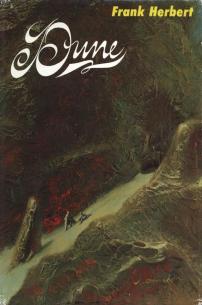
Some people have The Lord of the Rings, some people have Dune. They reread one of the two books on a regular basis. While I don’t read Dune every year, it’s the sf novel I’ve probably read the most times (and I haven’t reread The Lord of the Rings since I was about nineteen). This year I read Dune once again as it’s one of the titles on my list of favourite sf novels.

dune_first

Frank Herbert’s Dune is generally considered a classic science fiction novel. It’s certainly a best-selling sf novel – and there aren’t that many of them. In fact, it’s still in print now, more than 40 years after its debut. Common wisdom has it that the Dune series falls in quality as it progresses, although there are those who consider the sequel to Dune, Dune Messiah, the best of the lot. Since Frank Herbert himself conceived of the original trilogy – Dune, Dune Messiah and Children of Dune – as a whole, it’s unfair to consider them sequels. The trilogy is a thematic whole – as FH himself wrote: “I conceived of a long novel, the whole trilogy as one book about the messianic convulsions that periodically overtake us … This grows from my theory that superheroes are disastrous for mankind, that even if we find a real hero (whatever that may be), eventually fallible mortals take over the power structure that comes into being around such a leader.”

As for the later Dune books – yes, God Emperor of Dune is less a novel than it is a manifesto, but once you accept that the book becomes a more interesting read. Both Heretics of Dune and Chapterhouse Dune are, I think, technically better-written than the original three. Admittedly, Miles Teg’s development of superhuman speed always struck me as pushing plausibility just a little too far out of the suspension of disbelief envelope. And back-fitting an underground Judaic society into the universe felt a bit like pandering and unnecessary.

The less said about the Brian Herbert and Kevin J Anderson prequels and sequels, the better.

For those few who’ve not read the book, Dune is the story of Paul Atreides. It is set some twenty thousand years in the future, in a feudal interstellar empire in which computers , “thinking machines”, have been banned for millennia. Interstellar travel is controlled by the Spacing Guild, who use the spice melange to see into the near-future and so safely pilot their starships via foldspace. Melange is only found on a single world, Arrakis, AKA Dune. Paul’s father, Duke Leto Atreides, is charged by the Emperor with taking over Arrakis from his mortal enemy, Baron Harkonnen. But this is just a ploy by Harkonnen, who intends to destroy House Atreides. He attacks, but Paul and his mother, Lady Jessica, escape into the vast deserts of Arrakis and join the native Fremen. These are a hard people, and superlative fighters. Paul proves to be prescient and the messiah their religion foretold, and he leads them in battle against the Harkonnens and the Emperor. And wins.

Dune, for all its popularity and success, is not a very well-written novel. Here’s a sample passage:

His mother had undergone this test. There must be terrible purpose in it… the pain and fear had been terrible. He understood terrible purposes. They drove against all odds. They were their own necessity. Paul felt he had been infected with terrible purpose. He did not know yet what the terrible purpose was.

FH’s prose rarely rises above serviceable. It often drops below it. His poetry – presented as the lyrics of Gurney Halleck’s ballads – is bad. It’s no better in his collection of poetry, Songs of Muad’Dib. But then he did write a lot of haiku, and I hate haiku. Further, the continuous “head-hopping” is often confusing. That’s not to say FH was a bad writer, just that Dune doesn’t showcase his best. His writing in The Green Brain is, I feel, much, much sharper; and he draws his setting and characters much more effectively and skilfully in The Santaroga Barrier.

What FH was, however, was perhaps the deepest-thinking sf writer of his generation. Even if his prose often got in the way of the story, his fiction always left the impression it was never based on, or built around, trivia. He didn’t write escapist adventure-stories. Even a fix-up such as The Godmakers, in which the joins are painfully obvious, had something intelligent to say about government and religion.

FH spent a lot of time on the background of Dune, and it shows a depth and richness matched by few novels in the genre. Its feudal, somewhat old-fashioned, nature has also meant it has stood the test of time well. Dune reads pretty much the same now as it did when I first read it thirty years ago. The protagonist, Paul, is a young man whose words and actions continually seem to chime with prophecy, suggesting he is heir to greatness. And so it proves. There’s plenty there for young male adolescents to identify with, especially those who read science fiction. I no longer identify with Paul to the extent I did as a callow youth. And Baron Harkonnen now seems more of a pantomime villain than a real antagonist. All he lacks is a moustache to twirl. However, the setting remains as fascinating as ever – it’s easy to feel that the background is the real achievement of Dune. Both it and The Lord of the Rings were notable first and foremost for their deep and detailed settings, and both of them perhaps led to the current privileging of immersion over everything else in genre novels and novel series.

Each time I reread Dune, I find its narrative message harder to swallow – i.e., the human race is slowly stagnating, and a jihad is needed to mix up the genes and inject some vitality back into it. Paul tries to prevent this – or rather, he tries to find a less violent solution. But he fails. For me, jihad is the wrong word. It means “struggle” – and what exactly is the jihad in Dune struggling against? Second, Herbert equates a stagnating civilisation with genetic stagnation, which is not necessarily true. And, finally, going out and killing lots of humans is a pretty peculiar way of injecting some vitality back into the gene pool.

Speaking of killing, Dune is full of it. I hadn’t realised until this reading quite how many people are slaughtered throughout the story. And often for the most trivial of reasons. In one scene, two guards are a little quick to obey Feyd-Rautha in the presence of Baron Harkonnen. Since those guards are clearly more loyal to Feyd-Rautha than the baron, Harkonnen has them killed. Feyd-Rautha’s harem is also murdered as punishment for something he did wrong. It’s not just the villains of the piece. Perhaps it’s not unexpected that the Harkonnens would place little value on life, but the Fremen view it equally as cheap. Duke Leto is the only character who values the lives of his men. On joining the Fremen, Paul adopts their view. It all makes for a somewhat callous read. And, of course, it’s stated that the jihad will slaughter billions more after Dune‘s story has finished…

Unfortunately, David Lynch’s 1985 film of Dune has also slightly spoiled the book for me. For much of the novel, Stilgar remains as described in the novel. But when Paul and Jessica join the Fremen and Paul chooses his Fremen name… I kept on hearing Stilgar’s dialogue in Everett McGill’s voice. After seeing the movie, it’s almost impossible to hear, “We call that one muad’dib,” any other way.

Even though I’ve read Dune at least half a dozen times in the last 30 years, I don’t doubt I’ll read it again. For years I’ve been promising myself I’ll read all six of the FH-penned Dune books in succession. Maybe I’ll set myself that as a challenge one year, and blog the results. If I can bring myself to do so, I might even continue onto the two “Dune 7” novels written by Brian Herbert and Kevin J Anderson… Which would sort of be the opposite of going from dreadful sf B-movies to Ingmar Bergman… but with just as explosive results (see below).

Yes, Dune remains a favourite – although for reasons I’m not sure I fully understand. It’s not FH’s best-written novel. It’s not even the best-written of the Dune series. It is also a somewhat heartless novel – its core ideas have never really convinced me. But its setting remains a work of genius, and – let’s be honest – every male sf reader secretly wants to be Paul Atreides…


2 Comments

Hideous Beyond Belief!

Back in February of this year, I wrote about a film that had really impressed me, Divine Intervention by Palestinian director Elia Suleiman. In my post, I mentioned that I prefer foreign “art house” films to Hollywood blockbusters – I’d much sooner watch the sort of stuff directed by the likes of Aki Kaurismäki, Ingmar Bergman, Andrei Tarkovsky, Werner Herzog

However, I also have a small cinematic guilty secret: I enjoy really bad sf films. You know, those dreadfully earnest B-movie sf films from the 1950s and 1960s, with rubbish effects, lots of stock footage, and alien invaders that are quite clearly men in rubber suits. And those straight-to-video Star Wars rip- offs from the late 1970s and early 1980s, especially the Italian ones…

Like Starcrash. This was released in 1979, directed by Luigi Cozzi, and starred Caroline Munro, Christopher Plummer and David Hasselhof. Its plot is very nearly incoherent (unlike Cosmos: War of the Planets, whose plot is incoherent). The Hof is best thing in the film, which probably tells you all you need to know. Classic lines in Starcrash include: “Look! Amazons on horseback! I hope they’re friendly.” and “Imperial Battleship, halt the flow of time!” and “A floating spaceship is about to crash into us!”

Not all of these films are so dreadful, however. Some are much better than appearances would suggest. Galaxy of Terror has been a favourite since I first saw it on VHS back in the mid-1980s. And only a few nights ago, I watched another Roger Corman-produced film from 1966 which is bizarrely good…

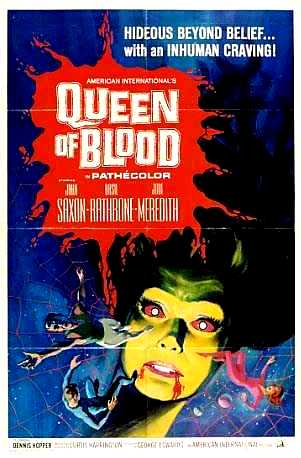
Queen of Blood is one of those 1960s American sf films created by overdubbing English dialogue over a pirated Russian sf film and adding additional scenes featuring US actors. It stars Basil Rathbone, John Saxon, and a very young Dennis Hopper. All of the special effects shots, Martian exteriors, and alien spaceship interiors are from Niebo Zowiet, “The Heavens Call”. Queen of Blood‘s plot also clearly inspired Ridley Scott’s Alien – there are obvious resemblances.

Aliens send a message to Earth requesting a meeting, but the spaceship carrying their ambassador crashes on Mars. The International Institute of Space Technology puts together a rescue mission. However, they find only a single alien body in the wreck. The aliens’ rescue ship must be somewhere else on the Red Planet. A second IIST rocket makes its way to Mars in order to place observation satellites in Martian orbit to aid the search. This rocket lands on Phobos… and discovers the alien rescue ship. Which contains a single survivor, a green-skinned woman. During the return journey to Earth, the alien woman kills off the IIST crew one by one and drinks their blood…

It’s not the most profound plot in the history of sf cinema. And Queen of Blood‘s half-Soviet origins hardly bode well. But somehow the film manages to be more than the sum of its disparate parts. The footage from Niebo Zowiet is… weirdly compelling: lots of long shots of huge colourful sets, which seem strangely other-worldly. The film also features some Russian crowd scenes, intercut with close-ups of the American cast. The sudden changes from long to short are a little disconcerting. The title role is played by Florence Marly who, despite green make-up and a very peculiar beehive hairdo, manages to convince without actually speaking a word.

Interestingly, one member of the crew of the first IIST rocket is Judi Meredith. Her character is chosen for the mission because she’s best qualified. And her boyfriend, John Saxon, happily acknowledges as much. For a film made in 1966, that’s quite remarkable. In other areas, perhaps Queen of Blood isn’t quite so forward-thinking – or even scientifically accurate (green-skinned blood-drinking alien queens notwithstanding). There’s no evidence of one-sixth gravity in the scenes set on the Moon, or micro-gravity when the second rocket “lands on” Phobos. But that’s not unusual in science fiction films of the time. Even in the good ones.

Films like Queen of Blood – i.e., not exactly “good”, but very much interesting – are not entirely common. The vast majority of sf films available on cheap B-movie DVD collections are truly dreadful, and often near unwatchable. And sitting through them one after the other over a period of several weeks is probably not a very clever thing to do. I’m a little bit afraid that if I now watch anything directed by Ingmar Bergman, my head is likely to explode. But, joking aside, I’d very much like to see Niebo Zowiet, the Russian film from which Queen of Blood so freely stole. Sadly, no copy with English subtitles appears to exist. Ah well. I’ll just have to keep on watching sf B-movies and hope I stumble across another gem…