It Doesn't Have To Be Right…

… it just has to sound plausible


1 Comment

Searching for Coincidences While Travelling Faster-Than-Light

It’s self-evident that technology has made the job of writing much easier. The word-processor is a far more efficient and effective tool than the typewriter (although, with the advent of in-line spell-checking, you’d have thought the standard of spelling would improve). The Web has also provided a low-cost distribution channel, which gives even the meanest of scribblers access to a potential worldwide audience. And then there’s the access the Web gives to useful information. Of course, you need filters firmly in place – there’s a lot of crap out there masquerading as “fact”.

It occurred to me recently that it’s not just in the “business” of writing that technology has proven a boon. Yes, it has expanded the possibilities for plots, but it has also affected the mechanics of plots. A particular example of this came to mind. Take a story written, or set, for example, in the first half of the Twentieth Century…

In order to advance the plot, the protagonist has to track down the femme fatale. He’s met her, but suspects the name she gave him was false. He can either ask about at the location where he met her, in the hope that someone recognises his description and so provides her correct name. Or, and this is a common technique in stories of this ilk, he stumbles across a photograph of her in the local newspaper’s society pages. A lucky coincidence. And the plot moves on.

Let’s transpose our story to the Twenty-First Century – or even after. Our protagonist could still find his femme fatale using leg-work. Or…

He could search the Web.

It’s not unlikely that the woman should appear somewhere on the Internet. In fact, these days it’s almost certain. Almost everyone is there somewhere – especially a woman who would appear in a newspaper’s society pages… It’s only a matter of defining plausible search criteria for the protagonist to use – a visual search may not be commonplace at the moment, but soon it may well be trivial. Our plot no longer needs an incredible coincidence to advance. Technology has given us a much more plausible alternative. And if this is science fiction, then there’s nothing stopping us inventing even more useful tools. Providing, of course, they’re consistent within the universe of the story, and not too wildly implausible in and of themselves.

The Web itself may not have been foreseen forty years ago – Bill Gates himself famously predicted the CD-ROM would be the “next big thing” in personal computing in the first edition of The Road Ahead in 1995 – but the Web does not contradict what we currently know about our world and the universe. Well, not unless you’re looking it up on the Conservapedia, that is.

Science fiction, however… Well, these days, sf seems all too ready to throw the laws of physics out of the window. It’s not just the sort of stuff that’s been rejected by Mundane SF – i.e., anything that isn’t “a believable use of technology and science as it exists at the time the story is written”. Media sf – films and television – has given us, for example, spaceships that rumble (sound doesn’t carry in a vacuum), spaceships that swoop and bank in space (so much for Newton’s Laws), not to mention all those alien races which happen to bear a remarkable resemblance to humans.

But does sf really need to adhere so rigorously to the laws of physics? Okay, sound in space is just plain silly. But, to me, the faster-than-light drive is a literary device. It doesn’t have to be scientifically plausible, it only needs to get the characters from A to B, the plot from Y to Z.The distances involved in interstellar travel make most plots set outside the Solar system impossible. Some have tried: William Barton’s Dark Sky Legion posits a slower-than-light human empire held together by agents who travel for thousands of years from world to world, ensuring none stray too far from the imperial template. It’s an excellent novel. Also excellent are Alastair Reynolds’ Revelation Space novels, which feature slower-than-light travel. In both cases, the lack of FTL is a world-building choice by the authors.

And so back to my point about googling for the femme fatale. Most people don’t know how a Web search works. It’s black box technology. And there’s no need to explain its workings when it’s used in a story. It’s a plot enabler. It also happens to be real. FTL is not real, but it’s also chiefly there to enable the plot. The same can be said of other non-Mundane elements in a science fiction story. Time travel. Alien races. A statistically unlikely abundance of Earth-like worlds. Artificial Intelligence.

Technology has expanded the range of plot enablers available in science fiction. Or, at the very least, it has provided opportunities to conceive of new ones. We know more about the universe now than writers back in the 1940s did, and yet all many sf authors have done is trick up those old inventions – FTL, and ever more ludicrous weaponry, for example – in modern scientific jargon. Where’s the leap equivalent to society pages –> Google? Science fiction often seems to be a history of discrete ideas – time travel, FTL, the Singularity… And because the focus is on those ideas as ideas, their role in enabling the plot is ignored.

And so the plot mechanics remain unchanged – and the gloss gets glossier, the surface gets more polished, and science fiction turns yet more escapist and less relevant…

(This has been a Monday morning ramble, and may well be followed up at a later date when I’ve managed to construct a coherent argument out of the thoughts which resulted in the above.)


Leave a comment

Why Am I Still Doing This…? Part 2

I must be mad, I tell you, mad… Well, if I’m not now, I will be by the time I’ve finished my Nightmare Worlds 50-movie pack. The SciFi Classics one was bad enough, but this set is rapidly showing itself to be of even lower quality.

But, never mind. Without further ado, here’s the next batch of personality-wipingly bad films from the set:

Death Warmed Up – many years ago, Peter Jackson, director of the Lord of the Rings trilogy and King Kong, started out his career with a bad sf/horror spoof called Bad Taste. The director of Death Warmed Up clearly tried for something similar – but his film is crap.

Doomsday Machine – the Chinese have built the ultimate weapon, so the crew of a soon-to-launch mission to Venus is quickly reshuffled, replacing half the men with women. The ultimate weapon does exactly what it says on the tin, leaving our hardy space explorers as the last of the human race. But, of course, they bicker and fight until there’s none of them left. Not a film to watch if you’re feeling misanthropic, but actually not bad for an early 1970s sf B-movie (if that’s not over-qualifying it too much).

Embryo – Rock Hudson is a genetic scientist who manages to save a dog fetus after its mother was run over. The dog grows to term and proves entirely normal – for a savage Rottweiler guard-dog. So Hudson decides to up his game and try the experiment with a human fetus. He’s successful, and the baby grows – using some super-growth scientific thingummy – into the bright and beautiful Barbara Carrere. But, of course, it all goes horribly wrong in the end. Hudson made a couple of odd but strangely watchable genre films during his career – like this one and Seconds.

End of the World – Christopher Lee is a priest who runs a convent. And he’s also an alien double. The aliens are trying to take over the world, of course. A young couple get involved somehow. I remember some scenes set in a 1970s computer centre, although the computer was apparently capable of tasks even modern ones can’t do. And there were the nuns, who were really aliens. And a transdimensional gate, or something, which was the cause of the natural disasters which were destroying Earth. A very odd film.

Eternal Evil – a television director is taught how to astral project by a mysterious woman, and while he sleeps does just that. And kills lots of people. I must have been astral travelling when I watched this, because I can’t remember any of it.

Evil Brain from Outer Space – Starman saves the Earth again. Sigh. This one had a really strange monster in it – I mean, yes, it was obviously a man in a rubber costume. But it looked very weird. Oh, and the titular evil brain spent the entire film being carried round in an attaché case. I’ve seen plenty of maguffins, but it’s the first time I’ve seen a brain used as one.

Shadow of Chinatown – this is actually a serial from 1936, and it’s real pulp action. A mad Eurasian scientist (Bela Lugosi) plots to put the Chinese merchants of an unnamed West Coast American city out of business. There’s a plucky reporter, her manly boyfriend, fistfights, narrow escapes, bombs, and poison traps. It would have been really exciting if it weren’t so, well, dull…

The Disappearance of Flight 412 – and here’s another one which proved less exciting than its title or synopsis suggested. A USAF plane witnesses a UFO encounter, and is directed to land at a disused airbase. Where the crew are held and interrogated by government agents. Their commanding officer, meanwhile, wants to know where his men have vanished to. It’s all because the policy is to cover up UFO sightings and not to investigate them, you see.

Idaho Transfer – I’m not entirely sure what to make of this one. The transfer was terrible, which didn’t help. But its story, and the way it approached it, was actually quite good. A group of scientists have perfected a time machine, and regularly send people 56 years into future, when the Earth appears to have suffered some form of ecological collapse and humanity has died off. The nature of the time travel device means only people under the age of twenty can go, and when the military seizes the time travel facility, a group of young people maroon themselves in the future. Only the Earth isn’t entirely depopulated, and it does eventually recover. An odd, low-budget, low-tech time travel film, not unlike Primer (although nowhere near as confusing).

Good Against Evil – a pilot for a television series which was never (thankfully) made. It apparently stars a young Kim Cattrall of Sex & the City. I don’t actually recall seeing her in it. But then I don’t actually recall much about this film. Something about Satan trying to possess a woman, and a writer trying to exorcise her. The writer is played by Dack Rambo. Who apparently has a twin brother called Dirk Rambo. Dack and Dirk. You can’t make this sort of stuff up…

Alien Zone – a man is dropped off on the wrong street while trying to return to his hotel. It’s raining badly, so a mortician offers him shelter. As they do. To while away the time, the mortician tells the man stories about four of the bodies currently occupying his coffins. As they do. I don’t actually recall what those stories were, however. Or what they had to do with aliens.

So, a mixed bag this time. Embryo, End of the World and Idaho Transfer weren’t bad – and might even have been quite good, if the transfer hadn’t been so poor. The Disappearance of Flight 412 proved duller than it should have been. The rest were as expected.

Don’t forget part one of this recipe for insanity.


5 Comments

20 British SF Novels You Should Read

It seems to be the season to exhort people to read books, or watch films, from some list of what-appear-to-be-randomly-chosen titles. So, move on over up there on the bandwagon, I’m climbing aboard.

But.

Most of the lists floating about the tinterweb are, let’s face it, a bit Americocentric. Here are twenty science fiction novels by British authors you should read.

Take Back Plenty, Colin Greenland
Tabitha Jute is the captain of a space barge, and when she agrees to ferry a cabaret act, Contraband, from Mars to the alien space station Plenty, things go from bad to… well, to crashing her space barge on Venus. A seminal post-modern space opera, and a personal favourite (see here).

Use of Weapons, Iain M Banks
Cheradenine Zakalwe was an operative for Special Circumstances. While the drone Diziet Sma tries to persuade him to come out of retirement for one last job, a second narrative recounts Zakalwe’s career in reverse chronological order… leading to one of the most memorable revelations in science fiction. Probably the best of Banks’ Culture novels.

A Clockwork Orange, Anthony Burgess
Alex loves a bit of the old ultra-violence, but the authorities aren’t so keen on it. One such incident gets a bit out of hand, and Alex is arrested, tried and convicted. While in jail, he volunteers for a brainwashing experiment, designed to remove his urge for violence. A novel that’s famous for several reasons – its story, its invented language Nadsat, Stanley Kubrick’s film adaptation, and Kubrick banning his own film from being shown in the UK…

Ash: A Secret History, Mary Gentle
In an alternate past in which the mediaeval nation of Burgundy did not disappear, female mercenary captain Ash is battling against invading Visigoths from North Africa. Meanwhile, a present-day academic is researching the biography of the fictional Ash… only to discover his own world slowly changing to be more like hers.

Life, Gwyneth Jones
Anna Senoz is a genetics researcher, and this is her, well, her life. And her career. SFSite said of Life: “You can stop reading right now and go out and buy the book. Otherwise, you’ll have to endure yet another one of these diatribes about how science fiction doesn’t get any respect from the literary mainstream. Because you can’t read this book and not reflect on the fact that had this been written by, say, Margaret Atwood, Life would be receiving more of the widespread attention it deserves.”

Light, M John Harrison
Back in 1975, Harrison reinvented space opera with The Centauri Device. Twenty-seven years later, he did it again with Light. Physicist and serial killer Michael Kearney is haunted by the Shrander. He is also on the verge of breakthrough in theoretical physics which will allow humanity to spread into space… and so populate the edges of the Kefahuchi Tract, a region of space that obeys no known laws of physics. Which is where, in 2400 AD, K-ship captain Seria Mau Genlicher and ex-space pilot Ed Chianese now live.

Absolution Gap, Alastair Reynolds
This is one of those novels which has three separate narratives which seem to have no connection to each other. But, of course, they’re linked. The world of Ararat has found itself dragged into a war between humanity and the Inhibitors. Rashmika Els is looking for her brother, who has joined one of the “cathedrals” which perpetually travel across the face of the frozen moon, Hela. And the crew of the lighthugger Gnostic Ascension are desperately searching for something to improve their fortunes… Of Reynolds’ Revelation Space novels, this one shows the strangeness of his universe best.

Behold the Man, Michael Moorcock
Karl Glogauer travels back in time from Britain in 1970 to Judea in 28 AD. He is obsessed with meeting Jesus Christ… except the Jesus he meets is not the one described in the Bible. Britain in 1970 was a grim place, but Biblical Judea is little better. At least Glogauer finds the fate he was seeking, although it’s perhaps not the one he expected to find.

The Drowned World, JG Ballard
If we don’t get global warming sorted out soon, this might well turn not to be science fiction. Ballard’s second novel, and deservedly in the SF Masterworks series.

The Separation, Christopher Priest
The Second World War ended in 1941. Except it didn’t. It’s all because of identical twins Joe and Jack Sawyer. After competing in the 1936 Olympics, they fall out. One becomes a RAF bomber pilot, while the other is a conscientious objector. Priest rings the variations on their two lives, and the consequences of one or the other, or both, dying.

Somewhere East of Life, Brian W Aldiss
Someone has stolen ten years of Roy Burnell’s memories, and so he wanders about Central Asia hunting for the magic bullet which will restore them. This is one of those near-future sf novels which, now that its future has passed, bears an uncanny resemblance to mainstream fiction. And yet it’s still sf.

The Time Machine, HG Wells
A man invents a time machine and travels to the future. To the year 802,701 AD, in fact. But you probably knew that already.

The Time Ships, Stephen Baxter
This is the authorised sequel to The Time Machine – and in it the publication of Wells’ novel has changed the future. The Time Traveller can no longer rescue Weena from the Morlocks. So he goes back in time to prevent his earlier self from inventing the time machine. Only that changes the future yet again… Baxter manages to pull a happy ending out of his story, but you’ll have to read the novel to find out how.

1984, George Orwell
Some say this isn’t science fiction. I say that just because some governments are using techniques described in the book – left-wing doubleplusungood, right wing doubleplusgood; Christianity doubleplusgood, atheism doubleplusungood – that doesn’t mean 1984 isn’t science fiction. The UK might as well be Airstrip One, anyway. And not even George Orwell would have dared invent Gitmo and “extraordinary rendition” for his novel.

Pavane, Keith Roberts
Queen Elizabeth I was assassinated in 1588, and England remains Catholic. The stories in this fix-up novel are set in a 1968 following on from this, but it’s not a 1968 we’d recognise. Pavane is still one of the best alternate history novels ever written, and Keith Roberts deserves to be better known than he is.

The Road to Corlay, Richard Cowper
A thousand years in the future, the ice-caps have melted and the UK is now a series of small islands (it’s that global warming thing again). Modern technology has been mostly forgotten, and a Church Militant rules everything. But the prophesied White Bird of Dawning could break their rule. It all depends on Tom, whose pipe-playing has the power to stir minds. While this novel may sound like fantasy, it’s very definitely science fiction. It’s also very English.

Chronocules, DG Compton
This novel has one of the all-time great opening sentences: “About twenty years before this story begins—give or take a few years, the Simmons s.b. effect being untried and seriously (not that it mattered) inaccurate—the desolate silence on Penheniot Village, at the top of Penheniot Pill which is a creek off the small harbour of St. Kinnow in the county of Cornwall, was shattered by the practised farting of young Roses Varco.” But then it was originally published under the title Hot Wireless Sets, Aspirin Tablets, the Sandpaper sides of used Matchboxes, and something that might have been Castor Oil, so what do you expect?

Silver Screen, Justina Robson
Anjuli O’Connell is a psychologist working with the Artificial Intelligence 901. Just before his death, a colleague filed a petition with the World Court to emancipate the AI, but the company which built and owns it is resisting. Not many debut novels are shortlisted for the Arthur C Clarke Award, but Silver Screen was. And it also appeared on the shortlist for the BSFA Award.

Oracle, Ian Watson
A Roman centurion is dragged forward to the present day by an experiment and finds himself in, of all places, Milton Keynes (that’s the town with the concrete cows). He’s picked up by a British researcher… But then the security services get involved. And so do the IRA. And the book heads smartly into thriller territory.

The Star Fraction, Ken MacLeod
This was MacLeod’s debut novel, and takes place in a balkanised UK. Revolution is in the air, and three very different characters find themselves involved. And behind it all is the mysterious Star Fraction. And the rogue AI, the Watchmaker. An astonishing debut from MacLeod.

Now go and read them.

(Before you all start spluttering about various books I’ve missed off the list, I picked titles which are either set (mostly) in the UK, or at some point in the future at which nation states are irrelevant. So no Black Man or Brasyl. Or Rendezvous with Rama. They’re also books I’ve both read and enjoyed. So no John Wyndham (never read him). Nevertheless, I’ve probably missed an entire county’s worth of UK authors who deserve mention. If you can think of any, then feel free to name them in a comment.)


1 Comment

Best SF Films

Last week, the American Film Institute released several new lists of top 10 films, including one for science fiction. And on his blog on AMC, the always entertaining John Scalzi commented on the list, pointing out that the most recent film on it was released in 1991. So he decided to create a list of Top Ten SF Films Released since 1991, and asked people for suggestions. Here’s my list (in order of year of release)…

1. Delicatessen, dir. Jean-Pierre Jeunet & Marc Caro (1991) – it’s hard to imagine how a post-apocalyptic black comedy featuring cannibalism could be, well, funny. But this film certainly manages it. The inhabitants of an apartment block in a Paris after some unspecified disaster regularly invite new tenants to take empty flats… so they can kill and eat them. Ex-circus performer Dominique Pinon is the latest such victim… but he manages to evade his fate.

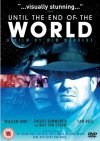
2. Until the End of the World, dir. Wim Wenders (1991) – when I first saw this back in 1992, I thought the 1999 it depicted was the most plausible I’d seen on film. Having watched it recently, I can see why I thought so and why it wasn’t so prophetic after all. Wenders has said he intended Until the End of the World to be the “ultimate road movie”, and that it is for much of its length. I blogged about it here. I still want to see the 4 hour 40 minute version, though.

3. Abre los Ojos, dir. Alejandro Amenábar (1997) – César, a wealthy playboy, is hideously disfigured in a car crash caused by a jealous ex-girlfriend. But doctors use a new surgical technique on his face, and he regains his former good looks. And the love of his life. Except everything seems a little different and not quite right… An unsettling film. It was remade by Cameron Crowe as Vanilla Sky, starring Tom Cruise. Beware of expensive Hollywood imitations; go for the original.

4. The Fifth Element, dir. Luc Besson (1997) – okay, this is a supremely silly film. Which is where much of its charm lies. A vividly technicolour space opera, it owes more to French sf comics such as Métal Hurlant than it does to Star Wars. This, of course, is actually a good thing. On the other hand, thinking too hard about The Fifth Element is probably not a good thing – although, to be fair, it holds up better in that department than Star Wars does.

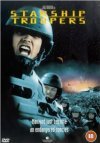
5. Starship Troopers, dir. Paul Verhoeven (1997) – the book is a thinly-disguised fascist political tract, so the only way to make a film of it would be as a satire. And that’s just what Verhoeven did. Perhaps it turns into a bit of a mindless bug hunt towards the end, but it skewers its satirical targets entertainingly – the adverts exhorting young people to sign up for the Mobile Infantry to kill bugs are a hoot.

6. Dark City, dir. Alex Proyas (1998) – a man wakes up in a bathtub, with no memory, and there’s a dead body in the other room. And the city outside is a dark and claustrophobic place which, bizarrely, changes each and every night. Despite initially appearing to be noir, Proyas piles on sufficient strangeness until the film can only be science fiction. It ends entirely appropriately.

7. Donnie Darko, dir. Richard Kelly (2001) – a troubled teenager survives a jet engine crashing onto his bedroom when a giant rabbit calls him outside and tells him the world will end in 28 days 6 hours 42 minutes and 12 seconds. The rabbit subsequently urges him to commit various acts of violence and vandalism. This is one of those films whose plot only becomes clear as the film progresses. But it all makes a clever kind of sense in the end.

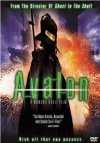
8. Avalon, dir. Mamoru Oshii (2003) – better known for animé, Oshii made this live-action film in, of all places, Poland. In Polish. With a Polish cast. It opens in a VR war game, and the special effects are jaw-dropping. The plot – a hunt for a “hidden level” in the game – is not as eye-opening as the visuals, but neither is it some dumb First Person Shooter.

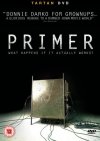
9. Primer, dir. Shane Carruthers (2004) – this starts off relatively straightforward: a pair of geeks inadvertently invent a time machine. But each time they go back in time, they’re co-existing with their earlier selves… and if they go back from that point… Two-thirds of the way into the film and there are several pairs wandering around, and several narrative threads following their exploits. A very clever film, and not a little mind-bending.

10. Sky Captain & the World of Tomorrow, dir. Kerry Conran (2004) – this was one of the first films released with entirely CGI-generated sets and backgrounds, but that’s not what makes it so remarkable. Sky Captain & the World of Tomorrow is an homage to old pulp science fiction and Saturday morning serials – not just the H Rider Haggard / Edward Bulmer Lytton plot, or the fantastic future of the past production design, but also all those shots so familiar from noir films: the policeman blowing his whistle, the heroine in the telephone booth, the running shadows thrown across buildings…


2 Comments

Old Rock Stars Never Die…

… they just end up playing gigs in Holmfirth. For those of you who don’t know the place, Holmfirth is where they film Last of the Summer Wine, a sitcom about three wily old codgers which has been running on the BBC since 1973. And Holmfirth is where I saw a band from my youth, Blue Öyster Cult, perform live last night.

I was a big fan of BÖC during my teens, and last saw them live in 1988. Twenty years ago. Sadly, they haven’t done much since then – they were dropped by their record label, released three albums a decade later on an independent label… with whom they subsequently fell out. And so are now without a recording contract once again. But they continued to tour. Or rather, some of the original members of the band continued to tour.

I forget how I discovered BÖC were playing the UK. I remembered being surprised they were appearing in Holmfirth – as well as the more usual venues in London, Manchester, Newcastle and Glasgow. But Holmfirth is an easy drive away, so I decided to go see them (and persuaded Craig to accompany me and provide transport). I didn’t really know what to expect – this is a band that formed the year after I was born, and whose original members are now in their sixties.

But you know what? They were bloody great.

The evening didn’t start well. Craig wanted to test his free GPS – and it soon proved it was worth every penny he’d paid. It randomly decided that we really wanted to visit a field somewhere near Hepworth, rather than Holmfirth. And then it would utter directions like “drive straight for a while,” “drive some yards”, and “turn slightly left”. We actually took a wrong turn shortly after entering Holmfirth – which took us directly to the venue. The GPS had suggested some other roundabout route, which was a mile longer.

The venue was weird – a cinema built in 1912 and currently being refurbished. No seats, a fancy gold proscenium arch and balcony, scaffolding and bare brickwork. I’d ordered the tickets on-line, to be picked up at the “box office”. Except they claimed I’d cancelled the payment. Which I hadn’t. So I went to get more cash from the ATM so I could pay for them. Only to be told when I returned that they’d made a mistake. I hadn’t cancelled my payment. Someone else, a Mr Hassal, had. And they’d got confused. As Craig pointed out, the hassle with the ticket sales had been caused by confusing Mr Sales with Mr Hassal…

Happily, BÖC were definitely on form. Only two of the original group remain: Eric Bloom and Buck Dharma. The set-list was a trip down memory lane. Pure rock nostalgia. The most recent song they played was ‘Shooting Shark’ from 1983’s Revölution By Night.

When BÖC started out in 1967, technology couldn’t deliver studio-quality sound on-stage. So bands would play extended “live” editions of songs – something to make the concert experience stand out. That was certainly the case last night. The highlight of the gig had to be ‘Then Came the Last Days of May’ from Blue Oyster Cult. It’s a classic song, but last night it was even better. When it came to the solo, Richie Castellano took the lead. I wondered if Buck Dharma no longer had the chops to play it. But no, after five minutes of scorching guitar-work from Castellano, Buck Dharma took over. And delivered another five minutes of superb soloing.

Other fan favourites – ‘(Don’t Fear) The Reaper’ and ‘Godzilla’ – were also greatly extended. In fact, during ‘Godzilla’ the band left the stage, giving Danny Miranda five minutes to solo on his bass. Which was then followed by the obligatory drum solo from Jules Radino. (Danny Miranda, incidentally, also plays bass for Queen + Paul Rogers, so we were treated to a quick instrumental Queen medley.)

Other tracks performed included ‘Harvester of Eyes’, ‘This Ain’t the Summer of Love’, ‘Cities on Flame with Rock and Roll’, ‘Career of Evil’, ‘Black Blade’, ‘Unknown Tongue’ and ‘Burnin’ For You’. It was all bloody good. (Even Craig admitted as much, and he was born nearly 10 years after BÖC released their first album.)

Best gig of the year? Too soon to say yet. But it was certainly the best one of the year so far. I don’t care how old they are – if BÖC are back touring in the UK next year, I’ll go and see them. Again.


4 Comments

Let’s Get Canonical

I work with databases – I was a Database Administrator, now I’m a Database Architect. And I’ve always told the developers I work with that I’m responsible for the integrity of the database not the integrity of the data.

But.

Incorrect data really annoys me. Especially the sort which has a canonical source, is only wrong because some moron mis-entered it, and then that wrong data has proliferated across the Internet. If you look down to the right, you’ll see a selection of books from my collection on LibraryThing. Books are an excellent example of the kind of screwed-up data I mean. LibraryThing pulls its book data from several sources. And some of it is just plain wrong – mispelt, inaccurate, incorrect… And yet it would be easy enough to check. Just look at the book itself.

Frank Herbert did not write Threshold The Blue Angles Experience. He wrote Threshold: The Blue Angels Experience. The author of Tom Strong Book 6 is not “various” but Alan Moore and Chris Sprouse (well, they’re the two that get top billing on the cover, although others did contribute).

It’s not just books. It’s CDs too. Whenever I buy a CD, I rip it to MP3s so I can listen to it at work and on my Yeep. And yet half the time I have to go and correct all the mispelt song titles. The Black League did not record a song called ‘Better Angles (Of Our Nature)’ but ‘Better Angels (Of Our Nature)’.

It’s not difficult to get it right. You don’t see books in Waterstone’s with mispelt titles. Or CDs in HMV or Zavvi like that.

In fact, I don’t see why there can’t be a single canonical source of such data – which would be the publishers, of course. It’s in their interest to ensure it’s correct. After all, how can you order a book or album if they’ve entered the title incorrectly? So why can’t the publishers – the content providers themselves – publish correct data about their products, and allow free access to it by the likes of LibraryThing, GraceNote or last.fm? It’s not that difficult…


Leave a comment

A Blatant Attempt To Fill Space

I’ve been a bit crap lately about posting here. Partly because I’ve been busy, but also partly because I’ve not been able to think of anything to write about.

Last week, I spent four days in Stuttgart for work, and I considered writing about that. But then I realised there’s not much you can say about Germany we don’t all ready know – it’s cleaner than the UK, it seems an all together nicer place, and it has a public transport network that puts the British one to shame…

Oh, and travelling through Manchester Airport was a nightmare. I’ve yet to be convinced that bottles of water are a danger to any aircraft. Or that all those queues serve any useful purpose – other than pissing passengers off, of course. As far as I’m aware, no X-ray machines or metal detectors were put in place in the London Undergound after the 7/7 Bombings.

Strange, isn’t it, that the people who make up these stupid laws are not themselves inconvenienced by them.

Anyway, I have in the past been asked to post more “funny stories” here. The following incident isn’t “funny”, but you might find it mildly entertaining. And thought-provoking. Or something.

It was in the late 1980s. I was studying at Coventry University. One dark winter’s evening, I was on my way home from the centre of town. My route took me between the two cathedrals – the new Basil Spence one, and the shell of the old one (photo by Tornad; taken from Wikipedia). As I passed the entrance to the old cathedral, I happened to glance in…

And saw a naked woman sitting on a big white horse.

Coventry, of course, was where Lady Godiva‘s famous ride took place.

As more of the interior of the cathedral came into view, I saw large spotlights and a camera crew. And I noticed that the woman wasn’t actually naked. I never did find out what was being filmed. But at least I wasn’t hallucinating. Nor was it the ghost of Lady Godiva I’d seen – I wouldn’t have liked to have suffered the same fate as Peeping Tom.


1 Comment

Why Am I Still Doing This…? Part 1

Well, I’ve now had a couple of weeks to regain my sanity after I finished watching the 50 films in the Sci Fi Classics 50-movie pack… So it’s on to the second 50-movie pack, Nightmare Worlds.

Alien Contamination – this Italian film pretty much transplants the plot of Ridley Scott’s Alien to Earth. A tramp freighter from South America drifts into New York harbour, its crew all dead. In the hold are strange alien eggs… which cause people to explode messily. The detective in charge, with the help of a secret government organisation of scientists, tracks down the surviving astronaut from a Mars mission. Together, they travel to the ship’s origin… and discover the other Mars astronaut, who had faked his own death and is now growing and distributing alien eggs for his alien masters on Mars. This film was entirely ordinary.

Alien Species – a trio of prisoners are being transported by sheriffs, when a fleet of UFOs attack Earth and force them off the road. The prisoners escape, and hide out in a nearby cave. Which proves to be the headquarters of the invading aliens. Initially watchable, this film quickly descended into silliness. The cave sets look fake, the aliens looks fake, and ten minutes in, the story began shedding plausibility and intelligence by the second.

Atomic Rulers of the World – a Japanese Starman film, and as such resembles all the other Starman films. The alien council of the Emerald Planet look like the deranged imaginings of the insane brother of the inventor of Teletubbies. The plot: Starman saves the Earth from human invaders from the planet Mirapolia.

The Alpha Incident – A space probe returns to Earth and brings with it a dangerous micro-organism. While being transported by train, a sample of this micro-organism is inadvertently released by a criminally stupid train guard. Five people are exposed, and promptly confined at a remote train stop while scientists rush to find a cure. This was as dull as it sounds.

Attack from Space – another Starman film. This time the Spherions are out to conquer Earth. Of course, Starman defeats them. Happily, they don’t make films like this any more.

Beast of the Yellow Night – a man sells his soul to the Devil after being saved from certain death. As a result, he turns into the titular creature at night – not just on yellow nights, I should add; whatever a “yellow night” might be – and kills people. This film couldn’t quite make up its mind what it was supposed to be – horror, thriller or family drama. The poor transfer made it even harder to figure out.

Warriors of the Wasteland – an Italian post-apocalypse movie. And if there’s one thing we now know about the Apocalypse from all the films on the subject, it’s that the Goths will inherit the Earth. Well, they’re not quite Goths in this one – the eponymous warriors wear white, for one thing. (Which means we also know Persil will survive the Apocalypse.) And they’re a bit too camp to be Goths. But, essentially, this film is Mad Max meets the Camp White-Clad Goths of the Wasteland. And he kills them all.

Werewolf Woman – this one is about a woman who turns into a werewolf. Of course. Actually, she only thinks she turns into a werewolf. Except she does at the end. Along the way, she meets and seduces numerous men, and then kills them. This is one of those movies where you get exactly what the title leads you to expect. In fact, the film’s alternative title Naked Werewolf Woman probably tells you more than you need to know…

The Nightmare Never Ends – an old Nazi hunter is killed, and the detective investigating the murder begins to obsess about the man’s death. The Nazi hunter had been tracking a notorious war criminal, a louche young SS officer, who doesn’t appear to have aged in the 35 years since WWII. Unfortunately, the title better refers to the film itself than it does to its plot…

Counterblast – a Nazi scientist escapes to England at the end of WWII, and murders and takes the identity of a British scientist returning from Australia. He continues to work on the biological weapons he had been creating for his Nazi masters, with the intention of using them to usher in a Fourth Reich. But it all starts to go wrong… This B&W British film from 1948 was actually quite good.

All the Kind Strangers – Stacy Keach is driving through deepest darkest Tennessee when it sees a young boy walking by the side of the road with a heavy bag of shopping. He stops and offers the kid a lift… which subsequently involves a long drive down a dirt track and across a creek… to a house where seven kids (ranging in age from late teens to under ten) live alone. They do have a “mother” – but she’s actually a woman they’ve kidnapped and forced to play that role. And so they likewise force Keach to become their father. There was a halfway decent story buried in this film – which isn’t at all sf or horror – but it didn’t deserve 74 minutes.

The Day the Sky Exploded – Earth is bombarded by asteroids. Which is sort of like the sky “exploding”. Cue lots of running around, explosions, buildings falling over. I don’t actually remember there being much in the way of a story in this film. Deep Impact it’s not. Happily, neither is it Armageddon.


2 Comments

2008 Reading Challenge – May

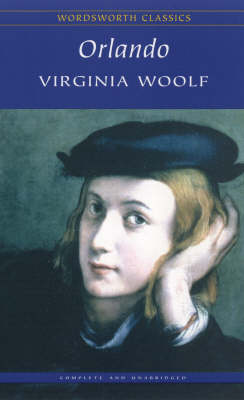
I’ve had Virginia Woolf’s Orlando on my book-shelves for a number of years, but had never got around to reading it. I forget why I even bought it. It was cheap, I know that much: there’s a Dh 10/- sticker on the back (ten Dirhams, the currency of the UAE; at the time I was living there, that would be about £1.65).

I also have the DVD of Sally Potter’s film, starring Tilda Swinton. And it’s a good film – looks fantastic, although the story meanders a bit.

So the book immediately went on the list when I decided to read a classic author each month of 2008. And now I’ve read it…

Orlando is a young noble in Elizabethan England. He is a favourite of Queen Elizabeth, writes volumes of execrable poetry, and has an affair with a Muscovite princess. The affair ends badly, and so Orlando wangles a position as Ambassador Extraordinary to the Sultan’s Court in Istanbul. Several years later, he is promoted to Duke and made a member of the Order of Bath. Shortly afterwards, he falls into a sleep from which none can wake him for a week. While he sleeps, the Janissaries revolt. When Orlando wakes, he is now a woman.

After spending some time with Anatolian gypsies, Orlando returns to England. She then lives through the centuries following until the publication of the book: “Thursday, the eleventh of October, Nineteen hundred and Twenty Eight” (the last words of the novel).

Orlando is written as a biography, with frequent authorial interjections – at one point, even declaring the date on which a passage was written – “…for the poet has a butcher’s face and the butcher a poet’s; nature, who delights in muddle and mystery, so that even now (the first of November 1927) we know not why we go upstairs…”; or commenting on the prose itself: “…who has so much to answer for besides the perhaps unwieldy length of this sentence…” The words “biography” and “story” are used throughout, explaining that Orlando is as much a commentary on Orlando’s life as it is a telling of it.

Unfortunately, Orlando is a paragon – loved by all who meet him; his legs “the shapliest legs that any Nobleman has ever stood upright upon”; his house the greatest in England, with 365 rooms and 15 acres of parkland… We are told this repeatedly. Woolf makes no effort to make her protagonist or her story plausible. Orlando’s central change of sex is left completely unexplained – and barely remarked upon by those who knew him before.

Orlando reads like a paean to its subject. It tells a story, yes, but it’s not really a novel. Woolf’s close friend and lover Vita Sackville-West was the inspiration for Orlando, and the book reads like an open and frank love letter to her. In places, the author’s heart is far too visible on her sleeve.

In one respect, reading Orlando proved an interesting exercise. It’s a fantasy, and it was published ninety years ago. Given the current form of fantasy, especially high fantasy (or sword & sorcery, as it’s sometimes known), comparisons between such novels and Woolf’s were almost inevitable. The current trend is for immersion, a narrative that drags the reader into the world of the story and keeps them there. And the world must be internally consistent in order for that to occur. Whereas Orlando does no such thing. The story is told to the reader, no effort is made to entice the reader into living the story in their imagination. Woolf is quite clearly writing Orlando in 1928, and often makes reference to items and knowledge that would have been unknown to her protagonist – “The thought struck him like a bullet”, for example. It’s an entirely different reading experience to that of, say, Robert Jordan’s Wheel of Time (quality of writing aside).

Personally, I prefer rigour and internal consistency in my fiction. Especially in regard to an invented world, or a story which cannot rely on the real world to provide consistency. Woolf’s authorial interventions I found intrusive. This might have been acceptable if they were witty – like Jane Austen, for example – but in Orlando, they were just fawning. Orlando was too good, too improbable, a hero/heroine, and quickly became boring. Orlando is, well, fanciful tosh.

So, another classic fails to make the grade. While I admitted back in February that I might give Hemingway another go some time, I very much doubt I’ll be doing the same to Virginia Woolf. Orlando is, according to Wikipedia, “generally considered one of Woolf’s most accessible novels”. Not to mention its importance to English literature. But I just can’t see it.

I’ve all ready picked out Nostromo by Joseph Conrad for next month. Let’s hope I like that one better.

(Incidentally, for those who want to try Orlando for themselves, here’s an online copy.)


2 Comments

Overlooked Classics – Part 2

Here is the second lot of sf novels which, I believe, shouldn’t be forgotten. I chose these books – and the preceding five – as much because they, and their authors, are obscure as I did because I like the novels. Most authors, even well-known ones, have some title buried in their back-catalogue which deserves better recognition. And some novels which are obscure today were much-lauded on publication. I’ve tried to avoid such books. The five titles below were, and still are, “overlooked”…

Blueprint For A Prophet (1997)
Carl Gibeily
I forget where I picked this book up. Given that I have the hardback edition, I suspect it was in some publishers’ clearance shop. Why I bought it… Well, the author was unknown to me, and the book wasn’t published as science fiction… It must have been the story. But I’m glad I did buy it and read it. Blueprint For A Prophet is set in Lebanon (Gibeily is Lebanese) and describes the rise of a fundamentalist prophet who knits together the Arab states into a powerful Muslim federation. But it’s not just about that, because one character is a theoretical physicist whose experiments could change history… Blueprint For A Prophet is one of those sf novels written by a non-sf writer which succeeds as science fiction.

The War for Eternity (1983)
Christopher Rowley
“Classic” is not a word usually associated with Christopher Rowley’s novels. His prose is usually little better than competent. But his debut novel is much better. The War for Eternity is set on the world of Fenrille, which contains a single continent ringing its equator, and is the source of a longevity drug. The drug is harvested from insectoid creatures native to Fenrille, but only certain people are permitted by them to do the harvesting. It’s a similar idea to that in CJ Cherryh’s Serpent’s Reach, although that’s the only similarity between the two books. In The War for Eternity, forces from Earth attempt to seize control of Fenrille, but are fought off by the colonists. The story also takes a final bizarre twist at the end. Rowley went on to write a further three novels set in the same universe – The Black Ship, The Founder and To a Highland Nation.

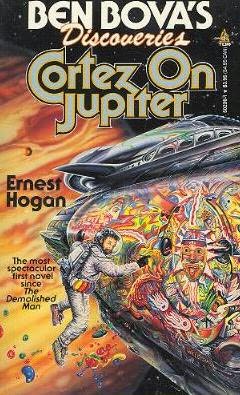
Cortez on Jupiter (1990)
Ernest Hogan
According to the cover of this novel, Cortez on Jupiter is “the most spectacular first novel since The Demolished Man. The Encyclopedia of Science Fiction described Hogan as “a figure of interest for the 1990s”. Unfortunately, he had one more novel published, High Aztec (1992), and then dropped out of sight. Which is a shame. Cortez on Jupiter is an early post-cyberpunk novel about a graffiti artists who ends up making humanity’s first contact with the sentient inhabitants of Jupiter. The flamboyant prose throws off ideas on every page, and the story is a rush from start to finish.

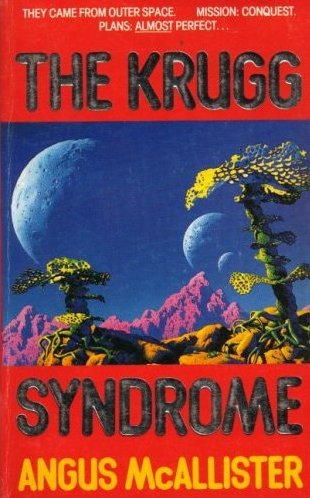
The Krugg Syndrome (1988)
Angus McAllister
This has to be one of the most mis-marketed books ever. From the cover, you’d expect something from the heartland of the genre, featuring strange expeditions to alien worlds. Instead, what you get is a comedy set in Glasgow in which a law clerk thinks he is an alien. Arthur Montrose is convinced he is a Krugg, one of a race of telepathic alien trees who are bent on conquering Earth. Unfortunately, he’s lost his telepathic powers and can no longer contact his home world… The Krugg Syndrome is a diary of Arthur’s experiences on Earth, the people he meets, his encounters with alcohol and sex, and his increasing inability to fulfill his Krugg mission…


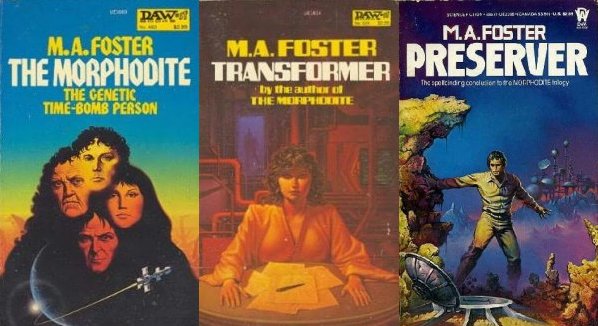
The Morphodite trilogy (1981 – 1985)
MA Foster
The Morphodite is an artificially created humanoid with the ability to change its appearance, with each transformation changing sex and appearing younger. However, the Morphodite’s real talent lies in spotting a society’s fracture points – i.e., places where the ramifications of one small action can spiral out until they bring down the society. In the first book in the series, The Morphodite, the eponymous character is created in The Mask Factory on the world of Oerlikon, escapes, and promptly wreaks its revenge. In Transformer, the authorities have tracked down the Morphodite and send assassins to kill it. The Morphodite learns that it was originally a woman from offworld. Now knowing its original identity, it leaves Oerlikon for the world of Teragon. Preserver is set on that world many years later. A young man, who works as a thug/assassin for hire, learns when his lover is kidnapped that he is the Morphodite. He then uses his powers to destroy Teragon’s society. There’s something very Vancian about Foster’s prose in these novels, although the central premise and its treatment is not in the slightest bit like Jack Vance. The three books were re-issued in an omnibus edition as The Transformer Trilogy.

Part one of “Overlooked Classics” is here.