It Doesn't Have To Be Right…

… it just has to sound plausible


11 Comments

Anatomy of a Story: Thicker Than Water

The second of the two stories I’ve put up on this blog is ‘Thicker Than Water’, a hard sf story set on a moon of Saturn. It was originally published in Jupiter sf magazine, issue 23, in January 2009.

Major Gina Priest lives on Tethys, a moon of Saturn. When two raiders from another moon, Titan, attempt to steal some of the fullerenes found on Tethys, they are captured. Gina is shocked to discover that one of the raiders is her brother. She learns she was abducted from Titan at a very young age. After another officer disobeys her orders and tortures the raiders, Gina decides to help the Titans escape and return with them to to her long-lost mother and father.

Here’s the PDF. You might want to read the story before you continue reading this.

The plot of ‘Thicker Than Water’ is based on the story of Iphigenia from ancient Greece. She was abducted as a child and taken to Tauris, where she grew up and became a priestess of Artemis. A pair of Athenians then raided the temple while Iphigenia was present. She learned they were her brother Orestes and his friend Pylades. So she lied to the Taurians, and returned to Athens to join her long-lost family. With the statue of Artemis they had stolen.

I forget where I originally came across Iphigenia’s story. It was back in the early 1990s, so it wasn’t on the Web. I’d also found a mention of a mysterious dark patch on Tethys in a planetology textbook I’d bought for reference – Exploring the Planets by Eric H Christiansen and Kenneth W Hamblin (1995). The book’s a bit out-of-date now, but I have the Web instead. I decided that the dark patch was buckminsterfullerenes – carbon molecules in the shape of spheres or tubes, which were thought to be artificial but do occur very rarely in nature. This idea came partly from another story, ‘Black Rain’ (available in Set It In Space And Stick A Robot In It), which is set on Titan, and takes place in an earlier version of the universe of ‘Thicker Than Water’. In that story, the settlement’s manufactory was destroyed by a blow-in of Titan’s noxious atmosphere, and the superconductor cultures were poisoned. So, instead of Aphrodite’s statue, I’d have Orestes and Pylades, natives of Titan, travelling to Tethys to steal fullerenes in order to re-seed their superconductor cultures. It all slotted very neatly together – and this is actually mentioned in passing in ‘Thicker Than Water’.

I wrote the story, and even submitted it to a magazine or two. They rejected it.

Then it sat in the “bottom drawer” for over a decade.

Last year, I dug out the manuscript, read through it, and decided it was worth having another go. But it needed more than just rewriting. While reminding myself of Iphigenia’s story, I came across mention of Euripides, an ancient Greek playwright. He actually wrote a play, Iphigenia in Tauris, based on Iphigenia’s story. So there’s another dimension, I thought. I can tie in an ancient Greek tragedy.

Greek plays, of course, have Greek choruses. So why shouldn’t ‘Thicker Than Water’ have one? And since NASA had posted a MP3 of the radio noises generated by Saturn, why not use the ringed gas giant as my “chorus”? Hence the numerous mentions of Saturn’s radio-noise in the story.

I used the play in other ways, too. I borrowed the odd phrase from the Potter translation (which provides the lines from the play which preface the story). And I named all my characters for the characters in the play. The king of Tauris is Thoas, but I decided to use King instead. Iphigenia, priestess of Aphrodite, is of course Gina Priest. Orestes and Pylades I shortened to Orris and Pyle. And two unnamed characters, a herald and a herdsman, became Messenger and Shepard.

There are a few other scattered “clues” as well – such as “as if from some oracular distance” in the opening paragraph. Oracular. Oracle. Delphi. Get it?

Oh, and Tauris… In the original version of the story, the settlement on Tethys was also a carousel – a ring which rotated at a speed sufficient to provide some gravity – but it was unnamed. When I stumbled across Euripides’ Iphigenia in Tauris, it occurred to me that a carousel could be torus-shaped. So Tauris became Torus. Sometimes research just gifts you things you’d be a fool to refuse or ignore.

I also changed the plot slightly when I rewrote the story. In the original version, Gina decides to help her brother to escape, but when she returns to his cell he has already been taken away. The story ended with her being unable to prevent his execution – as he was pushed out of an airlock without a spacesuit. For the new version, I had the three of them escape successfully. Which then allowed me to bring the alien sentinel more into the story. That – the mysterious alien vessel patrolling the Solar system – was there right from the start, but more as a clue to why Earth had abandoned its space colonies, and as the reason for the Tethysians protection of the sea of fullerenes.

It had always been in the back of my mind to have ‘Thicker Than Water’ (and the earlier ‘Black Rain’) be part of a single fictional universe. In it, Earth has withdrawn all its space resources, shut down its EM broadcasting, and essentially firewalled itself inside its atmosphere. This has left on their own the many settlements and colonies scattered on Mars and the moons of the Saturn, Jupiter and the Outer Planets. These settlements have also discovered a series of strange alien artefacts, most of which resemble extremely unlikely natural phenomena. Their purpose is unknown. And then there’s the mysterious alien sentinel loose in the Solar system which doesn’t take kindly to any kind of interference with these artefacts.

Now that I was basing my stories on the plays of Euripides, I decided to call this my Euripidean Space universe.

Despite all this going on in the background, the story still needed something more. The escape succeeded, and in the process doomed the Tethys settlement – from an implied attack by the alien… That gave me a better ending. But I needed something extra to round out the middle. So I looked to the news. And came up with…

Torture. The Tethysians would torture the two raiders from Titan, and that would in part explain Gina’s motivation to help Orris and Pyle escape.

I’m not actually all that interested in writing science fiction, I’m more interested in using science fiction in writing, in extending the genre. I don’t want to write adventure stories in a science-fictional universe – I consider it a form of artistic cowardice. ‘Thicker Than Water’ is in part a sf treatment of an ancient Greek play – it uses the same cast, and I tried in some way to carry the flavour across. But it’s also about torture, about Guantanamo and Abu Ghraib. Stories should be about something, about something relevant. Even if they are set in outer space and feature spaceships and aliens. Perhaps even especially if they are set in outer space and feature spaceships and aliens.

I read through the story now, nine months after it was published, and perhaps one or two of the reviews of it weren’t so far off the mark. Perhaps some of the characters’ motivations weren’t entirely clear – one of the perils, I suspect, of taking a story from an ancient Greek play. Perhaps the ending did seem a little disconnected… but the clues were there. But maybe that’s because that aspect of the story wasn’t intended to entirely stand alone – it would be just one element in a greater story, told through many stories. On reflection, I shouldn’t have relied on that. I’ll know better for the next one. And yes, there are more Euripidean Space stories planned.

Again, I hope you enjoyed both the story and this piece on it. No other stories of mine have been published in the last twelve months, although there’s a few due to see the light of day soon. Some time in the future, I may give one of those the same treatment.
1 Comment

Readings, yes, and watchings too

In lieu of intelligent content, here’s another trawl through the books what I’ve read and the films what I’ve watched since the last time I did one of these posts…

Books
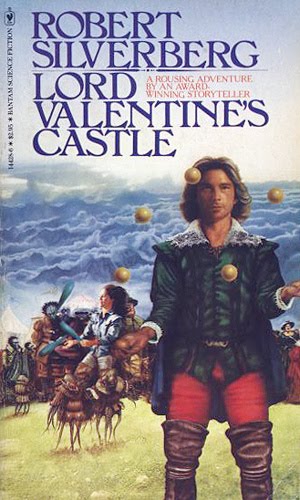
Lord Valentine’s Castle, Robert Silverberg (1980), was September’s book for this year’s reading challenge. I wrote about it here.

Live and Let Die, Ian Fleming (1954), I found in a local charity shop and I’m glad I got it cheap. The films are much better than the books. The books may be very much products of their time, but the casual racism and sexism makes them hard to enjoy. The plot, incidentally, only vaguely resembles that of the movie.

Fantasms and Magics, Jack Vance (1969), is a collection of short stories. The opening novella, ‘The Miracle Workers’, is classic Vance, and ‘Guyal of Sfere’ (which I kept on misreading as ‘Gruyere’) is a Dying Earth novella and quite good. The rest are forgettable.

The Dan Dare Dossier, Frank Hampson et al (1990), is the last of the thirteen volume series of Dan Dare reprints issued by Hawk Publishing. Unlike the others it’s not a reprint of strips from Eagle, but a discussion of Hampson, his studio of artists, the characters, world, and merchandising associated with the strip. The text could have done with some serious editing, but if you’re a fan of Dan Dare – as I am – then it’s all interesting and useful information.

Broken Symmetries, Steve Redwood (2009), is a collection of short stories by a small-press writer which I reviewed for Interzone.

Winged Rocketry, James C Sparks (1968), I reviewed on my Space Books blog here.

Shades of Gray, Lewis Shiner (2008), is a chapbook given away with purchases of the limited edition of Shiner’s last novel, Black & White. Shiner himself describes the four stories in Shades of Gray as either too rough, too slight, or too silly to go into the upcoming Collected Stories. It’s hard not to disagree.

Shifts, Adam Thorpe (2000), is themed collection of short stories, the theme being careers and people whose lives are defined by their careers. The stand-out is the title story, about a Ghanaian immigrant eking out a living in London in 1966. ‘Sawmill’ is a Greenesque tale set in, I think, an invented African nation, and is also very good. Some of the others don’t seem to do much, but the writing throughout is of a very high standard. I plan to read more Thorpe.

The Lordly Ones, Keith Roberts (1986), is also a collection of short stories. I like Roberts’ fiction – in fact, one of his short stories is a favourite, ‘The Lake of Tuonela’. Sadly, there’s nothing as good as that in this; nor indeed is The Lordly Ones as good a collection as the collection in which that appears, The Grain Kings. On the whole, some lovely writing in places, but a little dated in execution.

Transition, Iain Banks (2009). A new novel by Banks deserves a review all its own. And it shall get one. Soon. Keep watching.

Films
Highlander, dir. Russell Mulcahy (1986), I first saw when it came out twenty-three years ago. I remember at the time thinking it reminded me of an sf novel – one I later identified as George Turner’s Vaneglory. Watching it again, it’s not so close to the novel, but it is, well, very camp. All that posing in dark alleys and lights shining through rain and steam. And the Queen soundtrack. I also seem to recall the film being held in relatively high regard, although I can’t see why. There’s the bizarre casting: a Frenchman as a Scot, and a Scot as a Spaniard (well, Egyptian originally). The badly-choreographed fight scenes. The stereotype characters. And the franchise degraded in quality, too.

The Spirit, dir. Frank Miller (2008), I’d heard plenty of bad words about, but I decided to see for myself. It is bad. The look of the film aping a comic – like Sin City and 300 – is just a gimmick. The story is silly, the characters are paper-thin, the women are there to make the men look good, and the dialogue is cringe-worthy. Not impressed.

The Faculty, dir. Robert Rodriguez (1998), has to be one of the most blatant metaphors ever committed to celluloid. Oh noes, the teachers have all been taken over by aliens! But it’s done with tongue firmly in cheek, and even Josh Hartnett’s brainiac slacker character doesn’t spoil the fun. Plus there’s a few mentions of sf and sf authors by someone who clearly knew what they were talking about. A fun film.

Total Reality, dir. Philip J Roth (1997), is a bad straight-to-DVD sf film. That should be enough to make me avoid it, but in fact the opposite happens. I want to watch these sort of films, no matter how crap they are. And I never really enjoy them. Because they’re so bad. But I keep on watching them. In this one, a team of soldiers sentenced to death for treason are sent back in time on the trail of a pair of rebels. They have to prevent the murder of the self-help guru whose “system” was adopted by a politician and subsequently resulted in a brutal interstellar empire several centuries later. The CGI is terrible, the production design is awful, and the acting is poor. But the explosion of the guru’s house is pretty impressive.

Futuresport, dir. Ernest R Dickerson (1998), is another bad straight-to-DVD sf film. But with a surprisingly high-powered cast: Wesley Snipes, Vanessa Williams and Dean Cain. How the mighty have fallen. Well, not Dean Cain – he was never A-list. Futuresport is little more than a remake of Rollerball, but nowhere near as good as that film. All you really need to know is that it’s about a new ball game, called Futuresport. If you were going to invent a new ball game, why would you call it “futuresport”? It’s a dumb name.

Letter From An Unknown Woman, dir. Max Ophüls (1948), is another film from the Time Out Centenary Top 100 films list. I have three lists on Lovefilm DVD rentals – one for recent films, one for foreign films, and one for films from the Time Out list. Each month, I’m sent two from each list. Not all the films from the Time Out list have struck me as enjoyable or impressive. Letter From An Unknown Woman was one such. Louis Jourdan plays a self-centred concert pianist who sleeps with, and then discards, a young woman – played by Joan Fontaine – who has had a crush on him since she was a girl. The story is framed as a letter written by the woman, and sent to Jourdan after she’s died. I found it a bit dull.

Soldier, dir. Paul WS Anderson (1998). Yes, I know: Anderson has never made a good film. (Although his television movie, The Sight, is actually not bad.) Soldier is certainly worse than Event Horizon (see here). It’s Rambo in all but setting. Which is a planet on which some vaguely-defined interstellar human federation dumps its rubbish (shades of Futurama). Kurt Russell plays a genetically-engineered soldier who is left for dead and dumped on the planet of rubbish after losing in a demonstration fight against a newer model. Where he is taken in by a lost colony. And those exact same newer models just happen to visit the planet of rubbish on manoeuvres. They attack the colonists. Russell fights back. It’s another Anderson film which makes very little sense if you think about it too hard. The story follows through from beginning to middle to end, but there’s no logic to it, or to the world on which it takes place.

Léon, dir. Luc Besson (1994), I reviewed for videovista.net – see here.

Earth Alien, dir. Kevin Tenney (2002), is yet another crap sf film. It doesn’t boast the talent of Futuresport, but it’s not that far off – Eric Roberts, Arnold Vosloo and the ubiquitous John Rhys Davies. Someone is killing people in gyms, and Roberts is the detective investigating. Turns out the serial killer is an alien on hunting trip. Earth is a game reserve, humans are the prey, and Vosloo is the game warden. A very silly film. There’s not even a good explosion in it.

Mega Shark vs Giant Octopus, dir. Jack Perez (2009), I reviewed for videovista.net – see here.

Daratt, dir. Mahamat-Saleh Haroun (2006), I rented after enjoying Haroun’s earlier Abouna. Like that film, it’s set in Haroun’s native Chad. Sixteen-year-old Atim, orphaned by the civil war, determines to find the man who killed his father – as all war criminals have been given amnesty by the government now that the civil war has finally ended. He heads for, I think, the capital N’Djamena, where he discovers that his father’s killer, Nassara, is now a baker, attends mosque regularly, and has a young pregnant wife. In order to get close to the man and so find an opportunity for revenge, Atim apprentices himself to Nassara. And as he gets to know him, the less he wants to kill him. An excellent film. Recommended.

Privates On Parade, dir. Michael Blakemore (1982), is based on a play by Peter Nicholls, which is in turn based on his own experiences, as described in his autobiography, Feeling You’re Behind, which I read several years ago. The film is about a British armed forces concert party in Malaysia in 1948. Many of the characters are apparently based on real-life individuals. It’s a comedy, but it’s hard to know exactly who or what are its targets. John Cleese plays the commanding officer, and he’s a typical John Cleese character. The rest of the cast are just as much caricatures. And the English countryside makes a poor stand-in for the Malayan jungle. Mildly amusing.

Burn After Reading, dir. Joel & Ethan Coen (2008). I’m not a big fan of the Coen brothers’ films. I’ll watch them, and I sort of enjoy them. But that’s about all. This one is fairly typical of their oeuvre. John Malkovich plays a nasty intelligence analyst fired by the CIA, who subsequently starts writing his memoirs. Frances McDormand and Brad Pitt plays a pair of dim-witted gym employees who find a CD-ROM containing Malkovich’s memoir. George Clooney plays an equally dim-witted philanderer who gets involved with Malkovich’s wife and McDormand, and so gets dragged into the whole sorry mess. More amusing than Privates On Parade, but not by a great deal.

The Stepford Wives, dir. Bryan Forbes (1975), is the original adaptation of Ira Levin’s novel of the same name. Which makes it the superior adaptation. It’s certainly an unsettling film, but not a very scary one. The plot staggers around a little and the sub-Hitchcockian ending is a bit of a let down, but it hangs together entertainingly.

All That Heaven Allows, dir. Douglas Sirk (1955), is from the Time Out Centenary Top 100 films list and… it couldn’t have been more different than Letter From An Unknown Woman. I don’t recall ever watching a film by Sirk before, and I didn’t expect much of this. A 1950s melodrama, starring Jane Wyman and Rock Hudson. But. I loved it. So much so that I immediately went and bought the Directed By Douglas Sirk boxed set from Amazon – well, it was reduced from £69.99 to £13.48. Bargain. So All That Heaven Allows is just Lady Chatterley’s Lover set in 1950s USA, but it’s beautifully done and the 1950s Technicolour looks wonderful. You expect some wit in films of that period, but the condemnation of contemporary society and mores is done with surprising subtlety. A new film for the favourites list. Recommended.

Loulou, dir. Maurice Pialat (1980), stars a very young-looking Isabelle Huppert, and Gérard Depardieu, who seems to have looked the same for the past three decades. Huppert leaves her husband and shacks up with aimless drifter Depardieu. Things happen. It’s all very 1970s, very French and very sexist. Enjoyable, but I felt no desire to dash out and buy the DVD.


1 Comment

Book Porn – Shepard & Shiner

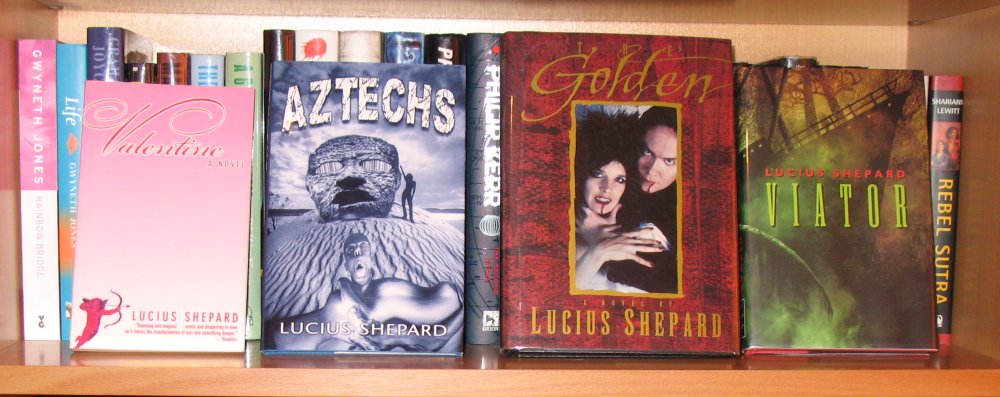
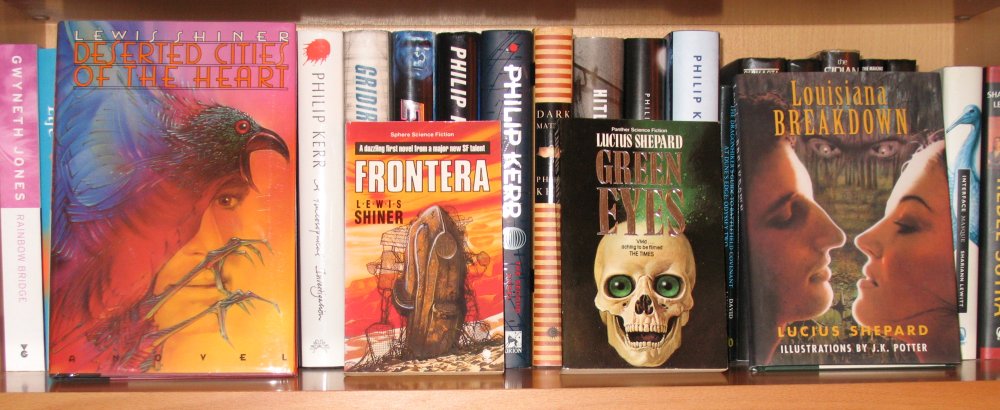
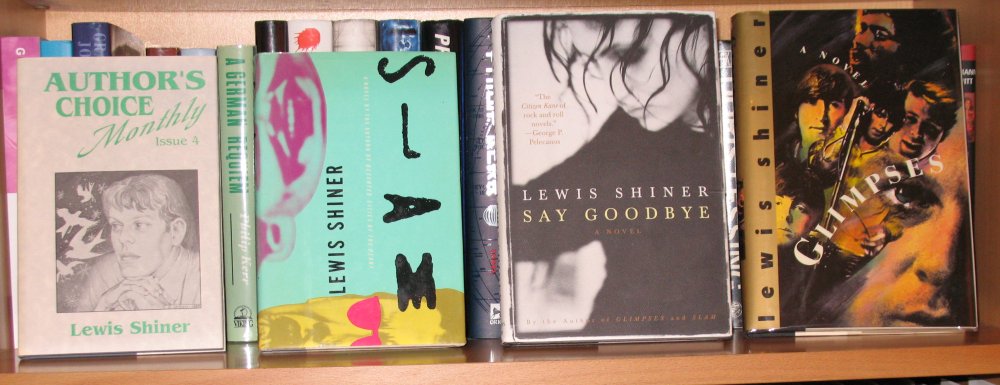
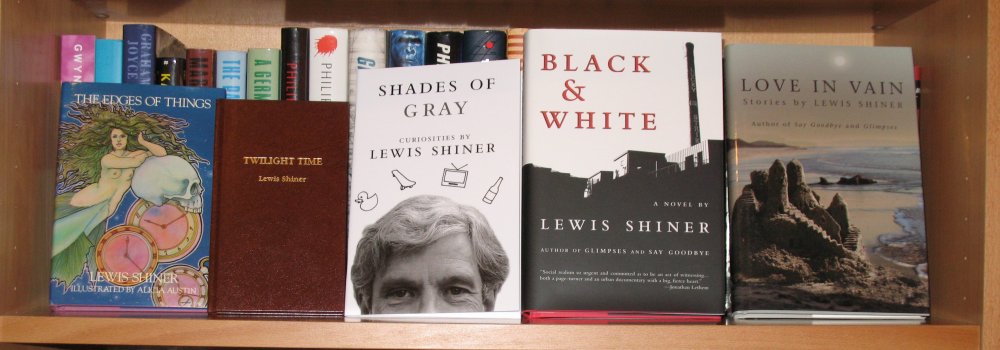
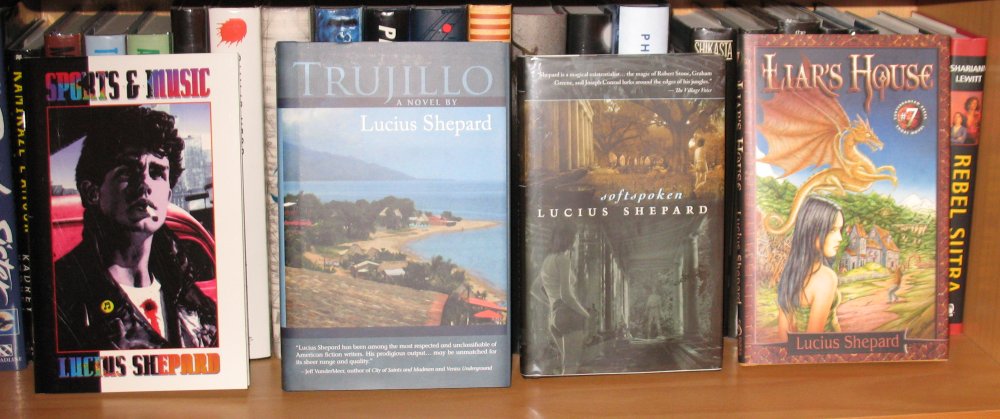
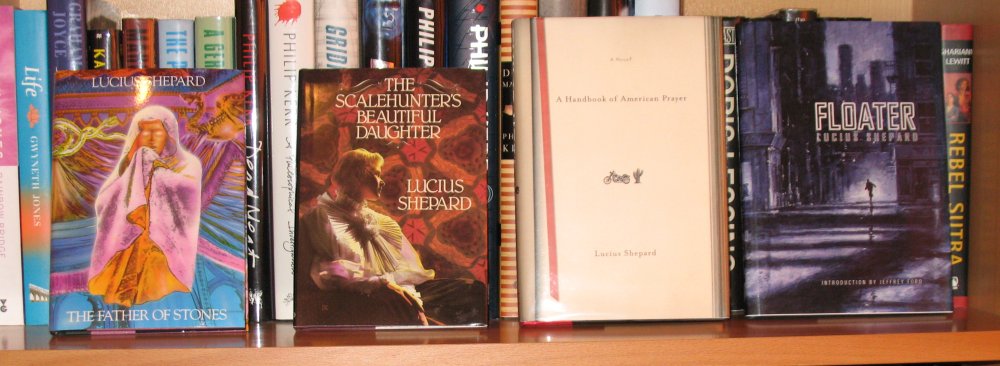
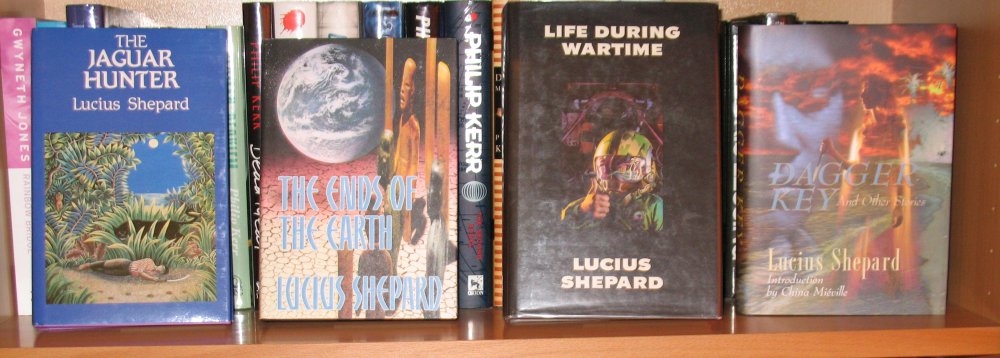
Lucius Shepard and Lewis Shiner are among the finest writers of fantasy (and the occasional science fiction) currently being published. Shepard has won a Hugo Award, a Nebula Award, two World Fantasy Awards, a Sturgeon Award, a Grand Prix de l’Imaginaire (France), a Kurd Laßwitz Award (Germany), five International Horror Guild Awards, a Rhysling (poetry), and a Shirley Jackson Award. He also won the Campbell New Writer Award for 1985. Shiner has not been so lauded and to date has only won a single World Fantasy Award. But then, many of his novels have been presented as mainstream rather than fantasy.

Both are writers whose novels and stories I admire as much as I enjoy. So I collect them. First editions, of course. Many are also signed – but both are frequently published by small presses, such as PS Publishing and Subterranean Press, which produce beautifully put-together signed limited editions.

But on with the photos. Below are the books I own by both writers. My Shepard collection is far from complete, but the Shiner one is… although there is a Collected Stories due to be published later this year by Subterranean.


Leave a comment

Catastrophia ToC announced

Editor Allen Ashley has announced the full table of contents of his forthcoming anthology, Catastrophia. The stories, by alphabetical order of author are:

  • ‘Hapless Humanity’ by Brian Aldiss
  • ‘The Phoney War’ by Nina Allan
  • ‘Nanoamerica’ by David John Baker
  • ‘Steven’s Boat’ by Billie Bundschuh
  • ‘Happy Ending’ by Simon Clark
  • ‘Something for Nothing’ by Joe Essid
  • ‘Check’ by Robert Guffey
  • ‘Fade’ by David Gullen
  • ‘Trouble with Telebrations’ by “J. B. Harris”
  • ‘Up’ by Andrew Hook
  • ‘A Hard Place’ by Carole Johnstone
  • ‘Scalped’ by Jet McDonald
  • ‘Noose’ by Adam Roberts
  • ‘In the Face of Disaster’ by Ian Sales
  • ‘Pixels on a Screen’ by Patrick Shuler
  • ‘The Long Road to the Sea’ by James L. Sutter
  • ‘Gravity Wave’ by Douglas Thompson
  • ‘Crashes’ by Stuart Young

I’m in good company there, I see.

See here for the full press release.


1 Comment

Anatomy of a Story: The Amber Room

It occurred to me some people might find it interesting to learn how I came up with the ideas for my stories, how I approached those ideas, and what I was trying to achieve with the stories which resulted.

First up is ‘The Amber Room’, which was published in Pantechnicon #9 in March 2009. If I were to write a blurb for the story, it would go something like this:

Tina lives in a museum, but this museum contains all the lost art treasures of the world. They were found by her boyfriend Chris, who has an amazing ability: he can visit alternate universes. That’s where he “found” the lost art treasures.

Here’s a PDF of the ‘The Amber Room’; so you can read it before reading the rest of this post.

The idea for the story came to me sometime in March 2007. As far as I recall, it was inspired by the real-life Amber Room itself, mention of which I’d stumbled across somewhere on the Web. I wanted to use it in a story, but, of course, it was lost. So why not write a story about it being found? And since I write science fiction, why not have it found in an alternate universe? In fact, why not have an entire museum filled with “lost” works of art which had been found in alternate universes?

But that’s not actually a story. It needs a plot, characters… a beginning, middle and end…

I remember banging out a first draft in pretty much a single sitting. In that original version, the story focused on Chris, the universe-hopping “art thief”, and was structured as a series of vignettes from his life in no particular chronological order. But it had the same sting in the tail: the identity of Chris’ girlfriend, that she was him from an alternate universe in which his “parents” had had a daughter.

I emailed the draft to a group of friends to see what they thought to it. We’ve been emailing each other stories and novel excerpts for several years now; I value their comments. They liked the central premise, but not the way I’d chosen to tell the story. I rewrote it, making Tina the central character and giving the narrative a linear structure. I sent this second draft to my friends. They liked it a great deal better. However, they still weren’t keen on the ending – initially, the story explained that Tina and Chris were alternate versions of each other. I changed that, made it, well, subtle – i.e., having Tina look at a pair of photographs which reveal the truth… And that too nicely linked in with the Amber Room and the whole concept of “lost” art, turning it into a metaphor of the central relationship. Sometimes, you get to a point in a story where all the choices you made earlier, without really knowing why you made them, suddenly slot together and it all works.

After that, it was simply a matter of refining and polishing the prose. At one point, it occurred to me that since the Amber Room featured four mosaics depicting the five senses, then I should do the same in the story. So every section is written such that it references each of the five senses, beginning with Tina hearing something, then seeing, then touching, and so on.

For example, from the first section: we have “The slam of the door echoed in memory, but she heard now only the metronome click of her heels on the marble steps” (sound). Later in the same section is, “The windows to her right painted great rectangles of sunlight on the floor” (sight). Then “Whenever in the Room, she felt a desire to run her fingers over the mosaics’ tessellae…” (touch), and “The Room soothed her, calmed her. It smelled of history” (er, smell). And finally, “… the wine tasted unnaturally full-bodied and rich to her” (taste). It’s not always a smooth progression – and looking back at the story now, I can see a couple of places where I slipped up and used a sight reference in a line that should have been sound reference, and so on.

Choosing to use the senses in this way also proved useful as it provided a framework for the descriptive writing. Because I could only use imagery specific to the sense referenced at that point in the narrative, I had to think harder about my sentences and word-choices. Take the line “She glanced back up the cochlea-curve of the staircase”. Originally, I’d used “nautilus-curve”, which was the image I wanted; but “cochlea” is hearing-related, and of a similar shape, so I used that instead. And I think it works better too.

Then there was the research. Every single piece of art mentioned in the story is real, and very much lost. When you’re writing, research should hurt. You need to get everything right. Sf is not like it used to be – you can’t just blithely invent stuff, or wave an authorial hand in front of the reader. Like you, readers have got access to the Internet, and they can fact-check as well as you can. Science fiction doesn’t mean you can make it up as you go along. On the contrary, it’s harder to write because you can’t rely on readers’ assumptions or common knowledge.

And, I should point out, it was while researching more about the Amber Room that I learnt of the four mosaics it contained. Which I then fed back into the story as a framework for the prose in each section. So none of it was wasted.

As for the roll call of alternate history sf mentioned on page four… The novels and stories mentioned are all ones I’ve read, and some of them I admire a great deal. Sticking ‘The Amber Room’ in among them was just my attempt at a little postmodern humour. And the “two films – different futures dependent upon whether or not a train was caught” on page seven… Most people have realised that one is Sliding Doors; the other is Blind Chance by Krzysztof Kieslowski.

‘The Amber Room’ was a deliberate attempt to write a “literary” sf story. I wasn’t interested in exploring the central premise. I was interested in the premise’s effect on two people and their relationship. How their relationship came about, how it was progressing. And I wanted the story to be about politics too, about the complicity and greed of politicians. Yes, I could have written a story in which Chris uses his experiences of all those alternate universes to create the perfect political system, or to help humanity reach the stars, or something equally sfnal… But that would be a different story and, to tell the truth, I’m not that interested in writing sf which privileges the central idea. I see the premise, the sfnal aspect of the story, as an enabling device – it enables a story that could not take place without it, that could not be transposed into another genre. If you can swap out the furniture and change the labels, and the story remains unchanged, then it’s not science fiction.

‘The Amber Room’ is by no means perfect – there are rough spots in it. But I achieved what I set out to do with it, and I stand by it. I was disappointed it received so many rejections – five, according to my records – before Pantechnicon took it. I thought it was better than that; I still do. I’d like to think others do as well. And I’d like to think others have found this dissection of it informative and useful.

I hope to do the same soon for the other story of mine I’ve posted here: ‘Thicker Than Water’.


1 Comment

Thicker Than Water

My story ‘Thicker Than Water’ was published in Jupiter magazine’s January 2009 issue. Unlike ‘The Amber Room’ (see here), it received a couple of reviews and was described as an “exciting story” (SFRevu) and “a good story with much promise, atmospheric and exciting” (SF Crowsnest). SF Site was less complimentary – “I was not really convinced … either by the motivations of anyone involved, nor by the potentially interesting conclusion, which is not sufficiently a part of the rest of the story.” For the record, ‘Thicker Than Water’ was inspired by the story of Iphigenia, the daughter of Agamemnon. Click the link below to download the story in PDF format.

Thicker Than Water


7 Comments

Reading Challenge #9 – Lord Valentine’s Castle, Robert Silverberg

I can’t say I’m a huge Silverberg fan. I’ve read many of his books and short stories, and I’ve enjoyed them. But I’ve never made an effort to seek out those of his works I’ve not read – as I have done with some other writers. To be fair, Silverberg is one of the stalwarts of the genre. He’s had – and still has, of course – a fifty-four year writing career, and has mostly produced good books and stories. During that more-than-half-a-century, he has won four Hugo Awards and five Nebula Awards.

Silverberg’s most well-known creation is, arguably, the world of Majipoor, on which he has set seven novels, two novellas and a short story. The first of these is Lord Valentine’s Castle, published in 1980.

Majipoor is a big planet – in fact, it was inspired by Jack Vance’s novel, Big Planet – with four enormous continents. The world has been settled for thousands of years and has a population of some sixty billion; but it is now something of a backwater, and rarely visited by people from other planets. It is home to several races – humans, Skandars, Ghayrogs, Vroons, Su-Suheris, Liimen, and Hjorts. There are also the native Metamorphs, from whom the humans took the world, and they now live in a reservation. Majipoor is ruled by four potentates – the Coronal, who is the executive arm of government and rules from his castle atop the thirty-mile-high Castle Mount; the Pontifex, the legislative arm, who lives in the Labyrinth; the Lady of the Isle of Sleep, who through dreams provides the world’s moral framework; and the King of Dreams, who punishes wrongdoers, also through dreams.

Lord Valentine’s Castle opens with a man called Valentine on a ridge looking down upon the city of Pidruid, on the western shore of the continent Zimroel. He doesn’t know who he is, or how he got there. A passing boy, taking cattle to market in Pidruid, approaches him and the two enter the city together. Within a couple of chapters, Valentine has shown an uncanny natural ability at juggling, and joined a juggling troupe. The Coronal – also called Valentine – is due to appear shortly in Pidruid on the Grand Processional all coronals take shortly after ascending to power.

The name is not a coincidence. Valentine the juggler soon learns that he was Coronal Valentine but, by some art or science never explained, his mind has been swapped into another body and someone else has taken his place as coronal. The more of his memory Valentine recovers, the more he determines to take back his throne. So he travels across Zimroel to its east coast, and there takes ship to the Isle of Sleep, in order to persuade the Lady (who is always the mother of the coronal) of his true identity. And after succeeding in doing that, he continues on to the eastern continent, Alhanroel, to first gain the Pontifex’s support, and then march on Castle Mount and throw down the usurper.

And that’s pretty much the plot. Silverberg intended that “the book must be fun”“all light, delightful, raffish…” And in that respect he succeeds. Valentine encounters obstacles on his way, but he overcomes them. He has exciting adventures – some of which seem a little too much, such as being swallowed by a legendarily giant sea-dragon while en route to the Isle of Sleep.

But then, Lord Valentine’s Castle is not a book to take seriously. It has a simple plot and a hero who prevails. It is, above all, colourful – Valentine’s journey east is very descriptive. And everything he sees and meets is exotic. And we know it is exotic because Silverberg has given it a made-up name. Although not all names, it has to be said, actually work all that well. “Niyk-tree” isn’t too bad, nor is “blave”; but “stajja” and “dhiim” just look like typographical accidents.

What strikes me most about this book is not the acknowledged debt it owes to Big Planet, but the debt it owes to Vance. Silverberg is channelling Vance. He does it well, because Silverberg is nothing if not a master craftsman. But, all the same, Lord Valentine’s Castle often feels a little like there’s too much Vance in it, as if Silverberg has crammed several novels by Vance into one book – which at 506 pages (in my 1982 Pan paperback; not the cover shown above) probably is equivalent to several novels by Vance…

Unlike some of the other books I’ve read in this year’s reading challenge, I didn’t regret rereading Lord Valentine’s Castle. I quite enjoyed it. It’s mind candy, but the sort of mind candy a friend might bring back from a trip to a foreign country – still fluffy, but with an exotic flavour to it. It’s a good book to read on a dull journey. And, like many books of its type, its general shape will linger – that the world of Majipoor is so big, Castle Mount and the Fifty Cities on its slopes, the overall story of the book but not Valentine’s individual adventures… and that it all ends happily. It had been a good twenty years or more since I last read Lord Valentine’s Castle, and still it felt comfortably familiar. Which is no bad thing sometimes.


4 Comments

Rounding up the Readings & Watchings

I seem to have been a bit busy lately, which is why I’ve not posted here recently as often as I have done in the past. Here, anyway, is another catch-up post on what I’ve read and what I’ve watched.

Books
The Handmaid’s Tale, Margaret Atwood (1985), I bought in Abu Dhabi, so I’ve had it at least seven years. I’ve no idea why it sat there neglected on my book-shelves for so long, because I expected it to be a good book. And so it proved to be. Admittedly, I’d also expected it to be a more straightforward approach to its premise – a US theocratic dystopia – that it actually was. But couching the story as the reminiscences of the narrator I thought worked very well. Some of the scenes were especially powerful. For all the bollocks Atwood talks in trying to distance herself from sf, it can’t be denied that she’s a very good prose stylist. An excellent book. Now I’d like to see the film.

The Power Of Starhawk, Stever Gerber (2009), is the second of Marvel’s collection of early Guardians of the Galaxy comics. These ones are at least better than the previous collection (see here). The Guardians are an odd group – they weren’t popular on their debut in 1969, but in the years following various people have tried to revive them – Gerber in 1976 (collected in this volume), Jim Valentino in 1990, and now Dan Abnett and Andy Lanning from 2008. It’s the Gerber ones – from Marvel Presents #3 to #12 – that I remember from my childhood. The artwork is typical of Marvel for the period, and the story has its moments. One for, er, fans, I suppose.

Sicilian Carousel, Lawrence Durrell (1977). I adore Durrell’s writing, and there’s plenty of good stuff in this one to salivate over. It’s one of his Mediterranean travel books, which, of course, are not travel books per se. In Sicilian Carousel, Durrell joins the eponymous package tour of Sicily, and writes as much about his fellow travellers as he does the island. As usual, he evokes place with near-perfect prose, and characterises his companions with a mixture of affection and pomposity. Typical Durrell – brilliant, in other words.

The Left Hand of Darkness, Ursula K Le Guin (1969), was August’s book for my 2009 reading challenge. I wrote about it here.

De Secretis Mulierum, L Timmel Duchamp (2005), is a novella originally published in F&SF magazine in 1995, but now available from Aqueduct Press as one of their “Conversation Pieces” series of fiction and non-fiction. A time-viewing project discovers that Leonardo da Vinci was a woman masquerading as a man… and that the same was also true of Thomas Aquinas. A female history doctoral student, against the wishes and advice of her sexist controlling male professor, continues with her thesis on da Vinci. I liked the central conceit, and the discussion of history and women’s roles in it that the conceit generated… but the professor was such a complete wanker he seemed a little as though he had been deliberately made so as a counterpoint to the conceit. A very good novella.

The Buonarotti Quartet, Gwyneth Jones (2009), is also a Conversation Piece, and is a collection of four short stories set in the same universe as Jones’ excellent Spirit, or The Princess of Bois Dormant (see here). The four stories are ‘Saving Tiamaat’ (originally published in The New Space Opera, edited by Gardner Dozois & Jonathan Strahan), ‘The Fulcrum’ (Constellations, edited by Pete Crowther), ‘The Voyage Out’ (Periphery: Erotic Lesbian Futures, edited by Lynne Jamneck), and ‘The Tomb Wife’ (F&SF, August 2007). The last story was also shortlisted for the 2008 Nebula Award. Like the novel, these are rich stories, and while sometimes that richness feels like it’s obfuscating the story, it also helps create a physicality to the invented universe. Of the four, I liked ‘The Fulcrum’ the best, although some of the characters felt as though Jones was having too much fun with the space opera furniture.

Stars in My Pocket Like Grains of Sand, Samuel R Delany (1984), I read for the LibraryThing sf reading group and… it was a bit of a slog. Delany is a writer I admire, and his Dhalgren (see here) has long been a favourite. But for some reason I find Stars in My Pocket Like Grains of Sand really hard to get into. I tried three times to read it back in the 1980s when it was first published, and failed. This time at least I finished the book. I’m not sure what it is that gives me so much of a problem – perhaps it’s the way the story gets heavier and heavier under the weight of accumulated detail, and so the plot gradually grinds to a halt. Perhaps it’s the bizarre society Delany has invented – in which everyone is addressed using the female gender, but the masculine gender is reserved solely for objects of lust – and which Delany seems determined to explain as much as possible about. Stars in My Pocket Like Grains of Sand doesn’t feel like a novel. It’s not just that it’s half of a diptych – which is unlikely to ever be completed – but it reads like 500 pages of set-up, of prologue, and the real novel, which would probably rival anything by Peter F Hamilton in size, isn’t there. One day I may have another go at reading it.

One Small Step, PB Kerr (2008), I reviewed on my Space Books blog here.

Renaissance, AE van Vogt (1979), is late van Vogt and… oh dear. There’s something I find entertainingly bonkers about van Vogt’s fiction, but his later novels are embarrassingly bad. This one is based on a premise so slight, so badly put together, and so stupidly old-fashioned in its attitudes, it made for a difficult read. Aliens have conquered Earth, put women in charge, and through the use of a drug made all men near-sighted so they are forced to view the world through “rose-tinted” spectacles (which have made them meek and mild and non-sexual). But when one man’s glasses are broken, he starts to regain masculine mastery, shows his wife who’s boss, and goes head to head against the aliens. If this had been written in the 1940s and 1950s, the attitudes in it might have been understandable. Definitely one for laying down and avoiding.

Orbital Vol 1: Scars, by Sylvain Runberg & Serge Pellé (2009), is one of the many French sf comics Cinebook is publishing in English editions. It’s not unlike Valérian: Agent Spatio-Temporel (see here), which I like very much. A couple of hundred years from now, Earth joins a galactic federation, although a faction of isolationists still cause trouble. A human and an alien Sandjarr are teamed together as diplomats, sort of federal marshals and mediators, to resolve a dispute between a human colony and their world’s owners, the alien Jävlodes. There’s a nasty info-dump in the middle of the story, but otherwise this is pretty good stuff. The sequel is on my Amazon wish list.

Nights of Villjamur, Mark Charan Newton (2009), is a debut-that’s-not-a-debut which landed earlier this year with quite a splash. (Newton’s actual first novel was The Reef, published in 2008 by small press Pendragon Press.) Nights of Villjamur was very well-received – except here, where a negative review caused a bizarre backlash in the comments thread. So, is the book worth the hype? Sadly, no. Newton has created an interesting world, but there are infelicities in the prose – caused, I suspect, by him trying too hard; his writing’s better when he sticks to plain language – and a couple of the narrative threads didn’t seem to add much to the plot. It shows plenty of promise; and yes, it’s a better book than The Reef. While it’s certainly a respectable debut, I’ll be surprised if we see it on any shortlists next year.

Films
One Of Our Aircraft Is Missing, dir. Powell & Pressburger (1942), is one of the Archer’s wartime films, and while it’s done with wit and style the heavy hand of propaganda flattens parts of the story. The crew of B for Bertie, a Wellington bomber, bail out over the occupied Netherlands when their plane is damaged by flak – but it flies on, unmanned, to cross the Channel and crash in England. The Dutch resistance take the downed crew in hand and smuggle them to the coast, where they’re given a boat and must row for Britain. Bizarrely, the film ends, and then a series of title cards appear on screen explaining that the cast, crew and everyone associated with the film wanted to know what happened to the crew of B for Bertie after their rescue. So there’s a brief epilogue showing the airmen doing their bit for Blighty.

Nosferatu, dir. FW Murnau (1922), is a famous silent film, the first to put Bram Stoker’s story of Dracula on celluloid – the names were changed because it was an unauthorised adaptation. I have yet to quite figure out how to approach silent films. I find them slow, and often my attention begins to wonder… but afterward I want to be able to watch them again. Nosferatu was a rental DVD, but I’m tempted to buy a copy of my own so I can watch it again. While the presentation – silent, black & white, the odd mugging style of the acting in those days, dialogue carried on infrequent intertitles – is something of a barrier to someone used to cinema as it exists now, that difference also forms part of the appeal.

Valerie and Her Week of Wonders, dir. Jamoril Jires (1970), is like Jodorowsky meets Buñuel. I didn’t understand one bit of it. The titular Valeria floats about; there’s a vampire-like figure who pops up every now and again, and who might or might not be her father; there’s her mother, who gets bitten by the vampire and grows younger; and… lots of other bits and pieces I couldn’t quite fathom, It’s all very dream-like… which is the apparent intent. I like strange films, but for some reason this one didn’t really appeal to me.

A Comedy of Power, dir. Claude Chabron (2006), stars the excellent Isabelle Huppert. In this films she’s a judge heading an investigation into a government-supported body which donates money to other nations for large infrastructure projects – the French equivalent of the Overseas Development Agency, in other words. And, like the OSDA, just as corrupt. There’s not much that’s actually funny in A Comedy of Power, despite its title; except perhaps the drôlerie of a system in which corrupt officials are protected by officials who are themselves corrupt… except for the one they’ve decided to sacrifice, of course. A surprisingly lightweight thriller.

Outland, dir. Peter Hyams (1981), may be High Noon in space – well, on a moon of Jupiter – but it never pretends to be anything else. Sean Connery plays the local marshal, who uncovers a conspiracy at the mine. So the mine owners send a team of assassins to Io to rid themselves of the troublesome sheriff. Mostly, it works; except for repeated instances of people exploding in vacuum. That doesn’t happen – in fact, it’s believed a person can survive for about three minutes in vacuum. Even then they won’t inflate like a balloon and then burst. If it hadn’t been for that, and the mysterious earth-like gravity (on a moon with a diameter 3,642 kilometres) – oh, and the lack of vulcanism on Io’s surface – Outland might have been quite a good sf film.

A Kind of Loving is a 10-episode television drama from 1982 I reviewed for videovista.net. See here.

Let The Right One In, dir. Tomas Alfredson (2008), is a vampire film from Sweden, which has deservedly won a bunch of awards. Oskar, a twelve-year-old boy, is being bullied at school. He makes friends with the girl who has just moved in next door, Eli, and who only appears at night and seems a bit odd. I’m not a big fan of horror films, or vampire films for that matter – notwithstanding Nosferatu above – but Let The Right One In really is very very good. It’s perhaps slower than I’d expected, more of a drama than a horror film per se. But it’s very effective, and definitely worth seeing.

Event Horizon, dir. Paul WS Anderson (1997), I remember first seeing at the cinema in Abu Dhabi. I wasn’t impressed then, and I’m still not impressed after watching it again more than a decade later. There’s nothing wrong with the central premise per se – Earth’s first FTL ship goes missing on its maiden voyage, and it transpires its FTL drive opened a portal into another dimension, Hell. Yes, the eponymous ship is little more than a haunted house in space; but the “hauntings” are effectively done. But that doesn’t mean it has to look like a haunted house. It should look like a spaceship. It doesn’t matter how cool it looks, it still has to look plausible.

Equilibrium, dir. Kurt Wimmer (2002), I’d heard vaguely good things about. So it came as a bit of surprise to discover that this film was rubbish from start to finish. The opening exposition is clumsy. The main character (Christian Bale, putting on a terrible American accent) is a “Grammaton Cleric”, which sounds like something out of a fourteen-year-old’s Dungeons & Dragons campaign. The story is ripped off from 1984. The final reveal that “Father” died years before is obvious right from the start. Throughout the film, everyone is supposed to be emotionless, thanks to a wonder drug called Prozium, yet all the dialogue references feelings and emotions. Even the “Gun Kata”, the firearm/martial art, is daft – watch any of the firefights and there’s no way any of the clerics could have survived. The film is stupid nonsense from start to finish.

Ordet, dir. Carl Theodor Dreyer (1955), is a film from the Time Out Centenary Top 100 Films list. It’s also very grim and dour. Perhaps that’s because it’s Danish (joke). It’s filmed in black and white, with a small cast, none of whom ever seem to smile. Anders Borgen wants to marry Anne Petersen, but their parents won’t allow it because each family belongs to a different Christian sect. The Borgens are, ironically, “Glad Christians”, while the Petersens are “Inner Mission”. Then Anders’ sister-in-law, Inger, suffers a stillbirth and then dies. Petersen relents and allows Anders and Anne to be betrothed. Then Anders’ older brother, Johannes, who is mad and believes himself to be Christ, reappears after vanishing earlier, and resurrects Inger. He also appears to be sane. Despite the flatness of its presentation – the sparse décor of the interior sets, the black and white film stock, the monotonous landscape – Ordet is a study in opposites: one faith against another, science against religion, sanity against insanity…. Perhaps it’s the straight face, which never cracks a smile, with which the film is played that makes the final scene so affecting.

Even Dwarfs Started Small, dir. Werner Herzog (1970), is the final film in the Werner Herzog Collection and… I’m not entirely sure what to make of it. The entire cast are dwarfs and the plot is, well, there’s little plot, in fact (no pun intended). A bunch of dwarfs are behaving anarchically outside an institution, and demanding the return of their leader who is imprisoned within by another dwarf. One dwarf rides round on a motorbike. Later, he hotwires a van and ropes the steering-wheel so it drives round continually in a tight circle. Another dwarf, Helmut Döring, has the most bizarre chuckle I’ve ever heard. Some films you are better if you have a bottle of wine or a few cans of beer as you watch them; Even Dwarfs Started Small is one of those films which are better if you have a bottle of wine or a few cans of beer before you watch them.