
It Doesn't Have To Be Right…

… it just has to sound plausible


13 Comments

Metaphorising the metaphors

To some people, science fiction is a toy-box packed with neat gadgets and shiny gewgaws, which they pull out and deploy in service to their story. They need, for example, a locale in which certain events happen a certain way, so they invent an alien world. That alien world needs to be distant, so some form of travel to reach it is required. And since distance in most people’s minds equates to time taken to reach the destination, some type of long-journey travel is required. To early writers of science fiction, there was only one model they could use: sea travel. And that worked pretty well because distant lands were exotic, and the distance – ie, journey time – itself was a signifier of exoticism.

Initially, Mars was pretty distant, but as we learned more about the Red Planet, so it became closer and less “colourful”. Locales in sf thus moved further afield. But by that point, the limits of the knowledge of the time had been reached, so imagination took over. The worlds were made-up, with no basis in reality. The universe itself became a fiction.

We now know a great deal more about the universe than we did in the 1920s and 1930s. We know that it is unimaginably vast, that the distances between stars preclude any meaningful relationship in human terms. The universe is no longer a fit place on which to map distant shores and strange new lands.

We also have over fifty years actual space travel, and we know how difficult it is to keep alive in space the fragile human organism and to travel useful distances in useful times. We also know there is an enormously expensive barrier between our world and the rest of the universe: our gravity well.

The spaceship-as-ocean-liner trope belongs to the fictional universe, not the real one. But the metaphor for the journey to far-off places has become so embedded in genre that it’s used as if it were no more than setting – as if it were a signifier of the genre itself. And while sf writers over the decades have rung a variety of changes over the spaceship trope – inventing new and more imaginative ways to explain how it circumvents the real universe, how it can traverse those distances beyond imagination in an eyeblink – the spaceship still operates very much as it did back in sf’s earliest days.

Except now, the spaceship trope is not enough. Now it has to be disguised, by referring to it metaphorically.

I work in computing, so the illustration of this which works best for me is that of the operating system. An OS is, according to Operating Systems Design and Implementation, by Andrew S Tannenbaum and Albert S Woodhull, a fundamental system program “which controls the computer’s resources and provides the base upon which the application programs can be written”. In the beginning, as Neal Stephenson once said, was the command line. Using it, computer operators could call on programs which would perform specific tasks. They understood that listing files from an area of the filesystem entailed reading data embedded in a magnetic media and then rendering that data in a human-readable format. But when computers moved onto the desks of business people and then into the home, that knowledge was unnecessary. Worse, it was potentially confusing. So someone invented the idea of a metaphor to represent the data on the magnetic media and the programs which performed operations on the data: the Graphical User Interface. (Invented by Alan Kay at Xerox PARC in 1973.) A GUI such as Windows or OS X or X11 is a metaphor which allows users to easily and simply perform complex operations on a computer using its built-in resources.

An interesting aside: several people have researched, and even built, orthogonally persistent operating systems. These are ones which run entirely in memory, and the complete memory-state is flashed to persistent storage (disk, flash card, etc) at regular and frequent intervals. Should the computer crash, the last memory-state image can be loaded back into memory, and the user returns to exactly where they were before the crash. The interesting thing about an orthogonally persistent operating system is that it needs a new metaphor. The existing one has become uncoupled from the underlying reality. The orthogonally persistent OS does not keep files in folders on a disk because it doesn’t need to put data way somewhere safe while it’s not in use. It doesn’t need to organise the stored data so it can be navigated. Everything is in use all the time. So it has a workspace, and everything is accessible within it all the time.

This concept of the operating system metaphor is one of the chief problems I had with cyberpunk as a subgenre – aside from its uncritical use, and tacit approval, of neoliberalism, of course. It took the metaphor that was the GUI and then layered another metaphor, cyberspace, on top of it. Cyberpunk writers wrote about the metaphor as if it were the thing itself.

And that’s what I see some twenty-first century sf writers doing. They’ve taken sf’s tropes, and are not only using them as if they were the thing itself but are adding a layer of metaphor on top. So when you dig deep into the story, you don’t find reality, you find a metaphor which has become uncoupled from its underlying reality. This is how I interpreted Paul Kincaid’s reference to “exhaustion”.

Personally, I think understanding how something works is key to learning how to do it better. It’s important to my development as a writer, I feel, to know what science fiction does, how it does it, and in what ways I can bend or break or subvert it to best effect. The uncritical use of tropes, and subsequent disguising of them, doesn’t appeal to me as a technique for writing sf. It pushes all the emphasis to the presentation layer, to the prose. Yes, good prose is important, I appreciate good writing. And I like to think my prose is good. But choosing pretty words is not enough for me.

I would sooner explore science fiction itself. I think as a genre we’ve stopped doing that. We’re either playing postmodernist shellgames, or metaphorising the metaphors, or deep-mining the genre for tropes as if those tropes were its sole raison d’être. Some might say these are indicators of decadence. Perhaps they are. But I don’t think it means science fiction is dead or dying, just that it needs a good kick up the bum…
8 Comments

England 3 Scotland 0

Last month, Neil Williamson was bemoaning his lack of productivity in short fiction on his blog, so I proposed a friendly competition to motivate him and myself. For each story we completed and submitted we would score one point. (Resubmissions didn’t count.) And for each story we sold or placed, we would earn another point. The one with the least points at the end of the year would buy the winner a slap-up meal in Glasgow at the 2014 Eastercon.

At the moment, I’m in the lead. With three points. I finished and submitted a story, ‘The Incurable Irony of the Man who Rode the Rocket Sled’, to Rustblind and Silverbright, an anthology of railway-themed genre stories edited by David Rix and to be published by Eibonvale Press, but… Rocket sleds ran on rails, yes, but I knew the link to the theme was tenuous. And so it proved. Which proved a bit of a problem, as I didn’t think the story was really sellable. It’s a mixture of fiction and non-fiction, has no plot, is only really genre if seen in a certain light, and is far more literary than most genre venues are comfortable with. Happily, The Orphan has taken it for their next issue. And I see from the contents of previous issues that it’s in excellent company.

‘The Last Men in the Moon’, however, is more overtly science fiction, but it’s also quite literary. I really must get that t-shirt printed up: “too literary for genre fiction, too genre for literary fiction”. (Joke.) Happily, literary serial anthology The Fiction Desk has taken it – my second sale to them after ‘Faith’ in The Maginot Line last year. ‘The Last Men in the Moon’ is a bit of a piss-take of sf, and it’s a bit of a deconstruction of the hoary old alien invasion / conquest of the earth trope, and I also get to flatten Sheffield in it.

I describe myself as a science fiction writer, but I’m starting to wonder if what I write really qualifies as sf. But the Apollo Quartet!, you cry. Except, as someone said to me recently, “I’m just waiting for someone to twig that the Apollo Quartet is not hard SF”. And it’s sort of true. The novellas are set in the past, they’re about real space hardware, and the central tropes to date are handwavy things like the Bell and a FTL drive I don’t bother to explain. And then I look at my last few stories to see print and… ‘Faith’ features real named astronauts but inexplicable irrational woo-woo things happen to them (it’s available free here). ‘The Way The World Works’ is set in an alternate 1984 and the ending is in no way science fiction. ‘Wunderwaffe’ is a Nazi / Metropolis / alternate history / time travel mashup, and probably deserves a genre all its own. ‘Dancing the Skies’ is just pure fantasy, with flying monsters and Spitfires. On the other hand, ‘Words Beyond the Veil’ is heartland hard sf, even if it does quote from the lyrics of a death metal album (you can read it here).

I think I write with a sf sensibility, even if what I write isn’t always science fiction. What I read is reflected in my writing, and I read a mix of science fiction and literary fiction. But I admire the prose of the latter more, and so try to emulate that. However, when I try to write straight-down-the-middle sf, I find I can’t do it. It feels… too arbitrary, too ungrounded. It’s not anchored to the real world. Even my fantasies have to be grounded in the real world – Spitfires and Wellingtons and the ATA in ‘Dancing the Skies’, for example.

Or perhaps I write with a literary fiction sensibility, which is why my sf usually turns out to be weak sf. It has been mooted that some of the most interesting science fiction being written these days is being written outside the genre. There are certainly literary fiction novels which use genre tropes that I consider better than most genre novels, like The Road or Girl Reading or Never Let Me Go. I used to think such books felt old-fashioned because their writers didn’t know how to deploy their tropes, didn’t have the experience of practiced sf authors in doing so, but what those literary authors have actually done is make the tropes more accessible.

And that I think is a problem with a lot of modern sf – it’s too abstruse, too much the product of, and for, a private members’ club. I complained, for example, that Leviathan Wakes was regressive, a throwback to the hegemonic space operas of the 1970s, but how many people actually care about that, or know enough about sf and its history to realise it? A small group within the small group that is the readers and fans of science fiction. Which makes me wonder what a space opera written by a literary fiction writer would look like. Not one of Banks’ Culture novels, there’s far too much pure genre in them. Is such a story possible? It would be a wonderful experiment, I think.

I’ve a feeling science fiction as a genre is no longer as willing to experiment as it once was. It’s settled into a happy rut, a happy series of ruts, in which expectation plays a large part – as it does in so much of twenty-first century life. This is a century defined by the management of expectation. Yes, there is stuff that challenges those expectations, but it’s way out on the long tail. And we’re happy with that because it can’t destabilise the centre from there. And yet everything that has destabilised science fiction in the past has made it a stronger, better genre – the New Wave, Cyberpunk, New Space Opera. Even if it did eventually get co-opted by the establishment as it became a core fixture.

It is time, I think, to repudiate science fiction’s core values. We need a New New Wave.


1 Comment

My trip into space

Well, into the National Space Centre, that is…

I may have been involved in science fiction for 25 years, but I’m relatively new to this “author” thing. I’ve done plenty of panels at conventions, but I’ve never given a reading, and I’ve certainly never spoken about something I’ve written to a bunch of complete strangers who may or may not have come to hear me talk or indeed have any clue who the hell I am.

But that’s what I did last Sunday.

The National Space Centre in Leicester had organised a two-week celebration of “Space Fiction”, beginning on 9 February and lasting until 24 February. I was asked if I’d like to contribute on one of those days as one of the clients of the John Jarrold Literary Agency. Since Adrift on the Sea of Rains and The Eye With Which The Universe Beholds Itself are proper hardcore realistic space fiction books it struck me they’d be well-suited to a reading in the National Space Centre… And so it was arranged: Philip Palmer, Chris Beckett and myself would each give a 30-minute talk/reading on Sunday 17 February.

As you approach the National Space Centre, the first thing you see is a giant pupa pointing up into the sky above Leicester. That’s the Rocket Tower. The rest of the building looks more like something you’d find on a university campus or science park. I’m not sure what I was expecting – something like a museum, I suspect – but it’s far more resolutely modern than my dim memories of visits to museums as a child suggested. I was immediately taken with the Soyuz on display in the main foyer. And it really is a tiny spacecraft. I’d known that, of course – I’ve researched this stuff, after all. But you have to see it in the flesh, so to speak, to realise quite how small and makeshift and fragile it is. The Soyuz is apparently only one of two on permanent display in the West.

I was collected from the foyer by Charlie, who was wrangling the three of us that day. She did an excellent job of looking after us, so much thanks. The actual venue for the talk proved to be a small lecture area just off the main concourse, with rows of benches facing a small stage backed by a large screen. There was another screen above the stage. Most of the National Space Centre is one big open space, partitioned into display areas by walls no more than three metres high, so there was a lot of background noise. But we had microphones.

Phil Palmer’s talk began at 12:15. He talked about science fiction and extrapolation, and it was obviously something he had spoken about before. He then read from both Debatable Space and Hell Ship. The audience was mostly families with small children – about twelve to fifteen people in total. Chris Beckett arrived during Phil’s talk.

Afterwards, we had a thirty-minute gap before Chris’ session started at 13:15, so we went to get a bite to eat from Boosters Restaurant. It was sandwiches and soup, so my face fell when I saw it. I asked one of the staff if they had anything that was dairy-free. He told me they’d make me any sandwich I wanted in a dairy-free version. That level of service and helpfulness still impresses me – it shouldn’t do, not in the twenty-first century; but it’s still unusual enough in the UK to be a pleasant surprise.

Chris’s talk was not as well attended as Phil’s had been. He spoke about rogue planets and how they’d been scientifically proven about he’d written Dark Eden. He also described the inspiration for the novel, and then read one of the chapters.

There was then another thirty-minute gap until my talk at 14:15. Phil had booked a ticket for the planetarium show, so he shot off to that while Chris, his wife Maggie, and myself went for a wander round. We headed for the Rocket Tower, though I was a little worried about suffering from vertigo on the top deck. But I was fine as long as I didn’t get too close to the railing. The LM simulator looked more like a computer game than an actual copy, but the 1960s living-room was good. The three of us recognised several items in it from our own childhoods. There was a piece of moon rock in a globe of the Moon, and one wall gave an illustrated timeline of the Space Race. The next deck down celebrated Soviet achievements, though from what I could see the Soyuz simulator was just a little room with a plastic seat in it. I didn’t linger as I needed to get back to lecture area.

Then it was time for my talk. I’ve not done public speaking since I left school decades ago, and I knew this was going to be nothing like being on a panel at a convention. For one thing, my audience would be just walk-ins, who had likely wandered across to see what was going on. My name will have meant completely nothing to them. (In the event, beside Phil and Chris, at least two members of the audience knew me – Will Ellwood, who I know via Twitter, and Dave Caldwell, who was a member of an APA I was in back in the 1990s.)

As soon as I was ready to begin, I hit my first snag. I only had two hands. I was using a PowerPoint presentation, so I needed to hold the clicker to advance the slides. I also needed to hold a microphone. And then there was the script of my talk, which I hadn’t learned off by heart. Damn. I’d need three hands. Charlie happily lent me her hands-free mike. She then introduced me and I started babbling…

I thought it went quite well. I managed not to speak unintelligibly fast, and I clicked through the slides in mostly the right places. I spoke about realistic space travel and science fiction’s poor record in depicting it, using ocean liners as spaceships rather than actual real spacecraft (such as the Soyuz in the foyer), and how I came to write the Apollo Quartet. I cut down the excerpts from Adrift on the Sea of Rains and The Eye With Which The Universe Beholds Itself I’d planned to read, and that proved to be a wise decision. I finished it pretty much exactly in thirty minutes. And the entire audience stayed throughout the entire talk. Afterwards, a couple of people came up and thanked me and said they had found it interesting.

Phil, Chris and myself then moved across to a table in the main concourse, where people could buy copies of our books and we would sign them. We were actually approached by more people asking for directions than we were people who wanted to purchase our books. But never mind.

It was a fun day. I’d liked to have taken the time to explore the National Space Centre more fully, and I certainly think it’s an interesting place to take children. Personally, perhaps, I’d have preferred more hardware and less science, but that’s what fascinates me. All the same, I could happily spend a day there.

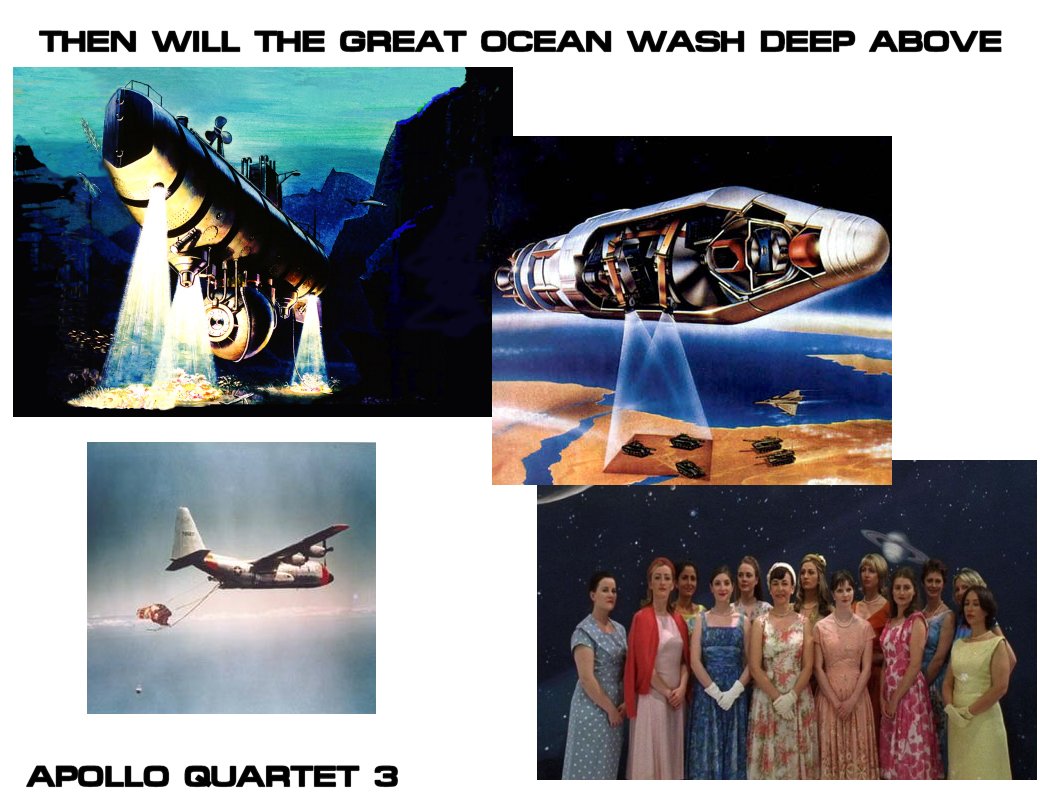
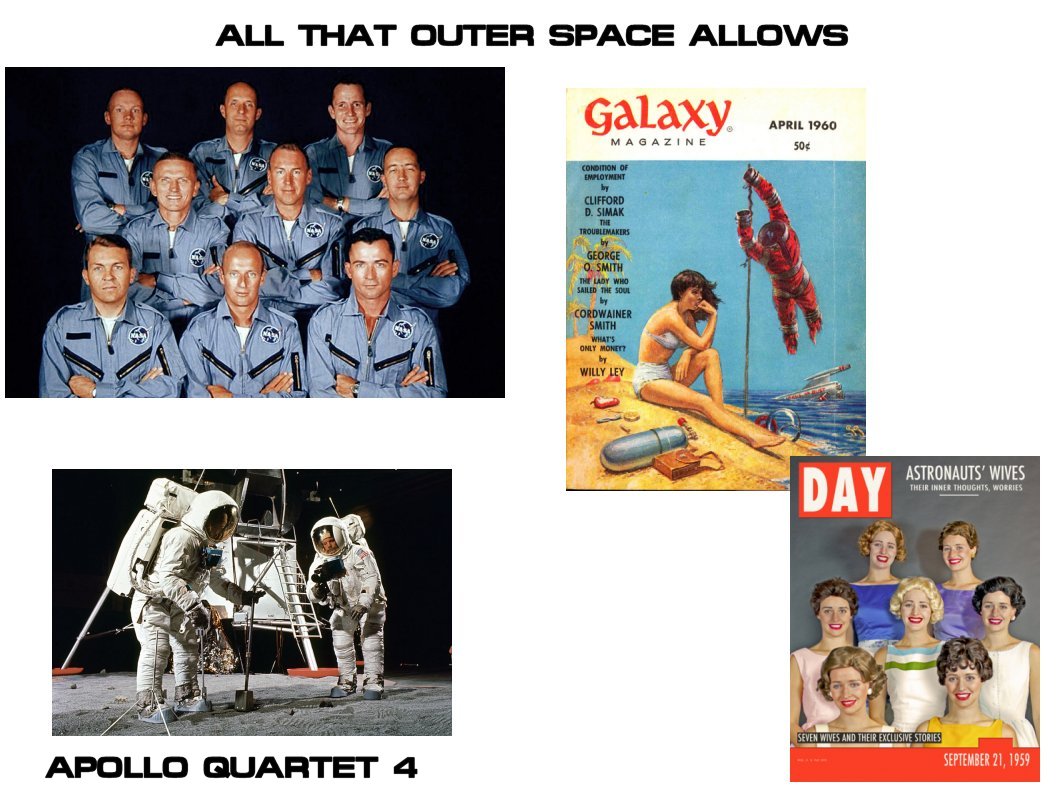
Finally, the last two slides of my presentation were hints to the stories of the final two books of the Apollo Quartet. And here they are…

aq3

aq4


3 Comments

Self-publishing for fun and profit

Some people have made a lot of money very quickly through self-publishing; some people have won big prizes on national lotteries. I’m not sure which has the better odds, but I suspect there’s little difference in it. You can, of course, increase your chances of doing the former – write something derivative that plugs into an existing fanbase, and self-promote to such an extent you’re indistinguishable from spam. If, on the other hand, you self-publish because you have a vision and you want to get it out there, but no one else is interested in publishing it for you… Well, in that case, don’t give up the day-job just yet…

I’ve made no secret of my reasons for self-publishing the Apollo Quartet. I didn’t want to compromise on my vision for Adrift on the Sea of Rains – a vision that has been happily vindicated, since the novella has been shortlisted for the BSFA Award; and I wanted to launch the book at the same time as Rocket Science, and no existing small press, had they chosen to publish it, could have done so in time.

I also chose to publish the book as both paper and ebook. I could, of course, have just released it on Kindle, as so many self-published authors do. But instead I paid a printer – MPG Biddles – to do me hardback and paperback copies.

I have learnt much about writing and publishing over the past ten months…

1 the elephant in the room
It’s actually a huge South American river, not a pachyderm, but it certainly dominates book-selling. And it treats us small fry very badly. If I hadn’t signed up for Amazon Advantage, my books would be shown as unavailable on the Amazon website (I’ve only signed up for the paperbacks, so the hardbacks are indeed shown as “currently unavailable”). Signing up for Amazon Advantage, I have to accept the 60% discount Amazon takes. So every sale I make through Amazon is at a loss. If they ordered 100 copies tomorrow, I’d have to refuse the order. I can’t afford to fulfil it. As it is, the orders Amazon has placed for single copies in dribs and drabs over the months are costing me more as I have to pay postage for each copy I send them.

Incidentally, I’d be happy to cut all my ties to Amazon, but I see no alternatives. I use the Amazon affiliates scheme on this blog, and I had planned to drop it. So I investigated a few alternatives. The Book Depository one is simple enough to use, but they’re owned by Amazon anyway. The Waterstone’s one is a joke. It’s run by a third party, you have to apply for approval first, and I couldn’t find out how to link to individual titles on the Waterstone’s site. They should sort that out – they’d get a lot more business.

2 it doesn’t have to be ebook all the way
Publishing on Kindle is trivial. You format the document, knock up a cover, and then upload it to Amazon through the Kindle Direct Publishing website. Easy. Publishing paper books is harder, but not that much more so. And it does cost money, which publishing on Kindle doesn’t – but even then, it’s not that much. For The Eye With Which The Universe Beholds Itself, I formatted the document as PDF, and had the cover-art done the same way. I got an estimate from MPG Biddles, then placed the order, uploaded my PDF files to their website… and weeks later boxes of books were delivered to my house. It cost me £202 for one hundred 80pp paperbacks.

Of course, selling paper books is more difficult than ebooks. You have to hold stock of a physical item, and ship it to customers when they order copies. For Kindle ebooks, Amazon does all the work for you. You just watch the sales mount up (or not). And selling around the world is trivially easy. Except Amazon US pays you in US$, which is a problem.

3 what’s the bottom line?
Amazon offers 35% and 70% royalty rates on books published on Kindle. You chose the price at which you sell the book. It’s best, of course, to look at the price of comparable ebooks. Too high and no one will buy it, too low and people will think it’s not worth reading. The ebook market is still in flux at the moment, with huge numbers of low-priced self-published books, and ebooks from major imprints priced roughly the same as hardback copies. So there are as many pricing models as there are publishers. I chose to price my ebook editions at about two-thirds of the paperback price – £2.99. That seems to be working quite well.

For self-published paper books, there is no royalty. There is only sale price minus unit cost. I priced Adrift on the Sea of Rains at £3.99, because I felt that was a fair price for a 80pp paperback novella. Unfortunately, I was thinking like a buyer not a seller. It was too low, and I’d have to sell the entire print-run of 100 to cover my costs. So for The Eye With Which The Universe Beholds Itself I increased the price to £4.99. Which means…

Cost per unit: £2.02
Cover price: £4.99
Profit per unit sold: £2.97

Except…
For copies sold over the internet, I include p&p in the £4.99, so that’s –
£4.99 – (£2.02 + £1.10*) = £1.87 per sale

For copies sold by hand, I only charge £4.00, so that’s –
£4.00 – £2.02 = £1.98 per sale

(* I don’t include the cost of envelopes as I re-use as much as I can; but if I did, it would be an additional 20p)

If I sold copies only over the internet, I’d have to sell 52 copies to break-even; if I sold only by hand, it would be 51 copies. The true figure is probably slightly higher as I sell using both methods, and there’s those copies I sell through Amazon Advantage. Nor do I factor in the cost of the copies I give away for review.

Of course, this is only the manufacturing cost. There are a host of unpaid contributions which create the final product – not just myself as writer, designer, promoter, publisher and book-seller; but also the cover artist and the editor. At present, I’ve been lucky enough to receive all that for free (though I plan to pay once Whippleshield Books is more established). There are also peripheral costs which have to be included – ISBNs, the ecommerce website – so it’s going to be a while yet before Whippleshield Books climbs out of the red.

However, those £2.99 Kindle ebooks are more or less pure profit (less Amazon’s cut, the VAT they charge but do not pay, delivery cost, etc.). The money from Kindle sales helps finance the paper versions of the books. I’ve also sold more copies on Kindle than I have paperbacks or hardbacks. In fact, it’s been interesting watching sales uptick when Adrift on the Sea of Rains gets mentioned online. There was small jump in sales when SF Signal reviewed it. And a considerably larger one when the book was mentioned on the Guardian’s book blog“one of the most outstanding self-published books of the year”. More copies were bought on Kindle as a result of that mention than in the preceding nine months.

Having said all that, there is one advantage to publishing a book as a paperback or hardback rather than just on Kindle: you get taken seriously. If I’d gone for the low-cost option – ie, ebook only – I very much doubt I’d have sold as many copies, seen the books reviewed so many times, or even had one shortlisted for the BSFA Award. The future of publishing may lie in self-publishing – I hate the term “indie author”, incidentally – but, with the exception of a handful of outliers, the rewards are proportional to the effort, and money, you put into it…


19 Comments

Writing rules? Really?

I stumbled across this post on io9, via SF Signal, and I can’t decide if it’s typical of their cluelessness or whether the site deliberately caters to clueless people. To be fair, they have carefully quoted the word “rules” because the ten points they make are a combination of wrongness, bad advice and the opposite of common sense.

io9’s 10 writing “Rules” they wish more science fiction and fantasy authors would break…

1) No third-person omniscient
As far as I’m aware, readers prefer third-person limited PoV, so publishers prefer it, so writers use it more. Omniscient is no longer as popular in genre fiction as it once was, though you will see it used in thrillers or literary fiction, with varying degrees of success. Given genre’s current trend for immersion, omniscient voice would be counter-indicated.

2) No prologues
I’ve been saying this for years. Wannabe writers write prologues because their favourite books – no matter how old – feature prologues. And even then, those books probably didn’t need them.

3) Avoid infodumps
According to Kim Stanley Robinson, info-dumping is just another narrative technique – and one he uses interestingly in 2312 with its Dos Passos-like “Quantum Walks”. Anything which interrupts the flow of the narrative should generally be avoided, and that includes exposition. There are ways of getting important information across to the reader – some of them are more elegant than others. In Adrift on the Sea of Rains, I used a glossary – and used that glossary to tell the story of the Apollo programme. In The Eye With Which The Universe Beholds Itself, the glossary serves triple duty – telling the story of the Apollo and Ares programmes, but also offering clues to the real story of the novella and hiding the coda.

4) Fantasy novels have to be series instead of standalones
At present, publishers in the UK like trilogies. You probably stand a better chance of getting a contract if you’ve written a trilogy rather than a stand-alone novel. There’s no reason why fantasy novels (of the epic mediaevalish secondary world variety) shouldn’t be stand-alones, and many have been – such as, er, um… well, I’m sure there must be one somewhere.

5) No portal fantasy
Isn’t portal fantasy a bit out of fashion these days? Most epic fantasies are secondary world fantasies.

6) No FTL
So that would be like Alastair Reynolds’ entire oeuvre, then? Books set outside the Solar System but without FTL have been around for a long time. An especially good one is William Barton’s Dark Sky Legion from 1992. It’s a damn sight more interesting an approach than pretending spaceships are ocean liners and interstellar space is just a very large ocean…

7) Women can’t write “hard” science fiction
Argh. This isn’t a rule, even if in quotes. This is just rank ignorance. And to the people in the comment thread of the io9 post asking for the names of women hard sf writers… Well, there’s this thing called the internet, it has search engines you can use, so go and bloody look for yourself. Admitting you’re ignorant is only the first step. Now you have to do something about it. Don’t go demanding people give you a list of authors’ names. Go and look for yourself. It’s not difficult.

8) Magic has to be just a minor part of a fantasy world
Random assertion is random.

9) No present tense
That’s me screwed then – the Apollo Quartet and Wunderwaffe are all written in the present tense. I like it, I like its immediacy. And I’ve read some excellent books written in the present tense – such as Katie Ward’s Girl Reading.

10) No “unsympathetic” characters
The problem with unsympathetic characters is that they’re, well, unsympathetic. And if you do find yourself sympathising with them, then you probably need help. Writing unsympathetic characters – especially in epic fantasy – means you end up with rapey grimdark shit, and that’s something the genre really needs to grow out of. It’s not big and it’s not clever.

So there you have it. Within a subset of genre fiction, all novels apparently do not break these “rules” – though obviously of course lots of other genre novels do. But to point that out would have rendered io9’s entire article meaningless.


22 Comments

Artistic license reviewed

I review books – for Interzone, for Vector, for SFF Chronicles (though not as often as I should), for SF Mistressworks, for Daughters of Prometheus, even here on my blog. I have been reviewing books since the late 1980s.(My first published review was of CJ Cherryh’s The Tree of Swords and Jewels in the BSFA’s review magazine, Paperback Inferno, in October 1988. I vaguely recall not liking the book.) I am not a critic, nor do I consider my writings about books to be criticism. I leave that kind of in-depth analysis to those who have the necessary tools to do it.

I have also been on the receiving end of reviews – more so this past year than in any other. In two capacities: as the writer of the text being reviewed, and as the editor of the book under review. On the whole, it’s been very informative. I knew when I wrote Adrift on the Sea of Rains that it was atypical and possibly difficult. I suspected its appeal was limited. Happily, it seems to have transcended that and the vast bulk of reviews have been positive and very complimentary. Many of them have also been quite insightful, pulling out things I’d hadn’t realised I’d consciously put in the story. But that’s what happens with good reviewers.

Which is not to say that good reviewers can sometimes get it wrong. Martin McGrath felt Dan Hartland’s review of his story in Rocket Science on Strange Horizons missed an important point, and so he responded to it in a blog post. Dan’s review is, in the main, a good, insightful review. I think it’s clear he and I differ on what science fiction is and needs to be – for one thing, I don’t feel Rocket Science is “weirdly old-fashioned”. If anything, the current fashion for hand-wavey sentimental sf harkens back to an older form of the genre, although the current form is generally far better written. Dan also comments on diversity in his review, pointing out that only five of the twenty-two contributors to the anthology are female. Rocket Science was open submission, so there wasn’t much I could do about that. But it’s bending the point a little to present the contents as being wholly male-centric, especially when the review fails to mention, for example, Deborah Walker’s ‘Sea of Maternity’, a story about a single mother and her unruly teenage daughter. In point of fact, as this post shows, 23.53% of the stories featured female protagonists.

But that’s a minor quibble, and I think Dan’s review of Rocket Science is a good and useful review.

Which is more than can be said for this review of Adrift on the Sea of Rains

Yes, there is a typo on the first page of the book: “sussurus” should be “susurrus”. There’s nothing I can do about that in the paperback and hardback editions. I’ve not bothered fixing it in the ebook edition, but I will do when I publish the second book of the quartet, The Eye With Which The Universe Beholds Itself. Typos happen, and while I should have caught that one, it did slip by a lot of other people as well.

I can understand someone having trouble with the prose style of Adrift on the Sea of Rains – no quotation marks! – and as a result not liking it. And so bailing before finishing it. I can comprehend a reader finding the subject not to their taste and so choosing not to read to the end. But, come on, giving up after a page because there are three (far from wildly obscure) words you don’t understand? That’s no excuse.

And to further suggest that it’s bad craft is insulting.

I do not believe in dumbing down my prose. I am not writing for people with limited vocabularies. I am writing for intelligent adults, because that’s what I consider my peers to be. I will not insult the intelligence of my readers because, as a reader, I loathe writers (or film-makers) who insult my intelligence. I may not always be successful in communicating precisely what I intended to communicate, but recasting it in words of one syllable is not a solution. I like writing “difficult” fiction, just as much as I enjoy reading “difficult” fiction. That difficulty, to my mind, adds value. It’s not just some slick superficial entertainment, but also something that makes you think, makes you reconsider your views and knowledge. Science fiction is particularly well-suited to that task – though the bulk of it fails to do more that bolster existing prejudices. I write about things that interest me and try to shine a new light on them. I don’t do “idea”. In fact, I’m becomingly increasingly convinced that the focus on idea is what continues to cripple science fiction. As long as you privilege idea, your fiction will not be taken seriously outside genre circles. And success within the genre is a poisoned chalice…

Science fiction is a small field, struggling to survive within the shadow cast by its history. There is also a very large elephant in the room of science fiction. (And I’m mixing metaphors, but never mind.) Past masters continue to provide topics within the genre conversation, despite no longer being relevant, of generally poor quality, and less available than in the past. Media sf is so popular the entire genre is believed to be the same as it – but science fiction is far from homogeneous. The sf works which receive general acclaim these days are ones that are not published as sf. Far from breaking down the walls of the ghetto, the tools of sf have leaked out but most of the readers and writers have refused to leave. This is not a healthy state of affairs.

There have been attempts in the past to re-engineer science fiction. While each ultimately failed, they did shift the genre in its course a little. Myself, I’d like to see science fiction stripped back to its roots and rebuilt for the twenty-first century, but that’s never going to happen. People are too happy with their tropes, no matter how old they are or how little sense they make in the current day.

I wrote the first two books of the Apollo Quartet as science fiction, and I set up Whippleshield Books as a science fiction small press. I consider myself a writer who writes in a sf mode. I use science fiction in my writing, I don’t actually write science fiction.

Perhaps the difference exists only in my head, but it’s enough for me.

EDIT: the review of Adrift on the Sea of Rains was also posted on Amazon.com with the heading “Artistic licence revoked!”. Hence, er, the title of this post… But I see now that’s he’s changed it… And reduced it to one-star. Yay, my first one-star review!

EDIT 2: “JL Dobias” has removed the “review” of Adrift on the Sea of Rains from his blog, so the link now points at some random blog post on “Gee Wiz” and “Wiz Bang” sf. The review on Amazon has also been removed, and the Goodreads review has been rewritten and now gives the book three stars rather than the original one. Dobias has thoroughly covered his tracks, so now only his comments here on my blog – all of which were from an email address belonging to a “Luci” – are all that remain of the whole farce. Given my dealings with Jerry/Luci, I suggest they’re best avoided.


9 Comments

Fly me to the Moon

This week saw the announcement by the Golden Spike Company of a plan to sell commercial passenger flights to the Moon. For a mere $1.5 billion each. This is your libertarian future, as so fondly imagined by various right-wing US science fiction authors: poverty endemic in all nations, while the One Percent get to fulfill their dreams in outer space. Of course, few of the ultra-rich can actually afford $1.5 billion, but don’t worry, there’s plenty of cash floating around in the public sector they can sequester. All they have to do is buy a couple of governments, and then persuade said governments to sell off their national assets: utilities, infrastructure, national healthcare…

This is the twenty-first century we can look forward to. All our dreams, the future of our race, we will have to experience vicariously. But that’s okay, because those dreams are about the only thing that can’t be taken away from us. Manipulation of the financial market means you will lose your house, selling off healthcare means injury or illness will beggar you, cost-cutting (AKA profit-maximising) and outsourcing means you will lose your job, tax avoidance by corporations and the ultra-rich means there’ll be no money for benefits to feed you or house you or keep you warm in the winter once you’re unemployed…

But at least someone will be having fun. Visiting the Moon.

goldenspike

It cost US taxpayers around $10 per person per year for a decade to put twelve men on the Moon with the Apollo programme. They did it for science, to beat the Soviets in the Space Race, and for humankind. There are a huge number of scientific and technological advances which spun out of Apollo. Computers and mobile phones as we know them likely would not exist but for the huge orders for integrated circuits – in their infancy at the time – placed by NASA for the spacecrafts’ guidance systems.

If we leave space travel in the hands of the ultra-rich – and that seems to be the way we’re going with all these dumb outer space tourist-jaunt proposals – then we are doomed to die when this planet can no longer support us. We will have no future as a race. And the way things are heading right now, we’ll be lucky to survive into the twenty-second century.

Remember all those space exploration sf novels of the 1940s and 1950s? NASA and the USSR demonstrated the reality was considerably more hazardous than had been imagined. So sf completely mythologised the whole endeavour – magical antigrav spaceships travelling light-years in days or hours using magical FTL drives. Those tropes are now so embedded in the genre, they’ve become part of the setting. I put together Rocket Science partly to question those tropes, to inject some realism back into space travel and outer space, to kickstart a new science fiction tradition based on the reality of space travel.

But what had never occurred to me – or to the genre as a whole, I suspect – is that space would become just another playground for the ultra-rich, just like one of those private Caribbean islands with beaches of golden sand and clear blue seas.

They have taken away our future. It’s time we stopped ignoring that fact in our fictions.


9 Comments

Five genre novels that do something interesting with narrative structure

I like stories that play around with the structure of their narrative. I like reading them, I like writing them. I particularly like the way they allow you to hide things, so you can drop them all on the reader at the end and blow their mind. I call that the B-52 Effect – not after the bomber but after the drink, which you knock back and it sort of goes whoommppfff when it hits your stomach. If I can do that in my fiction, then job done.

While I was thinking about interesting narrative structures, it occurred to me it’s not something genre fiction does often, but when it does it generally does it quite well. And I tried to think of ten excellent novels that boasted interesting narrative structures. But I could only think of five:

Lord Byron’s Novel: The Evening Land, John Crowley (2005), has perhaps the most common form of non-linear structure used in genre fiction, comprising two separate narratives – one of Byron’s fictional novel, which is also glossed with historical notes; and the second narrative is an email exchange set in the present about Byron’s life and his novel. One narrative informs the other and is in turn informed by it. I like that.

Ash: A Secret History, Mary Gentle (2000), shares a similar structure to Crowley’s novel, in that the main narrative is – perhaps – a fictional work about the title character, and this is wrapped within another narrative which comments on Ash’s narrative and is in turn changed by her narrative.

Use Of Weapons, Iain M Banks (1991), famously has two narratives intertwined and chronologically opposed – one moves forward in time, like your average normal linear plot; but the other alternates with it and moves backwards in time. It makes for a mind-blowing climax, but sadly it’s a single shot: once you know the ending, you’re not going to get that B-52 Effect again.

The Dispossessed, Ursula K Le Guin (1974), equally famously has a non-linear structure narrative, with alternating chapters set on each of the story’s two worlds, Anarres and Uras, but not in chronological order. According to the Wikipedia article on the book, the chapters if re-ordered chronologically would go: 2, 4, 6, 8, 10, 12, 1, 3, 5, 7, 9, 11, 13.

Synthajoy, DG Compton (1968) is, given that I’ve only read eight of Compton’s seventeen sf novels, the only one I’ve read so far that isn’t a two-hander. Most have a pair of protagonists, typically one male and one female, and the viewpoint alternates between them. Interestingly, in The Steel Crocodile the sections overlap so the reader sees events from both viewpoints. Synthajoy, however, has a single POV. At the start of the book, the protagonist is in an institution being “cured” after committing a crime. The narrative then starts to seamlessly slide into the past and describes the events that led up to the crime, and throughout the novel drifts back and forth between the two narratives. It is very cleverly done.

There are surely other genre novels with narrative structures other than the bog-standard linear beginning-to-end plot, but I’m having trouble thinking of good ones. There are fix-up novels, of course, though there’s nothing especially interesting in that as a structure. And both The Fifth Head of Cerberus and Icehenge comprise three loosely-linked novellas, and are both very good and cleverly done. Literary fiction is much more adventurous in this regard and two examples leap immediately to mind: Cloud Atlas and Girl Reading. Anyone else have any examples worth mentioning?


6 Comments

The journey is the metaphor, not the spaceship

Most science fiction treats space travel like air travel or sea travel. This is hardly surprising, since only a handful of authors of sf novels have actually experienced space travel (Buzz Aldrin, Edward Gibson, Mike Mullane, Scott Carpenter… I think that’s it). And back in the early days of the genre, of course, no one had. A couple of rocket scientists – Wernher von Braun and Willy Ley, for example – had a bash at sf; but most early sf authors simply adapted what they knew.

So there was the spaceship as ocean liner, requiring a dock (space station), with cabins for passengers, a bridge, and a bloke who sat in a comfy chair and just gave orders. Or there were the spaceships based on the barnstormers, small aircraft that people kept in their backyards, that required only a couple of hundred feet to take off, so they could jump in them, take to the air and fly off somewhere.

Of course, we now know space travel is nothing like either of the above. To get into orbit, an expensive task in terms of both energy and hardware, travellers are crammed into a tiny module. And everything is controlled by computer. If Skylon or the X-37B is any indication, future spacecraft won’t even have crew. And yet sf continues to use those old metaphors: the ocean liner in space, the barnstormer of the stars.

These metaphors completely ignore the basic realities of space travel. Not just the vast distances involved, distances that pretty much make it impossible to map any kind of human story onto an interstellar setting. But the whole metaphor of space as “the final frontier” breaks down as soon as you realise how hazardous simply being in space actually is.

The problem is not so much that these metaphors for space travel exist, but that they have become so embedded in science fiction that no one bothers to question them any more. They’re picked up and slotted into stories as if they’re part of the background. It’s a bit like writing contemporary fiction, only the trains in the story still run on steam. We have more than fifty years of actual space travel. Necessary practicalities and the history of space exploration have given us a tradition we can use in sf – and I don’t mean cosmonauts peeing on the back wheel of the bus that takes them to the launchpad, not that sort of tradition.

But sf is wedded to those patterns first laid down back in the 1930s, and all that’s been done in the years since is a gradual refining of them. Not only do I think it’s time we ditched those metaphors for space travel and came up with something inspired by post-1950 history, but I also think we need to look carefully at every metaphor and trope currently in use in sf. Because metaphors are narrative tools, not plug-in modules for story settings. We need to go through all those tropes and strike through the ones which are based on models that no longer hold true and haven’t done for almost a century. I chose space travel as my example as it’s a topic that both interests me and which I’ve researched for my own fiction. But there are plenty of others – robots, cyberspace, aliens, etc…

This is where the interesting science fiction is going to be, in the stories that re-engineer the tropes, that relate them to the real world. Slotting together identikit tropes only results in identikit fiction, and I don’t want the genre to be defined by such stories.


1 Comment

Writerly bloggy hoppy thing

I got nominated for this by RJ Barker and apparently bad things happen to you if you don’t answer the questions and pass it on. So, fingers crossed, here goes…

What is the working title of your book?
I’m currently putting the finishing touches to the second book of my Apollo Quartet, The Eye With Which The Universe Beholds Itself. It needs a little more work in places, but my beta readers all think it is a stronger work than the first book of the quartet, Adrift on the Sea of Rains, which pleases me.

Where did the idea for the book come from?
I blogged about this in a series of post on the Whippleshield Books blog – Genesis of Apollo parts one, two and three.

What genre does your book fall under?
Literary hard sf. Or “art house hard sf”, as one person has described it.

Which actors would you choose to play your characters in a movie rendition?
If Steve Forrest were a couple of decades younger, he’d be perfect for the lead role.

What is the one-sentence synopsis of your book?
A scientific station on an exoplanet, humanity’s only presence outside the Solar System, has vanished and they send the first man on Mars to find out what happened to it.

Will your book be self-published or represented by an agency?
It will be published by Whippleshield Books, which is, er, my own small press.

How long did it take you to write the first draft of your manuscript?
About four months. It’s a 22,000-word novella, but it required a lot of research.

What other books would you compare this story to within your genre?
I’m not sure there are any. Outside the genre, Ascent by Jed Mercurio, perhaps.

Who or what inspired you to write this book?
The 40th anniversary of the Apollo 11 lunar landings – see Genesis of Apollo parts one, two and three. But elements of the plot of The Eye With Which The Universe Beholds Itself were specifically inspired by Lavie Tidhar’s review of Adrift on the Sea of Rains (see here).

What else about your book might pique the reader’s interest?
It suggests a reason for the Fermi Paradox.

Nominate five people to roll this onto
I shall cheat as RJ Barker did, and nominate a single person – Neil Williamson, who writes excellent short fiction and has even been known to enjoy an Opeth song or two on occasion.