It Doesn't Have To Be Right…

… it just has to sound plausible


4 Comments

The Survival of Artistic Modes…

In an interview at Focus on Science Fiction and Fantasy, author Jack Campbell (AKA John G Hemry) says: “I think SF has a good future as long as it doesn’t take itself too seriously. By that I mean it has to remain focused on telling the story, rather than trying to be Literary.”

Which is where I do my impression of Ben Kingsley from Sexy Beast (here: warning – not for the easily offended or faint of heart.)

Rather than refuse to take itself seriously, science fiction needs to grow up. The word “literary” (capitalised or not) is not an insult, and should not be used as such. It is an aspiration. As long as sf continues to trivialise itself and its ambitions, then it will be seen as the province of children and sad nerds in anoraks. And that’s an image those of us who are serious about the genre having been trying to throw off for decades.

Just because mainstream critics and readers sneer at science fiction, that’s no reason for reverse snobbery. That’s no reason to take the complaints levelled at sf by mainstream critics and proudly claim them as the genre’s defining characteristics. We shouldn’t celebrate crap characterisation. We shouldn’t claim that lumpen “transparent” prose is superior to any other form. We shouldn’t privilege “idea” because it’s unique to the genre – and so that’s a competition we’ll always “win”. Neither should we privilege world-building, just because that’s an area in which we’ve had so much more practice…

I’m not saying we should dispense with story, or no longer consider it important. But neither should other aspects of fiction be ignored. Science fiction is not exempt from the rules of good fiction. If anything, it’s harder to do well because there is so much more which must be done well to succeed.

Also, it’s not about the genre surviving. Genres evolve, and that’s how they survive. It has nothing to do with taxonomy, or what letters publishers put on the spine of a novel. It’s about individual works surviving. A century from now, will people still be reading supermarket bestsellers? Or will they be reading the “serious” works? The history of literature so far suggests the latter. I don’t see any penny-dreadfuls still in print… but Dune is, 42 years after its first publication.

Science fiction is capable of so much more than trivial action-adventure tales dressed up with spaceships, aliens and robots. Why limit ourselves? I mean, isn’t that the whole point of sf? That there are no limits?


Leave a comment

One Year Ends…

… and another one begins.

2007 was a bit of a mixed bag. Book-wise, I read 175 books, but bought more. Both figures are up on last year. I need to spend less money on eBay. Mind you, I’ve been saying that for years. However, new to 2007 were books on the Apollo programme and mediaeval Arabic literature. Hopefully, those two “enthusiasms” should keep me going through 2008, and so limit my book purchasing…

Of those 175 books read, around half were science fiction. Brian Aldiss and Lawrence Durrell tied as most-read authors (5 books each), closely followed by Eric Brown with 4 books. Actually, Alan Moore was most-read, but that was graphic novels (11, in fact). Prior to 2007, all I’d read by Moore was Watchmen (excellent) and Batman: Killing Joke (meh). But last year I discovered Tom Strong, and loved it. Other authors new to me in 2007 were John Jarmain (see here and here) and Leigh Brackett. I can’t read more of the former – I’ve read everything of his that has been published – but I will read more Brackett. There were other writers new to me, but those two are the notables ones.

On the music front… myself and a friend, Craig, resolved in January last year to attend one gig a month during 2007. That plan fell flat – the first band we saw live was Mostly Autumn in April. But by the end of the year, I’d managed seven gigs and a metal festival. Not counting those at the festival, here are all the bands I saw perform in 2007: Glow, Mostly Autumn, Ted Maul, Cephalic Carnage, Akercocke, Kramer, Blind Ego, Pallas, Engel, Amon Amarth, Dimmu Borgir, Sonic Syndicate, Caliban, Dark Tranquillity, Soilwork, Ella, Fell Silent, The Final Sigh, Opinicus, Asuras, Coliseum, Pelican and High on Fire. The festival was Bloodstock Open Air… and I enjoyed it so much I’ve already booked tickets for 2008.

Films – since leaving the United Arab Emirates in 2002, I’ve been really crap about visiting the cinema. Admittedly, it was easy there. I lived around the corner from the best cinema in the city, and finished work at 3 o’clock, so it was easy to catch the afternoon showing. I usually had the auditorium to myself, too. With the exception of The Golden Compass, seen at a cinema in Leeds on 23 December, every film I watched in 2007 was on DVD or telly. Last year, I also became a fan of the films of Elia Suleiman, Werner Herzog and Ingmar Bergman.

I started writing short stories again in 2007. Not many – I was never prolific. In fact, that’s one of my resolutions for 2008 – be more prolific. One story racked up five rejections – including the dumbest rejection ever. Another one… I’ve still not heard back from the magazine. Fingers crossed. I also had a bash at poetry in 2007. Not something I’ve ever done before. One last buff and polish, and I think I’ll submit it somewhere this year. And, of course, there’s the novel… (It’s almost done, John.) Book two of a trilogy, and better than the first one, I think. Could this be the year? If I kick the writing into high gear, then perhaps it might be…


1 Comment

Buy this Book?

It’s not very often I post responses to something I’ve read on other blogs – in fact, this might well be the first time. But sometimes, it’s the only thing to do.

First, here’s an excellent piece from the Kenyon Review on book reviews, which makes some interesting points about customer reviews on Amazon. The author is careful not to say, however, that those who struggle to understand novels by Joseph Conrad or Toni Morrison should probably look to themselves and not blame the writer. If they don’t like a book, and can articulate why – then, fine. But to not like it because they don’t understand it? That’s not useful information.

And from the sublime to the ridiculous: Dave Hill (novelist) celebrates the imminent demise of the hardback on the Guardian blog. According to him, “Literary fiction even has its very own format to signal that it’s a cut above the vulgar crowd – the hardback edition, which conventionally precedes the paperback by a year.” So the loss of the hardback format is good because “the ‘literary’ demarcation stinks” and, further, “plenty of so-called literary fiction is overrrated”.

This is complete rubbish. First, the hardback is not limited to literary fiction. In fact, books of all genres are published in hardback. Even Harry Potter. And second, plenty of fiction from other genres is overrated. Such as Harry Potter

There is also a certain amount of prestige attached to being published in that format, rather than as a “paperback original”. But that’s hardly surprising – they’re more expensive to produce, and correspondingly priced higher. So publishers will only do that for those authors they expect to sell well. Or perhaps the publishers want to signal to the market that an author is something special. Irrespective of genre.

I have several hundred science fiction hardbacks on my bookshelves, and quite a few of other genres. I like hardbacks. They’re more… substantial objects than paperbacks. They last longer, too. Unhappily, British publishers these days tend to use glued bindings, and not stitched – which most US publishers still use – so modern hardbacks are not as hard-wearing as older ones. And because they’re longer-lasting, hardbacks are more collectible. I recently read John Jarmain’s Priddy Barrows, first published in 1944. Sixty-three years ago. I could find only two copies on the Web. I wonder how many I would have found if it had been published only in paperback? Some of the hardback books I own are now worth substantially more than they were on publication – and they’re weren’t published more than half a century ago…


1 Comment

Ten Years Later…

Novacon is an annual convention run by the Birmingham SF Group, which takes place over the first weekend of November. The last one I attended was Novacon 27 in 1997. Ten years ago. Back in those days I would go to two or more cons a year - typically the Eastercon and Novacon. When I moved to the Middle East, I could only return to the UK for a single con each year - and chose the Eastercon, on the entirely sensible grounds that more of my friends would be at it. After returning to live in the UK, I didn't bother with any conventions for a couple of years... until the 2005 Worldcon in Glasgow. And since then, I've been happy with just one convention a year, the Eastercon.

But, for some reason, I decided this year to also attend Novacon. Which this year took place in Willenhall.

Travel problems soured my visit to Fantasycon, and that was only a 40-mile train journey. This time I was travelling around 100 miles - and I'd have to change trains at Birmingham New Street. Foolishly, I'd thought that earlier screwed-up trip was just a one-off. But it seems the British rail network imploded some time during the past couple of months. My train to Walsall was delayed by thirty minutes - in fact, only local trains were actually running on time. As it was, I still managed to arrive in Walsall at the correct time. Fortuitous connections at Birmingham New Street, I think.

The hotel where Novacon 37 was taking place proved to be one of those low flat modern ones, situated just off a motorway junction. The rooms were laid out along a corridor which mapped out a square. The entrance to this square was at one corner. Naturally, I was given the room furthest away, on the corner diagonally opposite. After dumping my bag, I headed for the bar...

If this year's Eastercon in Chester felt like a two-day convention stretched out over three days, then Novacon felt as though it were exactly the right length. I chatted with various people on the first night - including Guest of Honour Charles Stross - before attending the Opening Ceremony. Later that evening, they brought out the free wine, free books and free food for some book launches and signings. I don't actually recall what was being launched, or who was signing. I do vaguely remember deciding I'd had enough and staggering off to my room around midnight. The next day I was told I'd actually left at ten o'clock.

As usual, I was up early the next morning. Unsurprisingly, I had a bit of a hangover. Breakfast wasn't bad - although the Quality Hotel keeps their plates dangerously hot. You can't hold one unless you wrap a dozen paper napkins around your hand. I spent the day in the bar, but I no longer recall the topics of conversation. At four o'clock, Andy Remic gave a reading from his new novel, War Machine, published by Solaris. He stood with his back to a window, and through the window I could see an expanse of grass and at its far edge some twenty metres way a line of trees. Every now and again, a pair of squirrels would leap across a gap in the trees - and only just make it. One squirrel, in fact, missed completely, and only saved itself from plummetting to the ground by grabbing the other squirrel's tail. It was a little distracting. Andy's book, incidentally, is militaristic sf, and if the excerpt he read is any indication it should be a good read.

Around half past seven, a gang of eleven of us went out for a curry. This entailed a ten-minute drive in two taxis. The food wasn't bad - although a couple of those present disagreed. Back at the hotel, we sat around, drank a bit more and generally complained about how knackered we were. I lasted until midnight before going to bed.

On the Sunday, I attended my second programme item of the con. Which makes Novacon 37 something of a record-breaker for me. I typically spend cons in the bar, only attending book launches, author readings, or awards ceremonies. But this time, I actually sat through a full sixty-minute panel discussion. The topic was 'The New Optimism in British Science Fiction'. The panel comprised Eric Brown, Ian Watson, moderator Catherine Pickersgill, GoH Charles Stross and Andy Remic. An interesting discussion, although I don't recall any real conclusion being reached.

Throughout the weekend, I went for occasional wanders about the dealers' room. Which was surprisingly big for such a small con. Among the 17 books I bought were Outpost Mars by Cyril Judd, and its "spiced up" Beacon Books version, Sin in Space (see here for my comments on the Beacon Books version of AE van Vogt's Undercover Aliens; I plan to do the same for Sin in Space). Most of the others were obscure paperbacks, bought for a couple of quid, by the likes of Colin Kapp, David J Lake, Rudy Rucker, Lin Carter, and Barry N Malzberg. I also picked up copies of Time Pieces and disLocations, short story collections edited by Ian Whates. And Andy Remic's Quake and Warhead, both of which he signed for me.

Since Eric Brown and myself were both heading north, we decided to travel together. Tony Ballantyne dropped us off at Walsall station at 3 o'clock (thanks for the copy of Divergence, Tony). I didn't arrive back home until 7:30. The train from New Street was packed solid, and forced to take two diversions because of work being done on the lines. In the old days, you could blame a single company - British Rail - for screwing up your journey. Now it's the fault of half a dozen. Privatising British Rail was a stupid thing to do.

On the whole, an enjoyable con. I got to meet up with friends, and meet new people. I didn't spend as much in the dealers' room as I'd expected or feared. Which is good. I did spot a couple of first editions I wanted, but I managed to resist temptation. I don't remember every thing that happened during the weekend, but I do recall - chatting with Ian Whates about prog rock (and letting Tony Ballantyne listen to some Tinariwen on my Yeep; he liked it more than the death metal...); discussing the current craze for zombies with Mark Newton and Christian Dunn; watching someone hand Charles Stross all twelve of his novels to sign, and his earlier book on Web architecture; talking about writing with Andy Remic; listening to Ian Watson's many funny anecdotes; being very surprised to see Liam Proven up and about before noon... Anyway, here are a few photos I took during the weekend.

It was a fun convention. I might even go again next year. I'll certainly not wait ten years before my next Novacon...


2 Comments

Hideous Beyond Belief!

Back in February of this year, I wrote about a film that had really impressed me, Divine Intervention by Palestinian director Elia Suleiman. In my post, I mentioned that I prefer foreign “art house” films to Hollywood blockbusters – I’d much sooner watch the sort of stuff directed by the likes of Aki Kaurismäki, Ingmar Bergman, Andrei Tarkovsky, Werner Herzog

However, I also have a small cinematic guilty secret: I enjoy really bad sf films. You know, those dreadfully earnest B-movie sf films from the 1950s and 1960s, with rubbish effects, lots of stock footage, and alien invaders that are quite clearly men in rubber suits. And those straight-to-video Star Wars rip- offs from the late 1970s and early 1980s, especially the Italian ones…

Like Starcrash. This was released in 1979, directed by Luigi Cozzi, and starred Caroline Munro, Christopher Plummer and David Hasselhof. Its plot is very nearly incoherent (unlike Cosmos: War of the Planets, whose plot is incoherent). The Hof is best thing in the film, which probably tells you all you need to know. Classic lines in Starcrash include: “Look! Amazons on horseback! I hope they’re friendly.” and “Imperial Battleship, halt the flow of time!” and “A floating spaceship is about to crash into us!”

Not all of these films are so dreadful, however. Some are much better than appearances would suggest. Galaxy of Terror has been a favourite since I first saw it on VHS back in the mid-1980s. And only a few nights ago, I watched another Roger Corman-produced film from 1966 which is bizarrely good…

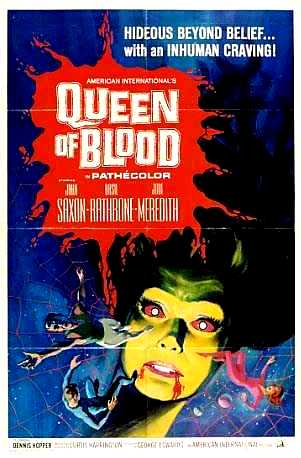
Queen of Blood is one of those 1960s American sf films created by overdubbing English dialogue over a pirated Russian sf film and adding additional scenes featuring US actors. It stars Basil Rathbone, John Saxon, and a very young Dennis Hopper. All of the special effects shots, Martian exteriors, and alien spaceship interiors are from Niebo Zowiet, “The Heavens Call”. Queen of Blood‘s plot also clearly inspired Ridley Scott’s Alien – there are obvious resemblances.

Aliens send a message to Earth requesting a meeting, but the spaceship carrying their ambassador crashes on Mars. The International Institute of Space Technology puts together a rescue mission. However, they find only a single alien body in the wreck. The aliens’ rescue ship must be somewhere else on the Red Planet. A second IIST rocket makes its way to Mars in order to place observation satellites in Martian orbit to aid the search. This rocket lands on Phobos… and discovers the alien rescue ship. Which contains a single survivor, a green-skinned woman. During the return journey to Earth, the alien woman kills off the IIST crew one by one and drinks their blood…

It’s not the most profound plot in the history of sf cinema. And Queen of Blood‘s half-Soviet origins hardly bode well. But somehow the film manages to be more than the sum of its disparate parts. The footage from Niebo Zowiet is… weirdly compelling: lots of long shots of huge colourful sets, which seem strangely other-worldly. The film also features some Russian crowd scenes, intercut with close-ups of the American cast. The sudden changes from long to short are a little disconcerting. The title role is played by Florence Marly who, despite green make-up and a very peculiar beehive hairdo, manages to convince without actually speaking a word.

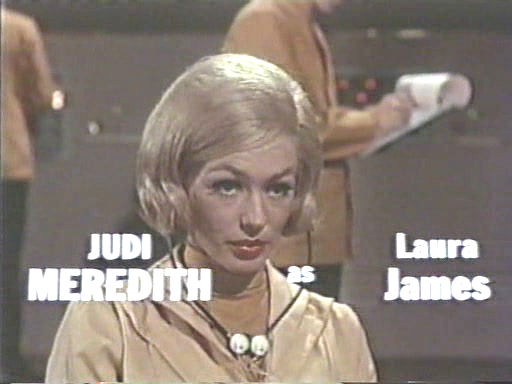
Interestingly, one member of the crew of the first IIST rocket is Judi Meredith. Her character is chosen for the mission because she’s best qualified. And her boyfriend, John Saxon, happily acknowledges as much. For a film made in 1966, that’s quite remarkable. In other areas, perhaps Queen of Blood isn’t quite so forward-thinking – or even scientifically accurate (green-skinned blood-drinking alien queens notwithstanding). There’s no evidence of one-sixth gravity in the scenes set on the Moon, or micro-gravity when the second rocket “lands on” Phobos. But that’s not unusual in science fiction films of the time. Even in the good ones.

Films like Queen of Blood – i.e., not exactly “good”, but very much interesting – are not entirely common. The vast majority of sf films available on cheap B-movie DVD collections are truly dreadful, and often near unwatchable. And sitting through them one after the other over a period of several weeks is probably not a very clever thing to do. I’m a little bit afraid that if I now watch anything directed by Ingmar Bergman, my head is likely to explode. But, joking aside, I’d very much like to see Niebo Zowiet, the Russian film from which Queen of Blood so freely stole. Sadly, no copy with English subtitles appears to exist. Ah well. I’ll just have to keep on watching sf B-movies and hope I stumble across another gem…


Leave a comment

The Stars Look Very Different Today

For the last couple of days, I’ve been watching the latest Space Shuttle mission on the Nasa TV webfeed (via the Flame Trench). It’s not the most exciting television in the world – well, it’s in orbit about the world, but you know what I mean. But it is fascinating in a minor mind-boggling sort of way. I mean, that’s space. It’s not on Earth. It’s 240 miles straight up. When you think what’s needed merely to survive there… Then you start to realise quite how amazing an achievement were the Apollo missions to the Moon.

The US says it is going back to the Moon, although I wonder how long the enthusiasm will last. Given that China, Japan and India have also expressed similar intentions, perhaps the spirit of competitiveness will keep it on the political agenda. I think they should go. It’s a great idea. And yes, after Nasa has done that, of course they should go to Mars.

But why stop there? How about Ceres next? The moons of Saturn?

It doesn’t matter that we don’t have any real reason for going. We should do it because we can, because whatever challenges it presents are solvable. It’s something to aspire to, something achievable to aspire to. It’s not a waste of money, it’s not money that would be better spent on solving earthly problems. Because, let’s face it, if that money were made available, it wouldn’t be spent on earthly problems anyway. It’d go towards another “liberation” or “police action”. Or be used to further prop up an unwieldy government apparatus. Spending billions of dollars on sending four men to the Moon is a tangible, and very visible, objective. And no one has to die, either.

There might even be some spin-off technology that will prove useful or lucrative. But that’s just gravy. And the merchandising should make a bob or two. With a bit of help, a Nasa programme could even bootstrap commercial enterprises into space. It’ll never be routine or economical – or rather, the amount of up-front investment required to make it routine is politically and economically unfeasible. Local authorities in the UK won’t even invest in trams, so I don’t consider it likely that even a nation with a GDP of nearly $14,000,000,000,000,000 will invest in an orbital elevator. So it’s either spaceplanes or “Spam in a can“.

There is some scientific benefit to going back to the Moon, and then onwards to Mars. But that’s not important. Robots could do the job just as well. But sending robots is boring. We’ve been doing that for decades, and no one really cares. Send astronauts (or cosmonauts, or taikonauts), not robots.

Project Constellation is an excellent idea. Do it.


Leave a comment

The "Beep" heard ’round the World

Today – October 4 – is the fiftieth anniversary of the launch of Sputnik, this planet’s first artificial satellite. And it seems all the promise of the early years of the “Space Age” hasn’t, well, hasn’t really been met. The last man on the Moon, Gene Cernan, climbed back into his Apollo 17 LM almost 35 years ago (on December 14, 1972). What happened? Why didn’t we go to Mars? We’re going to have to wait until 2020 before the US returns to the Moon. And it’s likely to get a little crowded up there – the Chinese, Japanese and Indians have all said they plan to send someone to the Moon around that time.


2 Comments

Hook, Line and Snicker…

Spoof and phishing emails are a fact of life in the Twenty-first Century. And most of us are savvy enough to spot them. Most of us, in fact, it seems are savvier than the people who actually create such emails – at least given their often poor command of English.

Sensible people delete these emails as soon as they spot them in their inbox. And normally, I do too. But when I saw the following phishing email, I had to share it:

Good day dear clients,

We are sorry to inform that the fraudulents with the accounts of our bank have recently increased. That is why our bank changes the security system, which will provide maximum security to our clients if the accounts are used by frauds. You will receive a special program to your e-mail this week, as well as the instruction how to use it. With its help you will have an opportunity to make payments. Without this program no one will be able to transfer money from your account. If you lose the program, you will have to pay $4,99 and we will send you the copy of it.

To confirm the registration of this anti-fraud program visit this web-site and complete the necessary forms:

We appreciate your business and hope to keep you as a customer for life. Citizens Bank Money Manager GPS Online is so easy, no wonder it’s number 1 !

I don’t know which is most amusing: the honesty of the email – “Without this program no one will be able to transfer money from your account”; or the concept of a phishing program you have to pay to replace should you “lose” it…