
SF Signal today posted a couple of Mind Melds on “Memorable Short Stories to Add to Your Reading List” parts one and two. An excuse, in other words, to ask a bunch of people to name their favourite genre stories.
So I thought I’d do the same – list my favourite stories, that is. And here they are in chronological order of publication (where copies exist online, I’ve linked to them):
‘Aye, And Gomorrah’, Samuel R Delany – first appeared in Dangerous Visions (1967), edited by Harlan Ellison, and while much of the contents of that anthology weren’t exactly memorable, Delany’s story has stuck with me through the years. It’s very 1960s, very lyrical, and notably thin on plot. But I think it’s the evocativeness of the prose which appeals most.
‘And I Awoke And Found Me Here On The Cold Hill Side’, James Tiptree, Jr – was originally published in Fantasy & Science Fiction‘s March 1972 issue, although I read it in Tiptree’s collection 10,000 Light-Years From Home. This story is a classic, a simple idea approached using an entirely original angle of attack. It’s bleak and a perfect antidote to most space opera. Everyone who likes space opera should read it.
‘The Lake of Tuonela’, Keith Roberts – was a more recent discovery for me (see here). It first appeared in New Writings in SF 23 (1973), edited by Kenneth Bulmer, but I read it in Roberts’ collection The Grain Kings. Roberts’ prose is impressive, and in this story he manages to evoke the titular lake, and the long tunnel to it, with some beautiful writing. If the story had actually done more, and had managed to really evoke its alien setting, then it would have been very nearly perfect.
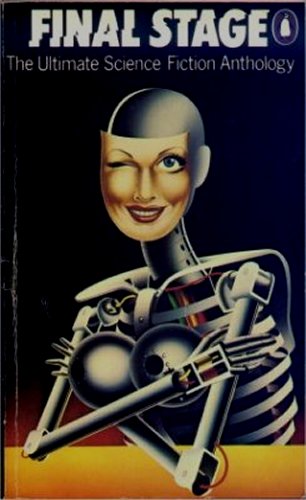
‘A Little Something For Us Tempunauts’, Philip K Dick – I first read in the anthology in which it was first published, Final Stage (1974), edited by Edward L Ferman & Barry N Malzberg; and which was, I think, one of the first sf books my parents bought for me. It also contains one of the few Harlan Ellison stories I remember liking, ‘Catman’. Like the Delany above, this is another story which is very much of its time – it feels very early 1970s to me, all Apollo and Grateful Dead and the like. But that works very much in its favour.
‘Air Raid’, John Varley – was originally published under the name Herb Boehm in Isaac Asimov’s SF Magazine Spring 1977 issue, because Varley already had a novelette, ‘Goodbye, Robinson Crusoe’, in the issue. ‘Air Raid’ was adapted as film, Millennium, and Varley later expanded his own screenplay into a novel, also titled Millennium. The story’s premise is certainly original – people from the future snatch passengers from planes just before they crash in order to repopulate their own time – and the pace never lets up from start to finish. The later novel rounds out the background and characters, and adds an interesting twist in that the different narratives follow the events of the plot in a different order, but the original story’s brevity gives the central idea greater impact.
‘The Gernsback Continuum’, William Gibson – was first published in Universe 11 (1981), edited by Terry Carr, but also appears in Mirrorshades: The Cyberpunk Anthology, edited by Bruce Sterling. Elegiac is not a word I’d normally associate with Gibson’s prose, but it’s certainly one that fits this story. For all its insistence of looking forward, sf has a curious tendency to gaze fondly at its past, and at the futures of its past. ‘The Gernsback Continuum’ is an excellent description of that tendency.
‘A Gift From The Culture’, Iain M Banks – is the first of three Interzone stories on this list. Interzone is probably my chief source of short sf, and has been since I first subscribed to the magazine back in the late 1980s. ‘A Gift from the Culture’ appeared in #20, Summer 1987, but can also be found in Banks’s only collection to date, The State of the Art. Banks’s Culture is one of the great sf invented universes, and ‘A Gift from the Culture’ is one of the few pieces of short fiction set in that universe. It’s also quite a sad story and, like ‘A Little Something For Us Tempunauts’, there’s an inexorable quality to its resolution – although it’s driven by character and emotion, rather than the laws of physics.
‘Forward Echoes’, Gwyneth Jones – is another Interzone story, this time from #42, December 1990. A slightly reworked version was also published three years later as ‘Identifying the Object’ in a chapbook collection of the same name from Swan Press. ‘Forward Echoes’ introduced the two main characters of Jones’s novel White Queen, and the Aleutians, the alien race of that novel and its sequels North Wind and Phoenix Café (and, of course, the recent and excellent Spirit: The Princess of Bois Dormant – see my review here). I think what first appealed to me about this story was its strangeness. It’s one of the most sfnally-evocative (to coin a phrase) stories I’ve ever read.
‘FOAM’, Brian Aldiss – was later expanded into a section of Aldiss’s 1994 novel, Somewhere East of Life. In 1991, Gollancz relaunched the magazine New Worlds as a paperback anthology edited by David S Garnett (in those days, Garnett was almost ubiquitous), and the story first appeared in that. Aldiss manages to layer strangeness upon strangeness in a somewhat picaresque plot set in the central Asian republics in the near-future (as was). This is another story, like the Jones, which makes something peculiar and sfnal of our world.
‘The Road To Jerusalem’, Mary Gentle – is the third and final Interzone story, from #52 in October 1991. It’s also the only alternate (alternative) history story in the list. In it, the knights templar have continued to exist to the present, and the world is a very different place. But it’s only as the story progresses does it become clear exactly how different.
The most recent story of the ten above is nearly eighteen years old. Which means it’s probably about time I brought the list up-to-date. I’ve certainly read some excellent stories published since Mary Gentle’s ‘The Road to Jerusalem’, but none seem to have stuck with me as much as the above ones have done. Perhaps I need to read stories a couple of times before they grow on me enough to be tagged as “favourites”. Perhaps that’s an exercise for another day – looking back over the short fiction I have access to which was published after 1991, and seeing if any of them have the same impact on me the above ten did.

 )
) )
) It Doesn't Have To Be Right...