
My review of Music for Another World, a themed anthology edited by Mark Harding, is now up at SFF Chronicles here. This is the anthology which contains ‘Arrhythmia’, Neil Williamson’s BSFA Award shortlisted story.
Category Archives: short stories
Cor. Swag.
Today, postie brought me the amalgamated British Fantasy Society Journal. The three magazines – Prism, Dark Horizons and New Horizons – are now a single hardback book. And very smart it looks too. See:


And what’s this on page 22? Why, it’s a story by Yours Truly: ‘Barker’, an alt history about the Space Race.

And while I’m at it: M-Brane SF Quarterly #1 is also now available in the UK:

With two of my stories in it: ‘Through the Eye of a Needle’ and ‘Human Resources’.
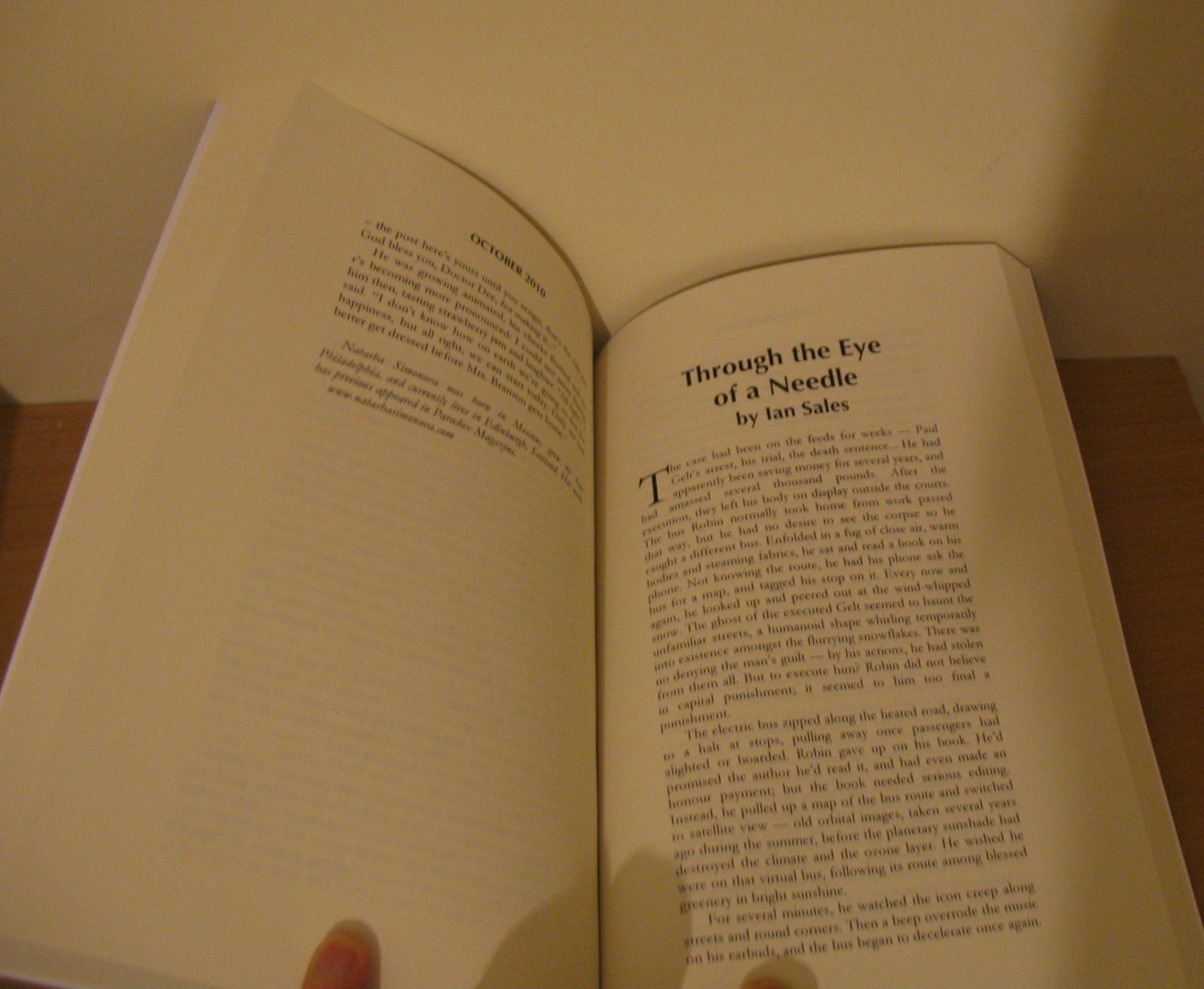

Go on, you know you want a copy…
The craft of space
I can’t decide if the success of USAF’s X-37B mission a couple of days ago is the most exciting thing to have happened recently regarding space, or simply further evidence that the US’s space programme is moribund. The Boeing X-37B is an unmanned orbiter which, like the soon-to-be-retired Space Shuttle, is thrown into orbit atop a launch vehicle (an Atlas V) but lands like an aircraft on a runway. The X-37B landed at Vandenberg AFB on 3 December after 220 days in orbit – photos here and video of the landing here.
The X-37B could be exciting because it’s a new orbiter. Admittedly, it’s the Space Shuttle’s Mini-me, and it’s robotic. But it’s new tech, and it’s likely to be kept up to date. So it might well be the first in a whole new, and evolving, generation of spacecraft. Which is important since, after all, launch vehicles haven’t substantially changed in more than fifty years. Rocket engines still work the same way; the same fuels are still used. But a cutting-edge orbiter? That’s a different matter.
Of course, there are a number of crewed spacecraft already in use, or at various stages of development. Soyuz, which is, ahem, as old as I am. Shenzhou. Also a handful of uncrewed spacecraft, such as Progress, ATC, H-II. SpaceX’s Dragon has had one test flight, but it was a stripped-down version and it’ll be a while yet before it’s capable of lofting people into orbit. Then there’s all those currently on the drawing-boards of numerous companies: Excalibur Almaz, Skylon, Lynx, CST-100, Dream Chaser… And, of course, NASA’s own Orion spacecraft.
I’m still not convinced that COTS, the reliance on the commercial sector to open up space, is going to work. It needs long-term, capital-intensive investment to really exploit space, and private companies won’t, and often can’t, do that. They may help populate LEO, but anything further, and more interesting, is out of their budget and timeframe. Perhaps it’s time the ESA’s member-states upped their contributions and set about doing something exciting involving people.
Some of you are no doubt wondering why this post isn’t on my other blog, A Space About Books About Space, as that would seem better suited to the topic. But I wanted to drag the news about the X-37B into the ongoing series of whinges I’ve posted here about realism in space-based science fiction. If it feels like I’m going on and on and on about this, it’s because a) I find the nuts and bolts of it all fascinating, and b) I think there’s plenty of opportunity in it for science fiction to do something interesting.
Which is not to say that I completely repudiate space opera and all that fanciful magic tech you find in most space-based science fiction. Yes, yes, I know: they’re literary devices. But the problem with literary devices is that they quickly become set-dressing. And then before you know it, they’re being used all over the place without any real thought for how they ought to be deployed. And, you know, sf has been doing that sort of thing for eighty years, so perhaps it’s time to try something a little different. Not that realistic space-based sf – or, as I call it, “spacecore” – has never been done before. You have everything from Jeff Sutton’s First On The Moon


More by accident than by design, I’ve been quite faithful in my own short fiction. My Euripidean Space stories (see here) may feature a mysterious alien sentinel loose in the Solar system, but otherwise treat space and space travel realistically. And my story in Postscripts 20/21, ‘Killing the Dead’ (see here), was set aboard a generation starship – so no fancy bending of the laws of physics there. I did say a couple of months ago that I was going to try writing a genre heartland sf story, with FTL and aliens and all the space opera trappings. But I couldn’t do it. One turned into a slower-than-light story, and the other ended up as a UK-based anti-capitalist tale.
Of course, not every sf story idea is suitable for either space opera or spacecore. But at the very least focusing on the mechanics and physics of space travel should prevent writers from writing skiffy – ie, sf stories that don’t really need to be sf. You know the sort I mean: the space destroyer and her noble captain, re-fighting WWII in outer space. I think they call it “military sf”… Recognising that space is not just the blank stuff between plot points can only help concretize the sfnal elements of a story, can only lead to a story which will only work in the setting invented for it.
These days, no sf writer has an excuse for not making an effort – all the information you need is at your fingertips. Everything you could possibly want to know, about everything from the interstellar medium to star maps to the Pioneer Anomaly, can be found somewhere on the Internet. And all those spacecraft I mentioned earlier? There’s plenty of info on those to be found online too. You can get a very real idea of exactly what is required for travelling or living in space.
There are too many monsters in science fiction these days. It sort of takes the science out of it. Shine a spotlight on the hardware, on the physics required for all to work, and we might get back to the sort of sf that inspired generations of scientists and engineers. It’ll be optimistic too. It’s the nature of the material.
And, it goes without saying, there’s more than enough wonder for everyone.
New moon
There’s a review here of issues 28 and 29 of Jupiter magazine on this month’s sfsite.com by Rich Horton. Jupiter XXVIII Autonoe has the second of my Euripidean Space stories in it (note to self: write more). Horton describes it as “a fun pure SF piece, a story of old wars and revenge in the moons of Saturn, with alien artefacts thrown in”. Not a bad response to a story I, er, “borrowed” from an Ancient Greek tragedy…
A thing of wonder
Here it is, the traycased edition of Catastrophia, edited by Allen Ashley, published by PS Publishing, and containing my story, ‘In the Face of Disaster’, among stories by seventeen other authors. PS do lovely books, as you can plainly see. Everyone should have lots of them.


Another Catastrophia review
Library Journal have posted a review here of Catastrophia, edited by Allen Ashley. My story, ‘In the Face of Disaster’, is one of four from the anthology mentioned in the review. Although the review only gives a short précis of each of the four stories, it says the anthology is “inventive though somewhat uneven in literary quality”.
There’s also a review of LE Modesitt Jr’s new novel, Empress of Eternity
Mentioned in despatches
It must be some sort of milestone in a writer’s career when something of theirs is reviewed in the national press for the first time. Today is that day for me. In the Guardian Reviews section, Eric Brown has reviewed the Catastrophia anthology edited by Allen Ashley, and in which I have a story. Eric mentions four stories from the anthology, one of which is mine, and writes: “…the more sober, literary examination of the breakdown of society when humanity suffers apperceptive prosopagnosia – face-blindness – in Ian Sales’s affecting ‘In the Face of Disaster'”. You can see the full review here.
Catastrophia review
Terry Grimwood, author and theExaggeratedpress publisher, has a review of Catastrophia on his website here. He likes it.
 It Doesn't Have To Be Right...