It Doesn't Have To Be Right…

… it just has to sound plausible


2 Comments

Overlooked Classics – Part 2

Here is the second lot of sf novels which, I believe, shouldn’t be forgotten. I chose these books – and the preceding five – as much because they, and their authors, are obscure as I did because I like the novels. Most authors, even well-known ones, have some title buried in their back-catalogue which deserves better recognition. And some novels which are obscure today were much-lauded on publication. I’ve tried to avoid such books. The five titles below were, and still are, “overlooked”…

Blueprint For A Prophet (1997)
Carl Gibeily
I forget where I picked this book up. Given that I have the hardback edition, I suspect it was in some publishers’ clearance shop. Why I bought it… Well, the author was unknown to me, and the book wasn’t published as science fiction… It must have been the story. But I’m glad I did buy it and read it. Blueprint For A Prophet is set in Lebanon (Gibeily is Lebanese) and describes the rise of a fundamentalist prophet who knits together the Arab states into a powerful Muslim federation. But it’s not just about that, because one character is a theoretical physicist whose experiments could change history… Blueprint For A Prophet is one of those sf novels written by a non-sf writer which succeeds as science fiction.

The War for Eternity (1983)
Christopher Rowley
“Classic” is not a word usually associated with Christopher Rowley’s novels. His prose is usually little better than competent. But his debut novel is much better. The War for Eternity is set on the world of Fenrille, which contains a single continent ringing its equator, and is the source of a longevity drug. The drug is harvested from insectoid creatures native to Fenrille, but only certain people are permitted by them to do the harvesting. It’s a similar idea to that in CJ Cherryh’s Serpent’s Reach, although that’s the only similarity between the two books. In The War for Eternity, forces from Earth attempt to seize control of Fenrille, but are fought off by the colonists. The story also takes a final bizarre twist at the end. Rowley went on to write a further three novels set in the same universe – The Black Ship, The Founder and To a Highland Nation.
Cortez on Jupiter (1990)
Ernest Hogan
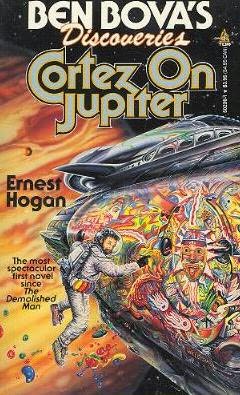
According to the cover of this novel, Cortez on Jupiter is “the most spectacular first novel since The Demolished Man. The Encyclopedia of Science Fiction described Hogan as “a figure of interest for the 1990s”. Unfortunately, he had one more novel published, High Aztec (1992), and then dropped out of sight. Which is a shame. Cortez on Jupiter is an early post-cyberpunk novel about a graffiti artists who ends up making humanity’s first contact with the sentient inhabitants of Jupiter. The flamboyant prose throws off ideas on every page, and the story is a rush from start to finish.

The Krugg Syndrome (1988)
Angus McAllister
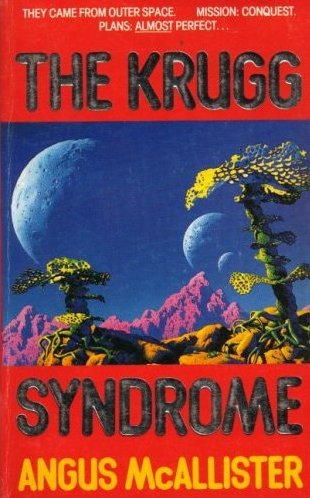
This has to be one of the most mis-marketed books ever. From the cover, you’d expect something from the heartland of the genre, featuring strange expeditions to alien worlds. Instead, what you get is a comedy set in Glasgow in which a law clerk thinks he is an alien. Arthur Montrose is convinced he is a Krugg, one of a race of telepathic alien trees who are bent on conquering Earth. Unfortunately, he’s lost his telepathic powers and can no longer contact his home world… The Krugg Syndrome is a diary of Arthur’s experiences on Earth, the people he meets, his encounters with alcohol and sex, and his increasing inability to fulfill his Krugg mission…

The Morphodite trilogy (1981 – 1985)
MA Foster
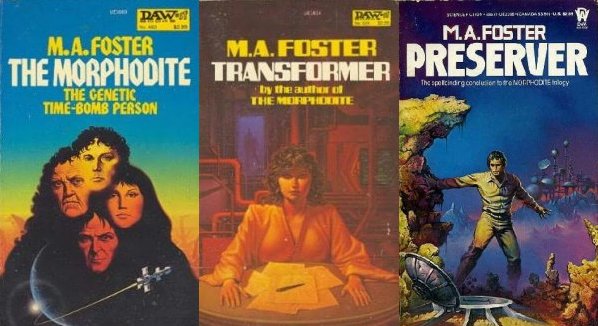
The Morphodite is an artificially created humanoid with the ability to change its appearance, with each transformation changing sex and appearing younger. However, the Morphodite’s real talent lies in spotting a society’s fracture points – i.e., places where the ramifications of one small action can spiral out until they bring down the society. In the first book in the series, The Morphodite, the eponymous character is created in The Mask Factory on the world of Oerlikon, escapes, and promptly wreaks its revenge. In Transformer, the authorities have tracked down the Morphodite and send assassins to kill it. The Morphodite learns that it was originally a woman from offworld. Now knowing its original identity, it leaves Oerlikon for the world of Teragon. Preserver is set on that world many years later. A young man, who works as a thug/assassin for hire, learns when his lover is kidnapped that he is the Morphodite. He then uses his powers to destroy Teragon’s society. There’s something very Vancian about Foster’s prose in these novels, although the central premise and its treatment is not in the slightest bit like Jack Vance. The three books were re-issued in an omnibus edition as The Transformer Trilogy.

Part one of “Overlooked Classics” is here.


8 Comments

Overlooked Classics?

Inspired by this post, I decided to have a go at producing my own list of ten sf novels which don’t really deserve to be forgotten. They’re hardly lost classics – in fact, most of the following I bought remaindered. But that doesn’t necessarily mean they’re bad. Good books get remaindered too. Nor does it mean, as a friend once insisted, that they’re faulty because they’re full of spelling mistakes. Books get remaindered because they didn’t sell.

The science fiction novels below were never going to win awards or redefine the genre. But they are entertaining reads, by no means ordinary, and certainly worth picking up if you see them in some second-hand or charity shop.

The Broken Worlds (1986)
Raymond Harris
Harris had three books published, and then vanished. This is his first. It’s a space opera, set after the fall of a galactic empire. The Martians, immortal warriors, are trying to recreate the empire. Caught up in this are cabaret artist Attanio Hwin and the mysterious woman Sringlë. As space operas go, The Broken Worlds is more colourful than most. While Harris doesn’t try to give his universe depth by slapping on some pseudo-historical patina, he still manages to present a series of worlds which are unique and interesting. EC Tubb did something similar with his Dumarest series, but that was unremittingly grim. The Broken Worlds is fun – The Encyclopedia of Science Fiction even calls it “an attractive picaresque adventure”. Harris’ other two novels are Shadows of the White Sun, which is better than The Broken Worlds but not as much fun, and The Schizogenic Man, which is perhaps the least interesting of the three.

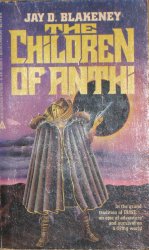
The Children of Anthi (1985)
Jay D Blakeney
Blakeney is a pseudonym of romance writer Deborah A Chester, who is also known under the name Sean Dalton for her YA sf series Operation StarHawks. The Children of Anthi is a richly-detailed space opera, in which scout Omari crashes on the world of Ruantl and is taken hostage by the world’s inhabitants. The story takes place on a single planet, but Blakeney has clearly spent a lot of time mapping out its society and customs. In places, it’s almost Herbert-esque, and fans of Dune will probably find something to enjoy in this novel. There is a sequel, Requiem for Anthi (1990), which is also worth tracking down.

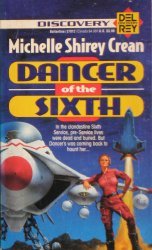
Dancer of the Sixth (1993)
Michelle Shirey Crean
As far as I’m aware, Crean has never had another novel published. Which is a shame, because Dancer of the Sixth is a pretty good read. It’s military sf, but it’s from that strange sub-set which feature female heroines, usually pilots. In this instance, the pilot is called Dancer, and she’s not a pilot anymore. Now she’s a member of the Sixth Service, military intelligence, and her past has been wiped and she conditioned to forget it. Until one day a fighter crash-lands on the planet where Dancer is stationed, and the pilot proves to be… someone masquerading as Dancer. So the real Dancer takes her place to find out what’s going on.

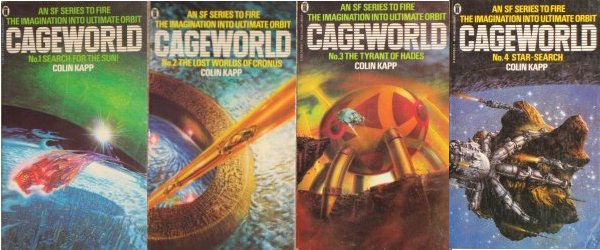
Cageworld (1982 – 1984)
Colin Kapp
This is a cheat as it’s a series of four books: Search for the Sun!, The Lost Worlds of Cronus, The Tyrant of Hades and Star-Search. The series features one of the most impressive Big Dumb Objects in sf – the entire Solar system has been encased in a concentric series of Dyson Spheres. Embedded in each Sphere are holes, and in these holes are Earth-like planets. People live both on these planets and the outer surface of the spheres. It’s all completely implausible of course, but that doesn’t matter. The series opens on the Mars-shell. The fabulously wealthy and mysterious Land-a has recruited Master of Assassins Maq Ancor, Space Illusionist Cherry, and Sine Anura, Mistress of the Erotic, to travel in towards the Sun in a specially built space-ship, Shellback. Contact with the shells’ controlling AI, Zeus, has been lost and they must discover why. In the subsequent novels, the same three travel outwards from Mars-shell, seeking to determine why emigration outwards has halted. Baroque and a great deal of fun.

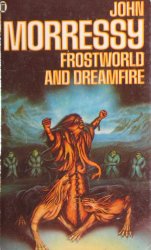
Frostworld and Dreamfire (1977)
John Morressy
Morressy wrote a series of sf novels set in a future interstellar federation called the Sternverein. This is the best of them. (The worst, The Mansions of Space, should be avoided.) Unusually for such space operas – and it’s the only one of Morressy’s series that is like this – Frostworld and Dreamfire is told from the viewpoint of an alien. Hult is the last of the Onhla, a race of primitive humanoid hunters who live on the frozen face of the planet Hragellon. He sets out on a quest to discover the world where legend claims other Onhla settled ages past. The Encyclopedia of Science Fiction describes the novel as “a strongly constructed and occasionally rousing epic of a metamorphic humanoid’s search”. Also worth seeking out is Morressy’s Del Whitby trilogy, also set in the Sternverein – Starbrat, Nail Down the Stars and Under A Calculating Star.

Part two of this post – another five “overlooked classics” – to follow soon.


3 Comments

I Did This So You Don’t Have To – Part 4

Here’s the final lot of films from the SciFi Classics 50-Movie Pack.

The Incredible Petrified World – a diving bell is sucked into a labyrinth of underground caverns, and the four crew-members are trapped there. A mad victim of a shipwreck from years before tells them there is no escape, but our plucky heroes – and heroines, of course – manage to find a route to the surface via a volcanic vent. This film is possibly only of interest to potholers.

Queen of the Amazons – a woman’s husband disappears during a trip into the African jungle. She organises an expedition to find him… only to discover he’s shacked up with the local Amazon queen. But she falls for her guide – who rescues her from all manner of jungle-related danger, of course; including man-eating lions and, er, locusts. There’s not much that’s sf about this movie. In fact, suspiciously many of the films in this 50-movie pack have been set in the African jungle. Maybe they’re hangovers from H Rider Haggard‘s She and King Solomon’s Mines

The Amazing Transparent Man – many years ago, comic 2000AD ran a story about a “Visible Man” – a chemical accident had turned his skin transparent so all his internal organs were, well, visible. This film, on the other hand, is just another tired retread of HG WellsThe Invisible Man. This time, however, he’s aiming for world domination. If he succeeds, how are they going to put his head on the coins and stamps, eh?

Horrors of Spider Island – an agent puts together a troupe of dancing girls for a show in Singapore. En route, their plane crashes and the bevy of beautiful girls find themselves stranded on a deserted island. It’s all sunbathing and skinny-dipping for a while… until their manager is attacked by a giant spider and turns into a half-man half-spider creature. Just like Club 18-30, then. While watching this, I couldn’t work out why the soundtrack was slightly off – the dialogue didn’t seem to match the lip movements. It was only afterwards I learnt that the film is German. I’d just assumed it was an early Roger Corman or something…

Devil of the Desert vs The Son of Hercules – another Italian swords & sandals starring some random bodybuilder as Hercules. These have all started to blur into one homogenous blob of badly-dubbed English, poorly-choreographed fight scenes, evil despots who live in caves and/or castles, and some bodybuilder hero in a leather skirt.

Zontar, The Thing from Venus – an object approaches Earth and proves to be an invader from Venus. It persuades an astronomer to act as its agent on Earth, but is eventually defeated. There was lots of people explaining the plot to each other – usually accompanied by manic laughter – and when Zontar finally does put in an appearance he looks like, well, like a bloke in a rubber monster suit.

Kong Island – some scientists visit the titular island with a plan to turn its gorilla population into an unstoppable army through the use of brain transplants. But a giant gorilla foils their fiendish plot. I know I’ve watched this one, but I have no memory of it. That’s probably a good thing

Bride of the Gorilla – Raymond Burr (better known as Perry Mason) is a plantation manager in a South American jungle. He falls for his boss’s beautiful wife, so he kills the old man and takes over the plantation and the wife. But his crime is witnessed by a native sorceress. She curses him. Every night, he turns into a… wild gorilla. After ripping various people to bits, he’s hunted down and shot. It’s all very silly but quite watchable.

Mesa of Lost Women – a mad scientist invents a serum which makes women beautiful. Men, however, turn into evil dwarves. (Sounds like beer to me.) The serum is actually made from, er, “spider hormones”. A group of people are taken to the secret lair of the mad scientist and manage to foil his fiendish plot.

Hercules and the Tyrants of Babylon – another US star gets roped into one of these Italian Hercules epics. This time it’s Peter Lupus of the Mission Impossible television series. He has to rescue the beautiful Queen of the Hellenes from the eponymous rulers of Babylon – who were actually the most interesting characters in the film. In all other respects, this was just like all the other Hercules films.

Hercules Unchained – happily, this was the last of swords & sandals. Hercules drinks from an enchanted spring, loses his memory, and shacks up with the beautiful but evil Queen Omphale. Fortunately, brave Ulysses helps him regain his memory, so Hercules wins the day yet again. I always thought Hercules only performed twelve labours, but it feels like I’ve watched hundreds of these films. I think I’d sooner muck out the Augean stables than watch another one…

White Pongo – the title creature a legendary white gorilla. A scientific expedition heads into the jungle to find it. One thing about this film puzzles me: the boxed set is titled SciFi Classics, but I fail to see what’s science-fictional about a jungle expedition to find a white gorilla. It’s not even horror, which at least some of the other non-sf films in the set are. But perhaps it’s a bit late to be asking this.

The Snow Creature – now this one is peripherally sf, inasmuch as the objective of the expedition is to find the fabulous Yeti. But in most other respects, it’s very like White Pongo. Parts of this movie appeared to have been filmed on location – although I suspect it’s the Rockies rather than the Himalayas…

That’s it. All fifty movies watched. And I survived. Now onto the second 50-movie pack, Nightmare Worlds

Also see parts one, two and three.


1 Comment

Alt.Fiction 2008

That’s the third alt.fiction finished. And each year it has grown bigger, and more areas of the labyrinthine Assembly Rooms have been opened to the event. I only made it to only two items during the day – a reading from his new novel, Kéthani, by Eric Brown (with the able assistance/prompting of Tony Ballantyne), and a talk by my agent, John Jarrold. I did want to attend the talk on ‘Science Fiction’ given by Eric Brown, Tony Ballantyne and Charles Stross. But it was the last item on the agenda at 8:15 p.m, and I didn’t want to get home late. Sorry I missed it, guys.

All attendees were given an ARC of Charles Stross’ Halting State in their convention pack. I had a chat with Charlie – mostly about the appalling cover art to the US edition of his Saturn’s Children and his upcoming signing tour of the US – and then got him to sign the ARC. On which subject… There were no dealers present – other than the redoubtable and near-ubiquitous Elastic Press, NewCon Press and TTA. This was both good and bad. Bad because I might have been able to pick up a few hard-to-find titles from the wants list. Good because it saved me money. The event organisers were selling books by the attending authors, and there was a signing session arranged about halfway through the day. But there was a poor choice of titles available, and they were pretty much all massmarket paperbacks. But then alt.fiction isn’t a convention per se, and that’s reflected in the attendees. This was particularly obvious during John Jarrold’s talk. Alt.fiction is aimed at unpublished writers, and in that respect the many talks provide some very useful and helpful information. And, of course, an opportunity to network.

Annoyingly, I forgot to take my camera along – although one or two people were happy I’d left it behind. I can’t think why… But, despite that, despite the lack of dealers, I had a good time, and I’ll certainly be attending next year’s alt.fiction.


3 Comments

I Did This So You Don’t Have To – Part 3

Yet more cinematic delights from the SciFi Classics 50-Movie Pack. And I use the word “delights” advisedly.

Warning From Space – yet another Japanese monster movie. In this one, flying saucers approach Tokyo – but not to destroy it. There’s a meteor on a collision course with Earth, and the aliens have come to warn humanity. I think this is the one that has the aliens that look like giant upright starfish with a big eye in their middle. They were… silly.

Phantom from Space – a flying saucer lands in California and a space-suited alien disembarks from it. He attacks and kills two passers-by. The authorities chase after him. So he takes off his spacesuit and underneath he’s… invisible!

Hercules & the Captive Women – sigh. More sandalled bodybuilders running up and down sandy valleys and in and out of caves. The eponymous women – it’s one at a time, rather than many at once – have been left out as sacrifices to Proteus by the queen of Atlantis. Hercules is only there because his friend, King Androcles of Thebes, drugs him and takes him on a mission to uncover who it is that’s trying to conquer Greece. But Hercules defeats the Atlanteans – the queen and an army of strange blond identical men with what look like false foreheads – and everyone lives happily ever after.

Lost Jungle – this one is a vehicle for 1930s animal trainer Clyde Beatty, and an excuse to have a lion and a tiger fight it out on-screen. Beatty’s (he plays himself) girlfriend disappears on an expedition to discover the lost island of Kamor, which boasts both African and Asian fauna. Lions and tigers, in other words. Beatty, freely admitting that Kamor will save him the expense of a trip to Africa and India, joins a rescue mission. And, er, rescues her. Oh, and there’s a fight between a lion and a tiger. Even though Beatty plays himself, the film makes an effort to give him a character-arc. I suspect that’s unusual in a 1934 film.

Teenagers from Outer Space – a bunch of Martians arrive in California in a flying saucer and decide it is an excellent place to raise their giant lobster-like cattle. Unfortunately, these creatures will destroy all earthly life, so one heroic Martian escapes to warn the population of a nearby town. There’s a sort of earnest amateurishness to this film.The special effects are poor, the acting is terrible, and the plot involves a lot of running about. Despite that it’s actually not bad.

Rocky Jones, Space Ranger: Menace from Outer Space – yet more interplanetary derring-do by Rocky, sidekick Winky, and token female Vena Ray. There’s a comet approaching the Earth, and it’s controlled by some villains. Rocky heads off in his spaceship and saves the day. Can anyone spell “formula”?

Colossus and the Amazon Queen – I bet Rod Taylor (of George Pal’s The Time Machine, among other films) doesn’t mention this one on his c.v. He plays the sidekick of strongman Glauco (played by yet another bodybuilder). The pair of them go exploring, and find themselves in the hands of the Amazons. Glauco escapes, and then rescues the others. All these Italian swords & sandals epics are starting to blur into one… Astonishing to think that these films were made in the same country that gave us the great Michelangelo Antonioni

Moon of the Wolf – there’s a werewolf loose down in the bayou. Even when this film was made in 1972, its plot was a cliché. David Janssen plays the manly sheriff, Bradford Dillman the louche aristocrat who’s really a werewolf, and Barbara Rush the sister who had a fling with the sheriff but had to go away because she consorted with the one of the lower orders… Southern Gothic meets An American Werewolf in Paris. In recent years, this has become an extremely popular sub-genre in written fiction – for reasons I completely fail to understand.

The Wasp Woman – an early Roger Corman, this one wasn’t too bad… except for the title character. The owner of a cosmetics company injects herself with wasp royal jelly in the hope of looking younger. Which it does. It also turns her into a wasp-human hybrid at intervals. Who attacks and kills people. Pretty silly. Um, on reflection, perhaps it wasn’t that good after all.

The Galaxy Invader – an alien crash-lands in the wrong part of the US, and a group of drunken rednecks go hunting for him. It’s sort of like Deliverance. But without a decent script. Or anyone who can act. Or a decent director. Or coherent dialogue. Actually, it was more like a home video.

Also see Part 1 and Part 2.


1 Comment

Mazel Tov

It takes a brave man in the US to criticise Israel. In The Yiddish Policemen’s Union, Michael Chabon has been even more courageous – in the world of his novel, Israel does not even exist. The Yiddish Policemen’s Union is an alternate history – or “counterfactual”, if you’re a literary snob – in which the Jews were booted out of Palestine in 1948, and so David Ben-Gurion never unilaterally declared on 14 May 1948 the establishment of the nation state of Israel. Instead, the US provides land in Alaska for temporary settlement, Sitka, on a sixty-year lease.

(There are clues in the story indicating that the world of the novel diverged further from our history than initially seems the case – a republic in Russia, mention of an atom bomb being dropped on Berlin in 1946, and references to a war with Cuba during the 1960s.)

Like Robert Harris’ Fatherland, Chabon uses his alternate history to tell a story whose resolution is dependent upon knowledge of real history. And also like Harris’s novel, The Yiddish Policemen’s Union reads like another genre entirely – in this case, a hard-boiled detective novel. Meyer Landsman is an alcoholic homicide detective living in a fleabag hotel. When a fellow tenant is murdered – executed, in fact, by a shot to the back of the head while high on heroin – Landsman investigates. Since Sitka is weeks away from “Reversion” – i.e., the end of the Jews lease on the Alaskan land, and thus the end of their “homeland” – Landsman’s superiors want him to drop his investigation. He deliberately disobeys them… and uncovers a conspiracy which reaches all the way up to the United States’ president.

The Sitka of The Yiddish Policemen’s Union is – as the title suggests – a Yiddish culture, rather than the real-world Israel’s Hebrew. Chabon does not translate the Yiddish, but the meaning of the words is clear from context. Anthony Burgess did something similar with Nadsat in A Clockwork Orange – even going so far as to say his intention was to “brainwash” the reader into understanding the borrowed Russian terms much as the protagonist Alex was himself brainwashed not to inflict violence. Given that Chabon has said in interviews that the inspiration behind The Yiddish Policemen’s Union was an article he wrote about a Yiddish phrasebook, this is perhaps not unsurprising.

The prose is very Chandleresque, although it occasionally struck me as a mite too calculatedly so. Some of the turns of phrase, the off-the-wall similes and metaphors, read a little forced. The relationship between Landsman and his partner, Berko Shemets, however, is handled beautifully – some of the best characterisation I’ve read in recent years, in fact. Interestingly, Chabon originally wrote the novel in the first person. Third-person present tense, I think, works much better. The tense gives the story an immediacy which pulls the reader along and over the hurdles created by unfamiliar Yiddish terms or Jewish practices.

Again like Fatherland, The Yiddish Policemen’s Union ends with an event which comes as little surprise to us from our knowledge of the real world. Chabon handles it at a remove, which lessens its impact. Landsman’s cynicism also acts as a barrier against the shock we should feel. But then, to have made him naive and credulous would have meant he could not follow the plot to its conclusion. As it is, the climax slips past little too quickly and easily.

Where The Yiddish Policemen’s Union really shines is in Chabon’s creation of Yiddish Sitka. It’s a fascinating alternate world, and described with a depth and level of detail uncommon in many alternate histories. Perhaps this is because the novel’s focus is very narrow – i.e., a single city and its environs, rather than an entire world. All the same, it’s an impressive invention.

Minor quibbles aside, I was much impressed by The Yiddish Policemen’s Union. Much has been made of Chabon’s sensitivity for the genre, and that attitude is very much clear in this novel. He has written a story that is quite clearly science fiction, without pandering to the snobbery of either the genre or its detractors. If only more writers would do the same…


2 Comments

Black Man / Thirteen

When I started this blog, it was not my intention to post reviews of the books I read. Well, not unless they were part of some annual “challenge” I’d set myself – and where I’d be charting my response to the challenge as much as writing about the books themselves. There are plenty of other places to find book reviews – both on and off the tinterweb. (Including my other blog, A Space About Books About Space, which is specifically about non-fiction books about the Space Race.)

However…

At some point during the Easter weekend, I’ll likely be voting on the novels shortlisted for the BSFA Awards. Unusually for me, I’d read half of the shortlist before it was announced. And I’ve now read another two from it – Black Man by Richard Morgan and The Yiddish Policemen’s Union by Michael Chabon. And here’s what I thought of them…

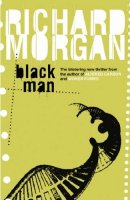
When a novel opens with a man on a spacecraft travelling between Mars and Earth eating the other passengers in order to survive, you know it’s not going to be an easy read. And so Black Man proves. Morgan‘s premise is that some 20,000 years ago humanity bred some sort of super alpha male out of the gene pool as the type was not suited to the newly-created mode of agrarian civilisation. But during the late Twenty-First Century, various nations genetically engineered a generation of these “variant thirteens” to be super-soldiers. In the UK, they were known as Osprey, and in the US as Project Lawman. Later the programmes which had created them were outlawed, and the surviving variant thirteens restricted to secure reservations.

But not all of them.

Some were exiled to Mars. One of them, Carl Marsalis, went to Mars but returned. He now works as an agent for the United Nations, tracking down and killing rogue variant thirteens. One such rogue has escaped from Mars – the cannibal mentioned earlier – and is now on a killing spree in the US. Marsalis is co-opted by COLIN (Colony Initiative), the pan-national agency responsible for the settlement of Mars, to find the killer.

Morgan pulls no punches. His US of the Twenty-Second Century is a grim, corrupt and selfish place. It’s two parts American history to three parts a European’s view of the country as it is now. The North and South have split, and the South is now a backward Bible-bashing regime cynically known as “Jesusland”. The Western seaboard has also seceded, and remains the economic and industrial powerhouse of the continent. From this side of the Atlantic, it seems all too frighteningly plausible a future.

Black Man is also an extremely violent novel. You have to wonder what Anthony Burgess would have thought – the forty-year-old A Clockwork Orange‘s “ultra-violence” seems tame in comparison to that in Black Man. Of course, the violence is there because the variant thirteens are sociopathic killers. I’m not quite convinced such behaviour would have been useful 20,000 years ago, never mind during the late 21st Century. And to have one as a sympathetic protagonist and another as an immoral villain is a difficult balancing act. Morgan pulls it off – just about. He perhaps uses the fact that Marsalis is a Brit a little too much as justification for his more sympathetic character. No reader, of course, would identify with a true variant thirteen – although I’ve seen blustering reviews by one or two on the Web who seem to think they’re kindred alpha male souls. It’s all bollocks, of course (no pun intended). Marsalis might as well be an alien – and as any sf writer knows, make your alien too alien for your readers… and you’ll have no readers. Morgan is a smart enough writer to know that Marsalis can’t carry the story if he hews too close to the line of his central premise.

There are other viewpoint characters – such as Sevgi Ertekin, a Muslim Turkish-American COLIN detective; her partner, Tom Norton; and even a believer from Jesusland working illegally in California, Scott Osborne, who gets caught up in the plot (and later disappears from the story, only to pop up near the end). To me, Ertkin seemed more like a stereotypical NYPD cop, and not that much different from Olivia Benson in Law & Order: Special Victims Unit. Her background struck me as one of Black Man‘s few weak notes – as well as the unfortunate inspiration for some unnecessary and over-long info-dumps when the story takes the characters to Istanbul.

World-building and premise aside, Black Man is a tautly-plotted thriller. Morgan is in control of his material throughout the story. Perhaps one or two of the clues necessary for resolution are a little too peripheral, making the scenes in which they appear seem somewhat unnecessary. But that’s a minor quibble. The writing is strong, with several nice turns of phrase. I wasn’t entirely convinced by the central premise – or rather, I wasn’t convinced that variant thirteens would ever be useful or necessary. I suppose that’s little different to believing time travel will ever be possible, but I’m not sure I can let it go enough to choose the novel above Alastair Reynold’s The Prefect or Michael Chabon’s The Yiddish Policemen’s Union.

My thoughts on The Yiddish Policemen’s Union to follow soon…


2 Comments

The Future’s So Bright

A couple of nights ago, I watched Wim Wenders’ Until the End of the World for the first time in many years. I first saw this film back in, I think, late 1993 or early 1994. I thought then its depiction of 1999 was one of the most realistic and plausible depictions of the near-future I had ever seen.

But that was before the year in which film is set. I’ve now watched it again almost a decade after the year in which it is set…

Wenders apparently wrote Until the End of the World to be the “ultimate road movie”. It’s set in the months leading up to the start of the new millennium. An Indian nuclear-powered satellite is out of control, and could fall from orbit, causing widespread contamination. Claire Tourneur (Solveig Dommartin) is returning to Paris from Venice when a traffic jam prompted by the impending crash of the satellite forces her off the beaten track. As a result, she is involved in an accident with a pair of friendly bank robbers. After giving them a lift to the nearest town – her car survived the crash, theirs didn’t – they ask her to take their ill-gotten gains to Paris for a 30% cut. En route, Claire then meets Trevor (William Hurt) and gives him a lift to Paris… but he steals some of the money.

The film then develops into a chase, with Claire and her boyfriend Gene (Sam Neill) following Trevor to retrieve the stolen, er, stolen money. Trevor is also being chased by bounty hunters, since he apparently stole an expensive prototype camera from a US lab. This camera records the brainwaves associated with seeing. Trevor is using the camera to record his relatives for his blind mother (Jeanne Moreau). The film finishes up in the Australian Outback, where Trevor’s father (Max von Sydow), the inventor of the camera, has a secret lab.

Then the Indian nuclear-powered satellite explodes, causing an electro-magnetic pulse which wipes out all unshielded electronic equipment…

When I first saw Until the End of the World, I was very taken at the way in which it showed technology integrated into everyday life. Cars had electronic maps on their dashboards, computers were small and portable, videophones were the norm, software programs had animated avatars as user interfaces and could search global data… And yet other aspects remained unchanged. Cars looked a sleeker but a lot of old models were still being driven. Cities appeared to have changed very little – more neon and glass, perhaps, but no real substantial changes. And the way in which people lived their lives had not altered…

Science fiction has never been about predicting the future – that’s futurism. But watching Until the End of the World now, eight years after it was set, seventeen years after it was made… it’s interesting seeing just how close Wenders was.

Cars do indeed have electronic maps on their dashboards – GPS. Desktop computers have not changed greatly in appearance in ten years (unless you include the introduction of TFTs), but laptops certainly have. They are a great deal smaller and more powerful than they were in 1991 – the Asus EEE, for example, is 22.5 x 16.5 cm. Admittedly, the animated GUI for the search programs shown in the film are crude; modern CGI is far more sophisticated and realistic. But the search through global data itself is not so far from Google and the like – don’t forget that when Until the End of the World was released, the WWW did not exist. And while videophones have yet to really catch on, mobile phones with cameras are common, as are webcams.

Despite this, the film still doesn’t feel like it was actually made in 1999. There are enough near-misses to indicate its true age. And, of course, the central conceit, the camera which records brainwaves, is pure science fiction.

It’s still a damn good film, however. I’m not sure I’d call it a favourite – the plot feels a little like two stories badly-welded together, and both William Hurt and Solveig Dommartin seem curiously blank throughout. And the edition released in the UK has no subtitles, despite there being a lot of French dialogue (which is a little too fast and fluent for me). But I’ll certainly watch it again.


8 Comments

The Heart of Matter

NOTE: THIS POST INCLUDES SPOILERS

Matter is Iain Banks‘ first Culture novel since Look to Windward in 2000. So there was a great deal of eagerness – and not just by myself – when it was announced. Orbit clearly realised that Matter‘s publication was an event – Waterstone’s has been selling the hardback at half price since a week or so before the official publication date.

There are, it has to be said, a certain number of things you expect to find in a Culture novel. And one of those things is a Big Dumb Object. In Matter, this is the Shellworld called Sursamen, which consists of a series of vast concentric spheres, each of which is in effect a planetary surface. Shellworlds were built for reasons unknown by a race which has long since vanished.

The Sarl, a human race, live on Sursamen’s Eighth level. They are at war with the Deldeyn, another human race, from the Ninth level. Ferbin is heir to the throne of Hausk, a cod-mediaeval Sarl kingdom. He’s more of a playboy prince than a suitable candidate for ruler, however, so when Ferbin inadvertently witnesses his father’s murder after a battle, he flees for his life. He determines to seek help from Xide Hyrlis, a Culture representative who had been a friend of King Hausk many years before. He also decides to track down his sister, Djan Seriy, who left to join the Culture, and now works for Special Circumstances.

There are three main narratives in Matter, centred on the three surviving offspring of King Hausk. Ferbin and his manservant Holse escape Sursamen and track down Hyrlis. Djan Seriy returns to Sursamen to learn the truth of her father’s death. And Oramen, youngest son and now prince regent, follows the invading Sarl army to the Ninth level and the Nameless City, an ancient metropolis slowly being revealed by the great Falls of Hyeng-zhar.

King Hausk’s murder, the war against the Deldeyn of the Ninth level… these are all part of a conspiracy orchestrated by Hausk’s trusted adviser, friend and murderer, tyl Loesp. He is working for the Oct, the alien race which control part of Sursamen. Their objective is not revealed until a good three-quarters of the way into the story, and its result is certainly not the intended one.

The Oct are mentored by the Nariscene, who are in turn mentored by the Morthanveld. Whose civilisation is equivalent in technology and advancement to the Culture. This civilisational hierarchy is important to the plot of Matter.

Iain Banks is one of the most interesting writers currently working in science fiction – but only in the sense of science fiction as a branch of literature. He’s not really an ideas man. Yes, the concept of the Shellworld is pretty impressive… but it’s been done before – in Colin Kapp’s Cageworld quartet. In fact, if anything, Banks has a tendency to pick up current ideas and slot them into his fictions, whether they fit or not. Look to Windward introduced nanotechnology to the Culture; and Matter introduces cyberspace. Neither had been mentioned prior to their appearances in these novels, and yet they are treated as if they had always existed. Which does make their sudden inclusion seem a little odd.

In some respects, the hierarchy of civilisations mentioned above also has the feel of an add-on required for Matter‘s plot to function – it’s not only reminiscent of David Brin’s Uplift novels, but it all seems so much busier a universe than earlier Culture novels had suggested. But denying the possibility of such additions and changes does smack a little of the “clomping foot of nerdism”. Fictional universes are as flexible and adaptable as required by the story.

What makes Banks really interesting is that his sf novels are not just simple action-adventures in a space opera setting. There’s enough detail in there to attract those who want immersion in a made-up universe, but he’s not one to slavishly follow genre story templates. Use of Weapons features two narratives running in opposite directions chronologically; Against A Dark Background has a quest plot, in which the protagonist loses every plot coupon shortly after winning it… but still manages to finish the course (but I’m not convinced that was done knowingly).

Having said that, Banks is less adventurous with the structure of Matter. It is, for much of its length, relatively traditional – something of a picaresque travelogue, albeit juxtaposed with high fantasy wargames on Sursamen’s Eighth and Ninth Levels… However, Matter ends with an appendix – a completely unnecessary dramatis personae and glossary. And after that, an epilogue. Which changes the final shape of the story. The appendix is there to hide the epilogue. Now, that is an interesting choice.

Banks usually has something interesting to say, too. Matter is no different in this respect. And, if I’m reading the novel right, it’s about Iraq, about whether so-called “developed” nations have the right to meddle in the affairs of other nations. The parallels are clear – should the Culture interfere in Sursamen? Unfortunately, Banks’ message is muddled. Matter‘s prologue shows one such intervention by Special Circumstances, and that later proves mostly successful. But the Culture’s refusal to interfere in the situation in Hausk – especially given how it progresses; and they are watching it, after all – leads to a situation which could destroy everything. The epilogue shows the Culture changing its policy.

This, then, is the message from the writer who chopped up his passport over the invasion of Iraq. According to Matter, he’s now saying it is good to interfere – if the interference prevents slaughter and destruction. Or perhaps he means only to interfere in the interference of the Oct, which has caused slaughter and destruction? Banks has pre-built the moral high ground into his universe – the more evolved civilisations, the Involved, are more advanced and therefore more moral. That’s part of evolution, after all. So it’s okay for moral – or advanced; or, perhaps, “developed” – civilisations to interfere, Matter seems to be saying, but not for less evolved ones. That’s not a good message. Because Banks’ universal hierarchy is a cheat – morality is treated as if it were a physical law, as if a civilisation accrued some kind of wavicles of morality as it progressed and aged.

Other areas of Matter worthy of comment… It is very talky. Characters waffle a lot. They often repeat themselves. The novel also suffers from a sudden flurry of small resolutions as the end approaches. Banks’ digressions are often his best bits – and some of the digressions in Matter are among the best he’s done – but it does mean that his climaxes frequently feel rushed. It does here. And, there is throughout the novel odd verbings of nouns and nunation of adjectives. Banks in part explains this, having Djan Seriy say the Sarl sometimes use “words oddly” – “we guilt you”, “he has been jealoused”. But there are occasions where even that is no defence – the neologism is neither in dialogue, nor even in a narrative set on Sursamen or featuring a Sarl character.

Oh, and why does Matter have double quotes for dialogue throughout, when normal British practice is single quotes?

One of the reasons Banks is an excellent writer is that despite all the above I liked Matter a great deal. It’s likely to be one of the most interesting sf novels published in 2008. Whether that makes it one of the best, I don’t know. Depends what else I read, of course. Unlike The Algebraist, Matter did not disappoint.


1 Comment

I Did This So You Don’t Have To – Part 2

Here’s the next set of films from the SciFi Classics 50-Movie Pack.

Attack of the Monsters – another Japanese monster movie. Three kids find a flying saucer, two of them climb aboard and are whisked away to another world. They see a giant monster with a sword on its head fight a giant pterodactyl. Then they’re rescued by two women in futuristic costumes, and taken into the women’s base. But the women are evil, and want only to conquer Earth. Happily, Gamera the giant flying turtle arrives, kills the monster with the sword on its head, and saves the day. If you want to watch a Japanese sf film, watch The Mysterians. Not this.

Voyage to the Prehistoric Planet – this film was created from a re-edit of the Russian film, Planeta Burg, with English dialogue recorded over it and a couple of scenes featuring Basil Rathbone added. A US spaceship arrives in orbit about Venus, but the first landing mission crashes. So a second one is launched to rescue them. While the film is badly-paced, and the story doesn’t make a great deal of sense, it all looks pretty cool. Well, except for the dinosaurs, which look like men in rubber dinosaur suits.

Voyage to the Planet of Prehistoric Women – this one uses the same footage as Voyage to the Prehistoric Planet, with the mystifying addition of several scenes featuring Mamie van Doren and a bevy of beautiful women in bikinis who are apparently the telepathic inhabitants of the planet. Their scenes don’t actually seem related to the rest of the film. Much of the movie is narrated by “director” Peter Bogdanovich. Voyage to the Prehistoric Planet was interesting but a bit dull; Voyage to the Planet of Prehistoric Women is near unwatchable.

Blood Tide – another one that wasn’t sf at all. James Earl Jones hams it up as a poet-turned-treasure-hunter on some Greek island. There’s an ancient temple accessible only via a sea cave, but it has some horrible guardian. Newcomers try to horn in on Jones’ treasure-hunting, the sea monster awakens, and the ancient temple is destroyed. A better transfer would have greatly improved this film. It didn’t actually appear that bad – although it was hard to tell at the time as the picture and sound were so poor.

First Spaceship on Venus – this is actually a badly-dubbed version of the East German film, Der Schweigende Stern (The Silent Star). Scientists analyse the debris of huge meteor impact, and discover a recording from a crashed spacesuit. They determine the spaceship was from Venus, and so send a mission to that planet. En route, they decode the recording. It’s an invasion plan… The production design is really good, with some excellent model work and some truly weird sets. I plan to get a copy of the original version – happily, it’s available on DVD.

Buck Rogers: Planet Outlaws – not the grinning beefy loon in a spandex girdle of the 1980s television series, this is the original one: Buster Crabbe. His prototype airship crashes on its maiden flight at the north pole, and he is frozen… and woken up centuries later. He ends up helping the inhabitants of an invisible city in their war against the evil Killer Kane. This involves such cunning ploys as hiding behind rocks, and jumping out at Kane’s men as they pass by. If you like Flash Gordon serials, then this is, well, exactly the same.

Killers from Space – Peter Graves of Mission Impossible stars as a scientist whose plane crashes during an atom bomb test. When he turns up later, no one believes his story of alien abduction and invasion. Unlike Whitley Strieber, it seems he’s telling the truth. This one wasn’t as bad as it sounds.

She Gods of Shark Reef – when the box cover says “SciFi Classics”, that’s what you expect: science fiction. By no stretch of the imagination could this film be considered that. Two gunrunners are shipwrecked on a Hawaiian island populated only by attractive women. When one of the women is chosen for the annual sacrifice to the shark god, the gunrunner who is in love with her tries to rescue her. Another film I suspect was more fun to make than to watch.

The Atomic Brain – a scientist experiments with brain transplants, including transplanting a woman’s brain into a cat, and vice versa. You can’t help but wonder how a human brain would fit into a cat’s skull, or what he used for padding when he put the cat’s brain in the woman’s skull. Judging by the woman’s acting, it was probably blancmange or something. This is the sort of film that gives B-movies a, er, bad name.

Son of Hercules: The Land of Darkness – another spaghetti sandal epic, and yet another random bodybuilder in the title roll. Except he’s not a son of Hercules, he’s actually Hercules himself. Although, for some bizarre reason, the English language dubbing calls him Argolese throughout. The blurb on the CD pack says, “Hercules falls for the daughter of a deposed king whose kingdom is held in thrall by an evil queen.” I know I’ve watched this film, but I can’t remember what actually happened in it.

Rocky Jones, Space Ranger: Crash of the Moons – this is a compilation of two episodes of a 1954 television series. It shows. Rocky’s sidekick, Winky, is annoyingly stupid. The female, Vena Ray, might prance about in a miniskirt, but she’s surprisingly assertive for the early 1950s. The special effects – apparently expensive for the time – are a little better than Flash Gordon from two decades earlier, but not much. Forbidden Planet this isn’t.

Santa Claus Conquers the Martians – the theme-tune to this film is great, a perfect piece of 1960s bubblegum pop. Sadly, it’s all downhill from there. Green-skinned Martian kids are addicted to Santa Claus on Earth television, so their parents decided to kidnap him. But Santa sets up shop on Mars, and wins everyone over with sacks full of cheap toys. I suspect that seeing the film as an allegory for the rise of Japan after World War 2 might be reading a little too much into it. Especially since it’s, well, crap.

Part one is here.