It Doesn't Have To Be Right…

… it just has to sound plausible


33 Comments

British SF Masterworks

Science fiction is a genre dominated by the US – which is where it was invented. The SF Masterworks series is published by a British publisher. So why not have a Masterworks series of British science fiction? This topic popped up on twitter yesterday, and inspired me to have a bash at creating my own list of fifty British science fiction masterworks.

I’ve not read all of the books listed below – so thanks to Kev McVeigh, Paul Graham Raven and Eric Brown for their input. Not all the books could really be considered “classics”, although the more obscure ones should probably be better known. The only rules I followed in putting together the list are: a) one title per author (unless it’s a trilogy in omnibus form), and b) a completely arbitrary cut-off date of 1995. Some of the books in my list are in Gollancz’s Masterworks series, but many are not. Yes, a few of my favourites have sneaked in there; not to mention a number of non-genre novels by non-genre writers which actually are science fiction.

There are no fantasy novels at all. That’s a list for another day…

1 – Frankenstein, Mary Shelly (1818)
2 – The War of the Worlds, HG Wells (1897)
3 – Last And First Men, Olaf Stapledon (1930)
4 – Brave New World, Aldous Huxley (1932)
5 – Nineteen Eighty-four, George Orwell (1949)
6 – The Day of the Triffids, John Wyndham (1951)
7 – The Death of Grass, John Christopher (1956)
8 – No Man Friday, Rex Gordon (1956)
9 – On The Beach, Nevil Shute (1957)
10 – A Clockwork Orange, Anthony Burgess (1962)
11 – The Drowned World, JG Ballard (1962)
12 – Memoirs of a Spacewoman, Naomi Mitchison (1962)
13 – A Man of Double Deed, Leonard Daventry (1965)
14 – The Time Before This, Nicholas Monsarrat (1966)
15 – A Far Sunset, Edmund Cooper (1967)
16 – The Revolt of Aphrodite [Tunc and Nunquam], Lawrence Durrell (1968 – 1970)
17 – Pavane, Keith Roberts (1968)
18 – Stand On Zanzibar, John Brunner (1968)
19 – Behold The Man, Michael Moorcock (1969)
20 – Ninety-Eight Point Four, Christopher Hodder-Williams (1969)
21 – Junk Day, Arthur Sellings (1970)
22 – The Continuous Katherine Mortenhoe, DG Compton (1973)
23 – Rendezvous With Rama, Arthur C Clarke (1973)
24 – Collision with Chronos, Barrington Bayley (1973)
25 – Inverted World, Christopher Priest (1974)
26 – The Centauri Device, M John Harrison (1974)
27 – The Memoirs of a Survivor, Doris Lessing (1974)
28 – Hello Summer, Goodbye, Michael G Coney (1975)
29 – Orbitsville [Orbitsville, Orbitsville Departure, Orbitsville Judgement], Bob Shaw (1975 – 1990)
30 – The Alteration, Kingsley Amis (1976)
31 – The White Bird of Kinship [The Road to Corlay, A Dream of Kinship, A Tapestry of Time], Richard Cowper (1978 – 1982)
32 – SS-GB, Len Deighton (1978)
33 – Where Time Winds Blow, Robert Holdstock (1981)
34 – The Silver Metal Lover, Tanith Lee (1981)
35 – Helliconia, Brian W Aldiss (1982 – 1985)
35 – Orthe, Mary Gentle (1983 – 1987)
36 – Chekhov’s Journey, Ian Watson (1983)
37 – A Maggot, John Fowles (1985)
38 – Queen of the States, Josephine Saxton (1986)
39 – Wraeththu Chronicles [The Enchantments of Flesh and Spirit, The Bewitchments of Love and Hate, The Fulfilments of Fate and Desire], Storm Constantine (1987 – 1989)
40 – Kairos, Gwyneth Jones (1988)
41 – The Empire of Fear, Brian Stableford (1988)
42 – Desolation Road, Ian McDonald (1988)
43 – Take Back Plenty, Colin Greenland (1990)
44 – Wulfsyarn, Phillip Mann (1990)
47 – Use of Weapons, Iain M Banks (1990)
48 – Vurt, Jeff Noon (1993)
49 – Ammonite, Nicola Griffith (1993)
50 – The Time Ships, Stephen Baxter (1995)

So, any I’ve missed out? Any UK authors – born, not simply resident – who belong on this list? Or are any of the books I’ve chosen actually really bad and don’t belong on it?

Perhaps this might turn into a meme – you know the sort of thing: how many have you read, how many do you own but have yet to read… For the record, I’ve read thirty-two of the books, and own a further four I’ve not read.


11 Comments

The Unreachable Frontier

Science fiction writers arguing about space exploration is a bit like fantasy writers arguing about which sword to use in a melee. The nearest the latter will have got to an edged-weapon is rolling a D20, and the former likely don’t know Max-Q from LOR. And there’s no reason why they should. Many sf writers, in fact, have no interest in the science and engineering of space exploration – by humans or by robots. It has no bearing on the stories they tell.

Some sf writers, of course, are actual working space scientists and engineers. Like Gregory Benford, who is a professor in the Department of Physics and Astronomy at the University of California, Irvine. Or Geoffrey A Landis, who works for NASA, and has presented his idea for living in dirigibles high in Venus’s atmosphere both on television and in fiction (in a recent issue of Asimov’s).

Myself, I’m no rocket scientist, but I’m interested in the subject and have read a number of books on it – see my other blog, A Space About Books About Space. Admittedly, I’m particularly interested in the hardware and engineering of the Apollo programme, which is pretty much a historical subject. Fascinating as the engineering solutions used by NASA were, progress has rendered many of them obsolete. Except for launch vehicles. The rocket engine has not substantially changed since the days of the Verein für Raumschiffahrt. Nonetheless, you can’t help pick up some of the relevant science when reading books by the likes of Tom Stafford (Gemini 6A, Gemini 9A, Apollo 10, ASTP), Harrison Schmitt (Apollo 17), or Michael Collins (Gemini 10, Apollo 11). Not to mention books about individual missions, or various aspects of human space exploration.

Sf writer Charles Stross recently posted an interesting piece about colonising space on his blog here. He argued that “space colonization is implicitly incompatible with both libertarian ideology and the myth of the American frontier”. The dream, he explained, is driven by nostalgia. And there’s an impedance mismatch between aspirations fuelled by the achievements of wild West pioneers and the reality of the inimical environment found outside the Earth’s atmosphere. In ye olde days, you could run away from what you felt was unwarranted interference in your affairs – sod society, I want to do what I want – and head out into the blue yonder. There was hardship and danger, but the environment those Randian pioneers were entering was an environment for which the human organism was adapted. That’s not true of space, or of worlds other than Earth.

S Andrew Swann, a libertarian sf writer, whose books I admit I’ve not read, took exception to this – see here. He counter-argued that the collective effort required to colonise space is not incompatible with libertarian ideology, “as long as the colony is a privately run enterprise and the inhabitants were all there by their own choice, and aren’t living off the threat of force to appropriate the resources needed for their survival”. Rubbish. In a privately-run enterprise, the inhabitants will not be there by choice, they will be there because they can afford to be there. And if they can no longer pay for the environment which keeps them alive, then… It’s a bit like health care. Can’t afford it? Whoops, sorry: you die. Unless, of course, you have a national health service.

The Apollo programme was a socialist programme, and deliberately so. James Webb spread throughout the country the money provided by the US Administration to meet Kennedy’s goal. By distributing the billions of dollars required to reach the Moon, he improved industry, education, and general standards of living in many parts of the US. Of course, there was a lot of wheeling and dealing taking place in Washington, such that some areas were chosen in preference to others.

Space is not an environment fit for human beings. You have to carry everything you need for life with you. One in ten space travellers is likely to catch cancer from cosmic radiation. If anything breaks down, you’re stuffed. The Apollo Lunar Module was one of the most reliable vehicles ever built. If it hadn’t worked, the astronauts it carried would have been stranded on the Moon; they could not be rescued.

But if libertarian politics are incompatible with the realities of space exploration and colonisation, they’re not apparently incompatible with space opera. But then most science fiction set in the Solar system, or on other planets, is essentially fantasy in that regard. It features magical drives which allow ships to travel faster than the speed of light, and magical devices to create a gravitic field inside the ship. Not to mention magical technology to create hulls which are not susceptible to meteoroids and space debris, magical closed-loop environment systems which function without any apparent maintenance or reprovisioning, magical navigation systems which can take a ship across distances measuring hundreds of light years with phenomenal accuracy… In science fiction, Clarke’s dictum would be better recast as “any sufficiently advanced technology is indistinguishable from wish fulfillment”.

There is little or no sf which engages realistically with the realities of living and working outside the sustaining envelope of Earth’s atmosphere. New Space Opera allegedly introduced some hard sf to space opera, but that chiefly seemed to be a recognition that the universe is a very big place. It’s possible technological quantum leaps in our future may make interstellar – or even interplanetary – travel a reality, but we have a fairly good understanding of the universe right now and there’s very little room to maneouvre in what we know.

There are those sf novels which describe a near-future in which humanity – well, the US – has spread out among the planets and moons of the Solar system. Even they skate over the difficulties of living and working in space; and they’re also predicated on the same sort of libertarian claptrap espoused by the likes of S Andrew Swann – “there’s gold in them thar ast’roids!”

That may well be why most sf – space opera or hard sf – uses magical wish-fulfillment technology to create an environment in which a story can be set. That environment need not be realistic – or rather, it need only create a sufficiently earth-like environment in which realistic stories can be set. The universe is, after all, the biggest canvas of all. Science and technology and engineering and politics and economics prevent us from writing on it. So we must use our imaginations. And if we must imagine away those hurdles in order to use that canvas, then why shouldn’t we?

But I’d still like to see some sf that makes a serious effort to depict humans in space realistically…


4 Comments

A Mini-haul

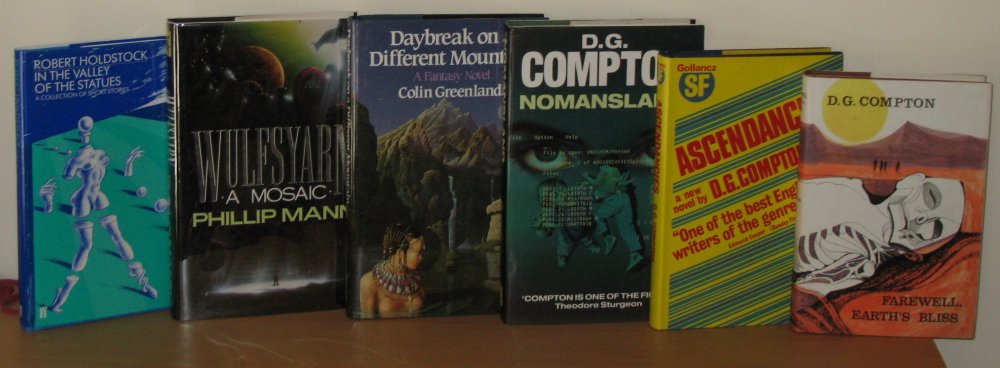
If you’re looking for first editions of out-of-print sf novels, the best place to look is Andy Richard’s Cold Tonnage Books. He also usually has a table in the dealers’ room at the Eastercon. I just ordered a bunch of books from him. and here they are:-

From left to right: In the Valley of the Statues, a collection of short stories by Robert Holdstock, who wrote chiefly science fiction before Mythago Wood was published. He will be missed. Then, Wulfsyarn by Phillip Mann, a UK-born New Zealand-based sf author, whose last published novels were the A Land Fit For Heroes quartet from 1993 to 1996. His novels are certainly worth checking out. Next, Colin Greenland’s debut novel, a fantasy, Daybreak on a Different Mountain. And finally three DG Compton novels: Nomansland, Ascendancies and Farewell, Earth’s Bliss. After reading The Continuous Katherine Mortenhoe (see here), Compton has joined my list of collectable authors.

I can feel especially good about these purchases because not only are they excellent novels, but this week I also managed to sell three George RR Martin A Song of Ice and Fire paperbacks and five Robert Jordan Wheel of Time paperbacks on eBay.


11 Comments

Meme-ing a list again

Jack Deighton posted this on his blog here a few days ago. It makes for cheap and easy content, so I’m doing similar. The list below is from the SFX Book Club list of classics. As usual, bold those you’ve read, italicise those you own but haven’t read…

1. The War Of The Worlds by HG Wells
2. The Martian Chronicles by Ray Bradbury
3. Ringworld by Larry Niven
4. A Princess of Mars by Edgar Rice Burroughs
5. A Canticle for Leibowitz by Walter M Miller
6. The Stars My Destination by Alfred Bester
7. Dragonflight by Anne McCaffrey
8. Rendezvous with Rama by Arthur C Clarke
9. The Shadow of the Torturer by Gene Wolfe
10. The Forever War by Joe Haldeman
11. The Weirdstone of Brisingamen by Alan Garner
12. Dangerous Visions edited by Harlan Ellison
13. A Wizard of Earthsea by Ursula K Le Guin
14. Do Androids Dream of Electric Sheep? by Philip K Dick
15. The Player of Games by Iain Banks
16. Pavane by Keith Roberts
17. Neuromancer by William Gibson
18. Collected Ghost Stories of MR James
19. I Am Legend by Richard Matheson
20. A Game of Thrones by George RR Martin
21. Stand on Zanzibar by John Brunner
22. Planet of the Apes by Pierre Boulle
23. The Moon is a Harsh Mistress by Robert Heinlein
24. Blood Music by Greg Bear
25. Non Stop by Brian Aldiss
26. Gulliver’s Travels by Jonathan Swift
27. Dune by Frank Herbert
28. The Left Hand of Darkness by Ursula Le Guin
29. A Case of Conscience by James Blish
30. Flowers for Algernon by Daniel Keyes
31. Star Maker by Olaf Stapledon
32. Frankenstein by Mary Shelley
33. The Einstein Intersection by Samuel R Delany
34. The Day Of The Triffids by John Wyndham
35. Titus Groan by Mervyn Peake
36. Vurt by Jeff Noon
37. Foundation by Isaac Asimov
38. The City And The Stars by Arthur C Clarke
39. Strata by Terry Pratchett
40. The Centauri Device by M John Harrison
41. Earth Abides by George R Stewart
42. Snow Crash by Neal Stephenson
43. The Death of Grass by John Christopher
44. Starship Troopers by Robert Heinlein
45. Brave New World by Aldous Huxley
46. From The Earth To The Moon by Jules Verne
47. Interview With The Vampire by Anne Rice
48. Life During Wartime by Lucius Shepard
49. Perdido Street Station by China Miéville
50. The Lion, the Witch and the Wardrobe by CS Lewis
51. Cities In Flight by James Blish

So, I’ve read thirty-six, and there’s a further five I own but have yet to read. It’s an odd list – mostly science fiction classics, with an occasional nod to popular fantasy. Some recent authors, but most from the first half of last century. It looks a bit like they started with a core of fifteen or so “classics”, and then got people to vote on the rest. I mean, why Delany’s The Einstein Intersection instead of Dahlgren, or Nova, or Babel-17? Strata and not a Discworld novel? It all seems a bit random. Two by Blish, but none by Silverberg? And, of course, remarkably few women. Three, in fact. Rubbish.

I think the list is ongoing, so perhaps it will improve as it progresses. I’ve not read the actual pieces about each Book Club novel. I’m not actually sure I want to…


5 Comments

Vulcan Bombers in Space

Steampunk and dieselpunk have both entered mainstream culture. So they’re no longer cutting-edge, they’re now closer to blunt instrument. And that means it’s time for science fiction’s fertile minds to spunng! into creative action once again. We need a new movement, a new aesthetic, a new subgenre. And I have just the one. I call it:

Jetpunk

Hang on, I hear you say. Steampunk was alternate history, in which the world’s technology remained at Victorian levels. We have jets now. We have jets in the twenty-first century, we’ve had them for seventy years, in fact. What’s alternate about that? What’s sfnal about that? Well, yes, that’s true. But we don’t have all those amazing supersonic jets they had during the Cold War. Like, well, the Avro Vulcan Bomber. Or the Convair B-58 Hustler. North American XB-70 Valkyrie. TSR-2. Tupolev Tu-22. All those planned Supersonic Transports and spaceplanes.

(Source: BAe Systems, via avrovulcan.org.uk)

(Source: USAF, via wingweb.co.uk)

(Source: Carl Ehrlich, via The Space Review)

That was proper science fiction, that was. Not the pointy magic rockets they used to put in sf novels of the period. No, they were proper engineered aeroplanes made out of titanium that could fly at silly speeds like Mach 3.5. And jet-packs. Flying cars. Giant Computer Brains – er, giant mainframe computers in giant data processing centres. Jetpunk. It’s the future they were designing and building fifty years ago, when a base on the Moon by the end of the century looked like a very real prospect. It’s the future we might have had, the one where we wear silver jumpsuits and eat food-pills.

It was a time of progress and of austerity, of paranoia and of trust, of innocence and cynicism. And, let’s face, those supersonic jets and spaceplanes looked pretty damn cool. It’s not steam engine time, it’s jetpunk time.

So who’s going to write the first jetpunk sf story?


18 Comments

The Continuous DG Compton

The first book by David Guy Compton I read was Justice City back in 1996. I picked it as one of my ten best books that year, and described it then as “excellently written, believable characters, and a crime plot that depends on its political dimension as much as it does on the psychology of its cast”. It wasn’t until six years later that I read another Compton, Chronicules. While not a comforting book to read, I did review it (see here), and noted that the prose was “a joy to read”. Last year I read Scudder’s Game, and only last month The Electric Crocodile. The more of Compton’s novels I read, the more I appreciate his writing. Yes, they are grim and misanthropic, and most have a very 1970s atmosphere – but that, I suppose, is part of their appeal.

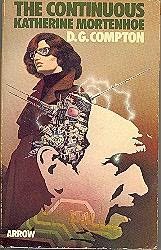
The Continuous Katherine Mortenhoe – also known as Death Watch and The Unsleeping Eye – is perhaps Compton’s best-known sf novel. It was originally published in 1974, and adapted into a film titled Death Watch by Bertrand Tavernier in 1980. I’ve not seen the film, although I certainly plan to find a copy. In the novel, the title character is diagnosed with “Gordon’s Syndrome” and told she has four weeks left to live. A successful television programme, Human Destiny, has found success broadcasting the final weeks of terminal patients, and they want Katherine to be a subject – for a large sum, of course. But she refuses. The producers of Human Destiny had been planning to try out some new technology on her: one of their reporters, Rod, has had his eyes replaced with television cameras. (His eyes still look the same, so Katherine would never know she was being filmed every moment.)

The novel is set in the future, and it’s a very 1970s future. I remarked on this in my capsule review of The Electric Crocodile and, I have to admit, it’s an aesthetic I find appealing – all that Brutalist architecture, the huge antiseptic data processing centres, the clunky technology… The society of Compton’s future is also a product of the book’s time of writing. It’s a future not much different from then, but not much like now. People live in huge blocks of flats, and die only of old age… except for notable exceptions, such as those who feature on Human Destiny. Mortenhoe works as an editor for a publisher – or rather, she manages a computer system which writes romance novels. Yet this old school Labour future also has its rich and privileged – everyone is provided for, but there’s still the fabulously wealthy. And from Compton’s characterisation of one such rich character in The Continuous Katherine Mortenhoe, it’s plain where his sympathies lay.

In fact, if there’s one thing that stands out in Compton’s novels it’s his sympathies. The technology or technological innovation around which Compton bases his stories – in The Continuous Katherine Mortenhoe, it’s Rod’s camera-eyes; in The Electric Crocodile, it was the supercomputer which allowed a self-proclaimed scientific “elite” to dictate the direction of human progress… It’s the misuse or abuse of this technology which is the plot-engine of the novels; and the fuel on which that engine runs is outrage. Rod’s camera-eyes represent an infringement of Katherine’s privacy of unthinkable levels. Every aspect of her life will be held up to public scrutiny and, possibly, probably, ridicule. She will have no secrets. Technology has robbed everyone of their secrets.

Much like the other Compton novels I’ve read, The Continuous Katherine Mortenhoe is a character study of its protagonists – the eponymous “heroine”, of course; and Rod the cameraman. The sections told from Rod’s viewpoint, however, are in the first person. As in The Electric Crocodile, Compton often repeats scenes from each character’s viewpoint, although the disconnect between what they experience is not so marked as it is in that earlier novel. While Rod is a bit of an everyman – he has a failed marriage in his back-history, and his ex-wife makes several appearances – Katherine is extremely well-drawn. She loves her current husband, but their marriage is perhaps best described as “comfortable”. She is not adventurous – but in order to escape the Human Destiny production team, she disguises herself as an indigent. And her decision to do so fits in wholly with her character. She is wholly ordinary, but extraordinary in small ways.

The writing, as in other Compton novels, is excellent. Of those British sf writers who were popular during the 1970s, Compton is perhaps the best prose stylist. Some may have been more popular, Bob Shaw, for example. Some of them may have had a steady career writing books for US publishers, such as EC Tubb or A Betram Chandler. But Compton was, I think, the best writer of the lot. Having said that, his books are very British, and very miserable. So it’s no surprise his novels have been mostly forgotten. Which is a shame. But I certainly plan to read more by him.


3 Comments

A One-Man Job: Moon

I am, I admit, not much of a fan of science fiction films. Too many of them privilege visual spectacle over story, or characterisation, or rigour, or plot logic, or even anything approaching an intelligent take on their subject. So it’s more by accident than design that I find I’ve watched all but one of the films on this year’s Hugo Award for Best Dramatic Presentation, Long Form short list. For the record, the nominees are:

Avatar looked fantastic, but was “about forty years out of date – in plot and in its somewhat offensive sensibilities – and suffers from some dodgy logic and some even worse dialogue” (see here). District 9 I found very disappointing, and was not at all impressed (see here). Star Trek XI was monumentally stupid (see here). I’ve yet to see Up. But Moon, I watched only recently, and…

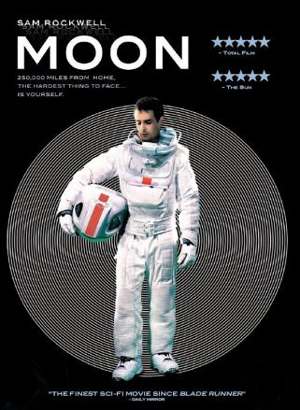
First of all, given the film’s $5 million budget Duncan Jones and his crew did an impressive job. Moon certainly doesn’t look cheap. Having said that, it makes an effort towards realism, but actually owes more to cinematic representations of the Moon than it does to the place visited and filmed by the Apollo astronauts. It’s not just that the gravity appears to be the same as Earth’s – although, bizarrely, star Sam Rockwell seems to move in slow motion when outside the moon base. The base itself resembles something designed for a movie, with its Syd Mead lines, and the fact that it’s so huge for just one person. There’s a famous photo of one of the Apollo astronauts seemingly embedded in machinery – that’s how cramped the Command/Service Module was. Putting mass on the Moon is expensive.

And yet, the reason there is a moon base on the far side of the Moon in the first place is good science. Sam Rockwell’s character, Sam Bell, is the supervisor of a number of robotic harvesters of Helium-3. In his book Return to the Moon, Harrison Schmitt of Apollo 17 presented an excellent case for mining Helium-3 from lunar regolith (see here). When, in Moon, one of the harvesters breaks down, Bell rides out in a rover to investigate the problem. Unfortunately, he’s not been feeling well of late, and his attention is distracted as he approaches the harvester… causing him to crash. There is no one else on the Moon and, thanks to a malfunctioning relay satellite, no way for Bell to call from the far side of the Moon to Earth. He is going to die. But then he wakes up back at the moon base. Except it’s not him. It’s a clone. This second Bell goes out and rescues the one who crashed. Resulting in two Sam Bells…

It’s a clever conceit – although Bell realises his true nature suspiciously quickly, as if the story needed to skip past the discovery phase in order to continue on with the resolution. In retrospect, the only problems I have with the film are niggles such as that. The lack of one-sixth gravity, the size of the moon base, the unnecessarily huge size of the moon rovers (and putting the hatch on top? that’s a terrible design for a vehicle to be used with spacesuits)… It’s a bit like those nuts who think the Apollo lunar landings were faked – when it costs more to maintain the fiction than it would have done to actually do it, then the conspiracy is plainly rubbish. And so with Moon – Lunar Industries, the movie’s fictional company, economises by using clones to run its Helium-3 mining operation, but then gives the clone an enormous moon base to live in…

I think this is worthy of comment because I’m fascinated by the Apollo programme, because I’ve read a number of books, and seen a number of films, on the subject – witness my other blog A Space About Books About Space. Yet I also read science fiction (and review it and write it). I speak the language of science fiction, in other words. And that can operate sometimes like a reverse Sapir-Whorf Hypothesis – as soon as a word is spoken, the concept behind it becomes obvious. Which means I’m likely to focus on the presentation of the conceit, rather than on how the conceit drives the plot…

Happily, Duncan Jones has disarmed most such criticism by consciously referencing other sf films. As you watch Moon, you find yourself going: “That’s from AlienOutland2001Silent Running…” Not to mention that much of the look of the film is a mix of Syd Mead, Ron Cobb and Gerry Anderson. Moon is a film which is very much in conversation with the genre. And it’s quite a loud conversation. The real-world science behind Helium-3 mining, the use of lunar scenery which actually looks like the real Moon… all these only make the conversation more compelling and interesting.

Will Moon make my best five films of the year? Unlikely. It’s the best of those I’ve seen so far on the Hugo shortlist without a doubt. It is, in fact, a good little film. But, like O2, I’m not overly fond of niggles.


6 Comments

Cool. A meme. A list: SF Masterworks

I started buying these in, I think, their second year. I have all of the numbered series – that’s up to 73 – but I plan to buy the new ones in the relaunched series. Anyway, apparently, there’s a meme doing the rounds. It’s clearly come from the SF and Fantasy Masterworks Reading Project (an excellent idea, by the way, chaps and chapesses), but a few others have picked it up. And I thought… why not? The ones in bold I’ve read. The ones in italics I have yet to buy.

II The Left Hand of Darkness, Ursula K Le Guin
V A Canticle for Leibowitz, Walter M Miller, Jr
X The Day of the Triffids, John Wyndham

1 The Forever War, Joe Haldeman
2 I Am Legend Richard, Matheson
3 Cities in Flight, James Blish
4 Do Androids Dream of Electric Sheep?, Philip K Dick
5 The Stars My Destination, Alfred Bester
6 Babel-17, Samuel R Delany
7 Lord of Light, Roger Zelazny
8 The Fifth Head of Cerberus, Gene Wolfe
9 Gateway, Frederik Pohl
10 The Rediscovery of Man, Cordwainer Smith
11 Last and First Men, Olaf Stapledon
12 Earth Abides, George R Stewart
13 Martian Time-Slip, Philip K Dick
14 The Demolished Man, Alfred Bester
15 Stand on Zanzibar, John Brunner
16 The Dispossessed, Ursula K Le Guin
17 The Drowned World, JG Ballard
18 The Sirens of Titan, Kurt Vonnegut
19 Emphyrio, Jack Vance
20 A Scanner Darkly, Philip K Dick
21 Star Maker, Olaf Stapledon
22 Behold the Man, Michael Moorcock
23 The Book of Skulls, Robert Silverberg
24 The War of the Worlds, HG Wells
25 Flowers for Algernon, Daniel Keyes
26 Ubik, Philip K Dick
27 Timescape, Gregory Benford
28 More Than Human, Theodore Sturgeon
29 Man Plus, Frederik Pohl
30 A Case of Conscience, James Blish
31 The Centauri Device, M John Harrison
32 Dr Bloodmoney, Philip K Dick
33 Non-Stop, Brian Aldiss
34 The Fountains of Paradise, Arthur C Clarke
35 Pavane, Keith Roberts
36 Now Wait for Last Year, Philip K Dick
37 Nova, Samuel R Delany
38 The First Men in the Moon, HG Wells
39 The City and the Stars, Arthur C Clarke
40 Blood Music, Greg Bear
41 Jem, Frederik Pohl
42 Bring the Jubilee, Ward Moore
43 VALIS, Philip K Dick
44 The Lathe of Heaven, Ursula K Le Guin
45 The Complete Roderick, John Sladek
46 Flow My Tears, the Policeman Said, Philip K Dick
47 The Invisible Man, HG Wells
48 Grass, Sheri S Tepper
49 A Fall of Moondust, Arthur C Clarke
50 Eon, Greg Bear
51 The Shrinking Man, Richard Matheson
52 The Three Stigmata of Palmer Eldritch, Philip K. Dick
53 The Dancers at the End of Time, Michael Moorcock
54 The Space Merchants, Frederik Pohl and Cyril M Kornbluth
55 Time Out of Joint, Philip K Dick
56 Downward to the Earth, Robert Silverberg
57 The Simulacra, Philip K Dick
58 The Penultimate Truth, Philip K Dick
59 Dying Inside, Robert Silverberg
60 Ringworld, Larry Niven
61 The Child Garden, Geoff Ryman
62 Mission of Gravity, Hal Clement
63 A Maze of Death, Philip K Dick
64 Tau Zero, Poul Anderson
65 Rendezvous with Rama, Arthur C Clarke
66 Life During Wartime, Lucius Shepard
67 Where Late the Sweet Birds Sang, Kate Wilhelm
68 Roadside Picnic, Arkady and Boris Strugatsky
69 Dark Benediction, Walter M Miller, Jr
70 Mockingbird, Walter Tevis
71 Dune, Frank Herbert
72 The Moon Is a Harsh Mistress, Robert A Heinlein
73 The Man in the High Castle, Philip K Dick
74 Inverted World, Christopher Priest
75 Cat’s Cradle, Kurt Vonnegut
76 The Island of Dr Moreau, HG Wells
77 Childhood’s End, Arthur C Clarke
78 The Time Machine, HG Wells
79 Dhalgren, Samuel R Delany
80 Helliconia, Brian Aldiss
81 Food of the Gods, HG Wells
82 The Body Snatchers, Jack Finney
83 The Female Man, Joanna Russ
84 Arslan, MJ Engh