Jupiter magazine’s next issue, #30 Hermippe, is due to be published any day soon. It contains my Jupiter Quartet of poems… and I can’t think of a more appropriate place for them to appear.
Category Archives: science fiction
Another obscure British sf masterwork
Among the books recommended to me by others for inclusion on my list of British sf masterworks (see here) was A Man of Double Deed

The title character of A Man of Double Deed
Coman returns to Earth after adventures on Venus – several of his previous escapades are mentioned in the novel – to find something strange going on. The youth of 2090 have taken to murder and suicide. It’s almost an epidemic. The only solution the World Council can conceive is a “War Section”. This is an area, preferably on another planet, in which the murderous teenagers and young adults can be left to their own violent devices. The Council is meeting shortly to consider implementing such a War Section, but the leader of the Council, Marst, is being influenced to vote against the proposal by a conspiracy. Coman’s boss, Karns, asks him to travel to the Fifteenth City, a holiday destination built above a line of islands in the Pacific, to persuade Marst to change his vote. Marst is apparently under the influence of a pair of “jokers”, telepaths who oppose the keymen but fortunately possess much weaker abilities. Coman and his two wives travel from the Twelfth City (London) to the Fifteenth City. Shortly after their arrival, while at a swimming-pool, Coman identifies one of the jokers, a woman called Linnel. He seduces her – Jonl and Sein are not happy about it, but they trust him. With Linnel’s help, Coman manages to prevent the conspiracy.
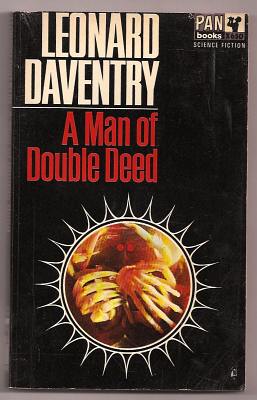
The plot summary above probably doesn’t quite illustrate how odd this novel is. Superficially, it resembles an ordinary piece of science fiction tosh from the 1950s or 1960s, with a superman hero, a supporting bevy of beautiful subservient women, and a future Earth which in no way resembles the Earth of the time of writing but still feels horribly dated. But that would be doing A Man of Double Deed
Coman is such a strange hero, for one thing. He is a dour intellectual, but not a misanthrope. He is not a man of action, but is often called upon to behave like one. There’s something of the World War II RAF officer in him, a combination of education, arrogance, pragmatism, and a grudging respect for others. He is his own biggest critic, but extremely private with his criticisms. He is very British.
Nor are the women of the story, Jonl, Sein and Linnel, characterless females. On the contrary, Jonl could become a keyman herself, but does not wish to do so on principle. Sein is more stereotypical a female character. She loves Coman, and longs for a baby. She gets her wish in the end, and it’s a result all are happy with. Linnel is a femme fatale, but an insecure one who falls for Coman’s singular charms, but refuses to bend entirely to his will. These three are not, I hasten to add, brilliantly-drawn female characters, or even especially realistically-drawn ones, but they are a good deal better-realised than is common for genre fiction of the time.
A Man of Double Deed
Perhaps the invention on display in the novel is not especially high, but the writing is solid, and even occasionally good, the characters are drawn well, and the plot comes to a satisfactory end… even if not everything is explained. What, for example, was the conspiracy which had hired the two jokers? Why did they not want a War Section? Nevertheless, A Man of Double Deed

Books from my collection: Phillip Mann
Phillip Mann was born in the UK but has been resident in New Zealand since 1969. Between 1982 and 1996, he wrote nine well-regarded science fiction novels. He’s had nothing published since, although Wikipedia claims he is working on a new novel. I hope so.
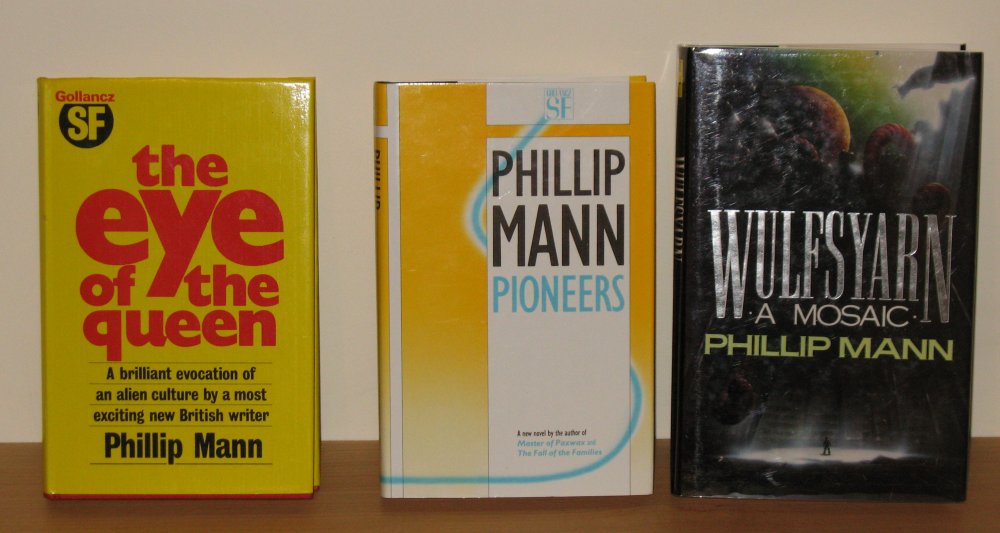
His first, fourth and fifth novels. The Clute and Nicholls Encyclopedia of Science Fiction


Mann’s second and third novels were the diptych, The Story of the Gardener: Master of Paxwax


His last four books were the alternate history quartet, A Land Fit for Heroes: Escape to the Wild Wood


Damn. Now I want to reread all his books…
British SF Masterworks redux
After all the comments on my list of 50 British science fiction masterworks, I decided to revisit it. There were several authors I’d inadvertently left off – and no, I’ve no idea how I managed to miss Paul J McAuley (sorry); but he’s on there now. There were also a couple of books I listed which, on reflection, were either too peripheral to the genre, or not really masterworks. The Durrell stays on, however, because a) he’s my favourite writer, and b) it features a number of sf tropes.
Brian W Aldiss claims in Trillion Year Spree

I’ve also changed Lessing’s entry from The Memoirs of a Survivor

So I have made some changes. And somehow the list has grown to fifty-five books.
1 – The Time Machine, HG Wells (1895)
2 – Last And First Men, Olaf Stapledon (1930)
3 – Brave New World, Aldous Huxley (1932)
4 – Nineteen Eighty-four, George Orwell (1949)
5 – The Day of the Triffids, John Wyndham (1951)
6 – The Death of Grass, John Christopher (1956)
7 – No Man Friday
8 – The Space-Born
9 – On The Beach, Nevil Shute (1957)
10 – WASP, Eric Frank Russell (1958)
11 – A Clockwork Orange, Anthony Burgess (1962)
12 – The Drowned World, JG Ballard (1962)
13 – Memoirs of a Spacewoman
14 – A Man of Double Deed
15 – A Far Sunset
16 – The Revolt of Aphrodite [Tunc

17 – Pavane, Keith Roberts (1968)
18 – Stand On Zanzibar, John Brunner (1968)
19 – Behold The Man, Michael Moorcock (1969)
20 – Ninety-eight Point Four
21 – Junk Day
22 – T-City trilogy [Interface


23 – The Continuous Katherine Mortenhoe
24 – Rendezvous with Rama, Arthur C Clarke (1973) – my review here.
25 – Collision with Chronos
26 – Inverted World, Christopher Priest (1974)
27 – The Centauri Device, M John Harrison (1974)
28 – Hello Summer, Goodbye
29 – Orbitsville [Orbitsville


30 – The Alteration
31 – The White Bird of Kinship [The Road to Corlay


32 – SS-GB
33 – Canopus in Argos: Archives [Shikasta, The Marriages Between Zones 3, 4 and 5, The Sirian Experiments, The Making of the Representative for Planet 8, The Sentimental Agents in the Volyen Empire], Doris Lessing (1979 – 1983)
34 – The Hitch-hiker’s Guide to the Galaxy [The Hitch-hiker’s Guide to the Galaxy, The Restaurant at the End of the Universe, Life, the Universe and Everything, So Long, and Thanks for All the Fish, Mostly Harmless], Douglas Adams (1979 – 1992)
35 – Where Time Winds Blow
36 – The Silver Metal Lover
37 – Cageworld [Search for the Sun!


38 – Helliconia, Brian W Aldiss (1982 – 1985)
39 – Orthe
40 – Chekhov’s Journey
41 – In Limbo
42 – Queen of the States
43 – Wraeththu Chronicles [The Enchantments of Flesh and Spirit


44 – Code Blue – Emergency!
45 – Kairos
46 – The Empire of Fear
47 – Desolation Road, Ian McDonald (1988)
48 – The Child Garden, Geoff Ryman (1989)
49 – Take Back Plenty
50 – Wulfsyarn
51 – Use of Weapons, Iain M Banks (1990)
52 – Vurt, Jeff Noon (1993)
53 – The Time Ships, Stephen Baxter (1995)
55 – Fairyland, Paul J Mcauley (1995)
So that’s the new list. I still intend to read and review some of the more obscure books – and have already done the Rex Gordon (see here). Those books I’ve written about on this blog now have links beside them – some are full-blown reviews, some are just a paragraph or two in one of my Readings & Watchings catch-up posts.
Now let the discussion begin.
Again.
An obscure British sf masterwork?
Several of the authors I included in my fifty British SF Masterworks list (see here), I’d not actually read. And with good reason – they’re more or less forgotten. One such author was Rex Gordon, the pen-name of Stanley Bennett Hough, born in 1917, who wrote nine science fiction novels between 1953 and 1969. Of those novels, the best-known is perhaps No Man Friday


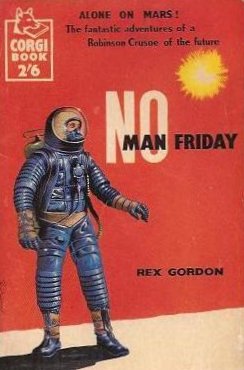
Gordon Holder is the narrator of No Man Friday
No Man Friday
En route to Mars, Holder has to leave the confines of the rocket to fix a deflector-plate which is causing the craft to spin. On his return, something goes wrong and the outer and inner airlock doors are both opened. Everyone inside dies. Only Holder survives, because he’s still wearing his spacesuit. Gordon has clearly thought about what it would be like to wear an inflated spacesuit in a vacuum, and describes the difficulty of performing tasks in such a suit – although he didn’t anticipate the damage to fingernails that modern-day astronauts apparently experience on EVA (see here).
The rocket crashes on Mars, but again Holder survives. Given that Gordon had no knowledge of the surface conditions of Mars – the first Mars lander would not be until 1971, when the Soviet Mars 3 managed to transmit data and pictures for 22 seconds; and the first successful landers were the US’s Viking 1 and Viking 2 in 1976 – nonetheless, he manages a reasonably believable Martian surface, not unlike, say, the Atacama Desert.
Holder manages to use the wreckage of the rocket, and its surviving equipment, to manufacture both water and oxygen. He builds himself a sand scooter, and goes exploring. But wherever he goes, it’s all the same: an endless red desert, populated only by strange Martian cacti and the over-sized termites which feed on them. He even experiments with the plants, trying to find some method of preparation which will make them edible and nutritious.
Then he discovers evidence of some larger animal – he has already guessed that the low gravity and air pressure would result in creatures larger in size than earthly ones. This creature proves to be humanoid in shape, but its behaviour demonstrates it is clearly not intelligent. But the giant centipede creatures, the size of buses, which feed on the corpses of the humanoids and communicate via biological light-organs, definitely appear to be.
Holder sets out to follow the giant centipedes, and eventually discovers their nesting area. He attempts to communicate with them…
Fifteen years later, a US rocket lands on Mars, and its crew are astonished to see a human approaching their craft on foot. Holder has survived as a favoured pet of the giant centipedes. He explains this to the Americans, telling them that the Martians will only allow one rocket per year to land on the Red Planet. The Americans reply that the system is unworkable, not least because the Soviets are planning their own mission. Holder tries to return to the Martians, but is unable to do so – some strange barrier prevents him.
No Man Friday
No Man Friday
Some personnel news
M-Brane SF has announced the table of contents for #21, due out 1st October, and which includes my story ‘Human Resources’. It’s another near-future science fiction story, although set in a slightly different world to ours. Apart from that minor difference, and the, er, “brain-hacking”, everything in it is real.
Don’t forget to buy a copy.
I’ve suffered for my research, now it’s your turn
I promised myself that during August I’d have a go at writing a space opera – you know, a proper one, with giant spaceships, aliens, awesome weaponry… that sort of thing. Not just because I enjoy reading such stories and would like to write one of my own, but also because I could make it all up. I mean, what would I need to research? The laws of physics? Most space opera stories ignore those pretty much, anyway. I could just take the story, and fly with it.
Sadly, I didn’t manage it. Instead, I wrote the first drafts of two stories – one set at the bottom of the Pacific Ocean, and the other about the exploration of Mars. (This was on top of ongoing work on a novelette and a novel.)
Both stories required a lot of research.
The Mars one was the easier of the two. There’s plenty of material online – there’s even a Google map of Mars. Plus, I have several books on the exploration of the Red Planet: Mission to Mars, Michael Collins (I reviewed it here); The Case for Mars, Robert Zubrin; Mars 1999, Brian O’Leary; and Mars Underground, William K Hartmann. So I had lots to read in order to make my fictional trip to Mars, and subsequent surface exploration, as accurate and authentic as possible.
The story set on the floor the Mariana Trench, which I’ve been referring to as my “bathypunk” story, was much harder to research. It seems bizarre that more information is available about Mars than about the bottom of the Pacific, but that does seem to be the case.
I forget where I first stumbled across mention of the bathyscaphe Trieste, which dived 35,767 feet to the floor of Challenger Deep, the deepest part of the ocean on the planet, in January 1960. But the whole thing struck me as fascinating. Perhaps it was due in part to that recent, and terrible, BBC series, The Deep
This January was the fiftieth anniversary of the Trieste‘s descent, but it’s been a curiously low-key celebration. There’s a very nice website here. But, while the fortieth anniversary of the Apollo 11 resulted in the publication of a number of books (see here), there’s been nothing about Jacques Piccard and Don Walsh’s trip 36,000 feet down, where the pressure is close to seven tons per square inch, on the floor of Challenger Deep. The best account I’ve found online is this, the Google Books scan of a contemporaneous article in Life Magazine, dated 15 February 1960 and written by Don Walsh himself.
This made researching my story a great deal harder than I’d expected. Yes, writing most varieties of science fiction requires research. Getting the details right in, for example, spacecore – I invented the term, so I’m going to damn well use it – is important. Happily, there’s plenty of information available online – the Apollo Lunar Surface Journals, for example – and I also have loads of books on the topic. But for my bathypunk story, I wanted to know the answer to a simple question: what are the actual physical dimensions of Challenger Deep? It’s described as a “bathtub-shaped slot” in the floor of the Mariana Trench; but I can’t find how deep that slot is, how long it is, or how wide. There’s even doubt as to whether it’s the deepest part of the Mariana Trench – the Wikipedia articles on it, Challenger Deep, and the Trieste all appear somewhat contradictory.
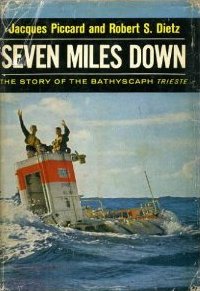 In the end, I had to resort to ordering a copy of Seven Miles Down
They say you should write about what you know. But, let’s face it, that would make for pretty boring fiction. And not just by me. It also makes little sense if you’re writing science fiction. Unless “what you know” can be read as “shit you make up that no one else has ever made up before”. Which is much harder than it sounds, and not always effective. Because how do you know that something you’ve just made up isn’t, well, wrong? You’ve just dreamt up this great idea: it’s sort of like a planet, but it’s actually a humungous ribbon which goes all the way around a star and people live on the inside surface of it… It’s a ringworld. And then someone reads your book featuring this ringworld and works out that it’s inherently unstable as described… Oops. Should have researched it.
Admittedly, it’s easy to get bogged down in the research for a story. And I actually enjoy reading about the stuff around which I base my stories. Sometimes, I’m already interested in a subject when an idea for a story comes to me – all those books I collect for my Space Books blog have inspired a few ideas, not all of which have become stories. Other times, something I read sparks an idea, which in turn requires research before I can make a story of it – like my bathypunk story, or ‘The Amber Room’ (see here). Then there are the ones where the idea comes out of nowhere, sometimes fully-formed, but usually vague and incomplete…
When I started this post, I’d intended to write about my experience in researching two different short stories, but I seem to have drifted from the point. Nonetheless, having read back over what I’ve written here, I’m now more determined then ever to see if I can write that space opera story, one where I can just make it all up, one that requires no research at all. Wish me luck.
There’s something moving in sf
There’s an interesting Mind Meld this week on SFSignal about “The Next Big Trend/Movement in SF/F Literature”. You can find it here. I noticed that my jetpunk (see here) doesn’t get a mention – although it has here in a post by Dr Nader Elhefnawy, which I suppose means it’s sort of arrived…
To be honest, jetpunk wasn’t an entirely serious suggestion, and I wrote the post chiefly because I liked the title “Vulcan Bombers in Space” and I wanted to post some pictures of cool aeroplanes. But I do think there’s room for some interesting fiction to be written in there – especially given that retro sf usually either means visions of the future from the 1930s – 1940s, or, well, steampunk and dieselpunk. The 1950s and 1960s were, I think, more interesting technologically, and some of the futurism from those decades would make for excellent science fiction.

(Source: Douglas Holland's Aerospace Site)
All of which got me thinking about other “movements” and what inspires me to write science fiction and what I try to put into my stories. I like the hardware, I freely admit it – I have all those books about the Apollo programme because I find the spacecraft, and the way they work, fascinating – the technology, the engineering, the science… and how that does what it does for those who use it. The hardware I find inspirational, but it’s the people using it I try to write about it.
And all those books about Apollo I’ve read persuaded me to try writing sf which was as realistic as I could possibly make it. Not Mundane sf – because I want to still use some of the genre’s tropes, like faster-than-light travel or aliens. But I wanted to show that space is a hostile environment, that getting out of gravity wells is difficult, that human beings can only operate in space because of the science and technology and engineering. And since I’d been thinking about trends and movements, I decided this should be called… spacecore.
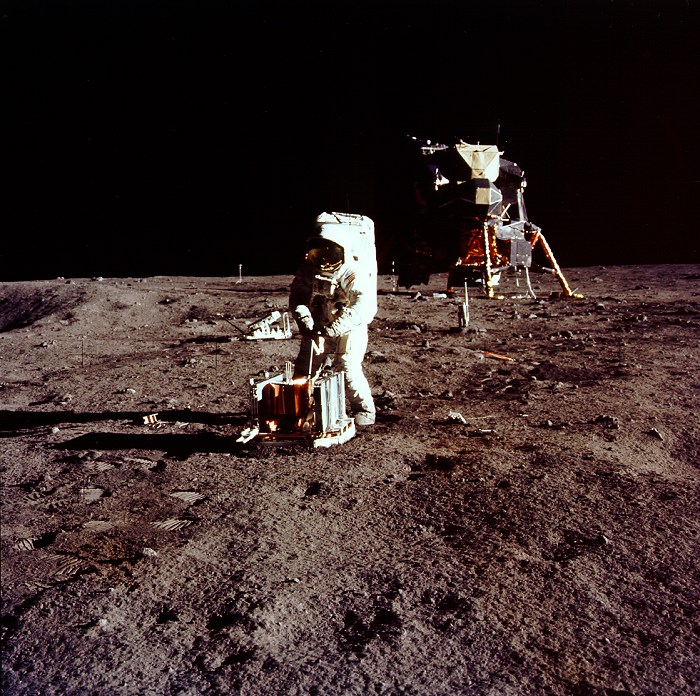
(Source: NASA)
Then I had an idea for another story, but this time set in the depths of the ocean – which again is as much about technology as it is about people since the ocean depths are as inimical an environment as space. I was going to title the story ‘Base Under Pressure’, but that really is the worst short story title ever. Anyway, I thought, stories set at the bottom of the sea need a name too. How about bathypunk?
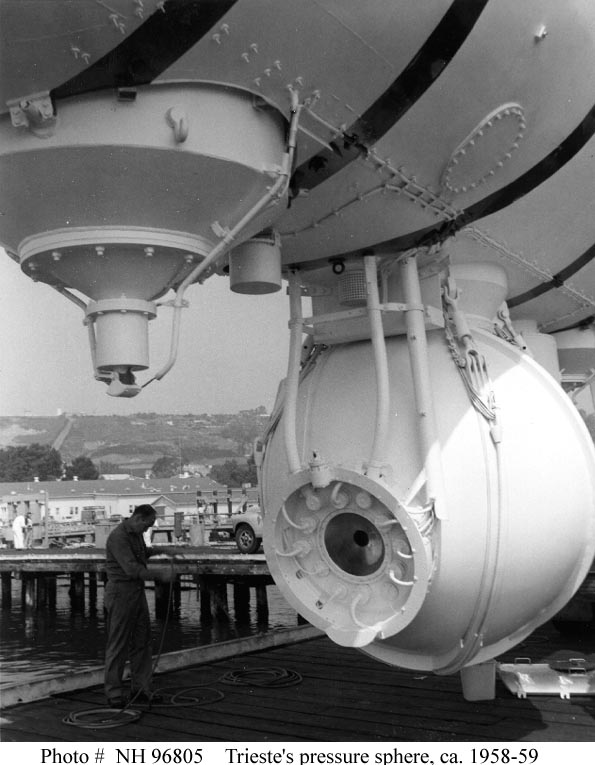
(Source: SEVEN MILES DOWN, Jacques Piccard & Robert S Dietz)
At which point, I decided – and had pointed out to me by friends – it was all getting a bit silly. To tell the truth, my sf stories are hardly written down a single line in the genre anyway: the Euripidean Space stories are near-future hard sf; ‘Killing the Dead’ is set in a generation starship; ‘The Amber Room’ features alternate universes; ‘Through the Eye of the Needle’ is near-future post-catastrophe… And the novels I’ve delivered to my agent are steampunk-ish space opera.
Also, movements and labels tend to be applied after the fact by commentators and critics. They point to a group of writings and decide they are enough alike to deserve a common term to describe them. Dreaming up a “-punk” or “-core” and then writing to it is apparently the wrong way to do it. Well, it is if you tell everyone that’s what you’ve done.
So I won’t. I’ll be thinking about jetpunk and spacecore and bathypunk and whatever other ones I dream up as I’m bashing out my stories. I’ll be thinking about the hardware and the people who use it. And if others do the same, if that means there’s a little less magic in sf and a bit more, well, science and technology, then I’ll consider that a good thing. But it’s not like a movement or a bandwagon or anything.
Unless you want it to be.
An untapped market?
I wasn’t going to write about this as I couldn’t honestly see that it deserved a response; but apparently others though it did. Rather than add my thoughts on the matter to the comment thread of the original blog post, I’m writing my own piece here.
“This” is a blog piece here about sf magazines. According to it, current sf magazines are badly-designed, do not contain “the best writing”, and cater solely to “extended fandom”. What they need to do is appeal to all those people who consume science fiction in all its forms. Not sf readers, because sf readers are “extended fandom”. No, sf “consumers” who watch films, play games, watch television series, collect action figures, etc., but don’t actually, well, read.
To do this, the next generation sf magazine needs to drag its design into the twenty-first century and publish only the best fiction.
Rubbish.
A magazine needs to consider four areas in order to succeed:
Design
I have to wonder if the poster was referring only to the Big Three sf mags – Asimov’s, Analog and F&Sf – when he complained about appalling design. He’s right in that respect – those three magazines are indeed boringly designed. They’re intended to fit into a pocket and be convenient, but that’s no longer a design criterion these days. However, there are a number of well-designed sf magazines currently being published, such as Interzone.
There are other design considerations. Gollancz have recently rebooted their SF Masterworks series, and the new covers are less science-fictional than the old ones. Not so long ago, they issued four space operas with modern abstract covers as a promotion. Do people expect sf novels to have spaceships on the cover? Do they expect fantasy novels to feature a hooded man? Do covers without spaceships encourage non-sf fans to pick up sf novels? It’d be interesting to find out, because it would have a bearing on the cover design of this new magazine. Should it be overtly sf, or not?
Or, how about sticking a photo on the cover instead, as SFX and the like do? Of course, it’d have to be Matt Smith rather than Alastair Reynolds. No one’s going to recognise Reynolds, even if he is a million-pound author. Unless we’re going to go down the author-as-celebrity route, and I’d rather not…
Content
Our new magazine should apparently publish “the best writing”. So, does that mean award-winning? Mike Resnick, for example? Charles Stross? Kij Johnson? Paolo Bacigalupi? They’ve all won awards. But then, the Hugo Award, the genre’s biggest award, is usually given on the basis of a couple of thousand votes, which is only a small subset of the sf readership. Perhaps instead “best” means “best-selling”, as the magazine is after all intended to make money. So JK Rowling and Stephenie Meyer. Urban fantasy… Which isn’t actually sf, but never mind. I suspect that “the best writing” will actually mean the editor’s definition of “best”… which is pretty much how it works for magazines now. Of course, in order to attract the best writers, in order to have a really good selection in the slush-pile, the magazine will have to pay top dollar.
Distribution
It’s no good publishing the best magazine in the world if it can only be found in one hobby shop in Milton Keynes. It needs to be available throughout the country, on every high street. This doesn’t come cheap. For a start, distributors demand huge discounts. As do retailers. Forget that cover price, because that’s not the amount your distributors and retailers will be paying. And if you intend to make a profit after discount on each issue, then the cover price is probably going to make it too expensive for your average consumer. Who’s going to spend £10 on a magazine because it “looks interesting”? You’ll need to offset the cover price with advertising revenue. But you can’t find advertising unless you have circulation, and you can’t get circulation unless you can afford to distribute…
Readership
Putting copies of the magazine into high street shops is only half the battle. People have to buy it. It’s no good sending out 50,000 copies every month, only to received 49,900 of them back thirty days later. Which means you need a design that appeals – including cover art. And contents that appeal – familiar faces and names and topics. You need an affordable cover price – so you’ll also need advertising…
It doesn’t work. For a large readership, you need something which will appeal to as many potential readers as possible. And those who consume sf but don’t read fiction… well, that’s because they don’t read. So they’re not going to be attracted to a fiction magazine, no matter how well designed or distributed it is. Some people might buy it if they recognise its contents – some familiar names in there, some references to things they know and understand, such as films, games, television series… Not fiction, in other words.
If you have pots of money – you’ve just won EuroMillions, say – and boundless optimism, then perhaps it might be worth a punt. But the number of magazine titles has been shrinking over the years for good reason, and no amount of naive pronouncements is going to suddenly re-invigorate the sf print magazine market.
But all is not lost. Because I have an alternative idea. I call it a “nebula”, because it’s sort of like a cloud. It is not a print magazine, it is electronic. Actually, it’s not even a magazine in the traditional sense of the word. It’s more like a playlist. For sf short fiction. It works like this:
There is a web site, and available for download – in a variety of e-reader and audio formats – is a pool of carefully-categorised stories. Each story is priced low, a couple of pounds only, a micro-purchase. Readers can create their own anthologies, or magazines, or fiction playlists, by putting stories together. This is why they’re carefully categorised. If you like space opera, then you can just buy space opera stories. There’ll be facilities to subscribe to feeds letting you know when new stories have appeared in specified categories, or by particular authors.
The web site will also feature lots of non-fiction content – reviews, interviews, etc. It will be free. There will be no paywall. Publication schedules can either be monthly or ad hoc. It doesn’t actually matter. Content is only limited by the technology – so the web site could include short films as streaming video, colour comic strips, podcast interviews, etc. The micro-purchased fiction will fund the free non-fiction content; the free non-fiction content will pull in the readers and introduce them to the micro-purchase fiction content. The web site can feature celebrities, the downloadable stories can include “the best writing”. And, best of all, it’s the reader who defines “the best writing”, because they need only buy the fiction they like.
I believe a couple of flash fiction sites operate in a similar fashion to this, and Lightspeed goes partway towards the micro-purchase fiction model (but is still tied to a monthly publication schedule). Given sufficient start-up capital, the “nebula” idea might work. It meets most of the demands of that original blog post, without relying on starry-eyed optimism or outright fantasy.
Comments?
Double Scots
I know, it’s a terrible title. And it took me ages to come up with it. But since it’s reasonably descriptive of the contents of this post, I’m sticking with it.
The two Scots in question are Michael Cobley and Gary Gibson, both of whom have had New Space Opera novels published this year. Cobley’s The Orphaned Worlds is the second in his Humanity’s Fire trilogy, and Gibson’s Empire of Light is the final book in his Shoal Sequence.
Last year, I said of Seeds of Earth, the first book of Michael Cobley’s Humanity’s Fire trilogy (see here), that it was “a pure hit of the purest space opera”. The Orphaned Worlds is no different.

The Sendrukan and Broltruan forces occupying the lost human colony of Darien have tightened their grip, and the freedom fighters have moved into the various historical Uvovo strongholds. Meanwhile, Earthsphere ambassador Robert Horst is hunting through the many levels of hyperspace to find the Godhead, a powerful machine intelligence. Theo Karlsson has been captured by Ezgara mercenaries – who are from another lost human colony – but these are good Ezgara mercenaries, and they discover something shocking in their history. Julia Bryce and the other Enhanced have been captured by a mercenary working for the Spiral Prophecy, who have sent a vast invasion force to Darien. The Knight of the Legion of Avatars has reached Darien, and sets about taking over the warpwell so he can free the millions of Avatars imprisoned in the hyperspace Abyss. And Kao Chih learns what happened to his home world – the third lost human colony – after his grandparents left…
The Orphaned Worlds is, in fact, not an easy book to summarise. There’s a lot going on in it. Middle books of trilogies are notoriously difficult, and too often feel like extended set-ups for the grand climax in book three. Cobley manages to avoid this trap by ensuring there’s always plenty of action, and by doling out small revelations which explain more and more of the trilogy’s story-arc. The Orphaned Worlds also features an admirably diverse cast. Cobley’s protagonists are engaging characters and he handles his various nationalities with skill. He has a good eye for describing scenery, and there’s a level of detail in the prose which makes every facet of his universe clear.
Having said that, the book’s not without some faults. In Seeds of Earth, I thought Cobley had “over-egged” his universe, and so too in The Orphaned Worlds – it feels too rich for the trilogy. Sometimes, in fact, it seems it should belong to a role-playing game, and so should be explored over several years through scenarios and campaigns and sourcebooks. The profusion of alien races and planets also means there are a lot of made-up names in the book. The Orphaned Worlds walks a tight-rope over a chasm of smeerp – mostly successfully; although there’s the odd section where it feels as though it might fall. But Cobley certainly deserves a slap for using the word “youngling”.

Gary Gibson’s Empire of Light is the third book in his Shoal Sequence trilogy, and neatly wraps up its galaxy-spanning story. Like the earlier books in the trilogy, Empire of Light often reads like a long sequence of special effects shots. Admittedly, they’re pretty impressive special effects – there aren’t many books, for example, in which wars are fought by exploding the stars around which the enemy’s planets orbit…
Dakota Merrick finds the Maker, creator of the caches which gave the various races of the galaxy faster-than-light travel, and discovers what it is. She also learns of the Mos Hadroch, a weapon which could be used to defeat the Emissaries. She joins up with Lucas Corso, who’s having trouble with his political rivals on the Freehold colony on Redstone. In a stolen frigate, they, and a handful of others, travel across the galaxy to the Perseus Arm to strike a blow against the Emissaries with the Mos Hadroch. But someone aboard the frigate is not exactly what he appears to be…
The bulk of Empire of Light‘s story is taken up with that long flight to the Perseus Arm and the goings-on aboard the Mjollnir. Much of the Long War – the exploding suns – takes place off-stage. Which is a bit of a shame, as the Emissaries were very funny. Nor do the Zarbi-like aliens of Nova War, the Bandati, figure much in Empire of Light. Given the enormous canvas of the trilogy’s story-arc, it makes for a curiously claustrophobic story. As a result, the the book’s resolution feels a little anticlimactic because its impact is chiefly focused on Merrick, Corso and the others.
There’s still much to like in Empire of Light. Those special effects shots, for one. Gibson also manages a nice demolition of the politics of Robert Heinlein’s Starship Trooper. On Redstone, only veterans have the franchise, and everyone has the right to determine the outcome of a dispute using a duel. Gibson uses Corso to point out how ineffective and corrupt such a regime would be. The sheer scale of Empire of Light‘s story also impresses. Where Cobley sets his story in a galaxy-sized “world” populated with hundreds and thousands of alien civilisations, Gibson’s universe feels more like a real galaxy – with vast empty spaces, and a history stretching back billions of years. There’s a sense of great antiquity to Gibson’s universe, more so than there is to Cobley’s. Yet Gibson still manages to keep his plot firmly focused on his characters.
The two books are excellent examples of the current state of British New Space Opera. Gibson provides excellent sfx, and has a better handle on the size and age of the universe. Cobley’s prose is more detailed, and his ability to evoke place is better. Cobley also has the more diverse cast, which he handles well. On the other hand, Gibson’s aliens feel like they belong in a New Space Opera novel, whereas Cobley’s occasionally feel like they should be in a RPG. Nonetheless, both trilogies – even though Cobley’s is as yet unfinished – are definitely worth reading.
 It Doesn't Have To Be Right...