It Doesn't Have To Be Right…

… it just has to sound plausible


22 Comments

Home truths

Truth #1
Isaac Asimov was a rubbish writer, and his Foundation is a rubbish book. It has cardboard characters who act as though they belong in 1940s middle America and not a galactic empire. The invention is minimal, the prose is bland and uninspired, the plot doesan’t make sense, and how the book has come to be consider a classic is beyond me. I am embarrassed when people think to suggest it as a good introduction to science fiction, or one of the genre’s best books.

Truth #2
The majority of male science fiction readers are sexist. They not only refuse to read books by women sf writers, they refuse to acknowledge that not doing so is wrong. They attempt to justify the evident unfairness in the genre through such mealy-mouthed justifications as “The gender of the writer is irrelevant” or “why should I impose quotas on my reading?” or “what about the men’s studies?” This is sexism. It is wrong.


2 Comments

All the news that’s fit to print

Nearly halfway through the year, and time for a little self-promotion – i.e., my magazine and anthology appearances during the rest of this year.

Andy Remic wanted “bizarro fiction” for Anarchy Book’s anthology Vivisepultura, and I certainly hope my story in it qualifies. There’s only one way to find out: buy a copy. Due to be published on 1st August.

I’ll be in The Exagerrated Press’ The Monster Book for Girls, edited by Terry Grimwood, which I believe will be launched at Fantasycon in Brighton in September.

I have a story in Eibonvale Press’ new anthology, Where Are We Going?, edited by Allen Ashley – due to be published in late 2011 / early 2012. The story is my bathypunk one, which was inspired by the one and only descent to Challenger Deep, the deepest part of any ocean , in 1960.

Next month’s Jupiter sf magazine has one of my stories in it. It will be, as far as I’m aware, the only death metal hard sf story ever to see print. It quotes extensively from the lyrics of one of my favourite bands, Mithras (with their permission, of course). Then there’s Alt Hist #3, publication date currently unknown, which will contain one of my stories.

Finally, there’s Rocket Science, the hard sf anthology I’m editing for Mutation Press. The submission period starts on 1st August, so I’m fully expecting to get mailbombed on that date.

For those of you who can’t wait, there’s always ‘Disambiguation‘ on the Alt Hist website, and ‘Barker’ in the Winter 2010 BFS Journal.


2 Comments

For every step forward…

… someone somewhere will be determined to drag you backwards. Everyone is talking about women in sf and the fact they’re appallingly under-represented… and Technology Review goes and publishes a list of The Best Hard Science Fiction Novels of All Time, which includes ten books, only one of which is by a woman sf writer. Sigh.

As if that weren’t enough, number two on their list is that well-known paragon of scientific rigour, The Time Machine by HG Wells. And, of course, there has to be a book by Asimov there too, though thankfully it’s not Foundation. Instead they picked I, Robot. I must admit, I’ve never understand the reverence in which the Three Laws are held. I mean, they’ve never been implemented in robots, there would be no point in doing so – robots, or “computer numerical control” machines, do exactly what their programming instructs them to do, and nothing more. So if you want a robot to kill a person, you simply put that in its instruction set.

As for the rest of Technology Review’s list… they’ve not made entirely embarrassing choices, though I wouldn’t actually classify many of the books on the list as hard sf. Still, as lists of science fiction works go, it’s a pretty poor job.


5 Comments

SF Mistressworks: one week on

On the 1st June, in response to a call for action by Nicola Griffith, I set up the SF Mistressworks blog, a site devoted to reviews of science fiction books by women writers. I had no desire, nor did I think it was fair, to provide the content entirely by myself, so I put out a call for volunteers. And lots of people responded – over a dozen, at the last count. I also said I was happy to take previously-published reviews, and a number of people subsequently donated old reviews they had written. As a result, in the past seven days I’ve posted fourteen reviews by various hands to the site, and have several days’ worth scheduled. The blog has also been averaging 300 hits a day.

So the response has been very good – better, in fact, than I expected. But there’s a danger interest might fade away as the year progresses. And I don’t want that; I don’t think anyone wants that. So I’m always on the look-out for new reviews and reviewers, and happy to take either (there’s an FAQ on the blog, explaining the sort of thing I’m after). It’s also good if other people promote the blog – link to it, mention it in passing, encourage discussion regarding it, whatever you think is appropriate.

For the record, the following books have been reviewed on SF Mistressworks (each title links to the review):

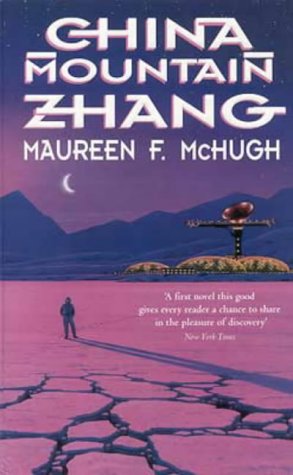
China Mountain Zhang, Maureen F McHugh
Grass, Sheri S Tepper
Ammonite, Nicola Griffith
The Journal of Nicholas the American, Leigh Kennedy
The Left Hand of Darkness, Ursula K Le Guin
The Female Man, Joanna Russ
Where Late the Sweet Birds Sang, Kate Wilhelm
The Steerswoman, Rosemary Kirstein
The Dispossessed, Ursula K Le Guin
Pennterra, Judith Moffett
The Handmaid’s Tale, Margaret Atwood
Rebel Sutra, Shariann Lewitt
Escape Plans, Gwyneth Jones
Halfway Human, Carolyn Ives Gilman

Still to come, reviews of:

And Chaos Died, Joanna Russ
Hermetech, Storm Constantine
Doomtime, Doris Piserchia
Black Wine, Candas Jane Dorsey
Winterlong, Elizabeth Hand
Starmother, Sydney J Van Scyoc
The Sword of Rhiannon, Leigh Brackett
Queen City Jazz, Kathleen Ann Goonan
The City Long After, Pat Murphy

… plus several more. I also intend to link to the website of as many woman sf writers as I can find, and list those sf books by women writers which have won prizes.

So, keep watching the site.


3 Comments

Women in sf reading challenge #5: China Mountain Zhang, Maureen F McHugh

China Mountain Zhang has been on my radar for a number of years – it’s one of those books I’ve heard many good things about, but have never really got around to buying or reading. Until now. And, in one of those moments of serendipity that confirm you’ve chosen the right time to do something, no sooner had I picked the book for my reading challenge then I found a copy in a local charity shop. It could simply be, of course, that I’d not been looking for it before, but since I’d been wanting to read it for many years I don’t think that’s the case.

Whatever. I’ve now read China Mountain Zhang. And I’m very glad I have done so. It is a very good novel. Zhang Zhong Shan is an ABC, American Born Chinese – except he is not really: his father is Chinese, but mother is Latino and he was genetically-engineered to appear pure Chinese. He is also gay. He works as a construction technician in New York in a United States dominated culturally, economically and politically by communist China. Zhong Shan translate roughly as “China Mountain” and is also the Mandarin equivalent of the Cantonese Sun Yat-sen. It is considered a name worth remarking on: as Zhang himself says, “To be named Zhang Zhong Shen is like being named George Washington Jones” (26).
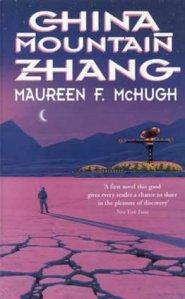
China Mountain Zhang is the story of Zhang, opening in New York on a construction site, and finishing in New York with Zhang working as a freelance organic engineer. In between, he spends time on Baffin Island and at university in Nanjing. The narrative also breaks away from Zhang on several occasions to tell the stories of Angel, a kite-flyer in New York, and Martine, a settler on Mars. Though both narrative threads seem unrelated, by the end of the novel they have touched, or have been touched by, Zhang.

Not one of the characters changes the world though their lives do so. But neither is this a novel of accommodation – no one changes to in order to fit better. In fact, Zhang finds himself less employable, having qualified as a construction engineer, than he had been as a construction tech. And despite homosexuality being illegal in both the socialist USA and China, Zhang never questions his sexuality.

And yet he questions his racial identity repeatedly. He is not really Chinese, though he appears to be. His mother named him Rafael, and he still uses the name among some of his friends. As China Mountain Zhang opens he has been invited to the home of his foreman Qian to meet his daughter. Qian is Chinese but has fallen from grace and been exiled to the US. He does not know that Zhang is not wholly-Chinese, nor that he is gay. Trapped in the identity he presents to Qian, Zhang reluctantly meets Qian’s daughter, San-xiang, and takes her out. They become friends, of a sort – she imagines more to the relationship than is ever going to be the case.

In a later break-away narrative, Xan-siang, who is not attractive – “She is astonishingly ugly. More than ugly, there is something wrong with the bones of her face” (p12) – has cosmetic surgery to correct her appearance… only to fall victim to a predatory man. Her ugliness had protected her, and now she is pretty she does not have the social skills to cope with the attention her looks now cause. Her story is the one unhappy one in China Mountain Zhang.

But before that, Xan-siang runs away from her parents and goes to stay with Zhang. Her father tries use to this to force them into marriage, so Zhang reveals he is half-Hispanic. Qian fires him. Which is how Zhang ends up working on Baffin Island. There, Zhang’s identity – racial or otherwise – is mostly irrelevant. The scientists of the station are more interested in their jobs. However, Zhang’s six-month stint there does qualify him for special entry into a university in China. Which is where he qualifies as an organic engineer. The sections set in Nanjing don’t seem to quite gel as effectively as those set in New York or even on Mars. Zhang is a foreigner, though he does not look like one, and his personal interactions appear mostly limited to his tutor, also gay and with whom he has a relationship. Admittedly, China Mountain Zhang is Zhang’s story, told from his point of view, so perhaps that’s unfair. Perhaps too it’s because Nanjing follows Baffin Island, and Baffin is a very limited environment.

Martine’s narrative, set mostly in her holding on Mars, initially seems to belong to a different novel. A link with Zhang eventually appears, but it is peripheral. Martine is an ex-soldier, now land-owner, on a collectivist Mars. A chance encounter with a new settler and his young daughter – both are living in dorms and have no credit and so cannot afford a parcel of land – brings Martine out of her self-imposed seclusion. There’s actually little in the narrative thread which demands it be set on Mars, other than a need for a society on which China has little or no direct influence.

There is a strand of utopianism to China Mountain Zhang. The world McHugh has built is by no means perfect – homosexuality is illegal, for example – but neither is it as unfair or unequal as the real world. It is, however, mostly prosperous and advanced – I think the story is set somewhere near the middle of this century, though I don’t recall an exact decade being named – but the world of the book has settlers on Mars, and people can “jack” into tools and computer systems. Inasmuch as it carries the story,  I found it convincing; but then I’m not wedded to capitalist ideals so I will happily accept a world built on alternative principles.

China Mountain Zhang was very well regarded when it first appeared. It was short-listed for the Hugo and Nebula, and went onto win the James Tiptree Jr Award and Lambda Award. Not bad for a first novel (in fact, it came top in the Locus Poll that year for Best First Novel too). On the strength of China Mountain Zhang, I certainly plan to seek out and read more of McHugh’s fiction.

(This review has been cross-posted on the SF Mistressworks blog.)


13 Comments

The women sf writers men won’t see

A call on the Guardian for people’s favourite science fiction novels last Monday resulted in a list of over 500 titles (tellingly listed as best science fiction novels). The list prompted both Nicola Griffith and Cheryl Morgan to point out how few novels by women sf writers had been named. The Guardian then added to the debate with an article ‘The incredible shrinking presence of women sf writers‘, only for its comments thread to prove how shockingly bad the situation actually is.

And so Nicola Griffth has asked people to take the Russ Pledge, “to make a considerable and consistent effort to mention women’s work which, consciously or unconsciously, has been suppressed”. And while my reading challenge this year has been to read one book by a women sf writer each month, and blog about it, I decided to do more.

So I’ve set up the SF Mistressworks blog. Which will comprise reviews of classic and twentieth century science fiction by women writers. It will offset all those “classic sf” and “50 sf novels you must read” and “best sf novels” lists you see all over the internet which have few or no women writers on them. It will demonstrate that women have been writing sf since the genre’s beginnings, and that many of their books are as good as, if not better, than many sf “classics”.

A number of people have all ready volunteered to write reviews, but more are certainly welcome. I have no intention of providing the content alone. I also don’t mind if there are multiple reviews – by different hands, of course – of the same book.

The SF Mistressworks blog is part of the conversation about women sf writers; but it will never direct it.


12 Comments

All watched over by the machine-like prose of science fiction

In the first two episodes of All Watched Over By Machines of Loving Grace, Adam Curtis lays the blame for the current economic crisis and last century’s ecological crisis on ideas propagated by two works of science fiction masquerading as non-fiction. The first is Ayn Rand’s Atlas Shrugged, a frankly risible book, whose philosophy of Objectivism led to decades of fiscal mismanagement and economic blunders. The second is Eugene P Odum’s Fundamentals of Ecology, which posited a deeply-flawed model of nature and society that corrupted several branches of science and technology for much of the twentieth century.

And while it may be stretching a point, given that Atlas Shrugged was a work of fiction but Fundamentals of Ecology claimed to be scientific non-fiction, I have to wonder how healthy has been science fiction’s magpie and indiscriminate approach to scientific and pseudo-scientific theories through the decades. Not just John W Campbell’s championing of Dianetics, or even L Ron Hubbard’s creation of Scientology, but also, for example, Jack Vance basing his The Languages of Pao on the Sapir-Worf Hypothesis. In fact, it might be said that science fiction has been little more than a delivery mechanism for bad ideas to impressionable members of society.

It could be argued, in other words, that science fiction is, and always has been, intellectually bankrupt.

But is this really surprising? Remember how the genre began, as a predictive and didactic mode of fiction invented by Hugo Gernsback, the author of Ralph 124C 41+ and publisher of several home electronics magazines. Science fiction is essentially prescriptive – it takes ideas and from them defines plot and world. The idea may be a thought experiment, albeit one that’s in service to a plot, but thought experiments built on flawed concepts cannot generate useful results.

Science fiction, unlike mimetic fiction, has never been observational. It models, rather than presents empirical evidence. It is machine-fiction, built upon calculated extrapolation from an initial position, presenting simplified conclusions drawn from simplified data sets. Because it seeks to explain.

I’ve written before of hard limits in science – these are not hypotheses or inventions, but known physical laws and theories, like gravity, chemical reactions, the speed of light… Our understanding of how chemicals react may change, but that altered understanding will not affect the amount of energy generated when two specific chemicals are mixed together. Likewise, no matter what we learn about the universe, the distances between stars will remain unchanged and, at present, far beyond our current ability to cross. There is room within the genre for fictions predicated on this approach to science and technology. Marry it with a mimetic mode of fiction, a mode which is first and foremost observational, and perhaps you have a new direction for the genre, or a new sub-genre.

Call it “hard-limits science fiction”.


10 Comments

A critical bookshelf

Over the years I’ve picked up a number of book about science fiction and about science fiction writers. These are books I’ve mostly dipped into, rather than read from cover to cover. Not all of them cover authors I still read, and some of them aren’t at all useful as critical works… but still I hang onto them. And here they are:


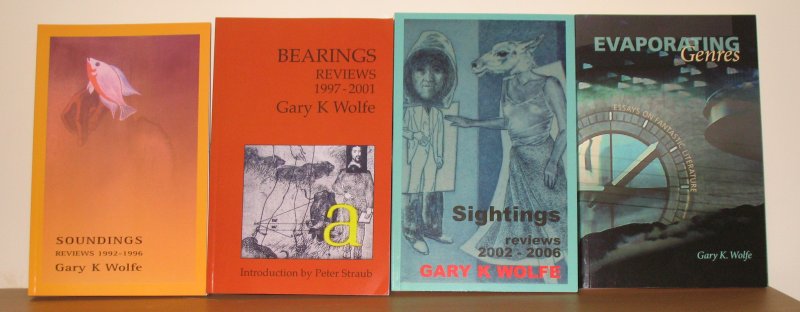
First up, four books by Gary K Wolfe: Soundings, Bearings, Sightings and Evaporating Genres. Wolfe writes sharp incisive reviews of genre books, and the first three books are collections of his reviews. Evaporating Genres is a more general critical work, and I’ve yet to read it (it was only published this year).

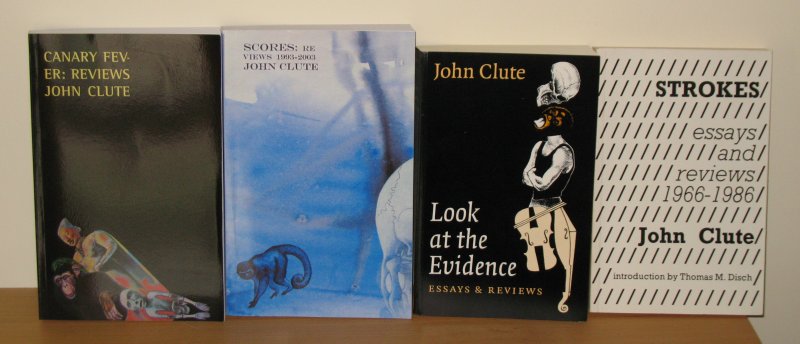
On this side of the Atlantic, we have sf critic John Clute, whose reviews are collected in these four books: Strokes, Look at the Evidence, Scores and Canary Fever. A new book of his essays has just been published, Pardon This Intrusion, but I’ve yet to buy a copy. Clute’s reviews can be difficult, if not willfully obscure, but he is also extremely sharp and clever.

These three books do exactly what it says on the tin: annotated lists of the top one hundred genre books, as chosen by the editors. Science Fiction: The 100 Best Novels and Fantasy: The 100 Best Books are sister-works; I’m guessing Pringle wanted to do both but ended up approaching another publisher for his Modern Fantasy: The Hundred Best Novels . Interesting books, but I can’t say I agree with the majority of their choices.

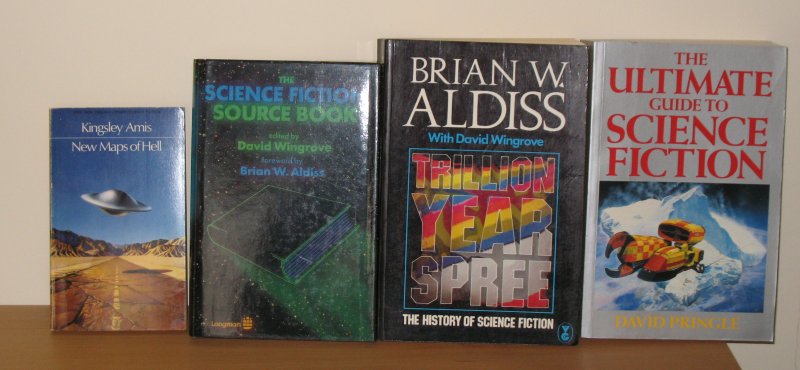
Two important critical works, New Maps of Hell by Kingsley Amis and Trillion Year Spree by Brian Aldiss, and a couple of general guides to sf, David Wingrove’s The Science Fiction Source Book and David Pringle’s The Ultimate Guide to Science Fiction.

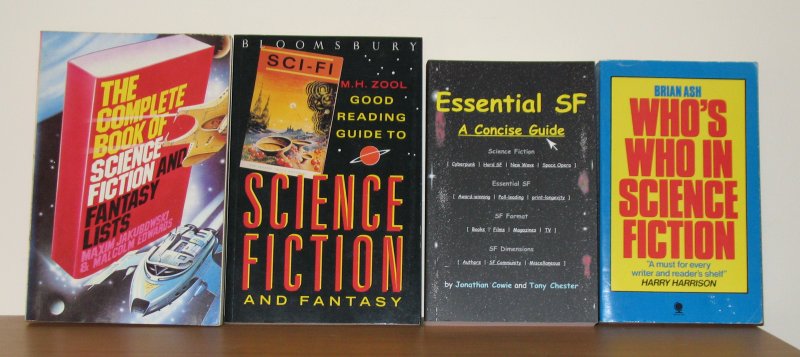
I’m not sure what use is The Complete Book of Science Fiction and Fantasy Lists, but never mind. Likewise, the Good Reading Guide to Science Fiction and Fantasy (Zool is actually the Oxford SF Group). Essential SF is, well, just that – at least according to the authors. Who’s Who in Science Fiction lists the pseudonyms used by genre writers.

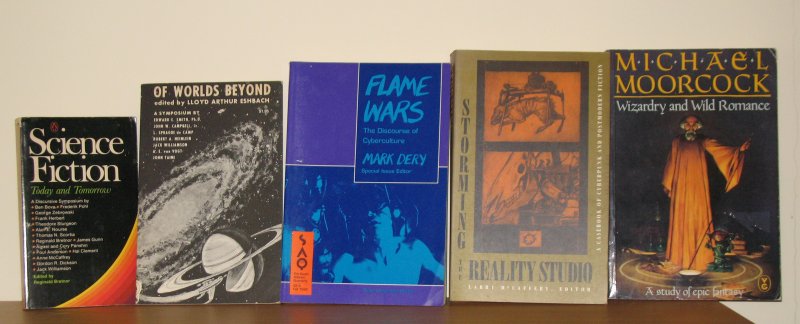
Four critical works. Bretnors’ Science Fiction Today and Tomorrow is a collection of essays by many big name authors of the 1970s and earlier: Frederik Pohl, Frank Herbert, Theodore Sturgeon, Jack Williamson, Gordon R Dickson, Ben Bova… Of Worlds Beyond is a series of essays on science fiction and writing science fiction by big name authors of an earlier generation: AE van Vogt, Robert Heinlein, EE ‘Doc’ smith, John W Campbell, and, er, Jack Williamson (most of the writing advice in the book is actually quite useless). Flame Wars and Storming the Reality Studio are academic studies of cyberpunk. Wizardry and Wild Romance is Michael Moorcock biting the hand that kept him in whisky for several decades.

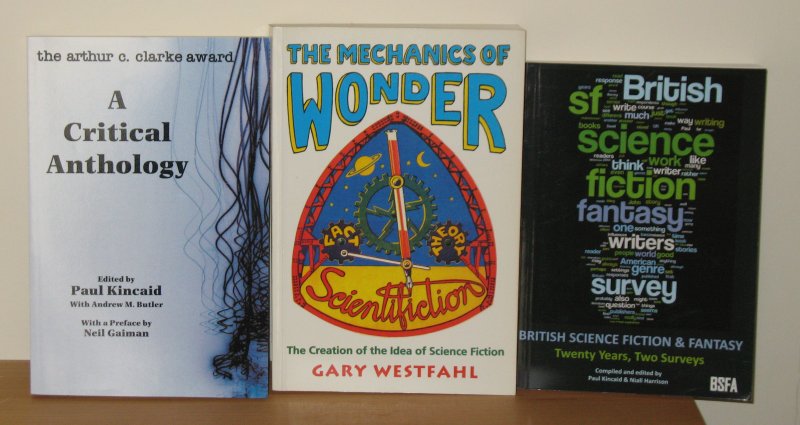
I seem to recall Gary Westfahl’s The Mechanics of Wonder causing something of a fuss when it was published in the late 1990s. I enjoyed it and, like Westfahl, I’ve always felt science fiction began in 1926 with the publication of the first issue of Amazing Stories. The Arthur C Clarke Award: A Critical Anthology is just that, and the title of British Science Fiction and Fantasy: Twenty Years, Two Surveys pretty accurately describes its contents too.

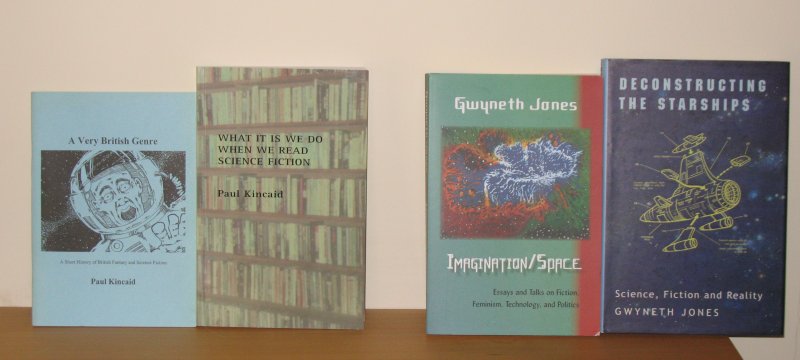
A pair of British critics: Paul Kincaid’s A Very British Genre and What It Is We Do When We Read Science Fiction; and Gwyneth Jones’ Deconstructing the Starships and Imagination / Space.

Some books about writers: Snake’s Hands is a study of the fiction of John Crowley; The Cherryh Odyssey covers CJ Cherryh’s works; Parietal Games is criticism about, and by, M John Harrison; Heinlein in Dimension is about Robert Heinlein; and The Universes of EE Smith is about the works of EE ‘Doc’ Smith.

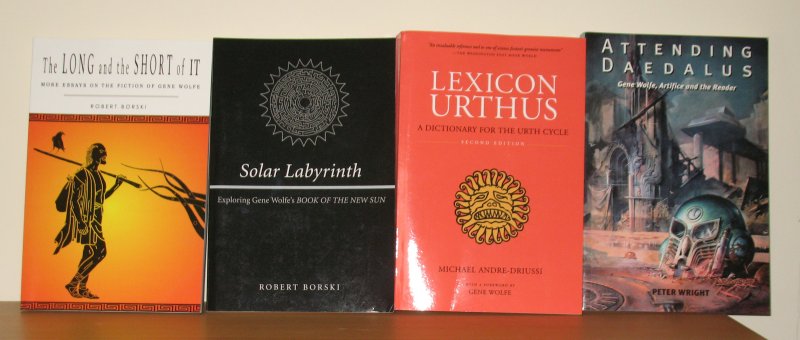
Some books about one writer: Gene Wolfe. The Long and the Short of It does not cover any specific work of Wolfe’s, unlike Solar Labyrinth, Lexicon Urthus, Second Edition and Attending Daedalus, all of which are about The Book Of The New Sun. I reviewed Lexicon Urthus, Second Edition for Interzone.

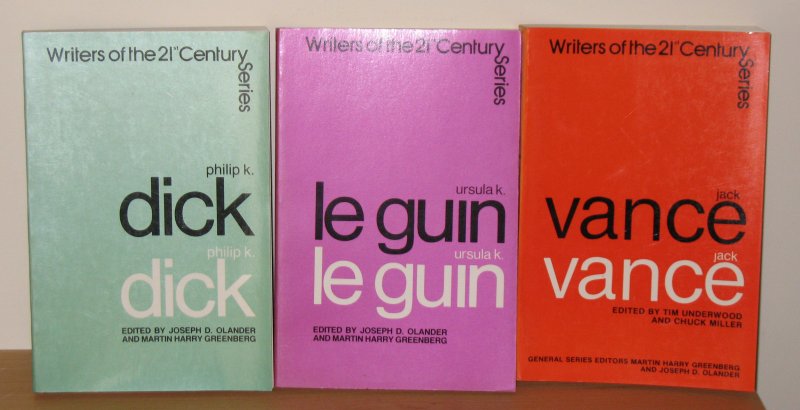
I picked these up years ago in a publishers’ clearance bookshop. I’m not sure why the series is titled Writers of the 21st Century, as only one – Le Guin – is still writing. Mind you, Philip K Dick is still being published, and having his stories adapted for the cinema, even though he died in 1982 (the book is copyrighted 1983). Jack Vance‘s last novel, Lurulu, was published in 2004, but we’re extremely unlikely to ever see anything new from him.

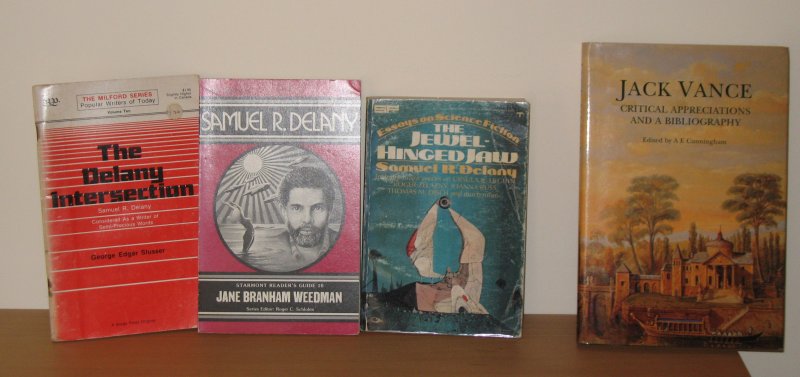
The Delany Intersection and the Starmont Reader’s Guide are both about Delany’s fiction. The Jewel-Hinged Jaw is Delany’s first and probably best-known work of criticism, though he’s written nearly a dozen such books. Jack Vance – Critical Appreciations and a Bibliography is just that.

Finally, two books about Edgar Rice Burroughs, Master Of Adventure about his fiction and A Guide to Barsoom specific to his Mars books. Who Writes Science Fiction? and Wordsmiths of Wonder are both collections of interviews with genre writers.

As well as the above books, I also have a number of science fiction and fantasy encyclopaedias and reference works. But that’s a post for another day.


Leave a comment

Alternate reading material

My story ‘Disambiguation’ is now up on the website of Alt Hist, the magazine of historical fiction and alternate history. It was originally published here on my blog a couple of months ago, but now it’s found a better home. It’s something of an experimental piece since it’s constructed from a series of real and fake Wikipedia articles. It also has flying boats in it. Go read it. Please.


6 Comments

So you think you know good sf?

So the Guardian wants to know what are our favourite sf novels. And up pop the usual suspects. Sigh. I can’t be bothered to post yet another rant on the topic. Instead, I will point you at these previous posts of mine:

The Ten Best Science Fiction Books… Ever
The Best Science Fiction Series
The Best SF Novels Since 1990

And for all you Foundation and Lensman fans:

The Worst Science Fiction Series