
The Future Fire, the online magazine of “social-political and progressive speculative fiction”, is back after an 18-month hiatus. And their new issue includes a flash fiction story by Yours Truly. It’s titled ‘ A History of the 20th Century, with Illustrations: Atonement’ and it’s about… Well, go and see for yourself. You’ll find it here. And while you’re at it, you might as well read the other excellent stories in the issue.
Category Archives: science fiction
Now we know where we’re going
News this week that the Eibonvale Press anthology Where Are We Going?, edited by Allen Ashley, will be launched in London on 2 March 2012. Details here. And look at the lovely cover:

This is the anthology which contains my bathypunk story – see here – so I’m especially pleased to see it. Looks like it has a top line-up too: there’s some very good names in that TOC.
Whores in Spaaaace
I am currently reading a big fat space opera which was published last year. It has received a number of positive reviews – George RR Martin himself even describes it as “kickass space opera” on the front-cover.
Part of the story is set in the Asteroid Belt. In the future of the novel, a number of asteroids have been settled – there are, in fact, some 150 million people living in the Belt – and the largest such settlement is the hollowed-out dwarf planet Ceres (approximately 480 km in diameter, six million population). The society in Ceres, and by implication in other colonised asteroids, is essentially US, capitalist, corporatist, with a few touches of foreign colour. This is neither especially convincing nor especially unusual in space opera – even one set in the relatively near-future as this one is. Ceres also has organised crime, gangsters, protection rackets, corruption, bent cops, poverty, drugs… And prostitution.
So, basically, the author is saying that he wants one half of the human race to exist for the gratification of the other half. He can’t claim “realism” because this is an invented world. He made it up. This is an artistic decision he made. He has put the women in his universe in that position. He includes a few named female characters – with and without agency – and thinks he’s covered his bases. His detective, for example, has a female captain – there, that must be good enough. But. Prostitution. Underage prostitution. Human trafficking. All three are mentioned. All three are taken as givens in this future universe.
FFS.
Is that the best an intelligent person living in the twenty-first century can do? Create some sort of Randian frontier-town society and think the presence of spaceships and AIs and some big melodramatic space-hopping plot makes it alright? It doesn’t. If you have prostitutes in your sf story, you’d better think damn hard why they’re there. If you have a rape in your fantasy story, you’d better think even harder why it’s there. Neither are acceptable. They are not genre tropes. You have no excuse for creating universes in which women are treated in this way.
Science fiction was created by (mostly) inadequate teenagers who grew up to become (mostly) dirty old men. But the bulk of sf writers these days fit neither of those descriptions. And yet those pioneers set the tone of the genre. After eighty-five bloody years, isn’t it long past time we got rid of that? Isn’t it about time we started treating half of the human race like, well, like human beings in our science fictions? Isn’t it about time we started giving them respect on the page? (Respect in the real world is a given.) It’s not like it’s difficult, it’s not going to hurt, it’s not going to cost you money. You have no excuse for not doing it.
But you know what’s worse than that? The fact this is only one of many battles that need to be fought.
Books you must read: Omega, Christopher Evans
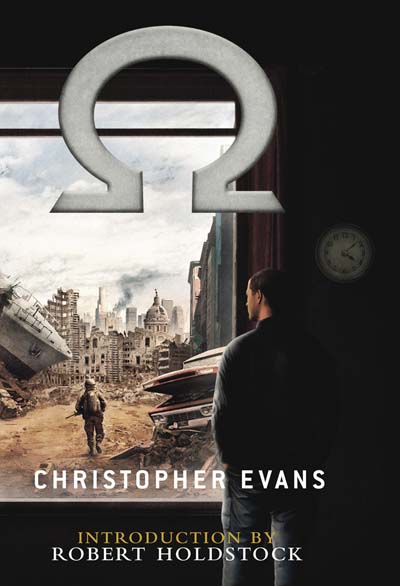 I’ve been a fan of Evans’ novels since reviewing his Aztec Century for Vector, the critical journal of the BSFA, back in 1993. His fiction is a literate, very British sort of sf, which doesn’t rely on flashy spectacle but on in-depth studies of their protagonists and their worlds. Omega, published in 2008 by PS Publishing and Evans’ first novel in more than a decade, is a case in point.
Owen Meredith is a maker of military history documentaries. One day while Christmas shopping with his wife and two daughters, a bomb explodes in Hamley’s. Meredith is outside and only injured in the blast, but his family are in the store and killed.
Major Owain Maredudd is an officer in an Allied army in a Britain that has been at war for over half a century. He had led a mission into enemy territory to test a new weapon, but something went wrong. Maredudd was the only survivor, and his memories of the mission are somewhat confused. As a result, he has been attached to his uncle’s staff. His uncle is the commander-in-chief of the allied forces in the UK and a member of the Joint Governing Council, the military junta that rules the Alliance. He is, in effect, the ruler of most of Europe.
When Meredith wakes in hospital after the bomb blast, he discovers first that at times he somehow inhabits Maredudd’s head, and so witnesses events in the major’s world. And secondly, Meredith’s memories of his life before the explosion don’t quite tally with the life he seems to now have. For a start, he is apparently in hospital because he was hit by a car while crossing the road. There was no bomb blast. And his wife left him several years before, taking the kids, and now lives in Australia.
As Meredith tries to figure out his life and pick up the pieces, so he comes to spend more time in Maredudd’s world. Maredudd himself is having his own problems as there seems to be something going on with his uncle to which he’s not privy but in which he is somehow involved. This is all to do with the secret weapon after which the book is titled. The Americans, once part of the Alliance, are apparently getting troublesome and the Omega weapon is intended to stop them.
Omega is not an easy book to do justice to. It’s an alternate history, inasmuch as part of the story is set in a world still embroiled in a world war. But it’s also much more than that. It’s a study of both Meredith and Maredudd, and their reactions to worlds they find it increasingly hard to fathom. While Meredith also has Maredudd’s world to explore, it’s implied that Maredudd is doing the same to Meredith. Certainly, there are periods when Meredith is strangely absent – though from others’ reactions it seems he continues to function as “normal”. The alternate UK is extremely well-drawn and very convincing, but it is the two protagonists who really carry the book. The writing is plain but elegant, the worlds of Meredith and Maredudd are portrayed with authority, and the novel is an engaging and surprisingly quick read.
I’m surprised Omega didn’t appear on any short-lists back in 2009. It’s certainly a better novel than the four that made it onto that year’s BSFA short-list – Aztec Century, incidentally, won the BSFA Award in 1994 – and it could have been a contender for the Clarke too. Recommended.
Women in sf reading challenge #10: City of Pearl, Karen Traviss
To be honest, I had not really expected to enjoy City of Pearl by Karen Traviss. From what I’d heard about the novel, it seemed the sort of science fiction I don’t especially like. And Traviss is known as an especially mercenary writer. No matter how talented she may be, such an attitude is unlikely to create works I would find appealing. Nonetheless, I picked the book as one of my dozen for my 2011 reading challenge, and though I may have slipped a little towards the end of last year, I had every intention of reading and blogging about the twelve listed novels.
And so I came to City of Pearl with, I admit, a few preconceptions. Some of them were indeed met, but I was surprised to find myself enjoying the novel more than I had expected.
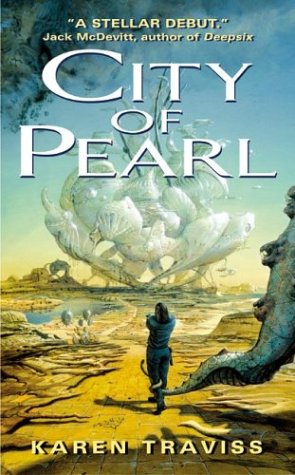
Shan Frankland is a hard-as-nails police officer in a near-future in which corporations dominate ineffectual governments. All crops are genetically-engineered and trademark, such that no foodstuff can be grown without paying a license fee to a company. When Frankland is offered command of a mission to Earth’s only interstellar colony on Cavanagh’s Star’s second planet, she accepts the mission. But she doesn’t know exactly why, because whatever was told to her to persuade her to accept was part of a Suppressed Briefing, which only releases information into her memory in response to certain triggers.
The mission arrives at Cavanagh’s Star 2 and finds a situation it had not expected: a small low-tech human colony with an extremely small environmental footprint living under the aegis of an alien race, the wess’har. The aliens are actually native to Cavanagh’s Star 2’s twin planet, and are on Cavanagh’s Star 2 to protect that planet’s native squid-like aquatic race, the bezeri. Who had been almost polluted to extinction by a third alien race, the isenj, who had colonised the world. The wess’har wiped out the isenj colony, but now allow the humans to stay on sufferance. Aras is the wess’har responsible for the planet and its ecosystem, and he has been given this role because he has been infected by a native parasite, the c’naatat, which has made him immortal and almost impossible to kill.
Though Frankland tries to keep a tight leash on the scientific team she has brought to Cavanagh’s Star 2, they cavil at her restrictions and continually seek to subvert them. This makes tensions high within Frankland’s mission, a situation not helped by her high-handed and take-no-prisoners attitude. When a second starship from Earth turns up, having departed fifty years after the first, it seems Earth has formed an alliance with the idenj, who determined to take back Cavanagh’s Star 2. During a skirmish with the isenj, Frankland is mortally wounded, but Aras, who has come to value her, infects her with c’naatat. Now she can never return to Earth.
I liked Frankland, and the best parts of City of Pearl were the parts which focused on her. Unfortunately, the aliens are all single-note: the wess’har are literal and unbending, the bezeri are enigmatic, and the isenj are numerous. The scientists are all characterised as venal and selfish, and only the military characters appear to possess any redeeming virtues. The human colonists on Cavanagh’s Star 2 are treated like simple back-to-the-land peasants, and the novel makes little or no judgment on them or their way of life. A lot of City of Pearl is in Aras’ point of view, and he’s neither convincingly alien nor especially interesting.
There’s a fixity of views throughout City of Pearl which I found a little off-putting. The wess’har are very literal and do not compromise. Frankland is very much convinced her own opinion is always correct. The entire cast – with the exception of those Traviss villanises – are straight from the US mode of science fiction, with its Rational Competent Men. Though many in City of Pearl are actually women. Or alien. There’s no subtlety or complexity in the novel. The scientists are wrong, the isenj are wrong. And that’s it. I can see how such binary views might appeal to some readers, especially genre readers, since populist genre fiction seems incapable of psychological depth.
There are apparently a further five Wess’har books, but I’ll not be bothering to read them. While City of Pearl managed an interesting meld of near-future sf and space opera, it was too much like military sf in tone to really appeal to me. Traviss’s prose is readable and well-paced, though to be honest I kept reading more because I liked the character of Frankland than anything else.
Oh, and the titular city is the wess’har capital on their world, and it makes perhaps a half dozen appearances in the novel. Frankland visits it toward the end in order to seek permission from the wess’har elders to stay with Aras. It’s a somewhat peripheral element of the story with which to title it.
Your world will not be my world
I think it was Orson Scott Card who wrote in an essay in Asimov’s back in the 1990s that any future of consequence would be American. That assertion was debatable then – if not offensively arrogant – but the world has changed a great deal in the past twenty years, making’s Card’s boast even less likely. And yet still I see contemporary sf novels in which Planet Earth seems to be either monoculturally US-ian, or contains worlds extrapolated from present US society.
Science fiction is chiefly a white, male, middle-class genre and is dominated by the USA, and so its sensibilities and concerns are typically those which confirm the prejudices of that demographic. But not always, of course – back in 1991, William Barton and Michael Capobianco’s Fellow Traveler was set in a future Soviet space programme; in 2012, Alastair Reynolds’ Blue Remembered Earth opens in a future where “Africa is the dominant technological and economic power” and follows the fortunes of an African family. (There is no mention in the blurb, however, of which African nation the family are from – Africa is, after all, as monocultural as Europe: ie, not at all; and since we’d say French or German or Polish or Swedish, we shouldn’t be saying “African”.)
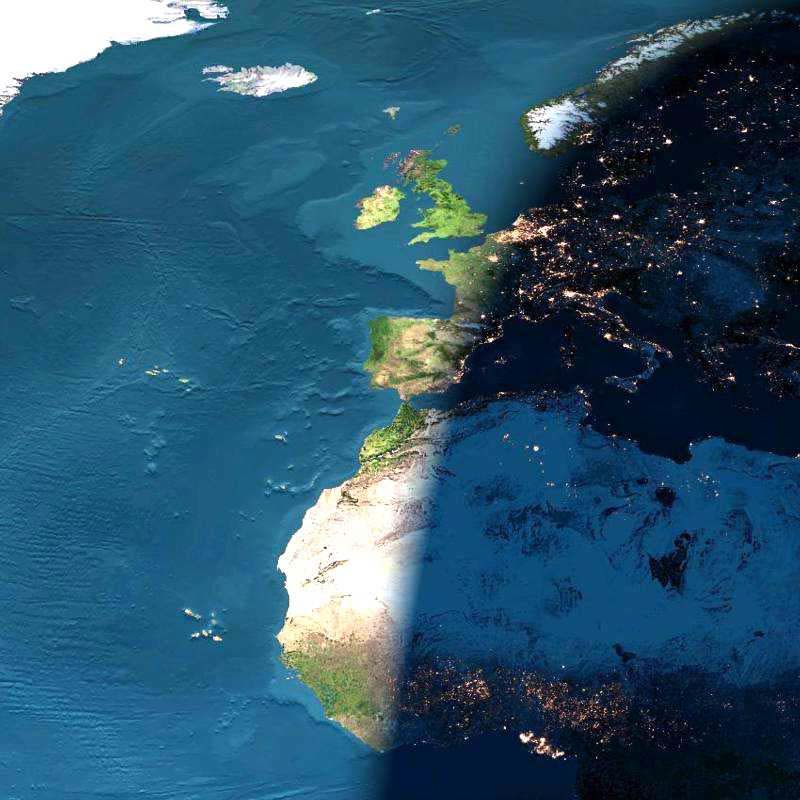
Photo taken by Columbia Space Shuttle
In reference to the near-future, sf has maintained some degree – though it could be greatly improved – of diversity of setting and cast. But anything set further hence usually devolves to the white, Western, Anglophone, vaguely US, vaguely right-wing default world carried over from the genre’s early beginnings. There’s no good reason for this. True, the US still performs much of the tentpole science, but not exclusively. The LHC is in Switzerland; the Soviets had a space station before the Americans; the Chinese may well be the first to set foot on Mars. Many nations have space agencies – indeed, out of the twenty-two past and present ESA astronauts, only one speaks English as a first language.
Even looking at the cyclical nature of empires suggests that US hegemony will no longer exist in any recognisable form by the middle of this century. Then there’s everyday technology and its uses. Such as surveillance. The US provides no good model for any future society in this regard. If anything, looking at the UK would be more useful. Twenty-five percent of the world’s CCTV cameras are in the UK. It is the most-surveillanced nation on the planet. Yet we don’t especially much care about the fact we’re always being watched. US ideas of privacy exist only in the US, and the US attitude to video surveillance does not map onto British sensibilities. It is likely that, as surveillance becomes more pervasive and ubiquitous, it is the UK attitude to it which will prevail.
Europe is also, of course, defiantly not monocultural. Its twenty-seven member states speak twenty-three official languages. Back in the day, Harry Harrison may have thought Earth, and hence any subsequent interstellar polity, might uniformly adopt an artificial language, but even the language he chose, Esperanto, has never been used routinely by more than an estimated one million people. India, a single nation, has no national language but recognises twenty-two regional languages (although the SIL Ethnologue lists 415 spoken throughout the country). History has shown that languages come to dominate areas as a result of conquest, religion, trade, or cultural imperialism; and often from a combination of all four. But that, obviously, does not mean that their dominance remains eternal: Arabic is no longer spoken in Spain, for example.
All of which suggests that science fiction has changed very little from the days of Amazing Stories, especially in regards to its in-built attitudes and sensibilities. The tropes it has developed over the generations have become shortcuts and defaults. It’s not just those galactic empires of whitebread worlds, but the technology and science and their uses. Can’t be bothered to figure out how spaceflight really works? Bung in some “thrusters” and “inertial compensators”. Can’t be bothered to design a plausible future? Just make it like the US, but with neat toys. It’s authorial laziness. Writing stories that not only cater to the prejudices of a perceived market but actively reinforce those prejudices is not something a genre which boasts of its inventiveness and transgressive achievements should be doing.
Mundane SF was seen by many genre fans as throwing the baby out with the bathwater – it’s the wildly improbably stuff like aliens and time travel which can be the most fun. But at least Mundane SF required its adherents to focus on the basics. You couldn’t just make shit up, you couldn’t just slot in those neat ideas from Tropes R Us, you couldn’t just pretend that interstellar travel was like air travel of today or sea travel of earlier decades. You had to think about the world of your story, not just pin a few baubles on the default setting. Sadly, Mundane SF is little more than a Wikipedia entry these days, but let’s hope it had some effect on the genre.
And let’s hope that Blue Remembered Earth, the first of a trilogy, is the start of a new movement in science fiction to break away from white middle-class Anglophone futures, a move towards more plausible and more representative world-building. Let’s hope Alastair Reynold’s new novel helps pave the way to a more adult and thoughtful genre. After all, if we want to take be taken seriously by non-genre writers, we shouldn’t bitch and moan about being ill-treated, we should show them that we can be as good as they are. We’ll only ever be taken seriously if we up our game.
And we need to start doing that right now.
Creatively bankrupt
I learnt today that Hollywood is planning to remake Paul Verhoeven’s Starship Troopers. And, in fact, there’s a remake of his Total Recall due next year (starring Kate Beckinsale and Colin Farrell). We all know of Hollywood’s recent penchant for remakes and reboots. It’s allegedly financially safer to trade on a known name than to try something new. The only person losing out in this strategy, of course, is us. Because we’ll see well-loved films completely ruined. Starship Troopers was a pitch-perfect satire of Heinlein’s right-wing novel, but who wants to bet the new version will keep the book’s odious politics intact? I will not go and see such a film; I will stay at home and watch my DVD of Verhoeven’s version again.
It might well be that the Starship Troopers remake isn’t so bad. But the odds are against it. Not only is there the online vocal hatred of Verhoeven’s film by conservative and libertarian sf fans (they’re totally wrong, of course), there’s also the US’s slow drift to the right over the past three decades, and… well, and there’s 2009’s Star Trek, a monumentally dumb sf film. And there was 2008’s The Day The Earth Stood Still. And this year’s The Thing. And… need I go on? This is what reboots do: they put the boot into well-loved and well-regarded films.
To be honest, I gave up on Hollywood’s output years ago. The best films these days are made elsewhere. And that’s not just genre films. But then, Hollywood chases that 15 – 25 male demographic and, let’s face it, focusing on the stupidest sector of society is not going to be good for your creativity. The superhero tentpole blockbuster is a case in point. Such films are all spectacle – they are like their titular heroes, all pumped-up muscles and no brains.
The best sf film I have seen in recent years, Cargo, was made in Switzerland. The only time I visited the cinema this year was to see Apollo 18, an independent Russo-American production. The bulk of my DVD viewing in 2011 has been foreign-language films, and 1950s and 1960s Hollywood films (made long before the rot set in). I’m planning to see John Carter next year, which has been produced by Disney, but I suspect that will be the last Hollywood film I go to the cinema to see. Given that the success of films is judged by their cinema takings, that seems a sensible way to express my disappointment and displeasure at Hollywood’s output.
The agency model of genre
The Ancient Greeks attempted to explain the world about them by applying human agency to it. Why does the sun cross the sky? Because some bloke in a chariot is pulling it. And since such feats required abilities above and beyond those normally attributable to humans, so those who performed them were deemed gods. Over time, the use of these gods as explanations became a narrative and so accreted history, politics, romance, symbolism, etc. But they still didn’t really explain what caused the sun to rise and set.
And so for fantasy. It does not seek to explain, it applies agency to something which does not, in the real world, possess it. Sometimes that agency cannot be wielded by humans – the supernatural, demons, gods and demi-gods. Or it gives humans agency over things not normally open to their use, via magic systems or supernatural talents. And those magic systems may be as structured and fractal as the laws of physics.
Science fiction, however, assumes the real world is explainable. The sun crosses the sky because the earth is turning, and the earth turns due to the action of its core. The universe operates according to a structure of interlocking principles and rules, which are not only parsable but fractal.
The worlds in science fiction stories are implicitly reachable, either by traversing time or space or both. This is not true for fantasy worlds. Yes, there are those where people from our world find themselves in the world of the story – The Chronicles of Narnia, The Fionavar Tapestry, or The Chronicles of Thomas Covenant, for example – but those are not journeys, they are magic portals. To some extent, it might be argued that similar travel to alternate dimensions, worlds or histories in science fiction might well treat such methods as magic portals, but the possibility of an explanation still underlies it. More than that, it is driven by an element of a rule-set which underlies the entire universe. The same cannot be said of fantasy.
That, I think, is the fundamental difference between science fiction and fantasy. That is why they are different modes of fiction, for all that they may share similar trappings or often use a shared toolkit. In sf, the universe is a rational and impersonal place, which operates independently of, and with no regard for, those who inhabit it (though they may engineer it for their own uses). In fantasy, everything has motivation because everything has some degree of agency, and the world exists for the benefit of its inhabitants. Their existence is part of the same act of creation which created the world. Without inhabitants, there would be no world. And everything in it is open to use by at least some of the inhabitants.
By the same token, neither genre is a subset of the other. Though they may be lumped together for marketing purposes and because the fanbases have traditionally overlapped, they have entirely different histories. The first science fiction came from electronics magazines in the 1920s; the first fantasies are a great deal older, perhaps even as old as civilisation itself. The current situation is an accident of the creative and production process for fantasy and science fiction. This doesn’t mean, of course, that they two should be sundered. Each benefits from its supposed relationship to the other. But there is a distinction, and to discuss either, or both, without recognising that benefits neither.
A tale of two cities
Well, that was a busy weekend. Two cities in two days, each in the opposite direction from home.
On Friday night, I was in Manchester, at the Academy to see Opeth perform live. The support act were Pain of Salvation. While I like bits of Pain of Salvation’s two Road Salt albums, I’m not really a fan of their music. Live, they put on a good show, but they struck me as bit posey and frontman Daniel Gildenlöw seemed to think he was Lenny Kravitz.
Rumour had it the Opeth set would be taken entirely from the new album, Heritage. Which is entirely progressive rock. Given that I still think that Blackwater Park is the band’s best album, and that Heritage is an album that is only slowly growing on me, I wasn’t entirely sure what to expect, even though this was the fourth time I’d seen them perform. And the set did indeed open with some tracks from Heritage. But then Mikael Åkerfeldt started bantering with the crowd – that night it was a lightly sarcastic paean to Kiss – and I knew that despite the new “direction” Opeth hadn’t really changed. The band then performed some older songs, although the entire set featured only clean vocals. In the case of ‘A Fair Judgment’ from Deliverance (a favourite track of mine), this wasn’t an issue as the album version features clean vocals. But ‘The Face of Melinda’ from Still Life is certainly different when it has all the growl vocals taken out. Still, Opeth are superlative musicians, and I suspect I’ll find myself liking Heritage a bit more after being reminded live just how good they really are.
The gig was my first in Academy 1. Last year, I’d seen Ghost Brigade, Orphaned Land and Amorphis in Academy 3, which is the smallest of the four venues. Academy 1 is like a small aircraft hangar. We were up near the front for Pain of Salvation’s set, and that wasn’t a problem – you could still get out to visit the bar or the toilets. But about five songs into Opeth’s set I felt the call of nature, and it was a real battle to get out of the crowd in front of the stage. And once I was done, there was no way I was going to be able to get back to where I’d been standing. That was annoying. (Also, I was wearing my Mithras Forever Advancing Legions T-shirt that night, and someone said, “Nice T-shirt” to me.)
So, Manchester meant getting home after midnight. And the next morning I was up and off to Nottingham for Novacon. I’d checked train times, both there and back – I was intending to only spend the Saturday at the convention, but I did take toiletries and a change of clothes in case I decided to stay the night. The last train home was at 23:15 but it didn’t get in until… 10:16 the next morning. Essentially, it dumped you in Derby, and you then had to wait for the first train the next morning. That’s not a viable journey, and you’d think railway timetable websites would recognise that. However, there were some direct trains between 20:00 and 21:30, so I had until then to make a decision.
I arrived in Nottingham at 11:00. Back in the late 1980s, I lived in Mansfield, my home town, and spent many weekend nights pubbing and clubbing in Nottingham. I’ve only been back a handful of times, but even so I know the geography of the city pretty well. I noticed a few changes in the city centre, but Mansfield Road, which is where Novacon’s hotel was sited, looked exactly as I remembered.
I bought a day membership on arrving at the hotel, and then headed straight into the bar. The first familiar face I spotted was Chris Amies, who I’d not seen for many years. After a chat, I left my bags with him and hit the dealers’ room. The usual suspects were all present: Porcupine Books, Cold Tonnage, Replay Books, Murky Depths, NewCon Press… I was at the Porcupine Books stall, when I spotted a couple of Women’s Press sf titles I didn’t own, and reached out for them. The stranger standing next to me turned to me and said, “You must be Ian Sales.” Which was a pretty good trick: my day membership badge didn’t have my name on it. The stranger proved to be Colum Paget, who has a story in Rocket Science. After a few more chats with various people, I returned to the bar… Which is where, as usual, I spent much of the con.
I had conversations with Al Reynolds, Ian Whates, Terry Martin, Kim and Del Lakin-Smith, Caroline Mullan, Fran and John Dowd, John Meaney, Leigh Kennedy, Janet Edwards… There was quite an intense discussion on utopias with Charles Stross, Justina Robson, Kev McVeigh and myself. I also remember a long talk about Uriah Heep (the band, not the Dickens character) with Swedish fan Bellis. The only programme items I attended were a 15 to 1 quiz and the second book auction (but I didn’t bid on anything). By about six o’clock, it was clear I’d be better off staying the night, so I checked into the hotel. I was quite impressed with the room – it was small but very modern. The shower – there was no bath – had a huge showerhead set flat again the ceiling, which was quite odd.
I was up at my usual time the next day, wolfed down breakfast, and then just hung around – in and out of the dealers’ room – throughout the morning. I was planning to leave later in the day, but was offered a lift home by Kev leaving at noon-ish, so I decided to accept it.
So that was the weekend. I caught up with a band I’ve liked for many years and caught up with some friends I don’t get to see very often. I didn’t feel up to much when I got home on the Sunday, so I’m now horribly behind on nanowrimo. But never mind. I bought almost a dozen books at Novacon, but I’ll put up photos of them in a separate post.
British sf masterwork: The Uncensored Man, Arthur Sellings
When I put together my list of British SF Masterworks last year (see here), a number of eligible authors were suggested to me that I’d never heard of before. One such was Arthur Sellings who, I discovered, had written six novels and numerous short stories (many of which were collected in two collections) between 1953 and 1970. He died suddenly in 1968 of a heart attack, “just as he was gaining more and more notice” according to his entry in the SF Encyclopedia here.
Although I actually put Sellings’ 1970 novel, Junk Day, on my British SF Masterworks list, I have so far only managed to acquire The Silent Speakers (1962), his debut novel, and The Uncensored Man (1964), his second novel. It was the latter I read.

Dr Mark Anders is a physicist at Jarwood, a secret British weapons laboratory. He is married to Ruth, who also works there, but their marriage is faltering. Ruth is too perfect, and too much a perfectionist, and whatever spark their relationship had possessed has long since dissipated. In an effort to cheer himself up, Anders goes visits an old friend who is a doctor in a distant town. While there, he witnesses a teenage patient of the doctor’s have an epileptic fit, wake up and talk for a minute in German, and then fall into a light coma. But the boy has learning difficulties and has never been taught a foreign language. Intrigued, Anders investigates further, but draws a blank. Then his brand-new computer spits out a page of Greek writing instead of the expected experimental results. He gets this translated, and it proves to be a quote from the Book of Revelations.
Mystified, and suspecting he may be suffering from some psychological condition, Anders visits Dr Nowatski, A Polish psychiatrist he met briefly at a party years before. Nowatski gives Anders a shot of LSD – it was legal, in those days. Under the influence of the drug, Anders… visits a parallel world and meets its human inhabitants. The remainder of the novel describes Anders attempts to learn the truth of this alternate Earth, his run-ins with Jarwood’s security stemming from his association with Nowatski, and his subsequent development of mental powers.
The Uncensored Man is tosh, but it’s quite well-written tosh. The central premise – the origin and reason for existence of the alternate Earth – is neither plausible nor convincing. While Anders is a nuclear physicist working on neutron bombs, Sellings gives no information on his actual work. And though the reason why his computer spouts Greek is explained, how it actually does so is ignored. The book lacks authenticity.
However, Anders is a well-drawn character. Likewise Nowatski. The two women – Ruth, and Nowatski’s wife, Anna – are less rounded, though their treatment is sympathetic. In fact, they are repeatedly shown to be better persons than their menfolk. The prose is also good – in other words, it is typical of British sf of the 1960s, and so much better than US sf of the same period. US authors of the time may have had the ideas, but British sf authors had the writing chops.
The Uncensored Man is a very British novel, and very much a novel of its time. These days, it’s little more than a curiosity. It’s no masterwork, and it remains to be seen which of Sellings’ novels belongs on my list. It’s an interesting read, but not one, I think, that would have set the genre alight.
As mentioned earlier, I also have a copy of Selling’s debut, The Silent Speakers (published as Telepath in the US), and if I see other novels by him I’ll no doubt pick them up. But he was neither as good as Compton, nor as prolific as other British sf authors of the time, such as Tubb, Brunner or Cooper. Like Rex Gordon and Leonard Daventry, the fact he’s now forgotten does not seem entirely surprising. But it would not have done the genre a disservice to have had the likes of Sellings and his peers representing it rather than some of the sf novels we now consider to be classics.
 It Doesn't Have To Be Right...