It Doesn't Have To Be Right…

… it just has to sound plausible


30 Comments

A good year for… something

Sometimes I feel like Bart Simpson when he keeps on reaching for the doughnut Lisa Simpson has electrified. Each year, I eagerly await the shortlists for the Arthur C Clarke and Hugo Awards; each year, I’m disappointed by the novels or short fiction chosen by one or both. I have already written about the Clarke (see here). I’d like The Testament of Jessie Lamb to win, but I expect Embassytown will. (Incidentally, it occurred to me reading Adam Roberts’ excellent report on the Clarke shortlist books here and here that his response to The Testament of Jessie Lamb mirrors mine to Embassytown; and vice versa. Sort of.)

Then there’s the Hugo Award shortlists…

The less said about the novel shortlist, the better. Oh, all right…

My thoughts on Leviathan Wakes are laid out quite clearly in my review on SFF Chronicles here. I am quite angry it has been shortlisted. I gave up on A Song of Ice and Fire several years ago after reading one of its humungous installments in which fuck-all happened. I gave up on epic fantasy as a genre a couple of years ago after getting sick to death of its shallowness, its use of rape as a trope, and its general lack of invention or innovation (though I will acknowledge there are some worth reading – RA McAvoy’s Lens of the World trilogy, Steph Swainston, KJ Parker, Carolyn Ives Gilman, A Princess of Roumania, for example). Deadline is the middle book of a trilogy about zombies. Zombies are passé, they have been done to, er, undeath. It’s time they were put to, um, rest. The world has moved on, it’s all krakens and sea monsters now. I think. Among Others I have heard mostly good things about, but I have not read it. And Embassytown, while I think it does not entirely succeed (see here), is probably the one book that does belong on this shortlist.

If I had bothered to pay for the privilege of voting, my choices would go: 1) Embassytown, 2) Among Others, 3) No Award

And the short fiction shortlist:

The Resnick is old-fashioned crap. As have been every one of his shortlisted stories in recent years. Clearly he has his fans; clearly they need to read a lot more widely. The Liu is what I think of as a “clarion-style story”. It is sentimental, uses a metaphor to illustrate its core emotional argument, and then beats that metaphor to death. I do not like such stories. The Scalzi is a jolly jape and does not belong within five thousand kilometres of a shortlist. Unless said shortlist was posted on April 1st. This one was not. Shortlisting Scalzi’s spoof does not prove that fandom has a sense of humour, it proves only that it thinks one of the best five stories written during the previous year was a stupid spoof knocked off in a weekend by a popular writer. That’s not only dumb, it’s a perversion of the whole concept of “best short story”. Nancy Fulda’s story is another “well-meaning parents try to use tech to cure autistic kid” story. There’s usually half a dozen of them published in any one year. Fulda’s is no better and no worse than most but, crucially, it brings nothing new to the trope. It’s also sentimental; I don’t like sentimental. The Yu is a piece of whimsy which threatens to mean more than it seems but never quite does so. It at least has some claim to a place on the shortlist.

My votes, had I paid to vote, would be: 1) E Lily Yu, 2) No Award.

I shall whinge about the novelettes and novellas in another post. I shall not bother with the other categories. I still don’t understand why fandom bothers with the dramatic presentation Hugos. The film and television industries have their own awards ceremony, and they spent a shitload more money on them than sf does. As for the remaining categories…

Did I say “bah humbug”? If I haven’t, take it as, er, read…


Leave a comment

Pimp and circumstance

Praise continues to trickle in for Adrift on the Sea of Rains…

On Twitter, Dave Hutchinson (@HutchinsonDave) tweeted: “I recommend that you beg, steal, borrow (but preferably buy) Adrift on the Sea of Rains by @ian_sales, because it’s a little cracker”, and then added on Facebook, “All people of good intent should read Adrift on the Sea of Rains by Ian Sales, as I did today. I loved it.”

On Twitter, Martin McGrath (@martinmcgrath) tweeted, “Cracking novella (and appendices)”, and Stuart Wallace (@soapyfrogs) said, “just read and loved ‘Adrift On The Sea Of Rains’ … More please!”

On his blog, Early Days of a Better Nation, Ken MacLeod wrote about alt.fiction and mentioned that Adrift on the Sea of Rains was “very good indeed”.

Robert Day has written a very nice review of it here on LibraryThing, and Cliff Burns has given it a five-star review on Amazon here.

Plans to create an internet Whippleshield empire continue apace. I’m still working on the website, but as soon as it’s up and running I’ll make sure everyone knows. I am also now the proud owner of a copy of Scrivener, and I plan to use that to create EPUB and MOBI editions of Adrift on the Sea of Rains. So expect it to be available for Kindle in a week or so.

Meanwhile, I need to get cracking on with the second book of the Apollo Quartet, Wave Fronts, in which the first man on Mars investigates the disappearance of Earth’s first exoplanet colony and discovers something which will completely change humanity’s relationship to the universe…


Leave a comment

A little lunacy…

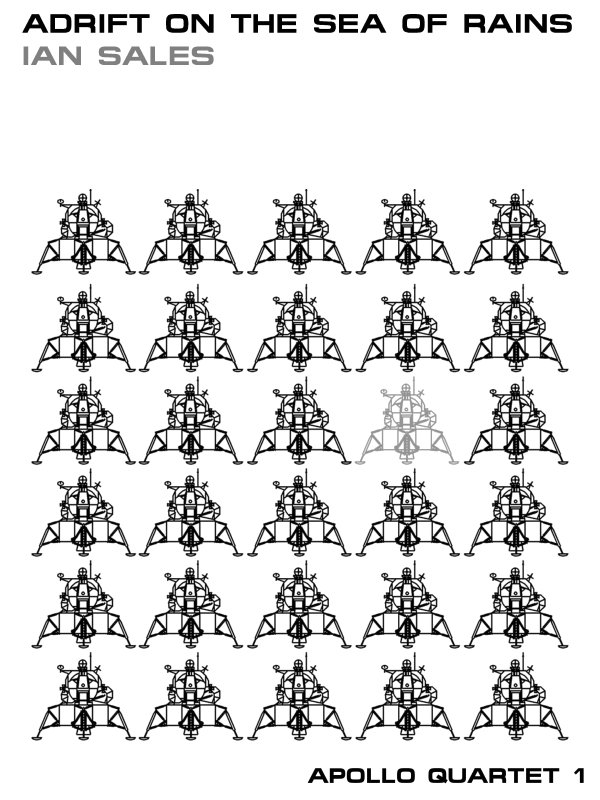
I did toy with the title “A taste of green cheese”, but fortunately good sense prevailed. Almost. Anyway, you’ve seen a photograph of the boxes containing it, you’ve seen its cover-art, and you’ve even seen the first review ever of it… So I thought I’d give you a little teaser of Adrift on the Sea of Rains. Here are the first three paragraphs (and a relevant picture):

SOME DAYS, WHEN it feels like the end of the world yet again, Colonel Vance Peterson, USAF, goes out onto the surface and gazes up at what they have lost.

In the grey gunpowder dust, he stands in the pose so familiar from televised missions. He leans forward to counterbalance the weight of the PLSS on his back; the A7LB’s inflated bladder pushes his arms out from his sides. And he stares up at that grey-white marble fixed mockingly above the horizon. He listens to the whirr of the pumps, his own breath an amniotic sussurus within the confines of his helmet. The noises reassure him – sound itself he finds comforting in this magnificent desolation.

If he turns about – blurring bootprints which might otherwise last for millennia – he sees the blanket-like folds of mountains, grey upon grey, and a plain of the same lack of colour, all painted with scalpel-edged shadows. Over there, to his right, the scattered descent stages of LM Trucks and Augmented LMs fill the mare; and one, just one, still with its ascent stage. Another, he knows, is nearly twenty years old, a piece of abandoned history; but he does not know which one.

You’ll have to buy the book to read the rest of it. It will be on sale at Eastercon (6 – 9 April) and at alt.fiction (14 – 15 April). And I hope to have a website up within a couple of weeks where it can be purchased direct.


9 Comments

My first book!

So what if I published it myself. At least I did it properly. See:

That’s 100 paperback copies and 100 hardback copies of Whippleshield Books’ first, er, book: Apollo Quartet 1: Adrift on the Sea of Rains. Well, that’s what I ordered. There may be more, and sometimes the printers do over-run. It looks like more. But I won’t know the exact number until I actually count them.

Anyway, I’m really pleased with how it’s come out. Not bad for a first effort. The cover art is actually more effective than I’d expected:

Having said that, I’ve spotted a few things I’m not completely happy with, but… lessons learned. I shall make sure not to make the same mistakes when I come to publish the second book of the Apollo Quartet, Wave Fronts.

For now, I have 75 copies to number and sign before the Eastercon…


44 Comments

Awards frenzy!

Wasn’t yesterday fun? The Clarke Award shortlist is announced on Tuesday to muted cries of disbelief: what, no By Light Alone? No Osama? No The Islanders? Sheri S Tepper? Are you serious? This is neither unusual nor unexpected. But then Christopher Priest comes crashing into the debate with a long and (mostly) well-argued rant that teeters throughout on the edge of madness and then at the end finally topples into lunacy. Kill the jury! They are incompetent! They didn’t pick the best books!

And now the Clarke Award is all over the newspapers, and even people in the US have actually heard of it.

Result.

This is a photo of China Miéville - because every piece on the Clarke Award or the state of British sf should be accompanied by a photo of China Miéville (source: guardian)

I remember back in the early 1990s when one publisher was so pissed off at the Clarke shortlist they boycotted the awards ceremony. Another year – it may even have been the same year – the “wrong” book won, and a publisher threatened to never submit any books ever again. It happens, it passes. We talk about it, we move on.

Which is not to say that sometimes awards do royally fuck up. Blackout / All Clear*, for instance. And many people, including myself, are somewhat disappointed with the 2012 Clarke Award shortlist. I didn’t think Embassytown belonged on it. Hull Zero Three I’ve heard mixed reports about. I’ve not heard anything good about The Waters Rising. Rule 34 is a loose sequel to Halting State, which has been sat unread on my book-shelves since I was given a free ARC of it at alt.fiction in 2008 (see here). Besides, I’ve worked in IT for twenty years, I’m a geek – and I hate geek fiction. I know nothing about The End Specialist, though the general consensus seems to be it’s pretty good and shows promise but isn’t exactly award-worthy. The Testament of Jessie Lamb I’ve read and it was the one title I guessed would be – and wanted to be – on the shortlist, so I’m pleased I got that right.

Of course, when teacup tempests like this occur, something is needed to calm the troubled, er, beverage. “It wasn’t a failure of process” is one. “The committee did exactly what they were charged with doing” is another. Both are valid. “It’s entirely subjective” is a third. It’s also complete bollocks. As Adam Roberts put it “aesthetic judgment is not an exact science”. But it’s certainly not an “entirely subjective” process. Otherwise we wouldn’t have literary sf vs every other type of sf. We wouldn’t even have classics of literature. Some books are objectively better than others. FACT.

The Clarke is a juried award, so it’s not a popularity contest. It doesn’t matter how nice the author of a book is; it should not influence the judges’ decision (see Cheryl Morgan here for mention of the different ways in which juried awards can work). Books don’t get on juried shortlists as rewards for long and well-regarded careers. Having said that, the Clarke is not just about the best science fiction novels published during the preceding year. It also tries to say something about the state of the genre in the UK. It’s a bloody great loud announcement in the genre conversation. (Which does make you wonder why they shortlisted a ten-year-old Tim Powers novel last year…) The Clarke shortlist does not just say, “here are the six best sf novels published last year” – because they are patently not. The shortlist also says something about what British science fiction is and should be. Whether we want to hear, or understand, that message is another matter entirely.

I certainly think that British science fiction appears to have smeared out into a spectrum with two extremes, at one end China Miéville and at the other Neal Asher. We have “literary” sf on the one side – Adam Roberts, Christopher Priest, Gwyneth Jones, etc. On the other, the giant splodey spaceships school of sf – Gary Gibson, Michael Cobley, Stephen Baxter (mostly), Gavin Smith, Charles Stross, Paul McAuley, Al Reynolds… And everything spread out on a line in between. The more literary end has dominated the Clarke Award in recent years. The current shortlist shifts the balance a little back towards the core genre end.

It’s an argument worth making. I can’t claim to know what was going through the heads of the judges, I can only speculate given the six books they chose for the shortlist. Some of them are acquaintances, and I’m aware of their opinions on certain genre-related matters. But even then, I wouldn’t dream of speaking for them as I’m as likely to be completely wrong as I am anywhere near the truth. However, if their intention was to get people talking, then in that respect they have succeeded admirably.

One such conversation took place yesterday on Twitter between myself and Neil Williamson. He argued that entertainment was often under-valued when determining the quality of a book. I pointed out that good books should do more than just entertain – “a book that aims for a low target should not be praised for hitting it”. Bad books can also prove entertaining – the example I gave was the works of AE van Vogt, which are abysmal but I enjoy reading them. Neil responded that writers should be praised if their books are entertaining, and skilfully and deliberately so. And so forth. We agreed to agree. I don’t doubt that over the next few weeks – and especially in the bar at the Eastercon next weekend – the Clarke shortlist will spark off further discussions. Some of them may even reach a conclusion or two.

And then, of course, there is the awards ceremony, when the winner of the Clarke will be announced. They will, of course, pick the wrong book. That’s how it works. And then we can argue about it all over again…

Until next year.

(* Completely unrelated, but has no one noticed that choosing Blackout and All Clear as titles links them incorrectly? During WWII, the blackout was permanent, it did not signal the start of an air-raid. The “all clear” was sounded after an air raid had finished.)

Leave a comment

Attack this book!

The Fiction Desk has just announced that their new anthology, The Maginot Line, will be published on 7 April. This is important because it contains one of my stories. ‘Faith’ is another of my alternate Space Race stories, and was inspired by a very strange dream I had.

There are eight other stories in the anthology. So that’s nine very good reasons to buy a copy. You can pre-order it for £9.99 from here.


10 Comments

Relevance? What’s that then?

It has been said that current science fiction is not especially relevant, if at all. It fails to address or comment on the concerns which face us on a daily basis. As we watch the world around us change for the worse, so science fiction fails to either document it, or perhaps chart a way out of it. When it does try to offer object lessons and thought experiments, they always lead to dystopias, while ignoring the fact that we’re already heading in that direction. We don’t need sf to tell us what can go wrong. We can see what’s going wrong in the world about us.

This is not true of all science fiction, of course. There are some sf writers who write about the world we know – Ken MacLeod, for example; or Bruce Sterling.

I have even tried to do the same myself, write stories about the abuses capitalism and the super-rich perpetrate upon everyone, stories about the climate, the economy… In ‘Human Resources’, I posited a world in which the free movement of labour followed the same rules as the free movement of capital, and described some of the ramifications of that. In ‘Through the Eye of a Needle’, I described a post-wealth world created by a billionaire’s catastrophic attempt to “fix” global warming. In ‘The Contributors’, I wrote about the effects on people when they’re treated as nothing more than dispensable components in an economic system.

But no one wanted my stories.

Two of them were published by M-Brane SF, after numerous rejections from other magazines. One I published myself here on my blog.

People want stories in which spaceships get blown up. They want stories about wars against humanised aliens… while in their daily newspapers the human enemy their armed forces are fighting are othered and demonised. They want stories about privileged heroes making their mark on the world around them. They want stories where violence – something which requires no talent or intelligence – solves seemingly intractable problems and makes lives better. They want simple solutions, not complicated problems.

It could be, of course, that my stories were crap. No one wanted them because they thought they were rubbish. Which does suggest that only good stories get published – but you’d have to be a real idiot to believe that. There is a lot of crap that gets published. Some of it even becomes popular.

Perhaps I’m being unfair. For every Leviathan Wakes, there’s an Embassytown (for every A Game of Thrones, a The Hundred Thousand Kingdoms). Not that any of those four novels are relevant. Science fiction (and fantasy) is a broad church, and the most popular sect will always be the least sophisticated. Most sf readers – most sf fans, in fact – don’t contribute to the genre conversation. They just consume. And it’s their levels of consumption that dictate in which direction the genre travels, not the commentary by those actively engaged with science fiction.

Take, for example, the Arthur C Clarke Award. Yesterday at noon, I started a thread on this year’s shortlist on SFF Chronicles. As of 8 am this morning, there were no comments on it. No one’s interested. They want to discuss the latest installment of A Song of Ice and Fire, or some fifty-year-old piece of crap that’s set firmly within their comfort zone and does little more than reinforce their prejudices

How can science fiction combat that willful blindness? No matter how relevant the genre is, if it’s preaching to an empty room it can never succeed.


14 Comments

Clarkes announced

Yesterday, the Arthur C Clarke Award shortlist was announced. And it goes like this:

Greg Bear, Hull Zero Three (Gollancz)
Drew Magary, The End Specialist (Harper Voyager)
China Miéville, Embassytown (Macmillan)
Jane Rogers, The Testament of Jessie Lamb (Sandstone Press)
Charles Stross, Rule 34 (Orbit)
Sheri S Tepper, The Waters Rising (Gollancz)

Well, I didn’t see that coming. I was expecting a more literary shortlist, but this one is definitely more core genre. So much so, in fact, that at least half of the books harken back to much older sf. Hull Zero Three is a generation starship story (with, apparently, a resemblance to Pandorum), and The Waters Rising is a sequel to a book published in 1993. Embassytown I’ve read (my review here), and thought it somewhat 1970s in story and style.

The remaining three at least appear to be more relevant. I’ve read The Testament of Jessie Lamb and thought it very good – well, I thought the first half excellent, and the second half less good. Rule 34 I may try reading, but The End Specialist doesn’t appeal at all.

Anyway, once again the Clarke Award has confounded expectation, something it has done since it was first inaugurated. I am, perhaps, a little disappointed in the shortlist – there were, I thought, better books than some of the ones chosen. Interestingly, Nicholas Whyte guessed four of the six, and could have guessed five of them, simply from their popularity on Goodreads.com and LibraryThing.com. Does this mean the Clarke was looking for “readability”, just as the Booker judges foolishly claimed to be last year? I’m pretty sure that’s not the case, but I do think there was an attempt at narrowing the definition of science fiction after previous years’ occasionallly bizarre flexibility over the term.

And no, I’m not going to predict the winner. I just hope it’s not Miéville.