It Doesn't Have To Be Right…

… it just has to sound plausible


8 Comments

Apollo Quartet 3 is here… nearly

There’s only a fortnight to go until Apollo Quartet 3 Then Will The Great Ocean Wash Deep Above is officially published, so I’m now making e-ARCs available for review. I have them in PDF, EPUB or MOBI format. Leave a comment if you’d like one.

I will, of course, be publishing the book in paperback and in a signed hardback edition limited to 75 copies, just as I did for Adrift on the Sea of Rains and The Eye With Which The Universe Beholds Itself. If you’re a collector-y type person, I’m afraid the hardback edition of Adrift on the Sea of Rains is sold out but there are still copies available of The Eye With Which The Universe Beholds Itself. Get one while you can. You never know, one day it might be worth something…


7 Comments

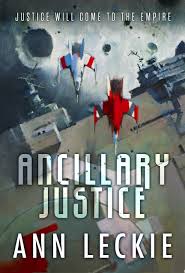
Ancillary Justice

Every couple of years, a science fiction novel appears which seems to generate a tremendous amount of positive buzz among my online genre friends and acquaintances. In 2011, it was Kameron Hurley’s God’s War, the first of a trilogy, which went on to win the Kitschies’ Golden Tentacle Award and appear on the short list for the Nebula Award. This year, it’s Ann Leckie’s Ancillary Justice, which is also a debut novel and the first book in a trilogy. I’m also seeing a lot more word-of-mouth for Ancillary Justice than I remember seeing for God’s War, and I suspect it will do better in the various genre awards than Hurley’s debut.

ancillary

But then Ancillary Justice is located much closer to genre heartland than God’s War, and the interesting things it does – and it does a number of interesting things – are, I suspect, more generally acceptable than those in Hurley’s book. Both suffer structurally, but where God’s War had a choppy start, Ancillary Justice has a weak ending… and I have to wonder if that is felt to be a more forgivable sin. Having said that, Ancillary Justice is a richer brew in heartland sf terms than God’s War – richer, in fact, than a great many 2013 science fiction novels – but I don’t feel it fully explores everything it has to say. God’s War at least aggressively interrogated its tropes. Which is not to say that I didn’t enjoy Ancillary Justice or feel it is a bad book. It is a very strong debut, and I have every intention of picking up the remaining two books in the trilogy when they are published.

First of all, let’s get the gender thing out of the way. Throughout Ancillary Justice, “she” is used as the default pronoun. This is allegedly because the narrator, Breq, comes from a culture which speaks an ungendered language. The problem here is that an ungendered language by definition possesses no gender, whereas “she” is very much a gendered term. The effect on the reader in English of using the word “she” as a default is not the effect it has on the characters within the story. Cause and effect are uncoupled. However, the effect on the reader does force a specific reading of the story. Leckie is making the reader interrogate their own perceptions of gender by using “she”, even if the argument for its use in the world of the story is weak. When Breq deals with speakers of other languages, ones that do use gendered pronouns, she frequently exhibits confusion over which pronoun to use. She uses visual clues to decide which is appropriate – there are, for instance, several references to clothing making this process difficult. But gender is not biological sex – and this is something that has been explored by science fiction over several decades. Numerous people have drawn comparisons between Ancillary Justice and Samuel R Delany’s Stars in My Pocket Like Grains of Sand which, I think, interrogates the concept of social gender more rigorously than Ancillary Justice. I like that Leckie has forced the reader to examine their own gender defaults, and I think that’s an interesting thing to do… but I’m not totally persuaded the world Leckie has created fully explores that aspect of the story.

Breq is the only surviving “ancillary” of an AI. Ancillaries are human bodies used as avatars – real-life “meat puppets”, if you will. As a result, AIs operate in effect as distributed intelligences. It’s a neat idea, but Leckie only skims the surface of it. Admittedly, for much of the book Breq is confined to a single body – once she was an avatar of the controlling AI of a warship, but now she is as effectively human as the person whose body she hijacked. Leckie plays the ancillaries as single intelligences with simply a much vaster range of sensory inputs. When Breq was One Esk, a troop of ancillaries on the troop carrier Justice of Toren, Leckie makes numerous references to the narrator’s ability to know what is happening in various different places, to call up information at will, and to monitor in great detail the human officers under whose command she serves. I’m not entirely convinced by Leckie’s presentation of an AI character, or its distributed nature – but then, to be honest, I don’t think I’ve ever found the presentation of AIs in science fiction especially convincing. Further, the plot of Ancillary Justice is actually hung from this incomplete version of a distributed intelligence – although how incomplete, or indeed different, is difficult to judge as unlike Breq we do not see that character from the inside.

While the gender thing and Breq’s once-distributed nature are the two most obviously arresting aspects of Ancillary Justice – and also appear to be the most remarked upon in reviews; as, er, I am doing in this review myself – there are a number of other elements to the story and world-building which I think are much more fascinating. I said earlier that Ancillary Justice was a rich brew, and it’s the combination of tropes Leckie has used, tropes which are not normally thrown together, or on which she has put a different and original spin, that I think make Ancillary Justice such an interesting sf novel.

Justice of Toren, the ship Breq-as-AI originally controlled, was operated by the Radch, a human civilisation led by Anaander Mianaai. Like the AIs, Mianaai has many bodies, thousands of them, and so rules the Radchaai by effectively being ubiquitous. The Radch is fervently imperialist, and has been operating a campaign of “annexation” on other human-populated worlds for over a thousand years. The Radchaai economy demands this – the Radch seem themselves as “civilised” and superior to all others (especially non-humans), and obviously they cannot maintain a society based on such a view without an ever-expanding underclass. There are many ways of reading the politics embedded in Ancillary Justice – an attack on neoliberalism, on neocons, on contemporary US politics… They all work. Nor do they overwhelm the story.

Which, such as it is, is presented in a format which hides its simplicity. Justice of Toren becomes inadvertently embroiled in an internal Radchaai struggle, kicked off by a pair of historical incidents involving alien races, most especially the Presger who are more powerful than the Radch. Ancillary Justice tells its story in two narratives strands. One is set in the present. Justice of Toren now survives only as Breq, a single ancillary survivor from thousands that had been used, or held in storage, on the ship. A second narrative takes place years earlier, when Breq was One Esk and is policing a city on a world that has been annexed. A Radchaai conspiracy intrudes, and One Esk and her officer, Lieutenant Awn, are caught up in it. Breq is the sole survivor of the fall-out from that incident and vows revenge on Mianaai. to that end, she travels to the world of Nilt to find a special undetectable gun which renders Radchaai armour useless. On Nilt, she stumbles across Seivarden, a Radchaai lieutenant recently revived after a thousand years frozen following the loss of her ship in battle. Seivarden is also now a drug addict. Breq remembers Seivarden, and decides to help her return to Radchaai space, although Seivarden is initially reluctant and ungrateful.

The two narratives build one upon the other, the historical one revealing the motivation for the present-day one, and the present-day one in turn making clear the actual events in the past. While it makes for a slow start, the structure actually allows Leckie to dole out exposition without interrupting the flow of the story. As the novel progresses, so its pace increases until the point where the two narratives meet – or rather, one is folded into the other – at the climax. Leckie’s world-building throughout Ancillary Justice is superb, and she manages to evoke multiple distinct cultures in detail. Perhaps at times the novel feels a bit like a Le Guin story crashing into a Susan R Matthews one, but that’s no bad thing – both are authors whose works I like and admire. Some have also remarked on an element of Iain M Banks to Ancillary Justice‘s world-building, though that may have been prompted by the presence of the AIs (ie, Minds) and the names of the characters. I don’t see a Banksian sensibility at work in Ancillary Justice, even though Ancillary Justice and Banks’s Culture novels are, beneath their space opera patina, both political sf.

Ancillary Justice is novel whose whole is greater than the sum of its parts. And yet some of its parts still manage that intellectual punch to the head – a “wonderpunch”, if you will – you expect in the best science fiction. There is a point in John Varley’s The Ophiuchi Hotline (1977) where the main characters travel out to the Oort Cloud and discover why aliens have been transmitting the eponymous beam of free information at the Solar System. In a meeting with these “Traders”, Varley throws away entire science fiction novels in a handful of lines –

“A few thousand. To get a representative sample. After that, we can learn humanity from each other.” He paused. “We know this is a strange request. The fact is, it is the only thing your race has to offer us. It is the only reason we have bothered to send you the things we have discovered and collected over seven million years.” (p 222)

Such a massive change in scale, delivered offhand in a few lines of dialogue, can’t help but provoke sense of wonder. Leckie does something very similar in Ancillary Justice, and it is the implications of this which I think proves one of the novel’s more fascinating elements:

When most people spoke of Radch, they meant all of Radchaai territory, but in truth the Radch was a single location, a Dyson sphere, enclosed, self-contained. Nothing ritually impure was allowed within, no one uncivilized or nonhuman could enter its confines. Very, very few of Mianaai’s clients had ever set foot there, and only a few houses existed who even had ancestors who had once lived there. (p 235)

Bear in mind that a Dyson sphere with a radius equal to the Earth’s distance from the Sun would have a habitable inner surface equivalent to 550 million Earths. Imagine the size of a civilisation which filled that and still needed to expand in order to fuel its economy. I would also guess the Dyson sphere is an artefact colonised by the Radch, since nothing in Ancillary Justice suggests they are capable of building it.

Not everyone has reacted positively to Ancillary Justice, although it’s hard to see how in comparison to other science fiction novels published this year it can’t fail to stand out. If I was afraid that the success of James SA Corey’s Leviathan Wakes meant that space opera was regressing, then I’m glad to say that Ancillary Justice shows that progress is still possible and desirable. Leckie’s novel gives me hope that science fiction is a genre it is still worth reading. Recommended.


5 Comments

Fantastika 2013

Back in April at the Eastercon in Bradford, Michael Cobley mentioned that a sf con in Sweden had invited himself and John Meaney as guests (though not as actual guests of honour). I’d always wanted to visit the country, so I said I’d go as well. I looked into it, and discovered there’d be a few other people I knew – both from cons and online – also attending, including one of the actual guests of honour, Lavie Tidhar. So I bought membership, booked my flight and hotel room, and the con even asked me to appear on a couple of programme items. Which I was happy to do.

The convention was called Fantastika, it was this year’s Swecon, and it took place in a suburb of Stockholm called Sickla.

I was originally going to write about the con in your usual con report format – a linear narrative, beginning with my arrival in Sweden, and ending with my return home. But a lot happened over the weekend, and it’d probably end up as TL;DR. So here’s a few of the more memorable incidents from Fantastika 2013 instead:

  • Agreeing to meet up with Lavie at Arlanda Airport so I could tag along to his signing at the SF Bokhandeln. But after waiting an hour in the airport concourse, he texts me that he’s already on the train, having been nabbed by his wrangler. So I make my own way to the book shop, wondering how we missed each other in the airport… only to learn later he landed at a different terminal.
  • The Arlanda Express is a modern, fast, electric train that runs every twenty minutes between the airport and Stockholm’s Centralstation. It also costs SEK 260 for a single.
  • Exiting Centralstation and discovering the map and directions I’d printed out from Google Maps were near useless. I had no idea where I was or where I needed to go. I figured out heading south was good… and when I came to water, I managed to get my bearings. From there, it was easy.
  • Stockholm is a lovely city. Very impressed.
  • After the signing, I travelled out to Sickla on the train with Jo Walton and Karin Tidbeck (the other GoHs), Lavie and Rebecka from the con committee. Lavie and I headed straight for the hotel to check in. As we approached it, a voice yelled out of a window, “I can hear you moaning from the second floor, Lavie!”. It was his agent, John Berlyne.
  • Lavie, John B and myself went for a meal later that evening in Urban Deli, a nearby delicatessen/supermarket/restaurant. I was impressed that the menu was colour-coded for gluten, lactose and peanut intolerances. Despite knowing that Sweden was expensive, I was still a little surprised by the SEK 710 bill.
  • The next day, I returned to the Urban Deli at lunch-time for a sandwich. They didn’t have any that were lactose-free, so the young woman behind the till happily fetched ingredients from around the shop to make one for me. Excellent service.
  • I had no intention of buying any books at the con, and after seeing the prices in the SF Bokhandeln was firm on that resolve. But Johan Anglemark pointed out that SAAM, a Swedish fan organisation, had brought along several thousand second-hand US and UK paperbacks for sale… at SEK 5 to SEK 15 each. I ended up coming home with seven books: five from Jo Clayton’s Diadem of the Stars series, a Mike Mars paperback, and a sf novel by a woman writer of the 1970s I’d never heard of, Gertrude Friedberg. (I also bought a copy of Karin’s collection, Jagannath: Stories, so she could sign it for me.)
  • Pretty much everyone in Stockholm uses their debit/credit card to buy things. Hardly anyone uses cash. I saw someone using  a card to buy a packet of crisps at a bar. I had taken cash with me; I ended up with half a ton of change in my pocket.
  • The people at the con were a lot friendlier and welcoming than I think would be the case at an equivalent-sized British con. I met loads of really nice people. I can’t remember everyone I spoke to, but as well as those mentioned earlier they included Steve, Emil, Miika, Nene, Anders, Thomas, Jon-Henri… and no doubt numerous others.
  • My first programme item was on at 10 pm on the Friday, which is the latest I’ve ever done a panel. The title was “Fantasy and sf worth reading”, and I think Lavie, Jo, moderator Linnéa Anglemark and myself managed to come up with a number of recent books worth reading. And yes, we did mention Ancillary Justice.
  • On the Saturday, Lavie, Mike C and John M were signing at the SF Bokhandeln, so I cadged a lift in with them, and spent an hour wandering around the old town. It was fascinating. But also really busy. A bit like York during the tourist season. Committee-member Ebba came with us and en route asked if we could pronounce the SF Bokhandeln’s address, Västerlånggatan. She said my pronunciation was “very elegant”. Not sure what that means.
  • Learning that the Swedish for “mushroom” is svamp. Which has to be the best word for fungi ever.
  • Mike C and the monster breakfast. (The hotel laid on the usual European buffet breakfast, and there was more than enough to choose from – even for me.)
  • I attended more programme items than I typically do at cons. Around half of the programme was in English. By the Sunday, I was timing how long into an item before Lavie mentioned Shimon Adaf’s name. And yet on the Sunday, in the one programme item in which Adaf was on-topic, “What sf is written outside the English speaking world?”, Lavie completely failed to mention him.
  • The con venue was excellent. The Dieselverkstaden is an old factory that has been converted into a library, cinema, climbing school, function space, bistro and coffee shop. It’s located in Sickla’s Köpkvarter, which is a massive retail park with a huge shopping centre. There was no shortage of places to buy coffee or food. (Although I never visited it, I was much amused by the name of a local Indian restaurant: Holy Cow.)
  • On the Sunday night, the dead dog party took place in a British-style pub nearer the city centre called the Bishop’s Arms. It took me four tries to order a Swedish beer called Rapa – must work on my accent.
  • On leaving the pub, after being given excellent directions by Anders, I led John B, Lavie and Icelandic author Emil Hjörvar Petersen to the Texas Long Horn steak house. Afterwards, John, Lavie and myself ended up walking all the way back to our hotel, which took almost an hour, through a mostly-deserted Stockholm. A somewhat odd end to the convention, but never mind.
  • The trip home went smoothly… right up until the moment I left Manchester Airport. The taxi to Stockholm’s Centralstation arrived early, so I ended up catching an earlier Arlanda Express to the airport. Which proved to be almost deserted. The flight was smooth, albeit a bit bumpy as we went over the Pennines. There was hardly any queue for passport control… And then I got to the railway station and had to wait an hour for a train. Which arrived early and sat at the platform for thirty minutes, but we weren’t allowed to board until five minutes before departure. The train was late leaving Manchester Piccadilly, so we ended up stuck behind a slow train… which resulted in a 15-minute delay. If you think the UK has a good railway network, you are either an idiot or you have never visited another country.

Fantastika 2013 was definitely worth every penny. I liked Stockholm a lot, the congoers were amazingly friendly, I had some really interesting conversations, the venue was excellent, and I thoroughly enjoyed myself. I’d definitely do it again.


3 Comments

The art of selling books

Books do well when lots of people buy copies, but if they don’t know it exists, how can they buy it? When you self-publish, that’s the part of the process you wish other people would do. Perhaps it’s just me, but it feels a little… off to be doing that for my own work. Of course, you can get other people to trumpet your work – assuming it’s good enough, that is – by sending out review copies, and they’ll spread the word for you. All the same, as a self-publisher, or a compact and bijoux small press (if you like), Whippleshield Books doesn’t have the budget or resources of a traditional imprint.

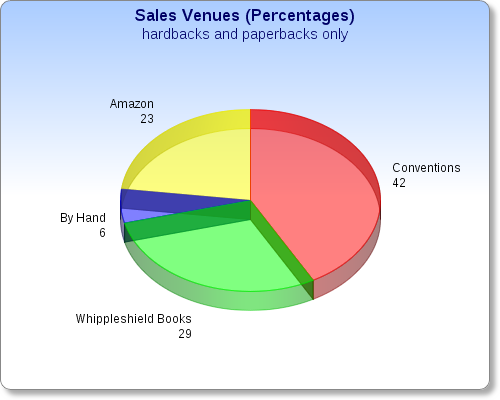
Adrift on the Sea of Rains has been print now for eighteen months, in signed numbered hardback, paperback and ebook. The hardback sold out within a year. The paperback went to a second printing, and copies are still available. The ebook… well, ebooks are pretty much eternally available. This morning, as another order for a couple of copies of Adrift on the Sea Rains arrived from Amazon, I wondered which sales channels had been most effective at selling the book. So, one spreadsheet later, I ended up with the following…

sales_venues

I was surprised to discover I’d sold more copies through the Whippleshield Books online store than I had Amazon – though, to be fair, the hardback has never been made available through Amazon. I was completely unsurprised to learn I’d sold the most copies at conventions. When you spend the weekend in a hotel with a captive audience, even the most inept sales person (yes, I know; but it’s my actual name, not a nom de métier) can flog copies. It’s probably worth noting that at Odyssey 2012, the Eastercon at which Adrift on the Sea of Rains was launched, the paperback cost less than a pint of beer at the hotel bar…

To date, I’ve not had enough of a catalogue to justify Whippleshield Books taking a table at conventions, so other dealers have often kindly offered to let me put copies on their own. But by the end of next year, Whippleshield Books should have at least five books out, so I’ll probably have to start taking a table in the dealers’ room. Mind you, transporting stock to conventions will be an… interesting exercise, since I don’t have a car. And, rather than just a writer who self-published, which allows me to wear my writer hat pretty much all the time at conventions, I’ll also be a writer and a publisher… Two hats. I’m not sure how’s that going to work out yet.

I’ve not mentioned ebook sales so far because, well, first I don’t have to do anything, it just sits there on Amazon and people download it onto their Kindles. And second, Kindle sales outnumber all others by at least a factor of five. Many best-selling self-published writers have published only on Kindle. I suspect that five years from now, small presses will be publishing ebooks and only tiny print runs of a collectible hardback or paperback edition. Many already are. Personally, I like hard copy books. I like reading them. And I like that I can design them – which I can’t do for an ebook. I chose the typefaces I used in Adrift on the Sea of Rains carefully. The ebook version defaults to the reader’s preferred font, probably Times New Roman.

Of course, ebook-only books present another problem – will conventions start setting up virtual dealers’ rooms? a part of their online presence where attendees – or perhaps anyone – can purchase copies of ebooks sold by dealers who have paid for the privilege (and may not even be present at the con)? And if they’re doing that, then why not stream the panel items as well? Attendees need never leave the bar, just sit there with their tablet, a pint and some friends. They might not even need to physically attend – it could be a distributed convention. Those on panels would have to physically be present, of course. Anyway, that’s another topic for another day…


22 Comments

On genres, modes, distances and invention

I won’t say where, or on what, I was at the time but this weekend I was thinking about definitions of hard science fiction for a podcast, and my thoughts spiralled out from there to definitions of science fiction itself. And it occurred to me that sf narratives break down into three rough forms: encountering the Other, embracing the Other and rejecting the Other. And the more I thought about it, the more it seemed to hold true. Think of a random sf novel, like… Dune. That’s embracing the Other – both Paul Atreides becoming a Fremen and learning to  use his new-found powers.

Since its earliest days, science fiction stories have been characterised by distance just as much as they’ve been characterised by science and/or technology. Alongside the Gernsbackian tales of new inventions which would improve the lives of all were stories of alien places and the strange peoples found there. Distance is a signifier for the “exotic” (in both meanings of the word). Before science fiction, they told tales of the South Seas.

The further away a place is, the more Other it is – it’s a simplistic formula, but this is pulp fiction, after all. The difficulty of the journey is less important than the distance travelled. There are very few Shangri-Las hidden in inaccessible mountain valleys, or their galactic equivalents, but lots of worlds on the rim of the empire or the edges of the galaxy. Travel itself is not uncomfortable, but does take time. Real spacecraft are small and cramped, with no amenities. Sf’s starships are interstellar ocean liners with cabins and restaurants and promenades. This is because the journey does not matter, it is only a metaphor. If there are hardships, they are associated with either finding the destination, or at the destination itself. Off the top of my head, the only sf story I can think of in which the journey itself is an obstacle is Ursula K Le Guin’s ‘The Shobies’ Story’ (in Gwyneth Jones’ Buonarotti stories, and her novel Spirit, there’s a similar effect with interstellar travel, but it does not make the journey an obstacle). No doubt there are other stories, though I maintain such stories are rare within the genre.

But then, there’s not much that’s Other about the act of travelling from A to B. Even in the Le Guin story mentioned above, the means of making the journey affects the travellers’ perceptions of their destination, making the act of encountering, or even embracing, the Other so much harder and more prone to misunderstanding.

Space opera, of course, is traditionally predicated on rejecting the Other, as is military sf. The drama in both subgenres typically derives from conflict, either from within the world or from without. And the further the enemy is from known space, the more Other they generally are. Even when they’re humans, they’re typically barbarians from the edge of the empire – though that may simply be science fiction ripping off the history of the Roman empire… which it has done far too many times.

The same argument might well apply to fantasy, even though it is a different genre. I suspect there are more narratives of rejecting the Other in epic commercial fantasy than of the other two forms. Given its generally consolatory nature, this is no surprise. Other modes of fantasy may well be more evenly distributed – I’m not as well read in fantasy as I am science fiction. It might well be that the same argument does not apply to fantasy, given that it is an entirely different genre to sf.

Science fiction is not, and has never been, a branch of the fantastic. You can’t categorise fiction by the degrees of invention it exhibits. All fiction by definition contains invention, whether it’s literary fiction with made-up characters , fantasy with made-up worlds, or science fiction with made-up science and/or technology. Nor can you categorise by trope… because first you would have to define each and every trope. And lay out the conditions under which each trope is fantasy and not science fiction, or vice versa. If a fantasy novel has a dragon in it, then it does not follow that all novels containing dragons are fantasy. And so on. Science fiction is a fundamentally different genre to fantasy, and it’s an historical accident that the two are typically marketed alongside each other.


Leave a comment

Weekend meme-y thing

… in lieu of intelligent content. This meme appeared earlier today on SF Signal, with instructions to leave answers to the questions in the comments. But I’m doing it here instead because.

The last sf/f book I finished reading:
… was The Maker’s Mask by Ankaret Wells. This was a self-published novel and I forget where I first came across Wells’ name. Anyway, the description made the book seem like it might be fun so I bought a copy. And it is fun. It’s also a bit rough, and the ending somewhat abrupt – it’s the first book of a duology. Looks like I’ll have to get the second one so I can find out what happens.

The last sf/f book I did NOT finish:
I tend to finish books that I start and rarely bale on them. I remember giving up on The Windup Girl about fifty pages in, after finding its racism and its use of the sex slave trope offensive. But that was a while ago. More recently, I gave up on Spitfire Girls by Carol Gould, which is not genre. It was so badly written, with arbitrary head-hopping, inconsistent internal chronology, and frequent references to things and events which were neither described nor foreshadowed.

The last sf/f book(s) I bought:
I bought a bunch of new books by favourite authors recently from a certain online retailer. These were: Marauder, Gary Gibson; Shaman, Kim Stanley Robinson; Proxima, Stephen Baxter; On the Steel Breeze, Alastair Reynolds; and Evening’s Empires, Paul McAuley. On order but yet to arrive are Ancillary Justice, Ann Leckie, and Sea of Ghosts, Alan Campbell, which Martin Petto persuaded me is worth reading (even though I don’t like epic fantasy).

The last sf/f book I bought that I already owned:
That would be The The Book of Being by Ian Watson. It’s the third book of a trilogy, and I had all three in paperback. I replaced the first two with first edition hardbacks a while ago, but only recently found a copy of the third book. More recently, I purchased a signed first edition of Kim Stanley Robinson’s Escape from Kathmandu even though I have it in paperback, but that has yet to arrive.

The last sf/f book I shared with someone:
I’m taking this to mean the last book I wrote about on my blog or something… which makes it A Spaceship Built of Stone, an excellent collection by Lisa Tuttle which I reviewed for SF Mistressworks – see here.

The last sf/f book I raved about:
I can’t remember the last time I was really evangelical about a genre book. Back in April, I remember being complimentary about Rosemary Kirstein’s The Steerswoman’s Road, as I’d just read the second part of it (it’s an omnibus), The Outskirter’s Secret, to review on SF Mistressworks – see here. And in January, I was very impressed by Joan Slonczewski’s The Wall Around Eden – see here; so much so that I mentioned it in a Locus Roundtable – see here. But I’ve not really been blown away by a genre novel since Katie Ward’s Girl Reading last year, and that was published as literary fiction anyway…

The last sf/f book I did not enjoy at all:
Hull Zero Three, Greg Bear. Which, astoundingly, was shortlisted for the Arthur C Clarke Award. Was not impressed at all. Before that, The Silkie by AE van Vogt, for which I had low expectations but it failed to meet even those. See here for my comments on both.


3 Comments

17,500 words or more

A few weeks ago in a review of Kate Wilhelm’s ‘The Infinity Box’ – see here – sf critic Paul Kincaid mentioned it was one of his favourite novellas. He also provided a link to an earlier post on another blog giving his favourite science fiction novellas – see here. So, of course, I started thinking about a list of my own… and immediately hit a couple of snags…

I like the novella, I think it’s an interesting length. It gives you the freedom to experiment you don’t have in a novel, and the room to experiment you don’t have in a short story. The four books of the Apollo Quartet are novellas, and I plan to write further at that length. But. Novellas are not as common as short stories – because they’re harder to write and harder to sell – and, as I tried putting together a list of ten favourite novellas, I discovered that few of them are all that memorable. It’s likely down to pure numbers: I’ve read so many short stories that I can quite easily think of ten which have stayed with me over the years. But ten novellas? Have I read enough for a critical mass of favourites to form?

The first few choices were easy. But then I had to resort to various collections and anthologies to prompt my memory. I also discovered that some of my choices were actually novelettes…

I hate the novelette.

It is a completely useless category. According to the Hugo Awards, a short story is up to 7,499 words, a novelette between 7,500 and 17,499 words, and a novella between 17,500 and 39,999 words. Anything over that is a novel. Back in the day, magazines apparently offered different pay rates for short stories, novelettes and novellas, and some magazines – well, Asimov’s and Analog – still list stories by category in their table of contents. But the novelette as a category serves no useful function for readers. There are short stories and there are novellas. Why do we need something in between? So the Hugo and Nebula Awards can hand out more awards to the voters’ friends? Most genre awards only have a short fiction category, they don’t even make a distinction between short story and novella…

But, as I said earlier, I like novellas, and I think it’s important to recognise them in the annual awards merry-go-round. But, please, kill the novelette. Expunge it, exterminate it, marmelize it, remove it from every ballot and magazine TOC.

Anyway, my favourite novellas… After some research, I managed a list of ten, all of which were categorised as novellas by isfdb.org. But restricting myself to stories of 17,500 to 39,999 words meant I’d been forced to chose some novellas I would be hard-pressed to call favourites. So I thought, sod it. I don’t care if some of them are novelettes. I reject the bloody category anyway. Which is how I ended up with the following ten novella/ettes…

‘Equator’, Brian W Aldiss (1959)
One of the things about a favourite piece of short fiction is that you can remember where you first read it. This was in an anthology called The Future Makers which I was given as a present one Christmas or birthday back in my early teens. The story itself is a piece of spy fiction with added aliens, and there’s something about its 1950s thriller template that makes it more memorable than it would be otherwise. It was also published separately as a novel under the same title.

‘Empire Star’, Samuel R Delany (1966)
Delany was one of my favourite writers during my teens and twenties, and I read everything by him I could lay my hands on. Dhalgren remains a favourite novel. But I remember being really impressed by the Moebius strip-like structure of this novella when I first read it. And it still impresses me on rereads. I first read it as one half of a Sphere double with ‘The Ballad of Beta-2’, and I’m pretty sure it was while on holiday in Paris with the family in the early 1980s.

‘The Barbie Murders’, John Varley (1978)
I’ve been a fan of Varley’s fiction since first reading one of his Eight Worlds short stories, but I can’t actually remember when I first read him. Having said that, ‘The Barbie Murders’ is not an Eight Worlds story but an Anna-Louise Bach one – although like many of the former, it’s set on the Moon. There is something very creepy about the story’s central premise – a cult in which all the members have had themselves surgically remade to resemble Barbie; and Varley uses this idea to ask questions about identity. I also think this is one of those stories which exists in that Schrödinger’s-Cat-like area between utopia and dystopia.

‘Great Work of Time’, John Crowley (1989)
I read this is The Year’s Best Science Fiction: Seventh Annual Collection, and it’s probably the premier work of time paradox fiction in the genre. It originally appeared in an author collection, Novelty: Four Stories, and has even been published as a standalone novella.

‘Identifying the Object’, Gwyneth Jones (1990)
This story (it’s one of ones on this list that’s actually a novelette) first appeared in Interzone #42, December 1990, under the title ‘Forward Echoes’. It’s the story that turned me into a collector of Gwyneth Jones’ fiction, Later, she amended it and it was published under its new title as the title story in a chapbook by Swan Press of Austin, Texas. The story takes place in the same world as Jones’ Aleutian trilogy, Buonarotti stories and Spirit: The Princess of Bois Dormant.

‘Forgiveness Day’, Ursula K Le Guin (1994)
I first read this in the collection Four Ways to Forgiveness, and of the four novellas in that collection, it’s the one that stood out the most for me. There are a lot of stories set in the Ekumen which could have made it onto this list, but most of them aren’t really long enough to qualify as novellas.

‘Beauty and the Opéra or the Phantom Beast’, Suzy McKee Charnas (1996)
I read this in the issue of Asimov’s in which it appeared, March 1996. In my contribution to the Acnestis APA a couple of months later, I described it as “brilliant” and wrote that “if it doesn’t get nominated for a Hugo or a Nebula, then there’s no justice”. In fact, it was shortlisted for the Hugo as a novelette and the World Fantasy Award as a novella (which proves my point above), and shortlisted for the Tiptree.

‘Marrow’, Robert Reed (1997)
Science fiction is full of Big Dumb Objects, from Niven’s ringworld to Clarke’s Rama, but most are associated with quite dull pieces of fiction. Reed’s ‘Marrow’ is told with a very clinical, detached voice, which only heightens the impact of the BDOs which furnish this novella. There’s the Great Ship, a slower-than-light starship the size and shape of a gas giant, and there’s the title world itself, which exists at the core of the Great Ship. This novellas was later fixed up into a novel of the same title.

‘Secrets’, Ian Watson (1997)
When I first read this in Interzone #124, October 1997, I characterised it as one of Watson’s occasional completely-off-the-wall stories, the ones he churns out every now and again that are even more bonkers than his usual output. It’s about jigsaws, Vidkun Quisling, Nazi occultism, and getting naked in an Oslo park. I liked it a lot, and it was certainly memorable. And then it re-appeared as the first section of the novel Mockymen, and it seemed even more mad, and I liked it even more. It reads like fantasy, and to use it as the opener for a sf novel (about aliens invading Earth) demonstrates such an insane view of genre that it’s hard not to admire its brazenness.

‘Arkfall’, Carolyn Ives Gilman (2008)
I read this as a standalone chapbook published by Phoenix Pick, which I’d purchased after being mightily impressed by Gilman’s fantasy Isles of the Forsaken. I reviewed ‘Arkfall’ for Daughters of Prometheus – see here – and yes, its setting could almost have been designed to appeal to me, but it was the social world-building Gilman does in the novel that, I think, most impressed me. It is certainly a novella that has haunted me since I read it.

So there you have it, ten pieces of long short fiction of novella-ish-type length. I suspect if I were to try the same exercise a couple of years from now I might come up with a slightly different list. But this will do for now. And I’m serious about getting rid of the novelette.


4 Comments

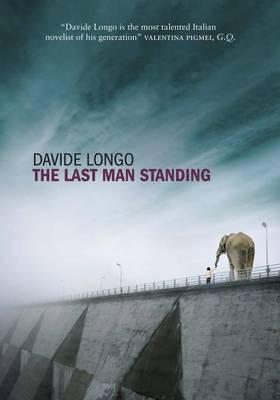
The Last Man Standing, Davide Longo

The-last-man-standingThe Last Man Standing, Davide Longo
MacLehose Press, 2012, 352 pp, £12.99

It seems close to certain that civilisation as we know it will not last for much longer. If Climate Change does not bring about a catastrophe, then the failures of nation-states, economies, or the entire capitalist system itself is sure to do so. And yet, despite ten thousand years of civilisation, the only post-catastrophe stories we can tell depict brutal worlds in which violent selfishness is the only mode of survival. Have we learnt nothing since we left the Rift Valley? Everything we have created since then has been the result of co-operation, and yet we cannot imagine using co-operation during a period when it’s most needed.

Of course, this is chiefly because popular entertainment as it now stands, driven by US market forces, is morally bankrupt, and because any such future fictions are in part based on American conceptions of a world without American society. When society goes, the American Dream is over and, we are supposed to believe, the American Dream is such a noble achievement that only animalistic behaviour can exist in the vacuum it leaves behind.

This is all rot, of course. Many US authors may subscribe to such a distorted view of human nature and society, but it’s disappointing when other nationalities follow suit. Davide Longo is Italian and The Last Man Standing was originally published in Italy in 2010; and it is an Italy after some unexplained catastrophe that it depicts.

The protagonist of The Last Man Standing, Leonardo, was a famous writer but took himself into self-imposed exile after a sex scandal. A female student had seduced him and then revealed all. Though it was clearly a set-up, he said nothing. This is because he is pathologically passive. For the first one hundred pages, he does nothing but witness some of the effects of the collapse of Italy: the village where he lives turns in on itself; outsiders are treated with suspicion and then violence.

Perhaps this is not entirely without reason. The villagers wish to keep what meagre supplies they have for themselves. Leonardo is not so cautious. Returning from a walk, he sees two men and a woman raid his house for food and clothing. Once they have left – he does nothing, he is too passive to confront them – he discovers they have defecated on his furniture. Is this what the fall of civilisation means? Shit on the sofa?

Leonardo’s ex-wife turns up with their daughter and her stepson in tow, she tells him she needs him to look after them until she returns from Switzerland with papers. She never returns. So Leonardo, daughter Lucia, ten-year-old Alberto and mute companion Sebastiano set out for the border hundreds of kilometres away.

En route, they meet with suspicion, violence, rape, murder and torture from a variety of people. Even when they find what appears to be a safe – if expensive – haven, it’s clear the safety is a careful illusion. Eventually, they are captured by a caravan of young people, ruled by an antichrist-like figure. Richard is so thinly characterised, he seems to inhabit a different book. He appears to exist only to put Leonardo through a baptism of fire, strengthening him sufficiently to win a contest of wills with Richard by cutting off his own hand. If Longo is trying to make a point here, it is wilfully opaque.

There’s nothing new in The Last Man Standing – indeed, the publishers have made a point of noting it, relying on the quality of Longo’s prose to sell the book. In recent years, the post-catastrophe world has become a somewhat crowded place in literary fiction, and the time has long since passed when stories set in it might say anything insightful. That Longo’s prose is generally good cannot save The Last Man Standing from being banal.

This review originally appeared in Interzone #242, September-October 2012.


2 Comments

Recentest readings

Time for another report from my ongoing mission to read every book I own. There is no five-year plan – actually, there is: A Five Year Plan, a thriller by Philip Kerr, which I read back in February 2005… What I mean is, there is no end in sight – in fact, it recedes further from me with each passing month. Must. Read. More. Books. (Yes, yes, I know: I could also try: Must. Buy. Fewer. Books. But don’t be silly, that’ll never happen.)
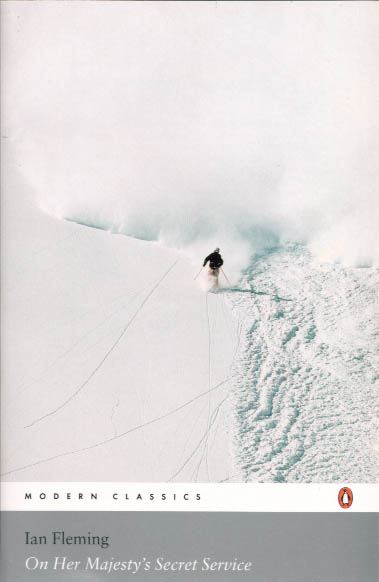
OHMSS18On Her Majesty’s Secret Service, Ian Fleming (1963). This is the one where Bond gets married, and then his wife is killed soon afterwards. The woman he marries is the daughter of a Sicilian mafia boss, but she’s been to finishing school and her previous husband was a wastrel Italian count so she’s now a contessa; and, of course, she’s beautiful. And suicidal. The book opens with Bond rescuing her from a suicide attempt when she throws herself into the sea. The actual plot concerns a fiendish plan by Blofeld to destabilise the UK by destroying its agriculture. There’s a mountain-top health centre in Switzerland run by a mysterious scientist – who may or may not be Blofeld – and Bond infiltrates it in the flimsiest of disguises. He finds it populated by a number of young English women, all there ostensibly to be cured of phobias and allergies. But they’re actually being brainwashed into performing a series of tasks to poison British agriculture. When Bond meets the centre’s owner, Comte Balthazar de Bleuville, he just knows he’s Blofeld, even though he doesn’t resemble Blofeld at all. Plastic surgery, you see. Anyway, Bond foils Blofeld’s fiendish plot – the English women are caught before they can cause any damage, and British forces launch a raid on Blofeld’s health-centre but Blofeld escapes. Afterwards, Bond gets married, Blofeld attempts to kill him, and his wife dies in the attack. There’s a good sequence when Bond escapes from Blofeld’s hideaway by skiing down the mountain – bizarrely, it reads more like the cinematic Bond than Fleming’s original. The science practiced by Blofeld is completely bogus, and the only connection between the villain of this book and the villain of Thunderball is Bond’s conviction that they are one and the same man. Fleming’s treatment of Bond’s father-in-law, the Sicilian capo, is deeply racist; and it goes without saying that the women throughout the book are little more than plot tokens or adjuncts to Bond’s masculinity. This is actually one of the better Bond novels I’ve read so far, though I still don’t think they deserve their immense popularity. I’d always assumed their success was due to the films, but apparently there was a James Bond strip in the Daily Express, which ran from 1958 to 1983. While the hardback of Casino Royale apparently sold out three print-runs within thirteen months in the UK – but flopped in the US: they retitled it You Asked For It, and even renamed 007 as “Jimmy Bond” in the paperback reprint – I do wonder if it’s the newspaper strip which, by bringing the character to a much larger audience (under Beaverbrook the Daily Express had the largest circulation of any newspaper in the world), really made Bond a twentieth-century cultural icon.
AMWBreathA Man Without Breath, Philip Kerr (2013). That’s me completely up-to-date on the Bernie Gunther novels, at least until a new one appears. In A Man Without Breath, Gunther has moved to the War Crimes Bureau, and is sent out to Smolensk because several buried bodies have been found in a nearby wood by German troops. The Germans suspect the bodies belong to Polish officers, killed by the Russians, who had allegedly shipped the Poles they had captured off to POW camps. The wood is Katyn Wood. When a pair of soldiers from a nearby signals detachment are found murdered in Smolensk, Gunther is asked to assist by the local field police. The more he investigates the double murder, and the circumstances surrounding it, the more he’s convinced there is some sort of conspiracy in place among the senior German officers in Smolensk. Meanwhile, other War Crimes Bureau investigators have found yet more murdered Poles buried in Katyn Wood… If Prague Fatale was a piss-take of a country house murder – including a locked room mystery! – A Man Without Breath is pure World War II behind-the-lines thriller. The plot hangs from two very real atrocities committed during the war – the Katyn Massacre, and another performed by the Germans (revealing it would constitute a spoiler, so I won’t). Kerr places Gunther firmly in the middle as all these events come to a head, and while he’s not responsible for resolving them, he is certainly the one who makes sense of them and puts the pieces together for the reader. One of the difficulties with writing historical fiction involving well-documented people and events is that everything must end up as it does in the history books. This is not Inglourious Basterds, Hitler and the Nazi bigwigs do not get gunned down before 1945. The larger events depicted in A Man Without Breath are actual history, and you can read about them on Wikipedia. The same is true of the movements of the more important figures. So when Hitler makes a flying visit to Smolensk in the novel, that’s what he actually did in the real world. Kerr does this really well. And having read science fiction for so many years, I’m finding myself increasingly drawn to fiction which includes elements I can go and look up afterwards. In fact, that’s something I try to write myself – even though what I write is science fiction…
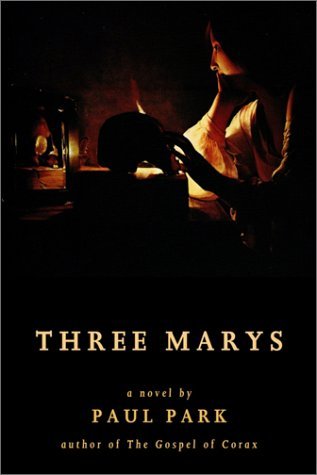
threemarysThree Marys, Paul Park (2003). After writing four excellent science fiction novels, one of which remains my favourite sf novel of all time, Park decided to write a couple of books set in Biblical Palestine. The first was The Gospel of Corax, a sort of alternate life of Jesus, in which he wasn’t crucified but wanders eastward, dispensing magic and theosophist philosophy. Three Marys is a more historical novel and, as the title indicates, takes as its protagonists three women called Mary who each knew Jesus – Mary Magdalene, Mary of Bethany and Jesus’ mother, Mary. I’m a big fan of Park’s writing, but first century Palestine is not a place and time that especially interests me. I’ve read one book set there this year, Philip Boast’s Sion (see here), but that was quite a strange book. Park’s is far better historically-grounded, and reads much more convincingly than Boast’s did. The three title characters are also beautifully drawn. But… I don’t find Jesus interesting as either a historical or a religious figure, and I struggled to gain purchase on Three Marys despite its lovely prose. I suspect I may have to reread it one day, but for now I’d say it was a book I admired far more than I enjoyed.
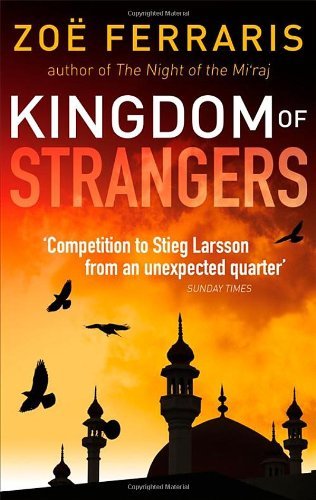
kingdomKingdom of Strangers, Zoë Ferraris (2012). The third book in Ferraris’ Jeddah-set murder-mysteries. A body is found in the desert after strong winds have blown sand from a dune by a road. The body is that of a young woman, has had its hands removed and appears to be several years old. The police investigate and eighteen more bodies are found in the area. It looks like Jeddah has a serial killer on its, er, hands, and no one knew about it. This is not unexpected: given the frequent abuse and mistreatment of female expatriate maids and nannies – many of them run away and the police rarely bother to look for them. Meanwhile, the Filipina mistress of Imbrahim Zahrani, the policeman in charge of the serial killer investigation, has gone missing, and he’s worried that knowledge of his affair will leak out and torpedo his marriage and career. Forensic pathologist Katya Hijazi is also keen to get involved on the serial killer case, but most of the police officers don’t want women working on it. She has also agreed to marry her fiancé, which creates a bit of a problem as the police think she is already married (and she wouldn’t be allowed to work there if she were unmarried). The setting of Ferraris’ novels makes for interesting reading, and while the crime aspects of the plot often seem incidental to documenting the lifestyle of the Saudis, it all hangs together entertainingly. I never actually lived in Saudi myself, only on the Gulf coast, but Ferraris’ portrayal does match what I know of the country and its inhabitants. She has a group of sympathetic and well-drawn protagonists, handles her supporting cast well, and I think I’m going to continue to read the books as they’re published.
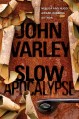
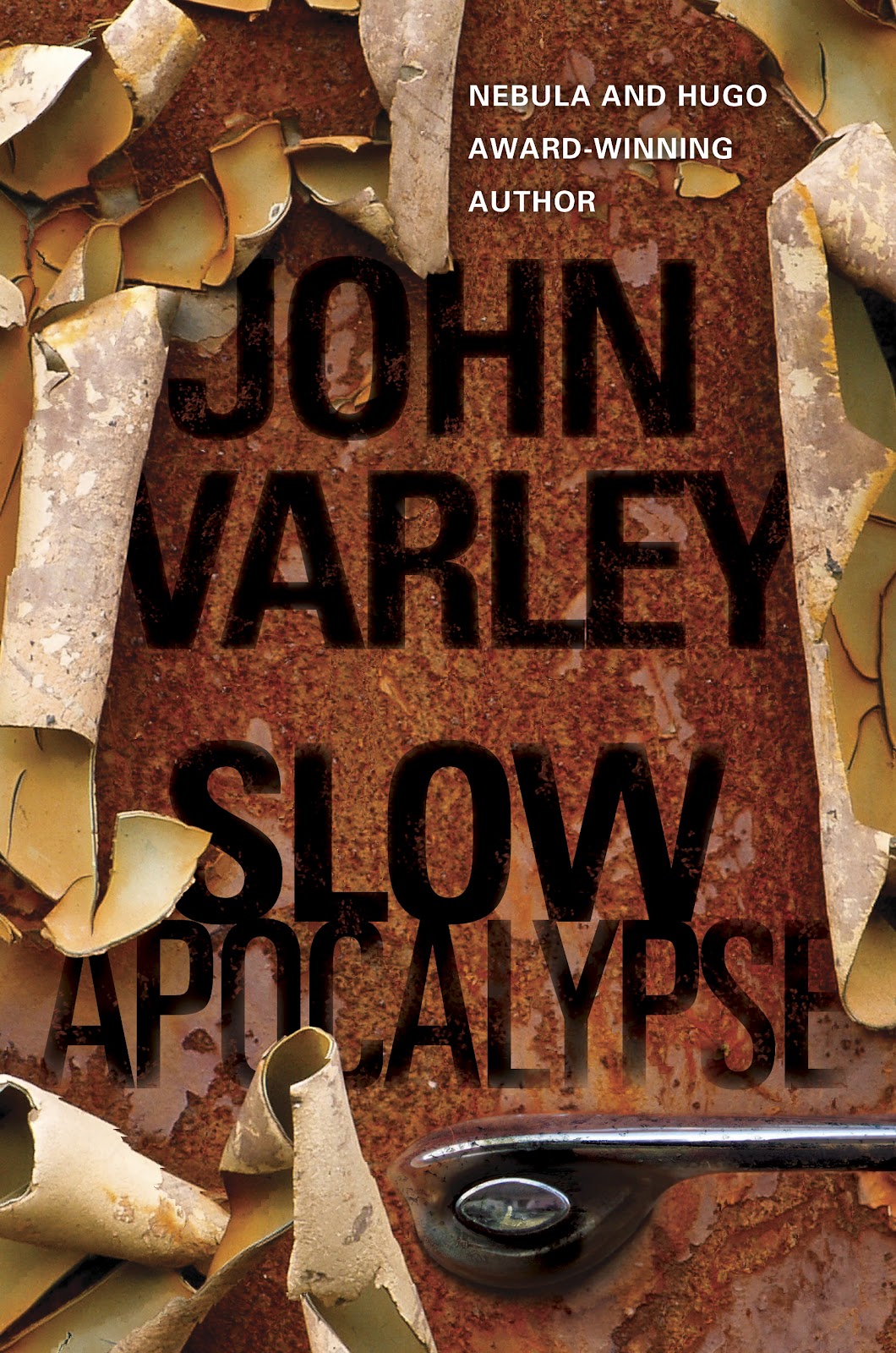
slow apocalypse_frontSlow Apocalypse, John Varley (2012). I fell in love with Varley’s short fiction when I first read some of it back in the 1980s, and his The Ophiuchi Hotline remains a favourite sf novel. I even sort of like Millennium, the film adaptation of his short story ‘Air Raid’, which he then novelised as, er, Millennium. Since 1998’s The Golden Globe (which I really must reread one of these days), I’ve bought his books in hardback on publication – he’s no longer published in the UK, so I’ve had to order them from the US. Sadly, none of his recent novels have quite matched up to those earlier works. And, unfortunately, Slow Apocalypse is more of the same. A Hollywood-based television writer, Dave Marshall, learns from a secretive ex-military contact that the US experimented with a bacteria to render enemy oil fields unusable, but that the scientist responsible turned rogue and released the bug into the wild. Marshall thinks the story is excellent material for a movie, one that will reinvigorate his stalled career. Then oil wells around the world start to explode… Soon, there’s very little petrol available, and other resources – such as food – which rely on petrol for transportation also become scarce. A huge earthquake then strikes Los Angeles, near-destroying the city, and society collapses. Marshall and family join together with their neighbours in the canyon in which they live to safeguard their houses. Because he heard the story early, Marshall has managed to stockpile plenty of supplies, but he’s afraid his neighbours may soon want to him to “share”. Also, their current redoubt is unsustainable for much longer – especially after a huge brush fire sweeps out of the hills and renders most of the city uninhabitable. The government is proving no help, and aid is virtually non-existent. So Marshall agrees to travel south with a group of close friends and colleagues, in search of somewhere sustainable to settle. It’s plain that Slow Apocalypse was written as a commercial disaster novel, and if it gives Varley’s career a boost than that’s all to the good. But. I found it really dull. Much of the book consists of Marshall – with wife or daughter – driving about LA and witnessing the damage done to it by the quake and subsequent breakdown of law and order. The whole thing reads prescriptively. There are a number of quite good action set-pieces, but they’re not enough to enliven the narrative. There’s also a Heinlein-esque mouthpiece character, but Varley has always been able to make such characters more palatable than Heinlein ever did. The plot is as predictable as a Hollywood movie, and might well follow Hollywood’s over-used three-act arc. Disappointing.
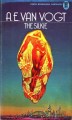
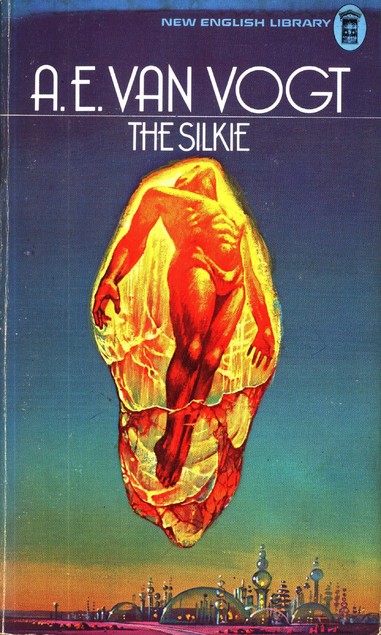
silkieThe Silkie, AE van Vogt (1969). Sometimes I wonder if something in my brain doesn’t work quite the way it should. I have very little time for Golden Age authors, but for some reason I keep on fooling myself that I have a soft spot for the works of one of them: AE van Vogt. I think his The House That Stood Still is very nearly a bona fide sf pulp classic, and some of his other novels can be entertaining in a not-quite-coherent way. But. He made his career out of the advice given in a how-to-write book, which basically said to break any narrative down into 800-word sections which must always end on a cliff-hanger. And it’s pretty clear in most of van Vogt’s fiction that when he finishes a section, he’s no real idea of what’s going to happen next. It’s often plain he’s no idea what’s going on within sections. His prose is competent at best; he mangles science, philosophy and history at will; and he has fixed-up and expanded so many of his stories, it’s impossible to say where some begin and others end. The Silkie is a fix-up and it reads like one. The book opens with a prologue, and it’s actually not that bad. It’s set in the present day in the Caribbean. A scientist and his daughter have been invited to the island of a secretive scientist who claims to have discovered immortality. Instead, the daughter meets a Silkie… a human capable of metamorphing into a seal-like creature which is equally at home underwater. And then the story completely changes, and we’re in outer space and Silkies apparently have a third form, which allows them to live, and move about, in space. There are also Variants, who are the products of Silkies and human women – all Silkies are male – but are not full Silkies. But they get written out of the story once van Vogt has finished with them. Which is pretty quickly. There’s a Variant boy who has astonishing mental powers and may be a threat to the Silkies, so the hero defeats him. Then it turns out there’s an alien attacking the Silkies, so the hero defeats it. And then it turns out there are bad Silkies who live in an asteroid inside the orbit of Mercury. So they weren’t invented by the scientist in the prologue after all. But they’re not really bad because they’re actually unknowingly under the control of a giant alien blob that’s older than the universe. But the hero defeats it. And discovers everything is all part of a plot by yet another alien race. So he defeats them… And it’s one damn thing after another, and each threat is written out of the story as soon as it’s vanquished, and its presence and/or defeat has no repercussions or ramifications on later parts of the story. The Silkie reads like the science-fictional ramblings of a drunk who has no grasp of plot, story-arc, continuity or rigour.
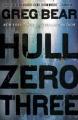
hull03Hull Zero Three, Greg Bear (2010). I stumbled across a copy of this in a local charity shop, and bought it because it was on the Clarke Award shortlist last year. So it must be good, right? I generally have a lot of time for the Clarke Award juries’ choices, although every now and again they pick books which to my mind don’t seem to be award-worthy. This was one of them. A man wakes on a giant spaceship, with no memory of who he is or what he is supposed to do. All he can remember is that he is a Teacher, and will be needed when the generation ship reaches its destination and begins the settlement of a new world – information he chiefly recalls from a dream fed to him while he was in cryogenic hibernation. He ends up running around the ship with a bunch of strange people – not your normal-type humans – encountering monsters and such, and eventually discovering why he was woken and what has happened to the ship. All the time I was reading this book, I was thinking: why is this spaceship so bloody huge? There’s one scene where the group enter a vast room with a catwalk across its middle and an enormous window in its floor. Why is it so big? If it’s an observation room, it doesn’t need to be so huge. It makes no sense – enormous chambers need more steel to build, more air to provide a breathable atmosphere of the required pressure, and more energy to heat. It’s stupid. The whole spaceship seemed to have been designed by a production designer for a B-movie. As, in fact, did the story. Systems aboard a generation starship come to blows over one of the mission’s objectives… monster movie in space results. I couldn’t see why Teacher specifically had been woken, why the generation ship had been designed in such a stupid manner, and by the end of the book I no longer cared. Bear has written much better than this, and this monster movie book didn’t deserve to be on the Clarke shortlist.
36 Comments

Summer reading #1: The Moon is Harsh Mistress

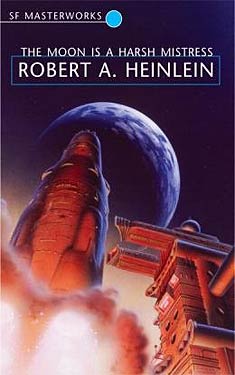
I’m starting to wonder what I’ve done that you should all hate me so much you’d make me read Robert Heinlein’s The Moon is a Harsh Mistress. Because surely you knew it was going to be worse than I expected. I had reasonable expectations for it – after all, it’s in the SF Masterworks series (that’s the edition I own – that’s the old, numbered SF Masterworks; it’s number 72). I’d also read a bunch of Heinlein back in the dim and distant past and remembered enjoying them… Also, the first true sf novel I ever read, aged ten or eleven, was Heinlein’s Starman Jones, Anyway, I’d expected to not like The Moon is a Harsh Mistress, much as I’d not liked Stranger in a Strange Land a few years ago when I reread it…

the-moon-is-a-harsh-mistress

But it’s worse than I imagined. It really is. Given the size of Heinlein’s oeuvre, am I supposed to seriously believe The Moon is a Harsh Mistress is the best of his books SF Masterworks could get the rights to? Because it is shit, so shit that I am revising my opinion of all the people I know who insist it is a good book… Perhaps that’s a bit harsh, but I can see no good reason why it is so well-regarded. In fact, I suspect its reputation is symptomatic of everything that is wrong with the genre and fandom.

The Moon is a Harsh Mistress is a first person narrative by Manuel Garcia O’Kelly who speaks in some sort of pidgin English throughout. It’s supposed to be a creole, the sort of English spoken by people who came from several different language groups but settled on English as a lingua franca. A lot of those people were apparently Russian speakers. You can tell this because sometimes Manuel, or Mannie, forgets to use the indefinite article and sometimes he forgets to use the definite article and sometimes he even forgets to use the first person pronoun. Oh, and his dialogue is liberally peppered with da, nyet and spasebo – because of course the last words you learn in any new language are “yes”, “no” and “thank you”. Mannie, or Man, is a “computerman” in Luna City, which is the sort of computer-related job someone who knows nothing about hardware, software, databases or systems administration might imagine an IT professional would do. It takes Mannie a while to realise, for instance, that a vocoder doesn’t need to actually generate sound in order to use the telephone. To be fair, The Moon is a Harsh Mistress was first published in 1966 (so it’s as old as me but, to be honest, I think I’ve aged better – and I’m no oil painting), but even back then computing was a deal more sophisticated than represented by Heinlein’s invented late twenty-first century (the DEC PDP-10, for example, was introduced in 1966).

Mannie spends a lot of time working on Luna City’s High-Optional, Logical, Multi-Evaluating Supervisor, Mark IV – HOLMES IV – which is what’s known in the IT industry as a “bollocks backronym”. The HOLMES IV is Luna City’s master computer – it runs everything. Because in the future, we will have a Giant Computer Brain in charge of everything, just like we had in the past– no, wait. Anyway, the HOLMES IV is so sophisticated it has developed sentience. But only Mannie knows this. The computer – nicknamed Mike for Mycroft Holmes by Mannie – has not made any effort to hide the fact it is an AI, but everyone else is so stupid they haven’t noticed. Except Mannie.

One day, Mannie decides to attend a political meeting. There he meets Wyoming Knott, a beautiful blonde political agitator. The “beautiful” bit is important, because every male that meets her has to look her up and down and whistle appreciatively. This is common practice when meeting an attractive female on the Moon. All women exist to be ogled by men, but it’s okay because they like it and they’re really in control. We know this from, well, from every book Heinlein has written, pretty much. There is in fact a nice long speech in Stranger in a Strange Land by one of the female characters explaining why it is a Good Thing for her to show off her naked body to dirty old men (p 280 in my NEL edition).

Luna City is an ex-penal colony and is administered by the Lunar Authority, headed by a Warden, and is just as draconian as it was back when everyone was a convict or transportee. Those at the meeting want to change that. The Warden gets wind of the meeting and sends along some goons. They try to arrest everyone present but instead the attendees kill them. Have a problem with someone on the Moon? Kill them. Disagree with someone on the Moon? Kill them. Don’t like someone’s politics on the Moon? Kill them. This is how Luna City with its “no laws” works. They kill each other. As a result, they’ve learned to be polite and courteous to each other. So that’s all right then. They might kill a person for the slightest of infractions, but at least they say “please” and “thank you” – well, they say spasebo.

A case in point: an Earth tourist who is supposed to be some sort of French/Scottish aristocrat, but is a “dinkum cobber” nonetheless – did I mention the really annoying Comedy Australian used in the novel? Anyway, said tourist is on the receiving end of some flirting by a fourteen-year-old girl in a bar, so he moves in for “a kiss and a cuddle”… only to be hauled away by a bunch of male teenagers. Rather than just kill him, their first inclination, they uncharacteristically decide to look for a judge, and come across Mannie, who stands in for the absent judge. Cue lecture on Luna City mores, and everyone gets fined. The tourist had no intention of having sex with the girl, that would be statutory rape. Except there’s no such thing on the Moon. If she wanted sex, then it’s fine. Except… kissing and cuddling a fourteen-year-old girl is still skeevy as fuck:

Had wandered into a taproom which lets stilyagi hang out, a sort of clubroom. This simple female had flirted with him. Boys had let matter be, as of course they had to as long as she invited it. But at some point she had laughed and let him have a fist in the ribs. He had taken it as casually as any Loonie would… but had answered in distinctly earthworm manner; slipped arm around waist and pulled her to him, apparently tried to kiss her.

LaJoie shivered. “At her age? It scares me to think of it. She’s below the age of consent. Statutory rape.”

“Oh, bloody! No such thing. Women her age are married or ought to be. Stu, is no rape in Luna. None. Men won’t permit it…” (p 164)

This is a fourteen-year-old girl, remember. Note that the situation is still her fault, that girls of her age are expected to be married, and that men get to decide what is and what isn’t rape.

The whole idea of a society succeeding because its members are free to kill each other without consequence – other than becoming a target for another murdering citizen – is just so stupidly dumb, I’m amazed Heinlein ever thought it workable. No, it wouldn’t lead to polite people, it would lead to dead people. And the survivors would be those more willing to kill than anyone else. This is not a village in some foreign land, either. It is on the Moon, where people cannot survive without technological assistance. So what happens if you kill the person who runs the air-plant? Everyone dies.

Heinlein is fond of pointing out that air is free on Earth but not on the Moon. Except, well, it is. You can crack it out of the regolith. And how else would the Moon be able to support a population of several million if it didn’t use such a method to generate air? The power for the process is also free – solar power. And, rather than measure living space in area, Heinlein uses the term “cubic”. Not volume, which is to three dimensions what area is to two dimensions. Cubic. Stupid.

Heinlein has been celebrated within science fiction as some sort of proto-feminist because of his “strong female characters”. While he certainly gives them voices in his narratives, and even occasionally some agency, they are still usually wives and mothers. Which is what all of the women in The Moon is a Harsh Mistress are – even Wyoh, the beautiful blonde political agitator all the men whistle at, who effectively disappears a quarter of the way into the story, and is only wheeled out whenever Mannie needs a hero’s welcome. (She marries into Manny’s extended family and becomes a hairdresser – I kid you not.) Mannie needs several hero’s welcomes because he’s an important figure in Lunar city’s fight for revolution. Not because he is political, not because he is smart, not because he is a charismatic leader. No, because he is the only person who knows the Giant Computer Brain is actually sentient, and he is friends with it. Bernado de la Paz is the brains behind the revolution – and he’s another Heinlein mouthpiece, full of shit which he spouts with as much authority as Heinlein can muster in his narrative.

The revolutionaries form a secret terrorist organisation, and the Giant Computer Brain impersonates their invented human leader, Adam Selene. Things start to get a bit hairy, so the Warden calls in the troops. But, of course, these trained military professionals are no match for spree-killing Loonies with no moral compass, and are readily vanquished. When Earth tries to get even heavier, the revolutionaries threaten to bomb cities using rocks fired from the mass-driver they normally use to send grain. Mannie and the Prof travel to Earth in order to argue their case before the various nations of Earth, but the perfidious politicians of Earth stab them in the back. Of course, what Mannie and the Prof are doing isn’t politics – that would make them just as bad as the nasty earthworms. There is another attack on Lunar City by Earth forces, and again it fails. As does a second attack. The Loonies bomb Earth, the Earth accepts Luna’s independence. The Prof is elected leader but dies, so Mannie and Wyoh take over. But they don’t like what the revolutionary party has become, so they resign.

The Moon is a Harsh Mistress irritated me from the first page, and as the story progressed, and Heinlein spouted his bullshit through his various characters and manipulated situations to make points with all the subtlety of Arnold Schwarzenegger, so I grew to really dislike the book. I’d throw it, but it’s number 72 in the SF Masterwork series and that would make my collection incomplete. But I shall certainly never read it again. And I will cheerfully mock anyone who claims it as a classic of the genre. It is didactic in the worst possible sense, its politics are risible, its moral landscape is hopelessly confused, and it reads like the wet dream of the dirty old uncle everyone ignores at the family barbecue.