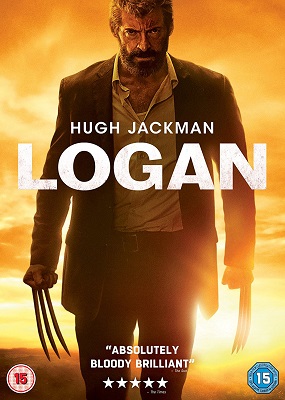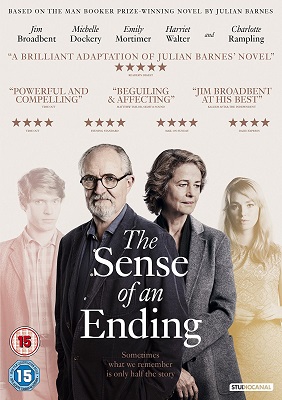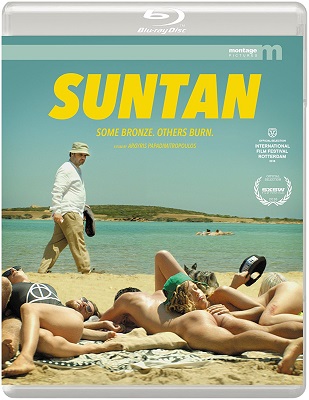
It Doesn't Have To Be Right…

… it just has to sound plausible


1 Comment

Moving pictures 2018, #9

Only five films this time, for some reason. Two of them are recent Hollywood blockbusters – one I thought over-rated, the other was terrible. You can probably guess which is which…
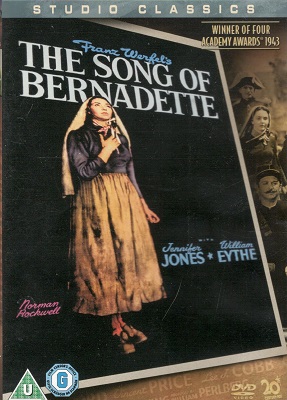
The Song of Bernadette, Henry King (1943, USA). I found this in a charity shop, and thought: classic Hollywood, probably worth a punt. It wasn’t. It’s an adaptation of a novel by Franz Werfel, which tells the story of the woman who “discovered” the “miraculous” spring at Lourdes. In the late 1850s, Bernadette, a schoolgirl, reported eighteen visions of the Madonna, and discovered a spring, following the instructions in one of those visions, which subsequently proved to have healing properties. Put that in a work of fiction and you’d find yourself on the sf and fantasy shelves. I mean, seriously? Lourdes is big business now, of course, with over 200 million visitors since 1860, despite the waters being repeatedly examined by scientists and displaying no unusual characteristics whatsoever. The Song of Bernadette comes across as a star vehicle for Jennifer Jones, who was married to producer David O Selznick, although she did win an Oscar for her role in this film…. despite playing a fourteen-year-old even though she was a decade older. (Another Jennifer Jones vehicle, Indiscretion of an American Wife – see here – is, despite the awful title, much much better.) The Song of Bernadette is all played very earnestly, with the sort of gravitas that suggests it’s based on historical sources, when it’s actually adapted from a novel which took a number of liberties with the life of the real St Bernadette. It’s all so fucking po-faced and serious despite the ridiculousness of its premise. The Song of Bernadette actually won four Oscars – best actress, best art direction, best cinematography, best music – but then it’s not like the Academy Awards have displayed all that much critical acumen over the decades… Not worth hunting down.
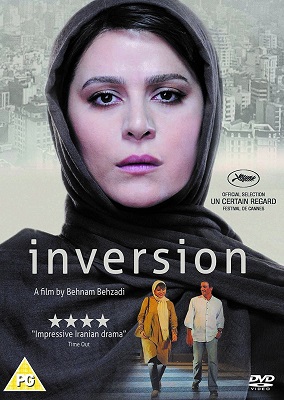
Inversion, Behnam Behzadi (2016, Iran). I have to date seen twenty-two films from Iran, a number of them by Abbas Kiarostami and Asghar Farhadi, two excellent directors. Iran has a strong film-making tradition and a number of brilliant films have come out of the country. Pretty much all of them have been deeply-rooted in Iranian society and the situation as it pertains in Iran. Inversion is a case in point. Niloofar lives with her mother and helps look after her. But when her mother collapses and is taken to hospital, and the only cure is to move her out of Tehran and its polluted air… Her brother assumes Niloofar will give up her life and move to the north with their mother. Niloofar doesn’t want to go – she has a successful business and she’s just started seeing an old flame who has returned to Tehran and is single once again. But her brother says he can’t go, and he’s not willing to shoulder part of the burden – why should he? He’s male. Since he owns the lease on Niloofar’s busines premises, he sells it under her so she’s forced to find new premises, and generally makes life difficult for her until she agrees to give up her life and move north to look after their mother. But she won’t budge. Even though it means refusing the role Iranian society expects her to play. All of the Iranian films I’ve seen have, to some degree, been critical of Iranian society, and mostly in regard to the role of women. In some it has been explicit, as it is in Inversion; in others, it is less obvious, such as in Kiarostami’s The Wind Will Carry Us. When your cinema is overwhelmingly negative, you have to wonder if there’s something about your country you need to change. So… how has the UK film industry reacted to Brexit? With fucking propaganda. Films about Churchill and Dunkirk. FFS. The man was not the greatest Briton who ever lived, he was a war criminal many times over, responsible for millions of deaths around the world. His leadership during WWII does not excuse his crimes, although it would not be fair to judge him without taking it into account. But. Iran under the shah was a repressive regime propped up by the West, Iran as an Islamic state is no utopia and the films it produces show as much – although the fact they exist shows an openness to criticism the shah was unlikely to allow. Inversion is definitely worth seeing. I will not be watching the Churchill ones.

Osaka Elegy, Kenji Mizoguchi (1936, Japan). I told David Tallerman, who gave me this box set, that I preferred Japanese films set in the twentieth century to historical films, and he pointed out that half of the films in this Mizoguchi collection are actually set in the twentieth century. Including this one. It’s an early film – released in 1936 – and its story is contemporary. I’ve seen enough films by Yasujiro Ozu (well, I’ve seen pretty much all his feature films from the 1950s onwards), so I think I have a good handle on the shape of his movies. Like Mizoguchi, he tended to use a stable of actors, and his films were very similar in the stories they tell. But I haven’t got to that stage with Mizoguchi yet, although I do find myself appreciating his films much more than I did when I first started watching them. In Osaka Elegy, a young woman is pressured into becoming the mistress of her employer. But hat affair ends when the wife finds out. She finds herself in a position where she needs money, and borrows it from her new sugar daddy. But when he demands it back, she has no one to turn to, not even her boyfriend, who had asked her to marry him. You would think, given the plot and my love of 1950s melodramas, Osaka Elegy would be right up my street, And it’s true that most of the Mizoguchi films I’ve seen so far have told women’s stories – The Story of the Late Chrysanthemums, Sansho Dayu and Utamaro and His Five Women being exceptions – but Osaka Elegy didn’t feel as centred on its female lead as, say, The Life of Oharu or The Lady of Musashino. But it’s not just that. Ozu’s films are really good illustrations of uchi-soto, inside-outside, but I don’t get that same feeling from Mizoguchi’s films. Yes, they’re more melodramatic, and the stories are based around the trials and tribulations of the central character – in this case, it’s telephone operator Ayako – and as such provide a dramatic commentary on Japanese society, and women’s role in it… But… I don’t know; perhaps they have too much plot for a melodrama. These are good films – although I could wish for better transfers – but so far they’ve yet to grab me the way Ozu’s films have done, or keep me entertained the way classic Hollywood melodramas have done. But they’re at least good for rewatches, so we shall see…

Atomic Blonde, David Leitch (2017, USA). This is based on a graphic novel, which I have not read; and I do wonder at the recent popularity of graphic novels as sources for movies. Okay, cinema is not an especially sophisticated form of entertainment – in story-telling terms, that is, rather than technically – and neither is the graphic novel, and their stories map out at around the same sort of time-lengths… But if you take a medium that has a tendency to simplify, which is partly baked in, and adapt it to another medium that has a tendency to simplify, which is also baked in… It’s not going to do much for your original story, is it? And when said story is a twisty-turny Cold War thriller that likes to think it can match Le Carré or Deighton for, er, twisty-turniness… Put it this way: there’s a cunning plot twist in Atomic Blonde and it was blindingly fucking obvious about ten minutes in. Charlize Theron, in what smells overpoweringly like a star vehicle or vanity project, plays an MI5 agent sent to Berlin in 1989 to clean up a failed attempt to hand over a stolen Stasi list of all foreign operatives in East Berlin. It’s supposed to be an easy job. But Berlin resident (the technical term for a spy undercover in a city) James MacAvoy seems to be playing his own game. So there’s lots of shooting, lots of fist fights, lots of bloody violence, in which Theron gives as good as she gets, and a plot that thinks it’s a hell of a lot clever than it actually is. And a film that looks really quite nice. The DVD cover should tell you that much, that this is a film which revels in its look. And in that respect, it succeeds really well. It looks great. But the story is pants, and has that blithe disregard to killing off characters graphic novels so often exhibit (because graphic novels don’t do characterisation), but which can be a real flaw in a movie. Even a Cold War thriller. Atomic Blonde looked very nice, but it really wasn’t very good. A shame.
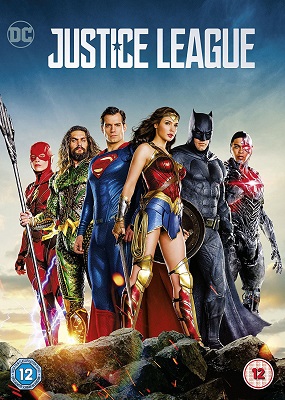
Justice League, Zack Snyder (2017, USA). When the current generation of superhero films first appeared, I quite liked them. Even the bad ones. I liked that CGI had reached the point where it could show superpowers onscreen and they actually looked, well, real. At the time, of course, I still read comics – or rather, I read the trade paperback omnibuses of various superhero titles. So I was sort of into fascist violence enacted via Spandex-clad goons. But in an ironic way, of course. (Who am I kidding? I would read superhero comics like a thirteen-year-old, and watched the films with the same sensibilities; it could never last.) After all, for all that Superman is called “the last boy scout”, like that’s an insult, he’s still judge, jury and executioner much of the time. And he’s one of the least objectionable ones. But it’s not the concept of superheroes which makes Justice League a bad film. It’s not even Zack Snyder, who does some things really well – and there a lot of those sort of things in Justice League. To be honest, I can’t think of another director who could have done anything with Justice League that would not have been unrecognisable. And yet, it’s a shit film. It has to pull together six superheroes, while also presenting the origin story of three of them. Although one of them had an origin story in a TV series but they decided to retcon that. We know Superman and Batman, although both have been rebooted that many times it’s hard to be sure which is which; and of course we know Wonder Woman from last year’s successful film. But the Flash is not the Flash of the television series – more than one, IIRC – and Aquaman and Cyborg are complete unknowns. Of course, when you have superheroes, you can’t have them beating up muggers and bank robbers – well, not unless they’re Batman – which means you need a global threat that only superpowered dudes can fight, and then only if certain things happen, including them actually agreeing to work together. Because when the planet is in peril, superhero egos need to be tamed first. But never mind. Apparently, evil supervillain Steppenwolf – the only supervillain named after a novel, unless I’ve missed one called Oliver Twist – failed to gain control of four Mother Boxes on a previous visit to Earth because the Amazons, gods and Atlanteans all managed to fight him off. But the death of Superman has made Earth an easy target, so he’s back. And there are no gods anymore, so the Mother Boxes safeguarded by the Amazons and Atlanteans are easy grabs. So much for that cunning defence plan then. The problem with writing stories based around Mother Boxes – sorry, plot tokens – is that the story totally depends on them being picked up one by one, and as soon as the enemy has one, well, there’s your conflict and your conflict’s resolution all in one easy-to-understand package. Except real fiction – real life – is not like that, not that fiction has any requirement to be like real life. I’m not a fan of story templates or three-act structures and the like, and I’ve seen many excellent films which make a point of not using them, but if it’s going to be used it needs to be done so with rigour and consistency. And Justice League doesn’t. It flails all over the place. Introducing heroes, only to have them write themselves out of the story, but then re-appear and help save the day. The Flash is completely re-invented as a twentysomethihg nerd so Joss Whedon has a character he can actually write dialogue for, because if there’s one thing his career since Buffy has prove it’s that he’s a one-trick pony. Amd then there’s Affleck’s Batman and Cavill’s Superman… And Affleck is actually not bad as Batman, probably slightly better than his precursors. Which sounds like heresy. Maybe it’s the grey hair at the temples that does it. Cavill just looks too chiselled to be Superman – an actual human being who looks to be good to play a superhero, who would have believed it? Wonder Woman is underused; the other three superheroes are paper-thin, perhaps because they have no origin film of their own. The end result is a movie that has a threat and a defence to that threat which don’t stand up to a second’s scrutiny. But it has lots of nice visuals, most of which are implausible, and some character beats that don’t seem to follow the same rhythm track as the main plot. One day, superhero films will grow up; Justice League suggests there’s a way to go yet.

1001 Movies You Must See Before You Die count: 895

1 Comment

Moving pictures 2018, #8

A nice geographic spread of films, which is the sort of viewing I’d like to be normal for me.

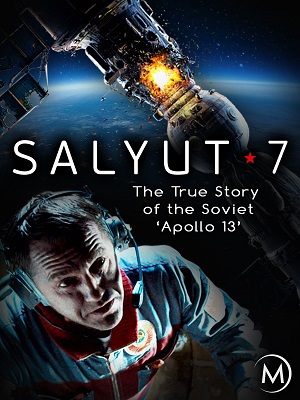
Salyut-7, Klim Shipenko (2017, Russia). At the time I watched this, Salyut-7 had not been released on sell-through and was only available for streaming – I watched it on Amazon Prime, inexplicably as a three-episode series: they split the feature film in two, and then added a making of featurette as a “third episode”. Which is bonkers. Happily, Salyut-7 – stupidly marketed as “the Soviet ‘Apollo 13′” – is excellent. The previous mission to Salyut – the USSR’s space station during the 1980s – had had a few problems, but when the space station completely shut down after its solar panels were hit by micrometeoroids, and resisted efforts to be restarted from the ground, the only solution was to send up a pair of cosmonauts to fix it. The mission is generally considered one of the toughtest ever attempted – although, of course, the West knew nothing of it publicly until after glasnost. In some respects, Salyut-7 is clearly a Russian attempt to outdo Gravity – at which it happily succeeds. The bulk of the action is set aboard Salyut 7, and the presentation of micro-gravity is just as convincing, if not more so, than in Gravity. True, there’s not much in the way of drama – I mean, even though the mission’s details were kept from the public, the death of the cosmonauts could never have been covered up. So it’s obvious they succeeded – well, to anyone who knows anything about the Space Race. But it was far from easy, and the film makes a meal of the difficulty. But it is, above all, really convincing in its presentation of microgravity and the hardware involved, Soyuz and Salyut. Much as I’m fascinated by the Apollo programme, I do find the Soyuz spacecraft an interesting piece of hardware, and it was good to see it in detail on the big screen (so to speak). If Salyut-7 set out to beat Gravity at its own game, then it succeeded admirably: the effects were as good, if not better; but it was also a true story. I can’t wait for it to be released on Blu-ray. Recommended.

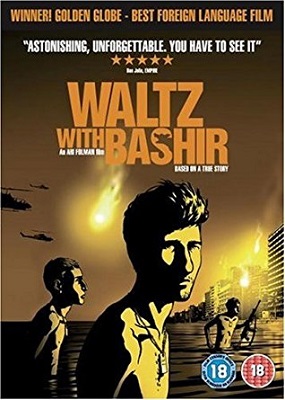
Waltz with Bashir, Ari Folman (2008, Israel). Do I classify this is a documentary or an animated film, because, well, it’s both. And it’s not like there are that many animated documentaries they can form a genre of their own. Folman served in the Israeli Defense Force (hah) during the invasion of Lebanon, but it’s not until he’s contacted by a friend from those days that he realises his own memories of his army service are suspiciously free of trauma. So he investigates, and discovers that he was present during a massacre of Lebanese prisoners of war by Falangists but had wiped it from his memory. The film implies the IDF was not complicit in the massacre but allowed it to happen – not because it had been unaware of what might occur, but because the consequences suited them. Years later, Folman has to make sense of memories he has suppressed for nearly thirty years. He travels to the Netherlands to talk to another survivor from his tank squadron, who has made a comfortable living from selling falafel. His friend too has been happy to forget what occurred during the war, although he has not actually blocked the memories. As Folman talks to people who were involved in the circumstances which led to the massacre, so he starts to remember himself what happened. Because the film is animated – it’s a sort of Rotascoped animation, unique to Waltz with Bashir – so it’s easy to tell the flashbacks and present day narratives apart. The film pulls no punches, it depicts the IDF conscripts as ill-trained and clueless, happier having barbecues on the beach than fighting… and completely unprepared for the brutality they encounter. This is not news… but it was suppressed by the Israeli authorities. Not that any other country would not have done the same. All nations did it repeatedly during WWII. The UK and US continues to do it in regard to the Middle East. I remember reading once about a first-hand account by an Israeli soldier in Lebanon and because he described soldiers stealing cars it was not published in Western newspapers as that would undermine the the reputation of Israel. Wars happen; but wars would not continue without a continual supply of weapons… and the same nations who publicly condemn those wars are happy to sell weapons to the combatants. To my mind, that makes them war criminals. They need to be prosecuted. And yes, if that means people like Folman are tried for war crimes – because they were certainly involved in them, whether they remember it or not – then so be it. I would hope the sentencing would reflect their level of involvement and culpability. That’s the proper way to do it.

Wittgenstein, Derek Jarman (1993, UK). I have, over the years, watched several of Jarman’s films, and have often wondered why his reputation was so high in certain circles. I remember thinking Caravaggio was quite good, but The Tempest felt a bit amateur-ish, and Blue was pretty much unwatchable. So I’m not sure what prompted me to put Wittgenstein on my rental list – perhaps a desire to give Jarman a more serious look? If so, I picked a good one for it. Because I actually thought Wittgenstein pretty good. The entire film is filmed against a black background. It’s not black box theatre staging because it doesn’t even make an effort to suggest scenery. It’s actors in front of a black screen. And it works really well. Wittgenstein is shown as a young boy and as a young man, played by two different actors. I know very little about philosophy, I never studied it at school and certainly not at university. And, to be honest, I’ve never felt inspired to explore the subject in the decades since I left full-time education. But Jarman’s Wittgenstein had some choice dialogue on philosophy, like “philosophy is just a by-product of misunderstanding language” and “Professor Wittgenstein, I recommend you read more Hegel”. The script was actually written by Terry Eagleton, although Jarman apparently heavily rewrote it. I’m not especially interested in how films are made, at least not as much as I’m interested in the final product. Sometimes, the genesis of a film can be as interesting as the film itself, but in most cases… Movie-making is a collaborative venture in which various creative types apply their vision to the project… and it’s a toss-up as to which vision finally makes it to the released product. At least with auteur cinema you can be fairly sure it’s the director’s vision. But in Wittgenstein alone, there’s that gap between script and film, between what Eagleton wrote and what Jarman has his cast say. As a film, I liked Wittgenstein – I found it informative and enjoyable. The black background totally worked. If I had wondered about Jarman’s reputation before seeing it, the film at least suggested he deserved his reputation. I plan to watch more Jarman, although I suspect I may have seen the best… (Gah, I now see the BFI are releasing a limited edition box set of his first six films on Blu-ray next month.)

Sumurun, Ernst Lubitsch (1920, Germany). Described as an “Oriental pantomime in six acts”, and also known as One Arabian Night, Sumurun is actually based on a play by Friedrich Freksa (do they have pantomimes in Germany?). A travelling group of performers arrive at an unnamed city. A slave trader wants to sell the troupe’s dancer to the sheikh for his harem. Meanwhile, the sheikh’s favourite from his harem, Sumurun, has fallen in love with a cloth merchant. The sheikh wants the dancer, Sumurun wants the cloth merchant. And then it turns out the dancer falls in love with the sheikh’s son. It’s all very tangled and frenetic and, er, tinted. I’ve no idea why they tinted early films. It doesn’t seem to add anything to the experience. Nor does there seem to be any reason for the tint – sometimes it’s blue, sometimes yellow, sometimes red… Sumurun was apparently filmed entirely in Berlin, using sets, which makes the external shots of the city an impressive achievement – and the desert even more so. Pola Negri is good as the dancer, and Paul Wegener makes a menacing sheikh, but the rest of the cast gurn at the camera like, er, championship gurners. Lubitsch himself, who plays the hunchbacked member of the troupe, is one of the worst. He was apparently so disappointed by his performance he swore never to act again. I’ve now seen four of the six films in this box set, and I must admit the first two were easily the best. Still, there are two films to go – Anna Boleyn and Die Bergkatze– so we shall see…

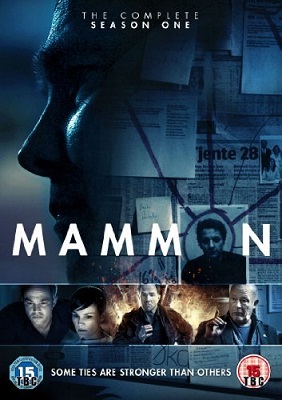
Mammon (2014, Norway). My mother, who is a big Nordic Noir fan, lent me this. She’d found it in a charity shop. It’s one of those television series where you’re not sure where it’s going for much of its length, which can be an advantage, inasmuch as it promises much. But, of course, it has to make good on that mystery in the finale. And Mammon didn’t quite pull that off. A newspaper publishes allegations of fiscal malfeasance at an investment company, and the CFO resigns under a cloud. It turns out he’s the brother of the journalist who broke the story. A few days later, the CFO commits suicide. The narrative jumps ahead five years. The journalist has dug deeper, with the help of a police officer from the financial crimes unit (they were together for a while during those five years but it’s over now). Their research leads them to a conspiracy centred around a class at a prestigious business school in Bergen twenty years earlier. Then two more important businessmen commit suicide when their finances are questioned… It’s all to do with that group at the business school – and the journalist’s brother was the leader – who decided to use insider trading to create fortunes and so beat the old boy network. And when one of their number decided to grass them up, they murdered him by tying him to a chair and setting fire to his house, also killing the man’s young son in the process… And so creating the creating the defining philosophy of the group – that they would not, like Abraham, sacrifice their sons but would sooner commit suicide. Helping the journalist is a billionaire who gained his wealth suspiciously, and he’s trailed several times before the viewer as a possible villain. But. And it’s why Mammon ultimately dissatisfied – there’s a good conspiracy at the heart of the story, and an excellent mystery… but it over-eggs the cake. We never learn the source of the billionaire’s fortune, for example – and then turns implausibly violent in the final episodes, with men in black SUVs murdering people with impunity. For four of its six episodes, Mammon was good telly. Then it threw it away. There is a second series, broadcast in 2016, and the show has been renewed for a third series.

The Pirogue, Moussa Touré (2012, Senegal). The title refers to a type of open boat used by the Senagalese to travel up the west coast of Africa to land illegally in Spain, and so make a better life for themselves in Europe. Some are realistic about their chances, some imagine Europe as a land of gold. The captain of the pirogue knows he is responsible for all those on the boat – about thirty people all told. He had initially refused the job, but he needed the money. At first, all goes well during the journey. They come across another pirogue whose engines (main and spare) have both failed, but decide they cannot stop to render assistance without jeopardising their own survival. But then there’s a big storm, and one of the men is swept into the sea. Unfortunately, he had the GPS on him. So they continue on, navigating by blind reckoning… but they’re as likely to be heading for Brazil as they are Spain. Fortunately, they’re picked up by the Spanish coast guard a day or so after their water runs out. After a couple of weeks in a camp in Spain, they’re repatriated to Senegal, none the worse for their ordeal. Except for the two who died, that is. The bulk of the film takes place in the boat, and it does an excellent job of setting out the characters, their reasons for being in the pirogue and their hopes for the future. There’s a tribal element to it, with the passengers coming from two tribes, one of which seems predominantly muslim, but it doesn’t generate conflict. There’s also a stowaway, a young woman, who causes some tension when she’s discovered – there is only so much food and water, after all. For all that The Pirogue is set on a boat in the open sea, it’s convincingly done. And the storm is especially convincing. I’m surprised this film isn’t better know, it’s a solid piece of drama and it is hugely relevant as an antidote to the racist scaremongering over immigration and refugees put out by the right. (A country without immigrants is a stagnant country. Easiest way to stop the refugee problem? Stop bombing the shit out of their homes. It’s very simple. Refutations that “it’s complex” are just excuses to not do anything.) Anyway, The Pirogue is very good, and there are two more films on this Great African Films Volume 4 DVD. It’s a shame the series is so hard to find, as it contains some excellent films (only one, Daratt, from Chad, was independently released on DVD in the UK). More films like this should be released in the UK.

1001 Movies You Must See Before You Die count: 895

Leave a comment

Moving pictures 2018, #7

Things don’t change overnight, much as we’d want them to. Okay, so I did manage to post a rant about science fiction on this blog recently… but I’m still watching – more or less – a movie a night, and most of those I think worth documenting. So the Moving pictures posts haven’t quite dialled back as much as I’d expected. And I’m still a little behind with getting them up on the blog. But I hope to be in a position to basically post one a week, with content covering other topics either side. But, like everything, it’s a work in progress…

Black Jack, Ken Loach (1979, UK). I have Loach all over my rental list because I think he’s a director whose oeuvre is worth exploring, even if not every film he made is actually any good (also true of many directors, to be fair). But then David Tallerman texted me, “Have you seen Black Jack?”, and I hadn’t so I moved it up my rental list. And lo, it appeared in the next set of discs. Which happens sometimes. Black Jack is based on a 1968 children’s novel of the same title by Leon Garfield, although I’m not sure the film was aimed at children per se. It’s set in 1750 in Yorkshire. A well-off couple, Quality in other words, hand their daughter over to a pair of doctors who run a sanatorium, because the daughter is unmanageable – there are hints it’s mental illness, but in other parts of the film it seems to be behavioural. Meanwhile, a lad is paid to look after the corpse of the title character by a “Tyburn widow”, a woman who bribed the men who fetched the bodies of criminals from the gallows so she could display the dead men in her front-room and charge money for the privilege of viewing it. But Black Jack is not dead. And he escapes, taking the boy with him. After helping a stuck coach, Black Jack conceives the idea of boobytrapping a ford so travellers would require his help. For a fee. And the first coach he waylays is the one carrying the two doctors and the daughter… The boy and the daughter escape and join a travelling medicine show. Meanwhile, the rest of the cast search for the missing daughter… This is low-budget film-making at its best. Although set nearly 230 years before it was made, Loach manages to present a convincing eighteenth-century England. The main actors, who are all teenagers, are uniformly good in their roles, although none of them went on to greater fame. And yet it all feels a bit like a Children’s Film Foundation movie – no bad thing, it must be said – although I don’t believe it was made as one. It has that sort of sophisticated approach to telling a story through film coupled with a really low budget that characterised a lot of CFF films. I thought it really good – and I hope that was why David texted to me to ask if I’d seen it…

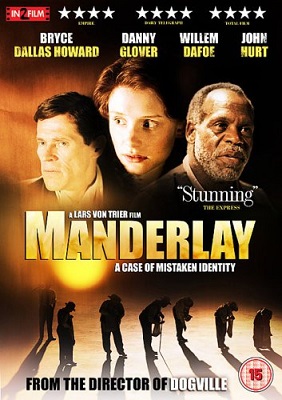
Manderlay, Lars von Trier (2005, Denmark). I really didn’t like von Trier’s Dogville, and Manderlay is the sequel to it, so why, I hear you ask, would I want to watch this film? Okay, I picked it up for 99p for a charity shop, so it was worth a punt… But… I have a lot of time for von Trier as a film-maker, even if I really don’t like some of his films. He has a very interesting oeuvre. And while I didn’t like the rape and violence in Dogville, I thought the use of black box theatre staging a fascinating way to present the story. The good news is that Manderlay uses the same black box theatre staging. The bad news is that the story is possibly even worse. Grace Mulligan, played in Dogville by Nicole Kidman but now by Bryce Dallas Howard, passes by the eponymous Alabama plantation on her way home from Dogville. A woman approaches them and tells them a man is about to be whipped for stealing a bottle of wine. They enter the plantation and discover that slavery still seems to pertain within its borders. Except not really. The owner’s ancestor had emancipated his slaves, but they chose to continuing living as slaves because… well, because… I don’t know. Is von Trier trying to say they were so unsophisticated they had no idea what emancipation meant, or that they could be hoodwinked into believing they were better off unemancipated? And that it need a crusading young female like Grace Mulligan to teach them the error of their ways? Which she fails to do, because they seem bizarrely sceptical of freedom, as if the institution of slavery were no more than the Stanford Experiment writ large, which is, quite frankly, deeply offensive. As I said earlier, von Trier is an interesting film-maker, and the staging of Manderlay as black box theatre is certainly interesting… but the story is such a bad take on slavery it’s almost impossible to watch… and you have to wonder if that was deliberate, and if so, why would someone make a film that was difficult to watch? Unless von Trier was daft enough to think that black box theatre was the only “difficult” element of the film… It’s not like Manderlay could be categorised as a noble failure. It’s an awful film, made in an interesting way – and I can’t think of a phrase that might make that description palatable, or any reason why I should think of a phrase to make it palatable. It’s a film best avoided, but you shouldn’t write off von Trier because of it.

That Obscure Object of Desire, Luis Buñuel (1977, France). I’m not a big Buñuel fan, although I’ve watched a number of his films. Um… checks records, discovers it’s actually ten Buñuel movies… A few of them I thought really good. But my finger sort of slipped on a near-monopolistic online retailer just after Christmas, and I ended up buying the Buñuel: The Essential Collection because some of the movies in it I’d not seen, and some of them I wanted to see again. The most recent film in the box set – it was actually Buñuel’s final film – is That Obscure Object of Desire, which was one I’d not seen. Initially, it appeared much like his other films from the 1970s – the same actors, the same presentation, the same sort of story… But like those other 1970s films it had that, well, genius twist that made it much more than the sum of its parts. That Obscure Object of Desire opens with Fernando Rey leaving Seville by train. A young woman tries to join the train, but he throws a bucket of water over her. He explains to the passengers in his compartment that he had been seduced by a woman called Conchita. The genius element of That Obscure Object of Desire is that Conchita is played by two actresses – Caroline Bouquet and Angela Molina, who play the character entirely differently – at different random times during the film. Rey is an unreconstructed 1970s male, and the film is presented from his viewpoint, but the use of two actresses as Conchita highlights their side of the story and so demonstrates the one-sidedness of Rey’s narrative. These films by Buñuel are not especially striking in the way they are filmed – the staging seems fairly unexemplary, to be honest – but the stories Buñuel chose to tell using cinema are excellent. Some are even pure genius. Not this one, perhaps; although it makes a series of pointed observations because of its peculiar presentation. I had bought this box set on a bit of a whim, having liked some of the films in it. But now I own it, and have seen more of its contents, I’m starting to realise it’s a bloody good collection to own. These are fascinating films and worth seeing.

Die Austernprinzessin, Ernst Lubitsch (1919, Germany). I bought this collection during Eureka’s Boxing Day sale, and it seemed like a good idea at the time. Okay, so I am interested in early European silent cinema – which pretty much means early silent German cinema, and directors like Lubitsch, Lang. Murnau, and even Dreyer, who was Danish but made several silent films in Germany. The princess of the title – it translates as “The Oyster Princess” – is the heiress to a millionaire who built his fortune on oysters, and she is deeply unhappy that a rival will be married before her. So her father promises to find her a more impressive husband, and employs a matchmaker to do just that. And he finds an impoverished prince who is more than happy to marry a millionaire’s daughter… The film is apparently a comedy, although other than an element of slapstick to some of the action sequences, it’s hard to see why. True, it’s taking the piss out of the rich, and the American rich in particular, as the characters are all American – but that makes it new money which is the object of derision, as is explicitly shown in the fact an impoverished prince is seen as suitable marriage material. It feels like the film’s targets are just too obvious and over-used. I suspect even in 1919, they were obvious and over-used. The excessive consumption of the US, and its desire for validation by old world aristocracy, is lampooned to a ridiculous extent – there’s a scene, for example, in which a small carriage is pulled by ten horses, nine of which have liveried riders. The daughter is played by Ossi Oswalda, who is even more peremptory than she was in Ich möchte kein Mann sein, but it’s clear why she was such a popular star at the time – both the humour and drama are broad, and she plays them broad. But she is good on the screen, and looks to be having a great deal of fun, which is infectious. Die Austernprinzessin is probably the least satisfactory of the films I’ve watched so far from the collection – its humour felt too obvious, and there was nothing in its staging whcih made it stand out, other than a propensity to play every joke to the hilt. Watchable, certainly; but not especially memorable.

Colossal, Nacho Vigalondo (2016, Canada). I really liked Vigalondo’s Timecrimes, but I’d heard mixed reports about this one, his first film made outside Spain. And, let’s face it, the story didn’t sound like all that prepossessing – woman with a drink problem who works in a bar discovers when she walks through a playground the morning after finishing work, a monster appears in Seoul and apes her movements. I mean, how does that work? What does it mean? The answer to the first is: bizarre lightning strike. The answer to the second is: well, I suspect the only metaphor in action here is so obvious that most viewers would discount it: woman destroys Seoul like she destroys her own life. I mean, really? None of this is helped by having Anne Hathaway, a well-known actress, in the lead role. She is good, no doubt about that; but the rest of the cast are nobodies (so to speak) so she stands out. Things get complicated when the bar owner, and old friend, discovers that he materialises in Seoul as a giant robot. And he’s less concerned about hurting Koreans. So where Hathaway’s monster apologises for her actions, his robot goes on a rampage – and she is forced to fight him to stop him. To some extent, Colossal feels like an extended comedy sketch without a punchline. The fact that it’s well-played and the sections set in Seoul look really good seem immaterial. Meh.

Border, Alessio Cremonini (2013, Italy). I forget how I stumbled across this film, but it sounded like it might be interesting, so I rented it. A woman in Syria learns her husband has deserted the Syrian army and joined the rebels, meaning she is now in danger from the Secret Service and the Shahiba. So she and her sister hire a man to take them across the border into Turkey, where they hope to meet up with her husband. The man they hired introduces them to a driver, Bilal, a fugitive in his own right. But en route they are forced to abandoned their pickup truck after being followed by an army patrol. And then the two sisters are separated… Bilal and one of the sisters stumble across a village that was slaughtered by rebels. The only survivor is a young girl, who they take with them. But things do not go well for them… I’veseen a review of the film online that complains it fails “to adhere to clasic story structures”, which tells me more about the critic, and what’s wrong with the Hollywood film-making, than it does the film. The review also complains that because the two sisters wear the niqab for much of the film, and so only their eyes are visible, it makes it difficult for the viewer to identify with them. But it seems to me that’s actually one of the points Border is making, that’s it’s easier to dehumanise those suffering in wars in the Middle East, which in turn makes it easier for Westerners to ignore their complicity in creating, and fuelling, those wars in the first place. Border tell a straightforward story, in as much as the three characters head for the Turkish border and have random encounters along the way, but that reflects the arbitrary nature of survival in a war zone. I thought Border a good film.

1001 Movies You Must See Before You Die count: 895


1 Comment

Moving pictures 2018, #6

I don’t seem to have been making much traction with the 1001 Movies You Must See Before You Die list recently. True, there’s a film from the list – Alphaville – in this half-dozen, but it was a rewatch as I first saw the film many years ago.

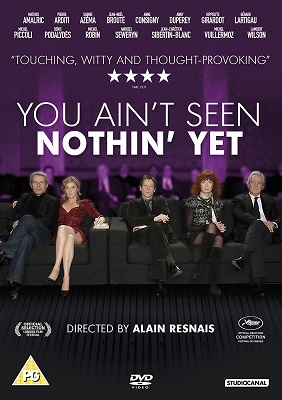
You Ain’t Seen Nothin’ Yet!, Alain Resnais (2012, France). It had never occurred to me the director of Last Year at Marienbad and Hiroshima mon amour had made films into the twenty-first century, but after stumbling across Muriel (see here), I looked further, discovered Resnais’s last film was released in 2014… and added a bunch of those available to my rental list. And the first to be sent proved to his last-but-one film, Vous n’avez encore rien vu, with its dumb Bachman Turner Overdrive title. Happily, the title is the only dumb thing about it. A famous playwright invites a dozen or so actors with whom he has worked during his career to his funeral. The actors are all billed as themselves. On arrival at the late man’s house, they are sat in front of a screen and asked to watch a performance of the playwright’s most famous play, Eurydice, put on by a young theatre collective. And as the collective act out the play, so those at the wake begin to act out the parts they took in past celebrated stagings of the play. For some of these scenes, Resnais lays in CGI scenery, intended I think to represent the scenery of the play when those actors were in it. The play-within-a-play has been around for a long time – Shakespeare even used it in Hamlet – but making the cast of the main play complicit in the staging of the embedded play is a new twist. And it’s cleverly done. Resnais apparently had another person direct the version of Eurydice watched by the cast, so that it would be different in style to his own direction. Having only seen three films by Resnais prior to this one, the distinction was lost on me. But never mind. A good film, worth seeing.

Level Five, Chris Marker (1997, France). Marker these days is probably best known for La jetée, an experimental film from 1962 which was freely adapted as Terry Gilliam’s Twelve Monkeys in 1995. Marker actually made a shitload of films, most of them short and most of them experimental. Level Five is feature-length, at 106 minutes, but very much experimental. It has a single cast member, Catherine Belkhodja, who views the world through a variety of computer screens. The Wikipedia plot summary refers to these last as “virtual reality”, but they’re not. And even for 1997, the computer graphics are crude. If anything, they remind me a little of Wim Wender’s Until the End of the World from 1991, which I first saw in 1992 or 1993 and thought a good presentation of the future at the time. Viewed from the twenty-first century, it’s not, of course. And Level Five feels somewhat similar in that regard. It’s not just the software or the hardware on display, but also the geopolitics, the social concerns… For all that it’s trying to be prophetic – deliberately so, it makes a feature of its analyses – Level Five seems to miss far more often than it hits. And having the film consist solely of either close-ups on Belkhodja or the computer graphics she is either watching or discussing doesn’t exactly make for gripping drama. I suspect this film needed another watch or two, but unfortunately it wasa rental and it’s gone back. Ah well.

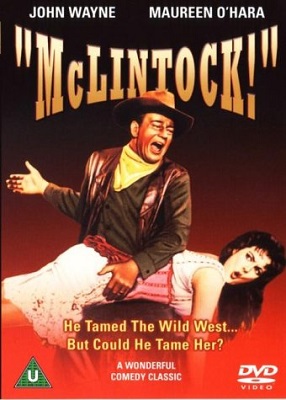
McLintock!, Andrew V McLaglen (1963, USA). Yes, that really is John Wayne spanking Maureen O’Hara on the cover art. And while art like that, and the offensive tagline, “He tamed the Wild West… but could he tame her?” might have been acceptable in 1963 (in some parts of society), they are no longer (Presidents Club notwithstanding). Even worse, a quick google shows that the film posters of the time used the same image, along with equally offensive taglines like “He’s a tender loving guy!” and “Wallops the daylight out of every Western you’ve ever seen!”. The sad thing is, is that for half of its length, McLintock! is actually an amusing comedy Western. McLintock! was a Wayne project, the first of many movies he used to promote his conservative Republicans values – although present-day Republicans may consider those values dangerously liberal in some respects. Wayne developed the script, he hand-picked the director, one of his sons played the young male lead, another son produced, and he insisted on a supporting role for Yvonne De Carlo because her husband had been injured filming How The West Was Won. The film is set in the town of McLintock, named for Wayne’s character, a local cattle baron, who owns pretty much everything in sight. His wife, Maureen O’Hara, left him two years earlier to live in New York, but now she is back – because their daughter, Stefanie Powers, is about to return from college. Meanwhile, homesteaders have arrived in McLintock, ready to settle land they’ve been given on nearby Mesa Verde. The US government has also released the chiefs of the local Comanche tribe, only for a locally-held commission to tell the tribe they must leave their land. All this is good drama, and Wayne’s character is even-handed, if overly paternalistic, and keen to see everyone is treated equally, Comanche or homesteader. But not the women. Twice in McLintock! women are spanked using coal scuttles, and on both occasions such disciplining is seen as both normal and required. In fact, Wayne and O’Hara are at loggerheads for much of the film, until he spanks her. And then she turns all loving and decides not to return to New York. Bah.

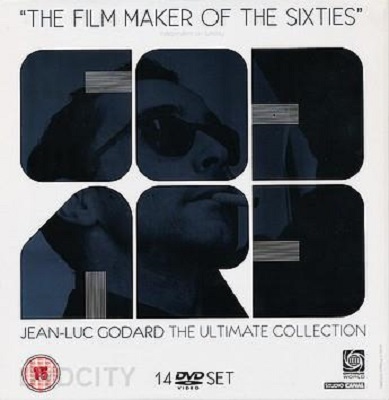
Alphaville*, Jean-Luc Godard (1963, France). Although I’d seen ten of the thirteen films in this collection before, for some reason I saved Alphaville to watch last – despite working my way through the others chronologically. I think perhaps it was because I’d last seen it nearly  a decade ago and perhaps felt I’d not appreciated it as much as I should have done… I don’t know. But I do know, however, that I liked it a great deal more this time. Eddie Constantine plays a secret agent posing as a jurnalist who visits Alphaville from the “Outer Countries”. It takes a while before his purpose there is clear, but he has been sent to bring back Professor Nosferatu, now known as Professor von Braun, the inventor of Alphaville and the Alpha-60 computer which rules it (it was not unusual in 1950s and early 1960s sf to assign AI-like capabilities to very large computers). Constantine meets up with Anna Karenina, von Braun’s daughter, and she gives him entry to the sections of Alphaville society his (fake) journalistic credentials cannot provide. None of Alphaville is filmed on sets. Godard made no effort to build a future city – and Alphaville‘s universe is implied to be galactic and not just planetary. Contemporary Paris provides the backdrop. At the time, some of the buildings used may have appeared futuristic, but now they appear mostly otherworldly, which has more or less the same effect. Some parts of the film haven’t aged so well. The seductresses, for example. Or the execution scene in the swimming pool with the sycnchronised swimmers. But there’s a lot that remains impressive. I especially liked a tracking shot following Constantine and Karenina as they travelled down in a lift, which continued in one take from them entering the lift cabin until they exited the hotel. An excellent film.

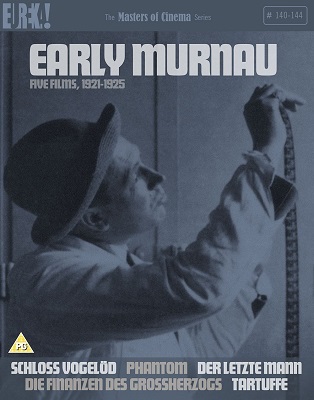
Tartuffe, FW Murnau (1925, Germany). I don’t know how many silent films I’ve watched, but I learn something new about cinematic narrative each time I watch one. I suppose I expected silent dramas to be completely different to films with sound, as if the use of intertitles laid a constraint on cinematic narrative which sound had removed from movie-making. And perhaps that’s true to some extent. But it didn’t mean silent cinema was completely unadventurous narratively. As Tartuffe demonstrates. It opens with a venal housekeeper gaslighting her employer so that he leaves his fortune to her and not to his actor grandson. Which the grandson learns on a visit to his grandfather. After being thrown out of the house, the grandson addresses the camera and insists he is not giving up. He returns to the house disguised as an impresario and puts on a private cinema screening for his grandfather and the housekeeper of… Tartuffe, the play by Molière. It’s a simplified version of the play, but the cut-down story is more than adequate to make the grandson’s point. In the film-within-a-film (explicitly so, unlike the Resnais above), Orgon returns from a trip and brings with him a religious man whom he greatly admires: Tartuffe. In fact, he admires him so much he changes every aspect of his life to accommodate Tartuffe. Orgon’s wife, Elmire, however, suspects Tartuffe is a fraud, and sets out to entrap him by seducing him. And she succeeds… I’ve seen several of Murnau’s films, and liked them, so this box set of his early works was a good buy. And a bargain too, as it was cheaper than the individual versions of the films in it.

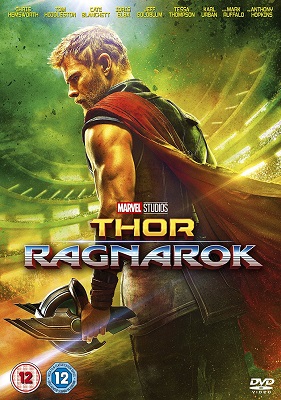
Thor: Ragnarok, Taika Waititi (2017, USA). I am not a fan of superhero movies. The ones everyone praises, I generally think are terrible. I mean, I’d always liked the Guardians of the Galaxy since first reading them in an Marvel anthology comic back in the 1970s, but the movie wasn’t even based on those Guardians of the Galaxy but a later reboot, and, for all its hype, it was pants. And the sequel was worse. So I had pretty low expectations for Thor: Ragnarok, especially given how forgettable the two previous Thor films were… And yes, I was aware Thor: Ragnarok had been directed by Taika Waititi, a leftfield choice for a MCU film, but I wasn’t convinced the addition of Kiwi humour to MCU bombast would work. But. I was actually entertained. Which was unexpected. Thor: Ragnarok is not a great film by any means, and it’s not entirely sure what it should have been. You have the pure Kirby-vision of the Asgard sections, but the part set on Sakaar feels more like a reject from a Star wars prequel. But the film has a number of good lines and some entertaining comic set-pieces. For example, when Thor is about to leave Dr Strange’s mansion and puts out his hand for Mjolnir and you hear the sound of glass breaking, I laughed out loud. I wasn’t convinced Waititi’s rock-creature deadpan humour worked all the time, but Cate Blanchett did make an excellent villain. I could live without most of the plot, and the final battle on Bifrost went on far too long. I’d certainly describe Thor: Ragnarok as one of the better films in the MCU, although that’s not a hard bar to clear. Perhaps its success might lead Disney to experiment a little more with who they choose to direct their films… What am I thinking? It’s Disney. They’re as corporate as you can get. They’ll either flog their new formula to death, or strangle whatever creativity their chosen director tries to put into their film…

1001 Movies You Must See Before You Die count: 895


3 Comments

Moving pictures 2018, #5

I swore I’d wouldn’t be posting just reviews of films all this year, but I had bad flu for a week, which meant I watched a lot of films and did very little blogging. So I’ve a backlog to clear. One more of these and I’ll up to date, and hopefully after that, their frequency will decrease… and lots of other content will start appearing instead. Hopefully.

Princess from the Moon, Kon Ichikawa, (1987, Japan). The only other Ichikawa film I’d seen before watching this was The Burmese Harp, which is excellent. So I expected good things of Princess from the Moon, despite the awful title and cover art. Sadly, the latter were indicative of the contents. As the title suggests, a baby arrives myteriously – well, in a meteorite – in Japan, and a family adopt the baby and bring her up as their own. It’s the Superman origin story without the superpowers. Okay, with the superpowers. Because the young woman does have strange powers. However, unlike Superman, she is eventually reunited with her people when a UFO, in a scene somewhat reminiscent of Close Encounters of the Third Kind, or is it ET: The Extra-Terrestrial, comes to Earth and she departs on it. Meanwhile, she proves so popular among the local menfolk, and indeed further afield, that she has to set them tasks in order to manage their advances. The film aparently did not do well and, despite the presence of Toshiro Mifune as the man who discovers the “princess”, it’s not easy to see why. The tone is all over the place, and Ichikawa adds nothing to a well-used story. Apparently, the dragon was originally going to double as the Loch Ness Monster in a Hammer film but the project fell through.

Viva, Anna Biller (2007, USA). I’d rented Biller’s The Love Witch on a whim, and been impressed enough by it to add her first feature film, Viva, to my rental list. It’s nowhere near as polished a piece, and in many respects a much less subtle pastiche. Which is not necessarily a bad thing – Biller is certianly a singular talent, devoted to pastiching 1970s aesthetics and B-movies, but with feminists sensibilities. It can make for an uneasy mix. While her sensibilities are unimpeachable, her dedication to the look and feel of the films she’s spoofing does tend to place them closer to their inspirations than the twenty-first century. Biller plays a Los Angeles housewife in the early 1970s who, with a friend, is persuaded to expand her sexual horizons by moonlighting as an escort (using the name “Viva”). There are a lot of very stilted conversations between the characters, and everything is colourised to an eye-bruising degree. Later, Viva ends up at an orgy, and it’s the sort of thing you’d expect in a Russ Meyer, although without the focus on women’s chests. The end result is far less clever than The Love Witch, and embarrassingly gauche in places, but certainly shows what Biller is about and attempting to do. Seen before The Love Witch, I suspect it might misinform viewers as to Biller’s intentions; seen after it, the films feels like a work in progress. She will go on to amazing things, I’m sure of it. Viva is part of the process.

A Man Vanishes, Shohei Imamura (1967, Japan). My previous experience of Imamura, The Ballad of Narayama (see here), I really did not like, but I suspect I added A Man Vanishes to my rental list based on the description rather than the name of the director. And I’m glad I did. The film starts out as a straightforward documentary on the case of a Japanese salaryman who simply disappeared. Bu then the documentary begins to question its own remit, and in a scene toward the end, the set is demolished around the filmmakers as they discuss what they have filmed, revealing the documentary itself to have been a fictional construct. It is astonishingly meta, and astonishingly informed about its own nature. I’m not sure what to make of it – it deconstructs itself from the inside in a way that I had frankly not thought within the vocabulary of 1960s film-makers. It’s clever in a way that far too few films are, and even fewer documentaries are. I thought it excellent.

Die Puppe, Ernst Lubitsch (1919, Germany). I think it was this film, of all the ones in this box set, which persuaded me to add it to my shopping basket during Eureka’s Boxing Day Sale. Ossi Oswalda plays the daughter of a toymaker who takes the place of a life-size doll bought by the local baron’s son who needs to marry but is not interested in doing so. So he marries the doll. Which is not a doll. He only married her because he had fallen under the spell on a local friary who hoped to use the dowry to fund their gluttony. So of course they’re a bit upset when it transpires the doll is a real woman. And he falls for her, so they’ll be keeping the dowry, thank you very much. Like the previous film in this set, Ich möchte kein Mann sein (see here), Die Puppe is played strictly for laughs, and Oswalda in the title role makes the film. It’s a thin premise, and not especially plausible, but the movie totally commits to it. It’s a more stagey film than the earlier one, with the action taking place on what are clearly stage-sets – and that includes the town square which features in the opening. Fun, but one for fans of silent movies, I suspect.

Dekalog*, Krzysztof Kieślowski (1989, Poland). In terms of Polish cinema’s exposure to the English-speaking world, Kieślowski is a giant. Poland had a huge film industry, and has produced a great number of world-class directors, many of which have been released in Anglophone markets. So quite why Kieślowski has come to be seen as the quintessential Polish director is something of a mystery, especially given the paucity of his oeuvre compared to others such as Andrzej Wajda or Agnieska Holland. The same, I suppose, might also be said of Satyajit Ray and Bengali cinema – Ray is comprehensively released on DVD on the UK, but none of Mrinal Sen’s movies are available in UK releases. But then Ray had Ismail Merchant proselytising for him in the West, probably because Ray was helpful toward Merchant and Ivory during the early days of their career. I don’t know that Kieślowski did the same for an Anglophone director, but I’ve seen no evidence he did. Which does make his selection as the face of Polish cinema somewhat inexplicable. He’s good, there’s no doubt about that. But, I’ve come to feel, middle-brow and you’d expect a director with such a high profile to be more, well, cerebral. But then perhaps Kieślowski’s reputation was formed by his TV work, which this box set has shown is superior to his feature film work. The Dekalog itself, ten one-hour long episodes, each of which illustrates one of the Ten Commandments, and all of which are set in the same block of apartments in Warsaw. Some are better than others; some are even somewhat opaque, with a far from obvious link to the Commandment they are intended to illustrate. Two of the episodes, five and six, were later remade as feature films, A Short Film About Killing and A Short Film About Love. They’re probably the two strongest episodes. This box set was definitely worth getting, just as much for the TV films and special features as for the Dekalog series itself.

Hidden Figures, Theodore Melfi (2016, USA). The US is very good at making films that show racist it once was but which reveal how racist it still is. On the surface, Hidden Figures cannot be faulted – women of colour were involved in the US space programme and they have a story worth telling, if only to show people they were involved. But in an effort to create drama, Hidden Figures creates situations which undo the achievements of the people it is trying to celebrate. It’s not as blindingly obvious as Kevin Costner ripping down the “Whites Only” sign on the women’s toilet, an entirely invented scene since the NASA facilities were not segregated so there was no need of a white saviour… but also the fact the film’s event are implied to take place during the late 1950s when Katherine Johnson is promoted to the Mercury Task Group, but she had been made a supervisor over a decade before in 1948. There’s no doubt the contribution of women of colour, or indeed women, to the Space Race has been forgotten, if not outright written from history; but the real histories of these people are dramatic enough without having to make changes. The fact the US practiced segregation some fifty years ago is frightening, and yet not all that much has changed – hence the need for films such as this. Black people have been so written out of history – US especially – they cannot see themselves in it, despite their many and varied and important contributions to it. They are there, doing their bit, and only a racist or a fool would say otherwise. On the one hand, I think Hidden Figures‘s purpose is admirable and I welcome the film’s existence; on the other, I rue that it has to exist in the first place, and that it has to warp history to provide a narrative acceptable to the public. But it’s not a great film, and I suspect you’d get more from the book on which it was based.

1001 Movies You Must See Before You Die count: 895

1 Comment

Moving pictures 2018, #3

Moving swiftly on… This year, this blog is not going to turn into a repeat of last year. Honest. There will be content other than film reviews (or rants). But it’s going to take me time to get to that point, as I need to change a few of the bad habitds I’ve picked up over the last two years, so you’ll have to bear with me for a few weeks…

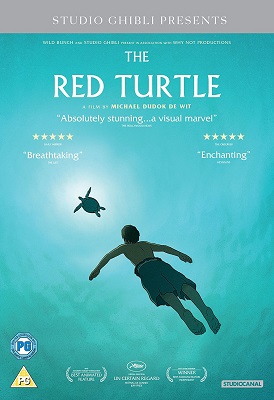
The Red Turtle, Michaël Dudok de Wit (2016, France). Sometimes, Amazon Prime really does throw up pleasant surprises. It would have thrown up more, recently, but it seems when they upgraded it they broke the subtitling thing, and they don’t show now unless they’re burned into the print. Which is fucking annoying. Streaming, eh. And people wonder why I prefer DVDs and Blu-rays… Not that the subtitle bug caused any problems with The Red Turtle, as it is notable for having no dialogue. A man is washed ashore on a deserted island. His attempts to escape on rafts are thwarted by turtles. Especially a large red turtle, which he manages to capture and drag on shore. The following morning, the red turtle has become a woman with red hair. The two live together and have a child. The child grows to a man. Who attempts to leave the island. And, okay, I admit, when the son was an adult, I spent most of the time wondering where his trousers had come from. It’s not like his father had a spare pair. But the animation in The Red Turtle is astonishingly beautiful, although not in a Makoto Shinkai way, more a ligne claire way. It’s not the most dramatic story to make it to the silver screen, true; but there’s some clever foreshadowing, and the lack of dialogue is no handicap to following the narrative. The Red Turtle has been praised by many and won a couple of awards, and Dudok de Wit won a special prize for Un Certain Regard at Cannes. The film was nominated for an Oscar but lost out to Zootopia (which I’ve not seen, but… really?). A definite candidate for my best of the year list.

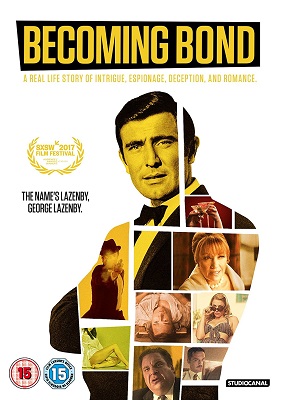
Becoming Bond, Josh Greenbaum (2017, USA). My promised Bondathon blog post is still to come – that’s the one in which I rank all twenty-four official 007 films in order, after watching them over 2 to 3 weeks… It should come as no real surprise that I think the best Bond film is… On Her Majesty’s Secret Service. In fact, I thought the best Bond movies were the stripped-back ones, without the stupid gadgets or supervillains. OHMSS was George Lazenby’s sole outing as Bond and popular wisdom likes to have it the film was bad and he was fired from the role as a result. In fact, Lazenby turned down a seven-film contract and a $1 million signing bonus (this was in 1969, so it was a fuckton of money). True, the film was generally considered one of the lesser movies in the franchise, but it has since been critically re-appraised and many consider it the best. I happen to agree. Becoming Bond is Lazenby’s story. He’s interviewed by the film-makers, but parts of his life are also dramatised, with Josh Lawson playing a young Lazenby. Lazenby’s career path to Bond is pretty well-known: mechanic to car salesman to male model. At the time Connery announced his retirement from 007, Lazenby was best known for a series of adverts for Big Fry chocolate. Broccoli met Lazenby and asked him to audition for the role of Bond. When Peter Hunt, editor on previous Bond films who had been given the director’s chair for OHMSS, met Lazenby, the role was pretty much his. Filming went well, although Lazenby insisted on doing his own stunts – there are conflicting stories about relations on-set, although the one about Rigg despising Lazenby, so much so she chewed garlic before a scene in which they kissed, is apparently untrue. Once OHMSS had been released, Lazenby refused to play ball with the producers. He turned up to the premiere sporting a beard. And he refused to sign a seven-film contract, despite the $1 million signing fee, partly thanks to bad advice from his agent who told him he could probably get $500,000 a role for any film going forward. Unfortunately, his film career pretty much died. He went into real estate, and earned a very comfortable living. Lazenby made a really good Bond. True, he was a bit stiff at first, but as the film progresses he settles into the role, so much so that he’s more convincing when undercover as Pursuivant, Griffin Or Sir Hillary Bray than Connery ever was as Bond himself. And in the action scenes, Lazenby displays real physical presence. The Bond fight scenes were always a bit crap, but Lazenby throws punches like they were real punches (he actually knocked out a stunt man during his audition). The next Bond to come close to Lazenby’s physicality is Timothy Dalton. Daniel Craig may be very physical, but it’s cartoon violence – compare the fight scenes set aboard a train in From Russia with Love and Spectre. Anyway, I should be saving all this for my Bondathon post. Becoming Bond is a fascinating documentary, which cemented my view that OHMSS is the best of the 007 movies.

Pedestrian Subway, Krzysztof Kieślowski (1974, Poland). I bought this box set when it was released a year ago, and it’s sat in its shrinkwrap until now. But Cinema Paradiso and the Royal Mail were conspiring against me in the week before and after Christmas, so I dragged it out and bunged in the first  Blu-ray… And this collection is really well presented. Really well presented. I had Dekalog on DVD, on two DVDs in fact, bought back in 2002 and 2004; but when this box set appeared, I bought it, and passed on the DVDs to a friend. And I’m glad I bought the boxset, and not just because of its additional material. As well as the ten episodes from Dekalog, two per disc, there are also one TV movie per disc and one documentary. I’ve not watched all of the latter, but Pedestrian Subway is the first of the TV movies. It was shot in black and white and takes place in a subway in Warsaw which boasts a dozen or so shops. A teacher is on a school trip to Warsaw, and sneaks away to visit a shop in the subway, in which works a woman, whom he apparently knows. The dialogue reveals that she is his wife and that he threw her out after catching her in flagrante delicto with another man. But now he misses her and regrets his decision. Apparently, Kieślowski threw away all the footage he had originally shot as he wasn’t happy with it, and hurriedly reshot the film from start to finish. It’s a clever piece of work – the relationship between the man and woman is revealed piecemeal, the events in the subway are a subtle criticism of the Polish regime, and some of those who appeared in the film had professional relationships with Kieślowski over a number of years. Dekalog is good drama on its own – which was something I had forgotten until I rewatched them, and I do find Kieślowski’s feature films a bit middle-brow – but these TV movies new to me turned out to be pretty damn good, so this is definitely a collection worth having.

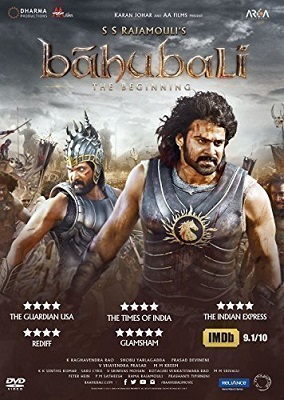
Bahubali: The Beginning, SS Rajamouli (2015, India). I was recommended this film by Indian colleagues at work, and I’m happy to add Bollywood film to my rental list – classic or modern. In fact, I’ve now got my mother watching Bollywood films. I lent her a couple, and now she looks for them in charity shops and has just given me Kabhi Alvida Naa Kehna to watch … But Bahubali. Or Baahubali. This is very definitely modern Indian cinema, despite being set some five hundred years ago. It’s not actually Bollywood but Tollywood – a Telugu-language film rather than Hindi, and the second Bahubali film has been been India’s biggest box office hit ever. The first one also did really well, and clearly had a huge amount of money spent on it. It is, in fact, a total CGI fest. It opens with a woman falling down a massive waterfall. She dies, but her baby survives and is brought up by local villagers. But he is super-strong and repeatedly tries to climb up the waterfall to discover the land above. When he finally does make it, he witnesses a young woman being chased by soldiers. She escapes and he follows her to a cave, and learns she is a member of a group of rebels in the Mahishmati empire, supporters of a queen who is being held by the current emperor. So the young man, called Shivudu, helps her, and discovers that he’s actually the queen’s son. The film then goes into total flashback and explains how Bhallaladeva and Shivudu’s father, Bahubali, went to war for the throne of Mahishmati. The battle scenes are fantastic – a cast of tens of thousands, almost all of which are CGI, but pretty convincing CGI. The waterfall too is CGI – it appears to be several thousand feet high, which is just ridiculous, but all in keeping with the general scale of the film. It’s like Lord of the Rings without the hobbits and elves and orcs. But turned up to eleven. And I’ve yet to watch the second film…

Side/Walk/Shuttle, Ernie Gehr (1991, USA). While hunting for a Benning film to watch on Youtube, I stumbled across this. Gehr also makes experimental films, and his career too began in the 1960s. I do like experimental films, although the most prominent examples appear to be American and I’d like to see more by other nationalities. But I’ve watched Maya Deren and Stan Brakhage and Bill Baillie, and I’d like to see more US ones too. Side/Walk/Shuttle was filmed from an outside elevator at a San Francisco hotel, and consists of footage from the lift and an unrelated soundtrack. It’s hypnotic, in the way real art can be, despite its simplicity. One of the beauties of video art is that anyone can do it, but it has to all fit together for it to be art. If you know what I mean. What differentiates random footage and art is purpose and structure, even if neither are apparent. A person locks off a camera and films ten minutes of a forest. That’s not art. But if the film-maker is trying to prove a point, or has a message, then it is. Even if not all the clues to to that point or message are evident. I’m reminded of a Turner Prize nominee from a decade or so ago which was basically a copy of the cover art of  a science fiction novel – by Tony Roberts, I seem to recall – but the art was more than just a painting. I’ve said before that video installations are my favourite form of art, and one of the beauties of video art is that you can embed the extra-textual knowledge in it. Which some do. Other make it part of the exhibit – ie, the text explaining the installation. You can’t avoid extra-textual knowledge in any artform. The alternative is “As you know, Bob,” conversations and the worst sort of exposition, which we science fiction readers know all about. On the one hand, I think art should be more than just is presented because it needs to be in dialogue with previous art and with culture; on the other, not everyone is sufficiently informed to plug into that dialogue. Catering to the latter only results in bad art.

Personnel, Krzysztof Kieślowski (1975, Poland). One of the ways in which this collection proves its worth is in the included documentaries. In KKTV, critic of Polish cinema Michael Brooke discusses Kieślowski’s career. Brooke doesn’t have much screen presence, and is clearly reading from a prepared script (and I was amused to spot the Mondo Vision editons of Żuławski’s films on the shelves behind him). But what Brooke had to say was very interesting. And when talking about Personnel, he made the film seem far more interesting than it would have initally appeared. A young man joins the staff of a local theatre in the costume department, and witnesses how the company operates on a day to day basis. He becomes involved in a denunciation of a colleague, and has to choose between loyalty to his friend or his own career… It’s a dilemma many, even in the UK or US, can likely identify with, although in communist Poland the consequences were far more severe. Brooke mentions that Personnel is partly autobiographical, that one of Kieślowski’s first job was in a theatre, and that some of the incidents in the film Kieślowski has admitted in interviews were taken from his own experiences. I don’t think the central one is, however, in which one of the performers publicly bollocks and humiliates a member of the wardrobe department on stage (the man who is eventually denounced, in fact). But I think the incident with the exploding cigarettes might have actually happened to Kieślowski.

1001 Movies You Must See Before You Die count: 895


Leave a comment

Moving pictures 2018, #2

I plan to watch less films in 2018 than I did in 2017, and already I’m spending an hour reading when I get home from work, and only putting a film on afterwards. And yet I’m three dozen films in and it’s only the 17 January as I type this, and I’ve a third and fourth post, with another dozen movies already lined up… Oh well.

Nightfall, James Benning (2011, USA). I found this on Youtube, which seems to be the place to find Benning films, as the Österreichisches Filmmuseum has only released half a dozen or so DVDs of his work. Some of his films are apparently available via Mubi, but I’ve yet to subscribe to it. Meanwhile, there are (often low-quality) copies uploaded to Youtube by various fans, plus Benning’s own Youtube account. Nightfall has nothing to do with Asimov, thankfully, but is 98 minutes of a forest high in the Sierra Nevada Mountains as the sun sets. That’s it. Benning locks off his digital camera, and leaves it running. It’s about as stripped-back Benning as you can get. Unfortunately, there’s an extra-textual element to much of Benning’s work – the juxtapositon of sound and vision, for example, and the reasoning behind it – and watching one of his films on Youtube means you don’t have access to that extra-textual knowledge. You can google for it… and I did. But all I could find claimed that Nightfall was precisely what it presented to be. But, knowing Benning’s work, I suspect there’s more to it than just that. I shall have to look further.

Elle, Paul Verhoeven (2016, France). This was a Christmas present. The last I’d heard, Verhoeven was working on some project back in the Netherlands after his successful Black Book, and it seemed pretty certain his Hollywood career was on hiatus as, despite the success of his Hollywood films, I suspect he was too idiosyncratic and the sequels by other hands to his movies had seen diminishing returns. Now, the movies he made in Hollywood were (mostly) top-notch, and while the Starship Troopers live-action franchise (not to be confused with the CGI one) upped the satire with each new installment, it also lowered the audience figures. The Robocop sequels went into a death spiral in terms of both quality and commercial success. And the sequel to Basic Instinct was a Sharon Stone vanity project, and rightfully bombed. (There was also an unofficial sequel to Showgirls, made by a porn actress who had a bit part in the original; it’s absolutely fucking dreadful.) So, Verhoeven: no longer Hollywood. And now he appears to have reinvented himself as French cinema’s successor to Andrzej Żuławski. Because Elle pretty much plays like Verhoeven channelling Żuławski. Which is no bad thing, I hasten to add. Plus, it stars La Huppert. Which is also a good thing – she is probably the best actor currently making films. In Elle, she plays the CEO of a video games company which has a fairly typical testosterone-driven nerd culture. One night, she is raped by a man who breaks into her house. Afterward, she carries on as if nothing had happened – but now she is suspicious of every man in her life: employees, friends, neighbours… The violence is played flat and brutal, which is a Verhoeven trademark, but the way the story pans out feels more Żuławski… although Verhoeven doesn’t have his cast acting as emphatically as Żuławski does. It’s an odd film, a very French drama into which these violent incidents erupt. Which is, I suppose, very Verhoevenesque.

Utamaro and His Five Women, Kenji Mizoguchi (1946, Japan). David Tallerman, who likes his Mizoguchi, gave me this box set as he had upgraded his copies of the films it included. (I’ve done the same for him when I’ve upgraded from DVD to Blu-ray.) Utamaro and His Five Women is set during the Edo Period in, er, Edo. The film opens with a samurai art student taking issue with the text on a print of a painting by Utamaro. He tracks him down and challenges him to a duel. Utamaro challenges him to a drawing contest instead… which he wins so handily, the art student joins him as an apprentice. And it’s the new apprentice’s girlfriend who becomes the first of Utamaro’s women, each of whom are combinations of model and muse. The second is a famous courtesan who has him paint on her back for a tattoo artist to use as an outline (as per the box set cover art). Another of his women is a lady’s maid he spots at the beach, diving into the sea among a large group of women and bringing out fish. One of the interesting things about this film – and it’s a good film if you like Japanese historical films – is that it was made under American Occupation immediately following WWII, and the Americans didn’t like the Japanese to make historical films as they thought they were militaristic and nationalistic (according to Wikipedia). But they let Mizoguchi make this.

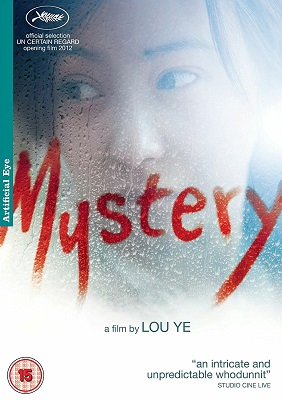
Mystery, Lou Ye (2012, China). Another Christmas present. Lou is a Sixth Generation director from China, and I’m a big fan of those films by the group I’ve seen. Other members include Jia Zhangke, Wang Xiaoshuai, Zhang Yuan,  whose films I’ve seen and much admire; and Lu Chuan and He Jianjun, whose movies I haven’t seen. Lou’s Suzhou River is a thriller/drama with a very clever structure; Mystery, a later film, also uses a non-linear narrative to tell its story. It also has that same documentary style approach to its narrative, which is, I freely admit, one of the real draws of Sixth Generation films. The movie opens with a young woman wandering out into a road and being hit by one of two racing sportcars. Except it may not have been an accident, as she appears to have been fatally assaulted beforehand. Lu Jie makes friends with Sang Qi at a playground where both their kids play. Sang is convinced her husband is having an affair and asks Lu to meet her at a coffee-shop to discuss the advisability of hiring a private detective. But it turns out the coffee shop overlooks the hotel where Sang’s husband meets his mistress. Except… Lu sees her own husband entering the hotel with a young woman. So Lu investigates, and discovers that Sang is also her husband’s mistress and Sang’s young son was fathered by him… You have to keep your wits about you to follow this, although the way the story is presented is deceptively simple. It’s the flashbacks, you see. The situation is complicated, and only revealed piecemeal. Definitely worth seeing.

Notre musique, Jean-Luc Godard (2004, France). I’m almost done with this Godard box set, and I’m really glad I bought it. These are films to watch again and again. Godard’s films have never been exactly traditional. Even in his early Nouvelle Vague movies, he played around with narrative forms. Later, he experimented even further. And continues to do so. Notre musique is from Godard’s phase when he mixed fact and fiction, and often played the protagonist himself. After an opening non-narrative section of documentary war footage, the film presents Godard waiting at an airport prior to flying to an arts conference in Sarajevo. He meets a man who will be an interpreter at the conference, French, but originally Israeli, whose niece will also be at the conference. Godard is interviewed by an Israeli journalist, who later interviews Mahmoud Darwish. Both interviews concern Israeli-Palestinian relations. For all his cleverness and cinimatic tricksiness, Godard was never especially subtle. His films are always about something, and if it’s not that which drives the narrative, then you can be sure the characters will discuss it a number times during the movie. Some of his films in fact are little more than discussions among members of the cast. In order to make a point, Godard not only uses language, ie, the spoken word, but also the language of narrative, and even the language of cinema. The epitome of this being, of course, his film Goodbye to Language (see here). (Although I prefer his Film Socialisme (see here), which is similar.) It’s not necessary to agree with Godard’s argument to appreciate his films, but then I don’t think he expects his films to be persuasive per se, more that they’re presented as arguments and their chief purpose is to provoke discussion (but from a sincere position). Anyway, this is by no means Godard’s best film of this sort, nor his most intriguing; but it certainly bears rewatching.

Emperor, Peter Webber (2012, USA). My mother lent me this one. I’ve watch a film about General MacArthur and Emperor Hirohito before, but it was Sokurov’s The Sun (see here), which could not be more different to this US take on the same historical events. Emperor is told from the point of view of Brigadier-General Bonner Fellers (a real person, like everyone in this film), who was a member of MacArthur’s staff and tasked with discovering Hirohito’s complicity in declaring war on the US. Before the war, Fellers had been in a relationship with a Japanese woman studying in the US, but she had returned home hurriedly for family reasons. He followed her back to Japan, weathered anti-Western sentiment from newly-militarised Japanese society, and met her father, a decorated general. As a Japanist, he’s a good choice to investigate Hirohito, although he did abuse his position during the war so that his girlfriend’s town was avoided by US Army Air Force bombers. MacArthur, meanwhile, is more concerned about using his occupation of Japan as a stepping-stone to the US presidency. To that end, he runs roughshod over Japanese imperial protocol. I happen to think humans are not gods, divine right is a con, and anyone who thinks royalty is any way different to anyone else is stupid. Despite that, Emperor was based on historical events and, as far as I can tell from some quick online research, quite accurate. Okay, Tommy Lee Jones somewhat overwhelmed MacArthur, but the remaining cast were, I guess, sufficiently unknown to me they could be seen as the historical characters they played. The CGI showing a devastated Japan was quite effective but, to be honest, the whole felt more worthy than it felt notable.

1001 Movies you Must See Before You Die count: 895
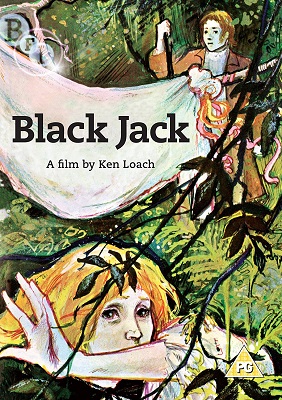

5 Comments

Moving pictures 2018, #1

I’ve no plans to give up writing about the films I’ve watched – and I still plan to chase completing the 1001 Movies You Must See Before You Die list 2013 edition, and to watch films from as many countries as I can. But I’m not intending to write another seventy of these posts in 2018 as I’m going to try and read more books this year.

The Salt of the Earth, Wim Wenders & Juliano Ribeiro Salgado (2014, France). I don’t know if I stuck this on my rental list because it was by Wim Wenders or because it was a documentary that looked interesting. But it certainly shouldn’t be confused with the excellent 1954 social drama about a strike at a US mine, whose title lacks the definite article. The Salt of the Earth is about photographer Sebastião Salgado. Born in Brazil, Salgado was originally an economist. While living and working in Paris, his wife bought him a camera. He began using it on his trips to other countries. Eventually, he gave up his career to focus on photography. His photographic work tends to stark black and white photographs of people in extreme situations – refugees, famine victims, war, workers at a vast open gold mine… It’s fascinating stuff, and Salgado’s work is both beautiful and harrowing, some of it perhaps too harrowing. Although Salgado has been exhibited all over the world, I’ve never seen any of his exhibitions – but then it’s only the last five or six that I’ve started visiting art museums, and I usually go to the modern art ones… but I did discover the work of Richard Mosse at one such. (Although this Christmas, I visited the David Collection‘s exhibition of Islamic Art, which was cool; and I liked their exhibition of paintings by Vilhelm Hammershøi (1864 – 1916).) Anyway, The Salt of the Earth is worth seeing.

Logan, James Mangold (2017, USA). Professor X says “fuck”! He says it a lot! I mean, okay, you expect that from Wolverine, but Professor X dropping the f-bomb is just weird. One day, someone will decide Logan is a post-superhero film, when in fact it’s just a straight-up superhero film, and if it does something new in MCU terms, I’m pretty sure the comics have covered similar ground many times in the past. Logan works as a limo driver, he is ageing and his powers are waning. He lives just over the border in Mexico, in an old industrial plant, where he and Caliban look after a doped-up Professor X. Who is doped-up because he had some sort of mental fit which killed a lot of people and they’re medicating him to prevent a re-occurrence. And then a woman turns up with a young girl in tow and begs for Wolverine’s help. It turns out Nasty Corp has tried to weaponise mutants by breeding kids with superpowers – come on, who wants to play in a universe in which scientists experiment on children? Are you sick? – and the girl is one of them, in fact she has Wolverine-like powers and is a pretty mean fighter to boot. So snarky cyborg enforcer, with private army at his back, and Mengele-like scientist played by Richard E Grant, go mano a mano against Logan, who has gone on the run with the Prof and the girl… And that’s about it. Yawn. It’s a chase movie, the baddies are tooled up, the good guys are either old or young but still not massively outmatched… It’s a definite improvement on the usual dreadful superhero films with their cartoon characters, who cause as much damage as the supervillains, and cartoon violence and cartoon morality. They don’t even have the saving grace of cartoon wit. It might well be that Logan is the superhero film growing up, but it’s got a long way to go yet.

The Sense of an Ending, Ritesh Batra (2017, UK). I read Julian Barnes’s novel of the same title during Bloodstock last year. I seem to remember it being a bit of a damp squib. A very nicely written novel, but it just sort of petered out, and its concerns were so trivial I really couldn’t care about any of its cast. And the same is, unsurprisingly, true for the film. Jim Broadbent plays a very Jim Broadbent character, who has his past rudely thrust in his face when he’s willed a diary by the mother of a woman he used to see when he was at university thirty-plus years earlier. Except he doesn’t have the diary. Because the woman, played by Charlotte Rampling, won’t give it to him. In fact, she tells him she destroyed it. So he stalks her, and discovers she has a mentally disabled son called Adrian… which is also the name of Broadbent’s best mate at school, who went on to marry Rampling after she and Broadbent drifted apart. Prompting a really shitty letter to them on his part. However, Adrian junior is not Rampling’s son, but her half-brother. And Broadbent sort of remembers an afternoon alone with Rampling’s mother… Yawn. We all confabulate, it’s a fact of life. It seemed a really feeble point to a story that didn’t appear to be going anywhere – no matter how well-acted, or -written, it was. Missable.

Suntan, Argyris Papadimitropoulos (2016, Greece). You know that story in The New Yorker that went viral the other week, and the writer ended up with a $1.2 million advance for her short story collection? There’s no logic behind why one thing goes viral and another doesn’t, although the story clearly described a situation many women had experienced. I’ve seen plenty of evidence of it happening on social media myself. It’s the same premise which drives Suntan. Kostis is hired as a doctor on a small holiday island. He keeps mostly to himself, but one day he treats a twenty-one-year-old female tourist, Anna, who flirts with him and invites him to the beach with her friends. So, after work, he heads down there, and sees Anna and her friends sunbathing nude or in skimpy outfits. They recognise him and he joins them… and over the space of several days, he spends his time after work hanging out with them. One evening, the two have sex on the beach. But then Anna disappears for several days, and when she returns Kostis is furious she left without telling him. She saw no reason to tell him, and is put off by his behaviour. He does the male thing, and stalks her. The film ends with a drunk Kostis, who has been fired from his job for his bad behaviour, kidnapping Anna… I have not watched much Greek cinema, only four films in fact, by Angelopoulos, Lanthimos, Tsangari and now Papadimitropoulos; but what I’ve seen has been very good. Recommended.

Your Name, Makoto Shinkai (2016, Japan). There’s no doubt Shinkai has produced some of the best feature-film anime to have come out of Japan this century – Your Name‘s home box office is only second for anime to Spirited Away (and Spirited Away holds the record for highest-grossing film in Japan). Mitsuha lives in a small town in central Japan. She has dreams about a boy in Tokyo. One day, she finds the words “Who are you?” written in her exercise book, and her friends remark on her weird behaviour the day before. It turns out she and the boy, Taki, have been swapping bodies. They help each other with other’s lives, communicating via notes or text messages they leave each other. Taki tries to track Mitsuha down, but all he has is a sketch of her town. He eventually discovers the town was destroyed by a meteorite, a piece of a passing comet, three years earlier. Their body-swapping time-slipped. So Taki tries to tell Mitsuha she must persuade the town to evacuate on that night… As you would expect from Shinkai, the animation in Your Name is gorgeous. It takes a moment before the story starts to pick up and it’s clear what’s going on – the viewer is initially just as confused as Mitsuha. But as the plot unfolds – as it’s clever how it works out – so you’re drawn into, first, the mystery, then the rush to warn Mitsuha, and, finally, the race to change the past. Good stuff. I suspect this may be an early runner for by top five of the year.

Star Wars VIII: The Last Jedi, Rian Johnson (2017, USA). So let’s talk about The Last Jedi. It is, I think, the dumbest of the Star Wars films yet, and that’s not an especially high bar to clear. It does some things well and it makes some interesting choices, but in its headlong rush to reset the universe back to what it was when the franchise kicked off, it runs a series of set-pieces which make zero sense either in relation to the world-building, the characters, or the warped physics that pertain in space opera movies. I liked that the Resistance is now run by women, older women, and I can’t help but wonder what the film might have looked like had Carrie Fisher completed filming. I liked Laura Dern’s character and I thought she was used well. But. Poe Dameron is not only a liability, he was pretty much responsible for the destruction of the Resistance. I realise the story template needed to have the Resistance reduced to a small band of heroes (which is a blatant retcon of the original trilogy, anyway; but never mind), but Dameron should have been booted out of the airlock after his first stupid stunt with the space bombers. (“I like him,” says General Organa… even though his dumb plan just resulted in the deaths of around 90% of the Resistance? Huh.) And… space bombers. WWII in space is one thing, but… space bombers. Bombs don’t fall in space… because there’s no gravity. It’s one thing to send a squadron of really slow spaceships on a suicidal mission – stupid, but it fits Dameron’s character and the Resistance’s clear military incompetence – but making them bombers is… Ugh. Next, there’s the central narrative of the film: the First Order’s big fuck off superstardestroyers are chasing the ragtag fugitive fleet of the Resistance… who can’t go very fast, only just fast enough to keep out of range of the First Order’s big fuck off superstardestroyers’s guns. I mean, really? Was that the best they could think up? Hugely powerful stardestroyers can’t catch up to a medical frigate? And they used to have a gun that could fire across the entire fucking galaxy in an instant? But now their superstardestroyers’ guns have an effective range of a few thousand kilometres? It’s such blatantly manufactured jeopardy, it feels like it’s treating the audience with contempt. Yes, yes, the General Organa blasted into space thing was silly, but made more sense within the universe than the space bombers did. On the other hand, I did like the sections set on Skellig Michael, and I thought the bit with the mirrors was especially good. Rey, in fact, makes a really good hero, much more so here than in The Force Awakens, where she seemed overwhelmed by the story. Kylo Ren, however, is still a petulant blank, whose characterisation and motivation bounce all over the place. (Having said that, the fight scene in the throne room was a proper bit of action sf cinema.) The Last Jedi also muffed its major villain – we don’t know where Snoke came from, and he dies without us learning. All that build-up for… zip. But then I still don’t understand how the First Order managed to pay for, build and staff a fleet of big fuck off superstardestroyers, while the actual government of the galaxy, the New Republic, ends up stuck with the pieces of crap it had when it destroyed the Death Star. That’s the big problem with this new Star Wars trilogy – it wants to go back to the plucky band of heroes versus the big bad empire, but it can’t plausibly get there within the lifetimes of its heroes. So the film-makers just went, ah fuck it, let’s have a new evil empire that’s more powerful than the Republic which defeated the old evil empire hiding out somewhere all along, just in case, you know, the old evil empire was defeated… Or something. And we’re supposed to swallow it. Can you imagine if the Fourth Reich turned up from nowhere in the 1970s, and it was better-equipped than the USA and USSR combined? Having said all that, lots of people have been finding positive things in The Last Jedi that were sadly lacking earlier Star Wars films. If we can just add intelligence to that list, then the next one might turn out alright…

1001 Movies You Must See Before You Die count: 895