It Doesn't Have To Be Right…

… it just has to sound plausible


1 Comment

Moving pictures 2018, #39

I should stop trying to explain my choices in film-watching. It is what it is. Yes, mostly obscure movies, but there’s also the occasional crowd-pleaser, and a classic or two…
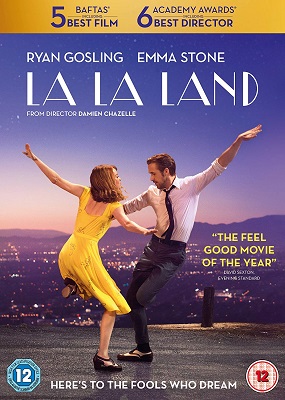
La La Land, Damien Chazelle (2016, USA). I’m not a big fan of musicals and, aside from half a dozen Busby Berkley films, the only ones I really like are High Society, Les Girls and Gentlemen Prefer Blondes. On the other hand, I did watch Seven Brides for Seven Brothers recently and was surprised to find myself enjoying it… Anyway, La La Land, a musical, surprised everyone by winning shedloads of awards a couple of years ago, although Hollywood movies about making movies in Hollywood, musical or otherwise, always seem to do well at awards time. The film follows aspiring actress Emma Stone and jazz pianist Ryan Gosling as they each try to make a success of their chosen careers, which, naturally, involves doing things they don’t want to do simply in order to put food on the table – well, in Gosling’s case it means joining a successful jazz fusion band. The musical numbers are completely forgettable, and even the flights of fancy, despite their Technicolor palette, aren’t that interesting. In fact, the only interesting thing about the film is the bittersweet ending, in which the two split up and are subsequently successful. I have no idea why this film won all the awards it won.
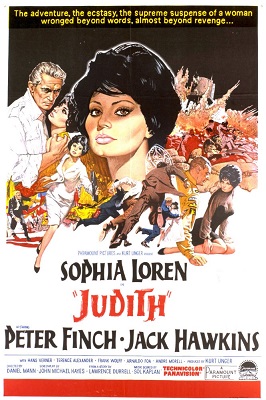
Judith, Daniel Mann (1966, Israel). Lawrence Durrell was not well served by the film industry. The first book of the Alexandria Quartet was adapted as Justine by George Cukor, but it was a financial and critical flop (it had been Joseph Strick’s project but he fell foul of the studio, and they replaced him with Cukor). This is not necessarily a bad thing, as Durrell’s novels would be very difficult to adapt – not that this has prevented Hollywood before with other properties. However, Durrell did provide a story for a movie made by the Israeli film industry, Judith. It was also turned into a novel, which remained unpublished until a couple of years ago. I’ve yet to read it. The story is set in Palestine, just before Israel’s unilateral declaration of statehood. The Jews are worried about the Syrians massing on the border, and have information that a tactical genius Wehrmacht tank commander is now working for the Arabs. But no one knows what he looks like. So they smuggle Sophia Loren into Palestine, since she was married to him and can identify him. But Loren doesn’t fit into the kibbutz where she’s pretending to be a member, arousing the suspicions of the other kibbutz members and the British authorities. Given the way Hollywood framed her career, it’s easy to forget that Loren was a bloody good dramatic actress, streets ahead of her contemporaries also imported from Europe. This is the second early Israeli film I’ve watched this year, and the second whose plot is based around the country’s creation. In this one, however, the threats are chiefly external, although it’s clear there’s an internal organisation more than qualified to investigate and, if necessary, prevent. Perhaps the scenes at the kibbutz tend to reinforce the popular, and hugely incorrect, image of hardy settlers building a homeland in an inhospitable wilderness, but the thriller elements of the story at least show that Palestine was a country under occupation – except, of course, it wasn’t the Jews that were being occupied (although they were certainly the most policed by the British). I’ve yet to read Durrell’s novel – but from the Alexandria Quartet alone, it’s clear where his sympathies lay – but on the whole I’d have to say I thought Hill 24 Doesn’t Answer (see here) the better film.
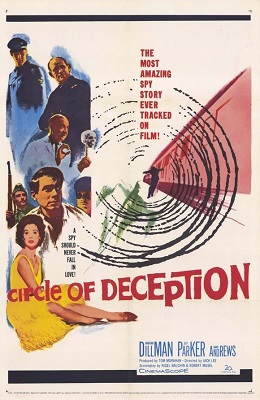
Circle of Deception, Jack Lee (1960, UK). And from watching a film because of the writer who provided the story to watching a movie because of its star. Which I don’t do very often. But Suzy Parker made only a handful of films, and she’s the best thing in them. Most people will probably remember Cary Grant and Jayne Mansfield in Kiss Them for Me, but Parker played the female lead. The Best of Everything is a superior 1950s film, and Parker is better than her fellow leads, Hope Lange and Diane Baker, although not as good as Joan Crawford… Anyway, Circle of Deception is a hard-to-find British film set during WWII starring Suzy Parker, who plays a Brit… and I think it’s her voice, although she was dubbed by Deborah Kerr in Kiss Them for Me, and her accent is pretty much spot-on for much of the film, although it does occasionally drift (which is what persuades me it’s her own voice). Anyway, Parker is the assistant of military intelligence captain Harry Andrews. They need to feed disinformation to the Germans, so they decide to parachute into France someone they know will break under interrogation. They feed their patsy – played by Bradford Dillman – with misinformation, then shop him to the Nazis. Everything goes as planned. Well, except for Parker falling for Dillman during his training. But she remains professional, and sends him off to his doom. The film actually opens several years after the war has ended, when Parker wants to track down Dillman and apologise to him. He’s now living in Morocco, and still suffers after his war experiences. There’s a nasty thread of expediency running through the film, which is I guess the whole point of it, and while both Andrews and Parker are good in their roles, Dillman struggles to keep up. Circle of Deception is an interesting, if minor, British WWII drama, but I suspect its story was seen as more shocking in the decades before 9/11 and Gitmo and extraordinary rendition.
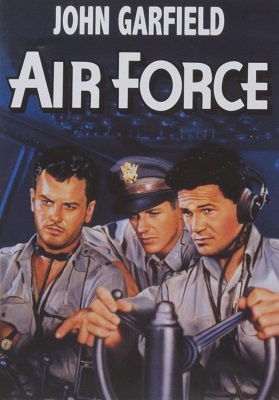
Air Force, Howard Hawks (1943, USA). I don’t know why Hawks didn’t serve during WWII – he was 45 in 1941, was that considered too old for combat duty? – although he did apparently serve as a flying instructor during WWI. Anyway, he spent the war years doing what he had been doing before the war: making films. Five between 1941 and 1946. Three of which were explicitly military: Sergeant York in 1941 (which is actually about WWI; see here), and Air Force and Corvette K-225 in 1943 (see here). Air Force – it was, of course, the Army Air Corps at the time – is about the crew of a B-17 in the Pacific theatre. It’s apparently based on a true story. A crew are ferrying a B-17 from San Francisco to Hawaii when they get caught up in the Japanese attack on Pearl Harbour. Pretty much all the external shots of the B-17 are model work, and not entirely convincing model work either. And the scenes set inside the Flying Fortress… well, I had thought the aircraft’s interior much more… utilitarian than is shown. I like feature films set on and about military aircraft – Strategic Air Command is one of my favourites – but nothing in Air Force felt especially convincing. Which is ironic, given it’s a true story. There are a couple of interesting scenes featuring state of the art computing in 1943, and the film features all of Hawks’s trademark dramatic elements… But it’s a minor work in his oeuvre, and probably only worth seeing for completeness’s sake.

Cute Girl, Hou Hsiao-Hsien (1980, Taiwan). Hou has said that he doesn’t consider his film-making career to have really begun until his third feature, The Boys from Fengkuei (see here), which makes you wonder why eureka! chose to include his two earlier films, Cute Girl and The Green Green Grass of Home, in this new Early Hou Hsiao-Hsien blu-ray box set. Especially since both Cute Girl and The Green Green Grass of Home are really just vehicles for Taiwanese pop star Kenny Bee, and actually not very good films. With extremely annoying soundtracks. The signature pop song from Cute Girl ended up stuck in my head for at least a week after watching the film. The plot is some rom com gubbins about a wealthy young woman who falls for a penniless young man (Bee) who pursues her relentlessly. There are, I seem to recall, a couple of good set-pieces, but the whole thing is so lightweight it’s a wonder it doesn’t blow away. And that fucking annoying song… Hou is a brilliant director but I can understand why he’d sooner this film was quietly forgotten.
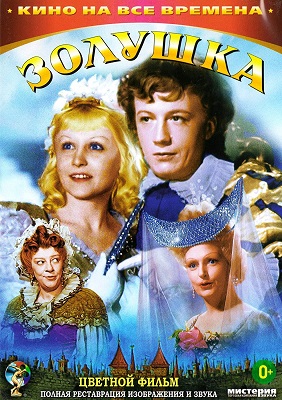
Cinderella, Nadezhda Kosheverova & Mikhail Shapiro (1947, Russia). I found this one Amazon Prime, and thought it worth watching. Which it was. In an odd sort of way. It’s a musical and, strangely enough, Soviet musicals in the 1940s were not much like, say, Meet Me in St Louis (1944, see here). So the songs weren’t exactly memorable, or exactly a pleasure to listen to. But the plot pretty much follows Charles Perrault’s version, although it’s explicitly set in a magical kingdom. But otherwise, it all goes down just like the pantomime. What was interesting, however, was the mise en scène, in which the setting resembled some sort of toy town, with overtly designed scenery that gave the whole film a fairy tale atmosphere. The colourful costumes did the same. Some the choreography was quite balletic, and the big set-pieces were effectively staged, but it was definitely the set design where the chief appeal lay. Worth seeing.

1001 Movies You Must See Before You Die count: 923


1 Comment

Moving pictures 2018, #38

Bit of a UK-fest this time around. Which is just how it sort of fell out. The one US film is a Roger Corman-produced rip-off of Alien. He made two – one I like very much, but this one was absolutely terrible. Oh well.

Wild Reeds*, André Téchiné (1994, France). One topic I’m pretty much cold to in both literature and film is “the sensitive passage into adulthood and the awakening of sexuality”, as Wikipedia describes this film. Basically, it translates as late teens or early twentysomethings acting like arseholes, and then stopping as it slowly occurs to them that they’ve been behaving like arseholes. And the “awakening of sexuality” bit often involves a great deal of sexism, as said teens suddenly discover that the people they’ve been treating as human beings are female and so society (ie, the patriarchy) tells them they shouldn’t actually be treated like human beings. Which is not say this film does either of these, because I don’t much recall what actually did happen as it was all rather dull. The action take places around the time of the end of the Algerian War, and one of the four youths the film focuses on was born in Algeria. Another is gay, but is treated badly by the others. I watched Wild Reeds because it’s on the 1001 Movies You Must See Before You Die list, but I can’t say anything in it especially grabbed me or persuaded me it belonged on the list. Meh.

Denial, Mick Jackson (2016, UK). I had a conversation with someone about David Irving at Fantastika in Stockholm last month, and then this film popped up on Amazon Prime… Not that I took it at face value. I read up on Irving on Wikipedia as I watched the film. Anyway, Irving is a piece of shit Hitler apologist who has had several of his books on the subject challenged – and in one case withdrawn after publication – who decided to sue a US academic, Deborah Lipstadt, whose area of study is the Holocaust, after she accused him of being a Holocaust denier. He sued her for libel in the UK, which has antiquated libel laws which were designed to protect the names of established shitbags rather than arrive at a truthful verdict. In order to win her case, Lipstadt had to prove that Irving had knowingly lied in presenting his thesis. Which her legal team did. So Irving lost. He probably still hasn’t paid off what he owes and the court case took place in 1996. For the record, the Holocaust happened, Irving is a Holocaust denier and his bending of history to serve a right-wing agenda makes him a piece of shit. The film presents the story relatively straightforward, although it does tend to minimise the timescale of events. I also suspect Timothy Spall plays Irving as more of a charmer than the real article, although he certainly manages to convey oleaginous arrogance. If the film has one flaw, it does feel a bit as though Lipstadt and her legal team are all paragons of humanity, and while their motives may have been pure in real life, the film does make it seem a little too good. But a good, entertaining film about an important event, and worth seeing.

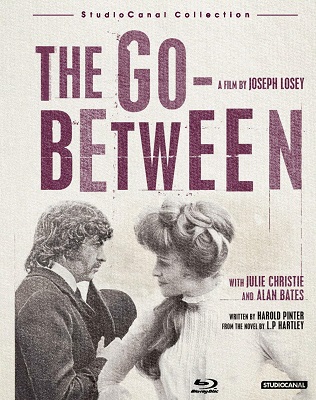
The Go-Between, Joseph Losey (1971, UK). I have one of LP Hartley’s novels on the TBR – actually, it might be an omnibus of a trilogy of his. But his best-known work, The Go-Between, isn’t it, or one of them, er, which ever it is. The story of The Go-Between is set in 1900, although confusingly it’s mostly flashback from, I think, the novel’s date, around 1950, so every now and again cars appear on the screen, which seems odd in something that it mostly seems to predate DH Lawrence… And it’s DH Lawrence it mostly seems to want to be, with the nubile daughter of minor gentry, Julie Christie, engaging in no-commitment rumpy-pumpy with hunky farmer, Alan Bates, on the side. And it’s almost as if the two leads were cast because of their connection to Lawrence adaptations – Bates in Women in Love, a great novel and a great film, and Christie in, er, well, no Lawrence adaptations, although she was the female lead in Dr Zhivago. Anyway. The title refers to a young boy, a school friend of the family’s youngest, who has been invited to spend their summer in their stately home. He ends up carrying messages between Bates and Christie, because he has a schoolboy crush on Christie, not realising he is enabling their affair. And when he finds out, he reacts badly. The Go-Between is the third film Losey made with playwright Harold Pinter and, like the other two, class plays an important part, although it feels in the film like the shadow of something that occupies more of the narrative of the source novel (I’m guessing as I’ve not read it). Apart from the obvious class difference between Christie and Bates, and a series of events which position the title character as lower class than Christie’s family, there’s not actually all that much there as commentary on class. Losey and Pinter’s The Servant was much more effective. Which is not to say The Go-Between was a bad film. It’s very good, it just strike me a bit as Lawrence-lite and I have to wonder if Ken Russell might have made a better fist of it…

Tomb Raider, Roar Uthaug (2018, UK). I remember when the Tomb Raider game was released – a friend of mine at the time was a big fan of it. And it seemed unremarkable that a film adaptation be then made of the property. But twenty years later, and you have to wonder why someone felt a reboot was needed. In the first version of the franchise, Brit Lara Croft and her father were both played by Americans – father and daughter too, as it happens – and they made a pretty good fist of it. In this new version, they’re played by… a Swede and a Brit. Who are unrelated. Although, to be fair, Alicia Vikander, does a good job as Lara. Dominic West, who I always get confused with Dougray Scott, plays her father. The film opens with Lara getting a pasting in a boxing-ring. It then quickly establishes that she is highly-educated, has no money, and works as a bicycle courier… because her father disappeared seven years earlier and she refuses to admit he is dead and so cannot touch his fortune until she does so. He disappeared on a trip to a mysterious island in the sea of Japan where an ancient evil Japanese queen’s tomb allegedly can be found. And its fabulous treasure. Lara is eventually persuaded to sign the papers declaring her father dead, but before she does so the solicitor gives her an envelope only to be opened after his death. A cryptic phrase on a piece of paper sends her back to the family estate – papers unsigned, of course – where she finds her father’s secret laboratory. The second act is Lara following her father’s research to the island… which she finds far too easily. Only to be shipwrecked after a violent storm. And then she discovers there is a secret organisation dedicated to ripping off mysterious ancient artefacts with special powers to advance their agenda of world domination. Or something. Anyway, they take Lara prisoner, she escapes, they break into the tomb, she helps them through its various traps, they discover the secret of the ancient Japanese queen, but she manages  to stop the baddies from profiting from it. Oh, and she finds her father, and he’s still alive. Albeit not for long… I enjoyed this more than I expected, to be honest. Vikander is good in the title role, and the excessive CGI is only mildly annoying. The risible plot is redeemed by an opening that actually feels like it’s set in the real world, although the introduction of the vast Croft wealth knocks it off track. And the conspiracy aspect has its moments, although it does feel like a feeble copy of Assassin’s Creed. I’ve still no idea why someone felt a reboot was required – has the game been revamped or something? – and while the original movie at least felt like a part of the moment back then, this one now smells not so much like it missed the boat as it is in actual search of a boat in the first place. But I sort of enjoyed it.

Forbidden World, Allan Holzman (1982, USA). Roger Corman’s New World Pictures was known for a number of things, and one of them was ripping off successful genre properties with low-budget straight-to-video (as was) releases. Ridley Scott’s Alien inspired two such rip-offs – Galaxy of Terror, which is actually not bad; and this one, the considerably more risqué, and considerably inferior, Forbidden World. Which opens with a robot waking its captain as their spaceship is under attack by marauders, who have nothing to do with the plot but do allow Holzman to re-use some model shots from, I think, Battle Beyond the Stars. After seeing them off, the hero lands on the planet of Xarbia, which is the location of a secret biological laboratory base. Which has accidentally managed to create a monster. Which then grows and kills everyone off, one by one. And, er, that’s it. Well, that and the gratuitous nudity. Like when one of the base’s young female staff members decides that what she really needs, despite all the carnage, is a naked sauna… The monster, when it’s eventually revealed, is not at all convincing, looking like it belongs in a much worse film. I’m told the soundtrack is held in high regard, but then it’s the only thing in the film that is at all original. Galaxy of Terror was a rip-off of Alien, but it did something very science-fictional with its premise. Forbidden World doesn’t. There’s some scientific bollocks intended to justify its plot, but it’s substandard writing. New World Pictures produced the odd gem during its time, but this isn’t one of them.

Genius Party/Genius Party Beyond, various (2007/2008, Japan). This is a pair of anthology anime films by various hands, put together chiefly, I think, as a portfolio for a newly-launched animation studio in Japan. Obviously, it was recommended by David Tallerman. There are seven short anime films in Genius Party and five in Genius Party Beyond. None are especially typical of Japanese anime – one, on fact, reminded me of the work of Jodorowsky and Moebius more than anything else. A lot of it is just plain weird. There’s an excellent one on Genius Party Beyond with a Juno Reactor soundtrack, which is probably the best of the lot. The problem, however, is that both films feel like what they are: over-extended showreels. It’s good stuff – excellent animation and some really inventive design… but it’s the sort of thing that works better in 5-minute segments rather than 20-minute segments. Especially since the stories of many of the segments feel like they’re stretched well past their natural length. On the other hand, both films are a showcase of inventive animation and, stories aside, demonstrate that very well. I don’t think either are necessarily for fans of anime, more for people interested in animation and its various forms.

1001 Movies You Must See Before You Die count: 923


1 Comment

Moving pictures 2018, #37

This is what my film watching looks like pretty much – one in six films is from the US. That’s not one in six is Anglophone, as the Israeli film is mostly in English, and One Way was entirely in English as it was set in the US. But there are two excellent Chinese films.

Zhou Yu’s Train, Sun Zhou (2002, China). A woman is on a train between Chongyang and Sanming. She is carrying a vase. A man asks her about it and she admits she made it. He insists on buying it, but she refuses. He introduces himself, he is a vet (a man collapsed earlier on the train and he denied being a doctor because a doctor of human medicine would have been preferable). The woman is on her way to visit her lover in Sanming, a poet. The film follows the woman, and her encounters with the vet and the poet, and that of another woman, played by the same actress, Gong Li. But the narrative is cut up and presented non-chronologically, which means it’s often a bit of a puzzle trying to figure out what’s going on, especially when the same actress plays the two female leads. It all looks great, and the cast are excellent. I’m reminded of Wong Kar-Wai’s films, especially In the Mood for Love and 2046, although without the arthouse cinematography, just the unadorned faux-documentary style used by Sixth Generation directors. I liked this film, but it really needed a rewatch. I’ll have to try and arrange one.

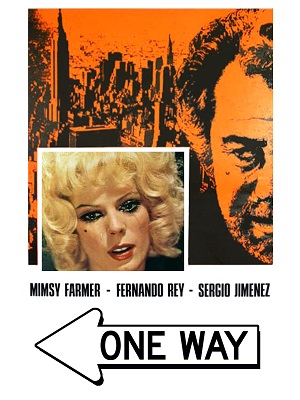
One Way, Jorge Darnell (1973, Mexico). The blurb for this film on Amazon Prime explains it is about an illegal immigrant in the US and declares it is still relevant today. In other words, the US is just as racist as it was in 1973. Probably more so. Although not as bad as the 1960s, when it practiced segregation and lynching. We’re no paragons of virtue here in the UK, but when it comes to racism the US is definitely a world-leader. And this forty-five year old film is ample proof. A farmer from Mexico moves to New York, illegally it must be said, but when someone gives me a good logical reason for secure borders then I’ll start believing “illegal immigration” is a thing. He finds himself subject to racism, but he can’t do anything because he’s there illegally. In one scene, he’s beaten up by drunk Americans at the bowling alley where he works restacking pins. In order to stay in the US, the farmer gets in deeper with criminals, as situation not helped by his desire – reciprocated – for the gangster’s girlfriend (I think she was his girlfriend). Unsurprisingly, it’s all about hiding from the authorities and so being driven into the arms of criminals, which only feeds into the myths surrounding illegal immigration in the first place. It’s like junkie culture – decriminalise drugs and there’s no reason for junkie culture to exist. Welcome immigrants, streamline them into becoming members of society and there’s nothing there for criminals. But then, there’s always the racism. That’ll remain as long as the establishment condones, and practices, it, and until there are real consequences for being a racist arsehole.

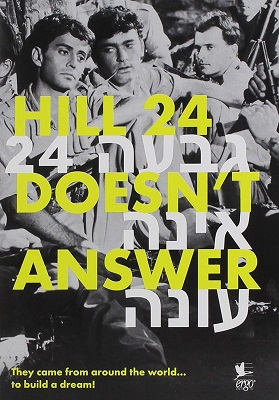
Hill 24 Doesn’t Answer*, Thorold Dickinson (1955, Israel). According to the Wikipedia page, the plot of this film “revolves around the personal stories of a number of soldiers who are on their way to defend a strategic hill overlooking the road to Jerusalem”, which is true but completely misses the point of the film. It is also Israel’s first home-produced feature film. Edward Mulhare plays an Irishman in the British occupying forces, who returns after Israel’s unilateral declaration of independence (the film says it was “sanctioned” by the UN, but that word has two meanings and the film is clearly hoping one will prevail). Anyway, Mulhare fancies a Jewish settler, and returns to help her in the fight for Israel. The problem with any film about the early days of Israel is framing their enemy. Who were they fighting? The Palestinians they had displaced? The British who had already left? That there was fighting is beyond doubt. Parts of Palestine were mandated to the Jews by the UN, the rest was won by blood. And what they were mandated was defended with blood. Let’s be fair here – the Israeli state has a right to exist, but so does the Palestinian one. And when you have two nations sharing the same territory, what do you do? China Miéville’s solution in The City & the City is obviously untenable, but neither can you privilege one group over the other as both have legitimate claims – after the fact, if not before. Making Jerusalem an international city is a step in the right direction, but hardliners will block that, and have. Wars are not going to resolve anything, especially when one side is funded by the US. But I’m not about to solve the Israeli-Palestinian problem as it requires someone with bigger guns than me. As early Israeli film culture goes, this isn’t too bad – the Arabs are mostly treated fairly, as are surprisingly the British. The latter are the architect of Israel’s woes, that much is made clear, through their repressive control of the region after WWII. But they’re not demonised. The main focus seems to be on the burgeoning romance between Mulhare and Israeli lead Margalit Oved. It’s a film that deserves to be better known, even if it doesn’t fit the current narrative about Israel. It’s home-grown, it makes a good fist of its story, and any challenges it might make to the current narrative are welcome.

2036 Origin Unknown, Hasraf Dulull (2018, USA). Sometimes you can find hidden gems among independent sf films, and with the sophistication of present-day CGI they can look every bit as good as big studio sf films. But without the zillion-dollar budgets, something has to give… and it’s usually either location or cast. This film takes place almost entirely in a single room, so that it’s not that one. And while Katee Sackhoff is a good actress and reasonably well-known, I should think her price-tag is pretty modest. Plus, the entire cast of 2036 Origin Unknown is single figures. A mission to Mars crashes mysteriously on landing. Years later, Sackhoff, on her own, is running an AI-controlled follow-up robot mission to investigate that crash. They discover a huge cube covered in alien carvings. It vanishes. And reappears in Antarctica. They trick it into returning to Mars. It is apparently some sort of instantaneous interplanetary or interstellar vessel. Some point during all this, the AI – which was put in charge over Sackhoff’s objections – decides to exterminate all life on Earth. Oh, and Sackhoff’s father died in that original Mars mission, so she has an emotional stake in the investigation. Sackhoff tries gamely to carry the film, but the plot has too many ludicrous moments and slowly unravels under the weight of ambitions it can’t meet. It’s a sight more original than many other independent sf films I’ve seen, but even original ideas need to be rigorously worked through.  Meh.

Part-Time Spy, Kim Deok-su (2017, South Korea). Gang Ye-Won is 35 and has spent most of her adult life trying to get a job with the Korean civil service, occupying a wide range of positions before she finally lands a job. In a state intelligence department. But then her boss is phished for $500,000 and he tasks her, secretly, with recovering the money. But the company responsible for the fraud – a call-centre that runs a number of phishing scams – has also been infiltrated by an undercover police agent. So this is basically a buddy movie, where the buddies came together through circumstance rather than choice, and the drama comes out of their interactions. Because neither has much time for the other. Gang is an accident-prone nerd but proves to have a gift for talking punters out of their hard-earned cash, and so gets in with the senior management. The undercover police officer, Han Chae-Ah, is skilled at unarmed combat, a maverick and arrogant. But, of course, they learn to like each other and work together to bring down the evil mastermind behind the phishing scam, not to mention Gang’s inept boss who lost the money in the first place. The comedy is broad, and the fight scenes aren’t that good… but then it would be churlish complain about a female buddy movie that actually has fight scenes. Entertaining. And it makes a good point about the human cost of phishing too.

Here, Then, Mao Mao (2012, China). I seem to remembering stumbling across this one on Cinema Paradiso’s website. Certainly the director is not a name I knew, and I’ve been exploring the oeuvres of both Fifth and Sixth Generation Chinese directors. But I like modern Chinese cinema – both the commercial films and the film festival ones, although the latter much more than the former. Here, Then, Mao’s debut feature, not only does the things I like about Sixth Generation films, but also the things I like about cinema from other countries. It tells a story about a group of twentysomethings in a provincial town, using the sort of faux-documentary style, with minimal dialogue, used by Sixth Generation directors. But it also uses long, often static, takes, and equally often pulled back so that the action takes place only in a small area at the centre of the screen. There are other tricks in there too – in one scene, two young women waiting for a bus dance to music, and the camera zooms in toward one until she is staring out of the screen, suggesting she is breaking the fourth wall. Characters move in and out of focus as the dynamic changes in other scenes. It’s a polished debut, displaying a facility with cinematic language unusual in a first film. I’d like to see it again, so I guess I’m going to have to pick up a copy. I suspect it might make my top five by the end of the year, although it has stiff competition. Highly recommended.

1001 Movies You Must See Before You Die count: 922


Leave a comment

Moving pictures 2018, #36

Managed to knock three films off 1001 Movies You Must See Before You Die list, and they weren’t bad films either.

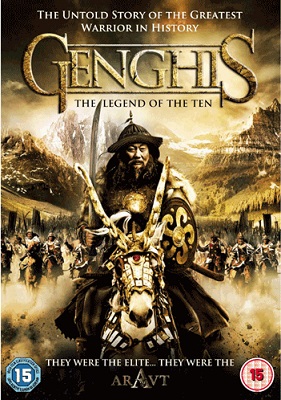
Genghis: The Legend of the Ten, Zolbayar Dorj & U Shagdarsuren (2012, Mongolia). I found this on Amazon Prime. Incidentally, when I refer to Amazon Prime, I mean the free movies it offers… and it’s an odd mix: straight-to-video crap, poor transfers of early twentieth-century films, occasional blockbusters available for a limited time, forgotten films from the seventies and eighties and nineties… and some very recent films from further afield, such as the Chinese and Taiwanese films mentioned in previous Moving picture posts, and like this Mongolian historical epic and the Russian comedy below. Genghis: The Legend of the Ten is the sort of nonsense title given to foreign movies for the US market. The actual title is Aravt, which is the term for the groups of ten into which the Mongol warriors of Genghis Khan’s time would organise themselves, as helpfully explained by an opening voiceover. The movie is about one such aravt, or group of ten. It is, unsurprisingly, historically accurate – as far as my limited knowledge can tell, but this is no Hollywood re-imagining of history. It’s also quite brutal. The battle scenes are well-staged, but the back-stabbing does get a bit complicated in places. It’s a polished piece of work, and if Mongolia has to mine the better-known elements of its history to make foreign currency, then they did a good job with this and I wish them the best of luck in their industry. It’s only the second Mongolian film I’ve seen – the other was Joy, and it did not live up to its title (see here) – but both are very good. A cinema to keep an eye on, so to speak.

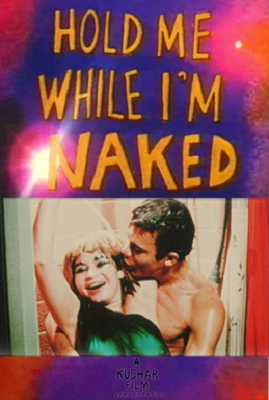
Hold Me While I’m Naked*, George Kuchar (1966, USA). I’d not realised until I started watching this that it was a short, only 15 minutes long. Kuchar was an underground film-maker in New York and San Francisco, active from the late 1950s through until his death in 2011. He made over 200 films, including video diaries. Hold Me While I’m Naked is generally reckoned to be the best of them – certainly it was the only one to appear in the Village Voice’s Critics’ Poll of the 100 best films of the twentieth century. I’m not sure I understand the appeal. There’s a distinct Woody Allen-ish tone to the piece, not helped by Kuchar’s voiceover with its NY accent, and I loathe Woody Allen’s films. The whole thing is resolutely cheap, shot on 16 mm in real locations, with much of the “story” (and I use the term loosely) carried by Kuchar’s voiceover lament in which he complains about his two stars as they perform a steamy shower scene for him (it’s implied the scene is for another film, but it’s not of course; it only only appears in this film). As a commentary on film-making, the meta-narrative is quite effective but seems naive to modern eyes , and it’s hard to see how it could have been all that innovative in 1966 given that Modernism had been around for half a century.

Gun Crazy*, Joseph H Lewis (1950, USA). From the title and poster, I had thought this was a cowboy film, although a closer look at the poster would have clearly shown it was a gangster film. Except it isn’t that either. A boy is fascinated with guns, steals one from a store, is caught and sent to reform school. Later he joins the army. The story picks up after he’s left the army. He’s now a crack shot and, at a travelling fair, takes up a challenge to a shootout against the fair’s resident trick shooter. He wins. The fair owner offers him a job, and he teams up with the trick shooter. They also enter into a relationship (it’s her on the poster). But she’s a bad sort and persuades him to help her rob stores and banks. They go on a Bonnie and Clyde style crime spree. The film is presented all very matter-of-fact, and I especially liked the back-seat camera during the car chases – I’d not seen that used before, and I don’t recall any films using it since. For a film of its time and type, it was a superior example, but I don’t know if that’s enough to warrant a spot on the 1001 Movies You Must See Before You Die list. It wasn’t noir, more like a 1950s spin on a 1930s gangster movie, much like The Phenix City Story, although without the latter’s true story to fall back on. Worth seeing, but not one, I suspect, that belongs on the list.

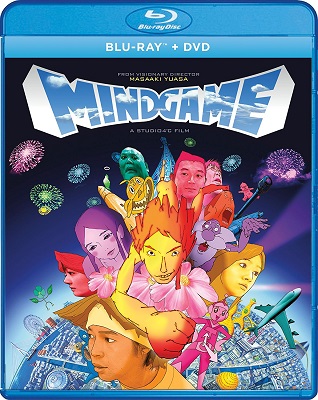
Mind Game, Masaaki Yuasa (2004, Japan). When this dropped through the letterbox from Cinema Paradiso, I should have guessed it had been recommended by David Tallerman. Not just because it’s anime, but because it’s weird anime. And, to be honest, a week or two after I watched it, I can remember almost nothing of it. Reading the plot summary on Wikipedia doesn’t help, because all I can remember is a really unappealing style of animation, realistic and so not the exaggerated features of much anime, but sketchily drawn. I remember a section set inside a whale, and some of the film took place inside a moving vehicle, but I’m otherwise completely blank. In such cases, I normally watch the film again before writing about it in a Moving pictures post, but this was a rental and I sent it back before I could rewatch it. I wanted to get the DVDs set back before I left for Sweden, so I put them in my bag to post at the railway station… but couldn’t find a post box… or at Manchester Airport… but couldn’t find a post box… and so ended up carrying them to Sweden and back, and posting them in the post box opposite my house the day after I got home. Sigh. Not that it made any difference as I wouldn’t have been able to watch and return any new DVDs before the weekend anyway. None of which is especially relevant, and I suspect I will have to watch this film again although what I do remember of it doesn’t exactly tempt me to do so. Oh well.

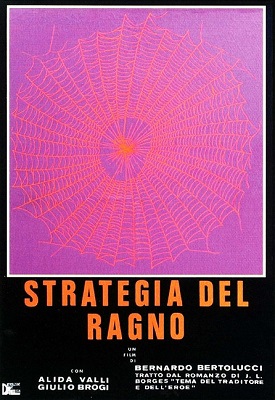
The Spider’s Stratagem*, Bernardo Bertolucci (1970, Italy). When you look at non-Anglophone directors, and which particular films from their oeuvres are available on UK sell-through DVDs or Blu-rays… not including films they might have made for Anglophone studios such as, in Bertolucci’s case, Last Tango in Paris, The Sheltering Sky and The Last Emperor… especially a director as highly-regarded as Bertolucci… Well, besides the aforementioned three, there’s Before the Revolution, The Conformist and 1900, although not a couple of English-language international co-productions, Stealing Beauty and Little Buddha (both currently deleted)… And certainly not The Spider’s Stratagem, the third of four films by Bertolucci to make the 1001 Movies You Must See Before You Die list (and the other three are readily available). Why is this? If those other films have found a market, then surely this one would. These days, however, it could be some streaming service hanging on to the rights in order to attract customers. For £9.99 a month, you can have access to the exclusive library of films they’ve managed to prevent being made available on sell-through… I know of a film from 1966 that’s never been released on DVD or Blu-ray, but a restored version is available from a streaming service. Anyway, that’s all by the bye. In this film, a young man returns to his hometown, where his father died a hero of the resistance. But as he asks people about what they remember of his father, so he hears different stories, and eventually realises his father had bottled out of his plan to assassinate Mussolini on his visit to the town and informed on himself to the authorities. But, the son comes to realise, the town needs its hero, so he says nothing, and so is caught up in the mythology they have created around his father. There are half a dozen or so world-class Italian directors, and I’ve watched films by all of them: Bertolucci, Fellini, Rossellini, De Sica, Visconti, Pasolini, … but I’m not sure I could call one out above the others. I love Fellini at his most self-indulgent, I’m a big fan of Pasolini, and both Visconti and De Sica made some excellent dramas… Rossellini never really worked for me, and Bertolucci I find too variable to admire that much – I loved The Sheltering Sky but Last Tango in Paris was awful. I think I’m starting to like Bertolucci’s films more, and I did like this one, but I’m not there yet.

O Lucky Man!, Edouard Parri (2017, Russia). This is not the Malcolm McDowell British film, obviously, which I have not seen and so cannot compare. It is instead a polished piece of Russian action/comedy/drama about a young man who is talked back from jumping off a bridge by a mysterious camp couple, who tell him they can give him the life he feels he deserves. Which they do. He is hired into some ill-defined high management position at a prestigious company the next day. He has a platinum credit card to use. But things start to go wrong, and when his fairy godfathers (a reference only to their role) try to fix things, it ends up worse. So when he misses an important business meeting and is fired, they arrange for him to save a woman from a pair of violent muggers and become a popular hero. Only it then turns out the woman had just ripped off a gangster and the muggers were his enforcers. And now he wants his money back. Then a British secret service agent, in an Aston Martin, turns up, and it’s a bit weird having James Bond speak Russian but there you go. I enjoyed this. It was a pretty obvious comedy, but it rang a few small changes, and I can’t say if they’re down to the Russian worldview or the scriptwriter, but it was enough to make it different. Even the spoof 007 was fun.

1001 Movies You Must see Before You Die count: 921


2 Comments

Moving pictures 2018, #35

A good mix, nothing too populist, but instead some good films from a number of different countries… Well, okay, maybe not all of them are that good…

Caravaggio*, Derek Jarman (1986, UK). That’s the last of the Derek Jarman box set and it’s a film I first saw many years ago – not at school, as it was released two years after I sat my A Levels, but perhaps when I was a university student. I don’t remember, I just remember the film itself… and this rewatch did not in that respect provide any surprises. There were a few scenes I had forgotten, but much of the film had remained in memory. Which I guess means something. Jarman’s use of deliberately anachronistic set dressing I’d certainly remembered, so the appearance of trucks and such in some scenes did not seem as shocking as perhaps intended. Which is not to say they did not perform their purpose – perhaps even more so, because the shock value no longer applied, I could see them for what they were. Which was elements of an idiosyncratic retelling of the life of Michelangelo da Caravaggio, which used his paintings – or those that have survived – as inspiration to document parts of his life. The  title role is played by Nigel Terry, who has never been better, but there are plenty of other familiar faces in there. Also in the cast is Sean Bean, in his first major role, as is Tilda Swinton, whom he snogs. Which was weird. The film is mostly told from Caravaggio’s death-bed, using it to jump back to incidents in his life. It works as well inasmuch as it allows for commentary. The film’s aesthetic, anachronisms and all, I thought especially effective, and I ended up liking the film more than I had expected. I bought this box set on a whim, and because I’d not seen Jubilee but some recent watches on Jarman’s films had persuaded me it might be worth a punt. And it was indeed. It’s even turned me into a sort of fan of Jarman’s films, which I wasn’t before. I’m now eagerly awaiting the Volume 2 box set.

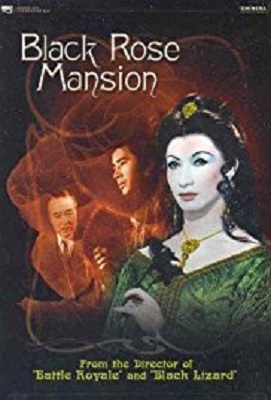
Black Rose Mansion, Kinji Fukasaku (1969, Japan). Fukasaku, who is best known these days for his film of Battle Royale, made two films with famous Japanese female impersonator Akihiro Miwa (AKA Akihiro Maruyama) – this one and Kurotokage (see here). Having seen both, I can definitely say Kurotokage is the better of the two. Which is not to say Black Rose Mansion, AKA Kuro bara no yakata, is bad. It has its moments. Miwa plays the mysterious singer in the titular roadhouse. Not only is Ryuko’s past a mystery, but it also seems wildly inconsistent, as a series of men turn up claiming to be her lover and she refuses to admit whether she had affairs with them. It is, to be honest, all a little over the top, especially given that some of them profess their undying love by killing themselves and the deaths are presented with all the technicolor relish of B-movies. The whole thing began to pall after a while, it must be said, given that Miwa’s character remained stubbornly mute on her past and the parade of past lovers didn’t seem to prove anything. If you must watch a camp 1960s Japanese thriller, then I’d recommend Kurotokage over this one.

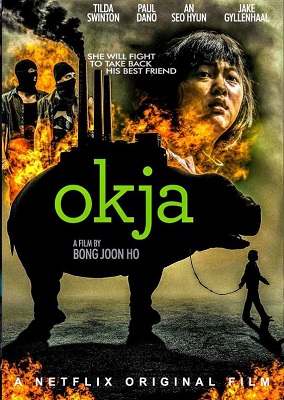
Okja, Bong Joon-ho (2017, South Korea). This was recommended by a number of friends, both those who watch Korean cinema and those who don’t. And having now seen it, I can understand why, as it sort of feels like a Korean film without actually being one. Although it certainly opens like a Hollywood movie. A US company has a bred a super-pig and sent super piglets around the world to be reared by indigenous farmers. Ten years later, they will be assessed and the best will win a prize. There’s a problem right there – not just the genetically-engineered pig, but the idea of using subsistence level farmers to grow it, given that the governmental and corporate world have been trying to wipe out subsistence level farmers for decades. Anyway, the one in South Korea, called Okja by the young woman who cares for it, wins and is shipped to New York for the ceremony. But an animal rights group try to prevent this, as they’re convinced the corporation’s motives are not as advertised. And it’s all the slightly off-kilter approach Boon brings to a story married to the usual Hollywood glib depiction of corporatisation and the near-future, sort of like cyberpunk with its raison d’être surgically removed so smoothly it hasn’t even noticed… It didn’t help that the titular super-pig looked more like a hippo, or that Tilda Swinton, playing the twin sisters who ran the corporation chewed the scenery more than the super-pig… It all felt like a fun movie that was trying so hard to appeal to a Hollywood market it had lost whatever charm it might have had. It looked very nice, but it was not very likeable.

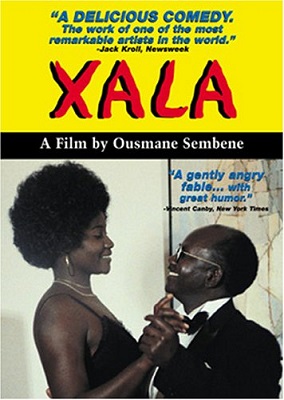
Xala, Ousmane Sembène (1975, Senegal). Xala, pronounced khala, means “temporary impotence” in Wolof, and is also the title of the novel by Sembène from which this film was adapted. The film opens with a voiceover describing Senegal’s independence, with actors playing the parts of the new Senegalese government. One of these, a minister, is congratulated on his upcoming nuptials. To a woman less than half his age. And she’s his third wife. I’m sorry, I don’t give a shit what your religion is, but there’s no justification for polygamy. Women are not property. Sembène is making the same point, although he’s also setting out an allegory about independence, in which the new wife is the country’s new-found freedom. Which results in impotence – the minister can’t get it up despite the manifold attractions of his new wife. He is not only too wedded to the old ways, he prospered too well under them. Now he has control, he doesn’t know what to do with it. So to speak. I have to date seen five films by Ousmane Sembène and I think they’re all pretty damn good. It’s not that they’re polished pieces of work, because they’re not – there are no special effects, no studio sets, most of the cast are non-professional, Sembène’s lack of resource as usually there to see on the screen… But they’re so well-presented. Not just as depictions of life in Senegal – in Dakar – at the time of filming, but also as drama and as political statements. Sembène made 13 movies (four of them shorts) and wrote ten novels. I want to see all his films, and have a bash at some of his novels.

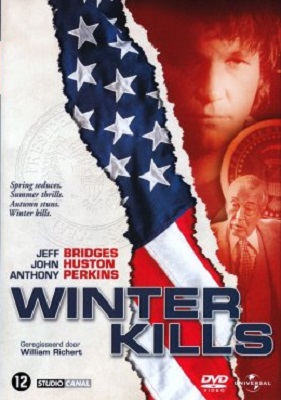
Winter Kills, William Richert (1979, USA). This film is allegedly a forgotten classic, and “forgotten” certainly applies to it as I’d never heard of it until I stumbled across it on Amazon Prime. And yet it received many positive reviews on its initial release. It also had a troubled production history, and I wonder if that has added to the film’s reputation… because as a straight-up thriller it leaves something to be desired, and as a comedy, black or otherwise, it fails dismally; although it nevertheless manages to mostly entertain. The plot is a thinly-disguised reference to the assassination of JFK. Twenty years after the death of the president, his brother is approached with evidence demonstrating the commonly-accepted narrative is wrong. So he investigates further, and follows a chain of anecdote and interview to… I’m not sure if it’s worth the spoiler. I can’t honestly see what was so good about this film it gained the label “forgotten classic”. The cast are pretty good, true, but the plot stumbles from the obvious to the inane, and its so-called humour falls flat more often than not. Its production history is actually more entertaining – look it up on Wikipedia. The version I watched was the director’s cut, which is not always the best cut. But, to be honest, it’s hard to see how any cut could make this film a classic unless there were thousands more feet of film left on the cutting-room floor. Best avoided.

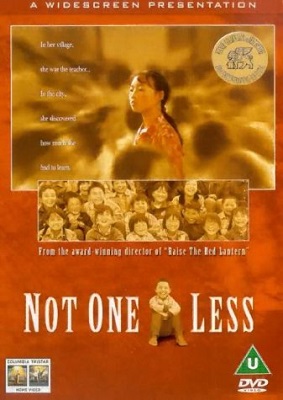
Not One Less, Zhang Yimou (1999, China). More Chinese cinema, from a well-known Fifth Generation director. The teacher in a countryside village has to leave for family reasons, so a substitute teacher is sent… but she’s thirteen-years-old and hardly qualified. And it shows initially. When one of the boys runs away to the city to earn money to pay off his mother’s debts, she follows him. But he’s not where he’s supposed to be, so she tries to persuade the radio station manager to broadcast a message to him. Instead, a local TV station take up her story and interview her on air – or at least try to, as she clams up from nervousness. But the boy, who’s living on the streets, sees the broadcast, the two are united, and they’re returned to the village with money and school equipment – chalk, basically – by the TV station, who smell a better story. Everyone in the movies is a non-professional actor, and many filled roles they hold in real life. It gave the whole thing a very documentary air, something I especially like about Sixth Generation movies, and I have to wonder if this is one of their touchstone works. Zhang, from the films of his I’ve seen, has had a varied career, but Not One Less so much resembled the sort of Chinese film I really like that I couldn’t help but love it. The cast of mostly children are really good, especially the two leads, and the whole thing is both excellent commentary and excellent drama. Apparently, the Chinese authorities made Zhang change the text at the end which claims one million children drop out of school due to poverty because the real figure – three to five times that – was too embarrassing. The poverty of the schooling actually shown on the screen should be embarrassment enough. An excellent film.

1001 Movies You Must See Before You Die count: 918


2 Comments

Moving pictures 2018, #34

Not a single US film in this bunch, although two are still Anglophone – British and Australian.

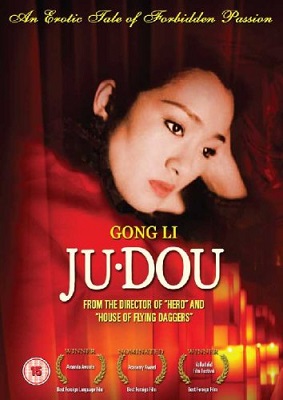
Ju Dou, Zhang Yimou (1990, China). Although I’m a big fan of films by Chinese Sixth Generation directors, such as Jia Zhangke, Wang Xiaoshuai and Lou Ye, that doesn’t mean I’m not interested in earlier generations – and I don’t just mean early classics like Wu Yonggang’s The Goddess (1934, see here) or Fei Mu’s Spring in a Small Town (1948, see here). There was also – obviously – a Fifth Generation, to which Zhang Yimou belonged, and those films of his I’ve seen I’ve thought very good. He also has two entries on the 1001 Movies You Must See Before You Die list: Red Sorghum (see here) and Raise the Red Lantern (not currently available on DVD). Ju Dou is Zhang’s third film (he’s better known these days for films like Hero, House of Flying Daggers and The Great Wall), and had I not read in the movie’s Wikipedia entry that it was filmed in Technicolor – in 1990! – I’d not have known it from the copy I watched. So can we have a restored edition, please? Because this is an excellent film, irrespective of the motion picture process used. The title refers to a young woman, played by Zhang favourite Gong Li, who is married to a cruel dyer. The dyer’s adopted nephew returns after a weeks-long trip to discover his uncle has remarried… and he begins to obsess over Ju Dou, who is being abused by her husband. It doesn’t end well, these things never end well, especially when Ju Dou has a son, and the dyer is confined to a wheelchair after a stroke and learns the son is not his own… It was clear watching this that colour had been uppermost in Zhang’s mind, and yet the DVD transfer had made a mockery of the Technicolor, washing out many of the colours and, in some scenes, giving the whole frame a faint tint. Now I love Technicolor, especially Technicolor landscapes – the New England autumnal landscape of All That Heaven Allows, the wide open spaces of Shane – and since much of Ju Dou took place in a dye works, there was no shortage of colour. Which, sadly, wasn’t especially obvious on this transfer. A good film, but I’d like to see a restored copy.

Outskirts, Boris Barnet (1933, Russia). I forget where I came across mention of this, and having now seen it I’m surprised it’s not on the 1001 Movies You Must See Before You Die list. A Soviet film from 1933 that covers the period prior to the October Revolution via the lives of ordinary Russian villagers? Barnet made several early Soviet films, but only Eisenstein, Vertov and Vsevelod make the list. Which is not to say they shouldn’t. But Barnet belongs on there too. More so than some early Hollywood films anyway. It’s not just that Outskirts documents the lives of villagers in early twentieth-century Russia, which it does very effectively, but also that it is dramatically impressive too. Part of it is set at the front during WWI, or Second Patriotic War, against the Austro-Hungarian Empire. And it’s the equal of any other WWI movie of the time, if not better. Barnet, by all accounts, was in the top rank of Soviet directors, but seems to be pretty much forgotten these days. Eisenstein’s oeuvre is readily available, but I can find only three of Barnet’s twenty-seven films, including this one, on DVD. A shame. On the strength of Outskirts, I’d say his films are definitely worth seeing.

The Man Who Had His Hair Cut Short*, André Delvaux (1966, Belgium). Govert Miereveld is hired to replace a departing teacher at a school. He begins to obsess over a female student, played by Polish actress Beata Tyszkiewicz (dubbed into Flemish?). He leaves the school and enters the law. Some years later, he accompanies a colleague who needs to attend an autopsy of a body washed ashore in another town. They suspect the body of being a suspect in a case, but in the event it turns out to be a completely different man. At the hotel, Miereveld bumps into the student he had obsessed over, who is now a famous opera singer. She remembers him from school and is surprisingly open to his, er, overtures. He spends time with her and she admits she knew of his obsession at school. She also admits the teacher he replaced had been asked to leave because he had been in a relationship with her. And her father, who had disappeared shortly after she left school, well, his description matches that of the body in the autopsy… The first time I watched this, I liked its focus on its protagonist – including the scene which lends the films its title – but I hadn’t realised how vital to the plot that focus was. Because Miereveld is badly affected by what he learns, and the final third of the film shows the aftermath. If the film has a flaw, it’s that it’s not entirely clear for much of its length what sort of film it is. It opens as an introspective drama, turns into a thriller, and then becomes something completely different. I liked it so much on second viewing, I considered picking up a copy of the book from which it was adapted… which is, of course, almost fucking impossible to find…

Brick Lane, Sarah Gavron (2007, UK). This is an adaptation of the novel of the same name by Monica Ali, set among the Bangladeshi community in London on, er, Brick Lane. I’ve not read the book, so I’ve no idea how the film differs from it. Nazneen is the wife of Chanu Ahmed, a man who seems convinced he can succeed in the UK, and is equally blind to the country’s racism – the film opens with him convinced he is about to be promoted, only to learn he has been fired. He’s keen on improving himself, and is evidently a voracious reader, but his wife is not happy, and his two kids seem to have little in common with him. Except Brick Lane is not about him, it’s about Nazneen, who has an affair with an Anglo-Bangladeshi (ie, born and bred in the UK, unlike Nazneen) who is part of a local group agitating for Muslim solidarity. And this is around the time of the 9/11 attacks. I was resident in the UAE when 9/11 happened, and working for a government-owned oil company… so the only version of events I heard was that told by Arabs who had been affected. So I can sympathise with the Bangladeshis depicted in Brick Lane and even understand the drivers which lead to the film’s more dramatic elements. White people are racist. That’s a simple fact. Sometimes it’s ameliorated by experience, sometimes by education, and sometimes by both. I like to think I fall into that last category, thanks to my years in the Gulf. But I also accept that all white people are racist, it’s merely a matter of degree and constant self-policing. And I try my best to self-police. So films like Brick Lane are important, if not the most compelling drama ever. On the one hand, Tannishtha Chatterjee is compelling in the lead role and Satish Kaushik makes her husband seem a lot more sympathetic than he deserves to be… But not much of it feels like it connects with Islam, despite an impassioned speech by Chanu Ahmed; and Nazneen’s lover, Christopher Simpson, comes across more as a paper-thin wide boy than anything else… I don’t know; maybe I was expecting more than the film was prepared to deliver, than the original novel was prepared to deliver. But it all felt a bit shallow and glib to me.

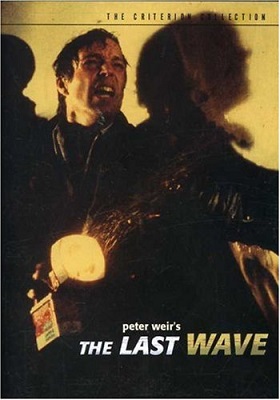
The Last Wave*, Peter Weir (1977, Australia). Richard Chamberlain is a corporate lawyer in Australia – the reason for his American accent is never explained, although his parents are introduced as his adoptive parents – who is assigned by legal aid to defend an Aboriginal man from the charge of murdering his friend. Something about the Aboriginal man Chamberlain finds striking, an inexplicable connection the two seem to have. The crime itself remains a mystery – five men in a bar, they’re thrown out for being Aboriginal, one ends up dead. The barrister assigned to the defence resents Chamberlain’s naivete – he can’t claim tribal murder for non-tribal Aboriginal people, ie, those living in the city. But Chamberlain is convinced it’s tribal murder, and through his dreams becomes swept up in the life  of his defendant, and the crime for which he was charged. There’s an obvious use of Dreamtime here, and Aboriginal beliefs, and perhaps the framing narrative is somewhat banal – it even has the “strange black man” outside the house, which was never an acceptable trope – but Weir handles the way Chamberlain gets sucked into the Aboriginal world-view quite effectively, so much so in fact that the final scene, to which the title refers, remains ambiguous. The Last Wave feels like a film with good intentions that has not aged well. It’s overlong, it’s choice of Chamberlain as the protagonist weakens its story, and its borderline positioning of Aboriginal people as “magical negros” only just manages not to be racist. The fact it has subsequently proven hard to find seems almost fitting. I’d say it was worth seeing, but only for those willing to track it down.

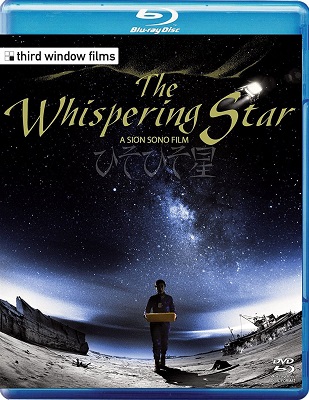
The Whispering Star, Sion Sono (2015, Japan). Another random film that looked interesting so I bunged it on my rental list. I suspect I may have thought it was anime and, from the title, sf anime, like 2001 Nights or Voices of a Distant Star. It’s sf, alright, but it’s not anime. It’s filmed in black and white. The director’s partner, Megumi Kagurazaka, plays an interstellar delivery person, although it’s not clear how real this is. Her spaceship resembles a house from the outside, and the opening scenes feature her repeating both a number of simple household tasks and her dialogue. It turns out she is delivering items to survivors of the Fukushima nuclear incident, played in the film by real life survivors. I don’t know if The Whispering Star was filmed in the areas abandoned as a consequence of the nuclear meltdown, but it certainly looks like it. To add to the strangeness, all the dialogue is looped, and delivered in whispered tones. Almost as if it were intended to represent telepathy. There’s no plot as such. The end result is an experimental film that overstays its welcome, and reminds me in many respects of Lukas Moodysson’s Container (there is also something container-like about Kagurazaka’s spaceship), but nonetheless makes a number of valid points about Fukushima. As a result of seeing The Whispering Star, I looked into Sono’s other films, and it looks like he has an oeuvre worth exploring…

1001 Movies You Must see Before You Die count: 918


Leave a comment

Moving pictures 2018, #33

Some long sought-after films here, and some random stuff that happened to catch my eye at the time. So to speak.

The Brain that Wouldn’t Die, Joseph Green (1962, USA). One of my favourite actresses of the 1950s is Virginia Leith, who made only a handful of films, and The Brain That Wouldn’t Die is her last. She plays the fiancée of an arrogant surgeon who thinks he knows better than the entire medical profession. Of course. But then he’s in car crash and his girlfriend is killed, except he saves her head and keeps it alive in his lab at home. But she’s no good to him as a disembodied head, so he goes hunting for a suitable body for her, visiting a nightclub, and then an artist’s model. It’s not like the first time he’s done this, as there’s a monster he created behind a locked door in his laboratory, and his assistant lost an arm and he performed and arm transplant on him. Leith’s character, however, would sooner die, so she persuades the monster to attack her husband. Despite the schlock plot, and the B-movie sensibilities, this wasn’t as bad as I had expected. In fact, it reminded me of Sam Fuller’s films, it had that same sort of underbelly of society feel to it, although the scenes set in the lab with Leith’s head were an odd contrast. A superior B-movie.

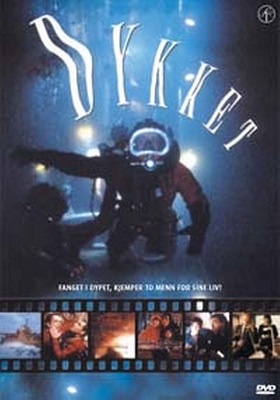
Dykket, Tristan DeVere Cole (1989, Norway). One of my “enthusiasms” over the past few years has been deep sea diving, particularly deep sea habitats and saturation diving. But there aren’t that many films based around saturation diving, and the few that do use it in passing – Sphere, I’m looking at you – tend to get it laughably wrong. But Dykket, AKA The Dive, a Norwegian/British production, is actually about divers on a saturation dive. After four months at sea, a diving support ship with three divers aboard – one of whom is Michael Kitchen! – is due to return to port for a refit. But one of Scanoil’s (a stand-in for Norway’s Statoil) sea-bed valves nearby has been turned off by a trawler’s net. The divers are due to return by helicopter to dry land, but since it’s a “bounce dive”, ie, they won’t spend long enough on the sea-bottom at 100 metres (that’s 300 feet, approx, or 10 atmospheres) to require decompression, they decide to give it a try. Of course, it all goes horribly wrong. First, one of the divers is caught in the trawler net, then the bell gets tangled up. So they’re trapped, the ship is running out of gas, and the bell’s reserves have all but gone… The version of this I watched was unfortunately lacking subtitles, and about a third of the dialogue is in Norwegian. But I knew enough about saturation diving to follow what was going on. The underwater scenes are done well, although the incidental music throughout felt more like it belonged to a Euro soap opera than a feature film. But it wasn’t bad. I’m surprised it’s never been release on DVD, not even even in this country – given it stars Michael Kitchen.

Europa ‘51*, Roberto Rossellini (1952, Italy). Ingrid Bergman plays the wife of a wealthy man in post-war Italy. One night, during a dinner party, her young son, desperate for attention, tries to commit suicide by jumping down the apartment building’s stairwell. He ends up paralysed from the waist down. Unfortunately, he dies in hospital a few days later. Stricken by grief, Bergman gets involved with poor people, and helps them out, even taking one woman’s place in a factory for a day. But her husband objects to her activities, and has her consigned to a mental hospital, because when men don’t get what they want from their women they lock them up. The film was apparently inspired by the life of St Francis of Assisi, and Bergman certainly plays her role like a martyr. It’s an odd film, because it’s usually described as Neorealist, and for the first thirty or so minutes it doesn’t at all seem like one. But then Bergman does her ministering angel among the poor bit, many of whom are plainly non-professional actors, and it very much resembles an Italian Neorealist movie. Of the directors associated with the movement, I’ve never really been a big fan of Rossellini’s films, and there’s nothing here to persuade me otherwise, despite it being on the 1001 Movies You Must See Before You Die list.

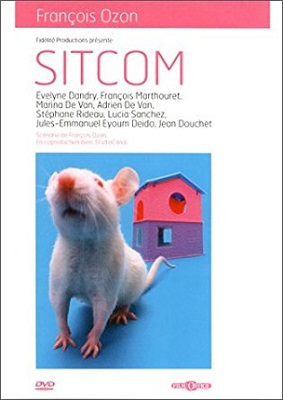
Sitcom, François Ozon (2000, France). Ozon’s films are readily available in the UK on DVD. Except this one. For some reason. There’s nothing in it I could see which would prohibit a sell-through release in the UK. And certainly nothing in it that is so unlike the rest of Ozon’s oeuvre it would preclude a release on that basis. The film concerns a family whose behaviour changes after the father brings home a lab rat as a pet. First, the son announces he is gay and completely changes his lifestyle. Then the daughter throws herself out of a window, is paralysed below the waist, and then begins exploring sado-masochism. The Spanish maid begins to act more like a member of the family than a paid servant, and her black husband, a sports teacher, starts sleeping with the gay son. The mother has sex with her son in order to “cure” him of his homosexuality. And the father eats the pet rat and turns into a giant rat. And, er, that’s it. I think the film is supposed to comment on the hermetic families which feature in US sitcoms, not to mention the anodyne humour and narrow-minded sensibilities. Unfortunately, the end result that comes across more like an exercise in trying to shock than any type of pointed commentary. And much of it is too silly to be taken seriously, anyway. I find Ozon a bit hit-and-miss, to be honest – I love some of his films, but others have struggled to keep my interest. This one falls in the latter camp.

The Shamer’s Daughter, Kenneth Krainz (2015, Denmark). The king of Dunark, his wife, youngest son and unborn child are found murdered. His oldest son, Nicodemus, is found drunk and covered in blood nearby. So the Master of Law calls in a shamer, a type of witch who can see everything of which a person is ashamed, but she can’t “see” evidence of Nicodemus’s, guilt. So they fetch her young daughter… who discovers that the son is innocent and his half-brother, Drakan, is the real culprit. So then Drakan seizes power, by throwing the Master of Law down a well – and no one thinks, well, if this is how he starts out, he’s not going to be a good ruler, is he? Of course not, this is fantasy. But the shamer’s daughter, and Nicodemus, manage to escape. The daughter is quickly caught, despite disguising herself as a boy. Because fantasy is all about the girls being rescued by the boys. Sigh. However, the Master of Arms begins to understand that Drakan is a bad sort, so he helps puts together a plot with Nicodemus to rescue the daughter and their mother as they’re thrown to the dragons. (despite being Danish, this film features mountains… and dragons.) The shamer’s daughter cannot get Drakan to admit his guilt – he’s not ashamed of murdering the king and his family – so she turns her gaze on the crowd, and gets them all to realise Drakan is a baddy. In the ensuing confusion, the good guys escape. Interestingly, though Nicodemus has Drakan under his sword at one point, and could end it all with one thrust, he chooses not to, and they all run away. To a nicer place, where the shamer and her daughter are reunited with the rest of their family. The world-building wasn’t bad, and the concept of shaming was a pretty good idea, but… Drakan was a pantomime villain, and it beggared belief that everyone would happily go along with his evil plans… and the title character had virtually no agency despite being the star of the story. Disappointing.

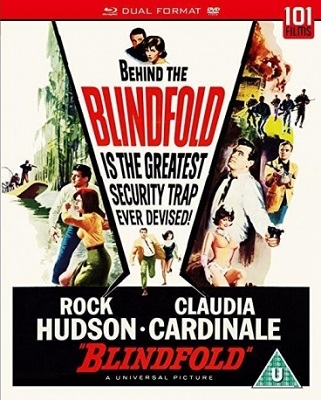
Blindfold, Philip Dunne (1966, USA). I could watch Rock Hudson in pretty much anything, but he pushes your level of tolerance sometimes. He made some outright weird stuff, and some stuff that seemed odd at the time but later turned into a classic, and some some thrillers that might have passed muster back then but really haven’t aged well. Like this one. Hudson’s performances are always watchable, and I now find him far better than Cary Grant, who seem to go from galumph to tea-bag tanned louche overnight in the mid-1950s. Hudson plays a psychiatrist who is recruited by the military to analyse a Soviet defector who refuses  to talk. He is blindfolded and taken from New York to a house in the Louisiana swamps. Then someone else turns up and convinces him the general who recruited him is a fake, and he needs to rescue the defector. But Hudson has no idea where they’re keeping the defector because blindfold. It all gets a bit confusing, and ends up with Hudson on the run, with the female lead, Claudia Cardinale, a nightclub dancer, of course, and the sister of the defector… They’re chased through the Louisiana swamps at night, and even though it’s done in a studio, it’s quite effective. But this is a pretty ordinary mid-sixties thriller, and not even its stars can do much with the material. Disappointing.

1001 Movies You Must See Before You Die count: 916


5 Comments

Moving pictures 2018, #32

A return to usual, with only two of the six films from an Anglophone country. I’m still trying to reduce the percentage of US films in my overall films seen list, and now rent two foreign-language films for every English-language one.

The Super Inframan, Hua Shan (1975, China). I was looking at new releases on DVD/Blu-ray on the Cinema Paradiso website and spotted this, and it looked totally worth a go, a Hong Kong action film done like a Japanese tokusatsu that ripped off Superman. Sadly, it sounded better on, er, paper than it actually was on the screen. I mean, it was exactly what the description promised – a ridiculous plot that confused science-fictional aliens and mythological demons, lots of balletic fight scenes, monsters that could only have been dreamt up by someone whose brain has turned into cheese, cheap costumes that visibly fell apart during the fights, risible dialogue, and jeopardy that was so fake it killed suspense. I had expected to be a lot more entertaining – and bits of it were quite amusing. But unlike some films which are so bad they go out through the other side and become good, The Super Inframan never even made it halfway. The transfer – it’s a new Blu-ray release – however was very good, and as brainless colourful moving pictures to watch while consuming alcohol go, it’s as a good a candidate as any other.

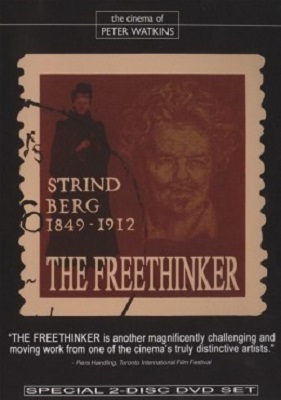
The Freethinker, Peter Watkins (1994 Sweden). I have no idea what to make of Watkins. His use of faux documentary is second to none, but his move toward a mix of drama and documentary, on obscure subjects, probably explains why his films are now financed by television companies in other countries, like Sweden. They are also long. It feels like he’s given up his chance to make a difference to focus on the stories he want to tell. And while I can’t begrudge him that, I have to begrudge the loss of 1990s and 21st century equivalents to War Games, Privilege and Punishment Park. Instead we have La Commune (Paris, 1871), all 345 minutes of it, and The Freethinker, all 276 minutes of it, and The Journey… all 873 minutes of it! The title of this film, which is split across two DVD discs, refers to Swedish playwright August Strindberg, who lived from 1849 to 1912, and wrote “over sixty plays and more than thirty works of fiction, autobiography, history, cultural analysis, and politics” (Wikipedia). ‘The Freethinker’ is also the name of Strindberg’s first play, which he apparently had trouble staging. In fact, Strindberg seems to have struggled for acceptance at first. I wonder if this is true of all art that withstands the test of time. It could be said art is the present in conversation with the past, and art that argues with, criticises, disputes or even refutes the ways of the past is art that tends to last longer. Of course, access also helps – either by popularity or patronage – and obscurity has consigned much great art to the dustbin of history. Watkins’s films are not especially accessible – 276 minutes! – and have become increasingly less visible. And yet they’re clever stuff. They’re inventive in the way they use their format – mixing dramatisation and documentary, breaking the fourth wall, having the cast comment on the historical personages they are playing… a technique also used in La Commune (Paris, 1871). However, unlike La Commune (Paris, 1871), The Freethinker reminded me in places of Sokurov’s films, especially his “elegies”. But where Sokurov talks over his found footage, meditating on a variety of topics inspired by the pictures on the screen, Watkins treats his documentary elements more traditionally, albeit as part of a far from traditional whole. Of course, Strindberg is, for Watkins, just a jumping off point to discuss the role of the artist and critic in society, much as in some of his other films – Privilege, for example, is commentary on the intersection of popular culture, commercialism and authority. At the moment, I’m in two minds whether I should replace my DVD copies of Culloden, The War Game and Punishment Park – part of a French-released box set which also contains La Commune and The Gladiators – with the eureka! and BFI Blu-ray releases… although I suspect I probably won’t. But I’ll continue to hunt down his other films, which, I must admit, are not especially easy to find.

Nowhere in Moravia, Miroslav Krobot (2014, Czechia). Krobot is apparently a highly-respected theatre director and this is his first feature film. Which might go some way to explaining why it is so slow and so dull. Which is totally unfair, as I know nothing about his plays. In this film, an ex-teacher of German now runs a small bar in a backwater Moravian village. Basically, very little happens for much of the film. It introduces the various oddball characters – the woman who lives with two men, the vagrant who drops into the bar every night to buy booze, the mayor who spends most of his time hunting a stag at night… Someone dies, and a relative from Germany comes to the village for the funeral. The bar owner’s sister goes back with him to Munich, she is many years his junior, for a better life. Then the woman with the two lovers is murdered by them. They’re caught very quickly, and taken away by the police. And, er, that’s it. Disappointing.

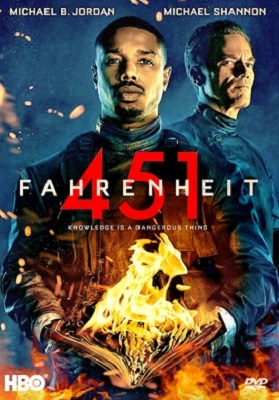
Fahrenheit 451, Ramin Bahrani (2018, USA). One would imagine in these days of fake news or YouTube slipping Nazi propaganda to children that Fahrenheit 451 would be ripe for a remake – despite the title referencing an ancient temperature scale only the US continues to use, and the actual temperature actually having fuck all to do with paper burning as Bradbury got it completely wrong… And yes, you’d be right about the need for a new Fahrenheit 451. Especially given Bradbury’s original intent for the novel – not a commentary against censorship but against the pervasiveness of popular culture fed through television… But this is not that Fahrenheit 451. This is a reboot of the original film adaptation but with added emojis and reality-TV gloss. And, er, that’s it. Montag is a firemen, he burns books. He comes to doubt his mission, and eventually joins those who seek to preserve books. Except culture is not just books, and in this day and age what were books can now be served in a variety of ways. This new Fahrenheit 451 has the firemen destroy computers because of ebooks (er, haven’t they heard of backups? the cloud?), and it’s pretty much stated that people are mostly illiterate (which suggests an easy test for “criminals” who own books – see if they can read). There is a lot of pointed commentary, on a variety of related subjects, that can be made using a story like Fahrenheit 451. Adding a 2018 gloss to Truffaut’s 1966 adaptation – and they didn’t even use Truffaut’s genius move of casting the same actress as both Montag’s wife and mistress! – is the dumbest possible way to use the story. What next? Nineteen eighty-four with VR goggles? Avoid.

Mishima: A Life in Four Chapters*, Paul Schrader (1985, USA). To be honest, I had thought this was a Japanese film, not an American one. After all Yukio Mishima was a famous Japanese writer, if chiefly famous for publicly committing seppuku – although many seem to forget he was also a right-wing nutjob, and even ran his own government-approved militia. He does, to be fair, come across as a fascinating character, more so at least than Strindberg, see above. and like Watkins’s The Freethinker, Mishima: A Life in Four Chapters is ostensibly a documentary about the man’s life, but uses non-traditional means of doing that. The film not only dramatises parts of Mishima’s life, but also excerpts from his books; and some of the latter are almost hallucinogenic. (I might even have a go at reading one.) I had not expected to like Mishima: A Life in Four Chapters, and even less so when I learnt it was a US film – although filmed in Japanese, with a Japanese cast – but I was surprised to discover that I liked it a great deal. In fact, I’m thinking of getting myself a copy…

My American Uncle, Alain Resnais (1980, France). Gérard Depardieu plays the technical director of a textile firm that’s merging with a competitor. He’s not offered the role of technical director in the new merged film, but a more important position as managing director of a subsidiary. But this requires a move several hundred kilometres from Paris, and is a job well out of his comfort zone. He makes a hash of it. And it affects his marriage. All this is to apparently illustrate the theories of philosopher Henri Laborit, who appears at intervals during the film, explaining his theories on evolutionary psychology (a lot of “evo psych” is now, of course, completely discredited). There are many characters in this film that have affairs with other characters, but given how prevalent that is in French dramas it didn’t really feel like it fed into Laborit’s thesis. So what you have is a long convoluted drama interspersed by lectures to camera by Laborit. Which makes for an odd viewing experience. Both Resnais and Jacques Rivette seemed to like making knotty elliptical dramas based on really quite subtle points, but both also seemed to have difficulty with pace. You can get away with that if you have the cinematography – and while Rivette clearly did, I’ve yet to be convinced Resnais had it. They’re both directors who each produced a fascinating body of work, neither which can be easily described. And it’s that refusal to follow expected narrative forms in narrative cinema – much as Michael Haneke does this century – that’s why I’m interested in their films… but sometimes it doesn’t quite work…

1001 Movies You Must See Before You Die count: 915


2 Comments

Moving pictures 2018, #31

Fifty-fifty this time around – three Anglophone films, and three non-Anglophone. Plus two from the 1001 Movies You Must See Before You Die list.

In the Year of the Pig*, Emilio de Antonio (1968, USA). There are several war documentaries on the 1001 Movies You Must See Before You Die list, although I think this is the only anti-war documentary on it. It is ostensibly about the Vietnam War – which is sort of like the American equivalent of the British Empire: if you meet someone who approves of it, then they’re a right-wing fascist moron and best avoided. In the Year of the Pig is both experimental and a traditional documentary. It features a lot of archival footage and talking heads; but that’s juxtaposed with poetic imagery and loud atonal music. But it succeeds in doing what it sets out to do: which is demonstrate that the US should not have been in Viet Nam. Nor indeed should the French have been. It is, despite its reliance on found footage, a good-looking film, although shots of French troops in pith helmets marching past and in which the faces have been blurred out looks weirder than was probably intended. I don’t necessarily agree with the film – it’s Western commentators on an Eastern country, and for all their claims of expertise they’re not Vietnamese. On the other hand, many of the interviewees discuss the US’s failure to treat Ho Chi Minh as “the George Washington of his country”. In other words, the US’s orientalists (for lack of a better term) all felt Ho Chi Minh should be accorded the same respect as any other national leader. But the French had already fucked up, so the US stepped in to “help”. Ha. It would be interesting to see a poll asking if people in the US thought the US won the Vietnam War. I suspect these day the majority might think they did. Fake news! One commentator states that “colonialism created communism”, which is an interesting, if ahistorical, opinion. Communism was already over 100 years old by 1968, and when you have empire looming over you and no prospect of independent local rule, then subsidised communism looks like an attractive alternative… but that’s not a bad take for 1968. Recommended.

Hellzapoppin’, HC Potter (1941, USA). Sometimes you stumble across a film, and even though it’s not the sort of thing you normally watch, it sounds interesting enough to bung it on your rental list. Actually, now I think about it, I do that a lot. Anyway, Hellzapoppin’ was described as a “ground-breaking comedy classic” and “Way ahead of its time, it’s been described as ‘Pythonesque’ and has influenced generations of comedians”. That’ll do for me, I thought. Okay, it was made in 1941, so we’re looking more at Abbott and Costello, or the Three Stooges, than we are Monty Python, but I can live with that. And… it was fun. It was clever, snappy, meta, had some memorable set-pieces, some real groaner lines, and actually reminded me more of the Busby Berkeley musicals from the decade prior than it did Python. It opens in a version of hell, but then the camera pulls back to reveal it’s a set. The director approaches the two comic leads and tells them he has a problem with a movie he’s working on, and they sit down in front of a screen… which begins to display the main narrative of the film, with commentary from the director, but then opens out to fill the frame. A rich family are staging a musical in the gardens of their mansion, because their daughter fancies a playwright but he won’t offer until he is a success. Midway through the play, the two comic leads discover the play should not succeed, so they sabotage it, only for it to become a comic hit. If this sounds familiar, stop me. It’s fun, it’s very much of its time, and to be honest I had no idea who any of the stars in it were.

The Machine, Caradog James (2013,UK). One day, a film-maker will, er, make a film about AI which a) treats the subject intelligently, and b) does not depend on a sexy female robot. But that day has yet to come – and may indeed never come. I tweeted not so long ago that I rarely watch sf television series as I’m not the target audience, and I suspect that is also true of sf films. Although there are a handful of sf films I love dearly. But, let’s face it, most of them are shit. As in, really shit. The Machine tries hard not to be Ex Machina, which it actually predates by a year, which is a point in its favour; and both Toby Stephens and Caity Lotz are quite good in their roles. But there’s a lot going on in The Machine and the director chose foolishly to tell the wrong story. Stephens plays a scientists working for the MoD on advanced prostheses for wounded soldiers, including brain implants to repair brain damage. But the implants haven’t been entirely successful. He brings on board Lotz, an AI researcher, in order to push forward on producing a robot soldier. But she is murdered by a Chinese agent – the UK and China are at war, btw – and then becomes the model for the first AI soldier. Of course. The Machine did well with its low budget, but it’s a story we’ve seen countless times before – Metropolis, anyone? – and it’s time the film world really came up with a fresh spin on it. On the other hand, it was less annoying than Ex Machina. Which, from me, the director should take as praise.

Three Lives and One Death*, Raùl Ruiz (1996, France). Some films make it onto the 1001 Movies You Must See Before You Die list because they are bona fide classics, and it’s obvious as soon as you watch them. Others are seminal works. Some had fascinating production histories, and the fact they exist at all is likely what’s being celebrated. And some of them… I’ve no fucking idea why the 70 film critics and commentators who put together the list chose some of the titles. Three Lives and One Death is not an obvious one – it’s French, although Ruiz is Chilean… but is probably best-known in France, where he settled in 1973 after Pinochet (you know, Margaret Thatcher’s favourite fascist dictator) seized power in Chile. Ruiz’s works are not easy to find in English-language releases, and he made over 100 films. He directed the only film adaptation of Proust’s In Search of Lost Time, which I really must read one of these days, Time Regained, which I have seen. Anyway, Trois vies et une seule mort has Marcello Mastroianni trapped in an apartment for decades by fairies – he’s allowed out, but he cannot leave unless he finds a replacement. And one day, he does: the husband of the woman he left years before when he became trapped in the apartment. I’m not entirely sure what this film is about, which I suspect is par for the course for films by Ruiz, and I’m not especially convinced everyone else is. It may well have made the list because of the scene where Mastroianni buries a hammer in the head of the other man. Which would be a shame. I suspect Ruiz belongs on the list, but I don’t know enough about his oeuvre to determine whether this film is the best representative. It’s certainly slightly off-the-wall, and Mastroianni is always watchable.

The Laundryman, Lee Chung (2015, Taiwan). This was another of the films, most starring Regina Wan, a Taiwanese distributor seems to have dumped on Amazon Prime. Not that I’m complaining, as the ones I’ve seen – The Village of No Return (see here), this one and Threads of Time (confusingly uploaded under the title Contact of Time) – were all pretty good. The latter is an historical epic about the life of Ming dynasty concubine Liu Rushi, although it seems to miss out many of the events of her life. But The Laundryman is set in the present-day and is about a hit man who is haunted by the victims of his hits – to the extent that it is interfering with his work. His boss gives him the name of a medium to consult – the boss is not entirely convinced by his problem – but with the medium’s help he discovers that the haunting is a consequence of his own background. Which involves his upbringing in a care home in which a doctor experimented on the violent tendencies of the children consigned to it. This was a good-looking film, and surprisingly good. I’ve seen comments complaining that the fight scenes weren’t so good, given they used slo-mo and repeated the same actions from different viewpoints. It’s true they slowed the pace, but I wasn’t expecting an action film so I wasn’t that upset by them. Fun.

Thelma, Joachim Trier (2017, Norway). The title character is a young woman from a strict religious background who moves to Oslo to attend university. One day in the university library, she has what appears to be a grand mal seizure. She undergoes a variety of tests – including an induced epileptic fit – but no cause can be found. Meanwhile, she falls in love with a fellow student, but it conflicts with her upbringing (the student is female). The film then cleverly reveals through flashbacks to Thelma’s childhood that she has the ability make whatever she wants happen – just like in ‘It’s a Good Life’. Sometimes with fatal consequences for others. Some critics have suggested Thelma is little more than a carbon copy of Carrie, and there are indeed similarities. But I think Thelma treat its premise with much more subtlety than the film of King’s novel. It is, for one thing, not overtly horrific. There are some quite horrible bits in it, but no buckets of blood, no torture porn. And it is so much better for their lack. Elli Harboe in the title role is really very good, an award-winning performance in a fairer world. I loved this film. I want my own copy.

1001 Movies You Must See Before You Die count: 914


2 Comments

Moving pictures 2018, #30

Six films, six countries, six languages. And not one of them English. Don’t think I’ve managed that before. And yes, Sebastiane is a British film. But the dialogue is entirely in Vulgar Latin. (On the other hand, there’s some English dialogue in Force Majeure – but the main language is Swedish.)

Sebastiane, Derek Jarman (1976, UK). I’m fairly sure I watched this back in the 1980s, perhaps even when I was at boarding school – although the likelihood of a bunch of fifteen or sixteen year old boys watching a homoerotic film set during Roman times with dialogue entirely in Vulgar Latin seems a bit far-fetched. Maybe I watched it during a school vacation. Or maybe when I was a student. Certainly, some parts of the film as I watched this time were familiar to me. The title refers to Saint Sebastian, who was a member of the Diocletian Guard in fourth-century Rome, and exiled to a remote garrison after trying to prevent the murder of one of the emperor’s catamites during an orgy. The orgy opens the film, and pretty much sets the scene for the rest of it. This is not a movie which makes a secret of who it is aimed at. At the garrison, Sebastiane declares himself a pacifist, and is eventually executed for refusing to fight. There are a lot of male bodies in very little clothing either lying around on a beach or fighting with wooden swords. According to Wikipedia, Sebastiane “was controversial for the homoeroticism portrayed between the soldiers and for being dialogued entirely in Latin”, and while I can see the latter being controversial – as indeed is the misuse of “dialogue” as a verb – the former should really not have been a problem in 1976. True, it would limit the film’s release – to pretty much a handful of cinemas in London, I imagine – but even in 1976 a gay film could hardly be controversial. It’s not like Jarman had built up a reputation for making heteronormative crowd-pleasers – Sebastiane was his first feature film after a number of avant garde shorts, many – if not all – of which had gay content. For all that, Sebastiane is… mostly dull. The opening orgy has its moments, is almost Fellini-esque in parts, but once the title character is exiled, the pace slows to a crawl and it often feels like the film is making more of a meal of its nudity and Latin than it really needs to. Despite that, for a first feature, this is quite a polished work, although the camera-work often impresses more than the acting. The more Jarman I watch, the more I’m glad I bought this box set.

Force Majeure, Ruben Östlund (2014, Sweden). I was lent this film by David Tallerman, although I’m not sure what prompted it as he normally lends me weird Korean or anime films. Not that I’m complaining, I hasten to add. A Swedish family are holidaying in the French Alps. One afternoon, while eating lunch on an outside deck of a restaurant, a controlled avalanche is triggered. But it looks much more severe than it is, throwing up lots of snow, which covers the restaurant deck and causes the diners to panic. The husband runs away, leaving his family to the their fate. And when the, er, snow has settled, he tries to make light of his, um, flight. But his wife is not so forgiving. And the rest of the film charts the disintegration of their marriage. It’s one of those films that isn’t at all funny but is described as  a comedy, a black comedy. As a general rule, even black comedies generate one or two laughs. This one didn’t. Which is not to say it’s a bad film. It’s actually really good. Just not very funny. Worth seeing, though.

L’humanité, Bruno Dumont (1999, France). I’ve yet to figure out what to make of this film. It was… odd. Emmanuel Schotté plays a police inspector in a small town in the north of France. A young girl’s body is discovered – she has been brutally raped and murdered. Schotté’s character seems a bit, well, not all there. Almost child-like at times. He reacts badly to the crime. He also spends time with his friends, who seem to accept him on sufferance, and lives with his mother, who bullies him. He interviews two Brits who were on the Eurostar, which passed the crime scene around the right time, but their testimonies prove completely useless, contradicting each other repeatedly. Eventually the crime is solved, but it’s not Schotté’s character who does it. L’humanité is essentially a crime narrative, and sort of the follows the forms, in as much as it features a crime, an investigation, and a resolution. And it mostly follows the unspoken rules of the form, as the killer proves to be a known member of the cast. But the nearest I can get to the way it treats its protagonist, Schotté, is that subgenre of crime novels which feature long angsty paragraphs focusing on the mess the protagonist detective is making of his or her life – although not quite as dourly as in Nordic noir. Scottish noir, perhaps? But the French version of it. Pascale Garnier, maybe? I’m not that well-read in the genre. Nonetheless, worth seeing.

Cruelty, Anton Sigurdsson (2016, Iceland). I stumbled across this on Amazon Prime and thought it worth a go. I’ve now seen four Icelandic films, and I have to ask: do they ever make happy films? Because the Icelandic title of this movie is Grimmd, and that’s pretty close to the English word which best describes it. Two young girls are found murdered in a wood. A female detective is put on the case. Her boss teams her with an ex-partner against her wishes. The detective focuses on a man she arrested for sex offences years before but never managed to prove her case against him. Registered sex offenders are pulled in, and her partner bullies a confession out of one of them. But that quickly falls apart. It turns out the detective’s brother is a sex offender, but he has been rehabilitated – but this crime results in someone digging up his past. And so his co-workers near beat him to death. Did I mention this was not a cheerful film? I have to wonder if the Icelanders are capable of making cheerful films. And yet it’s a lovely country and the people are extremely friendly. But I have yet to find an Icelandic comedy. If you like Nordic noir, then Cruelty, AKA Grimmd, is a good example; others may find its appeal limited.

Ceddo*, Ousmane Sembène (1977, Senegal). This is one of two films by Sembène on the 1001 Movies You Must See Before You Die list, and he is the only representative of his country, Senegal. The other film is Moolaadé (see here). Moolaadé was given a UK DVD release by Artificial Eye in 2004. It’s since been deleted, but copies can still be found. But Ceddo never was, and copies are really hard to find. (For the record, Sembène’s only other film available on sell-through in the UK is Black Girl, released in a dual format edition by the BFI in 2015.) But, Ceddo… The film is set around the time Westerners discovered the tribes of Senegal. And so too has Islam. The traditional monarchy in under threat on two fronts – the local imam wants to convert everyone to Islam, and the white traders are happy to accept anything that doesn’t disrupt their trade in slaves. The common people – the “ceddo” – kidnap the king’s daughter in order to force him to reject both the Muslims and the whites. But the king sides with the Muslims, and various attempts are made to “rescue” the princess. This is not a film that presents a nuanced picture of white/Islamic colonialism, and that’s fair enough as there’s little that’s nuanced about it. A traditional way of life was destroyed in the name of religion and/or commerce. The film is very declamatory, which is a style that appeals to me, with the opening scenes consisting of cast-members appealing to the king for judgement in various matters. The film also looks like nothing you might have seen before – unless you’ve watched other films by Sembène – and if not, why not? – or perhaps a film like Yeelen – and is a fascinating depiction of what I suspect is now a long lost way of life. This is my fourth Sembène film and they really are very good. Given that Ceddo is an historical film, it doesn’t have the punch of Moolaadé, which is set in the present-day. You should still watch both, however.

The Village of No Return, Chen Yu-hsun (2017, Taiwan). It looks like a Taiwanese distributor has gone and dumped a load of films on Amazon Prime, Not that I’m complaining. Admittedly, I watched this because it starred Shu Qi, one of my favourite Chinese actresses, although I’ve not seen her in anything for a while. At some point in China’s past, a village survived by collaborating with a local troop of bandits. But the local warlord needed the village under his control before making a play for the throne. So he sends an agent provocateur in to blow up a few houses, etc. Except the plan goes wrong from the start. He is accidentally poisoned by his wife (Shu Qi), who is kept chained up and had planned to commit suicide – but she couldn’t do it, and he innocently ate the poisoned sandwich. And then a con man poles up to the village with a machine that allows him to selectively edit people’s memories. And after a couple of demonstrations, he uses it to seize control of the village and convince everyone he has always been the chief. But then Shu Qi’s boyfriend, who had joined the bandits, returns and everything falls apart. This film was amusing, if somewhat confusingly plotted. The memory device was presented well, with memories displayed like they were silent films. I don’t think the title is especially accurate, but The Village of No Return is a lot fun.

1001 Movies You Must See Before You Die count: 912