It Doesn't Have To Be Right…

… it just has to sound plausible


5 Comments

Moving pictures 2017, #40

It’s odd how films drop into my viewing schedule – although “schedule” is far too strong a word – but… I watch a lot of rentals and, of course, I have a limited time to watch them (the longer it takes, the less rental discs I can get through in a month), whereas other films I own so I can watch them at any time… And yet only two of the below movies are actually rentals; the rest are films I’ve purchased. Also, we have the first Pasolini from the collection I bought… which makes him the second director, after Truffaut, who I’d seen previously (Truffaut in 2006, Pasolini in 2009) but had not been much bothered about, but in 2017 changed my mind sufficiently about their films to invest in a Blu-ray box set…
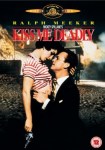
Kiss Me Deadly*, Robert Aldrich (1955, USA). This is one of a handful of classic noir films on the 1001 Movies You Must See Before You Die list, and I’d always assumed I’d seen it before at some point, probably because the title is so iconic. But nothing in it seemed familiar as I watched it, so I guess not. Actually, that’s not strictly true, as the maguffin in Kiss Me Deadly inspired the plot of Alex Cox’s Repo Man. Ralph Meeker plays two-fisted gumshoe Mike Hammer (a character I know best from the Stacy Keach incarnation of the 1980s), who is out driving on a lonely country road one night when he gives a lift to a young woman wearing nothing but a trenchcoat. Thugs then force his car off the road, take the two prisoner, knock out Hammer, torture the woman, then stage a car crash. Hammer survives. Determined to uncover who the woman was, and why she was murdered, he follows a series of clues, which eventually lead him to a beach house owned by a mysterious scientist, and a suitcase containing some radioactive material… which results in the film’s infamous ending – the beach house going up in a nuclear explosion. To be honest, it was all a bit ridiculous. Hammer has always been paper-thin as a character, and though Meeker made him more of a brutal thug than the white knight he’s usually protrayed, it wasn’t enough to make him interesting. The Wikipedia page points out many of the Bunker Hill locations used in the film have since disappeared, but that seems a pretty thin reason for inclusion on the 1001 Movies You Must See Before You Die list. I suppose a certain notoriety has attached to the film, despite its daft premise and incomprehensible plotting, and I did enjoy it… But I’m not convinced it should be on the list.

Privilege, Peter Watkins (1967, UK). After watching the slog that was Watkins’s La Commune (Paris, 1871) – all 345 minutes of it! (see here) – I wasn’t expecting all that much of Privilege, and the fact it’s a late sixties docudrama and a musical…, well, that didn’t bode too well either. But I was surprised to discover I loved it. Paul Jones, lead singer of Manfred Mann at the time, plays Steven Shorter, the UK’s most popular celebrity. The film opens, with documentary-style voiceover narration, as Shorter is welcomed back to the UK with a ticker tape parade. The film uses the same semi-documentary format, with occasional songs, as it follows Shorter’s career as a political tool to appease the masses and, later, a messianic figure to encourage church attendance and obedience. It’s all set in a 1970s dystopian UK, and Watkins is not afraid to use the completely absurd to make his point – the filming of the apple commercial, for example, is absolutely bonkers. I was reminded, while watching Privilege, of V for Vendetta, which covers similar territory, but uses fascist iconography as its dystopian credentials. Privilege, however, looks like it’s set in the same world as that inhabited by its contemporary viewers. Of course, it’s all tongue-in-cheek, although played beautifully straight – but it does make its point far more bitingly and effectively than V for Vendetta. I want my own copy of Privilege now.

Colossus: The Forbin Project, Joseph Sargent (1970, USA). I hadn’t planned to buy this. I knew of the film, but had never seen it before, and when a brand new edition – the first since VHS, I think – appeared, I fancied seeing it and so put it on my rental list. But then it appeared in a recent Prime Day at a price of great cheapness, and so I sort of found myself sort of clicking on the buy button… A Blu-ray too. And… it’s sort of fun in that early 1970s earnest science fiction B-list sort of way – ie, a serious film the studios never expected anyone to take seriously, although it was made with serious intent. Much like Planet of the Apes. The title refers to a massive computer, supposedly heuristic, and probably more like an AI as sf understands the term, which is put in charge the US’s nuclear deterrent. with no human oversight, or possibility of human intervention. What could possibly go wrong? The film – based on a novel by forgotten Brit sf author DF Jones – avoids the obvious consequences of such hubristic foolishness. It transpires the USSR has only gone and done exactly the same thing. And Colossus and the Soviet AI, called Guardian, begin “talking” to each other – in the film’s most technologically cringe-inducing scene – then form a gestalt and, well, take over the world, ushering in a new age of computer-led fascism. In actual fact, Colossus: The Forbin Project feels like a better-made film than it probably deserves. I can’t quite figure out why. There are no A-listers in the cast, what few special effects the film possesses are adequate and very much of their time (although the Colossus CCTV reticule is quite prescient), and the multiple scenes with the president of the US feel a little soap-opera-ish… I think it’s because the film takes itself seriously and doesn’t talk down to its audience. Yes, there’s plenty of expository dialogue, but it’s well-anchored in the story, and it’s only really its datedness that embarrasses (the aforementioned scene aside). I felt kinder toward Colossus: The Forbin Project after it had finished than I did while watching it, and while I love the aesthetics of early 1970s near-future movies, I don’t think this one is ever going to be a favourite…
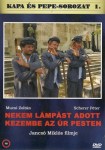
Nekem lámpást adott kezembe az Úr Pesten, Miklós Jancsó (1999, Hungary). This is the first of six low-budget semi-improvised comedy films written and directed by Jancsó after a long break from film-making. The films star a pair of gravediggers called Pepe and Kapa, played by Péter Scherer and Zoltán Mucsi. And, I admit, I’m not entirely sure what I watched. This is not an unknown consequence of watching a Miklós Jancsó film and, to be fair, it’s one of the reasons I like them so much. This movie (the title is a bit of a slog to type) opens with a group of men haring up in 4WDs, jumping out of them and then shooting some women and a man in a house. The action cuts to a cemetery, where Kapa and Pepe appear. They start chatting to two old men, Jancsó himself and Gyula Hernádi, the writer of many of Jancsó’s earlier films.  Kapa and Pepe, who wear insignialess blue uniforms, seem to spend most of the time arguing and insulting each other, in quite coarse language, often involving passers by in their disputes. Then there’s a funeral, followed by a wedding and… a new section starts, and now Kapa is a yuppie and Pepe is a policeman, but then he turns into a yuppie too, except Kapa can remember him being a cop and so is confused (he’s not the only one). The two gravediggers are not the only characters to re-appear, or change roles, as the victims of the opening shooting also turn up as Kapa’s family, but this time shot by his niece. Not that he seems overly bothered. And Jancsó and Hernádi turn up too, despite being killed earlier… And then Pepi is walking up the cable of a suspension bridge to the top of the tower, with nothing but a narrow handrail to either side (and it looks massively dangerous). Kapa joins him, and the two start to argue, and I had to look away as I suffer from vertigo and… well, I was lost. I don’t even know what the title – it translates as The Lord’s Lantern in Budapest – means or refers to (Kapa, in the guise of a corporate raider, calls himself “the Lord’s Lantern” after being shot in the head and coming back to life). The style is very different to the other Jancsó films I’ve seen, with cuts and close-ups and zooms and pull-backs, rather than long tracking shots and dolly shots. The acting is also much more natural, far less stylised – in fact, it’s pretty much what you would expect of a contemporary film. It’s all sort of bewildering, but in a completely different way to a film such as Electra, My Love, since the two main characters are not fixed – indeed in that earlier film, the characters are more or less concretized in mythology – but drift through a series of stories, maintaining their own identity even though there’s no narrative link from one story to the next. Despite being baffled by it, I’m glad I bought it. I’ll be watching this again, I think. And I’m looking forward to watching the five sequels…

The Canterbury Tales, Pier Paolo Pasolini (1972, Italy). Pasolini was one of those directors whose name I ticked off after watching the films of theirs which had made the 1001 Movies You Must See Before You Die list. But then earlier this year I watched his Saló, or the 120 Days of Sodom (see here), which proved far less gruesome than I’d expected (I’m extremely squeamish) and intriguing enough to persuade me Pasolini’s oeuvre was worth exploring further. So I stuck his Arabian Nights on my rental list, and a few weeks ago it duly arrived, I watched it (see here), and was much impressed. Enough to shell out for Six Films 1968 – 1975, a Blue-ray collection of, er, six films by Pasolini. And the first one, which I’d not seen, that I pulled from the box, was The Canterbury Tales. Annoyingly, I didn’t realise there was an English-language version of the film on the disc, so I ended up watching a film starring British actors dubbed into Italian with English subtitles. (Pasolini famously dubbed all his films into several languages.) And… I know of the source text, but I don’t know it, I’ve never read Chaucer. I don’t even know enough about it to judge Pasolini’s film as an adaptation. But I can judge it as a film and as a Pasolini film (based on the handful I’ve seen so far). In that respect, it clearly does everything Pasolini does, and it does them well. Perhaps the Chaplin pastiche/homage in ‘The Cook’s Tale’ is a bit too overt, and ‘The Reeve’s Tale’ does feel a bit too much like a 1970s British sex-comedy, although somewhat… earthier. I’ve also no idea where the film was shot – in the UK, certainly, judging by the cast, but all the locations certainly look the part.
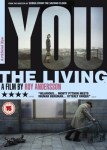
You, the Living, Roy Andersson (2007, Sweden). This is a sequel to Songs from the Second Storey, which I watched just before travelling to Sweden because it was, well, Swedish, although all things considered that might not have been too smart as it was  weird as shit… But I sort of enjoyed Songs from the Second Storey (see here) and I sort of enjoyed this sequel. Although perhaps “enjoyed” is too strong a word. As is “sequel”. Neither film is easy to describe. They have no plot, but are basically a series of vignettes, strung together with occasional linking material. The comedy is blacker than that really black thing they made earlier this year – or was it last year? – that’s the blackest thing ever, and Andersson shoots everything in sombre hues, and puts his cast in pale face make-up, which makes everything look even more miserable. You, the Living is worth seeing, although it’s unlikely to raise a chuckle, but make sure you’re in a good mood when you sit down to watch it.

1001 Movies You Must See Before You Die count: 875

6 Comments

Moving pictures 2017, #39

It pleases me when the six films I write about in these Moving picture posts are from six different countries. I mean, I make an effort to watch movies from nations other than the US and UK, but I don’t plan my viewing so meticulously that I hit six countries every six films. And it’s an odd bunch of films too. Half by directors I’ve seen films by before, and half that I knew nothing about when I slid the disc into the player…

Moonfleet, Fritz Lang (1955, USA). I’m pretty sure I read J Meade Falkner’s Moonfleet when I was a kid, so sure, in fact, I always get it confused with every book written by Wilkie Collins, even though the only Collins book which comes close, and that’s only in the title, is The Moonstone, which has nothing to do with Cornwall or smugglers and isn’t even set in the 1700s. Um, I see Wikipedia says of Moonfleet, “The book was extremely popular among children worldwide up until the 1970s”, which probably explains why I read it (I was a child in the 1970s). But this was Lang’s adaptation of the novel, a film that star Stewart Granger described as “a bloody awful film”, and it certainly isn’t a children’s film but more of a Hollywood swashbuckler. Sad to say, it’s easy to see why this film and Clash by Night (see here) aren’t actually readily available on DVD, despite being made by a director of Lang’s stature. A young boy is sent to Cornwall by his late mother into the care of an old flame. Unfortunately, said old flame, the local squire, is the head of the local smuggling ring. And the local magistrate is out to get him. The rest, despite the English source text, despite the German director, despite the mostly British cast (although it was shot on the MGM backlot)… is pure Hollywood historical. It has its moments, but Moonfleet is a Sunday afternooon film, and quickly forgotten.

Mughal-e-Azam, K Asif (1960, India). The cover art claims this film is in colour, but it was the only decent cover art for the film I could find. In actual fact, when released in 1960, Mughal-e-Azam was black and white. But in 2009, an extensive, and expensive, digital colourisation of the entire film was done. However, the edition I saw – a rental – was black and white, but for a ten-minute colour section in the middle, and another ten-minute colour section at the end. And, to be honest, given the sets and costumes and the abundant use of jewels and bright colours, I suspect 197 minutes of colourised Mughal-e-Azam would have burnt out my eyes. The film is considered a classic of Bollywood cinema, and it’s easy to see why. It’s set in the late sixteenth century. Emperor Akbar is desperate for a male heir, and walks barefoot to a shrine to pray for a son. Which he soon has. The son grows up to be spoilt and cruel, so Akbar sends him away to become a man. Fourteen years later, Prince Salim returns as a victorious soldier. Meanwhile, Akbar has got himself a new slave girl dancer, Nadira. Salim falls in love with her, and asks his father for her hand in marriage, but Akbar refuses. So Salim rebels, raises an army, there’s a big battle and Salim loses. He is sentenced to death, but if Nadira gives herself up, he’ll be spared. So she does and is entombed alive. But way back at the start of the film Nadira’s mother was granted a boon by Akbar, and she uses it now to save her daughter’s life – but the two must leave the country and spend the rest of their days in exile. This is a proper epic movie – the plot, the characters, the sets, the costumes, the cast of thousands (or at least what seems like one)… As a black and white film, it’s pretty good, but on reflection, despite my earlier comment, I think I probably would like to watch the colourised version. Mughal-e-Azam is a different type of film to Pakeezah, same basic Bollywood plot, of course, but more historical drama than romantic drama, and, despite also being filmed chiefly on massive sets, it doesn’t have that same slightly theatrical look of the other film (which was, to be fair, one of the chief attractions of Pakeezah). I’ve watched around two dozen Bollywood films by now, I think, and while I’ve enjoyed most of them, it’s the historical ones I’ve been tempted to buy my own copies – the Guru Dutt movies, for example, Pakeezah, and now perhaps Mughal-e-Azam

Tasuma, Daniel Sanou Kollo (2004, Burkina Faso). Sogo Sanou is an ex-soldier who fought in Algeria and Indochina for the French, and every month bicycles from his village into the nearest town to collect his military pension. Except it never arrives. Most Burkinabé ex-soldiers, it transpires, left the French army unaware they were eligible for a pension, so someone formed a Burkinabé organisation to apply for those pensions. But Sogo’s application has been delayed because bureaucracy. But he’s convinced that every time he bikes into town, it’ll be waiting for him. So much so, that on one trip he buys a much-needed motorised milling machine for his village from a local trader on credit. But his pension doesn’t arrive, the trader complains to the authorities and tries to re-possess the milling machine. Sogo is so pissed off with all this, he takes the local prefect hostage in his office, and demands he write a letter to General de Gaulle. “But he’s dead!” protests the prefect. “I know that,” says Sogo, “now start writing.” He’s easily taken by the police and thrown into jail. The women of the village then descend on the jail and, thanks to them, and the help of a friendly army lieutenant, Sogo is released. All of which leads to Sogo’s pension being expedited, relations with the trader mended, and there’s a celebration with music and dance at the village for all concerned. I’ve seen the film criticised in a review online as bucolic and a little too slavishly tied to a supposed “African formula”, which seems grossly unfair, if not a bit racist. Tasuma is certainly a product of its setting, and of the concerns which occupy the people in the village and town depicted. But that doesn’t make it formulaic. Anyway, Tasuma is a good film, perhaps not brilliantly directed or acted, but a lot of fun, makes a serious point, and has bags of charm. Worth seeing.

The Dance of Reality, Alejandro Jodorowsky (2013, Chile). Jodorowsky’s last film was 1990’s The Rainbow Thief, which was embarrassingly bad. He then spent two decades trying to interest investors in a sequel to El Topo, and various other projects, but failed. But in 2009, he turned to crowdfunding to finance a film based on his own childhood in northern Chile. That film is The Dance of Reality and… it’s actually pretty damn good. It’s also pretty much a recapitulation of all the ideas and symbolism Jodorowsky has used throughout his career. Jodorowsky’s grandson plays himself – Jodorowsky, that is – at age eleven, the son of a staunch communist and admirer of Stalin, who owns a lingerie shop in the Chilean port of Tocopilla. Convinced Alejandro is not manly enough, the father arranges various tests of his masculinity, which culminates in the boy becoming the mascot of the local fire brigade, accompanying them on a call-out to the local slums, and then breaking down at the funeral of a fire-fighter killed during that fire. In amongst that, you have a variety of life lessons taught to Alejandro by both real and symbolic characters. But it’s not so much the symbolism and imagery, these are things Jodorowsky has used both in his films and his bandes dessinées, and to anyone familiar with his work, they’re clear and obvious and play unambiguous roles in the story. But, more than that, The Dance of Reality actually looks pretty damn good too. The colours are vibrant, the tracking seamless, and the editing unobtrusive. The Dance of Reality is technically expert – and it’s an odd realisation to have while watching it because a) Jodorowsky’s films are better known for being bonkers, b) he hasn’t made a film for two decades, and c) the film is very nepotistic, with Jodorowsky’s three sons playing major roles and his grandson playing the lead. But it’s a good film. It’s a weird film, of course – but you expect that. And though I’ve seen all of Jodorowsky’s feature-length films (er, except the sequel to The Dance of Reality, titled Endless Poetry, which I have on the TBR (see here)), I was surprised at how well made The Dance of Reality proved to be. I’m now looking forward to watching Endless Poetry.

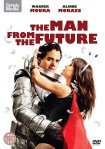
The Man from the Future, Cláudio Torres (2011, Brazil). I’ve no idea where I stunbled across this, but you can’t go wrong with a time-travel movie – even if they do all use the same damn plot – so I bunged it on my rental list. It was kinda fun, without ringing any fresh changes on the genre. I enjoyed it, but if you want to see a time-travel film there are better examples out there. Zero is a genius physicist who teaches at a university, much to his disgust, but is also experimenting on the side with a project to develop a new energy source. He is bitter and twisted, having never recovered, emotionally or mentally, from being humiliated at a university party twenty years before by his girlfriend of the time, Helena, now a world-famous model. It turns out Zero’s invention sends him back in time to the night of his humiliation, which he obviously tries to prevent by telling his past self what’s about to go down. But that changes the future and Zero wakes up in a new – to him – present, in which he is a multi-billionaire, has lost all his friends, and the love of his life, Helena, is in prison for drugs offences. So he has to go back in time again to correct his interference… You can see where this is going. It’s actually quite cleverly done, although the multiple iterations of the same short section of time, the aforementioned university party, do pall a bit. And Zero isn’t a great hero. But there’s a happy ending, so all’s well that ends well, so to speak.

To Joy, Ingmar Bergman (1950, Sweden). When I put this in the DVD player, I tweeted “am about to watch a Bergman film called To Joy and I think that title is probably a lie”… And within five minutes, the movie’s dialogue went something like “The paraffin stove exploded” and “Your wife died on the way to the infirmary”. So I guess I was right. Not joyful at all. Except, it sort of, well, is. Because the film immediately jumps back in time to when the two leads – the lead violinist and a violinist in an orchestra – first begin seeing each other. They had met at the academy but it’s only when he joins the orchestra that they fall in love and eventually get married. And the film follows their marriage, through its up and downs, and through the career ups and downs of the lead violinist, up to the point where they reconcile after a bad split and she takes the kids off to a holiday cottage with a paraffin stove… The film is set in Helsingborg, and the town features quite heavily, which gives the film less of a stagey aspect than many of Bergman’s films. The same is also true of the scenes where the orchestra rehearses, five minutes of just orchestral music, with no dialogue or narrative impetus. It’s not one of Bergman’s best, but it’s an interesting piece.

1001 Movies You Must See Before You Die count: 874


4 Comments

Moving pictures 2017, #38

I had a Reading diary post lined up next after my last Moving pictures post, but it takes me longer to write about books – chiefly because books take longer to read than films to watch, so I need to remind myself of the earlier ones in a post, and, also, a lot more happens in a book than in a film. I’m also working on a post about the Clarke Award, perhaps even the current state of awards, but I’m not even sure I’ll bother publishing that one. These days, no one gives a shit about honest criticism, reviews are indistinguishable from marketing hype, and fans are more concerned with protecting the ego of their creator friends than they are in any sort of real conversation about the genre. But who knows, perhaps I’ll end up in a ranty mood one evening… and publish and be damned…

But, until then, it’s…. the return of the film post! Only a couple of days after the last one! And the one before that! And it’s only the thirty-eighth I’ve written so far this year alone! (Out of probably about forty-two actual blog posts. Oh well.) The movies in this batch were all a bit random, chosen chiefly because I wasn’t in the mood to think too hard about what to watch.

The Woman Next Door, François Truffaut (1981, France). So I went and bought the François Truffaut Collection Blu-ray box set, because it was going cheap and I’d found myself increasingly drawn to his films, and of the eight films in the set I’d only seen four, so it was pretty much a bargain. And the first disc I pulled from the box was The Woman Next Door, a film about which I knew nothing. Although from the cover art, it clearly starred Fanny Ardant, whom I’d watched only the week before in, er, Truffaut’s Finally, Sunday, also in this collection (see here). The male lead is Gerard Depardieu, and while I’ve always thought him a good actor, in this film he seemed to shift between blank-faced and hyper-emotive, with nothing in between. He and his wife and small boy live in a house in a village near Grenoble. The empty next-door house is rented by a couple around the same age… and the wife, Ardant, turns out to be a woman Depardieu had had a turbulent relationship with before getting married. Their affair rekindles, but it doesn’t go well. He kicks off at a barbecue with the neighbours, she has an incident at the local tennis club… Much as I enjoyed The Woman Next Door, it felt like many of its narrative hooks were left unexplored or unresolved. Ardant was good, as indeed were the supporting cast, but I wasn’t convinced by Depardieu… And the end result was a film that promised more than it delivered. Even the final shock twist felt a bit meh, given what had gone on before. I still admire Truffaut for his films, but this isn’t one of his best ones; and though its slick performances might convince some that is the case, he’s made much better.

The Lavender Hill Mob*, Charles Crichton (1951, UK). I had a feeling I’d seen this before, but I couldn’t remember the details… and when I came to watch it, pretty much everything in it was immediately familiar. Alec Guiness plays a mild-mannered bank clerk whose job entails fetching gold bullion from a foundry, and accompanying it in an armoured lorry to the bank. He’s completely trusted, but he’s planning to steal a shipment of gold just before he retires. His only problem is how transport the stolen gold out of the country. When the owner of Gewgaws Ltd, a company that makes tourist trinkets, moves into the boarding-house in which Guiness lives, he has his answer. Among the souveniers Gewgaws manufactures are gold-painted lead miniatures of the Eiffel Tower, sold in Paris. By making a consignment out of real gold, they can send them to France undetected. To help them in the robbery, the two recruit a pair of criminals, using the Gewgaws premises as a honeypot by talking loudly about a broken safe there, full of wages, on the Tube. The robbery goes more or less according to plan – there are a few hiccoughs, but the police are clueless, so it all comes right in the end. Until they get to France… and discover their Parisian contact has sold six of the real gold Eiffel Towers… to a party of British schoolgirls. And it’s the robbers’ attempts to get back those missing Eiffel Towers that proves their undoing. Ealing Studios have always been well-branded, and it’s easy to see why – their films are very distinctive. There’s a breeziness to the comedy in them, despite their obvious Britishness, that no other studio of the time managed. It’s almost a a sketch-show type of humour, but grounded in quickly- but effectively-drawn characters that carry over from one set-piece to the next. It is, in other words, jolly good fun. And if it all seems a bit implausible in places, that’s the part of the charm. But I’m not entirely sure why it rates a place on the 1001 Movies You Must See Before You Die list.

Blow Out, Brian De Palma (1981, USA). I’ve never really known what to make of De Palma. He’s pretty much a straight-to-video director who manages to get theatrical releases, a sub-B-lister who is treated like a low-level A-lister. It’s not as if he makes bad films, although his use of split-screen is an affectation too far, but his movies mostly seem massively unoriginal. Blow Out is, apparently, De Palma’s homage to Antonioni’s Blow-Up, but if it is then De Palma has either never seen Blow-Up or has completely misunderstood it. Travolta plays a sound technician who is out one night recording ambient sound for the latest straight-to-video schlock horror movie he is working on, when he witnesses a car plummetting into a river. He dives in and rescues one of the passengers, a young woman. The other, who dies, proves to be a politician tipped to be the next president. Travolta analyses the recordings he made on the night, and realises there is a gunshot before the car lost control – someone shot out a tyre. The rest of the movie is Travolta trying to figure out what’s going on, while a hired assassin runs round trying to clean up the mess he has inadvertently made, and it’s all pretty much by-the-numbers thriller material. Lithgow is creepy, but not especially plausible, as the assassin, the parts about the film industry feel more like in-jokes than character development or background, and the dimwittedness of some of the characters contradicts their ability to avoid the noose the conspiracy is drawing about them. I have no idea why I stuck this on the rental list.

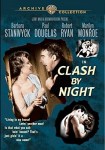
Clash by Night, Fritz Lang (1952, USA). I mentioned several Moving pictures posts ago that I’d been making an effort over the last few years to see every film directed by Otto Preminger. The same is true for Fritz Lang. Their shared nationality is a coincidence. As are their Hollywood careers as chiefly directors of well-regarded noir films. With Lang, you have those early silent classics, not to mention the Mabuse trilogy, or even the frankly bizarre India-set pulp adventure movies on which he finished his career. But, like Preminger, during his Hollywood years Lang made a wide variety of films – yes, including a couple of Westerns… and melodramas… like Clash by Night. Which is, er, not very good. Barbara Stanwyck plays the wild girl who returns to her fishing port home after years living it up away. She falls in with simple trawler captain Jerry, who introduces her to his wise-cracking mate, Earl, the projectionist. Earl is clearly more Stanwyck’s type, but she marries Jerry. But then Earl is a nasty piece of work, so it’s easy enough to understand why she rejects him. Although only for a few years… and then the marriage begins to fracture when Stanwyck does indeed take up with Earl… This is one of those gritty urban melodramas the US churned out by the yard back in the first half of the twentieth century, in which middle-class problems were ascribed to working-class families, but with added domestic violence. There is a horribly offensive thread running throughout this film in which men claim the only way to control their spouses is through violence. The relationship between Marilyn Monroe and Keith Andes (Stanwyck’s “brother”) basically consists of him controlling her through threats of violence. It’s nasty stuff. There are some classic US melodramas from the 1950s. This is not one of them. Despite its director. Best avoided.

In Bloom, Nana Ekvtimishvili (2013, Georgia). I can’t remember where I came across mention of this Georgian film, but I suspect it was a trailer on another DVD. The directors are actually given as Nana Ekvtimishvili and Simon Groß, but given that the former has a Wikipedia page and the latter does not, and the latter is also credited as a producer, I’m tempted to cast Groß as more of a facilitator… except it turns out the two are a couple, so perhaps it’s even more complicated. Still, this is a film set in Georgia, about Georgian people, and Ekvtimishvili is given preference as director, and she is actually Georgian, so I will do the same and credit her with the lion’s share. (And kudos to Groß, he seems content to let his partner represent the two of them.) Two fourteen-year-old girls get into trouble when one of them gets hold of a gun and uses it to rescue a younger kid from a bullying. Except it’s not about that, it’s about growing up during the Georgian Civil War, and about being a teenage girl during those turbulent times, and this is by no means a cheerful film, and certainly not one likely to re-affirm your confidence in humanity’s good nature – these days, the only films which do that are superhero ones, and they only do it for superheroes, so how fucked up is that? But there’s a rawness to Ekvtimishvili’s vision that lends her story a verisimilitude Hollywood could only dream of (this is not something unique to In Bloom, but it is something Hollywood strives for and fails to achieve). A depressing story, but worth seeing.

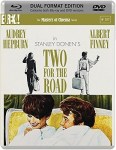
Two for the Road, Stanley Donen (1967, UK). Apparently eureka! have released a dual edition of this film, but the rental copy I watched was a terrible transfer, no better than VHS quality in places. And, to be honest, I’m not entirely sure why it deserves the treatment eureka! have given it. It’s pretty much a couple bickering, in cars, over a decade. Okay, so the chronology jumps back and forth quite cleverly, and the way the film signals at which stage of the relationship/marriage it is set works really well (er, it’s the model of car). But it’s still two people bickering. And it’s not helped by the choice of leads. I’ve never really taken to Albert Finney – he plays everything flat and snide, and it makes him unlikeable. When he tries for charm, as he often does here, it often falls flat, especially when he’s doing his terrible Bogart impression. Finney does some things really well, but romantic lead isn’t one of them. Audrey Hepburn, on the other hand, should be a natural romantic lead – and indeed has been in many films. But here she’s playing a woman from callow teenager to jaded housewife, and it’s beyond her range. She does either end of the spectrum well, but she can’t manage the transition – or rather, the transition doesn’t seem convincing when it happens to her. Of course, it doesn’t help that the version I saw was a terrible transfer. Perhaps there were subtleties I missed. Certainly, the film’s structure was cleverly done, and there were some good lines of dialogue (and an amusing running joke about Finney and his passport), but the couple also went from young and hapless to privileged and insulated with a speed and lack of commentary that is almost breathtaking (although not altogether surprising given the time the film was made). I wanted to like Two for the Road, either as fluff or as something a bit more serious… but it failed on both counts. One for Audrey Hepburn fans only.

1001 Movies You Must See Before you Die count: 874


6 Comments

Moving pictures 2017, #37

To people visiting this site after following the link from the Apollo Quartet audio book humble bundle (here), apologies. I normally write about science fiction and writing and critcism and sometimes even space exploration and technology… but for the past 18 months the $dayjob has sort of taken over and this blog has sort of turned into a film blog. I like films, I’ve always liked films. And I like to think I have good taste in films. I especially like films from other cultures, or from directors with very distinctive visions – auteurs, if you will. So, sadly, I’ve been blogging a lot about films for the last year or so. Normal service will be resumed at some point. Then I’ll starting writing criticism and stuff about science fiction, I’ll have the bandwidth to to invest in that sort of stuff. But, for now, it’s movies mostly. But they are good movies. Mostly.

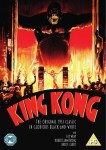
King Kong*, Merian C Cooper & Ernest B Schoedsack (1933, USA). Everyone knows the story of King Kong – you know, giant ape, “was beauty killed the beast” – although it’s likely from one of the remakes. The one I remember best is the Jessica Lange one from 1976… although, I say “remember”, but all I can actually recall is the basic story – you know, giant ape, “was beauty killed the beast”… This 1933 edition is the original, made by the guys who actually invented King Kong. A film director known for making adventurous and dangerous films is about to embark on his latest project, shooting on an island whose location he refuses to reveal. He has decided his project needs a love interest but can find no actress willing to accompany him on his expedition/shoot. Desperate, he goes looking for a suitable star on the night the ship he has chartered is due to depart… and stumbles across homeless Fay Wray, who is more than happy to accept his somewhat vague offer of employment. The ship sails to an uncharted island somewhere in the Pacific, where the natives worship a giant ape called Kong, and sacrifice young women to it at intervals. When the natives catch sight of Wray, they know Kong just gonna love her. (Why? Kong is a gorilla. Surely he lusts after, well, other gorillas?) The natives kidnap Wray and leave her for Kong. First mate on the ship and male love interest charges off to rescue her. There’s lots of stop-motion photography of Kong fighting dinosaurs. For 1933, it’s pretty effective. The hardy Americans manage to capture Kong, and take him back to New York to exhibit him to an eager audience… This is pure pulp, and unashamedly so. And, I guess, it could qualify as seminal, given that King Kong himself has become a cultural icon. And I can certainly understand the argument that seminal movies, as well as ones that are just plain excellent, belong on the 1001 Movies you Must See Before You die list… And, let’s be fair, King Kong is pretty trashy, but it’s entertaining trash and it never claimed to be anything more (unlike some of its remakes kof kof). I’ve now seen it, I’m glad I’ve seen it, I’ll likely never ever see it again, but that’s okay.

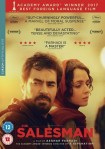
The Salesman, Asghar Farhadi (2016, Iran). The title refers to Arthur Miller’s play, as the film’s two leads are rehearsing for a production of it in Tehran in which they play the chief roles. The film opens with their family fleeing from their apartment building as the tenants are afraid it is about to collapse – a wall has fallen over, and building standards are apparently so poor in Iran it’s not uncommon for the entire building to follow suit. Forced to find another home, they turn to a fellow cast-member, who offers them a recently-vacated apartment in his building. So they move in. The other tenants in the building, remembering the previous tenant of the apartment, are a little worried, because, well, because of what happens. One evening, on her own in the flat, the wife takes a shower. The entryphone buzzes. Thinking it’s her husband returning from the supermarket, she presses the button and unlocks the front door. It is not her husband. And when he does arrive home, he finds his wife is missing and there is blood in the bathroom. She’s in hospital, having been assaulted. She doesn’t know who her assailant was. But he’d been surprised by neighbours, and ran off, leaving his pickup truck behind. So the husband uses it to track the man down… You can imagine how this would go if it were made in Hollywood, with either Bruce Willis or Liam Neeson… Happily, it doesn’t do that. The wife wants to forget about the incident, the husband wants revenge. And when he identifies the attacker, he sets out to have his revenge, only for that to go not as intended. I know of ‘Death of a Salesman’, but I’m not that familiar with it, so how it integrates into the story of the film is lost on me. I suspect the two stories resonate off each other, but I’m guessing – you don’t see enough the play in the film to judge. I was less than taken with Farhadi’s film prior to this, The Past, which felt like an ordinary French drama, but The Salesman is much, much better, a return to the films Farhadi had been making before.

Sofia’s Last Ambulance, Ilian Metev (2012, Bulgaria). The title is a bit of a fib, as this documentary doesn’t follow the actual last ambulance still operating in the Bulgarian capital, although the fleet is a fraction of what it once was. It’s the age-old story: a civilised society creates free healthcare for all… but then in come the capitalists and rentiers and plutocrats and they know people will never refuse to pay for medical care so they defund and destroy the public system, then mendaciously claim it doesn’t work, and so privatise it, thus earning themselves great profits. This should be made a crime. It’s no better than selling arms – worse, in fact, because people can choose not to pull the trigger, but they cannot choose not to be ill or injured. It’s past time for a change in attitude: profiting from healthcare is the action of scumbags. Anyway, Sofia’s Last Ambulance follows a single ambulance over several days. The camera remains focused throughout on the crew, and the patients are never revealed. Many of the scenes show them sitting in the cabin of their ambulance. Judging by the way the vehicle bounces around, the roads in Sofia are also in a shocking state. There are several scenes also set in the back of the ambulance, including one where a man involved in a RTA is in severe pain and keeps on sitting up, despite being repeatedly told not to – so much so, the paramedic tells him, “If you don’t lie down, you’ll leave your leg here on the stretcher!” (or words to that effect). The scariest part about Sofia’s Last Ambulance is that it’s a pretty good indication of what the NHS will look like post-Brexit, post- a decade of Tory cuts and corruption and robbery and lies. I’m actually starting to look back on Thatcher’s government with fondness, that’s how incompetent, malicious, corrupt and damaging both Cameron’s and May’s governments have been, and still are being. Their excuses are so thin, only a moron would swallow them. Bah. Sofia’s Last Ambulance: an excellent documentary. The UK’s Conservative government: a bunch of criminals that has repeatedly abused human rights.

Children of Heaven, Majid Majidi (1997, Iran). While there’s no mistaking Iranian cinema, I do sometimes have trouble distinguishing its directors – well, mostly. Children of Heaven, for example, reminded me of The Apple, but that was directed by Samira Makhmalbaf. And while Kiarostami possessed a singular vision, it was evident more in the structure of his films than in the shots he framed or the stories he told. Of course, there’s always a danger in confusing characteristics of a nation’s cinema with the visions of individual directors. After all, not every film made in India is three hours long and features singing and dancing. And while I’ve seen a number of films from Iran – twenty-one, at the last count – I doubt that’s enough to get a true handle on the film-making traditions in the country. After all, in this Moving pictures post alone, there are two Iranian directors, Majidi and Farhadi, and both create very different films, but both of which seem, to me, very much portraits of their country. In Children of Heaven, a young boy and his younger sister are forced to share a pair of ratty old plimsolls – because the sister’s shoes were stolen when the boy was on way hone from picking them up from the cobbler. The shoe-sharing results in the boy being late for school several times, and also several amusing incidents with the girl losing one or the other plimsoll (as they’re too big for her). But then she spots her old shoes on another girl’s feet, and follows her home. But she can’t work up the courage to claim her shoes back, and the girl seems in innocent of the theft anyway. The boy’s school then announces there is a nation-wide children’s 4-km running competition, the third prize for which is a holiday and a pair of Adidas trainers. The boy enters, and wins a place on his school’s team. He wants to win third prize, so he can have the trainers, and his sister then have the ratty plimsolls for herself… For a film whose two leads are under the age of ten but operating in an adult world, it comes as no surprise that Children of Heaven is big on charm. There’s not a great deal in the lives of the working-class Iranian in Tehran that’s actually charming per se – their father has to beg for work, and goes round pressing on entry buzzers at big houses asking for gardening work. and, to be fair, the whole plot hinges on the fact the family cannot to keep the two children properly shod. But the two kids are absolutely fantastic in their roles, and seeing how well they handle their parts actually makes the movie quite uplifting. They’re all in tears at the end, and they’re not tears of happiness, but it’s nonetheless a happy ending. I forget now why I added this film to my rental list, but it really is very good. Definitely worth watching.

Once upon a Time in Anatolia, Nuri Bilge Ceylan (2011, Turkey). I forget also why I added this to my rental list – or rather, I forget who recommended it and when. I’ve watched less than half a dozen films from Turkey, but I know Ceylan’s name from Uzak, which I watched back in 2012. And I remember it as being very good. Which ended up making Once Upon a Time in Anatolia something of a curate’s egg. It feels in part like an attempt at a Tarantino film (but why would anyone want to do that?), and follows a plot that could take place just about anywhere… yet it’s still peculiarly Turkish. The police have driven two murders out into the country to dig up the body of their victim. But the murderers are having trouble remembering precisely where they buried it. Meanwhile, the police talk among themselves, sometimes in Tarantino-esque dialogue, sometimes in the sort of elliptical hypothetical story more common in East European/West Asian films and stories. Eventually, the murderers take the police to the right place, and they dig up their victim. But then they realise they have no body-bags, and the corpse won’t fit in the boots of their cars. Ths is a film in which the story being told is actually incidental to the dialogue – the hunt for the murder victim’s buried body just provides structure, everything is in the conversations between the principals. And the problem with such films is that because the dialoguie skips all over the place, there’s no real structure to the story. Once upon a Time in Anatolia works because the hunt for the body is surreal enough, and yet real enough, to provide a framework for the dialogue. And some of the dialogue also links back into the framing plot – such as the one about the man whose wife died of mysterious means on the day she said she would die, and how an autopsy revealed she’d had a heart attack but not how she’d been able to predict it – and that connects to the autopsy of the murder victim and its findings. A good film. I think I’ll add the rest of Ceylan’s oeuvre – he’s made seven feature-length films, all of which are available – to my rental list.

Eroica, Andrzej Munk (1958, Poland). Munk’s Passenger is an incomplete classic of cinema, but he apparently managed to finish three movies, of which Eroica is the second. Though the the title refers to a piece of classical music – by Beethoven – its alternative title of “Heroism”, while obvious in the way US publishers like to be obvious, does explain its story better. The film consist of two separate stories, both of which take place in Poland during WWII. (There was apparently a third segment, but Munk cut it, and it eventually appeared on Polish television fourteen years later.) In the first story, a con-man deserts from his home guard unit and returns home to discover his wife has taken up with the commanding officer of the Hungarian company garrisoned locally. The Hungarian tells him he’s willing to change sides, and bring his men and artillery over to the Poles. So the con-man – called Dzidziuś, which Google translate tells me means “baby”, but which the subtitles translate as “Babyface”, an odd name for a man in his thirties – must walk to Warsaw to tell the Home Army about the Hungarian’s offer. And then head back home to offer terms, and then back again to give the Hungarian’s response. The second story is set in a POW camp. A Polish officer allegedly succeeded in escaping, the only one to do so, and his success has been good for morale. Except, he didn’t escape, he’s been hiding in the attic all the time. But those who know this can’t reveal it because he would then be taken by the German guards and, of course, it would be bad for prisoner morale. Meanwhile, the other prisoners make assorted fruitless attempts to escape. The story focuses on a group of officers sharing a single bunk-room – the camp comprises stone buildings, rather than the wooden huts more commonly seen in such films – as seen thrugh the eyes of two new prisoners assigned to the room. It doesn’t take a genius to see how the alternative title applies, although they’re typically Polish, and blackly comic, definitions of the term: the man who performs heroic deeds simply in order to have an easier life, and the hero whose reputation rests on a deed that was a lie. Another solid entry in the Masterpieces of Polish Cinema volumes.

1001 Movies You Must See Before You Die count: 873


2 Comments

Moving pictures 2017, #36

I watch on average two films a night. I’ve pretty much given up on broadcast and cable television, which is a shame as there are programmes on there I’d like to see. But with 200-odd channels, it’s almost impossible to find when and where they might be. I used to buy a newspaper every Saturday so I had a TV guide, but it was a piss-poor guide and only included about a tenth of the channels. I tried buying one of those TV guide magazines, the one that’s only about 65p and seems to be mostly about soap stars (oh wait, they’re all mostly about soap stars)… Anyway, they have schedules for far more channels than I have access to, so finding what I wanted to watch was no easier. I’ve also tried using tvguide.co.uk, but it’s horribly designed and never seems to remember my settings. I suppose these days people use Tivos and YouView boxes and such, and they have the facility to calendar and/or record programmes… but Virginmedia refuse to give me a Tivo and I even had to wait until my old set top box broken before I was given a HD one. Bah, technology.

On the other hand, I do get to watch a large number of (mostly) great films, with a much greater variety in topics, locations and languages. So it’s not like I’m losing out.

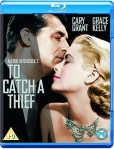
To Catch A Thief, Alfred Hitchcock (1954, USA). Hitchcock is one of my favourite directors, I have about eighty percent of the films he made – and he made a lot of films. As far as Hitchcock movies go, To Catch A Thief is a bit of fluff, which has been over the years its chief appeal. It’s the Hitch equivalent of Graham Greene’s “entertainments” – although that would presuppose Hitch made other films of the same ilk, and it’s hard to think of which might qualify – The Trouble with Harry, perhaps? Nonetheless, To Catch A Thief is so much lighter than his usual fare, which is probably why it’s great fun. Cary Grant, at his most teabag-tannish, is a retired cat burglar living on the French Riviera. But someone has been stealing the jewellery of wealthy guests to the region and everyone assumes Grant has come out of retirement. He’s determined to prove his innocence. So he teams up with an agent of an insurance company, and gets to know a rich US widow and her nubile daughter (Grace Kelly). Grant is at his most oleaginous, but it actually feels a little creepy in this, which is not something I’d noticed before. Perhaps it’s because I’ve seen so many early Grant films since last watching To Catch A Thief. Kelly is great – it’s one of her three best roles, along with Rear Window and High Society  – and the supporting cast are all top-notch. It’s all pure Hitchcock from start to finish, from the adept use of location shooting to studio close-ups, from the script full of misdirection to hints at a back-story.  It’s the setting more than anything that makes it feel like fluff. I only mention this in this film post because I recently bought a Blu-ray copy of the film – it was only a fiver (but not anymore, I see) – and I have to admit it’s a very nice transfer. The richer colours don’t work in everyone’s favour – Grant looks like he’s been creosoted – but it’s a superior print to the one on my DVD. Well worth £5.

Tabu, Miguel Gomes (2012, Portugal). I think I stuck this on my rental list because it was a Portugese film, although apparently it was at some point one of the most internationally successful Portugese films of all time. And while it reminded me in several ways of another Portugese film I’d seen, Manoel de Oliveira’s Eccentricities of a Blonde-Haired Girl (see here), so much so I wondered if the similarities were actually a characteristic of Portugese cinema, it also reminded me a great deal of Jauja (see here), which is from Argentina… Tabu opens with a prologue set in the nineteenth century in Africa – it doesn’t say where, but it’s implied it’s Lusophone… so Angola or Mozambique? – in which a man hunts a crocodile following the suicide of his wife, is killed by the crocodile, and henceforth there are sightings of a ghostly woman and a crocodile. The film abruptly shifts to present-day Lisbon and a trio of women. The oldest of these, Aurora, is eccentric, and when she goes into hospital and is near to death’s door, the other two women at her request track down a man called Gian-Luca… and the film flashes back to Aurora’s early twenties in Portugese Africa… where she married a local land-owner, but then had an affair with Gian-Luca, and nearly died in childbirth. The whole film is shown mostly with a voice-over standing in for dialogue. It gives the story a literary feel, but also distances the viewer, something I also noted about Eccentricities of a Blonde-Haired Girl. The thing is, it’s so different to most popular narrative cinema that, if it is a peculiarity of Portugese cinema (and, admittedly, I don’t know that it is), then I have to wonder how Portugese film-goers actually, well, view films. Imagine someone who had been brought up on entirely on nineteenth-centiry literature being given a modern best-seller to read. It feels like that. Which is not to say that Tabu is a bad film. On the contrary, it’s very good indeed. And if the prologue never really quite justifies its place in the story, it’s well presented and entertaining. Otherwise, the present day sections are not so interesting, but the flashback is good – the actor playing the young Gian-Luca, Carloto Cotta, is especially good. I added Tabu to my rental list on a seeming whim, you can add it to yours knowing it was recommended. Worth seeing.

Daughter of the Nile, Hou Hsiao Hsien (1987, Taiwan). I’m a big fan of Hou’s films, and have been ever since stumbling across his name somewhere, ordering a box set of his DVDs from Korea on a whim, and watching them and discovering how bloody good they are. He’s made a lot of films, and their availability in the UK is… Random, at best. Perverse, possibly. Happily, eureka! have just released a dual edition of one of his films, so that’s one I can cross off the list. Daughter of the Nile is a very Hou film, amost emblematic of his style without being representative of his oeuvre – if that makes sense. Hou makes films about the disaffected, as do the Sixth Generation Chinese directors, although Hou is, obviously, Taiwanese not Chinese. But Daughter of the Nile is also about affluence and adulthood, and while Hou does his thing with static shots and long shots – and it’s a style I very much like myself – Daughter of the Nile does feel more… kinetic than others films by Hou I’ve seen. Maybe it’s the gangster sub-plot… The main story describes a young woman who works at KFC, attends night school, and must look after her younger brother and sister. He’s the gangster. And he provides the film’s few moment of real drama – a shooting touside a night-club being one. I’d forgotten while watching the film that it was released in 1987… until a character pulled out a pager and then rang someone on a dial telephone. The fashions weren’t especially eighties, and usually films made in the 1980s look very eighties. But that’s more of an observation than a criticism. I think I’ll have to watch Daughter of the Nile again some time. Happily, Hou’s films bear repeated watchings.

Goodbye Gemini, Alan Gibson (1970, UK). I saw a trailer for this on a rental DVD, Say Hello to Yesterday (see here), and thought it worth seeing… and luckily managed to find a copy on eBay for a few quid. And, well, it’s okay, I guess. It’s very much a film of its time. A pair of twins arrive in London from South America, immediately arrange for the – murder? I’m not sure – of their housekeeper/guardian, go out pubbing and run into an unsavoury crowd. Well, not really unsavoury. They’re movieland 1960s swinging Englanders, into Johnnie Walker, flares, sideburns, fatuous dialogue and a social scene in which all men over the age of thirty are depicted as camp chickenhawks but no one is actually gay… Anyway, it seems the twins like each other a bit too much, and when the female of the pair falls for a gambler and wastrel, who then tries blackmailing the male of the pair, it all ends badly. While Goodbye Gemini was every bit as 1970 as Say Hello to Yesterday, it didn’t have Minis or silver birches. In fact, it looked generic 1960s. It did well on ther fashions, but less well on the scenery. So-so.

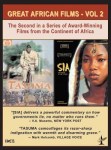
Sia, The Dream of the Python, Dani Kouyaté (2001, Burkina Faso). There are, to date, four volumes of Great African Films, each containing a pair of movies, and I plan to get hold of copies of all four. But they’re not easy to find. Well, in the US they seemingly are, but the company responsible for them seems reluctant to sell outside North America… Which is a shame, as these are are Region 0 DVDs and well worth seeing. I tracked down a second-hand copy of the first volume – Haramuya by Drissa Toure (Burkina Faso) and Faraw: Mother of the Dunes by Abdoulaye Ascofaré (Mali) (see here and here) – and  the raw potential of the two films more than justified the hassle and expense in finding copies. And while this second volume was no easier to find, although at least this one was new, the pure film-making story-telling of, at least, Sia, The Dream of the Python, proves it was another good purchase and well worth the expense. The story is relatively straightforward. It;s based on, apparently, a seventh-century myth, but there’s no real indication of when it is set. Some elements of it feel contemporary, some feel historical. Basically, a man’s daughter is earmarked for sacrifice to the python god, but she runs away the night before. The king’s troops fail to find her. Then her boyfriend, a powerful warrior, returns from the front, and overthrows the king and takes the throne. And it’s like watching half a dozen bog standard fantasies played out in their ur-version in a world that is richer and more real than the authors of said fantasies could ever conceive. It’s a not a perfect film, by any means. Some of its cast are plainly amateur, and it often promises more than it can deliver on its budget. But these Great African Films DVDs are definitely worth tracking down, and certainly belong in the library of self-respecting film fan.

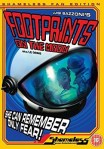
Footprints on the Moon, Luigi Bazzoni (1975, Italy). Sometimes you see a film and you think, I’ll have a bit of that, and then when it arrives you wonder why you picked it in the first place. I’ve watched several giallo over the years – both those classified as thrillers and those classified as horror – and some I’ve enjoyed while others I’ve thought were trash. Footprints on the Moon certainly has arresting DVD cover art, and an opening credit sequence in which a black-and-white LM descends onto the lunar surface, so surely it has to appeal… And I’ve watched it twice now and I think goddamnit I’m going to buy myself a copy because it’s a hidden gem and bears rewatching. It’s a giallo,  no doubt about that; but it’s one of those rare giallos that falls into no known genre. A woman who works as a translator discovers she has mysteriously lost three days. She finds a postcard from a holiday island that has fallen on hard times, and goes there. Where she is repeatedly mistaken for a woman who looks exactly like her but who was on the island several days previously. The plot resembles a psychological thriller with a twist in which the writer hadn’t quite thought everything through properly. But the decision to film the scenes on the “island” in Istanbul gives the whole film a sort of, well, Hav-ish feel, which, unintendedly, has made the place much more interesting. The invented island has become an even more so invented place. This is only confused further by the protagonist finding, and then wearing, a wig which makes her look precisely like the woman for whom everyone is confusing her. Add in a bizarre subplot, which gives the film its title, in which the woman dreams of a secret project where an astronaut is left to die on the Moon, and which is where top-billed star Klaus Kinski briefly appears… And, well, it’s completely insane. I can see I’ll be spending a lifetime defending this film, but I really do think it’s a forgotten classic. Go and rent it.

1001 Movies You Must See Before You Die count: 872


4 Comments

Moving pictures 2017, #35

I was described recently as a “film nerd”, which felt wrong somehow. I’m a “film fan”, certainly. In much the same way I’m a science fiction fan. I’ve been a subscriber to Sight & Sound since the late 1990s, and when I’ve liked a director’s work I’ve tried to watch as much as their oeuvre as I can find. The first director for which I did this was Alfred Hitchcock. Back in the late 1990s, when I was living out in the Middle East, I visited the UK one leave, and bought two DVD box sets of his films – the box sets, in fact, I recently upgraded to Blu-ray. My taste in movies has changed a bit in the years since I bought those Hitchcock DVDs, so much so that I now have to look a bit further afield for the sort of films I like to watch. Although I do still think Hitchock is an excellent director. But sometimes – often – I have no choice except to purchase a copy from some obscure source, because it’s not available for rental, streaming, or in your local HMV. I don’t think that makes me a film nerd – although, to be fair, I do currently own rather a lot of DVDs and Blu-rays…

Cyclo*, Tran Anh Hung (1995, Vietnam). There is only one Vietnamese film on the 1001 Movies You Must See Before You Die list, and it’s this one. I’ll admit I’ve seen very few Vietnamese films – in fact, this is only the second. Although, weirdly, it’s the second film I’ve seen by Tran – I reviewed his 2009 film, I Come with the Rain, actually a French film, for videovista.net several years ago. Anyway, I find it hard to believe the compilers of the 1001 Movies You Must See Before You Die list could find six films by Vincente Minnelli to include but only one from Vietnam. But it is, it must be said, a good one. The title refers to the profession of the main character – he pedals a bicycle taxi, or “cyclo”, about the streets of Ho Chi Minh City. He is not named throughout the film. His father died in a traffic accident some time before. He lives with his grandfather, who repairs bicycle tyres for a living, his older sister, who carries water in a local market, and his young sister, who shines shoes in local restaurants. They are dirt poor and pretty much live hand-to-mouth existence. But then the cyclo gets involved with gangsters, and his prospects start to look up. But it all goes horribly wrong when he is asked to kill someone but fails after overdosing on the drugs he was given to “calm him down”. This is all pretty grim stuff, and the way the lower levels of society prey on each other, facilitated by those with means, is hard to watch. At one point, the cyclo driver stops for a piss, and while he’s peeing against a fence, thieves run up and steal his cyclo. Given how much he depends on his cyclo, and how little he earns, and the fact hge doesn’t even own it but has paid a deposit to the owner of a cyclo company so he can use it… well, that’s pretty low. Of course, it’s always in the monied classes interests to have the lower classes fighting amongst themselves, because then they’re not fighting for what should rightfully be theirs. Cyclo certainly belongs on the 1001 Movies You Must See Before You Die list, but I’d like to have seen more films from Vietnam on it. I shall definitely be keeping my eye open for more movies from that country that I can watch.

Forever Amber, Otto Preminger (1947, USA). For some reason, I decided to work my way through Preminger’s oeuvre… and it’s not a bad oeuvre for a Hollywood director, especially a non-US-born Hollywood director (of which there were, and are, many). Although best known for noir movies, Preminger’s films are especially interesting because of their variety, and their varied levels of success at whatever he made – Preminger’s one Western for example, was River of Now Return (see here), which was something of a failure but is still quite an interesting film. And Forever Amber, despite being a historical romance based on a schlocky best-seller, is nearly an interesting film. The same might also be said of Preminger’s attempt at a Euro-thriller, Rosebud. But, Forever Amber… The title character is the adopted daughter of a farmer in seventeenth-century England. After the Restoration, Amber, now a sixteen-year-old beauty (played by the twenty-three-year-old Linda Darnell) meets a Cavalier captain, and follows him to London. She starts moving in high circles, but no sooner has she found wealth then she is conned out of it and sent to Newgate. Her cavalier captain, meanwhile, has been a given a ship and sent privateering. She breaks out of Newgate with a footpad, and the two go into partnership, she luring and he mugging fops in dark alleys. The Watch catch her, but the captain gets her a job as an actress so she won’t hang. An earl takes a fancy to her after seeing her on the stage and marries her. But she still pines for her absent cavalier captain… The film is an adaptation of a 1944 best-selling romance by Kathleen Winsor. It was her first novel. Wikipedia says of the book: “The fifth draft of Winsor’s first manuscript of Forever Amber was accepted for publication, but the publishers edited the book down to one-fifth of its original size. The resulting novel was 972 pages long.” WTF. Winsor went on to write a further seven novels, the first appearing six years after Forever Amber, and the last in 1986. It’s clear from Forever Amber, however, that she didn’t know much about seventeenth-century England. Rags to riches might be a romance staple plot, but Amber’s ups and downs beggar belief. And for a farm girl to end up married to an earl! While working as an actress! True, this is around the time Nell Gwynn first started appearing on stage  and later became the king’s mistress – but she was still under twenty and Amber would be almost a decade older. I suspect Gwynn might have been an inspiration for Amber. Even so, Gwynn’s career was far more… calculating than Amber’s history of lucky breaks. Foolishly, I went and bought a copy of the book on eBay for a couple of quid. One day, I might even get around to reading it.

A Gorgeous Girl Like Me, François Truffaut (1972, France). I’ve been enjoying the Truffaut films I’ve been watching, but this one was hard work in a way that made me think that perhaps it was me at fault. So I watched it again. And felt the same. I still don’t know why I bounced out of it, although I’m not apparently the only one to do so. A young sociologist arranges an interview with female inmate Camille Bliss, and records her as she tells her tale of woe – which is then presented in flashback. He decides she is innocent and finds sufficient evidence to prove her innocence, and she is duly released. After her release, Bliss becomes a singing star but a fling with the sociologist ends badly when her husband catches the two in the act. She kills her husband and frames the sociologist. Who is then sent to prison for the crime. I’m not sure why I didn’t click with A Gorgeous Girl Like Me. The more Truffaut I’ve been watching, the more I’ve come to appreciate his films. But not all of them. The Last Metro I thought a bit dull, despite a good story and high-powered cast. Shoot the Pianist I decided was the New-Wavest film that ever New-Waved. Day for Night had bags of charm, and Mississippi Mermaid had bags of gallic cachet. But A Gorgeous Girl Like Me just seemed to fall flat. Perhaps it was the self-centredness of Bliss, or the fact that some of her adventures just didn’t ring true, or even plausible. Fortunately, I went and bought The François Truffaut Collection on Blu-ray, which includes A Gorgeous Girl Like Me, so I’ll be able to watch it again and decide wther it really does work for me or not…

Miss Hokusai, Keiichi Hara (2015, Japan). I think it’s pretty clear who recommended this film, if not actually added it to my LoveFilm rental list one afternoon in the pub. The title refers to the daughter of the historically-famous artist, who was a reknowned artist in her own right. There is no plot as such to the film, just a series of incidents from her life. Some of them are fantastical, like the one where her father recounts a series of dreams where his hands sort of astral-project and travel all over the city, and he tells this to a famous oiran whose face, it transpires, astral projects while she is asleep. The animation is mostly very attractive, although there’s a lot of that anime-style mugging whose appeal bounces off me. In particular, there’s a student who works in Hokusai’s studio who’s played for laughs, and the comedy doesn’t work for me. The visiting artist who’s put forward as a love interest was a much more interesting character. Unfortunately, the episodic nature of the film works against it, because while it’s very nice to look at, and the characters quite clear, none of it is in service to a plot. True, I’ve not seen a great deal of anime, but I’ve seen a number of anime feature films I’ve thought very good – good enough, in fact, to pick up copies for myself. Miss Hokusai was somewhere around in the bottom of the top third, I think – much better than meh, but not quite really good.

Toni Erdmann, Maren Ade (2016, Germany). I had this on my rental list after hearing positive things about it (Sight & Sound were very complimentary, I seem to recall), but then discovered it was free on Amazon Prime. Result. And… it was one of those films which are quite obviously good, but you’re not sure if you’re enjoying it much. One minute, it’s engaging; the next you wonder why you’re watching it. But then, after it’s over, you decide on balance that it was actually a pretty good film. The title refers to someone who does not exist. A man in his sixties, a bit of a slob and a practical joker, decides that his workaholic daughter, currently working as a consultant on an asset-stripping project in Romania, needs to lighten up. Well, ostensibly, she’s helping a Romanian oil company outsource the maintenance of its oil refineries, but we all know that’s the first step in selling off national assets cheap to plutocrats so they can profit at the taxpayers’ expense… Anyway, he travels out to visit his daughter, but his presence is not really welcome – nor is it helped by him playing silly jokes, like handcuffing himself to his daughter and losing the key. So he leaves. Except he doesn’t. The day after, he introduces himself to the daughter and two of her friends in a restaurant, wearing a wig and false teeth, as “Toni Erdmann”. And he continues to pop up. It’s clear everyone thinks he’s a complete buffoon, but they’re not really sure if they should take him at his word, no matter how implausible it often is. And that’s part of the problem with the film, because Erdmann is a comic character who’s not all that comical. He’d be tragicomic, except there’s no tragedy here, only a father-daughter relationship that has eroded over time to almost nothing, and is now being strained by his intrusion into her life. But, of course, something has to give, and in Toni Erdmann it’s her resistance to his buffoonery and attempts to rebuild their relationship. Despite that, Toni Erdmann never manages to feel like a, er, “feel good” film. It makes for a weird disconnect, and it only really succeeds because everyone plays their part completely straight. A good film, but it takes a while before you realise it.

Arabian Nights, Pier Paolo Pasolini (1974, Italy). I wasn’t sure what to make of Pasolini after seeing two of his films, but after watching Arabian Nights I think I have a better handle on his work, and I sort of like it, but I’m still not entirely convinced… If that makes sense. Arabian Nights has been described as the best cinema adaptation of (some of the stories in) The Arabian Nights. It’s true that it keeps the nested narrative structure of many of the stories, which is confusing enough when reading them… although Pasolini somehow manages not to confuse the viewer. And the locations in the film – Eritrea, Yemen, Iran and Nepal – are fantastic. Arabian Nights looks fabulous, but… like the other Pasolini films I’ve seen, the acting seems amateurish at best, the plotting somewhat haphazard, and the dialogue often just repeats what is plain to see there on the screen. But everything looks so, well, appropriate to the story, so much more so than in, say, The Thief of Bagdad from 1924, with its ersatz Arabian studio sets and made-up script standing in for Arabic (or Farsi). And yet, although the cover art suggests Arabian Nights is pure spectacle, it never quite seems like it. I’m not sure how Pasolini manages it, but there’s power in his films and that overcomes all the bits that don’t add up – the acting, the dialogue, the plotting. Also, Pasolini seems to like long shots, and I’m a sucker for long shots. Whatever the reason, I really liked Arabian Nights. Pasolini has two films on the 1001 Movies You Must See Before You Die list, but this isn’t one of them; I think it should be. There’s a Blu-ray collection of six films by Pasolini available from the BFI, only two of which I’ve seen, Arabian Nights and Salò, or the 120 Days of Sodom.  I’m sorely tempted by it…

1001 Movies You Must See Before You Die count: 872


3 Comments

Moving pictures 2017, #34

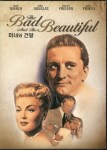
I think I might start posting DVD haul posts as well as book haul ones. Admittedly, many of the films I watch are rental DVDs, but those I can’t find at either LoveFilm or Cinema Paradiso, and are not recent releases, I generally have to hunt down, so perhaps it’s worthwhile recording that. Except, well, of the six movies below, only the first and last are from my collection. Nazar is the third of three films from the box set, and the other two have appeared in previous Moving pictures posts; while The Bad and the Beautiful is a Korean release I bought on eBay as the film is apparently not available in either the UK or the US. Go figure.

Anyway, time to start doing the bap-bap-baa bap-bap-baa bap-bap-baa from the Pearl & Dean theme tune as the main feature is about to begin…

Nazar, Mani Kaul (1991, India). After three movies by Kaul, I still have no idea what to make of him. Nazar, a later film than the other two, and apparently based on a Dostoevsky short story, as was the movie he made following this one, is, well, is pretty much Kaul channelling Godard. I like many of the Godard films I’ve seen – not that I’ve watched anywhere close to half of his total output – but he is pretty much a mixed bag. Some of his films, for me, work much better than others – and not for obviously discernible reasons: I love, for example, 2 or 3 Things I Know About Her, but was mostly left cold by Made in USA (I have the Criterion editions of both), and yet Godard shot both films simultaneously, one in the morning, the other in the afternoon, during the same month. However, one thing that is true of all of Godard’s films is that they bear, and sometimes demand, repeated watchings. I get that same sense from the three films in this Mani Kaul box set, but Nazar still strikes me as much more consciously Godard-esque than Uski Roti or Duvidha. And for that reason… it also seemed to me less successful. The well-off owner of an antiques shop in Mumbai marries a seventeen-year-old orphan. The film opens with her suicide, then flashes back to describe the events that may or may not have prompted the suicide. There are a lot of close-ups and pullbacks, with voiceover by the male lead Shekhar Kapur, but also some dialogue too. Much of the film consists of slowly moving shots with only music and sound effects. Kaul also does something interesting where he sits the camera in one spot, has the actors approach it, perhaps by crossing a room, and although the camera follows them it does not always pull back, and so an actor, or a part of them, fills the frame. Another Godard-esque aspect is that the dialogue sometimes feels like a series of non sequiturs. Certainly real-life conversations skip about, but the staginess of Nazar‘s dialogue, and the long silences in between, break the continuity. This box set was a good buy, and I’ll certainly watch the three films in it again, indeed I’d like to see more by Kaul… but I’m still not entirely sure what I’m watching.

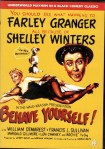
Behave Yourself!, George Beck (1951, USA). My mother gave me a bunch of DVDs recently to watch, mostly classic Hollywood movies and recent UK TV mini-series. This was the first one I watched and, well, the cover art does over-sell it somewhat. There’s no Shelley Winters reclining lasciviously in lingerie in it, for one thing. According to Wikipedia, the script was written in four days, and they’ve not done a bad job given the time they took. Winters and Granger are happily married, but it’s their wedding anniversary and he’s forgotten it – until Winters drops heavy hints, at which point he does the usual and claims to have arranged a surprise… Meanwhile, two groups of villains are attempting to exchange, I think, counterfeiting plates, for cash, and are using a trained dog to do it. One group has trained the dog to lead the other group to the wanted goods. Except the dog takes a liking to Granger, screws up his attempt to buy his wife some lingerie by trashing the store, follows him home… and is immediately assumed by Winters to be the surprise present Granger had hinted at. Except now one gang of villains wants the dog back, another have figured out the dog’s role and want it for themselves, and the other gang think whoever has the dog is their contact from the first gang… The one-liners come thick and fast, there’s plentiful slapstick, and the plot manages not to collapse into a heap. But. It’s all a bit, well, corny, the characters are stereotyped, and Granger is far too smiley and amiable for his role (it was apparently written for Cary Grant). It’s an entertaining 81 minutes, but it’s no surprise it was quickly forgotten.

Grey Gardens, Albert and David Maylses (1975, USA). This movie is on one of the iterations of the 1001 Movies You Must See Before You Die list, or perhaps another best of list, but it’s not on the list I’ve been using. But I watched it anyway. The title refers to a mansion in East Hampton, New York, USA, a property owned by members of the Bouvier family, relatives of Jackie Kennedy (as was). By the time the film was made, the mansion and its garden had fallen into disrepair, and the two women who lived there, the aunt and first cousin of Jackie Kennedy, both called Edith – Little Edie and Big Edie – were living in squalour. They were also quite eccentric. Grey Gardens is pretty much pure fly-on-the-wall, with some prompting by an off-screen interviewer. There’s an extensive look at the two Bouviers’ past, especially Little Edie’s career as a model and socialite in 1920s and 1930s New York. However, the problem with Grey Gardens, especially given its direct cinema approach, is that its worth depends entirely on its subjects. It handles the two women well, but I honestly don’t think they’re interesting enough in and of themselves, or because of how they’ve let the house fall into wrack and ruin, to justify the reputation this film has. Little Edie and Big Edie are not particularly interesting people. Odd, certainly. But not fascinating or admirable or important or even representational. Their only real claim to fame – because there are plenty of women, and men, who have let their homes fall into total disrepair – is the family connection to Jackie Kennedy and JFK. But, and I’m sorry I have to break the news to the US, the Kennedy family were not royalty and, more than that, actual royalty is not all that fucking interesting anyway. I suppose in some ways it’s the antithesis of the American Dream, ie, riches to rags, but in a world where, as Noam Chomsky has said, debt is little more than slavery (but hardly equivalent to it, because slavery is an abomination), and poverty is increasing massively thanks to the actions of the one-percenters, the two Edies’ downward trajectory is neither entertaining nor edifying. In other words, I don’t pity the Bouviers, I pity the people who pity the Bouviers. And that includes the Maysles.

52 Tuesdays, Sophie Hyde (2014, Australia). No idea how this one ended up on my rental list – I don’t think it’s the sort of film David Tallerman would have recommended, so perhaps I saw a trailer or something. Billie is sixteen, her parents are divorced, and her mother is now transitioning from Jane to James. Because of this, Billie goes to live with her father, and visits James every Tuesday after school. For a year. Hence, 52 Tuesdays. Unfortunately, James’s body rejects the male hormones, so his treatment stalls. Meanwhile, Billie has hooked up with Josh and Jasmine, two older kids from her school, and while the three experiment sexually, so Billie films them… leading to her sending a nude photograph of herself to Jasmine, which the school learns about and goes mental because it’s technically paedophilia as Billie is under the age of consent or something… I remember taking this out of the LoveFilm envelope, reading the précis on the DVD sleeve and thinking it didn’t sound too bad, but getting pulled into the story as I watched it… because Tilda Cobham-Hervey is really good in the role of Billie, the film iss played as a low-key drama, and it touched enough points out of the ordinary, in a nicely sensitive fashion, to give the story added interest. I’m guessing that adding it to my rental list was pure whim, but I really enjoyed 52 Tuesdays. A well-played uplifting drama about something personal, and a perfect antidote to Grey Gardens. Worth seeing.

Tropical Malady, Apichatpong Weerasethakul (2004, Thailand). Weerasethakul’s name is not unknown to me, although this was the first film by him I’ve watched. I seem to recall seeing a trailer of it on another rental DVD. But it was released by Second Run, and their catalogue is generally pretty damn good. So, despite not really knowing what to expect, I had reasonably high hopes when I slid Tropical Malady into the DVD player… And it both met them and failed them. The film tells two stories. In the first, a soldier is assigned to a provincial village, falls in love with a local villager, and the two spend time together. In the second, a soldier – not necessarily the one from the first story, but played by the same actor – follows a lost villager into the jungle and meets a tiger spirit – played by the love-interest of the soldier from the first story – who haunts and taunts him. Unfortunately, the links between the two stories – despite the shared cast, despite the shared setting – aren’t strong enough, although the individual stories themselves are very good. Had it been two separate films, I’ve have thought them much better – but as a conjoined work, and this despite my own experiments in literary structure – it didn’t to me seem as if it quite hung together. Despite that, I want to watch more Weeraserthakul, and perhaps I may later have cause to re-evaluate Tropical Malady. It’s nonetheless worth seeing – I enjoyed it, but it never quite gelled for me.

The Bad and the Beautiful*, Vincente Minnelli (1952, USA). As the asterisk indicates, this film is on the 1001 Movies You Must See Before You Die list and, while Minnelli has made some classic Hollywood films, I think putting six of them on the 1001 list is over-doing it. By quite a bit. Particularly with this one. The Bad and the Beautiful opens with a person telephoning a famous director, a famous actress and a famous writer, all of whom refuse to talk to the caller. They’re then called to the office of a top Hollywood producer, who explains they have good reason to refuse to speak to the caller, ex-producer Jonathan Shields but… The film flashes back to each of the three’s history, explaining how they came to know Shields (played by Kirk Douglas) and how he shafted them, before returning to the producer’s office… It’s a clumsy-as-hell narrative structure, the characters are all archetypes, and Minnelli was never more than ordinary in his framing… but it’s a Hollywood film about Hollywood and… yawn. Seriously, this is on the 1001 Movies You Must See Before You Die list? It’s a clichéd melodrama, in which the prize goes to who chews the most scenery. And yet… it was nominated for six Oscars and won five of them – and still holds the record for the most Oscars for a film not nominated for Best Picture or Best Director. For the, er, record, it won Best Supporting Actress, Best Art Direction (Black and White), Best Cinematography (Black and White), Best Costume Design (Black and White), Best Adapted Screenplay… but lost Best Actor. Incidentally, awards for black and white films were dropped in 1967, and both colour and B&W films competed in the same categories thereafter. It’s possible 1952 was a bad year, Oscar-wise, to prompt so many nominations – and wins – for this ordinary melodrama… Um, I see Best Picture went to The Greatest Show on Earth, Best Director to John Ford for The Quiet Man, Best Actor to Gary Cooper for High Noon and Best Actress to Shirley Booth for Come Back, Little Sheba… So, yes, a shit year. Seriously, this film does not belong on  the 1001 Movies You Must See Before You Die list, and I seriously doubt Minnelli deserves so many places on it either.

1001 Movies You Must See Before You Die count: 871


Leave a comment

Moving pictures 2017, #33

One from the 1001 Movies You Must See Before You Die list, which, to be honest, I didn’t much like, a rewatch (after many years), another strange Indian film, I finally cracked open the BBC Shakespeare Collection I bought a couple of years ago, and a pair of dramas, one made in 1970 and one set in 1970…

Buffalo 66*, Vincent Gallo (1998, USA). There are many puzzling films on the 1001 Movies You Must See Before You Die list, is, their presence is puzzling, not the film itself, such as all the ones by Woody Allen… but you can add this one to that not-so-select group too. An indie film directed by and starring Vincent Gallo, with a feeble plot, and featuring a central character who has no redeeming qualities whatsoever. It’s also supposed to be set, I think, in the early 1980s, although it’s hard to tell, and the soundtrack contains some 1970s UK prog rock anyway so who knows. Gallo has just been released from prison, and goes to visit his parents. Except he’s been lying to them for years, about his incarceration, even about his relationship status. So he kidnaps Christina Ricci and demands she impersonate his invented girlfriend. Which she does, for not-actually-discernible reasons, and does it a bit too well for Gallo’s liking. The title is apparently a reference to an American Football game in 1966 or something, as if anyone outside the US either knows or gives a shit about the country’s dumb sports. I really couldn’t see why this film was on the 1001 Movies You Must See Before You Die list – there were a couple of nice-looking scenes, and I actually like 1970s UK prog rock so I  enjoyed hearing the music. But… Buffalo 66 might be an above-average example of its type, but it’s eminently forgettable and doesn’t belong on the 1001 Movies You Must See Before You Die list.

Duvidha, Mani Kaul (1973, India). Uski Roti (see here) was Kaul’s first film; Duvidha was his third movie. I’m not really sure what to make of them – well, the two I’ve seen so far. I have watched Bollywood, I have watched parallel cinema. I like both, but I love the films of Ritwik Ghatak. And yet Kaul is nothing like either. If anything, he’s more consciously in the tradition of European art-house cinema, but without seeming to settle on a particular style. True, this is after seeing only two of the films on this DVD, but I’ve seen a lot of European art house films, and Kaul’s pacing reminds me of Béla Tarr (although he predates him), and some of his staging reminds me of Sergei Parajanov, and his use of voice-over and dialogue feels more Russian than Indian… In other words, Kaul presents a singular vision, not just in Indian cinema, but internationally… and I’m still trying t work out how much I like it. Duvidha at least boasts a more straightforward narrative than Uski Roti – a young couple marry, and the husband heads off to a distant town for five years to make his fortune… But a ghost in a nearby banyan tree learns of the husband’s plan, and so impersonates him and returns to the wife and takes the husband’s place. It’s based on a story by Vijayadan Detha, which was in turn based on a Rajasthani folk tale. Unlike the previous film, this one is shot in colour, but I can’t tell if the slightly washed-out palette is deliberate or a consequence of the transfer. The framing, however, is obviously down entirely to Kaul, and he shows a considerable amount of inventiveness in placing his camera and framing his shots. The pacing is once again slow, and the story is told through a mixture of voice-over and looped dialogue. There’s a bleakness to the landscapes depicted, something also notable in Uski Roti, but more visible here because the film is in colour. Clearly Kaul deserves his accolades and reputation, but I think I need to watch more of his films – or the ones I have a few more times – before I can get a real handle on his work.

Blind Chance, Krzysztof Kieślowski (1987, Poland). I last watched this over a decade ago – I had a DVD copy of it, which I gave away when I bought the Masterpieces of Polish Cinema Blu-ray box sets – and sort of remembered the story when I sat down to rewatch it. You know, the plot… the guy who catches a train, and his life goes one way… but then he doesn’t catch it and his life goes another way… twice. Sort of like Sliding Doors. But Polish. And political. And not a rom com. And without that annoying John Hannah chap. It’s clearly early Kieślowski, with its television staging and heated political arguments. This impression is hardly lessened by the second of the three “alternates”, in which the protagonist fails to make the train, attacks a station official and is arrested… and so ends up in the Polish prison system and becomes a dissident. I’ve seen pretty much everything Kieślowski made – Artificial Eye released most of them on DVD around a decade or so ago – and the one I remember most fondly is No End. Having now rewatched the Three Colours trilogy, after replacing my DVD copies with Blu-rays, I approached this rewatch of Blind Chance with mixed feelings. I’d remembered the basic plot… but I’d forgotten quite dull most of it is. At the time I first watched Blind Chance, I’d not seen much Polish cinema, so the political element of the story I found fascinating. But I’ve since lots of Polish films, and I’m a little better informed on the country’s political history… It’s a bit like… I’m currently reading Solzhenitsyn’s The First Circle, and it sometimes seems like its reputation rests on the fact it portrayed life in the USSR as some sort of blackly comic farce… and yet that has always been my impression of the Soviet Union. It is books like Francis Spufford’s Red Plenty that are really eye-opening about the USSR. And so Blind Chance – despite its tripartite structure, it doesn’t seem to offer any particular insight, or especially interesting commentary, on the Polish regime of the 1970s and early 1980s. Wajda’s Man of Marble and Man of Iron seem, to me, to make their point with much more bite than Blind Chance, although the latter is certainly the cleverer script. I don’t know; I found this rewatch of Blind Chance somewhat disappointing, much as I had the Three Colours rewatch.

Coriolanus, Elijah Moshinsky (1984, UK). I’d been renting DVDs from this box set, but then decided to go and buy so I could watch them at my own pace… so, of course, it’s taken me 18 months to crack open the box set and start watching it. I did rewatch The Comedy of Errors before watching Coriolanus – you know, the one with Michael Kitchen and Roger Daltry playing a pair of twins, both of which have the same names (as if), leading to all sorts of mistaken identity merry japes. Coriolanus stars Alan Howard in the title role, a Roman general who reluctantly stands for consul in Rome, and wins. But that pisses off the political classes, and Coriolanus blames it all on the plebians, whom he holds in great contempt. This is not the most edifying of Shakespeare’s plays – kof kof, of the ones I’ve seen; although to be fair there’s few enough of them that qualify as “edifying”. Coriolanus is apparently a tragedy, and not a historical play, although I don’t understand the distinction as surely Roman times were considered historical even in Shakespeare’s day? I mostly remember it as a lot of standing around pontificating in front of “crowds” of a dozen or so people, several after-the-battle scenes, and lot of Coriolanus feeling sorry for himself. Meh.

Say Hello to Yesterday, Alvin Rakoff (1970, UK). I think I saw a trailer for this on another rental DVD, and so stuck it on my list. Jean Simmons plays a suburban wife, who travels in to London one day on the train and comes to the attention of flighty young man Leonard Whiting. He badgers her incessantly, on the train and once she has arrived in London. Eventually, she succumbs. They end up in bed in a cheap hotel. He professes his undying love; she is more pragmatic. This is hardly a unique or insightful story, but it is an astonishingly accurate portrayal of its time. Okay, so I don’t actually remember 1970, but I do remember 1975 – and not a great deal had changed in terms of, well, the sort of things that would concern a production designer, during those five years. Everyone drives Minis, everywhere looks grubby, the whole aesthetic is just so naturally early 1970s it’s clearly unforced. Whiting is hugely annoying, but Simmons is good; but it’s the look and feel of the film where it truly scores. Though you can’t tell it from the film, it’s obvious the hotel sheets are drip-dry nylon. It’s that kind of movie. I tweeted while watching it that silver birches seem to embody the 1970s style of utopia for me. They’re there in Fahrenheit 451, and they feel almost emblematic of the sort of utopian, or comfortable, lifestyle the 1970s considered futuristic. For me, they’re a science-fictional tree.
The Commune, Thomas Vinterberg (2016, Denmark). Vinterberg’s Festen was the first film made following the Dogme 95 rules, and it’s a bona fide classic film. But he also made the bafflingly crap It’s All About Love. And the very good The Hunt. And, well, they were the only films by him I’d seen prior to watching The Commune. But I knew he was a name worth watching, so I bunged The Commune on the rental list – and I should really add a few more. In Copenhagen in 1970, a successful couple want to move into the large house in which the husband grew up, but they can’t afford the rent on their own (even though the wife works as a newsreader on television). So they invite friends of similar political leanings to share the house as a commune. They advertise to fill up the last few places. Unfortunately, the original couple’s marriage disintegrates – he’s a university lecturer and falls in love with student – and this causes problems in the house. This is not a Dogme 95 film, not judging by the lighting at least. And the plot is pretty much a lit fic staple – college professor sleeps with student, starts to question his marriage, it falls apart… except the girlfriend joins the commune, and the wife stays, and it’s all pretty obviously uncomfortable. Or helped by the rest of the commune, who are all the sort of earnestly progressive types more likely to get bogged down in trivia than actual worthwhile causes. A watchable film, better made than most, but not a great film.
1001 Movies You Must See Before You Die count: 870


4 Comments

Moving pictures 2017, #32

Two Hollywood films in this batch, although I’m not entirely sure that label can be applied to the first US film mentioned – Noomi Rapace as the female lead! Isabelle Huppert as her mother! Although otherwise, it’s solid mid-Hollywood casting down the line – Colin Farrell, F Murray Abraham, Armand Assante… But there’s also two Indian films, although one isn’t actually Bollywood… plus another Filipino movie, and the second film I’ve seen by Lucía Puenzo. In fact, aside from the shitty animated one, it’s a pretty good collection of movies.

Uski Roti, Mani Kaul (1970, India). There are two 20-DVD box sets released by the National Film Development Corporation of India, but I’ve had trouble finding copies at reasonable prices. Meanwhile, individual films – or in this case, three films in a single case – seem to be readily available… but are almost impossible to find on Amazon because the data entry is so piss-poor. And don’t get me started on big data… Anyway, I recognised the cover design of this Mani Kaul triplet as being from NFDC, and spotting that the back-cover described the films’ genre as “offbeat/social”, I decided they were worth a punt despite having never heard of the director… Only to later discover that Wikipedia describes him as “arguably the greatest Indian director of Hindi films” and also points out he was a student of Ritwik Ghatak (a favourite director of mine). The greatest Indian director Hindi films… and yet the DVD here is the only one of his films available in the UK.  (Not entirely the UK’s fault, as most Bollywood movies available here on DVD are released by Indian labels, not UK ones.) Had I known of the Kaul-Ghatak link, I might have guessed that Uski Roti is “parallel cinema” rather than Bollywood. No singing and dancing here. In fact, the first line of dialogue isn’t spoken until ten minutes into the film. And there isn’t a great deal of dialogue anyway. Kaul seems to like static shots in which there’s very little action or movement. He also likes voice-over narration, and indirect dialogue (if there is such a term – I mean where the character is on-screen, but the dialogue is voice-over). Despite watching Uski Roti twice, I’m still not entirely clear about the plot. Roti is a type of unleavened bread, and Uski Roti appears to be about a woman who makes lunch for her husband, a driver, and then walks to the road along which he drives to hand it to him when he passes. But he spends most of his time away from the family home. The pacing is languorous at best, there are lots of carefully-framed shots, and the whole thing feels like it was consciously made to be nothing like a Bollywood film. Worth seeing.

Insiang, Lino Brocka (1976, Philippines). This was the second disc included with Manila in the Claws of Light (see here), and also stars Hilda Koronel, this time in the title role. Insiang is a young woman living with her mother in a Manila slum district. She has a boyfriend, but her mother’s boyfriend rapes her. Her mother believes her boyfriend and not her daughter, and so Insiang runs off with her boyfriend. But after having consensual sex with her, he deserts her. So Insiang returns to her mother’s boyfriend, seduces him and persuades him to enact her revenge on her boyfriend. She also tells her mother she has slept with her boyfriend… and so her mother stabs and kills him. This is definitely social drama, but not, I think, Pinoy-style. It’s played very straight, the cast are excellent, and the scenes are all shot on location. Koronel is good in the title role – hugely better, in fact, than she was in Manila Claws of Light. I think, on balance, the earlier film is the better of the two, perhaps because its story has wider scope. Insiang is quite claustrophobic – deliberately so, I imagine, in order to evoke life in the slums – but it’s also a very incestuous story, which means it has a small cast. Manila in the Claws of Light was a bigger story, and while Insiang‘s narrower focus works well for it, I don’t think it’s as good as the other film. But the DVD set is definitely worth seeing. And I heop we’ll see more films by Brocka made available.

Dead Man Down, Niels Arden Oplev (2013, USA). I found this on Amazon Prime, and I’ve no idea what possessed me to watch it. I’m by no means a Colin Farrell fan, and while the thrillers in which he appears – Euro or Hollywood – are nowhere near as bad as those in which Liam Neeson appears, they’re often thin and implausible stuff. As, er, was this one. But in Oplev it had an interesting choice of director, which led to an entirely unexpected direction for the film, and, as mentioned above, Noomi Rapace plays the female lead and Isabelle Huppert is her mother. Farrell is an enforcer for a gangster, except it seems he isn’t. He has infiltrated the gang in order to exact revenge, because they accidentally killed his young daughter, and then killed his wife and himself (but failed the latter, obvs) when the couple chose to act as witnesses against the gang. However, Rapace, who lives in a neighbouring skyscraper on the same floor as Farrell, so their windows look onto each other’s flats, saw Farrell kill a man. And she’s disfigured from a car crash caused by a drunk-driver who was only lightly sentenced and still continues to drink-drive. She wants revenge, and blackmails Farrell into committing it for her. And there’s the problem… This is a dull dull dull ganster/revenge/lone hero plot, and there a zillion films like it, pretty much all of which are bad. Oplev, however, has chosen to approach the film entirely differently, and he slows down the pace, pulls back on the glorification of violence, and puts the emotional landscapes of the characters of Farrell and Rapace front and centre. And the whole lot is filmed in a low-lit style with a limited colour palette. With a good story, this would have been a superior thriller. With the story it has, it’s a dog food gateau. Oplev could not apparently lift inferior material to something more than inferior, even with a good cast and an art-house look and feel.

The Secret Life of Pets, Chris Renaud & Yarrow Cheny (2016, USA). My finger must have slipped or something, that’s the only explanation. Okay, so Hollywood has churned out some big-budget well-regarded animated feature films over the last couple of years… but every good one there are thousands of inferior ones. And since these days it’s almost impossible to tell the difference between marketing copy and critical commentary, I had mistaken believed this might be one of the few good ones. It wasn’t it. In fact, it was really bad. With a voice cast who seem to have made careers out of sounding like much more famous actors. I can’t even remember what the film was about, something to do with some house pets and the sewers, I seem to recall, but it was just one long uninterrupted stream of clichés and hoary old potted routines. Even the stylised animation looked a bit 1990s, albeit being digital it looked cleaner and smoother than it would have done in that decade. Avoid.

Wakolda, Lucía Puenzo (2013, Argentina). I think it was a trailer on another rental DVD that persuaded me to add this to my rental list. I’d seen a film by Puenzo several years ago, XXY, but had not at that time taken note of the director’s name. It was only after watching Wakolda that I put two and two together… and on the strength of these two films, I’d like to see more by her. A family heading south to Patagonia are asked by a German immigrant if he can drive with them as the roads are dangerous. They agree. After arriving at their destination – a hotel on a lake the family plan to re-open, the German goes on his way. But he reappears a couple of days later and asks to move into the hotel. He is a doctor, and he has noticed that the young daughter is small for age, due to her premature birth, and often sickly. He offers free treatment to improve her health, but the father is sceptical. Meanwhile, a photographer working locally turns out to be a Mossad agent and she identifies the doctor as Mengele. The film is based on Puenzo’s own novel of the same title. Mengele is portrayed as something close to a sociopath, so obsessed with his medical researches that he doesn’t even consider his patients as human beings, and his acts of kindness are merely part of his strategy to get people to agree to his plans. The film is told partly in flashback voice-over narration by the young daughter, and it’s all presented as a sort of gentle drama with an undercurrent of thriller. Good film, definitely worth seeing.

Pakeezah, Kamal Amrohi (1972, India). I forget why I added this to my rental list – it’s certainly not on the 1001 Movies You Must See Before You Die list, although it certainly belongs on it, but perhaps it was on some list of best Bollywood  movies or something. Anyway, I bunged it in the player not expecting much, I mean, a forty-five year old Bollywood film… boy meets girl, boy loses girl, boy gets girl back again, lots of singing and dancing, and probably a terrible print as well… But, well, it was all that, but it was also bloody good. It was if the Archers – Michael Powell and Emeric Pressburger, that is – had made a Bollywood film. Which in no way is to erase Amrohi’s achievement, which apparently took some sixteen years. But Pakeezah had that same Archers look of detailed interior sets built to resemble exteriors. And some of the photography is, despite the poor print, really quite astonishingly good. In fact, everything about the way this film was made is good. It’s set in Lucknow at the turn of century. It opens with a woman dying in childbirth, and her baby being taken by her sister, who brings the child up in her brothel, where she becomes a much fêted singer and dancer. The local nawab takes to her, and starts wooing her. While on a river trip, their boat is attacked by elephants and the dancer is thrown into the river. She is rescued by a forest ranger, and the two fall in love… There is plenty of singing and dancing in Pakeezah, but it’s classical Indian music rather than the popular musuic you might find in a more recent Bollywood film. The sets are fantastic, and the costumes are amazing… so it’s a shame the DVD transfer isn’t especially good. I’ve seen worse – the Guru Dutt ones, for example; and at least one of the recent Bollywood films I’ve seen was a really low res picture – but it’s a shame that a film that’s held in such high regard isn’t available in a better edition. Excellent film.

1001 Movies You Must See Before You Die count: 869


1 Comment

Moving pictures 2017, #31

I managed to cross a few films off the 1001 Movies You Must See Before You Die list this time, although two of them were US films by directors whose works I don’t especially like – and no, I don’t understand how the films made the list in the first place. This post also marks my first Singaporean film, wihch I stumbled across on eBay and which seemed intriguing enough to buy. The seller contacted me to point out the DVD was region 3, but I replied I’d bought a multi-region Blu-ray specifically because I want to watch DVDs and Blu-rays from other regions. This post has my first Jordanian film too – although I’m fairly sure this is a Jordanian film for the international market, rather than the Arabic-language market.

The Color Purple*, Steven Spielberg (1985, USA). I’m not a big Spielberg fan – in fact, I’m not a fan of his films at all, especially not of his push-button emotional content films – and that’s what The Color Purple is (despite my dislike of US spelling, it seems to fit in this case). I’ve not read the novel by Alice Walker but I fervently hope it’s not as bad as this film, which is an over-sentimental drama covering an African-American family over several decades from the 1920s onward. Whoopi Goldberg plays a poor and uneducated woman (when she’s an adult) in rural Georgia. She is married off to Danny Glover, even though he had turned up at the house intending to marry another sister. That sister runs away, and goes to “Africa” (I don’t recall the actual African nation being named) with a missionary couple. In the novel, at least according to Wikipedia’s plot synopsis, she ends up marrying the missionary husband after his wife dies; in the film, she marries a young man she meets in the “African” village in which she is living. Goldberg, meanwhile, is abused by Glover over many years, decades even. There are also some scenes at a bar, where a musical number is performed by the fallen wife of the local preacher… leading to a frankly ludicrous scene later where said fallen wife hears the choir singing and marches around a mile, singing all the while, and being heard by the congregation as she marches. I really didn’t like this film. It was manipulative to a degree I’ve not seen in a Spielberg film before, and he’s entirely about manipulating his audience. I also fail to understand why it made the 1001 Movies To See Before You Die list instead of like, say, Black Girl, a Senegalese film which makes a similar point albeit much more honestly. Still, I guess there was a lot of money pumped into The Color Purple

Theeb, Naji Abu Nowar (2014, Jordan). I’ve watched a number of Arabic-language films, but they’ve mostly been ones aimed at non-Arabic audiences – not badly-acted Egyptian dramas, in other words. Even the films of Elia Sulieman, a favourite director, are not really made for a Palestinian audience, although they are very Palestinian films. Amd while I’m all too happy to watch such films, it not the same as watching a Bollywood movie, which is a movie designed to appeal to its home audience. It seems to me, though I have no proof, that Theeb, a film made in Jordan by a Jordanian/British director, is a film designed more to appeal to an international audience than a Jordanian audience. And as a big fan of non-Anglophone cinema I have no real problem with that, but as someone who dislikes the concept of “world cinema” I’m less approving. Theeb is a good film, of that there’s no doubt. It’s an excellent historical drama, set in Jordan during WWI, and a clever character study of its central character, a young boy caught up in events he does not understand. But different countries have their different populist cinemas – I’ve mentioned Nigeria’s Nollywood before, and the difficulty of finding its popular films with English subtitles – but what I fail to understand is why it is assumed populist non-Anglophone cinema cannot find an Anglophone audience and only non-Anglophone auteur films are worth releasing in English-language markets. True, the English movie market is pretty much 99% Hollywood, and they can’t even work out how to handle Spanish-speaking audiences, which is a huge part of the US population. But in the UK, we have Welsh and Cornish and the two varieties of Gaelic, and TV channels and programmes and films for each, albeit small scale. And, personally, most of my favourite directors do not make English language films, so I have to watch with subtitles. In fact, subtitles are a passport to a world of cinema and only a fool would ignore them. Subtitles are good. And so is this Theeb.

Hannah and Her Sisters*, Woody Allen (1986, USA). I really don’t understand the appeal of Woody Allen’s films, and I certainly don’t understand why he has six movies on the 1001 Movies You Must See Before You die list, since none of them to my mind are all that good. Hannah and Her Sisters fools the viewer initially because it opens with a voice-over by Michael Caine, and no one on-screen resembles Allen. But then he appears, and it all begins to  slide downhill. Caine is married to Hannah, but fancies one of her sisters. Allen is an ex-husband of another sister, but once went on a date with yet another sister which ended badly. And, oh god, this sort of middle-class American bed-hopping drawing-room farce is tedious at best and embarrassing at worst. Allen at least manages not to entirely embarrass his viewers or his cast, but it’s a close-run thing. Caine does not do needy very well, and the film pretty much hinges on his needy desire for sister Barbara Hershey, Max von Sydow’s wife. I watched this film so I could cross it off the list. I only have one more Allen film left on the list to watch – Crimes and Misdemeanours – and then I never have to watch another Woody Allen film ever again.

Manila in the Claws of Light*, Lino Brocka (1975, Philippines). When I set out to watch all the films on 1001 Movies You Must See Before You die list, copies of this film were almost impossible to find. But then Martin Scorsese’s World Cinema Project went and restored it – yay for Scorsese – and then the BFI released it in the UK on dual format – yay for the BFI. And… it’s good, good enough to make want to watch more films by Brocka. Fortunately, as the DVD cover art indicates, there is another film bundled with Manila in the Claws of Light, Insiang. But my chances of finding any further Brocka movies is, I suspect, extremely remote. Anyway, Manila in the Claws of Light… A young man from the provinces (well, an island other than Luzon – the Philippines is an archipelago, after all) moves to Manila to track down his girlfriend, who had left earlier after being promised employment in the capital by a visiting woman promising jobs there for young women (yes, yes, it’s pretty obvious to us, but these are unsophisticated probincianos). The guy ends up working on a building site as casual labour, where he learns how they are treated, how their wages are garnished, and what life is like at the bottom of the heap. But he spends all his spare time looking for his girlfriend. And eventually finds her. Which is where, of course, things start to go wrong. The film opens in black-and-white, and the print quality is not especially good, which I thought odd for 1975… but then as the opening credits end it changes to colour and the print quality greatly improves. I’m not sure this adds anything to the film, or why Brocka chose to do it. Manila in the Claws of Light treads a fine line between melodrama and social realism, but manages not to fall off in either direction. Brocka is apparently “one of the most influential and significant Filipino filmmakers” (according to Wikipedia), and while I’ve known of Pinoy cinema for many years – there used to be a column in Gulf News’ weekly magazine dedicated to it; and one to Lollywood too – I’ll admit I didn’t take much notice of the directors’ names (although such columns tend to focus on the stars anyway), but even in my years of following “world cinema” (ugh) I’d not come across Brocka’s name before. Mostly my fault, yes, but given how so many directors from other countries are lauded in Anglophone cinema – Tarkovsky, Ray, Kiarostami, Kurosawa, Almodóvar, Tati, Fassbinder, Bergman, etc. – I’m surprised I’d not stumbled across Brocka’s name before. But then, as mentioned previously, Manila in the Claws of Light was, until this edition appeared, extremely hard to find. Perhaps the appearance of Two Films by Lino Brocka means more films by him, and other Filipino/Filipina directors, are going to be released in the Anglophone world. I hope so.

Girl Gets Girl, Sonia Sebastián (2015, Spain). I forget where I came across this – probably a trailer on another rental DVD – and decided to add it to my rental list. Bur I thoroughly enjoyed it. The film was almost like someone trying to out-Almodóvar Almodóvar himself. Ten years after running away from a wedding, Inés returns to Spain from Miami, just when her ex-girlfriend’s ten-year-old daughter is have a “first period party”. There then follows a series of mildly comic and well-written scenes in which each of the characters at the party try to get their own way. A previous girlfriend, for exmaple, turns up with a dodgy guy as her “boyfriend”. and he tries to drug her drink but the wrong woman drinks it. One of the two mothers of the young girl is desperately trying to hide her sexuality from her mother. The other mother thinks Inés still loves her, but Inés is basically just hiding from some enemies she made in Miami, And not just enenies, as one is an editor who fell in love with her and follows her to Spain to win her heart and/or get back her money. The script is witty, the characters are likeable, the plot is, despite being a but obvious in places, is clever. It’s by no means great cinema, but it is a fun film that entertains without annoying or insulting the viewer’s intelligence. Oh, and it doesn’t just pass the Bechdel Test, it comes top of the class. Worth seeing.

In the Room, Eric Khoo (2015, Singapore). As mentioned above, I stumbled across this on eBay and decided to take a punt on it (it’s not actually available on Amazon). It was a good call. The title refers to a room in the Hotel Singapura (an alternative title for the film) in which events happen over several decades. The story opens in 1942, in black-and-white, with a Brit and a Singaporean lamenting the loss of the Brit’s livelihood – a plantation – but also quite clearly about the love affair between the two men. Another story is about a madam who trains young women to be prostitutes in the early 1960s in the room, and in this sequence the production design and colour scheme is appropriate to the decade. There’s a rock band who occupy the room in the 1970s… and so on. There’s a variety of styles on display, all of which seem appropriate to the decade being depicted, but it does mean In the Room doesn’t feel like it presents a singular vision. Sometimes it feels like Wong Kar-Wai’s In the Mood for Love, other times it feels a bit like Almodóvar. Or maybe not. It’s not the most original plot on the planet – I can think of at least two bad films that have the same premise – and Khoo’s decision to give each sequence an appropriate flavour does tend to dilute his vision. But I still thought this was rather good, and I’m glad I took a chance on it.

1001 Movies You Must See Before You Die count: 867