It Doesn't Have To Be Right…

… it just has to sound plausible


1 Comment

Moving pictures 2017, #60

My film viewing seems to have been bouncing all over the place of late. A 1950s melodrama (but… Rock Hudson!), a Marx Brothers comedy, a classic Japanese film, a British historical farce…
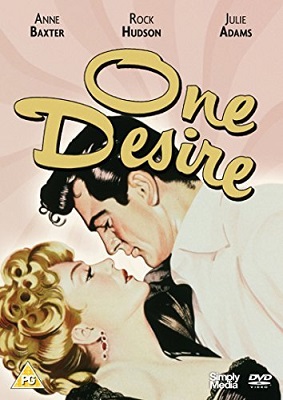
One Desire, Jerry Hopper (1955, USA). I find it hard to resist 1950s melodramas, especially ones starring Rock Hudson, even if they’re not, well, set in the 1950s. Like this one, which is based on a novel by Conrad Richter and is set at the turn of the twentieth century. Anne Baxter plays the madam and co-owner of a brothel/casino in the mid-West. Hudson is Baxter’s lover and dealer at the casino, but he’s ambitious and keen to head to Colorado and the silver mines. When he gets fired, he persuades Baxter to accompany him. At their destination, Hudson bumps into the local senator’s daughter, Julie Adams, charms her and ends up being appointed manager of the local bank. Baxter meanwhile takes in a young Natalie Wood after she’s orphaned when her miner father dies in a cave-in. Adams has her sights set on Hudson, and uses a PI to dig up Baxter’s past and show she is an unfit guardian for Wood and Hudson’s young brother. Baxter, humiliated in court, goes back to her old job in the casino. Hudson marries Adams, but doesn’t love her. Years later, Wood runs away and finds Baxter. Baxter returns and opens a saloon opposite Adams’s house. Adams accidentally sets her own house on fire and perishes. Hudson marries Baxter. Happy ending. Sort of. A pretty typical Technicolor period drama. I enjoyed it… but then I like 1950s Technicolor dramas.
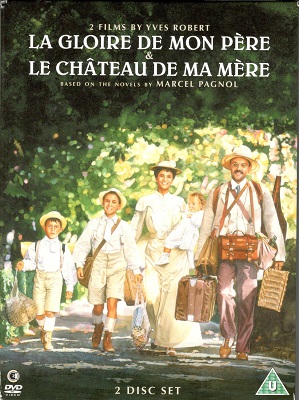
La gloire de mon père, Yves Robert (1990, France). My mother lent me this – it’s a two-film set, with Le château de mère – and it was not a film known to me. It apparently was very successful in France, and I can sort of see why. It’s very… nice. It reminded me of the sort of the dreadful nostalgic crap the British industry churns out these days (alongside mockney gangster movies and horrendous rom coms, the latter mostly written by Richard Curtis). The first clue is the voice-over – the main character is a kid, and the voice-over is his adult self, commenting on the events of his childhood. Like anyone can actually remember their childhood in that level of detail. In this case, the boy’s father is a socialist atheist teacher in the south of France during the first decade of the twentieth century. The boy’s aunt marries a local businessman who is the complete opposite of the father. One summer, the two families stay in the country, in the area in which they are originally from. And, during a hunt, the father shoots and kills two rock patrridges and celebrates his success – the “glory” of the title. The irony of this is that the father had previously taken the piss out of someone who had been photographed with a fish he had caught, and now he glories in a photo of himself with his two rock partridges. Other than that… I’m not entirely sure what point the film is trying to make. It’s based on a 1957 auto-biographical novel by Marcel Pagnol, and though I’ve not read the book, and am unlikely to ever do so, I very much doubt it’s as saccharine as this film. The DVD came packaged with a sequel, Le château de mère, and I’ll probably watch it. I hope it has more bite than this one.

The Cocoanuts, Robert Florey & Joseph Santley (1929, USA). I’ve never seen enough Marx Brothers’ films to determine whether or not I ought to be a fan, in fact I’m not entirely sure I’ve seen any of their most famous films (you know, the ones with titles Queen stole for their albums), although I’m familiar with the characters and many of Groucho’s best-known quotes. Since there was a new collection of their’ films just released by Arrow – The 4 Marx Brothers at Paramount 1929 – 1933 – I added its contents to my rental list. This was the first to arrive – and, coincidentally, the earliest film in the collection. The film is set in a Florida hotel run by the brothers – there’s no plot as such. There are several muscial routines, like out of a Busby Berkley film, but the rest of it is just the the Marx Brothers running aruond and playing their characters. Groucho is, surprisingly, not all that witty. Harpo is just as creepy as usual. Chico is probably the funniest character, for all that his put-on accent is considered offensive these days. Zeppo is in there somewhere, but for the life of me I can’t remember him. I guess that’s why he dropped out. I’d expected more of The Cocoanuts – it wasn’t especially funny or witty. And while the production numbers were a big part of it, I like Busby Berkley films so I’ve seen better (and more eye-boggling). The Marx Brothers films are worth seeing as historical Hollywood documents, but don’t expect too much of them.
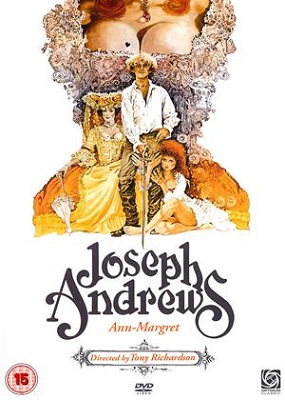
Joseph Andrews, Tony Richardson (1977, UK). Some films just seem to appear on my rental list and I’ve no idea why. If it’s a Japanese or South Korean film, then David Tallerman probably added them using the app on my phone when we were down the pub (but he won’t be able to do that anymore, as Cinema Paradiso doesn’t have an app). Sometimes, I vaguely recall seeing a trailer and so must have added the film myself. But there are some which, for the life of me, I cann’t recall why I put it on my rental list. Like Joseph Andrews. A British historical farce, based on a 1742 Henry Fielding novel, starring Colin Firth, Ann-Margret, Michael Hordern, Beryl Reid, John Gielgud, Peggy Ashcroft, Jim Dale, Wendy Craig, Ronald Pickup, Penelope Wilton, Kenneth Cranham, Timothy West… and lots more familiar Brit thesp faces. Firth plays the title character, a young man who draws the attention of libertine aristocrat Ann-Margret. Then he’s waylaid on the road, or something, and ends up at an inn, where he’s nearly arrested. The plot, such as it is, has Firth bouncing from one comical encounter to another, before eventually rejoining his love back in his home village. I can think of little to recommend this film – nothing about it stands out. I spent most of it playing “spot the luvvie”, which is a bit like watching the Carry On film without the jokes. Meh.

The Lady of Musashino, Kenji Mizoguchi (1951, Japan). I bought the Japanese Masters box set – deleted for several years, so hard to find – because it included an Ozu film that was no longer available. The other “master” is Kenji Mizoguchi, and the set includes two of his most celebrated films: The Life of Oharu (see here) and The Lady of Musashino. The latter film is set shortly after WWII. The title character lives in a village just outside Tokyo – the films opens with them witnessing the bombing of Tokyo from Musashino. Her husband is a drunkard who abuses her. Her cousin’s husband keeps on propositioning her, and a younger cousin who comes to live with them fancies her. The film navigates these complicated relationships – which is something Mizoguchi does really well – before finding a solution that suits all but the title character – which is something Mizoguchi also does a lot. When it comes to Japanese cinema from the first half of the twentieth century, I prefer Ozu’s ensemble pieces to Mizoguchi’s character studies (some of which are historical), and I really should watch more Kurosawa (which I’ve recently remedied by adding a bunch of his films to my rental list)… Anyway, the title character of The Lady of Musashino must find a way out of the complicated personal relationships that have accreted around her, and yet also protect Musashino. I like that Mizoguchi puts a woman front and centre, even in a society in which gender roles are extremely constrained, as he also does in The Life of Oharu – and I like that he does it so well she is the best-drawn charatcer in the film. The transfer, it must be said, is not great, but it’s not as much of a hurdle as it is with The Life of Oharu, several important scenes of which take place at night. I’ve seen several Mizoguchi films over the years – the first was apparently Ugetsu Monogatari back in 2012 – more by accident than design, I think, but I have a box set of four of his films, given to me by David Tallerman, which I’m now quite looking forward to watching…

1001 Movies You Must See Before You Die count: 885

1 Comment

Moving pictures 2017, #59

Six films, six countries. One director I’m a fan of, five directors new to me. So it goes.

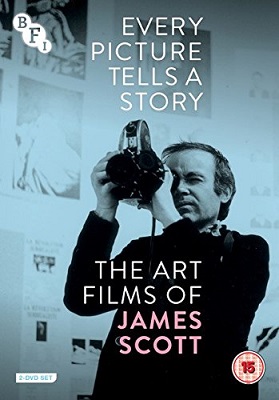
Every Picture Tells a Story, James Scott (1967 – 1984, UK). So I decided to split my rental list and include documentaries, and this was the first one I was sent. Last year, I’d rented a collection of Humphrey Jennings’s documentaries, and loved them so much I bought all three DVDs of his films. James Scott was a documentary film-maker new to me, a Brit, whose career stretched through the 1960s, 1970s and 1980s. His father was famous Ulster painter William Scott, and it is a dramatisation of the William Scott’s life which gives this collection its title. It’s not a documentary but a docudrama, starring Phyllis Logan (remember Lovejoy?) as Scott’s mother and Alex Norton (remember Taggart… um, after Taggart himself was no longer in it?) as his father. The remaining films on the two discs are documentaries about artists – David Hockney making etchings, Claes Oldenburg visiting the UK for a retrospective of his work at the Tate Gallery, on RB Kitaj, on Richard Hamilton, and a documentary for the Arts Council. It’s fascinating stuff, and more than justifies my decision to include documentaries in my rental viewing. (Interestingly, Scott’s one feature film for Hollywood was butchered before release by Weinstein and flopped badly.)

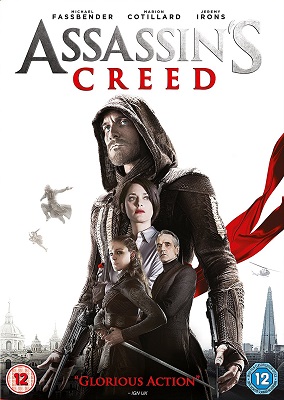
Assassin’s Creed, Justin Kurzel (2016, USA). A colleague at work wondered if I’d be able to follow the plot of this film given I’ve never played the games from which it was adapted. Nope, no trouble at all, seemed very straightforward. I was, however, surprised to find a science fiction tentpole blockbuster with half of its dialogue not in English (in Spanish, in this case). Michael Fassbender plays a convict on Death Row, who wakes up after his execution in a scientific institute in Madrid (although it looks more like some sort of Brutalist fortress). He is told he’ll be a subject in an experiment that will use his “genetic memory” so he can witness the life of a fifteenth-century ancestor. This is because the institute is owned by the Knights Templar, who are a powerful and power-hungry international organisation, and they’re after the Apple of Eden, which will eliminate human free will and so put them in total control, and which was last seen in the fifteenth century by… Fassbender’s ancestor. Who was actually a member of a secret order dedicated to combating the Knights Templar, the Assassins. Um, yes. It’s all risible nonsense, and makes even less sense when you watch a pair of knackered Assassins kill several hundred Knights Templar in an extended fight/parkour chase scene through mediaeval Madrid. I mean, if the Assassins were that effective, how could they lose? But it turns out they were just biding their time, because they don’t know where the Apple is either. But they mean to make sure the Templars don’t get it. The Templars are Nazis in all but name, given a thin veneer of multinational corporatism, which would make for telling political commentary… if only the film wasn’t so dumb. The Assassins are your typical Hollywood genre good guys – ie, just as violent and brutal as the bad guys, but righteous. Which could also make for telling political commentary… if only the world-building wasn’t so stupid. One for fans of the game.

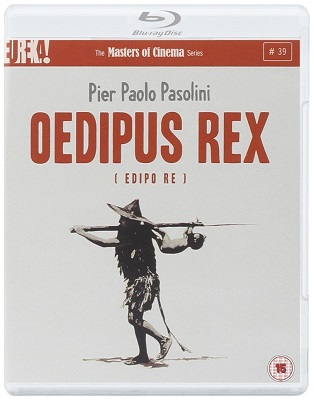
Oedipus Rex, Pier Paolo Pasolino (1967, Italy). I’ve written before there are two types of Pasolini film – let’s call them the character film and the landscape film – and this definitely falls squarely into the latter category. It was filmed in North Africa, like Pasolini’s Arabian Nights and Medea (sort of), although its story takes place in Ancient Greece. It pretty much follows the Ancient Greek story. An oracle tells a king he will be killed by his son, so his wife arranges for the baby to be taken away and killed. But a passerby rescues the baby boy and raises it as his own son. Once grown, the man, Oedipus, goes wandering. He encounters a merchant – he thinks – on the road, gets into a fight with him and his soldiers, and kills them. Later, he stumbles across a man (played by Pasolini’s partner, Ninetto Davoli) who is from a town terrorised by a monster. Oedipus kills the monster and is offered the throne of the town, as the king had vanished some years before while on pilgrimage. He accepts and marries the queen. He then learns that the merchant he’d killed earlier had been the king of the town. And further learns that he was adopted and that his father was… the king he had murdered… which makes his wife his mother. Just like the prophecy. Imagine that. Like Pasolini’s other “landscape” films – I’m not convinced the categorisation works, but let’s go with it – makes ample use of its Moroccan locations, features many non-actors in supporting roles, and lokos absolutely fabulous. There’s none of the earthy, or scatological, humour of this “character” films, but everything looks so good, and so idiosyncratic, that the seriousness – which, to be fair, often teeters on the edge of humour – seems fitting. Excellent stuff.

Time Traveller: The Girl Who Leapt Through Time, Masaaki Tanigushi (2010, Japan). Annoyingly, this is the sequel to a live action adaptation of a 1965/1966 serialised novel, The Girl Who Leapt Through Time, which was released in 1983, and later remade in 1997, and then remade as anime in 2006… And I’d seen none of those versions of The Girl Who Leapt Through Time, so I was coming to this belated sequel cold. Japanese films, especially ones based on well-known domestic properties, obviously don’t make concessions to international audiences. So it took me a while to figure out what was going on in Time Traveller. But the back-story didn’t really matter all that much. Young woman tries to track down the first love of her mother, comatose after an accident, and so travels back in time to the year of their relationship, 1972. but she gets it wrong and ends up in 1974. Where she ends up falling in with a geek amateur film director, while she triesd to track down her mother’s lover, even though she’s two years too late. It all felt like an affectionate spoof of the period, in much the same way Back to the Future did for 1950s small-town USA. But unlike that film, it ends up in a completely different place and concludes with a bitter-sweet ending. I liked it. I liked it enough to want to see the first film… which was when I discovered it had been released twenty-seven years earlier… so I ended up sticking the anime version on my rental list. But I’d still like to see the 1983 movie. And the 1997 movie as well. Happily, Time Traveller: The Girl Who Leapt Through Time does stand pretty well on its own, and is worth watching.

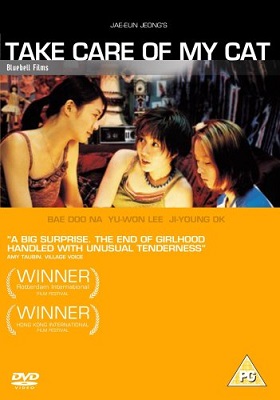
Take Care of My Cat, Jeong Jae-eun (2001, South Korea). I had thought I’d stumbled across this one on my own, but no, apparently David Tallerman added it to my rental list during one of our afternoons in Shalesmoor. I thought I might have added it myself because the title reminded me of No One Knows About Persian Cats, an excellent Iranian film. But no. Take Care of My Cat follows five young women after they graduate from high school. One joins a brokerage firm as a junior clerk, another works for free at her parents’ sauna, two twins sell handmade jewellery on the street, and one holds a succession of low-paying jobs because she wants to be an artist. And, er, that’s about it. There’s no plot, no three-act structure, no actual story… just character growth. Things happen – two of the women fall out, and a third tries to keep the group together; the artist’s grandparents, with whom she lives, are killed when the roof of their house collapses; the brokerage clerk’s ego takes a battering at work when she’s told she won’t go far without a degree… It’s an ensemble piece and it rises or falls according to the characterisation of its central cast, and their presentation by the actors. Happily, both are done well. The central dufference of opinion feels entirely in keeping with the characters of the two young women involved as they are written and played. It’s not the most thrilling film ever made and, despite its ending, it could perhaps have benefited from a little more plot. But it’s good stuff and worth seeing.

Japayuki, Joey Romero (1993, Philippines). The cover art, or what passes for  it on Amazon Prime, managed to disguise what proved to be a 24-year-old bog-standard true-crime thriller made in the Philippines about overseas Filipino workers. The term “japayuki” is used by Filipinos to describe the young women who work overseas in Japan, in a variety of jobs but mostly entertainment (ie, dancers in bars, and so on). The film opens with Maricris Soison’s body being returned to the Philippines. She apparently died of hepatits B. But an autopsy reveals she had actually been tortured and beaten to death. A campaigner is determined to discover the truth of her murder. Maricris worked as a dancer in a Tokyo nightclub and, the campaigner is told, had a drug problem. She digs deeper and discovers this a lie – the dancers were kept locked up in their accommodation, were not allowed to keep their passports, and were expected to give sexual favuors to nightclub patrons. Maricris rebelled and tried to escape. The campaign fails to get the Philippines government to declare Maricris’s death a murder, nor bring her employer to justice. The overseas workers bring too much money into the Philippines’ economy to risk jeopardising the country’s relations with Japan. Japayuki played like the sort of “based on a true story” drama that went straight to video back in the late 1980s and early 1990s, although the ones we saw were pretty much entirely American. Very little Filipino cinema makes it into the Anglophone world – it’s only now, for example, that one or two of Lino Brocka’s movies have become available on DVD in the US and UK, and he made over 60  feature films. He was also nominated twice for the Palme d’or. Joey Romero, however, is no Brocka.

1001 Movies You Must See Beforeyou Die count: 885


5 Comments

Moving pictures 2017, #58

Bit of an odd mix this Moving pictures post, although it’s a good geographical spread. Not so much of chronological spread, however, with one from the 1960s, one from the 1980s, and the rest less than a decade old (well, nearly). Half of the movies are by directors I’ve seen other films by – Edwards, Park and De Sica (two, four and six respectively). One of the films below was excellent, one was better than expected, and the rest were meh.

The Beast in Space, Alfonso Brescia (1980, Italy). I really liked Footprints on the Moon (see here), an Italian giallo released by Shameless, and I enjoyed The Tenth Victim (see here), also a Shameless release, but that doesn’t mean every film they’ve published is worth seeing. I’ve seen a number of spaghetti sci-fi films over the years – the most celebrated is probably StarCrash (see here) – and I’ll probably watch many more. But it’s a stretch to describe any of them as good, and The Beast in Space, which adds very mild softcore porn to the mix, is a case in point. It opens in a bar, and everything screams bad science fiction – the decor, the costumes, the dialogue… A studly man defends a woman from the approaches of a group of space merchants. Later, he offers her a position in his crew on the best spaceship in the galaxy, or something. It’s all about a planet at the edge of the galaxy which is the source of a valuable ore, but which few people have returned from. So the studly man’s spaceship flies there, and they discover the world’s secret – its inhabitants are immortal thanks to the unique ore… And there’s some giant satyr-like creature which chases the woman through a forest. Or something. The Beast in Space is pretty tame, and though the bad science fiction feels mostly like its in service to the titillating parts of the movie, the end result is something that doesn’t convince as either.

Priceless, Pierre Salvadori (2006, France). Audrey Tatou plays a young woman who lives as a kept woman. She targets rich old men, and enjoys a rich lifestyle as a result. One day, she mistakes a waiter for a rich playboy. He plays along, spending all his savings in the process, but is quickly dropped when Tatou realises her mistake. But then he is picked up by a wealthy older woman and becomes her toy boy, and so starts to follow the same lifestyle as Tatou. So, of course, they keep on bumping into each other and, of course, fall for each other. They try to outdo each other, seeing who can scam the most out of their patrons. And they manage a relationship under the noses of their sugar daddy/mummy. In an earlier decade, this might have played as a light fun comedy in which a pair of ne’er-do-wells take advantage of the rich. But these days it feels like a complete mis-step. We’re not the rich’s problem, they are ours. They take our money and hoard it. We know trickle-down theory doesn’t work. In fact, we know any economic theory which concentrates wealth decreases quality of life for everyone else. So there’s nothing amusing about rich people being shown as unwitting dupes. Oh my, someone cons a Rolex out of them. Boo hoo. When the truth of the matter is: a government should tax the shit out of them. You want fairness? Then redistribute wealth. The American Dream is a pernicious lie, and serves only those already in positions of wealth and power. So it’s a little disappointing to see European cinema opting into the same mendacious narrative.

The Handmaiden, Park Chan-wook (2016, South Korea). You know those films which are structured in several parts – not acts – in which each part tells the story from a different character’s point of view and so offers a different persepctive on the story to the viewer. This is one of those. In the first part, a young woman is put in place as the maid of a rich man’s daughter, so she can gaslight the daughter into marrying the con man who arranged for her hiring. Once married, he plans to consign his wife to an asylum and live off her fortune with the maid. But he pulls a switch at the end, and the maid is committed while the daughter goes off with the con man. Except… in the second part, the story is told from the daughter’s point of view, outlining quite how horrible her father – a collector of rare Japanese porn – is, and the things he makes her do. And, well, the daughter discovers the con man’s game and decides to turn the tables on him… And there’s yet another take on the story in the third part… and any real discussion of the plot would involve lots of spoilers so maybe not… The movie looks gorgeous, and its structure, with its voiceovers and overt exposition, works extremely well. I don’t think it’ll make my top five for the year, but it’ll certainly get an honourable mention.

Ghost in the Shell, Rupert Sanders (2017, USA). There was a lot of fuss when this film was announced because it’s an anime property and yet its main roles in this, its Hollywood live-action adaptation, were being played by white actors. Certainly they could have found an Asian actress to play Scarlett Johansen’s role, they’ve done it in other films. And you have to wonder how much influence stars have on box office, especially for known genre properties like Ghost in the Shell, a popular anime series. True, Beat Takeshi plays Johansen’s boss – but unless you know Japanese cinema, and that means you’ve likely seen the original Ghost in the Shell anime, that probably means little. The original was very much influenced by Blade Runner, and this US remake pushes that even further. The CGI is actually very pretty throughout. Unfortunately, the plot is dull. Johansen plays a woman given a cyborg body after a horrific accident. She is a member of an anti-terrorist squad which is chasing a mysterious villain who is threatening Hanka, a powerful robotics company. There’s a sideplot about Johansen remembering little of her past, and discovering that what she does remember has been falsified, but it’s given little weight against the main shoot-em-up plot. I can see why this film didn’t do very well, despite looking flash – in an OTT-CGI sort of way – in parts.

Monsters, Gareth Edwards (2010, UK). Edwards is, of course, the director of Rogue One, a gig he landed after this film and Godzilla. Which is a pretty meteoric rise. Star Wars is, after all, a massive property, and jealously guarded by Disney. They don’t just let anyone near it – and they’ve quickly fired anyone who treated it in a way Disney felt it should not be treated. Which makes Monsters surprising on two fronts – that the director of Monsters would be chosen to direct Rogue One, and that he would stay in the job as director of Rogue One. Monsters is set in Central America, and depicts a US couple’s efforts to to return home through an “infected zone” – northern Mexico – that has been devastated by an alien invasion. Initially, the aliens are never actually seen, only the damage they’ve wrought. But toward the end, once the couple reach the US, the aliens do make an appearance – and the CGI is a bit dodgy. Unfortunately, the film seems to depict the Central Americans as chiefly either corrupt or violent. A businessman charges them $5000 for a ferry ticket to the US coast. The male half of the couple – he’s actually an employee of the woman’s father – is then robbed by a woman he picks up in a bar… forcing the couple to take a more dangerous route. The treatment of the aliens is cleverly done – final scene notwithstanding – and the wrecks and ruins the couple witness on their journey north are convincingly staged (I assume they’re pretty much entirely CGI). The giant wall forming the US border – I expect Trump has that part of the film on a loop so he can masturbate over it – is especially effective. Better than I’d expected, even if the male lead is annoyingly useless.

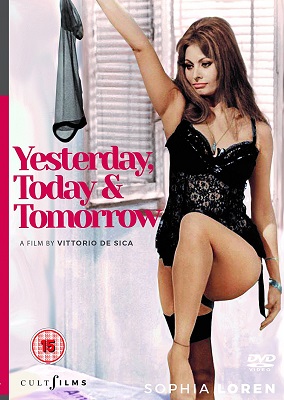
Yesterday, Today and Tomorrow, Vittorio De Sica (1963, Italy). De Sica is, like Visconti, one of those directors whose films I have watched sort of accidentally. The films of his I have mostly watched have been Italian Neorealist, which is not a film genre I’m especially fond of (but there are a number of them on the 1001 Movies you Must See Before You Die list). I’m pretty sure Yesterday, Today and Tomorrow doesn’t qualify as Italian Neorealist. It’s actually a sort of anthology film, although all three of its stories were directed by De Sica, and all three star Sophia Loren and Marcello Mastroianni. The first is set just after WWII. Loren and Mastroianni are poor. He’s out of work, she makes a living selling contraband ciagrettes. But she’s caught and fined. They can’t pay the fine, so the police come to arrest her. But they can’t because they’re not allowed to arrest pregant women. Loren manages to maintain her freedom by getting serially pregnant… for seven or eight years. Eventually, she decides enough is enough, and agrees to go to prison. But Mastroianni persuades a lawyer to petition for a pardon, which she receives. I wouldn’t have thought carrying, giving birth and caring for seven kids was preferable to a prison sentence. In the second story, Loren is an industrialist’s trophy wife, who gives her lover, Mastroianni, a ride from the airport in her husband’s expensive Rolls-Royce convertible. They bicker. En route, she is forced to swerve to avoid a child on the road, and crashes the Rolls. The damage to the car pisses her off more than the fact she nearly killed someone. Mastroianni is not impressed. She flags down a sportscar, and goes off with tis driver, leaving Mastroianni with the crashed Rolls Royce. In the final story, Loren is a high-class prostitute. Her neighbour’s grandson visits, and falls in love with Loren. Unfortunately, he’s all set to head off to the senminary, and his grandparents are horrified by his decision to pack it in to woo Loren. So Loren, with their help of one of her clients, Mastroianni, a playboy, try to convince the erstwhile priest not to give up his calling. Of the three stories, the first was the most memorable, and the second by far the most dull. Meh.

1001 Movies You Must See Before You Die count: 885

Leave a comment

Moving pictures 2017, #57

Following the 1001 Movies You Must See Before you Die list has proven an interesting experience. It’s introduced me to films and directors I might otherwise not have seen – although I’d already started exploring “world cinema” a long time before. And it’s not, to be honest, a great list – too much Woody Allen (one is too many), too many Hollywood classics whose time has passed (anyone who says the same is true of All That Heaven Allows will be punched, or at least roundly insulted), too many obvious picks as representatives of other nations’ cinemas… But it’s been worth using it to guide my viewing, even if the two movies from the list in this post were exactly the sort of films I have little time for…

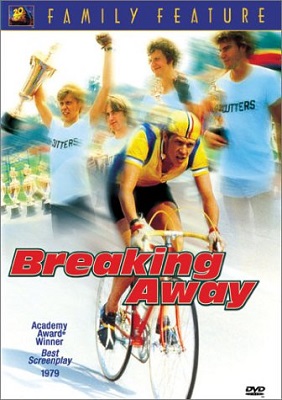
Breaking Away*, Peter Yates (1979, USA). A coming-of-age film set in small-town USA, specifically Bloomington, Indiana, whose name I know but I’ve no idea where from. A bunch of townies, centred around cycle-mad Dennis Christopher, have various run-ins with university students, culminating in a university-only bicycle race in which a townie team is finally allowed to compete… and manages to win. It’s all thuddingly obvious, for all its attempts at depicting the real life of townies – “cutters” – in Bloomington. Small-town America is not a place that holds any interest for me, and the lives of the people who inhabit it strike me as poor fodder for stories. Okay, so there are universal themes that can be explored, and in the right hands, that of a literary author like Joyce Carol Oates, say, there might be something there I’d be interested in. But US cinema is a (chiefly) commercial medium, so there’s a demand for accessibility built-in, and the life depicted in this movie, well, that’s a wide swathe of the audience. And they’re welcome to it. Seriously, Breaking Away is dull and mind-numbingly predictable, and I’m completely mystified by its presence on the 1001 Movies You Must See Before You Die list. It’s not even as if Yates is some sort of auteur – I mean, the only film he ever made that managed some sort of character was Krull. On the other hand, Breaking Away was apparently nominated for five Oscars, and actually won one (best original screenplay). Having said that, the gong that year went to Kramer vs Kramer (WTF?), despite the shortlist also including Apocalypse Now and All That Jazz. So, a fucked-up year for the Oscars, for sure. If you never ever see Breaking Away, you’ll have missed nothing.

La vie en rose, Olivier Dahan (2007, UK). This is a straight-up biopic of Edith Piaf, and it stands or falls on its depiction of its subject. Which was apparently good enough to get it nominated for a raft of awards. To be fair, I know nothing of Piaf or her music – I didn’t even know “piaf” meant “sparrow” until watching this film. And, well, it’s a biopic, it seems weird to comment on the story as it’s someone’s life. But you can comment on how it is presented, and this felt completely straightforward and, well, a bit dull. Piaf apparently started out busking during the interwar years, before being recruited by impresario Gérard Depardieu, and steadily growing in fame thereafter. The film leaps about chronologically, depicting scenes from later in her life in between the historical bits. Piaf was not, apparently, a very nice person. Earthy, I can understand, given her background; in fact I admire her for maintaining that element of her character. But she also became a bit of a diva, and did not respond well when crossed. But that that’s the gamble with “warts and all” biographies – does the subject survive the airing of their faults? Piaf clearly did – this film was hugely successful. I knew almost nothing about Edith Piaf before watching La vie en rose, and I know more having now seen it… but I’m still never going to buy one of her albums. Shrug.

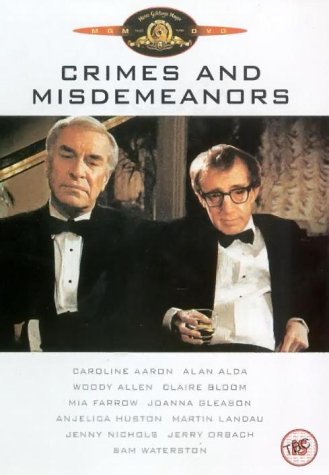
Crimes and Misdemeanors*, Woody Allen (1989, USA). Why are there so many Woody Allen films on the 1001 Movies You Must See Before You Die list? Not only do I dispute his alleged greatness, the man also abused his daughter and his existence, never mind career, should not be celebrated. I watched Crimes and Misdemeanors only so I could cross it off the list; I would not otherwise choose to watch an Allen film. I do not like them, I do not wish to support his career (this was a charity shop DVD, so happily he did not profit from my purchase). And yet, ignoring Allen’s presence, which pretty much renders this film nothing as he wrote and directed it, it’s just not all that interesting a movie. Martin Landau plays a wealthy and influential Jewish opthamologist, who has a grasping mistress murdered. Allen plays an unsuccessful documentary film-maker, who is hired to film his brother-in-law (Alan Alda), a highly successful TV producer, but Allen spends most of the film trying to get into Mia Farrow’s pants despite being married. It is creepy as fuck. Landau’s and Allen’s stories don’t really intersect – they have friends in common, and the whole point of the film is that they meet at the end and sort of confess their sins to each other and so give each other entirely unearned absolution. Except Landau hired a contract killer, and Allen is a grade-one shit. So not much resolution there for anyone with an ounce of morals. Of the Allen films on the 1001 Movies you Must See Before You Die list, none of which belong in the list, this is the least worthy of inclusion. Avoid.

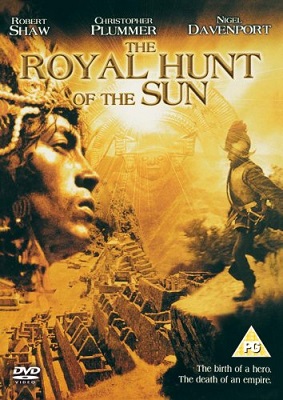
The Royal Hunt of the Sun, Irving Lerner (1969, UK). I found this in a charity shop and thought it might be worth a go. It wasn’t. It’s based on a play by Richard Shaffer. Christopher Plummer, who appeared in the play, swaps role to appear in the film. It’s about the meeting between Inca leader Atahualpa and conquistador Francisco Pizarro, who is played in the film by Robert Shaw. It starts with Pizarro trying to persuade the King of Spain to fund another expedition to the Americas, which he sort of agrees to do. There’s then a bit of exposition in which Pizarro explains in voiceover how he actually managed to put his expedition together… And then it leaps to South America and the conquistadors’ encounter with the locals and their plan to pillage the kingdom of Atahualpa by trickery. Pizarro claims godhood in order to get close to Atahualpa, who, as played by Plummer, is not all there. The conquistadors strike and Atahualpa is taken prisoner. But Pizarro comes to respect the man as he holds him prisoner, and when he insists the Inca should not be killed he argues against it. The film was shot on location, and it shows. Unfortunately, the script is too heavily based on the play, and the dialogue is far too stagey. On top of that, few of the actors convince in their roles – perhaps they might have done in a more obviously theatrical stage play, but in a movie shot on location they frequently over-act. There’s very little here worth watching, so it’s not worth going out of your way to find a copy.

JLG/JLG – Self-portrait in December, Jean-Luc Godard (1995, France). This is allegedly a documentary about Godard by Godard, but I’m not entirely convinced it is what it claims to be. Godard stars as sort of himself, inasmuch as he’s readily recognisable but the film refers to “JLG” in the third person. And yet it’s clearly presented as JLG, the voiceover is his train of thought, the topic of the piece his career and oeuvre… And the figure which appears in every shot is indeed Godard… but it seems odd that a director whose career is so focused – at least in its early days – on appearance should look so unkempt. Late in his career, Godard also seems to have discovered the usefulness, and the beauty, of static nature shots, and there are several very effective ones in JLG/JLG – Self-portrait in December. The end result is a film that seems late Godard in appearance but early to mid-Godard in content. True, that latter element is explicit – Godard listening interviews from earlier in his career, faux interviews throwing quotes from earlier in his career back at him. And then, in the middle, you have Godard reading from a French edition of AE Van Vogt’s The House That Stood Still, and I’m not sure what to make of it. Godard is a sf fan, that much is known. The House That Stood Still is the most noir of Van Vogt’s novels, and quite easily his best. In the right hands, it would make an amazing film. Is Godard the right hands?  He’s done US noir in the past, several times, and he’s done sf noir; but I can’t say I found the results especially convincing. Godard would certainly make an interesting adaptation of it, but I’m not convinced it would be a good one. None of which has anything to do with JLG/JLG – Self-portrait in December, which is a fascinating look more at Godard’s thought processes – at the time JLG/JLG – Self-portrait in December was shot – than his career, and nonetheless manages to some lovely cinematography, almost as if it were determined to demonstrate Godard could do it. Get this box set – if you’re a cineaste, it’s worth it.

1001 Movies You Must See Before You Die count: 885

Leave a comment

Moving pictures 2017, #56

A good mix of films this post…

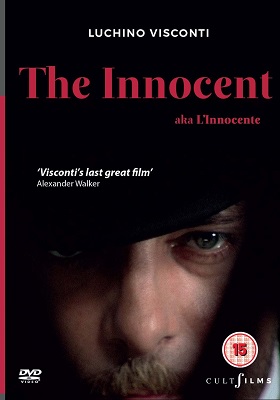
The Innocent, Luchino Visconti (1975, Italy). I have somehow managed to watch several Visconti films over the years without actually setting out to do so. First there was The Damned, which I thought okay, and then Death in Venice, which was pretty good (and I do like the Thomas Mann novella as well), and then The Leopard, which was very good indeed (so much so I read Giuseppe Tomasi di Lampedusa’s novel, and thought it excellent). And now The Innocent, which was Visconti’s last film, and which is another historical piece, this time set during the nineteenth century and based on a 1892 novel by Gabriele d’Annunzio. Jennifer O’Neill plays the mistress of an Italian peer, whose interest in his wife is re-invigorated after she begins an affair with another man. And then becomes pregnant. But then the lover dies, but the husband cannot accept the baby. It’s by no means a pleasant story, nor is it intended to be. But O’Neill is astonishingly charismatic as the mistress, and the mise-en-scène throughout is extremely convincing. It doesn’t have the faded grandeur of The Leopard, and so it seems less historically grounded, if you know what I mean, but it succeeds pretty much in presenting its time and place. I liked it a great deal, and I don’t know how much of that is down to its presentation as anything else. I can spot good cinematography, well, especially good cinematography, but I’m more likely to notice landscape cinematography than I am artful cutting between two characters in a scene or clever zooms and pullbacks. In other words, YMMV. The Innocent gives me some of what I look for in films in the visual sense, while providing an intriguing story. Nothing in it stands out per se, whereas for Pasolini it often does, which is why I prefer his films; but this is nonetheless a very good film, and I’d like to rewatch it. I’ve meaning to pick up my own copy of The Leopard for a while – but which one? The Criterion edition? Or the BFI Blu-ray? But I wouldn’t say no to a copy of The Innocent as well – although there’s only a single edition of this available, in DVD or Blu-ray, both by Cult Films.

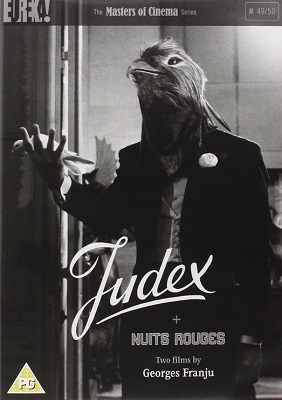
Judex, Georges Franju (1963, France). This is a remake of a 1910s serial od the same title, I think, or a remake of a remake of Fantômas, a 1910s serial based on a series of pulp novels published between 1911 and 1963, which was later adapted as a film; and I have another 1910s serial, Les vampires, by Louis Feuillade, the man who co-invented Judex, who is based on Fantômas, and who also made the 1910s Fantômas serial… Um, I think. Anyway. Judex, this film, is a 1960s remake of a 1910s-set mystery featuring the eponymous private detective, back in the day when villains had more personality than the heroes, and the good guys were just as often as contemptuous of the law as the bad guys. Judex featured some ridiculous plot about an evil banker who is kidnapped in order to force him to pay back the people he has ripped off – like that would ever happen. But there’s some evil lady crime boss also involved, and Judex, a masked defender of the downtrodden, with a gang of “ex-criminals and circus people”, although the only thing they have in common is the conjunction, who ends up rescuing the banker. Or something. It certainly looked all very 1910s, and was very pulp-ish. I’m not entirely sure what to make of it. It feels like a film that needs to be watched after watching the earlier films featuring the title character, but would likely feel superfluous having watched them. If you know what I mean.

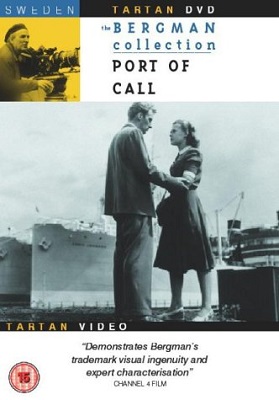
Port of Call, Ingmar Bergman (1948, Sweden). A young woman begins a relationship with a sailor who has had enough of travelling the seven seas. But this doesn’t go down so well with the local men, leading to violence, much bickering, and the sort of marital drama Bergman made much meat of throughout his career. There’s not much that stands out in this, except perhaps the opening scene where the young woman jumps into the harbour and is rescued by the sailor. The story is an original one by Bergman, although may well have been influenced by Harry Martinson  – whose book, Resor utan mål, the ex-sailor is actually reading in one scene; and Bergman later staged Martinson’s play, Trei knivar från Wei… none of which is relevant but does remind me of Malcolm Lowry’s fascination with the works of Nordahl Grieg, also, like Martinson, a Scandinavian who served aboard a tramp steamer (although a Norwegian rather than a Swede), and whose The Ship Sails On Lowry felt a harbinger of his own fiction, particularly Ultramarine, and one of whose plays Lowry even translated into English but was unsuccessful in staging (I’ve been trying to locate a copy of The Ship Sails On for ages, but the only one I’ve found is $150). Which series of facts create a number of resonances with a writer whose fiction fascinates me… And while there is zero commonality between the subsequent careers of Lowry and Bergman, although both were notorious perfectionists, it does mean that Port of Call fits into a place in my mental map of Bergman’s career in a much richer way than any of his other films. Go figure.

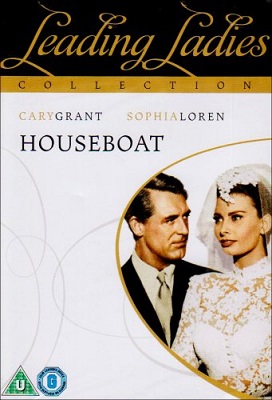
Houseboat, Melville Shavelson (1958, USA). I had it in my head this was a Rock Hudson film, although I’ve no idea why as it clearly stars Cary Grant. And Sophia Loren. It’s a pretty uninteresting spin on a common model from the time. Hollywood made shitloads of films like it, some were better than others, some were actually good films. This is neither. Grant is a widower with two young children he is determined to look after himself, despite being equipped for a bachelor lifestyle – ie, he lives in a small city apartment. One of his young sons sneaks out and makes friends with Loren, the daughter of a prominent Italian composer touring the US. She takes the boy home when he keels over, and is mistaken for a homeless person by Grant. So he offers her a job as the kids’ nanny. Which she accepts. For reasons. And they move out of the city and are forced to live on a ricketty old houseboat near the home of the sister of Grant’s late wife, who has her own designs on Grant. Except Loren too has fallen for him, but he takes no notice of her… until the country club dance when realises what was under his nose all along. Loren is good, the kids are good, but Grant feels a bit too sarcastically dismissive to be much of a catch. I used to think of Grant as the epitome of the 1950s male romantic lead, but I’m coming to the conclusion he was better in earlier decades. Certainly by the late 1950s, he was starting to more resemble the preserved presenter of an antiques show than a romantic lead. I’m almost starting to prefer the lolloping and puppyish Grant from his early 1930s films. Rock Hudson is clearly the better romantic male lead of the 1950s. So there.

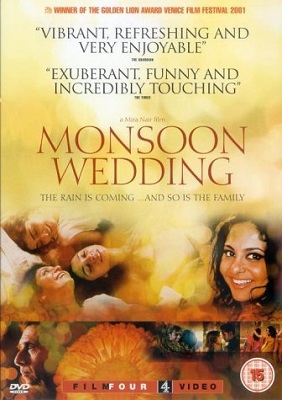
Monsoon Wedding, Mira Nair (2001, India). I remember this film being celebrated at the time of its release, one of those rare Hindi-language films which cross over to the English-language market. Except that’s not so rare for non-Bollywood films, and this wasn’t a Bollywood film. It was an international co-production, filmed in India with an Indian cast and some Indian money, but also a lot of US money – Nair is a US director – and UK money. So while it’s fair to describe Monsoon Wedding as an Indian film, it’s not a Bollywood film. And it shows. There’s a fly-on-the-wall tone to much of the film that feels almost antithetical to the Bollywood film-making process. As too does the anthology-style story-telling, with its intertwined narratives, and its ensemble cast. And its Romeo and Juliet plot. Which is a bit weird. As I had expected a Bollywood film, and got something that clearly wasn’t one but was in a Bollywood setting… And I have yet to work out if that means I liked it or not. Some of the characters seemed too broadly drawn, which would be a weird criticism to make of a Bollywood film but is appropriate here, and some of the minor story arcs were a little predictable and, well, ditto. Monsoon Wedding wasn’t bad, but I can’t figure out if that is because it was actually good or because it just wasn’t what it looked like it should be.

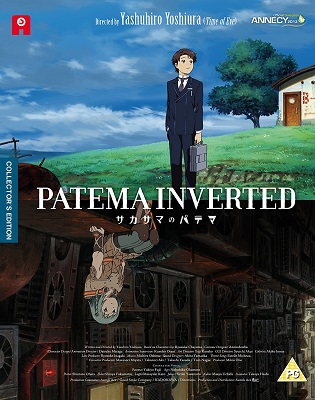
Patema Inverted, Yasuhiro Yoshiura (2013, Japan). I forget who recommended this, it may not even have been David Tallerman. In fact, I seem to remember it coming out of a conversation on Twitter. Anyway, with no expectations – because I have learnt that it’s best not have expectations for anime – I bunged it on my rental list, and so it arrived. Patema lives underground in a world whose gravity is inverted – ie, the surface of the world is down to her, even though she lives underground. She finds a shaft to the surface, and accidentally falls up it, and so finds herself on the surface. Upside down. She is helped by the son of a big wig on the surface world, who hides her because otherwise she would be killed or something. But her presence is discovered by the authorities, and during her interrogation, and subsequent, some surprising truths about her world come to light. The central premise of the film is, to be honest, hard to swallow, but the film goes totally with it and it actually starts to make a bizarre sort of sense by about two-thirds of the ways through. But then the final twist doesn’t really come as a surprise, despute all the narrative left turns designed to hide it. I quite enjoyed this – it looked fantastic, and it sold me on its daft premise. Sometimes that’s enough,

1001 Movies you Must See Before You Die count: 883


1 Comment

Moving pictures 2017, #55
The Godard box set has proven an excellent purchase. I’ve watched the films in it a couple of times each, and I suspect I’ll be watching them several more times as well. And I have another Godard box set to watch after this one as well. I guess I’m turning into a Godard fan. I don’t think every one of his films work – and the one here was especially mauled by critics – but sometimes it really does come together exceedingly well; and his continual experimentation, and facility with the language of cinema, to my mind makes him one of the most important European directors of the twentieth century. Unfortunately, not everything he made is currently available on DVD or Blu-ray – and he made a lot of films…

For Ever Mozart, Jean-Luc Godard (1996, Switzerland). I think I can safely say that drunkenly buying this box set has proven one of my smarter film purchasing decisions of 2017. It’s taken me a couple of watches of each film to get a handle on them, but I’ve liked what I’ve seen and I know I’ll watch them again. The films are also obscure, defy easy categorisation, and are the product of someone who has spent their entire career experimenting in the medium, and may well have contributed more to cinema narrative forms than any other living director. Having said all that, For Ever Mozart – apparently a phonetic pun as it sounds like faut rêver, Mozart, “dream, Mozart” – acually feels more like a Jacques Rivette film at times than it does a Godard one. But perhaps that’s because so many Rivette films are about rehearsal and narrative, and For Ever Mozart is about a theatre group who stage a play in Sarajevo during the years of ethnic cleansing. It’s a piece which revels in its tone-deafness, because the the whole point of the piece is that it’s tone-deaf. Unfortunately, one of Godard’s weaknesses appears to be the people-running-through-a-wood-in-fear-of-their-lives scenario, and that happens here. A little too often. Fortunately, there is also a lot more going on. Not least of which ties back to the title and the use of Mozart’s music as a theme. Godard is probably best known among non-Francophobe cinephiles for his work during the 1960s, especially that associated with the Nouvelle Vague. But I must admit I find his later stuff far more interesting. I still have the other Godard collection to watch, and it contains many of his better-known films, but I’ve very much enjoyed seeing the lesser-known films in this particular box set. Definitely worth getting.

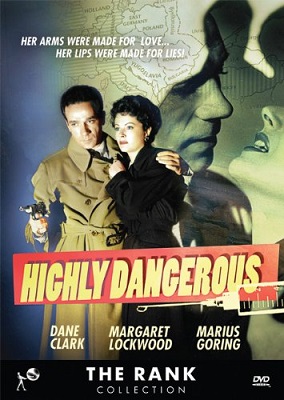
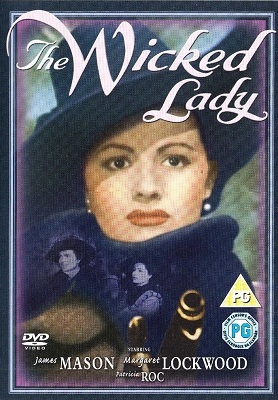
Highly Dangerous, Roy Ward Baker (1950, UK). After sending me one Margaret Lockwood film, LoveFilm went and sent me another the following week. This one was a British thriller, written by Eric Ambler, which nonetheless managed to be quite dull. Lockwood plays an entomologist sent to an invented Balkan state to discover if their rumoured biological beetle-based weapon is real. But she’s an amateur and inept at spycraft. She screws up meeting her contact at the railway station, and later is immediately spotted as a ringer by a US journalist. Whose help she enlists in in breaking into the secret laboratory to steal samples of the potentially lethal beetles. It’s all very earnest, and very British, and if the invented Balkan country fails to convince it’s because, well, they weren’t very good at that sort of stuff in those days – and I’m not entirely sure why they bothered to invent countries to stand in for, well, actual enemies of the West (of the time). Who knows. Maybe some Yugoslavian trade deal might have been jeopardised. Lockwood is, well, Lockwood, although it’s good to see a female lead in a thriller, and though she has to occasionally defer to her male colleague, she’s very much presented as an expert, which is something you still don’t see that often these days. Given Lockwood is just about the only female character in the film, it’s not going to pass a Bechdel Test… but a female heroine who doesn’t have superpowers who nonetheless drives the film? Um, I seem to remember Lockwood was a lead with agency in the last film by her I watched, The Wicked Lady (see here). I knew there was a reason I put that Lockwood DVD collection on my rental list…

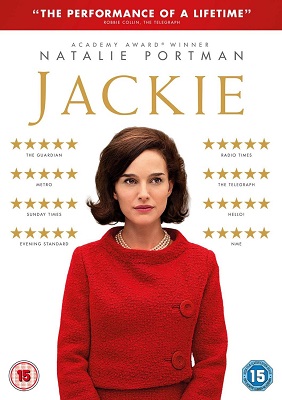
Jackie, Pablo Larraín (2016, USA). I really wanted to like this – it seemed like an interesting subject, and I’d been much impressed by Larraín’s No (see here), enough to want to watch more of his films… Although, to be fair, I would not have expected Larraín to have made Jackie… But… It’s Jackie Kennedy, of course. In the years just before, during, and immediately after, JFK’s assassination. Not being American, I have never understood the fascination with JFK, or the bizarre insistence that he was the best president the US “never had”. True, he created the political will to put a human being on the Moon, and his presidency did much for women’s rights… but he was also responsible for the Bay of Pigs fiasco and the Cuban Missile Crisis. Jackie, however, is about his wife, and JFK only makes occasional appearances. Natalie Portman is really quite astonishing in the role. Jackie Kennedy comes across as a not very nice person at all, and her fixed grin and wide-mouthed way of speaking feels more like a caricature than an actual character study. “Feels”, because I can’t judge its accuracy. Larraín’s direction seemed as good as that I’d noted in No, and even the back-and-forth-chronological structure seemed to work quite well, although there seemed ample opportunity to ramp up the emotional payload through clever cutting and that didn’t happen… The biggest problem I had was that I’d expected Jackie Kennedy to be a sympathetic subject, and she wasn’t. I should probably watch the film again.

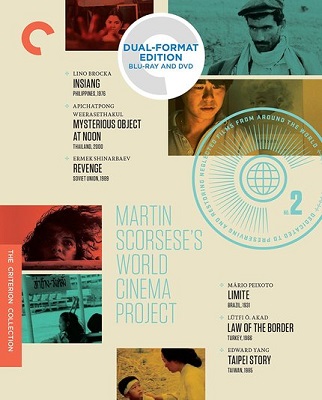
Revenge, Yermek Shinarbayev (1989, Kazakhstan). Beware of films with bland uninformative titles. Further, beware of films with bland uninformative titles from other languages where the film is generally known by its bland uninformative English title. Like Revenge. Because that’s not a title to encourage interest. And yet, Revenge is actually a lovely piece of film-making, a Kazakhstani film about the Korean disapora throughout east Asia, and which ends up on Sakhalin Island. It opens with a prologue set in seventeenth-century Korea, then jumps to 1915 and a Korean village. A schoolteacher murders one of the young girls in his class, and the father vows vengeance on him. He almost has it, but is thwarted at the last minute. So he takes a second wife, has a son, and raises the son to be the instrument of his revenge. The story moves through the decades of the first half of the twentieth century, as the murdering teacher, and the son, now a man, follows him – into China and then the USSR, to Siberia and Sakhalin Island. As the film progresses, so the protagonist and antagonist develop a relationship which is never quite consummated, and each in turn lives out the experience of Koreans in the areas into which they move. The acting is, it must be said, a bit hammy in places, but the mise-en-scène is thoroughly convincing in each of the periods it depicts, and the cinematography is mostly good but occasionally great. Martin Scorsese’s World Cinema Project No. 2 has a number of excellent films in it, but I did like this one a lot. It’s a movie that bears, perhaps even demands, repeated watches. Recommended.

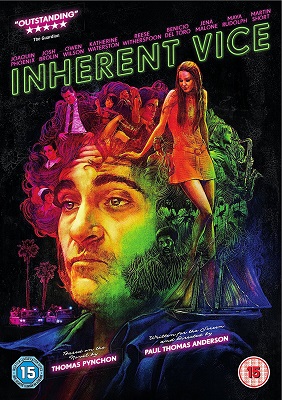
Inherent Vice, Paul Thomas Anderson (2014, USA). I hadn’t realised until I started watching this that it was an adaptation of a Pynchon novel. I know who Pynchon is, of course, and I’ve heard no end of praise about his fiction – but I’ve never actually read any of it. I have Gravity’s Rainbow on the TBR, and I will tackle it one day, buy Pynchon is pretty much unknown territory to me… Whereas Paul Thomas Anderson is not and, well, I’m not a fan of his films. Oh, they’re well-made films; but they’re entirely steeped in the American idiom and that doesn’t interest me in the slightest. Which might well explain why I found Inherent Vice a bit dull and uninvolving. I’m supposed to care about a dopehead American who manages to hold together a career as a private detective? Jaoquim Phoenix plays the aforementioned dopehead, who is asked to investigate an ex-girlfriend’s disappearance, only to get sucked into a state-wide conspiracy. I really didn’t get this. The dopehead lifestyle was presented as comical, without actually being funny, which rendered Pynchon’s worldview – something I have not experienced myself as I’ve not read any of his books yet – as weird and incomplete rather than just off-kilter. Pynchon is, I am reliably informed, famous for his erudition, but there was no evidence of that here. The whole thing came across as a gonzo thriller featuring potheads, and while Hunter S Thompson cuold be very funny indeed with his tales of excessive drug-taking, the humour here didn’t amuse me at all. Meh.

The Collector, William Wyler (1965, UK). This is an adaptation of John Fowles’s first novel. I have mixed feelings about Fowles – I consider him a middlebrow writer all too often mistaken for highbrow, and yet he wrote a handful of classic novels. The French Lieutenant’s Woman is a bona fide classic, A Maggot is a novel of notable ambition that only just doesn’t quite make the grade… the rest are middlebrow books du jour whose moments have passed, or even Dirty Old Man books. The Collector is a polished thriller novel, which was adapted by a US director and turned into an attractive, if implausible, UK thriller movie. This is not always the case.  Robert Wise shot The Haunting in the UK and it’s a classic piece of cinema. Terence Stamp plays a bullied young man who wins the pools and ends up buying an isolated house in the country. He is also a lepidopterist. And a stalker. He stalks Samantha Eggar, kidnaps her, and imprisons her in his basement. He hopes to make her love him. Which, of course, isn’t going to happen. None of it ever quite adds up, it all feels like it takes place in movie-land, where common sense doesn’t apply, and it’s not as if the cinematography lifts it above the usual as it feels mostly like an extended episode of Hammer House of Horror (worth getting; they were of their time but surprisingly entertaining). There’s not much in the way of surprises, and the local colour resembles no UK known to a Brit, even in 1965, but it manages to be entertaining.

1001 Movies You Must See Before You Die count: 883


2 Comments

Moving pictures 2017, #54

A couple more posts and I’ll be caught up with my viewing.

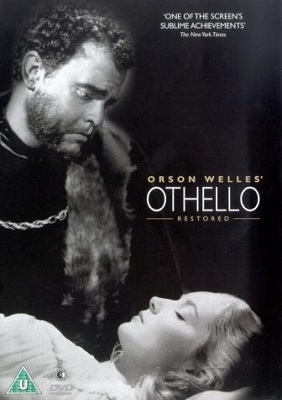
Othello, Orson Welles (1951, Italy). I’ve always felt a bit ambivalent about Welles – he was a true Hollywood innovator (and, later, a Hollywood outsider), who made some notable movies and some that were less notable… But then I saw his Falstaff – Chimes at Midnight, and was much impressed. Enough to want to see more of his Shakespeare adaptations – his thrillers suffer from over-complication, but his simplifications of Shakespeare to make the material fit his runtime actually seem make them more powerful. Othello is… probably the best adaptation of the play ever put on celluloid. Er, that I’ve seen. I did wonder if it was Welles’s best film… but I think its troubled production tells against it. It contains some of Welles’s most striking cinematography, but it never quite hangs together as a single vision. It was famously a difficult production – begun in 1948, but Welles ran out of money and used his salary from acting jobs to fund more filming, so it went in fits and starts over a three-year period… And yet, the end-result is… really quite astonishing. For the record, I profoundly disagree with blacking up, and no matter that Othello has been played since Shakespearean times by countless white actors in black make-up, or that Welles cast himself in the title role – one of Shakespeare’s juiciest, by all accounts – it still seems off to deny the part to an actor of colour. Even in 1951. But as director, Welles has put together an impressive film, making astounding use of the constraints he encountered while filming. The stark black and white silhouettes of the opening scenes are among the most arresting images I’ve seen in a movie’s opening minutes. And Welles’s use of lighting and shadow in subsequent scenes is borderline genius. I suspect Welles is the closest Hollywood ever came to a true auteur, and even then he was forced to make films outside the system, and even outside the country. He produced an enviable body of work – not just in cinema – and I’m surprised no one has ever thought to collect it: perhaps the wide spread of financing and production companies prevents it, but from Citizen Kane to F for Fake, that’s an oeuvre ripe for celebration.

Limite*, Mário Peixoto (1931, Brazil). This is on the 1001 Movies you Must See Before You Die list, and I’d pretty much come to the conclusion I’d never get to see it as no copies were available on DVD, nor any other format. According to Wikipedia, the single nitrate print of the film had degraded so badly it could no longer screened. So I did wonder how the makers of the list had managed to see it. But then Martin Scorsese’s World Cinema Project picked it as one of their films to restore – although some parts of the print were too badly damaged to fully restore, and one scene was missing altogether. But it did mean I got to see it. And… It’s an interesting film, but not especially strong on narrative. It opens with a couple lost in a boat, which is then interrupted by a series of flashbacks. Parts of it reminded me of Maya Deren’s work (which it predates), other parts of some of the early French silent films. Much of the scenery appeared very similar to that in Vidas Secas, which was made thirty years later, so not much had changed during the intervening years. I’m not sure how much of Limite‘s reputation rests on its rarity – it was only shown publicly three times, but was privately screened for Orson Welles in 1942, who greatly admired it. It was certainly worth seeing, but there are films which impressed me more in this collection.

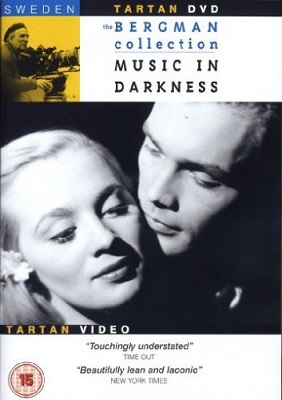
Music in Darkness, Ingmar Bergman (1948, Sweden). Bergman directed this, but the screenplay by Dagmar Edqvist is based on his novel of the same title. A classically trained pianist is blinded after being shot by accident at a shooting range during military manoeuvres. The only person who treats him like a human being is the servant girl in his parents’ house. But any sort of liaison is very much discouraged. The blind pianist decides to train as a church organist – it’s a better career than piano tuner, or piano player in a restaurant, for a person of his training – but even then is discouraged. He bumps into the servant girl, who is now training to be a teacher, and must win back her love. None of this is especially subtle, and while the actor who played the blind pianist – Birger Malmsten, who appears in many of Bergman’s early films – was never entirely convincing as a blind person, he was certainly convincing enough as an upper class Swede to handle that aspect of the plot.

Attenberg, Athina Rachel Tsangari (2010, Greece). I found this on Amazon Prime, which has thrown up the odd gem every now and again, and I admit I hadn’t realised it was Greek until I started watching it. And it’s a bit odd Greek, like a Yorgos Lanthimos film rather than a Theo Angelopoulos film – which is hardly a fair comparison as they’re the only two Greek directors I’ve seen recently, and the latter may be from an older tradition of Greek cinema. But, to be honest, I plan to explore Angelopoulos’s oeuvre further, and if Lanthimos and Tsangari are examples of twenty-first century Greek cinema, then I’m happy to explore that too. Providing, of course, such films are available in editions I can watch. (I studied Ancient Greek as a thirteen-year-old, but my command of modern Greek is non-existent, and I don’t remember what I learnt back then anyway.) There’s not much in the way of plot in Attenberg – a young woman’s father is dying, she enters into a relationship with a stranger who visits the small town where they live, her best friend has sex with her father. The characters are… a bit strange. The film opens, as shown in the DVD cover art, with the young woman and her best-friend ineptly teaching each other how to French kiss. And then sort of ambled along from there. I think I sort of liked it.

The End of Summer, Yasujiro Ozu (1961, Japan). For some reason, this film – Ozu’s penultimate movie – has not been released  by the BFI in one of their nice dual edition releases… although now I’ve hunted down a copy, they’ll probably go and do so. The End of Summer is, like every other Ozu film I’ve seen, an ensemble piece, about family, about business, about marriagable daughters who need husbands. It strikes me as a more Westernised film than his others, in as much as some of the characters are quite Westernised, and their Westernisation is part of the tapestry of family life Ozu weaves. A patriarch has an unmarried daughter and a widowed daughter-in-law and wants to finds husbands for them both. He runs a sake brewery which is starting to fail. The daughter-in-law – Ozu favourite Setsuko Hara – has no real desire to remarry; the young daughter would sooner marry a young man she knows who recently moved to Sapporo. But in the travelling back and forth between his offspring, from Kyoto to Osaka and back, the old man strains his his heart and is stricken with a heart attack. He survives the first, but not the second. And all his match-making counts for nothing. There’s a a sense in Ozu’s films of one generation ensuring the next is well settled for their life, so they too can ensure the same for their children. Mostly this comes across as patriarchs trying to find husbands for their daughters. In mid-twentieth-century Japan. Most fathers’ minds, it seems, when not filled with business deals, were exercised with ensuring their children were well settled for their own journeys into retirement. The idea that the previous generation has sufficient “float” to get the next generation started – either in social capital or financial capital – seems quaint at best these days. None of which invalidates Ozu’s movies. They’re well shot ensembles pieces – his technqiue of cutting from speaker to speaker during a conversation may be crude but remains effective – and his choice of domestic plots that illustrate elements if Japanese life of the time of shooting still resonate today. I still maintain Ozu is better than Mizogushi, and maybe one day I’ll convince David Tallerman of that too.

Alien: Covenant, Ridley Scott (2017, USA). Back in the 1970s, you used to be able to buy LPs of chart hits, usually published by K-Tel, which featured recent hits but performed by artists who only sounded like the original artists. Alien: Covenant should have been named Alien: K-Tel. It’s like a run-through of all the best bits of the previous Alien films, but done with less quality. And, following firmly in the footsteps of Prometheus, it doesn’t make the slightest bit of sense or go any way to building a logical narrative out of the franchise. And yet, according to Wikipedia, most film critics in the press were mildly approving. Really? Have they forgotten what a good film looks like? Because this isn’t one. The plot is cobbled together from bits and pieces of earlier Alien movies, it introduces fifteen characters and makes no effort to let the viewer get to know them – compare and contrast with the cast of Alien – and said cast also behave completely unprofessionally and fall to pieces at the first opportunity. There’s so many things wrong with this film it seems churlish to list them. That the eponymous ship is caught in a neutrino storm which is detected shortly before it hits (handily ignoring that neutrinos pass through everything without effect – so they’re fucking difficult to detect – and also wouldn’t actually cause any damage) and yet you can’t detect a storm of light-speed particles before it hits because by definition the first evidence of it is when the storm hits… Or the character who intercepts a radio message from a planet in his spacesuit because he is at the time “outside the communication buffers” of the Covenant, which is not what “buffer” means at all. Then there’s that really annoyingly stupid mistake perpetrated by all the Alien films, in which craft drop from the mothership while it is in orbit. It doesn’t work like that. Everything is in microgravity. Sadly, it’s also a major part of the plot in Alien: Covenant – because that’s how they manage to finally kill the alien. Oops. Spoiler. And a plot which blithely skates over genocide, with no apparent moral consequences, well, that’s no good either. This is the dumbest film in a franchise which has grown increasingly dumb with each new instalment. Avoid.

1001 Movies you Must See Before You Die count: 883


2 Comments

Moving pictures 2017, #53

I’m still trying to catch up on my Moving pictures posts. There have been a couple of weeks where I’ve watched as many as three movies in a single night.

Sweet Charity, Bob Fosse (1969, USA). Fosse’s All That Jazz is I think a great film. Sweet Charity, his first movie behind the camera, flopped – and it’s not hard to see why. Shirley Maclaine plays an innocent in New York, a young woman who works as a hostess at a dance hall and has had a string of a bad boyfriends – the films opens with her latest pushing her off a bridge in Central Park and stealing all her money. In an effort to better herself, she visits an employment agency, but has no skills or qualifications. She ends up trapped in the lift on her way down with a claustrophobe, who then proves so taken with her he woos her. She’s never had a normal boyfriend before, so she revels in his courting. And even accepts his offer of marriage. But when he discovers what she does for a living, he jilts her. This is a Fosse movie, so it’s all about the musical numbers, and most of them are pretty good. Sammy Davis Jr as evangelist Big Daddy is definitely memorable. I hadn’t known ‘(Hey) Big Spender’ came from this musical, and Fosse’s version is a prime example of repressed, well, something. Not a great film, but certainly a Fosse film.

Their Finest, Lone Scherfig (2016, UK). I’d seen this advertised on the sides of buses and trams for months, so when I saw a copy of it in a charity shop I thought it might be worth a go despite not expecting much of it. Another jingoistic pre-Brexit comedy, I thought, using WWII and the Blitz to sway public opinion, as if the two situations in anyway map onto each other. But I was wrong on several counts. It’s not a comedy. And while it takes place during WWII and is about Dunkirk, it’s very clear on the differences between the reality and the political narrative. Gemma Arterton plays a young woman hired to write “slop” (women’s dialogue, as the misogynistic screenwriter calls it) for a film unit put together to produce uplifting films for the British public. Her first project is the story of twin sisters who stole their father’s fishing boat to take part in the Dunirk rescue. Except they didn’t. The boat broke down. But Arteron lies, and the project gets the greenlight… and Their Finest turns into a pitch-perfect depiction of film-making in the 1940s, given it all felt very Archers. I’d been expecting some horrible Richard Curtis rom com set during the Blitz, but this was a little gem of a film. It’s by no means the comedy it has been sold as, but instead a solid drama of WWII – more like that Berkof drama than the comparisons its marketing was keen to draw. I liked it. Worth seeing.

Law of the Border, Ömer Lütfi Akad (1966, Turkey). I bought the first Martin Scorsese’s World Cinema Project because it included a restored version of one of my favourite films, A River Called Titas. But it proved an excellent box set, so when a second volume was released I immediately bought it. Like the first, it’s a varied mix, not all of which I’d heard of before. Like this Turkish film which is as old as I am. It apparently had a profound affect on Turkish cinema, with its mix of pseudo-western action and sociopolitical commentary. It’s set in a village on the Turkish-Syrian border, and many of the villagers survive by smuggling things across the border. But the authorities have put down new minefields, and now the border is virtually impenetrable. Then a new police lieutenant arrives in town, and a young and attrative schoolteacher persuades the village to open a school. Meanwhile, one of the local farmers has found himself with a flock of 3,000 sheep trapped on the wrong side of the border. So he tries to get master smuggler Hidir to bring the sheep across. But Hidir’s father died in the border minefield and he doesn’t want the same thing to happen to him. So he tries to accept the new order – sharecropping the local landowner’s fields. But that flock of sheep still presents quick riches to anyone who can get them across the border… Law of the Border was apparently pretty much lost – only a single copy survived Turkey’s 1980 coup, and it was in a parlous state. But not it has been restored – although only to the best that could be done given the state of the surviving negative. The film has its charm – it does that declamatory thing so many sociopolitical dramas do, and that I like. But it also wears its western inspiration on its sleeve, and there are lots of shoot-outs. Which does tend to make the last third of the film a bit busy. Hidir’s not exactly well-drawn either, and his character arc is a bit muddled. But for a 51-year-olf film from Turkey, it holds up pretty well.

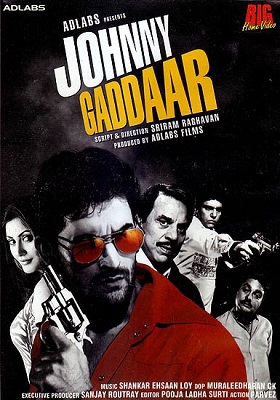
Johnny Gaddaar, Sriram Raghavan (2007, India). Five men invest large sums of money in a scheme which will double their money in a handful of days. It’s never directly said what the deal is, but it’s probably drugs. One of the five, Shiva, the biggest and strongest of the five, will take the train from Mumbai to Kolkata with the money, collect the goods, and then return with them. But Vikram has other ideas. He sets up an alibi, and then attempts to rob Shiva on the train – but it goes horribly wrong and he ends up killing Shiva. And that’s how it goes. As each member of the five discovers the truth, so Vikram is forced to kill them in order to protect himself. Except for the detective investigating the whole thing on behalf of the leader of syndicate, who is murdered by someone else in an act of self-defence. It’s all very cleverly done, and while Vikram was obviously a bad sort right from the start – and his opening murder, meaning the rest of the film was flashback, seemed a forced start, it did leave a mystery right to the end that provided quite satisfying. This was an entertaining comedy/thriller. As far as I’m concerned, modern Bollywood needs to get equal rating in my watching with modern Hollywood – although I do need to watch more classical Bollywood, having loved Pakeezah, Mughal-e-Azam and everything by Guru Dutt – and I shall adjust my rental list accordingly.

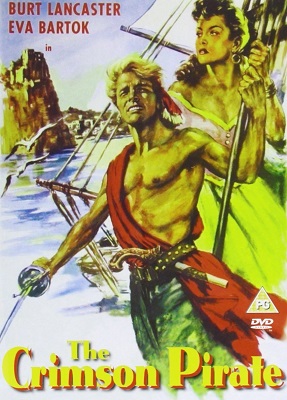
The Crimson Pirate, Robert Siodmak (1952, USA). You can blame Hal Duncan for this one. There was a discussion on Twitter about best pirate movies and he insisted this was the one. So I bunged it on my rental list, and they actually sent it a week later. And… I’m prepared to entertain it as a candidate. I’m not an expert on pirate films by any means, and the high point of Hollywood swashbuckling to my mind is probably The Adventures of Robin Hood, which is, er, not a pirate film… But The Crimson Pirate is certainly a viable candidate. I’m not entirely convinced – it tries to be clever, by introducing anachronistic technology, which is indeed amusing, but it gets it wrong, which kind of spoils the intended effect. And Burt Lancaster in the title role is a just way too much a goody two shoes to convince as a pirate in the first place. His bo’sun, a dour Brit, is great. Nick Cravat, as Lancaster’s silent sidekick, provides some excellent physical comedy. But the villains are paper-thin clichés, and the grand finale is a triumph of spectacle over plausibility. A hot air balloon that goes where directed? Yeah, right. Bonus points for getting the ballast thing right, but in a balloon you’re pretty much in the hands of the wind. Best pirate movie? Not convinced. On the other hand, I can’t think of any reasonable candidates for the top spot.

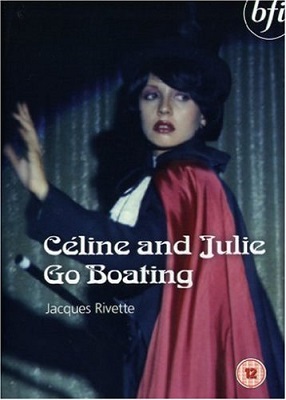
Céline and Julia Go Boating*, Jacques Rivette (1974, France). Rivette is a singular talent. When a limited edition box set (3,000 copies) of some of his films came out last year, I bought it – back in January 2016. I notice it’s still available. It’s worth buying. Céline and Julie Go Boating is one of his best-known films, but the title is a complete misnomer. It’s a literal transalation ofthe French title, which is better translated as “get caught in a shaggy dog story”. Um, yes. The original phrase has no such connotations in English. Which is unfortunate, because the film is all about two young women who find themselves in a story and discover they can affect its narrative. Julie is sitting in a park reading a park when Céline wanders past and inadvertently drops her sunglasses. So Julie picks up the sunglasses and follows Céline, with the intent of returning them… which turns into a weird sort of voyeurism into her life… before the two end up sharing an apartment… At which point the story jumps the rails when the two visit an abandoned house in which Céline once worked as a nanny… and they find themselves in the house’s past, but able to change what happened… Which they subsequently set out to do. This is where the title is of relevance. I like Rivette’s films. I’ve no idea what they’re about, but I find much in them that is appealing. I bought the aforementioned box set, and it was a worthwhile purchase. I suspect I may end up getting my own copy of Céline and Julia Go Boating. I’ve a feeling the movie requires a few more watchings…

1001 Movies you Must See Before You Die count: 882


Leave a comment

Moving pictures 2017, #52

My viewing of late has been partly dictated by LoveFilm’s imminent demise and a desire to watch as many films on my list that only it offers for rental. I can guess why it’s shutting down: there’s more money to be made in streaming. Let’s charge someone £2.49 to watch a film once instead of allowing them to rent up to twelve DVDs for £9.99 a month. Although, of course, you can pay monthly subscription fees for streaming services. And I would… if their selections weren’t so shit. There are now apparently dedicated streaming services – for Curzon, for Mubi, etc – which show the sort of films I want to watch. But I have to pay for each of them. Technology: finding more ways to separate you from your money for things that were cheaper, or even free, in the past…

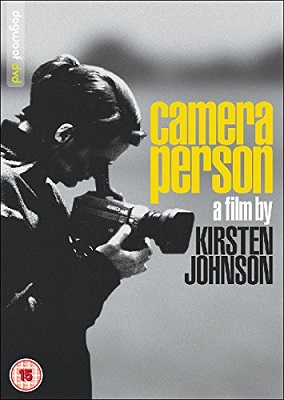
Cameraperson, Kirsten Johnson (2016, USA). Another recommendation from David Tallerman. Johnson is a documentary director, and Cameraperson is excerpts from the films she has made, assembled as a testament to her life and career to date. Er, that’s it. There is footage of Johnson’s children, or footage from, for example, her documentary about bin Laden’s driver… I’m not familiar with Johnson’s work, I admit; in fact, I really should watch more documentaries. I tend to watch only those on topics which interest me, like James Cameron’s descent to Challenger Deep, or the Apollo missions, or Alejandro Jodorowsky’s Dune… But documentaries, of course, cover a vast range of subjects, and I should know this because I live in a city that has an annual documentary festival (at which, incidentally, Cameraperson won the Grand Jury Award in 2016), and Johnson’s body of work covers some important topics. For the last year or two, I’ve split my rental DVDs between US/UK films and movies from the rest of the planet. But since I receive three at a time, perhaps I should introduce a third category for documentaries, and take one from each for each mailing. That sounds like a good plan, actually.

The Thin Man*, WS Van Dyke (1934, USA). William Powell plays an ex-private eye, married to wealthy socialite Myrna Loy. While visiting New York, a man they know disappears, and then his secretary is murdered. The disappeared man is assumed to be the murderer. The press repeatedly asks Powell if he’s investigating the case, but he points out time and again that he’s retired. But, of course, he starts looking into it, and, of course, he figures out what happened… resulting in a dinner party to which all the suspects are invited, and at which he reveals the murderer. Both leads were cast against type, but have real on-screen chemistry – although Powell does seem like he’s had a few too many throughout the film. But the way Loy and Powell actively take the piss out of each other is entertaining to watch. Loy is especially good. Apparently, director Van Dyke pushed Loy into a swimming-pool at a Hollywood party to see how she would react before casting her. Which is a pretty mean trick. Incidentally, the title refers to the disappeared man, not Powell’s character, but was mistakenly believed to be the latter – so much so, it led to five Powell and Loy sequels, all featuring the phrase “the Thin Man”. Not to mention a TV series that aired from 1957 to 1959, starring Peter Lawford and Phyllis Kirk. I’m not entirely sure why The Thin Man is on the 1001 Movies You Must See Before You Die list. It was certainly entertaining, but not I’d have thought an important film. True, it spawned a legacy that lasted a quarter of a century – but it’s mostly forgotten now.

The 9th Life of Louis Drax, Alexandre Aja (2016, Canada). I rented this because I’d read the book – it’s not one of Liz Jensen’s best, but she’s always worth reading. In fact, I’m surprised she doesn’t have a higher profile. Louis Drax is a nine-year-old boy who is in a deep coma after falling off a cliff at a family picnic. His father has disappeared, and it’s not clear if Louis’s fall was accidental or deliberate. Louis, who narrates the film, considers himself accident-prone, and several such incidents are shown in flashback. Actually, much of the film takes place in flashback. Louis was actually pronounced dead after his fall, but came back to life on the mortuary slab – but is now in a coma. A pediatrician who specialises in comatose children becomes interested in Louis’s case and has him moved to his clinic. Louis’s mother starts to take an interest in the handsome doctor. Meanwhile, Louis meets with a rock monster in his coma dreams, and in the real world threats are made against his mother. I’d forgotten the novel’s plot when I watched the film, but it wasn’t difficult to see where it was going. It was one of those films where everything felt a little fake, the outside scenes more like a studio set plus CGI than open air, the ward in which comatose Louis is kept not looking anything like a hospital… A triumph of set-design over actual realistic surroundings. But not a bad film.

Pigsty, Pier Paolo Pasolini (1969, Italy). There are two types of Pasolini film: one I like a great deal, one I’m less keen on. Pigsty does both. It has two seemingly unrelated narratives. In one, a young man wanders naked across a volcanic landscape (last seen in Pasolini’s Theorem), before finding a sword and armour. And then it’s a series of fights, as he meets up with other soldiers, kills them, builds his own army, and so on. But there’s nothing in the blasted landscape to eat, so he turns to cannibalism, but is eventually arrested. The other narrative is set in the 1960s, and features a German industrialist who is clearly intended to be Hitler, even down to the toothbrush moustache and virulent anti-semitism. But his wife would sooner breed pigs, which later come in useful in getting rid of a rival. The problem with Pigsty is that the Hitler narrative is too silly to have much bite, and while the one set in ancient times is effective and looks pretty damn good, it takes too long to get to its point. This year has been the Year of Pasolini for me (well, among a couple of other directors), and from knowing nothing about him and his films I’ve worked my way through at least two-thirds of his oeuvre in around twelve months. And I like it. Some more than others, it has to be said. But I don’t doubt his importance as a director, or the uniqueness of his vision. I suppose in some respects I find him a bit like Fellini, another Italian director whose importance is beyond doubt but whose oeuvre I personally find a bit hit and miss – I love Fellini’s more self-indulgent films and find his Neorealist ones a bit meh, but that’s just me.

Soigne ta droite, Jean-Luc Godard (1987, France). Godard’s films from the 1980s and 1990s, that I’ve seen, seem to be structured in parts, which I suppose is little more than more overtly delineated acts. Soigne ta droite has several, er, parts. It opens with a man instructed to carry a film can to another city, but he’s abused by another man, and left to fend for himself. And then there are several scenes set on a small prop airliner, in which the passengers behave like children. There are musicians rehearsing, discussing music, and performing it. There are some aerial shots of the (Swiss, I think) countryside. And there’s a voice-over narration for much of the film, which explains little and confuses more. Some of the dialogue is declamatory, and tries to be philosophical but doesn’t always make the grade. Unlike in, say, Miklós Jancsó’s films, the dialogue in the scenes often feels unlinked, a sequence of non sequiturs – in one scene, some passengers are haranguing a ticket agent at an airport, but what they say to her does not match what is being acted out in the scene. Despite watching this film two or three times, I’ve yet to work out what it’s about. Godard apparently described it as “a fantasy for actor, camera and tape recorder”, which is not very helpful. I shall probably have to watch it again.

The Wicked Lady, Leslie Arliss (1945, UK). For some reason I do not recall, I added a couple of Margaret Lockwood films to my rental list, and this was the first to arrive. I don’t know if it qualifies as a “quota quickie”, although it displays all the attributes – including James Mason in a leading role (as a Quaker and pacifist, he did not fight during WWII). (Um, it seems “quota quickies” only lasted from 1928 until 1938, so British films made during WWII don’t qualify – although Mason did make a lot of films during the period.) Lockwood plays the title character, an adventuress who steals her friend’s beau, only to find herself in a dull marriage… which she enlivens by taking up highway robbery, eventually teaming up with the infamous Captain Jackson (Mason). In many respects, it’s the dictionary definition of a bodice-ripper – apparently, it was considered very racy at the time. I would have thought the concept of a female leading lady who not only has agency, but pretty much breaks every rule of acceptable female behaviour for the time the film was set and also the time it was made (although the war would have changed some of those attitudes)… that I’d have thought more notable. And yet, for all that, the film is bit, well, dull. I think maybe the pacing is off or something. Certainly the plot is entirely predictable. And Lockwood makes a good leading lady, although somewhat bland at times. Mason is, well, Mason. The rest of the cast are your usual 1940s British actors with either cut-glass accents or put-on random regional accents. So, a bit meh, really.

1001 Movies You Must See Before You Die count: 881


1 Comment

Moving pictures 2017, #51

Sometimes the desire to not to watch Hollywood films gets a bit ouf of hand… The first US film in this post – well, I kind of enjoyed the first Guardians of the Galaxy as it wasn’t an awful piece of crap like the other MCU films… One-Eyed Jacks, on the other hand, was just ticking another film off the list… or maybe not.

Guardians of the Galaxy Vol. 2, James Gunn (2017, USA). I remember the Guardians of the Galaxy: there was StarHawk, who was a gestalt being comprising a man and a woman, and there was Charlie-27, who was short and squat and super-strong because he was born on Jupiter or something, and Martinex, who was made out of crystal because he was from an Outer Planet, and there was the blue-skinned guy who could direct his arrows with a whistle, and the ancient Earth astronaut, who was encased in a special skintight metallic suit that apparently left his mouth, nostrils and and eyeballs exposed, and who knows what other orifices, and who went by a variety of superhero names throughout his career, and… Well, none of that has anything to do with the reboot, which is what the film franchise is based on. Yondu, the blue-skinned guy with the arrow is there, but he’s not actually one of the Guardians, and the rest have been written out. Now it’s all about a wise-cracking half-alien guy from Earth and his daddy issues. Only, in this case, daddy is a planet. No, really. Okay, so he manifests as Kurt Russell, but he’s really a planet. Big round thing, with an angry looking brain in the middle. Just like, er, Earth. The first Guardians of the Galaxy was entertaining, if dumb, and I’d expected more of the same from the sequel. Except it seems to have dialled up the dumbness without doing the same for the entertainment. The characters are reduced to ciphers, the daddy-issues plot overwhelms everything, and there’s no forward direction presented for the franchise. It’s not a mis-step, it’s a step backwards. The first film made a lot of capital out of its soundtrack, and its justification for that soundtrack. That’s all the sequel has going for it. Avoid.

One-Eyed Jacks, Marlon Brando (1968, USA). I thought this was on the 1001 Movies You Must See Before you Die list, but it turns out it’s on one of the iterations of the list but not the 2013 one I’ve been using. And, to be honest, the only notable thing about One-Eyed Jacks is that it’s the only film directed by Marlon Brando. Brando plays one of a group of three bank-robbers whose last job goes awry. He’s captured by Federales, but manages to break out of jail five years later. And goes hunting for his compadre (the third died in that last bad bank raid). Said compadre is now a sheriff in San Diego, with a nubile daughter and a position to protect. Cue yawn. The history of this film is more interesting than its story: it was originally going to be directed by Stanley Kubrick, from a script by Sam Peckinpah. That would have been a mouth-watering western. Instead, we have a Brando vanity project. Because that’s all it is. I’ve never really understood why he has the reputation he has. When I first heard his voice, I assumed it was put on for his character; but no, he really does sound whiny whatever character he plays. And at 141 minutes, One-Eyed Jacks overstays its welcome by a good 50 minutes. There’s nothing special about this western – and the copy I watched was a terrible transfer – and I’m mystified why it made any iteration of the 1001 Movies you Must See Before you Die list.

Vanishing Waves, Kristina Buožytė (2012, Lithuania). I think I saw a trailer for this on another rental DVD – probably the only other Lithuanian film I’ve watched so far – and it looked interesting and was science fiction, so… Comparisons with Ken Russell’s Altered States are, I suspect, inevitable, if only because both films use sensory deprivation tanks as plot enablers. But in Vanishing Waves, the plan is to put their volunteer in a sensory deprivation tank and synchronise his brain waves with those of a young woman in a coma. The plan is more successful than anticipated, as he enters a dreamlike state where he interacts in some strange dream world with a young woman. It’s only after several sessions that he realises he is communicating with the comatose woman, and that the sessions offer a chance of waking her. The scientists running the project are concerned, because they’re not getting the results they expected, and they’re sceptical of the volunteer’s claims – especially when both volunteer and comatose women go into cardiac arrest during one session. The project is presented in that sort of dry corporate way, with lots of visible money, that the movie world seems to think how science is done. The dreamstates, however, are completely different, and effectively done. Worth seeking out.

Carla’s Song, Ken Loach (1996, UK). Ken Loach is not, I think, a great director. But he has a great body of work, and a couple of his films aspire to greatness. Not this one sadly. But to produce such a consistently left-wing body of work over nearly five decades is certainly something worth celebrating. Ken Loach may not have directed the best British film of the last fifty years – and there’s a contentious topic! – but he has directed an oeuvre that is impossible to ignore, that is good for all the right reasons, and yet has had disappointingly little effect. I, Daniel Blake earned scorn from a couple of right wing journalists but since the right-wing press can’t muster a single functioning brain cell among the lot, that means nothing. True, it was a flawed film, but it presented a cogent argument and made an important point. Carla’s Song is from what feels like another era, a time when left wing protest meant supporting communist regimes against US-backed right-wing insurgents. It’s set in 1987 and Robert Carlyle plays a Glaswegian bus driver with an attitude problem, who falls in love with a Nicaraguan refugee. But she has a dark secret: a lover back home whose fate is unknown. So the pair travel to Central America, and Carla’s home town to find out what happened to him. And Carlyle discovers he can’t handle the constant violence, while Carla realises she has to stay. Carlyle’s character doesn’t come across well, either too belligerent or too whiny; and the contrats between commonplace aggressive acts in Glasgow and the war between the Sandinistas and the Contra feels a bit laboured. But Oyanka Cazebas plays the title role with quiet dignity, and the location shooting is effective. Loach’s films are usually worthing seeing, some more so than others.

The Fabulous Baron Munchausen, Karel Zeman (1961, Czech Republic). I consider myself suitably embarrassed for not having this on my rental list until David Tallerman recommended it, although I really should have done. It is, so to speak, right up my street. But… Baron Munchausen… like the world really needs a another run at the story. When, in fact, it should have made do with this one. It opens with an astronaut landing on the Moon, only to be greeted by three men in old-fashioned dress: characters from Jules Verne’s From the Earth to the Moon. They’re then joined by Bran Munchausen. Who takes the astronaut with him to visit the Sultan in eighteenth century Turkey, where they both fall in love with his daughter and take her with them… A series of mad adventures then follow, including the three stuck on a ship swallowed by a whale, Munchausen riding a cannonball to spy on enemy troops during a siege, the astronaut building a steamship, only for it to explode… But it’s the animation and effects which make this film so good. It’s well, it’s Czech animation.

1001 Movies You Must See Before You Die count: 880