It Doesn't Have To Be Right…

… it just has to sound plausible


Leave a comment

Moving pictures, #10

Here we go again, more movies watched by yours truly. Only two from the list this time around.
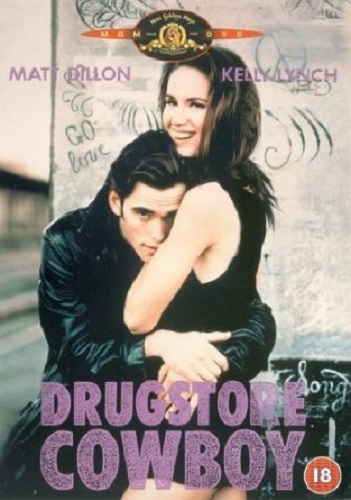
drugstoreDrugstore Cowboy*, Gus Van Sant (1989, USA). Even if you show how degrading junkie culture is in a movie, the very fact it is in a movie is in some way celebrating it. And there is seriously nothing to celebrate about junkie culture. Drugstore Cowboy is apparently based on a memoir, and depicts how a drug addict, and habitual robber of pharmacies, tries to go straight after one of his gang ODs. Matthew Dillon is a good-looking bloke; both Kelly Lynch and Heather Grahame are extremely attractive – a junkie might look in the mirror and see a Hollywood star, but that’s not what everyone else will see. Not only do films like Drugstore Cowboy sanitise and beautify their subject, but they also legitimise the lifestyle. I have no problem with people taking drugs, of whatever class (the drug, that is) – it’s their body and they’re free to abuse it how they like, using whatever substance they choose. But, short of legalising all non-ethical pharmaceuticals, which will likely never happen as long as governments remain broadly right-wing, the culture that illegality has created, not to mention the industry and power-structure, is not a fit subject for celebration in movies. Which sort of renders any criticism about this film as a film per se sort of moot. Nevertheless, its presence on the list didn’t seem justified.
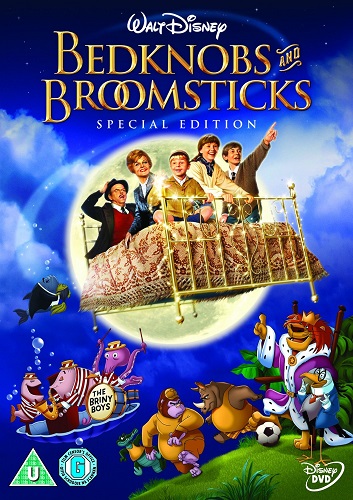
bedknobsBedknobs And Broomsticks, Robert Stevenson (1971, USA). Disney have apparently allowed a whole bunch of their films to be streamed free via Amazon Prime, so I’ve been working my way through the ones I’d never actually seen before. I didn’t mention my watches of Pinocchio or The Love Bug as I’d seen both as a kid, and besides I wasn’t impressed enough with them to want to write about them. I thought I might have seen Bedknobs And Broomsticks before, but as soon as I started watching it I realised it was all new to me… Except, well, it wasn’t. The animated section, set on the Island of Naboombu, I’d certainly see before. I even remembered the undersea sequence and the song ‘The Beautiful Briny’. So I must have seen that at some point. The rest – Angela Lansbury as a witch, the evacuee kids, the whole Portobello Road dance routine, even Bruce Forsyth as a spiv, never mind the actual story in which they hunt for the final parts of the spell for “substitutiary locomotion” – well, that was all completely new to me. Apparently, the film had been planned as an epic to capitalise on the success of Mary Poppins – I’d watched Saving Mr Banks over Christmas, but I don’t recall ever sitting all the way through Mary Poppins, although I probably have done – but was cut down from its planned 3-hour length, and eventually released as 117 minutes long. There’s currently a 139-minute “reconstructed” version available on DVD. I watched the theatrical release version on Amazon Prime. It was all a bit Hollywood England, and very nineteen-seventies (even though it was set during WWII), but better than I’d expected – but if I had to pick ten best Disney films… I could probably manage about three or four… this wouldn’t be one of them.
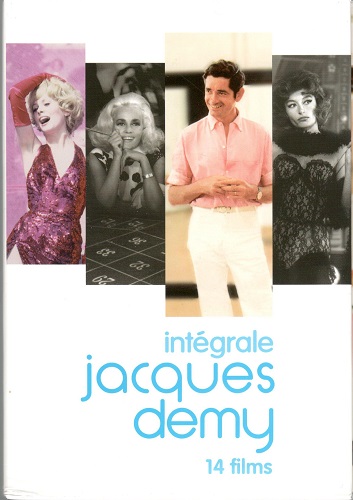
demyLa naissance du jour, Jacques Demy (1980, France). And so continues my journey through Demy’s oeuvre, as represented by the intègrale Jacques Demy DVD collection I bought earlier this year. La naissance du jour is a television movie adaptation of the novel of the same name by Colette. Watching it, I found myself wanting to read the novel – which, to me, a sign of the success of an adaptation. The main character, Colette herself, is living alone in a house and the film depicts her relationship with her neighbour, Vial, a a studly young man she sort of fancies, as well as her friends in the area. It’s set in the 1920s, roughly at the time of writing, and appears to be autobiographical – indeed, Colette spends a lot of time writing something in longhand, which might well be the novel La naissance du jour. It’s one of those typically French films in which the cast sit around a table outside eating their dinner and pontificating on love – and if that’s not the entire film, it ‘s certainly a pivotal scene. I hadn’t expected to enjoy La naissance du jour, and it didn’t feel especially Demy to be honest, but I did like it – and I suspect that was more a consequence of the source material than Demy’s adaptation. Nonetheless, I’m still glad I bought the collection.
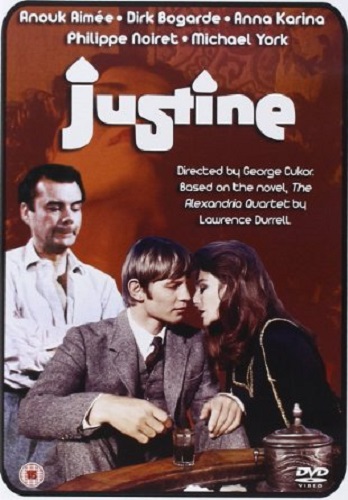
justineJustine, George Cukor (1969, USA). The Alexandria Quartet is one of my favourite novels – as the title indicates, it’s properly four novels but is most often found these days in an omnibus edition… and Durrell rewrote chunks of it for the omnibus edition anyway. Only one attempt has ever been to adapt the quartet for cinema or television – it would make an excellent television mini-series, it must be said – and that was this one, Cukor’s 1969 movie, which sort of munges together the plot of all four books into the first and uses its title. The end result is hugely unsatisfying – and not just for the casting of Michael York, who could be out-acted by a plank of well-seasoned oak – but for a series of casting decisions, and a script, that does neither the film nor the book any favours. And yet… in Anouk Aimée, they managed to find the perfect Justine. Go figure. And speaking of casting… John Vernon as Nessim Hosnani and Robert Forster as Narouz Hosnani is just plain indefensible white-for-black casting. But Dirk Bogarde, much as I love him, is totally the wrong person to play Pursewarden – he’s just not dissolute enough. George Baker, on the other hand, while he’s far too bluff for Mountolive, it sort of works in the movie. Having said all that, the major character in The Alexandria Quartet has always been the eponymous city. I have never visited Egypt – although I’ve always wanted to – but the city as revealed in the film certainly resembled the Alexandria I had imagined from Durrell’s novels. It’s a shame so little else in the movie did.

cinderellaCinderella, Clyde Geronimi, Wilfred Jackson & Hamilton Luske (1950, USA). Cinderella is generally reckoned to be one of Disney’s best animated feature films, and being a fan of Disney’s Sleeping Beauty, I was keen to watch it. Happily, Disney have made a whole bunch of films available on Amazon Prime – a situation of which I have taken advantage of, so to speak. I’m fairly sure I’ve seen Cinderella before – familiarity with Perrault’s story is not enough to explain memories of the Disney mice… Which is not to say I ‘d remembered everything from the movie. I had, in fact, been expecting not to like it much, having almost convinced myself that Sleeping Beauty was some sort of weird Disney aberration… except, well, it has to be said… okay, the mice are really irritating… but the animation in Cinderella is really quite lovely. I’d discussed Disney animated feature films earlier that day with David Tallerman, and texted him that night while watching the movie to say how much I was enjoying it. (He, incidentally, was watching Pinocchio that night, and enjoyed it a great deal more than I had.) I have by no means seen all of Disney’s best-known animated feature films, but I have seen a number of them. And so far, to my mind, Sleeping Beauty is easily the best, by quite a long way. But Cinderella is in second place. Fantasia holds a tentative third – albeit based on last watching it a couple of decades ago. A few years ago, Pornokitsch posted a “year of Disney” series of posts by Dreampunk.me – and while I’ve no desire to embark on anything remotely similar, I ‘ve seen a number of the films covered in the posts and… I was surprised at the lack of love for both Sleeping Beauty and Cinderella. And I hated Frozen. But I’d otherwise agree that Treasure Planet (a recent watch – see above re Disney films free on Amazon Prime – but not mentioned on this blog) is a lovely-looking animated film, but that’s about all it has going for it. All of which is a long-winded way of saying that I may at some point – thanks to Disney and Amazon’s “generosity” – end up in a situation where I have watched more Disney feature films than I ever thought likely; and, given my love of lists, I will likely order them according to some criteria or other which makes perfect sense to myself… But at this point in time, I can recommend both Sleeping Beauty and Cinderella as excellent films. Later, I may do the same for others from Disney.
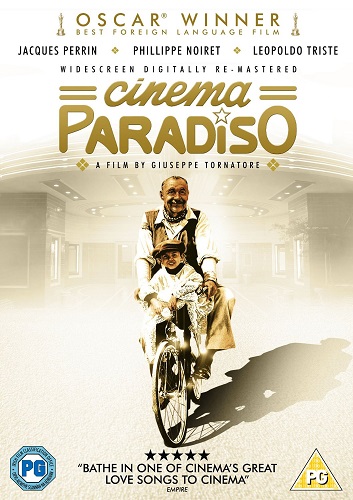
cinema_paradisoCinema Paradiso*, Giuseppe Tornatore (1988, Italy). My mother admitted to me this was one of her favourite films. so I bought her a copy for Christmas – and she lent to me and now I’ve seen it and… Yes, it’s a good film, but I doubt it will ever become one of my own favourites. This is no way different to my comments above regarding Disney films. To think a film is good is one thing, but to think a film is great requires you to love it in a way that can’t be explained as you would explain a film you think good. It’s the point where objectivity and subjectivity battle it out and subjectivity beats off all comers (while it sits on objectivity’s shoulders, of course). There are movies I love, and I can think of no rational reason why I love them. None of which is relevant. Cinema Paradiso is about the cinema in a small town in Sicily. A young boy becomes an unofficial apprentice to the projectionist, and when the latter is injured during a fire which guts the cinema, he becomes the projectionist in the newly-rebuilt cinema. The film is framed as the boy’s reminiscences, now that he is a grown man and a successful film-maker, which leads to some odd scenes set outside what is essentially a very long flashback. It’s a good film, and one that likely belongs on the list, perhaps more for revitalising Italy’s film industry than for the film itself – though I’d likely think that, given I’m more of a fan of Italian Neorealism than I am sentimental films like this. Nonetheless, worth seeing.

1001 Movies To See Before You Die count: 730

Leave a comment

Moving pictures, #9

Eighty percent of this post’s films are from the 1001 Movies You Must See Before You Die list, although that was more by accident than design. The Exorcist, for example, was a charity shop find; and the rest were just the ones the rental services sent me.

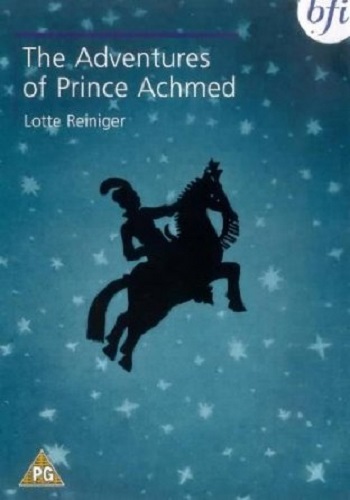
price_achmedThe Adventures of Prince Achmed*, Lotte Reiniger (1926, Germany). Another film on the list that would otherwise have never pinged on my radar – and not just because of its age, since I do, after all, like quite a few silent films (particularly those by Murnau, Dreyer and Lang). But The Adventures of Prince Achmed is also an animated film, done using a silhouette puppetry technique like the shadow theatre of Indonesia. It’s also apparently the oldest surviving animated film. The story is based on one from 1001 Nights, in which a prince visits a strange land on a flying horse, falls in love with the beautiful ruler, fights off an attack by demons, but she’s kidnapped by an evil magician, who traps Achmed under a boulder, but a witch rescues him, and then Achmed rescues Aladdin who is being attacked by a monster – cue 1001 Nights style flashback giving Aladdin’s back-story – and then the witch and the magician fight and the witch wins, so Achmed and Aladdin can rescue the princess, which involves fighting a hydra, but eventually Achmed wins that too, with the witch’s help, and they all live happily ever after… At 65 minutes, this does tend to drag a bit, even though there’s a lot of story to get through. The copy I watched had English narration and English intertitles, although only the intertitles were really necessary. The narration did emphasise the 1001 Nights nature of the story, however. I’m glad I’ve seen it, and can cross it off the list, but I’ll not be adding it to the wants list.

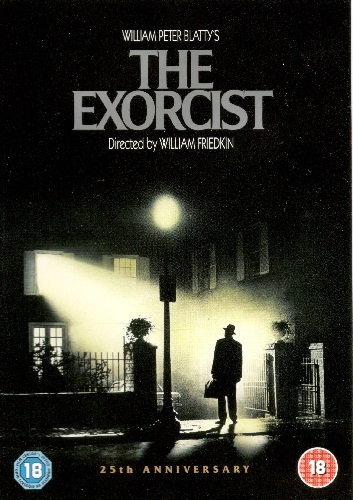
exorcistThe Exorcist*, William Friedkin (1973, USA). Back when I was at school, I worked my way through the first three of the Omen novelizations, although it was many years before I actually saw the films. The Exorcist, however, is an adaptation of a novel, which, despite reading the Omen books, despite, at that time, reading novels by James Herbert and Guy N Smith, I’ve never read. Nor did I ever see the film. But then I was never much of a horror fan, and even less so for films than books. And I’m far too squeamish to watch torture porn. But, The Exorcist… I knew the story, of course; and I’d heard about some of its more famous scenes. But it still came as a surprise when I started watching it that a) it begins at an archaeological dig in Iraq, and b) the lead character at that point is played by Max von Sydow. Also surprising is that The Exorcist is very much a 1970s film, in fact, it’s more a 1970s film than it is a horror film. If that makes sense. I’d relied on the film’s age meaning it was unlikely to trigger my squeam, if only because horror effects were so much more cinematic and less realistic back in the day; but in the event I wasn’t in the slightest bothered by even the most gruesome parts of the film – the projectile vomiting, the 360 head-turning thing – and even then they didn’t make an appearance until well near the end of the movie. I can see how the film has become iconic, although there’s not much in it that actually stands out. It is in all respects a typical 1970s movie adaptation of a novel, with a cast of vaguely familiar faces, a story that crams in far more of the book than is really needed, and solid directing and cinematography. I’m not sure it belongs on the list, however – and that’s not just because of my prejudice against horror films.
presidentThe President, Carl Theodor Dreyer (1919, Denmark). I count Dreyer’s Gertrud among my favourite films, and think extremely highly of his Day Of Wrath and The Passion of Joan of Arc (not that his other films are far behind). But Dreyer spent the first part of his career making silent films in Denmark and Sweden, few of which were especially successful, before heading to France to make The Passion of Joan of Arc. The Danske Filminstitut has released several of Dreyer’s early films on DVD and Blu-ray (his later movies are available in excellent editions from the Bfi), and Præsidenten (The President), Dreyer’s first feature film, is one of them. And having now seen it, I think I understand why it may not have hugely successful. It’s very, well, talky. There are pages and pages of intertitles. And the story, based on the novel Der Präsident by Austrian writer Karl Emil Franzos, is pretty complex for a silent film of 75 minutes. It’s also pretty grim. A Danish aristocrat returns to his home town as the president of the local judiciary, and one of his cases he’s due to see turns out to be a charge of infanticide against his daughter. He’d had an affair with his uncle’s governess, but refused to marry her because his father had advised him to never marry a commoner. He recuses himself and pleads for clemency – but the woman is sentenced to death. The aristocrat is assigned to another town, but before leaving he arranges for his daughter’s escape. Years later, he bumps into her and learns she is affianced to a plantation owner from Java. He returns to his home town to confess he organised her escape but is told that to do so would undermine the judiciary – and if he insists on confessing, then they will track down his daughter and see that her sentence is passed. All those intertitles, and the film even starts with a flashback… it makes for a confusing story.

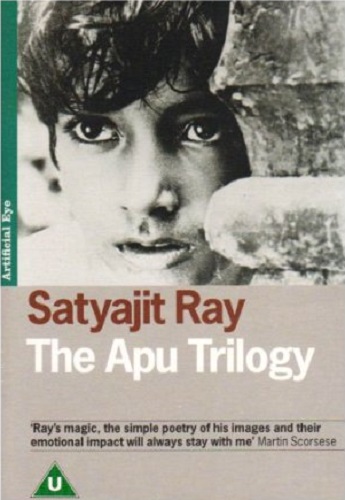
apuThe World of Apu*, Satyajit Ray (1959, India). This is third and final film of Ray’s Apu trilogy, following on from Pather Panchali (Song of the Road) and Aparajito (The Unvanquished) – um, I should really be consistent and use the Bengali titles for all three, so this third film is Apur Sansa. Anyway, I saw the first of these back in 2009 and the second in 2014, but in the last year or so – after seeing Jalsaghar (The Music Room) – I’ve come to a new appreciation of Ray’s films and am determined to see more of them. Anyway, Apur Sansa is the third film to feature the titular character, but unlike the other two is not based on a novel by Bibhutibhushan Bandopadhyay. Apu is a young man, unable to enter university because of lack of money, and struggling to find a job. He fancies himself a writer and is working on a novel. He accompanies a friend back to his home village for a cousin’s wedding. But on the wedding day, the groom has a mental breakdown. Another groom is desperately sought, since the wedding date is auspicious and to not marry off the bride would blight her life forever. After some persuading, Apu reluctantly agrees to take the groom’s place. He and his new wife return to Kolkata, and soon settle into a loving relationship. But when the wife, Aparna, returns to her home village, she dies giving birth to their first child. Apu blames the child for his wife’s death, and leaves his job and his home. He travels about India, taking odd jobs, and is only reunited with his son five years later when his friend comes looking for him and persuades him the boy needs him. The final scene, as had been long recognised, is a killer. There’s a starkness to Ray’s cinematography and staging, not to mention the social realism of the poverty he unapologetically documents, that gives Ray’s films a solid foundation of emotional power. Certainly a film that belongs on the 1001 Movies You Must See Before You Die list, and I plan to watch more Ray.

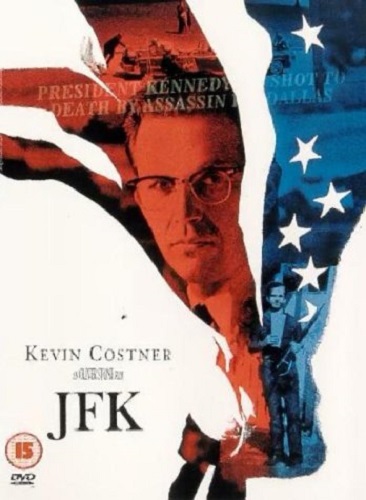
jfkJFK*, Oliver Stone (1991, USA). I can remember when Stone could seemingly do no wrong, and even though each project he worked on seemed, frankly, a bizarre choice, he still managed to impress both audiences and critics. But his career has long since waned. JFK was possibly his high point – fourteen award nominations and five wins. There’s not much point in giving the plot of the film – is there anyone on this planet that doesn’t know about the Kennedy assassination? Or indeed the various conspiracies which have sprung up to explain it? Stone takes Jim Garrison, a Louisiana DA, who obsessed over the case, and was the only person to ever bring a case related to the assassination to court (he lost, of course), as played by Kevin Costner. Over 3 hours, Stone goes through many of the inconsistencies ignored by the Warren Commission, and presents considerable evidence that contradicts the Commission’s findings… But I’m not quite convinced by his solution. Nor by James Ellroy’s, for that matter. The government;s preferred solution, lone gunman, is obviously complete bollocks. And certainly those Cubans who lost everything when Castro took over had motive… but assassinating a president, and getting away with it, requires help from the very highest levels of US government, industry and military. Eisenhower’s “military-industrial complex” makes for a handy villain – and certain the loss of future profits seems a viable motive… But such people can generate conflict whenever they want, wherever they want, and the president of the US is unlikely to have much impact on that – Afghanistan, Iran, Iraq and Isis, notwithstanding. Any way you look at it, there were – and probably still are – a group of powerful people in the US who are so arrogant they believe they can effect a regime change simply in order to better their own situation. It’s tempting to think a group of right-wing industrialists and technocrats arranged Kennedy’s death, and while subsequent history has given them more than they could have possibly wished for, it’s hard to believe they were that forward-thinking, or prescient, back in 1963. I can believe a small group of people in the intelligence services and military, for whatever reason, set it all up – but why? Afraid of budget cuts? Frightened the Cold War might come to an end? They’re not… visceral enough motives. It takes real hate, and a perception of real benefit, to plan something like the assassination of a president. We may well find out fifty years from now that it was all to do with something completely different, some other power group JFK had attacked… Or we may never find out. Still, it hasn’t stopped endless speculations.

1001 Movies You Must See Before You Die count: 728


2 Comments

Moving pictures 2016, #8

Almost up to date now – so it’ll back to the usual, somewhat irregular, schedule for these Moving picture posts after this one. A bit of a mixed bag this time – three from the US, two from France, and one from Spain (that isn’t actually Spanish); mostly from the 1980s; and mostly drama.

demyParking, Jacques Demy (1985, France). I’m really not sure what to make of this one. It’s like a cross between Cocteau’s Orphée and Xanadu, although without being anywhere near as awful as the latter. It’s actually a retelling, more or less, of Orphée – and Jean Marais, who played the title role in Cocteau’s film, plays Hades in this – but rather than a beatnik poet, Orpheus is a rockstar. Who wears a white jumpsuit and a red headband. And his music is awful – bland, insipid elevator rock, the sort of music Kenny G would sing if he’d been a singer. While rehearsing on stage, Orpheus is electrocuted. But when he gets to the afterlife, Hades can find no record indicating he was due. So he sends him back. Then a woman he met there, Hades’ personal assistant, Claude Perséphone, contacts Orpheus and offers to represent him. He refuses. But Orpheus’s girlfriend, Eurydice, commits suicide, so he tracks down Perséphone and persuades her to lead him back to the underworld in order to rescue Eurydice. The sections set in the afterlife are in black and white, with the occasional red, and the underworld itself resembles either an underground car park or the basement of some huge building. Those scenes are reasonably effective, although they’re not a patch on Orphée‘s, but the movie is completely hamstrung by Orpheus’s music and the baffling success he has apparently had with it. Not one of Demy’s better efforts.

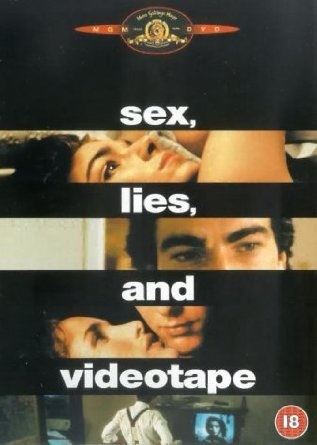
sex_liessex, lies and videotape*, Steven Soderbergh (1989, USA). This film apparently had an enormous impact on the independent film industry in the US, and Soderbergh has always been one of the more interesting US directors… and, to be fair, time has been relatively kind to it… but it’s a type of drama I don’t find particularly interesting. A school friend of a philandering lawyer drops into town to stay for the weekend, but decides to stay on for longer and rents a house. The lawyer’s wife helps him furnish the flat, and thwe two swap personal histories. The friend admits he cannot perform sexually with another person, and has taken to interviewing women on video about their sexual histories. Meanwhile, the lawyer is having an affair with a sister-in-law, and she becomes interested in the friend with the videotapes… and it only really ends badly for the lawyer, who pretty much deserved it. For all its polished dialogue and cast, I found it all a bit dull. But given the film’s impact, I suspect it belongs on the 1001 Movies You Must See Before You Die list, and I can at least now cross it off.

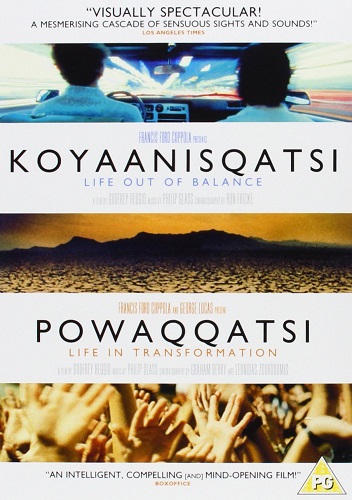
koyaanisqatsiKoyaanisqatsi*, Godfrey Reggio (1982, USA). I knew of this film but had never heard it mentioned all that approvingly, and despite knowing roughly what it was – ie, footage of cities and landscape, with music but no voiceover – and being a fan of James Benning’s films – it had never occurred to me to actually watch Koyaanisqatsi. But it’s on the 1001 Movies You Must See Before You Die list, so I bunged it on the rental list, and in the fullness of time it dutifully dropped through the letterbox. And I watched it. And, unsurprisingly, I loved it. Using slow-motion and time-lapse cinematography, Reggio filmed various parts of the US countryside, such as the Canyonlands National Park, as well as various cities – including footage taken on the streets of pedestrians, some of whom actually take notice of the camera. Over it all is a repetitive, but quite appropriate, electronic score by Philip Glass. It’s an easier watch than any of Benning’s films – despite the lack of voice-over, there’s a plain narrative to follow, and the visuals are, of course, quite stunning. The rental service screwed up when sending me this – although I suppose it might have been me – and a Blu-ray arrived rather than a DVD. So I got to see it in even better quality than expected. And it came with the sequel Powaqqatsi – see below.

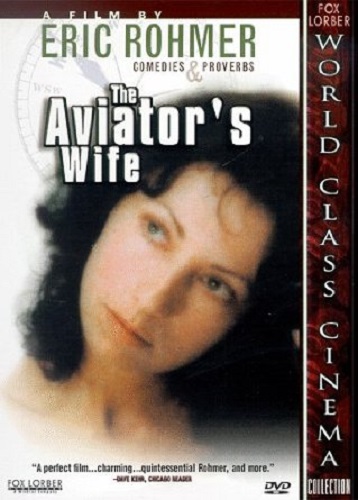
aviators_wifeThe Aviator’s Wife, Éric Rohmer (1981, France). I do like Rohmer’s films – at least those I’ve seen – albeit some more than others. This one strikes me as… middling Rohmer. A young man is afraid his girlfriend is still seeing her ex-, an airline pilot, and witnesses the pilot leaving her flat. Later, he spots the pilot with another woman, and decides to follow the pair. In a park, he bumps into a fifteen-year-old girl, who quizzes him on his behaviour, and the decides to help him trail the couple. Which is what they do. Around Paris. And the two of them discuss what the couple they are trailing might be up to. It’s a typical dialogue-heavy and leadenly-paced Rohmer film, and despite its plot and cast, it’s unfortunately somewhat light on charm.

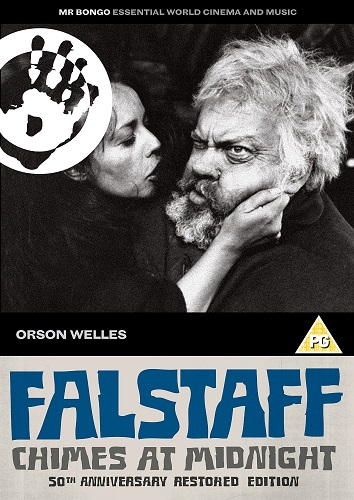
falstaff_dvdFalstaff – Chimes at Midnight*, Orson Welles (1966, Spain). Welles has done quite well on the 1001 Movies You Must See Before You Die list, with half a dozen – that’s around half of his feature film output – on the list. Three of them I’d seen many years before, one I watched and liked so much I bought the Criterion Blu-ray… and now there’s the only Shakespeare film of his that makes the list. And I hadn’t really expected to like it as much as I did. Possibly because I hadn’t been that impressed by The Immortal Story, seen only a few weeks before. And, it has to be said, Shakespeare is hard to do well… and Welles not only plays the title role but created his story, and dialogue, from Falstaff’s appearances in various of Shakespeare’s plays. And yet… it works really well. It doesn’t much feel like a Shakespeare play, despite the Shakespearean dialogue – and the scenes depicting the Battle of Shrewsbury are surprisingly brutal and effective. Welles’s make-up, to be fair, does appear a little over-done, much as it did in The Immortal Story, but it’s only noticeable in some of the scenes. I am not really a fan of Shakespeare’s plays, and watching the BBC adaptations was more prompted more by a desire to see what they were like, and I’ve never really found myself all that enamoured of the various film adaptations I’ve seen – such as those by Baz Luhrmann, Kenneth Branagh, etc – but I’ve seen two since I’ve been working my way through the 1001 Movies You Must See Before You Die list, and was somewhat surprised to discover they’re both very good – this one and Laurence Oliver’s Henry V. Go figure.

koyaanisqatsiPowaqqatsi, Godfrey Reggio (1988, USA). This is the second of three films – the third, Naqoyqatsi, didn’t appear until 2002 – and where the first film’s title translates as “life out of balance”, Powaqqatsi means “life in transition”. It focuses on the developing world, not the US, but follows the same pattern. This time, however, the Philip Glass score is much more intrusive, and seems to work to work against the visuals rather than with them. It don’t think it’s as successful a film as the first, although the cinematography is just as good. But now, I want the entire trilogy – apparently there’s a Criterion Collection Blu-ray trilogy, so that’s gone on the wants list (for some reason the Region B release, by Arrow Academy, only contains the first two films).

1001 Movies You Must See Before You Die count: 724


2 Comments

Moving pictures 2016, #7

Carrying on with getting my film posts to get up to date…

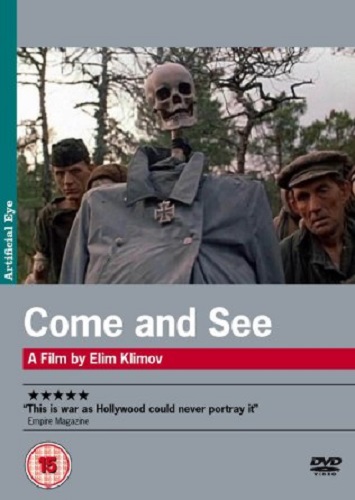
come_and_seeCome and See*, Elem Klimov (1985, Russia). The opening of this movie did not bode well. Two boys, playing at war, while one of them puts on a hoarse voice intended to sound adult… but then the older of the two starts digging where corpses have been buried and finally unearths a rifle. Later, partisans visit his home and recruit him, against the wishes of his mother, who knows that her survival, and that of her daughters, is uncertain if he leaves. But he goes, and becomes a Soviet partisan fighting the Nazis. And the film goes from meh to good and then to great in relatively short order. The boy is separated from his unit, and hides out with a girl his own age. They return to his village, but everyone has gone (they have been massacred – he does not realise this, but she does). The two meet up with the partisans, but their leader has been badly injured by the Germans. Eventually, the boy infiltrates a village and pretends to be resident there. But an SS unit arrives, locks everyone in the church and sets fire to the building. This is pretty brutal stuff. Perhaps the Soviets are all a bit more noble than they actually were (cf Larisa Shepitko’s Ascent) and the Germans are painted as complete animals – when likely all sides exhibited such behaviour – but, considering I’d known nothing about this film before renting it, and its title is not exactly much of a clue, I ended up thinking it very, very good indeed. And definitely a movie that belonged on the 1001 Movies you Must See Before You Die list. I’m surprised it’s not better known than it is.

demyL’évènement le plus important depuis que l’homme a marché sur la lune, Jacques Demy (1973, France). Marcello Mastroianni is a driving instructor, married to Catherine Deneuve, a hairdresser. One day, Mastroianni is not feeling well, so he visits the doctor… and is told he is pregnant. He becomes the centre of a big media circus, and other men begin reporting pregnancies too. (The film, incidentally, was released in the US as A Slightly Pregnant Man, which is a pretty naff title, whereas the original title is, er, long.) Sadly, while the quirky humour in the film never really quite works, the brightly-coloured production design is a lot of fun. Okay, so Deneuve is too elegant to really carry off the 197s outfits she wears, but Mastroianni fits his role perfectly. It’s all a bit of colourful French fluff, not only of its time but also screaming from every frame that it’s a film of the early seventies. I quite enjoyed it – which I guess means the intégrale Jacques Demy collection is currently batting about 50:50, which is not bad odds for a DVD collection.

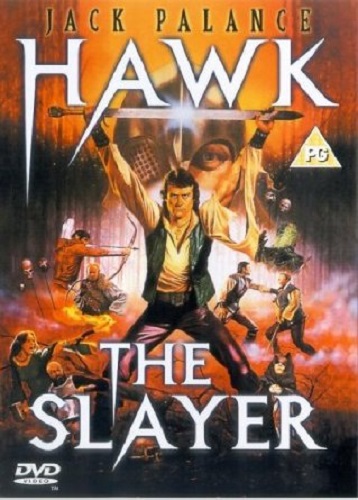
hawkHawk the Slayer, Terry Marcel (1980, UK). I remember this from year ago – decades ago… After all, who can forget the elf who can fire arrows like a machinegun, or Bernard Bresslaw playing a giant with two eyes, or a dwarf eating a fish whole, or Jack Palance as the villain chewing up the scenery with gusto… Um, that last applies to most genre films of the 1980s, but never mind. Anyway, I remembered Hawk the Slayer with some fondness from all those years ago, so I thought it worth watching again (that is, when I stumbled across a copy for £1 in a charity shop). And so it is. Daft, of course, with a cast of familiar faces from UK films and TV, who are clearly in it for the money but determined to have fun. The plot echoes that of a zillion sword & sorcery stories, and there’s nothing really new that Hawk the Slayer brings to the genre. The various fight-scenes were plainly staged to resemble those of Westerns, and it sort of worked; but it’s not like this movie will ever be considered Great Art, or even Slightly-Better-than-Average Art. One thing I hadn’t realised, however, is how much the soundtrack rips off Jeff Wayne’s The War of the Worlds. There are riffs and melodies which are uncannily similar to Wayne’s magnum opus. Not that such music seems all that appropriate to a high fantasy film… although it does seem weirdly appropriate to a nineteen-eighties high fantasy film. Go figure.

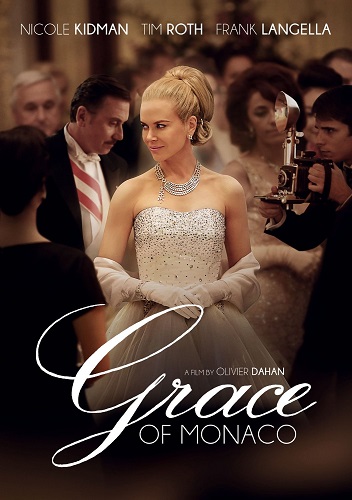
graceGrace of Monaco, Olivier Dahan (2014, France). I’m a fan of Grace Kelly, she’s one of my favourite actresses. Her career was famously cut short in 1956 by her marriage to Prince Rainer of Monaco, and I can’t help wondering what would have happened had she continued acting. Longevity certainly didn’t harm the careers of any number of her contemporaries, from Maureen O’Hara to Cyd Charisse (um, on the other hand, Charisse was in Warlords of Atlantis…). Anyway, while Kelly made some stone-cold classics, displayed, and was recognised for, her acting chops, she also made several pretty forgettable movies. But Grace of Monaco, in which Nicole Kidman plays Kelly, is about her after she married Rainer… and single-handledly prevented France from invading and annexing Monaco. Ah, you didn’t know about that? Probably because that’s not what actually happened. I hadn’t known Monaco began offering French corporations tax-free status if they moved their operations to Monaco, and this upset the French government. Who responded by telling Monaco it had to a) start levying tax on the corporations, and b) pay the tax raised to the French government. When Monaco refused, France blockaded the principality. Apparently, the rest of the world seemed unconcerned at this – one country threatening to invade another because its tax laws were preferable to companies. You’d never see that happening now, and not just because the corporations these days have so much power they can actually refuse to pay the tax they do owe, even in G12 countries. Anyway, Princess Grace gave a speech about it all at a Red Cross Ball, at which were present the great and good, including President de Gaulle, and it melted his heart and he lifted the blockade. Or something. When I started watching this film, Kidman didn’t really convince as Kelly, but as the story progressed she seemed to settle into the part and her portrayal became more believable. She isn’t Kelly, the resemblance is not even slight, but I suspect she may have been the best actress for the part. (Although, are there Grace Kelly impersonators? I guess so. There are Madonna and Cher and Barbra Streisand impersonators, after all.) Grace of Monaco has been comprehensively panned, and with mostly good reason. It does seem a bit unfair to criticise a biopic for being inaccurate, because you’d be hard-pressed to find one that is accurate. And that is a solid cast there – Kidman, Tim Roth, Frank Langella, Parker Posey, Derek Jacobi…  It also seems to capture the period resonably accurately, as far as I can judge. But, for all that, it’s just not… very dramatic. It builds up tension and then Grace Kelly sort of decides to take her new role seriously – she even learns French! – and then she solves all of Monaco’s woes with a tearful speech. Sadly, not an especially good memorial to Grace Kelly.

demyUne chambre en ville, Jacques Demy (1980, France). This is one of Demy’s sung dialogue films, and I’m still not entirely sure they work. The title refers to a room rented by a striking shipyard worker in the house of a sympathetic baroness. Although he has a steady girlfriend he plans to marry, he spends the night the wife a television shop owner, and the two fall in love. He tells his girlfriend, while the wife goes to tell her husband… who kills himself in despair. So she goes to her mother – who happens to be the baroness. But the shipyard worker is fatally injured during a demonstration, is taken to the baroness’s, where he dies in the arms of the telelvision shop owner’s wife. Who then shoots herself. It is not, perhaps, the most original story in the world. I seem to recall some guy called Bill did something similar about 400 years ago, and there was that Bollywood film I mentioned a Moving pictures post or two ago… It was all a bit fraught, the mid-fifties mise en scène didn’t have the benefit of the bright colours of the Demy film mentioned above, and the sung dialogue doesn’t realyl work for me. I shall probably have to watch it again some time.

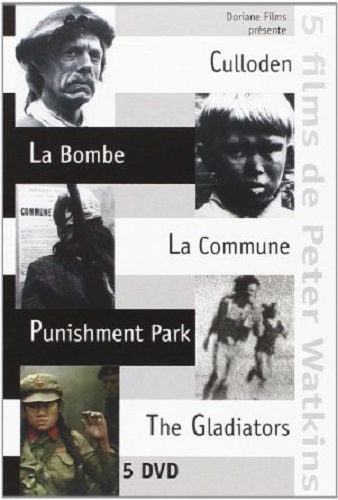
watkinsCulloden, Peter Watkins (1964, UK). I had to buy a French DVD collection because Watkins’s films are not available in the UK on DVD. Well, there were BFI editions of The War Game and Culloden, but they’ve now combined them into a dual edition omnibus, Culloden + The War Game, and eureka! have released a Blu-ray of Punishment Park (after I bought the collection, naturally)… But even so, he was a remarkable film-maker and his films should be readily available in this country as a matter of course. Culloden, made for the BBC, is framed as a fly-on-the-wall (so to speak) documentary of the eponymous battle as it takes place. People involved in the battle are interviewed, both before and after, and the narrator puts everything in context reportage voice-over. It is surprisingly effective. Even the fact this is a fifty year old television film doesn’t doesn’t lessen its impact. And it’s informative too. Recommended.

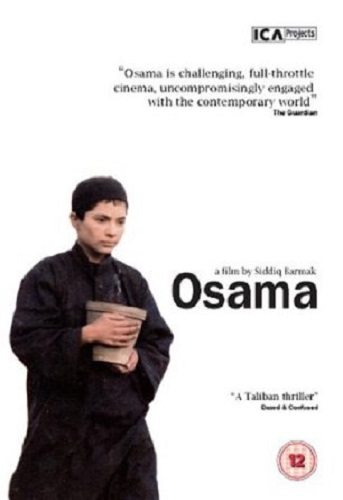
osamaOsama*, Siddiq Barmak (2003, Afghanistan). A doctor, whose husband was killed in the Soviet invasion, lives with her mother and daughter, but the Taliban have shut down the hospital where she works and the lack of man in the household means there’s now no money coming in. So the grandmother persuades the daughter to protend to be a boy, so “he” can get a job and earn enough for them to buy food. But then the Taliban recruit all the local boys for the madrassa – include Osama, as the disguised girl is now calling herself – and her masquerade becomes a thousand times harder. They really were a nasty bunch of men, the Taliban, and Osama pulls no punches in depicting just how evil they were. This is not a movie that is going to leave you feeling good about the world – although clearly that was not its intent. But you could always watch those films about a bunch Spandex-called nincompoops saving the world from alien invasions instead.

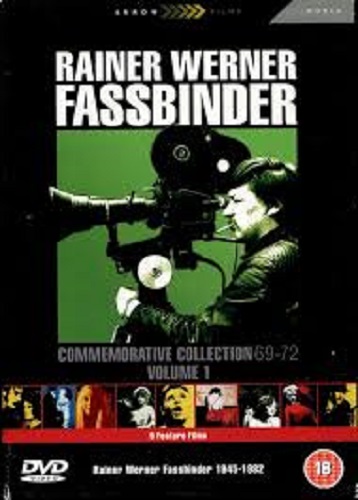
fassbinder1Love is Colder than Death, Rainer Werner Fassbinder (1969, Germany). Another early Fassbinder, again black-and-white, which opens with Fassbinder lying on the floor. It turns out he’s a hood, but he refuses to go work for the local syndicate. So they set another hood to follow him, and they sort of wander about town doing gangster-type things, including shooting people in a restaurant and robbing a local bank. I haven’t taken to these homages to classic Hollywood as I have other films by Fassbinder – and I have to wonder why so many budding film director of the twentieth century, particularly ones in post-WWII Europe, felt a need to make them.

1001 Movies you Must See Before You Die count: 721


4 Comments

Moving pictures 2016, #6

Cracking on with these…

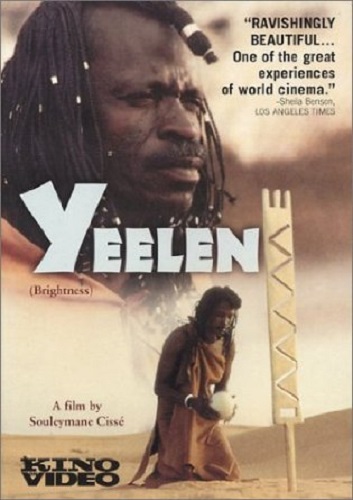
yeelenYeelen*, Souleymane Cissé (1987, Mali). I had to buy a copy of this as it’s only available on DVD in the US. That seems to be true of a number of films on the 1001 Movies You Must See Before You Die list. In fact, the cinema of African nations is poorly represented on DVD in the UK altogether. Mahamat-Saleh Haroun from Chad has three titles available out of six; Ousmane Sembène from Senegal also has three out of a dozen; and Souleymane Cissé from Mali has none – to name only three directors. Having now, with Yeelen, seen films by all three of these film-makers, I wish more of them were available. Haroun’s Daratt and Sembène’s Moolaadé are both excellent, but Cissé’s Yeelen is something special. It’s based on a Malian legend, probably from the thirteenth century, and depicts a young man with magical powers as he passes through various kingdoms, pursued by his father. It’s all slightly mad, in a way that makes sense within the story. When the young man, Nianankoro, tells someone they can’t move because of his magic, then they’re frozen. And remain so until he tells them otherwise. I’ve had to buy a number of DVDs on the 1001 Movies You Must See Before You Die list simply in order to watch them, but not all of them have been keepers. This one, however, definitely is. I loved the world it presented, I loved how well it presented it. Recommended.

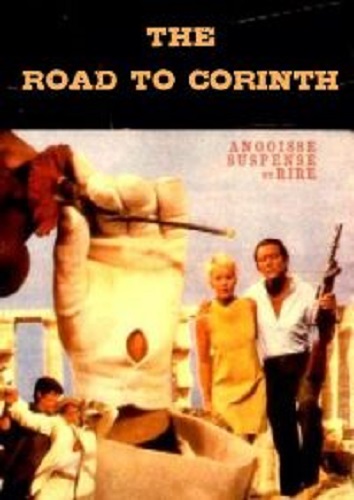
road_to_corinthThe Road to Corinth, Claude Chabrol (1967, France). I’ve seen a number of Chabrol’s films, but I don’t think this one is held in especially high regard, even by his fans. It was free on Amazon Prime, which is why I watched it. It wasn’t very good. A magician entering Greece by car is stopped by the police, who search his vehicle… and find a mysterious black box full of electronics. During interrogation, the man admits the box is one of many scattered throughout Greece will jam a NATO radar network; the man then bites on a cyanide pill. Then there are two CIA agents, and when one is killed, his wife investigates his death, despite being told not to by the CIA and the Greek authorities. With the help of the other agent, she figures out where the black boxes are hidden, there’s a showdown with the villain, who gets his just desserts. A particularly charmless thriller: not even the setting could make up for the lacklustre performances and nonsense plot.

demyLady Oscar, Jacques Demy (1979, Japan). Demy obviously liked a bit of variety – Lady Oscar is an historical film set in France, filmed in the UK with an English cast, and based on a Japanese manga. Some mentions of the film claim that Lady Oscar hides her gender, but she is openly a woman, she just dresses like a man and plays a man’s role as body guard to Marie Antoinette. She’s even in a sort of relationship with her childhood friend. But that doesn’t go so well, and they don’t meet again until the Revolution and the assault on the Bastille. I’m not entirely sure what to make of this film – it seemed well enough directed, although never quite wholly convincing as the plainly low budget had prevented a serious recreation of the period. The cast were passable in their roles, without standing out. But it all felt a bit, well, uninspired. Like an historical film lacking that certain something to make it spark. I’ll no doubt watch it again at some point, but a first pass didn’t impress.

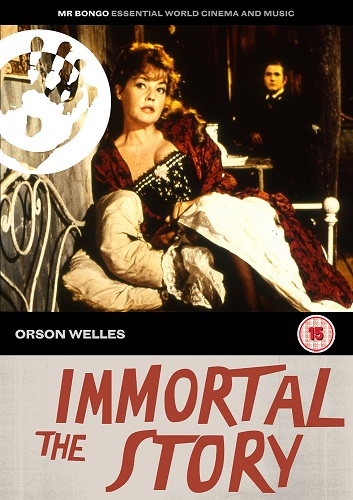
immortalThe Immortal Story, Orson Welles (1968, France). I didn’t realise until five minutes into this that it was an adaptation of a Karen Blixen story I’d read only a month or so before. Unfortunately, that pretty much spoiled it for me. The story, as the title implies, is quite memorable. A nasty rich man hears a story about a sailor who is approached one day ashore by an old man who tells him that he needs his services and will pay for them. The old man has a young wife but is without an heir. He’d like the sailor to sleep with his wife and hopefully make her pregnant. But the rich man, who is near death, is told by his assistant that the story is an urban myth – every sailor knows a sailor it has happened to. So the rich man decides to make it come true, so at least one sailor can tell the story truthfully. He hires Jeanne Moreau to act as his wife, and then goes looking for a sailor… I really should watch more of Welles’s films – those I’ve seen I’ve thought generally good, and while this is one of his lesser works, his oeuvre is certainly one that few US directors can boast (although commercial success seems to have mostly eluded him, given that his films were made in a variety of countries). Having said that, in this case I think you’d be better off reading the Blixen story (and, to be honest, I’d sooner Welles had adapted ‘The Tempest’, a better story, I thought, than this one).

fassbinder1The American Soldier, Rainer Werner Fassbinder (1970, Germany). Not to be confused with Wim Wender’s The American Friend, an adaptation of a Patricia Highsmith Ripley novel. The American Soldier is an early Fassbinder, filmed in black-and-white, about a man hired by three police officers to kill various villains in the city. Having worked my way through the second volume of the Rainer Werner Fassbinder collection, I’m discovering that’s no real preparation for the first volume. The films in this collection date from 1969 to 1972, when Fassbinder was starting out. On the one hand, they include experimental works which appeal to me – The Nicklashausen Journey, for example – but on the other they also feature early black-and-white films that feel like student works. This one feels too consciously a commentary on US noir films, borrowing their imagery and tropes – and there is, sadly, nothing ironic in appropriating tropes from a popular artform and giving them a local application. Or rather, it might seem like a good idea at the time, and even for a year or two afterwards, but it doesn’t stand the test of time – and while the films from this collection I have so far watched certainly showcase Fassbinder’s excellent eye for cinematic drama, some of his early works could clearly have done with more New German Cinema and less Hollywood plagiarism. Nonetheless, it’s worth picking up both volumes if you’re a cineaste.

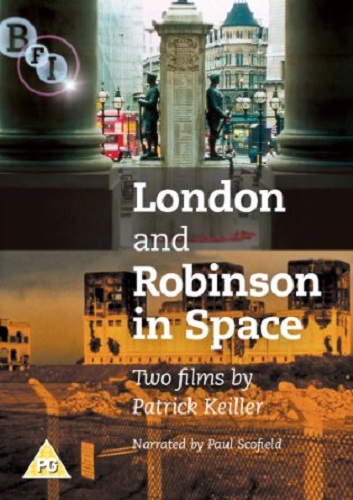
londonRobinson in Space, Patrick Keiller (1997, UK). Robinson in Space follows the same pattern as London (see here), with Paul Scofield recounting anecdotes about Robinson as the camera focuses on various part of England. To be honest, I don’t recall what the film is actually about, it’s a bit like listening to that really interesting bloke telling his stories down the pub, but instead of looking at his ugly mug you see the towns and countryside of England. I plan to watch more Keiller, and indeed watch this film again – and I think it bears repeated rewatchings. Like Benning’s films, despite Scofield’s narration, there is so much more there than appears on the screen, and part of the appeal is in figuring out the narrative which accompanies the voiceover and visuals. Having said that, I suspect there is something very personal about one’s reponse to this film – it is about Thatcher’s Britain, and I lived through that period, it affected me directly, and I also saw its effects on others on a daily basis (but then I fled the country, but we won’t mention that). My point being that Robinson in Space felt somewhat academic in criticising Thatcher and her legacy, when I felt it needed to be more visceral. Perhaps it’s Scofield’s voice – he sounds too erudite and, well, comfortable. Surely a film about Thatcher’s Britain should involve pain and misery and deprivation? But now I’m probably projecting and I should move on…

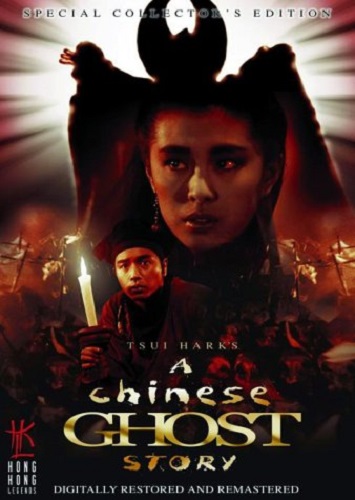
chinese_ghostA Chinese Ghost Story*, Siu-tung Ching (1987, Hong Kong). I thought I’d seen this several years ago, but I think that might have been The Bride with White Hair, which I think I owned many years ago and which is also a Chinese ghost story but isn’t actually titled A Chinese Ghost Story. A young tax collector tries to collect his first debt and discovers his book of records has been ruined by the rain. Without any money, he is forced to spend the night in a haunted temple, where he meets a young woman and falls in love with her. But she’s actually a ghost, and even though he knows this he still goes back to spend another night there. And from that point on, it all gets a bit frantic, with a priest and master swordsman who helps the tax collector, a battle with a powerful tree demoness, lots of zombie-like ghosts, and a promise to bury the young woman’s remains somewhere more auspicious but which urn is hers? This is one of those films that, while enjoyable and perhaps even ground-breaking in its time, seems to struggle to justify its place on the 1001 Movies You Must See Before You Die list. I mean, I enjoyed it; but I also remember enjoying The Bride with White Hair, which is not on the list.

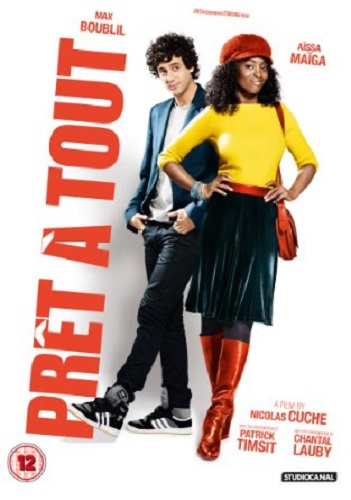
pret_a_toutPrêt à tout, Nicolas Cuche (2014, France). I’d actually tried watching some Richard Gere thriller on Amazon Prime, something about a Russian assassin long believed dead who kills a senator, so they bring in retired CIA agent Gere to track down the assassin except Gere is the assassin, and this twist is revealed in the first fifteen minutes… So I went looking for something else to watch and stumbled across Prêt à tout. Which proved to be much better. A slacker at college is in love with fellow student Alice, an activist. She, of course, is oblivious. But then the slacker and two of his mates invent a website which they sell for millions of dollars, and they decamp to Thailand to live the lives of the indolent rich. One day the slacker sees Alice on television, leading a strike at the failing powdered drink factory where she works. So the slacker buys the factory, but pretends to be just one of the workers in order to get closer to Alice. It doesn’t go quite as well as intended – she is still oblivious, even after he babysits her young son and the two become fast friends. Then the money runs out… An undemanding rom com, with a couple of likeable leads and a nice socialist spin on the usual rags to riches tale.

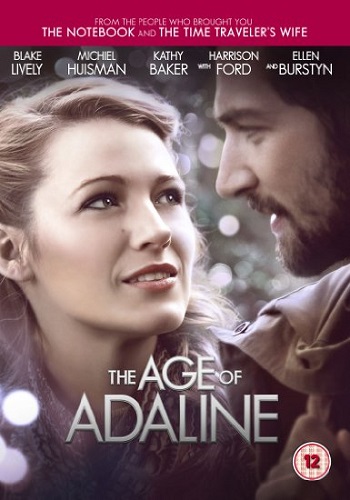
adalineThe Age Of Adaline, Lee Toland Krieger (2015, USA). A young woman crashes her car into a freezing lake, but a lightning strike revives her… and stops her from aging. That was in 1937. And throughout the decades following, she has remained twenty-nine years old, changing identities when needed. But at a New Year’s Eve party she meets an old beau, who doesn’t understand why she hasn’t aged… And there are lots of ways this film  could have gone, but it chose to take a good idea and turn it into mush. Which is a shame. It handles the period detail mostly well, the lead is a bit of a blank but I’ve seen worse, there are even a couple of familiar faces knocking about… but it all amounts to nothing since a week later I’ve completely forgotten what it was all about. And that’s despite liking the central premise and wanting to like the film. Hollywood does that to you – it says, here’s a neat idea that would make a good story, and here are some actors you’ve watched in the past and liked… and then you watch the film and you realise you can’t remember any of it. They should score films on that, decide if a film is a classic if someone can remember the plot a week after watching the movie. This one would fail.

1001 Movies You Must See Before you Die count: 719


Leave a comment

Moving pictures 2016, #5

Still catching up on these…

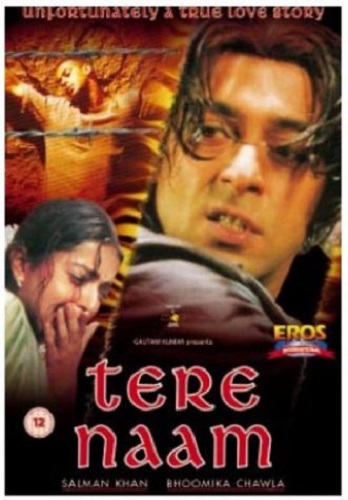
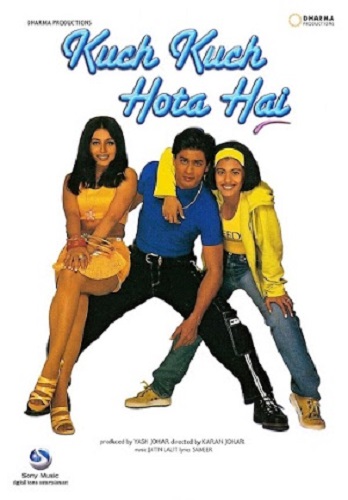
tere_nammTere Naam, Satish Kaushik (2003, India). After watching Deewaar, I stuck a bunch of Bollywood films on my rental list and the first to arrive was Kuch Kuch Hota Hai, which I really enjoyed… but the next one, Tere Naam, turned out to be something altogether different. The title means “in your name”, and the story is roughly based on that of Romeo and Juliet. Which makes it pretty dark for for what I’d expected of Bollywood – although the songs are still there, of course. Radhe is a “college rowdy” and head of the Student Union. Nirjara is the daughter of a priest, poor but a Brahmin. Radhe falls in love with Nirjara, but she doesn’t return his feelings. So he kidnaps her and forces her to fall in love with him. But then gangsters beat up Radhe, including repeatedly bashing his head against a railway locomotive’s buffer plate and giving him brain damage. He is consigned to hospital and then an ashram. In one of his infrequent moments of lucidity, he tries to escape but badly injures himself. Nirjara visits him but he is in a coma. So she goes home and commits suicide. Meanwhile, Radhe recovers – the coma has somehow fixed his brain damage – and escapes in order to see Nirjara… but, of course, she is dead. In amongst all this, we have typical Bollywood song and dance routines, the sorts of songs that rush through half a dozen musical genres in five or so minutes. There’s also lots of over-the-top fight scenes, with over-the-top sound effects. I’ve said before that Bollywood is “Hollywood turned up to eleven”, and this is as good an example of that as Kuch Kuch Hota Hai. It was dark, surprisingly dark, but still fun.

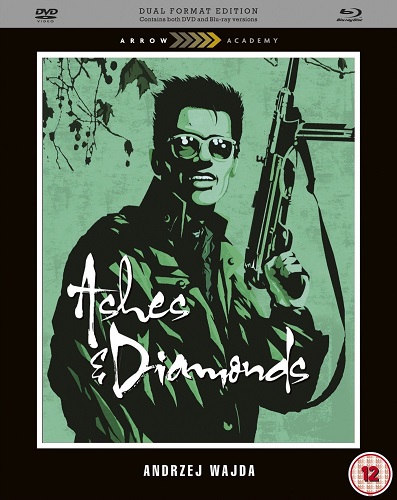
ashes_diamondsAshes & Diamonds*, Andrzej Wajda (1958, Poland). Wajda is one of Poland’s best-known directors but I seem to have missed out on most of his films – although I’ve watched a quite number of Polish directors; and have been a fan of Kieślowski’s work for a decade or more. Ashes & Diamonds is not Wajda’s only film to appear on the 1001 Movies You Must See Before You Die list, both Man of Marble and Man of Iron are on there – both of which I’ve seen, and both of which I rate highly. But then the topic of those two films – a Stakhanovite worker, socialism, and the failures of Stalinism – appeals to me, but Ashes & Diamonds is set shortly after WWII and is about the war and its immediate aftermath, a subject I find less interesting. A group of resistance fighters, formed during the war to fight the Russians but still fighting into the 1950s – plan to assassinate a minor government official. The first attempt fails, when they gun down the two occupants of the wrong jeep. so they plan an attack during a celebratory dinner for the official. But one of the assassins falls in love with the barmaid at the hotel where he is staying, and has second thoughts. The other assassin gets pissed with a report, gatecrashes the dinner and causes havoc. The first assassin – who wears sunglasses because he ruined his eyesight during the Warsaw Uprising by spending so much time in the city’s sewers – manages to kill the target but is then chased and gunned down by soldiers. The film is shot in black and white and the damage the war caused is plain to see in every frame. Ashes & Diamonds is generally reckoned to be one of the best films to come out of Poland but, to be honest, I preferred the other two Wajda movies I’ve seen. It all felt a bit too obvious and self-conscious, a bit too similar to the US films which inspired it. But it probably still belongs on the list.

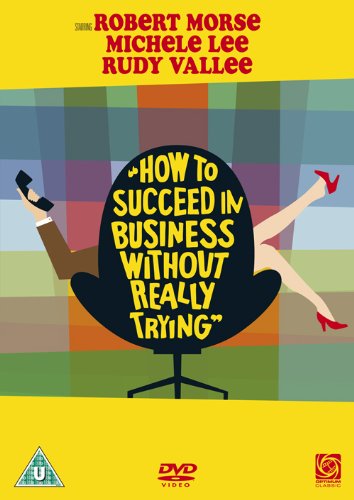
howtoHow To Succeed In Business Without Really Trying, David Swift (1967, USA). You know when they take a Broadway musical and put it on the silver screen and use the original cast and the film sinks without trace because no one knows who the stars are… well, that’s probably what happened to this particular film. Who remembers Robert Morse and Rudy Vallee? Admittedly, the female roles were recast for the movie, although it doesn’t appear to have been a springboard to fame for any of them either. The plot follows a window cleaner who uses the advice in the eponymous self-help book to rise up the corporate ladder at the Worldwide Wicket Company (“wicket”, of course, means something completely different outside the US, so was a piss-poor choice of word). The film is meant to be humourous, but it’s hard to find the laughs in a story that not only encourages, but actually celebrates, back-stabbing, character assassination and workplace deception. Even if it does feature songs. None of which are memorable. I’m not sure why I rented this, it’s not like I’m a fan of musical films – although there several I like quite a bit – so perhaps it was because it looked like it might be one of those stylised 1960s technicolour films which can be fun. It wasn’t. Avoid.

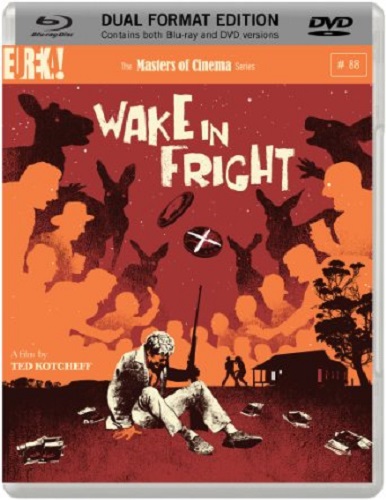
wake_in_frightWake in Fright*, Ted Kotcheff (1971, Australia). With a title like Wake in Fright, and that somewhat lurid artwork on the eureka! edition DVD, I think can be forgiven for letting this film slip down the rental list. But eventually it arrived… and proved to be not at all what I’d expected. And very good indeed. A teacher at some godforsaken Outback station heads for Sydney for the Christmas holiday. This requires taking the train to Bundanyabba, a small town, and catching a flight from there. But in Bundanyabba, he falls in with the locals, spends all his money gambling – a game called “two-up”, which entails flipping two coins up in the air from a small wooden paddle – and then goes on a drunken binge which ends up with a group of them haring around the Outback in a ute, pissed as farts, shooting kangaroos. As a chronicle of one man’s descent into drunken depravity and degradation, this is pretty scary stuff. Donald Pleasance plays a good part as the alcoholic doctor the teacher falls in with, and even Chips Rafferty as the jocular local constable successfully exudes macho menace while ostensibly helping the teacher. A good film, worth seeing.

demyModel Shop, Jacques Demy (1969, France). I bought the Intègrale Jacques Demy box set just so I could see films like Model Shop, which weren’t available in UK editions. And while the DVDs in the set are well-presented, I’ve yet to be convinced Demy’s oeuvre was, in total, especially good. He was certainly variable. Model Shop is set in California, with a US cast. and filmed in English, and feels like the product of a US director. A young architect is called up for the Vietnam draft, goes to a model shop (a photographic studio specialising in erotica), spends a night with one of its models, only to find the next morning that his girlfriend has left him and his car has been repossessed. Model Shop is considered one of Demy’s most-underrated movies but to be honest all I can remember of it was that it felt very Californian and surprisingly not much like the Demy films I’d seen up to that point. Still, I have the boxed set so I can always rewatch it…

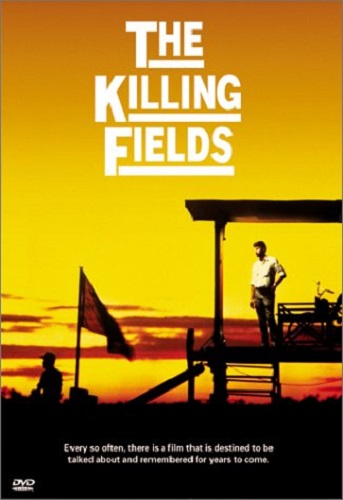
killing_fieldsThe Killing Fields*, Roland Joffé (1984, UK). I’ve had a copy of the soundtrack of this movies for, well, since its release, as it was composed and performed by Mike Oldfield and I was a Mike Oldfield fan (I suppose I still am, just not to the same level). So I knew the music, but not the film. But I knew mostly what the film was about – which was the Khmer Rouge’s seizure of power in Cambodia in the early 1970s. It focuses on a US journalist covering the civil war – played by Sam Waterson of Law & Order fame – and his Cambodian translator/guide/assistant, played by Haing S Ngor. When Khmer Rouge win the war and take power, Pol Pot begins his Year Zero policy. Waterson escapes back to the US, as does Ngor’s family, but Ngor himself is sent to a labour camp – and though Waterson tries to find him, he fails to do so. Fortunately, Ngor escapes and treks through the jungle to the border with Thailand, and is eventually re-united with his family. There’s not much you can say about Pol Pot’s regime – it was brutal, resulted in the death of a quarter of the country’s population, and so corrupted the high ideals which prompted it that those ideals themselves have been tainted by association. Joffé’s film is an efficient telling of the story, but I have to say Oldfield’s soundtrack is really intrusive. I used to like the album, but it felt completely out-of-place as I watched the film. A film that belongs on the list, I think, but not because it’s a great film.

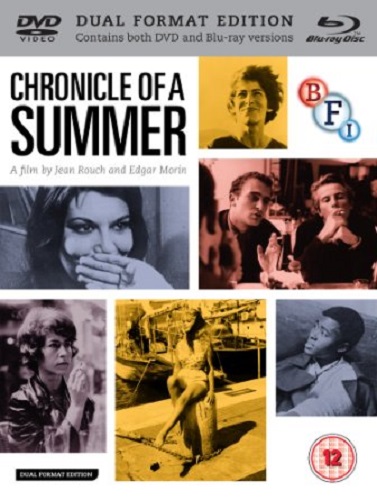
chronicleChronicle of a Summer*, Edgar Morin & Jean Rouch (1961 France). An odd beast, this one. Two film-makers sent out a bunch of students to interview working people about their happiness. Later, they showed the interviewees the film and asked their opinion. And that’s pretty much it. Filmed in black and white, with a 16 mm camera and a prototype portable tape recorder, it’s little more than a series of conversations between people, some prompted by questions – which range from the banal to the pretentious – while those answering try not to appear too stupid but instead come across as pretty typical for the time and place. I can see why it’s on the 1001 Movies You Must See Before You Die list, but it reminds me of Godard films like Masculin féminin and Une femme mariée, which I didn’t especially like or enjoy; and the banality of some of the encounters in Chronicle of a Summer make you wonder why you’re watching it. Meh.

demyLa baie des anges, Jacques Demy (1963, France). I said earlier that Demy’s output was variable – it’s not just the spoken-word versus sung-word films, more that some seem iconic whereas others feel anything but. Lola is an iconic film, with spoken dialogue; Les demoiselles de Rochefort is an iconic film, with sung dialogue. La baie des anges (The Bay of Angels) is just like Lola, a black and white film, starring Jeanne Moreau, which manages to perfectly capture a particular emotion of the time. A young man holidays in Nice, where he spends time gambling in the casinos. There, he meets Moreau, who looks and acts about as early-1960s French cinema as is humanly possible, a gambling addict who hangs around the casino. The two enter into a relationship. She tells him gambling will always come first for her. And so it does. This is a movie that relies style and presentation as much as it does story and, as mentioned earlier, comparisons with Lola are inevitable. And it compares favourably. Lola is on the 1001 Movies you Must See Before You Die list, but it’s probably a toss-up between it and La baie des anges as to which should have made the cut.

1001 Movies You Must See Before You Die count: 717


4 Comments

Moving pictures 2016, #4

Yet more movies, some from the list, some not. I’m not entirely sure what criteria I use when picking non-list films, but it seems to work as often as not. I’ve got a bit behind with these posts, so there’ll be a several of these appearing on the blog in quick succession.

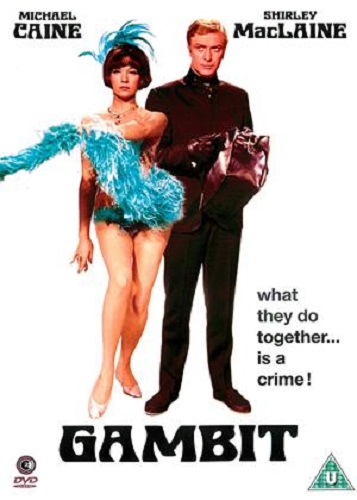
gambitGambit, Ronald Neame (1966, USA). A 1960s thriller with a twist in the tail, starring Michael Caine and Shirley Maclaine. Caine plays a shady type who plans to rob reclusive zillionaire Herbert Lom, and to do so he recruits Maclaine, a Hong Kong nightclub hostess who’s the spitting image of Lom’s dead wife. The plan is, the two travel to the Arab city of Dammuz, Lom’s home, as an English baronet and wife, Lom’s goons spot Maclaine’s resemblance, and so she and Caine are invited to dine with Lom in his private apartment… and then Caine steals Lom’s priceless Chinese statuette. Except things don’t go quite as smoothly as planned. Maclaine, for a start, proves more of a hindrance than a help, Lom quickly sees through Caine’s disguise, and the eventual robbery only succeeds more by luck than anything else. Not that any of it really matters, as that wasn’t the point of it all… Sadly, an interesting structure – a flawless run-through (ie, Caine’s explanation of the plan) followed by what actually happens – isn’t really enough to make this mostly charmless thriller stand out. There were a number of similar movies made in the 1960s and set in North Africa – Our Man in Marrakesh and Maroc 7 spring to mind – which also blithely trampled over local sensibilities in a bid for “local colour”, but they were more fun than this one. Caine’s po-face pretty much echoed my own as I watched this – but he at least was paid for his.

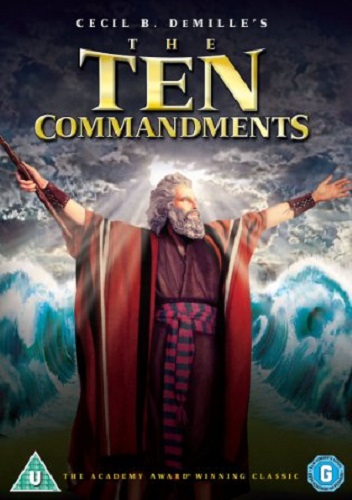
ten _commandmentsThe Ten Commandments*, Cecil B DeMille (1956, USA). You know the story of Moses from the Bible, right? As a baby sent down a river in a basket, rescued by Egyptian royals, who raised him as one of their own, but he sided with the Hebrew slaves (being Hebrew himself), and led them to safety by parting the Red Sea. and then there was something about a burning bush – WTF? I mean, I AM GOD AND I SHALL APPEAR IN A FORM WHICH WILL STRIKE AWE INTO MOSES, I SHALL APPEAR AS… A SHRUB ON FIRE! – and, of course, the Ten Commandments, zapped by God onto a giant piece of rock which proves handily portable. It’s a story so over-the-top it could only exist in a religious text or a Hollywood film. And here we have both. Super-entitled white man NRA spokesman Charlton Heston plays Moses, a Jew; Yul Brynner, a Russian, plays Rameses II, Moses’s Egyptian “brother” and later enemy. The story is blithering nonsense from start to finish and the characters are drawn with all the subtlety of a kids’ cartoon – but the sets are pretty impressive. Back when I was kid at school in Qatar, I was sent to Sunday School. It took place in the gym at the Doha English Speaking School, where I was a pupil. As far as I remember, all we did was colour in pictures depicting scenes from the Bible – my bright orange Jesus looked quite fetching. The Ten Commandments, well, it’s that. Pretty much.

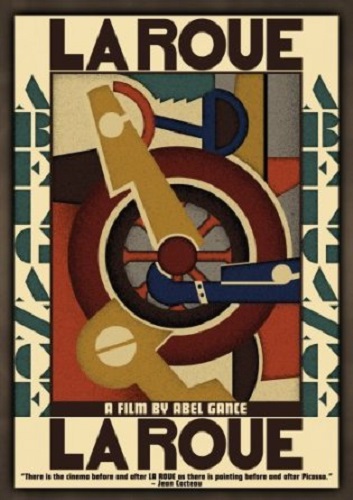
la_roueLa roue*, Abel Gance (1923, France). Gance is perhaps best known for his 5½ hour epic movie about Napoleon – soon to be made available on DVD/Blu-ray by the BFI… and yes, it’s on my wants list. At 273 minutes, La roue is also an exercise in viewing endurance. The wheel of the title is that of a train, and while the story – told in a variety of silent movie presentations, with differently-shaped views, dissolves and even colour washes – is a fairly standard family melodrama set on and about the French railways, what’s most notable is the number of cinematic techniques Gance makes use of which subsequently became part of cinema’s common language. Like many of the more sophisticated silent movies of the period – the films of Carl Theodor Dreyer, for example – La roue is very talky, or, rather, there are a lot of intertitles, and a lot of story to get across in narrative text. Hollywood, at least, knew to minimise the text and let the moving pictures tell as much of the story as possible – and if that led to films consisting of little more than crudely-linked sight gags, they were at least entertaining. Which is not to say La roue is not – but European silent cinema, from my somewhat limited viewing experience, seemed to focus on narratives rather than pictures (although European cinema also had a strong tradition of strikingly designed sets, unlike Hollywood). Perhaps that’s unfair, perhaps it was simply a different approach to film-making – certainly the visuals in Dreyer’s The Passion of Joan of Arc are impressive and arresting; but watching La roue is very much like watching someone create a new cinematic language, much of which you know will become universal. I had to buy a US import of this as no UK edition exists. A shame. Mind you, the same could be said of many of the more interesting films on the 1001 Movies You Must See Before You Die list…

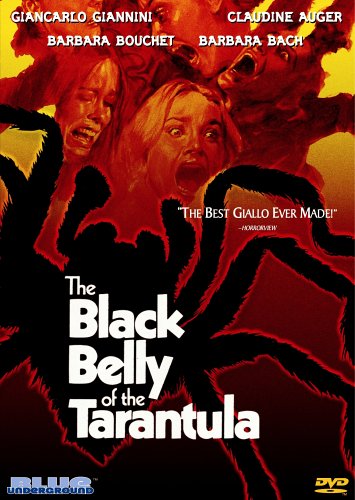
black_bellyThe Black Belly of the Tarantula, Paolo Cavara (1971, Italy). A serial killer injects his victims with the venom of the tarantula, paralysing them before he cuts out their heart. The tarantula is indeed venomous, but its venom causes hallucinations or muscle spasms (hence the tarantella), not paralysis. But never mind. The film basically comprises a series of murders of beautiful young women (of course), all by the same man, while a harried detective tries to figure out what’s going on. Eventually he finds a suspect… which leads to a chase up onto the roof of a quite impressive Brutalist office block. It’s all tied into a blackmail conspiracy based around a massage parlour, and a murderer who so obviously can’t be the murderer that he has to be the murderer. If that makes sense. Italian giallo can be fun, but they’re also usually rampantly sexist.

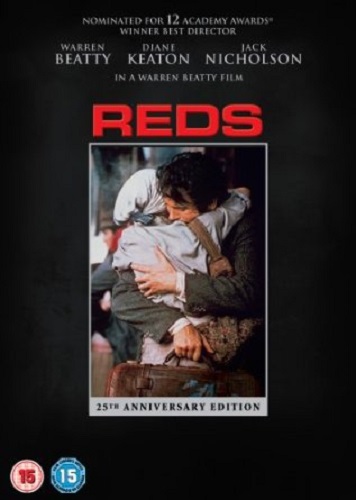
redsReds*, Warren Beatty (1981, USA). When actors direct films they’re usually vanity projects. True, there are actors who have gone on to have distinguished directorial careers, such as Ida Lupino. But most actor-directed films are usually pretty bad. Except Reds isn’t. The film is a biopic of John Reed, the US author who wrote Ten Days That Shook the World, about the Russian Revolution (adapted shortly afterwards by Sergei Eisenstein). Beatty plays Reed, and Diane Keaton is his long-suffering partner, Louise Bryant, who he charms away from her marriage, fails to encourag in her writing career, and then mostly neglects. Bryant ends up in an affair with Eugene O’Neill (played by Jack Nicholson at his most oleaginous), and then leaves for Europe to become a correspondent during WWI. Reed follows, the two rekindle their relationship and head to Russia, where they join in the revolution. After returning to the US, Reed writes his book and tries to build up the communist movement. But the various communists groups are all locked in internecine fighting – leading to a frankly bizarre party meeting which leads to a schism, and further inter-party fighting. Throughout the film, Beatty breaks away from his narrative to interview talking heads, real-life friends and acquaintances of Reed and Bryant, not all of whom thought highly of the pair or their relationship. I’ll admit I knew of the film prior to renting it, but had never seen it – it is, to be fair, 194 minutes long – and I wasn’t expecting much (see earlier comment re actors who direct). While the direction was efficient more than anything else, the story didn’t feel as though it were longer than it needed to be, and the use of the talking heads was inspired. I hadn’t expected Reds to be a movie that belonged on the 1001 Movies You Must See Before You Die list, even though I knew it was generally well-regarded by critics. But, you know what, it does belong there. Worth seeing.

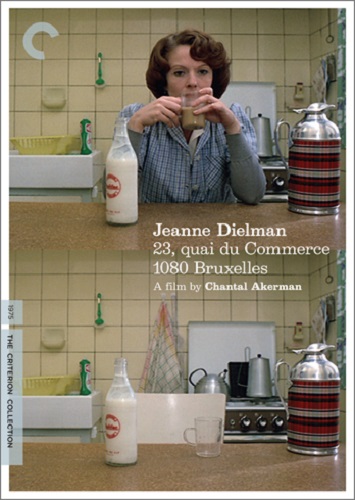
jeanne_dielmanJeanne Dielman, 23 Quai de Commerce, 1080 Bruxelles*, Chantal Akerman (1975, France). This was my first Akerman. It was her first too. And, I have to admit, a hugely impressive debut. The film is three days in the life of Dielman and shows her, in unadorned detail, going about her daily activites. The camera remains mostly static, there is very little dialogue, and no incidental music. And yet it’s compelling viewing. There is a story there, but it comes out of Dielman’s actions, not from a narrative stringing together events or cause and effect. I bought the Criterion DVD of this, which is the only edition available. That’s surprising – you’d think it’d be available here. Admittedly, it took me a while before I got round to watching it… But I’ll be trying more of Akerman’s films, that’s for sure.

1001 Movies you Must See Before You Die count: 713


4 Comments

Moving pictures 2016, #3

Continuing the, er, continuing series of blog posts on my movie-watching. Once againm a nother varied selection, not all of which were from the list.

texas_chainsawThe Texas Chainsaw Massacre*, Tobe Hooper (1974, USA). Not a film I’d normally choose to watch, but it was on the list so… And no, I don’t know why it made the list. I don’t know enough about horror films to know if The Texas Chainsaw Massacre was seminal or heralded a sea change in the genre or anything like that. I can only judge it as the movie I watched. And in that respect, it did not fare well. It looked cheap – not necessarily a bad thing, it has to be said, as cheap and amateurish is what drove the whole found-footage craze of the late nineties, and, in most cases, it actually worked quite well (more so, it must be said, for the earlier films, such as The Blair Witch Project and Paranormal Activity, than for Hollywood’s jumps on the bandwagon like Cloverfield). But, anyway. Young hippies travelling across the US run into a bunch of psychotic freaks living in a farmhouse, murderous mayhem ensues. Involving chainsaws. Not being a fan of the genre, I saw nothing to admire or like in this film. I suspect fans of the genre would be hard-pressed too – other than perhaps its position in the history of horror films. Still, at least I can say I’ve now seen it and so can cross it off the list.

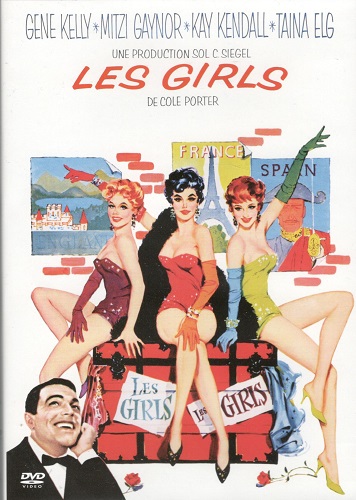
lesgirlsLes Girls, George Cukor (1957, USA). Three dancers accompany Gene Kelly (well, his character) on a tour of Europe: a Brit, an American and a French woman. The Brit later marries a member of the aristocracy and writes a kiss-and-tell memoir of the tour. The other two sue her because some of the details are less than accurate. So what we get is the same story, more or less, told from the point of view of the characters played by Kay Kendall, Mitzi Gaynor and Taina Elg, none of which actually agree. This film is, by most accounts, minor Cukor, although it boasts a score by Cole Porter and choreography by Jack Cole. This is a shame. The slightly unusual structure actually adds interest to a relatively straightforward story. The leads are all on top form – especially Kendall – and the musical numbers are quite good, as are the costumes. I’m surprised this film is not better known – I certainly enjoyed it more than, say, Guys and Dolls, which appeared only two years earlier.

wooden_clogsThe Tree Of Wooden Clogs*, Ermanno Olmi (1978, Italy). If I had to choose a list of favourite film genres – although perhaps “movements” would be a better word – then Italian Neorealism would be somewhere in the top ten, and likely higher than France’s Nouvelle Vague. But this is a film that really strains my liking for that genre. It is, on paper, a movie that should appeal – the life of a peasant family in 1898 in the province of Bergamo, a communist tries to drum up support but is ignored, a young couple are married, and a family is booted from their tenancy by their landlord. Life was brutish and short, although not for those who lived off the labour of the peasantry – a situation the current political class seem determined to return to – and this film simply documents it in a way which cannot fail to garner the viewers’ sympathy. Despite all that, The Tree Of Wooden Clogs was a bit of a, er, slog. It wasn’t that it was slow-paced, as I quite like “slow cinema”, nor that it was unremittingly bleak – I seem to be more tuned to that than I am to mindless optimism, anyway – but that the film seemed to lack focus or movement. I’ll try some more Olmi, but this is supposed to be his masterpiece.

finziThe Garden of the Finzi-Continis*, Vittorio de Sica (1970, Italy). And speaking of Italian Neorealism, de Sica was a leading director in the movement but The Garden of the Finzi-Continis is not a movie that qualifies as one (and no, I don’t know why the Arrow DVD cover singularises the family and removes their hyphen). It’s based on a novel by Giorgio Bassani, about a wealthy Jewish family who become victims of the Nazis. It opens in the 1930s, with a group of bright young things, some Jewish, some not, who meet in the titular locale to play tennis and be idle rich (although not all are rich). The film follows Giorgio, a middle-class Jew, who is friends – but hopes to be closer – with the Finzi-Contini daughter. But she has an affair with a man she admits she despises, and then leaves to stay with relatives in Venice. When she eventually returns, most of the Jews of the town have been sent to the death camps by the Nazis. Only the fate of the Gentile characters is shown. While it would be unfair to say the upper classes routinely collaborated with the Nazis, many of them did just that, partly because they shared their views but also as a means of protecting themselves (as if they deserved it…). Not that it was always successful. As The Garden of the Finzi-Continis shows. I much preferred this film to The Tree Of Wooden Clogs, for all that it was an historical drama set during a period for whch the entire human race should be ashamed, and not Italian Neorealism.

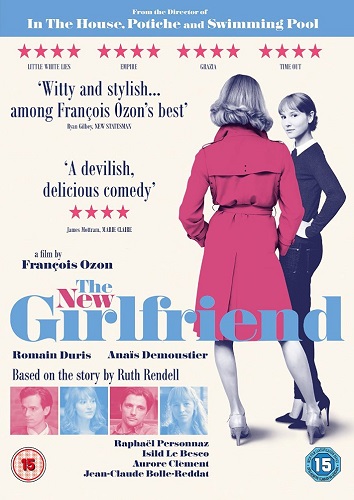
new_girlfriendThe New Girlfriend, François Ozon (2014, France). I admire Ozon as a director, although I’ve not liked or admired every film he has made. Nonetheless, when a new one is released, I stick it on the rental list. Although, for some reason, I actually bought this one on DVD. I hadn’t realised it was an adaptation of a Ruth Rendell short story of the same title, which I read many years ago in a  collection, also of the same title. But once I’d spotted that, I also realised that Ozon’s script doesn’t follow Rendell’s story all that faithfully. The basic premise is the same – a woman enters into a relationship with a man who is a transvestite. But from what I remember, the original story ends badly, whereas the film gives us a relatively happy ending. In pretty much all other respects, this is a typical Ozon film – it’s colourful, although not quite saturated, the characters are handled sensitively, and there is a plenty of wit in the script. I can’t say it’s my favourite Ozon, but it’s definitely one of his better ones.

1001 Movies You Must See Before You Die count: 709


1 Comment

Moving pictures 2016, #2

More films watched by Yours Truly, some of which might have been from a certain list, some of which might not.

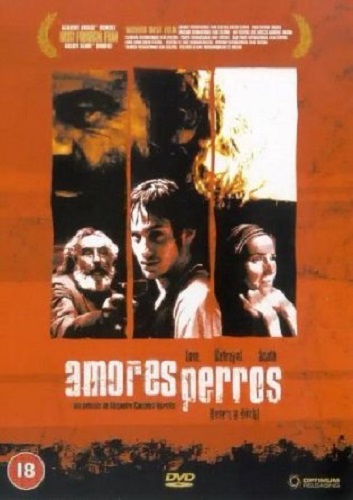
amores_perrosAmores Perros*, Alejandro González Iñárritu (2000, Mexico). I hadn’t realised this was the movie which brought Gael García Bernal to fame (admittedly, I’d thought Bernal Spanish, not Mexican), but having now seen it I can understand why so much notice was taken of him. Like another South American film on the list, Meireilles & Lund’s City of God from Brazil, Amores Perros is a series of interconnected stories, in this case three, all springing from a car crash. Bernal plays a young man who discovers that his brother’s dog is an excellent fighter. So he enters it in dog fights, and it wins repeatedly (the film-makers make it clear no dogs were actually harmed during the making of the movie). But then he accepts a private fight with a local gangster, and when his dog wins, the gangster shoots it. Bernal stabs the gangster and flees, with his friend and his wounded dog… which is when the crash happens. The driver of the other car in the crash was a model, the lover of a wealthy magazine publisher. Her leg is severely broken. While recovering in the new flat she shares with her lover, her yappy dog disappears down a hole in the floor, and searching for it she injures her broken leg, which then has to be amputated. The third section centres on a homeless man who appears briefly in the previous two stories. He rescues Bernal’s dog, but it is killed after he agrees to murder a man… Like most such films, the plot is complicated and somewhat convoluted. It is also, however, well-played by its cast, and well-shot. A deserving entry on the list.

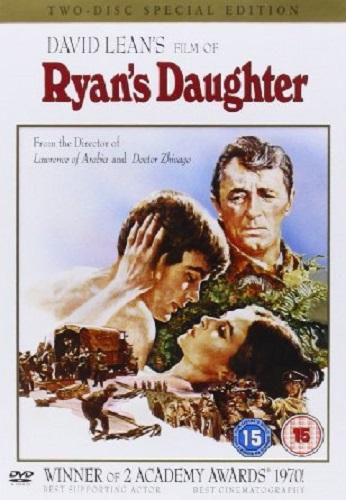
ryans_daughterRyan’s Daughter, David Lean (1970, UK). I’ve always been conflicted about Lean – I mean, I love Doctor Zhivago and Lawrence of Arabia, but for all his plaudits I’ve never really thought of Lean as a particularly good director. And Ryan’s Daughter appears to be an attempt at making another epic movie like the two previously mentioned, except, well,… Mind you, it has to be said the cinematography is frequently gorgeous. But Robert Mitchum makes an unconvincing Irish school teacher, although he does give it a good go. John Mills’s Oscar-winning village idiot feels like an invader from a much older, and less sophisticated, film, and the story’s leisurely pace means its moments of high drama often fade away to nothing. And there are several moments of high drama, perhaps the most notable of which is when the villagers help the Irish Republican Brotherhood recover arms and munitions during a fierce storm from the German ship which attempted to deliver them but foundered. It’s a movie that feels like it lacks focus because it has so many things going on in it, and in such a short narrative time-frame and constrained to such a small geographical location. And, to be honest, the whole introduction, intermission and entracte thing, with incidental music, just feels pretentious. Yes, I know Lean did it in the other two aforementioned films, but sticking up “INTERMISSION” in big letters on the screen does not make it an epic (I’m old enough – just – to remember when cinema showings did have intermissions), and I’ve yet to be convinced it serves any good purpose.

londonLondon, Patrick Keiller (1994, UK). Given my admiration of James Benning’s films, this was recommended to me as something similar I might like, and I ended up with a copy as a Christmas present and… Yes, good call. It has more of an overt narrative than Benning’s films – here provided by Paul Scofield’s narration – although the cinematography does indeed consist of static shots. Of, er, London. As the camera focuses on various parts of the city, the narrator recounts anecdotes and aphorisms by his friend Robinson, not always as they relate to the part of London on-screen. It’s fascinating, although there’s less work required to piece together the story as the voice-over pretty much does that for you. But the Scofield’s somewhat circuitous explanation of events is its own reward, and the anecdotes are entertaining, irrespective of their relevance to the view on the screen. I plan to watch more films by Keiller – and he’s made quite a few.

man_from_uncleThe Man from UNCLE, Guy Ritchie (2015, USA). Having just worked my way through eight of Solo’s and Kuryakin’s theatrical adventures, I thought it worth giving this twenty-first century reboot a go. True, the director’s name didn’t bode well, although I didn’t actually know it was a Ritchie film when I bunged it on the rental list. But, it arrived in its little envelope, I stuck it in the player and… the title sequence is actually really good. And the film’s commitment to period detail is impressive. The only problem was the two leads – Henry Cavill and Arnie Hammer – have zero on-screen charisma. Cavill has a chin you could chisel granite with, and you feel he ought to light up the screen when he appears, but… he just doesn’t. His urbanity felt like a thin veneer, and not bone-deep as it did with Robert Vaughan, and his suave something he put on only when the camera was on him. Kuryakin, on the other hand, has been re-imagined as some sort of Soviet super-strong thug, and Hammer plays him like a block of Soviet wood. I can’t actually remember the plot, and I’m pretty sure there was one somewhere.

ohenryO Henry’s Full House*, various (1952, USA). I stuck this on the rental list not realising it was an anthology film, with each segment directed by a different person. It starts off strangely, with a man in a jailhouse making notes on what the other prisoners are saying. This, we are then told by John Steinbeck, who is sitting behind a desk in a book-lined study, was O Henry, a journalist who used the people he encountered during his career as fodder for his stories… and each of the short films in O Henry’s Full House is in some way a result of this. Unsurprisingly, given the age of Henry’s stories, the sting in each one’s title comes as no real surprise. Charles Laughton plays a gentleman vagrant, who is chivalrous to Marilyn Monroe in an early role. Richard Widmark plays a hugely irritating villain who gets his just desserts in a nicely ironic fashion. A young woman is convinced her pneumonia will kill her when the last leaf falls from the ivy outside her window – but the leaf never falls. Two men kidnap an annoying kid for ransom, and it pretty much goes as you’d expect. And finally, a poor married couple each make a sacrifice in order to afford a decent Christmas present for the other – with ironic results. The directors involved were Henry Koster, Henry Hathaway, Jean Negulesco, Howard Hawks and Henry King. I’m guessing they couldn’t find five directors called Henry, although both Hawks were Negulesco are both excellent film-makers.

avengers_ultronAvengers: Age of Ultron, Joss Whedon (2015, USA). I’m not a big fan of the MCU films (and now even less of a fan of Marvel given its CEO’s financial support of Trump) and I really didn’t like The Avengers (despite being a Brit, and despite “the Avengers” referring to the far superior group led by John Steed, I think Avengers Assemble a stupid compromise title – we’re smart enough to figure out the difference between a bunch of US near-fascist goons in Spandex and the sarcastically urbane umbrella-wielding Steed; and I also note the Lycra’d loons have lost their definite article for this sequel). Anyway, Avengers: Age of Ultron: I didn’t like this either. Awful film. A stupid movie carried by the personalities of its cast – not the personalities of its characters, but of the actors who played them. With a stupidly confusing plot plastered over the top. One of the problems with Q in Star Trek: The Next Generation was that when you have a villain so powerful, how can you realistically have dramatic conflict? Marvel’s universe suffers from the same problem – something the comics themselves often side-step by randomly ramping up heroes’ superpowers from one story to the next – and Avengers: Age of Ultron falls into the same trap. The only way the Avengers can actually beat Ultron is by Plot Hole. But, to be honest, by that point of the film I was long past giving a shit about any of them, as they came across more like a team of parodies than a serious attempt at recasting comic-book stories for the cinema. Avoid.

1001 Films You Must See Before You Die count: 706


3 Comments

Moving pictures 2016, #1

A few people have said they’ve enjoyed these posts, so that’s enough for me – I’m going to keep them going. Otherwise, I guess, it’d be weeks between content appearing on this blog. Having said that, I really should write another one of my rants about science fiction, they usually go down well… But, for now, it’s movies and more movies…

cria_cuervosCría Cuervos*, Carlos Saura (1975, Spain). There are films you feel you really ought to like, given their subject and how well they’ve been made. I suspect Cría Cuervos is one such film. An eight-year-old girl witnesses a mistress visit her father on the night of his death, but she believes she was herself responsible for his death because she added “poison” to his glass of milk earlier that evening. She takes the glass from her dead father’s bedside and carefully washes it. Her mother appears in the kitchen, and the two talk. The father was a senior military officer in Franco’s fascist government. After the funeral, their mother’s sister is brought in to look after the girl and her two sisters – because their mother had died years before (in a clever bit of casting, Geraldine Chapman – the director’s partner at the time – plays both the mother and the adult version of the protagonist, who appears occasionally to comment on the events of her childhood). The children’s aunt is not a very good substitute mother, and the young girl obsesses over the “poison” she had given her father – which later proves to be nothing more than bicarbonate of soda – so much so that she even offers it to her mute grandmother. There is something contained about this film, the fact that Franco’s regime exists but impinges only peripherally, and yet the whole film is itself a commentary on that regime. It is, on reflection, a clever film, one that deserves more than single watching. I’m not convinced its child protagonist is necessarily a strong enough character to centre the film – and more ought to have been made of her future self’s appearances – but the way her life allegorizes Spain as a whole is effective. A good film.

uncleThe Man from UNCLE Movies: To Trap a Spy, One of Our Spies is Missing, The Spy with My Face, One Spy Too Many, The Spy in the Green Hat, The Karate Killers, The Helicopter Spies, How to Steal the World (1966 – 1968). I have no idea what possessed me to buy this boxed set of eight movies, expanded for theatrical release from episodes of The Man from UNCLE (I refuse to put full stops in the word, we don’t do that in the UK – abbreviations, initialisms and acronyms aren’t written with them in British English). Anyway, the men from UNCLE, Napoleon Solo and Ilya Kuryakin. One of the many cable channels to which I have access had been showing these films and I caught a couple. They weren’t very good, but I thought it worth seeing the rest… Hence the DVD box set. And, well, as expected, they weren’t especially good. To Trap a Spy stars Luciana Paluzzi as the femme fatale, but she’s completely wasted. The Spy in the Green Hat has a frankly bonkers Jack Palance as the villain, ably assisted by Janet Leigh as an unhinged secretary/assassin (the best character, it has to be said, in the lot). It’s near impossible to pick a “best” film as they’re all so bad – and often cheap, too. Despite the familiar faces of the guest stars, the movies still boast television-episode budgets, and there’s an English-looking house somewhere in Hollywood or Bel Air used as a mansion in a variety of European countries. Having said all that, Vaughn is impressively suave as Solo, McCallum is, er, McCallum, and THRUSH is still a dumb name for an evil organisation. Complete tosh.

black_sundayBlack Sunday*, Mario Bava (1960, Italy). This was apparently the first film Bava directed and wrote – and it’s on the 1001 Movies You Must See Before You Die list… which is why I watched it. I’ve seen comments which praise its cinematography, but Bava was always a bit of a stylist – and it’s a failing of critics everywhere and at any time that genre should somehow be treated differently, as if the same rules of style do not apply because, well, horror. Absolute bollocks. Genre is an attribute of the story, not of how the story is told. Having said that, Bava’s style was certainly distinctive, and often OTT. In Black Sunday, a witch is executed in the seventeenth century, but two hundred years later, a pair of innocents discover her grave and inadvertently bring her back to life. There are no surprises here, but it’s all done with panache and a somewhat more artistic approach to such stories than may have been common previously. Fun, but I’m not sure why it’s on the 1001 Movies You Must See Before You Die list.

superflySuper Fly*, Gordon Parks Jr (1972, USA). Because blaxploitation films became a thing in the 1970s, the 1001 Films You Must See Before You Die list feels an obvious need to acknowledge their existence by including a few on its list, without actually thinking it possible to build a list in which such movies are not necessary. Because if you make a list that’s 50% American, then it’s going to be racist by definition – hence the need for three films by Gordon Parks Jr. Include more films by, for example, Ousmane Sembène, Souleymane Cissé, Mahamat Saleh Haroun, Mehdi Charef, or any other film-maker from the African continent. In fact, the list has remarkably few Arab directors on it – none from Egypt’s enormous film industry, no Palestinian directors such as Elia Suleiman (a favourite of mine, I admit), although one or two Iranian directors and Israeli directors are listed. All of which has has no bearing on Super Fly, which is a relatively ordinary early seventies thriller, notable because its hero is a villain and the film more or less presents his career as the one of the few open to people of colour. Which is likely true in the US – then and now. Not a great film, and I suspect its implications would be lost on ninety percent of its audience – which does render its inclusion in the list somewhat moot.

kuchKuch Kuch Hota Hai, Karan Johar (1998, India). After watching Deewaar by mistake late last year, and having really enjoyed Dilwale Dulhalia Le Jayenge earlier in the year also, I went and stuck a bunch of Bollywood films on my DVD rental list. And Kuch Kuch Hota Hai was the first to arrive. My expectations were… pretty much based on Dilwale Dulhalia Le Jayenge, rather than Deewaar, and Kuch Kuch Hota Hai met them all – it even starred Shah Rukh Khan again (despite being released in the same year as Dilwale Dulhalia Le Jayenge). SRK, while at college, fell in love with the principal’s daughter, who had joined after studying in the UK, they married and had a baby. Sadly, the mother died in childbirth. Eight years later, daughter Anjali reads the final letter left by her mother and learns that she was named for SRK’s best friend at college. The original Anjali is about to get married, but young Anjali thinks her father would make a better husband. There’s also a long flashback sequence explaining how SRK, Tina (young Anjali’s mother) and original Anjali meet and become friends/lovers. Plus songs and dance routines. I loved it. That decision to add some Bollywood to my rental list? Totally vindicated. I will admit to a secret hope – many years ago, in a taxi in Abu Dhabi I heard a song from a Bollywood film playing on the radio, and it managed to cover about fifteen musical genres in less minutes. A friend later told me the film in which the song had appeared, but I have since forgotten the title and would love to stumble across it. But, Kuch Kuch Hota Hai was just a fun film from start to finish. I tweeted while watching it that “Bollywood was Hollywood dialled up to eleven”, and so it is. I have been bemoaning the preponderance of Hollywood films in my viewing last year, but Bollywood makes a perfect replacement. More such films have been added to DVD rental list.

public_enemyThe Public Enemy*, William A Wellman (1931, USA). One of the drivers of early Hollywood success appears to have been gangster movies, and I’m not entirely sure why. There are certainly other stories that are just as dramatic. I guess Prohibition fucked up the US more than it cares to admit. Not that the US would ever admit it’s been pretty much fucked-up since it was founded. Anyway, the end result is that many gangster movies of the 1930s all resemble each other – I kept on forgetting I was watching The Public Enemy, and confusing it with either Scarface or Angels with Dirty Faces. Although, sadly, it wasn’t a patch on Scarface. Cagney plays a gangster who makes good selling beer to bars – not that the bar owners have much choice, and much like the plot of Scarface – and argues often with his war hero brother. And, er, that’s about it. Cagney is a gangster, there is much gangsterly violence, Cagney dies a gangsterish death. The end. Watch Scarface, ignore all the other movies of like ilk.

1001 Movies You Must See Before You Die list: 704