It Doesn't Have To Be Right…

… it just has to sound plausible


2 Comments

Moving pictures, #32

The films I watch, and document in these moving pictures posts, are pretty much dictated by the rental services I use. While I might set the priorities for the various movies on my rental lists, it’s still random what actually gets sent to me. But then, of course, there are those DVDs and Blu-rays I’ve actually purchased for myself (usually because I want to see them and they’re not available for rental, like the, er, Benning DVDs). So, anyway, more films, of varying degrees of obscurity and/or classic status.
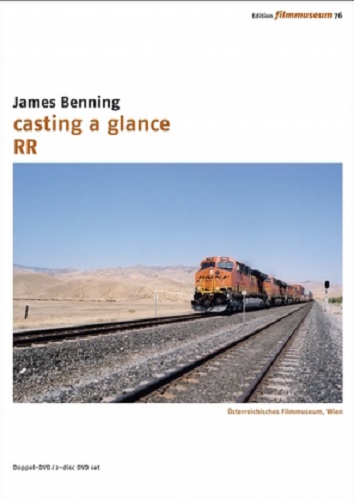
rrRR / casting a glance, James Benning (2007/2007, USA). RR stands for “railroad” and that’s pretty much what you get – 77 minutes of middle-distance shots of US locomotives travelling across the screen, some on urban railways (not “railroad”, because I am British) and some on tracks passing through some amazing landscapes. There is no voiceover, no scrolling text, just ambient noise. I now have some experience with Benning’s films, and while I can certainly sympathise with his desire not to compromise in art, RR is much harder film to watch than others by Benning I’ve seen. It follows in broad form his other works, but its lack of concessions to the viewer can make for difficult viewing. It is, like his other films, often mesmerising (I keep on using that word, I must find another one), and the landscape of the North American continent is in places absolutely stunning (yes, even with a railway track running through it). Benning’s films are an acquired taste, but totally worth it. And yet… casting a glance even manages to test a fan’s endurance. It is a series of shots over two years of Robert Smithson’s artwork ‘Spiral Jetty’. Which is exactly as its name says – a jetty made of stone, in spiral form, in the Great Salt Lake in Utah. What makes this film especially interesting is that although Bennig filmed the artwork over a two year period, he actually documents its lifetime since its creation in 1970 – as the sixteen shots of it depict “the historical water levels (mathematically reconstructed)”. The end result is more like a screensaver than any other Benning film I’ve seen, but still manages to keep interest. Narrative does intrude at one point, when the ambient noise is replaced by the song ‘Love Hurts’, a film released in the same year that Smithson died. I totally agree with making the viewer work to understand a film – culture is not babyfood, it should not be spoonfed – but Benning’s extra-textual references are often just too… extra. I still love his films – and the more about them I learn, the more I love them. But like Sokurov’s movies, there is a story taking place outside of the story on the screen, and knowledge of that totally changes the viewer’s perspective. I have maintained for years that X-Factor is a cross-platform event – the television show makes little sense unless you’ve been following the various dramas in the gutter press. I love the idea of cross-platform and extra-textual intellectual properties – a sort of implementation of Frank Zappa’s “interconnectedness of all things” – but it all needs to be available. Without the booklets in these Österreichisches Filmmuseum DVDs, I’m pretty sure I’d miss a lot of the commentary Benning embeds in his films. Which is a shame.

The-Blue-Angel-1930-Front-Cover-95283The Blue Angel*, Josef von Sternberg (1930, Germany). This is the film from which Marlene Dietrich’s public persona likely depends. It’s certainly the source of the most iconic presentation of her. The title refers to a nightclub in Weimar Republic Berlin, at which Dietrich’s character performs. However, the actual focus of the story is the schoolteacher who falls under Dietrich’s spell. Initially, he goes to the club to remonstrate with its star because naughty postcards of her (which she sells as souvenirs) are distracting his students. But he falls under her spell, and returns to watch her so often that he marries her, loses his job and ends up working as a clown in her show. The film was banned by the Nazis, which is obviously a point in its favour – but for all that it seems a fairly unexceptional film. I’ve no way of judging if it was more titillating than was the norm in the 1930, but there’s little enough in it that clearly signals it as belonging on the 1001 Movies You Must See Before You Die list. I’ve seen a number of films from the same era that were clearly innovative, if not seminal, for the period, or that simply stood out for a variety of reasons. The Blue Angel, sadly, is not one of them.
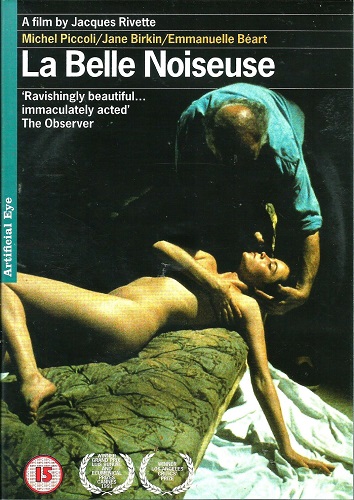
labellenoiseuseLa belle noiseuse*, Jacques Rivette (1991, France). I suspect I may like the idea of Rivette’s films more than I like Rivette’s films – although that’s hardly fair as La belle noiseuse is the first film by Rivette I’ve ever seen, But it is also 237 minutes long – and not that much actually happens during it. A young artist and his girlfriend turn up at the rural retreat of a famous artist who has not produced any new work in years. The girlfriend is asked to model for the famous artist. We see the artist make lots of sketches of the girlfriend, as well as start but not finish a number of paintings. Eventually he does finish one, and everyone assures him it’s a masterpiece, but the viewer doesn’t get to see it. I liked the film, it is very French, and like many of the best French films it subjects its characters’ relationships to much intense analysis. But it did test my patience at times – we see each of the sketches the artist draws, line by line, and it’s not exactly exciting viewing. But I liked that Rivette chose to show us that, I liked that he decided this was the way his film would proceed. As has no doubt become obvious over these Moving pictures posts, I like films by those who do things differently… I see there’s a Rivette Blu-ray box set now available, and it’s definitely tempting me…
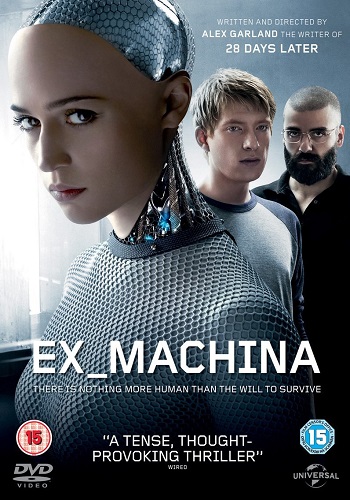
ex_machinaEx Machina, Alex Garland (2015, UK). I’d seen this film highly praised, and while I may be perverse, I’m not so perverse I’ll dislike a movie because it is popular – although certainly what I value in a film is not what most film audiences seem to. But ten minutes into Ex Machina, a movie I was expecting to be about AI, and all it appeared to be about was some ultra-rich knob who lived in the middle of nowhere (how did they supply his house?) and I was already thinking bad thoughts… only for it be pointed out on Twitter that this was the desired response. The person behind Ava, the AI robot (as seen on the DVD cover, because of course you’d give an AI a human face and a chicken-wire body), is meant to be an entitled prick. Because that then pushes the viewer’s emtional engagement onto Ava. The poor old programmer, Caleb, invited by Nathan to his billionaire hideway – and who has to be asked, “Do you know what the Turing Test is?” Of course, he does, he’s a programmer – finds himself a patsy for both Nathan and Ava by turns, and the fact he is emotionally engaged with the AI only makes you wonder why Garland chose to stack the deck so heavily in Ava’s favour. And having done that, the end of the film can hardly come as a surprise. I really didn’t like Ex Machina. I found it annoying, crude and a not very intelligent study of its premise. I much preferred the far less pretentious Chappie.
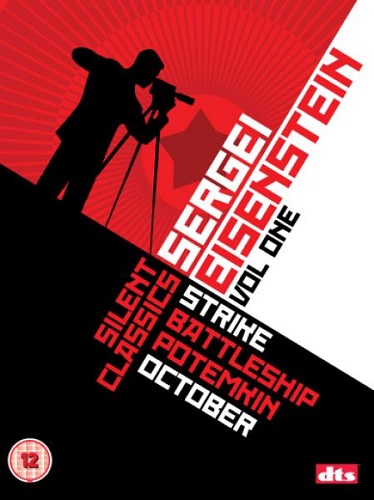
eisenstein_1October* Sergei Eisenstein (1927, Russia). I picked up a copy of Sergei Eisenstein Volume 2 at the end of last year – it contains Alexander Nevsky, Ivan the Terrible Part 1 and Ivan the Terrible Part 2 – but volume 1 proved much harder to find (since it had been deleted several years ago). Admittedly, I already owned a copy Battleship Potemkin and Strike, and October wasn’t exactly hard to find on DVD… but I wanted Volume 1 to go with my Volume 2, so I hung on until one popped up on eBay. Which it did. For a reasonable price. So I bought it. And I’ve now watched October twice and I’m still not sure what to make of it. For a start, it’s unashamed propaganda, a cinematic reconstruction of the October 1917 revolution, featuring many of the people who were involved in the actual event itself. Also, Eisenstein uses a surprisingly large number of modern cinematic techniques – or rather, techniques that have become standards in film-makers’ lexicons and are now used so unthinkingly that their origin is ignored. Anyone looking to put together a DVD collection of important films really should include both the Eisenstein collections (assuming they can find copies, that is).
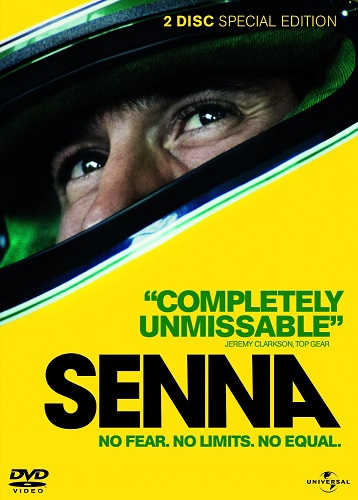
sennaSenna*, Asif Kapadia (2010, UK). This was available on Amazon Prime and since it was on the 1001 Movies you Must See Before You Die list, I watched it, despite motor racing being a sport in which I have zero interest. (Not that there is in fact any sport in which I have a more-than-zero interest.) Unsurprisingly, I found much of Senna not especially interesting, although I’d known almost nothing about Ayrton Senna prior to watching the film and he at least did come across as an interesting person – although chiefly through his work to improve the safety of F1 Racing – a sport in which a handful of rich pricks risk the lives of drivers in order to further line their own pockets, which is frankly disgusting. In fact, F1 comes across as little more than a playset for billionaire regressives. It’s telling that since Senna died and the increased safety he campaigned for came into effect, there has been only a single death during a race – and that was last year, ten years after Senna’s death. Having said all that… I’m not really sure why this film is on the 1001 Movies you Must See Before You Die list.

1001 Movies You Must See Before You Die count: 658

Leave a comment

Moving pictures, #31

More movies! Some good, some bad – well, some good, some meh. But mostly good, I think. Perhaps a few too many from the US, but that seems to be how it worked out. I did actually put together my own list of 101 must-see films (rather than 1001) on listchallenges.com – 101 Films for a Cineaste. Of course, I now realise there are films I’ve missed, so I’ll probably have to do a second list… And, no doubt, when I’ve seen yet more films, I’ll want to put together a third list…

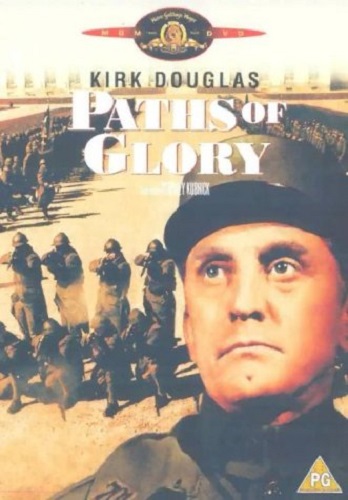
paths_of_gloryPaths Of Glory*, Stanley Kubrick (1957, USA). I think I might have seen this before, on television or something back in the 1980s (I spent most of the 1990s in the Middle East, so it was unlikely to be there – UAE television was shit). Certainly, bits of it felt familiar, although it’s a story that, in general form, has been told a number of times in film, book and even bande dessinée. During World War I, a general orders a division to attack a German redoubt, even though the attack will certainly fail and result in high casualties. As indeed it does. The general is so enraged, he orders three men, chosen at random from the survivors, be tried for cowardice, pour encourager les autres. Cowardice was a capital crime. It’s worth bearing in mind that in the British Army less than thirty percent of battlefield executions were upheld once the war was over. That’s seven out of ten men shot by courts martial should not have been executed. In a civilised world, that would qualify as a war crime. And the same is true of General Mireau’s actions in Paths Of Glory. But, of course, the wealthy and influential can do wrong. As Kirk Douglas, playing the colonel who defends the three men, discovers. The film is actually based on a novel, which was loosely based on real events – apparently, the invented bit is the random picking of three men; the French Army shot lots of men for cowardice, but its victims were not randomly chosen. A pity they didn’t shoot the generals*.

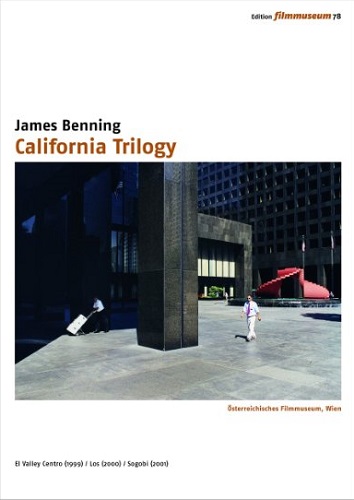
californiaEl Valley Centro, Los and Sogobi, James Benning (1999/2001/2002, USA). After three films in which Benning imposes narrative on his trademark series of static shots through either voice-over or scrolling text, these three films are nothing but pure imagery. Which, unsurprisingly, renders them more like art installations than actual cinema – although I can’t really see someone standing in front of a screen in a gallery for 87 minutes (the length of each film). Each film comprises 35 shots of precisely 2.5 minutes’ duration each. The first is about LA’s Central Valley, with shots of farms, oil fields, even fighter jets taking off from a USAF air base. Los is the urban part of the trilogy, with street scenes from greater LA. And Sogobi (the Shoshone word for “earth”) is the California wilderness, consisting of shots of mountains, rivers, deserts and chaparral. In all three films, the shots are carefully composed – in the first, the screen is split horizontally, usually by the horizon, across which objects move; in the second, it is the vertical lines of the city, and the spaces that creates; and the third’s nature shots are increasingly encroached upon by humanity’s presence. The final credits also give the names of the corporate owners of all the locations shown in the films, pointing out just how “free” the Land of the Free really is. Unlike the other Benning films I’ve watched, these require a great deal of work on the viewer’s part – though they’re also completely mesmerising to watch – in working out the narrative. They tell a story, but they make no concessions – there are no clues, no handy voiceover, no scrolling text. I am enormously glad the Österreichisches Filmmuseum is releasing Benning’s work on DVD, or I might never have come across it.

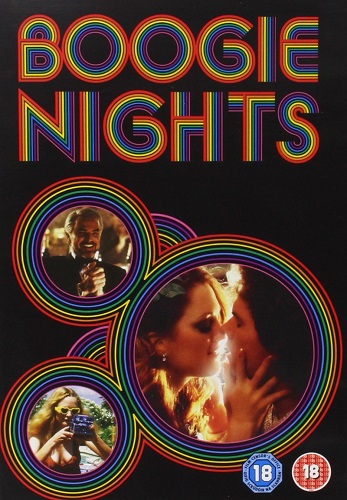
boogie-nights-mysBoogie Nights*, Paul Thomas Anderson (1997, USA). I’m aware of Anderson’s standing as a director, and I’ve seen several of his films… but I’ve never really understand why he’s so lauded. Is it simply that he’s a bit of a maverick? Certainly I can understand the topic of Boogie Nights not being a, well, mainstream movie topic, given it’s about the porn industry in LA. Mark Wahlberg plays a young man with an impressively large todger, which is, of course, never actually seen on screen (this being neither a DH Lawrence adaptation nor a comic book movie). He comes to the attention of Burt Reynolds, a porn director, who then casts him in some of his films. As Dirk Diggler, Wahlberg becomes rich and famous, and lives the rock star lifestyle to excess. Which is pretty much what this film is, a typical rags-to-riches-to-drug-addled-decline story, the only difference is it’s porn rather than music. I’m not entirely sure why Boogie Nights is on the 1001 Movies You Must See Before You Die list (a sadly frequent complaint of these Moving pictures posts).

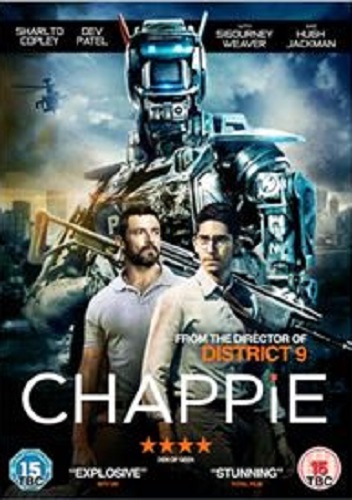
chappieChappie, Neil Blomkamp (2015, USA). I hadn’t really liked Blomkamp’s two earlier films, District 9 and Elysium, even though they were hugely popular. So I wasn’t expecting much of this one, especially since it hadn’t been all that well-received. So, of course, totally perversely, I actually enjoyed it and thought it rather good. The title refers to a police robot operated by the Johannesburg police force. After being damaged in a firefight with gangsters – its batteries have fused to its chassis, and so cannot be removed; in other words, it has five days of power left and then it’s irretrievably dead – the robot is pulled from the scrapheap by the inventor of the robots, Deon, for him to use on his home project: an AI. But on his way home with the dead robot, he’s hijacked by a trio of inept gangsters, who want him to reprogram a police robot to obey them. So he gives them his AI instead. But on booting up it has the mentality of a child, and though Deon tries to tech it morality, the gangsters trick it into committing crimes by the gangsters… It’s not the most original story on the planet. But Sharlto Copley gives Chappie real character, and the CGI robot itself is well done. It’s more of a comedy than a sf action/adventure film, but that I think is one of its strengths. The villains of the piece are a bit one-note; and the rival robot is plainly based on RoboCop‘s ED-209, and as far as homage it’s not exactly subtle. But I liked this one, it’s much better than Blomkamp’s earlier two films.

great_beautyThe Great Beauty, Paolo Sorrentino (2013, Italy). I loved Sorrentino’s The Consequences Of Love when I saw it back in 2013, I even picked it as one of my five best of the year films. So I’m a little surprised it’s taken me so long to watch The Great Beauty. Having said that, there’s now a Five Films by Sorrentino DVD box set available, so I might well get it… Anyway, The Great Beauty. I was not initially taken with this film as it took a while to settle into its story. The main character is a cultural commentator, skating by on the fame of a  highly-respected novel he wrote decades before, but now content to write newspaper columns and magazine articles. He wanders the streets of Rome at night, meets people and talks to them; he throws parties in his apartment – at one of which, he delivers a devastating takedown of a female friend who had called his bluff on “honesty” – and he has relationships with various women. The story seems to grow out of the film, rather than provide a structure for its narrative. Which means it does take you somewhat by surprise, as it pulls you in and then wins you over. I didn’t like it as much as The Consequences Of Love, but in channelling “faded glory” rather than “stylish” it makes for an interesting, if overly Fellini-esque, film (and there are several nods to Fellini throughout the film). On reflection, it might be worth waiting for that box set to appear on Blu-ray…

fassbinder1The Bitter Tears Of Petra von Kant*, Rainer Werner Fassbinder (1972, Germany). The title character is a fashion designer and the entire film is restricted to her small apartment. It also has an all-female cast. The movies open with von Kant being awoken by her assistant, Marlene. Several visitors appear throughout the course of the film, one of whom, Karin, von Kant takes a shine too. They enter into a relationship. Six months pass. Nowe the relationship is not so loving. Karin admits to have slept with a man, and it then turns out she has been seeing her ex-husband and they plan to get back together. Von Kant feels betrayed. And, er, that’s about it. Fassbinder made a remarkable number of films during his relatively short career, and he had the artistic courage to experiment with cinematic formats and narratives (much as von Trier does). The result are not always successful. Admittedly, The Bitter Tears Of Petra von Kant is on the 1001 Movies You Must See Before You Die list, and I think some of his other films are actually more interesting. But there’s certainly plenty ot chose from, and I’ve not watched all of his oeuvre. Yet.

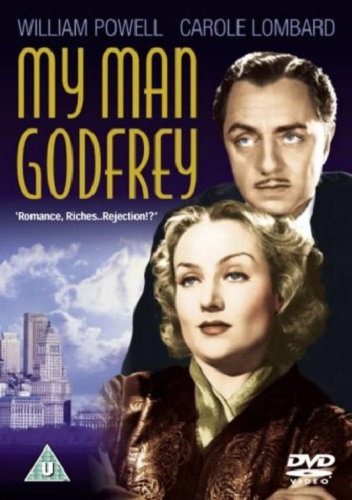
my_man_godfreyMy Man Godfrey*, Gregory La Cava (1936, USA). A bunch of nincompoop socialites play a game, the prize going to whoever can find most unwanted thing. One woman tries to persuade a homeless man (Powell) to be her item, but he refuses. Her sister (Lombard), however, is sympathetic to his plight, so he decides to help her show up her sister and so volunteers to be her unwanted thing. They win. Lombard is so grateful and so full of philanthropic goodwill, she offers Powell a job as her family’s butler. This has in the past proven a hard position to fill, as the family are demanding, scatter-brained, and often partying a bit too hard. Powell is the perfect butler and a boon to the family. Lombard falls in love with him – but this film isn’t that transgressive, as it turns out Powell is a runaway son from a rich patrician Boston family. Having said that, he does use his money to develop the city dump where he had been living into a nightclub, with homes and jobs for the people who had been living there. But philanthopy is no alternative to social welfare, and any society that relies on it has no business calling itself civilised. Still, to be fair, My Man Godfrey does run a good line in witty banter, and for a 1930s screwball romance it’s a reasonably good example. That the happy ending encompasses more than just the lovebirds is commendable, as is the somewhat feeble attempt to show that poor people are really people too; but the classism is bad, and so too is the easy acceptance that the largesse of the rich is a viable way to run a society.

1001 Movies You Must See Before You Die count: 654

* to wit:

The General inspecting the trenches
Exclaimed with a horrified shout
‘I refuse to command a division
Which leaves its excreta about.’

But nobody took any notice
No one was prepared to refute,
That the presence of shit was congenial
Compared to the presence of Shute.

And certain responsible critics
Made haste to reply to his words
Observing that his staff advisors
Consisted entirely of turds.

For shit may be shot at odd corners
And paper supplied there to suit,
But a shit would be shot without mourners
If somebody shot that shit Shute.


1 Comment

Moving pictures, #30

A wider spread of films this week – in terms of years (five decades) and countries of origin (five nations). Only one from 1001 Movies You Must See Before You Die list, however. And another film that is really bad and I’ve no idea why I bothered buying it or watching it. Eh.

bulldogDeadlier Than The Male and Some Girls Do, Ralph Thomas (1967/1969, UK). There must have been something in the water back in the 1960s, with all the debonair spy movies that appeared – not just the early 007s, but Derek Flint, Matt Helm, Maroc 7, Our Man in Marrakesh and… these two starring Bulldog Drummond. Who, er, isn’t strictly speaking a spy. And he originally appeared in the 1930s. He’s some sort of man-about-town who acts as a troubleshooter for an uncle in insurance. Or something. But he does do battle with a megalomaniac. And there are plenty of daft gadgets and nubile women in bikinis. Deadlier Than The Male opens with Elke Sommer poisoning an oil baron aboard his private jet, and then parachuting to safety as the plane explodes behind her. It transpires she was paid to do this by a UK oil company, but the oil company decides not to pay her fee – at least not until one of the directors is killed. But now there’s another person standing in the way of the oil company’s expansion, this time the ruler of a small Arab sheikhdom, who Drummond just happened to go to school with. So Drummond heads off to visit his chum on the Italian Riviera, partly to protect the sheikh and partly to discover who is Sommer’s boss. The film ends with a shoot-out on a giant mechanical cheesboard. Bonkers. Some Girls Do is more of the same. This time it’s a UK project to build the world’s first supersonic airliner (hey, we did that for real!), but the project is being sabotaged. It turns out the saboteurs are nubile young women with “robot brains”. Or something. The science is complete nonsense. The villain, for example, uses a subsonic ray to take control of the supersonic airliner. Good luck with that. “Supersonic” means “faster than sound”. Your ray will never catch up with the plane. Even for its subgenre, this is pretty brainless entertainment, without either the silly humour of Matt Helm and Derek Flint, the po-facedness of Bond, or the colourful locations of Maroc 7 and Our Man in Marrakesh.

starship_apocStarship Apocalypse, Neil Johnson (2014, USA). This is the sequel to Starship Rising, a film that was so bad I, er, bought the sequel. Johnson specialises in low-budget genre films, which I guess sort of makes him the self-published Kindle genre writer of the movie world. The set dressing in the two films by him I’ve now watched is cheap and nasty, the acting is poor, the dialogue terrible, and the stories derivative. This one has a disfigured, allegedly immortal emperor, and a small group – the entire cast of the film probably numbers less than a dozen – of rebels, who have this fantastic starship, or something. The only way to watch this film is pissed, which does sort of make figuring out what’s going on a bit difficult. I’ll probably have to watch both films again, but I’m not sure I want to…

american dreamsAmerican Dreams (lost and found), James Benning (1984, USA). It probably comes as no surprise that Benning has become one of my favourite directors. He hasn’t knocked Sokurov off the top spot – their oeuvres are almost impossible to compare, but Sokurov has at least made several narrative films (or rather, not documentaries) – but I’d definitely put Benning in the top five. And it’s because of films like American Dreams (lost and found). I can see why Benning’s Deseret made the 1001 Movies You Must See Before You Die list as it’s probably the most accessible of his films (that I’ve seen to date) – and even then it comprises static shots of scenery in Utah, countryside and towns, while a voice reads out stories from the New York Times from 1851 to 1995. American Dreams (lost and found) uses a much more interesting technique to tell its story. In fact, it uses three techniques. The images are of baseball cards and ephemera about Hank Aaron (apparently a great baseball star, although his fame is lost on me as I’ve never followed the sport). The soundtrack consists of a variety of spoken word excerpts, such Martin Luther King’s famous speech, or the first words spoken on the Moon, all iconographic moments in US recent history, alternating with popular music from the 1950s through to the very early 1970s. As well as both of these, a line of handwritten text scrolls across the bottom of the screen. This last is from the diary of a man who plans to murder Richard Nixon, and it reads exactly like the sort of thing written by someone who would plan such a thing – weird spelling mistakes, completely deluded, an oddly prurient but obscene fascination with women… As the film progresses, the story told by the diary deepens, until it is eventually revealed as the real diary of Arthur Bremer, who attempted to kill US presidental candidate George Wallace in 1972. Fascinating stuff.

close_upClose-Up*, Abbas Kiarostami (1990, Iran). I believe this is the film which brought Kiarostami to western critics’ notice, and it’s easy to understand why. It’s a documentary in which the people involved re-enact the events of the film’s topic, intercut with footage of the actual court case which results. A man meets a woman in a bus and tells her he is the famous director Mohsen Makhmalbaf. The man visits the woman and her family several times, and tries to raise cash from them for his next film. A journalist meets the imposter, realises he is not Makhmalbaf, and the police are called in to arrest him. Kiarostami interviews the journalist, the imposter and the family, and also films them re-enacting the events which led to the arrest. After the court case, the real Makhmalbaf turns up and gives the imposter a lift on his motorbike to the family’s home so he can apologise for trying to con money out of them. It all adds up to a very clever film, which feels partly like a documentary and partly like fiction, and which plays games with the viewer compact, to the extent it’s not clear where the lines blur. Kiarostami is one of the most important directors currently making films, and this film gives ample reason why.

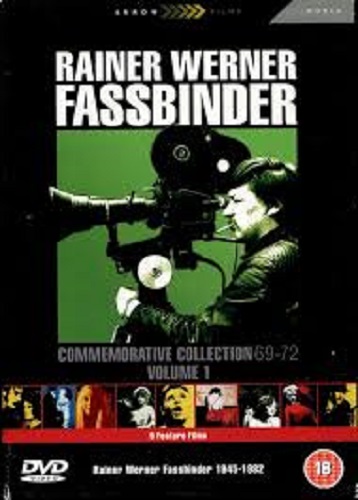
fassbinder1The Niklashausen Journey, Rainer Werner Fassbinder (1970, Germany). I have a soft spot for films which are little more than actors declaiming political arguments instead of dialogue in a story, such as Miklós Jancsó’s The Confrontation… And now this one. The story is based on a true story from the fifteenth century, about a shepherd who claimed to have seen the Virgin Mary in a vision and promptly tried to start an uprising against the church and landowners. It didn’t succeed. Fassbinder uses a mix of contemporary and historical costumes, and has his actors discuss revolutions and historical forces while notionally acting out the life of the shepherd. It works surprisingly well. Most of the scenes are static, with the cast either standing or sitting still while they speak. And yes, I ended up buying the Rainer Werner Fassbinder Commemorative Collection 69-72, Volume 1, so now I have both sets – and they’re worth it even if not every film in them is entirely successful.

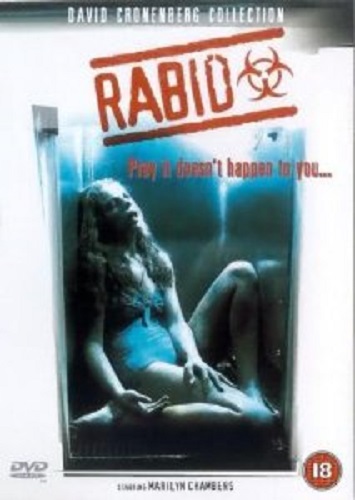
rabidRabid, David Cronenberg (1977, Canada). A charity shop find. Sadly, it was the only early Croneneberg they had. It is, unsurprisingly, distinctively one of his. A young couple are involved in a motorbike accident. She is badly burned, but fortunately the accident took place near a famous plastic surgery clinic. The head of the clinic employs an experimental method to graft skin over the burned area, and as a result the young woman, er, grows an orifice in her armpit, yes really, which has a stinger inside, yes really. She uses this to feed. Her victims cannot remember afterwards what happened, and then some time later they turn into zombies. Whoever the zombies bite, also becomes a zombie. It turns into an epidemic, its cause completely flummoxing the Canadian authorities. It’s a bit too daft a premise to shock as horror, although it works quite well as a completely bonkers thriller. Porn actress Marilyn Chambers plays the young woman, in her first straight acting role. Not a bad film, although it’s clear not much money was thrown at it.

1001 Movies You Must See Before You Die count: 650


Leave a comment

Moving pictures, #29

A few too many US films this time, although the Benning is actually only available on a DVD published by the Österreichisches Filmmuseum. But then the Satyajit Ray is a Criterion Collection DVD, and they’re only published in the US, so…

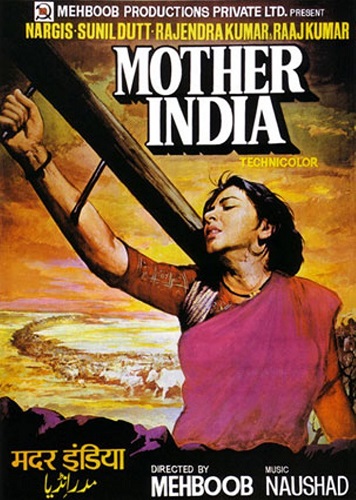
music_roomThe Music Room (Jalsaghar)*, Satyajit Ray (1958, India). I’ve been trying to watch more Ray as he’s an important director and to date I’ve only watched two-thirds of his Apu trilogy. The asterisk indicates this film is on the 1001 Movies you Must See Before You Die list, and while Ray is quite well-served in terms of UK DVD releases (thanks to the inestimable Artificial Eye), I decided to pick up the Criterion Collection DVD of The Music Room. The story is a common one, perhaps even common to Indian cinema (it’s certainly one shared with Mother India in part), in that it’s about the death of old ways and the rise of the new. The main character of The Music Room is a Bengali zamindar, wealthy and indolent, but good-hearted and more fond of music than he is looking after the lands and people he is responsible for. His decline is contrasted with the rise of a commoner who beocmes rich through business. The film cleverly shifts sympathy from the zamindar to the commoner, especially given whatever defence might be mounted of the zamindar system the example portrayed in The Music Room is far from a good advert. The film also makes  a great deal of its music, and apparently it was the use of classical Indian music in The Music Room which contributed to its success in the West (it was intended to be a commercial success in India as Ray’s previous film had flopped). I’m reminded of a night I once spent in a Bengali nightclub in Abu Dhabi, when after listening to a fifteen-minute song I asked the person sitting at a nearby table to explain the lyrics. They were surprisingly banal. That’s not something which can be said of this film, which maintains an impressive elegiac tone throughout.

prizziPrizzi’s Honour*, John Huston (1985, USA). There are a number of films whose presence on 1001 Movies you Must See Before You Die list is, quite frankly, baffling. This is one of them. It’s a fairly ordinary comedy-drama about Hollywood’s version of the Mob, notable only for Jack Nicholson’s gormless expression throughout and his tortured Brooklyn accent (at least, I think it’s Brooklyn, a native New Yorker would probably know what particular district it’s intended to portray). Nicholson’s character is an enforcer for a Mob don, and he falls in love at first sight with Kathleen Turner at a family wedding. But she’s from out of town (LA, in fact), so he never finds out who she is… Until some time later, when he’s out in LA and it turns out she’s involved in the hit he’s making. The two enter into a relationship, it transpires Turner is a contract killer, and later that she has ripped off the Mob and… well, it’s about as twisty-turny as the first two minutes of your average twenty-first century thriller movie. Turner plays a femme fatale, a role which has defined much of her career; I’m not sure if Nicholson was doing a comedy turn, it’s hard to tell. This is light entertainment, it’s not classic cinema, and you can happily live your life without having never seen it.

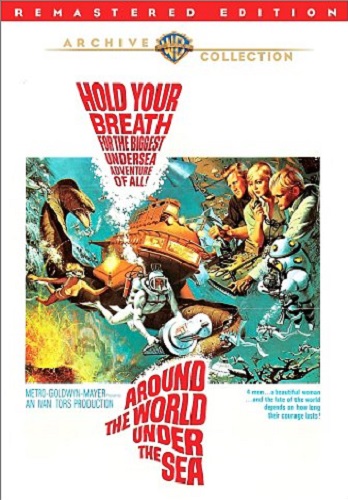
around_the_worldAround The World Under The Sea, Andrew Marton (1966, USA). The threat of increased, and more powerful, earthquakes, persuades the UN to back a plan to install earthquake sensors at strategic points around the globe on the ocean bottom. The plan is Lloyd Bridges’s, so he gets to lead the mission – which will involve a globe-spanning trip in a large submersible. Also aboard are five other scientists – Shirley Eaton, Brian Kelly (who doesn’t think a woman should be on board), David McCallum, Keenan Wynan and Marshall Thompson. This film is… tosh. Complete tosh. Wynan initially refuses Bridges’s invite, so Bridges goes to visit him… in his undersea home more than 700 feet below the surface of the sea. And Bridges dives to it on air. It’s also remarkably light down there, in fact the sea bottom is the sort of pale sand you’d find around, say, twenty feet below the surface. There are also other episodes where the crew go diving at depths of greater than 20,000 feet – and it’s unlikely the submersible itself would survive such a depth – on air and without bothering to either compress before or decompress afterwards. There are films which make a reluctant nod in the direction of scientific accuracy, and are those which don’t give a shit. This falls into the latter camp – and it’s not improved by it. The actual premise is complete bollocks, and the presentation of submersibles and diving is complete and utter nonsense. Best avoided.

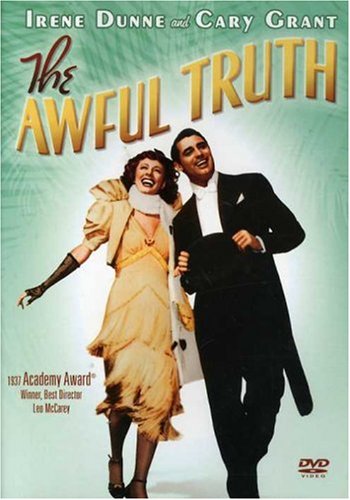
awful_truthThe Awful Truth*, Leo McCarey (1937, USA). There are films in which Cary Grant seems to glide through the proceedings, sliding along on charm and his perfect delivery of one-liners. Not every film, or even necessarily good films – he is better, for example in Operation Petticoat than he is in North by Northwest. But The Awful Truth is an early film – actually his thirtieth, if the filmography on Wikipedia is any guide – and his first attempt at the debonair leading man in a comedy-drama, a role which later came to define him. In this, he often seems a bit too eager to deliver the punch-line, and it gives him an earnestness which sits at odds with his later on-screen persona (but that’s what you get for watching an actor’s oeuvre in non-chronological order, which is I suspect the way most people end up seeing films starring a particular actor). The plot of The Awful Truth is typical screwball romance fodder: Grant and Irene Dunn are due to divorce, but by parading unsuitable new partners in front of each other, they eventually realise they belong together. Again. The script is witty, Dunne more than holds her own, and if Grant does smirk and gurn a little too often, it doesn’t detract all that much from the film’s essential charm.

american dreamsLandscape Suicide, James Benning (1986, USA). This is cinema as art installation, although Benning pushes the definition of that by including narrative. Yet his films are also documentaries – there is nothing fictional about the material he presents. Landscape Suicide is about two murder cases: one in Wisconsin, one in California; one in 1984, one in 1957. The earlier of the two is the capture of Ed Gein. Benning has an actor play Gein and act out his interrogation by the police. The second is Bernadotte Prott, who stabbed a high school friend to death, and is again portrayed by an actor who acts out her police interrogation. Landscape Suicide is built up from these static talking head shots and equally static shots of the areas in which the crimes were committed, in Wisconsin and California. Although there is nothing in this film which actually tells a story, Benning imposes narrative through his choice of images and his editing. I’ll admit he’s not to everyone’s taste: 90 minutes of static 16mm shots of three or so minutes duration, not always with narration or even people talking – both El Valley Centro and Los, for example, are images and ambient sound only – but it’s the actual procession of images which tells the story, and it’s very cleverly done. Quite meserising too.

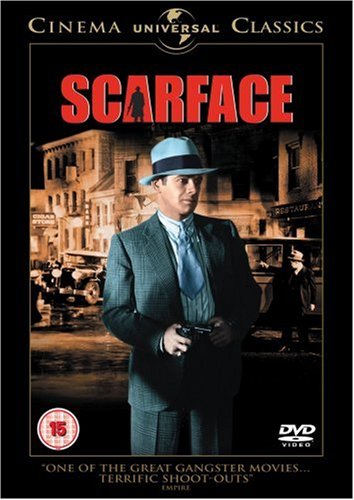
scarfacerScarface*, Howard Hawks (1932, USA). I’ve seen about half of Hawks’s oeuvre to date, and some of them I’ve found very good – if very much of their time and very much a product of the Hollywood system (neither necessarily being a bad thing, of course). I will admit to not having high expectations of this movie, a thinly-disguised biopic of Al Capone, even down to re-staging the Valentine’s Day Massacre. Its opening ten or twenty minutes aren’t especially prepossessing, as Paul Muni moves in on deals other gangs have made with speakeasies for their supply of beer (not that the speakeasies had much choice). But then the violence escalates, and it’s all very realistic – so much so, it captures the attention and holds it. Admittedly, I missed the whole “X equals death” thing, although I did wonder why the camera lingered on the ceiling joists of the garage where the massacre took place. Muni seems a bit too much like his role in I am a Fugitive from a Chain Gang to convince as a ruthless mobster, and Boris Karloff is far too lugubrious and, well, English, in a similar role. Despite that, the story speeds along at a breakneck, and accelerating, pace, and it’s not hard to understand why Scarface is considered a seminal film of its genre. Worth seeing.

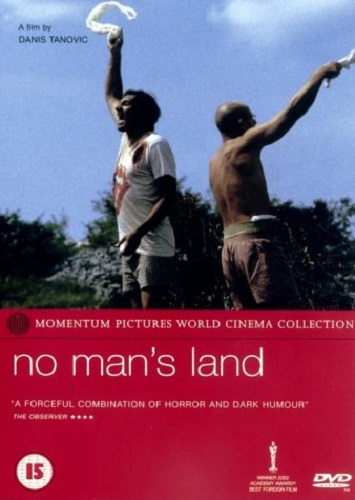
no_mans_landNo Man’s Land*, Danis Tanović (2001, Bosnia). The only film by Tanović I’d seen previously was Hell, his film of a screenplay by Krzysztof Kieślowski and Krzysztof Piesiewicz, the second of a new trilogy they were working on just prior to Kieślowski’s death (the first, Heaven, was filmed by Tom Tykwer after Kieślowski’s death; the third has never been made). All of which is completely irrelevant as that later film bears little or no resemblance to this one, which takes place mostly between the Bosniak and Bosnian Serb frontlines during the Bosnian War. After a patrol gets lost in a heavy fog, and another patrol is sent out to look for them, two soldiers, one from each side, end up trapped in an abandoned trench in no man’s land. Neither can leave, at risk of getting shot by the opposite side. Just to make matters worse, Bosnian Serbs have boobytrapped a dead Bosniak by putting a bouncing mine under his body. Except he’s not dead. A French sergeant in the UN Peacekeeping Force gets involved, but his superiors veto any resolution of the situation. But then the media arrives on the scene, especially a tenacious British reporter for a news channel. The decision to help gets bounced up the chain of command to Simon Callow’s colonel, but it seems the mine can’t be disarmed. The Bosniak and Bosnia Serb end up shooting each other, and the UN Peacekeepers lie to the media and tell everyone the third man has been rescued, even though he hasn’t. This humour isn’t black, it’s stygian. Like proper humour of this type, everything in it is completely inevitable, including the stupidity and dishonesty of the people involved. It is also completely convincing. Definitely worth seeing.

1001 Movies You Must See Before You Die count: 649


1 Comment

Moving pictures, #28

More films. Just the one from the US, so a reasonable spread. And a few more from the 1001 Movies You Must See Before You Die list, of course.

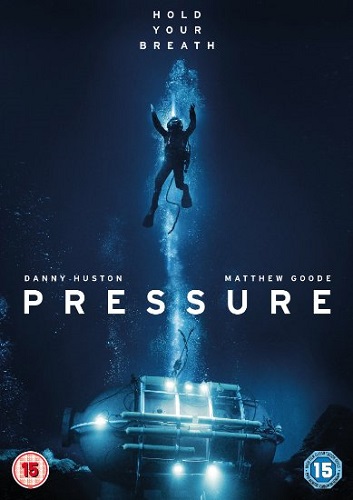
pressurePressure, Ron Scalpello (2015, UK). There are many deep sea films, but few of them are about saturation diving. And most of them are complete bollocks anyway. I watched Pioneer this time last year but that was more of land-based thriller than a diving film, although saturation diving did feature heavily in it (see here). But Pressure is very much a diving film. It’s set almost entirely in a diving bell 650 feet (that’s about 20 atmospheres) below the surface of the sea off the coast of Ethiopia. A severe storm strikes and sinks their support ship. So they’re stuck on the sea bed, with no way to decompress and only a limited supply of heliox. Rescue is almost undoubtedly on its way, but the storm may delay it and there’s no telling when it will arrive. Pressure gets most of the details right – it certainly looks like it’s using the right technology – although for obvious reasons it ignores the helium squeak. And toward the end it all gets a bit silly – one diver seems to explode while trying for the surface, but the same fate does not befall hero Danny Huston, even though he doesn’t apparently make any decompression stops en route. (And at that depth, decompression would be measured in days or weeks.) Still, it was good to see a film based on a topic that interests me, and I’ll take what it gets right and overlook what it gets wrong.

cleoCleo from 5 to 7*, Agnès Varda (1962, France). I am ambivalent about the Nouvelle Vague. Some of its films I love, some I simply don’t see the point of. I thought this might fall into the latter, given that it covers the titular hours of the, er, titular character, as she waits for the results of a medical test which she thinks will tell her she has cancer. The film opens, in colour, with Cleo at a tarot reading, but changes to black and white as she leaves and goes about the rest of the day. But, completely unexpectedly, I found myself really loving this film. It helps that Cleo, played by Corinne Marchant, is a likeable protagonist and centres the film; but more than that, there’s the final third in which Cleo meets soldier Antoine in a park and the two talk and mildly flirt – it works really well. The dialogue feels natural, though it covers topics totally in keeping with the film’s themes, and the two have a natural chemistry on screen that plays. It’s hard not to compare it to a pair of Godard films, both black and white – Masculin féminin and Une femme mariée (see here and here) – both of which chiefly comprise women and men in conversation (Godard, incidentally, appears in Cleo from 5 to 7, in a silent film-within-a-film shown to Cleo during the two hours). Neither, however, compares well to this film, which manages to make those conversations not sound like the pretentious twaddle you’d expect of Rive Gauche students but like the natural conversational topics two might people might accidentally fall into. I rather fancy getting a copy of this on DVD or Blu-ray…

shepitkoThe Ascent*, Larisa Shepitko (1976, Russia). Another director completely unknown to me, and one of her films is on the 1001 Movies You Must See Before You Die list – but none are available for rental in the UK, so I ended up buying a Criterion Collection DVD containing two of her films, and… The Ascent is set during the Great Patriotic War (WWII to me and thee) during the German invasion of Russia. It is, of course, cold and the ground is heavy with snow. A pair of Russian soldiers are sent to fetch food from a sympathetic farmer, but are captured by Germans. They are interrogated, and one agrees to join the local police – ie, become a collaborator. The film has a stark simplicity, helped by the snowy landscape, that plays to the story’s strengths; and while there’s not that much that’s subtle about the German invasion of the Soviet Union, the film’s verisimilitude gives its story a moral authority it might otherwise lack. To be honest, there’s not much about The Ascent that makes it stands out. It’s well-filmed, it treats its subject well, and it makes its points cleverly and with subtlety. It’s a good film, but I’m borderline on whether it belongs on 1001 Movies You Must SeeBefore You Die list, possibly because I suspect Shepitko made more interesting films or because “good” should not be sufficient reason for inclusion. Worth seeing, nonetheless.

warbirdsWarbirds, Kevin Gendreau (2008, USA). I knew this was trash just from the packaging alone, but it mentioned WASP (Women’s Airforce Service Pilots), the US equivalent to the UK’s ATA (which was not actually a female-only organisation but just comprised mostly women pilots), so I thought it worth a go. That was a mistake. The WASP crew of a B-29 are ordered to deliver their aircraft, with important passengers, to an island in the Pacific, but they are shot down en route. If the WASPs are anything like the ATA, then the aircraft they flew had no guns fitted, and generally a single pilot was sufficient for the trip. Anyway, the WASPs and secret Army brass end up stuck on an island occupied by the Japanese – except the Japanese have almost all been killed by… giant pterodactyls. Yes, it’s that silly. I wouldn’t have been surprised to learn that this film had been made by the Global Asylum, but apparently not.

leni_riefenstahlOlympia, 2 Fest der Schönheit*, Leni Reifenstahl (1938, Germany). I watched this first half of this a few weeks ago, and though it covers the same subject – the 1936 Berlin Olympics – I suspect it was split into two films simply due to reasons of length. Like the first film, Fest der Volker (see here), it shows the various events. But it actually opens with some lovely shots of nature, followed by some naked men cavorting about – which would be less of a problem if you weren’t conscious of the fact the men in question were Nazis – before eventually returning to the Olympic Games. A variety of events are shown, including sailing, equestrian things and sprinting, but it’s the decathlon which proves the most interesting. There are fewer shots of the crowds, and none of Hitler, but many more of the athletes. The focus seems to be on the winners rather than the Germans, so even though it’s Americans who dominate the decathlon, we get to see them as they win each event. There’s a very real sense that what you’re seeing old, a true ddocument of the state of athletics in 1936, and so it’s easy to forget the political baggage. I happen to think that baggage is important, but neither should it detract from Riefenstahl’s achievement. Whether this holds true for her other movies remains to be seen.

1001 Movies You Must See Before You Die count: 645


Leave a comment

Moving pictures, #27

Almost caught up with these. Although no doubt I’ll go and watch another half a dozen films one afternoon and end up behind again. Sigh. (Um, have just noticed: after my last Moving pictures post contained no US films, this one is entirely movies from the USA. Ah well. Must do better.)

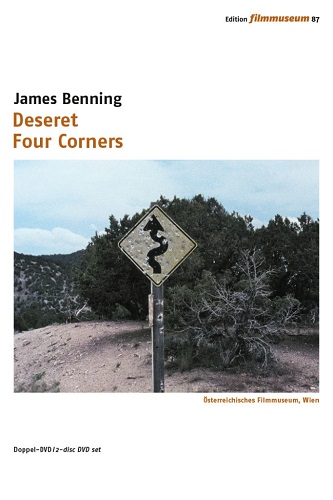
deseretDeseret*, James Benning (1995, USA). Ever watched a film and loved it so much you go online and buy every other film by that director you can find? I knew nothing about Benning, only that Deseret was on the 1001 Movies You Must Watch Before You Die list. I didn’t even know what the title meant. I couldn’t find a rental copy, so I ended up buying the film on DVD. And then I watched it one evening. The title actually refers to the name of a provisional state, proposed in 1849 by Mormon settlers but never accepted by the US government. Deseret-the-film is about Utah, which is one of the states in what would have been Deseret-the-territory. While a static 16mm camera records the Utah landscape, and later urban areas, in shots of no more than two or three minutes duration, a voice reads out stories about the state from the New York Times, starting in 1851 and through each year to 1994. Initially shot in black and white, when the voice-over reaches the 1990s the film becomes colour. The images show the changes wrought on the state by the presence of humanity; and some of the newspaper stories are quite critical of the people in Utah (although apparently the Mormon Church are happy with the film). I loved the use of imagery and voice-over, I found it mesmerising. It reminded me of Sokurov’s elegy films. I loved it so much I looked online, discovered the Österreiches Filmmuseum in Vienna has to date released five DVDS by Benning, including this one, featuring eleven of his films. So I bought the other four DVDs:  American Dreams (lost and found) / Landscape Suicide, casting a glance / RR, California Trilogy and natural history / Ruhr.

bigskyThe Big Sky, Howard Hawks (1952, USA). This film is not actually on the 1001 Movies You Must See Before You Die list I’ve been using, but it’s on the amalgamated list – meaning it either got added after 2013, or dropped in favour of a more recent film. But it’s a Howard Hawks film, which is why I rented it. Unfortunately, the copy I saw proved to be a terrible transfer, pretty much a VHS quality picture. It’s set in 1832, Kirk Douglas is a hunter who has run in with another hunter, the two become friends and travel together to New Orleans, where they sign up on a trip to travel 2000 miles up the Missouri River to trade with Blackfoot Indians. And they can do this because they have with them a Blackfoot princess rescued years before from an enemy nation. This is US history as told by whites for whites. The Native Americans are treated sympathetically – more so than you would expect for a Hollywood film – but this is still manifest destiny in action, the continent for its conquerors, etc. Douglas is at his smirking best, the nasty fur trading company is nasty, Arthur Hunnicutt does a good line in drunk hunters who have done it all and actually know quite a bit… A film worth seeing once but not a great film, and probably not really good enough to make any instantiation of the 1001 Movies You Must See Before You Die list.

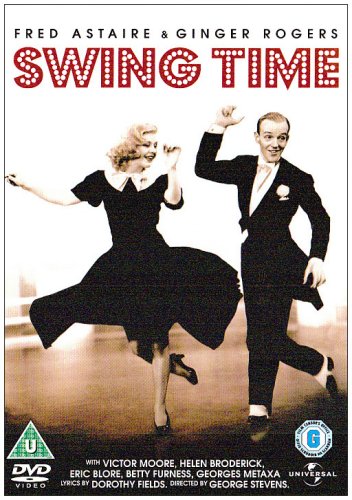
swingtimeSwing Time*, George Stevens (1936, USA). You can’t go wrong with Fred and Ginger. They are, in fact, perfect for a Sunday afternoon. I’m pretty sure it wasn’t a Sunday afternoon when I bunged this disc in the player, but a Sunday afternoon film was what I was expecting. And so it seemed to be. Fred misses his wedding because the rest of his dance troupe conspire to delay him as his marriage would lead to the troupe disbanding. When Fred does make it, after the wedding has been called off, he promises his angry father-in-law-to-be that he will return to wed his fiancée when he has earned $25,000. So he heads off to New York, bumps into Ginger but gets off on the wrong foot with her, follows her to the dance studio where she works as a teacher, buys a lesson with her so he can apologise, but when he fumbles his dancing she is fired by the studio’s oleaginous owner, so Fred demonstrates she really has taught him astonishingly well in such a short lesson… leading to a quite brilliant Fred and Ginger dance routine… And from that point on, the film couldn’t put a foot wrong. Okay, so it went a bit all formula, but it had built up such a bank of charm it would have had to really fuck up to lose it. Fred and Ginger audition for a club to put on a dance routine, but there are obstacles to overcome, not least Fred’s love of gambling… But it all works out in the end, as it must. A fun film.

deseretFour Corners, James Benning (1997, USA). This is the second film on the DVD mentioned above (see cover art to the left). It follows a similar pattern to Deseret, although it’s not quite as successful. The film is based on the works of four artists – Claude Monet, Moses Tolliver,Native American wall-painter “Yukawa” and Jasper Johns – and opens each of its four sections with on-screen text about the artist’s life. It then shows a series of 16mm shots of landscape from one of the four states which make up the four corners region: Utah, Colorado, New Mexico and Arizona. Mostly the voice-over focuses on the Native Americans who once lived in the region, the discovery and subsequent exploitation of their artefacts by local families, and the eventual disposition of the sites. Shots are often longer than in Deseret, which can test your patience, but the voice-over is always interesting. According to the DVD booklet, “I wanted to be entirely democratic, and so each section is exactly the same as all the others, down to the number of letters in the text biographies of the artists [total 1,214] and the number of words [1,186] in the voice-over stories”. I can’t wait to watch the other Benning films.

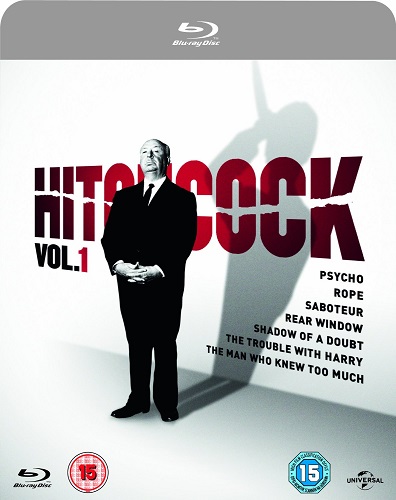
hitchcock1The Trouble with Harry, Alfred Hitchcock (1955, USA). A couple of months ago, Amazon had a “Prime Day” and offered a bunch of bargains to Prime members. On offer were Blu-ray editions of two Alfred Hitchcock collections for £15 each. I already had them on DVD – in fact, they were among the first DVDs I ever bought, back in the 1990s – but I fancied upgrading. And so I’ve been rewatching them on Blu-ray at irregular intervals. I’ve always rated Hitchcock as one of the most consistently entertaining of directors, a master craftsman who made a lot of excellent movies, including a couple of stone cold classics. This one, sadly, is neither. But what I had forgotten about The Trouble with Harry is the gorgeous Technicolor. It’s shot in New England in autumn, just like a favourite film of mine, and it looks beautiful on the screen. Unfortunately, the story is thumpingly light-hearted – Hitchcock’s only outright comedy, apparently – and the male lead, John Forsyth, can’t manage the lightness of touch required by the script. As I’ve rewatched these Hitchcock films I’ve found myself re-evaluating them. He was remarkable in how little footage he discarded  – in other words, he shot precisely as much footage as he needed and no more, and planned each shot so thoroughly retakes and reshots were unnecessary. And his films are brilliantly framed – even when it doesn’t go right, he still stuck to his plan (in this film, the trees were apparently embarrassingly free of leaves when the crew arrived to shoot, so Hitchcock had leaves glued to them – er, the trees, that is). But some of the stories he chose to film are, frankly, not very interesting. This one is a case in point – it’s like he tried for a screwball comedy but instead shot it as a melodrama. The end result is identifiable as neither. Another male lead might have been able to pull it off, especially given that the supporting cast are so good, but I doubt it – Hitchcock’s hand lays a bit too heavy on the movie. Still, it is, as I said, a beautiful-looking film.

m_verdouxMonsieur Verdoux*, Charles Chaplin (1947, USA). Chaplin plays the title role, a bank clerk turned bigamist and serial killer of wealthy middle-aged women. I’m not sure where the humour comes from in this, although there are a number of nice slapstick routines – a fall out of a window, for example, surprised a laugh out of me – and Chaplin does play his role well. But. But. It all feels a bit like a traveller from a different era. I can see the film working as a silent movie in the 1920s, but by the late 1940s it’s inability to decide if it’s a drawing-room farce, a slapstick comedy, or just plain black humour results in far too many shifts in tone. And Martha Raye’s character is just plain weird. I’m glad I went to the trouble of seeing it, but I’ll not be dashing out to buy all of Chaplin’s DVDs…

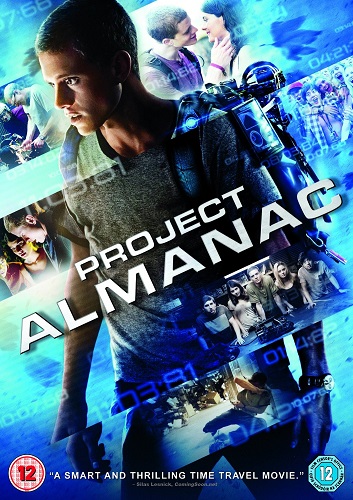
project_almanacProject Almanac, Dean Israelite (2014, USA). Is it possible to put a new spin on the time travel story? And no, doing it as found footage doesn’t count. In fact, that’s a strike against it. Because found footage needs to be part of the story, not just a gimmick for telling it, and it’s been so over-done now it’s lost all currency. But never mind, because at least Dean Isrealite thinks it’s a smart way to tell his story. Which in this case involves a high schooler whose deceased father turns out to have built a time machine – or very nearly one. But inventor son completes it, and he and his friends start travelling back in time, initially for shits and giggles, then kicks and Groundhog Day style romance, then personal gain, then to fix the dreaded Hollywood father-son issue. Twenty years ago, perhaps, this would have been an interesting film, but time is a friend to no one (oh the irony), and instead we have something not quite original enough, nor derivative enough, to be interesting, which pretends to scientific credibility while making a sixteen-inch pizza with all the trimmings of its pseudo-science, and whose central scene is set back-stage at a Lollapalooza festival as if the film-makers don’t want anyone the slightest bit confused about their audience demographic. This is a film whose window of relevancy is about five seconds long, and even shorter for anyone not in their early twenties, and whoops one year later it’s gone. Shame, as it had its moments.

1001 Movies You Must See Before You Die count: 643


Leave a comment

Moving pictures, #26

I need to get my cable telly sorted out. I have a nice large flatscreen TV set, but no HD channels – so everything looks blobby, and even with my piss-poor eyesight it’s off-putting. As a result, I’ve been mostly watching DVDs and Blu-rays. Sometimes as many as three or four a day on the weekends. Such as the following:

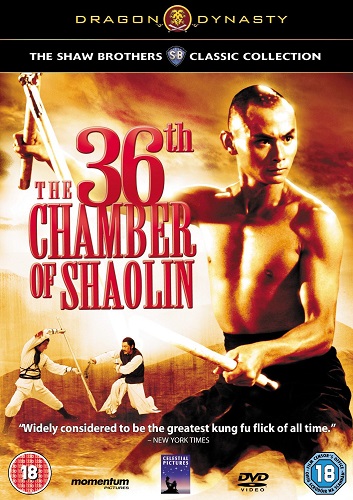
36th_shaolinThe 36th Chamber of Shaolin*, Chia-Liang Liu (1978, Hong Kong). Most movies are, of course, commercial endeavours. That’s why we have the concept of “box office”. The amount of money a film makes is taken as an indicator of its success – and, by foolish people, of its quality. And yet, commercially successful works can prove to be lasting art, even if not designed to be. Of course, there are directors – and this applies to all creatives – who can convince themselves their crass banal commercial output is real art, but their films usually go straight to DVD. Which is a long-winded way of saying that a Shaolin kung fu film is an unlikely entry to find on the 1001 Movies You Must See Before You Die list, given that it was likely banged out quickly to capitalise on a particular movie craze. (We are after all talking about a film produced by a company who made 1000 films between 1958 and 1997.) And yet, The 36th Chamber of Shaolin is not only considered a classic of the kung fu genre but, by virtue of being on the list, a classic of cinema – perhaps because it’s so exemplary of its genre. A young man decides to seek vengeance after his friends and family are killed by Manchu soldiers, so he enrolls in a Shaolin temple and works his way up the 35 levels of kung fu. I had expected this to be a bit dull – I’m not a fan of martial arts films – perhaps a bit like A Touch Of Zen; but it actually proved a lot of fun. Perhaps it’s the structure, the young man working his way up each of the 35 levels, often failing comically at first on each level. Worth seeing.

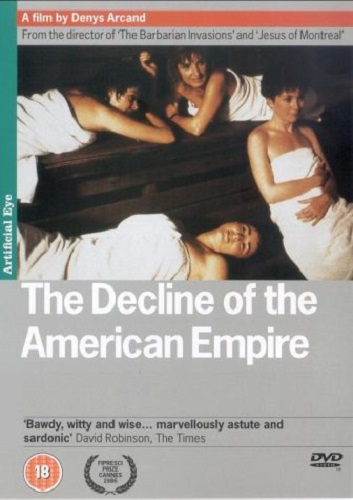
decline_americanThe Decline Of The American Empire*, Denys Arcand (1986, Canada). Four couples arrange a dinner party. The men make the food at one of the homes while the women visit the gym. They talk. You know when people joke that literary fiction is all about white middle class people and their disintegrating marriages? This is the cinematic equivalent. And it’s very dull. I’ve no idea why it’s on the 1001 Movies You Must See Before You Die list, it doesn’t do anything interesting or innovative, and while it has the odd moment of wit (and what film doesn’t? Um, best not answer that…) it offers no new insights – on a topic that is probably the most documented in Western literature and cinema, the white middle class marriage. Not worth seeing.

floating_weedsFloating Weeds*, Yasujiru Ozu (1959, Japan). The only other Ozu I’ve seen is Tokyo Story and that was back in 2009. I’m aware of his stature in Japanese cinema, but while I’ve watched a number of classic Japanese films I’ve not made any real effort to explore the country’s cinematic history. I know people who rate Ozu very highly, but on the strength of that previous film I wasn’t entirely sure why. Floating Weeds, on the other hand… It’s good; actually, it’s very good. It’s a little problematic – the central male character is violent towards women on several occasions, and it’s very unpleasant to watch. But the cinematography is wonderful to look at, and the relationships between the characters are handled with intelligence and nuance. Having said that, the pacing is somewhat on the leisurely side and the plot is perhaps overly stuffed. The film is set in 1958 at a seaside town. A travelling theatre troupe arrives, and it turns out the troupe’s star is the father of the young man who works in the post office and whose mother runs a local tea shop/bar. The lead actress of the troupe, who is in a relationship with the star, is afraid she’s losing him, so she pays another actress to seduce the son… Then it transpires the troupe is out of money and will have to disband, and certain relationships all start to implode quite messily. I think I might watch some more Ozu after seeing this one – and not just that one film of his on the 1001 Movies You Must See Before You Die list I’ve yet to see…
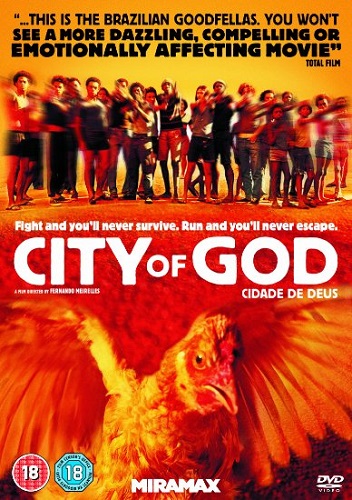
cityofgodCity of God*, Fernando Meireilles & Kátia Lund (2002, Brazil). A charity shop find. The film is set in the Rio de Janeiro favela of the title, and is apparently based on real events. The film’s narrator is on the edge of violence between rival drug dealers in City of God, and the movie is presented as a series of stories told by him about the various major players, and often jumps back and forth chronologically – in fact, the film opens with the scene which starts the final sequence of the plot. The bulk of the cast were apparently non-professionals, trained up by the directors, as they felt that would give the film a more authentic feel. And it does. I’m guessing the casual violence is also authentic – and it’s horrible and disturbing to watch, such as, for example when there are things like a young boy walking into a brothel and shooting everyone he sees. That young boy, named as “Little Dice” in the subtitles, grows up to be one of the two main drug dealers in the favela, and he only leaves his rival alone because his best friend, Benny, is friends with him. But when Benny is shot and killed, all-out war erupts. And it’s war with young men and boys as the fighters, using all manner of firearms. City of God is one of those films which makes you wonder why governments around the world insist on criminalising drugs. It’s almost as if they didn’t want to win the “War on Drugs”… The film span off a television series, City Of Men, which was itself adapted for cinema. The non-professional cast, incidentally, couldn’t return to their old lives in the favelas after filming, and so were given help to improve their situation. Which is about the only heart-warming thing about the whole film.

woman_dunesWoman of The Dunes*, Hiroshi Teshigahara (1964, Japan). Teshigahara is a director new to me, as is Kobo Abe, the author from whose novel this film was adapted (and it’s not the only Abe novel Teshigahara adapted). But on the strength of Woman of The Dunes I’ll definitely be trying more Teshigahara movies and perhaps even having a go at reading one of Abe’s novels. In this film, a high school teacher on holiday is indulging in his hobby, collecting and categorising seaside insects. He falls asleep in the sun and misses the last bus home, but some men from the nearby village offer him a bed for the night. This proves to be in a house in a pit in the sand dunes, a pit that can only be accessed by rope ladder. And the following morning, he learns he is to be kept a prisoner there with the house’s occupant, a young woman. The pair are, in effect, sacrifices to the sand. As long as they remain in the house in the pit, shovelling at the sand, it won’t engulf the village – and it’s implied there are other pits too. The teacher, of course, tries to escape, but none of his attempts succeed. Eventually he resigns himself to his situation, and the film ends with a shot of a missing persons report dated seven years later. Good film, definitely worth seeing.

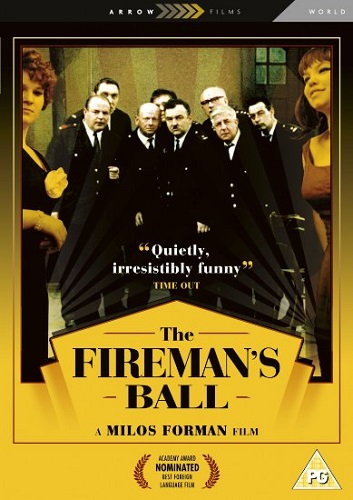
firemansballThe Fireman’s Ball*, Miloš Forman (1967, Czech Republic). Forman and screenwriters Ican Passer and Jarosalv Papoušek visited the town of Vrchlabí in order to work on the script of their new film, and while there attended a real fireman’s ball and were so amused by its piss-poor organisation that they decided to base a film on it. There’s a sort of black humour common to East and Central Europe – I’ve seen it mostly in Polish films, probably because I’ve seen more films of the region from that country – and The Fireman’s Ball is a beautifully-judged example. It’s not just the constant bickering and fatalism, but the way things always play out for the worse. The firemen have arranged a raffle for the ball, but as the film progresses the prizes go missing one by one. They arrange an impromptu beauty contest so the winner can present a gift to the retired chairman of the fire brigade, but the contestants all refuse to participate when called up onto the stage. An old man’s house bursts into flames, but all the firemen manage to rescue his some of his furniture. The film’s start was somewhat unprepossessing, so I wasn’t expecting much. But once the ball was in full swing, it definitely picked up and I really enjoyed it.

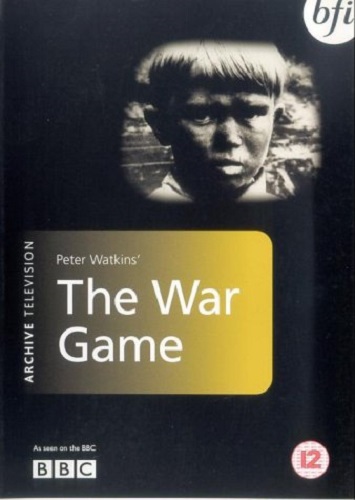
war_gameThe War Game*, Peter Watkins (1965, UK). From the perspective of twenty-five years later, the Cold War may seem like a weird period of global insanity, but it certainly felt very real at the time. US/USSR posturing inspired countless plots for books and films and television, and while the threat of World War III never seemed all that likely – the Soviets invaded Afghanistan, for example, and the West responded by, er, boycotting the Moscow Olympics – the consequences of nuclear armageddon were all too often publicised. In films such as The War Game, Threads and The Day After. The third of those is pretty terrible, a piece of meretricious and melodramatic US tosh, marketed on its supposed accuracy but more closely resembling a soap opera. Threads is especially effective, although its low budget does tell against it. And it might well be said the same is true of The War Game. Unlike the other two, The War Game is framed as a documentary describing life after a nuclear strike on the UK. And it’s very effective. So much so, in fact, that the BBC refused to broadcast despite commissioning it and it wasn’t shown on British television until 1985 – despite winning the Oscar for best documentary in 1966. After watching this, I decided to buy a copy, but the BFI one shown is deleted. So I ended up buying a collection of Watkins films released in France. So that should make for some cheerful viewing… Definitely worth seeing, nonetheless.

1001 Movies You Must See Before You Die count: 640


3 Comments

Moving pictures, #25

I should really get into the habit of reading a book in the evening. The TBR is shrinking far too slowly, and the DVD collection is growing far too quickly. And, sadly, not every film I’ve watched was worth the hour or two it took to sit through it. This is hardly a surprise, however. As some of the films described below might attest.

tabuTabu: A Story of the South Seas*, FW Murnau (1931, USA). I’m a big fan of Murnau’s Nosferatu, and I’ve been picking up copies of his other films – in the excellent Masters of Cinema series by eureka! – on DVD. Tabu: A Story of the South Seas was Murnau’s last film (he died a week before its opening) and, despite the year, it’s a silent film. The film apparently had a troubled gestation. Murnau joined forces with Robert J Flaherty, who had experience filming in Tahiti. Neithr could raise sufficient capital, so Murnau financed the bulk of the movie himself. In order to save money, Murnau trained locals as crew. He also rewrote the script, which caused problems with Flaherty – and their relationship subsequently worsened to the point where Flaherty no longer co-directed. The movie makes a point of its cast also being native to the region – an opening intertitle states that “only native-born South Sea islanders appear in this picture with a few half-castes and Chinese”, although the second half of the film is set at a French colony and features some French characters. A young woman of Bora Bora is is declared sacred to the gods, which somewhat upsets her boyfriend as she is now “tabu” (er, taboo). So they escape and settle at a nearby French colony. But, of course, the course of true love never runs smooth, not even in the South Seas. And so it proves here. There’s some remarkable photography, and I can only imagine its impact back in the 1930s when the nearest most movie-goers would get to Polynesia is a poster in a shipping office in their nearest port city. Worth seeing.

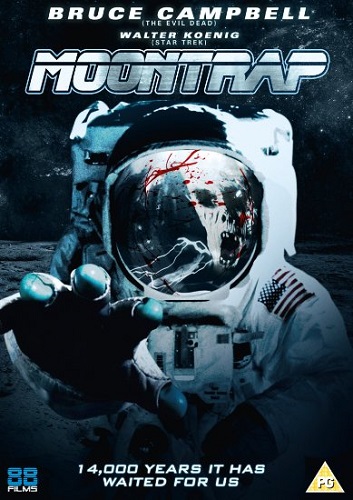
moontrapMoontrap, Robert Dyke (1989, USA). I have no idea why I put this on my rental list, but as soon as the film started and I saw it starred Walter Koenig, I knew I’d made a mistake. And Koenig’s hair looked almost real, so the film was a good deal older than I’d thought (that DVD cover makes it look a good deal more recent). There’s some nonsense about ancient astronauts, and one of their derelict spaceships drifts into Earth orbit, and a base on the Moon that was abandoned, as the DVD cover says, 14,000 years ago. But it all ends up as a really crap robot-type thing wreaking havoc in a secret base, and Koenig on the Moon – featuring scenes with model work more obvious even than Michael Bentine’s Potty Time – where he re-awakens a nubile ancient astronaut… leading to a later scene of lunar hanky-panky in an inflatable tent. This is a shit film, the sort of movie that its cast refuse to put on their cv’s, even Bruce Campbell who is a major cult actor. Except perhaps not the director, who probably still thinks it’s really good. He is very wrong.

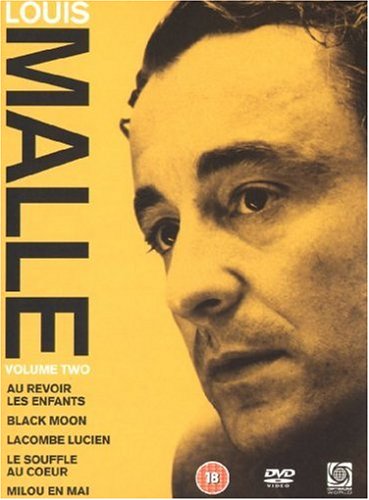
souffleLe souffle au cœur*, Louis Malle (1971, France). Malle is, I think, another one of those French directors, like Bresson, whose movies don’t really work for me. Others, such as Varda, Godard or Truffaut, I like some of their films but not others; and yet other French directors – Ozon, Rohmer, for example – I like pretty much everything of theirs I’ve seen. Anyway, Le souffle au cœur – better known among Anglophone film-watchers, perhaps, as Murmur of the Heart – is about a fifteen-year-old boy who, while at a sanatorium recovering from a bout of scarlet fever, has sex with his mother. The film is set during the 1950s, although there’s a very 1970s look and feel to it. The movie is apparently notable for its jazz score, but not being a jazz fan the thing that stood out for me was the juvenile objectification of women – which is, unfortunately, something all too common to commercial art of the 1970s and earlier. While the aforementioned fifteen-year-old is the film’s protagonist, and hence point-of-view, there’s no nuance to it – and, in fact, at the sanatorium a pair of teenage girls are presented as little more than targets to be conquered. Disappointing.

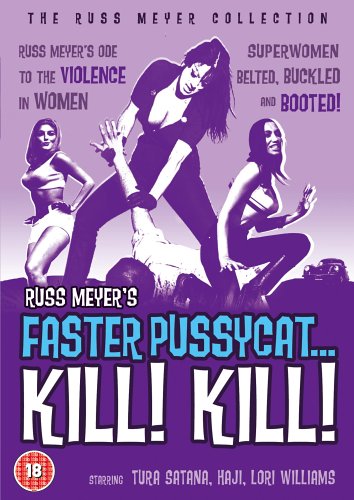
faster_pussycatFaster, Pussycat! Kill! Kill!*, Russ Meyer (1965, USA). Back in the 1980s, I remember staying at my aunt and uncle’s and watching Jonathan Ross’s The Incredibly Strange Film Show, an episode of which featured Russ Meyer. In the, er, decades since, I’ve seen Meyer’s Beyond the Valley of the Dolls, which was pretty crap; and I can’t honestly say I’d ever bother watching any of his other films, but Faster, Pussycat! Kill! Kill! is – bafflingly – on the 1001 Movies You Must See Before You Die list so I dutifully added it to my rental list. Much is made of the fact the film features three women as its protagonists, and they are indeed strong murderous women, especially the leader, the scenery-chewing Tura Satana. Three exotic dancers in fast cars head out into the Californian desert, challenge a young man to a race, beat him to death afterwards, then descend on a nearby farm whose owner apparently has lots of money hidden somewhere… where things start to go wrong. The film is shot in black and white, with a mostly unprofessional cast, and whatever energy it possesses is likely a result of financial constraints than artistic agenda. It’s mildly amusing… and somewhat scary that this film stands out because of its gender roles – because, to be honest, stuff like that should not be remarkable.

ninotchkaNinotchka*, Ernst Lubitsch (1939, USA). “Garbo laughs!” At least so the posters for this movie claimed; and there she is, laughing, on the DVD cover – as if she had never laughed in a film before ever. But I suppose a film about wealthy White Russian aristocrats versus dour Red Russians, even if the latter are mostly comedic, probably didn’t make for an appealing tagline in pre-WWII USA. I know this movie better as its 1957 musical remake starring Fred Astaire and Cyd Charisse, Silk Stockings, but other than the latter being filmed in colour, and featuring some singing and dancing, there’s not a fat lot of difference between the two. (Garbo’s Russian accent is, perhaps, a teensy-weensy bit less crap than Charisse’s.) Three Soviets head to Paris to sell off some jewellery for much-needed state cash, but the White Russian original owner of the baubles has other plans. When the title character is sent to learn what happened to the bumbling three, it gets all romantic and the icy Soviet envoy thaws. Meh.

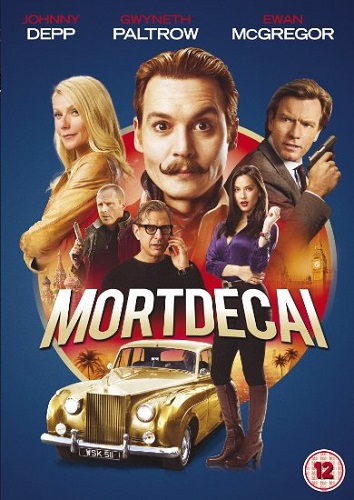
mortdecaiMortdecai, David Koepp (2015, UK). This is apparently based on a series of books by Kyril Bonfiglioli, originally published in the 1970s. I’m told the books are good. Sadly, the same can’t be said for the movie. You know when you watch something and even though it’s set in the present day (ie, the second decade of the twenty-first century) everything in its seems weirdly old-fashioned – like that Paddington film, for instance. And like this one. I suspect it would have felt old-fashioned if it had been made in the 1970s. Depp plays the title character, a louche art dealer who’s a little too fond of bending the law. One of his previous swindles comes back to bite him, and the plot of the film is basically him running around trying to run a con to save his own skin and his weird rockstar stately home. There are a couple of funny set-pieces, but Depp plays his role like Mortdecai is a grotesque and the whole 2015 mise en scène just doesn’t suit the story at all. You could try watching it pissed but I suspect it would be no better. In fact, it’s so meh I can’t even be arsed to try reading the books…

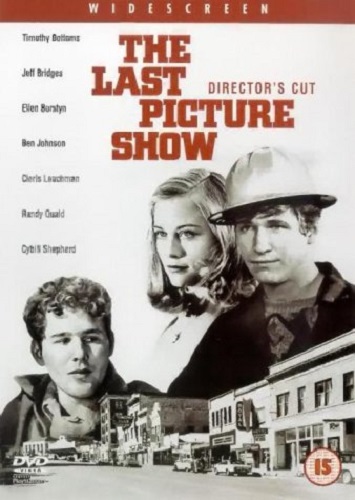
last_picture_showThe Last Picture Show*, Peter Bogdanovich (1971, USA). This is one of those films which launched a number of careers, not just director Bogdanovich’s, but also Cybill Shepherd and Jeff Bridges; and apparently had loads of Oscar nominations (but only two wins – for best supporting actress and best supporting actor). There must be something about the set-up which appeals to audiences but I can’t see it myself. Small US town, lives going nowhere, it’s been covered so many times in US films and books it’s gone beyond banal. I can’t even honestly day that Bogdanovich brings anything new to the cliché. There are a handful of small touches which work quite, most notably some of the character arcs, and the narrative flow through the film is smooth and builds well to the conclusion. I suppose there’s a point to be made in that I found this mostly dull but I love All That Heaven Allows, which is also set in small town USA during the 1950s. And both are, in their own way, tragedies. But Sirk’s film charts a downward trajectory, whereas Bogdanovich’s starts low and continues at that level before sinking even deeper. I also love Sirk’s Technicolor cinematography. The two films, to my mind, don’t really compare.

1001 Movies You Must See Before You Die count: 634


1 Comment

Moving pictures, #24

I’m now receiving five rental DVDs a week – so with that, cable television, my own (expanding) DVD/Blu-ray collection, and a Fire TV Stick, I’m making pretty good headway through the 1001 Movies You Must See Before You Die list. Not sure what happens when I finish it, however. Not sure I want to know. I don’t, of course, write about every film I’ve seen, chiefly because some of them are rubbish and not worth mentioning. Which doesn’t mean all of the films I do write about are good.

muriels_weddingMuriel’s Wedding*, PJ Hogan (1994, Australia). I can remember when everyone was talking about this film, but I never actually got to see it myself at that time. But now I have. And, well… it’s amusing, I suppose – although a corrupt small-town businessman and his feckless offspring are hardly the most edifying of subjects. Toni Collette is good in the title role, but I could never work out if she was supposed to be stupid or malicious. Both, I suspect. In many respects, the film reminded me of an ABC television series from the 1990s, SeaChange, which I really liked (it’s never been broadcast in the UK, I saw it on Dubai’s Channel 33). It too was set in a small seaside town and featured a casst of Australian working-class grotesques. Co-star Rachel Griffiths also reminded me a lot of Juliette Lewis, particularly from Natural Born Killers, which I’d watched a couple of weeks ago – it made for an odd viewing experiencing. An entertaining comedy, but I’m not sure it belongs on the 1001 Movies You Must See Before You Die list. But I am glad I finally got to see it.

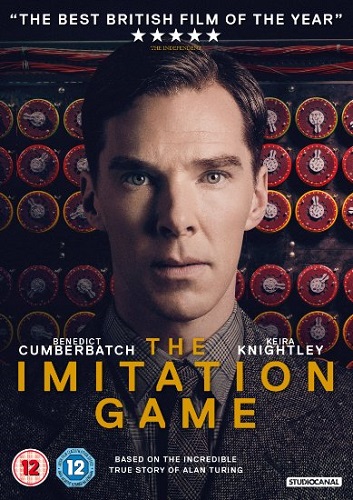
imitation_gameThe Imitation Game, Morten Tyldum (2014, USA). Alan Turing’s contribution to computer science and code-breaking during World War II is pretty well-known. His contribution to wartime espionage, however, isn’t. Which is probably because he made zero contribution to wartime espionage. Which is not what this awful film would have you believe. Remember U-571? A glossy Hollywood WWII movie about the quest to capture a German Enigma machine and code books so that allies could decipher enemy communications? Remember how U-571 claimed the first Enigma machine was captured by the hardy crew of a US submarine… and so pissed off an entire nation because it was British sailors who’d captured the first Enigma machine before the USA even entered the war. The Imitation Game, despite its British setting and British cast, is a US film. And plays the same stupid games with historical fact. According to The Imitation Game, Turing not only single-handedly cracked the Enigma code but also managed to unmask the Soviet spy at Bletchley Park. It’s all nonsense, of course, and the Wikipedia post on the film has a sizeable section on the accuracy (well, lack thereof) of the movie. As for Benidorm Cucumbersandwich, he’s a bit one-note, isn’t he; and it’s getting a trifle monotonous. A film best avoided.

the_signalThe Signal, William Eubank (2014, USA). I love how science fiction is open to enigmatic stories, and I love how cinema as a medium is also suited to such stories… I mean, most of Sokurov’s films are bafflingly opaque, but I still love them. And in written science fiction, I prefer genre as far away from pulpish action/adventure as it can get. You’d think The Signal would be right up my alley, in my bailiwick, etc, etc. So it’s a shame I found The Signal so dull. I certainly believe it’s possible to put an interesting spin on familiar tropes, and this film tries desperately hard to do that. But it never quite comes off. Three MIT students track a hacker to a remote location, where they experience a close encounter. They’re then captured and held in a secret underground research facility, but manage to escape. Only to learn things are not what they thought they were. I suppose those three MIT students are the first turn-off – stories which rely on exceptional protagonists are never going to appeal to me because I am no longer a teenager. But there are some nice ideas in The Signal, it’s just that they’re married to a plot that’s far too… Hollywood, and that works against it. Disappointing.

idiotsThe Idiots, Lars von Trier (1998, Denmark). The more films by von Trier I watch, the more of a fan I’m becoming. I like the fact he pushes hard against what cinema is, he uses it to tell stories that most would either shy away from (perhaps for good reason) or for which cinema would not seem a suitable medium. I think The Idiots falls into the former category, because it’s a pretty tasteless plot. A group of relatively well-off adults spend their time acting as if they are mentally disabled in public. They’re not doing it to prove a point, or to make clear a social injustice. Their motives are mostly selfish, and their behaviour mostly designed to be offensive and shocking. The film has, understandably, proven controversial. I think it – accidentally – makes a few valid points, though I suspect von Trier was inspired more by shock value than social policy. Having said that, a lot has changed since 1998 in regard to care, and there are films like Elling which present an entirely different picture. Von Trier is building up an enviable oeuvre, and I suspect he will be one of a handful of present-day directors still to appear on critics’ lists of best films fifty years from now.

mother_indiaMother India*, Mehboob Khan, (1952, India). There’s melodrama and then there’s meloDRAMA. This definitely falls into the latter category. The title makes it clear that the central role – Radha, played by Nargis – is a stand-in for the nation itself, although apparently the title was also chosen as a direct rebuttal to Ketherine Mayo’s 1927 anti-Indian polemic, also titled Mother India. When Radha marries, her mother borrows money from the local moneylender, who takes advantage of her illiteracy by taking three-quarters of their crop each year as interest – so they can never pay it back (just like those payday loan companies who advertise on television then). This effectively consigns Radha and her new husband to poverty, a situation which only worsens when he loses both his arms after a heavy boulder crushes them. And then her houses burns to the ground. And her eldest son grows up to be a total prat and joins a group of bandits. It’s like a soap opera but with everything dialled up to eleven. Highly entertaining, it has to be said; but it’s not Ritwik Ghatak or Satyajit Ray, and it’s not as fun and fluffy as Dilwale Dulhania Le Jayenge (all of which I recommend).

iamafugitiveI am a Fugitive from a Chain Gang*, Mervyn LeRoy (1932, USA). I honestly couldn’t work out if this was a satire of capitalism and the American Dream, or an attempt to show both in a positive and aspirational light. A young man returns to the US after WWI but is dissatisfied with his return to his pre-war job, dreaming of success in engineering. So he leaves and travels the country, taking up unskilled labour jobs to pay his way. Until, that is, he is inadvertently caught up in a bank robbery, arrested and sentenced to ten years on a chain gang. But he manages to escape after a couple of years, makes his way to Chicago, when he begins working in construction and subsequently works his way up to running his own highly successful business. But then his past is revealed, and hs lawyer suggests he owns up to his criminal past and hope that his present position as a pillar of the community will persuade them to reduce his sentence to time served. But they don’t. And he ends up back on the chain gang. For a 1932 film, this was surprisingly modern. Black and white, yes; and the staging was very much of its time, not that far advanced from silent movie days; but the message (a dirty word, I know) of the film very much resonates with the present day. A good film, and it probably does deserve to be on the 1001 Movies You Must See Before You Die list.

angel_faceAngel Face, Otto Preminger (1952, USA). I have yet to work out if Preminger was primarily a director-for-hire or an auteur since his oeuvre is pretty varied. He made some classic noir films, including Angel Face, but also movies like Carmen Jones and Bonjour Tristesse and The Cardinal. I’ll admit I’ve liked most of his films I’ve seen so far, even the slightly odd ones like Bunny Lake Is Missing or Rosebud, but I still think of him primarily as a director of noir films. In this one, Robert Mitchum, who never seems quite like he fits in, plays an ambulance driver who responds to a gas poisoning at a wealthy writer’s mansion, later ends up in a relationship with the writer’s daughter (Jean Simmons), is employed as her chauffeur… but she murders her parents, he tries to get out of the relationship and it all goes a bit pear-shaped. Throughout the film, Mitchum looks like a man out of his comfort zone, and while that might suit some roles it doesn’t quite apply here. Simmons is good, completely bonkers and totally plausible with it. The problems inherent in the affluent Hollywood set versus working-class probably needed to be highlighted, especially when you consider most noir films involve working class characters. Angel Face had its moments, but it’s neither Preminger’s best nor his best noir film. Still worth seeing, though.

1001 Movies You Must See Before You Die count: 629


2 Comments

Moving pictures, #23

Still trying to get up to date on these…

femmeUne femme mariée, Jean-Luc Godard (1964, France). I have a theory about Godard. So far I’ve seen about half a dozen of his films. Two of them I loved, the rest I didn’t much care for. The two I loved were both shot in colour – Le Mépris and Two or Three Things I Know About Her – the rest were black and white. So it seems I only like Godard’s colour films. Obviously I need to watch more to determine the truth of this theory, but Une femme mariée is black and white and I didn’t really like it. The married woman of the title is having an affair, and the film opens with her and her lover in bed. Then she leaves him, fetches her young son from school and meets her husband at the airport. He has a colleague with him. They head to the couple’s apartment, where they eat dinner. The colleague leaves, husband and wife then run around a lot and come close to domestic violence (it didn’t much look like a “play-fight”, as Wikipedia has it). And then… This is one of those films where the cast act naturally and it’s all about the dialogue. And like many Godard films, it’s all over the place, and the plot often seems like little more than a vehicle which allows the cast to pontificate on various topics that seem to have little or no bearing on the actual story (which is, I suppose, just as true of Two or Three Things I Know About Her, but in that film everything around the “lecturettes” worked much better and seemed much more interesting). Une femme mariée seems to be generally rated as one of Godard’s best, but I wonder how much of that is trading on its title character.

42ndstreet42nd Street*, Lloyd Bacon (1933, USA). I found this in a charity shop. It’s one of several Busby Berkeley films on the 1001 Movies list, many of which aren’t that easy to find in the UK. Busby Berkeley… a camera placed above the stage and looking down as large numbers of dancers make patterns not unlike those you’d find in a kaleidoscope. Then they wrap a plot around it. In this case, it’s a progenitor of Chorus Line and films of that ilk. I tweeted a line from this, “It’s going to be the toughest five weeks you’ll live through”, and asked people to guess the movie, expecting them to pick Platoon or Full Metal Jacket – which one or two did. No one guessed a 1930s film about putting on a Busby Berkley musical. Which is all beside the point. Ginger Rogers in an early role plays one of the female leads, the plot is fairly standard for the type, the final numbers are the usual over-the-top Busby Berkeley extravaganzas, and it’s easy to see why such films were popular back in the day… and you have to wonder why something similar isn’t equally successful today. Or perhaps that’s just me.

coherenceCoherence, James Ward Byrkit (2013, USA). Some films should hold your interest because they have an intriguing genesis, or a really fascinating idea at their core. And certainly the elevator pitch for Coherence sounded to me like something which would appeal. Unfortunately the end result never quite manages to pull it all together. It’s one of those films where the low or non-existent budget becomes a strength rather than a weakness – it was filmed mostly in the director’s own house. There’s a dinner party, and during it a comet passes over and things turn strange… Strange as in superposition, multiple instances of the same events – which means dinner guests from other alternate universe versions of the dinner party getting mixed up and crossing into alternate universes. So much so that keeping up with who is really who, and from where, becomes near impossible. The cast are generally good, but it’s one of those films where everyone talks over one another, and while real life is certainly like that it does get annoying very quickly in a movie (which is by definition artificial, and it’s the ones which make a virtue of it I tend to prefer), and anyway it sort of worked against what was quite a clever central conceit. The premise demanded a domestic story, but the idea needed to be progressed much faster than it was – the longer you take to develop an idea, the thinner it seems, whether it deserves it or not. Coherence managed to dissipate its drama when it really had more than enough to make a very good film.

broken_blossomsBroken Blossoms*, DW Griffth (1919, USA). This film is also known as The Yellow Man and the Girl, which probably tells you all you need to know about it. Some of Griffith’s other films have been accused of racism, and while Broken Blossoms‘ lead is played by a white man in Chinese make-up, the film was deliberately written to push tolerance during a period of heavy anti-Chinese prejudice. A Buddhist monk leaves China for London, where he finds it hard to promote Buddha’s peaceful philosophy to London’s huddled masses. Especially Lillian Gish, the abused daughter of a boxer. The monk rescue her after she’s been badly beaten by her father, and the two fall in love. But it is not to be. It’s pretty much Romeo and Juliet, even down to the ending, but set among the slums of London, and with Romeo as a Buddhist monk (which, I suppose, in the England of the time makes him no more welcome a suitor than a Montague to a Capulet). Griffith has a number of films on the 1001 Movies list, and while he was undoubtedly a pioneer of the medium, I can’t see what this particular film did to merit inclusion. Maybe it’s just because it’s an historical document…

dark_planetDark Planet, Fyodor Bondarchuk (2009, Russia). The real name of this film is Обитаемый остров, or The Inhabited Island – which is the name of the Strugatskys novel from which it was adapted. Why a random English-language distributor decided to randomly re-title it with the entirely random title Dark Planet is beyond me (mind you, we did better than the French, as it was titled Battlestar Rebellion in France). Because it deserves better. Which is not to say it’s perfect. Bondarchuk – yes, son of the actor – has made plenty of well-received films – I thought his 9th Company wasn’t bad, for example – and while Dark Planet certainly entertains throughout its length, it does feel a little like too much of it ended up on the cutting-room floor, and it’s more notable for the story it could have been, and which is plainly obvious, than for the story it is. A young man of Earth, played by the improbably good-looking (and, according to Bondarchuk, totally untalented) Vasiliy Stepanov, crashlands on a world on which the entire population are held in thrall by towers which broadcast brainwashing signals. You can see how it would have made sense in the novel, although it doesn’t really in the film. The plot is a little haphazard, but the final battle scene is done quite well. It’s a film that feels more like a series of missed opportunities than a coherent narrative – I’m reminded of The Crimson Rivers (Les Rivières Pourpres), in which the film-makers decided to leave some important exposition on the cutting-room floor because it slowed the pace of the narrative… resulting in a film that made a weird and inexplicable leap in its third act. Anyway, Dark Planet: worth a second look, though I’d prefer an edition more in keeping with the film-makers’ intentions than the one I watched. (After I wrote the above, I discovered the original Russian release consists of two parts of 100 minutes and 115 minutes. This UK release is an edited down version of 118 minutes. Why?)

leni_riefenstahlOlympia 1, Fest der Völker*, Leni Riefenstahl (1938, Germany). Riefenstahl, tame director of the Nazis, is a name I certainly know, but I’d never had any real desire to watch her movies. But she’s on the 1001 Movies list, more than once in fact, and her films are not available for rental, so I ended up buying a box set which included the two Olympia films, Triumph of the Will and a pair of other propaganda pieces. So I’m probably now on a list somewhere. Anyway, I watched Triumph of the Will several weeks ago but didn’t think it worth mentioning it here because, well, it’s a film about Nazis and Hitler and while it may have been state of the art in the 1930s, and still holds up reasonably well today, it’s probably only of real interest to historians. Olympia 1, Fest der Völker, however, is a more interesting film because it actually presages the way we watch sports on television, if not lays the actual groundwork for sports broadcasting. It is, as the title states, a film of the 1936 Olympics. So there’s lots of people in quaintly-long shorts competing in various athletic events, with occasional shots away to the wholesome German crowd or Hitler. Of all the events, I found the high jump the most interesting because it predates the Fosbury Flop, meaning the techniques on diplay looked odd and mostly inefficient. There is a second part, Fest der Schönheit, which I have yet to watch.

whosafraidWho’s Afraid Of Virginia Woolf?*, Mike Nichols (1966, USA). I’d always thought I’d seen this, and had it in my head it was some fluffy rom com much like those Rock Hudson films I love so much. It’s not, of course. It’s a very intense, and really quite mean, three-hour play by Edward Albee cut down to a two-hour cinema outing by Mke Nichols – his first film, in fact. Elizabeth Taylor and Richard Burton play a married couple at a small town college. She’s the dean’s daughter, he’s a professor of history whose boat has long since sailed. And now they just snipe at each other. A young couple join the faculty (George Segal and Sandy Dennis) and are invited to dinner by Taylor and Burton. They all get very pissed. Certain truths are aired. There is a lot of very uncomfortable dialogue. And… ho hum. There’s some good stuff in here, some really sharp dialogue – but I’m not convinced Taylor and Burton overcome their Hollywood profiles sufficiently to do the characters justice. Segal is pretty good, though. The film is also long – and it’s shorter than the play. It drags quite a bit in places. Having said that, watching Who’s Afraid Of Virginia Woolf? didn’t make me interested in Albee’s work, although this appears to be the only play of his that made it onto the silver screen.

1001 Movies You Must See Before You Die count: 625