It Doesn't Have To Be Right…

… it just has to sound plausible


1 Comment

Top five science fiction films

I saw someone recently tweet for requests for people’s top five science fiction films and I thought, I can do that. Then it occurred to me I’ve watched around 3000 movies in the past few years, and many of them were science fiction. So those films I think of as my favourites… well, surely I’d seen something that might lead to a new top five? Even if nothing sprung immediately to mind… True, I’m not that big a fan of science fiction cinema, and most of my favourite movies are dramas. And most of the sf films I have seen were commercial tentpole US movies, a genre I like even less…

I went back over my records, and pulled together a rough list of about fifteen films – it seems most of the sf films I’ve seen didn’t impress me very much – and then whittled that down to five. And they were pretty much old favourites. Which sort of rendered the whole exercise a bit pointless.

Or was it?
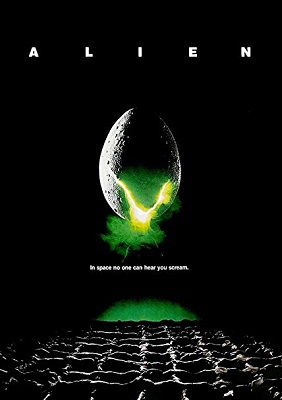
Top of my list is Alien, directed by Ridley Scott and released in 1979. Although distributed by 20th Century Fox, I’ve always counted it as a British film, as it was an entirely UK-based production, and in fact used many of the UK-based talent that had been working on Alejandro Jodorowsky’s aborted Dune movie. I’ve always loved Alien, pretty much since its theatrical release. Which is a bit weird as it was given an X-certificate, and I would have just turned thirteen when it was released. But I read the novelisation by Alan Dean Foster; I had the collectable magazines and books, even Giger’s Alien (published by Big O according to my copy, but by Morpheus International according to the internet). I fell in love with the world of Alien, with the grimy lived-in appearance of the Nostromo, with the weirdness of the boomerang spaceship, with the look of the alien creature itself. Which doubtless explains why I’ve never really rated any of the sequels. Alien did it first, Alien kept it simple, Alien did it best. The less said about the prequels, the better…

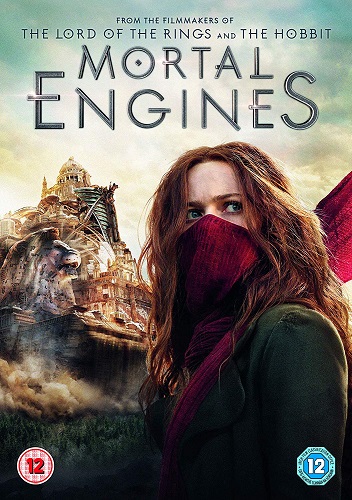
But if we’re talking science fiction cinema worldbuilding, there are plenty of other movies which might qualify. I love the production design of David Lynch’s Dune: the uniforms, the spaceships, the sets… It’s just a shame Lynch’s vision was so badly mangled by the studio, and that Lynch himself made quite a few questionable choices when adapting the novel. Other prime examples include Metropolis, Forbidden Planet, Blade Runner, Starship Troopers, Brazil, The Fifth Element, the various Star Trek films, the Star Wars movies… Or perhaps something more recent, such as Mortal Engines, anything from the MCU, Jupiter Ascending, Prospect, Science Fiction Volume 1: The Osiris Child, The Lure… Except the only film out of that lot I especially rate is The Lure, and I’d classify it as horror rather than science fiction. (Oh, Metropolis is good too, of course.)

Of course, those are films that required new worlds built out of whole cloth – there’s even a book about it: Building Sci-Fi Moviescapes (my copy, of course, is in storage). There are those that made do with the real world, making clever, or innovative use, of existing buildings and landscape. Examples include Alphaville, Crimes of the Future, Rollerball, even Interstellar (mostly). One of the most imaginative uses of location for a sf film I’ve seen is Footprints on the Moon, which manages to create a plausible invented country out of a pair of Turkish seaside resorts. Sadly, though I like the film a great deal, it’s not quite good enough to make my top five.

A film which also creates a new world out of clever location shooting makes the second slot on my list: François Truffaut’s Fahrenheit 451. I’m not a fan of the book, but I’m a big fan of Brutalist architecture and there’s plenty of that in the Fahrenheit 451 film. Plus a monorail. And Montag’s A-frame house in its leafy suburb with the silver birches and G-Plan furniture. It doesn’t look in the slightest bit futuristic – especially not now – but I love the film’s look and feel. (Except maybe the fire engine; not so keen on that.) But it’s not just the visuals, you also have Julie Christie playing two roles, the story’s focus on censorship (not television), the fact it ditched the stupid robot dog from the book, and Truffaut’s elegiac ending.

Science fiction films are not all set in the future or invented worlds. Some are set at the time the film was made. Girls Lost, set in early twenty-first century Sweden, might well have made my top five, but its central premise is just too fantastical. And Thelma, set in early twenty-first century Norway… well, telekinetic powers are a science fiction staple. At least they are in written science fiction. They’re more of a horror trope in cinema, and Thelma would also have made my list but it’s clearly a horror film.

An older film, one which depicts a 1980s Sweden, albeit far from any centre of civilisation, is Andrei Tarkovsky’s Offret, AKA The Sacrifice. Like Girls Lost and Thelma, its genre credentials are somewhat wobbly, but the fact it’s about a nuclear apocalypse, a very real concern during the Cold War and one much used by science fiction, pretty much since the genre’s early twentieth century origins, just about clinches it as science fiction for me. Okay, so Erland Josephson makes a deal with a higher power to put everything back and that’s hardly science-fictional, but never mind. Watching Offret is a harrowing experience, and science fiction cinema rarely manages that.

Most people, if they had to pick a Tarkovsky movie – and why wouldn’t they pick one? – would probably plump for either Solaris or Stalker. But the latter’s urban wasteland setting might suit its story but can hardly be called worldbuilding. And I’ve seen too many Soviet bloc sf films from the 1960s and 1970s to find anything special in Solaris‘s production design. They’re both great sf films, but I much prefer the look and feel of Herrmann Zschoche’s Eolomea to Solaris, although the latter is the better movie.

It’s not just actual Soviet and East German films, however. There are also the US ones from the 1960s which New World Pictures cobbled together from Soviet special effects footage, the best of which is Curtis Harrington’s Queen of Blood (containing footage from Небо зовет).

Offret takes slot number three.

When I wrote about building whole new worlds for science fiction movies, I very carefully didn’t mention one particular film, which takes place on another planet ruled by an entirely invented civilisation… but is actually a very old genre property. 2012’s John Carter. My number four choice. It did badly at the box office and its cast is hardly top-drawer. But it’s a gorgeous-looking piece of cinema, and its script makes some very adventurous decisions about its story-telling which, to my mind, totally paid off (longeurs notwithstanding). I’m not a fan of the books – they’re very much historical documents, and the tropes they introduced have been so extensively used and reworked in the decades since it would be impossible to make them fresh. But the basic story possesses a primal appeal, and although John Carter does complicate its plot with its nested endings, I think it gives the film a contemporary narrative sensibility. John Carter is a seriously under-rated movie, and it’s a pity corporate politics pretty much killed it.

That’s four movies, and the final slot was, as is usually the case, the hardest to fill. I could think of a number of films which almost made the grade. There’s Dredd from 2012, a bona fide, and ultra-violent, science fiction art-house movie, but it’s too thin on plot. Or Cargo, a Schweitzer-Deutsch film from 2009, which is a bit of a hodge-podge of genre tropes, some of which border on cliché, but looks pretty good and is about as science-fictional as you can get. Going a bit further back, there’s Peter Watkins’s Privilege from 1967, which is a clever, and quite funny, dystopian satire. Or Jonathan Glazer’s Under the Skin, in which an alien in the person of Scarlet Johansson drives around Glasgow in 2013 picking up men to provide meat for her home world.

However… I decided to go for a completely left-field choice for movie number five: The Untamed, a Mexican film directed by Amat Escalante, released in 2016. It’s a good example of a type of cinema I especially like, slow cinema. It is enigmatic. It has a documentary feel. And yet you have no idea where it’s going for pretty much its entire length. It also shows that science fiction can be used to illuminate the lives of people in the real world, it doesn’t always need fancy worldbuilding, expensive CGI or imaginative location shooting. Sometimes it just needs the introduction of something strange into the mundane.

So that’s my top five science fiction films. As of 2019. Ask me again in a year or two and it will probably be different.

I’ve no doubt missed out a huge number of eligible movies: I  either because I’ve not watched them, don’t think they’re any good, or just simply didn’t remember (despite trawling back through my film-watching records). I’ve also not mentioned any anime films, although many of them might well qualify. I’ve watched some excellent ones – anything by Makoto Shinkai, for example; or the Neon Evangelion movies – but I don’t love anime as much as I do live-action, and besides they probably deserve a list of their own. Another day, perhaps.
2 Comments

Moving pictures 2019, #12

More Amazon Prime viewing. The Blu-rays I brought with me are still in their shrinkwrap, sitting on a shelf across the room and mocking me. Currently, my viewing comprises assorted series from Swedish TV, such as Midsomer Murders (it’s worse than I thought), Antiques Road Trip, Murder She Wrote (known here as Mord och inga visor, Murder without evidence) and NCIS: New Orleans (which is even less believable than all the other NCIS franchises put together). On Amazon Prime, I’ve been watching Andromeda, which is a bit like a TV adaptation of a campaign for a space opera role-playing game played by fourteen-year-olds…

Fortunately, I’ve managed to find some halfway decent – and some quite excellent – movies to watch to keep me sane. And, of course, I’ve been reading books… although I’ve no idea why I decided to reread the Wheel of Time just because I have the whole series on my Kindle (courtesy of Worldcon75) and The Eye of the World is so bad it’s doing my head in…

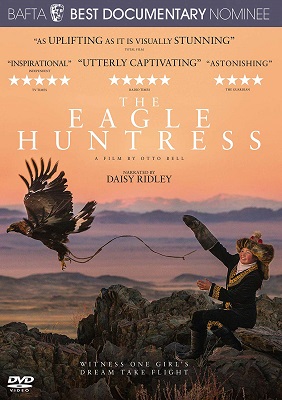
The Eagle Huntress, Otto Bell (2016, Kazakhstan). The Mongolian nomads in the Altai Mountains use eagles to hunt, particularly foxes, as hunting eagles is now considered more of a traditional sport than a survival skill. Aisholpan is thirteen years old, and she wants to be an eagle hunter. But it has always been the preserve of men. Her father is happy to train her because he thinks she has a real gift for it. Together, they capture an eaglet, which she then trains to hunt with her. She enters the annual eagle hunting competition at Ulgii… and wins. But her critics refuse to consider her a real hunter until she has caught a fox in the mountains. Which she then does. It’s a well-travelled narrative – girl wants to follow traditionally male occupation, demonstrates gender barrier is entirely arbitrary, and even excels at it… But it’s a story that bears telling over and over again. Because some men just do not get it. Women can do everything men can do. And when any man says that some thing is not for women, whether it’s hunting with eagles or programming computers or flying jet fighters, then that’s nothing more than sexism. The fact Aisholpan wins the eagle hunting competition – and okay, the judges might have cut her some slack on some of the events because of her age and gender, but her eagle actually broke competition records in other events – only demonstrates that any gender bar to the sport is complete nonsense. Anyway, The Eagle Huntress is beautifully shot, does an excellent job of presenting the people it documents, and tells a heart-warming story that should be better known. Recommended.

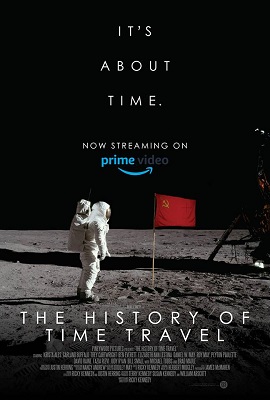
The History of Time Travel, Ricky Kennedy (2014, USA). It seems like an obvious conceit, and the most obvious example of it is the Back to the Future movies, but I don’t think time travel has been given the mockumentary treatment before, particularly time travel that keeps on changing its own history. The History of Time Travel opens with a factual account of the discovery of time travel – it only works to the past, not to the future – by a scientist and a wound-down WWII research project sometime during the 1960s. But the invention proves of little use. There’s some discussion of the Grandfather Paradox, and the ethics of interfering in the past… exemplified by the inventor travelling back in time to save his mother from dying when she gave birth to him… And the mockumentary then continues on from a point where two brothers invented time travel in the 1980s… and one of the went back in time to prevent their mother from dying in a car crash… And with each attempt to change the past, a new present is formed, their effects mostly confined to those associated with the inventors but occasionally spreading out further – leading in one timeline to the event depicted on the poster. And even to a time war between the US and USSR. The History of Time Travel is a shoestring affair, but they’ve taken care over making sure the script is consistent and logical, and that does them credit. Some of the “archive footage” is effectively done, even if the acting isn’t brilliant, and the continual rewriting of history as one or the other or both of the brothers goes back in time to save their mother or father actually works quite well. To be honest, I’d sooner see films like The History of Time Travel – made on the cheap, by people who were clearly invested in it and in science fiction – on the Hugo Award shortlist than some multi-zillion dollar semi-fascist Hollywood MCU tripe. But then the Hugo Award’s dramatic presentation categories have always been both a complete waste of time and a trash fire.

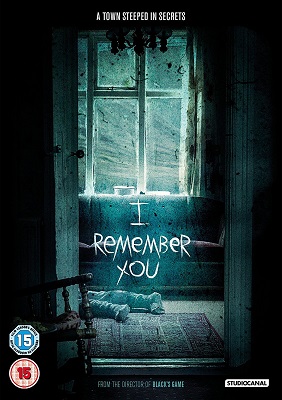
I Remember You, Óskar Thór Axelsson (2017, Iceland). This opens like a fairly typical Nordic noir, with a body found in a church, hanged, with crosses carved into her back. The policewoman investigating the case links it to the disappearance of a boy decades earlier. She finds a photo showing him with eight of his classmates, six of whom have since died in mysterious accidents. And all with crosses carved into their backs. The policewoman is being helped a by a doctor, whose own young son disappeared a few years earlier during a game of hide and seek with friends. Meanwhile, a man and two women – one is his pregnant wife, but he’s having an affair with the other – are trying to turn an abandoned building in an abandoned whaling station on a small island into a B&B. Half of the films made on planet Earth… well, if they’re not about sons having father issues, they’re about fathers trying to deal with the loss – permanent or temporary – of their sons. And 99.9999% of the time it’s supremely uninteresting. I Remember You, however, actually folds the disappearance of the doctor’s son into its plot, it’s not just “motivation” or back-story. Because solving the disappearance from decades before eventually leads to the doctor learning what happened to his son. Despite all that, I Remember You is not straight-up Nordic noir, as many of those involved in the story at intervals, and not entirely clearly, see the first missing boy. The supernatural aspect adds to the noir, making the story even more tense and leaving some things unexplained. I Remember You took a while to get started, but it was definitely worth the wait. Recommended.

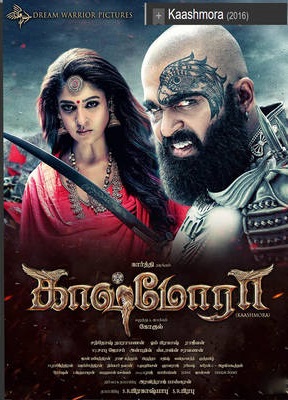
Kaashmora, Gokul (2016, India). This is not a Bollywood film, but a Tamil-language movie, so Kollywood. I’ve definitely seen Tollywood films (both Bengali and Telugu-language), but I don’t think I’ve seen any Kollywood films before. Anyway, Kaashmora is from Chennai and Wikipedia describes it as a “supernatural action comedy”, which isn’t far off the mark. The title refers to a TV celebrity ghost-hunter, who is actually a complete fake. A young woman wants to study him for her doctoral thesis. The two of them, plus a handful of relatives, all of whom, it transpires, were born under the same star sign, end up in a haunted palace – where centuries before a princess ran away with her lover, a prince of a rival kingdom, but was brought back by the king’s war hero general… who then murders the king, seizes the throne and takes the princess as his wife. But she kills him, but is killed by him. The two of them, plus twelve henchmen, have been haunting the palace ever since. And now Kaashamora, the doctoral student and assorted relatives, all born under the sing, are present ad the general can use them to lift the curse. Kaashmora starts out as a comedy, but the flashback explaining the back-story is a complete CGI action fest, and when all the principals are in the haunted palace, there’s CGI flying around all over the place, and it’s all quite gruesome but also very funny. Perhaps the film is over-long, but then Indian films do run longer than Western ones. I enjoyed it. Worth seeing.

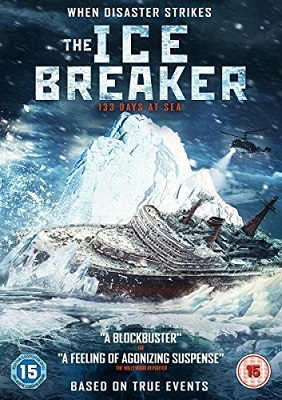
Icebreaker, Nikolay Khomeriki (2017, Russia). Yes, I know, the DVD cover says The Icebreaker, but I’m pretty sure the credits of the version I watched simply called it Icebreaker. But then Russian doesn’t have articles anyway, so it doesn’t make any difference. The film is set in the 1980s, during the last years of the USSR. A Soviet icebreaker in the Antarctic (although I’m pretty sure at least one subtitle mistakenly referred to it as the Arctic) finds itself trapped after a close encounter with a huge iceberg. The captain is demoted, and a replacement sent out by helicopter. But the helicopter breaks down on landing, so now they’re all completely trapped. And the fuel is running out. The Soviet authorities promise a rescue mission, but they’re dragging their feet because someone in the ministry delayed the ship’s departure and that’s what ultimately created the current situation. You wouldn’t think there’d be all that much drama there – and certainly very little action – but Icebreaker manages to find plenty. I’ve no idea where they filmed it, but it looked very convincing. And it has a happy end, which actually comes as something of a surprise. The Russians have been churning out well-made commercial blockbusters for a number of years now – although, to be fair, even some of the older Soviet big budget commercial movies were worth seeing – and it’s a shame their distribution is so patchy outside the Russo-speaking world. But for Amazon Prime, I’d never have seen Icebreaker, or a number of other films like it, and even then I stumbled across it more by accident than by design. Worth seeing.

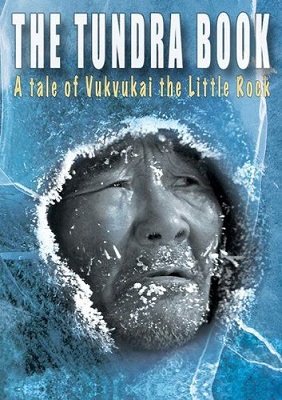
The Tundra Book, Aleksei Vakhrushev (2011, Russia). I’m not sure why I ended up watching two documentaries set in areas that were once part of the former Soviet Union. It just sort of worked out that way. Unlike The Eagle Huntress, however, The Tundra Book is set on the Chukchi Peninsula, in the far east of Russia and still part of the country. It’s a desolate place, and the most sparsely-inhabited region of Russia. The Tundra Book is about Vukvukai, a native of the region, who is in his seventies and leads an extended family that manages a herd of some fifteen thousand reindeer. And, er, that’s what the film is about. The cinematography is impressive, but the story isn’t very dramatic. Interesting, yes, but not dramatic. It’s a fascinating look at a way of life that’s about as far from my own as it is possible to imagine, but at 105 minutes it’s perhaps a longer than the subject matter needed. But still good.

1001 Movies You Must See Before You Die count: 939

ETA: I have it on good (Swedish) authority than “Murder without evidence” is a mis-translation of Mord och inga visor, which literally means “murder and no songs”, and is actually a pun on a Swedish expression ord och inga visor, “words and no songs”, which means “a harsh criticism”. Tack, Johan.


2 Comments

Moving pictures 2019, #11

This is the first post of films watched after my move to Sweden. I brought my Blu-ray player and my Amazon FireStick with me, but unfortunately the television in the hotel apartment I’m renting has no HDMI slot, so I can’t use them. I’ve been watching films on Amazon Prime on my laptop. Which has somewhat limited my ability to write blog posts or, well, fiction. Both of which I planned to do more often when I got here. Ah well. Perhaps when I find somewhere more permanent to live…

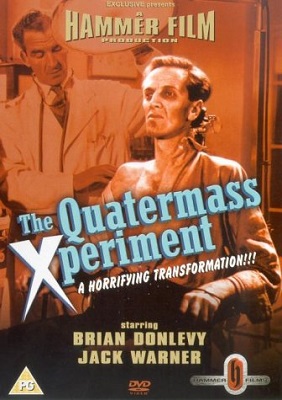
The Quatermass Xperiment, Val Guest (1955, UK). I’m pretty sure I saw this many years ago. If so, it was before I started documenting the movies I watched. Certain scenes felt very familiar… but there are number of British films from the same period which are quite similar… so maybe I have seen it before, maybe I haven’t. The Quatermass Xperiment is a film adaptation of a television series, originally broadcast in 1953 by the BBC. A British scientist, played in the film by an American, with no attempt at sounding British, but played by Brits on television, sends three astronauts on an experimental rocket into space. They lose contact… and the rocket later crashes in a field in the country. Only one astronaut has survived – in fact, there’s no trace of the other two. But that one astronaut seems to have caught some sort of space germ, which slowly turns him into a monster and sends him on a murdering spree. The film ends with Quatermass and flunkeys cornering the monster in Westminster Abbey, which has been closed for renovations. I’d like to see the TV series on which this film was based, because the film is a straight up monster movie and though it tries hard to be thoughtful its story is just too B-movie. Meh.

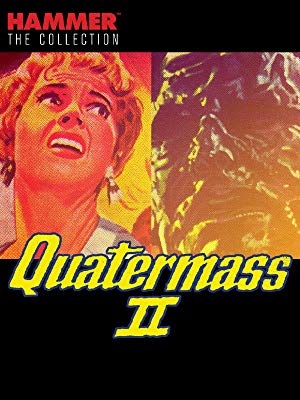
Quatermass II, Val Guest (1957, UK). It doesn’t take a genius like, er, Quatermass, to spot that this movie is a sequel to the one above. And like The Quatermass Xperiment, it was also adapted from a television series from 1955. Quatermass is once again played by American Brian Donlevy (although two different British actors had played the role in the two TV series). This time, small missile-shaped meteorites have been landing in Essex, and nearby is a secret government project researching new sources of food. Except it’s not researching that. Not anymore. As Quatermass soon discovers. The meteorites contain some sort of organism, which takes people, leaving them with a telltale scar, and these alien-inhabited people are using the government project as a bridgehead to take over the Earth. By growing a giant alien inside an oil tank. Or something. Apparently, The Quatermass Xperiment was extremely successful, so makers Hammer Film were keen to capitalise on it. Unfortunately, Quatermass II was outperformed at the box office by another Hammer movie, The Curse of Frankenstein, and so Hammer decided to focus on making horror movies. (They returned to Quatermass in 1967, with Quatermass played by Andrew Keir, a Scot.) Quatermass II is a much better film than its predecessor, although like the earlier film it climaxes with a giant monster. Both are very much films of their time, and while they resemble B-movies they’re generally better thought-through and smarter than US B-movies. But I’d still like to see the original TV series. Incidentally, when searching on Amazon Prime for these films, be careful. There are free versions available and pay-to-play versions. I’ve seen that a few times on Amazon Prime. Streaming, eh?

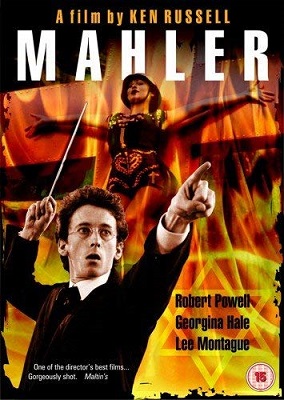
Mahler, Ken Russell (1974, UK). You’re never entirely sure what you’re going to get when you sit down to watch a Ken Russell film. Some of them are really quite bad, and yet others are absolutely brilliant. Mahler falls somewhere between the two. It looks cheap – despite being set in Mahler’s native Austria, it was clearly filmed in the UK – but there are some impressively-staged scenes. And some outright bonkers ones. It is not, after all, every day that you watch a movie featuring a dream sequence in which a dominatrix in SS uniform whips the protagonist on a mountain-top while he is tied to a giant sword… Robert Powell plays the title role, and the film opens with Mahler returning to Austria on a train, a famous composer and conductor – “I live to compose, I conduct to live,” he tells a reporter. His life story is told in a series of flashbacks – the antisemitism he experienced as a child, his later conversion to Catholicism (for, it is suggested, chiefly professional reasons), the death of his daughter… I know nothing of Mahler’s music and, to be honest, the film has not made me a fan of it. But I am a fan of Russell’s films – well, many of them – and while Mahler apparently, according to Wikipedia, “by 1985 the film had recorded a net loss of £14,000”, I actually liked it a lot. It’s bonkers, but in a good way. Powell is okay, but Georgina Hale as Mahler’s wife is better. There is some lovely photography of the Lake District – okay, it’s supposed to be Austria, but it’s still very nicely shot. I’d been in two minds about Russell’s films about composers, since they’re not people that really interest me, but if the others are like Mahler then I’m quite keen to see them.

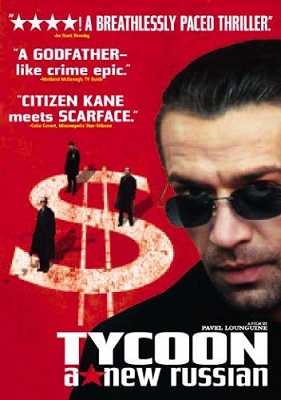
Tycoon, Pavel Lungin (2002, Russia). The first film by Lungin I watched was The Island, AKA Остров, which was released on DVD in the UK by Artificial Eye. That was back in 2015. Since then, I’ve watched Tsar (see here), a later film, and now Tycoon, AKA Олигарх, an earlier film. And, to be honest, they don’t much feel like all three were made by the same director. True, those first two are both about faith, although the stories they tell are very different – although Tsar is a lavish historical re-enactment. Tycoon, however, feels like a made-for-TV movie, and it’s somewhat surprising it was allowed to be made, given how critical it is of Russian oligarchs and the government corruption which created, fostered and profited from them. And still does. The film opens with the police seizing the offices of Infocar, the holding company of billionaire oligarch Platon Makovski. On his way home, Makovski is killed by a rocket attack on his car. The film then jumps back to 1985, when four childhood friends attended an economic symposium.. Shortly afterwards, they decide to go into business together, selling jeans they’ve stonewashed. And from there, it’s one business scheme after another, until a Georgian who manages a Lada factory joins then and they become automobile dealers. The film doesn’t really explain how Makovski and his friends became so powerful and rich. The business deals they do on-screen, often put together with the help of underworld contacts, or abetted by the Kremlin, don’t seem the sort to lead to a personal wealth of $5 billion, as mentioned at the start of the film. Through a series of flashbacks, Tycoon shows Makovski’s rise through its flashbacks, while the present-day narrative continues after his death as some of the old guard in the Kremlin move in on the company, with the help of one of the friends. It’s apparently based on a true story, but some of the details are too vague to convince, and the present-day events are a little too byzantine to be realistic. Still worth seeing, however.

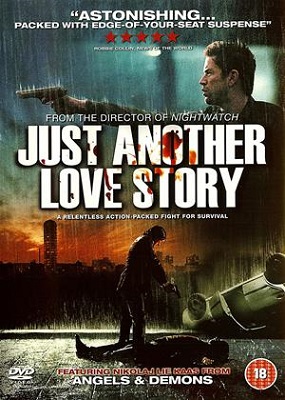
Just Another Love Story, Ole Bornedal (2007, Denmark). There are not many films that start with the protagonist lying dead on the street, while he explains that he’s dead. It’s been used plenty of times in written fiction, but I’m fairly sure it’s not all that common in cinema – although I’ve a vague feeling I’ve seen a 1940s noir film that used something similar. Anyway, protagonist Jonas is married with two kids and a life that doesn’t seem to be going anywhere. On the road one day with his family, he narrowly avoids an accident – but the woman in the other car was not so lucky and is seriously injured. Jonas goes to see her in the hospital, where he learns she has lost her memory. They won’t let him see her, so he lies and says he is the woman’s boyfriend, Sebastian. But all her family are there in her hospital room, and they’ve never met Sebastian – the woman met him while on holiday in Thailand, and had only just returned to Denmark. They take Jonas at his word. So he begins a double-life: Jonas with his family, Sebastian with the injured woman. But then Sebastian turns up… And it seems he’s being chased by Chinese gangsters because he stole some diamonds from them. Just Another Love Story is a feeble title, but this is a smart modern thriller, with a contemporary twist on a noir-ish story. Worth seeing.

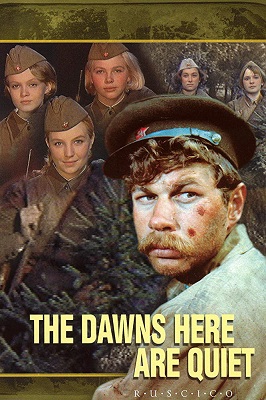
The Dawns Here Are Quiet, Stanislav Rototsky (1972, Russia). During WWII, a detachment of Soviets soldiers who man an anti-aircraft gun in Karelia are spending too much drinking and womanising, and the sergeant in charge complains to his superior officer. So the troop are re-assigned and the sergeant is sent an all-female platoon. Things go well for a while, until early one morning one of the soldiers spots a pair of German paratroopers. So the sergeant picks five of the female soldiers, and they go out to kill the Germans. Except, it turns out there’s a whole platoon of them. But they still have to stopped. And while reinforcements have been sent for, it’s going to be a while be they reach Karelia. The bulk of the film is the cat and mouse game, shot entirely from the Soviet point of view, as the sergeant and five young women try to get themselves into a position where they can ambush the paratroopers, which involves taking a path through a swamp known only to the sergeant, and eventually ends up with a running firefight in which the Soviets are badly out-numbered. For some reason, The Dawns Here Are Quiet has been presented on Amazon Prime as a two-parter, which proved confusing as I hadn’t noticed and the film ended up very abruptly. But it was definitely worth hunting down the second part as this is an excellent film. It was nominated for the Best Foreign Language Film Oscar in 1972, but lost out to Luis Buñuel’s The Discreet Charm of the Bourgeoisie, and I’m not entirely sure that film is actually better, or not so much better it would not be a difficult decision to choose between the two. Recommended.

1001 Movies You Must See Before You Die count: 939


Leave a comment

Moving pictures 2019, #10

This is the last post of movies I watched in the UK, which is why it’s only four films instead of the usual six.

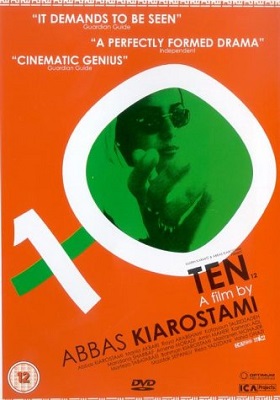
Ten, Abbas Kiarostami (2002, Iran). To anyone who has never seen an Iranian film, I say go out and watch one. Now. Iran has one of the best cinematic traditions on the planet, and a number of excellent directors. Not just Kiarostami, but also Mohsen Makhmalbaf, Asghar Fahadi, Jafar Panahi, Majid, Majidi, Babak Payami, Samira Makhmalbaf, Bahman Ghobadi… But if you were going to watch an Iranian film for the first time, I wouldn’t, er, recommend Ten. It’s good. And a good example of Iranian cinematic narrative techniques – especially Kiarostami’s. But it’s also nothing like Western cinema, and some might find that too much of a hurdle. The film is structured around ten scenes which take place in a car, mostly with the camera focused on the person in the front passenger seat. Who is in conversation with the driver, a woman. The passengers include her son, her sister, and various people to whom she is giving lifts. Sometimes the camera focuses on her. The conversations gradually reveal the driver’s life – such as the fact she is divorcing her husband. If I were to suggest a Kiarostami film to someone who had never seen one before, I’d probably pick Close-Up or Through the Olive Trees, or perhaps, because it’s my favourite of his, The Wind Will Carry Us (but be prepared to struggle finding his films in the UK as only some have been released on sell-through or rental). Kiarostami certainly had a singular vision, even among Iranian directors, and I do find faux-documentary narrative films of the sort he often made very appealing. However, the confined nature of Ten means a lot rests on the words and the actors, and I prefer movies that are, well, cinematic, ie, there’s very much a visual narrative to the story. Ten, like black box theatre, more or less dispenses with that. It is, as I said earlier, a good film, and perhaps quite emblematic of Kiarostami’s oeuvre, but it’s not what I’d call entry-level.

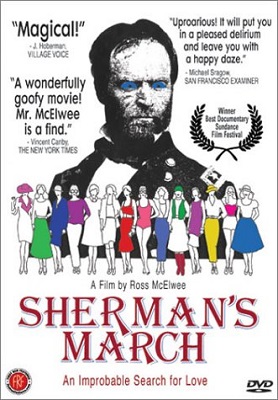
Sherman’s March*, Ross McElwee (1986, USA). So McElwee wanted to make about General Sherman’s march through  George and North and South Carolina during the American Civil War, and the impact his army had on the country through which it passed. But McElwee was originally from that area, and when he turns up with his camera, relatives and old friends are more concerned with match-making because his last relationship has just ended. So the documentary makes a half-hearted attempt to discuss the effects of Sherman’s scorched earth policy, but gets quickly, and often, derailed by McElwee’s pursuit of various women, which usually fail, for a variety of reasons. And then McElwee moves onto the next spot on Sherman’s route. And it sort of happens all over again. Surprisingly, it proved quite interesting viewing, perhaps because it’s a documentary. McElwee does also tackle his subject, and on occasion ties it into his own childhood in the area. I hadn’t expected to enjoy Sherman’s March, and some of the films on the 1001 Movies You  Must See Before You Die list have indeed been chores to watch, but I really did like this one. Recommended.

The Housemaid, Si Si (2014, China). This is available on Amazon Prime in the UK, although not apparently in Sweden – and that seems to apply to a whole bunch of Chinese films that had been dumped on Amazon Prime. Which is a shame. Not, I hasten to add, that The Housemaid, AKA Desire Nanny or Sex Babysitter, is the soft porn the poster suggests. It is in fact not unlike Secretary. Which is, I guess, er, borderline. Anyway, a young woman moves to the big city but has trouble finding work She signs up with a domestic agency, and her first job is to clean the house of a minor gangster. He takes a shine to her, and repeatedly asks the agency to send her. At which point, he starts ordering her to wear particular outfits when cleaning house. And it all snowballs from there. A second narrative covers the gangster’s son and his girlfriend, and their plan to steal money his father. The three parts of the film – social drama, sexual shenanigans with the gangster, and the plans of the gangster’s son – don’t sit together especially well, particularly those first two, where you have something that resembles a film by a Sixth Generation director which turns into some sort of light porn Youtube video. Ah well.

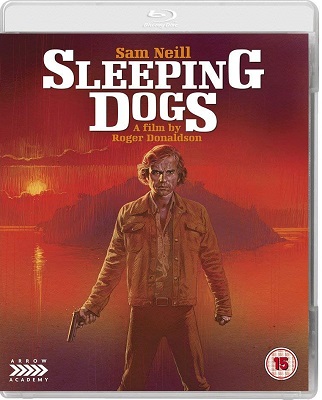
Sleeping Dogs*, Stephen Donaldson (1977, New Zealand). Another film from the 1001 Movies You Must See Before You Die list but, surprisingly, as indicated above, it’s not a US film. New Zealand cinema is not especially well-known, although considerably better-known after Peter Jackson made the Lord of the Rings trilogy. Of course, there have been a number of films from the country which have international reputation, and Sleeping Dogs must be one of them – although, to be honest, I’d not heard of it before deciding to work my way through the list… Sam Neill, sporting a hairstyle that looks uncannily like a bad wig, is thrown out by his wife and finds his way to the coast, where he rents an abandoned house on a small island. Meanwhile, New Zealand is descending into chaos after the 1973 oil crisis leads to a general strike, civil unrest, the imposition of ever more draconian laws and the formation of a “special police”. Leavers who want a no deal Brexit should take note. A squad of special police turn up one day, bundle Neill into a boat and cart him off to headquarters. He’s thrown into a cellar and left, with no explanation. Some days later, a senior officer, whom Neill knew from school, tells him that a cache of arms, for use by insurgents, had been on found on the island where Neill was living alone. He’s offered the choice of confessing to be a member of the resistance and deportation, or maintaining his innocence, which will lead to his execution. His choice is framed as “upholding democracy or supporting the resistance”, apparently without irony – no democratic society arrests and executes people without due process of law. Neill manages to escape police custody, and goes on the run. He is helped by the resistance, and ends up a handyman at a rural motel. Which is then taken over by a mixed squad of special police and US Army soldiers, led by Warren Oates. The man for whom Neill’s wife left him then appears and proves to be a member of the resistance. He wants Neill to trigger a trap to kill Oates’s men… The film is based on a novel called Smith’s Dream by CK Stead, and it’s tempting to suspect that dream was merely the desire to be left alone. Throughout the film, Neill refuses to choose sides, but is repeatedly dragged into the resistance’s plots. As a result he becomes something a folk hero, although at second-hand. Plot aside, Sleeping Dogs was clearly made with a small budget – despite the appearance of three Royal New Zealand Air Force helicopters and jet fighters – and the acting is pretty bad, even by Neill. But the camera does make good use of the famous New Zealand scenery. I can see why it’s on the 1001 Movies You Must See Before You Die list – as a New Zealand film. Its story might well be more relevant now than it was in 1977, and, while the film has dated, it’s so obviously a seventies film it comes across pretty much as an historical document. But it still looks noticeably cheap in the more dramatic scenes, and that does weaken it. Nonetheless, worth seeing.

1001 Movies You Must See Before You Die count: 939


Leave a comment

Moving pictures 2019, #9

This is the last-but-one post about movies I watched in the UK, and I’m typing this in Uppsala. I’d expected to be able to blog more after my move, especially given how bad Swedish TV is – I had to watch Midsomer Murders! twice! – but getting up to speed in a new job is pretty hard work and when I get home, I end up just watching stuff on my laptop from Amazon Prime. Or reading. And I’m spending the weekends exploring the town and learning how to shop in Swedish supermarkets…

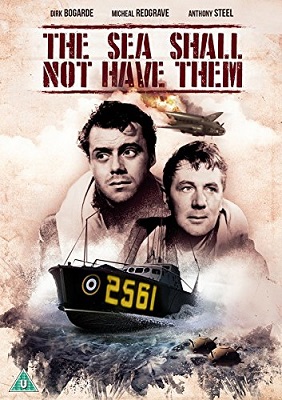
The Sea Shall Not Have Them, Lewis Gilbert (1954, UK). I think this was a lazy Sunday watch. Well, a moment of laziness in between packing boxes of books. I found it on Amazon Prime, and it’s a fairly typical film of its type and time – ie, a post-WW2 British film about the plucky British during WW2 – although it by no means paints every character as a paragon. The title is the motto of the Air Sea Rescue Services, a branch of the RAF which was responsible for rescuing the crews of aircraft downed in the seas around the UK. It later became the Search and Rescue Force, before being privatised – by the Tories, of course – in 2015. The Tories once again putting lives at risk in pursuit of profit. Scumbags. But back during WW2, it was still part of the armed forces. The film follows the crew of an ASRS fast motor launch, set to rescue the crew of a  bomber which was forced to ditch in the Channel. On board the bomber is an air commodore with secret Nazi plans detailing the successor to the V-2. So the rescue is urgent. Unfortunately, the launch’s crew are not the plucky exceptional Brits assorted folk these days would have you believe of the Greatest Generation. The newest member of the crew is next to useless and manages to set fire to the kitchen while making a cup of tea, nearly scuppering the boat. The engineer is lazy and claims to have done work he hasn’t done. The bomber crew are no better – Dirk Bogarde’s character stole a jerrycan of petrol he found at the side of the road and is afraid he will be imprisoned for it (and, yes, they’ve already found it in the boot of his car). The motor launch breaks down – thanks to the aforementioned engineer’s laziness – and the bomber crew have no way of reporting their position… but a rescue is eventually managed and all concerned return home to a hero’s welcome. Although pretty formulaic, it’s interesting how the characters are shown to be entirely ordinary and flawed. From the perspective of 70 years later, we can all too easily forget that – especially with WW2 currently being misrepresented by politicians and press for their own ends.

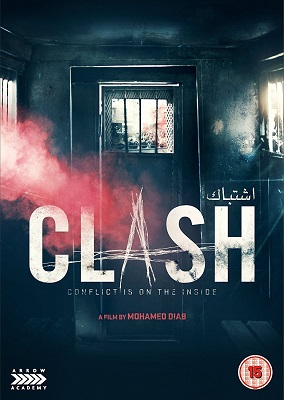
Clash, Mohamed Diab (2016, Egypt). Remember the Arab Spring and how it looked like the world was actually going to change for the better? Maghrebi regimes were going down  in flames, and while some nations descended into civil war, others looked like real change might happen. And perhaps real change  did occur in some cases – although not what the west wanted, and not always a step forward. Egypt, of course, had it bad, when widespread protests led to President Mubarak’s resignation and the seizure of power by the military. A new president was elected, but he included the Islamist Muslim Brotherhood in his government and that led to further protests. Clash is set during those protests and takes place entirely in the back of a police Black Maria. A group of people have been arrested for suspected Muslim Brotherhood sympathies, and imprisoned in the back of a police truck. Half of them are entirely innocent and were just in the wrong place at the wrong time. The other half are actual members of the Muslim Brotherhood, but it takes a while before they reveal it. Meanwhile, the prisoners witness the violence on the streets through the barred windows of the truck. It’s a cleverly-done film, keeping the story claustrophobic and personal, but positioning what happens in the truck as just one small, and mostly irrelevant, aspect of wider events. Given the impact of the overthrow of Mubarak, it’s no surprise it’s proven a popular subject for Egyptian cinema, and, like the US and its Vietnam War, exploring the ramifications of those events in their culture may well be part of a healing process. Um, does that mean we’ll be inundated with movies about Trump after the US finally gets rid of him? I hope not. Anyway, watch Clash. Recommended.

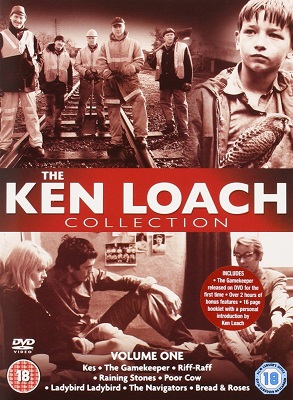
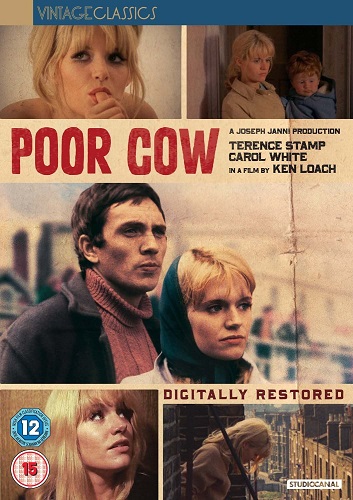
The Gamekeeper, Ken Loach (1980, UK). Apparently this film has been unavailable for a number of years, until being included in the pictured collection. Which is a shame, as it’s one of his better ones. It’s a lightly-plotted social drama, more of a documentary, than a narrative film, despite being based on a novel by Barry Hines (one of three adaptations of Hines’s novels by Loach, the best-known of which is Kes). The Gamekeeper is pretty much as its title indicates: events in the life of the eponymous man,  who works for one of the aristocracy. Mostly it’s about him dealing with other workers on the estate, and his son’s troubles at school. The final section of the film, the gamekeeper assists at grouse shoot (or it may have been pheasants, I’ve no interest in landed gentry brutally killing animals or birds, and no, it’s not a sport). The peer and his friends show all the condescension and arrogance you’d expect of the aristocracy, especially when the gamekeeper proves a little too loud and crude when beating. Personally, I’d sooner the birds had the guns and shot at the hooray henrys. Everything in the film is in Yorkshire dialect, and given that Hines was from Barnsley and set most of his fiction there… Several reviews online describe the aristocrat as a duke, but I don’t think there are any ducal seats in South Yorkshire, so it’s likely the family in the film are invented. Not that it matters. Loach has produced an important body of work, and if some films are better than others, that’s hardly unexpected. This was one of the good ones.

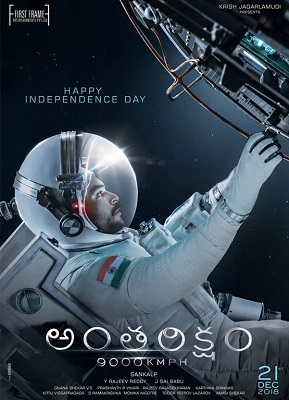
Antariksham 9000 KMPH, Sankalp Reddy (2018, India). I could describe this as a Telugu Gravity, and that would sort of be true. But it wouldn’t really get across the experience of watching it. And, to be fair, only the last act of Antariksham 9000 KMPH takes place in orbit. It’s also wrapped in a pretty standard Indian cinema romance narrative. Which is not entirely expected in a story about a satellite in a decaying orbit about to cause all manner of orbital destruction… The man responsible for said satellite resigned from the Indian Space Research Organisation after his wife was killed in a car crash. He was driving. He was also on the phone to a technician at mission control, trying to sort out a technical problem with the satellite, when he lost control of his car. Unfortunately, there’s doesn’t appear to have been much of a handover, and the satellite – lost since that incident – has reappeared and is about to cause untold damage in orbit, which would in turn cause everything to come crashing down to Earth, killing millions. And the only man who can prevent this is… the aforementioned engineer who resigned. So they have to persuade him to return to the ISRO fold. And they have to put a crewed mission together to go up into orbit to fix the satellite in situ – which is where it all gets a bit Gravity. Although this is a Telugu-language film, it’s  also an Indian one, so there are a couple of musical numbers but they’re quite restrained. The special effects in the third act are done quite well, but the plot and acting is so OTT it’s hard to tell. This is not a film you can take seriously, despite its subject. Which doesn’t mean it’s not a lot of fun. But if you start watching it expecting another Gravity, you’ll be disappointed – it doesn’t even get into orbit until the third act, for one thing. But it’s free to watch on Amazon Prime, so it’s worth a go if you’ve got that.

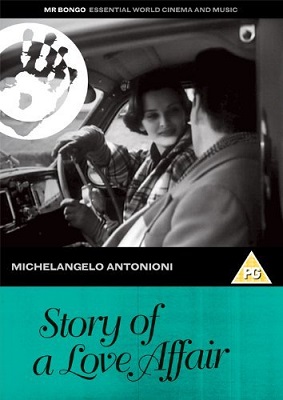
Story of a Love Affair, Michelangelo Antonioni (1950, Italy). This was Antonioni’s first feature film, and was apparently based on The Postman Always Ring Twice. A private investigator in Milan is asked to investigate a woman by her wealthy husband. The investigator discovers the wife had before moving to Milan been involved with a man whose fiancée had died after falling down a lift-shaft. And then that man turns up in Milan, and he and the wife end up in an affair, while the investigator and husband dig deeper into the suspicious death of the fiancée. I love Antonioni’s films but I’m not so enamoured of his early work. Perhaps Il Grido (see here) show some of the signature techniques he would later use, but Story of a Love Affair come across more like an unholy cross between Italian Neorealism and US noir. And, to be honest, the French did US noir much better. True, some noir has always had that air of cinema verité, and the Neorealist elements of Story of a Love Affair enhance that aspect… but it’s all very much a drama-turned-thriller, or perhaps the reverse, and though it works well I suspect I found it disappointing because I was expecting a more, well, Antonioni-esque film. Ah well.

1001 Movies You Must See Before You Die count: 937


Leave a comment

Moving pictures 2019, #8

Only one more of these and I’ll be up to date, but I’ll not be able to get that post done before I leave the UK. Still, I expect I’ll have plenty of time to catch up once I’m living in Sweden…

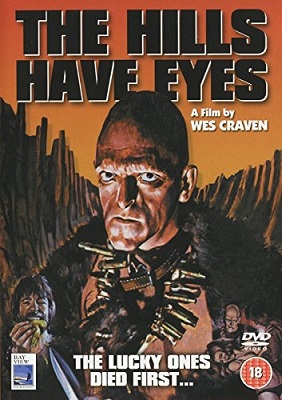
The Hills Have Eyes*, Wes Craven (1977, USA). I’m not a horror fan, especially modern horror. Too squeamish. I can watch 1970s and earlier horror because the special effects look like special effects. Once they started using CGI, they lost me as a viewer. Having said that, I wouldn’t normally have bothered with The Hills Have Eyes, although I’ve watched a number of Wes Craven movies over the years, except it’s on the 1001 Movies You Must See Before You Die list. And, like a number of other US movies on that list, I can’t honestly say I understand why it’s there. It made a star of Michael Berryman, but there’s not much about the film that suggests it’s a classic. A dysfunctional family are stranded in the Nevada desert and fall prey to a family of cannibals who live in the hills (it’s never entirely explained how they managed to survive there for two generations, but never mind). The Hills Have Eyes is apparently a cult classic, which I can totally see… but that doesn’t make it either a good film or one you must see before dying. Ah well, at least I’ve crossed it off the list.

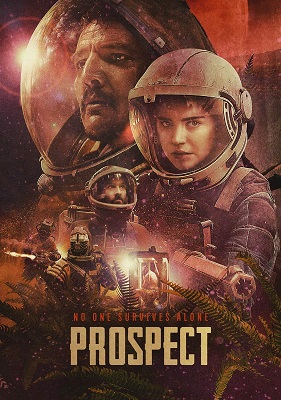
Prospect, Zeek Earl (2018, USA). A man and his teenage daughter, desperate for one last big strike, take a chance at prospecting for organic jewels on a world just before all contact with the world is lost. But it all goes horribly wrong – of course – and the father dies and the daughter is forced to ally herself with a smooth-talking criminal in order to escape the world and the brutal tribe of people trapped there. It all started quite well, with an interesting vision of interstellar travel; and then the prospecting in spacesuits in a forest because the air is poisonous, that looked quite good… But somewhere in the first half hour, the writer decided all the characters should talk like rejects from Firefly, and that stupidly mannered artificial way of speaking, like a cowboy who thinks he’s in a Jane Austen novel, got very tiring very quickly. It didn’t help that the story went a bit Mad Max, while looking like the 1980s Doctor Who gravel pit, and its early promise was pretty much pissed away. Worth a punt, but don’t expect much.

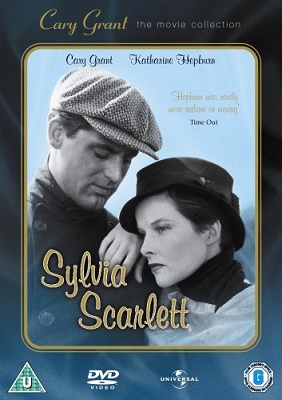
Sylvia Scarlett, George Cukor (1935, USA). This is the film that saw Katherine Hepburn labelled as “box office poison” until her career revived with The Philadelphia Story. It’s not entirely clear why contemporary audiences took against Sylvia Scarlett, or Hepburn in it. She’s just as annoying as she is in her other films, and the movie’s conceit of having her masquerade as male for much of its length is handled quite well. Co-star Cary Grant comes across as a bit of an odd fish. Everyone remembers him as the tea-bag-tanned urbane, if not louch, playboy of his later career, but in his earlier films he’s a bit of a galumph and in this one he even tries on a Cockney accent. It’s middling successful, but good enough for a US audience (mind you, Strine would make an acceptable Cockney accent to most Americans; and then there are those US films set in Eire where the cast all have Belfast accents…). Anyway, Hepburn et père flee France ahead of an embezzlement charge, and bump into grifter Grant on the ferry to the UK. And they, well, have sort of adventures around a 1930s Hollywood vision of England, where minor gentry have estates the size of the Isle of Wight and everyone drives on the right. I can see why the film was unsuccessful: it’s not very interesting. A pair of lovable rogues do lovable-roguish things. And then romance blossoms once the obvious subterfuge is seen through. But I don’t think it was so bad it should have blighted Hepburn’s career for over a decade. Meh.

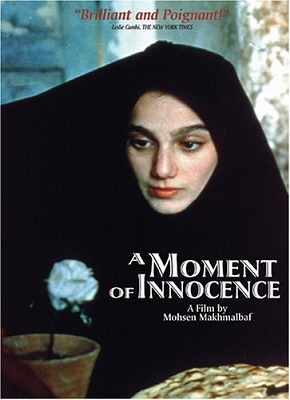
A Moment of Innocence, Mohsen Makhmalbaf (1996, Iran). A US film blogger I regularly read recently went on about Iranian directors doing European cinema and his surprise at such a thing proving both popular and sustainable – not just Makhmalbaf, but also Kiarostami, Farhadi, Panahi, Payami, Ghobadi… although Farhadi is probably the closest to European cinema and has made films in France – indeed, his latest is set entirely in Spain. But then Kiarostami also made movies in Italy and Japan. I’ve been watching Iranian films for over a decade now, and I certainly count it as one of the world’s best cinemas. Makhmalbaf has always been highly regarded in Iranian cinema, but his films have not been as readily available in the UK as those by Kiarostami or Farhadi (and even then it’s a bit hit and miss with Kiarostami). Hopefully, that will change with the UK release last August of Makhmalbaf’s Poetic Trilogy, containing the astonishingly good Gabbeh (and yes, yes, I’ve bought myself a copy to take to Sweden). Perhaps, if we’re lucky, we’ll see Makhmalbaf’s back-catalogue appear in Region B Blu-rays. One of the appealing qualities of Iranian cinema is its willingness to push the boundaries of cinematic narrative. In A Moment of Innocence, a director called Makhmalbaf, who never appears on screen, is casting for a movie about when, as a seventeen year old, he stabbed a policeman at a protest. He tracks down the policeman and auditions him for that role, but then has him involved in the casting process to find an actor to play a younger him during the protest. And so you have Makhmalbaf commenting on his past, while exploring how films are made and how they represent real stories, using real people playing the parts of actors and actors playing the parts of real people. It all feels like a companion piece to Kiarostami’s Close-up (1990), made six years earlier and featuring Makhmalbalf as a major offscreen character – much as he is offscreen in this film. And, well, the reason why I thought this film is really good is the reason why I think much Iranian cinema is good: it makes smart films that flout Hollywood cinema narrative conventions. And they look bloody good too. Everyone should watch Iranian films.

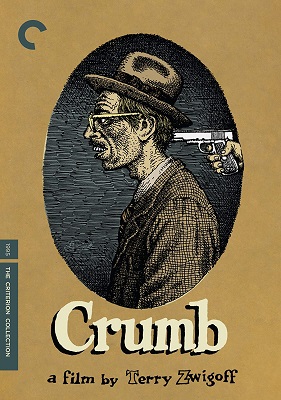
Crumb*, Terry Zwigoff (1994, USA). This is on the 1001 Movies You Must See Before You Die list. It is a biopic of US underground comic artist R. Crumb. Starring Crumb, his friends and family, admirers and fans. So its appeal is pretty much wholly linked to the interest a viewer might have in its subject. Which, for me, was pretty much zero. I admit I like some late Sixties west coast US music, and Crumb was briefly linked with it by virtue of drawing an album cover for Big Brother & the Holding Company’s 1968 album Cheap Thrills (ie, Janis Joplin’s band), but I’m mostly ignorant of Crumb’s various works. I much prefer French bandes dessinées to US underground comics, anyway. Which is no doubt why I found a biopic about one of the latter’s leading lights a bit of a bore. And I could see no reason why it should be on the 1001 Movies You Must See Before You Die list… although that’s hardly untypical of most of the US films on the list. If the film made a splash at its time of release, it doesn’t now. There are other more important people in comic art who deserve to have films made about them. Those films might even prove more interesting.

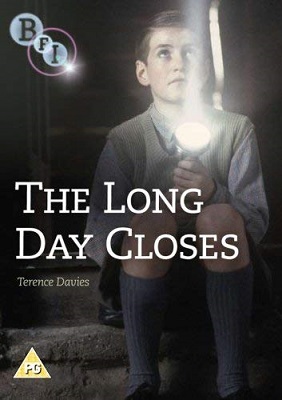
The Long Day Closes, Terence Davies (1992, UK). Davies is one of those directors whose films I like in theory but not in practice. If you know what I mean. He makes gorgeously-shot films with an amazing attention to detail, and yet they tell stories that are so mundane and forgettable that you wonder what you watched a day after the movie finished. It doesn’t help that many of his films depict an impoverished northern England during the middle years of last century, and very little has changed since then – or rather, communities, society as a whole, has changed a great deal since then, but the impoverishment has returned, thanks to criminal Tory austerity policies, except there’s no community to help share the burden. So Davies’s films feel like paeans to a world that never existed, even though they patently did exist. And that’s another problem: what exactly is the point of documenting them? I can understand the personal urge to document one’s own past, and though each person’s past is unique there’s often enough commonality to find an audience… But things are as bad now as they were then – and we don’t have the excuse of paying for a global war, or at least paying the US’s bill for their help in defending ourselves from a more powerful enemy during a global war (the US fucked the UK over, much more than Germany did, make no mistake about that. The US calls itself “the Land of the Free” but it doesn’t say “free” at the bottom of the invoice they issue for services needed when invaded by a foreign power… I digress. I am apparently known for it. My last manager complained of it – at least, I think he was complaining…) Anyway, I would recommend any Terence Davies film because they’re worth seeing. I don’t agree with, or even particularly enjoy, most of them, but I admire them and they’re one hundred percent worth seeing.

1001 Movies You Must See Before You Die count: 937


Leave a comment

Moving pictures 2019, #7

Am trying hard to get these out of the way before my move. Having said that, I’ve no idea what Sweden will bring. Film-wise, that is. My Firestick will still work, and I’m taking my Blu-ray player and a selection of DVDs and Blu-rays with me, but…

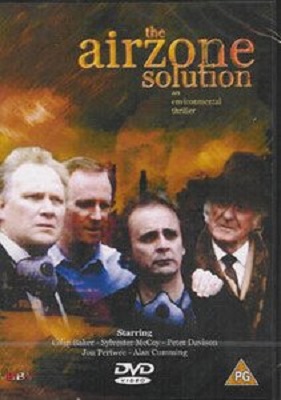
The Airzone Solution?, Bill Baggs (1993, UK). This was an oddity. I found it on Amazon Prime. Apparently, during the 1990s, the BBC released some straight-to-video teleplays under the imprint BBV, including this near-future story by the bloke who voices the Daleks in Dr Who, and which starred four of the actors who had played Dr Who: Jon Pertwee, Peter Davison, Colin Baker and Sylvester McCoy. It’s set in the near-future, which probably means a decade ago, and in which the UK suffers such bad air pollution there are plants around the country to clean the air. Then the government gives a contract to a dodgy company – this may sound a little familiar to followers of the Brexit debacle – to build a new generation of plants. Except an activist (McCoy) discovers the new plants are actually increasing air pollution, and takes the news to documentary maker Davison. They also recruit TV weatherman Baker, because he has the platform. Turns out the company has another plan in mind, one which explains the missing bodies of activists who raided the air plants and some very suspect biological research… It was all resolutely amateur, despite the cast, with almost no effort made to present a future London. It comes as no surprise to discover the whole BBV operation was run on the cheap. Dr Who completists might want to seek this one out, but I can’t think of any other reason why it would be worth watching.

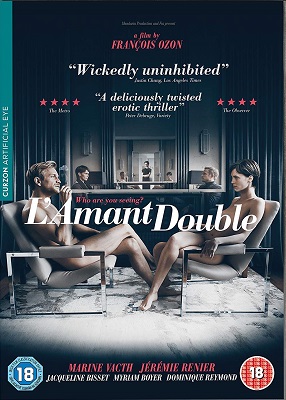
L’Amant double, François Ozon (2017, France). This is the latest from a favourite director. I say “favourite” although I find Ozon’s films a bit hit and miss. And this one was definitely miss. It’s basically Ozon does De Palma, and while he does it with more flair and better cinematography, he doesn’t overcome the, er, genre’s shortcomings. A woman in an intense relationship with her therapist spots him with another woman, only he denies it. It turns out he has a twin brother he never discusses. So the woman tracks down the brother, who is also a psychoanalyst, and ends up in a relationship with him. Then it all gets a bit tricky. It strikes me that for all the very different films Ozon has made throughout his career, they have been at heart pastiches. 8 femmes was a pastiche of Les parapluies de Cherbourg, Angel was Ozon taking off a DH Lawrence adaptation, Potiche was… I’m not sure how some of his other films fit into my theory, but what’s a theory without exceptions? And Sitcom, to be fair, was an overt spoof. Anyway, Ozon is always worth a go, no matter what he’s taking off, and if L’Amant double isn’t among his best it’s because he’s pastiching poor material.

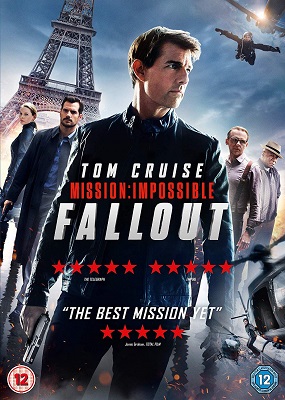
Mission Impossible: Fallout, Christopher McQuarrie (2018, USA). This is bread and butter stuff for Cruise these days, and probably his main source of income, so providing he sticks to the formula it should be almost impossible (see what I did there?) to fuck it up. And, happily, in this instalment McQuarrie keeps the franchise on the straight and narrow. It’s like 007. European locales, lots of action, a femme fatale, a convoluted plot, and an excuse for the hero to behave more morally than everyone else. Mission Impossible: Fallout does all that. There’s a plan to spring some random villain from an earlier film in the franchise from super-secure prison – do such things even exist outside of movies? Given actual prisons these days are mostly privatised and run by for-profit companies that employ from the bottom of the labour pool. Anyway, Cruise is hired, while pretending to be someone else, to spring said nasty. Meanwhile, there are a couple of nuclear warheads floating about, which Cruise needs to take off the market because some secretive international group of anarchists – with which the aforementioned villain is associated – want to use them to blow up various centres of religion. Which is, to be honest, something I can sympathise with, given that not even Trump and Brexit combined can fuck things up as much as religion does on a daily basis. Anyway, Mission Impossible: Fallout is formula stuff, with all the i’s dotted and the t’s crossed, the laws of physics routinely flaunted, and a view of geopolitics that invents a villain everyone can be happy to hate. Which is sort of risible, when you think about it, but that’s Hollywood.

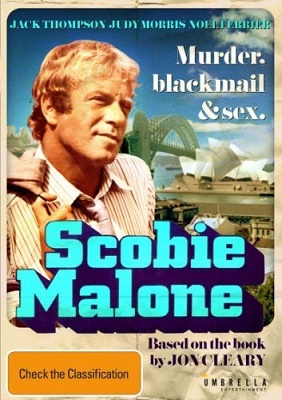
Scobie Malone, Terry Ohlsson (1975, Australia). Another Amazon Prime find. This is an odd Australian thriller based on a series of detective novels by Jon Cleary and set in Sydney. The film opens with the body of a woman found in a basement area of the Sydney Opera House. Detective Scobie Malone is given the case, and discovers the woman was involved with a senior politician. While Malone goes about interviewing the various suspects, and pissing everyone off, the film also shows the victim’s life in flashback. There’s not much to distinguish this film from other 1970s cop thrillers, other than its setting, and a pair of really really horrible songs… which doesn’t make it a dull film by any means. I’m not convinced Jack Thompson was especially good in the title role, although apparently several in the Australian film industry thought he was star material. He has certainly had a long and full career, but he was never the breakout he was expected to be. And watching Scobie Malone, it’s hard to wonder why anyone thought he might become an international superstar.

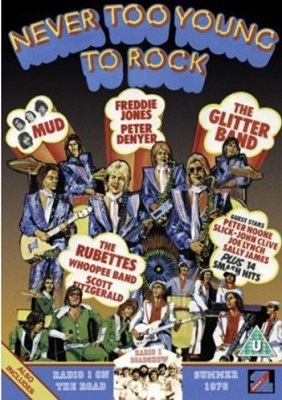
Never Too Young to Rock, Dennis Abey (1976, UK). There is some weird, and embarrassing, shit available on Amazon Prime. And make no mistake Never Too Young to Rock is a national embarrassment. True, it doesn’t feature Gary Glitter, another national embarrassment, and was made after The Glitter Band had split with him, but is there any genre of music more cringe-inducing than glam rock? Er, hair metal, possibly – but that was mostly US anyway. All of which probably makes no sense until you realise that The Glitter Band feature heavily in Never Too Young to Rock, as do Mud, The Rubettes and, er, Bob Kerr’s Whoopee Band (which included members of the Bonzo Dog Doo-Dah Band). At the time the film is set, popular music has been banned from television. So an eccentric bloke with a “rock detector van”, driven by Freddie Jones, travels about the country looking for the greatest rock bands for a televisual extravaganza. Quite how this ends up with Mud, The Glitter Band and The Rubettes is a mystery. They were never that big, even in 1976. And the music has not aged well. Although it has certainly aged better than the look. And much much better than the Glitter name. As 1970s UK musical oddities on film go – and the UK produced a number during the 1960s and 1970s – this is definitely bottom tier stuff.

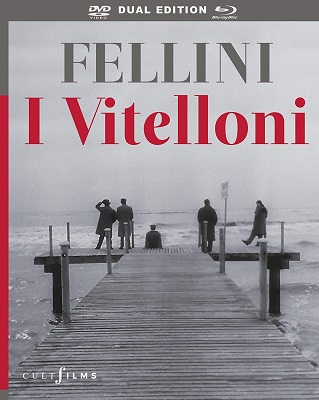
I Vitelloni, Federico Felloni (1953, Italy). When it come to Fellini, I’ve always liked his more indulgent stuff more than his other films, and that includes the Neorealist films, which, to be fair, has never been a genre that’s appealed to me. And it’s that genre  I Vitelloni reminded me of more than anything else.  The film opens with a downpour interrupting a beauty contest, but it’s all about five twentysomething men in small town Italy, trying to survive in a country still suffering from the effects of the war. It’s much of a piece with other Italian films made during the period, and while it apparently re-invigorated Fellini’s career after an earlier flop, I didn’t find it as appealing as the aforementioned over-indulgent films like Satyricon or Casanova. One of for fans of Italian Neorealism more than fans of Fellini.

1001 Movies you Must See Before You Die count: 935


Leave a comment

Moving pictures 2019, #6

I need to get this backlog out of the way before I start my new life. It’s not that I’ve watched loads of films over the past two months, more that I’ve not been writing blog posts as often as before. Busy packing up the DVD collection, you see…

Parineeta, Bimal Roy (1953, India). In recent years, I’ve watched quite a few Bollywood films, but I admit I do prefer the historical ones – although they’re generally poor transfers and good condition copies are almost impossible to find. Parineeta wasn’t too bad, possibly because black-and-white seems to survive better than colour. Who knows. It’s the usual boy meets girl, boy loses girl, boy gets girl back again story, this time complicated by the fact the two leads are from closely-knit neighbouring families, but his family are the rich ones and hers the impoverished tenants. She’s much put-upon, especially by her own family, and her relationship with the male lead grows over time, despite both their families trying to arrange marriages for them with others. The film is based on a novella by a popular Bengali novelist, which likely explains the almost Austen-esque feel to the plot (ie, its origin as written fiction, rather than a straight-up commercial Bollywood movie). The acting was a cut above usual, but the music was entirely forgettable. Say what you like about 1990s and twenty-first century Bollywood films, but they generally have memorable dance numbers (even if, most of the time, that’s all you remember of the film). Parineeta was good, a mix between parallel cinema and commercial Bollywood. Worth seeing.

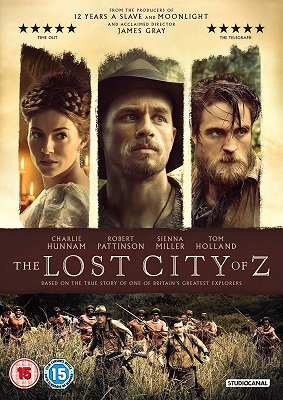
The Lost City of Z, James Gray (2016, USA). I really did not like this film. It felt like Embrace of the Serpent made for fox-hunting inbred Tory morons. It’s apparently a real story, about the British explorer Percy Fawcett, but based on a book about Fawcett written by an American. Which might explain some aspects of the film… Fawcett is a promising young Army officer in the first decade of the twentieth century, but he’s not from the right sort of family. So instead of a prestigious posting, he gets seconded to the Royal Geographical Society as cartographer. This results in him being part of an expedition in Brazil, where he hears rumours of a fabled city of gold. This leads him back to Brazil a number of times in an effort to find it. So this is a film with a lot of tramping through jungle, or travelling up jungle rivers. And it’s all done from the perspective of Edwardians. The end result is a film which repels while covering similar to material that of far superior films. I’m only glad I found this free on Amazon Prime.

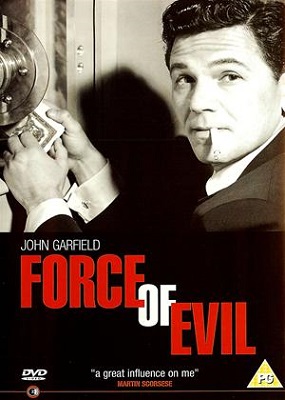
Force of Evil*, Abraham Polonsky (1948, USA). There are many US noir films considered cinema classics, and this is one of them. I’m not so enamoured of the genre as other seem to be, and can take its so-called classics more or less as I see them. Because Force of Evil, which appears on the 1001 Movies You Must See Before You Die list, is a good film, but not really a great film – and I’d expect the list to comprise great films. I have to wonder if Force of Evil made the list because of its subject: the numbers racket. As a study of how the numbers racket worked, and how established it was in everyday life, the film does an excellent job. But it does it in the guise of a noir film, with a successful lawyer to a mobster trying to save his principled older brother, who runs a small independent numbers game, from eventual mob take-over. Everything about the film is pure 1940s Hollywood noir – from the cast to the sets to the lighting to the story beats. One for fans.

A Dangerous Method, David Cronenberg (2011, Germany). I’m not exactly sure what the title refers to, given this film is about the friendship between Feud and Jung, and Jung’s patient-turned-disciple Sabina Speilrein. She is brought to Jung and he attempts to cure her of her psychosis using his theories, and so discovers her intelligence and aptitude and eventually uses her as an assistant in his work. He refers her to Freud – to be fair, I had not known the two had worked together, but this film is based on real events – and she eventually qualifies as a psychoanalyst herself and returns to Russia to practice. Since Cronenberg went mainstream, there seems to be less distinguishing his movies from those made by his contemporaries. There was a definitely a singular vision to the work he did up until the turn of the century – especially in his early work, like Crimes of the Future – but A Dangerous Method could have been made by more or less anyone. Which is not to say it’s not well-made, nor that its story is uninteresting. But it’s not something that lingers, and Cronenberg fans won’t find much here to admire.

A Man Called Ove, Hannes Holm (2015, Sweden). The title of this movie, however, is plain from the first frame. Ove is a cantankerous old Swedish man who has never quite got over the death of his his wife. He is forced into retirement, even though his job is all he has, especially since his wife died six months previously. He tries to commit suicide, but is interrupted each time by his new neighbours, a woman of Iranian extraction married to a Swede. And through his friendship with that family, he reconnects with his community and discovers a new lease of life. It’s completely a feel-good movie, but it works because Ove is such a miserable bastard you actually start to feel sorry for him when he finds himself forced to go on living when his plans to end it all are repeatedly foiled. I had, to be honest, expected something humorous like The Hundred Year Old Man Who Climbed Out of the Window and Disappeared (see here), but this was far from absurd. It was a gentle comedy about age and friendship, and it did it all without being overbearing or simplistic. Plus, it’s Swedish. Worth seeing.

The Untamed, Amat Escalante (2016, Mexico). Sometimes you stumble across a film – this one was on the Cinema Paradiso website – and when the disc arrive you, you sit down to watch it with little or nothing in the way of expectations… And if you’re lucky the film blows you away, but more often it’s entirely forgettable. The Untamed did not precisely blow me away, but it was far from forgettable. It opens with a woman tied down in a barn, who then – willingly – has sex with a tentacled alien, which has been hiding out in the barn since it crashlanded. Meanwhile, another woman is at odds with her homophobic husband, who happens to be having an affair with one of her gay work colleagues. When the first woman introduces the second to the alien, things start to go wrong. This film reminded me a great deal of Carlos Reygadas’s work, and not just because it’s Mexican. But it had the same sort of distant documentary feel I appreciate so much in movies, albeit with perhaps Yorgos Lanthimos’s oblique approach to storytelling (not that Reygadas is exactly direct). The end result is a film which starts out weird, then turns prosaic before circling back to weird and making that opening all of a piece with the whole. It also looks gorgeous, with some excellent cinematography. Escalante is name to watch. This is the fourth film he’s directed; I think I’ll try and track down the earlier ones.

1001 Movies You Must See Before You Die count: 935


Leave a comment

Moving pictures 2019, #5

I used to plan my viewing – well, mostly – but that seems to have gone by the board now that I’m about to up sticks. I don’t know what there’ll be available to watch for the first few weeks I’m in Sweden – I suspect I will reading more – although I will be packing my Blu-ray player in my suitcase. And, of course, a couple of a box sets…

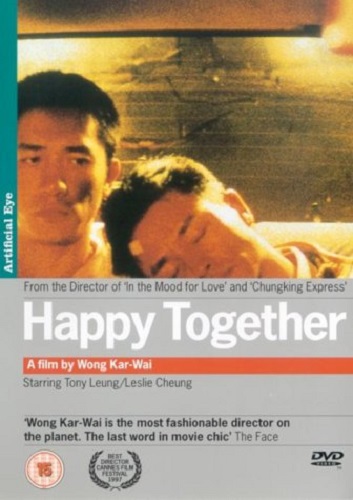
Happy Together, Wong Kar-wai (1997, China). I’ve yet to figure out what I feel about Wong’s films. I do like his most famous film, In the Mood for Love, and its sequel 2046, although I’ve been ambivalent about other films by him I’ve seen. And that’s pretty much true of Happy Together. It’s well-made, often with quite stunning cinematography, and with a great soundtrack – the second by Wong, I seem to recall, that includes a track by Frank Zappa (‘Watermelon in Easter Hay’ in this one). The problem is that Wong’s films are really good but they haven’t quite clicked for me, and I’m somewhat surprised they haven’t done so. They’re exactly the sort of thing I should Iike and admire, and some of them I do like and some of them I do admire, and some of them it’s both. Wong should be one of those directors on my “to watch” list, and he is to some extent or I’d not have rented this film… but whenever I watch one of his movies I always feel I should like it more than I actually do. I suspect I need to give his oeuvre a more careful study.

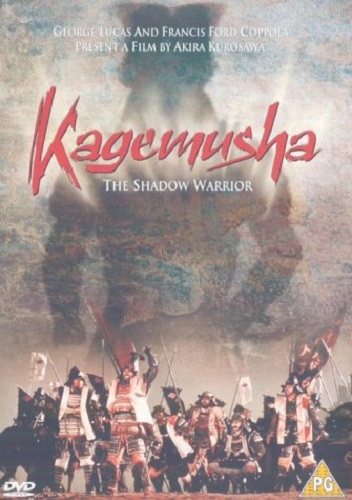
Kagemusha, Akira Kurosawa (1980, Japan). And after Wong, another director whose oeuvre I find a bit hit and miss. I like Kurosawa’s films, I have a lot of time for them, but he made a lot of samurai movies and they do all sort of blur into one another, if not even into themselves because they’re quite long. This one is a good three hours, and not a fat lot happens during that time. A daimyo in sixteenth-century Japan has a double – the kagemusha of the title – and after being shot by a sniper during a siege of a castle, the double takes his place. And proves more effective in it than the generals eager to maintain the pretence realised. It’s all very Kurosawa, a full-on historical samurai film with epic battle-scenes, real castles and an almost-Shakespearean plot. But it’s also very long and that, for me, told against it. It really doesn’t need three hours to tell the story, and it felt more often than not that Kurosawa was more in love with his material than any viewer was likely to be. But it’s Kurosawa, and that’s not so much a brand as it is a badge of quality. Anyone watching Kagemusha is going to know what they will get. I’ts probably telling that the Kurosawa films I like best are the ones that aren’t historical samurai films. One for fans.

Salome, William Dieterle (1953, USA). As mentioned in an earlier post, my mother lent me a box set of Rita Hayworth movies, which included a couple I’d not seen before. Like this one. To be honest, I hadn’t missed anything. Salome is a typical Hollywood Biblical story, which means it’s not only wildly historically inaccurate, it probably bears little resemblance to the original Bible story. For all the US bleats about being Christian, it shows a remarkably cavalier attitude to its central religious text – except when it’s doing the exact opposite and interpreting it entirely literally, despite that being scientifically impossible, never mind displaying a complete lack of common sense. The story of Salome is not one they tend to teach in Sunday school, given it involves a head on a plate. And, to be honest, even after watching the film, I’m not entirely sure what the film was actually trying to say. Salome is a Jew brought up in Rome, who upsets caesar because a Roman one-percenter wants to marry her and so she is sent back to Jerusalem, a city she does not know. But she’s not having that, so she uses her feminine wiles to overturn caesar’s decision. And after her famous dance, which might well have had seven veils in this film but they weren’t what is normally meant by “veil”, she asks a boon and her mother jumps in and ask for John the Baptist’s head on a plate, as you do, and that’s not really what Salome wanted. It’s all very 1950s bible-story Hollywood, and even Hayworth’s presence can’t redeem it. Avoid.

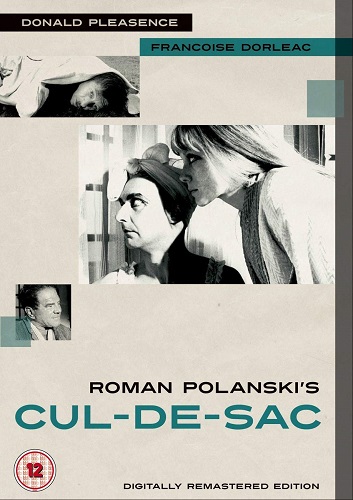
Cul-de-sac, Roman Polanski (1966, UK). I know I shouldn’t be watching Polanski movies but this was free on Amazon Prime so it’s not like I’m giving money to Polanski. How difficult is it to sort his situation out? I mean, the US will rendition people and throw them in Gitmo because they think they might be terrorists, and have no evidence to prove they are, but when they do have evidence someone committed a crime he gets to lead a normal life as long as he doesn’t visit the US. Of course, Polanski, a Pole, is white. And the US is not currently bombing Poland. But who knows with Trump. Or indeed the UK, as the racist Leave voters seem particularly incensed at the number of Poles in the UK. Anyway, Cul-de-sac is an odd film. Donald Pleasance and his wife Françoise Dorléac live in an old castle on Lindisfarne, when their home is invaded by bank robbers on the run Lionel Sanders and Jack MacGowran. Sanders takes the couple hostage while he tries to contact his boss. MacGowran, who was shot during the robbery, dies of his wounds. Then friends visit Pleasance and Dorléac, and the two have to pretend to normality while Sanders acts as their new manservant. Polanski sex-crime aside, he was a was good director and some of his early works from the 1960s are really good films. Cul-de-sac is characteristically odd, but it’s well-shot, extremely atmospheric, and the cast put in good turns. While I can’t recommend it, I have to admit it’s worth seeing.

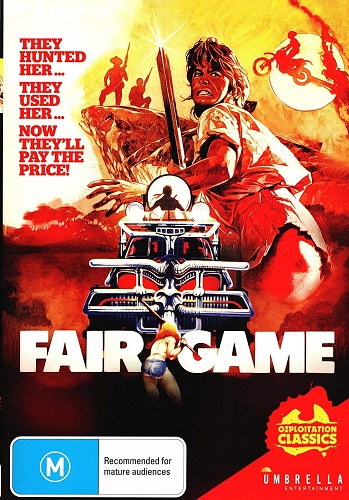
Fair Game, Mario Andreacchio (1986, Australia). Had it not been the fact this was movie was Australian, I would likely have written it off as a B-movie. Which it still is, to be honest. Three typical examples of Australian manhood harass and assault a woman who runs a wildlife sanctuary because she prevented them from kangaroo hunting. But their revenge goes awry when she proves more of a match for them. I would like to say it’s refreshing to see an Australian film in which a woman wins against a group of men, but I think that’s an unfair characterisation of Australian culture. And hardly commonplace in Hollywood or the UK film industry. The plot of Fair Game is a staple – there must be a couple of hundred Westerns which use it – in which a lone hero (female, in this case) defends the town (well, her sanctuary) against marauders bent on revenge, using a variety of tricks and traps based on what’s available. Not a great film, by any means, but worth a punt.

The Lion King*, Roger Allers & Rob Minkoff (1994, USA). Yes, I know. I’d never actually seen The Lion King before, and it’s not like I made a conscious decision to avoid it but since I don’t have kids it’s not the sort of film that crops up in my normal viewing. But it’s in the 1001 Movies You Must See Before You Die list, so I decided to add it to my rental list and watched it when it dropped through the letter box. Some twenty-five years after it was released. And it has not aged well. Not well at all. I’ll not bother summarising the plot. The animation is good, although nothing especially stands out – although the scenes involving the hyenas do harken back to earlier Disney films. As does the final showdown between Simba and Scar. But the comedy is occasionally borderline for 2018, and the songs are completely unmemorable. Yes, even the most famous one. Life on the veldt is completely romanticised – lions are carrion eaters, after all – and even some of the landscape looked a bit suspect. The Lion King was massively successful, and was the second highest grossing film of all time in its year of release (it has since dropped to number 40), and I suppose that’s why it’s on the 1001 Movies You Must See Before You Die list. But, frankly, there are better Disney feature films, such as Bambi, which are more deserving of a place. The Lion King seems to me to be more  triumph of marketing than film-making – I remember the advertising at the time was relentless – and that’s no indication of quality. Well-marketed films do not belong in a list called 1001 Movies You Must See Before You Die.

1001 Movies You Must See Before You Die count: 934


1 Comment

Moving pictures 2019, #4

Not so varied nationally a half-dozen this time. But content-wise there’s plenty of variety…

You’ll Never Get Rich, Sidney Lanfield (1941, USA). My mother found a Rita Hayworth box set in a charity shop and lent it me because I like Hollywood films from the first half of the twentieth century. Plus, it included a couple of stone-cold classics – Gilda and The Lady from Shanghai – I wanted to watch again. You’ll Never Get Rich, a Fred Astaire and Rita Hayworth vehicle I’d not seen before, turned out to be minor work from both. Astaire looks almost skeletal in it, and he’s about as far through as a kipper in pretty much all of his films. Theatre owner Robert Benchley (an excellent comic actor of the time) has designs on showgirl Rita Hayworth and enlists star of the show Fred Astaire to pretend to be Hayworth’s boyfriend to hide Benchley’s interest from his wife. But then WWII comes along and Astaire enlists and, for reasons I forget, masquerades as an officer in order to spend time with Hayworth, who he now fancies himself. Apparently, Astaire’s career had started to flag after he split he split with Ginger Rogers – why split? she was brilliant – but teaming up with Hayworth gave his career a boost, although he only made two films with her. He still claims her as his best partner, and she certainly kept up with him – but I can’t say Hayworth was better than Rogers, because Hayworth may have been an excellent dancer but Rogers was a perfect foil to Astaire. This is not a great film, and a pretty forgettable one from either star, each of whom has plenty of memorable ones in their oeuvres. One for fans.

Poor Cow, Ken Loach (1967, UK). My plan to work my way through Loach’s oeuvre is going to have to go on hold when I move to Sweden – unless I buy one of the several Ken Loach box sets currently available. The problem is, I watch his films and for each film I like, there’s another I’m not so keen on. So while I’m glad I watched Cathy Come Home, I didn’t really like it; but Poor Cow I did like quite a lot. Even though its story is broadly the same. It was Loach’s first feature film. The title refers to a young woman who is married to an habitual criminal. When he’s sent down for an inept jewellery shop robbery, she moves in with one of his mates (Terence Stamp, and the footage of him from this film was used in Steven Soderbergh’s The Limey). But then Stamp gets sent down for twelve years after a violent robbery on an old woman, and the young woman returns to her husband. But she dreams of a future with Stamp. The film was very much made in a documentary style, with improvised dialogue, real locations, and non-actors in several roles. The London tenements in which the title character lives were a revelation – for all that the UK claims to be a leading nation the fact people lived in such poor conditions in its capital halfway through the twentieth century is disgusting. Fortunately, they were knocked down and social housing constructed in their place. And then Maggie and her goons sold those all off for a quick buck, and developers have flattened them and built luxury towers that sit empty because one-percenters are using them as tax dodges or for laundering money… Meanwhile, you have scumbag Tories trying push through a law making it acceptable for rental properties to not be fit for human habitation… Fuckers. Anyway, Poor Cow is one of the Loach films I thought good. Worth seeing.

What We Do in the Shadows, Taika Waititi and Jemaine Clement (2014, New Zealand). There were a couple of laugh-out-loud moments in Waititi’s Thor: Ragnarok, unexpected in a MCU film, and though I’d liked his Hunt for the Wilderpeople (see here), I wasn’t sure I was on the same wavelength for his humour. And the first ten minutes or so of What We Do in the Shadows seemed to demonstrate as much… But then the central conceit started to come together, there were a couple of laugh-out-loud moments, and I found the film a lot funnier and more enjoyable than I’d expected. It’s a mockumentary about a household of vampires in present-day Wellington. Waititi himself plays the main character. There’s an ancient vampire who lives in the cellar and does not speak, a fourteenth-century Transylvanian played by Jemaine Clement, and a “much trendier” vampire who is “only” 183 years old. But then one of the group goes and turns a local man into a vampire, who had originally been intended as prey, and he tells all his mates he’s a vampire. Including Stu, his best mate. Who he introduces to the rest of the group, and they really like him. At several points, the vampires bump into a pack of werewolves, led by Rhys Darby, and I have to admit they had some of the best lines in the film – “We’re werewolves not swearwolves” had me giggling for a good ten minutes. Worth seeing.

Mortal Engines, Christian Rivers (2018, New Zealand). The book on which this is based has been around since 2001, and while I’ve known of it pretty much since it was published, I’ve never read it. Because it’s YA. I am in my fifties. I am not the target market for YA fiction. I wasn’t even back in 2001. But I knew of Mortal Engines, and I knew of its mobile cities. Which is about all this film has going for it. Because the plot is pretty much identical to the first Star Wars film. Even down to the X-Wing attack on the Death Star. London is a major predator city, but its chief scientist dreams of conquering Shan Guo (China), a rich land without mobile cities. Fortunately, as is the way of such things, a pair of hardy teens, well, early twenties, appear and thwart his plans. There’s the daughter of a scientist who opposed the villain, and the junior historian who initially foils the former’s attempt on the villain’s life, only to be ejected from London because he knows too much. And the two form a reluctant alliance in order to stop London’s plans to destroy Shan Guo’s Shield Wall… Much of the film is travelogue, and the pair move around the world, trying to reach allies. At one point, they’re captured by slavers and put up for sale. Why do so many sf novels – and films – feature slavery? Seriously. It’s vile and does not belong in any work of fiction that is not explicitly about it, historical or contemporary. There’s no commentary on slavery in Mortal Engines – the nearest it gets is implying the two heroes might be purchased by a butcher so he can make sausages out of them. Cannibalism is hardly fit for comic relief during a slave auction. It’s not like the world of the film is some sort of US post-apocalypse dystopia (yes, I know Reeve is British). A villain who pushes ahead with his plan, ignoring the human cost or obvious consequences is one thing; but it’s well past time sf stopped building worlds that feature slavery – and yes, I know I’m 18 years too late with this book (assuming the scene even appears in the book).

Bohemian Rhapsody, Bryan Singer (2018, USA). I know, I shouldn’t watch films by Bryan Singer – although by all accounts he was taken off this project fairly quickly and it was mostly shot by Dexter Fletcher. But at least I don’t plan to shortlist him for any fucking awards. As it is, Bohemian Rhapsody is, well, dull. And not very good. The only thing about it that impressed was its CGI reconstruction of the old Wembley Stadium (which had been around since 1923, which I hadn’t known). Rami Malek pulls off Freddie Mercury quite well, but all we know of Mercury is his public persona and that was pretty much a caricature. Seems a bit pointless to award an actor for playing a role that was pretty much an act. And then there’s the music. I probably know most of Queen’s songs but I don’t own a single album by them. They’re… okay. I can listen to them without cringing, but I wouldn’t spend money on them. Fortunately for the film, there’s plenty of the band’s music on display – because that’s all the band has going for it: Mercury aside, they’re not very interesting people. Unfortunately, the film makes some strange choices about chronology. It has the band upset at Mercury recording a solo album, when Roger Taylor had already recorded two and Brian May one by that point. It changes the timing on when Mercury told the band he had AIDS, which completely changes the impact of the revelation. And, by all accounts, it doesn’t do a good job of presenting Mercury’s relationships. It doesn’t seem to know if it’s supposed to be a biopic or a rock musical, which means it varies wildly in tone. Putting it on the Oscars shortlist is a travesty.
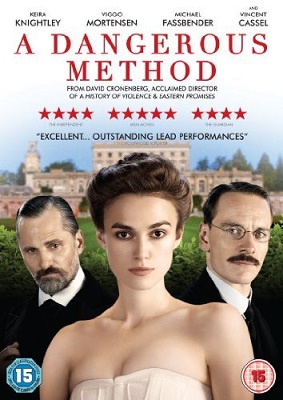
The 5,000 Fingers of Dr T, Roy Rowland (1953, USA). I remember seeing some of this film many years ago, I think when I was at school, back in the 1980s, but it may have been later, perhaps when I was at university. I don’t recall the details. I certainly knew of the film, and I knew it was bat-shit bonkers. So when I stumbled across it on Amazon Prime, I had no choice but to watch it. And it proved so much more bonkers than I’d supposed, and so much better. The plot is simple: a young boy objects to his piano lessons – he is following a course by Dr Terwiliker – and meanwhile is trying to matchmake between his widowed mother and the local plumber. He has a dream in which he finds himself in a strange world where he and 499 other children – the 5000 fingers, you see – are forced to play an insanely long keyboard by dictator Dr Terwiliker. The sets were clearly designed by someone who was on acid, the script was written by Dr Seuss, and the actors play their roles with a wholesome earnestness that is pure 1950s Disney but completely out of place. And it’s a musical. It is fantastic. And Dr Terwiliker’s song, ‘Doe-Me-Doe Duds’, is near genius. Check out these lyrics:
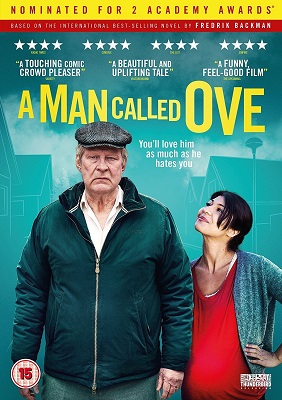
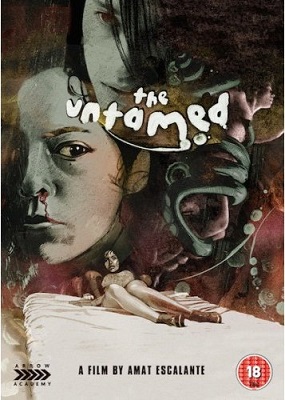
I want my undulating undies with the maribou frills!
I want my beautiful bolero with the porcupine quills!
I want my purple nylon girdle with the orange blossom buds
Cause I’m going doe-me-doe-ing in my doe-me-doe duds!

And the song finishes with:

So come and dress me in the blossoms of a million pink trees!
Come on and dress me up in liverwurst! and camembert cheese!
Come on and dress me up in pretzels, dress me up in bock beer suds! Cause I’m gooooo-ing
doe-me-dooooooooo-ing
in my doe-me-doe duds!

The 5,000 Fingers of Dr T has recently been released on dual format by Powerhouse films. I might get myself a copy…

1001 Movies You Must See Before You Die count: 933