It Doesn't Have To Be Right…

… it just has to sound plausible


3 Comments

Moving pictures, #40

Cracking on, so to speak… More cinematic consumption by Yours Truly.

BSG1978Battlestar Galactica (1978, USA). So this Black Friday seems to have infected the UK from the US (and to be fair it’s a better tradition than the UK’s home-brand Black Friday) and Amazon had a whole bunch of mostly uninteresting deals going, but one which caught my fancy was the re-imagined Battlestar Galactica Ultimate Collection on Blu-ray for £60 reduced from £160. To which I succumbed. And then the following week, they had Cyber Monday, and fuck knows what the fuck that is, but Amazon were selling a bunch of stuff cheap, among which was the original Battlestar Galactica series from 1978, plus the much-maligned Galactica 1980 sequel series, on Blu-ray for half-price at £20. So I bought it too. Foolishly. And watched it. Even more foolishly. I remember Battlestar Galactica quite fondly from the 1980s – it used to be on at 6 pm on BBC2 in Janet Street-Porter’s “yoof” spot. Much as I loved the universe of Star Wars, so I loved the universe of Battlestar Galactica. The uniforms, the spaceships, the, er, well, that was about it. Certainly not the stories. After all, who can forget the episode in which they spend an hour trying to figure out how to put out a fire on the Galactica before deciding to “let the vacuum in”? And the mangling of English in pursuit of a futuristic dialect is both annoying and embarassing – “frak” is okay, “felgercarb” is acceptable, but “chancery” is not the right word for a casino, and when a warrior goes on leave it’s not a “furlong”. Argh. I was, however, surprised by how closely the rebooted series followed the plots of the original series. Not entirely, obvs – but some of them were a lot closer than I’d remembered. The original Battlestar Galactica remains a notable piece of science fiction television, even if it was designed to totally cash in on Star Wars, and the things it did right mostly, but not always, outweigh the things it got wrong. Which is more than can be said for Galactica 1980

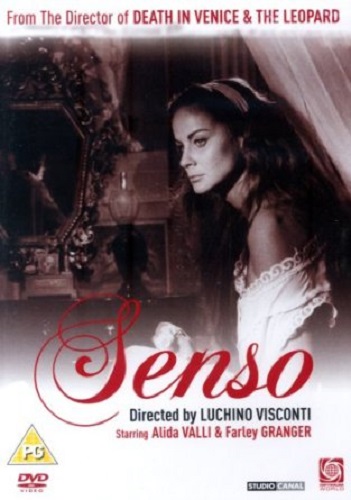
sensoSenso*, Luchino Visconti (1954, Italy). Visconti is a director I think well of – he has directed a number of films I admire. So I was predisposed to like Senso, despite knowing little about it. Other than the fact it was a period drama, which is not necessarily in my book a fact which might affect my opinion. And so it proved. Senso is a good period drama, but I’m not sure why it is a better period drama, other than perhaps its director’s name. Admittedly if its period is not of interest to audiences, that’s hardly the fault of the film-maker. But the whole point of period dramas is that they’re recognisable – or something about them is recognisable – to the viewer. For Senso, this is undoubtedly true of an Italian audience, much as it would be for Visconti’s excellent The Leopard… But Senso, for all its plaudits, never quite manages to evoke its time and place as a time and place sufficient to persuade audiences of its story. To be honest, I don’t recall much of the film (I write these posts a week or two after viewing the movie) and from what I do remember it struck me as mostly unsuitable romances during a period when such a thing existed and had very real social consequences. Nothing in the cinematography stood out, which I would have expected of a film by Visconti. He’s done better, and I’m surprised this one made the 1001 Movies You Must See Before you Die list.

BSG1978Galactica 1980 (1980, USA). Ever watched something – several episodes of something – and then wonder why the fuck you bothered? Admittedly, Battlestar Galactica, the original 1978 TV series, is far from great television. But even fans of that are hard-pressed to say something nice about Galactica 1980. It’s not just that the project started off with a dumb premise, but also that the premise was shot down by the network after the pilot and then replaced with an even dumber premise. It’s a generation after the original Battlestar Galactica ended and its stars all have better things to do except Lorne Greene whose career must have been in the toilet as he’s back but this time with a fake beard. And there’s another villain, another nasty member of the Council, played by Richard Lynch, who also played a villain in an episode of the previous series. The “ragtag fugitive fleet” has finally reached Earth, but our world is, er, far too technologically primitive to help them fight the Cylons. But Betamax! I hear you cry. Walkmans! Sinclair ZX81s! Ford Pintos! Legwarmers! So Xavier, the councillor played by Lynch, decides to travel back in time in order to boost Earth’s technology – and the period he chooses is – yawn – Nazi Germany in the 1940s. Peenemünde, to be precise. Xavier is going to help von Braun invent the V-2. But grown-up Boxey – now called Troy because Boxey is a dumb name, even for a kid – and Barry van Dyke sidekick Dillon are sent back after Xavier – whose name is at least not pronounced ecks-avier because that’s not how you fucking pronounce it, you fucking stupid X-Men – and manage to destroy the V-2 prototype as it launches and so, er, stop V-2s from raining death and destruction on London– no, wait. That happened anyway. Anyway, they don’t change history. Xavier escapes to another time period to continue his dastardly plan. However. The network didn’t like the idea of Galactica warriors chasing Xavier through time-period-of-the-week and asked for a rethink. So we got… space scouts! A bunch of kids from Galactica are stranded on Earth, chaperoned by Troy and Dillon, who decide to disguise the kids as a scout troop. The remaining six episodes involve Troy and Dillon having adventures in USA 1980 – including a cringeworthy double episode featuring Wolfman Jack – sometimes with, sometimes without, the super-strong, high-jumping super scouts who can also turn invisible. The final episode is a flashback in which Starbuck crashlands on an alien world, finds a crashed Cylon fighter, reprogrammes one of the Cylons into a middle-American, and then becomes the father – without actual sex – with a mysterious and flighty young woman of the young genius who directed Galactica’s strategy in earlier episodes. Both, I should add, remain remarkably clean during their ordeal. And the woman wears a quite flimsy nylon dress. Even the Cylon is shiny as fuck. Battlestar Galactica is pants; Galactica 1980 is an entire underwear department. I expect the Blu-ray will prove useful at persuading unwanted guests it’s finally time to leave…
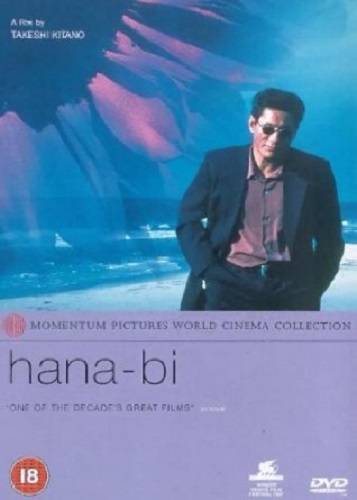
hanabiHANA-BI*, Takeshi Kitano (1997, Japan). According to Wikipedia, the title of this film should properly be in all caps. So that’s how I’ve done it. I have a lot of time for Takeshi Kitano – he has a wonderfully varied oeuvre, and some of his films are actually classics (plus if you don’t love the final musical number in his version of Zatoichi then you are clearly not human). This, however, is an early work, although apparently not early enough not to be known to display his trademark. er, trademarks. Such as gory violence. Which it contains in abundance. The film also follows an achronological narrative. Kitano plays Nishi, a police officer, whose wife has cancer. His partner is confined to a wheelchair after a shootout with a Yakuza. Nishi retires, and finds himself in debt to a Yakuza loan shark. So he masquerades as a police officer and robs a bank. The film skips back and forth in time, without clues (remember Gwyneth Paltrow’s plaster on her face in Sliding Doors?), which initially makes the film hard to follow. But it soon becomes clear and starts to grip. The moments of violence are shocking and bloody. Nishi, however, remains a cipher. A good film and a deserving entry on the 1001 Movies You Must See Before You Die list, I think.
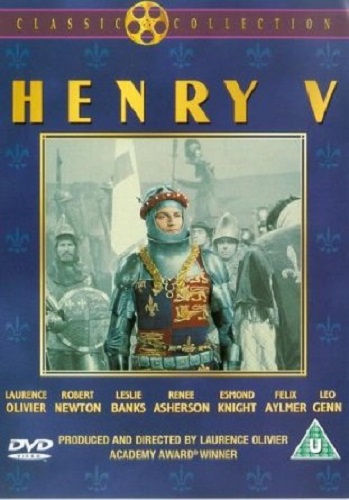
henry_vHenry V*, Laurence Olivier (1944, UK). One of the joys of following the 1001 Movies You Must See Before you Die list has been finding films you really enjoy and/or greatly admire that you would not otherwise have come across. Now I respect Shakespeare, and I’ve been intermittently working my way through the BBC adaptations of his plays (I really ought to buy the damn boxed set), but he’s hardly my first choice, or second , or third, choice of viewing. More so for a 1944 adaptation. By Olivier, who, for all his evident ability, has been characterised as a “luvvie”. So, unexpectedly, I found myself really liking his staging of Henry V. Not because he’s chopped it down to a suitable movie length, or because everyone acts like an actooor (including some godawful Welsh characters)… but because he chose to represent the world of his play as towns and cities are represented in mediaeval art, because he framed the play as a play, and because he staged the battles really quite effectively. It works, it works really well. From the opening pan across a model London to the Globe Theatre, its cast and audience, to the not-quite-Technicolor of its costumes and sets, to the faux mediaeval representations of places to the battle itself… it all works wonderfully well. It is Shakespeare made real. It’s not the dry play as learnt by schoolgirls and schoolboys, it’s visceral and real… and yet still a play. I had expected Henry V to be dull and firmly up its own arse, but in fact it is a great piece of cinema. It needs a proper re-issue , remastered on Blu-ray, not some afterthought “classics” DVD release.
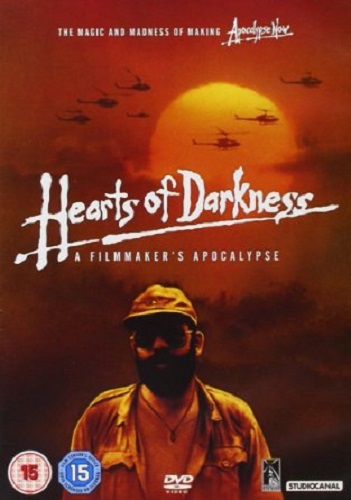
hearts_darknessHearts of Darkness: A Filmmaker’s Apocalypse*, Fax Bahr & George Hickenlooper (1991, USA). I like Apocalypse Now, I think it’s a good film. It wears its inspiration a little too obviously on its sleeve, but it doesn’t suffer because of that. And some of the supporting cast pretty much define stereotypes of Vietnam War movies (except Dennis Hopper’s character, which is a stereotypically Dennis Hopper character). Hearts of Darkness: A Filmmaker’s Apocalypse, however, is the documentary about the making of Apocalypse Now, a notoriously difficult film to make. Partly it was money – Coppola had to stump up his own cash, and it still went over-budget. Partly it was the location – the Philippines stood in for Vietnam, and despite promises by the government the borrowed military helicopters often disappeared with little or no notice to fight rebels. And partly it was Coppola not knowing what the fuck he was doing. Then there was Marlon Brando, who demanded $3 million for three weeks’ work, and who then spent days sitting around discussing his character’s motivation. What a prima donna. Seriously, that’s totally unprofessional behaviour, and I doubt his name on the credits added significantly to the movie’s takings. Coppola also spent a week filming Harvey Keitel in the lead role, before firing him and casting Martin Sheen (Sheen is very, very good, but it would have been interesting to see what Keitel was like, but sadly no footage is included). Hearts of Darkness: A Filmmaker’s Apocalypse is an object lesson in how not to make a film – there are a few problems which are a result of the location, but the main takeaway is that Coppola didn’t know what he was doing and bit off more than he could handle. Having said all that, Apocalypse Now is a genuine piece of classic cinema, but so perhaps it was all worth it…

1001 Movies You Must See Before You Die count: 696

4 Comments

Moving pictures, #39

Trying to get the last of these out of the way before Christmas. It doesn’t help that I’ve been watching a couple of films a night, more on the weekend. And it’s not as though I mention every film I’ve watched in these posts – some because they’re rewatches, but mostly because they’re some rubbish I stumbled across on TV, Amazon Prime or charity shop DVD… Anyway, here’s the latest batch…

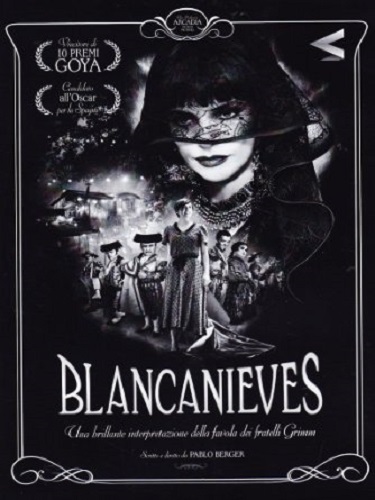
blancanievesBlancanieves, Pablo Berger (2012, Spain). Back in 2011, The Artist was released, a silent film produced in France, which went on to win a raft of awards. This was a bit of a blow to the makers of Blancanieves, who had decided to make a silent black-and-white film several years before but didn’t make it into production soon enough to beat The Artist to release. To be fair, The Artist is a very good film, but you have to wonder how many of its awards were a result of the novelty of a silent B&W film in the 21st century. But then we have Blancanieves, also a silent B&W 21st century film, against which to compare it. And, sadly, Blancanieves does not compare too favourably. It’s good, but it’s doubtful it would have beaten The Artist to any awards. Not in Blancanieves‘ favour is that it’s about bull fighting, a sport (and I use the term loosely) that only the Spanish seem to think is not barbaric. The plot is apparently based on ‘Snow White’, albeit transplanted to Spain and, er, matadors. It’s certainly a nice-looking film, and it works quite well as silent and B&W. And, but for inevitable comparisons to the Oscar-winning The Artist, it would likely count as a good film. But comparisons are inevitable, and it loses out to them. All the same, worth seeing.

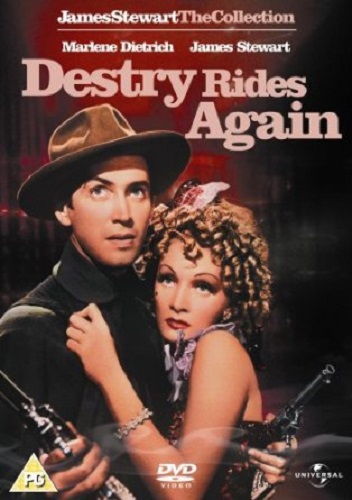
destryDestry Rides Again*, George Marshall (1939, USA). If there’s one story which appears again and again in Western films, it’s the lone hero who cleans up a town under the corrupt thumb of the local cattle baron. Given the bad name cattle barons have in Western literature – which is the nearest the US gets to a native mythos (native to its colonisers, that is) – it’s surprising unfettered capitalism is still seen as admirable. Maybe everyone is just waiting around for the lawman to turn up and clean up the town… although I wouldn’t go looking to that gallery of clowns the GOP is currently fielding as they’re so deep in the cattle barons’ pockets they’ve forgotten what daylight looks like… Ahem. Anyway, wild west town is dominated by criminal sorts, led by owner of the local saloon, at which Marlene Dietrich performs nightly. Villain has been cheating people at cards in order to get their land, and now owns the route needed by ranchers on their drives – and he’s going to charge them a fee per head to cross his land. When this leads to the sheriff’s murder, the corrupt mayor gives the tin star to the town drunk… who promptly sends off for Jimmy Stewart. In the past, the drunk had been deputy to Jimmy’s dad, the original Destry, a much respected lawman, and the drunk hopes the son has followed in the father’s footsteps… Except, it seems, he hasn’t. He doesn’t wear a gun. He lets the villains make fun of him. He even upholds the eviction of a homesteader who had lost the title to his land in a crooked card game. But, of course, Destry is playing a long game, and it all comes right in the end. Of course. This is a Hollywood western, after all. Even Dietrich, the saloon singer and accomplice of the saloon owner, proves to have a heart of gold. The best of the film, however, is when the women of the town, the wives and girlfriends, decide to intervene in the big fight between the forces of law and the villain’s henchman, and march straight in with various blunt instruments and proceed to hammer the shit out of the bad guys. That’s not something that normally appears in the mythos. And, perhaps, given more focus in the narrative, it might have made something special of Destry Rides Again. As it is, it’s a good western – though more for its breaking from the template than its slavish following of it – but there are a number of good westerns on the 1001 Movies You Must See Before You Die list, compared to the vast number of ordinary and just plain bad westerns that Hollywood made. Worth seeing.

spring_small_townSpring in a Small Town*, Mu Fei (1948, China). This is generally reckoned to be one of the greatest Chinese films ever made – which is quite an encomium given the size of Chinese-language cinema (yes, I know “Chinese” is a language family, not a language, but you know what I mean – the film is actually in Mandarin). A classic piece of cinema it certainly is, not only because of its age. It is also a really good film, a film I watched on rental DVD but would like to pick up my own copy so I can rewatch it. A woman’s life post-WWII is interrupted when a suitor prior to her marriage arrives in town. The film takes its time telling its story, but that actually works to its advantage because it allows for a nuanced presentation of the various relationships – wife and her husband, wife and old boyfriend, wife’s younger sister and the old boyfriend… To be fair, there’s not a great deal of subtlety in who the characters are intended to represent – the husband, for example, spends his time pining for the past and complaining about his various illnesses. And the wife is the heart of the film, and whose heart is torn. I really need to be get my own copy of this. Incidentally, the film was remade in 1993 by Zhuangzhuang Tian. I’ve not seen the remake, but I’m definitely intrigued…

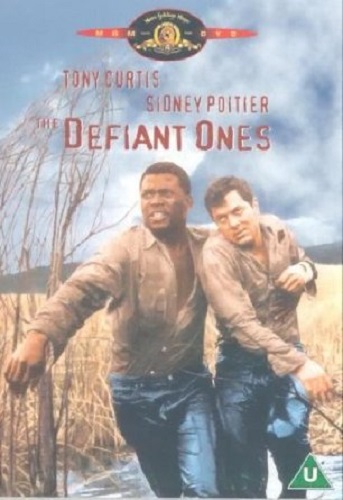
defiantThe Defiant Ones*, Stanley Kramer (1958, USA). It is horrible to think this film may well owe its position on the 1001 Mosvies You Must See Before You Die list because back in 1958 it was considered transgressive, perhaps even shocking. Because it’s about two cons who escape a chain gang while chained to each other. One is Tony Curtis, the other is Sidney Poitier. A white man chained to a black man. Curtis coasts, as well he might given his role, but Poitier is good (both were nominated for Oscars, but neither won – the award went to David Niven for Separate Tables). The two struggle through the swamps before stumbling into a company town, where they are captured and about to be lynched. But one of the residents argues against such vigilante “justice” and later helps them escape. They come across a boy, who takes them home to his mother, who has been abandoned by her husband. And she uses race to drive a wedge between the two, because she needs a man to look after her. There is not much, it must be admitted, in this film to like. The central premise should not be shocking or transgressive, and the responses of others to the two main characters throughout the film is deeply racist. True, the movies does comment – is itself a commentary – on those racist attitudes, but showing such things without actively presenting consequences seems to me a waste of time. Because, you know, there are people out there stupid enough not to see something bad in what they’re watching. All together, probably a film not worthy of the 1001 Movies You Must See Before you Die list.

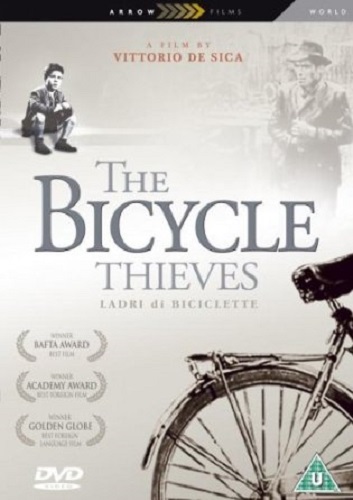
bike_thievesBicycle Thieves*, Vittorio De Sica (1948, Italy). I do like Italian Neorealist films, and this is considered an important work in the genre – an important work in Italian cinema, in fact – but I have to admit I didn’t much enjoy watching it. Chiefly because of its plot. An out-of-work man in post-WWII Rome is offered a job putting up posters, but he needs a bicycle to get the job. So his wife pawns the family heirloom linen to raise the money. But on his first day on the job, the man’s bike is stolen. And he spends the rest of the day trying to find it and its thief. Without success. Grinding poverty is a problem, but it is a structural problem in society. Certainly it’s fertile ground for drama, but such stories always to me imply that such conditions are either normal, inevitable or inescapable – and I disagree with all three conclusions. True, Italy after WWII was not in the best of places economically – but neither was the UK and it managed to create the NHS. The US, of course, was in a much better place – it profited from WWII – and it still treats its citizens like shit. Worse, certain of its citizens kill other ones if they try improve things for those who are not well off. All of which, however, has nothing to do with Bicycle Thieves. As mentioned previously, I like Italian Neorealist cinema, but I didn’t enjoy this particular example. Worth seeing, definitely, and certainly it belongs on the 1001 Movies You Must See Before You Die list, but that’s as far as it goes.

1001 Movies You Must See Before You Die count: 692


1 Comment

Moving pictures, #38

There’s probably another two or three of these posts to come before the year is out. I’ve yet to decide if I’ll carry on with them next year – I might choose to just write about a single film in a post, as I’ve done in previous years. We’ll see. Of course, there’s still a good 300+ films on the 1001 Movies You Must See Before You Die list. But meanwhile…

sleep_bSleeping Beauty, Clyde Geronimi (1959, USA). There was a trailer for this on a rental DVD, I seem to remember, and something about it persuaded me it would be worth watching. I might well have seen the film as a child, but I have no memory of it. A Blu-ray copy appeared in Amazon’s Black Friday sales, so I bought it. And… it’s probably one of the most Technicolor movies I’ve ever watched, second only to The Adventures Of Robin Hood. So, of course, I loved that about it. I also liked that the songs weren’t intrusive – the cast didn’t break into singing per se, the songs sort of grew out of the background music. And the style of the animation is that sort of stylised 1950s, er, style which I find much more appealing than the normal Disney style. So, despite the over-done Disney DVD cover, Sleeping Beauty is actually a gorgeous piece of animation. But, interestingly, it’s an odd take on the story, because it’s told through the viewpoints of three meddling middle-aged women, the good fairies, Flora, Fauna and Merryweather. They hide Princess Aurora from bad witch Maleficent, although, of course, fairy tale curses have a way of coming true… But that sleeping bit, it’s only like part of the final act, it’s the shape of Aurora’s life which is the backbone of the film. And it works really well. As does Maleficient’s actually quite scary transformation into a dragon when she tries to prevent Prince Philip from reaching the sleeping Aurora. Without watching all the other Disney animated features films, and going only on what I remember of them, I think I can safely say Sleeping Beauty is the best of them. Although I would like to watch The Jungle Book again…

nightofthecomet-bdNight of the Comet, Thom Eberhardt (1984, USA). I suspect this may be the most eighties film made during the eighties. I remember first seeing it in the mid-eighties on television – it was introduced by either Jonathan Ross or Alex Cox, as part of a cult film series, I forget which; but I’ve always fancied a copy of it… and then late last year Arrow released a dual-format edition. So I bought it. And… it’s pretty much how I remembered it and, as I mentioned earlier, so very eighties. It’s not just the soundtrack – little of which was actually familiar to me even though I remember much of the decade, although the songs did sound very much of the time. Nor the clothing. But I seem to remember Valley Girls appearing in several cult films at the time – the other one that springs to mind is Julien Temple’s Earth Girls are Easy – and the two main characters of this, played by Catherine Mary Stewart and Kelli Maroney, are pretty much perfect casting. There’s a sequence in the film which more or less defines it for me – and certainly proved the most memorable – and yet has nothing to do with zombies. (Oh yes, the plot is: a comet flies close to Earth, all those who did not spend the night in something with steel walls turned into dust… or a zombie.) Anyway, the two girls decide that since they’re now apparently the only inhabitants of Los Angeles they can do what they like… which includes trying out everything which takes their fancy in a department store – all to, of course, the strains of Cyndi Lauper’s ‘Girls Just Wanna Fun’. Anyway, the pair have their ups and downs, their moments of jeopardy, being rescued and as well as rescuing others – they’re good strong female leads… and it’s a shame films like Night of the Comet are not bettered remembered. Worth getting hold of.

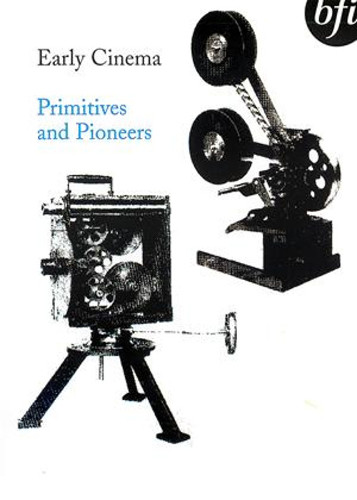
early_cinemaThe Great Train Robbery*, Edison Manufacturing Company (1903, USA). To be honest, I don’t remember much about this – it was one of about twenty or so films on a DVD collection of early cinema, Primitives and Pioneers – a mixture of US, French and British movies, all of which were identified by the company which made them rather than the person who directed them. Some of them were quite good – ‘Explosion of a Motor Car’ by the Hepworth Manufacturing Company was pretty good, if surprisingly, and comically, gruesome. Some of the others were mere fragments. However, one thing which did stand out – and I suppose The Great Train Robbery is as good an example as any – was the desire by the film-makers to tell stories using this new medium. So rather than documenting the world around them, they staged little vignettes and scenarios. A train being robbed, a woman’s baby being stolen from its pram, even the use of fantasy (hand-coloured too) in some of the early French films. In fact, while there’s little to say about the movie which appears on the 1001 Movies You Must See Before You Die list, the actual collection itself is totally worth watching.

blueBlue is the Warmest Colour, Abdellatif Kechiche (2013, France). There was apparently some fuss when this won the Palme d’or at Cannes, although I was not aware of that until after I watched it. But having now read some of the criticisms of the film, I can understand what the critics meant. The film is based on a well-regarded French bande dessinée about a young woman’s sexual awakening and subsequent lesbian relationship with a blue-haired artist. And, of course, the homophobia she experiences – from family as well as school friends. Much has been made of the sex scenes in this film, and it’s certainly true they play far too… straight to be convincing. It’s hard to explain, and I’m no real position to judge the veracity (although plenty who are have said what I am about to), but they don’t ring true, in the same sort of way that sexual encounters in pornographic films don’t ring true as real sex. The two leads, Léa Seydoux and Adèle Exarchopoulos, are excellent, but the whole films still feels like a mistreatment of its source material and the lifestyle on which its source material – Julie Maroh’s 2010 Le bleu est une couleur chaude – is based. I can understand why the film has proven controversial, and I can’t help but agree with those who find fault with it. I’ve seen it now, but, you know, it wouldn’t have bothered me if I never had… and I can’t really recommend it to anyone.

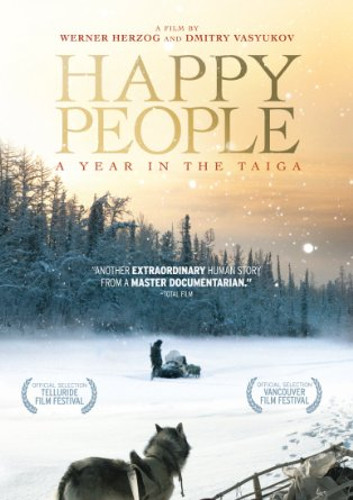
happyHappy People, Werner Herzog & Dmitry Vasyukov (2010, Germany). The subtitle of this film, “A Year in the Taiga”, pretty much tells you all you need to know about this documentary. Assuming, of course, you know what “taiga” means. I admit it, I think Herzog is a genius, and while not all of his films are great, he’s never made a dull film. And that’s as true of Happy People as it is of any film he’s made, even if it’s just a documentary about the inhabitants of Bakhta, a small village in the middle of Siberia, which can only be reached by air or river (and the latter only during the summer when the river isn’t frozen solid). It’s a hard life that Herzog and Vasyukov document, but appealingly simple. True, the values and attitudes of the village’s residents are equally simple, but they seem to suit the lifestyle. There is, for example, one moment where one of the native Ket people accidentally burns down his house because he’d been drunk and left a cigarette burning. But he and his mother are more concerned about the loss of their home’s fetishes than anything else. There’s a sad overtone to much of the proceedings inasmuch as the Ket’s traditional lifestlye has been overwritten by the USSR, but the film’s title is no lie and all those involved seem to be inspiringly happy despite the hardship of their lives. Another charity shop find that’ll be a keeper, I think.

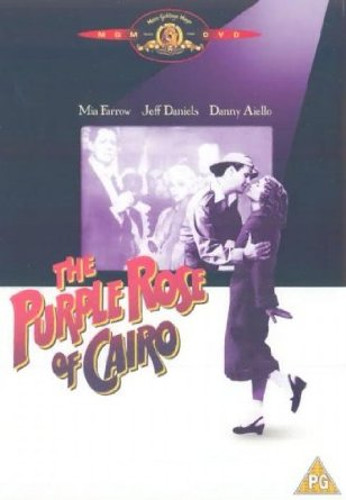
purpleThe Purple Rose of Cairo*, Woody Allen (1985, USA). I am not a fan of Woody Allen’s films. Actually, I can’t stand them. But this one was on the 1001 Movies You Must See Before You Die list, so I sort of had to watch it. (He has several – and far too many – films on the list.) From what I knew of the film, I guessed it would be less irritating than most of his oeuvre – he’s not in it, for a start. And the central premise sounded quite good: a character from a film steps out of a cinema screen and runs away with a lonely woman, only for the actor who plays the character to come searching for the pair. That description, however, proved somewhat incomplete. The woman, played by Mia Farrow, is a battered spouse. And she goes to the cinema to escape her husband as much as she does to watch movies. On the plus side, the idea of a character stepping out of a film, leaving the remainder of the movie’s cast to figure out how to proceed, is handled well and proves mildly amusing. The fish-out-of-water romance by the film character and Farrow is less amusing and trades a little on cliché. And when the actual actor turns up and proves to be self-centred and career-minded, well, that is an actual cliché. My opinion of Allen’s films remains completely unchanged having seen The Purple Rose of Cairo, and I still don’t understand why so many of his movies are on the 1001 Movies You Must See Before You Die list.

1001 Movies You Must See Before You Die count: 688


2 Comments

Moving pictures, #37

Only 315 movies to go and I’m done with the list. Unfortunately, not every film on it seems to be actually available – and the list does evolve – so it’s not like finishing it is, well, a death sentence. I should have a go at putting together my own, I suppose – although, to be fair, 1001 movies is a lot of movies – since I can think of a couple of dozen films which belong on the list much more than some of the Hollywood crap which actually does appear on it. (Quick plug here for my list 101 Films for a cineaste, and I really ought to do a part two and part three…)

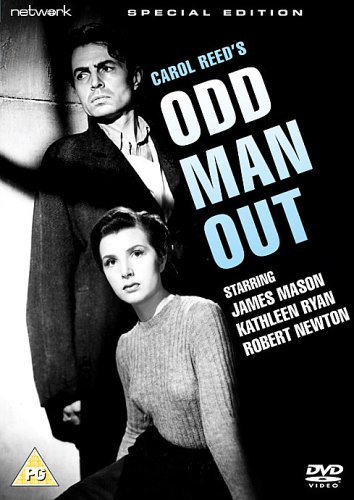
odd_man_outOdd Man Out*, Carol Reed (1947, UK). This was an odd one (no pun intended). It was probably a Quota Quickie – it starred James Mason, who made his career in Quota Quickies during WWII (he was a conscientious objector as he was a Quaker) and is black-and-white. It is also about the IRA. Of course, the organisation is never named, and even the city in which the film takes place remains nameless (although a bus appears at one point with “Falls Road” on its sign). Mason plays the leader of a cell, who has been ordered to rob a mill. The robbery goes wrong, and the men are forced to hide out. Mason is shot and separated from the others, and tries to head back his girlfriend’s house, where he had been hiding for the past six months. In pretty much all respects, Odd Man Out is a straightforward noir film – except for the political angle. It makes for an odd disconnect. While the cast are presented as criminals, and they perform criminal acts, as is fairly common in noir, the fact they’re IRA gives their actions added weight. To be fair, the film doesn’t belabour the point, and while it makes much of its setting, Belfast, the sectarian angle is played down, probably wisely. Apparently Odd Man Out received a BAFTA for Best British Film in its year of release. On balance, it probably deserves to be on the 1001 Movies You Must See Before You Die list.

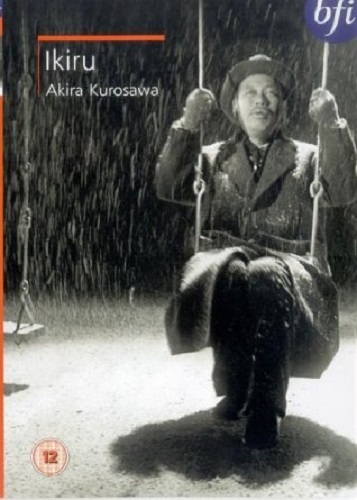
ikuruIkiru*, Akira Kurosawa (1952, Japan). Ask anyone who knows very little abut Japanese cinema to name a Japanese director, and Kurosawa will probably be the most popular answer (so don’t go picking it on Pointless). I have over the years watched a number of Kurosawa’s films and, perversely, still like his Russian one best. I hadn’t really expected to like Ikiru, an early work, especially given the plot summary. A minor bureacrat, Watanabe, is given 12 months to live after being diagnosed with bowel cancer. Impressed by the enthusiasm of his department’s sole female member, a young woman, he starts spending time with her. But she resigns from the ministry, and soon after tires of his company. She tells Watanabe he needs to find a hobby. He decides to take a petition to convert an urban rubbish tip into a playground, and push it through all the government departments and get all the backing and signatures it needs, to make it happen. There’s a quite horrible scene at his funeral during which the local deputy mayor takes full credit for the playground, totally downplaying Watanabe’s contribution. A good film.

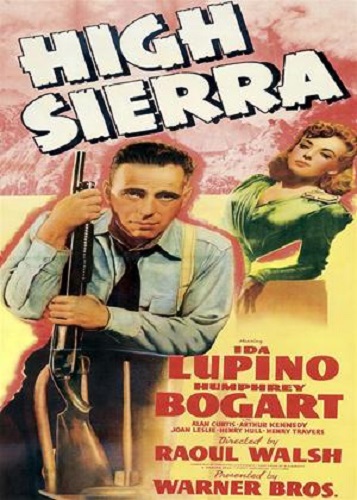
high_sierraHigh Sierra*, Raoul Walsh (1941, USA). I started watching this and wondered if I’d accidentally stuck a film on my rental list I’d already watched earlier in the year… but no, that earlier film was The Treasure of Sierra Madre which, like High Sierra, stars Humphrey Bogart, is in black-and-white, but otherwise bears no resemblance to it at all. On the other hand, I could have been confusing it with Angels with Dirty Faces, which stars the Humph as a bent lawyer, but I suspect it’s just all these noir films are beginning to blur together a bit… In this one, the Humph plays an ex-con who leads a robbery on a resort hotel. Though they plan it to the smallest detail, it all goes horribly wrong. Ida Lupino is good as the femme fatale. She had a fascinating career, incidentally – a Brit who moved to Hollywood, played in a number of noir films, before becoming one of Hollywood’s first female directors. (And Hedy Lamarr, a contemporary, held a patent for the maths used by torpedo guidance systems. Just compare those two with the current crop of Hollwood actresses…). The 1001 Movies You Must See Before You Die could do with having some noir trimmed from it.

black_narcussisBlack Narcissus*, Michael Powell & Emeric Pressburger (1946, UK). I’ve been a fan of the Archers for many years, and thought I had seen Black Narcissus years before – at least, I’m pretty sure I had – but I stuck on my rental list for a rewatch as it’s on the 1001 Movies You Must See Before You Die list. And… yes, it’s the film I thought it was, and it’s also very much not the film I thought it was. It is deeply problematical – Jean Simmons in blackface as a young Indian woman; the whole colonialist attitude to the locals – but it is also a gorgeous-looking film, which is especially surprising as it was filmed entirely in a studio (even the model of the mountain-top monastery looks gorgeous). I recently rewatched the Archer’s The Red Shoes, but didn’t enjoy it as much as I had on previous viewings – and I expected much the same for Black Narcissus, a film I could admire, with very much an Archers’ look and feel, but something of a Sunday afternoon movie and soon forgotten… Except I actually really did find myself liking it. It’s pure melodrama, it’s colonialist melodrama, it is, as I’ve said, deeply problematical… but there’s also a faint whiff of knowingness to it, and a definite series of hints that its viewpoint is skewed (the local British agent, for example, is very much sceptical view of his role). It all adds up to something considerably more than a Sunday afternoon movie, and I wouldn’t mind watching it again…

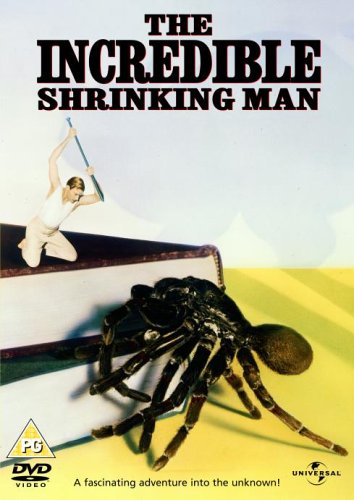
shrinkingmanThe Incredible Shrinking Man*, Jack Arnold (1957, USA). I was taken to task for not liking this film much by a friend on FB. But I really couldn’t get excited about it. Not only does it have that B-movie moralistic voice-over, in which the whole film is presented as an object lesson because no one involved in making the film had enough confidence in the audience to get the point of it all, but the special effects may have been shocking in 1957 but seemed relatively humdrum in 2015. The Incredible Shrinking Man is a B-movie and nothing more, and its presence on the 1001 Movies You Must See Before You Die list is either an acknowledgement that some B-movies have transcended their origins, or a completely mystery. I acknowledge the former, but incline to the latter in this case. The moralistic posturing in The Incredible Shrinking Man actually spoiled it for me, whereas I suspect a reliance on the pure visceral thrill of a tiny little man fighting a GIANT SPIDER might have given the film more authority in its central premise. Despite it s appearance on the list, this is a B-movie, it looked like a B-movie, it played like a B-movie, and its presence on the list is not enough for it to magically transcend its B-movie origins.

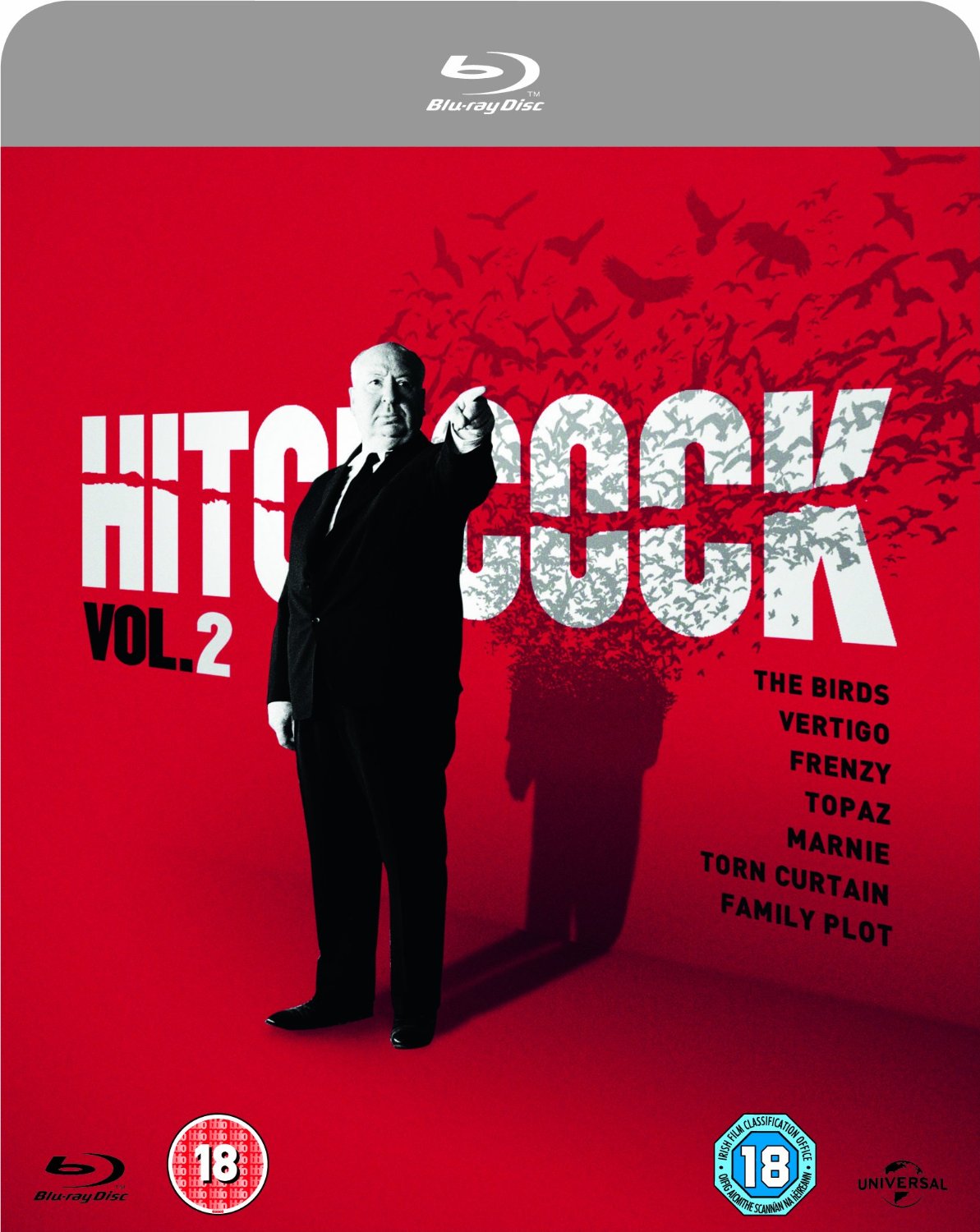
hitchcock2Torn Curtain, Alfred Hitchcock (1966, USA). Among the first DVDs I bought when the format appeared was a pair of Alfred Hitchcock collections. I replaced both of these with Blu-ray editions during a recent Amazon Prime Day, and have been slowly working my way through them – rewatches all, of course. I’ve not bothered mentioning them in these Moving pictures posts because they’re films I first saw decades ago, and have rewatched several times since. But I thought it worth writing about Torn Curtain for a number of reasons. It’s considered minor Hitchcock despite its high-powered stars (who were apparently forced on Hitch by the studio), but it’s also an odd film even within Hitch’s oeuvre. It’s set mostly in Europe – I was dead chuffed, for example, on my first visit to Copenhagen when I spotted the Hotel’d’Angleterre, which appears in this film – and it is a surprisingly European film for a major Hollywood player. Paul Newman is a US scientist who fakes a defection to the East so he can steal some formulae from an East German rocket scientist; Julie Andrews plays his wife, who inadvertently gets herself involved in the whole plot. I had forgotten how wonderfully Technicolor Torn Curtain is, and how surprisingly unpretentious it is. The fight scene between the Stasi agent and Paul Newman, which takes place in total silence, I pastiched in one of my novels I liked it so much. The pair’s trip across East Germany to a contact who will smuggle them into the West is resolutely ordinary, with weird moments of humour interrupting the jeopardy. I actually liked the film a lot more than I had done afterprevious viewings. And yes, it was totally worth replacing my DVD copies with Blu-ray ones.

1001 Movies You Must See Before You Die count: 686

3 Comments

Moving pictures, #35

Your usual selection of classics and obscurities. I’m going to have to find something new to post about when I’ve finished these– oh wait, I’m supposed to be a science fiction writer, I can always post about that, you know, science fiction and writing and, er, books…

camilleCamille*, George Cukor (1936, USA). This is the film in which Garbo apparently laughs– no, wait, that one was another one. This is the one in which she plays the consumptive mistress of a wealthy aristocrat, but falls in love with a younger, better-looking and poorer man, and so has to choose between love and security. Set in mid-nineteenth century France. She chooses the older man, but there’s that consumption, you see, so she dies. This is one of those films that proved entertaining enough, and despite its age made a good fist of its period, but it’s hard to see why it made the 1001 Movies You Must See Before You Die list. Meh.

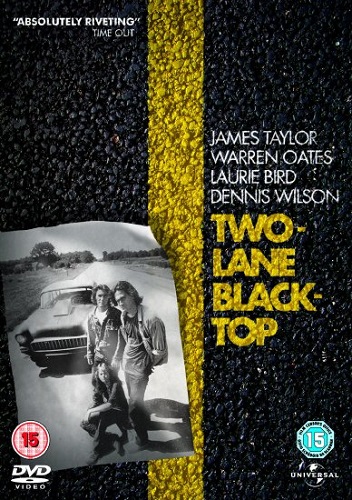
two_laneTwo-Lane Blacktop*, Monte Hellman (1971, USA). I had low expectations for this – an alleged cult classic, starring musician James Taylor and the drummer from the Beach Boys, about a pair of beatniks who race across the US in their souped-up ’57 Chevy. But you know what? It was actually pretty damn good. The main characters’ taciturnity worked well, as did rival Warren Oates’ constant line in bullshit. Despite containing mostly footage of cars driving along empty roads, with the occasional moment of drama and/or action… and despite the characters being little more than ciphers, with no appreciable arcs… and despite being very much a film of its time (with a pretty good, and thankfully not intrusive, soundtrack)… I really enjoyed this. I’d even consider buying my own copy. Definitely a film that belongs on the 1001 Movies you Must See Before You Die list.

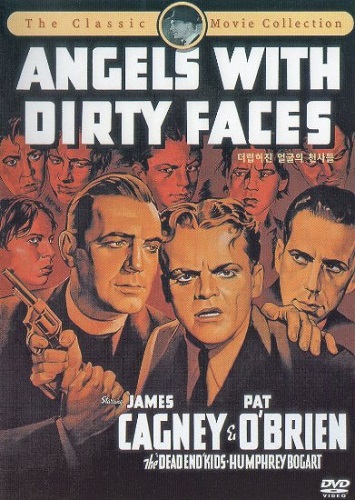
angels_dirtyAngels with Dirty Faces*, Michael Curtiz (1938, USA). The title of this film may well be iconic but the movie itself was a big disappointment. Cagney plays a gangster (yawn), who returns to the old neighbourhood after a stretch and meets up with his old childhood friend, who is now the parish priest. There’s a gang of youths the priest is trying to keep on the straight and narrow, but Cagney gets them involved in all sorts of illegal shenanigans. There’s something to do with corrupt city officials, and a couple of shootouts, and then Cagney is on Death Row and his friend asks him to set an example to the youths and kick and scream on his way to the electric chair (so that the youths will no longer idolise him). So Cagney does just that. There are a lot of noir films on the 1001 Movies you Must See Before You Die list, far more, I think, than the genre merits. And there are way more Hollywood movies on the list than are warranted. It could stand to lose a few of both… and Angels with Dirty Faces would be a good candidate.

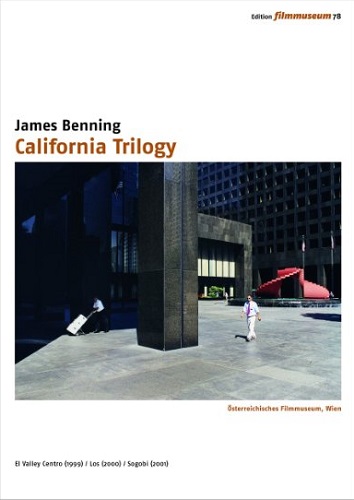
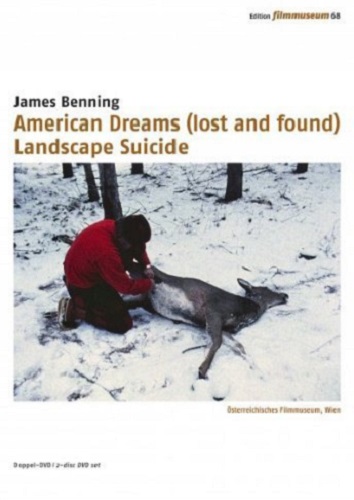
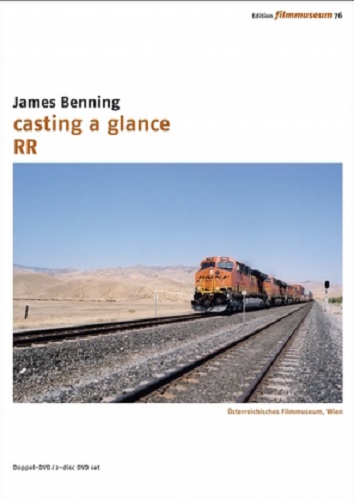
ruhrRuhr / Natural History, James Benning (2009/2014, Germany/Austria). These are the last two Benning films available on DVD (at least until the Österreicheschen Filmmuseum release some more), and one of them was a special commissions by the Natural History Museum of Vienna. Ruhr is a series of six static shots of industrial landscape in the Ruhr district:a road tunnel, a steelworks, an airport, a mosque, a street, and the chimney from a coking plant. In fact, that last shot, the chimney, accounts for 60 minutes of the film’s 122 minutes running time. Apparently, Ruhr caused something of a stir – it was one of Benning’s first films using a digital camera, and he was accused of “digital manipulation”. All that actually happens is he gradually darkens the image of the chimney as the film progresses, so that by the end of the hour-long shot, it’s almost entirely black. That’s all. Natural History, on the other hand, is a series of static shots of rooms and corridors in Vienna’s Natural History Museum, mostly behind-the-scenes places. While the chimney shot in Ruhr is weirdly compelling (nothing actually happens, just steam billowing out of it at intervals), and although Natural History does feature the occasional person wandering past (and voices on the ambient sound soundtrack), the latter film is more a chore to watch. Benning has made some twenty-five feature-length films, but only eleven of them are currently available on DVD. I hope more appear soon.

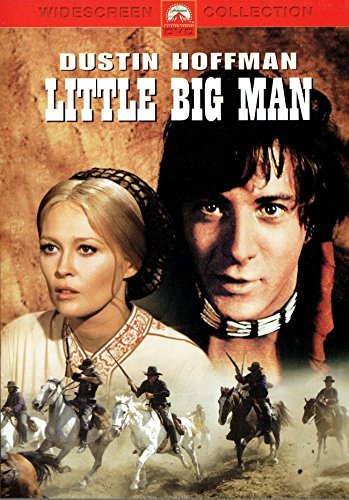
little_bigLittle Big Man*, Arthur Penn (1970, USA). This film is chiefly notable for Dustin Hoffman playing a centenarian under layers of prosthetic make-up (not especially convincing make-up either, by current standards) and apparently screaming for an hour before each take in order to speak with a hoarse voice like a really old person. Hoffman’s titular character starts out as a young boy adopted by the Cheyenne after the members of his wagon train are killed by Pawnee. Then when the Cheyenne are attacked by the US Cavalry, he reveals he’s really white and is taken in by the soldiers. He then bounces around among the settlers, along the way selling snake-oil, getting married, running a trading post… before signing on with Custer (who is portrayed as a moronic oaf) as a scout… only to end up living once again with the Cheyenne. Where he gets married again… only for Custer to attack the village and kill almost everyone. It all ends with the Battle of the Little Bighorn, which Hoffman’s character witnesses. The novel on which the film is based was by Thomas Berger (whose Regiment of Women, by the way, is fucking dreadful), and if it’s anything like the movie I’ve no desire to read it. I have no idea why this film is considered suitable for the 1001 Movies you Must See Before You Die list – when it wasn’t patronising, it was annoying; and when it was trying to be funny, it, well, it just wasn’t. Avoid.

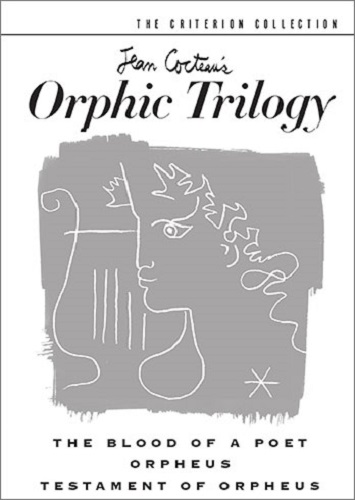
orphicThe Blood of a Poet, Jean Cocteau (1932, France). It took me a while, but I tracked down a copy of the Crtierion DVD release of Cocteau’s Orphic Trilogy, containing The Blood of a Poet, Orpheus (Orphée) and Testament of Orpheus. As is usually the case with these sorts of purchases, two weeks after I bought my copy, I saw another copy going for a fifth of the price I paid. Bah. Anyway, I really like Orpheus, and I wanted to see Testament of Orpheus, but I knew nothing about The Blood of a Poet and was not especially bothered about it. Nonetheless, I watched it and, oh dear, it’s another one of those 1930s French surrealist films. And I’m really not a fan of them. Mostly, it seems to be an excuse to display a bunch of cinema tricks, which ,to be fair, are actually pretty effective (one or two, I seem to recall, also make an appearance in Orpheus). Nevertheless, it’s worth tracking down a copy of the Criterion Orphic Trilogy set, although given it’s a) a US-only release, and b) deleted, it won’t be that easy to find (copies on Amazon marketplace start around £60). Don’t be fooled by the Studiocanal Jean Cocteau Collection, which contains only The Blood of a Poet and Testament of Orpheus, and not the best of the three, Orpheus.

shepitkoWings, Larisa Shepitko (1966, USSR). In order to see Shepitko’s Ascent, which appears on the 1001 Movies You Must See Before You Die list, I had to buy a two-film Criterion box set, which was the only DVD I could find of Ascent. The second film in the set was Wings. And having now seen both, I think Wings belongs on the list more than Ascent does. Nedezhda Petrukhina is a highly-decorated World War II (Great Patriotic War) fighter pilot, who now, twenty years later, is the principal of a school. While still something of a minor local celebrity for her wartime exploits, she is also seen as little more than her role at the school. She has to deal with unruly male students, apparatchiks, all the bureaucracy of her position, while dreaming of the freedom and excitement of her time during the war. There are perhaps elements of Wings which aren’t exactly subtle – contrasting a (mostly) domestic character study with aerial shots of Petrukhina flying through clouds, for example – but I think I much prefer the ordinariness, and its violence-free nature, of this film to Ascent.

I must admit, I thought I knew my taste in films before I started watching the 1001 Movies You Must See Before You Die list. I like science fiction films, I even liked bad science fiction films. And I sort of liked superhero films. And I liked some world cinema. While the list I’ve been using is not especially diverse – more than half of the films on it are from the USA – it has introduced me to a much wider variety of movies, and I’ve found I much prefer films on the edge rather than typical mainstream cinema. In fact, I’ve purged my DVD collection several times since starting the list, dumping a lot of the recent Hollywood titles (I still like the old classics from the 1950s and 1960s) at local charity shops, but then also hunting around online for copies of DVDs by some of the more obscure directors I’ve been introduced to.

1001 Movies you Must See Before You Die count: 674


2 Comments

Moving pictures, #34

Bit of a surprise this time round, a film I actually watched in a cinema. But before you get too excited – no, it’s not The Martian, it’s the latest 007, SPECTRE. And it was, well, it was…

spectreSPECTRE, Sam Mendes (2015, UK). The previous 007 film to this, Skyfall, was a massive international hit. I was less than enamoured of it – I laughed when I saw its open-air server farm, and I was flabbergasted, and deeply disappointed, when Skyfall itself turn out to be just a bloody house in Scotland. So my expectations – despite promotional advance notices – of SPECTRE were not high. And yet it still failed to meet them. The UK security services are being amalgamated under a super-technological super-surveillance organisation headed Andrew Scott (who seems to play the same character in every role), and whose technology was provided by a private contractor (plus much of its funding too). This is actually quite a pointed indictment of Tory politics and economics, but it’s unfortunately lost in the rest of the film’s crap plot. Which revolves around Oberhausen – later renaming himself Blofeld, er, for reasons – played by an unctuous Christoper Waltz, who is as threatening a villain as a week-old blancmange. Meanwhile, manly man Bond is totes old school and no one wants old school no more, so he’s persona non grata. Except totes old school is the only way to beat smiley villain Waltz and super-surveillance-state Scott. And the rest is all useless fat on a story already over-marbled with adipose tissue. The car chase through Rome in hypercars is superbly silly as there are no roads that allow the cars to reach the speeds they’re capable of. The family link between Oberhausen and Bond adds nothing. The female characters are paper-thin. Fiennes adds some much needed gravitas as M but is inconsistently written; and Wishart’s Q has yet to find a peg on which to hang his character. This is an underwhelming film. It has the big action sequences, it has the secret lair in the middle of nowhere, it even has the obligatory torture scene. But we’ve had more than half a century of Fleming’s hugely over-rated books, and it’s going to need more than state-of-the-art film-making to inject some much-needed life into the film franchise.

un_chien_andalouUn chien Andalou*/ L’Age d’or*, Luis Buñuel (1928/1930, France). I admit it, I looked away during the razor/eyeball scene. I’m squeamish, I won’t apologise for it. As for the rest of Un chien Andalou… er, um… Good question. It’s a surreal movie, and reputedly an early model for muscial promo videos, but to be honest I can’t remember what was part of Un chien Andalou, L’Age d’or or even Cocteau’s The Blood of a Poet. They all seem to have merged in memory into one movie of bizarre cinematic non sequiturs. There was a man dressed as a nun, and a woman standing in the middle of street and then hit by a car, and, er… Nope, it’s gone. L’Age d’or at least boasted something approaching a plot, even if it was only a series of scenes of a pair of thwarted lovers. The opening sequence, however, seemed to bear no relationship to the rest of the film. And though it looked like a silent film (if that makes sense…), every now and again someone would speak. Meh. I’ve watched seven of Buñuel’s films so far, and I think I much prefer his later ones – although I did like The Exterminating Angel – and probably the one I’ve thought best so far is The Discreet Charm of Bourgeoisie. Oh well.

salt_earthSalt of the Earth*, Herbert J Biberman (1954, USA). I knew nothing about this film, other than it was on the 1001 Movies You Must See Before You Die list and neither of the two rental services I used had copies. And then it appeared on Amazon Prime as a free-to-watch movie. So I watched it. Not the best quality, it has to be said – a cut above a rental VHS cassette, but about the same as a piss-poor DVD transfer. But. Amazing film. One that deserves to be restored and released on Blu-ray, that needs to be on every list of great films. Not because it is beautifully shot, or even amazingly acted, or fantastically scripted. It is, in most respects, a pretty ordinary drama of the early 1950s. But it is the reasons why it is not ordinary that make it stand out. Its story of a strike at a New Mexico zinc mine is based on real events. The US mining industry is notorious for its callous disregard of employees and environment. In Salt of the Earth, latino miners go on strike to demand equal pay to whites. But in order to get around an injunction against picketing their place of employment, it is their wives who actually picket. Leaving the men at home to look after kids and household. And the women are determined to win – so much so they continue despite being arrested repeatedly. And this is all based on true events. In fact, the bulk of the cast were not professional actors, but people actually involved in the strike which inspired the film. Go watch it.

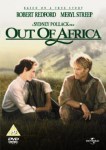
out_of_africaOut Of Africa*, Sydney Pollack (1985, USA). I have yet to work out if I actually liked this film or not. As I watched it I sort of flipped from one state to the other. I liked the character played by Meryl Streep – Karen Blixen – but hated Streep’s weird accent. Robert Redford was a real charmer – but seemed too urbane for his part. The cinematograpy was mostly gorgeous – but still managed to hit every Africa cliché available. And yet… by the end I sort of found myself liking it. I think it’s possibly because it’s a dramatisation of Karen Blixen’s actual life, as documented in her book of the same title as the film, and that knowledge gave the film a much needed boost of credibility. The fact it’s a true story – it says so on the DVD cover – added an edge, more interest. I’m tempted to mention the cinematography, but it would be a piss-poor director who failed to find lovely visuals in Africa – and Pollack may not be an auteur, but he knows his craft and he’s been producing money-making films for decades. Not a great film, a borderline case perhaps, but I think I’m generally well-disposed toward it.

closely_observed_trainClosely Observed Trains*, Jirí Menzel (1966, Czech Republic). This is a title I’ve certainly seen mentioned a number of times in relation to classic films or recommended arthouse films or best world cinema. Despite all that, I knew little about it. It has, I now know, a typical Czech black humour, and its ingenu protagonist is a character Czech cinema has taken advantage of more than his fair share of times. In this case, the ingenu is a trainee station guard at a small country station in German-occupied Czechoslovakia during WWII. The remaining cast are… not grotesques, but certainly comic figures. And that’s about it. There’s a final sequence in which the ingenu places a bomb on a passing Nazi troop train, but the film is more a series of short character arcs than an actual story with a beginning, middle and end. Not a bad film, and probably deserving of its place on the 1001 Movies You Must See Before You Die list, but not a great film.

tomorrowlandTomorrowland, Brad Bird (2015, USA). You know when you hear about a film and its premise sounds interesting and then you learn it was written by Damen Lindelof and you think oh fuck… Well, that’s Tomorrowland. On the plus-side, Disney have done an excellent job on the Blu-ray release. And the film does look quite lovely at times. On the other hand, it’s a complete hot mess that makes no sense and is about as rigourous as a bowl of strawberry jelly. Child Clooney visits the World Fair in 1964 and travels forward in time to a place called Tomorrowland. The film abruptly shifts to the present – except they’re taking apart Space Shuttle launch platforms and the last Space Shuttle mission was in 2011, so maybe not the present per se. Clooney is now a reclusive inventor after being thrown out of Tomorrowland – but Casey Newton, who has seen visions of Tomorrowland thanks to a special badge given to her – is determined to find her way there. And no, none of this actually makes any sense. The place Tomorrowland seems to be based more on magical technology rather than 1950s visions of the future (which was clearly the intent). And even in the so-called present-day, there’s the usual science fiction bobbins masquerading as plot – such as the robots with the shit-eating grins – but things really jump the shark when a wax exhibit on the Eiffel Tower proves to be the key to launching a secret steampunk rocket hidden under the edifice, which goes up into space, and, er, back down again but lands somewhere in Tomorrowland – because that’s how re-entry works obvs. And it’s all because the magic tech which keeps Tomorrowland together is slowly destroying our reality. Or something. The more you think about Tomorrowland, the less sense it makes. Which is pretty much Lindelof’s USP, I suppose. It doesn’t so much fail to suspend your disbelief as take your disbelief and throw it out of a fifty-storey window. I will no doubt watch this movie several times, and be even more confused by it – and not in a good way – with each subsequent viewing. A major disappointment.

1001 Films You Must See Before You Die count: 670


Leave a comment

Moving pictures, #33

It seems to be mostly US films in this post, but that’s just the way the rental DVDs came. And all but one film are from the 1001 Movies You Must See Before You Die list too.

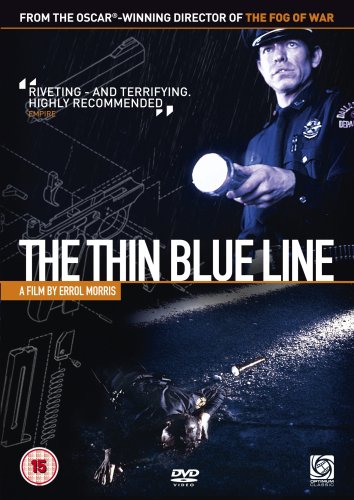
thin_blue_lineThe Thin Blue Line*, Errol Morris (1988, USA). There are a number of documentaries on the 1001 Movies You Must See Before You Die list, and while I can understand why they were chosen I’m not entirely convinced they still hold up today. The Thin Blue Line is a case in point. It’s a study of a cop killing in the US in 1976, for which an innocent man was sentenced to death (although his death sentence was actually commuted to life imprisonment). If every miscarriage of justice in the US prompted a documentary, we wouldn’t be able to move for the damn things. There’s not much in this one that makes it especially interesting – the man found was found guilty thanks to perjured testimony and a determination by the district attorney to make a case, despite all the evidence suggesting another perpetrator. That the actual killer came from a community with a strong KKK presence may have had something to do with it, but The Thin Blue Line shies away from outright accusations. Apparently, this documentary was one of the first to make use of re-enactments of the crime although, interestingly, the re-enactments shown are as per the various witnesses and not the actual suggested series of events. It was mildly interesting.

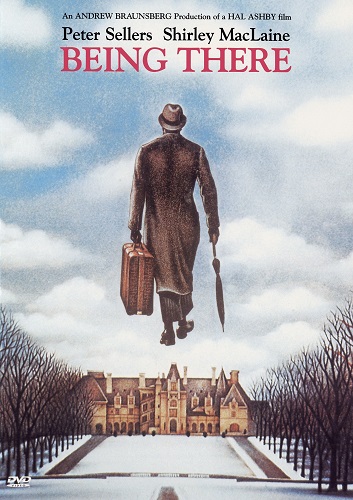
being_thereBeing There*, Hal Ashby (1979, USA). Although I’ve been aware of this film for several decades, I’d never actually seen it. Back in the late 1970s, Peter Sellers was a huge star, so anything he did was news. And Being There, a film in which he plays a mentally disabled man who is forced out into the world when his guardian dies, was a film I remember getting quite a bit of press. And time has apparently been generous to it, seeing that it’s on the 1001 Movies You Must See Before You Die list. Which is, of course, why I stuck it on my rental list, and watched it when it arrived. And… It’s a movie with a single mildly amusing joke – that the complete lack of understanding of Sellers’s character is taken for great wisdom – which it relentlessly flogs to death. It is perhaps overly charitable to describe Being There as a one-joke movie, because it tries desperately hard to find the humour in its premise… and the obvious location is: among the rich and powerful. Humbling those in power – in a non-threatening way that doesn’t actually, er, threaten their power – is a Hollywood speciality, and Being There pokes fun at the US rich and the US presidency with all the subtlety and effectiveness of a sword made of cooked spaghetti. I have no idea why this film was considered worthy of the 1001 Movies you Must See Before You Die list.

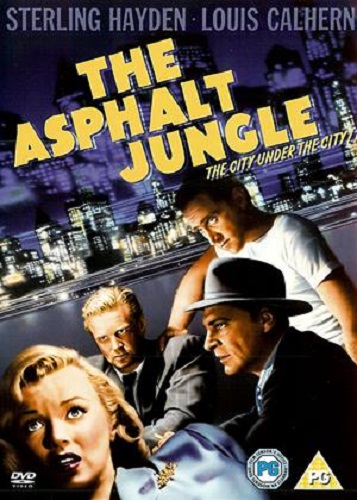
asphalt_jungleThe Asphalt Jungle*, John Huston (1950, USA). Although the DVD cover to the left doesn’t feature her, this film is often noted for being one of Marilyn Monroe’s earliest roles. Which is at least notable, as there’s little in this film to actually suggest it might be a superior example of a noir movie. While I recognise it’s hard for old films to demonstrate their reason for inclusion on a list of film classics since techniques they may have originated have become industry standards… And to take a slight swerve sideways, it’s a bit like why John Carter failed so badly – because the tropes it made use of had been used so frequently by science fiction and science fiction cinemas in the century since A Princess of Mars was published, that the movie felt like it was re-using old material when it was actually the origin of that material. And perhaps that’s also true of The Asphalt Jungle – not, of course, that that should be the chief reason for inclusion on such a list – but I suspect Monroe has more to do with its reputation than any inherent quality in the film. A criminal mastermind fresh out of prison arranges a jewellery store heist, but their middleman has secretly decided he’s going to fence the goods himself. Actually, he’s decided he’s going to do a runner with them. Unfortunately, the police are sniffing around the gang for a number of different reasons and then… well, honour among thieves and all that. Noir fans will probably get more out of this film than I did.

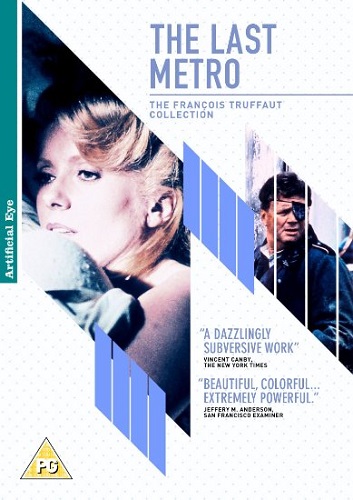
last_metroThe Last Metro*, François Truffaut (1980, France). I think Truffaut’s adaptation of Fahrenheit 451 is a wonderful film, but I’ve not really taken to anything else he has directed. Which now includes this one. Set during the occupation of France by the Nazis, Catherine Deneuve plays the owner of a small theatre which continues to operate – apparently, people would go to the theatre to keep warm as fuel was severely rationed. Her husband, a Jew, has allegedly fled France, but is actually holed up in the theatre’s basement. Meanwhile, Gerard Depardieu has joined the cast as the new male lead… and it all went on a bit and no doubt made a bunch of important points – especially in regard to the collaborationist theatre critic – but it was also dull. The cast were uniformly excellent, and the  mise en scène mostly convincing, but there didn’t seem to be anything there to hold the viewer’s attention. I don’t doubt that Truffaut is an important director, and he certainly belongs on a list of 1001 Movies You Must See Before You Die, but I’ve not seen enough of his oeuvre to determine if The Last Metro is the best choice… And yet, the reasons I love his Fahrenheit 451 are purely personal and I don’t know if that makes it worthier of inclusion on such a list.

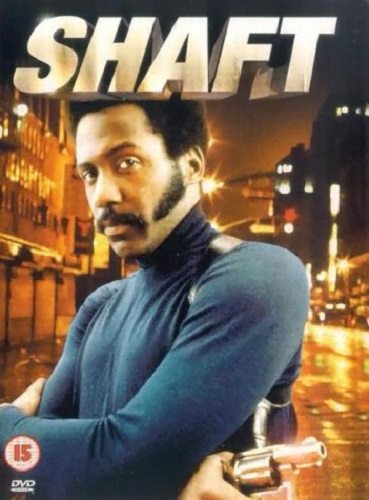
shaftShaft*, Gordon Parks (1971, USA). Most people would recognise the theme tune to this film within a few bars, but how many could tell you the plot of the movie? The title character is a private detective who gets involved in a Mafia attempt to move into Harlem and displace black gangsters. It is, pretty much, a bog standard PI film of the 1970s. But it also makes a point of its title character’s race, and asks some important questions along the way. Richard Roundtree is actually surprisingly bad in the title role, although none of the cast actually shine. But the 1970s ambience works well, the pacing is just about right, and the gangster plot resolves itself in a satisfying way. There were many Blaxploitation films released during the 1960s and 1970s, and it’s hard to believe Shaft was among the best of them. As a thriller, it’s an inferior example of the genre, but, bad acting aside, what makes it stand out is its commentary on black culture and society. Roundtree gets to say things that needed saying. And yet, forty-five years later, “black lives matter” is still a thing, and videos of US police beating up, or even killing, black people are uploaded almost daily to Facebook…

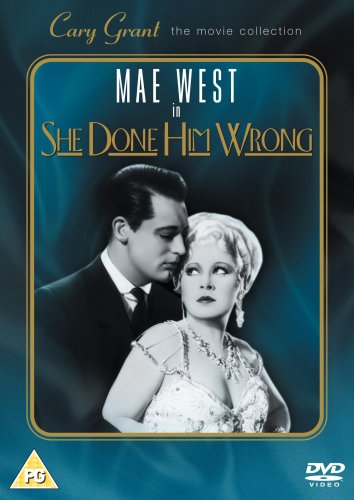
she_done_him_wrongShe Done Him Wrong*, Lowell Sherman (1933, USA). I think this is the first Mae West film I’ve ever seen, but she was just like I’d imagined she would be. On the other hand, I hadn’t realised Cary Grant was in it – not until he appeared on the screen, that is. West plays a singer in a Bowery saloon, who has many jewels and a lifestlye that doesn’t quite match her occupation. Grant plays a Sally Army captain based in a building next door. But he’s not really, he’s a G-man. And West’s boss and beau has been involved in naughty business. So Grant keeps on popping into the saloon, while West does her thing – which includes taking in a young woman who her boss would, unbeknownst to West, send to San Francisco to be a prostitute or a pickpocket. But West is a surprisingly benevolent figure, despite her image – as, apparently, was West herself, who insisted on having a WOC play against in her in her films and stage shows, and did much to battle racial discrimination in Hollywood. Despite all that, She Done Him Wrong is only mildly entertaining. It all feels a bit melodramatic, and while West sails through the proceedings with all the presence and aplomb of the biggest battleship in the fleet, Grant lacking his later (and customary) sheen isn’t especially watchable, and the the rest of the cast are a bit pantomime. This might well have been an early box office success and Oscar nominee, but I’m not sure that a footnote in the history of US cinema is a good enough reason to qualify as one of the 1001 Movies You Must See Before You Die.

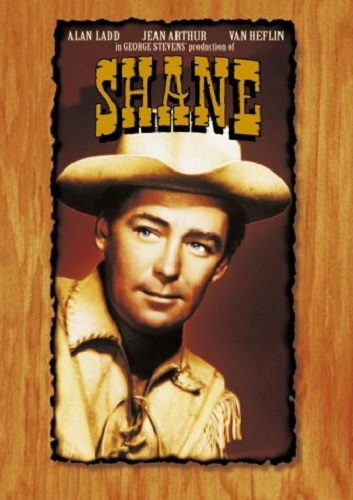
shaneShane*, George Stevens (1953, USA). I am not a big fan of Westerns, athough I do love me some Technicolor. And Shane, a seminal Western, opens with some gorgeous Technicolor footage of Wyoming. In fact, those first twenty or so minutes are absolutely lovely. But in a genre in which Clint Eastwood has become the defining hero (and anti-hero), Alan Ladd no longer really convinces. The plot too suffers from the raft of similarly-plotted Westerns which have followed, including some by, er, Clint Eastwood. Cattle barons are trying to force the homesteaders to leave so they can take over their land. Into this drifts lone gunman Shane, who stays to help one particular homesteader family. And, well, the story then runs along well-polished rails. A bit too well-polished. There’s some night footage, which is not very effective, and, in keeping with the time, several scenes in which a studio is tricked out to look like the outdoors – which are equally ineffective. The fight scenes also seem a bit… gentlemanly, and not quite violent enough. Interestingly, it was Shane which introduced the effect of using wires to pull back actors when they’d been shot. It’s now an industry-standard effect. I really wanted to like Shane more than I did. The opening footage promised more than the rest of the film delivered, and even the scenes set in town couldn’t manage the charm of my favourite Western, Rio Bravo from 1959. I’m tempted to give Shane another go – there have been several films I’ve not liked much on first viewing, but then come to really like – so I think I’ll keep an eye open for a cheap copy…

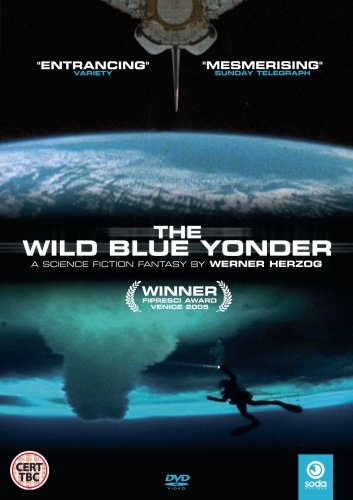
wild_blue_yonderThe Wild Blue Yonder, Werner Herzog (2005, Germany). The elevator pitch for this movie alone was enough to get me interested: Brad Dourif portrays an alien who tells how his race tried to form a community on Earth, shown over re-purposed footage of Space Shuttle astronauts in orbit and divers beneath the ice in the Antarctica. And yet, watching it… Much as I enjoy watching Dourif, it felt like the film would have been better served by having Herzog himself narrate it. The footage is fascinating, and has that sort of documentary artistic feel that Benning does so beautifully in his films, but the narration – the plot itself, in fact – treads a narrow line between silliness and well, not profundity, but certainly a gravitas appropriate to the imagery. In other hands, or indeed without Dourif’s barking mad staring eyes, I don’t doubt it would have been silly from the moment the opening credits rolled. But Herzog is a genius, and even his maddest projects are clearly the products of genius, no matter how unhinged. The Wild Blue Yonder works, and even though I found this is in a charity shop, it’s a keeper.

1001 Movies You Must See Before You Die count: 665


2 Comments

Moving pictures, #32

The films I watch, and document in these moving pictures posts, are pretty much dictated by the rental services I use. While I might set the priorities for the various movies on my rental lists, it’s still random what actually gets sent to me. But then, of course, there are those DVDs and Blu-rays I’ve actually purchased for myself (usually because I want to see them and they’re not available for rental, like the, er, Benning DVDs). So, anyway, more films, of varying degrees of obscurity and/or classic status.

rrRR / casting a glance, James Benning (2007/2007, USA). RR stands for “railroad” and that’s pretty much what you get – 77 minutes of middle-distance shots of US locomotives travelling across the screen, some on urban railways (not “railroad”, because I am British) and some on tracks passing through some amazing landscapes. There is no voiceover, no scrolling text, just ambient noise. I now have some experience with Benning’s films, and while I can certainly sympathise with his desire not to compromise in art, RR is much harder film to watch than others by Benning I’ve seen. It follows in broad form his other works, but its lack of concessions to the viewer can make for difficult viewing. It is, like his other films, often mesmerising (I keep on using that word, I must find another one), and the landscape of the North American continent is in places absolutely stunning (yes, even with a railway track running through it). Benning’s films are an acquired taste, but totally worth it. And yet… casting a glance even manages to test a fan’s endurance. It is a series of shots over two years of Robert Smithson’s artwork ‘Spiral Jetty’. Which is exactly as its name says – a jetty made of stone, in spiral form, in the Great Salt Lake in Utah. What makes this film especially interesting is that although Bennig filmed the artwork over a two year period, he actually documents its lifetime since its creation in 1970 – as the sixteen shots of it depict “the historical water levels (mathematically reconstructed)”. The end result is more like a screensaver than any other Benning film I’ve seen, but still manages to keep interest. Narrative does intrude at one point, when the ambient noise is replaced by the song ‘Love Hurts’, a film released in the same year that Smithson died. I totally agree with making the viewer work to understand a film – culture is not babyfood, it should not be spoonfed – but Benning’s extra-textual references are often just too… extra. I still love his films – and the more about them I learn, the more I love them. But like Sokurov’s movies, there is a story taking place outside of the story on the screen, and knowledge of that totally changes the viewer’s perspective. I have maintained for years that X-Factor is a cross-platform event – the television show makes little sense unless you’ve been following the various dramas in the gutter press. I love the idea of cross-platform and extra-textual intellectual properties – a sort of implementation of Frank Zappa’s “interconnectedness of all things” – but it all needs to be available. Without the booklets in these Österreichisches Filmmuseum DVDs, I’m pretty sure I’d miss a lot of the commentary Benning embeds in his films. Which is a shame.

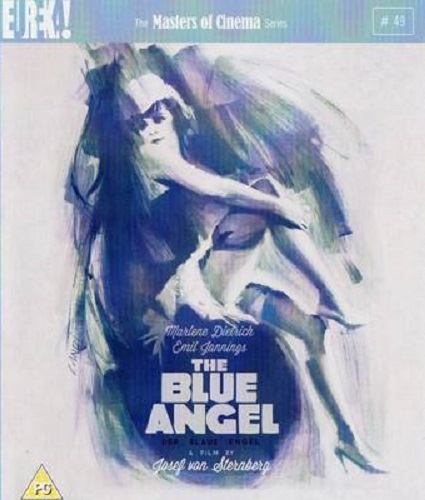
The-Blue-Angel-1930-Front-Cover-95283The Blue Angel*, Josef von Sternberg (1930, Germany). This is the film from which Marlene Dietrich’s public persona likely depends. It’s certainly the source of the most iconic presentation of her. The title refers to a nightclub in Weimar Republic Berlin, at which Dietrich’s character performs. However, the actual focus of the story is the schoolteacher who falls under Dietrich’s spell. Initially, he goes to the club to remonstrate with its star because naughty postcards of her (which she sells as souvenirs) are distracting his students. But he falls under her spell, and returns to watch her so often that he marries her, loses his job and ends up working as a clown in her show. The film was banned by the Nazis, which is obviously a point in its favour – but for all that it seems a fairly unexceptional film. I’ve no way of judging if it was more titillating than was the norm in the 1930, but there’s little enough in it that clearly signals it as belonging on the 1001 Movies You Must See Before You Die list. I’ve seen a number of films from the same era that were clearly innovative, if not seminal, for the period, or that simply stood out for a variety of reasons. The Blue Angel, sadly, is not one of them.

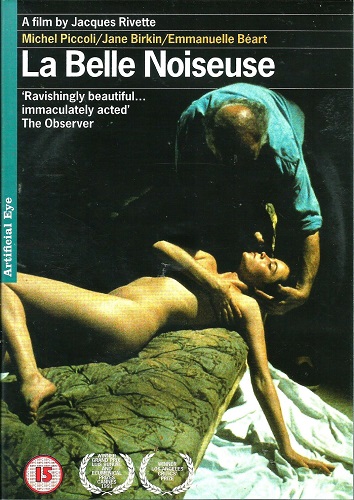
labellenoiseuseLa belle noiseuse*, Jacques Rivette (1991, France). I suspect I may like the idea of Rivette’s films more than I like Rivette’s films – although that’s hardly fair as La belle noiseuse is the first film by Rivette I’ve ever seen, But it is also 237 minutes long – and not that much actually happens during it. A young artist and his girlfriend turn up at the rural retreat of a famous artist who has not produced any new work in years. The girlfriend is asked to model for the famous artist. We see the artist make lots of sketches of the girlfriend, as well as start but not finish a number of paintings. Eventually he does finish one, and everyone assures him it’s a masterpiece, but the viewer doesn’t get to see it. I liked the film, it is very French, and like many of the best French films it subjects its characters’ relationships to much intense analysis. But it did test my patience at times – we see each of the sketches the artist draws, line by line, and it’s not exactly exciting viewing. But I liked that Rivette chose to show us that, I liked that he decided this was the way his film would proceed. As has no doubt become obvious over these Moving pictures posts, I like films by those who do things differently… I see there’s a Rivette Blu-ray box set now available, and it’s definitely tempting me…

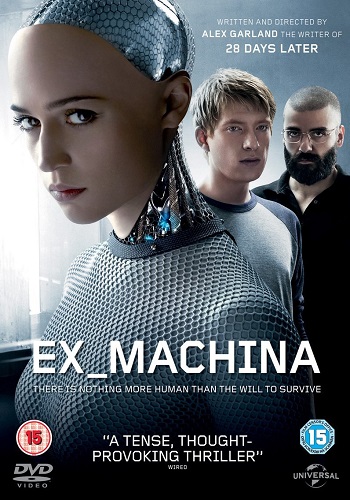
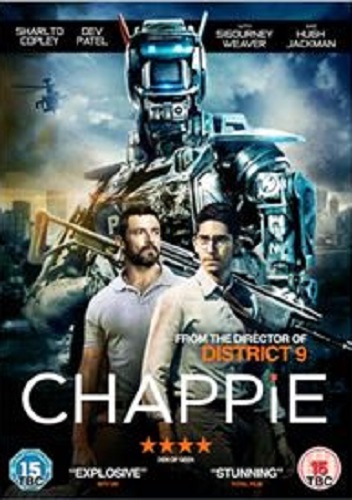
ex_machinaEx Machina, Alex Garland (2015, UK). I’d seen this film highly praised, and while I may be perverse, I’m not so perverse I’ll dislike a movie because it is popular – although certainly what I value in a film is not what most film audiences seem to. But ten minutes into Ex Machina, a movie I was expecting to be about AI, and all it appeared to be about was some ultra-rich knob who lived in the middle of nowhere (how did they supply his house?) and I was already thinking bad thoughts… only for it be pointed out on Twitter that this was the desired response. The person behind Ava, the AI robot (as seen on the DVD cover, because of course you’d give an AI a human face and a chicken-wire body), is meant to be an entitled prick. Because that then pushes the viewer’s emtional engagement onto Ava. The poor old programmer, Caleb, invited by Nathan to his billionaire hideway – and who has to be asked, “Do you know what the Turing Test is?” Of course, he does, he’s a programmer – finds himself a patsy for both Nathan and Ava by turns, and the fact he is emotionally engaged with the AI only makes you wonder why Garland chose to stack the deck so heavily in Ava’s favour. And having done that, the end of the film can hardly come as a surprise. I really didn’t like Ex Machina. I found it annoying, crude and a not very intelligent study of its premise. I much preferred the far less pretentious Chappie.

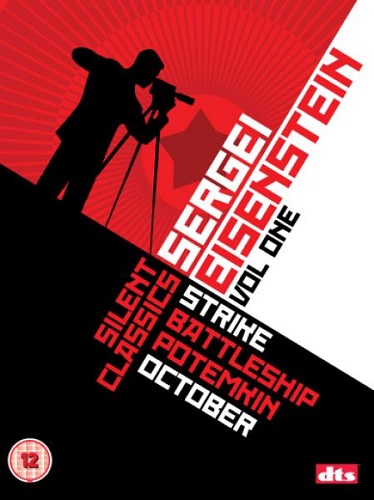
eisenstein_1October* Sergei Eisenstein (1927, Russia). I picked up a copy of Sergei Eisenstein Volume 2 at the end of last year – it contains Alexander Nevsky, Ivan the Terrible Part 1 and Ivan the Terrible Part 2 – but volume 1 proved much harder to find (since it had been deleted several years ago). Admittedly, I already owned a copy Battleship Potemkin and Strike, and October wasn’t exactly hard to find on DVD… but I wanted Volume 1 to go with my Volume 2, so I hung on until one popped up on eBay. Which it did. For a reasonable price. So I bought it. And I’ve now watched October twice and I’m still not sure what to make of it. For a start, it’s unashamed propaganda, a cinematic reconstruction of the October 1917 revolution, featuring many of the people who were involved in the actual event itself. Also, Eisenstein uses a surprisingly large number of modern cinematic techniques – or rather, techniques that have become standards in film-makers’ lexicons and are now used so unthinkingly that their origin is ignored. Anyone looking to put together a DVD collection of important films really should include both the Eisenstein collections (assuming they can find copies, that is).

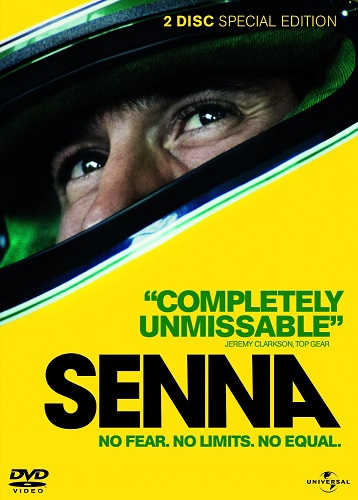
sennaSenna*, Asif Kapadia (2010, UK). This was available on Amazon Prime and since it was on the 1001 Movies you Must See Before You Die list, I watched it, despite motor racing being a sport in which I have zero interest. (Not that there is in fact any sport in which I have a more-than-zero interest.) Unsurprisingly, I found much of Senna not especially interesting, although I’d known almost nothing about Ayrton Senna prior to watching the film and he at least did come across as an interesting person – although chiefly through his work to improve the safety of F1 Racing – a sport in which a handful of rich pricks risk the lives of drivers in order to further line their own pockets, which is frankly disgusting. In fact, F1 comes across as little more than a playset for billionaire regressives. It’s telling that since Senna died and the increased safety he campaigned for came into effect, there has been only a single death during a race – and that was last year, ten years after Senna’s death. Having said all that… I’m not really sure why this film is on the 1001 Movies you Must See Before You Die list.

1001 Movies You Must See Before You Die count: 658


Leave a comment

Moving pictures, #31

More movies! Some good, some bad – well, some good, some meh. But mostly good, I think. Perhaps a few too many from the US, but that seems to be how it worked out. I did actually put together my own list of 101 must-see films (rather than 1001) on listchallenges.com – 101 Films for a Cineaste. Of course, I now realise there are films I’ve missed, so I’ll probably have to do a second list… And, no doubt, when I’ve seen yet more films, I’ll want to put together a third list…

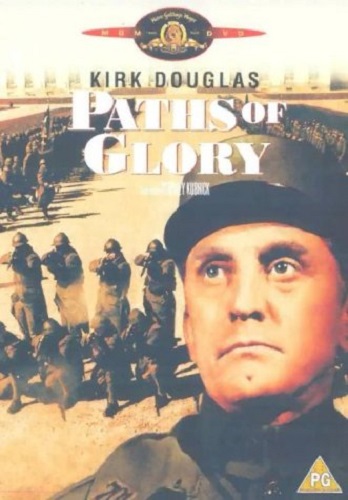
paths_of_gloryPaths Of Glory*, Stanley Kubrick (1957, USA). I think I might have seen this before, on television or something back in the 1980s (I spent most of the 1990s in the Middle East, so it was unlikely to be there – UAE television was shit). Certainly, bits of it felt familiar, although it’s a story that, in general form, has been told a number of times in film, book and even bande dessinée. During World War I, a general orders a division to attack a German redoubt, even though the attack will certainly fail and result in high casualties. As indeed it does. The general is so enraged, he orders three men, chosen at random from the survivors, be tried for cowardice, pour encourager les autres. Cowardice was a capital crime. It’s worth bearing in mind that in the British Army less than thirty percent of battlefield executions were upheld once the war was over. That’s seven out of ten men shot by courts martial should not have been executed. In a civilised world, that would qualify as a war crime. And the same is true of General Mireau’s actions in Paths Of Glory. But, of course, the wealthy and influential can do wrong. As Kirk Douglas, playing the colonel who defends the three men, discovers. The film is actually based on a novel, which was loosely based on real events – apparently, the invented bit is the random picking of three men; the French Army shot lots of men for cowardice, but its victims were not randomly chosen. A pity they didn’t shoot the generals*.

californiaEl Valley Centro, Los and Sogobi, James Benning (1999/2001/2002, USA). After three films in which Benning imposes narrative on his trademark series of static shots through either voice-over or scrolling text, these three films are nothing but pure imagery. Which, unsurprisingly, renders them more like art installations than actual cinema – although I can’t really see someone standing in front of a screen in a gallery for 87 minutes (the length of each film). Each film comprises 35 shots of precisely 2.5 minutes’ duration each. The first is about LA’s Central Valley, with shots of farms, oil fields, even fighter jets taking off from a USAF air base. Los is the urban part of the trilogy, with street scenes from greater LA. And Sogobi (the Shoshone word for “earth”) is the California wilderness, consisting of shots of mountains, rivers, deserts and chaparral. In all three films, the shots are carefully composed – in the first, the screen is split horizontally, usually by the horizon, across which objects move; in the second, it is the vertical lines of the city, and the spaces that creates; and the third’s nature shots are increasingly encroached upon by humanity’s presence. The final credits also give the names of the corporate owners of all the locations shown in the films, pointing out just how “free” the Land of the Free really is. Unlike the other Benning films I’ve watched, these require a great deal of work on the viewer’s part – though they’re also completely mesmerising to watch – in working out the narrative. They tell a story, but they make no concessions – there are no clues, no handy voiceover, no scrolling text. I am enormously glad the Österreichisches Filmmuseum is releasing Benning’s work on DVD, or I might never have come across it.

boogie-nights-mysBoogie Nights*, Paul Thomas Anderson (1997, USA). I’m aware of Anderson’s standing as a director, and I’ve seen several of his films… but I’ve never really understand why he’s so lauded. Is it simply that he’s a bit of a maverick? Certainly I can understand the topic of Boogie Nights not being a, well, mainstream movie topic, given it’s about the porn industry in LA. Mark Wahlberg plays a young man with an impressively large todger, which is, of course, never actually seen on screen (this being neither a DH Lawrence adaptation nor a comic book movie). He comes to the attention of Burt Reynolds, a porn director, who then casts him in some of his films. As Dirk Diggler, Wahlberg becomes rich and famous, and lives the rock star lifestyle to excess. Which is pretty much what this film is, a typical rags-to-riches-to-drug-addled-decline story, the only difference is it’s porn rather than music. I’m not entirely sure why Boogie Nights is on the 1001 Movies You Must See Before You Die list (a sadly frequent complaint of these Moving pictures posts).

chappieChappie, Neil Blomkamp (2015, USA). I hadn’t really liked Blomkamp’s two earlier films, District 9 and Elysium, even though they were hugely popular. So I wasn’t expecting much of this one, especially since it hadn’t been all that well-received. So, of course, totally perversely, I actually enjoyed it and thought it rather good. The title refers to a police robot operated by the Johannesburg police force. After being damaged in a firefight with gangsters – its batteries have fused to its chassis, and so cannot be removed; in other words, it has five days of power left and then it’s irretrievably dead – the robot is pulled from the scrapheap by the inventor of the robots, Deon, for him to use on his home project: an AI. But on his way home with the dead robot, he’s hijacked by a trio of inept gangsters, who want him to reprogram a police robot to obey them. So he gives them his AI instead. But on booting up it has the mentality of a child, and though Deon tries to tech it morality, the gangsters trick it into committing crimes by the gangsters… It’s not the most original story on the planet. But Sharlto Copley gives Chappie real character, and the CGI robot itself is well done. It’s more of a comedy than a sf action/adventure film, but that I think is one of its strengths. The villains of the piece are a bit one-note; and the rival robot is plainly based on RoboCop‘s ED-209, and as far as homage it’s not exactly subtle. But I liked this one, it’s much better than Blomkamp’s earlier two films.

great_beautyThe Great Beauty, Paolo Sorrentino (2013, Italy). I loved Sorrentino’s The Consequences Of Love when I saw it back in 2013, I even picked it as one of my five best of the year films. So I’m a little surprised it’s taken me so long to watch The Great Beauty. Having said that, there’s now a Five Films by Sorrentino DVD box set available, so I might well get it… Anyway, The Great Beauty. I was not initially taken with this film as it took a while to settle into its story. The main character is a cultural commentator, skating by on the fame of a  highly-respected novel he wrote decades before, but now content to write newspaper columns and magazine articles. He wanders the streets of Rome at night, meets people and talks to them; he throws parties in his apartment – at one of which, he delivers a devastating takedown of a female friend who had called his bluff on “honesty” – and he has relationships with various women. The story seems to grow out of the film, rather than provide a structure for its narrative. Which means it does take you somewhat by surprise, as it pulls you in and then wins you over. I didn’t like it as much as The Consequences Of Love, but in channelling “faded glory” rather than “stylish” it makes for an interesting, if overly Fellini-esque, film (and there are several nods to Fellini throughout the film). On reflection, it might be worth waiting for that box set to appear on Blu-ray…

fassbinder1The Bitter Tears Of Petra von Kant*, Rainer Werner Fassbinder (1972, Germany). The title character is a fashion designer and the entire film is restricted to her small apartment. It also has an all-female cast. The movies open with von Kant being awoken by her assistant, Marlene. Several visitors appear throughout the course of the film, one of whom, Karin, von Kant takes a shine too. They enter into a relationship. Six months pass. Nowe the relationship is not so loving. Karin admits to have slept with a man, and it then turns out she has been seeing her ex-husband and they plan to get back together. Von Kant feels betrayed. And, er, that’s about it. Fassbinder made a remarkable number of films during his relatively short career, and he had the artistic courage to experiment with cinematic formats and narratives (much as von Trier does). The result are not always successful. Admittedly, The Bitter Tears Of Petra von Kant is on the 1001 Movies You Must See Before You Die list, and I think some of his other films are actually more interesting. But there’s certainly plenty ot chose from, and I’ve not watched all of his oeuvre. Yet.

my_man_godfreyMy Man Godfrey*, Gregory La Cava (1936, USA). A bunch of nincompoop socialites play a game, the prize going to whoever can find most unwanted thing. One woman tries to persuade a homeless man (Powell) to be her item, but he refuses. Her sister (Lombard), however, is sympathetic to his plight, so he decides to help her show up her sister and so volunteers to be her unwanted thing. They win. Lombard is so grateful and so full of philanthropic goodwill, she offers Powell a job as her family’s butler. This has in the past proven a hard position to fill, as the family are demanding, scatter-brained, and often partying a bit too hard. Powell is the perfect butler and a boon to the family. Lombard falls in love with him – but this film isn’t that transgressive, as it turns out Powell is a runaway son from a rich patrician Boston family. Having said that, he does use his money to develop the city dump where he had been living into a nightclub, with homes and jobs for the people who had been living there. But philanthopy is no alternative to social welfare, and any society that relies on it has no business calling itself civilised. Still, to be fair, My Man Godfrey does run a good line in witty banter, and for a 1930s screwball romance it’s a reasonably good example. That the happy ending encompasses more than just the lovebirds is commendable, as is the somewhat feeble attempt to show that poor people are really people too; but the classism is bad, and so too is the easy acceptance that the largesse of the rich is a viable way to run a society.

1001 Movies You Must See Before You Die count: 654

* to wit:

The General inspecting the trenches
Exclaimed with a horrified shout
‘I refuse to command a division
Which leaves its excreta about.’

But nobody took any notice
No one was prepared to refute,
That the presence of shit was congenial
Compared to the presence of Shute.

And certain responsible critics
Made haste to reply to his words
Observing that his staff advisors
Consisted entirely of turds.

For shit may be shot at odd corners
And paper supplied there to suit,
But a shit would be shot without mourners
If somebody shot that shit Shute.


1 Comment

Moving pictures, #30

A wider spread of films this week – in terms of years (five decades) and countries of origin (five nations). Only one from 1001 Movies You Must See Before You Die list, however. And another film that is really bad and I’ve no idea why I bothered buying it or watching it. Eh.

bulldogDeadlier Than The Male and Some Girls Do, Ralph Thomas (1967/1969, UK). There must have been something in the water back in the 1960s, with all the debonair spy movies that appeared – not just the early 007s, but Derek Flint, Matt Helm, Maroc 7, Our Man in Marrakesh and… these two starring Bulldog Drummond. Who, er, isn’t strictly speaking a spy. And he originally appeared in the 1930s. He’s some sort of man-about-town who acts as a troubleshooter for an uncle in insurance. Or something. But he does do battle with a megalomaniac. And there are plenty of daft gadgets and nubile women in bikinis. Deadlier Than The Male opens with Elke Sommer poisoning an oil baron aboard his private jet, and then parachuting to safety as the plane explodes behind her. It transpires she was paid to do this by a UK oil company, but the oil company decides not to pay her fee – at least not until one of the directors is killed. But now there’s another person standing in the way of the oil company’s expansion, this time the ruler of a small Arab sheikhdom, who Drummond just happened to go to school with. So Drummond heads off to visit his chum on the Italian Riviera, partly to protect the sheikh and partly to discover who is Sommer’s boss. The film ends with a shoot-out on a giant mechanical cheesboard. Bonkers. Some Girls Do is more of the same. This time it’s a UK project to build the world’s first supersonic airliner (hey, we did that for real!), but the project is being sabotaged. It turns out the saboteurs are nubile young women with “robot brains”. Or something. The science is complete nonsense. The villain, for example, uses a subsonic ray to take control of the supersonic airliner. Good luck with that. “Supersonic” means “faster than sound”. Your ray will never catch up with the plane. Even for its subgenre, this is pretty brainless entertainment, without either the silly humour of Matt Helm and Derek Flint, the po-facedness of Bond, or the colourful locations of Maroc 7 and Our Man in Marrakesh.

starship_apocStarship Apocalypse, Neil Johnson (2014, USA). This is the sequel to Starship Rising, a film that was so bad I, er, bought the sequel. Johnson specialises in low-budget genre films, which I guess sort of makes him the self-published Kindle genre writer of the movie world. The set dressing in the two films by him I’ve now watched is cheap and nasty, the acting is poor, the dialogue terrible, and the stories derivative. This one has a disfigured, allegedly immortal emperor, and a small group – the entire cast of the film probably numbers less than a dozen – of rebels, who have this fantastic starship, or something. The only way to watch this film is pissed, which does sort of make figuring out what’s going on a bit difficult. I’ll probably have to watch both films again, but I’m not sure I want to…

american dreamsAmerican Dreams (lost and found), James Benning (1984, USA). It probably comes as no surprise that Benning has become one of my favourite directors. He hasn’t knocked Sokurov off the top spot – their oeuvres are almost impossible to compare, but Sokurov has at least made several narrative films (or rather, not documentaries) – but I’d definitely put Benning in the top five. And it’s because of films like American Dreams (lost and found). I can see why Benning’s Deseret made the 1001 Movies You Must See Before You Die list as it’s probably the most accessible of his films (that I’ve seen to date) – and even then it comprises static shots of scenery in Utah, countryside and towns, while a voice reads out stories from the New York Times from 1851 to 1995. American Dreams (lost and found) uses a much more interesting technique to tell its story. In fact, it uses three techniques. The images are of baseball cards and ephemera about Hank Aaron (apparently a great baseball star, although his fame is lost on me as I’ve never followed the sport). The soundtrack consists of a variety of spoken word excerpts, such Martin Luther King’s famous speech, or the first words spoken on the Moon, all iconographic moments in US recent history, alternating with popular music from the 1950s through to the very early 1970s. As well as both of these, a line of handwritten text scrolls across the bottom of the screen. This last is from the diary of a man who plans to murder Richard Nixon, and it reads exactly like the sort of thing written by someone who would plan such a thing – weird spelling mistakes, completely deluded, an oddly prurient but obscene fascination with women… As the film progresses, the story told by the diary deepens, until it is eventually revealed as the real diary of Arthur Bremer, who attempted to kill US presidental candidate George Wallace in 1972. Fascinating stuff.

close_upClose-Up*, Abbas Kiarostami (1990, Iran). I believe this is the film which brought Kiarostami to western critics’ notice, and it’s easy to understand why. It’s a documentary in which the people involved re-enact the events of the film’s topic, intercut with footage of the actual court case which results. A man meets a woman in a bus and tells her he is the famous director Mohsen Makhmalbaf. The man visits the woman and her family several times, and tries to raise cash from them for his next film. A journalist meets the imposter, realises he is not Makhmalbaf, and the police are called in to arrest him. Kiarostami interviews the journalist, the imposter and the family, and also films them re-enacting the events which led to the arrest. After the court case, the real Makhmalbaf turns up and gives the imposter a lift on his motorbike to the family’s home so he can apologise for trying to con money out of them. It all adds up to a very clever film, which feels partly like a documentary and partly like fiction, and which plays games with the viewer compact, to the extent it’s not clear where the lines blur. Kiarostami is one of the most important directors currently making films, and this film gives ample reason why.

fassbinder1The Niklashausen Journey, Rainer Werner Fassbinder (1970, Germany). I have a soft spot for films which are little more than actors declaiming political arguments instead of dialogue in a story, such as Miklós Jancsó’s The Confrontation… And now this one. The story is based on a true story from the fifteenth century, about a shepherd who claimed to have seen the Virgin Mary in a vision and promptly tried to start an uprising against the church and landowners. It didn’t succeed. Fassbinder uses a mix of contemporary and historical costumes, and has his actors discuss revolutions and historical forces while notionally acting out the life of the shepherd. It works surprisingly well. Most of the scenes are static, with the cast either standing or sitting still while they speak. And yes, I ended up buying the Rainer Werner Fassbinder Commemorative Collection 69-72, Volume 1, so now I have both sets – and they’re worth it even if not every film in them is entirely successful.

rabidRabid, David Cronenberg (1977, Canada). A charity shop find. Sadly, it was the only early Croneneberg they had. It is, unsurprisingly, distinctively one of his. A young couple are involved in a motorbike accident. She is badly burned, but fortunately the accident took place near a famous plastic surgery clinic. The head of the clinic employs an experimental method to graft skin over the burned area, and as a result the young woman, er, grows an orifice in her armpit, yes really, which has a stinger inside, yes really. She uses this to feed. Her victims cannot remember afterwards what happened, and then some time later they turn into zombies. Whoever the zombies bite, also becomes a zombie. It turns into an epidemic, its cause completely flummoxing the Canadian authorities. It’s a bit too daft a premise to shock as horror, although it works quite well as a completely bonkers thriller. Porn actress Marilyn Chambers plays the young woman, in her first straight acting role. Not a bad film, although it’s clear not much money was thrown at it.

1001 Movies You Must See Before You Die count: 650