It Doesn't Have To Be Right…

… it just has to sound plausible


3 Comments

Moving pictures, #45

More movies!

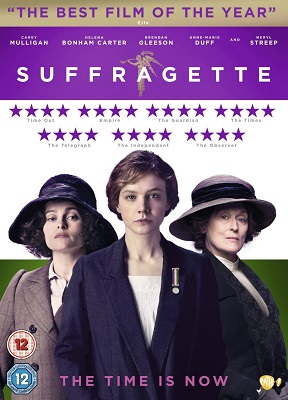
suffragetteSuffragette, Sarah Gavron (2015, UK). I’m surprised it’s taken until 2015 to make a film like this. Actually, I’m not surprised, just disgusted. True, this film is bsed on fictional characters, and real historical people such as Emmeline Pankhurst and Emil Davison do make brief appearances (the former is, in fact, played by Meryl Streep). The film tells the story of the women’s suffrage movement in the UK through a pair of invented characters – a working-class laundress played by Carey Mulligan, who more or less accidentally becomes a suffragette. Well, inasmuch ,as she rebels a clear injustice and that brings her into contact with the suffragettes and so she reluctantly joins their campaign. To me, it seems incredible that women should ever have been denied the vote, but I’m not stupid, I realise that historically men have been complete scumbags, and many still are today. I remember thinking while watching Suffragette that most social progress has come about because of violent action, and that decades of insistence on “peaceful demonstration” has only slowed the rate of social progress – if not driven it backwards, as twenty-first century culture seems in many ways less progressive than that of the twentieth century. I have to wonder sometimes if the twentieth century was only a social experiment, and now it’s over. But I suspect what’s more likely is that WWI killed off great swathes of the upper classes and so opened up management of society to the middle classes, but now the upper classes are back in charge once again. But Suffragrette… An important film, I think, because of its subject, but not a great film; and though played well by its cast and directed well, it did all feel a bit meh. Recommended because of its subject, if not as a film per se.
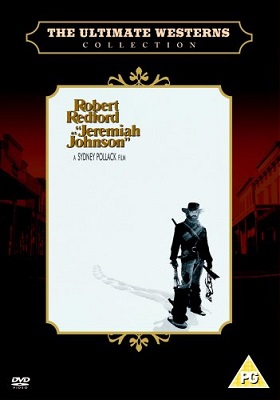
jeremishJeremiah Johnson, Sydney Pollack (1972, USA). I’m not a big fan of Westerns, but I find myself liking several Western films that don’t follow the usual Western story-lines. Like this one. Not a brilliant film, by any means; but there’s lots of lovely scenery in it, and the story is sufficiently distant from your typical Western story that I found it interesting… but I’m not convinced Robert Redford was suitable for the title role. He looks too, well, urbane. The title character heads off into the mountains for a new life. Fortunately, he stumbles across an old timer before he dies of starvation, and the old timer teaches him how to survive. Taking his leave after learning all this is to learn, he finds a homesteader family that had been attacked by Blackfoot. The wife has been driven mad with grief and she insists Johnson take her young son with him. So he does. He then comes across a trapper who had been buried neck-deep in sand by Blackfoot, and rescues him. They track down the Blackfoot who attacked the trapper and steal back his possessions – and killed the Blackfoot braves. This apparently makes Johnson something of a hero among the other Native American tribes of the area. He ends up married to the daughter of a Flathead chieftain, and they and the boy start to make a life for themselves. But the US Cavalry asks for Johnson’s help to resuce a wagon train, and this requires a ride, against Johnson’s better judgement, through a Blackfoot sacred burial ground. The Blackfoot respond by killing his wife and adopted son. There then follows many years of Blackfoot sending young braves to test their mettle against Johnson, all of whom, of course, he kills. We like to think of the Wild West taking place in the scrub and desert of south-west USa, but there’s other scenery which falls within the genre – the Rocky Mountains in this case. And it’s hard to film such landscapes badly… but when they’re filmed well, they’re gorgeous. Pollack had always struck me as a Hollywood stalwart – a director of commercially successful films, with the odd critical success thrown in, but by no means an auteur. And while Redford may not convince as the title character in Jeremiah Johnson, Pollack does a really good job at presenting the landscape (I can’t say “capture” but I have no personal experience of it). The end result is a superior Western, albeit perhaps high second-tier rather than first-tier. But worth a watch.

uchoUcho*, Karel Kachňya (1970, Czech Republic). I wanted to like this film more than I did. For many reasons. For the fact it was banned for many years in its home country, and only shown for the first time after the Velvet Revolution. For its subject: the lives of people in a totalitarian state. For its story: the paranoia endemic in totalitarian states is heightened for a couple after they return from a party and find their front door unlocked, and that tears their marriage apart. And for its use of New Wave cinematic techniques to tell its story. But something about it didn’t quite click for me. Possibly because I have a positive view of the trappings it presents as totalitarian, which I’ve taken from films like Eolomea and Wings. If that makes sense. This is not to say what happened to the Czech Republic – Czechoslovakia as was – at the USSR’s hands is in any way condonable. But in the Eastern Bloc the signifiers they presented for success and happiness I actually find quite appealing, and though they’re all utopian surface, cleverly hiding the totalitarian reality underneath, it’s hard not to be beguiled by the dream. Which is a bit of a long-winded way of saying that Ucho reveals that horrible reality underneath as a commentary by someone who actually lived it. In terms of technique, Ucho has much to recommend it – the use of ambient light, the tight focus on the central charaters… a variety of New Wave techniques, in fact. But the shifting of focus of totalitarian depradations to married-couple dynamics feels at times like diminuation of what should be a major dramatic point. There is, for example, a point in the film when the doorbell rings and the husband and wife work themselves up into such a frenzy believing the secret police have come to take him away that he walks down to open the gate carrying a suitcase of overnight things. But it turns out it’s only a bunch of drunken colleagues from the minsterial party which opens the film. The threat remains – and the movie is clear on that – but the decaying relationship between husband and wife seems to be used a little too often to ratchet up a more existential fear than is deserved by the story. Ucho is an important film, but it is somewhat disappointing as a piece of cinema. Worth seeing – once, at least.
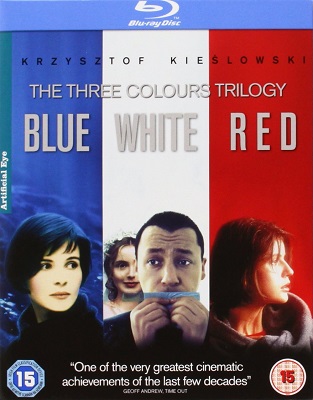
three_coloursThree Colours: Red*, Krzysztof Kieślowski (1994, France). And so the Three Colours trilogy, and my rewatch of it, comes to a close; and Red is generally considered the best of the three… and so it is, but by considerably more of a margin than I’d remembered. Yes, yes, that final scene where all the major characters from all three films are paraded across the screen is silly and unnecessary; but there’s still a focus and tightness to the story of Red which is so much stronger than that of the other two films. Irene Jacob, who was so good in The Double Life of Veronique, plays a model in Geneva with an absent boyfriend. One night she hits a dog in her car, and it turns out the dog’s owner is ex-judge Jean-Louis Trintignant, who cares nothing for the dog. So Jacob pays for the vet bills and adopts it as a pet. But it turns out Trintignant is a bit of a misanthopric oddball, who listens in on the phone calls of his neighbours… and he draws Jacob into his obsession. But she also has problems of her own. I’d started watching Red expecting something similar to my rewatches of Blue and White, so I was surprised to discover how much better than them it is (final scene notwithstanding). There is, now I think back on it, not much that stands out in terms of cinematography – a lot of use of the titular colour, and some nice photography of night-time Geneva. And, to be fair, the cast in all three films have been excellent – but I think it’s the dynamic between Jacob and Trintignant that works so well and lifts the film above Blue and White. The film is supposed to represent fraternity, yet most of the relationships in it have failed by the end – Jacob and her absent boyfriend, a neighbour and his girlfriend… And the strongest relationship in the film, between Jacob and Trintignant, is between two characters who have nothing in common, in fact Jacob is vehemently opposed to Trintignant’s practice of phone hacking. But when Jacob leaves to visit friends in the UK, Trintignant is the only one to wish her good fortune. This rewatch has amended my opinion of the Three Colours trilogy. They’re undoubtedly good films, but having watched so much more non-Anglophone cinema since I first watched them I find them more excellent examples of a particular type of film than merely excellent films. Kieślowski was a gifted film-maker and left an enviably impressive body of work, but I find myself thinking better of his earlier Polish films than I do his later French ones. Go figure.
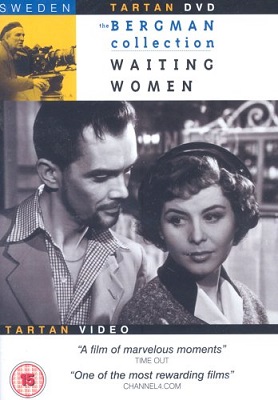
waiting_womenWaiting Women, Ingmar Bergman (1952, Sweden). Bergman wrote a number of films about women, and while I don’t know enough to call his attitude to women into question, I do wonder sometimes. In Waiting Women, we have a group of women reminscing about the situation which led to their current state of affairs. And it’s all about relationships. The movie opens with a group of women preparing a meal together, before then flashing back to stories of their relationships, the longest and most memorabe of which is that featuring Gunnar Björnstrand and Eva Dahlbeck – although it does also include a nasty line in misogynistic cracks from Björnstrand. And the infamous elevator scene. Which is, to be honest, one of the highlights. The two are trapped in a lift, and over the course of some ten minutes their rancour turns to humour. The flashback structure at least meant Waiting Women didn’t feel like a televised play, which a lot of Bergman’s films do (even those with scenes that take place outdoors). Not great Bergman by any means, but even his sub-par films are still a cut above most film-maker’s best.
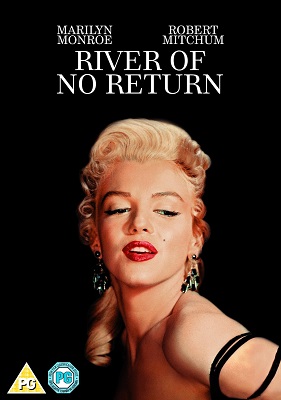
riverRiver of No Return, Otto Preminger (1954, USA). I mentioned in a previous post that Preminger only made one Western… and this is it. And it’s a curious beast. It has many reasons to like it, and yet to fails to, well, impress. The story is an adaptation of The Bicycle Thieves, which is a point in its favour; and the landscape in which the film is set is gorgeous, and often extremely well-photographed… but it’s the things that make it a Hollywood film which spoil it. The close-ups are done in a studio, not on location, and it shows – badly. Marilyn Monroe was a big draw at the time, but she doesn’t bring anything special to this film. In fact, she’s a bit crap – and only seems to really shine when she’s at her most artless (although I guess that was part of her talent as an actress; having said that, by all accounts, she was pretty insufferable during this shoot). Mitchum turns up to a gold-diggers’ camp to pick up his ten-year-old son, who had been left there by arrangement. It turns out the son had been looked after by saloon singer Monroe. Mitchum and son go off to Mitchum’s homestead beside the eponymous river… only for Monroe and fiancé gambler to turn up on en route to stake a claim at Council City. Their raft founders, but Mitchum rescues them. Gambler responds by stealing Mitchm’s horse to continue his jounrey, but Monroe remains behind. Gambler never returns so the three of them make their own way, by raft, to Council City. The location shooting ias lovely, the studio shots anything but. In fact, it seems for much of the film the continuity people were given the day off, as close-up shots often seem to take place in completely different environments. River of No Return is an odd beast. Preminger was a skilled director, and he manages a solid narrative with (mostly) good turns from his cast. But the mix of location shooting and studio shots never quite match and the discrepancy jars badly. One for completists.

1001 Movies You Must See Before You Die count: 796

Leave a comment

Moving pictures, #44

More viewing, only one from the 1001 Movies You Must See Before You die list this time, and it’s an American film… although, once again, half of the films below are from the US. I need to increase the number of non-Anglophone films I watch.

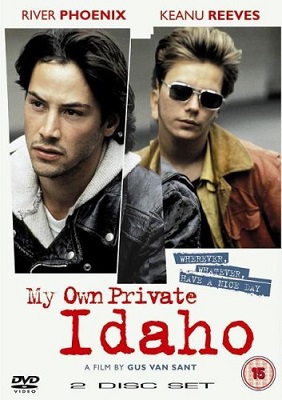
idahoMy Own Private Idaho*, Gus Van Sant (1991, USA). The only thing I knew about Gus Van Sant prior to deciding to work my way through the 1001 Movies you Must See Before You Die list was that he’d made a shot-for-shot remake of Hitchcock’s Psycho. Which sounds like an interesting exercise, except, well, that’s pretty much what a play is, the same story with a different cast. And since I’d seen Hitchock’s film a number of times and was familiar with it, Van Sant’s experiment proved even more disappointing. Van Sant’s most-famous film, however, is My Own Private Idaho, which, okay, I may have heard of before, but knew nothing about. And it turns it’s about a pair of street hustlers, played by River Phoenix and Keanu Reeves, except Phoenix has narcolepsy, and Reeves’s father is rich and the mayor of Portland. Oh, and the story is roughly based on Shakespeare’s Henry IV plays… which is fine as far as it goes, but when Van Sant starts using Shakespeare’s dialogue it really doesn’t work. Having Reeves call the Falstaff figure, Bob Pigeon, “a horseback-breaker, a mountainous tub of lard”, just sounds really silly in 1990s Oregon. In fact, it’s the Shakespeare-isms which spoil My Own Private Idaho. Okay, so Reeves’s character is not entirely believable (make him actual royalty, though, as Shakespeare did, and it weirdly seems okay), although it does make for an effective ending. But it’s that mix of Rechy’s City of Night and old Bill’s Henry IV Part 1, etc, which doesn’t gel. It’s like oil and water, or even a lava lamp. It’s just too obvious when Reeves et al start spouting the Bard’s couplets, and it upsets the balance of the film. I can see how My Own Private Idaho might appeal to some, but it wasn’t a movie I rated highly.

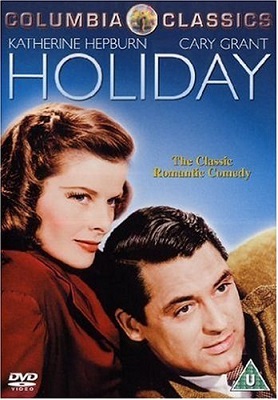
holidayHoliday, George Cukor (1938, USA). An early screwball romance starring Cary Grant and “box-office poison” (as she was at the time) Katharine Hepburn? What’s not to like? Quite a bit, according to audiences when it was released. Grant plays a man who plans to quit his job as soon as he can afford to and do nothing, and Hepburn plays the sister of his fiancée, who is stinking rich. This was during the Great Depression. Hollywood: super-sensitive, as usual. Grant meets Doris Nolan while on holiday in Lake Placid, and the two get engaged. He doesn’t realise she is filthy rich and the youngest daughter of an eminent New York banker. He turns up to the family home, learns the truth, but manages to charm the father and so get permission to marry. But it seems Nolan is a bit of a stuffed shirt, and it’s her libertine sister, Hepburn, who’s a better match for Grant. This one is early in Grant’s career, so he hasn’t got the polished urbanity of later films. If anything, he’s a bit of a galumpher, more of a tail-wagging puppy. Hepburn is Hepburn – did she ever change? – and it’s hard to believe she was ever box-office poison. By all accounts, this film did much to rehabilitate her. Edward Everett Horton and Jean Dixon provide excellent comic relief as Grant’s best friends, a pair of cycnical academics. Both stars, and director, made much better films, but Holiday has its moments. It’s not great, but if you’re into films from the era, it’s probably worth seeing. But I can understand why it flopped at the box office.

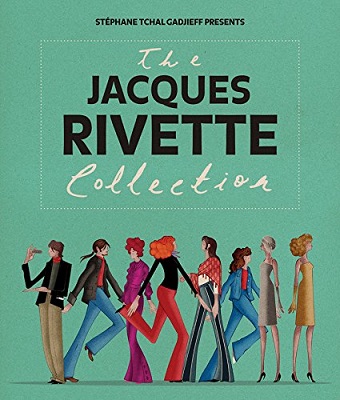
rivetteMerry-Go-Round, Jacques Rivette (1983, France). I watched Rivette’s La belle noiseuse, because it was on the 1001 Movies you Must See Before You Die list, and I thought it very good; and then Arrow Academy released a limited edition Blu-ray collection of some of Rivette’s films, none of which I knew anything about… but the collection was a limited edition, and I’ve learnt to my cost previously it’s best to buy things like this straight away because when you finally come to realise you want a copy they’re either not available or cost silly money. So I bought The Jacques Rivette Collection. On the basis of having seen a single film by the director. So it goes. And yet there’s nothing in Rivette’s movies that immediately appeals to me. They’re well-crafted, certainly; and very French. And, er, very long. Especially the centre-piece of this collection Out 1 – 12 hours and forty minutes! fucking hell – which I admit I have yet to watch. In fact, I’m working my way through the the collection in installments, beginning with Merry-Go-Round, which clocks in at a mere 2 hrs and 40 mins. And I’m not entirely sure what to make of it. A woman sends a telegram to her sister in Rome, Léo, and an ex-boyfriend in New York, Ben, asking them to meet her at a hotel in Paris. But when they turn up, she’s not there. They follow a series of clues and end up at her old home, where she tells them that her father, who died two years previously after embezzling $4 million, isn’t dead. And then she’s kidnapped and taken away in an ambulance. There then follows an almost dream-like quest, in which Ben and Léo try to track down the not-dead father and his millions. Much of this involves running through woods. Including being chased by a knight on horseback. Or exploring empty houses, particularly ones where doors give onto different landscapes – breaking that compact between director and viewer in which the spaces depicted on screen connect in a logical and plausible manner. (Sokurov does something similar in Faust, by having characters enter the frame from parts of the space the camera has already shown do not have entrances.) So the world of Merry-Go-Round doesn’t quite follow the “rules”, but then neither does the quest narrative. There are long extended scenes which do nothing to advance the plot. There are also plot-holes. And interludes in which two odd-looking blokes play noodley jazz on double bass and bassoon. In parts, Merry-Go-Round feels like an early-1980s L’Avventura – or rather, it sets up an expectation of being a 1980s L’Avventura, perhaps on little more than its lack of plot momentum. I am, on balance, glad I bought The Jacques Rivette Collection (it’s still in stock! Get it now while you can! Only 3,000 copies!), and I think they’re films which will bear rewatching, if not demand it; but I’ve a way to go yet before I call myself a Rivette fan.

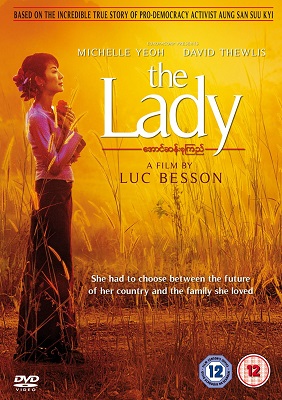
ladyThe Lady, Luc Besson (2011, France). Of all the subjects about which Luc Besson might make a film, I must admit a biography of Aung San Suu Kyi is not one I’d ever have guessed. But then, in many respects, The Lady doesn’t feel much like a Besson film. There’s a moment of almost cartoon-like violence when paramilitaries of the former prime minister assassinate the Executive Council (ie, the government-in-waiting for when the British withdraw), including Suu Kyi’s father. But in most other respects, The Lady is pretty restrained. Michelle Yeoh is especially good in the title role, and if David Thewlis was a bit too thespian as her husband, it didn’t detract overly much from the film. I will admit to knowing only the broadest details about Suu Kyi and Myanmar, and so films such as The Lady are eye-openers. Seriously, military juntas are not governments. The UN could surely make a legal, ethical and moral case for overthrowing such governments. But, of course, military juntas are excellent customers for arms dealers, and selling weapons is what it’s all about in the twenty-first century. The UK is now second only to the US as a seller of armaments. Mostly to the same countries we bomb or which have created the current refugee crisis. If you truly did reap what you sow, this country would neck-deep in salt.

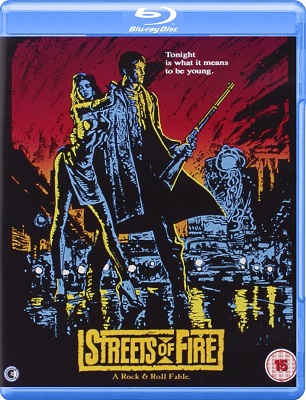
streets_of_fireStreets of Fire, Walter Hill (1984, USA). I had vaguely fond memories of this, after seeing it back in the 1980s, so despite its somewhat negative reputation I thought it might be worth watching. And having now seen it… I think my memories were a little imprecise. It looks great, mostly, no doubt about that; and the music, while of its time, is quite listenable. But that script. It’s fucking awful. It’s totally misogynistic, and it puts words in the mouths of its cast – Rick Moranis, especially – they should have been embarrassed, if not fucking offended, to speak. Diane Lane plays a rock star who is kidnapped by a bike gang led by Willem Dafoe. A young woman persuades her ex-soldier brother, Michael Paré, an ex-boyfriend of Lane’s, to come home and rescue the rock star. And it pretty much goes as you’d expect. I’d hoped time had been kind to Streets of Fire, that it’s 1980s macho posturing might seem more like kitsch thirty years later. It hasn’t. Rick Moranis snarling misogynistic comments at the camera is still a horrible thing to see. Paré does his best with a bad part, Dafoe does even better with a worse part, but Lane does nothing with a nothing part. Visually, the film still scores, and its influence on later films is easy to see. But the reasons why it flopped it 1984 are also obvious, and not even thirty years is going to make it a cult hit.

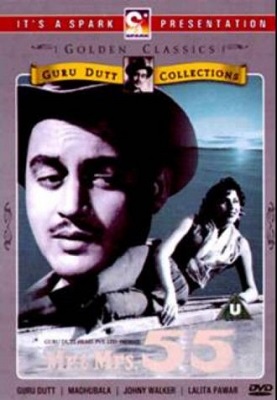
mr55Mr & Mrs 55, Guru Dutt (1955, India). The more of Dutt’s films I watch, the more I appreciate them. Admittedly, this was not a good transfer – BFI, why are you not all over Dutt’s films? – and the plot was pretty much a Hollywood staple (never mind a Bollywood staple), but even so… Rich playgirl Anita is living the high life but then discovers she has to marry before the age of 21 in order to inherit seven million rupees. And she only has a month to do it. She approaches her friend, tennis pro Ramesh, but he’s off to Wimbledon. In desperation, her mother pays cartoonist Dutt Rs 10,000 to marry Anita, with the promise of a quickie divorce soon after. Of course, the two fall in love after the ceremony. But then careful lying by the mother ensures each thinks the other doesn’t really love them, so the divorce goes through… But they get together and realise they do actually love each other after all. It’s all keyed off American signifiers of success – not just Anita hanging around a posh tennis club and worshipping pro Ramesh at the beginning – but also the trappings of wealth enjoyed by Anita’s family are familiar to Western audiences. And yet, there’s also something indefinably Indian about it – and I don’t mean the fact it breaks into song at assorted moments. It feels like an Indian film based on a Hollywood template, by someone who was quite aware of, and more than capable of using, the story patterns of both Indian and Hollywood cinema. Dutt makes good films. He really needs transfers worthy of his work.

1001 Movies You Must See Before You Die count: 795


2 Comments

Moving pictures, #43

Well, 2016 is definitely turning into the year of movies. To date, I’ve seen 431 movies, mostly on DVD and Blu-ray, mostly my own or from LoveFilm or Cinema Paradiso or on Amazon Prime. Some of them have been very good indeed, and I will probably watch them again (if I haven’t done so already). Some were rentals I liked so much, I went and bought a copy of my own. And some… well, best not mention them…

Anyway, on with the next half-dozen adventures on the silver screen wot I have partaked:

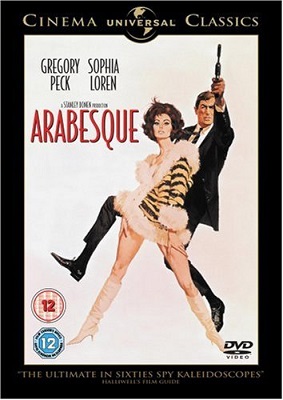
arabesqueArabesque, Stanley Donen (1966, USA). Who remembers Charade? Cary Grant and Audrey Hepburn in Paris. Lee Marvin as the villain. Missing millions. Which turned out to be a rare stamp on an innocuous envelope. It’s a film with bags of 1960s charm – with a pair of leads like Grant and Hepburn, how can it not have charm? Arabesque was apparently Donen’s attempt to hit the same sweet spot again. Unfortunately, while Donen wanted Grant, he got Peck. And Grant’s dialogue doesn’t work when coming from Peck. Sophia Loren manages to hold up her end, however. But both are hampered by a convoluted plot that’s almost impossible to follow. Donen apparently remarked that the film could only succeed if he made it “so visually exciting the audience will never have time to work out what the hell is going on”. And having now seen it, I can certainly vouch for the second half of that statement. Peck plays an Eygptologist who is asked to translate a message in heiroglyphics by head of an Arab state. It’s all to do with some big oil develoment deal and a plan to assassinate the ruler, but most of the plot consists of Peck getting beaten up by the villain’s henchmen or Peck and Loren chasing around London after the scrap of paper with the heiroglyphics on it. Not a high point on all three cvs, to be honest.

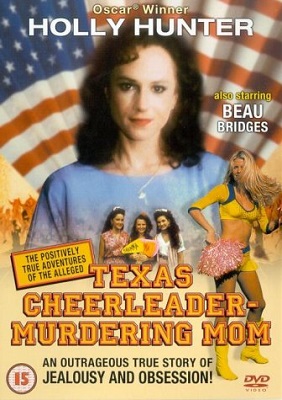
texasThe Positively True Adventures of the Alleged Texas Cheerleader-Murdering Mom, Michael Ritchie (1993, USA). In the normal course of events, I’d not give this film a second look, or indeed even a first one. But a film blog I read, Antagony & Ecstasy, wrote a long semi-approving piece on it, and a week or two later I stumbled across a copy in a charity shop… But, well, I guess this is not a movie that travels well. I’ve never seen the appeal of, or humour in, films depicting US white trailer trash or working class, and that’s pretty much what this is – although it’s based on a true story. Holly Hunter plays the title role, a mother who was so determined to see her daughter succeed she sort of agreed when her drunken brother-in-law (Beau Bridges) tried to entrap her into paying him to off a rival mother. The film is framed partly as Hunter preparing for an interview after the fact, and partly a dramatisation of events, and the whole thing seems mostly motivated by stupidity because the actual character motivations are somewhat opaque. Which makes Hunter’s character come across like a sociopath. Which, to me, sort of ruins the whole desperate housewife story. It’s not very funny film, either. I gave my copy to David Tallerman, so we’ll see if he makes anything of it.

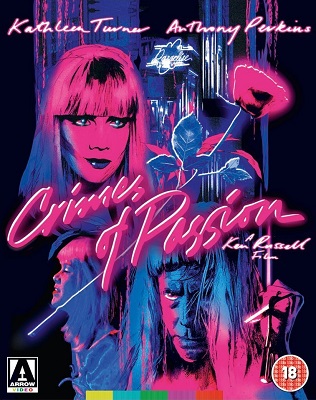
crimesCrimes of Passion, Ken Russell (1984, USA). I don’t think I’d ever call Russell an “interesting” director – he made a handful of solid films, one or two near-classics, and a lot of self-indulgent crap. From the write-up, I suspected Crimes of Passion fell on the border between “solid work” and “self-indulgent crap”, so watching it was a bit of a gamble. And having now watched it… yes, it pretty much straddles the two groups. Kathleen Turner plays a fashion designer who moonlights as a prostitute, using the name China Blue. A surveillance expert is asked to spy on her because her employer suspects her of selling designs to competitors, and he becomes obsessed with her. There’s Anthony Perkins, in full frothing-at-the-mouth mode, wandering around as preacher, who alternately demands to “save” China Blue or have sex with her. He also frequents peep shows. And then there’s China Blue’s customers, with their fetishes… It all looks a bit cheap (and I mean that in its pecuniary sense), and with Perkins drooling and spraying spittle one minute, and then Turner chewing the scenery in the next, it makes it all look like a shoestring exploitation flick with bizarrely high production values. An odd film.

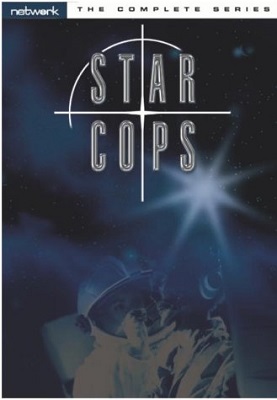
star_copsStar Cops (1987, UK). Many thanks to Paul Cornell for tweeting that a third-party seller on Amazon had clearly found a stash of these somewhere and was selling them at a decent prize (around £20, if you must know). I’d missed buying myself a copy of Star Cops before it was deleted, and by the time I wanted one the price had reached silly money. But now I have one. I remembered the series from its original broadcast back in 1987, although having now seen all nine episodes on the DVD I think I might have missed one or two of the episodes. Anyway, I remembered it as smartly-written, with slightly dodgy production design and cheap effects. What I’d certainly forgotten was the vastly irritating theme song by Justin Hayward, which, while not quite as bad as Enterprise‘s, does have the added horror of getting stuck in your head for days afterwards. David Calder plays a British police officer on 2017 who distrusts the computers and continues to investigate a case the computers have ruled a suicide. It turns out he’s right, of course; but it makes him enough enemies, and leads to the murder of his girlfriend, so he accepts a position as the new head of the International Space Police Force, based on a station in LEO. After a coupleof episodes there, the ISPF moves to an office at a base on the lunar surface (which was obviously a relief for the actors and the budget as it meant no more wires). One of the star cops is presented as a bit of an old-school dimwit, but he also does a nasty line in racist and sexist remarks. The other star cops are an Australian engineer, a US engineer, and a Japanese doctor. Most of the stories are pretty good, although the final one, ‘Little Green Men and Other Martians’, despite having a neat premise, does suggest the lunar base is wide open to whoever turns up – which I wouldn’t have thought all that likely. I’m glad I finally got hold of a copy. These days, sf television series may have fancy special effects, but they rarely have writing as good as this.

vidas_secasVidas Secas*, Nelson Pereiras dos Santos (1963, Brazil). This is generally reckoned to be the first film in Brazil’s Cinema Novo movement. I wanted to watch it because it’s on the 1001 Movies You Must See Before You Die list – and because I’d become a fan of Glauber Rocha after watching three of his Cinema Novo movies – but Vidas Secas is almost impossible to find on DVD (as I type this, there’s one copy available on Amazon for… £101.95). Fortunately, I managed to get a copy from another source, for no more than the price of a typical DVD. And yes, it was worth it. It’s an adaptation of a novel of the same title, by Graciliano Ramos, and tells the story of a poor family in north-east Brazil. It was entered into the Cannes Film Festival and won the OCIC Award. Its plot isn’t easy to summarise, as it’s really just a series of incidents in which the family move from one place to another, try to scratch a living, are preyed on by those more powerful than themselves, and so move on elsewhere. In one village, a local policeman drags the husband into a card game, but when the husband leaves after losing his money, and so the policeman loses even more, the policeman goes after him, beats him up, and then arrests him for resisting arrest. The husband is thrown into jail and whipped. It’s a grim film, althugh not unaffecting – near the end, the family are so hungry the husband tries to shoot their dog, but it takes him ages to work up the courage to do it, and then he botches it and the dog crawls away to die slowly. This is not a film to watch if you’re not in a cheerful mood. It definitely belongs on the 1001 Movies you Must See Before You Die list, though.

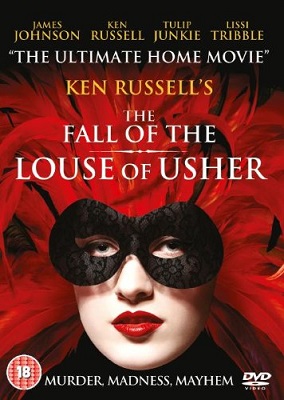
usherThe Fall of the Louse of Usher, Ken Russell (2002, UK). Well, I mentioned Russell’s self-indulgent crap earlier, and I hadn’t watched this. Which is absolutely awful. It’s Russell’s last film, was shot on his own property, and features himself and friends as the cast. A rock-star, Roddy Usher, played by James Johnston of Gallon Drunk, is consigned to a mental institution after killing his wife and walling up her body. His doctor is played by Russell himself. He gives Usher shock treatment and, well, lots of things happen, few of which I can, thanksfully, remember. It all looked horrible and cheap and amateurish, and I’m surprised it ever saw a general release. The DVD, released by Final Cut, calls it “the ultimate home movie”, but even that fails to convey how crap it is. This is definitely a film to avoid. It was Russell’s last feature film, and a poor epitaph for a man who did make some good stuff during his long career.

1001 Movies You Must See Before You Die count: 794


Leave a comment

Moving pictures, #42

More films. So it goes.

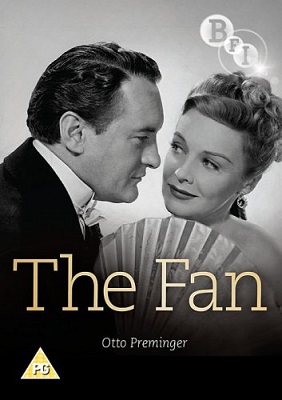
fanThe Fan, Otto Preminger (1949, USA). I have a fondness for Preminger’s films, although that may well be simply because he was a name I fastened onto when I started tracking my film watching… but I started out watching his movies so I may as well carry on and complete his oeuvre. Of which this is not a good example. It is an especially unwitty adaptation of Oscar Wilde’s ‘Lady Windermere’s Fan’, which inadvertently has the advantage of making the story much simpler to parse – although, to be fair, I’ve not seen Wilde’s play, so the loss of his dialogue is not one I’d notice. (There are, of course, more faithful adaptations of the play, but I’ve not seen any of those either.) It opens shortly after WWII, when an old woman in an auction room objects that the fan which is for sale, found in the ruins of a bombed house and unclaimed, is hers. The auction house tells her that if she can verify her claim, they’ll hand it over. So she goes looking for Lord Darlington, a friend from many years before… And after a bit of banter (very little of which is Wildean), we’re in flashback territory, and it’s the last decade of the nineteenth century and the “adventuress” Mrs Erlynne has arrived in London and attached herself to the company of Lord Darlington and the young Windermeres. And when Arthur Windermere puts up for a London residence for Mrs Erlynne, and is often seen her company, tongues begin to wag, and a nasty rumour eventually reaches Margaret Windermere. It all comes to a head at a fancy party at the Windermeres, to which Erlynne is invited, and at which she reveals her secret (she’s Margaret Windermere’s black sheep mother, who ran away decades before). As historical drama, this is a pretty solid, if unadventurous, movie, but you expect more from Wilde and the bowdlerisation of his lines has done it few favours. One for Preminger completists, I think.

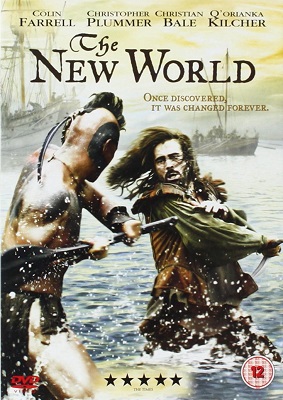
new_worldThe New World, Terrence Malick (2005, UK). I don’t know what to make of Malick. His films are beautifully shot but also complete nonsense. There is, for example, a brilliant idea at the heart of The New World, but for some reason it doesn’t quite work. It may be that Malick’s use of Hollywood stars, and their highly-promoted identities, works against what he is trying to achieve… The New World tells the story of Pocahontas, although focusing mostly on the English men with which she had relationships. Malick has gone for a completely authentic look and feel to his story – even going as far as getting a professor of linguistics to reconstruct the extinct Powahatan language spoken by the Native Americans of the period and location the film takes place. But the real genius of The New World – or rather, what could have been the real genius – is that the bulk of the dialogue is actually voiceover and is the characters, all of whom are real historical figures, speaking the text from their own diaries and journals. But. It doesn’t quite work because this is not a documentary and the real historical figures are played by recognisable Hollywood actors such as Colin Farrell, Christopher Plummer, David Thewlis or Christian Bale. True, the pivotal role of Pocahontas is played by an unknown, Q’orianka Kilcher, a German actress, in her first major role. And she’s very good in it too. It goes without saying that The New World is mostly gorgeous to watch, and it looks and sounds exactly how you would expect a English colony in North America in the early seventeenth century to look and sound (well, except for the drama school kids, but we won’t mention them)… I remain conflicted about Malick and his films. They look lovely, he’s probably the closest the Hollywood system has come to slow cinema, but… there’s always something slightly off about them. Perhaps it’s simply that his style of film-making doesn’t work in Hollywood, is fatally compromised by Hollywood’s use of familar names and faces in roles where the baggage they bring undermines their parts. It doesn’t help that Malick’s reputation in the US as “auteur supreme” likely gives him the freedom to be self-indulgent, and a little self-indulgence goes a long way. But whatever it is, there’s something about Malick’s films that rubs the wrong way, and I wonder if it’s the friction between the Hollywood system and the sort of films Malick’s movies try to present themselves as being.

city_of_womenCity of Women, Federico Fellini (1980, Italy). As male writers get older, they enter a Dirty Old Man phase – cf John Fowles’s Mantissa, or anything by Robert Heinlein after the mid-1960s… – and creators in situations which give them more than the usual artistic freedom are especially susceptible. True, Fellini has been self-indulgent since day one, but I do love that self-indulgence in his colour films – or, at least, I loved those I’d seen… But Fellini has made many films, and bizarre as Satyricon is, or Casanova… others would no doubt fall either side of that indulgence divide (to coin a phrase). I had very little idea of what to expect from La città della donne, except perhaps something like a cross between Giuglietta della spiriti and something created by a middle-aged Italian male… And, er, that’s a bit what it’s like. It feels like it can’t decide if it’s an attack on feminism or a celebration of it, and the fact it sends mixed messages is clearly not to its credit. There are things to like in City of Women – and they’re the same sort of things to like in Fellini’s career – but there’s also that weird undercurrent that feels like a, well, MRA attack on feminism. Which is like watching a comedian whose every other joke falls flat, but you’re never entirely sure if that’s deliberate. Things have changed in the four decades since the film was made, and it renders some of its complaints weirdly old-fashioned, others weirdly trivial, and some even more relevant now than they were then. A man on a train (Marcello Mastroianni playing, well, Marcello Mastroianni) flirts with a woman, and when the train stops in the middle of nowhere and she disembarks, he follows her… through some woods to a sort of isolated hotel where a conference on feminism, attended entirely by women, is taking place. And, er, that’s it. This is Second Wave Feminism as the butt of an extended joke… except, there’s a sense throughout that the joke is on those who see the feminism as the joke. I don’t know. Given Fellini’s career I’m inclined to think he was having fun at the expense of anti-feminists (while not subscribing to feminism himself), but parts of City of Women are so bonkers – the final third of it, pretty much – that it’s hard to be sure what he meant. Given his previous films, I’d give him the benefit of the doubt, I think; but City of Women still remains the least satisfactory of his colour films I have seen so far.

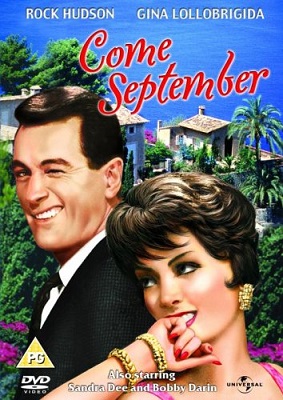
septemberCome September, Robert Mulligan (1961, USA). I do love me some Rock Hudson rom com, and he was at his best in these during the 1960s. And, let’s face it, how can you go wrong with Gina Lollobrigida as the female lead? And Italian locations? (Although apparently Lollobrigida was not keen on returning to Italy.) Anyway, Hudson plays a successful industrialist who, each year, spends the month of September in his large villa on the Genoese coast. But one year he decides to go in July instead… which promptly screws up a few things. For a start, his girlfriend, Lollobrigida, is about to get married to some English wet, but breaks it off when she gets his call. And his butler, played superbly by Walter Slezak, has been runnnig the villa as a hotel for eleven months of the year. And, en route to his villa, Hudson has a run-in with a bunch of American rowdies led by Bobby Darin. So Hudson finds his girlfriend wavering, his house occupied by a group of young American women and their chaperone, and he has Darin’s rowdies camped outside on the road because Darin fancies one of the guests of the “hotel”, Sandra Dee (Darin and Dee actually married after the film)… Aside from Hudson’s massive sense of entitlement, this is a pretty straightforward 1960s rom com. It has its charms, and some of its jokes are quite good, but it’s hamstrung by the fact that Hudson’s character is actually a nasty piece of work. It’s watchable because Hudson is eminently watchable – and there are probably only a handful of actors of the time who could have got away with playing such a role – but not even Lollobrigida’s screen presence and charm, Darin’s cinematic surliness, or even Dee’s all-American bland chirpiness, can make this more than a middling rom com of the period, even for Rock Hudson.

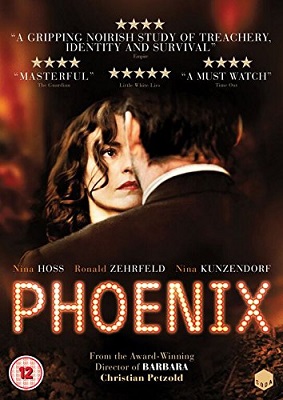
phoenixPhoenix, Christian Petzold (2014, Germany). I don’t chose my viewing entirely from lists of best films. Sometimes it’s stuff I stumble across that takes my fancy, and sometimes it’s movies recommended by friends. As this one was. By David Tallerman. Who has recommended good films to me in the past (some, it must be said, better than others). In fact, Phoenix had not pinged on my radar at all, and having now watched it I’m glad David recommended it. A Jewish woman who survived the camps returns to Berlin to discover what happened to her Gentile husband. She had been badly wounded in the face, and she requires plastic surgery, which results in her appearance changing. So when she tracks down her husband, he does not recognise her. But he does think she looks enough like his “missing” wife that she could impersonate her and so claim the inheritance left to her. The woman does not reveal her true identity and plays along with this subterfuge, partly to disprove the lie of a friend who insists the husband was the one who gave up the woman to the Gestapo. Phoenix is based on a 1961 French novel, Le retour des cendres, but, to be honest, to my mind it seems to work better with a German setting – it certainly gives the central premise a bigger emotional payload. A good film and definitely worth seeing. It might well make a future 1001 Movies list, if it hasn’t already.

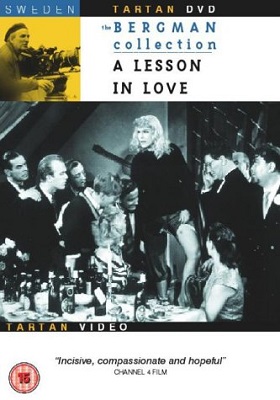
lessonA Lesson in Love, Ingmar Bergman (1954, Sweden). Bergman made a lot of films and some of them are bona fide classics of the medium. Others are little more than cinematic adaptations of middling stage plays – or, at least, that’s how they come across, even if they’d been written directly for film. As far as I know, A Lesson in Love was conceived of and produced purely as a film. But it’s not that easy to tell with Bergman. A Lesson in Love is also minor Bergman, inasmuch as it’s entertaining and has something to say, but when all’s said and done, it sort of fades into that middle Bergman ground where so many of his films reside and where it’s hard to tell one of them from the other. I could put together a list of a dozen top-notch Bergman films, and even for a director who made over sixty films, that’s an enviably large list. Sadly, A Lesson in Love would not be on that list. It’s a 1950s Swedish comedy about a gynecologist and his patients and marriage and affairs, and to be honest it all sort of blurs into one after a bit. There’s some good witty dialogue and some on-target points, but nothing in it really stands out. It probably needs a rewatxch, to be fair, but if there’s one thing about Bergman’s oeuvre that is true it’s that it can stand multiple rewatches. And not many directors can say that.

1001 Movies You Must See Before You Die list: 793


1 Comment

Moving pictures, #41

Despite a weekend away at Bloodstock, I managed to keep to my somewhat heavy schedule of film-watching; although, once again, most of the movies below are not from the 1001 Movies You Must See Before You Die list (only one is, in fact). But that’s chiefly due to the vagaries of the DVD rental services I use. Anyway, avanti…

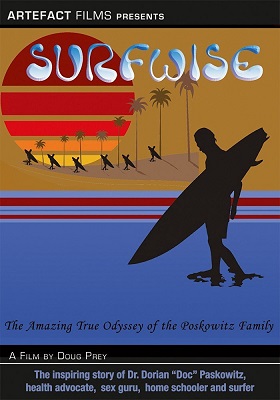
surfwiseSurfwise, Doug Pray (2007, USA). Dorian Paskowitz graduated from Stanford Medical School in 1946, ended up in Hawaii, and became enamoured of surfing. This led to your typical surfer dude philosophy of diet and lifestyle, albeit several decades before it came to prominence… Paskowitz went on to introduce surfing to Israel, and many years later to Palestine. But Surfwise is more about Paskowitz and his family than it is his accomplishments. Initially, the film clearly admires the man, but the interviews with his eleven children paint a somewhat different picture: of a man who was harsh, if not abusive, and left his children with a completely different legacy to that painted by the opening third of the documentary. Paskowitz himself seems unrepentant – he led an interesting life and knows it, and he stands by pretty much every idea he has ever had, no matter how unpopular or crackpot. Certainly, Paskowitz is an interesting individual, with a story to tell; and it’s quite clever how Surfwise uses that to hide the fact he isn’t half as nice as protrayed, and then slowly shifts the sympathy of the viewer away from him. But when all’s said and done, Surfwise is a well-made documentary about a not-especially-interesting topic.

three_coloursThree Colours: White, Krzysztof Kieślowski (1994, France). I’m prepared to accept that Kieślowski belongs on a list of the greatest directors, and I’ll happily agree he’s created several superior examples of a particular type of film. But… These rewatches – prompted by upgrading my DVD copies to Blu-ray – have proven an interesting exercise, if somewhat disappointing, inasmuch as the movies haven’t quite matched up to what memory, and the weight of critical opinion, has insisted they’re worth. True, White is generally considered the weakest of the trilogy, although having now watched it again I’m not sure why. The story is more obvious, and the driving emotion of the story more… primal; and there are a few bits which are implausible… But the plot has more drive than Blue and the characters’ motivations more obvious (except, perhaps, for Juliette Delpy’s character, who comes across more like a motivation for the lead character, played by Zbigniew Zamachowski, than a character in her own right). Delpy and Zamachowski, both hairdressers, were married, but the film opens with their divorce. In Paris. Where Zamachowski is at a disadvantage as he doesn’t speak French. He ends up with nothing, but a chance encounter with another Pole sees him smuggled back to Poland, by air, in a suitcase (even in 1994, this was implausible). Through a combination of contacts and clever dealing, Zamachowski becomes a millionaire… and promptly fakes his own death and frames Delpy for his murder. The “white” apparently refers to “equality” in the three political ideals of the French Revolution, and I guess that applies to Zamachowski’s revenge on his wife, although revenge seems a curious means of applying equality. It goes without saying that White is beautifully shot and arranged, and that the cast put in spotless performances, but it still feels like a movie of a type rather than a movie per se. Kieślowski was very good at what he did, and Piesiewicz wrote scripts perfectly suited to Kieślowski’s approach to film-making… But a little goes a long way, and while my tastes have turned more toward slow cinema than they had been before, it does seem a little like Kieślowski’s reputation is a little over-stated… Nonetheless, an excellent film, an certainly more deserving of a place on the 1001 Movies You Must See Before You Die list than many that are actually on it.

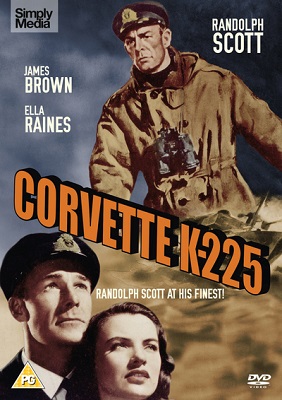
corvetteCorvette K-225, Richard Rosson (1943, USA). I had thought this was a Howard Hawks film, which is why I added it to my rental list; but he apparently only produced it. Oh well. Still, I enjoy WWII naval films, almost as much as I enjoy Cold War USAF films, and considerably more than I enjoy WWII infantry films. The title of the movie refers to a Flower-class corvette, built in Canada and operated by the Royal Canadian Navy. The ships were originally designed for near-shore operations, but ended up as escorts for convoys across the Atlantic. Lead Randolph Scott returns to Halifax after losing his corvette, and most of his crew,  to a U-Boat. He’s a given a new ship – the titular ship – currently on the slipway being built. They build the ship, Scott gets his crew, they go out on escort duty, accompanying a convoy to Southhampton. There’s a romantic triangle, of course – well, sort of: Scott starts seeing the sister of an officer who died on his previous ship, and, to make matters worse, her young brother joins the new corvette as a junior officer, fresh out of the academy. The convoy goes as you’d expect – from a dramatic standpoint rather than an actual WWII standpoint – and even results in an encounter with the U-Boat which sank Scott’s previous corvette. This is solid wartime drama, good for the folks at home, good for those fighting; and interesting because it gives an accurate idea of life aboard a corvette on a trans-Atlantic convoy. Better than I expected.

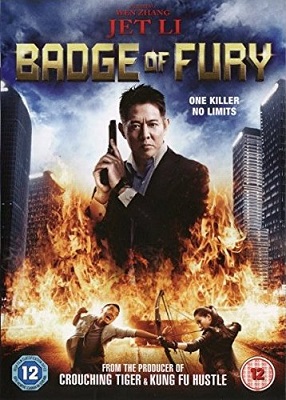
badgeBadge of Fury, Wong Tsz-ming (2013, China). Some confusion over the title of this, since the DVD seems to be Badge of Fury but the streamed version I watched on Amazon Prime was titled Badges of Fury. No matter. Anyway, I stumbled across it on Amazon Prime, didn’t up to watching something too weighty and this seemed like it’d be worth a go. And so it was. The beginning wasn’t too auspicious – three bumbling cops who mess up a sting to catch a gangster at a posh party when one of the cops recognises an entirely different gangster and attempts to arrest him instead (although Jet Li can never be “bumbling”, so his character is just lazy and a clock-watcher). In fact – title aside – the film doesn’t initially come across as a comedy and it’s only when you twig that it’s getting increasingly silly that you realise. As a Hong Kong comedy/action movie, Badge of Fury is perhaps more polished than most, although the repartee is somewhat repetitive. But when you start spotting references to other Hong Kong action films, well… it gains a whole other dimension. Not only are there direct references, including to some of Li’s own films, but the final fight scene riffs off climactic fights from at least four films that I counted, of which Once Upon A Time in China was only the most obvious. I hadn’t expected much of Badge of Fury, and initially it seemed to promise very little, but as it progressed it showed itself to be a clever piece of work, and even a halfway decent comedy. Worth seeing.

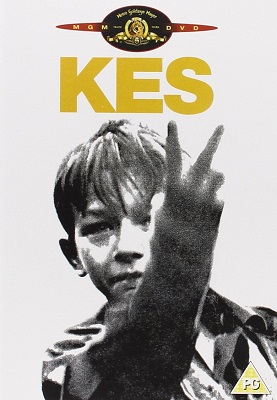
kesKes*, Ken Loach (1969, UK). I’m surprised I’ve managed to fail to see this over the past couple of decades, although it’s not like I’ve made an effort to avoid it. But it’s a well-known and highly-regarded British film – probably one of the best-known from this country, in fact (second only to, shudder, Four Weddings and a Funeral, I suspect). It’s also pretty much a local film – not so much for where I’m from but where I now live (although my home town is not that far from my current city of residence). Anyway, it’s set in Barnsley. A young boy who is bullied by his older brother and at school, steals a kestrel chick from a nest and raises it following the advice given in a book he stole from the local library. I’ve no idea if Kes prompted the media characterisation of “it’s Grim Up North”, but it certainly must have fed into it. Because Kes paints a bleak picture of Barnsley (not undeservedly; I’ve been there); although, of course, one depressed area is not all depressed areas – and I say that as someone whose relatives’ background is not dissimilar to that of the characters in Kes (although not my own personally as my parents moved to the Middle East when I was two). But the life depicted in Kes was not unfamiliar. Although I did struggle once or twice with the dialect. Yet, when all’s said and done, the film deserves its plaudits. Loach’s documentary-style approach made the story emotionally powerful – helped by a good cast, including Brian Glover with actual hair (in his first ever role). I’ve now seen two Loach films in quick succession, and been inmpressed by both. Those Loach box sets are looking more attractive every day…

lets_make_loveLet’s Make Love, George Cukor (1960, USA). I like 1950s films, even musical ones, although not as much as melodramas, and at least one 1950s musical by Cukor I’ve seen I like a lot – that would be Les Girls – but I’m not a huge Marilyn Monroe fan (I’d sooner watch, say, Ginger Rogers)… But anyway it seems I stuck this on my rental list, and so it dropped through the letter-box and I watched it and… Meh. Yves Montaud plays a billionaire playboy who learns an off-Broadway revue intends to take the piss out of him in one of their musical numbers. So he decides to check it out himself, walks into the rehearsal… and spots Marilyn Monroe rehearsing a musical number. He immediately falls in love, auditions for and wins the part of a lookalike of himself, with the intent of wooing Monroe incognito. It’s a hoary old plot, and I’m pretty sure Hollywood trots it out at least once a decade. Monroe provides a couple of iconic moments, Frankie Vaughn is a bit whiny as the male star of the revue, and Montaud can’t seem to decide if he should play it stiff or charmant and so manages some weird state in between the two. There’s a bit of fun in Milton Berle, Gene Killy and Bing Crosby appearing as themselves, each hired to teach Montaud, respectively, comedy, dancing and singing – all in order to increase his appeal to Monroe. But the film’s biggest fault is that it all seems a bit drab, and the sets and costumes for the musical numbers are weird and cheap-looking. Not the best film in either Monroe’s or Cukor’s oeuvres, although apparently it provided Hollywood with plenty of gossip about Monroe and Montaud…

1001 Movies You Must See Before You Die count: 793


3 Comments

Moving pictures, #40

This is the second Moving pictures post in which I’ve not watched a film from the 1001 Movies You Must See Before You Die list. Oh well. I have, on the other hand, now watched all of the Sokurov films I now own. But there are still a couple more I’m after before I have everything he has made. And two US films out of six isn’t bad, I can live with that.

dialoguesDialogues with Solzhenitsyn, Aleksandr Sokurov (1998, Russia). I was dead chuffed at getting hold of this. The only copy I’d seen available was priced around £180, which was way too much for me (it’s now £220, I see). But then I realised Sokurov was spelt Sokourov by the French, so I googled that… and found a copy of Dialogues avec Soljenitsyne for €30 on Amazon.fr – and all the packaging was French/English, and the DVD included English subtitles. Result. I tried watching it earlier this year, but decided to leave it until I’d read some Solzhenitsyn… and having now read One Day in the Life of Ivan Denisovitch, I can quite categorically say it made bugger-all difference. The DVD contains two made-for-TV short films – ‘The Knot’ and ‘Dialogues’, both of which involve Sokurov interviewing Solzhenitsyn. ‘The Knot’ opens as a documentary about the writer, using archive footage and voice-over – typically Sokurovian in other words. But then it becomes Sokurov and Solzhenitsyn talking as they walk through a wood near the writer’s home – also typically Sokurovian. To be honest, there’s not much in either film which suggests why Solzhenitsyn is a Nobel laureate author – of course, the proof of that lies in his written works. As mentioned earlier, I’ve read One Day in the Life of Ivan Denisovitch, and I thought it interesting but not world-shattering literature. While Solzhenitsyn comes across as a very clever bloke, and well-informed on the history and literature of Russia, at times his position as an icon of contemporary Russian culture doesn’t seem entirely clear. This may well be because only a fraction of his works have made it out of Russian – despite his much-publicised flight to the West and subsequent career at US universities (I was horribly reminded of Nabokov’s Pale Fire while watching this part of the documentary about Solzhenitsyn’s past). Having said that, watching the two films did make me want to read Solzhnetisyn’s Red Wheel series… but only two of the books, August 1914 and November 1916, have so far been published in English; and it doesn’t look like the rest will ever be translated. Bah. But I think I’ll try some more Solzhenitsyn.

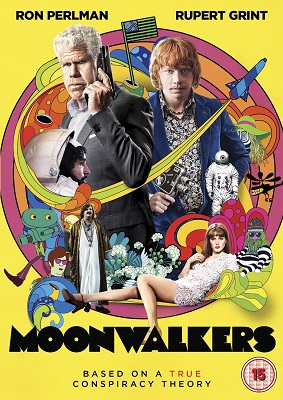
moonwalkersMoonwalkers, Antoine Bardou-Jacquet (2015, France). What I knew: a comedy about an attempt to fake the Apollo 11 Moon landing in case it failed. What I didn’t know: a French comedy set in Swinging Sixties UK, with Ron Perlman as some sort of CIA über-agent and the ginger guy from Harry Potter as the star. What I found out: it’s not very funny. Perlman is tasked with persuading Stanley Kubrick to film a fake Moon landing just in case Apollo 11 doesn’t make it. But his paperwork gets damaged en route to the UK, so he has no way of identifying Kubrick. Which proves less than helpful after bumping into prog rock group manager Rupert Grint, who promises him he can hire Kubrick. Of course, it’s not Kubrick, it’s his whacked-out mate. End result: random German Warhol-ish director is tasked with making Moon landing footage, prog rock band (especially egotistical lead singer) think it’s a promo video for their music, falsetto gangster is after Grint because he owes him money, and Perlman is slowly unravelling from a combination of Vietnam PTSD and accidental weed and acid intake. So much laughs. You’d think. But this film seems to be more interested in slo-mo violence and gore. It doesn’t help that Grint acts like he’s in a school play and Perlman does his Perlman thing. The supporting cast at least manage their bits well. But the whole is definitely not better than the sum of its parts. An entirely forgettable comedy, which struggles for humour.

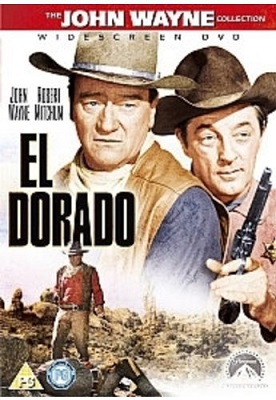
el_doradoEl Dorado, Howard Hawks (1966, USA). Hawks made a lot of Westerns – unlike Preminger, who only made one – and they do have a tendency to blur into one, possibly because he kept on remaking the same bloody story. After all, Rio Lobo is pretty much Rio Bravo (much as I love the latter); and even this one, El Dorado, follows the same story beats as those two. John Wayne: check. Drunken sheriff: check. Who sobers up for the showdown: check. Evil cattle baron: check. Feisty female character: check. Hawks does ring a few changes on his formula in El Dorado, however. Wayne plays a gun-for-hire who turns down an offer of work from cattle baron Ed Asner after learning of his true plans from local sheriff and old friend Robert Mitchum. An unfortunate encounter results in Wayne receiving a rifle bullet which lodges by his spine and occasionally paralyses him. Later, in a saloon, Wayne steps in when James Caan avenges his mentor’s death – so introducing McLeod, another gunslinger, who has signed up with Asner. When Wayne learns that Mitchum has turned into a useless drunk, thanks to a woman running out on him, Wayne and Caan decide to prevent Asner and McLeod from succeeding. The rest pretty much works itself out as this sort of story does. I have probably seen more Westerns than I ever wanted, or expected to, and some of them have been actually quite impressive. This one wasn’t. Even for fans of Hawks or Wayne, or both, it’s still probably considered a by-the-numbers entry. Entirely forgettable.

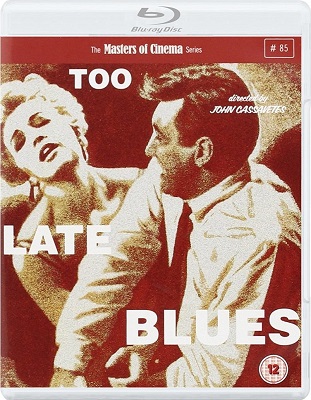
too_late_bluesToo Late Blues, John Cassavetes (1961, USA). A Cassavetes film I actually quite liked! That must be cause for celebration. And yet the music which forms the heart of this film – instrumental jazz – is so bland and inoffensive, it might as well be elevator music. Getting Stella Stevens to croon wordlessly over the top of it – which is pretty much the film’s plot – doesn’t improve it one jot. Bobby Darin plays a jazz musician and composer, who is happy to play bland lite instrumental jazz, although his band are hungry for success. He meets Stevens and decides to add her to the act. They try to cut a record. In a bar, Darin refuses to defend himself when a drunk tries it on with Stevens… and so the two split. He plays lite jazz for hire, she becomes a prostitute. It’s not a pretty picture. The film works because Cassavetes manages to get the viewer invested in the characters. Darin was inspired casting – he looks so innocuous, and yet he dresses and acts like he’s some kind of stud (I don’t know if that’s Darin being a star when the film was made, or just acting – hard to tell with a lot of US “actors”). Stevens, who always had more acting chops than most of her roles required, shows what she’s capable of, although in the singing department she’s hardly memorable. But the two stand-outs are Everett Chambers as Darin’s oleaginous agent and Cliff Carnell as the band’s bluff saxophonist. I’m a long way from becoming a fan of Cassavetes’s films – although I seem to have watched enough of them – but I thought this one more impressive than the others.

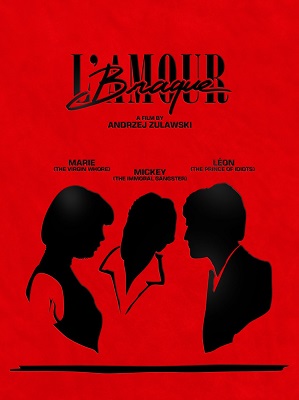
lamourL’amour braque, Andrzej Żuławski (1985, France). This may well be the most 1980s film ever made. And it’s not like there isn’t strong competition – like, er, Bruce Willis’s entire career pre-The Sixth Sense. True, it’s a French film, and that’s not something that immediately comes to mind when you think of 1980s films. But the over-acting Żuławski appears to demand of his cast, when married to a 1980s soundtrack and lots of shoulderpads, seems so 1980s it’s almost painful. The story, on the other hand, is the usual Żuławski tosh. Tchéky Karyo leads a gang of bank-robbers, and after the successful heist which opens the film, they stumble across Frances Huster, the somewhat bland lead of Jacques Demy’s Parking, and sort of adopt him. Huster then falls for Karyo’s girlfriend, Sophie Marceau… and there you have the romantic triangle Żuławski loves to structure his movies around. Like most Żuławski films, it’s all very intense, and the cast clearly give it their all, although the story is not quite as interesting as his other films. In fact, it all feels very much like a fairly ordinary 1980s French thriller given the Żuławski treatment, much like Subway felt like a fairly ordinary 1980s French thriller given the Besson treatment… back when “the Besson treatment” meant something. Having said all that, Mondo Vision have been doing an amazing job on these Żuławski re-releases. I missed the first two – L’important c’est d’aimer and Possession – but I’m definitely keeping track of them from now on…

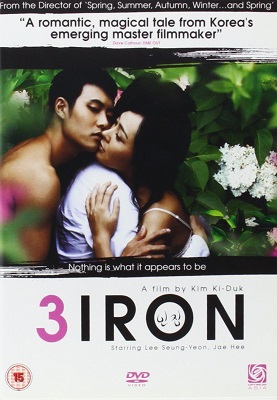
3-iron3-Iron, Kim Ki-duk (2004, Korea). I was somewhat puzzled when the rental service sent this as I knew nothing about the film and couldn’t think why I’d added to my list. But it turned out to be one recommended by David Tallerman, and his suggestions have generally proven quite good – although this was definitely the best to date. A homeless drifter tapes take-away menus over the keyholes of houses and flats, so he can tell if the places are occupied. Once he has ascertained they are empty, he breaks in and stays there – and while he’s there, he fixes broken appliances and does the residents’ laundry. But one such property proves to be still occupied: by the wife of an abusive husband. The wife leaves the husband and joins the drifter, but when they occupy an apartment owned by an old man who has died of lung cancer, the drifter is charged with his murder. While in prison, the drifter hones his skill at “invisibility”. Reviews have apparently focused on the fact that neither of the two leads actually speak during the film, but the true genius of 3-Iron is that it makes the drifter’s invisibility entirely plausible. It’s not authorial fiat, as in Christopher Priest’s The Glamour, but a carefully-practiced skill, with a narrative history… and that’s what makes it work. It helps that the film looks pretty good too, and the cast do an excellent job with a script that has no lines for them to speak. I really liked this. An excellent film that took an interesting approach to interesting material. Recommended.

1001 Movies You Must See Before You Die count: 792


Leave a comment

Moving pictures, #39

Well, slightly less than half of this post are US films, although I’d prefer it to be no more than one or two per post. But we’re getting there, as our national railway famously once said only to be privatised and then completely fail to get anywhere…

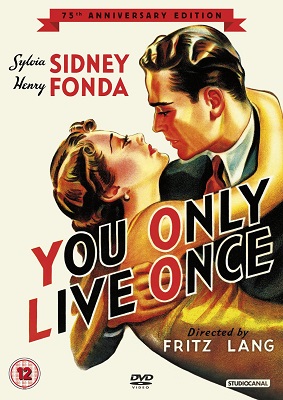
only_live_onceYou Only Live Once, Fritz Lang (1937, USA). This was a cheerful movie. Henry Fonda plays a habitual criminal who decides to go straight – mostly thanks to the love of a good woman, in this case Sylvia Sidney, the secretary of the local public defender. But not everyone is so forgiving. Although the public defender (who is secretly in love with his secretary) gets Fonda a job at a delivery company, he’s fired when he takes time out to look over a new house with his new wife. And no one else will employ him because he’s an ex-con. Absolutely no one. And then someone robs an armoured car, and a hat is left at the scene which points to Fonda as the culprit. He’s found guilty (the trial is off-screen, probably because it sounds so much a travesty of justice Lang was too embarrassed to show it), and Fonda ends up on Death Row. But an opportunity for escape presents itself, he takes it, but accidentally kills the prison priest… seconds after the warden has received news that Fonda is innocent and has been pardoned. Too late! Fonda collects his wife, and the two go on the lam. To be honest, I’d expected more from Lang. I’ve seen a fair number of his noir movies, and I expected this to be as good as they were. And certainly the scene where Fonda escapes from prison is very atmospherically staged and shot. But everyone is so horrible to Fonda, and the odds are stacked against him so strongly, the set-up to justify Fonda’s abrupt shift from optimism to desperation feels forced and completely implausible. So, not one of Lang’s better films.

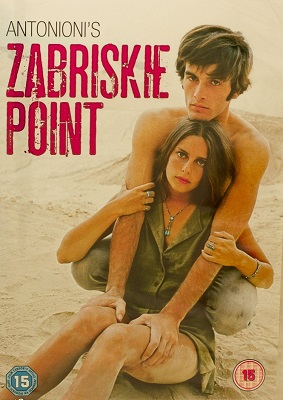
zabriskieZabriskie Point*, Michelangelo Antonioni (1970, USA). I’m a big fan of Antonioni’s films, and his Red Desert is one of my all-time favourite movies; but I also like late 1960s/early 1970s hippy films – or, at least, ones that comment on the hippy condition. It’s not just the direct rebellion, nor the questioning of society, but also that so many of these types of films throw in an additional dimension – which might well be typical hippy occult bullshit, but at least adds something a little more interesting to the story. And so to Zabriskie Point, which opens with semi-documentary footage of a protest at a California university. But when the police turn up, the protest takes a violent approach and several people are killed. Including a policeman. The film then abruptly switches to two characters: a young woman who is looking for a man in the Mojave Desert who works with emotionally disturbed children. Meanwhile, a young male student from the university protest, and a prime suspect in the death of the cop, steals a plane and flies off to Arizona… where he meets the young woman. And they go to Zabriskie Point, a real place just east of Death Valley, Nevada, where they have sex – well, actually, a full-blown orgy kicks off… and this isn’t really a film where you can describe the plot, or where such a précis would do the film any favours. But it is by Antonioni so it looks absolute fantastic and, to be fair, he makes just as good a fist of depicting the culture he’s filming as Demy does in Model Shop – they’re neither part of the culture, but their outsider status allows them see more than might be visible from inside. Antonioni made several excellent movies – I’d put Zabriskie Point in the top five of those; in fact I think I’d call it my third favourite after Red Desert and Blow-Up.

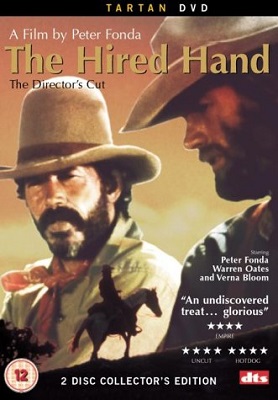
hired_handThe Hired Hand*, Peter Fonda (1971, USA). Sigh. Another 1970s Western on the 1001 Movies You Must See Before You Die list. But… well, this is a surprise. I’m not a fan of the Western, and have only three in my DVD collection – and I’ve probably seen more than I ever really wanted to because they’re on the 1001 Movies list… Certainly I’d never have considered watching this one: an early seventies Western, directed by Peter Fonda… (Even though I liked Easy Rider a lot.) But in fact it turned out to be pretty damn good. For exactly the same reasons why it flopped on release back in 1970. It’s slow, its cinematography is poetic, and it has a great soundtrack. Its story, to be fair, is not very interesting, and its characters are not very strong… but the whole works because the pictures and story go together exceedingly well. Fonda plays a drifter who decides to return to the wife who kicked him out years before, and asks only that he be taken on as a “hired hand” in order to prove he has changed. But a stop-off en route had made enemies of some nasty sorts and they track him down, and your typical Wild West showdown ensues. Where The Hired Hand really scores, however, is in its opening third: the cinematograhpy goes mad for dissolves and montages, and it works wonderfully well. The bluegrass score by Bruce Langhorne is also really well done – and I’m not a person who really notices incidental music (I have, like, three original soundtracks in my music collection… er, except for all those ones by Andrzej Korzyñski). Altogether, this is good stuff, and I’m tempted to pick up a copy for myself.

24_city24 City, Jia Zhangke (2008, China). I had been seriously impressed by Zhangke’s A Touch of Sin, so of course I added the rest of Zhangke’s oeuvre to my rental list… and this was the first sent to me. And, I’m happy to report, I did not choose wrong. Zhangke is a name to watch and a new director to join my favourites. The title refers to a new suburb built on the site of an aircraft factory. The film covers several decades in a semi-documentary style, first interviewing workers in the aircraft factory (whose location and purpose is a state secret because the aircraft are military). The film is divided into three sections: one during the days of the plant’s operations, another after it has closed and the plant has been mothballed, and one after the site has been redeveloped and a dormitory suburb now occupies the location. The mix of staged interviews, informal interviews (one scene consists entirely of a man at a bar reminiscing about his career at the factory), and small family dramas which illustrate the personal histories affected by the history of the factory and the town which springs up in its place, is extremely effective; and I especially like the factualness of it. 24 City is, apparently, a real place, and the story of the film is no doubt based upon, or inspired by, real events; but the mix of fact and fiction I find quite compelling – much as I did in A Touch of Sin. Excellent stuff.

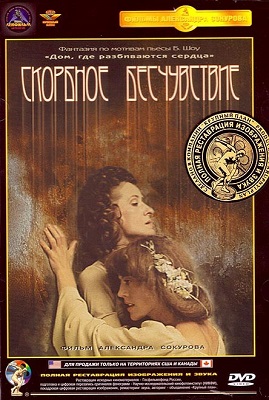
mournfulMournful Unconcern, Aleksandr Sokurov (1983, Russia). This was another work by Sokurov that remained underground for many years – it was banned by the Soviet authorities – before finally being publicly screened after glasnost… and was promptly nominated for a Golden Bear. It’s based on George Bernard Shaw’s Heartbreak House, but is intercut with documentary footage. The cinematography is, surprisingly, straightforward, but the whole thing feels ike an unholy mix of David Lynch and Peter Greenaway, albeit put together in an entirely Sokurovian way. That documentary footage, for example – it’s contemporary with the setting, the 1920s, and features Shaw himself, a zeppelin, World War I, an Antarctic expedition, the River Ganges, and various places in Africa. The choices of incidental music is also typically Sokurovian, and often anachronistic. Heartbreak House, subtitled “A Fantasia in the Russian Manner on English Themes”, which is apparently a reference to Chekhov, whose plays inspired Shaw’s, is set in the home of Captain Shotover – played by Ramaz Chkhikvadze as half Falstaff and half Lear – and is partly a drawing-room farce and partly an Edwardian sex comedy. Gunfire and explosions can be heard on the soundtrack throughout the entire film, which ends with a zeppelin dropping a bomb and blowing up the house. It’s… an odd beast. The story seems well-suited to Sokurov’s feelings about the Soviet Union. The use of documentary stock footage is perhaps more intrusive than in the other films in which Sokurov uses it, but it works really well (some of the inserts provide clever and amusing commentary on the main story). I’m not so sure about the story itself, however – I don’t know what changes Sokurov made to Shaw’s play, though the setting seems to be as described. Still, like all of Sokurov’s films, it’s one that will require repeated viewings.

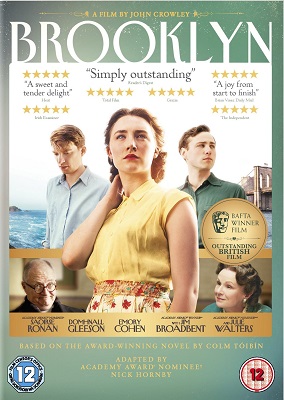
brooklynBrooklyn, John Crowley (2015, Ireland). This was one of those films of the last year or so which received lots of positive buzz and reviews, and didn’t involve superheroes, so I thought might be worth watching. It’s also an adaptation of a novel (winner of the Costa Novel Award, but only longlisted for the Man Booker) by Colm Tóibin, who, I admit, I’ve never read. The story is relatively simple – a fact stressed by several of the reviews: young Irish woman in the 1950s travels to New York in order to build a new life. She lives in a boarding-house and works in a department store, but she is shy and unassuming and very homesick. Then she meets a young man, of American-Italian extraction, and the two enter into a relationship. She is is now much happier and more settled. But then her sister in Ireland dies unexpectedly, so she returns to succour her mother. And now life back in Ireland seems much more attractive than it did when she left for New York. That is until the town gossip reveals something the young woman had been sort of trying to forget… and so she returns to New York. It’s a very pretty film, the cinematography is quite lovely, and the cast are uniformly good. Julie Walters as the landlady of the Brooklyn boarding-house, however, is a scream. But the story all feels a bit drab and low-key and devoid of any real insight, which makes the movie feel more like well-shot wallpaper than actual drama. I enjoyed it, but I think it was over-praised.

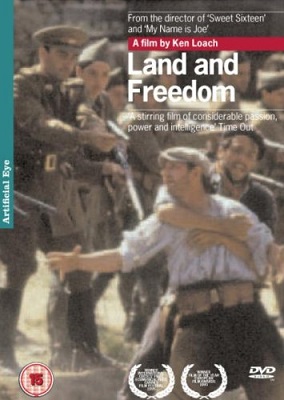
land_freedomLand and Freedom, Ken Loach (1995, UK). I thought this was on the 1001 Movies You Must See Before You Die list, but not apparently the edition of it I’m using. Still it’s by Ken Loach and the subject matter – the Spanish Civil War – made it seem worth renting. And so it proved. An old working-class man in Liverpool collapses in his council flat, the ambulance comes, but he dies en route. Later, going through his things, his granddaughter discovers he had sailed to Spain in the 1930s to fight for the Republicans against the fascists. She reads his letters… and these are dramatised, with Ian Hart playing the young Scouser. On arrival on Spain, it all seems a bit haphazard, but Hart joins POUM’s milita and is soon out fighting (which basically seems to involve taking potshots from the POUM trenches at fascist soldiers in their trenches). At one point, the militia oust a troop of fascist troops from a village, and the villagers then conduct a fierce discussion on private ownership and collectivisation. After Hart is injured training new recruits – a rifle explodes when he fires it – things take a turn for the worse as the various left factions begin fighting amongst themselves, and even start killing those whose idealogies are not approved. It hardly comes as a surprise the fascists win (even for those who don’t know their history). The right always will… because the left seems happier fighting among itself than showing a united front to the enemy – just look what’s happing in the UK now. You look at Trump, and it’s 1930s Germany all over again; you look at the UK, and it’s 1930s Spain. Neither, of course, bode well… I’ve watched the occasional Ken Loach film over the years and enjoyed them, but have never really made an effort to seek them out. However, I find myself appreciating social realism in movies much more these days than I used to (and consequently despising fascistic sfx-heavy tentpole movies). I see there are three box sets of Loach’s films available – Volume 1, Volume 2 and At the BBC. I might well avail myself of them…

1001 Movies you Must See Before You Die count: 792


1 Comment

Moving pictures, #38

Wa-hey, I did it! An entire Moving pictures post without a single US film. Which is not say I watched zero US films during the period, just that they were so shit they weren’t worth documenting (and, to be honest, there were only one or two of them). But still, it’s an achievement. And one I hope to repeat.

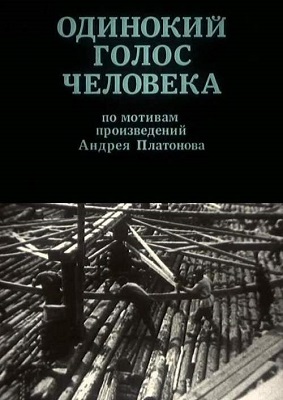
lonelyThe Lonely Voice of Man, Aleksandr Sokurov (1978, Russia). This was Sokurov’s first feature-length film, created as his thesis at the prestigious VGIK film school – but the school authorities wouldn’t accept it, and despite requests to do so by a number of big names, Sokurov had to submit something else in order to graduate. The Lonely Voice of Man, meanwhile, became an underground film; and it wasn’t until glasnost that it finally saw official release – although Sokurov took the opportunity to “reconstruct” it first. It had already built up a reputation from its underground showings, but post-glasnost it picked up several awards, and much critical acclaim, at numerous festival showings. It’s roughly based on the writings of Platonov, in much the same way, I guess, that Whispering Pages is based on the writings of Gogol or Save and Protect is based on Madame Bovary. Sokurov takes a very loose approach to “adaptation”. To be honest, I know nothing about Platonov – had not even heard of him until watching this film – but I don’t doubt that familiarity with his oeuvre would add more to the viewing experience, much as it would for the aforementioned films (which, to be honest, is not something I’ve tested – although I did drunkenly buy a collection of Chekhov’s stories while watching Stone; and when I found a copy of Gogol’s collected short stories in a charity shop, I bought it…). Anyway, The Lonely Voice of Man opens with the historical footage depicted on the poster I’ve used on this post, before moving onto the plot of Platonov’s novella ‘The River Potudan’, in which a young man returns home after fighting for the revolution. His girlfriend has since qualified as a doctor, and their two changed circumstances affect their relationship. So he runs away and becomes a manual labourer in a nearby town. The cast are non-professionals, and the picture is distorted – although to a much lighter extent than Sokurov uses in later films. The cinematography is dark, with a muted palette, and a camera that focuses on objects as often as it does the characters, not to mention a non-chronological narrative. While not everything in the film is immediately parseable, the sudden switches between seasons seem, to me, to signal, changes from one narrative to another – ie, boyfriend and girlfriend getting married, and after the husband has left. In Figures of Paradox, Jeremi Szianawski considers The Lonely Voice of Man a masterwork, but it seems to me more of an apprentice piece, a working-out of the themes and techniques Sokurov goes on to make extensive use of in his career (although both Szianawski and myself agree that The Second Circle is a masterpiece). There’s no doubt in my mind that Sokurov is one of the most interesting directors currently making films – and that’s as much a result of his contradictions as it is of the idiosyncratic approach he has taken to film-making.

subarnarekhaSubarnarekha*, Ritwik Ghatak (1965, India). Although this film appears on the 1001 Movies You Must See Before You Die list (one of two Ghatak movies to do so; the other is The Cloud-Capped Star), it has apparently never been released on DVD with English subtitles. Which is a shame. Having now seen it, I think it’s a better film than The Cloud-Capped Star, but not as good as A River Called Titas (which is not on the 1001 Movies You Must See Before You Die list; go figure). But I own all three films now, so I can watch them again at leisure. Ghatak directed eight films in total, and is highly-regarded – if not of the same stature as Satyajit Ray, he’s not far from it – so it’s weird that only The Cloud-Capped Star and A River Called Titas are available on DVD (and the first is not that easy to find – Amazon third-party sellers have it at £80 (but you can get it direct from the BFI for £20)). Anyway, Subarnarekha, AKA The Golden Thread, opens with a woman being taken away from a refugee camp, but her son is left behind. A young man takes the boy in hand, and takes him with him, and his daughter, when they leave and settle in West Bengal. Jump ahead a few years and the orphan boy and the daughter are now in love, but the father is told his career at the factory, amd his rise to manager, could be threatened if his daughter marries someone from a lower caste (ie, the orphan). Then it gets sort of complicated – but that difference in caste, and how it impacts the father’s career, is the axle on which the story revolves. It might well be heresy, but I think I prefer Ghatak’s films to Ray’s. To date, I’ve seen three by Ghatak and four by Ray – but Ray was both much more prolific and is more readily available on DVD in the UK, so perhaps I’ll change my mind once I’ve seen more of Ray’s films. I do wish more by Ghatak were available, however.

sils_mariaClouds of Sils Maria, Olivier Assayas (2014, France). I’ve followed Assayas’s career on and off since first seeing Irma Vep back in 2000, although, annoyingly, the film of his that has sounded most interesting to me was 2002’s Demonlover, which was never released on DVD in the UK. He’s a film festival favourite, and his last film, Personal Shopper, won him the Best Director Award at Cannes this year (a joint win with Cristian Mingiu). Clouds of Sils Maria is an English-language film despite being set in Switzerland and with a French actress, Juliette Binoche, in the lead role. Binoche plays an actress who has been asked to accept an award in Zurich on behalf of a reclusive Swiss playwright. Her own career began when she played one of the two lead roles in the stage and screen versions of the playwright’s most famous play, which is about the relationship between a young woman and an older woman. Binoche is travelling with her assistant, Kristen Stewart, an American, and the mirroring of their relationship with that of the two women in the play is, er, well, a bit obvious. Fortunately, both actresses are good in their roles – Stewart is especially good – and if the shape of the story unfolds all too predictably, the script provides more than enough material for the cast to get their teeth into so they put on a good show. But, for all that, the film comes across as a somewhat dull story that just happens to be especially well-made. Perhaps it’s the milieu in which it’s set – the European great and good, swanning about in swanky hotels, and arguing over a past, and career histories, that don’t feel especially well-seated in the plot. Assayas strikes me as a more consistent director than François Ozon – although it may be unfair to compare the two as Ozon belongs to a later generation of French film-makers – but I think Ozon’s oeuvre is the more varied and interesting of the two, and Ozon’s best films are better than Assayas’s.

days_whenThe Days When I Do Not Exist, Jean-Charles Fitoussi (2002, France). This film was sent as a “bonus” with a purchase made on eBay, so I had no idea what to expect. And the internet was no real help – there’s no Wikipedia page for Fitoussi, and the imdb page for Les jours où je n’existe pas is surprisingly free of information. Whch is a shame, as it proved to be an excellent movie. It opens with a funeral, and an actor discussing the life of the person interred in the grave. The conversation – well, monologue – continues in the car as they drive away from the cemetery. And it’s only then that the main narrative begins: a man meets a woman in a park, and the two begin a relationship. But he only exists on alternate days. To him, it’s an unbroken succession of days, but for her – she’s alone every other day, and it begins to pall. So much so that she asks a friend to help try and prevent her husband (I think they’re married by this point) from appearing. But it doesn’t work. The story is told chiefly through voice-over narration (framing narrative aside), and there are occasional breaks away from the characters when the camera shoots landscape (although there’s something Benning-like about these scenes, the camera is not static but slowly pans and zooms). The whole effect feels a little like Patrick Keiller and a little like Godard (when he’s being experimental, but not too off-the-wall), but it works really well. Definitely a pleasant surprise. According to imdb, Fitoussi has made almost a dozen films, although only three or four are feature-length. I’ll definitely keep an eye open should any of them appear in editions with English subtitles.

veroniqueThe Double Life of Veronique*, Krzysztof Kieślowski (1991, France). On its release, a film critic said of The Double Life of Veronique that it made “little or no sense on paper”, and she was pretty much spot-on. It doesn’t. The story is complete tosh. And yet it’s a beautifully-shot and beautifully-played piece of cinema. It not only works, it works exceedingly well – so well, in fact, it won both the Prize of the Ecumenical Jury and the FIPRESCI Prize at Cannes. (Barton Fink won the Palme d’Or that year, and La belle noiseuse the Grand Prize of the Jury.) The film’s title refers to young women, both played by Irène Jacob. The first is Weronika, who travels to Kraków to stay with her sick aunt, auditions for a conductor and is chosen by him as lead soprano for a planned concert. On the way home from the audition, during a violent protest, she spots a young woman who looks exactly like her. This second woman takes some photographs and then gets on a coach and drives away. This is Veronique, who teaches music at a school in Paris. Twenty minutes into the film, during the concert, Weronika collapses and dies on stage. The focus shifts to Veronique, who is suddenly overcome with sadness. A series of strange events seem to link her to the dead Weronika but transpire to be a “test” by a puppeteer and writer of children’s books Veronique has met. His last such test is sending her a cassette of ambient sounds. The postmark on the envelope leads her to a Paris railway station, where she finds the puppeteer in a café. He has been waiting there for her for two days. Angry, she leaves him – but he follows her to her hotel and the two become involved… The Double Life of Veronique is, quite frankly, made by Irène Jacob in the title role. Though the cinematography is pure Kieślowski, as is the ultra-careful timing of the story, the plot feels thinner than Krzysztof Piesiewicz’s usual material. None of which is to say The Double Life of Veronique is a bad film, or even disappointing for Kieślowski, because I thought it a better film than Three Colours: Blue, even if it did feel like the story was forever about to topple into nonsense. I need to watch Kieślowski’s other films to see if they’re also as good as I remember them – especially No End, which I seem to recall liking a great deal – although it seems not all of them have been released on Blu-ray… although Arrow Academy are going to release Dekalog in a dual edition box set later this year – it’s on my wishlist.

equinoxEquinox Flower, Yasujiro Ozu (1958, Japan). I must be getting into Ozu’s films – I recognised the characters in this movie as the same ones from Late Autumn and An Autumn Afternoon. And because the plot was about marrying off daughters, a subject shared with those other two films, I initially thought it followed on from them. But it was actually made two years before one and four years before the other. (Although, just to confuse matters, the main character has the family name Hirayama in each film, but is played by a different actor… each of which plays a differently-named character in the other two films.) In Equinox Flower, Hirayama must deal with his own two daughters, neither of which want arranged marriages – and the boyfriend of one, in fact, approaches Hirayama to ask for the hand of his daughter – as well as trying to reconcile an old friend with his estranged daughter and also help  a female acquaintance find a husband for her daughter… The film is set mostly in Hirayama’s office, home and a Ginza bar called Luna, where the estranged daughter works. There is also a scene in the same inn which appears in the later two films (with the same landlady too). I’ve said before that Ozu’s films are very domestic – and it’s not just that they’re chiefly uchi, but more that the stories are driven by the interlinkage between several families who seem to be undergoing the same trials and tribulations. And yet there’s a telling moment in Equinox Flower, toward the end, which admits the outside world, when Hirayama and his wife are at seaside, sitting side-by-side on a bench (it’s the cover image of the DVD), and she tells him that WWII was a wonderful time for her, and he replies that he hated it. And this is after differences of opinion over their daughters’ futures and the one’s impending marriage. It’s in the small things that Ozu excels – it is, in fact, where he finds his stories. And I’m not entirely sure if the fact they’re Japanese makes them more domestic than they would be had they been set in another nation. I think it might well. Good stuff.

summer_interlideSummer Interlude, Ingmar Bergman (1951, Sweden). Bergman is a Swedish institution – at least from the outside – perhaps so much so that he overshadows everything else produced on film or television in the country (twenty-first century Nordic crime TV series notwithstanding). And, despite the size of his output, Bergman’s oeuvre isn’t all that varied. His many films are usually three- or four-hander plays, typically about relationships or families, played out with a bit more scenic freedom than a theatre offers. Summer Interlude, considered among his best by some, is a case in point. The lead character is a ballerina, who goes to stay with relatives in the country for a holiday, and subsequently has a holiday romance. But the unsophisticated boyfriend doesn’t understand the dancer’s sophisticated world – especially her relationship with her urbane “uncle” – and it all ends badly. It’s all very, well, play-ish, a story driven by relationships which are laid out in dialogue rather than through visual clues – although Bergman certainly uses his scenery to good effect (and I have to wonder if the scene involving wild strawberries inspired the later film of that title). Criticising Bergman would be like criticising Shakespeare, but nothing should be sacred – and, like Shakespeare, some of Bergman’s output works better, or at least appeals to me more, than others. Summer Interlude has its moments, but I think I’d place it in middle-tier Bergman – neither a stand-out nor one of the forgettable ones.

1001 Movies you Must See Before You Die count: 791


1 Comment

Moving pictures, #37

I’m still working toward my entirely USA-free Moving picture post, but I’m not quite there yet…

sicarioSicario, Denis Villeneuve (2015, USA). I’d heard many good things about this film, although these days that doesn’t really give you any real indication of what to expect. It’s a thriller about the US-Mexican border and drugs and drug cartels. That tells you much more. Like, for example, it’s an essentially racist film. Every Mexican is either a gangbanger or an illegal immigrant. The only one that isn’t, a Mexican lawyer working with the US authorities, turns out to be an assassin bent on revenge. The message of the film seems to be the only way to beat the drug cartels is to descend to their level – ie, to tacitly admit that the rule of law has failed. This is pretty much implicit in the fact the operation which comprises much of the film’s narrative is planned and led by the CIA. Who are legally prohibited from operating on US domestic territory. But that’s not a narrative I’m prepared to accept. Treating Mexicans like subhumans, assassinating drug barons, and behaving like Wild West cowboys makes the good guys worse than the bad guys. You cannot win if you surrender the moral high ground. What makes it especially egregious is that there’s an easy way to solve the problem: legalise drugs. I fail to see how it can continue to be considered “political suicide”. The only explanation is that the illegal drug market earns so much it is in its interest to remain illegal, and those involved have bought sufficient politicians to keep the situation unchanged. Of course, it doesn’t help when popular culture valorises those who both supplying drugs and those break the law in order to prevent the supply of drugs. Because in order to create a hero, you need a villain for them to fight (but not necessarily defeat – because the War on Drugs is as unwinnable, and as just as much created and perpetuated by the forces of so-called law and order, as the War on Terror). This is not drama, it’s propaganda for the status quo. Films like Sicario have tendency to make me rant, which is why I dislike watching them. It nevertheless is a nice-looking film, and Emily Blunt is good in the lead role. But the story is a bag of shite, and a film that requires you to cheer for people who have willingly abandoned law and morality in order to achieve a suprious objective (and, in this case, a frankly objectionable, illegal and offensive, objective) leaves you little to like. Meh.

three_coloursThree Colours: Blue*, Krzysztof Kieślowski (1993, France). Many years ago, I decided to widen my movie viewing by watching something highly-regarded that wasn’t your usual Hollywood output. I’d been subscribing to Sight & Sound for a few years, and over the decades I’d watched the occasional “arthouse film” or “world cinema” – if anything, I liked those sort of’films, which displayed different sensibilities and visions to those I’d grown up with. And so I came across Kieślowski, who was apparently regarded as a critics’ and directors’ director, and I dutifully bought all his available films in Artificial Eye DVD editions. And yes, they were good films, streets ahead of a lot of the stuff I was used to watching. Although Blind Chance didn’t do much more than other films using the same repeated-time premise had done, and while I really liked No End it felt like an aberration in Kieślowski’s oeuvre… But of all his works, the Three Colours trilogy is reckoned the best, and I duly bought it and watched each of the three films and thought them superior drama… Recently, Artifical Eye decided to release all of Tarkovsky’s films on Blu-ray for the first time, which reminded me they had already done so for some of Kieślowksi’s – so I decided to replace my DVD copies with Blu-ray editions, and… Juliette Binoche plays the wife of a composer who attempts to free herself of her life after her husband’s death in a car accident. But it proves much harder than she had anticipated. But with a Kieślowski film, it’s as much about the cinematography as it is the story – this is the film with the infamous sugar cube scene. I was surprised by what I’d remembered from previous viewings – the overall shape of the story had gone, but a sequence shot from the back offside wheel of a car had stuck with me, perhaps because it had struck me as a corny shot when I first saw it and still seems somewhat corny. But most of the rest of the film has that clarity of mise en scène you often see in French films (well, except perhaps in some of Godard’s more experimental movies), as well as the tight focus on a single character, usually an emotionally-damaged person. Blue is certainly excellent film-making, and Kieślowski’s reputation is well-deserved; but after watching the film it felt like a superior example of a particular type of film rather than a superior film. If that makes sense.

atlantisAtlantis Down, Max Bartoli (2010, USA). I bought this at the same time as the execrable Battle Tanker (see here), but it’s not that much better. The title refers to a Space Shuttle (surely by 2010 it was known the fleet was going to be retired? The last flight, by Atlantis, coincidentally, was in July 2011, after all). But not apparently in the world of Atlantis Down. A simple supply mission to several space stations goes awry when a bright flash strikes the Shuttle, and the crew mysteriously find themselves back on Earth… or is it? One member remained behind on the spacecraft, but the rest find themselves in a mysterious wood. And as they explore it, they’re killed off one-by-one in weird ways. It’s some alien experiment or something, but it’s also exceedingly derivative and dull. I forget what the actual point of the alien experiment actually was; I’m probably better off for not remembering. I do recall that the CGI Shuttle didn’t look right, that the Shuttle’s flightdeck appeared weird (the windows were above the crew’s heads), and that the references to “internal gravity” just made the whole thing sound stupid. Atlantis Down is not as bad as Battle Tanker, but that’s nothing to be proud of. It’s two wasted hours I could have better spent watching something by, say, Sokurov…

days_eclipseDays of Eclipse, Aleksandr Sokurov (1988, Russia). It’s not easy to love everything in a particular director’s oeuvre. Take Douglas Sirk, for example. All That Heaven Allows is my favourite film, and I also love Imitation of Life, Magnificent Obsession and Written on the Wind. But Sirk also made a lot of forgettable films, like Taza, Son of Cochise or Battle Hymn. Aleksandr Sokurov is the director I most admire, and while I don’t love his films in the same way I love All That Heaven Allows, I do find them endlessly fascinating – and one or two I have watched repeatedly because they are so gorgeously filmed and yet so strangely resistant to parsing. Days of Eclipse is one of Sokurov’s better known films, albeit not in the Anglophone world as no English-subtitled edition has ever been released on DVD. It is also, unlike many of his other films, an adaptation of a novel, a science fiction novel, Definitely Maybe by Arkady and Boris Strugatsky. But not an especially faithful adaptation – in the book, the main character is an astrophysicist and a mysterious force is interfering with his research; in the film, the main character is a doctor in a poor town Turkmenistan, and he discovers that religious faith appears to be improving the health of his parents. The movie is shot in a variety of different styles – mostly in a sienna-tinted monochrome, but occasionally in colour, and sometimes in straight black and white. If there’s a pattern to this, I didn’t spot it. The protagonist also unfortunately looks more like a member of a boyband than a Soviet physician, which is a little off-putting. But it’s certainly a film – like all of Sokurov’s – which bears repeated viewings and, in fact, pretty much demands them. I’m going to have to watch it again, for sure. At least it’s not one of the impenetrable ones which, typically, I tend to prefer as I can never figure out what’s going on in them. Days of Eclipse feels perversely straightforward. I still think Sokurov is one of the most interesting directors currently working, and I love the philosophical meditations of his documentaries… but his fictional films seem, to me, to succeed more the… more painterly they are. If that makes sense. The stories feel like snapshots, as though an encylopaedic knowledge is required to tease out and comprehend all the references. It makes for a viewing experience that leaves you wanting another viewing…and another one… and another one. I’m glad I finally got to see Days of Eclipse, even though I found it a little disappointing; but I’m extremely glad I have a copy of my own and can watch it again at my leisure. Which I certainly plan to do.

julietJuliet of the Spirits*, Federico Fellini (1965, Italy). When I bought myself copies of Casanova and Fellini Satyricon, I decided to chuck Fellini’s Roma onto the order despite having never seen it. I could have chosen Giulietta degli spiriti (Juliet of the Spirits) instead, since it was Fellini’s first film in colour and initially it looks on a par with the films mentioned… Fortunately, I didn’t. I liked Roma much more than I did Juliet of the Spirits. You see, there’s something I don’t quite get about Fellini’s films. The colour ones I’ve seen are hugely self-indulgent – it’s their chief appeal; and yet the black and white ones I’ve watched have not been as indulgent to the same extent. Except perhaps . And now I think about it, the whole trapeze thing in the final act of La strada is pretty self-indulgent… But Juliet of the Spirits is just as mad as Fellini Satyricon and Casanova, and just as much the product of a director who appeared to have free rein, and no desire to self-censor. It’s the complete antithesis of Hitchcock. At least it is in that respect. But Hitchcock apparently liked to build complicated sets on soundstages, and so too did Fellini – pretty much all of Juliet of the Spirits appears to take place on one. (I was also maused to spot in the openning titles that much of the film’s wardrobe had been supplied by Bri-Nylon.) The title character is married to a man who organises events and charity shows, and is also a serial philanderer. A series of encounters with a number of strange people guide her to a resolution with her husband. It would not be unfair to describe the film as a series of encounters with grotesques (in its original sense – the word derives from the statues placed in grottos in 15th century Italy), although the “caves” here are mostly over-furnished sets intended to be people’s homes, or a wood, or the beach, or…  Giulietta Masina is quite astonishingly good in the title role, appearing both knowing and wide-eyedly innocent. The artificial nature of some of the sets – their house, for example, appears to have an astroturf lawn – sometimes feels tonally wrong. And, to be fair, the whole occult element of the plot was totally lost on me. I would rate it higher than the black and white Fellini films I’ve seen – except for – but not as good as the other colour ones I’ve seen.

aar_paarAar Paar, Guru Dutt (1954, India). There’s this weird series of tonal shifts in many of the Bollywood films I’ve seen. Apparently serious subjects are interrupted by song and dance routines, or unprompted moments of physical comedy. Aar Paar does sort of the reverse. It starts off as a comedy – a bit of light-hearted joshing as Dutt is released from prison, and while wandering the streets of Mumbai he pratfalls when he trips over the legs of a mechanic under a car… This last is Nicky, the love-interest, and that’s the “meet cute”. But Nicky’s father will have nothing to do with Dutt. He carries a message, as promised, from another prisoner to a local gangster… and so becomes embroiled in the gangster’s dirty schemes, while posing as a taxi-driver. But as he woos Nicky, and she comes to love him, against the wishes of her father, so a young woman working in the gangster’s bar falls in love with Dutt. And then it all turns serious, with Dutt coerced into being the getaway driver for a bank robbery because the gangster has kidnapped Nicky… And then Dutt, plus Bollywood regular Johnny Walker, decide to double-cross the gangster and rescue Nicky, leading to a Hollywood-style car chase and shootout. With songs, of course. I think th ereason I enjoy Dutt’s films is because he shows more of India than you see in more recent Bollywood films – the first song in Aar Paar features a series of women carrying water; compare that with the generic Westernised yuppie characters in Dil Chahta Hai. True, Aar Paar owes a lot of its story and story beats to Hollywood rather than Bollywood, but it’s still a very idiosyncratic approach to the material, and it’s also highly entertaining. I’ll be watching more by Dutt, I think.

outlawThe Outlaw, Howard Hughes (1943, USA). I think this one ended up on my rental list because I thought it was a Howard Hawks film – and so it is… sort of. It was actually directed by Howard Hughes, but Hawks was uncredited co-director. And, after all that, it seems the film is mostly famous for Jane Russell’s boobs. Hughes claims to have invented a push-up bra in order to make Russell’s bust more, er, well, more. But according to Wikipedia she never wore it. And, to add insult to injury, Russell plays a token over which the male characters fight but isn’t in the movie all that much. It’s actually about Billy the Kid, Doc Holliday and Pat Garrett – and although the last is a sheriff, I’m not entirely sure who the title refers to. Anyway, Russell tries to kill Billy in revenge for her brother but fails; later, after Billy has been wounded in a fight with Garrett, she nurses him back to health… and falls in love with him. But Holliday still wants his horse back – the theft of which kicked off the whole plot, although it being in the Kid’s possession didn’t prevent the two from becoming friends (Holliday and the Kid, that is). But it transpires Russell is also Holliday’s girl, so her falling for the Kid pisses him off. There’s a double-cross which sees her strung up to tempt the Kid back so Garrett and Holliday can capture him. And some gunfights. And mostly it felt like the sort of mythologising sexist rubbish Hollywood has always churned out about the Wild West, with nothing to lift it above any others of its ilk. I believe it is currently out of copyright, but I can think of no good reason why it should be remembered and celebrated.

1001 Movies You Must See Before You Die count: 789


3 Comments

Moving pictures, #36

Nope… FAIL. I started well… but then it all turned into US films. Admittedly, a few are classics but…

idaIda, Paweł Pawlikowski (2013, Poland). Despite his name, despite the fact this film was made in Poland, about a Polish subject, with a Polish cast and Polish money… the director is a Brit and his previous films were all set in the UK. None of which makes the blindest bit of difference, of course. If there’s a sensibility at play here, then it’s undoubtedly more Polish than British – and that’s not just because Ida was filmed in black and white and is paced more like East European “slow cinema” than it is, say, Gosford Park. All of which, to my mind, are good things. The title refers to an orphan about to take her vows at a convent. The mother superior tells her she has one living relative, an aunt, and she should visit her before making her final decision. Ida’s aunt proves to be a judge, and a decade before in the 1950s had a been a state prosecuter known as “Red Wanda” who sent men to their deaths at state show trials. Ida wants to learn what happened to her parents, so the two drive to the rural farm where the family lived. They were Jewish, but had been protected by the locals during the Nazi Occupation; but then one night they disappeared. The family who now run the farm – and had protected the family – are afraid Wanda and Ida want their property back, and are prepared to fight for it. But Ida is really about the relationship between Red Wanda and her niece, and while Ida herself is something of a blank – played by a non-professional in her first role – Agata Kulesza as Wanda quickly takes over the film and carries it through to her abrupt end. Ida was the first Polish film to win an Oscar for Best Foreign Language Film, and I think it’s on a later 1001 Movies You Must See Before Die list than the one I’m using. An excellent film, definitely worth seeing.

taalTaal, Subhash Ghai (1999, India). Bollywood films are now a regular part of my viewing. I admit I prefer the historical ones more than the current ones, but this one did have a good soundtrack. And from my limited experience to date, it seems most Bollywood films follow the same plot: boy meets girl, boy loses girl, boy wins back girl. There’s also usually a class difference between the two, or at least something that makes the two lovers “star-crossed”. In this case, Akshaye Khanna is the son of a wealthy industrialist, and Aishwarya Rai is the daughter of a lowly folk singer. They meet cute (he nearly falls off a cliff, is saved by her, then inadvertently causes her to nearly fall off), and, er, fall in love, but his father is against the match, and insults her family when they visit in Mumbai. She goes off and becomes a pop star, using songs based on her father’s music, and pop-star/producer Anil Kapoor asks her to marry him. But Rai is still carrying a flame for Khanna, as he is for her; and Kapoor reluctantly realises this and gets the two back together again. So, pretty predictable stuff. But the song and dance routines are good, especially an extended number when Rai performs at a MTV Award ceremony in Canada. Fun.

dallasDallas Buyers Club, Jean-Marc Vallée (2013, USA). Which is anything but fun. McConaughey apparently lost 21 kg to play the lead role, and he looks bloody awful. It’s quite off-putting. True, he’s playing a man who’s HIV+ and only a heartbeat away from full-blown AIDS… and has a lifestyle that includes heavy drinking and smoking and frequent drug use. But it’s what he does after his diagnosis which forms the plot of the film. Dallas Buyers Club is about the system Ron Woodroof – a real person, and this film is based on his life – put in place to obtain unapproved drugs to prolong his life as a HIV sufferer. He smuggled the drugs into the US by claiming they were for his personal use, and got around the law by not selling them but giving them away free to people who paid him $400 a month to be in his buyers club. It was not his idea – he picked it up from schemes being used in New York – but Woodroof did sue the FDA for the right to take one of the unapproved drugs he had been using. Much has been made of McConaughey’s side-kick in the buyers club, a transgender called Rayon, who was not a real person but based in part on a number of people known to Woodroof, and played by Jared Leto. To be honest, Dallas Buyers Club felt like a film of actors acting rather than a somewhat liberal-with-the-facts retelling of a person’s life- oh wait, of course, biopic… I mean, it felt like an artefact, not that it was helped by being about a bunch of not very nice people who had found themselves in a truly horrible situation not of their making. And while people certainly died because HIV treatment was ineffective and inadequate during the early 1980s, Dallas Buyers Club unhelpfully implies this was partly the FDA’s fault because it refused to approve drugs… Except pharmaceuticals need to be carefully regulated because without controls all manner of horrible shit would be killing desperate people in order to fatten the P&L accounts of Big Pharma. Dallas Buyers Club also apparently claims the drug Woodroof was originally prescribed is toxic and ineffective, but it’s not. And the treatment he self-administered is far less effective than the film claims. It’s bad enough to paint the FDA as the villains when they perform a vital role; it’s another to completely misrepresent drugs and drug regimens in service to drama. Meh.

twentieth_centuryTwentieth Century, Howard Hawks (1934, USA). For a film made only three-and-a-bit decades into the century, naming it for the entire 100 years is a bit of a hostage to fortune. Still, we’re talking Hawks here, and pre-Code, and screwball comedy – so it’s likely to be entertaining if nothing else. And so it proves. John Barrymore is a Broadway actor and producer, and he decides to turn lingerie model Carole Lombard into a Broadway star, despite her initial lack of apparent talent. He succeeds. Three years later, she plits from him, and his career goes into decline and he ends up in jail for debts. He escapes, disguises himself and catches the Twentieth Century train – the real source of the film’s title – from Chicago to New York. Also aboard is, of course, Lombard. The movie then turns into a drawing-room farce, only the drawing-room is very long but very narrow and is travelling across country at a high rate of speed. There are a number of running jokes featuring other passengers, such as a man known for writing cheques he can’t redeem, and he gives one to Barrymore. Of course, the plot runs along rails as set as the Twentieth Century itself, and the presence of a desperate Barrymore after one big hit and Lombard on the same train naturally leads to a new partnership and, if not a happy ending, at least one that could lead to happiness.

shanghaiShanghai Express*, Josef von Sternberg (1932, USA). When it comes to US films from the 1930s I’ll admit I’m frequently baffled why some made the 1001 Movies You Must See Before You Die list and others didn’t. I could be charitable and suppose the list-makers hadn’t managed to watch every Hollywood film from the decade, but that would be unfairly assuming they’d skimped on their due diligence – I mean, you don’t produce a list called 1001 Movies You Must See Before You Die without making a serious effort to watch as many eligible films as possible. Perhaps it just comes down to value judgements – after all, “best is just subjective”… Except, of course it fucking isn’t, otherwise everything would mean nothing. But people respond differently to films, as I’ve certainly learnt during my informal project to watch all of the movies on the aforementioned list. So perhaps that’s it. True, I like me a 1930s screwball comedy much more than I like me a po-faced 1930s thriller, especially ones that wears its orientalism proudly on its sleeve and even uses “yellowface” in one of its lead characters. The title refers to a celebrated madam, played by Marlene Dietrich, who is on a train from Beijing (here called Beiping) to Shanghai during a civil war. Also on board are an ex-lover of Dietrich, a French general, a bible-basher, and a half-Chinese businessman. The last is played by Werner Oland, best known for playing Charlie Chan. And he proves to be more than a businessman, he’s actually a rebel warlord. And he takes the ex-lover, a British officer and brain surgeon on his way to operate on the governor-general of Shanghai, as hostage for one of his men taken by the Chinese authorities. It’s all very intense, and each character has a well-defined character arc… but you can’t help noticing that it’s played pretty damn insensitively and for all its star performances it’s still little more than Yellow Peril. If the 1001 Movies You Must See Before You Die list must have a 1930s film set aboard a train on it, it’d have been better off with Twentieth Century – and I don’t think that’s a great film either.

road_to_gloryThe Road to Glory, Howard Hawks (1936, USA). Not sure what happened here – the rental service must have suffered some sort of blip and sent me two Howard Hawks films from the thirties. But never mind. If the title of The Road to Glory reminds you of a later film by a certain Stanley Kubrick, the title is not the only thing the two (nearly) share. Both are set among French soldiers during World War I. And both far from glorify combat. However, where Kubrick’s movie was about three soldiers unfairly charged with cowardice, and the officer who fights to save them from the firing squad, The Road to Glory is about, er, two French Army officers who fall in love with the same woman. Oh well. I tend to think of Hawks as one of those directors who produced solid films with just that little bit more which showed he had a real eye for the medium. He was no auteur, but neither was he a workmanlike director. But that extra touch isn’t always evident in his movies. It’s there in Scarface, a handful of tricks and a certain eye in some of the scenes; but there’s little in The Road to Glory that doesn’t look like anything more than a dab hand at staging, lighting and blocking. I’ve watched quite a few of Hawks’s films by now, but I can’t say I’ve spotted a “Hawks vision”. Which is not something you can say of Hitchcock’s films. There’s something very distinctive about the way the Hitch staged and shot his movies, and if Hawks had an approach all his own I’ve yet to spot it. Perhaps I need to see more of his films. Perhaps no such thing exists.

battle_tankerBattle Tanker, Jeffrey Scott Lando (2011, USA). I spotted this in a charity shop and though it looked like the sort of thing put out by the Global Asymlum, I thought it might be worth a go. It wasn’t. It’s shit. Really shit. There’s this mysterious weaponised substance called ICE-10, which has something to do with a meteorite that landed in the 1960s and something to do with anti-matter – like everything in this movie, it’s all confused bollocks. This ICE-10 is kept in a secure facility in Alaska, but they want to drill there so the US government has decided the safest place for it is at the bottom of the Marianas Trench. The plan is to put the substance aboard an oil tanker, sail it to the trench, and then scuttle the ship. This is all helpfully explained… and the film abruptly cuts to the ship and it seems they’ve already gone and put the ICE-10 aboard and are halfway across the Pacific. We’re told the ship is a Very Large Crude Carrier, and the film’s title seems to confirm this, but VLCCs do not have holds with hatch covers because why would you put a giant deck hatch on a tank of oil? The ship is also entirely CGI, so it’s not like they couldn’t get it right – although it is very cheap and crap CGI. The interiors are just as bad, although at least they’re not tricked-out industrial plants. The character arcs and dialogue follow text-book story beats, which has the unfortunate side-effect of making the characters comes across as complete fucking idiots for most of the movie- oh wait, that’s how these sort of things work, you can’t have common sense in use too early because how else are you going to show that the characters have grown. Seriously, ban all recipes and templates from script-writing – it makes for shit movies. Having said all that, only a complete fucking idiot would expect Battle Tanker to be quality; and while I was expecting a piece of shit, it failed to even rise to those levels. At various points, the ICE-10 containment – the design of this on the monitoring software bore no resemblance to the actual CO2-wreathed hardware, suggesting a budget shortfall – is “vented”, which generates great clouds of anti-matter, or something, which makes things which encounter it blow up, such as US Navy cruisers, airliners, and, er, Honolulu… I found this DVD in a local charity ship, but I think the world would be a better place if, instead of returning it, I destroyed it.

1001 Movies you Must see Before You Die count: 787