It Doesn't Have To Be Right…

… it just has to sound plausible


Leave a comment

Moving pictures 2017, #13

The New Year’s resolution is still working. I seem to be averaging one US film per Moving pictures blog post. The films in this post were half-rented and half-owned, and two were rewatches (albeit one of them not since many years).

herzogHeart of Glass, Werner Herzog (1976, Germany). I first saw this many years ago, after buying a Herzog DVD box set in a sale. And of that initial watch, all I  could really remember was the fact the cast were hypnotised before shooting began, and the really weird way they performed on-screen as a result. Which pretty much meant I’d categorised the film as “weird Herzog that’s probably pretty good but still weird”. What I’d forgotten were the parts of the film where the camera focuses on some part of the landscape, like some Caspar David Friedrich painting, lacking only the figure of a man, while some strange German prog rock plays… for ten minutes. I love stuff like that. When the actual story kicks off – a master glass blower at a factory in an eighteenth-century town and takes the secret of the glassworks’s unique ruby glass with him – it feels a bit like the film has landed badly in the proasic after some flight of fancy. The local baron is desperate to find the secret, so much so failure drives him mad. And the rest of the town go made too. While I’d remembered how odd the casts’ performances were, since they’d been hypnotised, they actually proved considerably stranger than I’d thought. In many cases, it was like they weren’t there, their faces seemed completely blank. At other times, they over-reacted as if whatever they saw or felt just got stuck. It was… very weird. And I really did like the musical interludes. Bits of Heart of Glass are among my favourite bits of Herzog.

my_brilliant_careerMy Brilliant Career*, Gillian Armstrong (1979, Australia). I was perhaps unfair in dismissing this as a “dull Australian historical drama”, as I did on Facebook shortly after watching it, yet I really did find it over-long and uninteresting. The title refers to the boast uttered by an independent young woman in late nineteenth-century Australia. She is convinced she will become a much-lauded writer – and given that the film is based on an important Australian novel, it might well be said she did just that. A young woman is sent from the family farm to live with her grandmother in order to calm her down and teach her how to behave like a proper young woman. She meets two men, and she falls for the one with the money. She spends time at his estate. He proposes. She rejects him. His fortune then collapses. She takes a job as a governess in order to support herself, but is sent home because the family mistakenly think she is seducing the oldest son. Her boyfriend proposes again. She rejects him again. And says she wants to become a writer. (Not that writing and marriage are incompatible, as a great many female writers can attest – even in the late nineteenth century… although perhaps not so much in Australia.) My Brilliant Career pretty much stands or falls on how you take to the lead character, Sybylla, the Miles Franklin stand-in. While the film was put together well, and the two leads, Judy Davis and Sam Neill, put in excellent performances, I really didn’t take to Sybylla, which is why I didn’t take to the film. Some films like that, I might decide a second chance is warranted, and so watch them again. But this was a rental and I didn’t get a chance before sending the disc back. So it’ll have stay as a “meh” from me.

astronautAstronaut: The Last Push, Eric Hayden (2012, USA). I have a great idea for a film, it’s it like the plot of my 2011 story, ‘Barker’, about the first man in space, who dies; but in this version it’s a British space programme, because we nearly had one, you know (actually, no, we didn’t, that’s implausible make-believe). Anyway, someone made that film, it was called Capsule, and it was very dull. Astronaut: The Last Push takes that idea one step further. Two US astronauts are being set to Europa, but the most efficient course is a slingshot by Venus, and then a second by Earth. Since this will take several years, the crew of two are put into hibernation. But then the spacecraft is hit by a micrometeoroid en route to Venus, which wakes up one astronaut and kills the other. So the surviving astronaut has to stay awake, and sane, during the remaining weeks of the trip from Venus back to Earth. As does the viewer. Because once the accident is over, the only drama remaining centres on the continued sanity of the surviving astronaut. And his coping mechanisms. And that’s neither dramatic not interesting enough to fill 85 minutes. I’m a sucker for space movies, but so many of them look better on paper than they do realised on the silver screen. Usually because the story isn’t really fit for 90 minutes. But I’ll keep on watching them, in the hope I find a good one.

far_pavilionsThe Far Pavilions (1984, UK). As far as I remember, I read MM Kaye’s novel The Far Pavilions one Christmas or Easter holiday while staying in the Middle East with my parents because there was nothing else to read. It was not my usual choice of book. But I really liked it – so much so, I went on to read Kaye’s other historical novels and, years later, tracked down copies of her crime novels. A later reread of The Far Pavilions reminded me why I had loved it so much the first time I read it. So I was keen to see the television adaptation… and so I did, within a year of two of its release. But I also remember being disappointed with the adaptation, but despite that I was pleased when I stumbled across a DVD of The Far Pavilions in a charity shop for 99p (as indeed were the rest of the family, who’ll be borrowing it from me). The story is simple enough. An English boy, Ash, survives the Indian Mutiny and successfully masquerades as the son of his Indian nurse until the age of eleven. At which age, he makes himself known at the Corp of Guides garrison in Mardan in North-West India. He is sent off to England to be educated, and to grow up, as a proper Englishman, and then returns to India on his majority to take up a place as an officer in the Corps of Guides. The book makes much of Ash’s childhood as Ashok, but the TV series leaves it as off-screen back-history. Which means that Ash’s ability to pass as a “native” (Urdu-speaker? Pushtu-speaker?) has to be taken as dramatic licence in the TV series – especially since all the dialogue is in English and there are no indicators the characters have changed language. (Actually speaking, say,  Urdu, and having English subtitles would be unacceptable on UK and US television in 1984, more’s the pity.) Ash was best friends with a young princess when a kid, but now he’s a pukka sahib he ends up meeting her, only she’s being married off to a nasty piece of work and he has to escort her to her wedding. They reconnect, are horrified by her future, but both have roles to play. There’s some fine landscape in The Far Pavilions, and some good dramatic moments, but the casting is iffy at best. Ben Cross never really convinces as Ashok, a blacked-up Amy Irving makes a poor Anjuli, and Omar Sharif and Christopher Lee as Pathans is just taking the piss. The storming of the Residence in Kabul is effectively staged, and the pomp and circumstance during the princesses’ trip south, and subsequent marriage, looks good. But the miniseries never matches up to the book – which I really must reread one of these days – and, thirty-two years later, feels like a too-thin adaptation that traded on a low-grade celebrity cast and Indian scenery. True, it was the first miniseries HBO were ever involved in, so early days for the format (and kudos to them for actually going to India to film it), but I’d really liked the novel and had hoped to like this just as much.

vagabondVagabond*, Agnès Varda (1985, France). The film opens with the discovery by a vineyard worker of a young woman dead in a ditch, from what appears to be exposure. From the voiceover, it appears this might be a documentary, and a series of interviews with those involved in finding the body, and the authorities and emergency services who turn up, only increases the documentary feel. But then Vagabond abruptly shifts back in time to the earliest appearance of the young woman the narrator admits she has uncovered… and the moves forward with a combination of dramatisation of the young woman’s life – she is a drop-out, travelling about France with a tent on her back and picking up casual jobs to pay for food – and interviews with those she interacted with along the way. Vagabond doesn’t blend fiction and fact as it’s entirely fctional, but it does blend the typical modes of presentation of fiction and fact. In itself, the story isn’t all that interesting – in attempting to track back the young woman’s life and discover who she was, the narrator, and so the viewer, discovers she was perfectly ordinary. She admits at one point to having been a well-paid secretary in Paris, but decided she had had enough of that life and so took to the road. The people she meets are perfectly ordinary, lending yet more of a documentary feel to the film. The only other Varda film films I’d seen prior to this were Les glaneurs et la glaneuse, which I thought okay, and Cleo from 5 to 7, which I loved. Vagabond I thought good. So I really should add me some more Varda to my rental list. Happily, there are two box sets of four of her films each available in the UK.

masterpieces_1Camouflage, Krzysztof Zanussi (1977, Poland). I had a moment of weirdness when watching this when I realised that one of the characters had an English accent when speaking Polish. I don’t speak Polish… but I’ve apparently heard enough of it in films to to recognise some Polish words being pronounced with an English accent. Weird. It turned out the actress was bi-lingual, but brought up in the UK, and in this film was playing a Polish-speaking Brit. She is one of several students at a university summer camp. She is also having an affair with one of the lecturers. And that lecturer is one of the young ones, who has different ideas to how students should be treated than the older lecturers. This comes to a head over the summer camp’s competition, in which each student stands up before the class and gives a a talk on a topic. (The summer camp is specifically for students studying linguistics, incidentally.) The young lecturer favours one student to take the prize, one of the older lecturers disagrees. It causes problems. To be honest, I thought the talk the young lecturer felt deserved the price, or at least what little of it appeared in the film, based on a fallacy and not especially good. But never mind. Camouflage is another one of those television dramas writ large that the Poles did so well in the 1970s. It doesn’t feel like a feature film but an entire series edited together and, in hindsight, I have to wonder if this is because these films take the time to build their characters. They don’t create ones that fall neatly into well-known types. The Polish-speaking English actress mentioned earlier is a good example. Why have someone like her in the film? Her background doesn’t impact the story, is not relevant to the resolution. But the fact she exists makes every character in the film feel more rounded. And when the story revolves around the conflict between two lecturers, of different generations and sensibilities, then well-drawn characters are a must. Camouflage also looks wonderfully 1970s. Not the horribly over-egged 1970s of twenty-first-century attempts at recreating the 1970s, like American Hustle, but the real 1970s, with daft pointy collars, tank tops, and shirts and ties and jackets in different unaplatable shades of brown. A good film.

1001 Movies You Must See Before You Die count: 855


4 Comments

Moving pictures 2017, #12

More movies from around the world. Two were from the first of the three Masterpieces of Polish Cinema box sets I bought (I can’t find these box sets for sale anywhere online, so I’ve linked the title to website promoting the original Martin Scorsese Presents Masterpieces of Polish Cinema‘s tour of, er, cinemas.)

beijing_bikeBeijing Bicycle, Wang Xiaoshuai (2001, China). As a fan of both Jia Zhangke and Zhao Liang, I was keen to see more films by modern Chinese directors, and Wang Xiaoshuai’s name cropped up as another of the “Sixth Generation”, which includes Jia. So I stuck one of his films on my rental list… Having cottoned onto Wang through Jia and Zhao, the director this film most reminds me of is Hou Hsiao Hsien, who is Taiwanese, although it does have the documentary feel Jia manages to give his films. Four teenagers from the provinces land a job at a bicycle courier company. They are each given a new mountain bike, the cost of which is taken out of their wages for the first six months. One of them is a week or two away from paying for his bike when it is stolen. So he fails to deliver the package that had been given to him – there’s an excellent sequence in which he turns up to a posh spa and gives the name of his contact, only for the brainless receptionist to assume he means a guest of the same name, and so he has to have a shower to enter the spa and afterwards is told he must pay for the shower – and is subsequently fired. He vows to find his stolen bike, and the company manager tells him that if he does, then he can have his job back. And he finds it. It had been sold to a schoolboy who fancies a girl in his class and has been accompanying her on her ride to school (but he stole the money from his parents to buy the bike). Unfortunately, the rest of the story rests on a fallacy – that the purchaser of stolen property owns the stolen property because they bought it in good faith. The moment the courier turned up and identified his bike, the schoolboy should have handed it over and demanded his 500 yuan back from the person who’d sold him the bike. But these are schoolkids, I suppose, and allowed to get it wrong – so wrong, in fact, that the courier and the schoolboy end up agreeing to use the bike on alternate days, the one so he can keep his job, the other so he can get closer to the girl he fancies. Who has already started going out with someone else anyway. This is not a cheerful film. (Does China even make cheerful films these days?) But it is a good one.

gods_egyptGods of Egypt, Alex Proyas (2016, USA). I knew this was going to be complete nonsense – I remember when the film was released last year, and what people were saying about it. But it was a Saturday night, I had a bottle of wine, and it couldn’t be that bad, could it, surely? Um, yes. Worse, in fact. Let’s ignore, for the moment, the whitecasting (especially since it’s equally troubling in the film following, although that at least has a more understandable excuse). So, skipping over the fact the film has a pretty much uniformly white cast playing the actual gods of Ancient Egypt from, er, Egypt, in North Africa… Even ignoring such a colossal failure, Gods of Egypt fails in so many other ways. For a start, it takes that mythology and turns it into a fantasy film. True, there is, as far as I know, no organised church of Isis, Horus, etc, to take religious offence at this appropriation; and Hollywood has done pretty much the same for Greek mythology since someone hand-cranked a camera in California for the first time. But neither past custom nor lack of a lobby group makes it acceptable in this day and age. And, as well as all that, Gods of Egypt is just, well, a shit film. The acting is terrible, the plot is nonsense, the production design looks wholly generic, and who really gives a shit about a bunch of super-powerful over-entitled people and their abuse of the population they rule? It might have flown forty years ago, but not now. Okay, so the way they made the gods all bigger than actual people was sort of cool… for about five minutes. But, to be honest, the entire film you just wanted them to put themselves out of your misery. Not only did Gods of Egypt make any random MCU movie look good, it also made it look positively left-wing. Avoid.

masterpieces_1Pharaoh, Jerzy Kawalerowicz (1966, Poland). And from the ridiculous to the sublime. Well, not quite. But it was obviously perversity which made me put on another film about Ancient Egypt immediately after sitting through Gods of Egypt. Pharaoh, however, is an earnest historical drama, shot in the Uzbekistani desert with a blacked-up cast. A cast – and that’s pretty much all the speaking parts – in dark skin make-up so they resemble Ancient Egyptians is never going to be acceptable… although this movie was made fifty years ago and is Polish-language. Suitable Polish-speaking actors were likely impossible to find (in which case, the best answer: make a different film), but we have what we have. Fifty years ago, Kawalerowicz went ahead and made Pharaoh. And, to be fair to him, he made more of an effort at verisimilitude under much more constrained circumstances, than Hollywood ever did. As it is, Pharaoh is pure historical epic but, despite opening with a huge battle sequence, still feels somehow small-scale. Perhaps it’s because the two main exterior locations, the palace and the temple, appear to exist in an empty desert wasteland. I don’t recall seeing a city, or even a camp for the slaves working on the various monuments. The story centres on the power struggle between a pharaoh and his priests, with lots of intense scenes set in darkened chambers in either building. I’m not entirely sure what to make of Pharaoh – it’s well-made, although its sensibilities are no longer acceptable, but in many ways it’s a good old-fashioned Sunday afternoon movie. It’s worth noting, however, that DI Factory have done a lovely job with this Martin Scorsese Presents Masterpieces of Polish Cinema box set. The packaging looks great, and the restored film’s transfer looks excellent. Happily, I have seven films in this box set yet to watch, and another two box sets in the series as well.

francofoniaFrancofonia, Aleksandr Sokurov (2015, France). There is a Curzon cinema here in Sheffield but, for reasons best known to themselves, Curzon chose to screen Francofonia only at their Bloomsbury and Soho cinemas, and not in a city which has an annual documentary film festival. Bastards. So I had to wait for the Blu-ray. I’d first heard about Francofonia some three years ago, and had expected it to appear in 2015. I had also been expecting something in a similar vein to Russian Ark, only this time about French history and the Louvre, albeit mostly focusing on the Nazi occupation of Paris. But I should have known better. Because Francofonia is actually closer to Sokurov’s “elegy” documentaries, especially Elegy of a Voyage, as well as bafflingly meta-fictional, like Mournful Unconcern (which was adapted from George Bernard Shaw’s Heartbreak House and features documentary footage of Shaw himself), not to mention Dialogues with Solzhenitsyn, in which Sokurov discusses the writer’s oeuvre and then interviews him on several occasions (including during a walk through some woods near Solzhenitsyn’s home). It’s not that Francofonia distils Sokurov’s career, more that it feels like a film that makes use of more of the techniques he has employed in other films than any other. Part of Francofonia is a dramatic reconstruction of the Germans taking over the Louvre, part is a history of the Louvre and of its director at that time. Another part is Sokurov himself trying to hold a video conversation with an agent aboard a ship in mid-Atlantic, during a severe storm, about a container of items destined for the museum and which might be lost. Every now and again, Luftwaffe planes fly over Paris. There is also archive footage of Hitler arriving in Paris. Sokurov is, in many respects, a product of his career. Early documentaries stitched together from archive footage led to his ability to build narratives from snippets of historical film, as well as provide a philosophical voiceover to pin it all together; his early problems with the authorities rejecting his films led to a more elliptical way of making his points; and his often precarious funding resulted in him having to edit a finished product together out of an unfinished project, so much so the enigmatic narratives were often more pragmatic than deliberate. Add to that a tendency to lard his films with references to literature and art – such as Dostoevsky in Whispering Pages, Caspar David Friedrich in Moloch – to an extent that sometimes the reference overwhelms its role in the narrative. This is, after all, the director whose first episode of a five-episode series about soldiers in Afghanistan consists entirely of a filmed snowscape while a voiceover discusses the life and career of Mozart. Francofonia, more than any other film I’ve seen by Sokurov, including Russian Ark, shows the advantages of modern film-making technology. It is a gorgeous piece of work and seamlessly assembled. It probably looked fantastic on a cinema screen. (Bastards.) But it also showcases Sokurov’s genius to an extent I’d not previously witnessed – the things I love his work for? They’re all in here. I’d always thought it a crime Sokurov was best-known for the technical achievement of Russian Ark, ie, a single take of 99 minutes; but with Francofonia I think his genius might become more widely known for what it truly is. I’ve been a fan of Sokurov’s work for many years and have most – but not quite all – of the feature films and documentaries he has made. I consider him the most interesting film-maker currently alive, and I’m hugely glad that not only is Francofonia seemingly doing well but also that is so much more emblematic of his work than I’d expected. It is an astonishing piece of work, go see it.

eleneaElena, Andrey Zvyagintsev (2011, Russia). I’ve now seen all four of Zvyagintsev’s films (a fifth is due for release this year), and I think I rate Elena second-best after The Return. The title refers to the working-class wife of a rich Muscovite. They met when he was in hospital and she was a nurse. The husband has a daughter by his dead first wife, Elena has an unemployed brother with a growing family. Elena wants to provide for here relatives, who live in a tiny flat in a block in a Moscow suburb, but her husband refuses to fund her brother’s indolence. Then the husband has a heart attack while swimming, and is once again in hospital. When he returns to their penthouse flat, Elena nurses him… but when he reveals he is going to write a will in which his daughter gets everything and Elena only an annual allowance, she poisons him. Since he died intestate, she gets half of everything. Zvyagintsev typically takes his tme over telling his stories, and Elena is no exception. The first five or so minutes of the film are a silent tracking shot through the penthouse. And then, the introduction of the couple”s domestic life takes another thirty or so minutes before the dramatic tension which is at the heart of the story is revealed. If you like your 5-second jump-cuts, this is not the film for you – indeed, Zvyagintsev’s oeuvre is not for you. But well-drawn character studies with an eye for detail and insight? Then he mostly definitely is. All of Zvyagintsev’s films are worth seeing.

masterpieces_1Provincial Actors, Agnieska Holland (1979, Poland). I’ve seen Holland’s Europa Europa (1990), and thought it very good, so I was not expecting to be disappointed by Provincial Actors (AKA Aktorzy prowincjonalni), an earlier film. The title is an apt description of its story. A provincial theatre is putting on an important play, but the director is “modern” and some of his artistic decisions don’t sit well with the cast, especially the older members who have been in productions of the play before. I will admit I know nothing about the play – ‘Liberation‘ by Stanisław Wyspiański from 1903 (he appears to have been an impressively accomplished Renaissance man) – but it is clear it’s an important play in Polish theatre. I think where Provincial Actors really works is that it’s not entirely about the play and the young director’s re-interpretation of it – this is no Peter Pan Goes Wrong – but that the lives of the actors, and the history they have together, is just as important. There’s an astonishing moment set in the apartment of one member of the cast, who is ironing a dress when a body plummets past the window behind her. It is another member of the cast. There are external factors to the play which explain, and determine, how the various members of the cast behave, and their attitude to the play and its direction. It’s an accomplished piece of ensemble acting, shot with that sort of television docudrama conviction that Polish films of the 1970s and 1980s seem to do so well. I’d like to see more films by Holland. Happily, she has made a lot; not so happily, I don’t think all that many of her early works are available in the UK…

1001 Movies You Must See Before You Die count: 853


2 Comments

Moving pictures 2017, #11

An even odder selection than usual. Two US films that are on the 1001 Movies you Must See Before You Die list, another film by a favourite director, and a film I knew nothing about but which blew me away when I came to watch it…

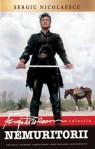
nemuritoriiNemuritorii, Sergui Nicolaescu (1974, Romania). I had thought this was a science fiction film, although I’ve no idea why. Perhaps it was the translation of the title, which means “The Immortals”. It is, in fact, an historical drama, set during the Middle Ages, and about a group of mercenaries who return to their homeland, Romania, and attempt to oust its current ruler. And, er, that’s it. There’s a running joke about a wooden chest which carries a great treasure, and which all their enemies are keen to possess… but the chest proves to be empty. In places, Nemuritorii reminded me of Verhoeven’s Flesh and Blood – it has that same earthy and violent approach to Middle Ages history – and Nicolaescu’s reputation as a good filmer of battle scenes is amply demonstrated. But Nicolaescu’s relationship with the Ceaușescu regime was problematic at best, and though he entered politics after the 1989 revolution, I’m told he’s not held in especially high regard by modern Romanians. I can’t say that Nemuritorii struck me as a great film, although it was entertaining enough and shot well enough. That earlier mention of Flesh and Blood was not entirely unwarranted – this film felt much the same: an entertaining Middle Ages adventure, with numerous battles, a cast of near-stereotypes, and a carry-through gimmick. I enjoyed it, but I’m not sure it’s a good film.

shes_gottShe’s Gotta Have It*, Spike Lee (1986, USA). I don’t think I’d actually watched any Spike Lee films until this watching this one, his debut, although I knew full well who he is and am aware of some of the films he has made. and while I can’t say the film appealed to me a great deal, I can see why it belonged on the 1001 Movies You Must See Before You Die list – so I’m glad I saw it. It’s not just that’s it’s an entirely African-American film, made wholly within the African-American culture of the US, but that it also takes a nicely meta-cinematic approach to its story and plays around with cinematic narratives and conventions. For a debut film, that’s pretty ballsy. And it works. The title refers to Tracy Camilla Johns, a young African-American woman living in Brookyln. She has three suitors (all three of which she regularly has sex with), but she cannot decide which one would be best-suited as her permanent partner – and, to tell the truth, she likes having three boyfriends. Characters in the film frequently talk directly to camera, there’s plenty of character assassination, and the film ends on an ambiguous note. The acting is not great – John Canada Terrell is especially bad – and the artificiality of the narrative structure is occasionally pushed a bit too much in the viewer’s face… but for a debut piece of work this is an astonishingly ambitious movie and its success rate is amazingly high. On top of that, She’s Gotta Have It was also one of the films that led to the resurgence of US indie films in the 1990s. I suspect its narrative experiments have been overlooked because of its importance as an African-American film and an indie film (and Lee’s character’s later appearances in Nike adverts), but She’s Gotta Have It has a lot to recommended it. Worth seeing.

reasonReason, Debate and a Story, Ritwik Ghatak (1974, India). This was Ghatak’s last film – he died in 1976… although according to the University of California Press edition of A River Called Titash, Ghatak’s adaptation, A River Called Titas, an earlier film, was not released until after his death, although Wikipedia claims otherwise. Whatever the truth, Ghatak made only eight feature films, and I’ve now seen half of them. And though they’re black and white and mostly exist only in bad transfers or prints, and were probably produced and shot on tiny budgets, I find them fascinating. Not just because they depict life in India – or rather, Bengal, and now Bangladesh – in a fashion not commonly seen in Indian films… but also because they were as much political and sociological essays about Indian life as they were dramatic stories. A River Called Titash, the book, has been described as an ethnological account as much as it is a novel, and that’s equally true of the film. Reason, Debate and a Story is not an historical film, although it is in parts ethnographical, particularly when it documents the dances by Bengali villagers. Ghatak himself plays a drunkard writer who has been critical of the partition of Bengal – and I suspect he was pissed in several of the scenes (he was an acoholic, after all). His wife leaves him so he decides to leave Kolkata, and as he wanders out of the city he picks up assorted waifs and strays. There’s his brother-in-law, who is educated but cannot get a job; an extremely handsome young woman; and a teacher of Sanskirt teased as “mad” by his pupils. The woman is, I think, a metaphor for Bangladesh, which desires reunification with West Bengal (and later does one of the worst lip synchs of a playback singer I’ve seen in a film). The Sanskrit tracher is obviously the history of India. And later, when they meet up with a villager who makes masks for dances, you have literate suburban India versus uneducated rural India. Ghatak doesn’t disguise his arguments, and as avatars his characters are hardly subtle. But there is also some very nice landscape cinematography (badly served by the poor quality film stock used), and I will admit to having thought Bangladesh was chiefly delta and alluvial plain before seeing this film. The aforementioned dances, which appear to be based on mythology, with dancers in masks dressed as Hanuman, Durga, Ganesh, etc., are fascinating. Ghatak’s message on the reunification of Bengal gets a little lost, although I’m doubtless missing lots of references as my knowledge of the area is quite poor. Weirdly, the film opens with a trio of dancers in black zentai outfits dancing on a set meant to represent a desert. They reappear two-thirds of the way through the film, and at the end. I have no idea what they’re intended to signify. But I still think Ghatak is a genius director.

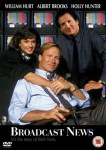
broadcast_newsBroadcast News*, James L Brooks (1987, USA). Nope, don’t get it. This is an average drama, well played by its cast – although with Hurt and Hunter, that’s a pretty high-powered cast – but I have no idea why it’s on the 1001 Movies you Must See Before You Die list. It’s just not that interesting. Hurt plays a sports anchor from a regional station who has landed a job as news anchor of a national station. (It’s probably worth pointing out that no other country has the US’s bizarre regional/national broadcasting set-up, and we non-USians have no fucking idea how it works.) Hunter is a top news producer, and Albert Brooks a gifted TV journalist. Hurt wants to pick Hunter’s brains to make himself a better anchor, but she won’t have it.  Brooks wants his try in front of the camera. It’s all completely boring and trivial, and Brooks’s career as an actor continues to mystify me. Hurt and Hunter are both good, but they’re in the top rank of Hollywood talent (not that they can draw salaries commensurate with their ability; that’s not how Hollywood works). But even so top talent needs a story more interesting than this. Broadcast News is a Sunday-afternoon film, or maybe a Saturday-afternoon-instrad-of-football film, it’s not 1001 of the top films ever made.

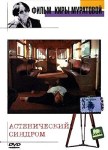
asthenic_syndromeThe Asthenic Syndrome*, Kira Muratova (1990, Russia). I’ve watched this twice now and I’m still not sure what it’s about, or indeed if it’s any good. It’s two films with unconnected stories. The first is black-and-white (well, more of a sepia colour) and opens at a funeral. The widow is grief-stricken, and, it seems, slightly unhinged. She attacks a man at a bus-stop, she bumps into people, she shouts and rants at no one in her flat, she drops wineglasses on the floor and breaks them… As if that weren’t baffling enough, the dialogue is completely bizarre. People shout at each other, and over each other’s voices, and what they say usually has no relevance to what’s happening in the story. Halfway through The Asthenic Syndrome‘s 153 minutes, the film appears to end, and the camera pulls back to reveal a man on a stage in front of a cinema screen in an auditorium. He introduces the actress who played the widow in the black-and-white film, but the audience are uninterested and file out noisily. One man remains after the others. He’s a teacher and the protagonist of the second film, which is in colour. The dialogue in this film is much like it is in the first. The teacher has narcolepsy – in fact, he fell asleep during the film-within-a-film (Wikipedia mistakenly implies the title refers to his narcolepsy, but asthenia is just a medical term for “weakness”). The Soviet Union depicted in the film is a grim and run-down place – I like the phrase someone used to describe The Asthenic Syndrome, “the last Soviet film and the first post-Soviet film” – but I  find it more interesting as a contrast to earlier optimistic Soviet films such as, say, Moscow Does Not Believe in Tears, made only a decade earlier. The Asthenic Syndrome‘s avant-garde approach does wear a bit thin over two and a half hours, although there’s some quite arresting imagery, and there’s a lot of repetition, particularly in the dialogue. I’m going to have watch The Asthenic Syndrome again, I think, to get a proper handle on it, but I sort of fell on balance that it belongs in the 1001 Movies you Must See Before You Die list. And I’d like to see more of Muratova’s films.

50_cubanI Am Cuba, Mikhail Kalatozov (1964, Cuba). I bought the Mr Bongo 50 Years of the Cuban Revolution box set because it included Lucía and Memories of Underdevelopment, and I knew little or nothing of the other two films. Well, one was by Tomás Gutiérrez Alea, who also directed Memories of Underdevelopment; but I knew nothing about I Am Cuba (AKA Soy Cuba). So late one night I stuck it in the player, expecting an earnest documentary of communist Cuba, likely something of a chore to watch… but I loved it. And I don’t understand why it’s not on the 1001 Movies you Must See Before You Die list. It’s one of the most technically innovative films I have ever seen. It is a documentary about Cuba, but it uses some of the most astonishing camera techniques I’ve seen since first watching Eisenstein or Vertov. Obviously, some of the shots are almost routine these days, and done using CGI, but back in the early 1960s, they didn’t have that – and there are several where you have to wonder how the hell Kalatozov managed it. There’s one where the camera swoops from the street up the side of a building, then from the rooftop through windows and down to the street, that is quite astonishing. I Am Cuba is not a documentary in the usual sense of the word – there’s no earnest voiceover explaining what’s shown on the screen, just people and events in Cuba being filmed almost fly-on-the-wall. Apparently, the film didn’t go down very well when it was made, and was pretty much forgotten for thirty years, and only rediscovered in the early 1990s – and championed by both Martin Scorsese and Francis Ford Coppola. That 50 Years of the Cuban Revolution turned out to be an excellent buy – three excellent films and one very good one.

1001 Movies you Must See Before You Die count: 853


1 Comment

Moving pictures 2017, #10

Another good spread of films. The sole US one is actually a documentary about the making of a German film, and is included in the Werner Herzog Blu-ray collection.

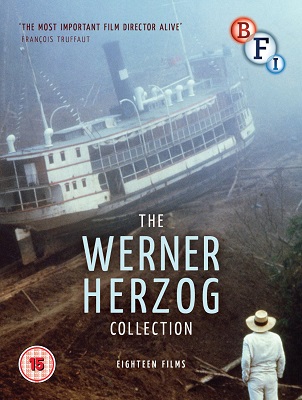
herzogBurden of Dreams, Les Blank (1982, USA). There are several famously difficult pieces of film-making, and perhaps the two best-known are Francis Ford Coppola’s Apocalypse Now and Werner Herzog’s Fitzcarraldo. Coppola’s film was documented in Heart of Darkness: A Filmmaker’s Apocalypse by Fax Bahr, George Hickenlooper and Eleanor Coppola (see here), so it should come as no surprise to learn there’s an equivalent documentary made during the filming of Fitzcarraldo. A comparison between the two documentaries in inevitable – both films were made in remote locations, with productions that spiralled out of control, a difficult marquee name, and a director with a far from firm grip on the production. Yet in Burden of Dreams Herzog comes across as jolly and mostly sanguine. There’s none of the expected despair. Kinski’s antics also don’t figure largely in the documentary, despite stories that the film crew offered to murder the star because of his outrageous demands and behaviour. Much of Burden of Dreams focuses on the logistics of the shoot, and the difficulties of dragging the riverboat up over the hill (they actually had three copies of the boat, by the way). Of course, there were also other problems – Fitzcarraldo originally starred Jason Robards in the title role, but he took ill and had to pull out. Watching him in the part, it’s clear it was better-suited to Kinski. Mick Jagger also played a supporting role, but when the shoot was delayed as they recast the title role, Jagger had to leave due to other commitments. They didn’t bother to recast, just wrote his part out of the film. Which was just as well as he was terrible. Of the two documentaries, I think Heart of Darkness: A Filmmaker’s Apocalypse is better, but that may simply be because Apocalypse Now is a more epic movie than Fitzcarraldo.

signale1Signale – Ein Weltraumabenteuer, Gottfried Koldtiz (1970, Germany). Back in the 1960s and 1970s, DEFA, the East German national film studio, made four big budget science fiction films. Three were made available in the US in a DVD box set around a decade ago – Der Schweigende Stern, Im Staub der Sterne and Eolomea. I think the box set is deleted now, so it’s hard to find. But if you see a copy, snap it up. However, one of those four films, Signale – ein Weltraumabenteuer, often described as East Germany’s answer to Kubrick’s 2001: A Space Odyssey, has never been released on DVD (except perhaps in Germany… but the copy I watched was actually from a German television broadcast, so perhaps not). Anyway, a friend came round one  Saturday evening – a German, as it happens – to watch some films, and I put Signale – Ein Weltraumabenteuer on. I’d been expecting good things of the film, as I like the other DEFA sf films, especially Eolomea, although I’d been told Signale – Ein Weltraumabenteuer wasn’t that good… And, er, it wasn’t. The spacecraft Ikaros is exploring near Jupiter when it’s hit by meteorites and suffers catastrophic damage. The crew survive, but they have no radio. A search for their wreck is unsuccessful, and they are presumed dead. But Commander Veikko is convinced they’re still alive and wants to try using his spacecraft, Laika. But he’s forbidden from doing so, and so uses a routine mission to service some satellites or space probes (it wasn’t clear which) to surreptitiously hunt for the lost spacecraft. Which he finds. And they rescue the stranded crew in the nick of time. What little plot there is in the film occurs in the last thirty minutes, the rest of it is just over-extended set-up. Including several scenes on a beach. I think there must have been a rule in East German sf film-making that required at least one beach-scene. And if the cast were riding horses, that was even better. A future party scene is also mandatory – although the one aboard Laika, to celebrate a crewmember’s anniversary, is cut short and seems entirely pointless. Also, confusingly, during the party the blonde wears a brunette wig and the brunette wears a blonde wig. Oh, and also apparently de rigeur in Warsaw Pact sf movies is a crap robot. And the one in Signale – Ein Weltraumabenteuer is only beaten by the one in Через тернии к звёздам. Despite all that, I’m glad I found a copy of Signale – Ein Weltraumabenteuer, and I’m glad I watched it. I might even rewatch it one day.

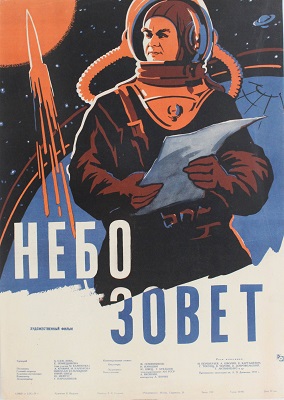
nebo_zovyotНебо зовет, Mikhail Karyukov & Aleksandr Kozry (1959, Russia). And after Signale – Ein Weltraumabenteuer, we settled down to watch Небо зовет, a Soviet sf film I’d been wanting to see for ages, but had never managed to find a copy on DVD. And… It turned out to have an almost identical plot to Signale – Ein Weltraumabenteuer: one spacecraft has to rescue another. Even worse than that, I have a copy of Battle Beyond the Sun, which is pretty much an edit of Небо зовет dubbed into Engish and with additional monsters. So it made for an odd viewing experience. Небо зовет opens with a journalist being shown around an office where Soviet scientists are designing rockets and spacecraft. Inspired by the models he is shown in a museum at the office, he dreams of a future in which the USSR has an extensive space presence. And the screen goes all fuzzy… and we’re in that very future. The Soviets are about to send a spacecraft to Mars, but the Americans are determined to beat them (the US mission seems to be a private enterprise). The Americans steal a march on the Soviets, but come a cropper when their rocket encounters a meteorite storm. So the Soviets divert to rescue them, but this ends up with both crews being stranded on an asteroid, Icarus. An automated rescue mission is sent but spectacularly blows up. A second, crewed, is successful, but the crew die. However, the crew of the Soviet and the US rockets both survive, and are given a hero’s welcome when they return to Earth. The model work and production design in Небо зовет is excellent, and while the space station design, which resembles an aircraft carrier, seems a bit odd (their spacesuits have magnetic boots, so they won’t just float away), as do the giant clamps with which the rockets dock. But this is a 1959 film, and the Soviet space programme was very secretive (they didn’t even admit Korolyev’s existence until after glasnost). Небо зовет is fun in a dated sort of way, and certainly a great deal better than its butchered US edit, Battle Beyond the Stars.

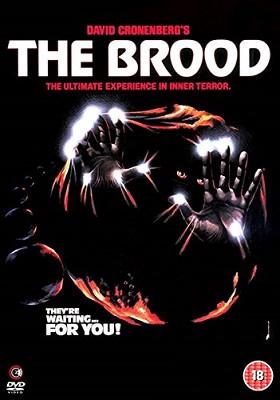
broodThe Brood, David Cronenberg (1979, Canada). I’m not sure why I stuck this on my rental list. It’s not like I’m a big fan of Cronenberg’s work, although I’ve liked many of his films. But he does horror, mostly, and I don’t like horror films. I’m okay with older ones, before CGI, when the special effects are obviously special effects. As is the case with The Brood. The story in this film, on the other hand, is completely bonkers, and despite a good cast – Ollie Reed! – never really rises above the completely silly. Reed plays a psychiatrist whose treatment causes patients to physically manifest their mental pathologies. Yes, actually physically manifest them. Meanwhile, a husband suspects his ex-wife, who is a patient, of abusing their young daughter and he’s trying to win custody as a result. At which point, a weird child in a snowsuit appears and starts beating people to death with hammers. When the husband stumbles across the weird child hiding in his mother’s house and it attacks him, he kills it in self-defence. At the autopsy, the police discover the child has no belly button, no genitals, no teeth, and is not entirely human. It turns out there are lots of these weird children – a group of them later appear and beat a teacher to death with hammers in front of her class of young kids (yes, seriously – how on earth was Cronenberg allowed to film that?) – and they are all parthogenically generated by the ex-wife in response to her anger, and they go out and attack the objects of her anger. It doesn’t… really work. It’s all played with a straight face, and is pretty convincing in parts, but as it progesses the dafter it gets… until the whole edifice is moments way from collapsing into a heap… Which it doesn’t quite managed to do. Not a good film, but a better one than its plot suggests.

zhao_liangPetition: The Court of Complainants, Zhao Liang (2009, China). In China, those who feel they have been abused by local government and the local justice system can petition the government in Beijing. But it’s a long drawn-out process and riddled with corruption. The petitioners live in a shanty town outside the city, and can spend years, even decades, there. Starting in 1996, Zhao filmed some of these petitioners as they tried to get justice from a government that plainly didn’t care about them. Some of the stories, you wonder why the government has not stepped in – a tax collector who demands more grain from some farmers, and less from others. One petitioner is killed by a train after running from “retrievers”, goons hired to force the petitioners to return home, and the camera shows the bits of her body strewn along the track. In the end, everything is razed – “Petition City” is completely demolished, as is the local train station, in order to make room for facilities for the 2008 Olympics. I’ll admit to being surprised Zhao has been able to make his films – although by all accounts it was far from easy – and if they’re not overtly critical of the current Chinese regime, they certainly are by implication. It is horrifying what the people in the film have had to put up with in order to redress injustices, and even scarier that by the time the Olympics opened – and there is a deeply corrupt institution, if ever there was one – any trace of Petition City and the people who lived there had vanished. Zhao’s Crime and Punishment is set in a provincial town and the authorities it depicts seem more incompetent than anything else – or, at least, corrupt in small and human ways. But Petition is set in Beijing, the seat of government, and the people interviewed by Zhao in the film are all from the provinces, showing just how little the government cares about its people. This is, of course, not unique to China. Every capital gets the lion’s share of finance and resources. And as wealth gravitates to the capital to take advantage of that fact, so the equity gap widens and those in the provinces find them increasingly poorer and increasingly powerless… Until they end up in a similar situation to those depicted in this film. There is apparently a five-hour director’s cut of Petition: The Court of Complainants, but I’m not sure I could have sat through it. The box set I bought includes the 120 minute cut. If I’ve not said it before, Zhao Liang is definitely a name to add to your list of directors to watch – Behemoth first, then this one.

ek_din_achanakEk Din Achanak, Mrinal Sen (1989, India). Three names usually crop up in articles on Bengali cinema: Satyajit Ray, Ritwik Ghatak and Mrinal Sen. I’ve seen a number of films by the first and plan to watch more, I’m already a fan of the second, but I’ve never seen anything by the third. Until now. And Sen’s movies are even harder to find than Ghatak’s. In fact, Ek Din Achanak is the only one available from a large online retailer of books and films and other stuff. There’s another one, Antareen, I’ve managed to track down… Both were released by NFDC Cinemas of India, who have also released two 20-DVD box sets of restored films from various parts of India. WANT WANT WANT. They’re bloody expensive, though, and I’ve yet to find a UK-based seller. Anyway, Ek Din Achanak was a well-played drama about a family whose father, a university professor, disappears one day. They try to carry on without him, and eventually become so accepting of their situation that they blame their present troubles of their own making on him. Despite the plot, and the focus on the family, Ek Din Achanak doesn’t feel as theatrical as Ray’s films. It feels like a movie. Which does sort of feed into my glib description of Ray as India’s “Ingmar Bergman”, although I haven’t quite figured who that makes Mrinal Sen… as if I could do that anyway after watching a single Sen film… But in Ek Din Achanak I found a well-played drama about a situation that felt real, but also unreal enough to be the sort of story you would expect in a literary-style drama. I’d like to see more by Mrinal Sen; I suspect I might have trouble finding more to do so.

1001 Movies You Must See Before You Die count: 850


3 Comments

Moving pictures 2017, #9

A mix of the usual suspects this time around, and it sounds good to say that and mean cinema from countries such as Russia, Germany, Japan and China. It seems I’m actually sticking to one of my New Year resolutions.

man_movie_cameraEnthusiasm: Symphony of the Donbass, Dziga Vertov (1931, Russia). If there are two words which are likely make me buy something I had not otherwise considered purchasing, they are “limited edition”. I’d seen Vertov’s astonishing Man With a Movie Camera a couple of years ago, but hadn’t been that bothered about owning a copy… and then Eureka! decided to release a limited edition dual-format box set of Man With a Movie Camera plus some of Vertov’s other works. So, of course, I had to buy it. On the other hand, it’s also true I treasure the sort of films in this box set, ie, documentaries of other times and other places… and yes, that’s probably a consequence of my love of Sokurov’s films. But I’m also fascinated by films which see cinema as more than just brainless spectacle, and Vertov was a vocal proponent of cinema as a social tool. And of the films in this box set, Enthusiasm: Symphony of the Donblass is a prime example of the type. It’s pure Stakhanovism – a coal mine in the Don region is determined to beat its quota, and Vertov is there to film them doing it. And, er, that’s it. It’s not a silent film, although the others in the set are. It’s also quite astonishing how crude coal-mining techniques were back in 1930s USSR. Men wielded picks against the coal face, ponies pulled carts of coal from the face to the pit-head. I come from a mining background – my grandfathers all worked down the pit, and although my father joined the Electricity Board when he left school, my uncles all went to work for the NCB. Despite all that, I know little about the actual work of extracting coal from underground, and what little I know of early twentieth-century UK coal-mining comes from, er, DH Lawrence. I suspect Soviet techniques were not all that different, and it’s interesting actually seeing them on the screen. All told, this limited edition box set has proven to be a wise purchase.

lisbon_storyLisbon Story, Wim Wenders (1994, Germany). I stuck this one my rental list thinking it was by Manoel de Oliveira, but it’s actually by Wim Wenders, whose films I’m also happy to watch (although I’ve seen considerably more by Wenders than de Oliveira). But de Oliveira does appear in the film, so blame Amazon rental’s search facility… Although, having said all that, I did enjoy the film. Wenders I find a bit variable, but this was one of his better ones. A German director – the same one, in fact, from Wender’s The State of Things (1982) – asks the sound man from that film to make his way to Lisbon. Which he promptly does. But the director is not there. So the sound man wanders about the city, recording ambient sounds, making friends with the director’s friends (a bunch of kids, mostly, and a string group with a female singer). The philosophy underlying the film, as proposed by the missing director, when he appears, is bollocks… but the film is a mostly sympathetic portrait of its titular city and the characters it finds there, and for that reason it’s watchable and sort of successful. I like many of Wenders’s films, and I’d certainly put him in a list of “100 most interesting directors of the twentieth century”, but… The Million Dollar Hotel? Really? It was so bad. Having said that, it’s a bit unfair to write Wenders off on the basis of one film – and I see from Wikipedia, he’s made nearly 20 films since the aforementioned, none of which I’ve seen. So perhaps it’s time I rectified that. Because Lisbon Story, despite being rented under false pretences, is an enjoyable film.

chungking_expressChungking Express*, Wong Kar-wai (1994, China). This was Wong Kar-wai’s breakthrough film, and, according to Wikipedia was shot in six weeks as if it were a student film. And it shows. Admittedly, I say that having come to Wong’s films first through In the Mood for Love and loving it, and so I can’t help but compare Chungking Express to it. And while I found it a good film, I did wonder why it’s on the 1001 Movies You Must See Before You die list. Wong deserves to be represented but this isn’t his best film. It’s important in as much as it signals his new direction and aesthetic, but then why not pick a film that is a better representantive of that new aesthetic, such as In the Mood for Love? Chungking Express comprises two stories, both of which revolve around unnamed Hong Kong police officers and their lack of a love life – or rather, the consequences of their lack of a partner and the efforts they go to in order to find one. In the first story, a cop buys a tin of expired pineapple chunks, as you do, on the anniversary of his break-up with his girlfriend, and falls in with a mule for a drug lord. In the second, a cop falls for a young woman who temporarily takes over the fast food outlet from which he buys a “chef’s salad” every night. The film looks like a mix of rushed shots and carefully-framed shots, an aesthetic Wong honed to excellent effect in his later films. The oblique approach to plotting also stood him in good stead in his later films – compare it with Ashes of Time (or even Ashes of Time Redux). Wong is a singular talent, and as such belongs on the 1001 Movies You Must See Before You Die list, but you sometimes have to wonder at the choices from a director’s oeuvre they’ve picked for the list.

late_springLate Spring, Yasujiro Ozu (1949, Japan). Ozu gets to you slowly. You watch one film and then you start watching another, and before you know it you watch more and you become a fan. And yet each film follows a similar plot: a daughter who must be married, and then a slow parade of the reasons why this cannot happen or must happen. And the beauty of Ozu’s films, of the way they are constructed, is that the viewer sympathises with each and every viewpoint. Perhaps it’s just that he builds strong characters on screen, to such an extent you realise how many characters in commercial cinema are little more than ciphers or tags. There’s no point in describing the plot of Late Spring, or indeed any Ozu film, because that’s not the point. They’re not just domestic dramas, they are ur-domestic dramas. They are so rich with detail, they actually transcend drama. Getting lost in an Ozu film is not getting lost in the story but getting lost in the lives of the characters. And that’s not something you can say about many movies. I came to Ozu late, but I’ve come to love his ability to generate drama from the prosaic, the quotidian. The differences between UK society and Japanese society become irrelevant, because Ozu manages to make the viewer care about the situation from the Japanese point of view. And that makes these rare films. I’m collecting all the BFI releases, why aren’t you?

robin_hoodRobin Hood, Wolfgang Reitherman (1973, USA). I’ve seen this named as one of the best, if not the best, of Disney’s animated feature films. So my hopes were high when I slid it into the player. And the opening credits are really quite well done. But I much prefer the Disney films with the clean lines, rather than the more sketched sort of lines of the 1960s and later. But even with that, Robin Hood just seemed… so small a story, with Nottingham depicted as a village, and everything just too small scale for the story as it purported to be. There was some impressive voice talent – or rather, well-known names – in some of the parts, such as Peter Ustinov and Terry-Thomas, and they were good. But it all felt a bit like an unrelated story that had borrowed the trappings of the Robin Hood legend, without bothering to be all that faithful. So far – and I’ve not seen all of the Disney animated feature films yet – I’d rate them as follows: 1 Sleeping Beauty, 2 Cinderella, 3 101 Dalmatians… and er, I need to watch, or rewatch, more Disney animated features to build up that top five. And no, I don’t count the Pixar films. I’ve still got a number of the classics to watch (or re-watch, albeit the last time I saw them was decades ago as a kid), before I can produce a definitive list. All the same, I’m not expecting Robin Hood to score as highly for me as it does for others. Did I mention that I was born in a town that used to be part of Sherwood Forest, so this legend has always felt like part of my heritage? No? Well, it does. Although that’s only a minor part of the problem. I liked the animal characters, even if it was a little worrying that both Robin and Maid Marion were both foxes (no trans-species love affairs in Disney), and some of the non-native species present in the film didn’t really have much reason for being present. And framing the over-arching narrative as some sort of good-ole-boy southern-USA story felt like appropriation. Not one of Walt’s best.

zhao_liangCrime and Punishment, Zhao Liang (2007, China). I loved Zhao’s Behemoth, which is an astonishing documentary that deserves to be seen by everyone. And, one night, having imbibed a certain amount, I decided I wanted to see more by Zhao but the only films available I could find were in a French-released box set. It had English subtitles, so I bought it. And… it’s pretty grim stuff. There are three films, and none of them makes for cheerful viewing. Crime and Punishment follows a small group of police officers in an impoverished town in north-east China. The people they deal with are poor, often not especially smart, and several are habitual criminals. The police officers are, by turns, arrogant, corrupt, violent, naive and not very smart. There’s a lot of shouting in this film, and several instances where the police openly beat up a suspect they’ve apprehended. But it’s the opening sequence to the film which sticks most in memory, a silent sequence in which the police officers fold up their bedding with military precision until each bed contains only a perfectly-formed cube of duvet. With all the guff you see in the press about China’s powerhouse economy and industrial and technological might, it’s worth remembering that the bulk of the country’s population live in poverty – as is amply displayed in Crime and Punishment – and those who don’t are pretty much indentured labour – as seen in Jia Zhangke’s 24 City and A Touch of Sin (which are, admittedly, not documentaries). I may not have been entirely sober when I clicked “buy” for the Zhao Liang box set, but it proved a worthwhile purchase. Which neatly brings my words on this last film in this post back to my words on the first film…

1001 Movies You Must See Before You Die count: 850


4 Comments

Moving pictures 2017, #8

This seems to be a mostly classic film post, except for a recent Swedish TV series. One movie is a rewatch (the Herzog), the rest proved not as expected…

adviseAdvise & Consent, Otto Preminger (1962, USA). In the week in which a White Supremacist installed himself in the White House, and his meat puppet president signed whatever Executive Order was put in front of him, well, that probably wasn’t a good week to watch this film, which shows how US democracy works, or doesn’t work. The president has put forward a candidate for secretary of state, Henry Fonda, but it’s an unpopular pick with some of the senators, especially good old boy the senator for North Carolina, Charles Laughton. So Laughton sets out to sabotage Fonda’s acceptance by the Senate. The Party Whip, on the other hand, wants to push it through. So they convene a subcommittee of friendly faces to lightly grill Fonda before accepting his apointment. But Laughton pulls a fast one and introduces a witness who claims Fonda was a communist when at college. Fonda denies it and makes the witness look like a lying fool. He later admits to the president it was true. One of Fonda’s allies subsequently turns on him because Fonda lied under oath, but he’s already being blackmailed over a homosexual affair when in the army. Winston Churchill reputedly said that “democracy is the worst form of government, except for all the other ones”, and there’s also that famous poll run by sf editor Donald A wollheim back in the 1960s in which the government of choice of sf fans was “benevolent dictatorship”. In other words, after more than ten thousand years of civilisation we humans still have no fucking idea how to run a society fairly. And despite repeated attempts at utopia – and I consider there to be two great historical attempts at utopia, neither of which remained utopian beyond a single generation – such experiments only work with small communities. Maybe that’s the answer, maybe total devolution to the lowest possible level, say a couple of hundred people, is the answer. There are those, after all who swear by Athenian democracy, as practised in small village town halls across the US during the first half of the twentieth century. But, Advise and Consent… I watched it because I’m trying to work my way through Preminger’s films, but I wouldn’t otherwise recommend it unless you’re interested in historical treatments of Washington politics.

herzogCobra Verde, Werner Herzog (1987, Germany). If I had to pick the most bonkers of Herzog’s feature films, I’d be hard-pressed to settle on just one. Cobra Verde has its moments, but despite having Klaus Kinski in the lead role, is saner than many of Herzog’s other movies. Cobra Verde is, however, a bigger spectacle than many of Herzog’s other movies. Kinski plays a rancher in nineteenth-century Brazil who loses his property to drought, works at a silver mine but murders his boss when he discovers the workers are being exploited, goes on the run as the eponymous bandit (Green Cobra! Sounds like a superhero), before eventually becoming the slave overseer of a sympathetic sugar baron. When Kinski gets all three of the sugar baron’s daughters pregnant, the baron decides as punishment to send Kinski to west Africa to re-open the slave route (and hoping, of course, that he’ll get killed in the process). But Kinski manages to persuade the king of Dahomey to accept rifles for slaves, sets himself up in a local abandoned castle, and all I can pretty much remember is Kinski doing his thing (apparently to such an extent the cinematographer quit, and Kinski and Herzog’s friendship finally bit the dust). There are massive set-pieces, with what appears to be the populations of small towns running around or dancing or fighting. Despite Kinski’s presence, and the over-the-top staging of some of the scenes, Cobra Verde does feel more sane than many of Herzog’s other films. Not dialled back, by any means, just less insane than what Herzog actually went through to realise some of his other movies. I’m not entirely sure how I feel about Cobra Verde, and I suspect Herzog’s films are immune to criticism to some degree. Cobra Verde is a good one, but perhaps not a great one, and I’d rate some of his documentaries above it. But if you call yourself a film fan, you should have all of his movies and documentaries anyway.

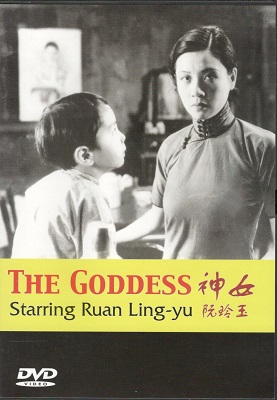
goddessThe Goddess*, Wu Yonggang (1934, China). This was a lucky find on eBay. Doubly so. I’d ordered one copy I found there, only to be sent a CD of background music for Chinese restaurants. I complained, they sent me a freepost address label to return it, and gave me a full refund. Fortunately, a second copy popped up on eBay for sale, for two-thirds of the price I’d paid before. So I bought it. Annoyingly, the BFI now plan to release a new restoration in April ths year. Argh. It’s a conspiracy, I tell you. The Goddess is a well-regarded silent film from the early decades of China’s film industry. Wikipedia refers to that period as “China’s cinematic golden age”, but I’m pretty sure the country has been having another golden age for the last couple of decades – see Jia Zhangke, Zhao Liang, Wang Xiaoshuai and Diao Yinan, among many others. The Goddess is also known as one of the last films by Ruan Lingyu, one of the most popular actresses of her day (and who committed suicide at the age of 24 in 1935). I tracked down a copy of The Goddess because it’s on the 1001 Movies You Must See Before You Die list, although I do like many silent films… but The Goddess, to be honest, felt much like the other silent films I’d seen. The setting and cast were, of course, Chinese, but the story itself was one that transcends nations. And the treatment of the story, and the way it was framed, seemed much in line with other silent dramas from other countries. There was no sense of vision, such as you’d get from directors like Carl Theodor Dreyer or FW Murnau – see The Passion of Joan of Arc or Nosferatu – although Ruan Lingyu’s talent was plain to see. I don’t know where The Goddess sits in the history of Chinese cinema – Ruan made over two dozen films before The Goddess, and Wu directed a further eleven films (his last in 1980) after The Goddess, his debut. I suspect there are more important films than The Goddess, but I also suspect  any better candidates have either been lost or are unknown in the US. Which is a shame.

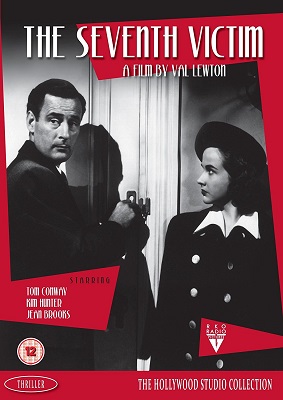
seventh_victimThe Seventh Victim*, Mark Robson (1943, USA). There are some odd choices on the 1001 Movies You Must see Before You Die list, and not just because they’re films I don’t care for, or, while good, don’t seem good enough to be one of the 1001 best films ever. But there are also those films which just aren’t all that good or innovative or important, so why are they on the list? Like The Seventh Victim. Which is a B-movie. A young woman at a residential school is told that her fees have not been paid for several months, and attempts to her contact her older sister, her guardian, in New York have failed. So the woman goes looking for her sister herself – and encounters a mystery. No one has seen her sister for weeks, her cosmetics business is now owned by an other woman, and the sister apparently rented a room above an Italian restaurant which she never used… and which contains only a noose hanging from the ceiling and a chair. It turns out that the sister had been recruited into a Satanic cult – although they’re presented more like Freemasons than the Hellfire Club – but told her husband about them and so broke one of the cult’s laws. Which is punishable by death. So she’s been hiding out, with the help of her psychiatrist. And that’s about it. It’s all very intense and earnest, but the Satanists aren’t in the slightest menacing. The sister’s disappearance adds a noir feel, but that collapses once the actual plot is revealed. There are a couple of earnest monologues on the sort of psychological claptrap Hollywood B-movies loved to lard their films with back in the 1940s and 1950s, but none of it is convincing or insightful. The Seventh Victim is entertaining enough, but it’s no more than a B-movie, and it certainly doesn’t belong on the 1001 Movies You Must See Before You Die list.

jordskottJordskott (2015, Sweden). I found this in a charity shop, misread its price tag and thought it an excellent bargain, but could hardly refuse to buy it when I got to the till. It was still cheap, however. And I’m glad I bought it, because it proved to be pretty good. It starts off as a Nordic crime series, and then turns into something more like Grimm. Eva is a crisis negotiator with the Piketen special operations police task force in Stockholm – in fact, the first episode opens with her trying to persuade a man armed with a shotgun to give up his hostage, his wife. Afterwards, she learns that her father has died, and so takes a leave of absence and heads to her home town of Silverhöjd. She has not returned there since her daughter, Josefina, disappeared in the forest surrounding the town seven years before. Eva was also estranged from her father. Shortly after her arrival, a young boy goes missing, and she sees a link between his disappearance and that of her daughter. Then another young child goes missing. Eva is heir to Thörnblad Cellulosa, a logging and mining company, which owns much of the forested land around Silverhöjd, and it is the company’s operations in the forests which has led to the kidnappings. It’s all to do with a pact signed in the eighteenth century between Eva’s ancestor and the mysteroious race which lived in the forest. But, Eva’s father, and now the acting CEO, want to mine the area because silver has been discovered underneath it. Eva’s daughter mysteriously returns, but has been infected with a parasite which is slowly taking over her body. It’s this parasite the title refers to – and when “fed” properly, it gives its host heightened senses and much greater strength and endurance. Because it seems there are group of people with this parasite who help protect the various creatures from Swedish folklore which live among humans. The plot lost it a bit toward the end, when a single character starts pushing everyone toward the worst possible end, and Eva’s decision to turn her back on it all felt out of character. I’d also liked to have learnt more about the secret society with the parasite, but perhaps they’re saving that for a sequel (although none has been made so far). The unexpected mix of Nordic crime and Swedish folklore went well together, despite the odd bit that was a little too hard to swallow. Good stuff. And if you see a copy going in a charity shop near you, it’s definitely worth shelling out for.

50_cubanStrawberry and Chocolate, Tomás Gutiérrez Alea & Juan Carlos Tabío (1994, Cuba). This is the second of two films on the 50 Years of the Cuban Revolution box set by Gutiérrez, and the last-but-one film he made. Ill health forced him to enlist the help of a friend as co-director. Although released 1994, Strawberry and Chocolate is set in 1979. The lead character, David, is a student. He stops for an ice cream at a café, and is approached by a gay man, Diego, who tries to chat him up. When Diego reveals he has some hard-to-find foreign books at his apartment, David agrees to accompany him home. Diego is hoping for more, and the two become friends – but nothing more – and David learns about life after the revolution, as seen by someone on the fringes of society. David’s homophobic room-mate, on the other hand, sees the friendship as a chance to investigate Diego and his circle of anti-revolutionary friends, and so denounce them. There’s something astonishingly cheerful about this film, although it does quite emotional in places. The two main leads – and the female lead, Nancy, one of Diego’s neightbour, and who David ends up in a relationship with – are all likeable and well-played. Gutiérrez, known to his friends as Titón, was a film-maker in the New Latin American Cinema, which I think is a sort of umbrella term which includes Brazil’s Cinema Novo. New Latin American Cinema was, as Wikipedia put it, “largely concerned with the problems of neocolonialism and cultural identity”, and put the social usefulness of cinema ahead of artistic considerations such as cinematography or three-act stories or storybeats. It’s certainly true that cinema is a powerful tool in that respect; it’s equally true that most Western audiences appear to prefer brainless spectacle. But even then, there are ways of effecting social change without writing in-your-face social drama. Strawberry and Chocolate is a charming drama, and, to be fair, some of its social concerns are over my head as I’m unfamiliar with Cuban history and society – but it makes an effort. And so few Hollywood movies do. They just re-iterate and valourise and normalise the same old right-wing bullshit that has turned the second decade of the twenty-first century into a copy of the fourth decade of the twentieth century. Art has meaning and cinema is an art. And on the strength of Strawberry and Chocolate, and Guttiérrez’s earlier Memories of Underdevelopment, I’m going to try and see more of his films.

1001 Movies You Must see Before You Die count: 849


2 Comments

Moving pictures, #7

For all my efforts to watch films from different countries, there seem to be a handful that appear more often than others – and they’re all in this one: India, China, Sweden, Germany and the US. And the UK too, of course, although there’s no British film in this post. Having said that, Poland might be turning up in quite a few Moving pictures posts over the next few weeks…

herzogFitzcarraldo*, Werner Herzog (1982, Germany). The thing with special effects is that none of it is real. With physical effects, it’s faked by physical means. These days, with CGI and digital effects, none of it exists outside a computer. But sometimes, film-makers do exactly what they show on the screen. And one of the famous things about Fitzcarraldo is the central portion of the film, where the cast drag a steamship over a mountain ridge from one river to another. And that’s what they actually did. The story of the film seems almost incidental to that one achievement. Basically, the title character – his name is a Hispanisation of “Fitzgerald” – is an opera lover and plans to bring Caruso to the Amazonian town he calls home. In order to do that, he needs money. So he buys a tract of land that cannot be reached by river – or rather, it can, but the river in question is blocked by fierce rapids. So Fitzcarraldo plans to drag his boat over the ridge between the navigable river and the unnavigable one. And he enlists the help of a local Amazonian tribe to do so. Of course, this is a Herzog film, so nothing goes as well as planned. By all accounts, the filming was as difficult as that of Francis Ford Coppola’s Apocalypse Now – there is even an equivalent “making of” documentary, Burden of Dreams (due to appear in a Moving pictures post later). And so the film itself is more or less incidental in the face of that central event – which is every bit as astonishing as you would think. They physically drag a steamship of three hundred tons up and over a mountain ridge a good three or four hundred metres high. The whole film screams difficult shoot right from the start, and the fact the film works, is even successful, is probably more due to the insane ambition of Herzog in attempting it and the unforgiving landscape in which he chose to shoot. It’s one of those cases where everyone suffered for their art, but their act of suffering produced art over and above the norm. And it shows. And that’s without Kinski going completely off the rails during the film – so much so, the crew offered to kill him for Herzog. Definitely in the top five of Herzog films.

hometownPlatform, Jia Zhangke (2000, China). The final film in the Hometown trilogy, although, to be fair, I’ve not watched them in the order in which they were released. In fact, the order goes Pickpocket (1997), Platform (2000) and Unknown Pleasures (2002). Having said that, all three films share a common story: disaffected youth being disaffected youth in different circumstances. In Platform, the cast are a theatre troupe, and they travel about the province putting on state-sanctioned plays. One member forms a relationship with a man, who stays behind when the troupe goes on tour. As China changes, so does the material the troupe performs, until they end up performing rock songs. There’s a definite consistency of vision and approach to the three films in the trilogy, and seeing them in quick succession can feel like too much of a thing in too short a time. Jia has an excellent eye, and his use of mostly amateur cast members and real locations gives the films a documentary feel he has managed to maintain throughout his career so far (both 24 City and A Touch of Sin possess it). I have in recent months found myself becoming a fan of the new cinema coming out of China – not just Jia, but also Zhao Liang, and films like Black Coal, Thin Ice, rather than Hong Kong art house directors like Wong Kar-wai, who I do still like. According to Wikipedia, Jia is a member of the “sixth generation” of Chinese directors, so I guess I should try films by other members of that group…

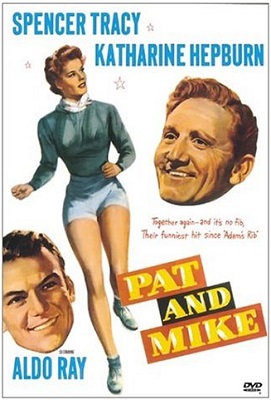
pat_mikePat and Mike, George Cukor (1952, USA). In classic Hollywood films, there are great screen partnerships, and there are those that occasionally achieved greatness… Tracy and Hepburn made nine films together, and one or two are judged classics, like Adam’s Rib (1949), although I do have soft spot for the one where Hepburn is in charge of a GIANT COMPUTER BRAIN,  Desk Set (1957). Pat and Mike follows a similar pattern to the other films in which the pair appeared – and pretty much to any screwball comedy / rom com of the period. Hepburn plays a natural athlete who wins lots of competitions… providing her husband is not present. As soon as he appears, she slices the ball, hits the net, etc, etc. And so along comes sports agent Tracy, who spots this and needs to keep the two apart in order to profit from Hepburn’s sporting skill. Naturally, the two fall in love. Naturally, this results in snappy dialogue. I’ve watched a lot of George Cukor films, and a lot of them have been very good… but I can’t say I’ve spotted a George Cukor vision, which is not something I’d say of many directors whose careers I’ve been following. Given his oeuvre, I’d have expected something more consistent from Cukor – he has, after all, made some bloody good films, and you’d expect more of them to be of that quality. Pat and Mike, sadly, is pretty forgettable, not a film you’d be reccommending should you find yourself putting together a list of George Cukor films worth seeing. One for fans of screwball comedies.

classic_bergmanA Ship Bound for India, Ingmar Bergman (1947, Sweden). Apparently, “Classic Bergman” means minor Bergman films you will forget ten minutes after watching them. Now, by definition, any Bergman film is worth watching – he’s one of the best directors the twentieth century produced, and that’s a fucking large field in which to excel – but this box set hasn’t really showcased Bergman’s best. “Classic” then, in this case, means “for completists”. And while I’d happily count myself in that category, I’m not so much a fanboy I can actually remember much of this film despite watching it. The main character was a sailor, or wanted to be a sailor, and had a bad relationship with his parents… and okay, I may not have been entirely sober when I watched this film but at least I own the box set so I can watch it again. But from what I remember nothing in it particularly engaged me, so I’m guessing it’s much liked the other films in the box set, ie, a polished theatrical piece shot in stark black and white, starring some of Bergman’s usual stable of actors. I’ll probablyh have to watch it again.

name_riverThe Name of a River, Anup Singh (2003, India). I’m not entirely sure what to make of this. I’ve watched it three times now, and I’m no wiser. I had thought it was a documentary on Ritwik Ghatak and his works, but instead it appears to be a somewhat plotless actual feature film, and a nicely shot one it is too, which was inspired by Ghatak’s movies. Parts of it are sort of restagings of some of the scenes in the movies – the ones set on the distinctive fishing boats of the Titas River, for example, I recognised immediately. There are also interviews, staged more like conversations, between members of the films’ casts – such as the two female leads from A River Called Titas. I’ve only seen three of Ghatak’s eight films – although I do have a fourth to be watched now – which is not enough to spot all the references in The Name of a River. But from the section based on A River Called Titas, and the conversation between its two female leads, there’s a lot in here to unpack. I’ve made my opinion on Ghatak more than clear on this blog in other posts, and I admit I was looking for a little more insight into his career than The Name of a River offers – in fact, now I think about it, it didn’t seem to offer any insight at all. I did enjoy it and it is pretty good – it sucessfully replicates Ghatak’s visuals, and makes clear his politics, and there’s some interesting anecdotal stuff from actors who worked with him. But I guess if I want insight, I ought to read Ghatak’s own writings on cinema.

kahaaniKahaani, Sujoy Ghosh (2012, India). This was a surprise, and a very pleasant one. I’ve no idea why I stuck it on my rental list, but when I shoved it in the player I was expecting three hours of typical Bollywood entertainment. And then it opened with a gas attack on the Kolkata Metro in which a carriage full of people died. Well, that was pretty dark. Not Bollywood at all. The story then jumps forward two years, and a pregnant woman flies into Kolkata from London and makes her way to a district police station. Her husband had been sent to the National Data Centre on assignment, and then vanished. She has come to look for him. She enlists the help of Rana, one of the police officer, but their investigation goes nowhere. But then the HR manager of the National Data Centre remembers another employee, Milan Damji, who resembled the pregnant woman’s husband. So they start looking for him. But it all spirals out of control – the HR manager is murdered, an Intelligence Bureau officer turns up and starts ordering people about, and then it turns out Damji’s was responsible for the gas attack two years earlier… Kahaani turned out to be a good film, a solid thriller which made excellent use of ts location, and had an especially good lead in Vidya Balan, who plays the pregnant heroine. There’s neat twist at the end, which, to be honest, wasn’t all that hard to spot. Apparently, there’s a sequel, Kahaani 2: Durga Rani Singh, released late last year, so it’s not available for rental yet. But when it is, I’ll be sticking it on my list.

1001 Movies You Must See Before You Die count: 847


2 Comments

Moving pictures 2017, #6

This was going to be a post without a US film… But I had to do a bit of juggling after realising that  I’m going to have watch The Name of a River again, which is a sort of drama-documentary about Ritwik Ghatak’s films, before I can write about it. So I bounced that film into my next post, and pulled Midnight Special into this one… and spoiled my entirely non-US run. Oh well.

baaxzBaaz, Guru Dutt (1953, India). I do like me some Dutt, but I wish there were decent transfers of his films available. Yes, they’re over sixty years old, and Bollywood has not been as assiduous in preserving old films as Hollywood has – and Hollywood has been far from perfect in that regard anyway. In fact, no one has, to be fair: just think of all those TV series from the 1940s and 1950s the BBC went and erased… But Dutt’s works are definitely worth restoring, although as far as I know none of his work has been earmarked for restoration. True, I’d sooner Ritwik Ghatak’s entire oeuvre was restored and made available first, but Dutt would be my second choice for such a project. Having said that, Baaz is perhaps the most disappointing of Dutt’s films I’ve seen so far, and that’s chiefly because it’s an historical movie. It’s set in the sixteenth century, when the Portugese had conquered parts of India, and is in most respects a swashbuckling tale recast locally. Yes, I know, not an entirely fair description as it’s based on the real history of India. But Dutt’s genius lay in his ability to reshape Western movie templates to suit an Indian audience. And that’s what he has done here. The local Portugese potentate is a nasty piece of work who cracks down on local traders. A handsome prince, played by Dutt himself, is sent to Portugal for tutoring, but is captured en route by a local firebrand turned pirate, the daughter of an imprisoned merchant, the two fall in love, and the story falls out precisely as you would expect. This is not a brilliant print, although that’s unsurprising for an Indian film more than sixty years old. And the production is occasionally of its time – in one scene, Dutt and his lover ride a horse along a beach… over the tyre tracks left by the film crew’s vehicle. This is not Dutt’s best film, probably one for completists, but I’ve yet to find any evidence to contradict his label as “India’s Orson Welles”…

marketa_lazarovaMarketa Lazarová*, František Vláčil (1967, Czech Republic). I watched this twice before sending it back to LoveFilm, and now I’m tempted to buy the Second Run František Vláčil box set because I think it’s a film that bears, if not requires, rewatching. The film is set in the Middle Ages, and opens with a group of bandits attacking a caravan travelling through the countryside in winter, in deep snow, in fact. They slaughter most of the caravan but take one hostage, the son of the Bishop of Hennau (not a Catholic bishop, then), although the bishop himself escapes. The plot then dives off into an attempt by a troop from the king to wipe out the bandits, and it’s not until half an hour into the film before the title character appears. She’s the daughter of a local, and the son of the bandit chief falls in love with her. It’s not worth giving a plot summary, not because it’s especially complicated but because the bits don’t quite join up – you can get a full summary on Wikipedia. The fact the story seems more like a group of characters blundering from one plot to another doesn’t actually detract from the film, and, if anything, adds to the chaotic nature of the time and place it depicts. The movie is brutal, in the way that many films about the Middle Ages are, and uncomprising in its depiction of greed, corruption and all the baser instincts of humanity. In parts, it reminds me of similar films I’ve seen, including Vláčil’s own The Valley of the Bees, but also in some weird way Aleksei German’s Hard to be a God. Marketa Lazarová‘s stark black and white cinematography, like in the other two films, suits the material well, especially given it takes place entirely in winter, with deep snow on the ground. And now I’ve been thinking about this film as I write this, I’m even more inclined to get that box set…

hometownPickpocket, Jia Zhangke (1997, China). The second film in the Hometown trilogy box set and, I have to admit, these films are proving a little disappointing after Jia’s A Touch of Sin and 24 City. Like Unknown Pleasures – and, I later found, PlatformPickpocket follows a group of disaffected young people in an industrial town in north China. In this case, it’s mostly the title character, who ran with a gang of pickpockets as a teen but now just drifts aimlessly about while his peers are all settling down (such as the one who gets married, but doesn’t invite Xiao Wu, the title character, and the film’s alternative title, to the wedding celebration; and Xiao Wu is incensed when he finds out). Xiao Wu enters into a half-hearted relationship with a prostitute, but she soon drops him for someone with more of a future. Eventually, Xiao Wu, who has refused to change his ways, is arrested for theft, and it seems his punishment will be especially harsh. Pickpocket is Jia’s first feature-length movie, shot on 16mm, and with an amateur cast. None of that can be held against it, even though it lacks the crisp cinematography, and the more expansive eye, of his later films. But its biggest flaw is, I think, the fact it’s a glum film. That didn’t seem quite so bad when watching Unknown Pleasures, perhaps because that film had a bit life to it, if only from the Mongolian King beer marketing events with the singing and dancing, and some of its characters felt a little more lively. Jia is definitely a name worth watching, and I’m keen to see his latest, 2015’s Mountains May Depart, which, because this country is so shit, is not yet available here…

jaujaJauja, Lisandro Alonso (2014, Argentina). I saw a trailer for this on a rental DVD and stuck it on my list as it looked like it might be interesting. And so it was. It’s an Argentine/Danish co-production, and stars Viggo Mortensen as a Danish cartographer in Patagonia in the 1880s. He is there with his teenage daughter, and the lieutenant of the local Argentine army detachment has designs on her. But she’s already in love with a soldier. She runs off with him into the desert because the soldier has been dared to provide proof that a missing officer, Zuluaga, is now leading a troop of bandits. Mortensen heads off in pursuit to rescue his daughter. Eventually he meets an old woman living in a cave, and it seems she is his daughter. As can undoubtedly be seen from the DVD cover art, Jauja looks very distinctive. The aspect ration is almost square, with rounded-off corners, and the colour palette has been clearly heightened. There’s also an odd theatrical aspect to the staging of each scene, even though almost all of the film takes place out in the country, either in the Patagonian desert or among the rocks by the shore of… a lake? the ocean? I enjoyed this. It was nicely weird and had some lovely photography. Worth seeing.

fedoraFedora, Billy Wilder (1978, Germany). I bought this as a Christmas present for my mother since Sunset Boulevard is one of her favourite films and this is a belated sequel to it. And even then, despite the similar topic, and the shared presence of both Wilder and William Holden, there isn’t all that much in Fedora that’s an actual sequel of Sunset Boulevard, if anything it’s more of a reboot that shares a similar plot. For a start, it’s set in Europe, rather than Hollywood… although that may well have unintended. Hollywood wasn’t too keen on financing the film, so it was made with Germany money and a pan-European cast… and has pretty much been forgotten since its release. There’s also the fact it’s not all that good. The title refers not to a hat but to a Garbo-esque movie star who inexplicably retired some years before, after a long and illustrious career in which she never apparently aged, and who now lives in seclusion on a Greek island. Fedora opens with news reports of her death – she had thrown herself in front of a train. The film then goes straight into extended flashback, as William Holden, a film producer desperate for a break, tries to arrange a meeting with Fedora so he can persuade her to sign up to his new film project. The two had briefly been lovers back in the 1940s. Holden beards Fedora in the local town. She seems distracted, almost skittish, and tells him she is a virtual prisoner of the Countess Sobryanski, an old woman confined to a wheelchair. The secret to Fedora’s agelessness is not hard to guess, although the fact the plot hinges on Fedora’s affair with Michael York, played by himself, feels more like it belongs in a comedy than a serious drama. I enjoyed the film, but it seems one hell of a come-down for Billy Wilder.

midnight_specialMidnight Special, Jeff Nichols (2016, USA). Annoyingly, I can’t find a copy of the UK DVD cover art for this anywhere online, and even Amazon has the Blu-ray cover art on its DVD page. I’ve seen mixed reviews of the film online, either 1-star or 5-stars, no inbetween, and that’s from film critics in newspapers not your average punter on Amazon. And I can see why it’s polarised opinion, because it’s an essentially daft story that actually looks pretty compelling. And yes, that final reveal is impressive, although it did remind me a bit too much of Brad Bird’s Tomorrowland: A World Beyond. Basically, a young boy is being chased across the US by the members of an evangelical cult and the FBI. He is with his father, and a friend of his father, a state trooper. The cultists want him because they think he can see the future, and the FBI want him because he apparently has access to secret spy satellites. This is because he has magical – perhaps even alien – powers and he can shine blue light out of his eyes. He can also make satellites crash to earth. For much of its length, Midnight Special is a taut thriller with some neat, if not entirely comprehensible, special effects. As the film progresses, the boy reveals he isn’t human and is a member of a race who live “elsewhere” and have been watching humanity for a very long time. (I don’t recall an explanation for why he has a human father, though.) As each group of chasers closes in on the boy – there’s a FBI agent who goes rogue, as well – and at one point the cultists manage kidnap the boy, but the father soon get him back… As they all converge, everything all comes to a head. And, well, I won’t say “everything is revealed”, although it is, sort of, but the resolution does very little to explain the world of the film. I don’t think Midnight Special deserves much of the praise heaped upon it, but I think it’s an above-average film of its type.

1001 Movies you Must See Before You Die count: 847


4 Comments

Moving pictures 2017, #5
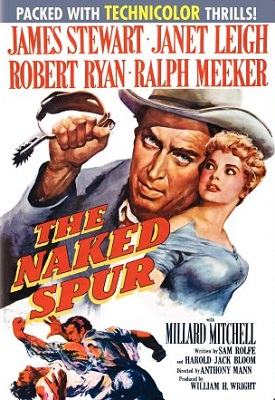
I’d say this time it was an odd mix of movies, but I’m pretty sure that applies to most of the film posts I’ve been sticking up here…

4_months4 Months, 3 Weeks and 2 Days, Cristian Mungiu (2007, Romania). After being embarrassed by a Romanian friend at not having seen any films from his country, I’ve now seen three in the space of a couple of months. And I’d be hard-pressed to pick the best of those three. It’s not only that all three are excellent films – the other two, for the record, were 12:08 East of Bucharest and The Death of Mr Lazarescu – but they all tell stories of importance: about the collapse of the Ceauşescu regime, the pressure the Romanian public health system finds itself under, and, in 4 Months, 3 Weeks and 2 Days, the Ceauşescu regime’s handling of abortion. (And no, I don’t consider abortion a sensitive or offensive topic, I consider the choice a right all women should have; on the day I can grow a foetus inside me, then I’ll be qualified to decide whether it is a good thing or a bad thing.) 4 Months, 3 Weeks and 2 Days is set in the 1980s. A student at university is pregnant and needs to have an abortion. But it is illegal in Romania. She enlists the help of her room-mate, and the two track down someone who is willing to do it secretly for money. He gives them a series of instructions. They manage to screw them up – they book a room in the wrong hotel, they don’t have enough money, they lie about how long the woman has been pregnant… However, while the abortionist’s increasingly offensive demands on the two young women are, well, offensive, what is also scary about 4 Months, 3 Weeks and 2 Days is the invasive control the Ceauşescu regime had on the daily lives of Romanians. The Ceauşescus were overthrown in 1989 – I was in my early twenties then, and remember it on the news. But I’ve never asked my Romanian friends what they remember of it – they’re younger than me, true, but not too young; and they lived it. Movies like 4 Months, 3 Weeks and 2 Days are important in that they are a window on bad times, and keep the horror of them alive in the hope that no one is daft enough to bring them back. A decade or from now, I suspect there will be a fuckton of films made about the Trump years in the US.

alfredo_garciaBring Me the Head of Alfredo Garcia*, Sam Peckinpah (1974, USA). This was apparently a critical and commercial failure on its release, but has since become a cult favourite, so much so it’s on the 1001 Movies You Must See Before You Die list – but I’m not convinced any “critical re-appraisal” in the years since 1974 justifies a place on the list. The title character is – off-stage – the preferred heir of a Mexican jefe, but he deflowers the jefe’s daughter and flees when her pregnancy is discovered. The jefe issues the titular order. A pair of, it must be said, somewhat effete US goons stumble across ex-GI bar-piano-player Warren Oates, who happens to know Garcia. Oates decides to try for the reward on Garcia’s head himself, a task made easier when he discovers that Garcia died in a car crash and is now buried in a country graveyard. So, with girlfriend in tow, he heads off to find Garcia’s grave, intending to dig him up, cut off his head, and take it to the jefe to claim the reward. Needless to say, it does not go as smoothly as planned. Bring Me the Head of Alfredo Garcia is, quite frankly, a B-movie – it looks like a B-movie, it plays like a B-movie. True, I’ve yet to be convinced of the genius of Peckinpah, but I can see why Bring Me the Head of Alfredo Garcia flopped on release. In many respects, it feels like a made-for-TV movie, with its stock footage and stock villains, although it is considerably more graphically violent than any US television network would allow. I think you have to be a fan of a particular type of film, which I am not, as should be blindingly evident from the movies I document in these Moving picture posts, to appreciate something like Bring Me the Head of Alfredo Garcia, or even to hold it in any kind of positive regard. I have watched films on the 1001 Movies You Must See Before You Die which I have subsequently purchased for my own collection, and even some where I’ve purchased everything by the director for my own collection. I won’t be doing that for Bring Me the Head of Alfredo Garcia. Even if Arrow have recently released a remastered limited edition Blu-ray of the film…

naked_spurThe Naked Spur*, Anthony Mann (1953, USA). This film isn’t available on DVD in the UK, not for rent or for sale, but fortunately, one evening, while flicking through cable channels I found it playing on TCM… So I watched it. Jimmy Stewart plays a bounty hunter determined to capture murderer Robert Ryan and bring him to justice in Abilene, Kansas. He misrepresents himself as a sheriff to an old prospector and an ex-Cavalry soldier, and the three succeed in capturing Ryan. The four, plus Janet Leigh, the daughter of an old friend of Ryan, who had been with Ryan, set off for Abilene. En route, Ryan does his best to undermine Stewart, break up the group and so engineer his escape. And that’s pretty much it – a bunch of cowboys bitching at each other for 91 minutes. Well, except for the last act, where Ryan does escape but dies crossing a river swollen by floods. There are a lot of Westerns on the 1001 Movies You Must See Before You Die list, and I can understand that they’re the closest the US gets to a homegrown mythology, and a handful of Western films are bona fide cinema classics but… I’m not convinced this is one of them. There are Western films which mythologise the landscape, there are Western films which have had their story patterns followed by many other Westerns… And while The Naked Spur certainly puts a novel spin on your average Western story, I don’t think that’s enough – despite the presence of Jimmy Stewart – to make this more than just above average. Perhaps a fan of Western films could explain to me why The Naked Spur is one of the 1001 films a person must see.

satyajit_ray_3The Home and the World, Satyajit Ray (1984, India). And that’s The Satyajit Ray Collection volume 3 box set completed, and while I consider fellow Bengali Ritwik Ghatak a genius film-maker, I’m still unconvinced Satyajit Ray is no more than a very, very good one – albeit considerably more prolific. He is, I suppose, an Ingmar Bergman rather than an Andrei Tarkovsky. Which is not to say that neither Bergman nor Ray did not make superior films. But there is more than just their respective positions in my own mental map of world cinema that the two have in common. Like Bergman, many of Ray’s films are theatrical. This is one of them. It is set almost entirely in the home of a Bengali noble in 1907, just after the 1905 Partition of Bengal. A UK-educated noble tries to introduce Western ideas into his home, and into his dealings with his wife, on his return home. But this opens her up to the fiery independence rhetoric of the nobleman’s best friend… which leads to a romantic triangle between the three. Since the marriage was arranged, the noble allows his wife her emotional freedom… which, of course, because this is how such stories pan out, pushes her back toward her husband. The film is based on a novel by Rabindranath Tagore, a prolific Bengali writer, who Ray adapted on a number of occasions. I really need to try reading some Tagore. As for the film, it sets up a fascinating situation, but it slowly settles out into a somewhat stereotypical romantic triangle. On the whole, I don’t think this volume 3 has been of as high quality as volume 1… which does make me wonder what volume 2 will be like and why I bought volume 3 before I bought volume 2…

memoriesMemories of Underdevelopment*, Tomás Gutiérrez Alea (1968, Cuba). I rented this film from Cinema Paradiso, but a week after sending it back, and when it came to write this post, I decided I needed to watch it again. So I had a look on Amazon and discovered it was one of four films in Mr Bongo’s 50 Years of the Cuban Revolution box set. The box set also included Lucía, which I already own, but that was no problem, I could give my copy away. So I ordered 50 Years of the Cuban Revolution… The following morning, I remembered I had 50 Years of the Cuban Revolution on my LoveFilm (ie, Amazon) rental list. Oops. I’d better remove it. Too late! As luck would have it, they’d dispatched a film from the box set with my next set of rental DVDs. And it just happened to be… Memories of Underdevelopment. Oh well. Both copies of the film arrived on the same day, but I watched the one I’d bought. And… on second viewing I thought it much better than I had first time around. This has happened before with some of the movies I’ve watched – the appreciating it more on second viewing thing, not the buying only to be sent it on rental as well thing, although to be honest the latter has happened once or twice before too. Anyway, Memories of Undevelopment follows an intellectual, a writer, as he tries to survive and make sense of the new Cuba post-revolution. It does this by focusing on his relationships with women – interspersed with some historical commentary and a long sub-plot about a friend who inherited a furniture store. As the film opens, Sergio’s wife has left him and fled to Miami to escape the revolution. Sergio has stayed. He is, to put it bluntly, something if a lecherous pig. He flirts with his young housekeeper, Hanna, and has a sexual fantasy about her adult baptism. He then meets aspiring actress Elena and seduces her. But her family are far from happy about this, especially since Elena is only sixteen (or seventeen). Sergio promises to marry her, but doesn’t so, he is arrested and charged with rape. I’m still not sure if Sergio’s relationships are intended to be allegories – Alea was apparently pro-revolution, and Memories of Underdevelopment is certainly critical of Cuba’s Spanish occupiers. Which does mean it’s a little hard to tell where the film’s sympathies lie. A negative stand seems too obvious a reading, but then a broadly positive critical reading doesn’t seem to fit either – in terms of the film’s response to the Cuban revolution, that is. Perhaps it needs another rewatch…

classic_bergmanDreams, Ingmar Bergman (1955, Sweden). Havng now seen four of the five films in this “Classic Bergman” box set I’m starting to wonder what “classic Bergman” actually is. After all, his most-celebrated film is The Seventh Seal, and that was made only two years after this one. And Bergman’s first film appeared in 1946 (he did not direct 1944’s Torment, only wrote the screenplay), and the earliest film in this box set is… well, 1946’s It Rains on Our Love, but the latest is 1958’s So Close to Life… Anyway, in Dreams, the owner of a model agency travels from Stockholm to Gothenburg for a commission with her most popular model, Doris. The model finds herself a sugar daddy in Gothenburg, while the agency owner has hooked up with an ex-lover (who turns out to be married). The film has all the ingredients of a typical Bergman film, and manages them all in a typically Bergman-esque fashion. I’ve said in the past that watching a Bergman film is like reading a story by a classic literary author. It’s a good story, but that doesn’t mean you’re going to be thinking about it for weeks afterwards. And this is one of Bergman’s films like that – which is why, I guess, it’s in a “Classic Bergman” box set, and not given a premier release, like Smiles of a Summer Night, also released the same year. True, an also-ran from Bergman is always going to be worth seeing, but this entire box sert has shown itself to be more for Bergman fans than cineastes.

1001 Movies You Must See Before You Die count: 846


2 Comments

Moving pictures 2017, #4

I’m still keeping to my resolution to watch more non-US films than US ones, but I’m not doing so well with my plan to actually watch less films – only a month into 2017 and I’m already on my fourth Moving pictures post. Oh well.

embraceEmbrace of the Serpent, Ciro Guerra (2015, Colombia). I found this free to view on Amazon Prime and put it on my watchlist. About a week later, it was recommended to me, so I moved it up my To Be Watched list… And I’m glad I did as it is very good indeed. In fact, it’s a serious contender for an updated version of the 1001 Movies You Must See Before You Die list, and would almost certainly make my own version of such a list. The film follows a split narrative, one set in 1909 and one in 1940. Their stories – indeed, the routes taken by the characters – are almost identical. The two are linked by one man, Karamakate, the sole survivor of an Amazonian tribe and a shaman. In 1909, he reluctantly helps a German ethnographer to find a sample of the semi-mythical sacred plant yakruna so that it might cure him of his illness. In 1940, an older Karamakate guides an American botanist to the location of the last surviving yakruna plant. The American claims he is only following in the German’s footsteps, but he actually wants to steal a sample of yakruna as it reputedly keeps rubber trees free of disease and the US is losing its access to sources of rubber thanks to Japanese successes in WWII’s Pacific theatre. Embrace of the Serpent is shot entirely in black-and-white, except for a colour sequence near the end which depicts the American’s drug trip after being fed some yakruna. It’s a very… Herzogian film. And I mean that as a compliment, a very great compliment. It looks fantastic, the cast are totally convincing, as indeed are the atrocities they witness – in both timelines – during their travels. Well, okay, maybe not so much the Brazilian self-styled messiah. But in telling its story, the film makes a number of important points – so much so, in fact, that the somewhat weak ending is entirely forgivable. Go watch it.

ducklingDon’t Torture a Duckling, Lucio Fulci (1972, Italy). I’ve watched a few of these giallos by now, although I still think of the genre as more thriller than horror, and Don’t Torture a Duckling falls more toward the latter than the former. A journalist covering the disappearance of a local boy in a small village notices the presence of an attractive and modish young woman, clearly not a villager, played by Barbara Bouchet, and learns she is the daughter of wealthy man who owns a house in the village, which he never uses, and to which she has been exiled after some scandal in the city. Then more boys in their early teens go missing, the two investigate, suspecting that something other than the witchcraft claimed by some villagers is the cause. Even when a woman claims responsibility for the disappearances (murders, that is, once the bodies are found), it turns out she thought she was guilty because she had stuck pins in voodoo dolls representing the victims… But the actual cause of their deaths is far more mundane and physical. Like all giallo, Don’t Torture a Duckling (I don’t actually recall the reason for the title) is all a bit fraught and over-emphatic. Even the gore – and this is apparently the first film in which Fulci used gory effects – is over-done, with the blood on the murder victims resemble scarlet nail polish more than it does actual blood. There are a few nods at an actual genre plot, with a number of suspects dragged in front of the viewer as the actual murderer, only for them to be almost immediately proven innocent. Even if you like giallo, or the films of, say, Dario Argento or Mario Bava, Don’t Torture a Duckling is not an especially memorable example. In fact, you’d be better off sticking to the films of Argento or Bava. Forgettable.

moniqueMonique, John Bown (1970, UK). I’m not sure how this found its way onto my rental list – I mean, “slap & tickle”? A 1970s British sex comedy? The concept alone makes me cringe. And yet, for all that, Monique proved to be pretty low-key and played more like a kitchen-sink drama than a Carry On film. I’m not saying it was a good film by any means – it was, after all, somewhat predictable, a bit dull, and quite dated. A dull and ordinary lower middle class family with two kids hires a French au pair to take care of said kids. As is the way in such films, the au pair is attractive and “sexually-liberated” (not that the phrase actually means anything – it’s really no more than code used by men who are afraid of independent women), and ends up in bed with the husband and the wife… and it all seems to work quite happily. To be honest, I don’t remember all that much: the eponymous au pair was good with the kids, kept both husband and wife happy and together, and it all looked very much a product of its time, without being sneering, prudish or prurient. If anything, Monique probably suffers because it’s lumped in with other films that have also been badged “slap & tickle”. It is, in the end, a somewhat dated but relatively sensitive domestic drama of middling quality.

two_daysTwo Days, One Night, Jean-Pierre & Luc Dardenne (2014, Belgium). I know the name Dardenne, although I had not thought I’d seen any films by the two brothers… until I checked by records and discovered I’d watched their The Kid with a Bike back in 2013, and had thought it pretty good. Despite that, I don’t remember why I added Two Days, One Night to my rental list as it’s not on the 1001 Movies you Must See Before You Die list, although it is plainly a good film and worth seeing. Marion Cotillard’s character works for a small company which makes solar panels. When it comes time to return to work after suffering a nervous breakdown, she discovers that a manager had held a ballot in her absence and the workforce voted to accept a bonus rather than Cotillard returning to work, since Cotillard’s work had been picked up by others. But she needs her job, so she persuades the company to hold a second ballot, giving her the eponymous timeframe to persuade the other employees to vote to keep her. This is capitalism at work. A one-off bonus versus an employee’s salary? Of course the company will push for the former. And accepting the bonus is so short-sighted as well. Unless Cotillard had been completely useless – and it’s implied she was not – I would’nt have voted for her to lose her job myself, no matter what my circumstances or the size of the bonus. The film is predicated on the other workers voting against her – but its attempt to present good reasons for doing so do not convince. “We need the money” is not an excuse for shafting a fellow employee. Because, of course, the next such victim might well be yourself. And, quite frankly, I find it hard to believe a bonus of €1000 would be so persuasive to employees of a successful small firm in Belgium in 2014. None of which is to say that Two Days, One Night is a bad film. It’s put together very well, and Cotillard is especially good in the lead. The one brief moment of violence is shocking, if not entirely plausible; but it’s later offset by the humanity shown by one of the firm’s immigrant workers. I stumble over the movie’s premise, so I don’t think it belongs on any list of films you must see, but it’s certainly worth seeing.

satyajit_ray_3Deliverance, Satyajit Ray (1981, India). I discovered shortly after watching this that its star, Om Puri, had died a week into 2017. Watching Deliverance, made thirty-six years ago, Puri was very recognisable – he doesn’t seem to have changed much over the years. In Deliverance, he plays a humble shoemaker. He asks the village brahmin to set a propitious date for his daughter’s wedding, but the brahmin sets him a number of tasks to complete before giving his answer. Which essentially means Puri is performing unpaid labour. And that’s pretty much it for 75 minutes. (The short running time is because it was originally filmed for television.) Of the two great directors – or, at least, internationally-renowned directors – that Bengal produced, I still much Ritwik Ghatak’s work, even though that’s based on a smaller sample – three films, or a third of his oeuvre; compared to ten films out of 36… um, which works out at roughly a third for both, but never mind. And the two collections of Ray’s films that I’ve now watched… well, the most successful films in them have been historical, and typically either adaptations of novels or plays, which gives them something of a Bergman-esque sort of feel. And when that works, it works very well indeed. But when it’s lacking, the resulting film is not always entirely successful – much like Deliverance. Which, to me, felt like it tried to be several things at once but never quite succeeded at any. It wasn’t funny enough to be a comedy, its depiction of village life wasn’t entirely convincing, and its acting was dialled too high to convince as a Satyajit Ray film but not high enough to be a Bollywood film. I shall continue to explore Ray’s oeuvre – he was an important director, and fortunately much of his oeuvre is available to explore. Much as I enjoyed The Home and the World and The Public Enemy in this Ray collection, I think the films in the Satyajit Ray Collection Volume 1 were better. But get both, or indeed all three, just in case I’m wrong, anyway…

knight_of_cupsKnight of Cups, Terrence Malick (2015, USA). I have no idea whay I continue to watch Malick’s films. Okay, this was another free to view on Amazon Prime, but, seriously, life’s too short to sit through two hours of what pretty much resembles a perfume commercial with a breathless voiceover quoting from a variety of literary sources. It’s not as if it’s all in service to a plot, either. True, some of the cinematography is lovely, but Malick has developed a habit of swinging his camera right in close to a person’s face and then back out again, and it gets annoying fast. Christian Bale plays a successful Hollywood script writer who wanders around listlessly through several vignettes very loosely based on cards from the Tarot deck. He meets and has sex with several women, he gets into an argument with his father, he meets up with his brother and the two tell each other how their relationship works… And it’s all really dull and pretentious twaddle, and I continue to be mystified by the high regard in which Hollywood, and actors, holds Malick. Films are about more than pretty cinematography, and while I’m certainly a tart for it, I do ask for more that pretty pictures in the movies I appreciate and/or love. Hence my characterisation of Malick’s films as perfume adverts. It’s pretty people behaving in ways that do not make sense while living a lifestyle unavailable to 99% of the planet’s population. It is, to be honest, tosh. I think it’s time to swear off Malick. After The New World, I was prepared to give him a chance, but with To The Wonder and Knight of Cups, life is far too short to waste time watching such vacuous and pretentious twaddle.

1001 Movies You Must See Before You Die count: 843