It Doesn't Have To Be Right…

… it just has to sound plausible


Leave a comment

Moving pictures 2019, #6

I need to get this backlog out of the way before I start my new life. It’s not that I’ve watched loads of films over the past two months, more that I’ve not been writing blog posts as often as before. Busy packing up the DVD collection, you see…

Parineeta, Bimal Roy (1953, India). In recent years, I’ve watched quite a few Bollywood films, but I admit I do prefer the historical ones – although they’re generally poor transfers and good condition copies are almost impossible to find. Parineeta wasn’t too bad, possibly because black-and-white seems to survive better than colour. Who knows. It’s the usual boy meets girl, boy loses girl, boy gets girl back again story, this time complicated by the fact the two leads are from closely-knit neighbouring families, but his family are the rich ones and hers the impoverished tenants. She’s much put-upon, especially by her own family, and her relationship with the male lead grows over time, despite both their families trying to arrange marriages for them with others. The film is based on a novella by a popular Bengali novelist, which likely explains the almost Austen-esque feel to the plot (ie, its origin as written fiction, rather than a straight-up commercial Bollywood movie). The acting was a cut above usual, but the music was entirely forgettable. Say what you like about 1990s and twenty-first century Bollywood films, but they generally have memorable dance numbers (even if, most of the time, that’s all you remember of the film). Parineeta was good, a mix between parallel cinema and commercial Bollywood. Worth seeing.
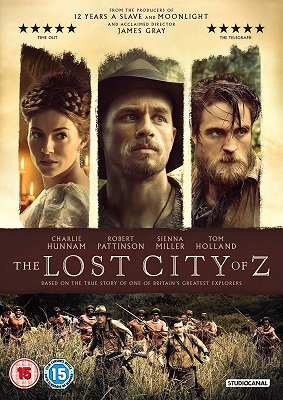
The Lost City of Z, James Gray (2016, USA). I really did not like this film. It felt like Embrace of the Serpent made for fox-hunting inbred Tory morons. It’s apparently a real story, about the British explorer Percy Fawcett, but based on a book about Fawcett written by an American. Which might explain some aspects of the film… Fawcett is a promising young Army officer in the first decade of the twentieth century, but he’s not from the right sort of family. So instead of a prestigious posting, he gets seconded to the Royal Geographical Society as cartographer. This results in him being part of an expedition in Brazil, where he hears rumours of a fabled city of gold. This leads him back to Brazil a number of times in an effort to find it. So this is a film with a lot of tramping through jungle, or travelling up jungle rivers. And it’s all done from the perspective of Edwardians. The end result is a film which repels while covering similar to material that of far superior films. I’m only glad I found this free on Amazon Prime.
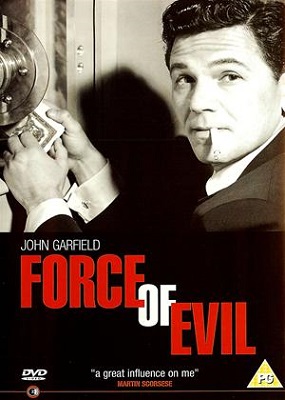
Force of Evil*, Abraham Polonsky (1948, USA). There are many US noir films considered cinema classics, and this is one of them. I’m not so enamoured of the genre as other seem to be, and can take its so-called classics more or less as I see them. Because Force of Evil, which appears on the 1001 Movies You Must See Before You Die list, is a good film, but not really a great film – and I’d expect the list to comprise great films. I have to wonder if Force of Evil made the list because of its subject: the numbers racket. As a study of how the numbers racket worked, and how established it was in everyday life, the film does an excellent job. But it does it in the guise of a noir film, with a successful lawyer to a mobster trying to save his principled older brother, who runs a small independent numbers game, from eventual mob take-over. Everything about the film is pure 1940s Hollywood noir – from the cast to the sets to the lighting to the story beats. One for fans.
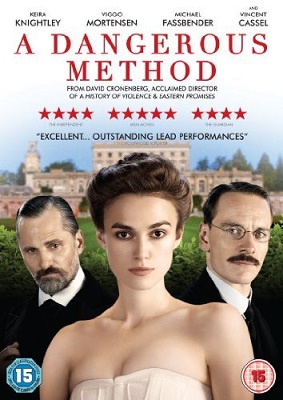
A Dangerous Method, David Cronenberg (2011, Germany). I’m not exactly sure what the title refers to, given this film is about the friendship between Feud and Jung, and Jung’s patient-turned-disciple Sabina Speilrein. She is brought to Jung and he attempts to cure her of her psychosis using his theories, and so discovers her intelligence and aptitude and eventually uses her as an assistant in his work. He refers her to Freud – to be fair, I had not known the two had worked together, but this film is based on real events – and she eventually qualifies as a psychoanalyst herself and returns to Russia to practice. Since Cronenberg went mainstream, there seems to be less distinguishing his movies from those made by his contemporaries. There was a definitely a singular vision to the work he did up until the turn of the century – especially in his early work, like Crimes of the Future – but A Dangerous Method could have been made by more or less anyone. Which is not to say it’s not well-made, nor that its story is uninteresting. But it’s not something that lingers, and Cronenberg fans won’t find much here to admire.
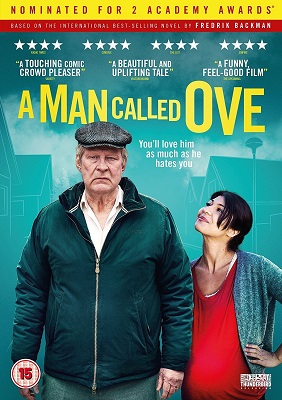
A Man Called Ove, Hannes Holm (2015, Sweden). The title of this movie, however, is plain from the first frame. Ove is a cantankerous old Swedish man who has never quite got over the death of his his wife. He is forced into retirement, even though his job is all he has, especially since his wife died six months previously. He tries to commit suicide, but is interrupted each time by his new neighbours, a woman of Iranian extraction married to a Swede. And through his friendship with that family, he reconnects with his community and discovers a new lease of life. It’s completely a feel-good movie, but it works because Ove is such a miserable bastard you actually start to feel sorry for him when he finds himself forced to go on living when his plans to end it all are repeatedly foiled. I had, to be honest, expected something humorous like The Hundred Year Old Man Who Climbed Out of the Window and Disappeared (see here), but this was far from absurd. It was a gentle comedy about age and friendship, and it did it all without being overbearing or simplistic. Plus, it’s Swedish. Worth seeing.
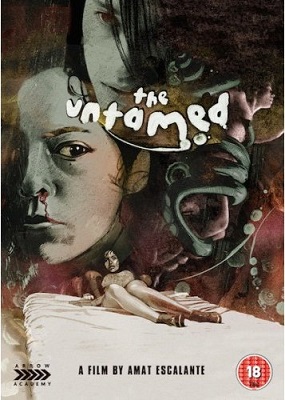
The Untamed, Amat Escalante (2016, Mexico). Sometimes you stumble across a film – this one was on the Cinema Paradiso website – and when the disc arrive you, you sit down to watch it with little or nothing in the way of expectations… And if you’re lucky the film blows you away, but more often it’s entirely forgettable. The Untamed did not precisely blow me away, but it was far from forgettable. It opens with a woman tied down in a barn, who then – willingly – has sex with a tentacled alien, which has been hiding out in the barn since it crashlanded. Meanwhile, another woman is at odds with her homophobic husband, who happens to be having an affair with one of her gay work colleagues. When the first woman introduces the second to the alien, things start to go wrong. This film reminded me a great deal of Carlos Reygadas’s work, and not just because it’s Mexican. But it had the same sort of distant documentary feel I appreciate so much in movies, albeit with perhaps Yorgos Lanthimos’s oblique approach to storytelling (not that Reygadas is exactly direct). The end result is a film which starts out weird, then turns prosaic before circling back to weird and making that opening all of a piece with the whole. It also looks gorgeous, with some excellent cinematography. Escalante is name to watch. This is the fourth film he’s directed; I think I’ll try and track down the earlier ones.

1001 Movies You Must See Before You Die count: 935

Leave a comment

Moving pictures 2019, #5
I used to plan my viewing – well, mostly – but that seems to have gone by the board now that I’m about to up sticks. I don’t know what there’ll be available to watch for the first few weeks I’m in Sweden – I suspect I will reading more – although I will be packing my Blu-ray player in my suitcase. And, of course, a couple of a box sets…

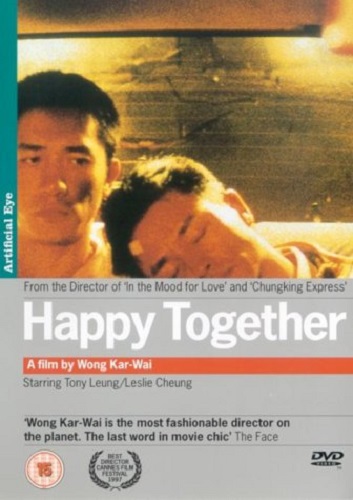
Happy Together, Wong Kar-wai (1997, China). I’ve yet to figure out what I feel about Wong’s films. I do like his most famous film, In the Mood for Love, and its sequel 2046, although I’ve been ambivalent about other films by him I’ve seen. And that’s pretty much true of Happy Together. It’s well-made, often with quite stunning cinematography, and with a great soundtrack – the second by Wong, I seem to recall, that includes a track by Frank Zappa (‘Watermelon in Easter Hay’ in this one). The problem is that Wong’s films are really good but they haven’t quite clicked for me, and I’m somewhat surprised they haven’t done so. They’re exactly the sort of thing I should Iike and admire, and some of them I do like and some of them I do admire, and some of them it’s both. Wong should be one of those directors on my “to watch” list, and he is to some extent or I’d not have rented this film… but whenever I watch one of his movies I always feel I should like it more than I actually do. I suspect I need to give his oeuvre a more careful study.

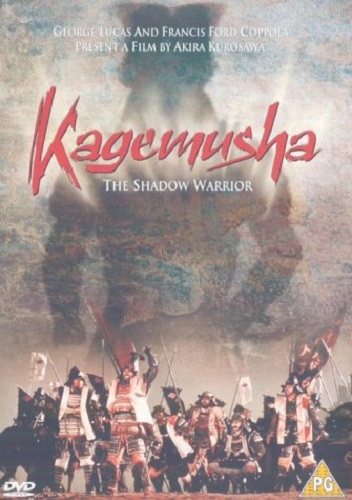
Kagemusha, Akira Kurosawa (1980, Japan). And after Wong, another director whose oeuvre I find a bit hit and miss. I like Kurosawa’s films, I have a lot of time for them, but he made a lot of samurai movies and they do all sort of blur into one another, if not even into themselves because they’re quite long. This one is a good three hours, and not a fat lot happens during that time. A daimyo in sixteenth-century Japan has a double – the kagemusha of the title – and after being shot by a sniper during a siege of a castle, the double takes his place. And proves more effective in it than the generals eager to maintain the pretence realised. It’s all very Kurosawa, a full-on historical samurai film with epic battle-scenes, real castles and an almost-Shakespearean plot. But it’s also very long and that, for me, told against it. It really doesn’t need three hours to tell the story, and it felt more often than not that Kurosawa was more in love with his material than any viewer was likely to be. But it’s Kurosawa, and that’s not so much a brand as it is a badge of quality. Anyone watching Kagemusha is going to know what they will get. I’ts probably telling that the Kurosawa films I like best are the ones that aren’t historical samurai films. One for fans.

Salome, William Dieterle (1953, USA). As mentioned in an earlier post, my mother lent me a box set of Rita Hayworth movies, which included a couple I’d not seen before. Like this one. To be honest, I hadn’t missed anything. Salome is a typical Hollywood Biblical story, which means it’s not only wildly historically inaccurate, it probably bears little resemblance to the original Bible story. For all the US bleats about being Christian, it shows a remarkably cavalier attitude to its central religious text – except when it’s doing the exact opposite and interpreting it entirely literally, despite that being scientifically impossible, never mind displaying a complete lack of common sense. The story of Salome is not one they tend to teach in Sunday school, given it involves a head on a plate. And, to be honest, even after watching the film, I’m not entirely sure what the film was actually trying to say. Salome is a Jew brought up in Rome, who upsets caesar because a Roman one-percenter wants to marry her and so she is sent back to Jerusalem, a city she does not know. But she’s not having that, so she uses her feminine wiles to overturn caesar’s decision. And after her famous dance, which might well have had seven veils in this film but they weren’t what is normally meant by “veil”, she asks a boon and her mother jumps in and ask for John the Baptist’s head on a plate, as you do, and that’s not really what Salome wanted. It’s all very 1950s bible-story Hollywood, and even Hayworth’s presence can’t redeem it. Avoid.

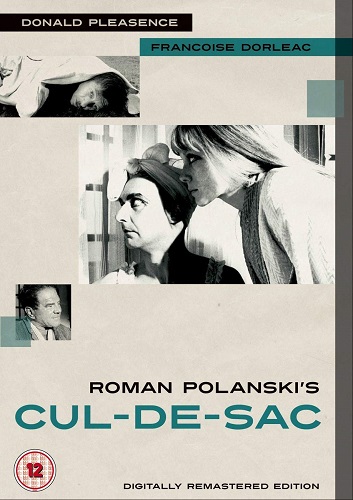
Cul-de-sac, Roman Polanski (1966, UK). I know I shouldn’t be watching Polanski movies but this was free on Amazon Prime so it’s not like I’m giving money to Polanski. How difficult is it to sort his situation out? I mean, the US will rendition people and throw them in Gitmo because they think they might be terrorists, and have no evidence to prove they are, but when they do have evidence someone committed a crime he gets to lead a normal life as long as he doesn’t visit the US. Of course, Polanski, a Pole, is white. And the US is not currently bombing Poland. But who knows with Trump. Or indeed the UK, as the racist Leave voters seem particularly incensed at the number of Poles in the UK. Anyway, Cul-de-sac is an odd film. Donald Pleasance and his wife Françoise Dorléac live in an old castle on Lindisfarne, when their home is invaded by bank robbers on the run Lionel Sanders and Jack MacGowran. Sanders takes the couple hostage while he tries to contact his boss. MacGowran, who was shot during the robbery, dies of his wounds. Then friends visit Pleasance and Dorléac, and the two have to pretend to normality while Sanders acts as their new manservant. Polanski sex-crime aside, he was a was good director and some of his early works from the 1960s are really good films. Cul-de-sac is characteristically odd, but it’s well-shot, extremely atmospheric, and the cast put in good turns. While I can’t recommend it, I have to admit it’s worth seeing.

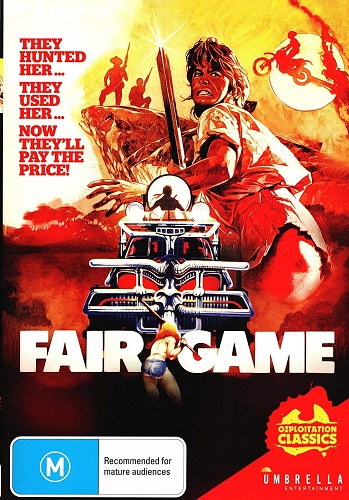
Fair Game, Mario Andreacchio (1986, Australia). Had it not been the fact this was movie was Australian, I would likely have written it off as a B-movie. Which it still is, to be honest. Three typical examples of Australian manhood harass and assault a woman who runs a wildlife sanctuary because she prevented them from kangaroo hunting. But their revenge goes awry when she proves more of a match for them. I would like to say it’s refreshing to see an Australian film in which a woman wins against a group of men, but I think that’s an unfair characterisation of Australian culture. And hardly commonplace in Hollywood or the UK film industry. The plot of Fair Game is a staple – there must be a couple of hundred Westerns which use it – in which a lone hero (female, in this case) defends the town (well, her sanctuary) against marauders bent on revenge, using a variety of tricks and traps based on what’s available. Not a great film, by any means, but worth a punt.

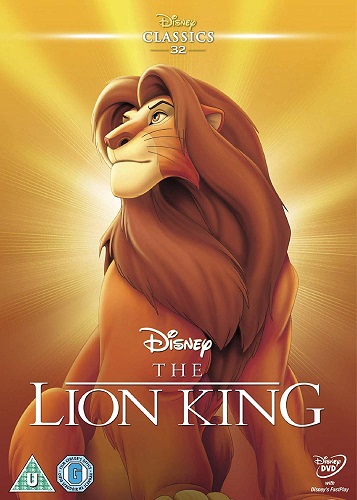
The Lion King*, Roger Allers & Rob Minkoff (1994, USA). Yes, I know. I’d never actually seen The Lion King before, and it’s not like I made a conscious decision to avoid it but since I don’t have kids it’s not the sort of film that crops up in my normal viewing. But it’s in the 1001 Movies You Must See Before You Die list, so I decided to add it to my rental list and watched it when it dropped through the letter box. Some twenty-five years after it was released. And it has not aged well. Not well at all. I’ll not bother summarising the plot. The animation is good, although nothing especially stands out – although the scenes involving the hyenas do harken back to earlier Disney films. As does the final showdown between Simba and Scar. But the comedy is occasionally borderline for 2018, and the songs are completely unmemorable. Yes, even the most famous one. Life on the veldt is completely romanticised – lions are carrion eaters, after all – and even some of the landscape looked a bit suspect. The Lion King was massively successful, and was the second highest grossing film of all time in its year of release (it has since dropped to number 40), and I suppose that’s why it’s on the 1001 Movies You Must See Before You Die list. But, frankly, there are better Disney feature films, such as Bambi, which are more deserving of a place. The Lion King seems to me to be more  triumph of marketing than film-making – I remember the advertising at the time was relentless – and that’s no indication of quality. Well-marketed films do not belong in a list called 1001 Movies You Must See Before You Die.

1001 Movies You Must See Before You Die count: 934


1 Comment

Moving pictures 2019, #4

Not so varied nationally a half-dozen this time. But content-wise there’s plenty of variety…

You’ll Never Get Rich, Sidney Lanfield (1941, USA). My mother found a Rita Hayworth box set in a charity shop and lent it me because I like Hollywood films from the first half of the twentieth century. Plus, it included a couple of stone-cold classics – Gilda and The Lady from Shanghai – I wanted to watch again. You’ll Never Get Rich, a Fred Astaire and Rita Hayworth vehicle I’d not seen before, turned out to be minor work from both. Astaire looks almost skeletal in it, and he’s about as far through as a kipper in pretty much all of his films. Theatre owner Robert Benchley (an excellent comic actor of the time) has designs on showgirl Rita Hayworth and enlists star of the show Fred Astaire to pretend to be Hayworth’s boyfriend to hide Benchley’s interest from his wife. But then WWII comes along and Astaire enlists and, for reasons I forget, masquerades as an officer in order to spend time with Hayworth, who he now fancies himself. Apparently, Astaire’s career had started to flag after he split he split with Ginger Rogers – why split? she was brilliant – but teaming up with Hayworth gave his career a boost, although he only made two films with her. He still claims her as his best partner, and she certainly kept up with him – but I can’t say Hayworth was better than Rogers, because Hayworth may have been an excellent dancer but Rogers was a perfect foil to Astaire. This is not a great film, and a pretty forgettable one from either star, each of whom has plenty of memorable ones in their oeuvres. One for fans.

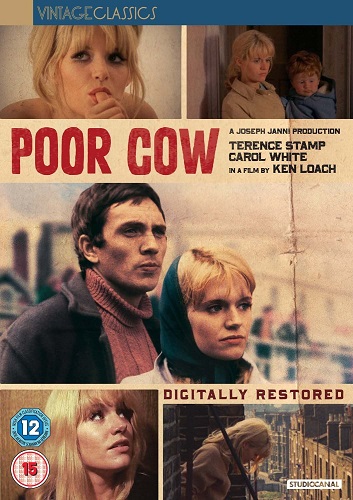
Poor Cow, Ken Loach (1967, UK). My plan to work my way through Loach’s oeuvre is going to have to go on hold when I move to Sweden – unless I buy one of the several Ken Loach box sets currently available. The problem is, I watch his films and for each film I like, there’s another I’m not so keen on. So while I’m glad I watched Cathy Come Home, I didn’t really like it; but Poor Cow I did like quite a lot. Even though its story is broadly the same. It was Loach’s first feature film. The title refers to a young woman who is married to an habitual criminal. When he’s sent down for an inept jewellery shop robbery, she moves in with one of his mates (Terence Stamp, and the footage of him from this film was used in Steven Soderbergh’s The Limey). But then Stamp gets sent down for twelve years after a violent robbery on an old woman, and the young woman returns to her husband. But she dreams of a future with Stamp. The film was very much made in a documentary style, with improvised dialogue, real locations, and non-actors in several roles. The London tenements in which the title character lives were a revelation – for all that the UK claims to be a leading nation the fact people lived in such poor conditions in its capital halfway through the twentieth century is disgusting. Fortunately, they were knocked down and social housing constructed in their place. And then Maggie and her goons sold those all off for a quick buck, and developers have flattened them and built luxury towers that sit empty because one-percenters are using them as tax dodges or for laundering money… Meanwhile, you have scumbag Tories trying push through a law making it acceptable for rental properties to not be fit for human habitation… Fuckers. Anyway, Poor Cow is one of the Loach films I thought good. Worth seeing.

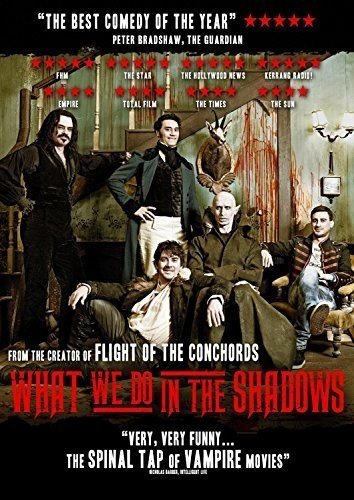
What We Do in the Shadows, Taika Waititi and Jemaine Clement (2014, New Zealand). There were a couple of laugh-out-loud moments in Waititi’s Thor: Ragnarok, unexpected in a MCU film, and though I’d liked his Hunt for the Wilderpeople (see here), I wasn’t sure I was on the same wavelength for his humour. And the first ten minutes or so of What We Do in the Shadows seemed to demonstrate as much… But then the central conceit started to come together, there were a couple of laugh-out-loud moments, and I found the film a lot funnier and more enjoyable than I’d expected. It’s a mockumentary about a household of vampires in present-day Wellington. Waititi himself plays the main character. There’s an ancient vampire who lives in the cellar and does not speak, a fourteenth-century Transylvanian played by Jemaine Clement, and a “much trendier” vampire who is “only” 183 years old. But then one of the group goes and turns a local man into a vampire, who had originally been intended as prey, and he tells all his mates he’s a vampire. Including Stu, his best mate. Who he introduces to the rest of the group, and they really like him. At several points, the vampires bump into a pack of werewolves, led by Rhys Darby, and I have to admit they had some of the best lines in the film – “We’re werewolves not swearwolves” had me giggling for a good ten minutes. Worth seeing.

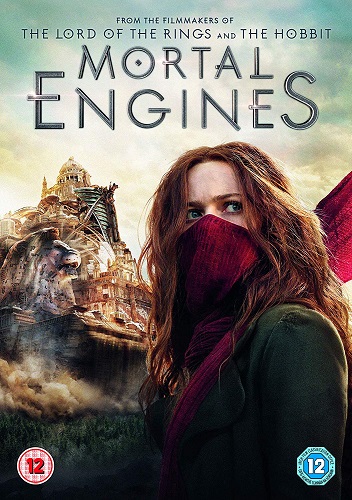
Mortal Engines, Christian Rivers (2018, New Zealand). The book on which this is based has been around since 2001, and while I’ve known of it pretty much since it was published, I’ve never read it. Because it’s YA. I am in my fifties. I am not the target market for YA fiction. I wasn’t even back in 2001. But I knew of Mortal Engines, and I knew of its mobile cities. Which is about all this film has going for it. Because the plot is pretty much identical to the first Star Wars film. Even down to the X-Wing attack on the Death Star. London is a major predator city, but its chief scientist dreams of conquering Shan Guo (China), a rich land without mobile cities. Fortunately, as is the way of such things, a pair of hardy teens, well, early twenties, appear and thwart his plans. There’s the daughter of a scientist who opposed the villain, and the junior historian who initially foils the former’s attempt on the villain’s life, only to be ejected from London because he knows too much. And the two form a reluctant alliance in order to stop London’s plans to destroy Shan Guo’s Shield Wall… Much of the film is travelogue, and the pair move around the world, trying to reach allies. At one point, they’re captured by slavers and put up for sale. Why do so many sf novels – and films – feature slavery? Seriously. It’s vile and does not belong in any work of fiction that is not explicitly about it, historical or contemporary. There’s no commentary on slavery in Mortal Engines – the nearest it gets is implying the two heroes might be purchased by a butcher so he can make sausages out of them. Cannibalism is hardly fit for comic relief during a slave auction. It’s not like the world of the film is some sort of US post-apocalypse dystopia (yes, I know Reeve is British). A villain who pushes ahead with his plan, ignoring the human cost or obvious consequences is one thing; but it’s well past time sf stopped building worlds that feature slavery – and yes, I know I’m 18 years too late with this book (assuming the scene even appears in the book).

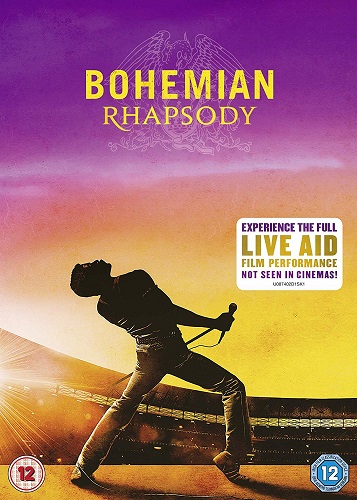
Bohemian Rhapsody, Bryan Singer (2018, USA). I know, I shouldn’t watch films by Bryan Singer – although by all accounts he was taken off this project fairly quickly and it was mostly shot by Dexter Fletcher. But at least I don’t plan to shortlist him for any fucking awards. As it is, Bohemian Rhapsody is, well, dull. And not very good. The only thing about it that impressed was its CGI reconstruction of the old Wembley Stadium (which had been around since 1923, which I hadn’t known). Rami Malek pulls off Freddie Mercury quite well, but all we know of Mercury is his public persona and that was pretty much a caricature. Seems a bit pointless to award an actor for playing a role that was pretty much an act. And then there’s the music. I probably know most of Queen’s songs but I don’t own a single album by them. They’re… okay. I can listen to them without cringing, but I wouldn’t spend money on them. Fortunately for the film, there’s plenty of the band’s music on display – because that’s all the band has going for it: Mercury aside, they’re not very interesting people. Unfortunately, the film makes some strange choices about chronology. It has the band upset at Mercury recording a solo album, when Roger Taylor had already recorded two and Brian May one by that point. It changes the timing on when Mercury told the band he had AIDS, which completely changes the impact of the revelation. And, by all accounts, it doesn’t do a good job of presenting Mercury’s relationships. It doesn’t seem to know if it’s supposed to be a biopic or a rock musical, which means it varies wildly in tone. Putting it on the Oscars shortlist is a travesty.

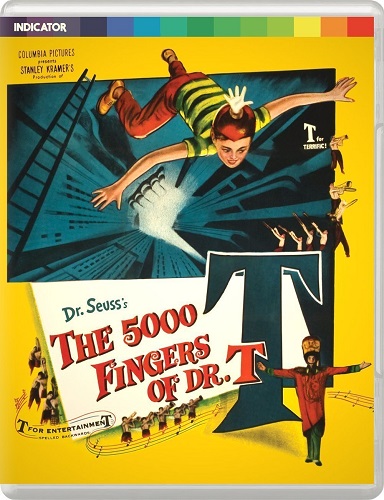
The 5,000 Fingers of Dr T, Roy Rowland (1953, USA). I remember seeing some of this film many years ago, I think when I was at school, back in the 1980s, but it may have been later, perhaps when I was at university. I don’t recall the details. I certainly knew of the film, and I knew it was bat-shit bonkers. So when I stumbled across it on Amazon Prime, I had no choice but to watch it. And it proved so much more bonkers than I’d supposed, and so much better. The plot is simple: a young boy objects to his piano lessons – he is following a course by Dr Terwiliker – and meanwhile is trying to matchmake between his widowed mother and the local plumber. He has a dream in which he finds himself in a strange world where he and 499 other children – the 5000 fingers, you see – are forced to play an insanely long keyboard by dictator Dr Terwiliker. The sets were clearly designed by someone who was on acid, the script was written by Dr Seuss, and the actors play their roles with a wholesome earnestness that is pure 1950s Disney but completely out of place. And it’s a musical. It is fantastic. And Dr Terwiliker’s song, ‘Doe-Me-Doe Duds’, is near genius. Check out these lyrics:

I want my undulating undies with the maribou frills!
I want my beautiful bolero with the porcupine quills!
I want my purple nylon girdle with the orange blossom buds
Cause I’m going doe-me-doe-ing in my doe-me-doe duds!

And the song finishes with:

So come and dress me in the blossoms of a million pink trees!
Come on and dress me up in liverwurst! and camembert cheese!
Come on and dress me up in pretzels, dress me up in bock beer suds! Cause I’m gooooo-ing
doe-me-dooooooooo-ing
in my doe-me-doe duds!

The 5,000 Fingers of Dr T has recently been released on dual format by Powerhouse films. I might get myself a copy…

1001 Movies You Must See Before You Die count: 933


1 Comment

Moving pictures 2019, #3

Guess what, I’ve only gone and built up a backlog of these posts. This time, at least, I have a good excuse: I’m sorting out the flat prior to my move. And there are films I’ve bought I want to watch before I put into them storage. Which is my way of saying: there are more Moving pictures posts to come, and it will be a couple of months before I started posting anything of any real substance…

Meanwhile,the usual mixed bag of movies…

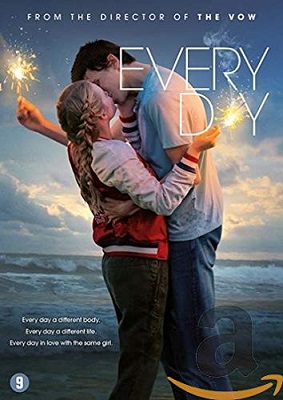
Every Day, Michael Sucsy (2018, USA). This is a topic that has been tackled several times in science fiction, and more recently in YA fiction, and it’s something I find slightly fascinating… In Every Day, based on a YA property by David Levithan, a character called A hops from body to body day by day, and on one such day meets a young woman they fall in love with, and so seek her out in each of their incarnations. It has to be a love story, or the world has to be at stake – this is how these stories work… although I would read a book that required neither, but then I’m no big fan of commercial fiction. Given that one of the central duo is played by a different actor every ten minutes or so, the film does well to make A a believable, and sympathetic, character. And also treats each of the lives into which A jumps sensitively. There are a couple of nice touches, and the final romance is bittersweet, but never especially soppy. I enjoyed it.

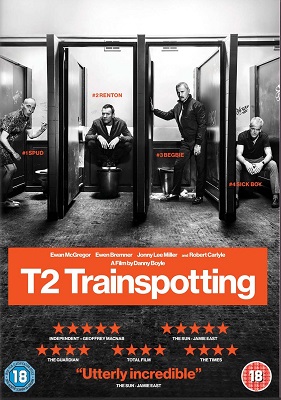
T2: Trainspotting, Danny Boyle (2017, UK). There are so many films that don’t deserve sequels but get them anyway and then you get a film that doesn’t need a sequel and it gets one anyway and the sequel is actually pretty damn good. Because that’s what this is: T2 is actually a good film and a good sequel. I’m not a fan of Danny Boyle’s movies – I hated Sunshine, for instance; I still do – and much as I enjoyed Trainspotting, having read and enjoyed the book first, I had mixed feelings about seeing the sequel. But it not only met my expectations, it succeeded them. Franco has broken out of prison, and when he learns Renton is back in town – he’s spent the last twenty years in the Netherlands – he is determined to get his revenge. Renton is back on a visit to make amends for the events of the original film, but Spud is still a drug addict but on the brink of suicide, and Simon is a cocaine junkie who runs his mum’s old pub and runs a blackmail scheme with his Bulgarian girlfriend. Simon still hates Renton – and all the more so now it appears he has made a success of himself in Amsterdam – and so pretends to go along with him in order to have his revenge. The characters were all completely believable continuations of the original ones – and there’s even a cleverly-updated version of the “Choose life” speech from the original film. None of the characters were likeable, and most of them were relentlessly stupid in the way real people often are (especially when it comes to referendums), and the plot had all the remorseless momentum of a runaway train. I was expecting a warmed-over take on the original film, but instead I got a sequel that butted up seamlessly to the original, and was a bloody good film in its own right. Recommended.

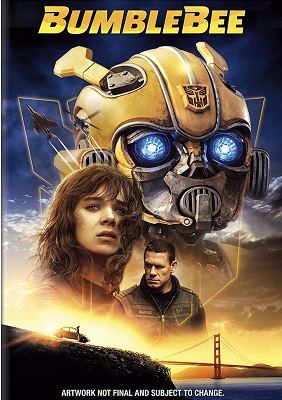
Bumblebee, Travis Knight (2018, USA). I didn’t grow up with the Transformers, and I thought all the Michael Bay films were pretty crap, so people said Bumblebee is actually quite good, I took it with a massive dollop of salt. And I was right to do so. Because, well, Bumblebee might be better than the Bay movies, but that doesn’t make it a good film. The title refers to yellow Transformer on the DVD cover, who is sent to Earth in the 1970s – although for much of the movie, it was only the soundtrack which signalled it was the 1970s – to recon the planet for Optimus Prime, leader of a band id rebels fighting for their lives on the Transformer home world. Bumblebee is attacked by a Decepticon shortly after arrival, and rendered mute. The film then shifts to the teenage female protagonist, who’s into cars, and finds a yellow Volkswagen Beetle in a scrapyard which she buys (or maybe she was given it). The Beetle is Bumblebee. There are a few amusing comic set-pieces, and it’s nice to see a female teenage petrolhead as a protagonist. But this is still a by-the-numbers Transformers movie, tentpole sf commercial movie-making in the twenty-first century. It’s all about the visual effects. Characters are sketchily drawn, the plot is entirely predictable, and the whole thing is about as memorable as a headache.

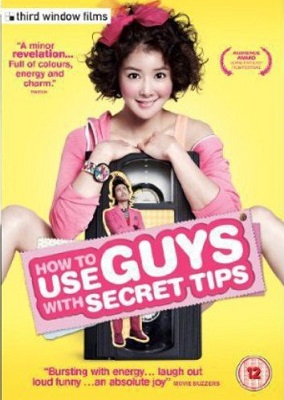
How to Use Guys with Secret Tips, Lee Won-suk (2013, South Korea). Readers of this blog will be unsurprised to learn that this film was recommended to me by David Tallerman. Because it’s Korean, of course. The title pretty much describes the plot: a young woman uses the video course which gives the movie its title to attract men and make herself be taken more seriously by others… and the film shows the effect of the various lessons from the course. I’m somewhat surprised the phrase “a kooky Korean comedy” appears nowhere on the DVD packaging, because it would be nicely alliterative and, well, that’s sort of what it is. The young woman works for a company which makes adverts and, following the videotape, she becomes a famous female director and enters into a relationship with a top heartthrob actor. There’s a bit of bite to it, inasmuch as it comments on gender inequality and sexism in the workplace, but the fact the protagonist gets everything she wants renders it more of a light fantasy than a satire. Fun, though. Worth seeing.

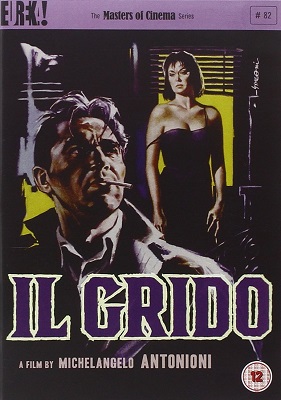
Il Grido, Michelangelo Antonioni (1957, Italy). I’ve loved Antonioni’s films since first seeing L’Avventura a dozen years ago (I really should watch it again), and his Red Desert is one of my top ten favourite films. Il Grido is an early work, and much closer to Italian Neorealism, a genre of which I’m not a big fan, than his later works – although the story is typically elliptical and some of the cinematography is very much in a style similar to his later films. A man learns that his girlfriend’s husband has died (in Australia, after seven years in that country) but she refuses to marry him as she says she loves another. So he leaves town and wanders aimlessly along the Po valley with his daughter, looking for work. This is where the film is most like Antonioni’s later films: things happen to the father, but they are random and unrelated; he settles down in one place, is happy, but then moves on; he meets people who seem happy, only to learn they are as damaged as he is. There is an especially memorable scene where the man meets a young woman who proves to be a prostitute living in a shack in a shanty town by the side of the river, and they go for a walk across the river flats, and it’s an early version of a visual metaphor Antonioni uses to greater effect in later films. Il Grido may be one for Antonioni fans, but it’s a good film in its own right.

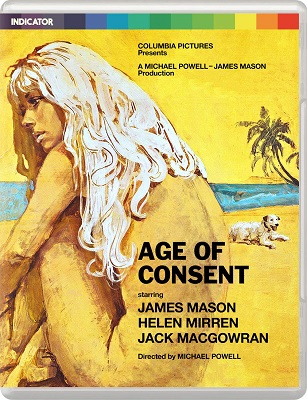
Age of Consent, Michael Powell (1969, Australia). I found this on Amazon Prime, and for all that Amazon treats its employees like shit and Bezos’s wealth is an obscenity – but then, Amazon is a US company, Bezos is a citizen of that country, and there’s a reason you’re more likely to get companies like that and people like him in the US… Despite all that, I only watch the free movies on Prime, and I’ve found some right good ones, mostly by accident. Like this one. Which, er, was not exactly good, but never mind. Powell, as any fule kno, was one half of the Archers, who made some of the best British films of the first half of the twentieth century. Unfortunately, Powell’s career nosedived after his solo film, Peeping Tom, which was unfairly savaged by critics of the time and is now justly seen as a classic. Age of Consent, his last feature film, was made in Australia. It is… odd. James Mason, sporting a dodgy Australian accent, plays a famous artist in New York suffering from burn-out. He rents a shack on a small island off the coast of Australia, where he meets a teenage Helen Mirren… and she inspires him. Despite the title, there’s nothing dodgy about their relationship – she is only his model. Which doesn’t stop others from thinking there’s more to it. Mason, despite his accent, is actually quite good – coincidentally, he met his second wife on this film, and they way she screwed over his children makes for an odd story – and Mirren is, well, gauche, which is not something you expect of her (she was in her early twenties when she made the film). I’m not convinced the movie entirely works – some of the humour feels forced, the characters are more like grotesques than caricatures, and the ending is both predictable and dodgy. One for Powell fans, I suspect.

1001 Movies You Must See Before You Die count: 933


1 Comment

Moving pictures 2019, #2

I admit it: film posts are easy content. More so, as it’s easy to watch a wide variety of movies. So why the fuck don’t more people do it? They watch the same old Hollywood shit, and yet there’s an entire world’s worth of cinema out there to explore and it’s not at all difficult to find it. Amazon Prime even makes some of it available for free, and that’s over and above what publishers release on DVD or Blu-ray in the UK, or what TV channels broadcast, Scandi-noir or otherwise…

Of the five films below, only one was a rental, and only one was a purchase. The others were streamed. I am not, I must admit, a huge fan of streaming, if only because the available films are limited, or, for the more obscure films, it costs over and above for curated lists of movies. It’s the old argument: I buy a DVD for £10 and watch it twenty times; or I stream a film at £2 a view… And while it’s unlikely I’ll watch a film six times, although it has happened, at least I’ll know it’s always available, which is not something that can be guaranteed for streamed films. And for some streaming services, like mubi, it’s even a feature: you only get access to a movie for 30 days.

Perhaps it’s old-fashioned of me, but I prefer the idea of controlling my own access to culture. True, when I buy a cinema ticket, it’s only good for one showing; true, when I pay to enter a museum, the ticket is only good for one visit. But we have sell-through for films, and books for literature… and both forms allow me unlimited repeated access to art I enjoy… and while that may not be particularly good for the creator, it is clearly less good for the publisher… who would like to charge for every single view because it maximises their revenue…

But I’ve drifted from the point. Here are five films I enjoyed. Some I’d like to see again. And can. Others I can’t… without paying for the privilege – and I have certainly done that: bought a DVD or Blu-ray of a film after watching a rental or streamed film, because I wanted a copy of my own.

Adelheid, František Vláčil (1970, Czechia). I really should write these posts shortly after watching the films. Especially since I have a bad habit of not focusing one hundred percent on the movies I’m watching. I’ve usually got my laptop on my, er, lap, and I’m writing a Moving pictures post from a couple of weeks previously… Oh the irony. So I don’t really need to explain that while I watched Adelheid and I enjoyed Adelheid, looking at the plot summary on Wikipedia I’m coming up blank. It doesn’t help that my memories of it are getting confused with Ucho. This is a film I clearly need to watch again… and I would stick it back on my rental list, except that’s not going to be a thing I can do after March… Oh well. I remember the movie being good, which is about all I remember, and I do like Vláčil’s films, so it’s definitely worth another go.

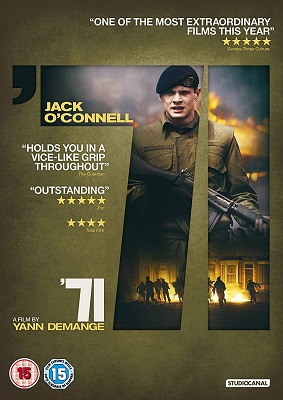
‘71, Yann Demane (2014, UK). This had been sitting on my watchlist on Amazon Prime for months, but I’d never felt in the mood to watch it, until, one night, it occurred to me I’d best get my watchlist trimmed down before I left the UK. At which point I discovered that ’71 is actually a pretty good film. It depicts the British Army in Belfast in the year of the title, and a young soldier gets cut off from his platoon after an ill-advised, and ill-managed, mission to assist the RUC search some houses. The army’s Military Reaction Force, an undercover unit who were no better than the terrorists they were supposed to take down, provide a bomb for Unionists to place in a Catholic pub, but it explodes prematurely… and is mistakenly believed to be an IRA attack. But the soldier on the loose knows the truth. The film did a really good job of setting time and place… except for the scenes that were clearly filmed in Sheffield’s Hyde Park flats. It pretty much blows it when a film set in one city is obviously filmed on location in your home town. The movie also demonstrated that even in 1971, the army was as shambolic as it was in 1941. Not a popular opinion given the death-toll, on all sides, caused by the Troubles; but the days of blindly supporting your country because it’s your country should be long over– Ah fuck, what am I saying? Brexit. It’s brought all that brainless shit back again. But so few people seem to have a built-in moral compass, or they let something else, like religion, overrule it. And let’s face it, those things that overrule it, they swing one way then the next on a weekly basis. All of which is by the bye. ’71 does a very good job of showing that both sides in the Troubles were complete bastards, although the RUC were clearly the worst. The film makes an excellent fist – Hyde Park notwithstanding – of setting time and place, and the performances are good. Worth seeing.

War and Peace, Part 4: Pierre Bezukhov, Sergei Bondarchuk (1967, Russia). I have a huge amount of respect for this film – or rather, all four films – and yet the only version we have available to us now is a terrible copy of the original. It’s a crying shame. Bondarchuk’s War and Peace is a towering cinematic achievement, and the best adaptation of the novel too, but all we have is the 35mm print chopped down from the original 70mm, and a few scenes from the television version which were left out of the 35mm edit and subsequently re-inserted. With subtitles, rather than dubbing. But the dubbing is a bit erratic in the edition I watched anyway, with the Russian dubbed into English, but not the French or German (and no subtitles for those languages, either). I would actually prefer subtitles throughout – films should be shown in their original language, with subtitles (the Italian film industry’s penchant for featuring non-Italian actors, typically English- or German-speaking, and dubbing them into Italian notwithstanding). There’s not much to say about the plot of War and Peace, Part 4: Pierre Bezukhov as it consists of little more than the subtitle character wandering around a warzone and towns that have been all but destroyed by the fighting. It’s all physical effects, of course – no CGI back in the mid-1960s. And that’s one thing that has been impressive throughout all four of these movies: the scale of the effects. A Napoleonic battle, with real soldiers. Actual nineteenth-century palaces. A cast of tens of thousands. And behind it all, a showcase of technical innovation, and a genuine work of literature providing the story. (Note to self: reread War and Peace one of these days.) Bondarchuk’s War and Peace would be absolutely brilliant, if we had the original print. Sadly, we don’t. But what we do have is enough to hint how good it was.

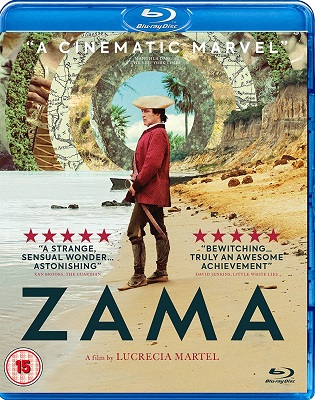
Zama, Lucrecia Martel (2017, Argentina). South American directors get little press in the Anglophone world, and female South American directors even less… and yet there are some excellent ones. Not just Martel, but also Claudia Llosa and Lucía Puenzo. But of the three, Martel definitely has the highest profile at present. Llosa has not produced anything since 2014, and Puenzo since 2013 – which suggests it’s more about what’s available, which is criminal. While all three are South American – Llosa is Peruvian, the other two are Argentine – and they share a similar elliptical approach to storytelling, the stories they’ve chosen to tell are very different. Some are historical, some are contemporary. Most are stories about women. Zama is unusual, insasmuch as the title character is male. It is also adapted from a major work of Argentine literature, a 1956 novel of the same title by Antonio de Benedetto. Zama is a Spanish corregidor in late 1700s Paraguay, separated from his wife and children by the Atlantic, and desperate to return home. But his entreaties fall on deaf ears, and the decline of his mental state is reflected in the decline of his career, or vice versa. It’s beautifully shot – it looks absolutely gorgeous on Blu-ray – and there’s something ineluctably South American about it all… so much so, that the film it put me in mind of most was Alejandro Jodorowsky’s biopic, The Dance of Reality (which is set more than 100 years later and in a different country on the same continent, but never mind). Martel, like Llosa and Puenzo, has an enviably varied oeuvre, but all three also have an enviably excellent oeuvre. Seek their films out, you will not be disappointed. And Zama is hot right now, so easy to find. Watch it.

A Star is Born, Bradley Cooper (2018, USA). Hollywood and the US film establishment, which is very much in Hollywood’s pocket, seems to love this film so much it has been made three times before – in 1937, 1954 and 1976 – although the 1954 one, with Judy Garland and James Mason, is generally reckoned the best of the three. Er, make that the best of the four. One thing you can say of A Star is Born is that it’s very much a movie of the time it is made… except when it isn’t. Because, seriously, Bradley Cooper’s rock-god character, and the music he plays, well, that hasn’t been a thing since the 1970s. Just watch a documentary about The Eagles, or any other big US band of the time. They played it then. No one plays it now. The last time Jackson Browne toured new material and filled an auditorium, Reagan was president. And Lady Gaga, who does well in her first major role, starts out like Linda Ronstadt before going all, well, Lady Gaga, at the behest of her record label, who think she will be more successful. Well, yes, playing twenty-first century music in the twenty-first century is more likely to be successful than playing 1970s music. The entire tribute band industry, er, notwithstanding. Anyway, Cooper is a rock god on the slide, drinks way too much, and, desperate for alcohol, stops off in a drag bar – nice call out to drag culture, but a bit off-the-wall, tbh (although check out the number of drag clubs that appeared in 1980s action movies) – and sees Lady Gaga, a faux queen, perform, and is smitten. Where to start with the disentanglement? The assumption that Gaga’s character is clearly cisgender to the drag club audience? That she shines in comparison to drag acts? That her career is so in the toilet she can only appear as a faux queen? Anyway, Cooper and Gaga hook up, and she plays him her material and he likes it and she even performs it onstage during his tour… But it’s all straight-up 1970s rock, and that’s not 2018, so it all seems weirdly alternate universe. But then Gaga’s record company moulds her into a twenty-first century pop artist like, well, Lady Gaga, and though it seems more believable as a career path, it doesn’t as a musical path from the material she’d performed earlier. None of which is to say the film is not entertaining. It is. Cooper does grizzled rock god to a tee, and Gaga is hugely likeable in her first major role (and I say that as someone who knows fuck all about her musical career). The movie looks good and the concert sequences are pretty convincing. It’s all very much a Bradly Cooper vehicle, but that’s hardly unexpected. And given the story, the story’s pedigree, and Cooper’s role in the project, Academy of Motion Picture Arts and Sciences recognition was hardly unexpected, if disappointingly predictable. I’ve always had a soft spot for movies about rock stars or rock groups, and A Star is Born ticks all the necessary boxes. But it still feels as artificial as its earlier incarnations – epitomised by the insertion of the long “Born in a trunk” musical number in the 1954 version, added by star Garland after director Cukor had left the production, and the fact the best copy of the 1954 movie currently available has stills and recorded dialogue to cover parts of the story that didn’t make the original theatrical cut but are now considered necessary to understanding the film’s plot… The reputation of the 1976 remake by Frank Pierson has not aged well – I’ve not seen it for many years, so I’ve no idea if the film itself has weathered the decades. I mean, Kris Kristofferson, okay, maybe; but Barba Streisand? I should try to watch it – suitably reinforced, of course. But it would not surprise me if, forty years from now, Bradly Cooper’s A Star is Born enjoys a similar reputation to Frank Pierson’s.

1001 Movies You Must see Before You Die count: 933


1 Comment

Moving pictures 2019, #1

We’re a month into the new year, and I’m still having trouble coming up with something more interesting to post than reviews – if that’s the right word – of obscure, and not so obscure, films I’ve watched. But then I’ve been busy: trying to declutter prior to my move. Five thousand books and two thousand DVDs, it transpires, take a lot of sorting out…

Anyway, until all that’s out of the way, have half a dozen movies I watched in January…

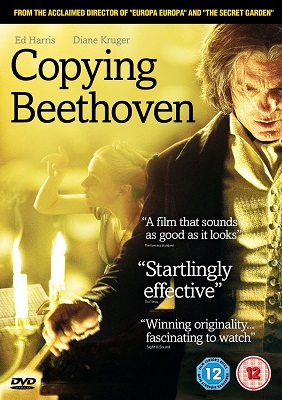
Copying Beethoven, Agnieszka Holland (2006, USA). My mother lent me this one and the only reason I agreed to watch it was because it was by Agnieszka Holland, a Polish director whose few films I’ve seen I’ve thought very good. Copying Beethoven is not her only English-language movie, nor even her first. In fact, she’s made quite a few, most of them not in Hollywood, and several of them starring Ed Harris, who plays Beethoven in this one. The story is simple enough. Beethoven requires someone to produce neat copy of his manuscripts. A young woman, with ambitions of being a composer herself, despite the fact women composers are exceedingly rare at that time, manages to persuade Beethoven to take her on. And later co-composes one of his pieces, as well as composing her own. The problem is, it’s all historical nonsense. It’s a nice idea, and it’s well played by its leads, although Ed Harris does overplay his part somewhat, but it’s entirely invented and it’s supposed to be an historical film. Some of us, you know, look this shit up. And when something pretends to be historical, I want to know if it is and go visit Wikipedia. Which is where Copying Beethoven fails. Badly. It would be nice – it would be great – if it had really happened, and I like the idea of pretending as if it had happened by making a film about it. But… Maybe I’m being as bad as those arseholes who complain about female blacksmiths in fantasy novels… except the worlds in fantasy novels are entirely invented, and this purports to be real, and yet it’s a story I’d sooner was true than invented…  So let’s pretend it really was like that. History is, after all, written by the winners. And if from 2006 onward it’s accepted as actual history that Beethoven had a female amanuensis, then good, excellent in fact. Which makes this adaptation of our new history (and I’m not being sarcastic there, I hasten to add) somewhat disappointing inasmuch as  the leads are, well… Harris is OTT and Diane Kruger is a bit of a blank. The previous films I’ve seen by Holland were ensemble pieces, so perhaps she let the reduced cast in this one get the better of her.

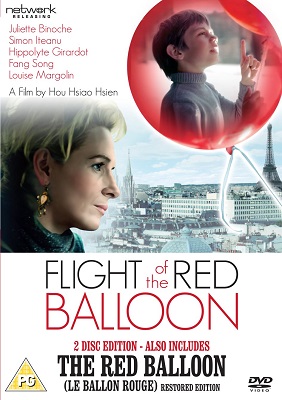
Flight of the Red Balloon, Hou Hsiao-hsien (2007, France). The title of this film is a reference to a French short, Le ballon rouge, from 1956, in which a young boy finds are balloon, which then follows him around. And Hou’s Flight of the Red Balloon opens with a young boy also finding a red balloon, but it proves to have a mind of its own, resists his please for it to follow him and goes off on its own way. The film then shifts to the boy’s mother, Juliette Binoche, who is a puppeteer, and has just employed a Chinese student in Paris as a nanny for her son. And, er, that’s it. The balloon has drifted off, and whatever purpose it played in the plot seems pretty much and over and done with ten minutes in. Bar the occasional brief appearance. Perhaps the Chinese nanny is the red balloon – except, no, that doesn’t really work either, as the film is about Binoche, her son, and the boy’s older sister, who had been living with Binoche’s divorced partner in Brussels but has moved to Paris for college. It’s all very low-key, with much of the film taking place in Binoche’s tiny apartment. The performances are very natural, as is the lighting; and the movie manages that trick Hou has down to a fine art of making the quotidian feel like it’s important, making small drama feel like it should be melodrama. I do like Hou’s films, but some of them I find more successful than others. Flight of the Red Balloon struck me as middle-tier Hou, but perhaps that’s because it’s a French family drama, set in Paris, and that’s hardly an under-subscribed genre of film…

The Predator, Shane Black (2018, USA). It’s the Decade, maybe even Century, of Reboots, I mean Spider-Man has been rebooted like thirty-five times in the past eight years, so why not reboot a piece of low-brow populist sf crap from the 1980s and hope its macho bullshit finds a new audience in Trump’s America? What could go wrong? And anyway there’s always the marketing machine to make sure it sure it earns a profit even if it is a piece of shit. And this reboot certainly is. A piece of shit, that is. It opens with the protagonist on a mission to kill some unspecified baddie in, I think, Mexico. Which is not the US, and is a separate sovereign nation. But that doesn’t matter because this is the US and the only national boundaries they recognise are their own, with or without a wall. Said protagonist witnesses a Predator spaceship crash, and steals some of the armour. Back in the US, he’s taken in for questioning because of what he saw and then dumped with a bunch of soldiers incarcerated for various offensively stereotyped mental conditions. So he breaks them out, they become his squad, and it’s all so macho and fucking American it makes you want to do that thing from The Exorcist and projectile vomit while your head spins around. I was rooting for the Predators; I wanted them to wipe out the US. Because every single US character in this film was a total shit and deserved to be ripped into pieces by an alien. The Predator also did a shitload of retconning when it came to the franchise, and not entirely to the franchise’s benefit. This is a film that has no brains, revels in its brainlessness, and proclaims its lack of brains as the epitome of American manhood. And manages some pretty offensive characterisation to boot. It can get fucked.

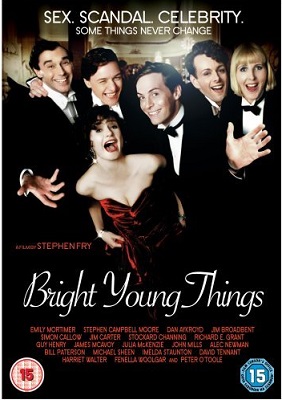
Bright Young Things, Stephen Fry (2003, UK). Since I was going through a phase of reading Evelyn Waugh, it made sense to watch the film adaptations of his novels. So I found a copy of Sword of Honour (see here) and… Vile Bodies, that last under the title Bright Young Things, which is the term used in Waugh’s novels for the dissipated twentysomethings of the 1930s and 1940s he writes about in Decline and Fall, Vile Bodies, Put Out More Flags and so on. Fry you would expect to have a feel for the material – and I say that based on his public persona and nothing else – and so it proves. Bright Young Things does  feel a bit like an early who’s who of UK thesps, as it’s full of familiar faces – including Sir John Mills in his last ever part, a non-speaking role – but as an adaptation of its source material it actually scores pretty well. Waugh doesn’t seem to adapt well – his satires become dull dramas; well, except for Brideshead Revisited, where a dull-but-clever drama is adapted as a dull-but-clever drama. But Fry clearly does not take Vile Bodies seriously and it shows. Most of the comic set-pieces from the novel are there, although not all, and some are changed and not to their benefit. But the end result is probably the most faithful adaptation of Waugh’s oeuvre I’ve so far seen. Worth seeing, but you’re better off reading the books.

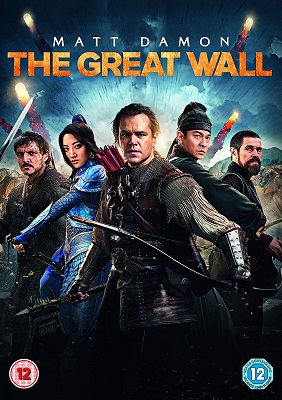
The Great Wall, Zhang Yimou (2016, China). I remember the fuss when this was released. OMG whitewashing a Chinese movie! Matt Damon stealing a role from a Chinese actor! All complete bollocks. This was a Chinese film, made by Chinese film-makers with Chinese money, who just happened to cast Matt Damon in one of two roles for European characters. Having said all that, I was expecting an historical film and, er, The Great Wall is certainly not that. I think the first clue was the demon-like creature that attacked Matt Damon and his colleagues, but by the time the army of demons attacked the Great Wall of China I was pretty sure this was outright fantasy. It is, unsurprisingly, for a twenty-first century big budget Chinese film by a big-name director, a polished piece of work. The story may well be bollocks, but it makes damn sure it’s entertaining bollocks. And the film does so many things Chinese cinema does so well, and Hollywood quite frankly has no clue about, and though the story is completely risible it all hangs together with an economy of, well, action, because that’s what drives the story, and it provides as few opportunities as it can for the audience to sit back and think about it what it is watching. It’s very entertaining. Complete bollocks, but very entertaining. Sort of like a MCU film – but without the dodgy politics.

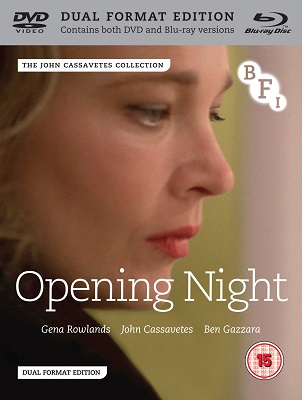
Opening Night, John Cassavetes (1977, USA). You know how you want to like a director’s films, and some of their films you even do like quite a bit and think are really very good, but you still have this overall impression that the director’s oeuvre is not one that appeals to you… And then you watch a film by them and you wonder maybe they really are your thing after all. I think I just did that. I’ve seen half a dozen films by Cassavetes, and some of them I’ve thought are really quite good. But the first few movies by him I saw poisoned by view of his oeuvre. Much as I liked Too Late Blues, I really didn’t take to The Killing of a Chinese Bookie… And yet, I loved Opening Night. It is much like his other films – thin on plot, reliant on his cast, especially the lead (usually his partner, Gina Rowland, or a friend), with dialogue that feels more improvised than scripted. Rowland plays an actress in a stage play, opposite Cassavetes himself, who has her age abruptly brought home to her when a young female fan is hit and killed by a car after a performance. It doesn’t help that the play is about a woman who is having trouble accepting that she is ageing. Rowland’s stage role and “real life” echo each other, and her response to her realisation impacts her behaviour and performance. And it’s a bravura performance from Rowland. I mean, it’s not like she hasn’t shown her chops in other Cassavetes films, but she carries this one above and beyond. Opening Night made me want to watch the other Cassavetes films I’ve seen all over again.

1001 Movies you Must See Before You Die count: 933


Leave a comment

Moving pictures 2018, #69

Sixty-nine! Sixty-nine of these Moving pictures posts for 2018. Pretty much all of them with half a dozen movies per post. That’s a fuck of a lot of films. That’s pretty much two a night, and three on Friday, Saturday and Sunday. Sometimes more. I expect my movie-watching to plummet following my imminent move northwards. Which will be a good thing, because I’ll have the time to do all the things I used to do – such as, er, write. And read more. Although I did manage 150 books read in 2018. Which is pretty respectable, and an improvement on the previous two years. But my record is still 220 books read in one year, in 2008, and I have to wonder why that year was so different…

But this post is about movies. It’s the last Moving pictures post of films watched in 2018. Which is why there are seven films instead of the usual six. In all other respects, it’s fairly typical of my movie-watching over the past twelve months: two Chinese films and a Bollywood one (in Hindi, but with no singing and dancing), a movie by a director I “discovered” last year, a piece of Hollywood Extruded Product tosh, and an off-the-wall film by a director completely unknown to me.

Aftershock, Feng Xiaogang (2010, China). This is the fifth film I’ve seen by Feng and I can’t really say there’s been anything that struck me as especially characteristic about his movies. He likes ensemble casts, but pins most of the story on only two or three of the characters, and they follow different threads which start out together, before going their separate ways, only to meet up later. At least, that’s true of Youth (see here) and Aftershock, but perhaps not of the other three movies by him I’ve seen. Anyway, the title of Aftershock is a clue to its story. In 1976, an earthquake completely levelled the town of Tangshan, killing nearly a quarter of a million people. The film follows a single family during it. The husband dies in the earthquake, and the two children are trapped. The mother is forced to choose by rescuers between the two of them. She chooses the boy – who is rescued, but his arm was crushed and he loses it. However, the girl manages to escape, but has lost her family. She is adopted by man and wife Red Army officers who were involved in the relief effort. The film then follows the two children as they grow up separately, unaware of the other. They both return to Tangshan, and see the brand-new city that sprung up in place of the one destroyed by the earthquake. Eventually, the two siblings track each other down and meet, but they have nothing in common. The depiction of the earthquake which opens the film is really well-staged, and extremely convincing. The remainder of the film is closer to Youth than other films by Feng I’ve seen. It was apparently originally released in IMAX, the first major commercial IMAX film produced outside the US, and, quite frankly, those earthquake scenes must have been scary as shit in IMAX. But even you don’t get to see it in that format, Aftershock is worth watching.

Black Snow, Xie Fei (1990, China). I like Chinese cinema. I like Second Run. The latter have published some excellent movies on DVD or Blu-ray over the last few years, including several of my favourite directors, Miklós Jancsó, from a wide spread of countries and directors. Okay, they might not have published everything Jancsó made, but I can hardly complain given I’ve discovered new favourites from movies they’ve published I might otherwise not have seen. None of which is especially relevant as I rented Black Snow because it was a Chinese film, although the director was unknown to me. A young man completes his prison sentence and returns to his home. He is determined to go straight, but has trouble making ends meet. He sells clothes on the black market, and manages to avoid falling afoul of the authorities. Even when a friend of his from prison escapes and comes to hide out at his flat, he still manages not to get dragged into crime. It’s all very realistic, with hand-held cameras and location shooting – Xie Fei is not Sixth Generation, but they use many of the techniques he displays here. I had not expected Black Snow to be as good as it proved to be. Recommended.

Accatone, Pier Paolo Pasolini (1961, Italy). This was Pasolini’s first feature film – he had first made a career for himself as a novelist, and was highly regarded as such. Which is weird because I know him first and foremost as a film-maker. I guess one of these days I’ll have to try one of his novels – assuming they’ve been translated into English. And why wouldn’t they be? He’s famous, right? Anyway, Accatone means “beggar” and is the nickname of a young man on the streets of Rome, who pimps a young woman. But then she is sent to prison and he finds himself without an income. I’m a big fan of Pasolini’s films – yes, even Salò, or the 120 Days of Sodom – and I love his irreverent approach to his material, especial Catholic material, and his bizarre visuals. But Accatone, whose story is apparently an amalgamation of two of his novels, is basically Italian Neorealism in all but name. And I’m not a big fan of Italian Neorealism. True, Neorealism tends to use non-professional actors, and Pasolini also did in many of his films. Accatone is one for completists, I think ,and not indicative of the rest of his career. To be fair, Eureka! have done a sterling job with this dual format release, bundling Accatone with an early documentary by Pasolini, Comizi d’amore, in which Pasolini does a vox pop on sex across Italian society.

Hunter Killer, Donovan Marsh (2018, USA). I’ve no idea why I watched this. I do like submarine movies, or ones that are set beneath the sea surface, but this had big budget Extruded Hollywood Product stamped all over it, so I knew it was going to be bad. And yes, it did some things well – the CGI underwater scenes were quite effective, and the film-makers made an effort to be accurate with all the hardware… if not with the story. And for a film in which a Russian minister tries to kick off WWIII, but is foiled by a maverick USN submarine captain, it’s remarkable – and yet entirely unsurprising – that the word NATO is not mentioned even once. Anyway… Gerard Butler, a “mustang” (which I believe is the US armed forces term for an officer who started out as an enlisted), is given command of a nuclear hunter/killer sub, and unfortunately happens to be nearest when another US Navy sub goes missing in the Arctic. The viewer already knows what happened because they saw it in a prologue. A Russian sub torpedoed it. It turns out a rogue Russian minister – unfortunately, he’s the minister of defence – has kidnapped the Russian premier and is determined to kick off a war with the US. So Butler is sent in to find out what’s going on. And the US sends in a SEAL team, led by Toby Stephens, by HALO, to find out what’s going on, er, on land… And watching this you’d be forgiven for thinking either the Cold War was still going and that there were only two nations on planet Earth, which is the sort of risible crap Hollywood used to churn out to persuade the world it actually knew what it was doing as the “world’s policeman”. It was, of course, patently clear that they had no fucking clue. Now, I hasten to add, the UK would not have been any better, as we seem to have persuaded the world we know what we’re doing when we’ve been pretty much incompetent from day one. Anyway… Hunter Killer is the sort of militaristic tosh Hollywood used to produce back in the 1970s and 1980s and it’s somewhat surprising Hollywood thinks it’s relevant today. The worst enemy the US has right now is occupying the White House. Rogue Russian ministers with nuclear submarines are about as believable as alien invasions. Avoid.

Miss Violence, Alexandros Avranas (2013, Greece). I have checked and happily Amazon Prime still works in Sweden, although I suspect rights issues means I won’t have access to the same films. Which is a shame as in amongst all the crap it makes available, it throws in some little gems like this one. Comparisons with Dogtooth are inevitable, but Miss Violence actually makes sense in the end. The movie opens with Angeliki jumping from the balcony of her apartment during her eleventh birthday party. The police and social services step in help the family – grandfather, grandmother, mother, son and two surviving daughters – come to terms with their loss. But the family seems to recover suspiciously quickly. And then the film slowly reveals the family life… the ultra-controlling father, the complicit grandmother… (The mother apparently died years before.) I won’t reveal what it is that drives the plot, but when the film shows what prompted that opening suicide it comes as no real surprise – which it’s not to say it’s not shocking, just that it explains so much of what had so far in the film seemed difficult to parse. I think this film should be up there with Dogtooth, to be honest, although perhaps its clarity works against it in that comparison. Recommended.

Tumbbad, Rahi Anil Barve, Anand Gandhi & Adesh Prasad (2018, India). See my comment above re Amazon Prime. This is a Hindi film, but it contains no singing or dancing. It’s actually a horror film, which is not something Bollywood is especially known for. The title refers to a cursed village, where it always rains. But in the village is a fortress that holds a secret, which is revealed to a young man by his grandmother who has, er, grown into a tree. According to the opening credits, a god was cursed to be forgotten and imprisoned in the fortress. But adventurers from one family have learnt how to game that forgotten god – who shits gold coins when disturbed – and have so made their fortune. It’s all completely bizarre, but no more so than any Hollywood horror film. The scenes where the men of the family climb down a well into a hidden chamber like the inside of a giant stomach, feed the imprisoned god with bread effigies, and then dash out of their protective circle to grab the gold coins spilling from the god’s loincloth. Of course, as is always the way with these sorts of stories, someone gets greedy and comes a cropper. and that brings the whole bizarre enterprise to an end and seals the fate of the family. I had zero expectations when I started watching this film – other than liking Bollywood films, that is – but this was so completely unexpected, and put together so well. Recommended.

Evolution, Lucile Hadžihalilović (2015, France). And this film was also from Amazon Prime. I’m not entirely what it was about, however. There is a small boy living on an island with his mother. One day, while swimming he sees a dead boy at the bottom of the sea. His mother goes to check but tells him there was no body. Later, the boy is taken to hospital where he is operated on. He finds himself in a ward with several boys of the same age, who have had the same operation. The nurses, it transpires, are implanting some sort of creature in the boys. Which they later cut out of them, an operation the boys do not survive. But one of the nurses – they’re not entirely human, obviously – takes a shine to the original boy, and eventually helps him escape the island. The whole thing is shot in mute, almost submarine, colours, and there’s definitely an undersea theme, and a hint the nurses, and the boy’s mother, are from beneath the waves. Evolution is one of those odd Euro horror movies that rely more on the visuals than any kind of plot or, well, sense. It’s hard not to be reminded of The Lure, which I loved, but Evolution has no music in its story, and there are, well, less people in it. So, a good film, although not as good as The Lure; but worth seeing.

1001 Movies You Must See Before You Die count: 933


2 Comments

Moving pictures 2018, #68

Unusually, this post includes a film that is both recent and Extruded Hollywood Product. I even saw it at the cinema! But it was Christmas, and it’s sort of a family tradition to see a film at the cinema at Christmas. And, to be honest, dumb as it was – it gloried in its dumbness, in fact – I enjoyed the film much more than I’d expected to. So there.

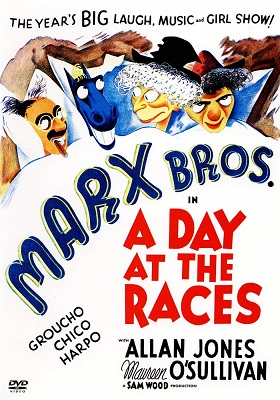
A Day at the Races, Sam Wood (1937, USA). And another Marx Brothers film chiefly famous these days because Queen used its title for one of their albums – and if you want to argue which of the two deserves to be better remembered… Well, Queen are still going, albeit only just, although the recent jukebox musical has probably done the surviving members’ bank accounts a world of good. And the Marx brothers… well, Zeppo was the last to die, in 1979, and the brothers’ last feature film was released thirty years before that… Obviously their films were very much of their time, and those elements of their comedy which have been picked up and re-used no longer seem fresh – which, perversely, means parts of their movies just aren’t very funny, and other parts would be funny if the jokes had not been done to death in the decades since. It doesn’t help that all their madcap escapades are generally hung on a rom com skeleton, and the latter is usually pretty weak. In this movie, a struggling sanatorium, under threat from a developer who wants to turn it into a casino, panders to a wealthy resident – Margaret Dumont, the “fifth Marx Brother” – by hiring Groucho as her personal physician. Meanwhile, the boyfriend of the sanatorium’s owner has spent all his money on a horse. Which everyone knows runs a like a donkey. Fortunately, they accidentally discover the horse jumps like a champion, so they enter him in a steeplechase, he wins a big pot, and the sanatorium is saved. These films are worth seeing once, I think, although I couldn’t honestly tell you which is the best one.

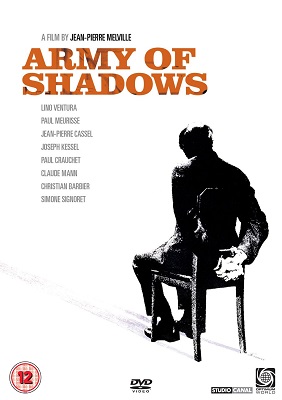
Army of Shadows, Jean-Pierre Melville (1969, France). I’ve watched a lot of French films but Melville is not really a director whose oeuvre I’ve been especially keen to explore. Some of his films are considered classics, and certainly Le Samouraï I thought very good, although more for its visuals than its somewhat derivative story. “Army of shadows” refers to the French Resistance, and that’s what the film is about: a group of resistance fighters during the Nazi occupation of France; and based on a novel (I think) published in 1943. The film was not well-received in France on its release, not released in the UK until a decade later, and not even released in the US until 2006. It has been re-evaluated in recent years, and it may well be because there’s no one left who lived through the events it depicts and is likely to be offended by Melville’s treatment. While they say history is written by the winners, as the generations come and go and events pass beyond living memory, so the movies which depict them become less personal and are re-assessed and then valued pretty much solely for their technical qualities. Fifty years from now, should someone make a movie which takes seriously the premise the Moon landings were faked, it could be considered a work of genius… because where is Buzz Aldrin to punch them? And so for Army of Shadows… And yet, other than its grimness, nothing much really stood out in the film. Meh.

Adela Has Not Had Her Supper Yet, Oldřich Lipský (1977, Czechia). Imagine if the Czechs had made The Little Shop of Horrors, but with stop-motion animation instead of songs. Actually, you don’t need to. Because they did. And it’s this film. Adela is a carnivorous plant, brought to life using stop-motion. And, er, that’s it. The film opens when famous US detective Nick Carter, an American pulp detective from 1886, while on a visit to Prague is caused to solve the disappearance of a dog. Which leads to a series of bizarre murders. And it’s all because of a mad scientist and his carnivorous plant. The animated sequences were all done by Jan Švankmajer, which, if you know the name, tells you everything you need to know. If you don’t know the name – why not? I stumbled across this film on Amazon Prime, and it was one of those gems which makes you grateful the platform exists. Recommended.

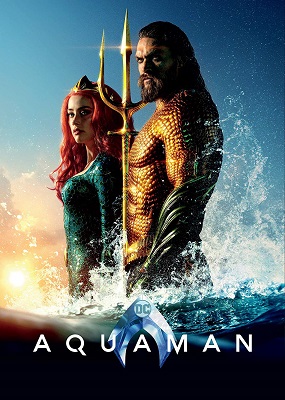
Aquaman, James Wan (2018, USA). It has been a tradition for many years in our family to go and see a film at the cinema together at Christmas. If I remember rightly, the first time we did it was to see the first Lord of the Rings movie, The Fellowship of the Ring. Which would make it 2001. So we’ve been doing it for nearly two decades. This year, the only movie suitable, and showing at a convenient time, at the cinema in Lyngby, just outside Copenhagen, was Aquaman. Which, to be honest, I was not especially bothered about seeing. I had, after all, seen Justice League, and that was bloody awful. I’d also heard that Aquaman was pretty dumb. So my expectations were low. And… surprisingly… it both met them and exceeded them. It was indeed as dumb as shit. And there were plot-holes you could sail an entire continent through… A king of Atlantis who died tens of thousands of years ago leaving a clue which references a statue of a Roman emperor? WTF? Anyway, Jason Momoa, probably best known as Khal Drogo in Game of Thrones, plays the title role, a half-Atlantean, whose mother, Nicole Kidman, washed up onshore in Maine after fleeing an arranged royal marriage under the sea. A lighthouse keeper rescues her, they fall in love, have a baby, and then she’s recaptured by her estranged submarine husband’s soldiers… The baby grows up to be Aquaman, presented initially as a full-on, if disenchanted, superhero. And… is it worth describing the plot? Of course not. There’s a subplot featuring the villain Black Manta which serves no purpose but does give the film one of its best action sequences. There are giant sharks with laser beams on their heads ridden by Atlantean warriors. There is an entirely pointless duel between Aquaman and the chief villain. And there is a vast undersea battle with some astonishingly effective CGI. It all looks pretty damn gorgeous, but it also quite evidently has the IQ of a lump of concrete. And yet, despite the latter, it’s pretty damn entertaining. I’ll not be rushing out to buy the Blu-ray, this is true; but when I left the cinema I didn’t feel like I’d been robbed. Aquaman is so stupid and OTT and yet so clearly not taking itself very seriously, that it keeps you entertained for all of its 143 minutes. It’s not going to win any awards – well, it might get on the shortlist for the Hugo Award, which tells you all you need to know about the Hugo Award – but it’s a tentpole crowd-pleaser, and as that it succeeds better than I’d expected.

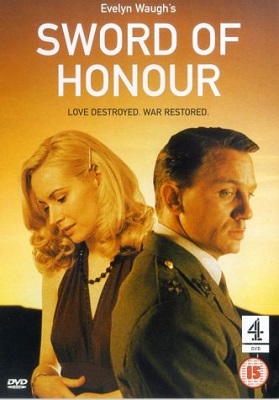
Sword of Honour (2001, UK). I read Sword of Honour over Christmas, and then watched the DVD when I returned home after the holiday. So I had the novel fresh in my mind when I put the disc of the Channel 4 TV movie adaptation in the player… And they really didn’t do a very good job, did they? The novel is a satire, but film turns it into a dull wartime drama. Daniel Craig plays Guy Crouchback, who has been living in Italy for years but returns to the UK before the outbreak of WWII in order to sign up. In the book, Crouchback’s career is a consequence of the general incompetence of the British military, enlivened with a couple of comic set-pieces, such as that surrounding Apthorpe and his “thunder-box”, which the film turns into a short pathetic incident. In fact, most of the emphases of the novel’s plot are misrepresented in the film. Crouchback’s experiences on Crete are a direct result of a military blunder, but the film presents it as a straightforward defeat. True, a novel can offer much more in the way of context than a film – or rather, it can offer more than just immediate context through visuals, which films do so much better. Of course, a lot of nuance is lost, because it can’t be telegraphed as well onscreen as it can in prose. But there’s a meaty enough plot in Sword of Honour to build a really good satire about WWII and, watching what Channel 4 actually did, it feels like they pulled every one of their punches, as if afraid to be too critical of Britain at war. Which is ironic, given that Waugh “cleaned up” his own wartime experiences when writing Crouchback’s – or rather, he made Crouchback a much more sympathetic character than Waugh’s actual career would have made him (“officer most likely to be shot by his men”, one fellow officer described Waugh). Sword of Honour, the film, follows the story of Waugh’s trilogy, later rewritten as a single novel, reasonably faithfully, but it turns a smart satire into a dull drama. Avoid.

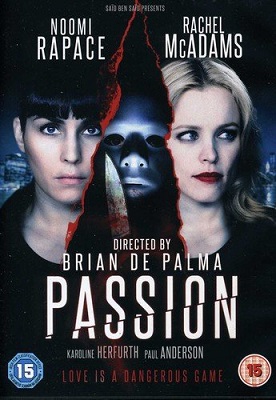
Passion, Brian De Palma (2012, France). De Palma has a well-earned reputation as a poor man’s Hitchcock, inasmuch as he tends to direct knotty thrillers that have all the plot complexity of a Hitchcock film but never quite manage to look as good as a Hitchcock movie. I’m not entirely sure that’s fair – true, Hitchcock was one of the greatest directors Western cinema has produced, but I suspect de Palma’s reputation partly rests on the fact the films he makes are somewhat… salacious. In this one, we have Rachel McAdams as an ambitious advertising executive, more than happy to steal credit for good ideas from her underlings. Chief among whom is Noomi Rapace. Who discovers that McAdam’s lover Dirk is being blackmailed by McAdam because he has embezzled the firm. But then the lover is found dead, and Rapace appears to be the murderer. And even confesses to the crime. Except she’s been so strung out on prescription drugs since McAdams torpedoed her career that perhaps she isn’t guilty, after all… The movie’s resolution should come as no real surprise, although de Palma sets it all up very cleverly. Unfortunately, the two lead characters, played by Rapace and McAdams, indeed the entire set-up, feels really very 1980s. The only thing that’s missing is the shoulderpads. It looks good, all very twenty-first century, but the corporate world feels so old-fashioned the whole film could be mistaken for an extended episode of Dynasty featuring secondary characters. Meh.

1001 Movies You Must See Before You Die count: 933


Leave a comment

Moving pictures 2018, #67

I need to get these out of the way. I have three Moving pictures posts, including this one, to finish off 2018’s viewing. Posts #68 and #69 to follow soon…

Heaven’s Gate, Michael Cimino (1980, USA). This film is probably best known for breaking New Hollywood and ending the US’s willingness to give carte blanche to directors and instead returning to Extruded Studio Product. Which, given the fact most of Hollywood’s best films are director films, seems a step backwards. Except Hollywood is all about profit, not about making good films. Which is not to say that Heaven’s Gate is a good film. It looks fantastic. But it is overlong, massively distorts the story it tells, and was reputedly a terrible production. Legend has it Jonathan Hurt went off and made The Elephant Man in between shoots on Heaven’s Gate. It’s easy to believe, because the whole film reeks of out-of-control personal project. The story, as it goes, is yet another take on the cattle barons versus homesteaders conflict in late nineteenth-century USA. The film opens with two friends graduating from Harvard. It then jumps forward twenty years, and one of the men is a marshal while the other represents the cattle barons. In the film, the homesteaders are all European immigrants, which was not the historical case. Nor did they kill cattle because they were starving. But Cimino is making a point beyond the history he used as inspiration, so he ups the stakes all round, and has the cattlemen respond with brutal violence. And this is in a 219 minute film, so it goes on and on and on… The fact the production was so bad, and Cimino a total prima donna – he apparently wanted the street widening for one of the towns he’d had built, and instead of moving one side out six feet he demanded both sides were moved out three feet each – well, it’s easy to see why Heaven’s Gate flopped so badly on release. It’s been reassessed since – but a lot of it still doesn’t work: the layered-on xenophobia, the excessive violence, the rambling plot, multitude of characters… If Heaven’s Gate is seen more favourably now, it’s probably because auteurs have been back in favour for a few decades and the success of sell-through, in whatever format, has opened up a market for auteur movies. Which Heaven’s Gate isn’t really. But as the last gasp of New Hollywood it’s worth seeing at least once.

Under the Silver Lake, David Robert Mitchell (2018, USA). It is possible to accurately describe a film in such a way that it sounds like it’s worth watching but the 139 minutes spent watching it could still prove a total waste of time. Which is as good a description of Under the Silver Lake as any plot summary. Slacker Andrew Garfield is having trouble paying his bills and is threatened with eviction. He spots a young woman at the apartment building’s pool and is smitten. But then she goes missing. Meanwhile, he’s intrigued by an underground comic which shares the film’s name, and which suggest there is some secret history underlying pretty much everything. After a series of encounters, Garfield bounces from one clue to the other in his hunt for the young woman, before ending up at the mansion of some mega-wealthy recluse who claims to have written every single pop song ever heard. So Garfield brutally murders him. He eventually tracks down the missing woman, and it’s all to do with secret hermetically-sealed fallout shelters beneath the Californian desert, where members of the ultra-rich seal themselves off until they die because only by doing that can they achieve immortality, or some such bollocks. Under the Silver Lake tries really hard to be Eyes Wide Shut but pretty much fails at every point. The plot didn’t seem to go anywhere, except round in ever-pointless circles. It looked pretty, though; and the cast were quite good. But definitely not worth seeing.

Blind Shaft, Li Yang (2003, China). This is the film for which Li made his name, and the first of his loose  trilogy of “Blind” films. A pair of con men work in China’s poorly-regulated, and often illegal, coal mines. They pick some more schmuck desperate for a job, and persuade him to pretend to be their brother, and the three of them will sign up at a coal mine. They then murder the third man and claim it was an accident. And the mine owners pay them off because they don’t want the authorities investigating the mine. The films opens with a murder, and then follows the two miners as they return to the city to look for a new victim. But the naive teenager they eventually persuade to join them… one of the miners likes him too much to murder him. For all that we’re told China is a communist country, and communist countries have free healthcare and education, and the booming Chinese economy has seen giant cities grew up out of nothing, not to mention vast industrial zones… but the films made by Sixth Generation directors tell a slightly different story. Sch as this one, and Li’s later Blind Mountain. People far from the shiny new cities live in poverty, and have to pay for medical treatment and education. There’s a scene in Blind Shaft, in which the two miners, flush with the spoils of their last crime, are in the city and spot a youth holding up a sign which says he has won a place at college but needs money to pay for it. The miners are so impressed he has passed the entrance exams, they give him some money. It’s a different picture to the one painted by glossy trans-Pacific blockbusters, which likely explains why they tend not to get theatrical releases (or indeed approval from the Chinese authorities in some cases). Definitely worth seeing.

Love in a Fallen City, Ann Hui (1984, China). There’s some good stuff on Amazon Prime. you just have to look for it. And it’s probably tempting to stick to the high profile stuff, even for foreign films, as the movies we see made in other countries depend on what’s made available to us – either by dubbing or subtitles – and often isn’t all that indicative of that nation’s cinema. This is certainly true of China, Western views of whose cinema have no doubt been chiefly shaped by first of all Hong Kong action movies, plus Shaw Brothers’ wu xia, then later wu xia films kicked off by the international success of Crouching Tiger, Hidden Dragon… Plus, of course, there are the films by Fifth Generation and Sixth Generation directors, and the entirely different aesthetic, and choice of subject matter, they bring to Chinese cinema… But there are yet other films, which were either never released in the West, or had such limited releases they were all but invisible, and for whatever reason, although I’m not going to complain, some of them seem to have been made available on Amazon Prime. This is not to say all such movies are undiscovered gems. One or two of them are actually quite good, but most are pretty unforgettable – and some of the more successful ones are actually pretty bad. Love in a Fallen City is an adaptation of a novella of the same title by Eileen Chang, originally published in 1943, set before and during the Japanese invasion of China in WWII. It’s a boy meets girl, girl is not sure about boy, boy and girl realise they truly love each other as disaster strikes sort of story. It’s all very well-meaning, but I suspect the source material makes a more interesting job of it than the film did. It’s been several weeks since I watched it, and pretty much nothing has stuck. Oh well.

The Legend of Tarzan, David Yates ( 2016, Australia). Tarzan must be up there with Sherlock Holmes as the white male fictional character who has had the most film adaptations and, like Holmes, each adaptation has brought contemporary concerns to the adaptation. Perhaps Tarzan movies have not been quite so “contemporary” as Sherlock Holmes fighting the Nazis in the 1940s, but each take on the character, even if set in its correct period, has been of its time. Which is probably a good point to document my own relationship with the character of Tarzan, which is entirely overshadowed by a Tarzan annual I read in a hotel in the mid-1970s the night before an orthodontist’s appointment. It was one of the those hotels with a bathroom shared by several rooms. And one story in the Tarzan annual affected me powerfully. That, and the pain of having a brace fitted, have burned it into my memory. Other than that, it was regular showings of the 1960s Tarzan television series (that’s the one with the chimpanzee called Cheeta) on Dubai television when I was a kid, and memories of the Johnny Weismuller movies, although I can’t remember when and where I saw them. Of course, of Edgar Rice Burrough’s properties I’ve always much preferred John Carter, and I don’t recall even reading a Tarzan novel – although one of my favourite books as a kid was Burne Hogarth’s Tarzan of the Apes (I had the Pan UK reprint paperback, which apparently doesn’t even exist on Amazon). Anyway, he’s a familiar character to me, and it’s been interesting seeing how he’s been re-interpreted over the years. The Legend of Tarzan opens with Tarzan, as Greystoke, settled in England, but asked to return to the Congo to investigate slavery there – and so becomes embroiled in a plot by the Belgian envoy to deliver Tarzan to an tribal leader in return for the fabled diamonds of Opar. It’s all very twenty-first century, with lots of CGI apes, and near-superpowered protagonists, but it makes an excellent point about the slavery. It smells quite a lot like a Victorian superhero movie, and the story beats are more from that template than the source material, but it’s certainly an improvement on the last few Tarzan movies and better than the reviews it received.

Big Shot’s Funeral, Feng Xiaogang (20011, China). Donald Sutherland plays a big name Hollywood auteur in China to remake Bertolucci’s The Last Emperor. The production company has hired a Chinese cameraman to follow Sutherland and record everything he says and does as material for a “making of” documentary. Unfortunately, Sutherland’s character doesn’t seem to have much clue what he’s supposed to be making – or rather, he has an entirely different film in mind to the one the producers are expecting or that he signed up for. This often results in incomprehensible instructions to the cast and extras, which his translator translates as something more understandable. Meanwhile, Sutherland forms a friendship with his documentary cameraman, despite the cameraman’s rudimentary English. But as the shoot progresses, so Sutherland’s character becomes disenchanted with the project. He doesn’t want to make some commercial crowd-pleaser, but that’s what the producers want and that’s how the production is being steered. Before shooting is finished, the director falls into a coma. The cameraman is asked to arrange his funeral, and told to use sponsors to pay for it. Which is where it all turns into farce, as the cameraman’s friend, a businessman, gets sponsorship deals for everything. I’ve found Feng’s films a bit hit and miss, but this one was good. It went from laid-back self-deprecating humour to quite biting satire. Good.

1001 Movies You Must see Before You Die count: 933


Leave a comment

Moving pictures 2018, #66

Another somewhat eclectic bunch of movies, although only one counts as Extruded Hollywood Product. Even worse, it’s Extruded Marvel Hollywood Product. But I actually enjoyed it. It came across mostly as a piss-take, which is a definite improvement over the po-faced bollocks of the Avengers films…

Venom, Ruben Fleischer (2018, USA). As is the case with 90% of the current MCU output these days, I’m coming to this with little or no knowledge of the original comic incarnation. To be honest, I had thought Venom was a Spider-Man villain, although I’ve no idea why, but Spider-Man doesn’t appear here and the story is set entirely in San Francisco and Spider-Man lives in New York city. Tom Hardy plays an internet investigative journalist who pisses off the wrong person once too often – in this case, it’s Musk-like zillionaire Riz Ahmed, who seems to have the secret of interstellar flight which no one on planet Earth in 2018, er, actually has. But, WTF, this is MCU. People with fucking superpowers. So a “space shuttle” that apparently visits an exoplanet, even though no one has apparently colonised Mars, or even spread out into the galaxy, seems completely unremarkable. Unfortunately, said mission to the exoplanet has brought back some sort of weird alien life form. Which escapes and inhabits Tom Hardy’s body. Turning him into Venom, a superhero/supervillain. Sort of. Another alien parasite inhabits Ahmed, turning him into Riot, who is just the same as Venom but, well, bad. It’s all completely risible, but the filmmakers seemed to recognise that and there’s a nice line in piss-take throughout the movie, which is to be honest the only thing that makes it watchable. Thank fuck Joss Whedon didn’t make it. It would be unwatchable. Venom is not a great film. It’s mildly amusing, Hardy puts in a performance judged to a nicety, and the banter is unexpectedly better than is typical for a MCU movie. Unfortunately, the CGI is unexpectedly worse than is typical for a MCU film. Which is the only thing that spoils an otherwise entertaining 112 minutes.

Departures, Yōjirō Takita (2008, Japan). My mother lent me this, and one of these days I’ll persuade her to watch a film by Yasujiro Ozu… But for now, she’s the one lending me Japanese films. and quite odd ones at that. (Take that, David Tallerman.) Departures is a bout a young man who leaves Tokyo when the orchestra in which he was a cellist is disbanded, and in his home town he answers a job ad and becomes someone who prepares bodies for “encoffinment”, usually in front of the family of the deceased. Apparently, this is not an actual Japanese practice – or rather, it is not a separate career, as it’s normally performed by the funeral directors. But in the film, it’s a real job. Takita makes it clear this is not a run-of-the-mill occupation, opening with the dressing of a transgender person, and in which the dressers’ sensitive treatment defuses the obvious tensions in the room. It’s people’s response to the protagonist’s choice of career which drives the film – it’s seen as a slightly shameful job, although as is always the case in such films, attitudes soon change. While not an especially memorable film, Departures struck me as a well-played drama.

Space Raiders, Howard R Cohen (1983, USA). I don’t normally bother to document crap films, even science fiction ones, but Space Raiders is one of several movies Roger Corman cobbled together out of the special-effects footage from Battle Beyond the Stars. And, to be honest, I’m sort of conflicted about how I view Battle Beyond the Stars. Actually, I’m not. I liked it for many years, but I have to admit it is actually shit. It’s The Magnificent Seven in space – and, shockingly, one of them is a woman – and it’s a cheap piece of crap, albeit with some nice model work. And it’s the latter which resurfaces in Space Raiders. Who, as the title suggest, raid a base, only to discover a stowaway aboard: the son of the base’s commander. But they take a shine to him, and while ostensibly holding him for ransom, they look after him, even saving him from a plot by the alien controller of that space opera perennial the lawless where-pirates-meet-up space station that only seems to exist in brainless space operas. Oh wait, I committed a tautology. But you know what I mean. Having said all that, even for New World Pictures Space Raiders is weak sauce. The studio famously tried to make as many feature films as it could out of its rip-off material. Space Raiders is definitely New Worlds second-tier, although for me the studio will never exceed the greatness that is Queen of Blood.

Schloss Vogelöd, FW Murnau (1921, Germany). I do like Murnau’s films, although a friend thinks them over-rated. And it wasn’t until I watched this film I though he might be right. A hunting party at the eponymous secluded schloß is kept in by constant rain. An uninvited guest turns up, uninvited because it’s believed he shot his older brother and so became sole heir of the family fortune. To make matters worse, his brother’s widow also turns up to the schloß, which sort of makes things a bit icky. Flashbacks show that the widow’s marriage wasn’t as smooth as she claims, but also casts doubt on the brother’s guilt. While the film is well-shot, and some of the close-ups are really quite astonishing in their detail, at 70 minutes the story feels stretched beyond its natural length. Had it been made 20 or 30 years later, with, you know, sound, perhaps the slower scenes – and there are plenty of them – might have been a bit more interesting. But when you have characters sitting around mouthing silently, with only the occasional revelation or plot twist, attention quickly flags. Of course, the cinema experience was entirely different back in 1921, and while I don’t believe attention spans are actually any shorter now than they used to be, film audiences in 2017 have been trained over several decades to watch movies in an entirely different way to audiences in 1921. I do like Murnau’s films, but watching them is definitely an exercise in experiencing an historical document – some more so than others…

Women, Stanley Kwan (1985, China). This is one of many Shaw Brothers films that have been dumped on Amazon Prime. It is also Chow Yun-Fat’s first starring role. And Kwan’s first go at director. Make of that what you will. Which is, er, probably not much. Cora Miao plays a newly-divorced wife who is trying to make a new life for herself and meets up at regular intervals with a group of female friends. Who occasionally bring along male friends. Mostly to treat them in a nicely subversive way, much as men would treat women. But the woman’s husband, play by Yun-Fat, is not so quick to let his wife go. Women is a film that wears its time of making firmly on its sleeve. I’ve watched a number of films that were more 1980s than this one – and it’s strange but I’ve yet to see a film not made in the 1980s, but set then, that has managed to be 1980s – which is a long-winded way of saying that Women is very 1980s. But unless you’re a fan of the 1980s, I can’t really recommend this one.

Cathy Come Home, Ken Loach (1966,UK). In British television history, this is an important work. The fact its message has been entirely ignored – if not at that time, then almost certainly this century – seems almost incidental. As does the fact the heartless government during which its story takes place is Labour. Tories are evil scum. That’s a fact. But Labour have done their best over the decades to match them. Corbyn will in all likelihood make a crap prime minister, but he’ll make a better one than any Tory. But why bother? British politics has fuck-all to do with what either party will actually do, only with some rose-tinted view of what they’re supposed to have done in the past… A young couple end up homeless because the wife becomes pregnant and the husband is injured at work. They’re forced to leave their flat because of the baby and… It all sounds like the heartless consequences of Tory social policies – and in the twenty-first century that would almost certainly be true. But, as mentioned earlier, at the time Cathy Come Home was broadcast, Harold Wilson was prime minister and Labour had been in power for two years. But then, when you compare Cathy Come Home and I, Daniel Blake… The latter film is more immediately affecting because it shows the consequences of evil policies we can see for ourselves pretty much anywhere in the UK. The earlier film might well have been the first people saw of Labour’s policies of the time but, because they couldn’t map the experiences of Cathy and her husband onto what they thought they knew of the country… Of course, some people have been quite vocal in expressing a similar disconnect with I, Daniel Blake – but they’ve all been entitled Tory wankers, like Toby Young. Cathy Come Home is considered a landmark piece of television, but it does feel like its message has been lost over the decades since it was first broadcast. I, Daniel Blake, on the other hand, is an equally important film, but it feels like its message has been lost in only a year or two, or has been wilfully ignored…

1001 Movies You Must See Before You Die count: 933