It Doesn't Have To Be Right…

… it just has to sound plausible


1 Comment

Moving pictures, #34

Damn, more American films. Bit of a relapse here, although to be fair four of the US films are from the 1001 Movies You Must See Before You Die list.
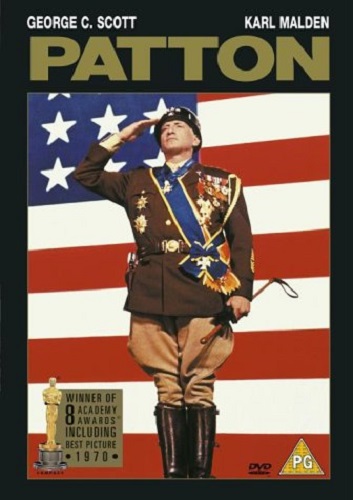
pattonPatton*, Franklin J Schaffner (1970, USA). George C Scott won an Oscar for his portrayal of the title character in this biopic, although he famously refused to accept it. But the rest of the cast and crew were happy to accept Oscars for Best Picture, Best Director, Best Original Screenplay, Best Film Editing, Best Sound and Best Art Direction. In Best Film, it was up against Airport, Five Easy Pieces, Love Story and M*A*S*H, so not an especially strong year (although the smart money would likely have been on M*A*S*H), because there’s not much in Patton that actually seems like Oscar-material. The script was written without the approval of the family and mostly from the memories of Patton’s friend and aide General Omar Bradley – and despite that still invented a number of incidents. It was filmed in Spain, and not in North Africa or Italy. The historical details are often inaccurate – it’s not just the use of tanks that weren’t built during WWII. but that the Luftwaffe only appears to possess two Heinkel bombers… and they weren’t capable of strafing the ground, which they do multiple times during Patton. Admittedly, the film was made before CGI – in the twenty-first century, they’d no doubt fill the skies with zillions of Luftwaffe bombers and fighters (which would, of course, be just as ridiculous). Patton was by all accounts an odd bloke, and Scott manages to get that across… but much of the film seems like little more than a spat between Patton and Montgomery as each chases after the glory of defeating the Axis. Hardly the most edifying motivations for waging war, but I guess it plays better than tactical and strategic opportunism. There are a vast number of WWII films, but there only a handful I’d rate, and this isn’t one of them. Watch Das Boot instead, or The Big Red One.
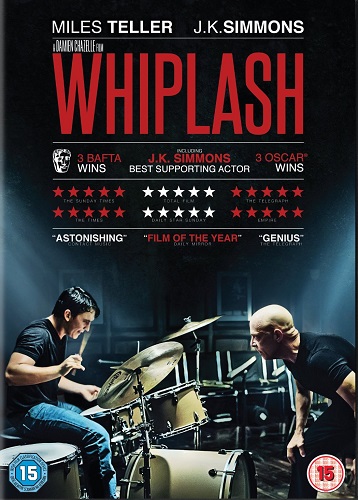
whiplashWhiplash, Damien Chazelle (2014, USA). Numerous positive reviews persuaded me to add to this my rental list, despite the subject not appealing. A student at a famous New York musical school is training to be a jazz drummer. He is talent-spotted by one of the lecturers, a well-regarded composer – and an abusive arsehole. And the film is all about how he abuses the student – and the other students in his jazz band. It’s one of those films where you can recognise how well it was played by its cast, and how well-written the story, but you still wonder why the fuck you watched it. JK Simmons – probably best-known in this country as Dr Skoda from Law & Order – plays the composer, who is a real nasty piece of work… and he thinks his methods are justified because only by driving people to breaking point are true muscial geniuses made. Which is, of course, complete bollocks. But, of course, the student initially responds to Simmons’s abuse, before eventually being pushed too far and cracking. And dropping out of music altogether. Only to later bump into Simmons, accept his flattering offer of drumming for his band at a jazz festival – but it’s all a trick to humilate the ex-student on stage, except he then turns the tables, which segues into one of the longest and most boring drum solos ever recorded (and I say that despite being a fan of prog). Whiplash was not a film I would normally have watched, and I can’t say I’m glad I watched it. Put it down as one of those films or books that you don’t like even though you recognise that they’re good (because, of course, how you respond to a work is an entirely different thing to its actual quality). Meh.

wingsWings*, William A Wellman (1927, USA). This was the first film to ever win an Oscar, which is of course about as much an indication of quality as winning the first ever Hugo. And yet… I believe Wings has a somewhat mixed critical legacy, but I admit rather enjoyed it. True, Clara Bow was somewhat clumsily inserted into the plot, and it showed. And, bizarrely, although it’s Gary Cooper’s first appearance on film, he looks pretty much the same as he did throughout his entire career. Basically, two rivals for the love of the same woman join up when the US finally decides to enter WWI (please don’t call it the 17-18 War, it erases the three years of fighting by all the other nations that were involved). During basic training as pilots, the two beat each other to a pulp and so become fast friends. They are shipped to Europe, where they begin flying sorties against the Germans. On one such sortie, one of them is shot down. But he manages to steal a German biplane to return to the allied line… only to be shot down and killed by his best mate. Wings is justifiably praised for its aerial sequences, which are pretty impressive for a 1927 silent movie – and, I suspect, would still have been impressive had the film been made fifty or sixty years later. Perhaps the romantic triangle – the two male leads and Jobyna Ralston; Clara Bow is the over-looked love interest – is hoary and clichéd, even for the 1920s, and perhaps the trench warfare doesn’t resemble depictions since put on celluloid or, er, televisual æther, but those are minor quibbles – the film is called Wings because it’s about a pair of aviators, and in that area it scores highly. Worth seeing.
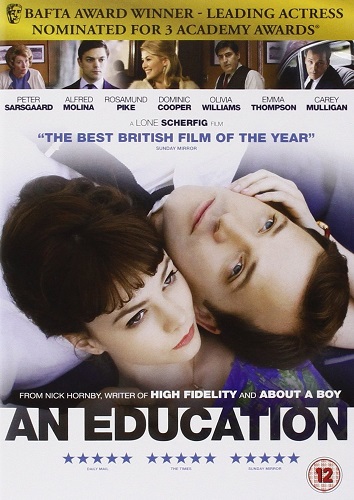
educationAn Education, Lone Scherfig (2009, UK). I stumbled across this on Amazon Prime, and since it’s on at least one edition of the 1001 Movies You Must See Before You Die list, I gave it a go. It’s based on a memoir by a British journalist, who, apparently, was seduced as a sixteen-year-old by a thirtysomething con man and so was introduced to a life she had only previously dreamt of – sort of. Teacher-pupil romances are nothing new, and have been a staple of literature and cinema for centuries (well, at least one century), but there is still something skeevy about a man in his late thirties in a relationship with a 16-year-old schoolgirl. An Education is set in the 1960s, when, we are supposed to believe, “things were different”, as if that’s supposed to excuse them… Although, of course, such relationships likely still happen today. I note that only recently – in 2016, for fuck’s sake! – has Virginia made it illegal for men to marry 12-year-old girls. Anyway, the heroine of An Education, Carey Mulligan, is clever and plans to go to Oxford – but after falling for the oleaginous charms of smooth talker Peter Sarsgaard (who does a pretty good British accent, it must be said), she drops out of school. After several adult adventures, including a dirty weekend in Paris, she learns he is already married – and tries to return her previous life, except it’s not that easy (but she succeeds anyway). An Education was slick and sixties and about as believable as an episode of Danger Man. It feels like a watered-down version of The Servant, without the menace, the suspense or the commentary on class and society. Meh.
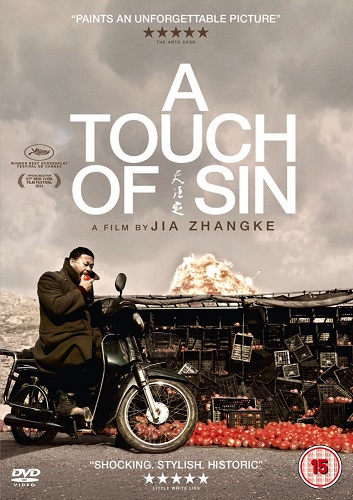
touch_sinA Touch of Sin, Jia Zhangke (2013, China). This is on later editions of the 1001 Movies You Must See Before You Die list (obviously it hadn’t been released when they put together the 2013 edition of the list), but it sounded like it was worth renting… And so it proved. It’s bloody good, easily the best film of the seven in this post. I’ve not seen anything by Zhangke before, but I’ll be adding his other films to my rental list. A Touch of Sin comprises four stories, all based on real events, and linked only by the similarity of their documented effects on those involved. In the first, a man in provincial town rebels against the rich man who has bought the village’s coal mine but not redistributed its riches as promised. The episode opens with a violent encounter and ends with one. The second episode is the slightest of the four and details one man’s murderous robbery spree. The third has a young woman travel to a provincial town, where she ends up working as a receptionist in a massage parlour. But when a local VIP demands she “service” him and tries to rape her, she responds violently. The final story is the most interesting. A young man leaves his job after inadvertently causing an industrial accident – the employer assigns his wages to the injured party as recompense – and ends up working as a host and waiter in a hotel catering to rich businessmen from Hong Kong. He then leaves that job and goes to work in a factory. Shortly afterwards, he commits suicide. China apparently has a very high rate of suicide, and the fourth story is based on one company where 18 employees attempted suicide (14 succeeded) within a year. This is the unadvertised cost of your cheap computers and and smartphones (not to mention the pollution). Western consumers are happy to accept the low prices resulting from company practices which lead to 18 staff suicides in one year, but then have the gall to moan about these products no longer being manufactured in Western countries. But don’t worry, people of the West! Soon, you will have a nation populated entirely by workers on zero-hour contracts with no rights, where only the air is free, and the environment, well, companies won’t have to siphon off funds from CAPEX to make sure the birds and bees don’t fall out of the sky. So you’ll still get your cheap smartphones and tablets, and on the back they’ll say “MADE IN ENGLAND”. Ahem. A Touch of Sin (a daft title, and the deliberate nod to A Touch of Zen does it no favours) is a beautifully-shot and altogether real study of the effects of capitalism on China. Recommended.
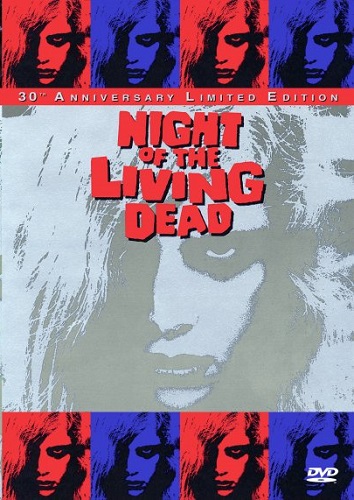
living_deadNight of the Living Dead*, George A Romero (1968, USA). I think I did this wrong – I watched Dawn of the Dead before watching Night of the Living Dead. Both are on the 1001 Movies You Must See Before You Die list, and I’ve no idea why I did it in that order. Okay, dawn comes before night, but Dawn of the Dead was released in 1978 but Night of the Living Dead was Romero’s first film and released a decade earlier. Also, I don’t get zombies. I don’t get the appeal, I don’t get the position they occupy in Anglophone 20th/21st-century culture. I didn’t, for example, even realise that the big thing about 28 Days Later is that the zombies run. So fucking what. In Night of the Living Dead, a couple visit the woman’s mother’s grave in a cemetery. A zombie attacks them and kills the man. The woman finds refuge in a house with a black man with a good head on his shoulders (a rarity in US cinema back in 1968). It transpires there are also people hiding in the cellar. Zombies attack the house. They fight them off. An escape attempt goes badly wrong. People die. Yawn. This is allegedly a classic of the genre, and for an independent film it has a couple of things to recommend it. But I suspect it’s one for fans of the director and/or zombie films; and not for me.
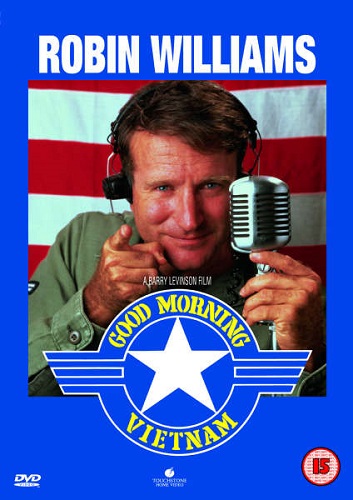
vietnamGood Morning, Vietnam*, Barry Levinson (1987, USA). Is there no phrase in cinema more likely to cause the heart to sink than “biopic”? Well, “directed by Chris Columbus”, perhaps. Or “from the producers of…”, as if the ability to bring in a film on time and on budget is any kind of artistic recommendation. Except, well, Good Morning, Vietnam, isn’t actually a biopic. Adrian Cronauer was a real person, and he really was a DJ in Saigon during the Vietnam War. He tried pitching a sitcom based on his experiences to TV networks, but tyey – conveniently forgetting that M*A*S*H was one of the most successful sitcoms of the time, and so proving that television executives have always been remarkably stupid – turned it down as they didn’t think war a fit subject for comedy. So Cronauer wrote a TV movie script, which passed across Robin Willams’s desk, and Williams liked it so much he turned it into a film project. The actual plot of the film, Cronauer has said, bears very little resemblance to his actual experiences; and all of Williams’s on-air performances were improvised during filming. Which does make you wonder why they bothered basing it on a real person. Or insisted it was true. After all, back in 1987 there was no social media, there was no “post-truth” politics; back then, words meant what the dictionary said, expertise was valued, and demagoguery had not been successful since 1930s Germany. Still, at least Williams got a shedload of award nominations out of Good Morning, Vietnam, so it wasn’t a total waste of time.

1001 Movies You Must See Before You Die count: 784

1 Comment

Moving pictures, #33

Again, more US films than I really would like to be watching. True, over half of the 1001 Movies You Must See Before You Die list is American, and when I’m looking for brainless entertainment to watch of a Saturday night with a bottle of wine in hand, then the US provides more suitable films than any other nation but… I’d seriously like my movie viewing to be more global, and though I’ve been making an effort in that direction, it sometimes feels like I’ve not been assiduous enough… Oh well. Most of my favourite films and directors are not from the US, and my DVD/Blu-ray collection now certainly comprises more world cinema than Hollywood…I’m getting there.

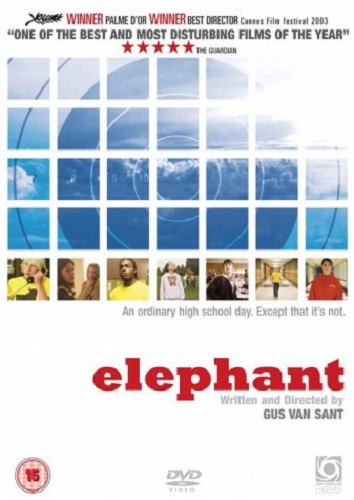
elephantElephant*, Gus Van Sant (2003, USA). You know that thing they have in the US, and that keeps on happening, where someone walks into a place and shoots everyone, because civilised nations banned guns the first time it happened but the US is happy to sell assault rifles to any lunatic with a dollar bill… Elephant apparently started life as a documentary about a real school shooting, but turned into a fictional representation of one. The film follows the victims, witnesses and perpetrators, often criss-crossing timelines, which is quite an effective technique. But the film itself offers no commentary on its subject, other than showing the shooters being bullied by jocks. Which is weak. I mean, it’s not hard to condemn either the shooters, the culture which persuaded them shooting their peers was a conceivable response, or the society which allowed them access to the weapons to do so. But Van Sant does none of these. He humanises the victims – which is the weakest argument of all against such atrocities. We know they’re human, we know they are just like us. We also know the perpetrators are little different to us. What we want to know is: why was this allowed to happen? And what is being done to prevent it? In the US, the answer to both appears to be: very little.

evangelion_3Evangelion 3.33: You Can (Not) Redo, Hideaki Anno (2012, Japan). The Evangelion films are re-workings of the Neon Genesis Evangelion OVA, but rather than distillations of that 26-episode series they feel more like isolated excerpts from it, ie random episodes from a much longer story. I like that the films make no concessions to their viewers, and that despite their basic plot of high-school kids piloting mecha in fights against giant aliens, there’s so much more going on that’s left for viewers to puzzle out: the world-building, the relationships between the characters, the technology, even the family dynamics for those characters who are related to each other… In this movie, the action takes place fourteen years after the explosive end of Evangelion 2.22 You Can (Not) Advance. Shinji and Evangelion Unit 01 have been drifting in orbit. He is rescued by WILLE and fitted with an explosive collar. Only it turns out WILLE is fighting NERV, and they have a, er, flying battleship. Which is now powered by Evangelion Unit 01 (there are around a dozen Evangelion units by this point). And then it sort of gets a confusing, with some cast members carried over from the earlier films, and entirely new ones to figure out as well. Not to mention a circuituous route, via the weird dynamics between the Evangelion pilots, to a final battle scene, which triggers another apocalypse… I’m going to have to watch this again – if not all three films – before I truly figure out what’s going on. It’s all made for an odd viewing experience. Although superficially the same, and sharing a design aesthetic, the three movies manage to present three episodes of one story-arc in three tonally different ways. The fourth and final film is due Any Day Now, having postponed several times since its original release date in 2013.

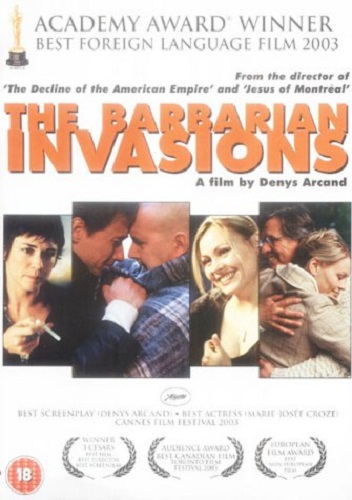
barbarianThe Barbarian Invasions, Denys Arcand (2003, Canada). Arcand’s The Decline of the American Empire was on the 1001 Movies You Must See Before You Die list I’ve been using, but this sequel is on a different one. I’d not been that impressed by the first film – it seemed almost a parody of an independent movie, a group of characters sitting around moaning about the state of the world – so I can’t say I was especially keen on seeing this sequel. But I must have stuck it on my rental list, and subsequently forgotten about it, because it arrived and I watched it and… It’s just as dull. It’s set seventeen years after The Decline of the American Empire, which was released in 1986, and features most of the same cast. Rémy has terminal cancer, and his family – especially his son, a financier living and working in London – and his friends (from the earlier film) come to visit him. There’s a lot about the Canadian national health system being over-stretched and ineffective, but I can’t decide if that’s done deliberately in order to enable the plot (rich son pays for expensive treatment in US), or some kind of commentary on public healthcare. There’s also a number of scenes of the friends sitting around and talking, a lot of which is reminiscences. I found it all a bit uninvolving, much as I did The Decline of the American Empire. Meh.

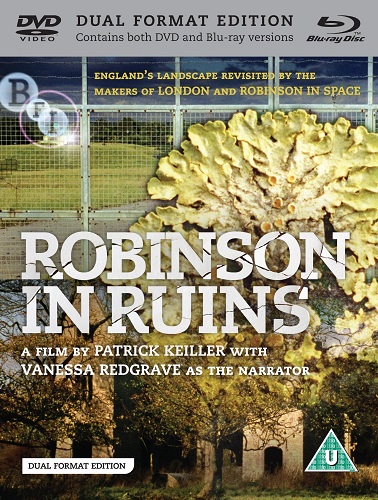
robinsonRobinson in Ruins, Patrick Keiller (2010, UK). I really liked Keiller’s earlier two films, London and Robinson in Space, and was expecting much the same of this one. But it was so much better. It has the cinematographic beauty that comes from well-placed static shots like in Benning’s films tied to a clever voice-over narrative like something out of an Adam Curtis documentary. This time Vanessa Redgrave narrates, as the lover of the narrator, and Robinson’s friend, in the earlier two films. Robinson in Ruins opens with Robinson’s release from prison, and then describes his journey through Oxfordshire and Berkshire, remarking on the things Robinson found and their history and how it all links in to the UK’s current economic malaise (current as of 2010, of course; we all know who exactly who – Osborne’s damaging and ineffective “austerity” aside – is responsible for the UK’s economic woes in 2016). I liked London and Robinson in Space a lot, but Robinson in Ruins is so much better. Perhaps its because it’s nearer in time than those two earlier times. True, I remember Tory Britain from 1979 to 1997 (although I was abroad for the last three years of it). Of course, 2010 saw the end of thirteen years under New Labour, although Robinson in Ruins is more about the damaging effects of big business and capitalism, and the corruption in which its naturally embedded, than it is economic policies. I suspect I will be watching this again before the end of the year, and it might well make my top five best of the year by December…

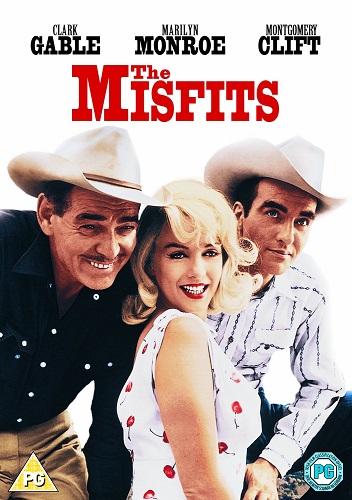
misfitsThe Misfits, John Huston (1961, USA). This was both Clark Gable’s and Marilyn Monroe’s last movie, and when it arrived from the rental service I assumed I’d stuck it on my list because it was on the 1001 Movies You Must See Before You Die list – except it isn’t, at least not the 2013 edition, which is the one I’m using. So I’m somewhat mystified as to why I stuck it on my rental list. Because it’s not that interesting. Monroe plays a somewhat flighty divorcee, Gable plays an ageing cowboy, the two fall in love. There’s Montgomery Clift as a rodeo cowboy who hooks up with them, and Eli Wallach as Gable’s friend, who’s a mechanic and flies a biplane. Gable and Monroe’s relationship falters when Gable decides to go capture some wild horses in the hills (to sell for dog food). He, Monroe and Wallach, plus Monroe’s friend Thelma Ritter, head off to a rodeo to find a third cowboy and so meet Clift. It all feels a bit like a cynical attempt to plug into some US myth or other, not to mention trading on its two marquee name stars. Gable is good, but Monroe looks like she’s sleepwalking half the time – and by all accounts, it was a difficult shoot as she often turned up late, and sometimes never at all. Clift isn’t too bad, although he doesn’t quite convince as a dim-witted cowboy. The final act, where the five – Wallach in a biplane, the rest in a pickup – try to round up half a dozen wild horse, and Gable gets dragged across the desert by a mare, feels somewhat over-stretched. Meh.

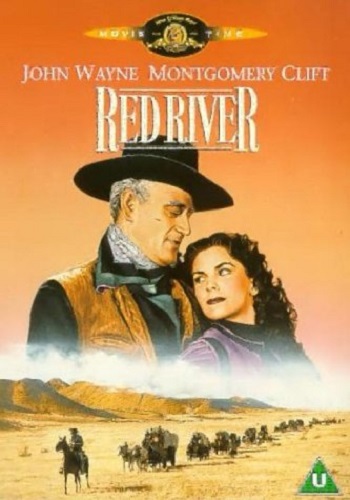
red_riverRed River*, Howard Hawks (1948, USA). I honestly thought I’d already seen this – I mean, I’d seen a several Hawks westerns starring John Wayne, and I was pretty sure this was one of them. But apparently not. Of course, it’s not that easy a call, given Hawks’s penchant for remaking his films under new titles… Wayne plays a typical Wayne character, who leaves a wagon-train, and his sweetheart, which is bound for California, to head south to claim land in Texas, accompanied only by a grizzled old man and a pair of steers (one male, one female, of course). Later that day, they see smoke on the horizon and dash back to discover the wagon-train destroyed by Native Americans and everyone killed. There is only one survivor, a traumatised boy called Matt. The three continue south, Wayne finds his land and claims it, killing a representative of a Mexican don who has title from the King of Spain (so much for international relations…). The film then jumps forward fourteen years, Matt has grown up into Montgomery Clift, and Wayne looks more like himself than Ronald Reagan (as he did earlier). Wayne’s ranch has proven successful and he has thousands of head of cattle. But no money. The just-ended civil war saw to that. So he needs to take his cattle to the nearest railhead in Missouri hundreds of miles away to sell them. There’s a nearer railhead in Kansas, but since no one has actually been there and see it, Wayne refuses to head that way. His high-handed tactics during the drive end up with Clift challenging him, taking over the drive and heading north along the Chisolm Trail to Kansas. Fortunately, the rumoured railhead exists, and Clift gets an excellent price for the cattle. Wayne then turns up. ready to kill him, they have a big fist-fight, and make up. It’s all very manly, and just like you’d expect the Wild West to be. Of course, having seen a number of Westerns, I’m aware of the way cattle barons like Wayne’s character treated homesteaders and settlers, and that’s not even mentioned – in fact, the only town in the film is the Kansas one at the end. Admittedly, the cattle drive is pretty impressive… although the use of sound-stages for the campfire scenes do spoil all that location shooting a bit. I’m not that much of a fan of Westerns (see my comments on the genre in previous Moving picture posts), and I understand that the Chisolm Trail was historically important, and that Red River makes a good story of it, but it’s all a bit too macho and one-sided for me.

1001 Movies You Must See Before YOu Die count: 780


Leave a comment

Moving pictures, #32

Definitely a mixed bag this time around. Perhaps a few too many from the US, but a couple from India as well. Plus Korea and Italy.

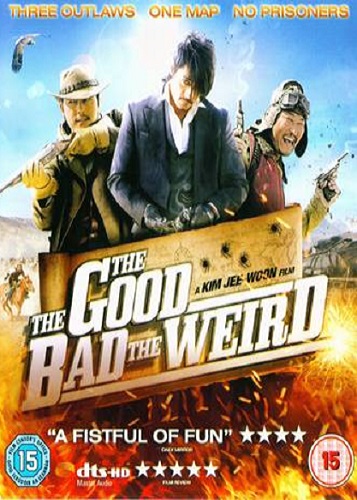
The-Good-The-Bad-The-Weird-2008-Front-Cover-1554The Good, the Bad, the Weird, Kim Jee-woon (2008, Korea). The title of this film pretty much clues you into its story – yes, it’s a Western, but a weird one, and very much Korean. And, perhaps surprisingly, a lot of fun and pretty good to boot. There’s a treasure map, which a Japanese official is carrying from China to Japan. But while crossing a Manchurian desert, his train is attacked by the Bad, who has been sent by the map’s owners to retrieve it. However, also attacking the train is the Weird, who manages to get the map first – although he doesn’t realise what it is or its value. Then the Good, a bounty hunter, turns up to kill the Bad, but instead gets caught up with the Weird as he escapes the Bad’s goons. And so it goes, as the Bad catches up, they have shoot-outs and fights, before the two manage to escape yet again… and eventually decide to make for the treasure. En route, the Good reveals that he’s after the Bad because he’s the “Finger Chopper”, a notorious criminal back in Korea. Eventually, the three of them arrive alone at the treasure… except the treasure is not what they’d expected. The fight choreography is done well – and there’s plenty of it – and the story has a somewhat off-kilter sensibility that plays entertainingly. I’d forgotten I’d put this on my rental list, and when it popped through the letter-box I was expecting it to be a bit meh, but I really enjoyed it. A better-than-average popcorn movie.

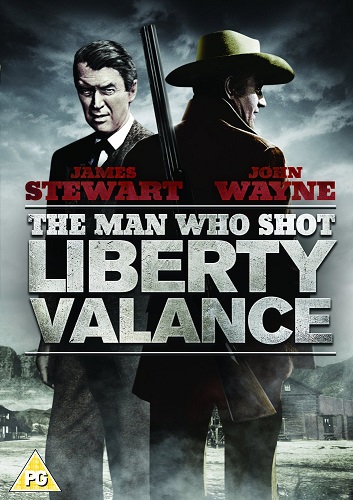
liberty_valanceThe Man Who Shot Liberty Valance*, John Ford (1962, USA). There are a lot of westerns on the 1001 Movies You Must See Before You Die list and I’m not an especially big fan of the genre. A few I’ve enjoyed, one or two I’ve even bought copies for myself. But most are, for me, Sunday afternoon viewing, enjoyable enough to watch but you’ve forgotten them ten minutes after the credits rolled. I get that they’re US mythology, that they’re predicated on tales of strong manly men being strong manly men and winning against all odds, but to be honest I find that Hollywood macho bullshit tiresome at best. I do, however, love the landscape in which these stories take place, and I value films which make a proper meal of it. The Man Who Shot Liberty Valance sadly does anything but – it was shot entirely on a soundstage. But it does offer an interesting spin on the whole idea of Wild West mythology… although it pretty much reduces it to a single line, and then spends the entire film justifying that line. Which is, “When the legend becomes fact, print the legend.” Jimmy Stewart plays a lawyer who travels west and settles in the rough town of Shinbone. En route he is waylaid by Liberty Valance (Lee Marvin), the local gunslinging hoodlum. Stewart vows justice – but legal justice. Tom Doniphon (John Wayne), the local stand-offish hard man, warns Stewart that law books are not going to do it. And so it proves. Marvin continues his reign of terror, Stewart teaches literacy to many of the towns folk (including love interest Vera Miles), and Wayne pines after Miles and gets angry with Stewart for stealing her heart. Then Stewart goes into politics, upsetting Marvin who engineers a shoot-out. But Stewart shoots and kills Marvin. Or does he? There’s little to admire in the story of this film, with its tale of rule by strength and politics corrupted by money. By all accounts, it was also a horrible shoot. Ford constantly belittled Wayne, and at one point even turned on Stewart. It sometimes astonishes me that little of the hardships of making some films comes through in the final product, which is, I guess, a testament to the professionalism of those involved. You can’t tell watching a film whether it was a happy shoot or an absolutely miserable one. And, to be honest, I think we viewers should know. The end does not justify the means. The fact that Ford made a bunch of people’s lives a misery so someone else could make pot loads of money is, when you think about it, pretty offensive. Film is a far more collaborative medium than writing… but the various media all take care to hide the tribulations of the creative process… because, of course, they’re selling product. Still, that’s capitalism for you…

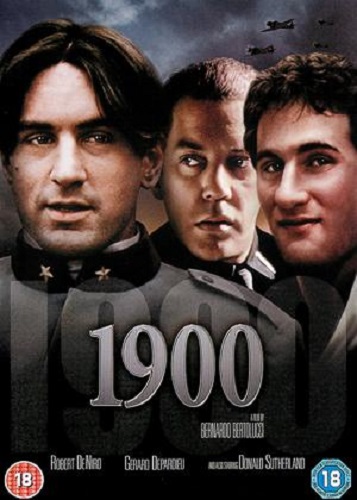
19001900, Bernardo Bertolucci (1976, Italy). I think I saw this on one of the alternative 1001 Movies You Must See Before You Die lists – ie, not the 2013 edition – so it was either dropped before, or added later… and I’m not entirely sure why it was there in the first place (I seem to say that a lot about the films I’ve watched). It’s certainly epically long, 317 minutes in fact, and was originally released in two parts. It tells the story of two men, the son of a padrone and the son of one of his workers, from the late nineteenth century through to the end of the Second World War. The padrone, Robert De Niro, comes to an uneasy alliance with the fascists, but the worker’s son, Gerard Depardieu, becomes a communist and fights them. Donald Sutherland plays the foreman hired by De Niro who becomes a full-fledged fascist, black uniform and everything. The film mixes the historical with the personal, sometimes to good effect, but often the focus is too tight on unlikeable characters and the relationship of the scene to the grander sweep of the narrative seems lost. One example is a sequence in which Sutherland accidentally kills the young nephew of the padrone… and the death, subsequent hunt for the “missing” boy and discovery of his body is used to illustrate the ignorance, ruthlessness and expediency of the fascists without actually making them any more villanous than they already had appeared to be. Having said all that, I wasn’t especially convinced by the three leads’ performances, although Depardieu seemed the best of the trio. And there were far too many moments when it all seemed a bit overwrought, everything turned up to eleven… only for the narrative to move on and dial things down to something more appropriate. As far as I could determine, the point of the movie was the move from the old system of landed aristocracy – the padrones – to something more equitable, in which the people owned the land they worked – with a somewhat violent diversion via the fascists, who picked up on the general malaise and incorporated it into their rhetoric but actually did very little to address it (UKIP voters, take note: this is how fascism operates). As a result, the ending, in which De Niro is cast down, and Depardieu uplifted, doesn’t really feel like a consequence of the preceding five hours… This is not helped by the film opening with a scene from near the end, so that the movie is actually one long flashback sequence. Meh.

river_titasA River Called Titas, Ritwik Ghatak (1973, India). Ghatak’s The Cloud-Capped Star is on the 1001 Movies You Must See Before You Die list, and I watched it back in November 2014; and so too is his The Golden Thread, but that’s apparently – annoyingly – not available on DVD. Anyway, I’d thought The Cloud-Capped Star good enough to want to see more by Ghatak and, in the fullness of time, A River Called Titas was sent to me by one of my rental services. The film is one of those which comprises many interlocking stories (Wikipedia claims it was one of the first to do so – in 1973? Really?), all based around life in the villages on the banks of the eponymous river. One main narrative thread tells of a young woman kidnapped on her wedding night, but after she escapes from her captors she realises she has no idea who her husband is or where he lives. The movie takes a while to get started, and the quality of the original black and white stock was plainly quite poor – as is the audio quality – but the various weaving in and out of people’s stories soon proves captivating. I seem to rememember The Cloud-Capped Star being quite grim, and so is this in places, but the overall effect felt far more cheerful. There was also some excellent cinematography, especially of the river, as there was in the earlier film. I liked this so much, I’m considering getting copies of both of Ghatak’s films released by the BFI (except, WTF, copies of The Cloud-Capped Star are now £80…*); and I also fancy reading the source novel of the same title by Bengali writer Adwaita Mallabarman.

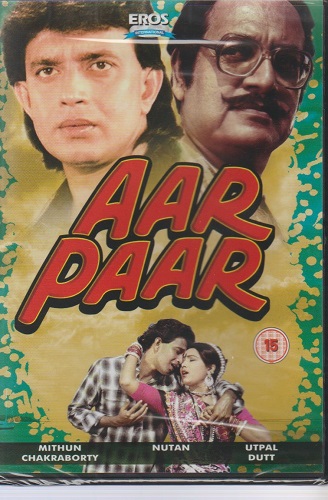
aar_paar_1Aar Paar, Shakti Samanta (1985, India). After being impressed by Guru Dutt’s Pyaasa (see here) and Kagaz Ke Phool (see here), I decided to buy a copy of his Aar Paar… but the seller screwed up and sent me this 1985 film of the same title instead. When I pointed out their mistake, they told me to keep the DVD sent in error and they also sent me the correct one. As for Samanta’s Aar Paar… it’s pretty much what you’d expect a not very good Bollywood film to be like. True, the Bollywood films I’ve seen so far have been considered good ones, and I’ve enjoyed them; but Aar Paar was definitely like a cheap version of them. I can’t even remember the story – in fact, I think there were several of them, I’m not sure. I remember a number of really badly choreographed fight scenes in which it sounded like they were fighting with exploding fists. There were, of course, several song and dance numbers, one of which I seem to recall took place on a boat. And there was a villain with greased-back hair. And the hero was not only fighting for the love interest but also for social justice – something to do with the fishing industry, in this case. This is one of those films that goes in one eye and out the other, and also goes reasonably well with popcorn and beer because it doesn’t much matter if you’re not following it. Miss ten minutes and you can pick up what’s going on within thirty seconds. It was fun, kinda, but if I hadn’t been sent it by mistake I’d never have bothered to seek it out to watch. [0]

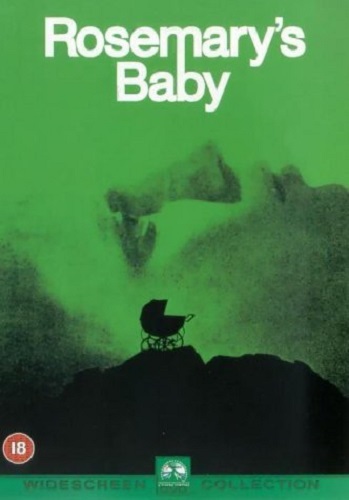
rosemaryRosemary’s Baby*, Roman Polanski (1968, USA). Polanski’s actions leading to his current legal status in the US aside, I’ve never really understood why he’s held in such a high regard as a director. Okay, Repulsion was good, and Chinatown is a classic – but the latter at least is a result more of its script than its direction. And so to Rosemary’s Baby of which… I can remember very little and it’s only been a week or so since I watched it. Mia Farrow plays Rosemary, and John Cassavetes her husband (which is a little odd as I know him primarily as a director), and the two have this weird friendship with an older couple (Ruth Gordon and Sidney Blackmer) after they move to a new apartment… Rosemary gets pregnant, but it doesn’t go well, and her doctor is somewhat horrified to learn that the weird neighbours have been feeding her “tannis root” and… I must have fallen asleep or something because apparently there was all this Satanic stuff and I missed it. I suspect I’m going to have to watch this film again, but I really don’t want to. What I do remember hardly endeared it to me, or persuaded me it was worth greater study. Perhaps if I stumble across a copy for 99p in a charity shop, I might buy it and watch it again, but otherwise it’s Polanski and… Meh.

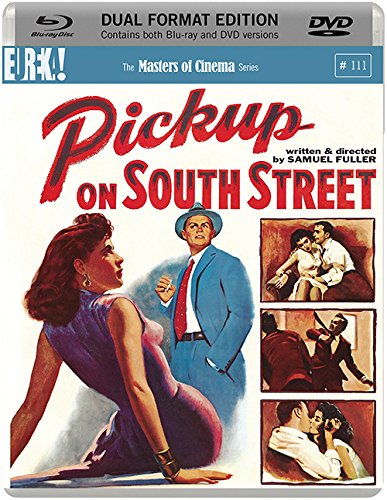
pickupPickup on South Street*, Samuel Fuller (1953, USA). A year or so ago, I’d never even heard of Samuel Fuller, and now I find myself something of a fan of his films – albeit only on the strength of having seen five of them. This one is noir, and pretty typical in its following of the forms, except… it’s all about secrets stolen to sell to the communists. Cold war noir. It’s a pretty typical Fuller film (and I say that despite my limited experience) inasmuch as he wrote and directed it, and it feels like he banged it out much as a pulp fiction writer would bang out simplistic moral tales which hooked onto the current Zeitgeist. There’s no denying Fuller’s technical proficiency (or indeed technical creativity – cf The Big Red One), amd his ability to craft taut and well-plotted noir stories certainly seems to deserve more credit than it gets – although, to be fair, this is the third film by Fuller to be given the Masters of Cinema treatment, so perhaps that last comment is unfair. But there is something impressively hermetic about Fuller’s plots, they’re not just ur-noir, they’re pretty much ur-cinema. They are without indulgence, just pure dialogue and tight visuals in service to a self-contained story. Truth to tell, the actual story feels almost incidental – in this particular movie, the microfilm of top-secret information is no more than a maguffin. But that matters not a jot. I mean, there’s solid entertainment, and then there’s a film which is so tightly-packed it’s like neutronium or something. I bought this, rather than rented it, and it was a fine purchase. [dual]

1001 Movies You Miust See Before You Die count: 779

* Not wanting to miss out on A River Called Titas, given the price now asked for The Cloud-Capped Star, I went and bought it. But then I did a bit of hunting and discovered copies of The Cloud-Capped Star were still available from the BFI shop for the RRP, so I ordered one. It’s annoying, but apparently my tastes are so fringe I need to buy stuff I want straight away, because once it’s deleted/out-of-print it’s going to cost ten or twenty times more. Gah.


2 Comments

Moving pictures, #31

Bit of an odd bunch, this. Nothing from the 1001 Movies You Must See Before You Die list. A few rentals, a couple from my own collection, a charity shop find, and one I found on Amazon Prime and initially thought was bloody awful but found myself enjoying by the end of it.

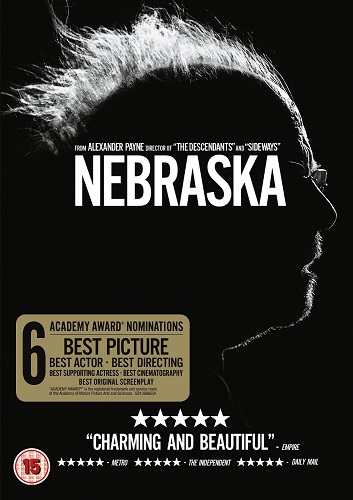
nebraskaNebraska, Alexander Payne (2013, USA). Bruce Dern is a crotchety old man, not entirely all there, who receives a letter telling him he’s been entered into a draw for $1 million and he thinks it means he’s won the prize. So he heads south to Lincoln, Nebraska, from his home in Billings, Montana… Or rather, he tries to, as he can’t drive. After several attempts to walk south to Lincoln, Dern’s youngest son reluctantly agrees to drive him to collect his “winnings”. The family all know there’s no prize money, but all they can do is humour Dern. En route, the pair stop off in Hawthorne, Nebraska, Dern’s home town. Once his family and old friends discover Dern is rich, they all want a piece of the money. Which doesn’t exist, of course. Dern is great in the lead role, and Will Forte – also responsible for the fucking awful MacGruber – puts in a good turn as his son. But it’s Dern’s film, and he’s more than up to the job. It’s filmed in black and white, which initially feels like an affectation, but soon seems to suit the material. Payne is not a director I especially rate – his previous movies I’ve seen have all been lightweight Hollywood comedies – but Nebraska is actually not bad. Like many films which show working-class white Americans, it demonstrates they can be not very nice people – while also suggesting they’re worse than depicted. The same might be said of working-class Brits, of course; or indeed those of any nation. But there is a particular mix of wilful ignorance and uncritical patriotism which seems characteristic of the white American working-class which is really unpalatable.

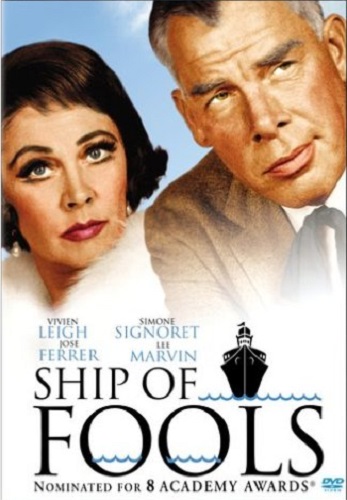
ship_of_foolsShip of Fools, Stanley Kramer (1965, USA). A group of assorted characters are crossing the Atlantic just prior to World War II, hoping for Oscars in what they hope might be, in 1965, an Oscar-bait movie. The star-studded cast says so, the weighty themes say so, filmed in black and white says so, the 149 minutes running time says so… In the event, Ship of Fools was nominated for Best Actor, Best Actress and Best Supporting Actor, but won only for Best Art Direction – Set Direction Black and White and Best Cinematography Black and White. Having now seen the film, I’m not surprised. It’s so full of itself, it’s astonishing the ship didn’t sink the second the director shouted “Action!”. As is the case in most ensemble films, there are a variety of interlocking plots being worked out. They’re supposed to have added weight because the voyage takes place just before the outbreak of WWII and José Ferrer’s character is a straight-up German Nazi. Then there’s the Jew, with the mordant sense of humour, whose misplaced optimism seems somewhat tasteless. And Vivien Leigh was apparently suffering full-blown paranoia, but managed to put in a passable performance. Oskar Werner plays the good German – on the one hand, he’s trying to improve the conditions of the passengers in steerage; on the other, he’s feeding La Condesa’s drug habit. The film was apparently adapted from a 1962 novel by Katharine Anne Porter, who based it on a journey she actually took across the Atlantic in 1931. It took her 22 years to write the book. Porter was apparently disappointed with the film. I’m tempted to try the novel, but I can’t recommend the movie.

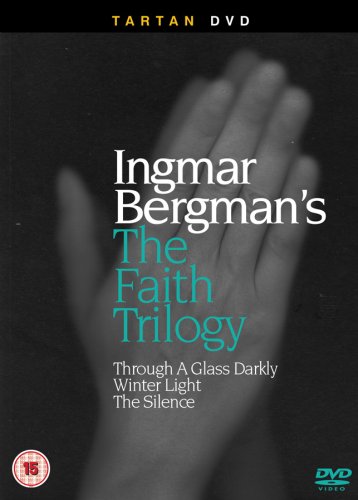
faithWinter Light, Ingmar Bergman (1963, Sweden). A married couple live happily in a small Swedish village, and the local vicar is their very good friend. They consult him on all manner of things, and he sets their hearts at rest every time… Of course not. This is a Bergman film. It’s not cheerful. It’s as miserable as the most miserable-looking git caught without an umbrella in a cold and miserable thunderstorm. I don’t think cheerful was in Bergman’s cinematic vocabulary. What Winter Light is, is the study of a married couple who are suffering existential qualms due to China’s development of an atomic bomb, and who are not comforted by their local vicar’s words of reassurance. But then the vicar has his own problems, chief among which is an ex-lover he no longer loves… And then the husband of the couple shoots himself and… I’m reminded to some extent of Tarkovsky’s The Sacrifice, which also has a plot enabled by the threat of atomic bombs (the phrase “atomic bomb” sounds so much better than “nuclear bomb” – the former sounds like a wonder of science, the latter just another war toy). In The Sacrifice, the threat of nuclear war persuades Joseph Erlandsson – a member of Bergman’s stock conmpany at one point – to bargain with God: he will give up everything he owns if the holocaust is averted. It does, of course, somewhat depend on believing in a god. Winter Light plays the same existential game with the implied threat, but rather than apply it to a man’s possessions it makes play with his religious convictions instead. Of the three films in the The Faith Trilogy, I enjoyed The Silence the most, perhaps because it seemed most recognisably experimental in format; but on reflection, I wonder if Winter Light, being a much weightier story, is not the better one. [2]

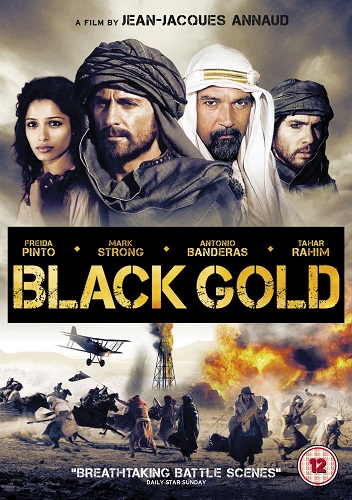
black_goldBlack Gold, Jean-Jacques Annaud (2011, Qatar). Also known as Day of the Falcon, which is just as vague a title. It’s basically the life of ibn Saud, but with oil as the cause of the war between the two royal houses. The film was panned on release, chiefly because of its casting – Antonio Banderas plays one emir, Mark Strong the other; Frieda Pinto plays the love interest, and Liya Kebede the other major female character. The star, the young prince who becomes an ibn Saud-like leader, is played by Tahar Rahim (which was weird as I’d watched him in A Prophet only a week or so before). Banderas, the sultan of Hobeika, and Strong, the sultan of Salmaah, have just signed a peace treaty, and have agreed to keep the “Yellow Belt” as a buffer zone between their two sultanates (I assumed this is taking place somewhere in Nejd). Salmaah also has to hand over two of his young sons to Hobeika to ensure the peace. (I’m not sure whether Banderas or Strong are sultans or emirs, the two terms seemed to be used interchangably during the film – probably they were ra’ees, usually translated as “ruler”). Anyway, some years later Americans discover oil in the Yellow Belt. Salmaah rejects them, but Hobeika is happy to profit from the “black gold”. But then the elder of Salmaah’s two sons who is living with Hobeika tries to escape and is killed. The younger, Auda, played by Rahim, who is a bookish sort, is sent to his father as peace envoy. His father persuades Auda to help in his plan to conquer Hobeika and shut down the oil wells. Auda must lead a diversionary force into the Yellow Belt, while Salmaah himself leads another force right up to the gates of Hobeika. Except librarian Auda proves to have real tactical genius, and defeats Hobeika’s armoured cars with a force of prisoners on camels. And when he then attacks the Bani Sirri and frees their slaves, he earns the loyalty of all the other desert tribes… And so turns up to Hobeika with an enormous army at his back. There are a few elements here taken from the life of ibn Saud – such as his attack on Riyadh and defeat of the House of Rashid – but the Hijaz is ignored, Mecca is ignored, and the history of oil in Saudi didn’t start until later (see Abdelrahman Munif’s Cities of Salt and sequels). But despite its fancification of the real history of the interior of the Arabian peninsula (and did the Bedu tribes really dress that colourfully?), and the failure to cast appropriately (Strong at least manages an Arabic accent; Banderas doesn’t even try), I sort of found myself enjoying Black Gold. It was daft, but it was colourful and the references to ibn Saud’s life added an extra dimension.

szamankaSzamanka, Andrzej Żuławski (1996, Poland). Gosh, what to say. There is something about Żuławski’s films which… er, defies explanation. They are completely bonkers, but bonkers in such an emotionally intense and intensely watchable way that’s it’s hard not to feel something for them. The sight of Valérie Kaprisky burning up the screen in La femme publique had burned itself into my memory, and now Iwona Petry, as the (titular) heroine of Szamanka, who throws such an idiosyncratic performance at the screen it’s hard to forget it. She’s a student who rents a flat from an academic, but right from the moment they meet it’s l’amour fou. And it gets more fou as the film progresses. Meanwhile, the acadmic has discovered the well-preserved body of a two-thousand year-old shaman. The historical investigation and the affair become confused, so much so that the academic hallucinates the shaman telling him he was killed by his mistress. And so, as often happens in Żuławski films, the plot echoes the psychological dimension. Petry’s performance treads a fine line between plausible and outright weird, and the fact it works is more down to the tense atmosphere Żuławski manages to keep going for the length of the film – despite the lack of an obvious thriller plot. There are moments when it all feels like OTT posturing… but then something sort of clicks into place, and the film’s trajectory toward its tragic end is once again on course. As with La femme publique, I bought the Mondo Vision special edition DVD, which comes in a fancy box, with included OST CD, booklet and collectible bits and pieces. The presentation suits the material – I can think of many directors who deserve such releases, but Żuławski is certainly on that list. Worth buying. [1]

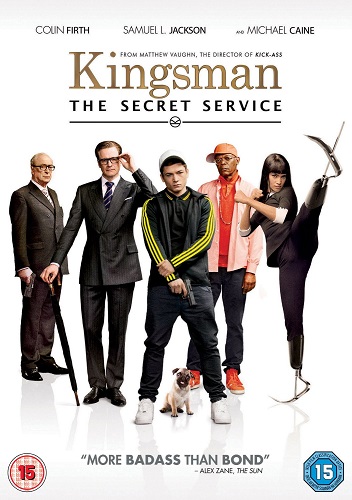
kingsmanKingsman: The Secret Service, Matthew Vaughn (2014, UK). A couple of weeks after watching this and I still haven’t decided if this is a clever satire of 007 and other British secret agent movies, or a horrible affirmation of their worst aspects. The title refers to a private intelligence service which cleaves to an image of stereotypical British upper class manhood from about sixty years ago. And then they meet a stereotype of 1990s British working class manhood… But, of course, the establishment eventually assimilates him. En route, we have a dumb plot to kill off 90% of the global population via free SIM cards in their phones (so, er, not really 90% then) as planned by squeamish lisping zillionnaire Samuel L Jackson. Tonally, Kinsgman is all over the place – it can’t decide what values it should be promoting, and as a result ends up saying very little that makes sense. The Bond-ish villain is presented as a spoof without actually being much of a commentary, which renders it toothless as satire. Firth is even stiffer than usual in the lead role, Taron Egerton is forgettable as the everyman bruv, and the supporting cast are more noticeable for who they actually are rather than the parts they’re playing. Kingsman will kill a Satruday evening if accompanied pizza and beer, but it’s never going to make any list celebrating the best of cinema.

1001 Movies You Must See Before You Die count: 776


Leave a comment

Moving pictures, #30

Only one US film in this lot? I must be slipping. Lots of British films though – more, in fact, than it appears, since the two Jennings collections contain 14 and 8 films respectively. They were a damn sight more interesting than the one US movie, too.
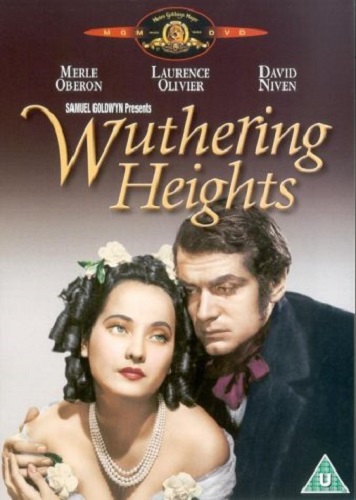
faithThe Silence, Ingmar Bergman (1963, Sweden). This is the third film in Tartan DVD’s The Faith Trilogy by Bergman (the other two in the set are Through A Glass Darkly and Winter Light), but I’ve not been watching them in order. The Silence is set in an invented Central European country. Two sisters, one with her young son, are travelling by train through the country, and stop to spend some time in one of the towns. The older of the two sisters is a translator; she is also ill. They take an apartment in a run-down, but grandiose, hotel. While the son wanders around the hotel – at one point acting about with a troupe of dwarfs from a Spanish travelling show – his mother wanders about the town, visiting a theatre, sitting in a bar, before returning to the hotel with a man. In an introduction, Bergman explains that he’s always liked The Silence, but was convinced it would be a flop. In fact, it proved one of his more successful films internationally. It’s filmed in stark black and white, with very little dialogue (only 38 lines, claims Bergman), and the faded grandeur of hotel and town is evident in every film. I’ve said before that watching a Bergman film is like reading a literary fiction short story… and that’s especially true of this one – but one of those slightly-fabulist European stories where a deep reading is needed to figure out what’s going on. I liked this film much more than Through A Glass Darkly, although only the latter is on the 1001 Movies You Must See Before You Die list.

jennings_1The Humphrey Jennings Collection Volume 1: The First Days (2011, UK). After renting The Humphrey Jennings Collection Volume 2: Fires Were Started because the title film was on the 1001 Movies You Must See Before you Die list, I decided to buy all three of the BFI collections of Jennings’s short documentaries. There are fourteen films in this set, from 1934 to 1940. The early ones cover subjects such as the history of the post office, steam locomotives, chalk barges in Cornwall, fashion, a postcard’s journey and the GPO’s telephone link with the US via shortwave (the films were made by the GPO Film Unit). Later films show Britain during WWII – not just of the Blitz, but also showing how the government and farmers worked together to raise crops on land left fallow. Given that the later films are actual propaganda, it’s hardly surprising they’re all patriotic and jolly-old-Britain-look-how-wonderful-we-are, although as historical documents they’re quite fascinating. But even the pre-war ones hav ea certain terribly English quality about them, not just because of the BBC accents, but also thanks to their slightly patronising listen-with-mother air. Some were mucy more interesting than others – while the post office ones were a bit dull, and 1934 documentary on locomotives had its moments, I did find ‘Speaking from America’ (1938), with its description of shortwave translantic communications, fascinating. Worth seeing.

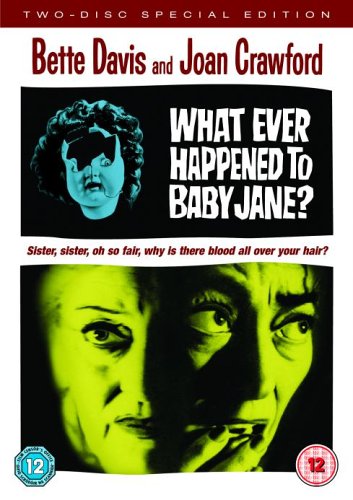
baby_janeWhat Ever Happened to Baby Jane?*, Robert Aldrich (1962, USA). It would seem the most notable thing about this movie is that its two stars – Joan Crawford and Bette Davis – loathed each other, and that hatred fed into their portrayals of washed-up acting sisters. Because there’s nothing else in the film to warrant its appearance on the 1001 Movies You Must See Before You Die list. Davis plays a successful child star (well, not her, obvs, a child plays her) who didn’t make the grade as an adult actress; while her sister, Crawford, proved a star as an adult. Until, that is, an attempt by one sister to run over the other – they didn’t get on, even back then – resulted in Crawford being paralysed from the waist down and so killed her career. Who actually ran over who is not revealed, and left to provide a twist at the end… and it’s a pretty feeble twist. The film quickly sets up the sisters’ back-history, and cleverly uses clips from early films by Crawford and Davis, before leaping ahead to the early 1960s. Crawford is bed-ridden, and cared for by Davis, who resents her sister’s fame and the fact she now has to care for her. And then, afraid Crawford is going to sell the house, Davis begins to mistreat her – and impersonates her over the phone to hide her mistreatment… It’s a hard film to take seriously. The plot telegraphs every twist and turn with all the subtlety of a brick in the face, Davis plays her role like a wild-eyed loon, and Crawford couldn’t play a convincing doe-eyed victim to save her life. The final twist in the tale is, as mentioned earlier, neither a surprise nor dramatic. Meh.

jeuxJeux interdits*, René Cléments (1952, France). During WWII, a young girl’s parents are killed in an attack by a German Stuka, and she seeks refuge at a nearby farm. The family take her in, especially since she is of an age with their youngest son. When one of the older sons dies of his illness, the two kids begin a “game” of their own – they create a cemetery for the dead animals they find, and steal crosses from, first, the older son’s hearse and later the graveyard, for the graves of their creatures. When the boy’s father finds out, he is furious… eventually leading to the young girl being taken away to a refugee camp by the Red Cross. I like the films of Jean Renoir – some more than others, it has to be said – and Jean Cocteau; but I can’t say I’ve ever really got on with other French films made before, say, the mid-1950s. Actually, I did like À nous la liberté (1931), and Dreyer’s The Passion of Joan of Arc (1928) doesn’t count as the film may be French but he’s Danish… I’ve no idea what it is, I just find them a little dull, and often longer than they need to be. And so it was with this one. Meh.

jennings_3The Humphrey Jennings Collection Volume 3: A Diary for Timothy (2013, UK). There are only eight films in this final set, but they’re mostly longer than those in the first volume. They’re from 1944 to 1950 (Jennings died in a fall from a cliff in Greece in 1950, while scouting locations), and are mostly work done by the Crown Film Unit (originally the GPO Film Unit) during WWII. The opener, for example, explains how British troops took the German song ‘Lili Marlene’ as their own after finding copies of it in over-run German positions. ‘A Defeated People’ (1946), on the other hand, shows the Germans trying to rebuild their shattered cities – and no film of London during the Blitz can ever compare with what Hamburg looked like by the end of the war. I don’t think you could accuse Jennings’s war films of being jingoistic, despite the fact they were propaganda. Most seem designed to bolster the spirits of the Brits – yes, there’s a note of “they deserved it” in ‘A Defeated People’, but the film is bluntly honest about the state the allies left the country in (and it does rightly point a finger at some of the plutocrats, the Krupp family in this case, whose industrial empire is still going… and you’d be surprised at the number of global brands still in existence which actively supported the Nazi regime…). Anyway, like the first and second volumes, this is worth seeing.

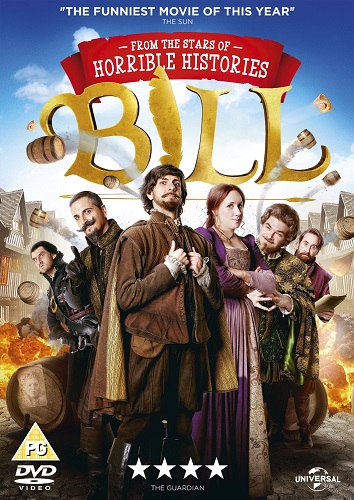
billBill, Richard Bracewell (2015, UK). I stumbled across this on Amazon Prime, and initial indications were not especially good… Bill Shakespeare is thrown out of his lute band after doing a blinding solo in a song during a gig. So he writes a play and decides to head to London to seek fame and fortune… Where he gets embroiled in a plot by the Earl of Croydon and King Philip II of Spain to kill Queen Elizabeth at a peace summit between the two. The story fits in Shakespeare’s “lost years”, between his departure from Stratford and appearance on the London stage. But I’m pretty sure it don’t go as this film claimed. I wasn’t that impressed initially – the humour was mostly based on anachronisms, and that’s a hard trick to pull off. But as it progressed, the jokes got funnier, the humour sharper, and the plot, er, thicker. The film was put together by the central cast from the Horrible Histories series, and is the second project they’ve worked together on (the first was Yonderland). They each play multiple roles, and they’re good in them (some, in fact, it took me a while to notice they were the same actors). There are some good lines and running gags, and it’s all a good deal funnier than Ben Elton’s lacklustre Upstart Crow.

trentTrent’s Last Case, Herbert Wilcox (1952, UK). I found this in a local charity shop and thought it worth a go. It wasn’t. It’s apparently the third film version of a 1913 novel by EC Bentley, which is considered by many to be the first send-up novel of the crime genre. Bentley also invented the clerihew (it is, in fact, his middle name). Despite the title, Trent’s Last Case was actually the first novel by Bentley featuring journalist/detective Philip Trent – and was intended as a standalone, but proved so popular Bentley wrote a sequel in 1936, Trent’s Own Case (and a short story collection, Trent Intervenes, in 1938). Wealthy businessman Sigsbee Manderson is found dead in the garden of his home, apparently a suicide. Trent, covering the death for his newspaper, investigates and decides it was murder. Initially, he believes the widow to be the guilty party, but then fastens on the tycoon’s personal assistant. But when he accuses the PA, and explains how the crime went down, he’s told he has some parts right – moving the body, impersonating the dead man, falsifying an alibi – but the tycoon did apparently kill himself. At which point, the widow’s uncle reveals that he actually killed the tycoon, accidentally, in a wrestle over a gun. Trent also falls in love with the widow, and asks her to marry him. Michael Wilding was awful as Trent, Orson Welles wore bizarre prosthetic eyebrows and a prosthetic nose which made him look like Parker from Thunderbirds, and Margaret Lockwood only reminded me of better actresses from the period. The film may have been a piss-take of crime novel conventions, but it came across as just a badly-plotted film. Oh well.

1001 Movies You Must See Before You Die count: 776


1 Comment

Moving pictures, #29

Half of this post’s films are American, so I seem to be slipping a little. Having said that, movies from countries other than the US (or UK) are surprisingly difficult to find on DVD or as rentals – especially old films. For example, I’d really like to see Vidas Secas, an early Brazilian Cinema Novo movie, by Nelson Pereiros dos Santos… but I can’t find a copy. There are also a number of directors whose oeuvres I’d like to explore, even ones that are really well-known (albeit not Anglophone), but not all of their films are available – Godard, for instance… Ah well. I guess I should have more mainstream tastes… Or learn some more languages…

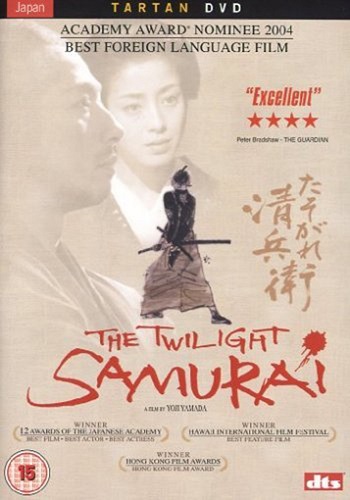
twilightThe Twilight Samurai, Yoji Yamada (2002, Japan). I am not a huge fan of Japanese historical dramas; I’ve seen several of Kurosawa’s films, for example, but I like Dersu Uzala – which is set in, er, Russia – best. And while Ozu’s are historical in that they’re set in the past, they’re set in the twentieth century, so, er, not really historical then. (Slight digression here on what defines “historical”. The general consensus is that historical fiction is fiction set before the liftetime of the author and written from research not personal experience. So just because a novel, or film, is set in the 1970s, forty years ago, that doesn’t make it historical (unless the author is in their twenties, but, seriously, why would they try writing a novel set four decades ago knowing there are people still alive who remember the decade quite well?).) Anyway, The Twilight Samurai is set a few years before the Meiji Restoration of 1868. A widower samurai spends his money on ensuring his daughters are fed and clothed, and so gains a reputation for being unkempt and a bit smelly. Then a childhood friend turns up after a quick divorce from her abusive husband, and begins spending time with the samurai and his two daughters. The ex-husband appears, very drunk, and challenges the woman’s brother, Twilight’s friend, and so Twilight jumps in and accepts the challenge. He surprises everyone by beating the ex-husband, even though armed only with a stick… Although slow to start, this film began to pick up as the title character became less the butt of jokes and more the protagonist of the story. Turned out better than I thought it would. Worth seeing.

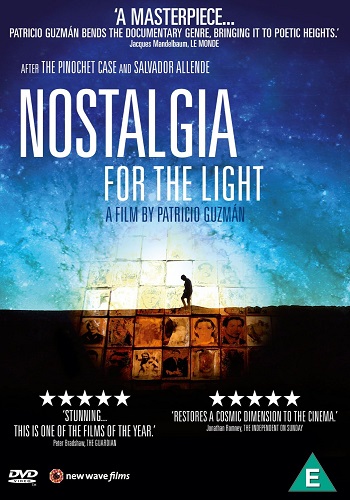
nostalgiaNostalgia for the Light, Patricio Guzmán (2010, Chile). I’m surprised this didn’t make the 1001 Movies you Must See Before You Die list. Perhaps the makers didn’t think its topic as worthy as that of… Senna, or a film about a female serial killer. But then Joshua Oppenheimer’s The Act of Killing didn’t make the list either, so perhaps the list-makers aren’t interested in films on state-run massacres. It might remind them of their own nation’s complicity in several such… (Not that the UK is innocent – and Margaret Thatcher was very chummy with Pinochet, and for that, among many other things, deserves our deepest contempt.) Nostalgia for the Light contrasts the search for stars by the astronomers of the Atacama Desert with the search for the bodies of the Disappeared by a group of Chilean women who sift the sand for the remains of their husbands and sons and brothers… The film features Guzmán in voice-over describing how the events shown relate to Chile’s history and character. There’s a telling moment when Guzmán says of one old couple, survivors of Pincohet’s regime, that they represent Chile for him: the man cannot forget anything that happened to him, the woman has dementia and cannot remember anything. A fascinating, but heart-breaking, documentary that both destroys your faith in humanity but also reaffirms (okay, it destroys any faith you might have had in the rich and powerful – but then you’d have to be daft as a brush to have any faith in them in the first place). I’d put this on my own 1001 Movies list.

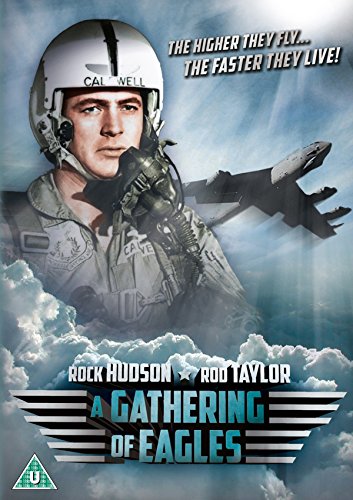
gatheringA Gathering of Eagles, Delbert Mann (1963, USA). My mother told me there was a Rock Hudson film on Drama one afternoon, and when I learnt it was A Gathering of Eagles, I had two reasons for wanting to catch it: Rock Hudson and SAC. (The actual conversation went like this: Mother: “There’s a Rock Hudson film on Drama this afternoon. Gathering something…” Me: “A Gathering of Eagles?” Mother: “That’s it.” Me: “I keep on thinking today is Saturday.” Mother: “That film is on tomorrow afternoon.”) I like Hudson’s films, he was an excellent leading man during a period whose films I enjoy; and I’m fascinated by the military hardware, especially aerospace hardware, built and used by the US – especially the USAF’s Strategic Air Command – during the Cold War. Rock Hudson and B-52 bombers. Cool. I wasn’t expecting great cinema, but as long as there was some good aerial photography and lots of interior shots of the B-52s, then I’d be happy. I love stuff like that. Strategic Air Command, starring Jimmy Stewart, some B-36s and some B-47s, is one of my favourite films; but it’s a fairly routine drama. And Toward the Unknown showcases the XB-51, which makes it quite interesting. A Gathering of Eagles has plenty of aerial photography of B-52s refueling from KC-135 tankers, but is mostly concerned with Hudson pissing off everyone in the wing he’s been given command of. The movie has its moments, but if you want to see B-52s on-screen you’d be better off watching Bombers B-52.

danishThe Danish Girl, Tom Hooper, (2015, UK). This film has taken quite a bit of stick for taking liberties with a novel which itself takes liberties with the real life of its subject: Lili Elbe, one of the first people to undergo gender reassignment surgery. For a start, her name wasn’t Lili Elbe – that was invented by a journalist. Her name was actually Lili Ilse Elvenes. Eddie Redmayne plays Einar Wegener/Lili Elvenes, and while the film tries to show Wegener coming to the realisation she is the wrong gender, Redmayne spoils the effect somewhat with his smirking. The movie never manages to convince, despite showing a reasonably good depiction of 1920s Copenhagen – possibly because it squeezes the events of nearly two decades into what feels like a handful of years. There are plenty of other inaccuracies too – so many, you have to wonder at the point of making a film about a real person that seems happy to ignore what actually happened. Of course, Hollywood has never let facts get in the way of a good story (although this is a British film), and actually has a well-known history of rewriting, er, history… But then the UK film industry does that too – like The Imitation Game turning Alan Turing into a spy-catcher… I don’t know; The Danish Girl felt like a ham-fisted attempt to tell a story that served its subject badly… and its viewers too. Meh.

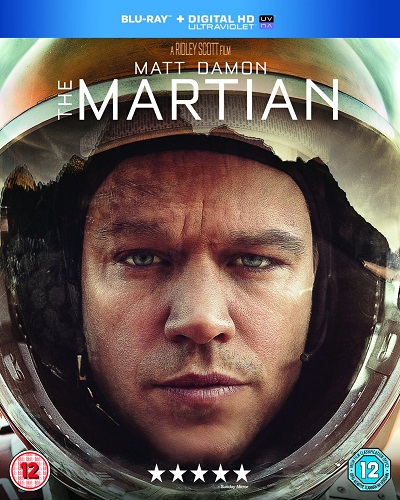
martianThe Martian, Ridley Scott (2015, USA). But you didn’t like the book, I hear you cry, so why watch the film? Well, it’s not unknown for bad books to make good films – in fact, I can think of several off the top of my head. And, to be fair, The Martian may have been badly-written but its story read as though it lent itself quite well to a cinematic treatment. Or so I thought. Unfortunately, while Scott’s The Martian looks very pretty – and at times, even resembles the Martian surface – the adaptation only highlights the flaws in Weir’s story. The storm looks very effective, but is complete nonsense – given Mar’s extremely low surface pressure, a hurricane would feel as powerful as a faint breeze. Also, Watney appears to have plenty of food, but still spends all that time and effort growing potatoes. And the final rescue scene is risible – the NASA spacecraft deliberately slows itself down while on a free-return trajectory about Mars… thus ensuring it will never get back to Earth. I was also amused they’d completely toned down the swearing from the book. The script demonstrated how pointless were the scenes set on Earth (badly-inserted in the novel for its publication by a publishing house), especially since they did little more than obfuscate the science. The success of the book was baffling, but the Hollywood marketing machine was there to ensure the movie adaptation was no flop – especially with marquee names like Ridley Scott and Matt Damon attached. So it seems churlish to complain about the quality of the film – since no one seems to give a shit. I mean, this is commercial fiction, and a commercial movie adaption thereof, actual quality is not relevant… but I do object to a story being sold on its science credentials when those credentials are paper-thin (Weir is now being invited to talk to Congress about space exploration!). The Martian is an entertaining, but not especially convincing, film about a man marooned on Mars. I still think Apollo 18 – rock monsters aside – is one of the most realistic sf films ever made.

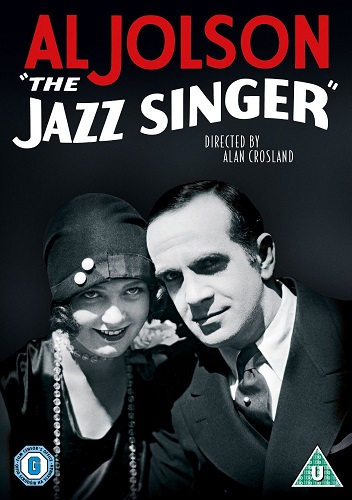
jazz_singerThe Jazz Singer*, Alan Crosland (1927, USA). This film is famously the first “talkie”, and its commercial (albeit not critical) success pretty much killed silent films – although not entirely: Dreyer’s mostly-silent Vampyr was released in 1932, and Murnau released two silent films after The Jazz Singer, City Girl in 1930 and Tabu and 1931; not to mention a silent film, The Artist, winning the Oscar in 2012… But clearly the moment The Jazz Singer appeared, silent films were obsolete, so it sort of doesn’t really matter what The Jazz Singer was like as a film per se, except… Jolson plays the son of a cantor who would rather sing in music halls, and so is disowned by his orthodox Jewish father. Eventually, of course, they reconcile… but that’s after a good sixty or so minutes of each posturing to defend their own  point of view. The film is not without its problems – chief among which is that Jolson’s career was based upon performing in blackface, and so he does several times in the movie. By all accounts, when singing live he was accomplished at creating an emotional connection with the audience, but this doesn’t really transfer to film. In other words, he doesn’t much look like a leading man, and the various songs he performs don’t really explain it either. There’s no denying the historical impact of The Jazz Singer, but being first at something doesn’t automatically confer quality. Dreyer’s Vampyr, mentioned earlier, would have been a much better “first talkie”… but The Jazz Singer is what we have. I’m tempted to include it on my own 1001 Movies You Must See Before You Die list because it was the first kind, but reluctant to do so because it’s not a very good film…

1001 Movies You Must See Before You Die count: 774


5 Comments

Moving pictures, #28

I was under the impression I’d knocked a few more off the 1001 Movies you Must See Before You Die list recently, but apparently not. Two of the directors in this post I’m a fan of, and one of them I’m becoming a fan of…

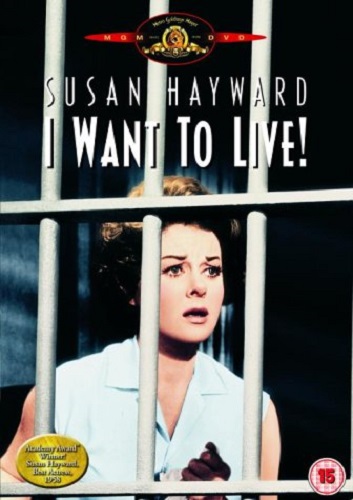
i_want_to_liveI Want to Live!, Robert Wise (1958, USA). Not only was this film based on a real-life murder case, but the movie makes a right meal of its origin, opening with a screen of text that insists how true it is – it’s even signed by the journalist who broke the story in the first place. So it’s a little off-putting to then learn that the story takes some major liberties with the truth. Like presenting the central character as innocent when she was actually guilty. Bah, Hollywood. The story goes as follows: Barbara Graham is a habitual criminal, whose marriage to a drug addict proves the last straw… so she leaves him and joins up with his associates, only to be arrested for the murder they had committed of a rich old woman, Graham is sentenced to death and then executed. The film presents Graham as a pawn in the actual murderers’ plot to commute their death sentences to life. But in reality, she was just as guilty. Susan Hayward plays Graham in an Osar-winning turn, but when all’s said and done I Want to Live! is a boringly ordinary moral drama. Samuel Fuller did it much better in both Shock Corridor (see here) and The Naked Kiss (see here), on a lower budget and without an Oscar-bait star. Meh.

sunset_songSunset Song, Terence Davies (2015, UK). I stumbled across this on Amazon Prime, and having been impressed by Davies’s Distant Voices, Still Lives (although I thought the film much older than it was), I decided to give this one a go. It took several goes. It is grim. Majorly grim. Scottish grim. Beautifully shot, but as grim as the grimmest thing in a list of grim things. It looks beautiful – far too beautiful for Scotland, it seems, as part of it was shot in New Zealand. It’s based on a classic Scottish novel by Lewis Gibbon of the same title, and tells the story of a young woman, and farmer’s daughter, in the years up to and including the First World War. Peter Mullan plays family patriarch, and he’s a nasty piece of work. I’m tempted to say it’s like DH Lawrence but with the boinking taken out, but that’s the not the only thing missing. Lawrence was hardly an optimist but his novels are generally more cheerful than Sunset Song. When it wasn’t people growling at each other in Scottish accents, they were either shouting or wailing. It made for a gruelling viewing experience. I think this is a good film, and really quite beautifully shot at times, but its unremitting grimness made it difficult viewing, and some times your appetite for punishment is not quite as high as at other times. You need to be in the right mood to watch this. Recommended, but with caveats.

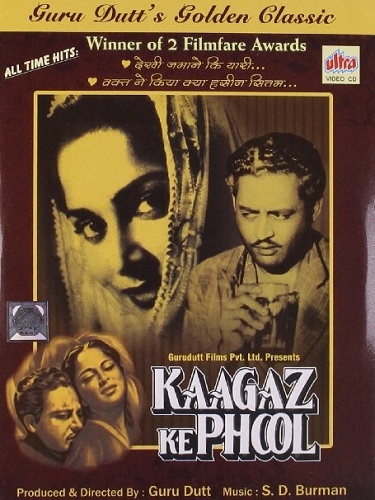
kagaazKagaaz Ke Phool, Guru Dutt (1959, India). Exploring Bollywood films has been fun, but most of those I’ve seen have been pretty forgettable. A good night’s entertainment, but basically just a Hollywood family blockbuster turned up to eleven. With singing and dancing. So Guru Dutt’s Pyaasa came as something of a surprise… although now I’ve seen him described as “India’s Orson Welles”, his films begin to make more sense. They are clever and well-shot, and make excellent use of Bollywood conventions to tell a story that doesn’t really map onto Bollywood story templates. And this is just as true of Kagaaz Ke Phool, Dutt’s last film. Annoyingly, there don’t seem to be any good transfers of his films – you’d think he’d be a director ripe for a set of remastered editions by Criterion or the BFI (for one thing, he only directed eight films, between 1951 and 1959). Given the lovely job the BFI has done for Dreyer, I’d like to see them do the same for Dutt. And I say that having seen only two of his films. In Kagaaz Ke Phool, Dutt plays a Bollywood director whose career is declining. His wife and her family have always seen his career as beneath them, and he now has no access to his daughter. While secretly visiting his daughter at her boarding school, Dutt bumps into a young woman and gives her his coat to protect her from the rain. Later, she visits his studio to return the coat and he realises she has star quality. She becomes a big Bollywood star, and romantically attached to Dutt; but the daughter would sooner her mother and father got back together again, so the star gives up her career and becomes a teacher in a village. This is well-made stuff, and while it feels somewhat back-handed, and not a little insulting, to describe Dutt as “India’s Orson Welles”, it is a label that fits. After watching Pyaasa, I decided to buy this – and despite being disappointed at the quality of the transfer, I think I’ll be buying more of Dutt’s film. But can the BFI please step up and remaster them all, please?

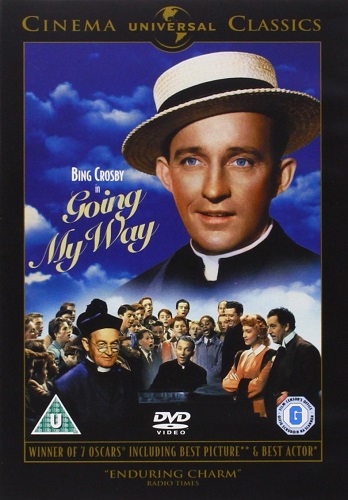
going_my_wayGoing My Way, Leo McCarey (1944, USA). This was the biggest grossing film of its year, and was nominated for ten Oscars, winning seven of them, including Best Picture, Best Director, Best Actor and Best Supporting Actor. And yet it’s not on the 1001 Movies You Must See Before you Die list. Strange. Or, at least, I thought so… But now that I’ve seen it… It’s, well, it’s sentimental tosh. Bing Crosby plays a young priest sent to the New York parish of St Dominic’s to get it sorted out. The incumbent is old, the church is mortgaged, and both need fresh new management. Which is what Bing does. And he sings too. He turns the local boys’ gang into a choir, sorts out a young woman who has left home, and generally spreads common sense and happiness with his trademark smile and “ba ba ba bum”. He also tries to raise money for the church by selling one of the songs he’s written – performed by an old friend who is now an opera diva. The music publisher doesn’t like the song, but when Bing and choir start singing ‘Swing on a Star’, he likes that one. There’s a relentless cheeriness to Going My Way that fails to offset the schamltzy plot and awful songs. I can perhaps see how in wartime it proved so popular, but its charm has long since dissipated. True, Oscar-winner Barry Fitzgerald isn’t bad as old Father Fitzgibbon, even if his character is a total stereotype. I’ve no idea why I stuck this on my rental list. Meh.

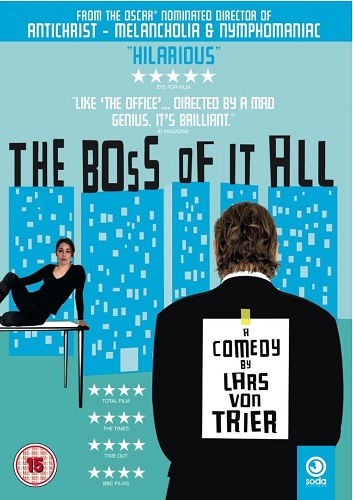
bossThe Boss of It All, Lars von Trier (2006, Denmark). There’s nothing especially original about the plot of this film – it is, I guess, a variation on La cage aux folles. Or maybe something else. A man wants to sell his successful IT firm, but for the ten years it’s been in operation he’s pretended he’s not the actual boss. So he hires a friend actor to play “the boss of it all” in negotiations with the Icelandic buyers of the company. And, subsequently, with the employees. Of course, it gets very complicated, very quickly. It doesn’t help that the actor is a bit of a twit, and completely out of his depth. But von Trier does an excellent job of characterising his cast – in fact, in many respects The Boss of It All is a masterclass in small-cast drama. But that’s not good enough for von Trier, so he decides to present the movie explicitly as a piece of cinematic comedy, by introducing it in voice-over, explaining its aims, and even some of its story elements. The end-result is a post-modern cinematic approach to a post-modern story. I wasn’t entirely sure I was going to like it – but like most von Trier films, it ends up making you wonder: is this rubbish… or genius? And the fact he can elicit that response makes me tend toward the latter. Von Trier is experimenting with the medium, and that should be celebrated. If not every experiment is successful, that doesn’t invalidate the attempt… And it still makes him a damn sight more interesting a director than most of the other directors on this planet.

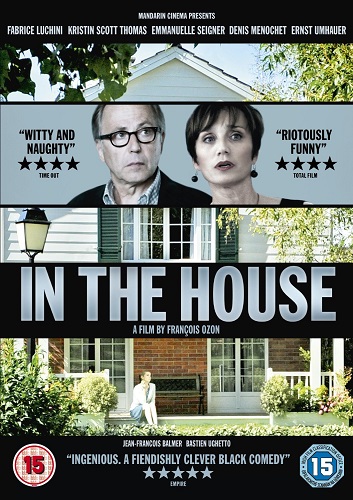
in_the_houseIn the House, François Ozon (2012, France). The near-sociopathic inveigling of a person into another family in this film reminds me of another movie, but I’ve yet to figure out which. Probably because the details are different enough to make comparison difficult. Anyway, I like Ozon’s films – well, I’ve not liked or admired every film he’s made, but I admire him as a director and he’s built up an inpressive oeuvre. In the House is one of the better ones, if not an especially characteristically Ozon film – this is not 8 femmes or Angel or Ricky; but perhaps it’s not so far from 5 x 2 or Jeune et jolie. Perhaps that variety is as much an Ozon trademark as the sensibility which created 8 femmes, Potiche or Le refuge… Whatever; Ozon is certainly one of my favourite directors, so I’m always keen to see his latest. In the House is one of his domestic thrillers, played straight, but with that unsettling edge he does so well. A pupil at a school writes an essay about his weekend for an assignment, and in it describes how he befriended a fellow pupil, went to his house to tutor him in maths, and so ingratiated himself in to the family. The essay ends “à suivre”. The teacher is a failed writer (one novel twenty years ago, nothing since), and encourages the pupil to continue his “story”… And so the pupil becomes more and more involved with the family… until it all goes horribly wrong. A good and unsettling film, with some good performances. Worth seeing.

1001 Movies You Must See Before You Die count: 773


6 Comments

Moving pictures, #27

If I’ve been posting overmuch on movies, it’s because the day job has not left me much time of late for reading and thinking about science fiction…

film_socialismaFilm Socialisme, Jean-Luc Godard (2010, France). There are some things you like the idea of more than you like the actuality. And, for me, that’s sort of true of Godard’s films. I admire his approach to cinema, his willingness to experiment and push at the boundaries of the medium, I admire what he’s made and what he’s done with his career… but I don’t necessarily like every film he’s made. Film Socialisme is a case in point. It’s a film whose concept I find more appealing than its execution. And yet I’m not so daft not to realise that its intent is likely to result in a film that wouldn’t be especially enjoyable. If that makes sense. It’s sort of like Koyaanisqatsi, which on paper should be dull and uninteresting but is actually a fascinating piece of cinema; Film Socialisme, on the other hand, sounds intriguing on paper, but is actually somewhat dull to watch. Partly, I suspect, that’s from Godard’s choices at presenting his material. The film is split into three “movements”. The first is set aboard a cruise ship, and is presented much like a fly-on-the-wall documentary, with no plot and no discernible characters; and it occasionally it drops into low-resolution video. The second movement is a somewhat absurd family drama at a petrol station, in which a pair of children put their parents on trial. And the third movement is cinematography of several well-known cities around the world. Bits of it work really well. But it feels mostly like an early draft, like someone working out a theory they haven’t quite thought through. I suspect it needs another viewing.

wutheringWuthering Heights*, William Wyler (1939, USA). I may be getting my early nineteenth-century classics confused, but wasn’t there a mad woman confined to an attic and a house on fire and lots of running across the moors in Wuthering Heights? I don’t know; I’ve never read the book. I watched Andrea Arnold’s adaptation of it back in 2013, but I don’t remember much from it. This version from 1939, however, seems to be the one most people know of – hence it’s appearance on the 1001 Movies You Must See Before You Die list, no doubt. Merle Oberon is Cathy, the girl from the big house who loves uplifted street urchin Heathcliff, played as an adult by Olivier. (And no, I’ve no idea what “wuthering” means.) There is a particular style of historical movie Hollywood did in the 1930s – I’m thinking of Queen Christina (see here) as well as this one – filmed in stark black-and-white, with only a token nod in the direction of authenticity or fidelity to the source material, and usually positioned as vehicles for their star or stars. Wuthering Heights sits firmly in that tradition. Like other films of its type, it relies heavily on its source material for its emotional content, but restructures and simplifies the plot and characters to meet the needs of the medium, often to the point where the original story is unrecognisable. The result is rarely satisfactory, except perhaps to those who don’t know the source. Not that I did – but I still found this film undeserving of its place on the 1001 Movies You Must See Before You Die list.

le_jourLe jour se lève*, Marcel Carné (1939, France). It seems I might have a bit of a blindspot when it comes to French cinema of the 1930s and 1940s, because so much of it appears on best of lists and 1001 Movies You Must See lists, and yet I’ve only really liked a small handful. Which, sadly, does not include Le jour se lève… despite its appearance on the latter list. In précis, Le jour se lève sounds like an interesting film: a man shoots another visiting his flat, then barricades himself inside, while the police gather outside the building to arrest him at the break of day. Meanwhile, the man’s story is told in flashbacks, leading up to the motive behind the shooting. It’s cleverly done, and so well-structured you never lose sight of either the framing narrative or the flashback chronology… But when all’s said and done, the story is somewhat banal – yes, he was involved with two women, and the prior lover of one of them is the victim. It’s a film that’s easy to admire for its technical skill, if not for its plot. The characters are not exactly sympathetic, and the jump-about chronology hardly gives the viewer ample reason to sympthasise with them anyway. It’s a film that feels cold, and about which it is easier to feel cold rather than get excited. A borderline case for the 1001 Movies you Must See list.

autumn_avoAn Autumn Afternoon*, Yasujiro Ozu (1962, Japan). I am not technically a convert to Ozu… although I watched Tokyo Story a couple of years ago and was not especially taken with it… but then earlier this year I watched Floating Weeds and liked it a lot, and then went on to watch Late Autumn, which I liked even more… And now An Autumn Afternoon, which feels like a satirical retake of Late Autumn, and which I find myself liking a great deal. Which I guess actually does make me a convert to Ozu. Like Late Autumn, An Autumn Afternoon concerns men trying to marry off young women. Five men, friends since middle school, meet regularly. One would like to find a husband for his daughter, another thinks his secretary should get married. They invite an old school teacher to one of their meetings, and then learn that he now runs a noodle-shop in a working-class area. While visiting the noodle-shop, one of the men, Hirayama, the ostensible central character of the film, runs into a petty officer from the ship he commanded during the war. Meanwhile, Hirayama’s son-in-law borrows money to buy a refrigerator… and a set of golf clubs. An Autumn Afternoon is a very “inside” film, a very uchi film. Not only is the outside framed as if it is indoors, with walls to either side mimicking the many shots of corridors which appear in the movie, but the plot itself revolves around people of the outside group who have relationships with those in the inside group, ie, the central cast. It is also a beautifully-shot film, and the framing of much of it reminded me of Douglas Sirk’s work. As too did the slightly mocking and subversive tone it took to to the society it depicted. I liked Floating Weeds and Late Autumn a lot, but I loved An Autumn Afternoon. Highly recommended.

haoldHarold and Maude*, Hal Ashby (1971, USA). This was apparently a critical and commercial failure on its release, although it has subsequently picked up a cult following. I cannot honestly see the appeal. Harold is the son of a wealthy socialite, but he is glum and mordant and stages fake suicides for his mother. She brushes them off as bad jokes. Maude is an old woman Harold meets at a funeral (he is in the habit of attending the funerals of strangers; as is Maude). She’s a bit of a character – she steal cars, she believes in living for the day, she’s pretty much a mad grandma. The two hang out together, Harold falls in love with Maude, they plan to get married. But on her eightieth birthday, shortly before the wedding, she commits suicide as she feels eighty years is long enough. The film pretty much hangs from Maude’s characterisation and she is not, to put it bluntly, an especially believable character. The ease with which she steals cars is, for a start, highly implausible. No one says it’s meant to be, but there are some things in a story you can appropriately slide over, and some things you can’t. Harold’s joke suicides, for example, its easy to accept them, no matter how horrible or improbable (and at least one is physically impossible as presented), but there’s a limit to what’s plausible – and some elements of Maude’s character don’t pass the test. Another US film whose presence on the 1001 Movies You Must See Before You Die list is somewhat baffling.

made_in_usaMade in U.S.A., Jean-Luc Godard (1966, France). This was shot back-to-back with 2 or 3 Things I Know About Her, which is one of my favourite Godard films. Of course, that’s no reason for this film to be equally good. Which, sadly, is the case. I’ll admit I’ve never understood the obsession some European directors had with US noir films – Rainer Werner Fassbinder and his The American Soldier (and others), Godard and Made in U.S.A. (and others)… Perhaps it was envy of the glamour and romance of the Hollywood system… except – noir? Perhaps it was the stark morality of noir, something European culture had given up centuries before. Perhaps it was… I don’t know, the use of archetypes as characters, the use of stereotypes and cliché as cinematic shorthand… Not that either Fassbinder or Godard could ever have made a straight noir film à l’américaine, as is amply demonstrated by Made in U.S.A. It is allegedly set in Atlantic City, but no effort was made to use locations, or to dress sets, in order to give the impression of a US setting. Anna Karenina travels to the city to meet her boyfriend, learns he is dead, and decides to investigate his death. Karenina then bounces from one group of characters to another, being lectured at by, and lecturing to, these people. She finds a strange man in her hotel room, knocks him out… and he later turns up dead in the flat of a writer. Made in U.S.A. has certainly blown my Godard theory out of the water – well, mostly. I mean, I’ve also recently watched Goodbye to Language and Film Socialisme, and I thought they were interesting, if not entirely successful, experiments, and certainly worth rewatching. Made in U.S.A., despite being a colour film, reminds me more of Masculin féminin and Une femme mariée than it does 2 or 3 Things I Know About Her or Week End. Still, I bought the DVD, so I’ll be able to watch it again, and perhaps I’ll revise my opinion.


2 Comments

Moving pictures, #26

MOAR MOVIES…

saragossaThe Saragossa Manuscript*, Wojciech Has (1965, Poland). Imagine the Arabian Nights set in eighteenth-century Spain but with a Polish cast speaking Polish throughout, and you might get some of the flavour of The Saragossa Manuscript. The film is based on an actual book, The Manuscript Found in Saragossa, allegedly by Count Jan Potocki, originally published in 1805, although the book was added to in later years, bits were lost, and even the complete contents are not entirely certain. A plot summary would take up a lot of bandwidth, chiefly because it consists of stories nested within stories nested within stories, to such an extent it’s no longer clear which is the framing narrative. Mostly it’s based on the adventures of a Spanish nobleman in the eighteenth century, as written down in the aforementioned manuscript, which is discovered by a pair of officers from opposite sides in Zaragoza during the Napoleonic Wars. The first half of the film seems to consist of the hero of the story, an ancestor of one of the officers, being enchanted by ghosts and then waking up under a set of gallows; but in the second half, the stories become even more inter-nested, and the film begins to get much more interesting. So much so that by the end of it, I quite fancied having a copy of it. Wikipedia claims “multiple viewings of the film are recommended in order to comprehend the plot”, although I didn’t find it that hard to follow (once, that is, I’d realised it aped the Arabian Nights’ structure), but I’d still like to watch it again. Recommended.

first_manFirst Man into Space, Robert Day (1959, UK). I have no idea why I put this on my rental list – I’m guessing it’s because of the title. I’m not sure I’d describe it as “Best of British” as the cover claims, given that it’s set in the US, was filmed partly in the US, and features a mostly US cast hardly makes it especially British. But it was produced by a UK company and filmed by a British director. An astronaut pilots a rocket-plane into space, encounters some weird cosmic storm, and crashes back on Earth transformed into a monster… and promptly goes on a rampage. It’s fairly typical B-movie nonsense of the period, of course, although interesting inasmuch as the rocket-plane was the very real X-1, and stock footage of X-1 flights was used (at least for the in-atmosphere bits). True, the cockpit as depicted in the film bore no resemblance to the real X-1’s, and the X-1 never reached Mach 2.5 or flew out of the atmosphere (it wasn’t until the X-15 that either of those happened – and it held speed and altitude records for decades). I think the actual last flight of the X-1 captured on film was an appearance in Josef von Sternberg’s Jet Pilot from 1957 as a Soviet “parasite fighter”, and actually flown by Chuck Yeager for the production. Filming for Jet Pilot took place between 1949 and 1953, but the film wasn’t released until four years later.

dancerDancer in the Dark, Lars von Trier (2000, Denmark). This was a “lucky” charity shop find, and I say “lucky” because I’m still not sure if von Trier is a genius or a complete charlatan. And I’m no nearer knowing after watching this… although I am starting to incline toward to the former. Dancer in the Dark is an unholy mix of made-for-TV true-crime drama and late twentieth-century music video. It’s a musical, but its star is Björk, which means every musical number (and she’s in them all) bears more resemblance to her music than it does musical film or theatre of the time. Now, I still consider Björks’s Post from 1995 a classic pop album – although I no longer own a copy (whereas Chapterhouse’s Blood Music, from 1993, I still own and think is the best shoegazer album ever made). Anyway, Dancer in the Dark… Björk plays a Czech emigré to the US who works in a factory. She is steadily losing her sight, but is saving up her wages to pay for an operation so her son will not suffer the same fate (plots like this DO NOT WORK in the UK, because we have the NHS – THIS IS A GOOD THING, DO NOT KILL THE NHS). Anyway, her boss finds out, she loses her job, she kills her landlord (at his request) and, wouldn’t you know it, she’s arrested and charged with his murder. Then there’s a court case, which owes more to The Thin Blue Line than it does Law & Order. The supporting cast is surprisingly high-powered – and in one notable scene, Björj plays against Catherine Deneuve in a prison visiting booth… and though Björk isn’t actually acting she somehow or other manages to hold her own against Deneuve. Unfortunately, that’s not true of every scene she’s in, and her gauche artlessness often works against the others’ much more polished performances. Still, von Trier is not a director who follows the rules, and you watch his film for that reason as much as for any other. [2]

once_chinaOnce Upon a Time in China*, Tsui Hark (1991, China). Well, there’s Once Upon a Time in the West, Once Upon a Time in America, Once Upon a Time in the Midlands and even Once Upon a Time in Mumbai… not to mention many other variations, or the fact that Once Upon a Time in China is actually a series of films, comprising Once Upon a Time in ChinaOnce Upon a Time in China IIOnce Upon a Time in China IIIOnce Upon a Time in China IVOnce Upon a Time in China V, Once Upon a Time in China VI and Once Upon a Time in China and America. I think I’ve seen that last one too. I was, perhaps unfairly, expecting something like Hero or even Hark’s later Seven Swords. But Once Upon a Time in China felt very small-scale, more like those Hong Kong films I used to watch on VCD back in the 1990s. Jet Li plays a martial arts instructor and apothecary who finds himself caught in the middle of a fight between the local milita and a criminal gang, while Americans are trying to move into the country, looking for slave cheap labour to use back home. Some of the fight scenes are cleverly done, particularly the final one in the godown, with the combatants on huge ladders. Of the twenty Chinese films on the 1001 Movies you Must See Before You Die list, I’ve now I’ve seen around half. One or two I loved, but most, like this one, seemed little better than those VCDs I used to watch. Oh well.

descendantsThe Descendants, Alexander Payne (2011, USA). This is not actually on the 1001 Movies You Must See Before You Die list I’ve been using, but it’s on the combined list given on listchallenge.com, so it must have appeared on an earlier, or later, edition of the list. I’m baffled as to why. Clooney plays a laid-back Hawaiian lawyer whose wife is in a coma aftet a boating accident. According to the terms of her living will, it’s time to turn off her life-support, so he gathers in their two daughters (and the older one’s dim-witted boyfriend). Also at stake is a large parcel of land on the island – Oahu, I think – which the family wants to sell for a huge amount to a developer. Clooney is not against the sale, but when he learns his wife was having an affair it sort of complicates matters. And… they put this on one of the iterations of the 1001 Movies You Must See Before Die list? Seriously? It’s a not very interesting family drama about a bunch of unlikeable characters – Clooney is not very good at playing unlikeable, obviously, but he’s so passive in this he’s not very sympathetic. Not worth seeing.

101_dalmatians101 Dalmatians, Clyde Geronimi, Hamilton Luske & Wolfgang Reitherman (1961, USA). I’m not sure why I’ve been watching so many Disney films recently. Some are on the 1001 Movies You Must See Before You Die list, and I found myself admiring a couple of them enough to buy copies for myself… but several have also appeared on Amazon Prime and so I thought I might as well give them a go. I suspect I saw 101 Dalmatians way back in the 1970s when I was a kid, but I have no memory of doing so (much as I didn’t for The Rescuers – see here), and it’s impossible to tell if what I do know of the film is from having seen it or just simply picked up from more than five decades of commentary on it. Anyway, I spent a Sunday afternoon watching 101 Dalmatians… and was surprised to find it a considerably more charming film than I’d expected. I hadn’t known it was set in the UK, although I should have guessed since I sort of knew that Dodie Smith was a British author. And, of course, a lot of successful Disney properties of the 1960s were based on UK books and set in the UK. Rod Taylor (an Australian) was an odd choice for Pongo, the male lead, but he was good in it. Cruella De Vil was somewhat OTT and, while the rest of the cast were standard Disney types, the dogs were good and surprisingly not annoying. And the art was good too. Better than I had expected.

1001 Movies You Must See Before You Die count: 769


3 Comments

Moving pictures, #25

I catch up… then I get behind. But I’m staying reasonably on top of these posts for now… possibly because I’ve been rewatching Battlestar Galactica so I’ve not been watching movies all the time.

le_trouLe trou*, Jacques Becker (1960, France). As I was watching this, I kept on thinking I was watching a Robert Bresson film, because it could just as easily have made by him – in many ways, Le trou reminds me a lot of A Man Escaped, at least more than just “man escapes from French prison”. Which is pretty much the plot. A group of prisoners in a cell dig a hole in the floor, which leads them into the prison’s cellars. From there, they find their way into the sewers… except the sewer tunnel is blocked, so they must dig around the concrete plug blocking it. The story is based on a real prison escape and, in fact, one of the original escapees plays himself in the film (well, sort of, the names are all changed, although I’m not sure why). There’s a matter of factness to Becker’s direction, despite which the film remains too… personal, too readily creates a narrative from its cast’s back-stories… to come across as a documentary. It makes for an odd disconnect. True, Le trou can be watched as a work of fiction and, in fact, that’s probably the easiest way to watch it, and the way most people are likely to watch it. (I can’t remember if the film opens with text explaining it’s a dramatisation of real events.) It’s the opposite, I suppose, of the 1980s penchant for dramatising documentaries, making something with a fictional format of them.

city_girlCity Girl, FW Murnau (1930, USA). It’s the age-old story: farmer’s son goes to the big city to sell the corn harvest, meets a young woman, falls in love, marries her, doesn’t get the expected price for the corn, goes back home with new bride, but farmer is not happy – at the reduced price for the corn or the new wife. Things get worse. But then they realise the errors of their ways, and everyone lives happily ever after. While the cinematography and direction are up to Murnau’s usual standard, where this film really scores is in depicting life on a US farm in the late 1920s. The harvesting scenes are especially fascinating, because the technology used is sort of halfway between how you imagine it was done in the nineteenth century or earlier and how it’s done now. I do like Murnau’s films – they’re straightforward, the characters are well-drawn, if somewhat broadly so, and for their time they’re cutting-edge, which makes them interesting as historical documents. Murnau is also a good example of those German directors who crossed over to Hollywood and, you would like to think, caused Hollywood to up its game and produce serious films instead of endless variations on the Keystone Cops. It’s not as if Murnau was on his own – Lang, Lubitsch, Wilder, von Stroheim, Sirk, even Hitchcock, who cut his teeth in the German film industry. Not all of them stayed, of course. Lang’s last films were made in Germany (well, India – but they were German films), and von Stroheim retired to France. City Girl is by no means Murnau’s best – that would have to be Nosferatu or Tabu – but it’s still worth seeing. [dual]

faithThrough a Glass Darkly*, Ingmar Bergman (1961, Sweden). Two couples – father, son, daughter and son-in-law – are holidaying on Fårö, a Swedish island in the Baltic (which Bergman loved so much, he ended up moving there). Father is a novelist and has just returned from working abroad. Daughter has been diagnosed with schizophrenia, but refuses treatment. Son-in-law is a doctor and is having trouble persuading father of the severity of his wife’s condition. And son is not happy about his father’s absences. If films were books, then Bergman’s movies would be literary fiction. And watching one of his films is like reading a polished literary short story, the sort that fifty years later is studied in schools. Even the stark black and white cinematography of Through a Glass Darkly feels like a deliberate choice to create a precise atmosphere, much as a writer crafts sentences. Bergman’s use of ensemble acting and a stable of actors only heightens the likeness: three of the actors in Through a Glass Darkly – von Sydow, Andersson and Björnstrand – were all part of Bergman’s stock company at some point in their careers. [0]

lauraLaura*, Otto Preminger (1944, USA). I had high hopes for this famous noir film – not just because of the genre or director, but also because it starred Gene Tierney, who appeared in several classic noir films. But… the film opens after Laura’s murder, with a detective trying to find out who the killer is. He interviews Laura’s patron, an effete newspaper columnist, and Laura’s boyfriend, a louche playboy. The detective learns so much about Laura that he begins to obsess over her… so he’s somewhat flabbergasted when he falls asleep in her apartment and she walks through the door. Turns out it wasn’t Laura who was killed, but one of her models (the body’s face had been destroyed by a shotgun blast, but since it happened Laura’s apartment they assumed it was her). Preminger directed some killer noir films, and Tierney was the epitome of a 1940s Hollywood femme fatale – no matter the role, she seemed to take into herself all the baggage associated with the character. I suspect this was due to the fact she wasn’t actually a very good actress. She had screen presence, certainly; but she never seemed especially convincing – not that it was a requirement at the time, cf Ava Gardner’s career – and the same is true in Laura. Tierney is more of a centre around which the story revolves, in which position she does quite a good job. But Laura the character is about as convincing as a unicorn, and the story of the film is not much better. Had I been putting together the 1001 Movies You Must See Before You Die list myself, I would have chosen a different Preminger noir film – Whirlpool, perhaps, or Fallen Angel. Not this lacklustre affair.

love+one+another+coverLove One Another, Carl Theodor Dreyer (1922, Germany). What an odd film. I say that having seen – and even liking – any number of odd films. I am, I admit, a fan of Dreyer’s films, and the more of his films I watch, and the more times I watch each of them, the more my admiration grows – but, let’s face it, most probably know of him only from his three Danish films of the 1940s, Day of Wrath, Ordet and Gertrud. But they’re products of the end of his career, and his earlier stuff is also very good (to be fair, The Passion of Joan of Arc is also pretty well known) but even so, the BFI aside, Dreyer’s entire oeuvre is not that readily available. He bounced around in his early years – working in Denmark, Norway and Germany… and it is the last country where this film was made. It’s based on a novel – Elsker hverandre by Aage Madelung from 1918 – and is set in Russia in the late nineteenth century.  The central character is a Jewish girl who experiences anti-semitism on a daily basis but falls in love with a Gentile, Sasha. When news of the affair surfaces, she is expelled from school and flees to St Petersburg to stay with her brother, who converted to Christianity. She becomes involved with underground revolutionaries and, against the backdrop of the Tsar’s pogroms against the Jews, she manages to get back together with Sasha, and they join the Jew fleeing Russia. Although set in Russia, Love One Another was filmed entirely in Germany. It is, in its way, as important an historical record as Eisenstein’s October: Ten Days That Shook the World, even though it’s fictional. (Apparently, some of the extras in the films were actual survivors of the Jewish pogroms in Tsarist Russia.) Worth seeing. [0]

manf_westMan of the West*, Anthony Mann (1958, USA). I can’t help comparing this film with Shane, released five years earlier, and not to Man of the West‘s advantage. Gary Cooper plays a retired outlaw who, en route to Fort Worth by train to find a teacher for his small town’s new school, finds himself caught up with the outlaw gang to which he once belonged. He has a saloon singer and a con artist in tow, and tries to protect the two from the outlaws (led by his uncle), but only manages by reluctantly agreeing to help them rob a bank in Lassoo. But when he gets to Lassoo, it’s a ghost town and the bank has long since closed. Cue shoot-out. To be honest, Cooper makes a more convincing cowboy than Ladd did in Shane, and even though it’s been a dozen years since he hung up his black hat, at 57 he was probably a little too old for the part. But that’s a minor niggle. The photography is not as impressivas in Stevens’s film, but the story is at least not quite so… melodramatic. It feels like a Western from a later period. After watching Shane on rental DVD, I bought myself a copy of the Master of Cinema edition Blu-ray. I don’t think I’ll be doing the same for Man of the West, although a Masters of Cinema edition has been released.

phantom_libertyThe Phantom of Liberty, Luis Buñuel (1970, France). I rented this to test if my Theory of Godard could be applied to Buñuel, even though it had already failed several times. I have this theory, you see, that Godard’s films in colour are better than those in black and white – at least, the Godard fims I’ve seen which I like have all been in colour. But that’s not strictly true for Buñuel – I liked The Exterminating Angel a lot (black and white), but not Tristana or Belle du jour so much (both colour). I did like Buñuel’s The Discreet Charm of the Bourgeoisie (colour)… but did that mean I’d like The Phantom of Liberty… especially since it’s considered amongst his most surreal films (or rather, most experimental plot-wise)? The easy answer is… yes, I liked it; and no, it seems the theory only really applies to Godard. The Phantom of Liberty does not have a plot, it’s just a series of vignettes linked by characters, none of which are actually resolved. Some feel like failed comedy sketches – the Carmelite monks who play poker using holy relics as chips, Michael Lonsdale throwing an impromptu room party and then his wife dresses up in her dominatrix outfit and whips him on the arse, the dinner party where the guests sit on toilets at the table and shit but go to a private room to eat; others are not remotely comedic, such as the sniper in the Tour Montparnasse, or the police chief who gets a phone call from his dead sister. They are all, however, mostly surreal – like the emu that wanders through a man’s bedroom as he tries to sleep. On balance, I think The Discreet Charm of the Bourgeoisie the better film, but I did enjoy The Phantom of Liberty, and I plan to watch more of Buñuel’s films.

1001 Movies you Must See Before You Die count: 768