It Doesn't Have To Be Right…

… it just has to sound plausible


4 Comments

Moving pictures 2017, #5

I’d say this time it was an odd mix of movies, but I’m pretty sure that applies to most of the film posts I’ve been sticking up here…

4_months4 Months, 3 Weeks and 2 Days, Cristian Mungiu (2007, Romania). After being embarrassed by a Romanian friend at not having seen any films from his country, I’ve now seen three in the space of a couple of months. And I’d be hard-pressed to pick the best of those three. It’s not only that all three are excellent films – the other two, for the record, were 12:08 East of Bucharest and The Death of Mr Lazarescu – but they all tell stories of importance: about the collapse of the Ceauşescu regime, the pressure the Romanian public health system finds itself under, and, in 4 Months, 3 Weeks and 2 Days, the Ceauşescu regime’s handling of abortion. (And no, I don’t consider abortion a sensitive or offensive topic, I consider the choice a right all women should have; on the day I can grow a foetus inside me, then I’ll be qualified to decide whether it is a good thing or a bad thing.) 4 Months, 3 Weeks and 2 Days is set in the 1980s. A student at university is pregnant and needs to have an abortion. But it is illegal in Romania. She enlists the help of her room-mate, and the two track down someone who is willing to do it secretly for money. He gives them a series of instructions. They manage to screw them up – they book a room in the wrong hotel, they don’t have enough money, they lie about how long the woman has been pregnant… However, while the abortionist’s increasingly offensive demands on the two young women are, well, offensive, what is also scary about 4 Months, 3 Weeks and 2 Days is the invasive control the Ceauşescu regime had on the daily lives of Romanians. The Ceauşescus were overthrown in 1989 – I was in my early twenties then, and remember it on the news. But I’ve never asked my Romanian friends what they remember of it – they’re younger than me, true, but not too young; and they lived it. Movies like 4 Months, 3 Weeks and 2 Days are important in that they are a window on bad times, and keep the horror of them alive in the hope that no one is daft enough to bring them back. A decade or from now, I suspect there will be a fuckton of films made about the Trump years in the US.

alfredo_garciaBring Me the Head of Alfredo Garcia*, Sam Peckinpah (1974, USA). This was apparently a critical and commercial failure on its release, but has since become a cult favourite, so much so it’s on the 1001 Movies You Must See Before You Die list – but I’m not convinced any “critical re-appraisal” in the years since 1974 justifies a place on the list. The title character is – off-stage – the preferred heir of a Mexican jefe, but he deflowers the jefe’s daughter and flees when her pregnancy is discovered. The jefe issues the titular order. A pair of, it must be said, somewhat effete US goons stumble across ex-GI bar-piano-player Warren Oates, who happens to know Garcia. Oates decides to try for the reward on Garcia’s head himself, a task made easier when he discovers that Garcia died in a car crash and is now buried in a country graveyard. So, with girlfriend in tow, he heads off to find Garcia’s grave, intending to dig him up, cut off his head, and take it to the jefe to claim the reward. Needless to say, it does not go as smoothly as planned. Bring Me the Head of Alfredo Garcia is, quite frankly, a B-movie – it looks like a B-movie, it plays like a B-movie. True, I’ve yet to be convinced of the genius of Peckinpah, but I can see why Bring Me the Head of Alfredo Garcia flopped on release. In many respects, it feels like a made-for-TV movie, with its stock footage and stock villains, although it is considerably more graphically violent than any US television network would allow. I think you have to be a fan of a particular type of film, which I am not, as should be blindingly evident from the movies I document in these Moving picture posts, to appreciate something like Bring Me the Head of Alfredo Garcia, or even to hold it in any kind of positive regard. I have watched films on the 1001 Movies You Must See Before You Die which I have subsequently purchased for my own collection, and even some where I’ve purchased everything by the director for my own collection. I won’t be doing that for Bring Me the Head of Alfredo Garcia. Even if Arrow have recently released a remastered limited edition Blu-ray of the film…
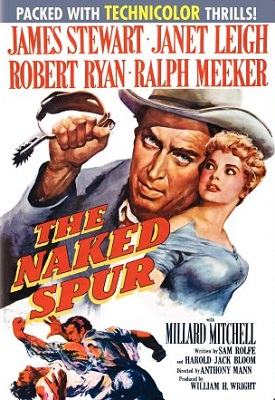
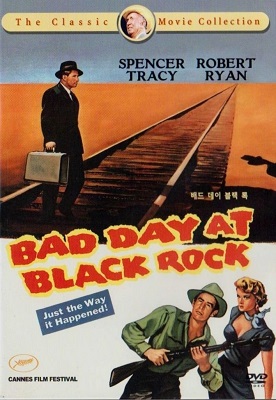
naked_spurThe Naked Spur*, Anthony Mann (1953, USA). This film isn’t available on DVD in the UK, not for rent or for sale, but fortunately, one evening, while flicking through cable channels I found it playing on TCM… So I watched it. Jimmy Stewart plays a bounty hunter determined to capture murderer Robert Ryan and bring him to justice in Abilene, Kansas. He misrepresents himself as a sheriff to an old prospector and an ex-Cavalry soldier, and the three succeed in capturing Ryan. The four, plus Janet Leigh, the daughter of an old friend of Ryan, who had been with Ryan, set off for Abilene. En route, Ryan does his best to undermine Stewart, break up the group and so engineer his escape. And that’s pretty much it – a bunch of cowboys bitching at each other for 91 minutes. Well, except for the last act, where Ryan does escape but dies crossing a river swollen by floods. There are a lot of Westerns on the 1001 Movies You Must See Before You Die list, and I can understand that they’re the closest the US gets to a homegrown mythology, and a handful of Western films are bona fide cinema classics but… I’m not convinced this is one of them. There are Western films which mythologise the landscape, there are Western films which have had their story patterns followed by many other Westerns… And while The Naked Spur certainly puts a novel spin on your average Western story, I don’t think that’s enough – despite the presence of Jimmy Stewart – to make this more than just above average. Perhaps a fan of Western films could explain to me why The Naked Spur is one of the 1001 films a person must see.
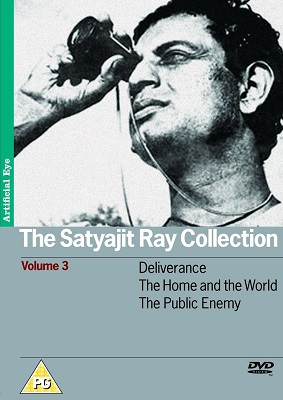
satyajit_ray_3The Home and the World, Satyajit Ray (1984, India). And that’s The Satyajit Ray Collection volume 3 box set completed, and while I consider fellow Bengali Ritwik Ghatak a genius film-maker, I’m still unconvinced Satyajit Ray is no more than a very, very good one – albeit considerably more prolific. He is, I suppose, an Ingmar Bergman rather than an Andrei Tarkovsky. Which is not to say that neither Bergman nor Ray did not make superior films. But there is more than just their respective positions in my own mental map of world cinema that the two have in common. Like Bergman, many of Ray’s films are theatrical. This is one of them. It is set almost entirely in the home of a Bengali noble in 1907, just after the 1905 Partition of Bengal. A UK-educated noble tries to introduce Western ideas into his home, and into his dealings with his wife, on his return home. But this opens her up to the fiery independence rhetoric of the nobleman’s best friend… which leads to a romantic triangle between the three. Since the marriage was arranged, the noble allows his wife her emotional freedom… which, of course, because this is how such stories pan out, pushes her back toward her husband. The film is based on a novel by Rabindranath Tagore, a prolific Bengali writer, who Ray adapted on a number of occasions. I really need to try reading some Tagore. As for the film, it sets up a fascinating situation, but it slowly settles out into a somewhat stereotypical romantic triangle. On the whole, I don’t think this volume 3 has been of as high quality as volume 1… which does make me wonder what volume 2 will be like and why I bought volume 3 before I bought volume 2…
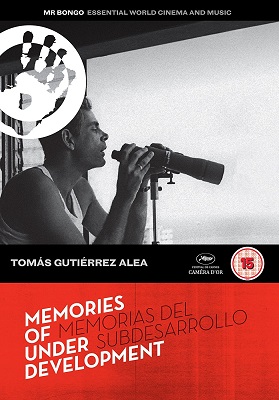
memoriesMemories of Underdevelopment*, Tomás Gutiérrez Alea (1968, Cuba). I rented this film from Cinema Paradiso, but a week after sending it back, and when it came to write this post, I decided I needed to watch it again. So I had a look on Amazon and discovered it was one of four films in Mr Bongo’s 50 Years of the Cuban Revolution box set. The box set also included Lucía, which I already own, but that was no problem, I could give my copy away. So I ordered 50 Years of the Cuban Revolution… The following morning, I remembered I had 50 Years of the Cuban Revolution on my LoveFilm (ie, Amazon) rental list. Oops. I’d better remove it. Too late! As luck would have it, they’d dispatched a film from the box set with my next set of rental DVDs. And it just happened to be… Memories of Underdevelopment. Oh well. Both copies of the film arrived on the same day, but I watched the one I’d bought. And… on second viewing I thought it much better than I had first time around. This has happened before with some of the movies I’ve watched – the appreciating it more on second viewing thing, not the buying only to be sent it on rental as well thing, although to be honest the latter has happened once or twice before too. Anyway, Memories of Undevelopment follows an intellectual, a writer, as he tries to survive and make sense of the new Cuba post-revolution. It does this by focusing on his relationships with women – interspersed with some historical commentary and a long sub-plot about a friend who inherited a furniture store. As the film opens, Sergio’s wife has left him and fled to Miami to escape the revolution. Sergio has stayed. He is, to put it bluntly, something if a lecherous pig. He flirts with his young housekeeper, Hanna, and has a sexual fantasy about her adult baptism. He then meets aspiring actress Elena and seduces her. But her family are far from happy about this, especially since Elena is only sixteen (or seventeen). Sergio promises to marry her, but doesn’t so, he is arrested and charged with rape. I’m still not sure if Sergio’s relationships are intended to be allegories – Alea was apparently pro-revolution, and Memories of Underdevelopment is certainly critical of Cuba’s Spanish occupiers. Which does mean it’s a little hard to tell where the film’s sympathies lie. A negative stand seems too obvious a reading, but then a broadly positive critical reading doesn’t seem to fit either – in terms of the film’s response to the Cuban revolution, that is. Perhaps it needs another rewatch…
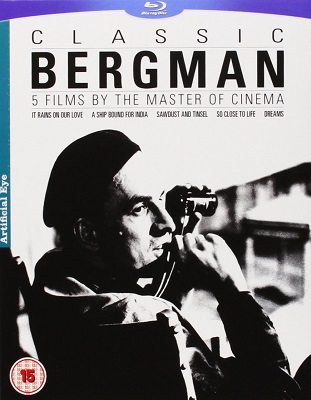
classic_bergmanDreams, Ingmar Bergman (1955, Sweden). Havng now seen four of the five films in this “Classic Bergman” box set I’m starting to wonder what “classic Bergman” actually is. After all, his most-celebrated film is The Seventh Seal, and that was made only two years after this one. And Bergman’s first film appeared in 1946 (he did not direct 1944’s Torment, only wrote the screenplay), and the earliest film in this box set is… well, 1946’s It Rains on Our Love, but the latest is 1958’s So Close to Life… Anyway, in Dreams, the owner of a model agency travels from Stockholm to Gothenburg for a commission with her most popular model, Doris. The model finds herself a sugar daddy in Gothenburg, while the agency owner has hooked up with an ex-lover (who turns out to be married). The film has all the ingredients of a typical Bergman film, and manages them all in a typically Bergman-esque fashion. I’ve said in the past that watching a Bergman film is like reading a story by a classic literary author. It’s a good story, but that doesn’t mean you’re going to be thinking about it for weeks afterwards. And this is one of Bergman’s films like that – which is why, I guess, it’s in a “Classic Bergman” box set, and not given a premier release, like Smiles of a Summer Night, also released the same year. True, an also-ran from Bergman is always going to be worth seeing, but this entire box sert has shown itself to be more for Bergman fans than cineastes.

1001 Movies You Must See Before You Die count: 846

2 Comments

Moving pictures 2017, #4

I’m still keeping to my resolution to watch more non-US films than US ones, but I’m not doing so well with my plan to actually watch less films – only a month into 2017 and I’m already on my fourth Moving pictures post. Oh well.

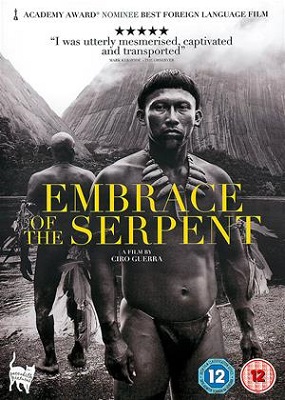
embraceEmbrace of the Serpent, Ciro Guerra (2015, Colombia). I found this free to view on Amazon Prime and put it on my watchlist. About a week later, it was recommended to me, so I moved it up my To Be Watched list… And I’m glad I did as it is very good indeed. In fact, it’s a serious contender for an updated version of the 1001 Movies You Must See Before You Die list, and would almost certainly make my own version of such a list. The film follows a split narrative, one set in 1909 and one in 1940. Their stories – indeed, the routes taken by the characters – are almost identical. The two are linked by one man, Karamakate, the sole survivor of an Amazonian tribe and a shaman. In 1909, he reluctantly helps a German ethnographer to find a sample of the semi-mythical sacred plant yakruna so that it might cure him of his illness. In 1940, an older Karamakate guides an American botanist to the location of the last surviving yakruna plant. The American claims he is only following in the German’s footsteps, but he actually wants to steal a sample of yakruna as it reputedly keeps rubber trees free of disease and the US is losing its access to sources of rubber thanks to Japanese successes in WWII’s Pacific theatre. Embrace of the Serpent is shot entirely in black-and-white, except for a colour sequence near the end which depicts the American’s drug trip after being fed some yakruna. It’s a very… Herzogian film. And I mean that as a compliment, a very great compliment. It looks fantastic, the cast are totally convincing, as indeed are the atrocities they witness – in both timelines – during their travels. Well, okay, maybe not so much the Brazilian self-styled messiah. But in telling its story, the film makes a number of important points – so much so, in fact, that the somewhat weak ending is entirely forgivable. Go watch it.

ducklingDon’t Torture a Duckling, Lucio Fulci (1972, Italy). I’ve watched a few of these giallos by now, although I still think of the genre as more thriller than horror, and Don’t Torture a Duckling falls more toward the latter than the former. A journalist covering the disappearance of a local boy in a small village notices the presence of an attractive and modish young woman, clearly not a villager, played by Barbara Bouchet, and learns she is the daughter of wealthy man who owns a house in the village, which he never uses, and to which she has been exiled after some scandal in the city. Then more boys in their early teens go missing, the two investigate, suspecting that something other than the witchcraft claimed by some villagers is the cause. Even when a woman claims responsibility for the disappearances (murders, that is, once the bodies are found), it turns out she thought she was guilty because she had stuck pins in voodoo dolls representing the victims… But the actual cause of their deaths is far more mundane and physical. Like all giallo, Don’t Torture a Duckling (I don’t actually recall the reason for the title) is all a bit fraught and over-emphatic. Even the gore – and this is apparently the first film in which Fulci used gory effects – is over-done, with the blood on the murder victims resemble scarlet nail polish more than it does actual blood. There are a few nods at an actual genre plot, with a number of suspects dragged in front of the viewer as the actual murderer, only for them to be almost immediately proven innocent. Even if you like giallo, or the films of, say, Dario Argento or Mario Bava, Don’t Torture a Duckling is not an especially memorable example. In fact, you’d be better off sticking to the films of Argento or Bava. Forgettable.

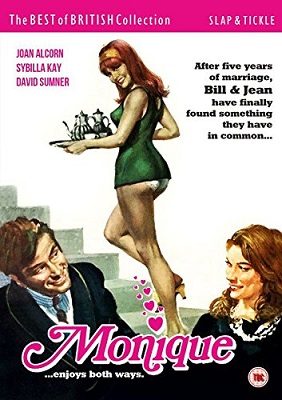
moniqueMonique, John Bown (1970, UK). I’m not sure how this found its way onto my rental list – I mean, “slap & tickle”? A 1970s British sex comedy? The concept alone makes me cringe. And yet, for all that, Monique proved to be pretty low-key and played more like a kitchen-sink drama than a Carry On film. I’m not saying it was a good film by any means – it was, after all, somewhat predictable, a bit dull, and quite dated. A dull and ordinary lower middle class family with two kids hires a French au pair to take care of said kids. As is the way in such films, the au pair is attractive and “sexually-liberated” (not that the phrase actually means anything – it’s really no more than code used by men who are afraid of independent women), and ends up in bed with the husband and the wife… and it all seems to work quite happily. To be honest, I don’t remember all that much: the eponymous au pair was good with the kids, kept both husband and wife happy and together, and it all looked very much a product of its time, without being sneering, prudish or prurient. If anything, Monique probably suffers because it’s lumped in with other films that have also been badged “slap & tickle”. It is, in the end, a somewhat dated but relatively sensitive domestic drama of middling quality.

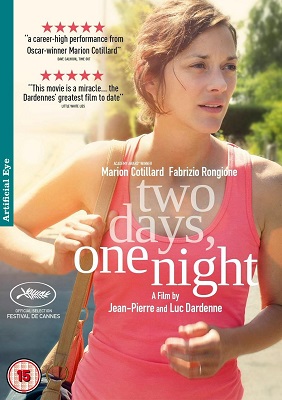
two_daysTwo Days, One Night, Jean-Pierre & Luc Dardenne (2014, Belgium). I know the name Dardenne, although I had not thought I’d seen any films by the two brothers… until I checked by records and discovered I’d watched their The Kid with a Bike back in 2013, and had thought it pretty good. Despite that, I don’t remember why I added Two Days, One Night to my rental list as it’s not on the 1001 Movies you Must See Before You Die list, although it is plainly a good film and worth seeing. Marion Cotillard’s character works for a small company which makes solar panels. When it comes time to return to work after suffering a nervous breakdown, she discovers that a manager had held a ballot in her absence and the workforce voted to accept a bonus rather than Cotillard returning to work, since Cotillard’s work had been picked up by others. But she needs her job, so she persuades the company to hold a second ballot, giving her the eponymous timeframe to persuade the other employees to vote to keep her. This is capitalism at work. A one-off bonus versus an employee’s salary? Of course the company will push for the former. And accepting the bonus is so short-sighted as well. Unless Cotillard had been completely useless – and it’s implied she was not – I would’nt have voted for her to lose her job myself, no matter what my circumstances or the size of the bonus. The film is predicated on the other workers voting against her – but its attempt to present good reasons for doing so do not convince. “We need the money” is not an excuse for shafting a fellow employee. Because, of course, the next such victim might well be yourself. And, quite frankly, I find it hard to believe a bonus of €1000 would be so persuasive to employees of a successful small firm in Belgium in 2014. None of which is to say that Two Days, One Night is a bad film. It’s put together very well, and Cotillard is especially good in the lead. The one brief moment of violence is shocking, if not entirely plausible; but it’s later offset by the humanity shown by one of the firm’s immigrant workers. I stumble over the movie’s premise, so I don’t think it belongs on any list of films you must see, but it’s certainly worth seeing.

satyajit_ray_3Deliverance, Satyajit Ray (1981, India). I discovered shortly after watching this that its star, Om Puri, had died a week into 2017. Watching Deliverance, made thirty-six years ago, Puri was very recognisable – he doesn’t seem to have changed much over the years. In Deliverance, he plays a humble shoemaker. He asks the village brahmin to set a propitious date for his daughter’s wedding, but the brahmin sets him a number of tasks to complete before giving his answer. Which essentially means Puri is performing unpaid labour. And that’s pretty much it for 75 minutes. (The short running time is because it was originally filmed for television.) Of the two great directors – or, at least, internationally-renowned directors – that Bengal produced, I still much Ritwik Ghatak’s work, even though that’s based on a smaller sample – three films, or a third of his oeuvre; compared to ten films out of 36… um, which works out at roughly a third for both, but never mind. And the two collections of Ray’s films that I’ve now watched… well, the most successful films in them have been historical, and typically either adaptations of novels or plays, which gives them something of a Bergman-esque sort of feel. And when that works, it works very well indeed. But when it’s lacking, the resulting film is not always entirely successful – much like Deliverance. Which, to me, felt like it tried to be several things at once but never quite succeeded at any. It wasn’t funny enough to be a comedy, its depiction of village life wasn’t entirely convincing, and its acting was dialled too high to convince as a Satyajit Ray film but not high enough to be a Bollywood film. I shall continue to explore Ray’s oeuvre – he was an important director, and fortunately much of his oeuvre is available to explore. Much as I enjoyed The Home and the World and The Public Enemy in this Ray collection, I think the films in the Satyajit Ray Collection Volume 1 were better. But get both, or indeed all three, just in case I’m wrong, anyway…

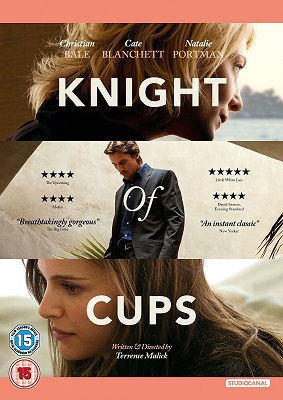
knight_of_cupsKnight of Cups, Terrence Malick (2015, USA). I have no idea whay I continue to watch Malick’s films. Okay, this was another free to view on Amazon Prime, but, seriously, life’s too short to sit through two hours of what pretty much resembles a perfume commercial with a breathless voiceover quoting from a variety of literary sources. It’s not as if it’s all in service to a plot, either. True, some of the cinematography is lovely, but Malick has developed a habit of swinging his camera right in close to a person’s face and then back out again, and it gets annoying fast. Christian Bale plays a successful Hollywood script writer who wanders around listlessly through several vignettes very loosely based on cards from the Tarot deck. He meets and has sex with several women, he gets into an argument with his father, he meets up with his brother and the two tell each other how their relationship works… And it’s all really dull and pretentious twaddle, and I continue to be mystified by the high regard in which Hollywood, and actors, holds Malick. Films are about more than pretty cinematography, and while I’m certainly a tart for it, I do ask for more that pretty pictures in the movies I appreciate and/or love. Hence my characterisation of Malick’s films as perfume adverts. It’s pretty people behaving in ways that do not make sense while living a lifestyle unavailable to 99% of the planet’s population. It is, to be honest, tosh. I think it’s time to swear off Malick. After The New World, I was prepared to give him a chance, but with To The Wonder and Knight of Cups, life is far too short to waste time watching such vacuous and pretentious twaddle.

1001 Movies You Must See Before You Die count: 843


2 Comments

Moving pictures 2017, #3

Why do I do it? I know superhero films are rubbish, and I know that watching them just irritates the shit out of me… but I still end up sticking them on my rental list. I suppose they’re easy films to watch drunk, and shouting at the screen can be reasonably entertaining when in that state – yes, yes, old man shouts at clouds, I know. But at least I’m doing it in the privacy of my own home…

xmen_apocalypseX-Men: Apocalypse, Bryan Singer (2016, USA). So Bryan Singer kicks off the X-Men franchise, with the smartest superhero movie seen up to that time and, to be fair, I think it still stands as one of the best examples of the genre even today. As does the sequel. But not the third; no, the third was shit. Then Singer tries to reboot Superman, but that doesn’t go too well. So he goes back and reboots the superhero franchise he kicked off in the first place: the X-Men. And I guess X-Men: First Class was sorta fun inasmuch as it spoofed the 1960s and the earlier X-Men movies, and the new cast, it must be said, were pretty good picks across the board. But the retconning of the X-Men universe was a bit weird, and the final showdown over the Cuban Missile Crisis was just plain stupid. That was followed by – oh dear – X-Men: Days of Future Past, which pretty much made recent human history, never mind the future, a by-product of a grudge match between Magneto and Professor X. And so we come to X-Men: Apocalypse… which has nothing to do with an apocalypse per se, although one is plainly on the cards, but is so called because Apocalypse is the name of a supervillain. Because if you’re a supervillain, you pick a name that’s as fucking world-ending as you can possibly get. Apocalypse is from Ancient Egypt, and we know this because that’s where the film opens. Inside a pyramid. Which is a temple. Except, as any fucking fule kno, the pyramids were tombs not temples. Apocalypse is having his mind transferred into the body of a mutant who, like Wolverine, can self-heal even fatal injuries. But it goes wrong, and Apocalypse and his supergoons are buried beneath the pyramid. Cut to present-day Cairo, and a CIA agent has tracked a member of an apocalyptic cult to a secret underground temple… Apparently, in some five thousand years, Apocalypse’s pyramid has become buried under tens of metres of bedrock, not that any pyramids were actually built on land that Cairo now covers… Never mind that Cairo in the 1980s, which is when this movie is set, was a pretty secular city and resembled a busy Western city way more than it did a North African shanty town. But there are prejudices to be reinforced here, and a peaceful and secular Middle East is not one of them. And after that, I pretty much lost the plot. Apocalypse is revived and tries to end the world, as you would if you had chosen that word as your supervillan moniker. The X-Men fight him. The X-Men’s mansion is completely destroyed. But they rebuild it later, brick for brick, using their superpowers. See, that’s what they should have done: the X-Builders. They’d have proven way more use to society as builders than prancing around in Spandex and levelling cities as collateral damage in some sort of superhero pissing contest.

hometownUnknown Pleasures, Jia Zhangke (2002, China). Jia became a name I planned to watch after seeing his 2013 film, A Touch of Sin. Happily, he has a back-catalague that is mostly available in the UK on DVD, including the three films in this Hometown trilogy DVD box set – Pickpocket, Platform and Unknown Pleasures. The last is set in Datong, an industrial city in north China, near the border with Inner Mongolia. Two young men have been doing nothing since they graduated from school. Bin Bin spends his time watching television with his girlfriend, Xiao Ji rides his motorbike around town. Then they meet Qiao Qiao, the singer/model spokesperson for Mongolian King Beer, and Xiao Ji enters into a relationship with her – which gets him into trouble with her gangster boyfriend. Bin Bin tries to join the army but fails the medical. In desperation, the two decide to rob a bank, but it goes badly wrong. Jia was apparently inspired by Datong’s many derelict buildings and factories, but then realised the streets were filled with people who were just as much victims and relics of faded past glories. It is not, to be brutally honest, an original concept in the slightest, and there are no doubt hundreds, if not more, films which have similar stories. But Jia’s film has a rawness – a consequence of shooting it on digital video in nineteen days – which US movies, independent or Hollywood, typically lack. (Plus, I like watching films set in other parts of the world.) Despite the speed with which it was put together, Unknown Pleasures is a tight story, with an escalating plot, that opens by documenting the aimlessness of Bin Bin and Xiao Jia, ramps up when an explosion partly destroys a local textile mill, and then deepens the two characters’ troubles when Qiao Qiao’s boyfriend has Xiao Ji beaten up. The final scenes of the film, with the bank robbery and its aftermath, just oozes despair. A good film, but not a cheery one.

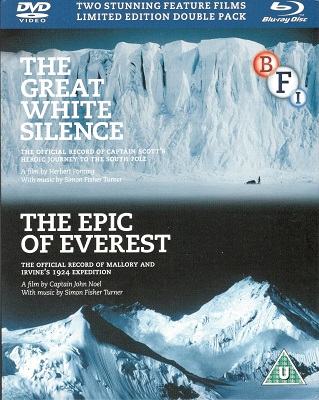
everest_silenceThe Epic of Everest, JBL Noel (1924, UK). George Mallory made two attempts to reach the summit of Everest, the first in 1922, the second in 1924 – which forms the subject of this film – and, during this later attempt, he disappeared while trying for the peak. Not that the film makes a secret of it, mentioning on an intertitle 35 minutes in that he and fellow climber Irvine “were to meet their deaths”. Mallory’s body was found in 1999, but it’s still not known whether he made it to the summit. He might well have done, beating Edmund Hilary and Sherpa Tenzing by twenty-eight years. It seems unlikely, however, as The Epic of Everest bluntly explains that the pair simply disappeared from sight while being watched from 4,000 feet below. What is undoubtedly remarkable is that Mallory’s expedition was filmed – although the cameras could not be taken higher than 23,000 feet. The cinematography, despite being black-and-white, despite, you imagine, the crudity of the equipment, is astonishing. Even the first twenty minutes, in which the expedition travels to Everest, visiting several Tibetan villages en route, is beautifully photographed. Once the expedition reaches the mountains and climbs above the snowline, it’s mostly shots of people standing around in front of tents pitched at the feet of great slopes of snow and ice, while tiny figures in the background trudge up a white incline. True, it’s the scenery which impresses more than anything else… until you remember it all took place ninety-three years ago, when motion pictures were only a couple of decades old, television would not appear for another decade, and even human flight had been first achieved only a quarter of a century earlier. This is your actual history, it’s like real time travel. Get yourself a copy – fittingly, it comes bundled with The Great White Silence, Ponting’s film of Scott’s failed attempt to reach the South Pole…

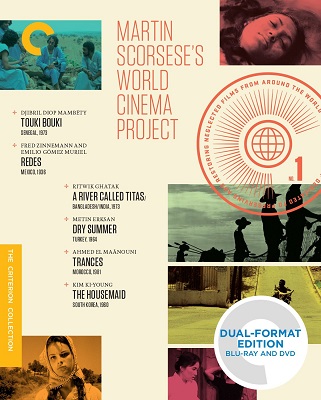
world_cinemaRedes, Emilio Gómez Muriel & Fred Zinneman (1936, Mexico). This is the last of the films in the Martin Scorcese World Cinema Project Volume 1 box set – can we have a volume 2, please? Anyway, Redes… The title apparently means “fishing nets”, but the English title is given as “The Waves”. It’s a documentary-style semi-fictional story of a Mexican fishing village in the 1930s, and for the time it was made it’s an astonishingly accomplished piece of work. Watching Redes, it’s hard not to be reminded of Hemingway’s The Old Man and the Sea, and the same sense of futility underlies the movie’s story, as the fishermen’s livelihood is threatened by a capitalist entrepreneur who owns the boat and sets the prices for the fish. When one fisherman’s son dies because he cannot afford healthcare (and this is in 1936, remember, not 2017), the fisherman persuades his fellows to revolt. Apparently, this is not a story that goes down well in some quarters in the US, much like the excellent Salt of the Earth from 1954 didn’t (especially with Pauline Kael), and I’ve seen an online review of Redes which accuses it of being Communist propaganda and then looks for faults to pick in the film-making and acting… It’s true Redes shares many characteristics with Italian neorealism, although it predates it by a number of years, but it seems the height of hypocrisy to praise those characteristics in an Italian neorealist film but condemn them in Redes. Bah. This is an excellent film, watch it. More, it’s only one of the films in a truly excellent box set, which any self-respecting cineaste should own.

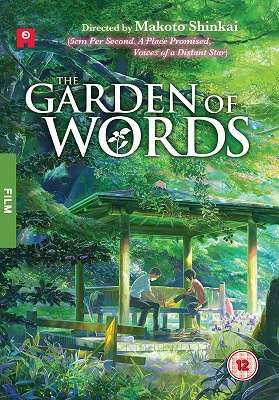
garden_of_wordsThe Garden of Words, Makoto Shinkai (2013, Japan). David Tallerman told me to stick this on my rental list, but he’d neglected to mention it was anime. Although, to be fair, I should have known anyway, as I’ve seen Shinkai’s earlier Voices of a Distant Star. And while I tend to associate anime with alien invasion- and mecha-type stories, such as the excellent Neon Evangelion series, which is, er, both, I should know that it’s not always sf, it’s not always about giant robots or aliens… Especially since it’s the ones that are not genre, like Only Yesterday, Ocean Waves and From Up On Poppy Hill, that I like best of Studio Ghibli’s output. The animation in The Garden of Words is really quite gorgeous – it doesn’t have that painterly element that so drew me to Only Yesterday, but instead an almost photo-realist aspect that, at times, seemed to improve on nature. A schoolboy ducks his lessons to draw shoes, as he plans to be a shoe designer, at a park in Tokyo. In the pagoda he normally frequents, he meets a woman in her twenties, and the two become friends. He learns she was a teacher at his school, but had resigned after being bullied. The pair’s friendship is helpful to each of them, but it comes to an acrimonious end.  They forgive each other, but go their separate ways. This was better than I had expected, and way better than I had expected once I realised it was anime. I will be exploring more of Shinkai’s oeuvre, I think.

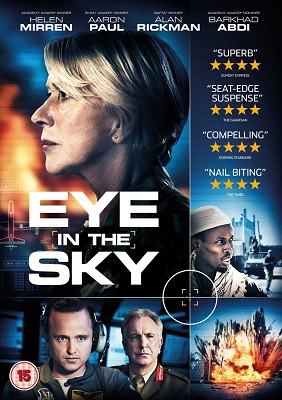
eye_in_the_skyEye in the Sky, Gavin Hood (2015, UK). I remember seeing this advertised on the sides of buses a year or two ago, and I vaguely recall hearing goodish things about it, so when it popped up free to view on Amazon Prime, I took the oportunity to watch it. And yes, it’s… mostly good. It takes a a difficult topic and tries to give an objective take on it. The only problem is, it tries to make a moral grey area out of something that is pretty much black and white. The British have tracked half a dozen Al-Shabaab (a real Jihadist group) leaders to a house in an Al-Shabaab-controlled suburb of Nairobi. Some of the leaders are Brits, one is an American. The UK government plans to take them out, by firing a Hellfire missile from a Reaper drone, piloted by a crew in Nevada. But then a young girl from a neighbouring house sets up a table to sell bread within the blast radius of the Hellfire and… Pretty much the entire movie is arguments for and against the legality of killing a small brown girl in an attack on known and wanted terrorists – and just to make sure everyone knows they’re terrorists, two of them are filmed preparing suicide bomber vests by a tiny camera drone disguised as a beetle… As far as the US government is concerned: hell, what’s one little brown girl to them? They’ve killed plenty already. (To be fair, it’s the US drone pilot who derails the mission when he demands a second “collateral damage assessment” because of the presence of the girl.) The Brits are considerably less eager to cause her death, I mean, kill her, and look for ways to save her, even if it jeopardises the mission’s objectives. Of course, what the film glosses over is the entire edifice on which the film rests: the law. They are looking for legal ways to murder people. The UK is not at war. Kenya is certainly not an enemy country. Terrorists may well be “the enemy”, but given that they’re not combatants of a nation against which the UK has declared war, it’s hard to see how they can be legally declared enemy combatants. Especially since a) any atrocity they have provenly committed would make them liable for arrest and due judicial process, but not summary execution, and b) anything they might have planned has not yet occurred and so is not an actual crime. But, you know, no one cares about logic or morality or legality when it comes to terrorists, or even brown people. Well, most white people don’t. They’re just scared. And racist. Having said that Eye in the Sky‘s story was built on shaky ground, it handled its plot points well… up to the bit where a government minister has a go at the Army general in charge of the operation, played by Alan Rickman, who responds with, “Never tell a soldier about the cost of war”, which is just self-serving bullshit, because if soldiers really cared about the cost of war they’d be trying to find ways to avoid them instead of finding enemies under every rock.

1001 Movies You Must See Before You Die count: 843


1 Comment

Moving pictures 2017, #2

The resolutions for film-watching seem to be working. There’s only one US film in this lot and, while it wasn’t on the list I’m using, it is on some other ones. And it wasn’t that bad either.

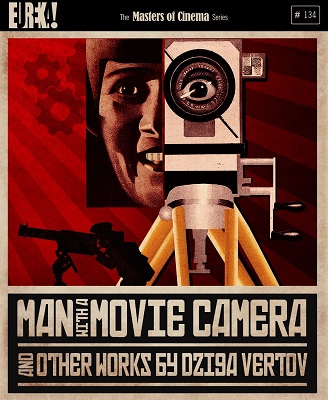
man_movie_cameraKino-Eye, Dziga Vertov (1924, USSR). Vertov is best-known for his Man with a Movie Camera, an astonishing piece of silent meta-cinema made in 1929. Eureka! recently released a new edition of that film, dual format, featuring some of the Vertov’s other works. Vertov apparently had… strong ideas about cinema and its uses, using it to document “film truth”, which, as Wikipedia has it, has “fragments of actuality which, when organized together, have a deeper truth that cannot be seen with a naked eye”. It perhaps appears an obvious truth these days, no matter what media, but in 1920s Soviet Russia it seems somewhat ironic, especially given some of the “embellishments” of actual events Eisenstein reputedly incorporated into his films. But the idea of making films with an agenda, with more than just an aim “to entertain”, I certainly find appealing. Art is a powerful tool, even if it’s chiefly used for the most trivial of purposes. In Kino-Eye, Vertov perhaps set his sights a little high – Wikipedia again: he believed “his concept of Kino-Glaz would help contemporary ‘man’ evolve from a flawed creature to a higher, more precise form”. Which, to me, smacks of Fyodorovism, or at least a form of it stripped of its spiritual dimension. No matter what his motives, in Kino-Eye, Vertov gives us a silent documentary of life in the USSR in the early 1920s, featuring a number of, for the time, novel cinematic techniques, such as montages and, er, running the film backwards. I’m not entirely sure what message the latter is intended to convey, especially the sequence where a bull is slaughtered… which is then run in reverse and so shows the butcher stuffing the bull’s organs into its body and the bull miraculously coming to life. Nonetheless, Kino-Eye is a fascinating slice of life of a time and place that has long since passed, and it is somewhat scary to realise that the lives of the Russian poor have not substantially changed, despite a century of progress, despite eighty years of socialism… And, of course, extremely disheartening.

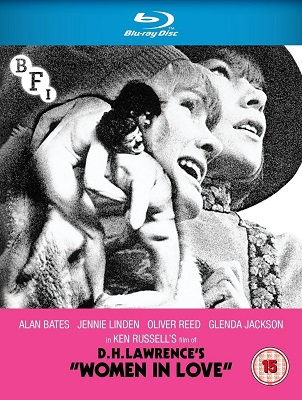
women_in_loveWomen in Love, Ken Russell (1969, UK). I’d been meaning to watch this after reading the book, so when I learned the BFI had put out a new edition on Blu-ray, I picked myself up a copy. I have yet to get a handle on Russell’s oeuvre – some of his films show a singular vision, some of them seem no more than polished examples of their type. And it’s saddening to think that some people think Russell’s vision was defined by films such as The Lair of the White Worm or The Fall of the Louse of Usher, especially when you consider films such as The Devils, Billion Dollar Brain and Crimes of Passion. And, of course, Women in Love. But there’s also Women in Love as an adaptation of a DH Lawrence novel. And it is not a novel that would be easy to adapt for cinema. Happily, Russell avoids the book’s bitterness, although Oliver Reed’s stiffness as Gerald Crich hints at some dissatisfaction somewhere, without making it clear whether it is Lawrence’s or the film-maker’s. Of course, Russell’s film is best-known for the nude wrestling scene between the aforementioned Reed and Alan Bates, who plays Lawrence stand-in Rupert Birkin, and it’s certainly a… striking scene. In a nutshell, Bates plays Lawrence, Jennie Linden plays his wife, Frieda, Glenda Jackson plays Katherine Mansfield, and Alan Bates her husband, John Middleton Murry. Bates is a wealthy mine-owner in Derbyshire, Jackson and Linden are sisters and schoolteachers, and Bates is a school inspector. At this point in Lawrence’s career, his admiration for the working class had turned sour, as indeed had his appreciation of the upper classes, after London society had turned its back on him. It’s obvious in the book, but it’s not even evident in the film. Russell does an excellent shop with the story he has been given, and if Lawrence’s acerbic prose has been diluted in its move to the screen, it doesn’t spoil Women in Love as a film qua film. It is, without a doubt, one of Russell’s best films, and it deserves the accolades it received, including: four Oscar nominations, one win; three golden Globe nominations, one win; and eleven BAFTA nominations. As an adaptation, its refusal to engage completely with its source material actually works in its favour. I am a big fan of DH Lawrence’s writing, and would of course recommend reading the novel. But Russell’s film is also very much worth seeing, just as much for what it adapts well as for what it doesn’t.

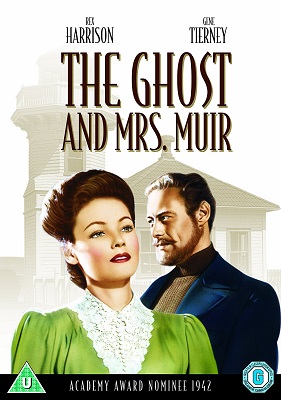
ghost_mrs_muirThe Ghost and Mrs Muir, Joseph L Mankiewicz (1947, USA). Gene Tierney is a widow, desperate to get out of her mother-in-law’s house and control, and so moves to the south coast to look for suitable accommodation for herself and her young daughter. But she doesn’t have much money, and when she spots a house going cheap in the book of the estate agent she has engaged, but he insists it is unsuitable for her… well, that only makes her determined to check it out. And the reason the house is cheap, it transpires, is because it is haunted by its previous owner, a retired sea captain played by Rex Harrison. But Tierney is determined to take no shit, least of all from a ghost, so she and Harrison come to an accommodation, she moves in, and everything goes, er, swimmingly. But money is tight, and tighter still when Tierney’s pension from her late husband’s share of a gold mine dries up completely. So Harrison suggests she write his memoirs. And that’s what they do. And a publisher buys them. And the book is best-seller. At the publisher’s office, Tierney meets George Sanders, an oleaginous writer of children’s books, who charms her. Harrison thinks he’s a wrong ‘un, but she thinks he will ask for her hand in marriage. Then she learns he’s already married… Whatever charm The Ghost and Mrs Muir possesses comes entirely out of its story. Tierney, always a face worth following on the screen, is never entirely convincing in her role but still manages to keep the viewer’s interest and sympathies. Harrison is gruff and old-fashioned, and perhaps a little too debonair for his role, but it’s all forgivable. I’m pretty sure I’ve seen this film on a list of great films somewhere – if not the 1001 Movies you Must See Before You Die list, then perhaps the They Shoot Pictures Don’t They one… and I can’t honestly see why it was there. It’s a charming story, played well and shot well, but it’s by no more than an above-average example of of its type.

satyajit_ray_3An Enemy of the People, Satyajit Ray (1990, India). I was impressed with Ray’s percipience in making this film, only to discover it’s an adaptation of a Henrik Ibsen play from 1882 – despite, frighteningly, being still relevant today, never mind in 1990 or 1882. In Ibsen’s original, a doctor discovers that the waters of the town’s bath are contaminated, but when he makes this known, those who stand to profit from the trade brought to the town by visitors to the bath set out to rubbish his findings. Ray adds religion to the mix, inasmuch as the contaminated water is in a temple, and bolsters the story with a little of science – drinking the water from the temple could give a person hepatitis. But the story pretty much remains the same. The doctor – Dr Gupta in Ray’s film – tries to publish his findings in the local newspaper, but his brother, head of the local municipality, brings pressure to bear to prevent it. In desperation, Dr Gupta arranges a talk at a local university… but his brother fills the audience with his stooges and manages to turn public opinion against Dr Gupta. After all, how can water provided by a god make people ill? (Don’t get me started.) Ray’s treatment of his material is very low-key. The film consists almost entirely of interiors, and the camera placement is more suitable to that of a TV series than a feature film. But the material is certainly deliberately infuriating, especially the debate in front of the students, and it’s all too easy to extrapolate An Enemy of the People‘s story to the present day. In fact, it’s scarily prescient. Even more so, when you consider Ibsen wrote it in 1882.  Ray doesn’t have the sense of the mythic about his films that Ghatak does, but his films are more personal and more, well, theatrical.

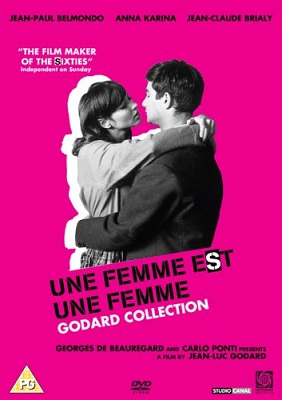
une_femmeUne femme est une femme, Jean-Luc Godard (1961, France). One day I will have a theory about Godard’s oeuvre that works, but for now my present theory is plainly nonsense. This is a colour Godard film, it’s also one clearly prompted more by his relationship with star Anna Karina than it is anything else, and yet it still manages to hang together and work reasonably well. Okay, so it’s pretty much Godard taking the piss throughout with musical cues – in fact, the entire film is a lesson in how to annoy the viewer using only musical cues. There’s a silly argument at one point, which is what most people seem to remember from the film, in which boyfriend and girlfriend Jean-Claude Brialy and Karina continue an argument by showing each other words from the titles of the books they own. Karina and Brialy are an item, she wants children, he insists only once they’re married but doesn’t ask her to marry him. It’s a silly, and constrained, personal drama, whose fame chiefly seems to rest on Godard making such a to-do about Karina, his girlfriend of the time (they married after the film had completed). Plot-wise, Une femme est une femme is as thin as you can get and still manage 85 minutes of running time. It pretty much relies entirely on the charm of its cast. Karina is, strangely, variable. Brialy is good throughout. And Belmondo wins every scene he appears in. As Godard films go, this feels more like a five-finger exercise, and whatever boundaries it pushes seem more accidental than part of the reason why Godard made the film in the first place. I suspect my new Theory of Godard looks something like: when Godard is making a point, it’s likely to be a good film; but when Godard is more interested in his cast, or one member of the cast, then it’s not…

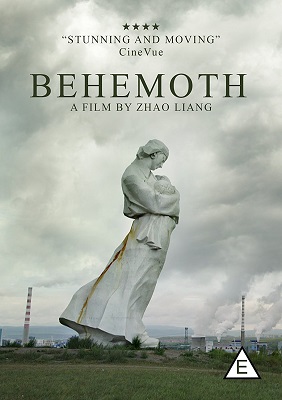
behemothBehemoth, Zhao Liang (2015, China). I forget where I stumbled across Zhao’s name, perhaps linked with Jia Zhankge’s, but I stuck one of his films on my rental list, and it duly arrived and… this is bloody good stuff. In fact, I thought it was Zhangke when I started watching it, but it looked so unlike his movies that I was briefly confused. But. For a start, Zhao Liang chiefly makes documentaries, whereas Jia Zhangke’s films only resemble documentaries. In Behemoth, Zhao Liang documents China’s open-cast coal mining and those whose survive by pirating coal from the edges. Zhao does this odd thing where he splits the screen but in such a way that the splits are not immediately obvious, as if the screen is a triptych of linked scenes. It is weird, but effective. He also has a naked male figure who appears in many scenes and quotes from classical Chinese literature… and that description sounds completely different to how it actually appears in the film. I put Behemoth in the DVD player expecting something like A Touch of Sin, but  I found myself watching something very different and, if not better than that film, certainly as good as it. I immediately put Zhao Liang on my list of directors to watch. You should too.

1001 Movies you Must See Before You Die count: 843


1 Comment

Moving pictures 2017, #1

The first film post of 2017. I’m not planning on watching as many films this year as last, since I’m hoping Ill be spending that time doing other things, like writing. I’m also going to try and watch two non-US films for every US one. I sort of managed it in this post – two US films, although admittedly one was a short, and the rest from the UK, Sweden, Italy and Russia.

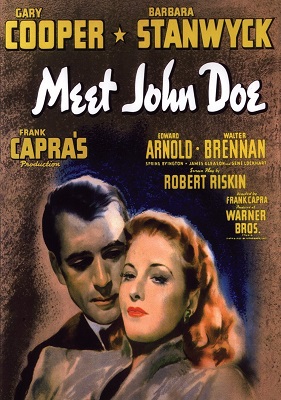
meet_john_doeMeet John Doe, Frank Capra (1941, USA). The world was not a nicer place when Capra was making his films, but the solutions to its problems did seem so much easier to implement. And, of course, the same obstacles to those solutions existed then as now – greed, and the need for the rich to keep the poor in a place where they can control them and keep them poor. Meet John Doe is typical in that regard, so typical its story pretty much iterates that entire philosophy. A newspaper reporter, played by Barbara Stanwyck, is fired when a new owner takes over her newspaper. She retaliates by publishing a suicide letter in her last column, in which a “John Doe” promises to leap from the newspaper building because of man’s greed and inhumanity to man. The new owner likes the letter, so much so it prompts a hunt for a real John Doe. And Garry Cooper, a homeless ex-baseball player, is cast in the part. Cooper’s homespun neighbourliness strikes a chord, and people form John Doe clubs… and next thing you know there’s an entire political movement wrapped around it. Except the John Doe Clubs refuse to allow politicians as members. But then the newspaper owner who backed the campaign reveals he had planned to use it all along to create a third political party under his control. And when Cooper objects, they monster him in front of  his followers at a rally in a stadium – because, well, they’re scumbags, because that’s what rich people do when they don’t get their way. The whole grassroots movement then falls apart, and Cooper is driven into hiding. But the sheep-like people eventually see the error of their ways and the John Doe clubs start reforming… There’s a lot in Meet John Doe that maps onto twenty-first politics, proving only, I guess, that twenty-first century politics is not all that much different to twentieth-century politics. The homespun neighbourliness Cooper sells doesn’t play in the present day, what with assorted demagogues whipping up xenophobic and racist hate for their own ends – stand up, Mr Farage, Mr Trump.  Of course, this is a Capra movie, and he was a master at leaving the viewer feeling good about life. Which is where, I suppose, his films differ from real life…

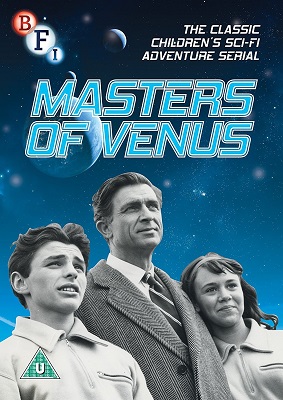
masters_of_venusMasters of Venus (1962, UK). I remember the Children’s Film Foundation films you used to see at the cinema before the main feature, although this one predates me by quite a bit and was apparently shown on telly anyway. But it sounded worth a punt, so I stuck it on my rental list… and so it arrived and… it was pretty much completely as expected: the sort of science fiction film and television churned out until the late 1960s, and which never really convinced but then no one ever expected it to. A teenage boy and girl often visit their father’s work – he’s a rocket scientist, in charge of the first flight to Venus. On one particular visit, two sinister agents of an unknown power – they have six fingers on their hands, so it’s clearly not the Soviets – try to sabotage the rocket. They succeed in sabotaging the control centre, but the rocket – with two of its crew and the two teenagers – launches prematurely and sends the four off to Venus. Once they reach Venus, something seizes control of the rocket and prevents them from returning to Earth. The two astronauts investigate, and are captured by Venusians. So it’s up to the two kids to rescue them. Venus was apparently colonised by people from Atlantis and they’re afraid of conquest by Earth. There are two factions, Men of Action and Men of Science, and the former plan to destroy Earth to safeguard Venus. The latter would sooner reach an accommodation. Once on Venus, the story pretty much runs along well-established rails – captured, escape, captured again, find allies among Venusians, escape, turn tables, save the day, etc, etc. It’s fun, in a very dated sort of way, and does sort of make you pine for the simpler days of science fiction and story-telling. I mean, watching it fifty-plus years later as an adult, you’re going to get a different experience, and nostalgia is going to be ninety-nine parts of it. Which sounds a little like damning with faint praise as, like most of the Children’s Film Foundation’s output, Masters of Venus is well-made, pacey, and ticks (for the time) most of the right boxes. It’s an historical document, no denying that, but given that perspective it’s worth seeing.

maya_derenAt Land, Maya Deren (1944, USA). After watching Meshes of the Afternoon by Deren and Alexander Hammid, I had a look round on Youtube and it seems most of Deren’s output is on there. There’s been some controversy over who exactly contributed the most to Meshes of the Afternoon, with it generally being seen as chiefly Deren’s work, but Stan Brakhage claiming that Hammid was mostly responsible for it. But given that Deren went on to make nearly a dozen further films, and Hammid only made two more, and she spent decades lecturing on film-making, she’s clearly the more important figure of the two in American avant-garde cinema. And At Land, which has only her name attached, is not dissimilar to Meshes of the Afternoon in approach. It opens with reversed film of Deren emerging from the sea, but then she finds herself at a dinner party. There’s a chess game between two women on the beach, and lots of rolling around in the sand. It’s all completely silent – as was, in fact, Meshes of the Afternoon, until a soundtrack by Teiji Ito, who was married to Deren at the time, was added in 1959. I’m enjoying my delves into avant-garde cinema, although, to be honest, I’m not big on symbolic story-telling in the medium. I guess in that respect it’s little different to my taste for plain prose – prose claire, if you will – inasmuch as I’m all for evoking strangeness, but through the use of clear imagery. And, while Deren’s films are striking, I’m not sure I agree with obfuscation of story by telling it through symbolic imagery. It should be a value-add, not the be-all and end-all. Nonetheless, I plan to watch more of Deren’s films. If I can find them…

classic_bergmanSawdust and Tinsel, Ingmar Bergman (1953, Sweden). The title is a bit of a clue – and the DVD cover art would be even more of one, but my copy was part of the box set depicted – but this movie is set in a circus. But it’s not a happy movie. Well, it is a Bergman movie. Yes, yes, I know, he made some light-hearted comedies as well as his usual dour Nordic tragedies, but Sawdust and Tinsel falls firmly into the latter camp. A circus arrives in town, and the owner tries to patch things up with his ex-wife who lives in the town. But it goes badly, resulting in the man his current lover is having a fling with challenging the circus-owner and subsequently getting badly beaten up by him. There’s a certain flavour to Bergman’s films, no matter where they are set – a circus, a maternity ward, a holiday home – that tends to overpower any story he might tell. It’s not just the stark black and white cinematography, which is only true for about two-thirds of his oeuvre; or the “staginess” of many of his films, which give them the feel of theatre plays or literary short stories (although in a different fashion to, say, Orson Welles’s adaptation of Karen Blixen’s The Immortal Story). I’m not sure I’m a fan of Bergman’s work, although I’ve managed to collect quite a bit of it. Some of his films are blindingly good, and he amassed a hugely impressive body of work… but I’m not sure yet how much value I put on many of his works. I think I need to know him better, I need to rewatch some of the films I’ve watched, perhaps with some sort of structure or purpose. I think he deserves it, and I think it would be rewarding doing so. And, to be fair, there are not that many directors you could say that about.

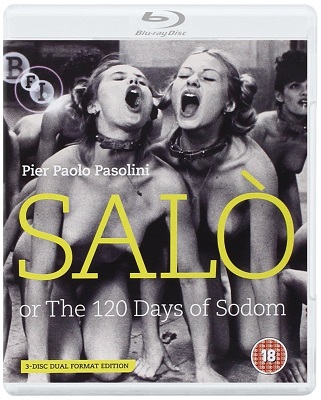
saloSalò, or the 120 Days of Sodom*, Pier Paolo Pasolini (1975, Italy). I didn’t go into this film completely ignorant of what it would be like, which was just as well, as it’s a brutal and horrible film, and while it certainly makes some important points, it nonetheless makes for very uncomfortable viewing. During World War II, Salò, a town on Lake Garda, became the centre of Mussolini’s last fascist state, from 1943 to 1945. Then there’s the Marquis de Sade’s The 120 Days of Sodom, which the title references, although the film takes place over three days. It all seems relatively innocuous at first. Four men, referred to only by their titles, take a group of teenagers, and then pretty much treat them and all those about them with a complete lack of morals. During a meal, for example, one of the soldiers starts to rape a waitress. There are repeated scenes of a woman telling stories of her past to an audience of the teenagers; sometimes she sings. It’s the end of the film which is most brutal. I’m squeamish, I freely admit it, and I dislike watching horrific scenes in films – in fact, I deal with them best when they’re obviously special effects (ie, pre-CGI). But even Salò, or the 120 Days of Sodom tested by tolerance for squeam, particularly toward the end when many of the teenagers are physically tortured. Having now seen Salò, or the 120 Days of Sodom, I’m in two minds about the film. It’s a horrible film to watch, but it makes important points. Pasolini was an important director, and his work should be treated accordingly. Salò, or the 120 Days of Sodom is also on the 1001 Movies you Must See Before You Die list, amongst many others, so it’s clearly a film regarded highly by many… I’m glad I watched it, but I’m not so sure I could watch it again. And yet I find myself conflicted over buying the shiny new BFI Blu-ray release…

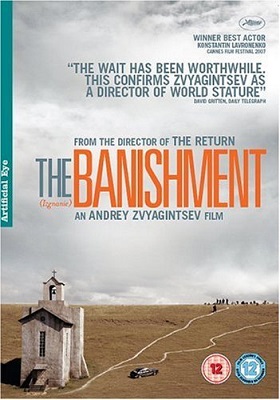
banishmentThe Banishment, Andrey Zvyagintsev (2007, Russia). This is the third Zvyagintsev film I’ve seen, after the earlier The Return and the later Leviathan. So I knew what to expect: glacial pacing, long static takes, close-ups on actors who barely change expression… And I like that sort of stuff, I really do. But for some reason The Banishment seemed like more of a watching ordeal than the other two films by Zvyagintsev I’ve seen. A family travel out into the country to spend time at his childhood home. The wife reveals she is pregnant, but the husband does not believe the baby is his. He forces his wife to have an abortion, but she deliberately overdoses on pain medication afterwards and dies. A flashback reveals that the baby was the husband’s, after all. There’s a subplot involving the husband’s brother, who is a gangster of some sort, and who turns up and then promptly has a heart attack – but there’s not much to it. The cinematography is gorgeous, with some beautiful shots of the Russian countryside (actually, not entirely Russian – The Banishment was filmed in France, Belgium, Moldova and Russia; in fact, the countryside home was built from scratch in Moldova. But never mind: we all know movie geography does not map onto the real world, and that an exterior shot of a building in movieland is not necessarily the location of the following interior shots…

1001 Movies You Must See Before You Die count: 843


1 Comment

Moving pictures, #69

The last Moving pictures post of 2016 (although it’s appearing in 2017), and I’m still slightly boggled by the fact I wrote 69 of these bloody things in twelve months. While I didn’t write about every film I watched, at 6 films on average per post, that’s still a big whole pile of movies. Some of them were good, some of them were bad, and some of them became favourites. Most of them I’m at least glad I watched. Let’s hope the same can be said during 2017.

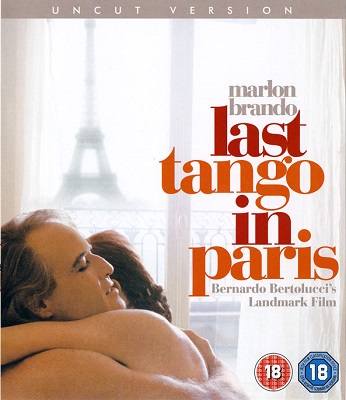
last_tangoLast Tango in Paris*, Bernardo Bertolucci (1972, France). I’m still convinced Bertolucci is just a gifted copyist, and Last Tango in Paris is just Bertolucci doing Nouvelle Vague, but with some very dodgy sex scenes. Okay, so the first clue is Marlon Brando as the male lead, an actor whose appeal continues to mystify me and whose adoption by Hollywood is quite baffling. The only thing to be said in his favour is he has shown a little more critical acumen than his colleagues in choosing the projects he worked on… But Last Tango in Paris is a blot on his copybook. It’s an “erotic drama”, which means there’s lots of simulated sex – and all involved have repeatedly insisted it was simulated – but lots of dodgy sexual politics. Even for 1972. Brando plays an American in Paris who owns a run-down hotel and whose wife has just committed suicide. He falls in with Maria Schneider, a carefree twentysomething Parisian. They have hot sex. Brando sets the rules and gets unreasonably angry when Schneider breaks them – sexual politics, 1972-style. There are lots of intense close-ups, New Wave style, and even that bit where Brando taps Schneider on one shoulder then pops around the other, doesn’t Azanvour do that in Tirez sur le pianiste or am I misremembering? The film sparked controversy on its release, but was a critical and commercial success. I’ve always known of it, of course, it’s like the first big mainstream “dirty” film that everyone of my generation knows about; the second is 9½ Weeks, which I saw back in the 1980s and I’m sure would be a major disappointment if I ever rewatched it. Of course, whatever reputation might have attached to Last Tango in Paris as far as a callow youth was concerned, that no longer holds true for me, and I took the film as I found it. And having seen it, and read up on the actual controversy regarding its making – it pretty much destroyed Schneider, those simulated sex scenes were as near as dammit to rape… it’s hard to consider it worthy of the 1001 Movies You Must See Before You Die list. To be honest, Andrzej Żuławski does it much better with l’amour fou as a theme, and at least manages such stories in a style all his own… Bertolucci, on the other hand, is a bit of chameleon, and while he certainly has an excellent eye – I’m thinking of both The Last Emperor and The Sheltering Sky, but there are many good shots in Last Tango in Paris – I’m not convinced the sum of Last Tango in Paris‘s good bits outweigh the extensive and less than salubrious baggage it carries.

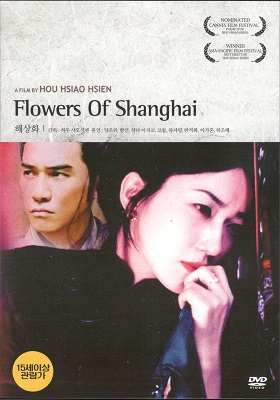
flowers_shanghaiFlowers of Shanghai, Hou Hsiao Hsien (1998, Taiwan). So I bought this “box set” – it was five DVDs in a cardboard box – because I wanted to see two of the films in it. But having now watched four of them, I’ve become a bit of a Hou fan, because he really is very good. Flowers of Shanghai is the most gorgeous-looking for Hou films I’ve seen so far, with perhaps the exception of The Assassin. The film takes place in four late nineteenth century brothels in Shanghai, and is divided into four sections, each named for the central courtesan of that section: Crimson, Pearl, Jasmine and Jade. The film chiefly consists of a static camera focusing on a group of people, courtesans and their most frequent patrons, and so telling the story of their lives and the realtionships between them, some of which are defined by those patrons. Plot-wise, it’s perhaps not the most gripping of stories, but if there’s one thing my travels in Hou territory have taught me it’s that he prefers to lay out his story in the incidentals. The dialogue defines the relationships between the characters, the mide en scène defines the setting, and the story comes out of the interplay between the two. So it’s just as well that Hou scores so highly on presenting his mise en scène, it is in fact one of his strengths as a director. He frames gorgeous shots because he has set up gorgeous shots – and Flowers of Shanghai shows that off to an impressive extent. I’m still not entirely sure why I bought the Hou “boxed set”, given that I’d only seen one of Hou’s films before, but it was a wise purchase. I now count myself a fan of his work and plan to purchase everything else he made – because, of course, only two or three are actually available for rental in the UK…

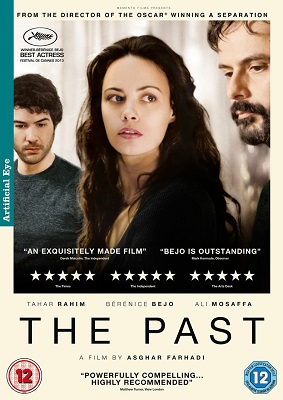
the_pastThe Past, Asghar Farhadi (2013, France). And from a new director I now admire to… well, Farhadi’s About Elly is a brilliant film, a clever drama/thriller and wholly Iranian. I loved it the moment I saw it back in 2013. His Fireworks Wednesday and A Separation were also very good. But The Past is, well, it’s not an Iranian film. It’s a French film. And it suffers as a result. It’s about Iranian immigrants in France, but their concerns, the plot, is all the sort of stuff that would drive a French film. I know the immigrant experience is important, and that documenting it is not only worthwhile but important… But, to a non-native eye I freely admit, The Past did seem to resemble more the experiences of non-immigrants than immigrants. If that makes sense. Perhaps it was a sense that the, er, sensibility seemed suited to the language and setting, when the nationality of the director and cast suggested it should have been otherwise. I firmly believe cinema is a powerful tool for documenting life across the planet, in all its manifest forms, in all its various societies and communities. That’s why I treasure world cinema. It provides an insider’s view. I’m not interested in a French-style drama that just happens to be made by an Iranian director and happens to feature a cast of Iranian extraction, because I’m more interested in seeing life as experienced by Iranians, yes, even Iranians living in France. Perhaps I’m doing The Past a great disservice, perhaps I’m completely missing a huge part of this film, but I’ve seen a number of Iranian films and I’ve seen a number of French films and to my eye this smelt like a French film. Which is not to it was a bad film – Farhadi is bloody good, after all – but I do prefer Iranian cinema to French cinema, and would rather this film had tended to the former than the latter…

meshesMeshes of the Afternoon*, Maya Deren & Alexander Hammid (1943, USA). Most discussions of avant garde cinema often focus on US avant garde cinema, possibly because most European avante garde film-makers went on to become commercially successful, such as Luis Buñuel. And of those US avant garde films, Meshes of the Afternoon from 1943 is generally noted as one of the most seminal. While on the one hand the experimental films of Bruce Baillie and Stan Brakhage might fit into the commonly-held view of the history of cinema – it was the 1960s! everyone experimented! – but no one really expects the same of two decades earlier. Common sense dictates there must have been people experimenting with film in the 1940s just as much as there were in the 1960s (for the all the latter decades reputation for experimentation, etc.), but popular history tends to elide such experiments. Meshes of the Afternoon, which is on the 1001 Movies You Must See Before You Die list, is one such experiment whose reputation has withstood the test of time. I found a decent copy of Youtube and watched it there. And watching it, well, there’s a lot of Lynch in there, or rather, Lynch was clearly influenced by this film, if not others by Deren. A woman dreams about a hooded figure with a mirror for a face. She follows it along a path, but loses it. She returns home and finds a key. The key morphs into a knife. There are several versions of her sitting at a table. She sees the hooded figure in her bedroom. Some of this is a dream, some of this seems to be a re-enactment of something she dreamed. Unfortunately, I don’t know enough about avant garde cinema, and its history, in order to understand why Meshes of the Afternoon is considered so important. It’s good, certainly; but I’ve no way of judging its historical importance. Given the year… although Buñuel’s Un chien Andalou was released in 1929… there’s clearly some early importance there, and Deren went on to make more films and lecture extensively in film-making. Some of Deren’s other films are available on Youtube – I’ve watched one, At Land, already – and I think she has an oeuvre worth exploring… But with Benning, Bailie, Brakhage and now Deren & Hammid, this is obviously an area of cinema I need to spend a bit more time on…

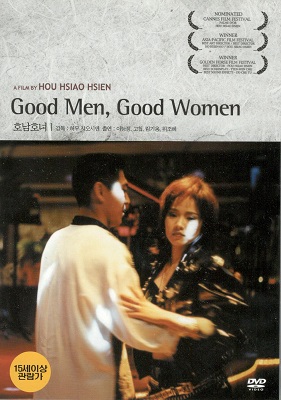
good_menGood Men, Good Women, Hou Hsiao Hsien (1995, Taiwan). That’s the last of the “box set”, so now I’ll have to get me some more Hou DVDs. This is the third film in Hou’s Taiwanese History trilogy, which also includes A City of Sadness (not seen) and The Puppetmaster (see here). Like the second, and possibly the first, it’s a biopic, this time about Chiang Bi-Yu, who left Taiwan in the 1940s to fight the Japanese in mainland China, and after WWII returns to Taiwan, becomes a communist and so comes into conflict with the Kuomintang regime. The film depicts Chiang’s life in black-and-white, but is interspersed with sections in colour documenting the life of the actress who plays Chiang in the film that is Good Men, Good Women… And I have to wonder if this is where Stanley Kwan got the idea for the structure of Center Stage (see here). Both are great films, of course; and it’s no surprise that China, and other areas speaking languages of the Chinese family, should produce movies that are more than kung fu actioners or gorgeous wu xia spectacles, but we rarely get to learn that over here in the UK… So mark both those films down on your list as superior films – even if, er, they’re not actually available in the UK or US.

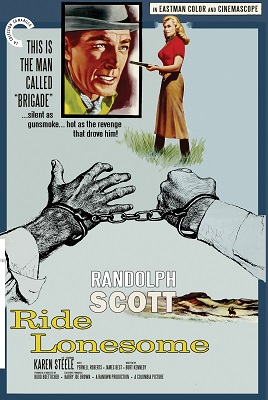
ride_lonesomeRide Lonesome*, Budd Boeticher (1959, USA). I couldn’t find a copy of this in the UK or US, so ended up buying a rip from someone on eBay because the film had passed out of copyright. Fortunately, it proved to be a good transfer – to be fair, most these days for sale on eBay are pretty good transfers. And as I started watching Ride Lonesome I sort of understood why it had made the 1001 Movies You Must See Before You Die list, but then the further into the film I got the less I understood why it had earned its place on the list. Partly that was down to Randolph Scott, the star, who seems a pretty solid centre around which to plot a Western story, but he does, well, have an unfeasibly big head, in fact, he looks a bit like a puppet. Some actors make great Western heroes – Gary Cooper, John Wayne, Jimmy Stewart… Randolph Scott just seems proportioned wrong. As for the story… He plays a bounty hunter, taking a killer to Santa Cruz, Arizona, to be hung. They stop off en route at a desert rest-stop – and the scenes set in and around that are lovely to look at and well played – and pick up a pair of freebooters, and the rest-stop’s widowed female owner, as companions. All of which leads to complications later. The story is not much, but this is a Western. The desert scene cinematography is very good, and I’d love to have seen it in full-on restored Technicolor. Later scenes, in landscape more familiar from Western television series, were less impressive. And the story’s final twist was not quite as unexpected as the story had suggested it might be. A good Western, I suspect, although I’m not so sure it deserves a place on the 1001 Movies You Must See Before You Die list.

1001 Movies You Must See Before You Die count: 842


Leave a comment

Moving pictures, #68

Half of the films in this post are from the US, but then one of them I did actually see at the cinema. It’s become a bit of a tradition over the last decade to go see something at the cinema during the Christmas holiday, and that usually means something genre and very commercial… like Star Wars. And this year, it was Rogue One.

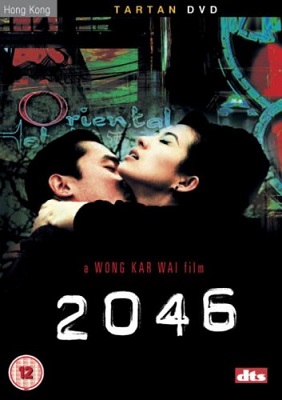
20462046, Wong Kar-Wai (2004, China). I bought this years ago, along with In the Mood for Love, when they were originally released in the UK on DVD – both as special editions in cardboard sleeves. I’ve no idea why. Somewhere I’d come across the director’s name, possibly in Sight & Sound, and picked up his two latest films… and while I’d clearly liked them enough to hang onto the DVDs, I’d not rewatched them until recently. And… my, 2046 is gloriously self-indulgent, isn’t it? It rehashes the plot of In the Mood for Love, with the same actors, but set in the titular year. Kar-Wai sets his scene through the use of neon-soaked montages, a combination of special effects and live photography, and it’s very effective. The actual set dressing is a little dated, although clearly not meant as an entirely serious attempt to present a real 2046 CE. Certainly 2046 is one of those films that doesn’t so much tell a story as provide a feast for the eyes. I’ll be hanging onto my copies of In the Mood for Love and 2046, I think. I also need to watch more Wong Kar-Wai, I think.
400_days400 Days, Matt Osterman (2015, USA). Some films look good on paper, but fail to live up to their promise. This is a classic example – although it tries hard. Four astronauts are consigned to a simulated space mission for the eponymous period of time in an underground replica of a spacecraft. Rather than build a simulator in a nice controllable environment, like an aircraft hangar, which is what most actual experiments of this type do, in the film they bury their fake spacecraft in a field in the middle of nowhere… Despite this, it all goes well for about 200 days. Then they start to turn psychotic, but that turns out to be caused by a fault in the environmental system. Then someone breaks into the “spacecraft”, and they lose touch with “mission control”. So they climb out of their simulator… and discover a post-apocalyptic world. Apparently, while they were on their mission, an asteroid hit the moon, and a vast quantity of pulverised moon dust dropped into earth’s atmosphere, causing a nuclear winter. However, two of the astronauts think this is all part of the simulation. The other two are not so sure. The film doesn’t resolve itself either way. 400 Days tries hard, but never quite convinces. The simulator in no way resembles a realistic spacecraft, and burying it in a field is just daft. The final scenes try so hard not to resolve the set-up, they end up setting a completely different tone to what’s gone before. This is a film that wants its cake and to eat it too, but manages neither. Avoidable.

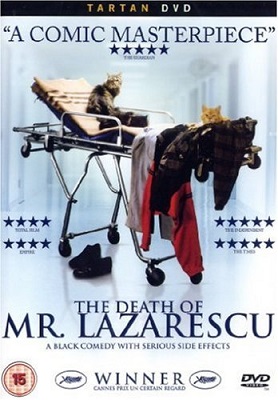
death_lazarescuThe Death of Mr Lazarescu, Cristin Puiu (2005, Romania). Some films, on the other hand, don’t work on paper, and should not work on the screen – but somehow manage to. This is a classic example. An old man with a drink problem and past medical problems needs to go to hospital because he feels ill, but gets taken from hospital to hospital – in Bucharest – by the ambulance, because none of the hospitals will accept him. This is a black comedy. Ten years from now, it could be reality. In the UK. Thanks to scumbag Tories. Lazarescu complains of an upset stomach, and blames it on a prior condition. It gets more serious, his neighbours get involved, an ambulance is called for. And then the ambulance, and the paramedic who is taking care of Lazarescu, is bounced from hospital to hospital. Because he drinks, he is seen as less deserving of medical care – and since when did lifestyle become a barrier to healthcare? What next? Skin colour? Nationality? True, drinkers are more likely to suffer from certain conditions – but that doesn’t make drinking the cause of everything they might suffer. And healthcare for all is healthcare for all. Romania was, nominally, a socialist nation, but seriously who thinks the Ceaucescus were an actual socialist regime? Which is not in the slightest bit relevant, as Romania has an apparently quite efficient health service, it just failed the title character in this case – and more for effect, I hope, than an actual representation of the current state of affairs. Despite that, a good film and definitely worth seeing.

rogue_oneStar Wars: Rogue One, Gareth Edwards (2016, USA). Unlike The Force Awakens, I went into Rogue One with no particular preconceptions – this was not a prequel or sequel or midquel, it was a story set in the same universe as the two Star Wars trilogies. Except, of course, it turned out to be a midquel – although it retconned details I hadn’t even known, given that I’m supremely uninterested in EU Star Wars… Anyway, I took Rogue One as I found it, and I even sort of ignored the various moment of fan service as the sort of dumb frills the story didn’t need but the marketing department had insisted on including. And, as a result… it wasn’t bad. It wasn’t great, by any means. But it wasn’t bad. A science officer who walked away from the empire is tracked down and forced back to work – building the Death Star. Because, of course, the Death Star could only be designed by one man. But his daughter escaped and has become a bit of a freebooter. But now the rebels want her because she’s a link with an extremist group led by Forrest Whitaker and he has an Imperial pilot who has defected and wants to deliver a message to the Rebel Alliance. The message is from the science officer. Cue reluctant hero, lots of heavy-handed Imperial enforcement, and some eye-popping visuals. But, as with all of the Star Wars films, the story logic falls down in several places. We’re supposed to believe the science officer deliberately built a flaw into the Death Star (you know, that bit at the end of the first ever Star Wars film), but, well, couldn’t he have made it a bit fucking easier? And then there’s the Empire’s love of “master switches”, which are usually sited in some totally random place because of course where else would you put it? And an archive of technical plans that isn’t accessible over the network? What use is it, then? It’s like something out of an IBM catalogue from 1988. And how come the rebels could talk to the ships in orbit through the shield, but they couldn’t beam the data out? How does that work? Oh wait, made-up bollocks. Of course. In hindsight, The Force Awakens feels like a canny way to open Disney’s management of the franchise – a giant cheese-fest of fan service with a plot that reiterates the original, and parades all those beloved favourites in all their aged glory across the screen – because, hey, cultural icons turn wrinkly too, or rather, that actors who play them, and get paid to do so, turn wrinkly and, sadly, die. Which, also sadly, ties back into Rogue One and its two turns by CGI actors – Peter Cushing, who died in 1994, and a young Carrie Fisher, who even more sadly died only last month. Neither looked quite real – close enough to be very creepy, anyway. I suspect Rogue One is a good example of what we can expect from Disney in the Star Wars universe: feature-film-length episodes of a long-running series, with a story arc that retcons itself and tangles itself up so completely as it progresses that by 2050 it’s not going to make the slightest bit of sense to even the most ardent of Star Wars nerd. Still, who knows, by then we could have moved past post-truth to a post-narrative world…

red_queenThe Red Queen Kills Seven Times, Emilio Miraglia (1972, Italy). Is this a giallo? I think this is a giallo. Although it’s more like supernatural horror than a detective story. Two sisters, one blonde and one brunette, do not get on. The blonde accidentally kills the brunette, as you do, when they’re teenagers. Many years later, the father dies and his will is held in probate for a year. Because there’s a family legend that the Red Queen will return and kill seven family members, and look!, people are getting murdered in horrible ways. All the clues seem to point to the brunette sister, who everyone has insisted is living somewhere in the US, but yup, her body is still down in the cellar, where the two surviving sisters hid it. There’s a twist, of course, maybe even two or three. To be honest, I only watched this a couple of days ago as I write this and I’m having trouble remembering the details. Barbara Bouchet, as the blonde sister, is very watchable, but it must have been about two-thirds into the film before I even noticed it was set in Germany (everyone speaks Italian, of course). It’s all very silly, one of those films pretty much defined by the bright-red fake blood they use on, er, films of this type. The final scene, in which Bouchet is trapped in a room in the cellars which begins to fill with water – deliberately, it’s a trap – is a cleare reference to The Phantom of the Opera, or perhaps to one of the zillions of films which ripped off the idea from The Phantom of the Opera, but it does make you wonder why they built a room in the cellars of the castle that could be filled with water… A fun night in, providing alcohol is involved.

bad_dayBad Day at Black Rock*, John Sturges (1955, USA). This is apparently not available on DVD in the UK or US, which is a surprise. Fortunately, someone on eBay was selling a Korean copy they’d bought for a cheap price – not that I realised it was a Korean release until I received it. But it was an excellent transfer – and it need to be, because this is Technicolor in all its, er, technicolour glory. The film is set in 1946. Spencer Tracy plays a stranger who appears at titular town, looking for a Japanese man. The locals don’t take kindly to his questions. But that’s because they killed the Japanese man during the war, because he was Japanese and they are racist. Parts of the plot of Bad Day at Black Rock were very reminiscent of Rio Bravo from 1959, although that would require a temporal paradox, and, to be fair, the plot of Rio Bravo was so good Howard Hawks used it at least three times himself. However, the film that Bad Day at Black Rock most reminded me of was Violent Saturday, another Technicolor thriller and absolutely gorgeous to see, although Bad Day at Black Rock‘s desert scenery didn’t really lend itself to the format. But it’s a good thriller, sort of noir without being noir, and looks great, even if some of its performances are a bit over-egged (Ernest Borgnine, for example). Some of the 1001 Movies You Must See Before You Die I’ve had to buy legal rips or foreign-language DVDs because they’re not available in the UK or US… and most, I’ve no desire to keep. But this one is a keeper. A good film.

1001 Movies you Must See Before You Die count: 839


3 Comments

Moving pictures, #67

An entirely world cinema Moving pictures: six films, six different countries… and not a single Anglophone one among the lot. Admittedly, as the DVD cover art below indicates, three of the films were from a single box set, the Criterion Martin Scorsese’s World Cinema Project 1, which is definitely worth getting. (No volume 2 has appeared yet, however.)

world_cinemaDry Summer, Metin Erksan (1964, Turkey). During a drought, the tobacco farmer on whose land the local spring can be found decides to keep all the water for his own crops. So he blocks off the irrigation ditches – it all looks like some sort of falaj system – to the other farmers’ fields. Obviously, they’re not happy about this. Nor is the farmer’s younger brother. There are fights, the farmers without water kill the dog of the farmer with water, the falaj is repeatedly attacked and its sluices broken. For all that the film repeats its simple story, and the story is clearly a metaphor for greater struggles, it works well and doesn’t feel stretched or over-long at ninety minutes. Dry Summer apparently won awards at both Berlin and Venice film festivals, and was submitted to the Oscars but not nominated. (Vittorio De Sica’s Yesterday, Today and Tomorrow won.) I’ve seen a few recent Turkish art house films, but this was my first experience of mid-twentieth century Turkish cinema – although not, I suspect, popular Turkish cinema of the time. Worth seeing.

xlXL, Marteinn Thorsson (2013, Iceland). This doesn’t appear to have been released on DVD – I saw it on Amazon Prime – which is a shame, as it’s a pretty good film and worth seeing. Leifur is a member of the Icelandic parliament. He’s also an alcoholic and a womaniser, with a history of public drunken incidents. After his last escapade, starting a fight at a performance art thing, the prime minister tells him he must go into rehab. Leifur resists. The film is told in non-chronological order, with flashbacks and montages, which sort of mimic Leifur’s own drunken memories of his adventures. Because Leifur is a MP, there are several scenes filmed in the area around Reykjavik’s Parliament House… which is a couple of hundred metres away from the Icecon 2016 venue, and the hotel where I stayed… So that was cool, seeing a bit of Reykjavik I actually knew. XL is pretty brutal in depicting Leifur’s antics and their effect on his family and friends. He’s completely in denial, which only makes matters worse. The jump cuts and montages don’t make for easy viewing, and occasionally feel a little overdone, but they certainly help embed the film in Leifur’s POV – and, in fact, there are several scenes, including the opening, which are actually shot from Leifur’s POV. Worth seeing.

onibabaOnibaba*, Kaneto Shindo (1964, Japan). In forteenth-century Japan, two women live alone in a hut in a meadow of thick reeds. Two soldiers fleeing a battle make their way among the reeds. The women kill them, take their arms and armour, and then throw the bodies into a deep hole in the meadow. The women’s neighbour returns from fighting and admits that the husband of the younger of the two women did not survive. Some samurai enter the reeds, and are killed and robbed by the women. The neighbour and the young woman start a secret sexual relationship. A samurai in a demon mask appears. The older woman kills him. The woman wears the mask to scare her daughter away from the neighbour. After being caught out in a downpour, the woman cannot remove the mask. She reveals herself to her daughter, and the two of them try to remove the mask. Eventually, they succeed, but the older woman’s face is covered in weeping sores… The simplicity of the setting – reeds, rude huts, deep hole – works well with the stark black and white photography. The demon’s appearances (whichn it’s the old woman) are staged well, if a little over-theatrical. A good film, worth seeing.

goodbye_southGoodbye South, Goodbye, Hou Hsiao Hsien (1996, Taiwan). I’ve mentioned Hou’s soundtracks before, but this has the best one I’ve heard so far. It’s a mix of techno and rock, and there’s probably more music in this film than there is dialogue. Not that the film needs much in the way of dialogue anyway. A pair of Taiwanese low-lifes get involved with gangsters when they set up a gambling den in Pingxi. This is only first in a series of schemes of dubious legality intended to make the pair money, all of which fail to do so. There are several performances by the nightclub singer girlfriend of one of the pair, and a number of dialogue scenes set in cars as the pair drive about Taipei. There’s not much in the way of plot here – not that there was in Hou’s The Boys from Fengkuei – just a string of incidents that blur one into the other. As mentioned earlier, the soundtrack is excellent, and the cinematography is very much like that in Hou’s other films, with lots of static long shots, often with odd choices for camera placement. I now want more of Hou’s films on DVD.

world_cinemaTrances, Ahmed El Maamouni (1981, Morocco). Apparently, the Martin Scorsese’s World Cinema Project began when Scorsese was working on one of his films in 1981 and he saw Trances on TV. He loved it so much, he tracked down the distributor and director, and arranged for the film to remastered… and here it is, on DVD and Blu-ray (US-only, sadly), in a box set with five other films. And unlike those other films, it’s a documentary. It’s about a Moroccan band called Nass el Ghiwane, which started life in avant garde political theatre, but, at the time of filming, tours the country playing Moroccan folk music (chaabi), and apparently kicked off a new social movement. The film mixes concert footage, interviews with band members and fly-on-the-wall documentary. It’s a film that fascinates due to its topic rather than the way it was put together, although I suspect that’s an occupational hazard for all documentary films. I can understand why Scorsese was attracted to it, as it’s especially good at capturing a moment, and a movement, encapsulated and defined by the music of Nass el Ghiwane. A good film.

world_cinemaTouki Bouki, Djibril Diop Mambéty (1973, Senegal). And another from the Martin Scorsese’s World Cinema Project, this time from Senegal. I’ve seen Ousmane Sembène’s Mooladé, another Senegalese film, which is excellent, but Touki Bouki is a very different film. It’s about men, for a start, and not women – in particular, one young man, and his girlfriend, who dream of a better life, but have neither the money nor the ambition to better their lot. Eventually, they steal some money from a rich man, and use it to buy passage to France. But the man finds he can’t leave, and his girlfriend goes on without him. This is a very brightly-coloured film, especially in the scenes which show animals being slaughtered for food, and which makes them particularly gruesome. I had to look away, they’re far more graphic than you’d see depicted in a film these days. Despite that, it’s a good film and I’ll probably be watching it again in 2017.

1001 Movies You Must See Before You Die count: 838


2 Comments

Moving pictures, #66

A mostly far eastern Moving pictures post this time, with films from China, Taiwan and South Korea. Plus some Italian melodrama, a classic piece of Disney, and a recent Hollywood blockbuster which generated a ridiculous amount of stupidity on release.

center_stageCenter Stage*, Stanley Kwan (1992, China). I couldn’t find any copies of this film for sale in the UK, and while it had apparently been released in the US at some point, it had also long since been deleted. So I bought a copy from Hong Kong… on Blu-ray. Bizarrely, Hong Kong is region A, because it counts as a “dependency” of, I assume, the US, despite being a British Crown Colony from 1842 to 1997 (region B) and before that part of Imperial China (there were, of course no Blu-ray regions then), and since 1997 a Special Administrative Region of China (region C). Fortunately, I have a multi-region Blu-ray player. As for the actual film… All I knew about Center Stage, AKA Actress, was that it starred Maggie Cheung and was a biopic of a famous actress in the 1930s Chinese film industry. What I hadn’t expected was that the film includes a framing narrative, to which it occasionally breaks, in which Cheung and the director discuss how she will approach the role of the actress, Ruan Lingyu, in the film which is Center Stage. So you have Cheung as Lingyu and Cheung as Cheung. It’s surprisingly effective. Especially since Kwan has made an effort to make the 1930s part of his film as convincing as possible. The end result is a character study of a tragic figure from China’s cinematic history as well as a commentary on that character study, and it’s all carried magnificently by Cheung, who deservedly won a best actress award at the Berlin International Film Festival (surprisingly, the film was not entered for Cannes or the Oscars). The film looks exceedingly good, Cheung looks exceedingly good, and I’m surprised the only edition currently available is a Hong Kong Blu-ray. This really is a film which deserves to be seen more widely.

before_revolutionBefore the Revolution*, Bernardo Bertolucci (1964, Italy). Another film I watched solely because it was on the 1001 Movies You Must Watch Before You Die list although, to be fair, Bertolucci’s name was known to me – ever since seeing The Last Emperor at a cinema in Nottingham back in 1987, in fact. But the year, the country, the black-and-white film stock… led me to think Before the Revolution was an Italian Neorealist film – about which I have mixed feelings, inasmuch as I take the films as I find them rather than liking the genre – but Before the Revolution proved to be more Nouvelle Vague than anything else. A pair of young men, carefree to the extent you only see in New Wave films, but one drowns in a swimming accident and the other finds himself attracted to an older woman, an aunt, although I don’t think a blood relative, and it all seemed very Nouvelle Vague… I especially remember one scene, shot through the window of a car which was quite effective, but had more in common with Godard than it did, say, De Sica or Rossellini. Which is not to say that Before the Revolution was a bad film – just that it reminded me of Godard or Antonioni, and not any Italian Neorealist director, and while I much prefer the first two names, I found this a bit of a lacklustre copy. Given Bertolucci’s oeuvre, I suspect him of being a gifted copyist – The Sheltering Sky is a lovely-looking film, albeit not a great adaptation of the novel, but what is it that makes it a Bertolucci film? I wonder if 1900 was as close as Bertolucci got to a personal film, and even that felt like it borrowed from many sourcres. I can’t say Bertolucci has ever impressed me that much – he doesn’t seem to have an individual vision, and those of his films I’ve liked I’ve done so because of the films themselves. I suspect Before the Revolution deserves more attention than I gave it, but after watching a whole bunch of Italian Neorealist films it did seem a bit of a capitulation to the commercial forces they had set out to resist.

lady_trampLady and the Tramp, Clyde Geronimi, Wilfred Jackson & Hamilton Luske (1955, USA). I know I saw this once as a kid, but when I came to watch it again I realised I’d forgotten a couple of important things about it. One, it was released in 1955, at a time when Disney were on a roll with their feature films; and two, it’s set in 1909. I also keep on thinking it should be called “The Lady and the Tramp”. Which it shouldn’t. Because “Lady” is the name of a female cocker spaniel pup given to the wife in a middle-class US family. All goes well until the wife becomes pregnant, and Lady subsequently comes second in the family’s affections. The Tramp, on the other hand, is a mongrel who lives on the street, and he explains to Lady that when a baby arrives, the dog is no longer wanted. And so it proves. Lady and the Tramp spend time together, a sort of doggy romance. But one of their escapades goes wrong and she’s caught by the local, er, dogcatcher (even though she’s wearing a collar). In the pound, she learns about the Tramp’s other “girlfriends”, and so spurns him on her release. But then a rat sneaks into the house and threatens the new baby, and the two dogs’ successful attempt to kill the rat is misinterpreted by Lady’s owners… although they soon learn their mistake. And the Tramp becomes a member of the family and breeds with Lady. Happy ending. The animation is, as you would expect from 1950s Disney, and Geronimi and Luske, really very nice. The dog’s eye view is also done effectively. But the story suffers because it doesn’t have the fairy-tale quality that Sleeping Beauty and Cinderella, for example, both possess. And, to be honest, I’m not all that taken with animals as protagonists. Lady and the Tramp was better than I was expecting, but I’d class it as an also-ran in the Disney classics category.

boys_fengkueiThe Boys from Fengkuei, Hou Hsiao Hsien (1983, Taiwan). This is the second film from the Hou “box set”, and much as I was impressed by The Puppetmaster I find this film much more to my taste if not quite as obviously classic film material. If that makes sense. A group of youths in a fishing village leave school with little in the way of education or prospects. They spend of their time gambling and fighting. Three of them head for Kaohsiung, a major city, to look for work. One of the three falls in love with a young woman living in a nearby flat. Nothing quite works out. Like the other Hou films I’ve seen, The Boys from Fengkuei makes extensive use of static camera placement and long shots, which is, I admit, a style of cinematography I like. I like that distance, that sense of the screen as a window on the story… and while I can also appreciate the effectiveness of a close-up, I’ve only really seen it used all that effectively in Truffaut’s Tirez sur le pianiste – in other films, you just don’t notice it, which makes you wonder why they bothered to use it. Hou seems to like static viewpoints, usually carefully-chosen, and while it’s not as obvious, or stagey, a technique as that used by, say Peter Greenaway, it does impact the film. There is a scene, for example, where the “boys” fight, and the fight spills off-screen, so all the viewer sees is an empty alleyway with the noise of a violent fist-fight on the soundtrack. Hou also – and this I admit surprised me – does great soundtracks. I should have guessed from the first film of his that I’d seen, The Assassin, and its really quite wonderful closing credits music. But all of the films I’ve seen by Hou so far have excellent incidental music. Stick him on your list of directors worth seeing, because he surely belongs there. I think he’s becoming one of my favourite directors…

ghostbustersGhostbusters, Paul Feig (2016, USA). And so we come to the explosion of stupidity that was the remake of Ghostbusters. It seemed quite simple – remake Ghostbusters, a mildly amusing 1984 Hollywood comedy with something of a cult following, for the twenty-first century. Put a comedy dream-team on it. Solved. Except the dream-team picked was that responsible for Bridesmaids, a successful twenty-first century comedy… which meant the Ghostbusters central cast would be female. Normal people went, okay, cool, go for it. A handful of right-wing dickheads decided they didn’t like this, and they kicked up a stink. The level of stupidity in their complaints was hard to believe. Especially when you consider that the film about which they were complaining was pretty much fan service from start to finish. The thing about Ghostbusters (3) is that it’s a pretty ordinary film of its type. It has a handful of good jokes, but, as many twenty-first century comedies seem to do, it also relies overmuch on the characters developed by its cast in other films. In other words, if Melissa McCarthy plays the most sensible role in your film, then you have a problem. But when every Ghostbuster-related joke is a fan service, and everything around it is a stable of actresses playing their best-known characters… you don’t have an especially good film. It entertained. Just. But the one thing the film certainly didn’t deserve was the moronic criticism by right-wingers who objected to a female Ghostbusters. It’s such a feeble complaint, you have to wonder at the intelligence of those who supported it. (To be honest, I don’t wonder: I consider them all quite stupid.) If you enjoy the sort of comedies which have been released in the last five or six years, you will enjoy Ghostbusters. If you enjoyed the original Ghostbusters you will probably get added value from the fan service and references. It’s not an especially good film – but to criticise it solely because the central cast are female just makes you a complete fucking idiot.

world_cinemaThe Housemaid*, Kim Ki-young (1960, South Korea). I bought the Criterion box set of Martin Scorsese’s World Cinema Project because it included a remastered version of A River Called Titas (on both DVD and Blu-ray). But there are a further five films in the set, including The Housemaid, a film on the 1001 Movies You Must See Before You Die list and which I’d not been able to find a copy elsewhere. (Eureka! released a UK edition of Martin Scorsese’s World Cinema Project in 2013, but their version only includes three films – none of which are The Housemaid or A River Called Titas; they also called their edition volume 1 but there doesn’t appear to have ever been a volume 2. Bah.) Anyway, The Housemaid, AKA Hanyo… a Korean family hire a housemaid, but over time she gets a little too friendly with the husband. And then next thing you know, she’s pregnant with his child. As is his wife. Which puts him in something of a quandary. Well, at least that sort of quandary experienced by men with zero or low morals. Upset that her child will not be treated in the same way as that of the wife, the housemaid threatens one of the children with poison. and so the housemaid and the wife engage in a downward spiral of threats while the husband makes all the wrong decisions and so makes the situation worse. The Housemaid has been described as horror and erotic horror, although to me it played out like a drama, albeit a somewhat dark one. Worth seeing.

1001 Movies You Must See Before You Die count: 837


2 Comments

Moving pictures, #65

In this post, a new nation joins the roster of countries from which I’ve now seen films: Burkina Faso. I really need to get more of those Great African Films DVDs, as I do like films from African countries – as much for the variety as for what they reveal of life in the various nations on the continent. Other than the Burkina Faso movie, only the two US directors were unknown to me (and one of them turned out to be a Brit, anyway).

preciousPrecious, Lee Daniels (2009, USA). This is on another list, rather than the one I’ve been using for the past two years. And it wouldn’t otherwise be the sort of film that would interest me. The title refers to the central character, an overweight black teenage girl with learning difficulties, a physically abusive mother, and a child with Down Syndrome (who actually lives with the girl’s grandmother) fathered by her own father. The film is adaptation of a novel, Push, by Sapphire, and it’s pretty grim stuff. The mother is especially horrible, subjecting Precious to a litany of verbal and mental abuse, and the occasional moment of violence, throughout the film. Precious herself is an innocent, completely unable to see a way out of her circumstances. But then she’s given a place at an alternative school, and she begins to open up… in the process revealing her mother’s behaviour toward her and that her child is the product of incest (oh, and she’s pregnant once again, also incestuous, when the movie opens). The book’s prose apparently reflects Precious’s improved command of language as she attends the alternative school, but the voiceover narrative doesn’t make this especially clear. The film has been accused of throwing a bit too much at the protagonist, and although there’s a clear arc toward some sort of happy ending, it is pretty heavy-handed. Still, that’s what drama does…

american_history_xAmerican History X, Tony Kaye (2009, USA). Another film that’s on another list, but this one was also free to watch on Amazon Prime so… To be honest, the story of the making of the film is more interesting than the story of the film. In American History X, Edward Norton plays a neo-Nazi who goes to prison after viciously murdering two black guys, sees the errors of his ways after being sexually assaulted by another neo-Nazi in the showers and spending time working alongside a black guy who was imprisoned for six years for stealing a TV. On his release, Norton tries to prevent his younger brother, who has fallen under the spell of the same neo-Nazi guru Norton had, from following in his footsteps. These days, neo-Nazis get upset when they’re called neo-Nazis, or even just straight Nazis, but fuck ’em. They’re neo-Nazis. “Alt-right” is just as much a bullshit right-wing propaganda term as “political correctness”. Ignore anyone who uses either. But, American History X… Apparently, the studio were unhappy with Kaye’s first cut. And his second cut.’Then Norton hired an editor to cut the film to his taste. So Kaye played the prima donna, famously hiring a rabbi, a RC priest and a Buddhist monk to sit in on a meeting with studio bosses. Um, yes. The film has its moments, but Norton is too weedy to convince in his role (just compare him to the meatheads Nazis he meets in prison), and the whole thing over-inflates the success of neo-Nazism so much it dangerously normalises it. I’m all for rehabilitation narratives, but they need to be stronger than this to justify their existence. It doesn’t help that every black character in American History X is a gang banger, except for Avery Brooks’s mentor, which only just feeds into the whole neo-Nazi white supremacy thing. Seriously, films about Nazism and neo-Nazism should make the politics so unpalatable – as they are in real life – that no one would want to have anything to do with them; they should not leave enough wiggle room for an intellectually-challenged viewer to start giving brainspace to the toxic shit they peddle. We all know the dangers of “post-truth”, which is another word for “lie” or “fiction”. After all, 52% of Republicans believe Trump won the popular vote even though the actual facts show Clinton won it by nearly three million votes. And don’t get me started on the lies put out by the Leave campaign…

sons_roomThe Son’s Room, Nanni Moretti (2001, Italy). And from the “look at my award-winning turn playing a toxic character in a toxic film” American History X to a drama that has a cast of human beings and deals with a very real situation. Moretti himself plays the father in a middle-class Italian family. Teenage boy and teenage girl cause the usual familial disruptions. Moretti’s job as a practicing psychiatrist means he has his patients’ problems as well as his family’s to deal with. Nonetheless, the family are generally easy-going, centred, good-natured, although attractive in a sort of lifestyle magazine advert way. And then the son dies in a diving accident, and the surviving three members of the family have trouble dealing with their grief. Moretti’s character replays over and over his last day with his son, when he cried off from the promised jog together because a patient had called him and asked for his help (the patient had just been diagnosed with cancer, it transpired). My only previous experience to Moretti’s films was his Caro diario, which I thought pretty good. That was a more personal film, although The Son’s Room covers such an emotive topic it feels a much more personal movie. I should probably watch more Moretti – he’s very good. Recommended.

great_african_1Haramuya, Drissa Toure (1995, Burkina Faso). As mentioned earlier, and evident from the DVD cover art, this is the second film in the Great African Films Volume 1 DVD I bought on eBay. This is pretty much a slice-of-life drama set in Ougadougou, the capital of Burkina Faso. A teenager gets a job in a shop, but worried that his parents cannot affort to eat, he steals some flip-flops to sell, but is caught and fired. There’s a long-running plot-thread about stolen mopeds. And also a police investigation into drug dealing – which one dealer manages to evade by feeding his marijuana to an uncle’s goats… who promptly start butting each other and everything in sight. Haramuya is light on plot, but it’s also an excellent window onto a world I would not otherwise be likely to see. Toure’s direction is effective, but workmanlike more than anything else. The film comes across as a social drama, but structured as a series of interlinked narratives. The cast are natural, with only one or two moments where it feels a little amateur. Of the two films in Great African Films Volume 1, Faraw! is clearly the better, but Haramuya is still worth seeing. There are, to date, a further three volumes – 2 Tasuma and Sia, The Dream of the Python (both Burkina Faso), 3 Daratt and Desert Ark (Chad and Algeria), and 4 The Pirogue, Colobane Express and The Silent Monologue (all three Senegal). I plan to buy them (although I’ve already seen Daratt).

sonatineSonatine, Kitano Takeshi (1993, Japan). I stumbled across this in a local charity shop, and since I know Takeshi’s name, it was an obvious decision to buy it. Only later did I discover it’s the film which brought him international attention. And having now seen it, I can understand why. A Yakuza enforcer and his team are sent to Okinawa to sort out a dispute between two gangster plans but the enforcer realises it is all a plot to remove him. So he hides out with his team at a beach house, where they play games and tricks on each other… before it all comes to a violent end when the Yakuza boss turns up looking to resolve the situation. And, er, that’s sort of it. When the enforcers are hiding out at the beach, they act like kids. Takeshi, who plays the lead role, plays it totally deadpan, so the humnour is even funnier because it bounces off him completely. Of course, being a Takeshi, it’s also pretty violent, with lots of gun battles and violent murders. But there’s also a strong thread of black humour running throughout the film. For example, when the enforcers first arrive in Okinawa, they’re taken to an office building used by the clan. They’ve not been there five minutes when someone shoots at a window. What’s that? asks one of the Okinawa team. That’s just the other clan, they’re always shooting at us… This DVD only cost me a quid, and I fully expected to drop it off in a random charity shop after I’d watched it… But I think I’ll be keeping it. Worth seeing.

gabbehGabbeh*, Mohsen Makhmalbaf (1996, Iran). Iran, despite its theocratic regime, perhaps even in spite of it, has a strong presence internationally in the cinema world, and has produced a number of excellent directors and films. Some have worked within the system, some have worked around it. I’m not sure which group Makhmalbaf belongs to, although the fact his name is important to the plot of Kiarostami’s Close-up suggests he has the approval of the authorities. And, to be fair, there’s nothing in Gabbeh that might offend them. It’s an Iranian fairy-tale, based around the style of rug from which the film takes its name. An old couple make their way to a stream to wash their gabbeh, and a young woman, who answers to the name of Gabbeh, magically appears out of the picture wiven into the rug. Gabbeh’s story is also depicted in the rug, which changes as the film progresses. She is betrothed to a young man, but each time they try to set a wedding date something happens to put it off. She tells this story to the old couple. As should be evident from the DVD cover, this is a gorgeous-looking movie. Recommended. And no, I didn’t pay the price show on Amazon, I bought my copy on eBay for considerably less.

1001 Movies You Must See Before You Die count: 834