It Doesn't Have To Be Right…

… it just has to sound plausible


3 Comments

Moving pictures 2018, #5

I swore I’d wouldn’t be posting just reviews of films all this year, but I had bad flu for a week, which meant I watched a lot of films and did very little blogging. So I’ve a backlog to clear. One more of these and I’ll up to date, and hopefully after that, their frequency will decrease… and lots of other content will start appearing instead. Hopefully.

Princess from the Moon, Kon Ichikawa, (1987, Japan). The only other Ichikawa film I’d seen before watching this was The Burmese Harp, which is excellent. So I expected good things of Princess from the Moon, despite the awful title and cover art. Sadly, the latter were indicative of the contents. As the title suggests, a baby arrives myteriously – well, in a meteorite – in Japan, and a family adopt the baby and bring her up as their own. It’s the Superman origin story without the superpowers. Okay, with the superpowers. Because the young woman does have strange powers. However, unlike Superman, she is eventually reunited with her people when a UFO, in a scene somewhat reminiscent of Close Encounters of the Third Kind, or is it ET: The Extra-Terrestrial, comes to Earth and she departs on it. Meanwhile, she proves so popular among the local menfolk, and indeed further afield, that she has to set them tasks in order to manage their advances. The film aparently did not do well and, despite the presence of Toshiro Mifune as the man who discovers the “princess”, it’s not easy to see why. The tone is all over the place, and Ichikawa adds nothing to a well-used story. Apparently, the dragon was originally going to double as the Loch Ness Monster in a Hammer film but the project fell through.

Viva, Anna Biller (2007, USA). I’d rented Biller’s The Love Witch on a whim, and been impressed enough by it to add her first feature film, Viva, to my rental list. It’s nowhere near as polished a piece, and in many respects a much less subtle pastiche. Which is not necessarily a bad thing – Biller is certianly a singular talent, devoted to pastiching 1970s aesthetics and B-movies, but with feminists sensibilities. It can make for an uneasy mix. While her sensibilities are unimpeachable, her dedication to the look and feel of the films she’s spoofing does tend to place them closer to their inspirations than the twenty-first century. Biller plays a Los Angeles housewife in the early 1970s who, with a friend, is persuaded to expand her sexual horizons by moonlighting as an escort (using the name “Viva”). There are a lot of very stilted conversations between the characters, and everything is colourised to an eye-bruising degree. Later, Viva ends up at an orgy, and it’s the sort of thing you’d expect in a Russ Meyer, although without the focus on women’s chests. The end result is far less clever than The Love Witch, and embarrassingly gauche in places, but certainly shows what Biller is about and attempting to do. Seen before The Love Witch, I suspect it might misinform viewers as to Biller’s intentions; seen after it, the films feels like a work in progress. She will go on to amazing things, I’m sure of it. Viva is part of the process.

A Man Vanishes, Shohei Imamura (1967, Japan). My previous experience of Imamura, The Ballad of Narayama (see here), I really did not like, but I suspect I added A Man Vanishes to my rental list based on the description rather than the name of the director. And I’m glad I did. The film starts out as a straightforward documentary on the case of a Japanese salaryman who simply disappeared. Bu then the documentary begins to question its own remit, and in a scene toward the end, the set is demolished around the filmmakers as they discuss what they have filmed, revealing the documentary itself to have been a fictional construct. It is astonishingly meta, and astonishingly informed about its own nature. I’m not sure what to make of it – it deconstructs itself from the inside in a way that I had frankly not thought within the vocabulary of 1960s film-makers. It’s clever in a way that far too few films are, and even fewer documentaries are. I thought it excellent.

Die Puppe, Ernst Lubitsch (1919, Germany). I think it was this film, of all the ones in this box set, which persuaded me to add it to my shopping basket during Eureka’s Boxing Day Sale. Ossi Oswalda plays the daughter of a toymaker who takes the place of a life-size doll bought by the local baron’s son who needs to marry but is not interested in doing so. So he marries the doll. Which is not a doll. He only married her because he had fallen under the spell on a local friary who hoped to use the dowry to fund their gluttony. So of course they’re a bit upset when it transpires the doll is a real woman. And he falls for her, so they’ll be keeping the dowry, thank you very much. Like the previous film in this set, Ich möchte kein Mann sein (see here), Die Puppe is played strictly for laughs, and Oswalda in the title role makes the film. It’s a thin premise, and not especially plausible, but the movie totally commits to it. It’s a more stagey film than the earlier one, with the action taking place on what are clearly stage-sets – and that includes the town square which features in the opening. Fun, but one for fans of silent movies, I suspect.

Dekalog*, Krzysztof Kieślowski (1989, Poland). In terms of Polish cinema’s exposure to the English-speaking world, Kieślowski is a giant. Poland had a huge film industry, and has produced a great number of world-class directors, many of which have been released in Anglophone markets. So quite why Kieślowski has come to be seen as the quintessential Polish director is something of a mystery, especially given the paucity of his oeuvre compared to others such as Andrzej Wajda or Agnieska Holland. The same, I suppose, might also be said of Satyajit Ray and Bengali cinema – Ray is comprehensively released on DVD on the UK, but none of Mrinal Sen’s movies are available in UK releases. But then Ray had Ismail Merchant proselytising for him in the West, probably because Ray was helpful toward Merchant and Ivory during the early days of their career. I don’t know that Kieślowski did the same for an Anglophone director, but I’ve seen no evidence he did. Which does make his selection as the face of Polish cinema somewhat inexplicable. He’s good, there’s no doubt about that. But, I’ve come to feel, middle-brow and you’d expect a director with such a high profile to be more, well, cerebral. But then perhaps Kieślowski’s reputation was formed by his TV work, which this box set has shown is superior to his feature film work. The Dekalog itself, ten one-hour long episodes, each of which illustrates one of the Ten Commandments, and all of which are set in the same block of apartments in Warsaw. Some are better than others; some are even somewhat opaque, with a far from obvious link to the Commandment they are intended to illustrate. Two of the episodes, five and six, were later remade as feature films, A Short Film About Killing and A Short Film About Love. They’re probably the two strongest episodes. This box set was definitely worth getting, just as much for the TV films and special features as for the Dekalog series itself.

Hidden Figures, Theodore Melfi (2016, USA). The US is very good at making films that show racist it once was but which reveal how racist it still is. On the surface, Hidden Figures cannot be faulted – women of colour were involved in the US space programme and they have a story worth telling, if only to show people they were involved. But in an effort to create drama, Hidden Figures creates situations which undo the achievements of the people it is trying to celebrate. It’s not as blindingly obvious as Kevin Costner ripping down the “Whites Only” sign on the women’s toilet, an entirely invented scene since the NASA facilities were not segregated so there was no need of a white saviour… but also the fact the film’s event are implied to take place during the late 1950s when Katherine Johnson is promoted to the Mercury Task Group, but she had been made a supervisor over a decade before in 1948. There’s no doubt the contribution of women of colour, or indeed women, to the Space Race has been forgotten, if not outright written from history; but the real histories of these people are dramatic enough without having to make changes. The fact the US practiced segregation some fifty years ago is frightening, and yet not all that much has changed – hence the need for films such as this. Black people have been so written out of history – US especially – they cannot see themselves in it, despite their many and varied and important contributions to it. They are there, doing their bit, and only a racist or a fool would say otherwise. On the one hand, I think Hidden Figures‘s purpose is admirable and I welcome the film’s existence; on the other, I rue that it has to exist in the first place, and that it has to warp history to provide a narrative acceptable to the public. But it’s not a great film, and I suspect you’d get more from the book on which it was based.

1001 Movies You Must See Before You Die count: 895


1 Comment

Moving pictures 2018, #4

I still seem to be watching a lot of films. Normal service – well, normal as of 2015 – should be resumed soon…

Cinema Komunisto, Mira Turajlic (2010, Serbia). Back in the day, Yugoslavia as was decided to attract foreign investment by opening up one of its state-run studios, Avala Film in Belgrade, to foreign film-makers. President Tito was a big movie-fan, so it gave him the opportunity to meet many film stars, such as Orson Welles or Kirk Douglas. Cinema Komunisto uses both archive footage and interviews with those who worked at Avala. The facilities are now pretty much ruins, but the massive wardrobe and props departments still exist. It’s interesting stuff, with lots of nice touches – like the bridge Avala helpfully blew up for a US war movie, only for the film-makers to use a model shot in the final cut; or the US film star who complimented Tito on his wonderful palace, only to be told it was the “people’s palace”. Yeah right. “Socialist” dictators and their insulting fiction of non-ownership of their wealth. Worth seeing.

Yojimbo, Akira Kurosawa (1961, Japan). I thought I’d seen this, but it seems I think I’ve watched more Kurosawa films than I actually have. And this was one of the ones I hadn’t actually seen. That has now been remedied. Obviously. The title means “bodyguard” and refers to the character played by Toshiro Mifune, who is never named. He wanders into a town in which two rival gangs have the local populace terrorised. Mifune decides to do something about it, by playing one gang off against the other. I’m told the story is based on Dashiell Hammett’s Red Harvest, which I’ve never read, although Kurosawa claimed it was based on Hammett’s The Glass Key. Yojimbo was certainly lifted pretty much wholesale by Sergio Leone, however, transplanted to the Wild West and made as A Fistful of Dollars. Which seems entirely approproate as, despite its setting in mediaeval Japan, there is very much a Wild West air to the film. There are guns – one of the enforcers in one gang has a revolver, makes much use of it – but most of the fight scenes feature swords. The characters seem a little caricatured, much like in a spaghetti Western, including the boar-like brother of one gangster, and the seven-foot tall enfrocer of the other. Kurosawa clevery ramps up the violence as the film progresses, until the final showdown results in the destruction of the businesses of the two merchants who back each of the two gangs. I’ve stuck a load of Kurosawa on my rental list recently, as I really should watch more of his films.

People on Sunday, Robert Siodmak & Edgar G Ulmer (1930 Germany). I had thought this was a documentary, but it isn’t. It’s actually a drama, made by a film club in Berlin, a fact the film actually makes a point of. It opens by introducing the main actors, and points out that once the film is over they will be returining to their day jobs, which it helpfully indicates. The story follows four friends on a Sunday, as they head for Wannsee to enjy the summer sun on the beach. As siilent dramas go, People on Sunday ticks all the boxes, but what makes the film remarkable – and it can hardly be “a pivotal film on the development of German cinema”, as Wikipedia puts it, if Lubitsch was making popular films in Berlin more than a decade earlier – but what is certainly remarkable about People on Sunday is the number of people involved in it who went on to have careers in Hollywood. Not only the two directors, Siodmak and Ulmer, but also Curt Siodmak, Billy Wilder and Fred Zinnemann. Worth seeing.

The Calm, Krzysztof Kieślowski (1976, Poland). One of Kieślowski’s favourite actors, Jerzy Stuhr, plays an ex-con who tries to turn his life around after being released from prison. It’s never revealed what he was sent down for, although it seems unlikely to have been a violent crime. Stuhr leaves Kraków and heads out into the country. He gets a job on a building site, where the manager seems to trust him – although not, it transpires, for necessarily the right reasons. He meets a young woman, the two marry and a baby is on the way. His has turned his life around and everything is going well. He is a model member of society. But materials keep on disappearing from the building site, and when the manager threatens to take the cost of the missing materials out of everyone’s wages, they go on strike. Stuhr ends up as an unwilling liaison between the two. And learns that the manager himself is responsible for the thefts – and that he trusts Stuhr because Stuhr, an ex-con, would make a good patsy should the scheme be uncovered. Stuhr can’t resolve the situation and his fellow workers decide he is a scab. So they beat him up. This is not a cheerful film, although it initially appears to be. It seems Kieślowski is trying to say that no matter how hard you work to improve yourself, the system will still fuck you up in the end for no good reason. And in 1970s Poland, that was likely true. So it’s a little ironic that The Calm was banned by the Polish authorities, and didn’t get shown until 1980, because it depicted a strike and strikes were illegal in Poland.

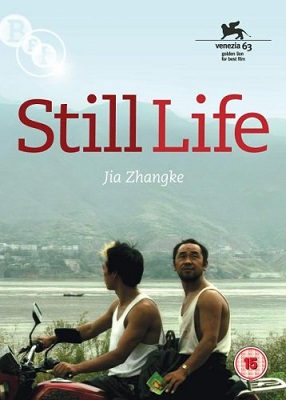
Still Life, Jia Zhangke (2006, China). That’s the last of the Christmas presents, and the last of Jia’s films until the box set containing Mountains May Depart that I’ve pre-ordered arrives. His films really are brilliant, so much so that each time I watch a new one I have to decide whether or not it is my new favourite Jia film. Still Life came close, perhaps just inching out 24 City but not managing to steal the top spot from The World. Still Life is set in the Three Gorges area and tells the story of Han Sanming (played by Han Sanming), who has returned to travelled to track down his wife and daughter who ran away sixteen years earlier. But the address he has for them is now underwater, part of the city that has been destroyed for the Three Gorges Dam project. Sanming joins a local demolition crew, who are demolishing buildings using lump hammers. The film then shifts to Shen Hong (played by Zhao Tao, who played the lead in The World, and Han Sanming played her boyfriend), a nurse who is in Fengjie to look for her husband, who it turns out has become a successful local businessman. In fact, he runs several demolition contracts, and Sanming works for him. He also has a rich girlfriend. When Shen Hong finds this out, she asks for a divorce. In the final section of the film, Sanming’s wife turns up and reveals that their daughter is now working furthe rsouth in indentured labour to pay off the wife’s brother’s debt. Sanming offers to take wife and daughter with him, but he would have to pay off the debt – and he doesn’t have the money. so he returns alone to the coal maines of Shanxi… Although a drama, Still Life plays like a documentary – it’s one of the chief appeals of Jia’s films – and some of the scenery on display is fantastic. The Three Gorges region is astonishingly beautiful, but it is also heavily built-up and, during the period the film was made, was being slowly demolished and flooded for the dam. It makes for some striking cinematography. Excellent stuff.

Ich möchte kein Mann sein, Ernst Lubitsch (1918, Germany). The title translates as “I don’t want to be a man”. Ossi Oswalda plays the high-spirited daughter of an indulgent uncle. When he leaves, she is put in the charge of a new guardian, who is far more strict. So she dresses up as a man and goes out on the town, ending up in a posh ball, where she finds it much harder to be a man than she had expected. She bumps into her new guardian, and tries to steal his date in revenge. Unfortunately, someone else has more success, and Oswalda and her guardian drown their sorrows in drink and become great friends. So much so they begin kissing each other. When they leave the ball, the cab driver drops Oswalda off at the guardian’s house, and vice versa. But it all works out in the end. Oswalda is undoubtedly the star of the film – there wouldn’t be a film without her. Her bad behaviour in the opening section of the film does an excellent job of outlining her character; and her antics when cross-dressed, most of which are based on a complete obliviousness to her disguise, display excellent comic timing. When you consider that Ich möchte kein Mann sein was made a dozen years before People on Sunday, and there’s not all that much that’s technically different between the two… it does undermine the claims to importance of People on Sunday. The latter is undoubtedly the better film – it’s longer, 73 minutes to the 41 minutes of the Lubitsch, and it’s a drama played completely straight and which makes a feature of its amateur cast. Ich möchte kein Mann sein is a flat-out comedy, although not the fall-about slapsatick comedy Hollywood was making at the time, and it makes a meal of its “fish out of water” story. A fun film, but one chiefly for fans of silent cinema.

1001 Movies You Must See Before You Die count: 895


1 Comment

Moving pictures 2018, #3

Moving swiftly on… This year, this blog is not going to turn into a repeat of last year. Honest. There will be content other than film reviews (or rants). But it’s going to take me time to get to that point, as I need to change a few of the bad habitds I’ve picked up over the last two years, so you’ll have to bear with me for a few weeks…

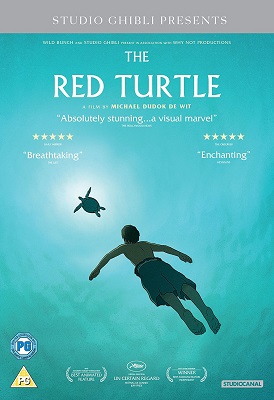
The Red Turtle, Michaël Dudok de Wit (2016, France). Sometimes, Amazon Prime really does throw up pleasant surprises. It would have thrown up more, recently, but it seems when they upgraded it they broke the subtitling thing, and they don’t show now unless they’re burned into the print. Which is fucking annoying. Streaming, eh. And people wonder why I prefer DVDs and Blu-rays… Not that the subtitle bug caused any problems with The Red Turtle, as it is notable for having no dialogue. A man is washed ashore on a deserted island. His attempts to escape on rafts are thwarted by turtles. Especially a large red turtle, which he manages to capture and drag on shore. The following morning, the red turtle has become a woman with red hair. The two live together and have a child. The child grows to a man. Who attempts to leave the island. And, okay, I admit, when the son was an adult, I spent most of the time wondering where his trousers had come from. It’s not like his father had a spare pair. But the animation in The Red Turtle is astonishingly beautiful, although not in a Makoto Shinkai way, more a ligne claire way. It’s not the most dramatic story to make it to the silver screen, true; but there’s some clever foreshadowing, and the lack of dialogue is no handicap to following the narrative. The Red Turtle has been praised by many and won a couple of awards, and Dudok de Wit won a special prize for Un Certain Regard at Cannes. The film was nominated for an Oscar but lost out to Zootopia (which I’ve not seen, but… really?). A definite candidate for my best of the year list.

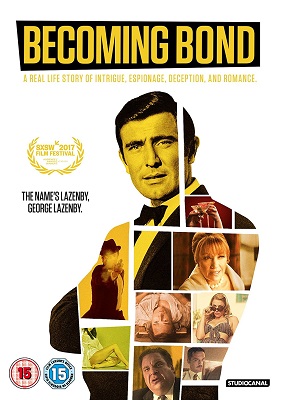
Becoming Bond, Josh Greenbaum (2017, USA). My promised Bondathon blog post is still to come – that’s the one in which I rank all twenty-four official 007 films in order, after watching them over 2 to 3 weeks… It should come as no real surprise that I think the best Bond film is… On Her Majesty’s Secret Service. In fact, I thought the best Bond movies were the stripped-back ones, without the stupid gadgets or supervillains. OHMSS was George Lazenby’s sole outing as Bond and popular wisdom likes to have it the film was bad and he was fired from the role as a result. In fact, Lazenby turned down a seven-film contract and a $1 million signing bonus (this was in 1969, so it was a fuckton of money). True, the film was generally considered one of the lesser movies in the franchise, but it has since been critically re-appraised and many consider it the best. I happen to agree. Becoming Bond is Lazenby’s story. He’s interviewed by the film-makers, but parts of his life are also dramatised, with Josh Lawson playing a young Lazenby. Lazenby’s career path to Bond is pretty well-known: mechanic to car salesman to male model. At the time Connery announced his retirement from 007, Lazenby was best known for a series of adverts for Big Fry chocolate. Broccoli met Lazenby and asked him to audition for the role of Bond. When Peter Hunt, editor on previous Bond films who had been given the director’s chair for OHMSS, met Lazenby, the role was pretty much his. Filming went well, although Lazenby insisted on doing his own stunts – there are conflicting stories about relations on-set, although the one about Rigg despising Lazenby, so much so she chewed garlic before a scene in which they kissed, is apparently untrue. Once OHMSS had been released, Lazenby refused to play ball with the producers. He turned up to the premiere sporting a beard. And he refused to sign a seven-film contract, despite the $1 million signing fee, partly thanks to bad advice from his agent who told him he could probably get $500,000 a role for any film going forward. Unfortunately, his film career pretty much died. He went into real estate, and earned a very comfortable living. Lazenby made a really good Bond. True, he was a bit stiff at first, but as the film progresses he settles into the role, so much so that he’s more convincing when undercover as Pursuivant, Griffin Or Sir Hillary Bray than Connery ever was as Bond himself. And in the action scenes, Lazenby displays real physical presence. The Bond fight scenes were always a bit crap, but Lazenby throws punches like they were real punches (he actually knocked out a stunt man during his audition). The next Bond to come close to Lazenby’s physicality is Timothy Dalton. Daniel Craig may be very physical, but it’s cartoon violence – compare the fight scenes set aboard a train in From Russia with Love and Spectre. Anyway, I should be saving all this for my Bondathon post. Becoming Bond is a fascinating documentary, which cemented my view that OHMSS is the best of the 007 movies.

Pedestrian Subway, Krzysztof Kieślowski (1974, Poland). I bought this box set when it was released a year ago, and it’s sat in its shrinkwrap until now. But Cinema Paradiso and the Royal Mail were conspiring against me in the week before and after Christmas, so I dragged it out and bunged in the first  Blu-ray… And this collection is really well presented. Really well presented. I had Dekalog on DVD, on two DVDs in fact, bought back in 2002 and 2004; but when this box set appeared, I bought it, and passed on the DVDs to a friend. And I’m glad I bought the boxset, and not just because of its additional material. As well as the ten episodes from Dekalog, two per disc, there are also one TV movie per disc and one documentary. I’ve not watched all of the latter, but Pedestrian Subway is the first of the TV movies. It was shot in black and white and takes place in a subway in Warsaw which boasts a dozen or so shops. A teacher is on a school trip to Warsaw, and sneaks away to visit a shop in the subway, in which works a woman, whom he apparently knows. The dialogue reveals that she is his wife and that he threw her out after catching her in flagrante delicto with another man. But now he misses her and regrets his decision. Apparently, Kieślowski threw away all the footage he had originally shot as he wasn’t happy with it, and hurriedly reshot the film from start to finish. It’s a clever piece of work – the relationship between the man and woman is revealed piecemeal, the events in the subway are a subtle criticism of the Polish regime, and some of those who appeared in the film had professional relationships with Kieślowski over a number of years. Dekalog is good drama on its own – which was something I had forgotten until I rewatched them, and I do find Kieślowski’s feature films a bit middle-brow – but these TV movies new to me turned out to be pretty damn good, so this is definitely a collection worth having.

Bahubali: The Beginning, SS Rajamouli (2015, India). I was recommended this film by Indian colleagues at work, and I’m happy to add Bollywood film to my rental list – classic or modern. In fact, I’ve now got my mother watching Bollywood films. I lent her a couple, and now she looks for them in charity shops and has just given me Kabhi Alvida Naa Kehna to watch … But Bahubali. Or Baahubali. This is very definitely modern Indian cinema, despite being set some five hundred years ago. It’s not actually Bollywood but Tollywood – a Telugu-language film rather than Hindi, and the second Bahubali film has been been India’s biggest box office hit ever. The first one also did really well, and clearly had a huge amount of money spent on it. It is, in fact, a total CGI fest. It opens with a woman falling down a massive waterfall. She dies, but her baby survives and is brought up by local villagers. But he is super-strong and repeatedly tries to climb up the waterfall to discover the land above. When he finally does make it, he witnesses a young woman being chased by soldiers. She escapes and he follows her to a cave, and learns she is a member of a group of rebels in the Mahishmati empire, supporters of a queen who is being held by the current emperor. So the young man, called Shivudu, helps her, and discovers that he’s actually the queen’s son. The film then goes into total flashback and explains how Bhallaladeva and Shivudu’s father, Bahubali, went to war for the throne of Mahishmati. The battle scenes are fantastic – a cast of tens of thousands, almost all of which are CGI, but pretty convincing CGI. The waterfall too is CGI – it appears to be several thousand feet high, which is just ridiculous, but all in keeping with the general scale of the film. It’s like Lord of the Rings without the hobbits and elves and orcs. But turned up to eleven. And I’ve yet to watch the second film…

Side/Walk/Shuttle, Ernie Gehr (1991, USA). While hunting for a Benning film to watch on Youtube, I stumbled across this. Gehr also makes experimental films, and his career too began in the 1960s. I do like experimental films, although the most prominent examples appear to be American and I’d like to see more by other nationalities. But I’ve watched Maya Deren and Stan Brakhage and Bill Baillie, and I’d like to see more US ones too. Side/Walk/Shuttle was filmed from an outside elevator at a San Francisco hotel, and consists of footage from the lift and an unrelated soundtrack. It’s hypnotic, in the way real art can be, despite its simplicity. One of the beauties of video art is that anyone can do it, but it has to all fit together for it to be art. If you know what I mean. What differentiates random footage and art is purpose and structure, even if neither are apparent. A person locks off a camera and films ten minutes of a forest. That’s not art. But if the film-maker is trying to prove a point, or has a message, then it is. Even if not all the clues to to that point or message are evident. I’m reminded of a Turner Prize nominee from a decade or so ago which was basically a copy of the cover art of  a science fiction novel – by Tony Roberts, I seem to recall – but the art was more than just a painting. I’ve said before that video installations are my favourite form of art, and one of the beauties of video art is that you can embed the extra-textual knowledge in it. Which some do. Other make it part of the exhibit – ie, the text explaining the installation. You can’t avoid extra-textual knowledge in any artform. The alternative is “As you know, Bob,” conversations and the worst sort of exposition, which we science fiction readers know all about. On the one hand, I think art should be more than just is presented because it needs to be in dialogue with previous art and with culture; on the other, not everyone is sufficiently informed to plug into that dialogue. Catering to the latter only results in bad art.

Personnel, Krzysztof Kieślowski (1975, Poland). One of the ways in which this collection proves its worth is in the included documentaries. In KKTV, critic of Polish cinema Michael Brooke discusses Kieślowski’s career. Brooke doesn’t have much screen presence, and is clearly reading from a prepared script (and I was amused to spot the Mondo Vision editons of Żuławski’s films on the shelves behind him). But what Brooke had to say was very interesting. And when talking about Personnel, he made the film seem far more interesting than it would have initally appeared. A young man joins the staff of a local theatre in the costume department, and witnesses how the company operates on a day to day basis. He becomes involved in a denunciation of a colleague, and has to choose between loyalty to his friend or his own career… It’s a dilemma many, even in the UK or US, can likely identify with, although in communist Poland the consequences were far more severe. Brooke mentions that Personnel is partly autobiographical, that one of Kieślowski’s first job was in a theatre, and that some of the incidents in the film Kieślowski has admitted in interviews were taken from his own experiences. I don’t think the central one is, however, in which one of the performers publicly bollocks and humiliates a member of the wardrobe department on stage (the man who is eventually denounced, in fact). But I think the incident with the exploding cigarettes might have actually happened to Kieślowski.

1001 Movies You Must See Before You Die count: 895


Leave a comment

Moving pictures 2018, #2

I plan to watch less films in 2018 than I did in 2017, and already I’m spending an hour reading when I get home from work, and only putting a film on afterwards. And yet I’m three dozen films in and it’s only the 17 January as I type this, and I’ve a third and fourth post, with another dozen movies already lined up… Oh well.

Nightfall, James Benning (2011, USA). I found this on Youtube, which seems to be the place to find Benning films, as the Österreichisches Filmmuseum has only released half a dozen or so DVDs of his work. Some of his films are apparently available via Mubi, but I’ve yet to subscribe to it. Meanwhile, there are (often low-quality) copies uploaded to Youtube by various fans, plus Benning’s own Youtube account. Nightfall has nothing to do with Asimov, thankfully, but is 98 minutes of a forest high in the Sierra Nevada Mountains as the sun sets. That’s it. Benning locks off his digital camera, and leaves it running. It’s about as stripped-back Benning as you can get. Unfortunately, there’s an extra-textual element to much of Benning’s work – the juxtapositon of sound and vision, for example, and the reasoning behind it – and watching one of his films on Youtube means you don’t have access to that extra-textual knowledge. You can google for it… and I did. But all I could find claimed that Nightfall was precisely what it presented to be. But, knowing Benning’s work, I suspect there’s more to it than just that. I shall have to look further.

Elle, Paul Verhoeven (2016, France). This was a Christmas present. The last I’d heard, Verhoeven was working on some project back in the Netherlands after his successful Black Book, and it seemed pretty certain his Hollywood career was on hiatus as, despite the success of his Hollywood films, I suspect he was too idiosyncratic and the sequels by other hands to his movies had seen diminishing returns. Now, the movies he made in Hollywood were (mostly) top-notch, and while the Starship Troopers live-action franchise (not to be confused with the CGI one) upped the satire with each new installment, it also lowered the audience figures. The Robocop sequels went into a death spiral in terms of both quality and commercial success. And the sequel to Basic Instinct was a Sharon Stone vanity project, and rightfully bombed. (There was also an unofficial sequel to Showgirls, made by a porn actress who had a bit part in the original; it’s absolutely fucking dreadful.) So, Verhoeven: no longer Hollywood. And now he appears to have reinvented himself as French cinema’s successor to Andrzej Żuławski. Because Elle pretty much plays like Verhoeven channelling Żuławski. Which is no bad thing, I hasten to add. Plus, it stars La Huppert. Which is also a good thing – she is probably the best actor currently making films. In Elle, she plays the CEO of a video games company which has a fairly typical testosterone-driven nerd culture. One night, she is raped by a man who breaks into her house. Afterward, she carries on as if nothing had happened – but now she is suspicious of every man in her life: employees, friends, neighbours… The violence is played flat and brutal, which is a Verhoeven trademark, but the way the story pans out feels more Żuławski… although Verhoeven doesn’t have his cast acting as emphatically as Żuławski does. It’s an odd film, a very French drama into which these violent incidents erupt. Which is, I suppose, very Verhoevenesque.

Utamaro and His Five Women, Kenji Mizoguchi (1946, Japan). David Tallerman, who likes his Mizoguchi, gave me this box set as he had upgraded his copies of the films it included. (I’ve done the same for him when I’ve upgraded from DVD to Blu-ray.) Utamaro and His Five Women is set during the Edo Period in, er, Edo. The film opens with a samurai art student taking issue with the text on a print of a painting by Utamaro. He tracks him down and challenges him to a duel. Utamaro challenges him to a drawing contest instead… which he wins so handily, the art student joins him as an apprentice. And it’s the new apprentice’s girlfriend who becomes the first of Utamaro’s women, each of whom are combinations of model and muse. The second is a famous courtesan who has him paint on her back for a tattoo artist to use as an outline (as per the box set cover art). Another of his women is a lady’s maid he spots at the beach, diving into the sea among a large group of women and bringing out fish. One of the interesting things about this film – and it’s a good film if you like Japanese historical films – is that it was made under American Occupation immediately following WWII, and the Americans didn’t like the Japanese to make historical films as they thought they were militaristic and nationalistic (according to Wikipedia). But they let Mizoguchi make this.

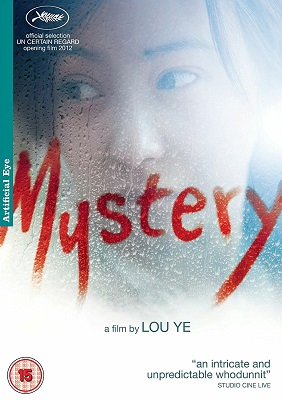
Mystery, Lou Ye (2012, China). Another Christmas present. Lou is a Sixth Generation director from China, and I’m a big fan of those films by the group I’ve seen. Other members include Jia Zhangke, Wang Xiaoshuai, Zhang Yuan,  whose films I’ve seen and much admire; and Lu Chuan and He Jianjun, whose movies I haven’t seen. Lou’s Suzhou River is a thriller/drama with a very clever structure; Mystery, a later film, also uses a non-linear narrative to tell its story. It also has that same documentary style approach to its narrative, which is, I freely admit, one of the real draws of Sixth Generation films. The movie opens with a young woman wandering out into a road and being hit by one of two racing sportcars. Except it may not have been an accident, as she appears to have been fatally assaulted beforehand. Lu Jie makes friends with Sang Qi at a playground where both their kids play. Sang is convinced her husband is having an affair and asks Lu to meet her at a coffee-shop to discuss the advisability of hiring a private detective. But it turns out the coffee shop overlooks the hotel where Sang’s husband meets his mistress. Except… Lu sees her own husband entering the hotel with a young woman. So Lu investigates, and discovers that Sang is also her husband’s mistress and Sang’s young son was fathered by him… You have to keep your wits about you to follow this, although the way the story is presented is deceptively simple. It’s the flashbacks, you see. The situation is complicated, and only revealed piecemeal. Definitely worth seeing.

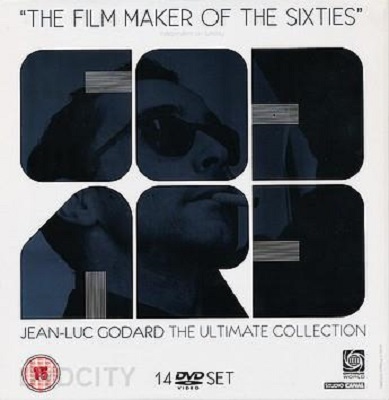
Notre musique, Jean-Luc Godard (2004, France). I’m almost done with this Godard box set, and I’m really glad I bought it. These are films to watch again and again. Godard’s films have never been exactly traditional. Even in his early Nouvelle Vague movies, he played around with narrative forms. Later, he experimented even further. And continues to do so. Notre musique is from Godard’s phase when he mixed fact and fiction, and often played the protagonist himself. After an opening non-narrative section of documentary war footage, the film presents Godard waiting at an airport prior to flying to an arts conference in Sarajevo. He meets a man who will be an interpreter at the conference, French, but originally Israeli, whose niece will also be at the conference. Godard is interviewed by an Israeli journalist, who later interviews Mahmoud Darwish. Both interviews concern Israeli-Palestinian relations. For all his cleverness and cinimatic tricksiness, Godard was never especially subtle. His films are always about something, and if it’s not that which drives the narrative, then you can be sure the characters will discuss it a number times during the movie. Some of his films in fact are little more than discussions among members of the cast. In order to make a point, Godard not only uses language, ie, the spoken word, but also the language of narrative, and even the language of cinema. The epitome of this being, of course, his film Goodbye to Language (see here). (Although I prefer his Film Socialisme (see here), which is similar.) It’s not necessary to agree with Godard’s argument to appreciate his films, but then I don’t think he expects his films to be persuasive per se, more that they’re presented as arguments and their chief purpose is to provoke discussion (but from a sincere position). Anyway, this is by no means Godard’s best film of this sort, nor his most intriguing; but it certainly bears rewatching.

Emperor, Peter Webber (2012, USA). My mother lent me this one. I’ve watch a film about General MacArthur and Emperor Hirohito before, but it was Sokurov’s The Sun (see here), which could not be more different to this US take on the same historical events. Emperor is told from the point of view of Brigadier-General Bonner Fellers (a real person, like everyone in this film), who was a member of MacArthur’s staff and tasked with discovering Hirohito’s complicity in declaring war on the US. Before the war, Fellers had been in a relationship with a Japanese woman studying in the US, but she had returned home hurriedly for family reasons. He followed her back to Japan, weathered anti-Western sentiment from newly-militarised Japanese society, and met her father, a decorated general. As a Japanist, he’s a good choice to investigate Hirohito, although he did abuse his position during the war so that his girlfriend’s town was avoided by US Army Air Force bombers. MacArthur, meanwhile, is more concerned about using his occupation of Japan as a stepping-stone to the US presidency. To that end, he runs roughshod over Japanese imperial protocol. I happen to think humans are not gods, divine right is a con, and anyone who thinks royalty is any way different to anyone else is stupid. Despite that, Emperor was based on historical events and, as far as I can tell from some quick online research, quite accurate. Okay, Tommy Lee Jones somewhat overwhelmed MacArthur, but the remaining cast were, I guess, sufficiently unknown to me they could be seen as the historical characters they played. The CGI showing a devastated Japan was quite effective but, to be honest, the whole felt more worthy than it felt notable.

1001 Movies you Must See Before You Die count: 895

5 Comments

Moving pictures 2018, #1

I’ve no plans to give up writing about the films I’ve watched – and I still plan to chase completing the 1001 Movies You Must See Before You Die list 2013 edition, and to watch films from as many countries as I can. But I’m not intending to write another seventy of these posts in 2018 as I’m going to try and read more books this year.

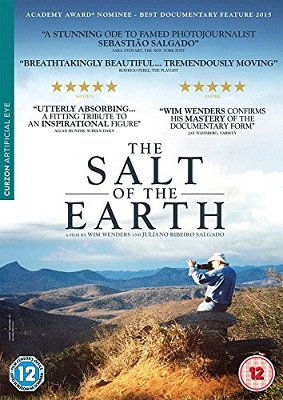
The Salt of the Earth, Wim Wenders & Juliano Ribeiro Salgado (2014, France). I don’t know if I stuck this on my rental list because it was by Wim Wenders or because it was a documentary that looked interesting. But it certainly shouldn’t be confused with the excellent 1954 social drama about a strike at a US mine, whose title lacks the definite article. The Salt of the Earth is about photographer Sebastião Salgado. Born in Brazil, Salgado was originally an economist. While living and working in Paris, his wife bought him a camera. He began using it on his trips to other countries. Eventually, he gave up his career to focus on photography. His photographic work tends to stark black and white photographs of people in extreme situations – refugees, famine victims, war, workers at a vast open gold mine… It’s fascinating stuff, and Salgado’s work is both beautiful and harrowing, some of it perhaps too harrowing. Although Salgado has been exhibited all over the world, I’ve never seen any of his exhibitions – but then it’s only the last five or six that I’ve started visiting art museums, and I usually go to the modern art ones… but I did discover the work of Richard Mosse at one such. (Although this Christmas, I visited the David Collection‘s exhibition of Islamic Art, which was cool; and I liked their exhibition of paintings by Vilhelm Hammershøi (1864 – 1916).) Anyway, The Salt of the Earth is worth seeing.

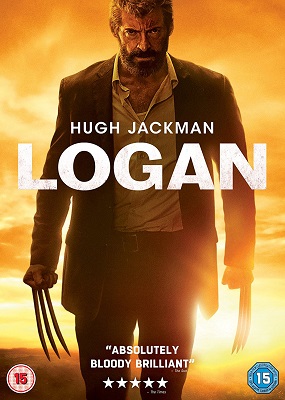
Logan, James Mangold (2017, USA). Professor X says “fuck”! He says it a lot! I mean, okay, you expect that from Wolverine, but Professor X dropping the f-bomb is just weird. One day, someone will decide Logan is a post-superhero film, when in fact it’s just a straight-up superhero film, and if it does something new in MCU terms, I’m pretty sure the comics have covered similar ground many times in the past. Logan works as a limo driver, he is ageing and his powers are waning. He lives just over the border in Mexico, in an old industrial plant, where he and Caliban look after a doped-up Professor X. Who is doped-up because he had some sort of mental fit which killed a lot of people and they’re medicating him to prevent a re-occurrence. And then a woman turns up with a young girl in tow and begs for Wolverine’s help. It turns out Nasty Corp has tried to weaponise mutants by breeding kids with superpowers – come on, who wants to play in a universe in which scientists experiment on children? Are you sick? – and the girl is one of them, in fact she has Wolverine-like powers and is a pretty mean fighter to boot. So snarky cyborg enforcer, with private army at his back, and Mengele-like scientist played by Richard E Grant, go mano a mano against Logan, who has gone on the run with the Prof and the girl… And that’s about it. Yawn. It’s a chase movie, the baddies are tooled up, the good guys are either old or young but still not massively outmatched… It’s a definite improvement on the usual dreadful superhero films with their cartoon characters, who cause as much damage as the supervillains, and cartoon violence and cartoon morality. They don’t even have the saving grace of cartoon wit. It might well be that Logan is the superhero film growing up, but it’s got a long way to go yet.

The Sense of an Ending, Ritesh Batra (2017, UK). I read Julian Barnes’s novel of the same title during Bloodstock last year. I seem to remember it being a bit of a damp squib. A very nicely written novel, but it just sort of petered out, and its concerns were so trivial I really couldn’t care about any of its cast. And the same is, unsurprisingly, true for the film. Jim Broadbent plays a very Jim Broadbent character, who has his past rudely thrust in his face when he’s willed a diary by the mother of a woman he used to see when he was at university thirty-plus years earlier. Except he doesn’t have the diary. Because the woman, played by Charlotte Rampling, won’t give it to him. In fact, she tells him she destroyed it. So he stalks her, and discovers she has a mentally disabled son called Adrian… which is also the name of Broadbent’s best mate at school, who went on to marry Rampling after she and Broadbent drifted apart. Prompting a really shitty letter to them on his part. However, Adrian junior is not Rampling’s son, but her half-brother. And Broadbent sort of remembers an afternoon alone with Rampling’s mother… Yawn. We all confabulate, it’s a fact of life. It seemed a really feeble point to a story that didn’t appear to be going anywhere – no matter how well-acted, or -written, it was. Missable.

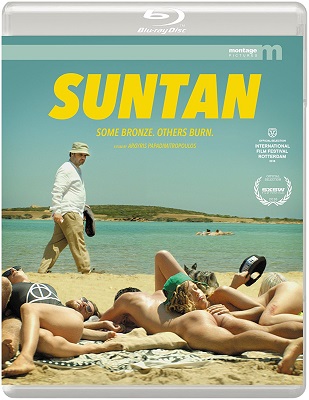
Suntan, Argyris Papadimitropoulos (2016, Greece). You know that story in The New Yorker that went viral the other week, and the writer ended up with a $1.2 million advance for her short story collection? There’s no logic behind why one thing goes viral and another doesn’t, although the story clearly described a situation many women had experienced. I’ve seen plenty of evidence of it happening on social media myself. It’s the same premise which drives Suntan. Kostis is hired as a doctor on a small holiday island. He keeps mostly to himself, but one day he treats a twenty-one-year-old female tourist, Anna, who flirts with him and invites him to the beach with her friends. So, after work, he heads down there, and sees Anna and her friends sunbathing nude or in skimpy outfits. They recognise him and he joins them… and over the space of several days, he spends his time after work hanging out with them. One evening, the two have sex on the beach. But then Anna disappears for several days, and when she returns Kostis is furious she left without telling him. She saw no reason to tell him, and is put off by his behaviour. He does the male thing, and stalks her. The film ends with a drunk Kostis, who has been fired from his job for his bad behaviour, kidnapping Anna… I have not watched much Greek cinema, only four films in fact, by Angelopoulos, Lanthimos, Tsangari and now Papadimitropoulos; but what I’ve seen has been very good. Recommended.

Your Name, Makoto Shinkai (2016, Japan). There’s no doubt Shinkai has produced some of the best feature-film anime to have come out of Japan this century – Your Name‘s home box office is only second for anime to Spirited Away (and Spirited Away holds the record for highest-grossing film in Japan). Mitsuha lives in a small town in central Japan. She has dreams about a boy in Tokyo. One day, she finds the words “Who are you?” written in her exercise book, and her friends remark on her weird behaviour the day before. It turns out she and the boy, Taki, have been swapping bodies. They help each other with other’s lives, communicating via notes or text messages they leave each other. Taki tries to track Mitsuha down, but all he has is a sketch of her town. He eventually discovers the town was destroyed by a meteorite, a piece of a passing comet, three years earlier. Their body-swapping time-slipped. So Taki tries to tell Mitsuha she must persuade the town to evacuate on that night… As you would expect from Shinkai, the animation in Your Name is gorgeous. It takes a moment before the story starts to pick up and it’s clear what’s going on – the viewer is initially just as confused as Mitsuha. But as the plot unfolds – as it’s clever how it works out – so you’re drawn into, first, the mystery, then the rush to warn Mitsuha, and, finally, the race to change the past. Good stuff. I suspect this may be an early runner for by top five of the year.

Star Wars VIII: The Last Jedi, Rian Johnson (2017, USA). So let’s talk about The Last Jedi. It is, I think, the dumbest of the Star Wars films yet, and that’s not an especially high bar to clear. It does some things well and it makes some interesting choices, but in its headlong rush to reset the universe back to what it was when the franchise kicked off, it runs a series of set-pieces which make zero sense either in relation to the world-building, the characters, or the warped physics that pertain in space opera movies. I liked that the Resistance is now run by women, older women, and I can’t help but wonder what the film might have looked like had Carrie Fisher completed filming. I liked Laura Dern’s character and I thought she was used well. But. Poe Dameron is not only a liability, he was pretty much responsible for the destruction of the Resistance. I realise the story template needed to have the Resistance reduced to a small band of heroes (which is a blatant retcon of the original trilogy, anyway; but never mind), but Dameron should have been booted out of the airlock after his first stupid stunt with the space bombers. (“I like him,” says General Organa… even though his dumb plan just resulted in the deaths of around 90% of the Resistance? Huh.) And… space bombers. WWII in space is one thing, but… space bombers. Bombs don’t fall in space… because there’s no gravity. It’s one thing to send a squadron of really slow spaceships on a suicidal mission – stupid, but it fits Dameron’s character and the Resistance’s clear military incompetence – but making them bombers is… Ugh. Next, there’s the central narrative of the film: the First Order’s big fuck off superstardestroyers are chasing the ragtag fugitive fleet of the Resistance… who can’t go very fast, only just fast enough to keep out of range of the First Order’s big fuck off superstardestroyers’s guns. I mean, really? Was that the best they could think up? Hugely powerful stardestroyers can’t catch up to a medical frigate? And they used to have a gun that could fire across the entire fucking galaxy in an instant? But now their superstardestroyers’ guns have an effective range of a few thousand kilometres? It’s such blatantly manufactured jeopardy, it feels like it’s treating the audience with contempt. Yes, yes, the General Organa blasted into space thing was silly, but made more sense within the universe than the space bombers did. On the other hand, I did like the sections set on Skellig Michael, and I thought the bit with the mirrors was especially good. Rey, in fact, makes a really good hero, much more so here than in The Force Awakens, where she seemed overwhelmed by the story. Kylo Ren, however, is still a petulant blank, whose characterisation and motivation bounce all over the place. (Having said that, the fight scene in the throne room was a proper bit of action sf cinema.) The Last Jedi also muffed its major villain – we don’t know where Snoke came from, and he dies without us learning. All that build-up for… zip. But then I still don’t understand how the First Order managed to pay for, build and staff a fleet of big fuck off superstardestroyers, while the actual government of the galaxy, the New Republic, ends up stuck with the pieces of crap it had when it destroyed the Death Star. That’s the big problem with this new Star Wars trilogy – it wants to go back to the plucky band of heroes versus the big bad empire, but it can’t plausibly get there within the lifetimes of its heroes. So the film-makers just went, ah fuck it, let’s have a new evil empire that’s more powerful than the Republic which defeated the old evil empire hiding out somewhere all along, just in case, you know, the old evil empire was defeated… Or something. And we’re supposed to swallow it. Can you imagine if the Fourth Reich turned up from nowhere in the 1970s, and it was better-equipped than the USA and USSR combined? Having said all that, lots of people have been finding positive things in The Last Jedi that were sadly lacking earlier Star Wars films. If we can just add intelligence to that list, then the next one might turn out alright…

1001 Movies You Must See Before You Die count: 895

1 Comment

Moving pictures 2017, #70

This is it, the last post of the films I watched in 2017. I hope they’ve been entertaining, and perhaps informative. And if I’ve made new fans of some of my favourite directors, then I can honestly say I’m happy and they’ve been worth the effort.

Of course, because that’s the way it goes, this series of post ends with more of a whimper than a bang…

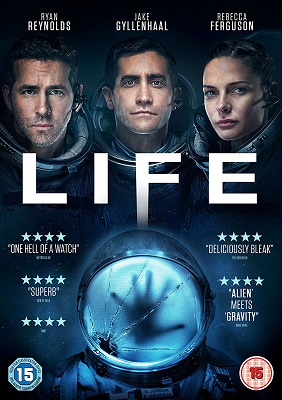
Life, Daniel Espinosa (2017, USA). I can just imagine the pitch meeting. Hot young producer: “So they take this alien creature, a microbe say, onto the space station to study it, and it grows… and this is the kicker… it grows into an alien killing machine! And it kills off the crew one by one!” The studio executives are all nodding and going: “This sounds very original and exciting.” Meanwhile, the PA in the corner is banging her head against the desk and muttering, “It’s Alien, for fuck’s sake. It’s Alien, for fuck’s sake. It’s Alien, for fuck’s sake.” And yup, that’s pretty much what this is. Okay, so it’s no facehugger, but a microbe is brought from Mars by a probe; and it’s not the Nostromo, a corporate tug light-years way from Earth, but the ISS (of a decade or two hence) some 400 kilometres above our heads. But the plot is Alien from start to finish. And it adds nothing to the original. I like the idea of using the ISS and showing an accurate depiction of living in space in a commercial sf/horror movie… except it’s not that accurate. The ISS of the film looks like it was initially based on the real thing, but the Cupola is ten times larger, and everywhere is a bit dim and ill-lit, not the shining white of the real thing. As for the rest of the movie… microbe grows into alien monster, alien monster kills astronauts. Yawn. Apollo 18 did the monster space fiction thing better; Alien did the haunted house with monster in space thing better. Life is shit. And then you die. Or something.

Tre Fratelli, Francesco Rosi (1981, Italy). Until I started watching this, I hadn’t realised it was by the director of Christ Stopped at Eboli, which I watched last year and liked a great deal. I’d also thought Tre Fratelli was on the 1001 Movies You Must See Before You Die list. But apparently not. Or, at least, not the 2013 edition I’ve been using. And, for some bizarre reason, despite the year of release, I had it in my head it was Italian Neorealism Which it is not. It’s a well-observed and -played drama, much like the other Rosi film I’ve seen. Well, except for the dream sequences. Whech were quite odd. Especially the one for the brother who works as a counsellor at a borstal-type place. The other two brothers are a judge, who has just accepted a terrorism case and his wife now fears for their lives, and a factory worker involved in a strike. The judge’s wife, it turns out, has good reason to be scared. I should watch more films by Rosi, I think. I thought this one pretty good, too.

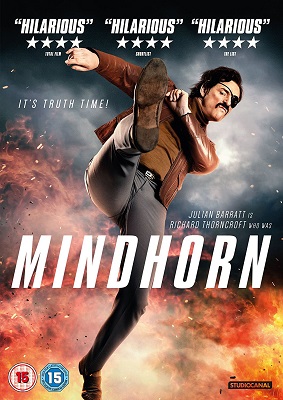
Mindhorn, Sean Foley (2016, UK). I found this on Amazon Prime, it was late, I’d had a glass of wine or two, and it proved entertaining enough I sat through it to the end. The title refers to an early 1970s detective character on television played by a now washed-up actor. There’s a murder on the Isle of Man, and the chief suspect goes into hiding and insists he will only give himself up to ‘Mindhorn’, as if the fictional detective were a real person. So the actor has to play him one more time. Naturally, being a complete dickhead, he tries to take over the investigation, but the police treat him with the contempt he deserves. Just to confuse matters, Mindhorn’s love interest from the telly show (and real life) also lives on the Isle of Man… but she married the stuntman who doubled for Mindhorn. Who is a smug, and none too bright, plonker. That’s the problem with films like this: the characters are all “characters”, not real people, comic caricatures on which the writers and/or actors have lavished much time and effort. It can kill a comedy. Happily, here it doesn’t. Not because the characters are well-drawn, but because they grow, Mindhorn himself especially. Yes, he’s a total dickhead, but he becomes more sympathetic as the film progresses. The central premise is not especially original – and, to be honest, Norwegian Ninja spoofed the concept way better – but Mindhorn manages to be a consistent, and plausible, low-budget alternative. I enjoyed it. Worth seeing.

South, Frank Hurley (1919, UK). Hurley was an Australian who accompanied Shackleton on his 1914 to 1916 expedition to Antarctica. South is a compilation he made of the footage and photographs he shot during that period, as well as on a 1917 expedition to South Georgia. This is similar material to Herbert G Ponting’s footage of Scott’s ill-fated expedition, although Shackleton of course returned home. It’s fascinating stuff, not just seeing unspoilt wilderness as witnessed by among the first human beings to visit it, but also the crude yet effective methods used to combat the appalling conditions. South doesn’t have the same frisson as Ponting’s The Great White Silence, and not just because there’s no tragedy attached, but because it has less of a narrative through-line. It’s a compilation of documentary footage almost a century before non-narrative cinema became a thing. It’s fascinating, but it’s probably an acquired taste.

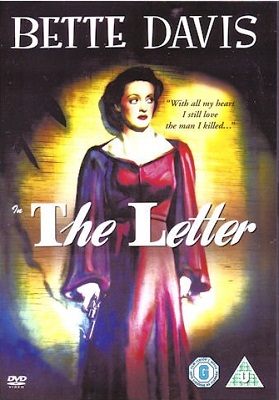
The Letter, William Wyler (1940, USA). Bette Davis is the wife of a British rubber plantation owner in Malaya. She shoots a man in cold blood, and then claims it was self-defence as he had assaulted her. Everyone rallies to her side, and she seems to take the legal hoops through which she must jump as no more than an inconvenience she had herself initiated by shooting her assaulter. Except, it’s not so cut and dried. As the husband discovers when Davis confesses the dead man was her lover and she loves him still. My mother found this DVD in a charity shop, and it was only after watching it that I discovered it appears on a best films list – not one of the 1001 Movies You Must See Before you Die lists, but perhaps a They Shoot Pictures Don’t They one – so clearly it’s held in regard by some. I found it a well-played, if dated, drama, likely due to its origin as a play by Somerset Maugham, although Wyler, a name I know quite well and normally a safe pair of hands, didn’t seem to bring much to the adaptation. It played like a Davis vehicle, and while perhaps better written than most such, it had more the feel of that than of a cinematic adaptation of an ensemble theatre piece. Enjoyable enough, but not one to seek out.

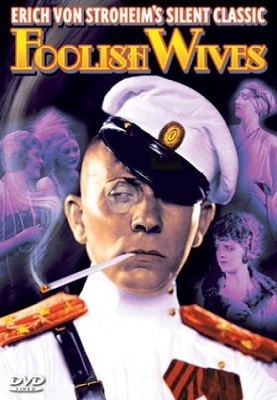
Foolish Wives*, Erich von Stroheim (1922, USA). I had to buy this from a seller on eBay who had ripped an out-of-copyright version,  because it’s not actually available on DVD in the UK or US. Despite being such an important film. But, of course, it was a silent film, and importance means fuck-all when compared to commerical success, and silent films stoped being commercially successful back in the 1920s, shortly after The Jazz Singer was released (although many excellent silent films were released years later – FW Murnau’s Tabu wasn’t released until 1931). Von Stroheim plays a con merchant who pretends to be a German aristocrat in order to separate rich US women from their riches. It’s a genre of film which, to be honest, should really be instructional for the prospective con artist rather than tell the victims’ stories, and it’s only the fact films take so long to make it into the cinemas that renders the techniques they reveal useless. Well, that and rich people’s desire to safeguard the wealth they’ve stolen. But who gives a fuck about them. Our culture does not always reflect our concerns, sometimes it drives them. So long as the rich are valourised in popular media, so their depredations will be accepted in real life. Commercial media is a powerful tool, as the right wing press has learnt, and attitudes can be changed through film and tv. But for all, say, Dr Who’s progressiveness, Hollywood’s regressiveness has meant two steps back for every one step forward. Foolish Wives is nearly a century old, but it had a more responsibile attitude to its topic than anything produced by Hollywood in the past thirty years. True, it was going for a moral lesson, and it was one that punished the director’s character – but he did little more than Wall Street has done, and he saw his just desserts. Wall Street never has.

1001 Movies You Must See Before You Die count: 895

3 Comments

Moving pictures 2017, #69

I have two of these posts left to round off my film-viewing in 2017. Which means 70 Moving picture posts, each of half a dozen movies (although one or two might only have been five movies), which by my reckoning, if my maths is right, is around 420 movies I reviewed during the year. Although, “review” might be a bit strong a term for my rambles and rants. Anyway, this time around I managed it again – six films, six different countries. Admittedly, half of the the films were by directors known to me, and I’ve seen other films by them, but never mind.

Hollywood Hotel, Busby Berkeley (1937, USA). That’s the last of the Busby Berkeley Collection 2, with only four films in this set instead of six. And they weren’t especially good ones. Hollywood Hotel was directed by Berkeley but doesn’t feature any of his signature production numbers, unfortunately. Dick Powell plays a small-town saxophonist who’s been hired by All Star Pictures in Hollywood. He leaves his position with Benny Goodman’s band – Benny Goodman played by Benny Goodman – flies to California and is put up in the eponymous hotel. Which is also where big movie star Mona Marshall has a suite. And Marshall has just thrown a diva tantrum and refuses to go to the premiere of her new film. So All Star Pictures put out a casting call for a lookalike, and hire Virginia Stanton to impersonate Marshall at the premiere (Marshall and Stanton are played by real-life sisters Lola and Rosemary Lane, of the Lane Sisters), and and also order new-hire Powell to accompany her. No one tells him, however, that she’s not the real article. Cue mistaken identity hilarity. Powell is then fired, and ends up working at a drive-in burger joint, before getting another chance at stardom, with the help of Stanton. Hollywood Hotel is mostly entertaining, although the musical numbers are a bit weak – except perhaps for the Benny Goodman ones. Lola Lane is terrible, but Rosemary Lane is good, which is weird. Unfortunately, the film suffers from a lack of a big production number, and, it has to be said, a completely unrealistic depiction of how Hollywood works… Meh.

Souvenir, Bavo Defurne (2016, Belgium). I found this on Amazon Prime, which occasionally throws up films worth seeing. Isabelle Huppert plays a factory worker who was once a winner of an analogue to the Eurovision contest. A young boxer who starts work at the factory recognises her, enters into a relationship with her, and persuades her to have another go at stardom. So she re-enters the pan-European song contest, with some help from her ex-mentor (and ex-lover), and proves a big success. Huppert plays her part with a weird distanced sort of smile on her face all the time – the character is an alcoholic, but I don’t think that’s what she’s trying to convey. And the song she sings during her auditions and performances isn’t actually very good. I don’t recall when Huppert is supposed to have won the contest, but it can’t have been that long ago, the eighties perhaps. And yet it sounds to me – and I’m no expert on French pop, although I’m a big fan of French bands Niagara and Guesch Patti, both of which were successful during the late eighties and early nineties, but they were pop rock, and not the drippy saccharine ballard Huppert sings. It’s an interesting story, and played well by its cast – although this is Huppert, so what do you expect – but it all felt a bit dated, and the music on which the story rested seemed too weak to carry the movie.

A mohácsi vész, Miklós Jancsó (2004, Hungary). This is the fifth of the Kapa and Pepé films, and just as baffling as the earlier four. Unlike the previous four films, it appears to be mostly historical, alth0ugh it doesn’t make a great effort to present an historically accurate mise-en-scène – which is not in itself a problem, as some great historical films have made little effort to convince in terms of mise-en-scène, and I’m thinking of several by Sokurov here as good examples…  But, of course, the Kapa and Pepé movies don’t so much revel in their anachronisms as make it a feature of the series. The two titular characters are, after all, supposed to be timeless. So while A mohácsi vész – the title translates as The Mohács Evil, and refers to the Battle of Mohács… although I’m not entirely sure if it’s the 1526 battle or the 1687 one, although the costumes suggest the former. But Péter is crowned king – and to be honest, I suspect the two swap identities beween films, if not in the films themselves – is crowned king, and battles the… Ottomans? (Not Ottomen obvs.)  But then the film jumps to the modern day, and the same character dynamics and relations – and even arguments – still seem to apply… although the mise-en-scène is now an abandoned factory or something. Music features just as heavily, although in this case it’s provided by a male-voice choir. Partway through the film, Kapa and Pepé make use of an autogyro type vehicle – it’s clearly faked up for the film and would otherwise not fly – but it feels more like a time-machine, especially that from George Pal’s 1960 film, although that may be simply be me layering my own cultural references on the film, especially given that in A mohácsi vész the autogryro seems to only fly. If that makes sense. I’m a big fan of Jancsó’s sixties films, with their overtly political stories, declamatory dialogue, and almost dance-like staging in which the cast are continually on the move. These Kapa and Pepé movies are completely different, although they play just as many games with the medium’s form and expectations – there are layers and layers to the movies, and that’s not taking into account the meta-cinematic nature of some of them in which Jancsó himself appears… and is killed… only to re-appear later as himself again. The six films, offered as a “set”, were a lucky find on eBay. I’m glad I bought them. And I’d still like more of Jancsó’s oeuvre to be made available.

The Legend of Bhagat Singh, Rajkumar Santoshi (2002, India). Back in the 1940s, while Mahatma Gandhi was waging a campaign of non-cooperation against the British in order to win India’s independence, Bhagat Singh was a member of the Hindustan Republican Association and fighting his own battle for independence. Where Gandhi promised self-rule, and replacement of the British by the Indian upper classes, Singh preached true equality and independence. He also used more traditional terrorist tactics to make his point – beginning with the murder of a police officer, and ending up with a symbolic bombing of the Indian parliament (symbolic in as much as it wasn’t intended to harm anyone, and Bhagat and his fellow bomber surrendered immediately afterward). Once in court, the HRA use the dock as a platform to get their message out to the country. In one scene, they cross-examine an ex-member of their group who is a government witness and trick him into revealing the recipe for a homemade bomb – which the press dutifully record, and print the next day. But, of course, this is also a Bollywood film, so there are dance numbers. And they’re handled quite well. To anyone not used to the Bollywood formula, their presence in an historical drama about the fight for Indian independence might seem odd, but… Bollywood. I enjoyed this, and learnt something about India’s twentieth-century history I hadn’t known (I had known the British behaved like total racists bastards, as we have done throughout our history, but I’d not known about Singh and the HRA). Worth seeing.

Indiscretion of an American Wife, Vittorio De Sica (1953, Italy). Apparently top US producer David O Selznick wanted a vehicle for his wife, actress Jennifer Jones. For whatever reason, he chose De Sica to make it – a story set in Italy, based on an Italian novella, starring Jennifer Jones and Montgomery Clift in the lead roles and an otherwise mostly Italian cast. De Sica did not deliver the happy rom com Sezlnick wanted, which is probably why this film is more or less forgotten. Which is a shame, as it’s actually pretty good. Unfortunately, the copy I watched – on one of those “three classic films on one disc” cheapo DVDs – was a pretty poor transfer. There’s a Criterion edition, which includes both Selznick’s cut and De Sica’s cut (I don’t know which cut I saw). It’s probably worth getting. Jones plays an American wife who returns to Rome to meet her ex-lover, an Italian. They discuss their relationship, and her impending departure (and return to her husband), and it’s all very well done. Jones and Clift are good in their roles – although the production was apparently troubled. I’ve seen the film described as a lost classic in several places and, Criterion edition notwithstanding, that does seem to be the case. Worth seeing.

Kangaroo, Tim Burstall (1987, Australia). My mother found this for me. It’s an Australian made-for-TV movie based on DH Lawrence’s semi-autobiographic novel Kangaroo, which is about his time in Australia. Although Lawrence is from the same part of the UK as I am – or perhaps that should be the other way round – ie, Nottinghamshire, and his most famous novels are set there, it’s easy to forget that he travelled a lot and lived in several different countries. He died in France, but his ashes are interred in Taos, New Mexico, USA. In Kangaroo, a notorious British writer arrives in Australia, only to find his reputation has preceded him. He is treated with hostility by the local authorities – they even search his lodgings for anti-war material. It doesn’t help that the writer gets involved in with several secretive political organisations, especially one run by the title character, a nickname for the fascist “Diggers Club”. One for fans of Lawrence only, and they’d probably be better off with the novel.

1001 Movies You Must See Before You Die count: 894


Leave a comment

Moving pictures 2017, #68

Not an especially interesting spread of films in this post, although I did enjoy some of them.

Gold Diggers in Paris, Ray Enright & Busby Berkeley (1938, USA). The Gold Digger series had legs, at least during the 1930s. The first two installments in the series are apparently lost, but it managed a number of films before vanishing into obscurity – although I’m not sure if the series was a casualty of declining audiences or the imposition of the Hays Code. But some of the Gold Diggers films are better than others, and the fact this one is in the second of the Busby Berkeley Collections at least gives a clue as to which it might be… Which is sadly not wrong. France is putting on an exposition and decides to invite ballet companies from several countries. So they send a comedy incompetent to the US, who is tricked into inviting a dance troupe from a nightclub instead of an actual ballet troupe. And, er, that’s it. The US academy of ballet learns they were robbed of the invite and set out to fix things. Meanwhile, the manager of the nightclub dance troupe – and the lead singer of its routines – has to keep the French authorities unaware of his his dancers’ true nature. It’s mildly amusing, and not at all probable, and some of the dance routines in the final act are okay. And the Schnickelfritz Band, who perform several numbers, are actually pretty good. I do like these Busby Berkeley musicals, but some of them are so much better than the others. I’d love to see them in colour. But you take what you can get, and what you can get is worth seeing at least once.

Festival Express, Bob Smeaton, (2003, UK). I don’t really know enough about documentaries to put together a rental list of ones I should watch, so I picked a bunch whose subjects sounded like they might be interesting. And one of the subjects I like is music of the 1960s and 1970s. The title of this film refers to a train hired by a concert promoter in 1970 to transport several bands across Canada to appear at gigs in Toronto, Winnipeg and Calgary. The promoter provided a carriage with all the equipment for jam sessions, and the idea was the various bands would play music as they travelled. Which they did. They also drank a lot. A lot. And it was all filmed. But the film was held up for years by rights disputes, and then lost, before resurfacing early this century, and all the parts put in place to release the 1970 footage as part of Festival Express. The documentary consists of interviews from 2003 with those who were on the train and are still alive, as well as film shot at the time of the jam sessions, events on the train and at the gigs at the various cities. If you like the music of the time – Janis Joplin, Buddy Guy, Grateful Dead, The Band, and so on – it’s a pretty good documentary. There’s some good concert footage – and more in the special features – and some of the jam sessions are especially good. The “let’s put a groupie’s chest on the cover” art is less good. But don’t let that put you off. Worth seeing.

Valerian and the City of a Thousand Planets, Luc Besson (2017, France). I’ve been reading Jean-Claude Mézière and Pierre Christin’s Valerian and Laureline series since the 1990s – one or two in French initially, but then in English as Cinebook began publishing translations of each volume. So when I heard Luc Besson was making a film featuring the two characters – it could hardly be described as an “adaptation” of a 21-volume science fiction bande dessinée – I was pretty stoked. Besson may be a bit and miss as a director, and, to be honest, more miss than hit, but his previous attempt at space opera, The Fifth Element, had been lots of fun. But then the reviews of Valerian and the City of a Thousand Planets began to roll in and… oh dear. It sounded like he’d made a right pig’s ear of it. But I was famliar with the source material, and most reviewers apparently were not, so I decided to reserve judgement until I’d seen Valerian and the City of a Thousand Planets for myself. And… oh dear. Let me say straightaway, it looks gorgeous. It’s a total CGI-fest, and shows a great deal of imagination in the CGI creatures and aliens it presents. But. The Valerian and Laureline series is about, well, Valerian and Laureline. And that’s where Besson’s movie mostly falls flat. In the bande dessinée, Valerian mostly resembles Belmondo (with maybe a soupçon of Lazenby thrown in) and Laureline is basically Bardot with red hair. So the casting of DeHaan and Delevingne is absolutely mystifying. The two characters’ relationship also develops over the course of the series, with Valerian the competent Galaxity agent and Laureline the unsophisticated young woman he rescues from Earth’s past… only for Laureline to turn out to be much more competent of the two, and her use of Valerian as “muscle” becomes a running joke. There are flashes of that relationship in Besson’s movie, but mostly it seems to be Valerian as a hormonal fifteen-year-old boy and Laureline as a seventeen-year-old girl who has already seen it all. And both played by actors that are plainly in their twenties. There are other weird bits. Like the bizarre appearance of an Apollo CSM in the final sequence – but it’s not a real Apollo CSM, as it has a glass cockpit. So what’s that about? And the actual plot, where an area in the centre of Galaxity, sorry Alpha Station, is impervious to sensors, but turns out to hide the Pearls who survived genocide in the opening sequence… Well, it’s all a bit confused and the timelines don’t really add up. But then French films, and especially Besson’s films, are infamous for leaving important elements of the plot on the cutting-room floor. Pace, apparently, is everything in France. The band dessinée series, on the other hand, is very very big on common sense and narrative logic. It is one of its virtues. Valerian and the City of a Thousand Planets has lots of pace. It is indeed headlong. It does not have much continuity or common sense. I can only hope this film persuades the film-making world that Mézière’s and Christin’s series is a good property for adaptation. And that whoever attempts it next does a better job.

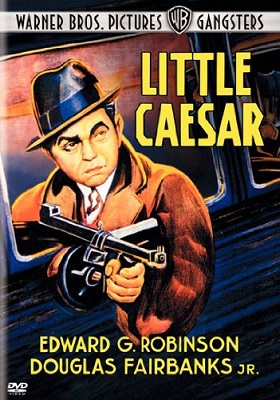
Little Caesar*, Mervyn LeRoy (1930, USA). This was apparently Edward G Robinson’s first appearance on film as a gangster, a role he would occupy for much of his career. Which is, I guess, mildly interesting, but not a good reason for the film to be on the 1001 Movies You Must See Before you Die list. Because as far as I could tell, that seemed to be the only thing about Little Caesar that was notable. Especially when you compare it to contemporary gangster films like Scarface. Robinson is keen to claimb the gangster ladder, which is what he does. He works his way up to top dog, but then things start to go wrong and he goeson the run and ends up a drubk living in a doss house. Until the DA starts making public statements calling him a coward, and because these sorts of characters are so one-dimensional all it takes is threatening their manhood to force them out of hiding, so Robinson makes an attempt on the DA’s life and is defeated. Yawn. There are some seminal gangster movies from the 1930s, but I fail to understand why this is considered one.

Le château de mère, Yves Robert (1990, France). This is the sequel to Robert’s La gloire de mon père and, like that film, is also based on an autobiographical novel by Marcel Pagnol, and is in fact the adaptation of Pagnol’s sequel to La gloire de mon père. So, the same characters, the same general situation, roughly the same period, certainly the same place… and a slightly different plot. The boy, who’s the narrator of the films, is put forward as the school’s representative in some sort of academic competition, and so needs to study hard. Meanwhile, the family decide to return to their holiday home, but this entails a 3-hour walk from the railway station. Until, one day, they’re surprised by a canal guard, who has access to all the gardens through which the canal runs and so provides a shortcut which makes it a 30-minute walk. So the family start using the shortcut. They’re accosted by one of the property owners, but he’s happy for them to trespass. A guard on another property is less forgiving and reports them. La chaâteau de ma mère is more of the same, pretty much. A rose-tinted version of Provence during the 1920s, a soupçon of social commentary, lots of nostalgia, and lots of shots of Provençal landscape. It was every bit as dull as La gloire de mon père, although some of the humorous scenes were better. Not being French, I don’t understand the appeal of these films – but then I don’t understand the appeal of Heartbeat or Last of the Summer Wine and I live in Yorkshire…

You’ll Never Be Alone, Álex Anwandter (2016, Chile). I’ve no idea where I came across mention of this film. I suspect I added it my list because it was a recent drama from Chile and available for rental. Given that my previous experience of Chilean cinema is Patricio Guzmán’s documentaries (and if you’ve not seen them, you must), I had no real idea what to expect. What I got was… surprisingly brutal. A man is the manager of a factory that makes shop window dummies. He has worked there for 25 years and feels he should be a partner in the business, and so has been persuaded by the owner to invest some of his own money in order to buy partnership. His son is openly gay. One night, his son is attacked by some local youths who know him – including one who has been fucking him – and put into a coma. The man has to spend the money he planned to invest in the company on his son’s medical bills. And then, the factory owner sells the mannequin factory to a rival company. His son is racking up expensive medical bills – millions of pesos – and his twenty-five years of loyalty are apparently worth shit. So he does something about it. This is a grim film, and the gaybashing which is its most dramatic moment is horrible and brutal. And, of cource, because that’s how these things go, the perpetrators are not even charged as there are no other witnesses than the victim, even though everyone knows who did it. When the father confronts one later in the film, the youth seems more scaredof being caught than ashamed of what he has done, even though he took advantage of the gay son by having sex with him. You’ll Never Be Alone is worth seeing, but for god’s sake, watch something cheerful after seeing it.

1001 Movies You Must See You Die count: 894


Leave a comment

Moving pictures 2017, #67

I seem to have built up another backlog of these again. Cracking on…

Passion, Jean-Luc Godard (1982, Switzerland). Some people consider this one of Godard’s best, although he seems fixed in the minds of the general cinema-going public only as the Nouvelle Vague director of films such as À bout de souffle, Bande à part and Une femme est une femme. Of course, he’s made many more films than that, and is still making them. Passion marked Godard’s return to mainstream cinema after a period making experimental pictures. A Polish film-maker in Switzerland is exasperating his backers by staging huge, and expensive, tableaux based on famous paintings, none of which suggest a commercial narrative movie. Meanwhile, Isabelle Huppert is fired from her job at a local factory, and subsequently tries to organise a strike. The film-maker, played by Jerzy Radziwilowicz, is in a relationship with Huppert; he’s also in a relationship with the wife, played by Fassbinder favourite Hanna Schygulla, of the owner of the hotel where he is staying. It’s an odd mix of a film. The Huppert narrative is very much realist social drama, but the Schygulla elements feel a bit like a bedroom farce and the tableaux scenes are more Peter Greenaway than anything Godard has done previously. It works, because Godard is good at this stuff. And he also has an excellent cast – Huppert, probably the best actor currently making films, is on top form, even with the stutter with which her character is lumbered. The tableaux are… odd. As I said, more Greenaway than Godard. But unlike Greenaway, Passion shows how they are constructed – their existence is part of the narrative, rather than them actually being the narrative. I rate other films by Godard higher than Passion (although I’m not that much of a fan of his Nouvelle Vague movies). Um, thinking about my favourite Godard films, they’d probably look like this: 1. Le mépris, 2. 2 or 3 Things I Know About Her, 3. Je vous salue, Marie, 4. Week End, and 5. either Passion, Détective or Film Socialisme.

The Mortal Storm*, Frank Borzage (1940, USA). A write-up of this film somewhere – Wikipedia? imdb? – states that it rarely mentions the country in which it was set in order not to offend German audiences. Except that’s completely untrue. It makes it abundantly clear it’s about Germany and the average Germans’ complicity with Hitler and the Nazis. The whole point of the film is a relationship between a non-Nazi and the daughter of a Jewish intellectual. No effort is made to disguise this. Jimmy Stewart is friendly with the daughter of college professor Frank Morgan, who is Jewish. She’s already engaged to a Nazi party member, but when her step-brothers start spouting the party line, she realise her mistake. This is a good film because it’s totally not subtle. It’s not a great film – some of the opening shots have that sort of artificial grandeur Hollywood managed every so often with its studio shots… but once the plot gets into gear they disappear. Given its subject – even more timely now than it has ever been – The Mortal Storm probably deserves its spot on 1001 Movies you Must See Before Die list, even though technically there’s nothing that’s special or important about it.

Gold Diggers of 1937, Lloyd Bacon (1936, USA). A theatre owner wants to put on a new show but his partners have spent all on his money on the stock market. So they get his life insured, planning to bump him off and then collect to make good on their debts. But the insurance salesman – Gold Diggers regular Dick Powell – who sold him the policy is keen on him staying alive. So the corrupt partners try to kill the theatre owner, but Powell has to keep him alive in order to earn his commission. Cue hilarity. There are some entertaining set-pieces, but the humour is all a bit obvious and some of the acting closer to mugging. There’s one of Berkeley’s big routines at the end, but the way the final act gives everyone the happy – or not, in the villains’ case – ending does feel over contrived. I don’t know if the Gold Diggers series was killed by the Hays Code or the declining quality of the films, but they’re not bad examples of their time and type, and they’re usually entertaining. If you find copies of these two Busby Berkeley collections, they’re worth having, although volume one much more so than volume two.

Uncle Boonmee Who Can Recall His Past Lives, Apichatpong Weerasethakul (2010, Thailand). I’d known Weerasethakul’s name originally as the director of The Adventures of Iron Pussy, a film I’ve never seen, but a spoof of 1970s Thai action films and musicals didn’t sound like it would appeal. But then earlier this year I came across mention of the film he made after that, Tropical Malady, and it seemed much more like the sort of movie I enjoy watching. So I stuck it on my rental list (see here). And followed it with Syndromes and a Century (see here). And then it turned out Martin Scorsese’s World Cinema Project No. 2 included Weerasethakul’s first film, Mysterious Objects at Noon… So I’ve now seen four films by Weerasethakul, and they’re very good. They’re slow and elliptical and often beautifully shot. Sort of my thing, really. Okay, so sometimes the parts don’t quite fit together, but I really like the fact Weerasethakul ignores the three-act structure. Uncle Boonmee Who Can Recall His Past Lives consists of six linked stories about the title character. They’re odd, but odd in a way that is presented as completely normal. The dead  sister of Uncle Boonmee’s wife joins them for dinner and they treat her appearance as completely unremarkable. A nephew who disappeared returns as a forest spirit – covered head to toe in fur and with red eyes that glow in the dark – and they treat him as if he were just a lost nephew. It’s beautifully laid-back. True, not much, if anything, happens; but Weerasethakul presents worlds in which strange things take place and they are treated as completely ordinary. And the slow dead-pan delivery not only makes their ordinariness within the world of the film more believable but also makes them even more extraordinary to the viewer. I think I’m becoming a bit of a Weerasethakul fan. And yes, now I want to see The Adventures of Iron Pussy.

Silver Lode*, Allan Dwan (1954, USA). That’s some cover art. Silver Lode is actually a relatively ordinary 1950s Western, and that cover art looks more like some twenty-first century Western romance, with its artfully-designed typeface and artfully-placed lens flare. A US marshal and three marshal deputies ride into the eponymous town with a warrant for the arrest of John Payne, a pillar of the local community. The marshal tells everyone that Payne killed his brother – shot him in the back during a poker game – and stole the pot of $20,000 dollars. At first, the people of Silver Lode are on Payne’s side and are keen to ensure he is conveyed safely to California, where the warrant was issued, in order for his innocence to be proven. But then one of the marshal’s deputies admits to Payne that it’s all a fake – the marshal is no marshal and the warrant is forged – and it’s all for revenge… but the marshal kills the deputy and pins it on Payne… Public opinion turns and Payne finds himself hiding from the mrshal and his deputies and the townsfolk. It’s an interesting spin on your usual Western story, and it’s handled well – Payne’s actual guilt is left in the air until the very end – but in terms of presentation there’s nothing special about Silver Lode. I’d sooner its position on the 1001 Movies You Must See Before You Die list went to a better non-Hollywood film.

O Pagador de Promessas*, Anselmo Duarte (1962, Brazil). Another highly-regarded film that doesn’t seem to have ever had a DVD release – at least not in the UK – so I ended up having to buy a rip on eBay from a US seller. O Pagador de Promessas, variously translated as Keeper of Promises and The Given Word, is the only Brazilian film to win the Palme d’Or. Like some of the other Brazilian films I’ve seen, it’s on the 1001 Movies You Must See Before You Die list, and I do wonder if I’m seeing the cream of the crop – Vidas Secas, the films of Glauber Rocha… These are excellent films and it’s criminal they’re not better known in the Anglophone world. But O Pagador de Promessas… A poor farmer promises to carry a crucifix from his farm to a church in Salvador (like those other excellent Brazilian films, O Pagador de Promessas is set in Bahia) if his donkey survives its illness. But the church are unhappy with the farmer’s “pagan” promises, and various other groups try to use him to promote their own anti-Catholic causes. From my limited exposure to Brazilian culture, Bahia seems to be fertile ground – Vidas Secas is set there (see here), as are Rocha’s Black God, White Devil and Antonio das Mortes (see here and here), not to mention Mario Vargas Llosa’s excellent novel, The War of the End of the World (see here). It’s not all carnivals and football. Duarte made half a dozen feature films between 1947 and 1967 – I’d like to see them all. And watch the rest of Glauber Rocha’s oeuvre, of course. I should make more of an effort to track these films down.

1001 Movies You Must See Before You Die count: 893


Leave a comment

Moving pictures 2017, #66

I managed to knock a few off the 1001 Movies You Must See Before You Die list and despite them both being US films – one Hollywood, one independent – I thought they earned their place on it.

Mr Arkadin, Orson Welles (1955, Spain). After making Macbeth, most of Welles’s remaining films were made in Europe with international financing. It’s perhaps a bit of a cheat to describe Mr Arkadin as a Spanish film, given it was English language, had an American director, and featured a cast including Americans, Italians, Germans, Brits and Spaniards, among others… but it was shot mostly in Spain, and Welles was resident there at the time, so… The story opens with a private plane flying into Spain with no one aboard and presents it newsreel-fashion as a mystery, which the film will then solve… by telling the story leading up to that moment. Robert Arden is an American knocking about in Spain, who inveigles himself into the affections of the daughter of reclusive billionaire Arkadin, played by Welles in a bad wig and beard. When Arden finally meets Arkadin, he’s offered a job – Arkadin cannot remember his life before 1927, and wants Arden to research it for him (the reason given is so that no nasty surprises turn up when Arkadin bids for military contracts). So Arden tracks down past associates of Arkadin, ending up in Mexico, where he discovers the truth about the man. And the truth about why he was asked to research the man’s past. Arden heads back to Spain to tell the daughter, Arkadin charters a plane in an effort to stop him. He fails. Apparently, there are several cuts of the film knocking about, some better than others, and none what Welles really intended. The end result is something that tries to be The Third Man, with bits of Shakespeare thrown in, all shot in Welles’s inimitable style, and then edited so it teeters on the edge of sense. Welles overplays his role, Arden is not a sympathetic hero, and the supporting cast  are more like circus performers than actors. But it’s Welles, so it’s worth seeing.

Roger & Me*, Michael Moore (1989, USA). I know of Michael Moore, of course, and the career he has carved out for himself. I’ve seen seen a couple of his films. But I’d never seen the one that started his career, and since it was on the 1001 Movies You Must See Before You Die list… So I bunged it on the rental list. I wasn’t expecting much of it – Moore has tackled much more contentious subjects in later films, and given that this was his first too, I expected it to be crude and simplistic. And while it was certainly the latter, it was never the former. It’s a surprisingly polished piece of work. Unfortunately, recent events have pretty much underminded it. Flint, Michigan, was the town where the automobile production line was invented, and it has relied heavily on car manufacturing ever since. But in the 1980s, the automobile corporations decided to cut costs by closing down plants in the USA and opening them in much cheaper countries. This is known as “making the product cheaper while taking away the spending power of the market which buys it so your business eventually collapses and oh look guess what happened…” Around a third of Flint’s carworkers found themselves out of a job. This is painted as devastating to the community, well, some parts of the community, the country club set are completely oblivious of course… which is why Moore wants to beard GM chairmain Roger Smith and ask him to defend his decision. In the film, the workforce is cut from 80,000 to 50,000 over slightly more than a decade. True, this is bad for any community which relies on a single industry. But as of 2015, GM has 7,000 workers in Flint. And, of course, the city is better known now for its poisoned water supply. A city in the US without fit drinking water for much of its population the three years and counting. And the US still think it’s a world leader. Ha.

Zardoz, John Boorman (1974, Ireland). I think I last saw this back in the 1980s, but it’s one of those sf films you tend to know a lot about if you’re into sf without actually having to have seen it all that often. I mean, you either absorb the plot – or major points of it – through osmosis, or it’s extremely memorable. I’m noty entirely which is the case. Okay, so Sean Connery in a Zapata moustache and red nappie is pretty memorable. And so is the flying head which appears on the Blu-ray cover-art. Connery is Zed, an Exterminator, whose job it is to, well, exterminate Brutals, who are the debased remnants of the population after some catastrophe (although they seem to wear 1970s clothing). Meanwhile, there are the Vortexes, safeguarded by forcefields and in which live the Eternals, the immortal descendants of a group of scientists who chose to safeguard all human knowledge. Zed hides away in the floatibng head and is taken to one of the Vortexes. During the flight, he kills Arthur Frayn, the Eternal who controlled the floating head and looked after the Exterminator/Brutal programme. In the Vortex, Zed is studied, and discovered the be more intelligent than the Eternals. Because they’re sort of Eloi, they’re weak and decadent and many of them have drifted into catatonia. But Zed shakes them up. And they needed it, because they were going nowhere. I know plenty of sf fans count this as a favourite, and it has sort of dippy 1970s charm to it – and I’m a fan of many things from the 1970s – but it’s hard not to reach the conclusion Zardoz is more style than substance. Bits of it are borrowed from all over, not least the book/film it directly references. And asking the viewer to believe Sean Connery is more intelligent than Charlotte Rampling or John Alderton… Well, suspension of disbelief only stretches so far. On the other hand, some of the shots of the Irish countryside are really impressive, and the production design does a lot with very little – although does a look bit like a BBC production at times. I’m glad I watched it again – and can do so whenever I want, as I bought the Blu-ray in the eureka! sale – and it’s certainly true there are shitloads of worst sf films. But there are also a lot of better ones, and it’s never going to make it into my top ten.

Varsity Show, William Keighley (1937, USA). So  I tracked down a copy of the Busby Berkeley Collection Volume 2 on eBay, and it was cheap – and, when it came, it has to be said, a bit battered, but never mind. It’s also not as good as the first collection. But I knew that going in. In Varsity Show, Dick Powell is a washed-up Broadway writer who is co-opted into helping out his alma mater with their annual variety show. He’s doing it because he needs the money, and they want him to running things because the fuddy-duddy in charge is sure to produce a piss-poor show. Powell is on form, and some 0f the female cast shine, but it’s also one of those films where twenty-somethings are referred to as “kids” and the musical numbers aren’t especially memorable. The “kids” rebel, of course, and end up occupying a theatre in New York in order to put on their show. Which is where it turns into your typical Busby Berkeley number. And they really were astonishing. Okay, there’s a leap of imagination required when a dozen dancers on a tuny stage suddenly turns into hundreds of dancers on a massive soundstage… but the way it does that kaleidoscope thing with the dancers is often mind-boggling. Equally mind-boggling is the final scene, in which the theatre’s owners send the police, who sit down to listen to the show, and then the National Guard, who takes seats to watch the show, and, well, you can guess the rest. Varsity Show has a weak story but it manages a good Busby Berkeley extravaganza at the end.

The Phenix City Story*, Phil Karlson (1955, USA). This was a hard film to track down. Despite being on the 1001 Movies You Must See Before You Die list, it doesn’t appear to have ever been released on DVD, and certainly not in this country. But I found a copy on eBay, from one of those sellers who sell DVD rips of out-of-copyright movies, and it proved to be a pretty good transfer. And a pretty good film. There are two cities either side of a river: Columbus, Georgia, and Phenix City, Alabama. There is a street in Phenix Citty lined with casinos and brothels, and the gangs who run them pretty much control the town. That is, until they inadvertently convince a popular lawyer to run for state attorney general on a ticket to clean them out. And when they kill him, his warhero son takes them on instead. Interestingly, the film opens as a documentary, with a journalist interviewing people involved in the clean-up of Phenix City. It’s only about 15 minutes in that it becomes a traditional narrative cinema film. The gangsters aren’t very convincing, and it’s all a bit Wild West in places – although apparently it’s based ona true story. It’s also pretty brutal, far more than you’d expect from a mid-1950s movie. That aside, and despite a somewhat sensationalist tone, The Phenix City Story proved a lot better than expected, and might just about deserve its slot on the 1001 Movies You Must See Before You Die list.

Scenes from a Marriage, Ingmar Bergman (1973, Sweden). I bought the Criterion edition of this a while ago, which includes both the international movie release and the original Swedish television series. And it was the latter I watched. Of course. Liv Ullmann and Erland Josephson are a happily-married couple. He’s an academic, she’s a family lawyer. At least, they’re happy when the series opens. They’re being interviewed by a magazine and they discuss their marriage openly. And later, when friends comes round for dinner, the friends’ unhappy marriage is contrasted with that of Ullmann and Josephson. Except, as the following five episodes show, it’s not all sweetness and light. There are several shocking incidences of violence, which really should not have been acceptable even in 1974. Josephson leaves Ullmann for another woman, but then tries to rekindle his marriage – and he’s really quite horrible about his girlfriend. Eventually, the two separate, and then meet up years both married to other partners… and they have an affair. Josephson’s character is quite a nasty piece of work, and Ullmann seems far too accepting of his actions – although she does use them to advantage when they agree to divorce. Scenes from a Marriage was apparently blamed for the rise in divorce rates in Europe, although it was most likely coincidence. The film/series is highly regarded, and it does seem in places like the epitome of Bergman, but I can’t really say I liked it. It looked bland – perhaps deliberately so – but neither of the main characters were pleasant, or sympathetic, enough to hang a 281-minute TV miniseries on. There were some good bits, true, and it times the marriage did actually feel genuine. But it was a bit like a gory autopsy, and unpleasant to watch more than it was intertaining.

1001 Movies You Must See Before You Die count: 890