It Doesn't Have To Be Right…

… it just has to sound plausible


8 Comments

The NPR 100

Lists, lists, lists, lists. Everyone likes lists. NPR are doing one here. They have cunningly called it a “Top-100 Science Fiction, Fantasy Titles”, which can mean either favourite or best. First they asked people to nominate titles. Then they asked Giant SF Brains Gary K Wolfe, Farah Mendlesohn and John Clute to whittle down those picked to a list of  “several hundred” titles on which people can vote. It is a… strange list. The usual suspects are there, of course. There are, happily, a number of women sf writers, though less than expected – I make it 22%.

Anyway, here is the list. Annotated. I’ve also put in bold those I’ve read, and in italics those I have on the TBR.

The Acts Of Caine Series, by Matthew Woodring Stover – I’ve never even heard of these.
The Algebraist, by Iain M Banks – not his best book by a long shot, not even his best non-Culture novel either.
Altered Carbon, by Richard Morgan – that Morgan’s debut novel was chosen doesn’t surprise, though I’d have said Black Man is the better novel.
American Gods, by Neil Gaiman – I don’t get the appeal of Gaiman.
Anansi Boys, by Neil Gaiman – see above.
Anathem, by Neal Stephenson – I don’t much understand the appeal of Stephenson, either.
Animal Farm, by George Orwell – this is a bit, well, slight, isn’t it?
The Anubis Gates, by Tim Powers – I’d say this is a contender.
Armor, by John Steakley – really?
The Baroque Cycle, by Neal Stephenson – I read first two and then gave up.
Battlefield Earth, by L Ron Hubbard – probably the worst sf book ever written, liked only by Scientologists and idiots.
Beggars In Spain, by Nancy Kress – I’ve read the novella, but never the novels.
The Belgariad, by David Eddings – I read the first last year; I am thirty-five years too old to think these books are good.
The Black Company Series, by Glen Cook – never read any of them.
The Black Jewels Series, by Anne Bishop – never heard of them.
The Book Of The New Sun, by Gene Wolfe – excellent, though The Fifth Head of Cerberus I think is better.
Brave New World, by Aldous Huxley – I didn’t like it when I read, and I fail to understand why it is considered a classic.
Bridge Of Birds, by Barry Hughart – never read it.
The Callahan’s Series, by Spider Robinson – I’ve read a few of these; one of my pet hates is the “stories told by regulars in a bar” type of story; plus, these are really quite rubbish.
A Canticle For Leibowitz, by Walter M Miller – never read it.
The Cat Who Walked Through Walls, by Robert Heinlein – well, RAH on the list somewhere is no surprise: he casts a giant shadow across the genre – but isn’t this one of his later crap books?
Cat’s Cradle , by Kurt Vonnegut – never read it.
The Caves Of Steel, by Isaac Asimov – another giant of sf, but one I consider among the most over-rated writers in the genre. He is the McDonald’s of sf, and his books are all burgers.
The Change Series, by SM Stirling – I know nothing about this series.
Childhood’s End, by Arthur C Clarke – one of Clarke’s better ones, but not my first choice.
Children Of God, by Mary Doria Russell – not as good as The Sparrow, and that I thought was somewhat overrated.
The Chronicles Of Amber, by Roger Zelazny – they started well enough, but they tailed off towards the end.
The Chronicles Of Thomas Covenant, The Unbeliever, by Stephen R Donaldson – I’m not a big fan of epic fantasy, and I suspect these would not survive a reread.
The City And The City, by China Miéville – a good novel, and a multi-award winner.
City And The Stars, by Arthur C Clarke – also one of Clarke’s better ones.
A Clockwork Orange, by Anthony Burgess – Burgess wrote several novels that were much better, though they weren’t genre.
The Codex Alera Series, by Jim Butcher – never read them.
The Coldfire Trilogy, by CS Friedman – have never read anything by Friedman.
The Commonwealth Saga, by Peter F Hamilton – I did read his Night’s Dawn trilogy –  it was enough.
The Company Wars, by CJ Cherryh – I like Cherryh’s fiction, but I’d sooner chose individual books.
The Conan The Barbarian Series, by Robert Howard – I’ve read loads of these but I’ve no idea how many; but… they’re pulp: the character has transcended his origin, the stories haven’t.
Contact, by Carl Sagan – I suspect the popularity of this rests more on its author than the book itself.
Cryptonomicon, by Neal Stephenson – I remember enjoying this; mostly.
The Crystal Cave, by Mary Stewart – never read it.
The Culture Series, by Iain M Banks – an excellent series, but the individual books are variable; I’d sooner have voted for one of the books.
The Dark Tower Series, by Stephen King – never read it.
The Day of Triffids, by John Wyndham – never read it.
Deathbird Stories, by Harlan Ellison – anoterh sf giant I consider greatly overrated.
The Deed of Paksennarion Trilogy, by Elizabeth Moon – never read it.
The Demolished Man, by Alfred Bester – I hated this book when I read it.
The Deverry Cycle, by Katharine Kerr – never read it.
Dhalgren, by Samuel R. Delany – one of my favourite sf novels, definitely a classic.
The Diamond Age, by Neal Stephenson – I seem to remember this being better than Snow Crash.
The Difference Engine, by William Gibson & Bruce Sterling – individually, both have written better books.
The Dispossessed, by Ursula K LeGuin – a bona fide sf classic.
Do Androids Dream Of Electric Sheep?, by Philip K Dick – to be honest, I prefer the film.
Don’t Bite The Sun, by Tanith Lee – never read it.
Doomsday Book, by Connie Willis – it was okay, I guess; I don’t understand all this award-love Willis receives.
Dragonflight, by Anne McCaffrey – never read any of them.
Dreamsnake, by Vonda McIntyre – never read it.
The Dune Chronicles, by Frank Herbert – the prose in Dune may not be very good, but it’s still the premier piece of world-building in the genre and Paul Atreides is the best teenage special snowflake in literature; the later books are better written; the sequels by Kevin J Anderson and Brian Herbert are about as literate as used toilet paper.
Earth, by David Brin – this is a bloated techno-thriller.
Earth Abides, by George R Stewart – it was okay, I guess; though it hasn’t aged well.
The Eisenhorn Omnibus, by Dan Abnett – these are Warhammer books, right?
The Elric Saga, by Michael Moorcock – I’ve read some of these but I don’t recall which – like Conan, Elric has transcended his pulp origin but many of the books haven’t.
Ender’s Game, by Orson Scott Card – never read it, never will.
Eon, by Greg Bear – a neat central premise, I seem to recall, spoiled by clumsy geopolitics and a dull story.
The Eyes Of The Dragon, by Stephen King – never read it.
The Eyre Affair, by Jasper Fforde – I thought this was terrible: a neat idea, but really badly written.
The Faded Sun Trilogy, by CJ Cherryh – I loved this when I was a teenager, but I wouldn’t call it a favourite now.
Fafhrd & The Gray Mouser Series, by Fritz Leiber – never read it.
Fahrenheit 451, by Ray Bradbury – hated it; the film is far superior.
The Farseer Trilogy, by Robin Hobb – read the first one, and thought it readable but dull.
The Female Man, by Joanna Russ – another bona fide classic; a recent reread only increased my admiration of it.
The Fionavar Tapestry Trilogy, by Guy Gavriel Kay – I caguely recall these as being interesting, if a bit bland, secondary world fantasies.
A Fire Upon The Deep, by Vernor Vinge – a bit of an uneven work, but I think this qualifies.
The First Law Trilogy, by Joe Abercrombie – read the first book and was unimpressed.
Flowers For Algernon, by Daniel Keyes – a classic, certainly.
The Foreigner Series, by CJ Cherryh – read the first one, and have the next eight on the TBR; solid work, but not worthy of a place on the Top 100.
The Forever War, by Joe Haldeman – another classic.
The Foundation Trilogy, by Isaac Asimov – I think my opinion on this is known: it is, in a word, shit.
Frankenstein, by Mary Shelley – never actually read it (though I have seen lots of films).
The Gaea Trilogy, by John Varley – I much prefer his Eight Worlds fiction.
The Gap Series, by Stephen R Donaldson – this is a superior space opera, though it is grim and not entirely successful.
The Gate To Women’s Country, by Sheri S Tepper – never read it.
Going Postal, by Terry Pratchett – never read it.
The Gone-Away World, by Nick Harkaway – I started it, but gave upl one day I will return to it.
The Gormenghast Trilogy, by Mervyn Peake – one day I will read it.
Grass, by Sheri S Tepper – I can never remember what actually happens in this novel.
Gravity’s Rainbow, by Thomas Pynchon – is on the TBR.
The Handmaid’s Tale, by Margaret Atwood – another classic.
Hard-Boiled Wonderland And The End of The World, by Haruki Murakami – never read it.
The Heechee Saga, by Frederik Pohl – like many series, it’s diminishing returns with each additional book; Gateway is good, but the rest?
The Hitchhiker’s Guide To The Galaxy, by Douglas Adams – mildly amusing, I suppose.
The Hollows Series, by Kim Harrison – never heard of them; urban fantasy, is it?
House Of Leaves, by Mark Danielewski – is on the TBR.
The Hyperion Cantos, by Dan Simmons – these are very good, though I do need to reread them sometime.
I Am Legend, by Richard Matheson – was okay, I suppose.
I, Robot, by Isaac Asimov – nope.
The Illuminatus! Trilogy, by Robert Shea & Robert Anton Wilson – read the first, but gave up.
The Illustrated Man, by Ray Bradbury – never read it.
The Incarnations Of Immortality Series, by Piers Anthony – have read a couple of these, though I forget which; I remember them as light, forgettable reads – hardly the qualities of a classic.
The Inheritance Trilogy, by NK Jemisin – this trilogy isn’t even completed yet – how can it be a classic?
Jonathan Strange & Mr Norrell, by Susanna Clarke – is on the TBR.
A Journey To The Center Of The Earth, by Jules Verne – seen the film, not read the book.
Kindred, by Octavia Butler – is on the TBR.
The Kingkiller Chronicles, by Patrick Rothfuss – another trilogy that has yet to be completed…
Kraken, by China Mieville – is on the TBR.
The Kushiel’s Legacy Series, by Jacqueline Carey – never read it.
Last Call, by Tim Powers – I remember this as being entertaining, but I don’t think I’d call it Top 100 material.
The Last Coin, by James P Blaylock – never read it.
The Last Herald Mage Trilogy, by Mercedes Lackey – never read it.
The Last Unicorn, by Peter S Beagle – never read it.
The Lathe Of Heaven, by Ursula K LeGuin – I wasn’t overly taken with this one when I read it.
The Left Hand Of Darkness, by Ursula K LeGuin – definitely a classic.
The Legend Of Drizzt Series, by RA Salvatore – never read it; but isn’t the bloke who wrote “‘You killed me,’ said the surprised man”?
The Lensman Series, by EE Smith – everyone who nominated this should be ashamed of themselves.
The Liaden Universe Series, by Sharon Lee & Steve Miller – I’ve read some of these but they’re, well, fluff.
The Lies Of Locke Lamora, by Scott Lynch – is on the TBR.
Lilith’s Brood, by Octavia Butler – never read it.
Little, Big, by John Crowley – a classic fantasy, though I think the Ægypt Sequence is much better.
The Liveship Traders Trilogy, by Robin Hobb – never read it.
Lord Of Light, by Roger Zelazny – interesting, possibly borderline Top 100-worthy.
The Lord Of The Rings Trilogy, by JRR Tolkien – not much you can say about this really, is there?
Lord Valentine’s Castle, by Robert Silverberg – entertaining fluff; Silverberg has written much better books.
Lucifer’s Hammer, by Larry Niven & Jerry Pournelle – never read it.
Lud-in-the-Mist, by Hope Mirrlees – is on the TBR.
The Magicians, by Lev Grossman – never read it.
The Malazan Book Of The Fallen Series, by Steven Erikson – read the first and gave up; I’m not into reading RPG campaigns.
The Man In The High Castle, by Philip K Dick – one of Dick’s better ones, though I need to reread it.
The Manifold Trilogy, by Stephen Baxter – surprised by this choice: Baxter has written better.
The Mars Trilogy, by Kim Stanley Robinson – a classic of the genre.
The Martian Chronicles, by Ray Bradbury – didn’t like it when I read it; wishy-washy and twee.
Memory And Dream, by Charles de Lint – never read it.
Memory, Sorrow, And Thorn Trilogy, by Tad Williams – never read it.
Mindkiller, by Spider Robinson – never read it.
The Mistborn Series, by Brandon Sanderson – never read it and never will.
The Mists Of Avalon, by Marion Zimmer Bradley – never read it.
The Moon Is A Harsh Mistress, by Robert Heinlein – is on the TBR (because it’s in the SF Masterworks series)
Mordant’s Need, by Stephen Donaldson – I remember being better than the Thomas covenant books.
More Than Human, by Theodore Sturgeon – is on the TBR.
The Mote In God’s Eye, by Larry Niven & Jerry Pournelle – is pretty much indicative of everything that was wrong with best-selling sf in the 1970s.
The Naked Sun, by Isaac Asimov – and again, nope.
The Neanderthal Parallax Trilogy, by Robert J Sawyer – never read it.
Neuromancer, by William Gibson – I’m told this has not aged well, but I plan to reread it soon
Neverwhere, by Neil Gaiman – never read it.
The Newsflesh Trilogy, by Mira Grant – never read it.
The Night’s Dawn Trilogy, by Peter F Hamilton – if classic status were measured by weight, this would be a contender.
Novels Of The Company, by Kage Baker – never read it.
Norstrilia, by Cordwainer Smith – to be honest, I can remember Smith’s short stories much better than his only novel; there may be a reason for that.
The Number Of The Beast, by Robert Heinlein – perhaps the one novel that epitomises RAH’s late bloated crap novel phase.
Old Man’s War, by John Scalzi – never read it.
On Basilisk Station, by David Weber – mildly entertaining fluffy rip-off of Hornblower; top 100? I think not.
The Once And Future King, by TH White – I read it so long ago, I remember nothing of it.
Oryx And Crake, by Margaret Atwood – is on the TBR.
The Otherland Tetralogy, by Tad Williams – never read it.
The Outlander Series, by Diana Gabaldan – never heard of it.
Parable Of The Sower, by Octavia Butler – never read it.
The Passage, by Justin Cronin – last year’s mega-hyped coming-to-a-cinema-near you blockbuster, which started well but then turned dull and derivative; oh, and it’s the first book an unfinished trilogy.
Pattern Recognition, by William Gibson – never read it.
Perdido Street Station, by China Miéville – this was something special when it first appeared, but has time been kind to it?
The Prestige, by Christopher Priest – good, but I wonder if it’s appearance here is more due to the film – because Priest has written better.
The Pride Of Chanur, by CJ Cherryh – it’s nice to see all this love for Cherryh, but a little more variety might have been preferable; there are, after all, other women writers of space opera and hard sf.
The Prince Of Nothing Trilogy, by R Scott Bakker – never read it.
The Princess Bride, by William Goldman – the film is better; this is a list of books.
Rainbows End, by Vernor Vinge – never read it.
Rendezvous With Rama, by Arthur C Clarke – if I had to pick a Clarke, it would be this one – because the central BDO more than makes up for the cardboard characters and dated futurism.
Replay, by Ken Grimwood – a fun book and certainly worth reading… possibly top 100 worthy, I think.
Revelation Space, by Alistair Reynolds – why not the series? Banks got his series on the list – because there are better books in the Revelation space series than this one.
Riddley Walker, by Russell Hoban – never read it.
The Riftwar Saga, by Raymond E Feist – I’m fairly sure I read one of these many, many years ago; I remember nothing about it.
Ringworld, by Larry Niven – unlike the Clarke, I don’t think the central BDO makes up for the novel’s other deficiencies – like a lack of a plot.
The Riverworld Series, by Philip Jose Farmer – the central idea is a good one, though having reread the first book a couple of years ago, I’m less sure about the use to which Farmer puts it.
The Road, by Cormac McCarthy – certainly one of the best-written books on this list.
The Saga Of Pliocene Exile, by Julian May – I remember enjoying these in my teens; one day, perhaps, I will reread them.
The Saga Of Recluce, by LE Modesitt Jr – I have only ever read one Modesitt novel – I had to review it for Interzone: it was pants.
The Sandman Series, by Neil Gaiman – nope.
The Sarantine Mosaic Series, by Guy Gavriel Kay – never read it.
A Scanner Darkly, by Philip K Dick – Dick’s best novel, and a sure-fire classic.
The Scar, by China Miéville – never read it.
The Shannara Trilogy, by Terry Brooks – never read it, never will: they look horribly derivative and twee.
The Shattered Chain Trilogy, by Marion Zimmer Bradley – never read it.
The Silmarillion, by JRR Tolkien – never read it.
The Sirens Of Titan, by Kurt Vonnegut – not a big Vonnegut fan, to be honest; it was okay.
Slaughterhouse-Five, by Kurt Vonnegut – as above.
Small Gods, by Terry Pratchett – never read it.
Snow Crash, by Neal Stephenson – when this was published, I couldn’t see what all the fuss was about; I still can’t.
The Snow Queen, by Joan D Vinge – I’m planning to reread this soon, though a recent quick dip into it demonstrated it was a lot more romancey than I’d remembered from my original read all those years ago.
Solaris, by Stanislaw Lem – I suspect I read a bad translation, because this was surprisingly dull; Tarkovsky’s film is greatly superior.
Something Wicked This Way Comes, by Ray Bradbury – is on the TBR (because it’s in the Fantasy Masterworks series).
Song for the Basilisk, by Patricia McKillip – never read it.
A Song Of Ice And Fire Series, by George R. R. Martin – I read first three, but I will not be reading the rest – despite all the current hype; I might watch the television series, though.
The Space Trilogy, by CS Lewis – never read it.
The Sparrow, by Mary Doria Russell – I remember the fuss when this was first published; I didn’t get it.
The Stainless Steel Rat Books, by Harry Harrison – I loved these as a kid; I reread the first a year or two ago, and found it absolutely terrible – dreadful, dated, misogynistic crap.
Stand On Zanzibar, by John Brunner – is on the TBR (SF Masterworks series, natch).
The Stand, by Stephen King – never read it.
Stardust, by Neil Gaiman – never read it; seen the film, though.
The Stars My Destination, by Alfred Bester – if I had to pick and early-ish sf novel, it would be this – because its sheer verve more than compensates for its datedness.
Starship Troopers, by Robert Heinlein – a crypto-fascist polemic thinly-disguised as a novel; the film is infinitely superior.
Stations Of The Tide, by Michael Swanwick – a very good novel, though I was mildly disappointed when I reread a few years ago; but as the genre’s premier Southern Gothic sf novel, it is certainly top 100 worthy.
Steel Beach, by John Varley – I like the Eight Worlds, but I wouldn’t say this is the best novel – The Ophiuchi Hotline is.
Stranger In A Strange Land, by Robert Heinlein – I reread this recently; it was awful.
Sunshine, by Robin McKinley – never read it.
The Sword Of Truth, by Terry Goodkind – I read the first book many years ago; I thought it derivative and unimaginative; I’m told the series later turns very weird and offensive.
The Swordspoint Trilogy, by Ellen Kushner – never read it.
The Tales of Alvin Maker, by Orson Scott Card – never read it.
The Temeraire Series, by Naomi Novik – never read it.
The Thrawn Trilogy, by Timothy Zahn – aren’t these, like, shared world? Star Wars? Should they even be on this list?
Tigana, by Guy Gavriel Kay – I remember this as being quite good.
Time Enough For Love, by Robert Heinlein – more late period bloated wankery from RAH; next, please.
The Time Machine, by HG Wells – it never ages.
The Time Traveler’s Wife, by Audrey Niffenegger – never read it; but the film was creepy: he stalks her, folks; that is not good.
To Say Nothing Of The Dog, by Connie Willis – never read it.
The Troy Trilogy, by David Gemmell – never read it.
Ubik, by Philip K Dick – one of his trippier novels: I’m not sure if that makes it good or bad.
The Uplift Saga, by David Brin – if you distilled the story of this series down, it would be quite potent; as it is, it’s a good example of its sort, and perhaps belongs near the bottom of a top 100.
The Valdemar Series, by Mercedes Lackey – never read it.
VALIS, by Philip K Dick – another good Dick, I seem to recall.
Venus On The Half-Shell, by Kilgore Trout/Philip Jose Farmer – wasn’t this just a silly joke/gimmick?
The Vlad Taltos Series, by Steven Brust – never read it.
The Vorkosigan Saga, by Lois McMaster Bujold – I’ve read a couple, they were okay.
The Vurt Trilogy, by Jeff Noon – I read the first one when it was published, but didn’t really get on with it.
The War Of The Worlds, by HG Wells – no one would have believed… yup, a classic.
Watchmen, by Alan Moore – a graphic novel, with superheroes, in a list of sf and fantasy books; it’s good but does it really belong here?
Watership Down, by Richard Adams – the best book about talking rabbits ever written.
The Way Of Kings, by Brandon Sanderson – never read it and never will – why should I support someone who says they’re prejudiced but asks me to respect their prejudice?
Way Station, by Clifford D Simak – I used to be a big Simak fan, but this was never one of my favourites.
We, by Yevgeny Zamyatin – never read it.
The Wheel Of Time Series, by Robert Jordan – these are big, probably about four metres tall if you stacked them one on top of the other; that is the only notable thing about them.
When Gravity Fails, by George Alec Effinger – a possible contender for the top 100, though my memories of it are somewhat hazy.
Wicked, by Gregory Maguire – never read it.
Wild Seed, by Octavia Butler – never read it.
The Windup Girl, by Paolo Bacigalupi – is on the TBR.
World War Z, by Max Brooks – never read it.
The Worm Ouroboros, by ER Eddison – is on the TBR (Fantasy Masterworks series).
The Xanth Series, by Piers Anthony – you must be joking: these pervy books? bad puns and dodgy sexual politics? for shame.
The Yiddish Policeman’s Union, by Michael Chabon – better-written than many other books of its ilk, and with an interesting alternate history… a possible contender.
1632, by Eric Flint – never read it.
1984, by George Orwell – still a classic.
2001: A Space Odyssey, by Arthur C Clarke – the film was better.
20,000 Leagues Under The Sea, by Jules Verne – I think I read a bad translation of this because it was surprisingly dull.

So there you have it. I suspect that when Top 100 is revealed, I will end up grinding my teeth. Again. Oh well.

4 Comments

Women in sf reading challenge #6: The Year of Our War, Steph Swainston

This post is a bit late because I had to reschedule my reading. I decided several weeks ago to make July a month of reading only women writers. But then I was sent three novels by men for review, with a deadline of the end of July. So I moved them to the top of the reading pile so I could finish them in June and not break my promise for July. Anyway, I managed to finish them in time, and so the first book of July was…

When I picked The Year of Our War for my reading challenge at the beginning of this year, I’d heard it argued that the book could be read as sf even though it was marketed as fantasy. I’d also heard it described as “New Weird”, although quite what that means no one seems really sure. But never mind: I wanted to read it, so I bent the rules a little. And, now that I have read it, I have to be honest and say that to me The Year of Our War seems very much a fantasy novel.

Jant Shira is half-Rhydanne and half-Awian. The Rhydanne live high in the mountainous region of Fourlands, are very much used to the cold, and are extremely quick. Awians are very much like normal humans except they possess small wings on their back. Because Jant has the Rhydanne speed and build, and the Awian wings, he can fly. He is the only person who can do this.

He is also immortal.

Two thousand years before, god left Fourlands. He put San, the Emperor, in charge and made him immortal. And in the years since then San has gifted fifty exceptional people with immortality. They form the Circle, and all have superhero-like names – Jant, for example, is Comet. Another member of the Circle is Lightning, a superlative archer, and one of the first people to be made immortal.

Around the same time god left, the Insects invaded Fourlands. These are pony-size ant-like creatures, and they have overwhelmed the northern quarter of the continent. But, after centuries of stalemate, more and more of them are now appearing and encroaching on human-inhabited lands.

The Year of Our War is, I believe, the first book in a series. Certainly, the novel does not resolve the bigger questions its plot asks. A possible source for the Insects is mooted, but not confirmed – and no explanation of that source is offered. Why god left is certainly never revealed. In fact, much of the story of The Year of Our War revolves around a fight for supremacy between a pair of immortals: Mist, the Sailor, and his wife.

There’s much to like in The Year of Our War. The story is narrated by Jant, who is a junkie, and he gives an interesting perspective on the plot. In fact, the entire cast are extremely well-handled. The prose is polished and very readable, although there’s a tendency in the first half of the book to describe everything everyone is wearing, often using unfamiliar and archaic terms. There’s a feeling of depth to the world of the story, as if the author has spent a great many years building it.

But.

Swainston names M John Harrison as an inspiration, and there’s certainly a little of Viriconium in Fourlands. There’s also that same refusal to be ruled by the “clomping foot of nerdism”. Which unfortunately manifests as gaps in rigour. Towards the end of the novel, for example, a famous sword appears and is described as a “katana”. But there’s a lot of cultural baggage that goes with such a weapon, and none of that is present in The Year of Our War. There’s a sense that Fourlands is built from magpie-like borrowings from the real world, but without the history and culture which underpins those borrowings.

The Year of Our War is a not a novel which makes immersion easy – there are too many details which throw the reader out of the world. Sometimes the characters respond in ways which rely on knowledge of the real world, not on knowledge of the world of Fourlands – in other words, they don’t always react like characters in a fantasy novel.The names of people and places seem… odd, as if there are no languages behind them, they’re just random conglomerations of letters. Also not helping is the story’s refusal to provide neat answers – or indeed, provide neat puzzles requiring answers. The concept of god leaving Fourlands, for example, and putting an immortal in charge is extremely cool – there’s an entire novel series just in that – but here it’s merely background. The presentation of the immortals as a sort of superhero team also feels slightly out-of-place in a fantasy world.

As I read The Year of Our War, I concluded I’d be unlikely to ever try its sequels. But as I drew nearer to the end I started to change my mind. And not simply because I wanted to find out what happens. The lack of rigour which had annoyed me no longer seemed to matter. Thing is, I’m not a big fan of fantasy. I’ve read my fair share, but I’ve found little to admire in much of that I’ve read. When reading KJ Parker’s Colours in the Steel last year (see here), I had a similar response to that I was having with Swainston’s novel. That book was a great shambolic monster of a story, which seemed to spend more time on world-building than it did plot. But the engine of its story was driven by such an innovative power-source (and I’m mixing metaphors here, but never mind) that I found myself liking the book more and more as I drew closer to the end. The Year of Our War is less inventive plot-wise than Colours in the Steel, but it does present an interesting – and perhaps even opposed – approach to its world-building. And that, I think, is enough to warrant further exploration.


Leave a comment

Results: Best Science Fiction/Fantasy Books by Women Writers

Back in 21 June, I asked people to nominate their five favourite fantasy or science fiction novels by women writers. And yes, I’m doing what everyone else does in these sorts of polls and conflating “favourite” and “best”. Well, it is a sort of popularity contest type poll…

Anyway, some twenty-nine people left comments. And I have now counted up the results…

Best/Favourite Novel
1 The Left Hand of Darkness, Ursula K Le Guin (7 votes)
2 The Dispossessed, Ursula K Le Guin (4 votes)
3= Ash: A Secret History, Mary Gentle; Howl’s Moving Castle, Diana Wynne Jones; The Handmaid’s Tale, Margaret Atwood; The Many-Coloured Land, Julian May; To Say Nothing of the Dog, Connie Willis; Woman on the Edge of Time, Marge Piercy (3 votes each)

A broad selection tying for third place there, though the first and second positions don’t really come as much of a surprise.

Best/Favourite Writer
1 Ursula K Le Guin (14 votes)
2 CJ Cherryh (7 votes)
3= Diana Wynne Jones, Gwyneth Jones, Joanna Russ, Margaret Atwood, Tricia Sullivan (4 votes each)

Le Guin’s success is not really a surprise. Most of her books are still in print, she consistently appears on best of the genre lists, and she has written highly-regarded sf and fantasy. Cherryh’s books seemed almost ubiquitous during the 1980s and much of the 1990s, but are less visible these days – which is a shame. In total, 58 authors were named.

Books by year

  1810s 2
  1920s 1
  1960s 8
  1970s 21
  1980s 33
  1990s 29
  2000s 21
  2010s 3

This probably says more about the age of those who voted than it does the success of women writers during those particular decades.

Given a wider pool of voters, the results might have looked different. But even so, this poll is as valid as any other genre list you might find on the internet.


10 Comments

A critical bookshelf

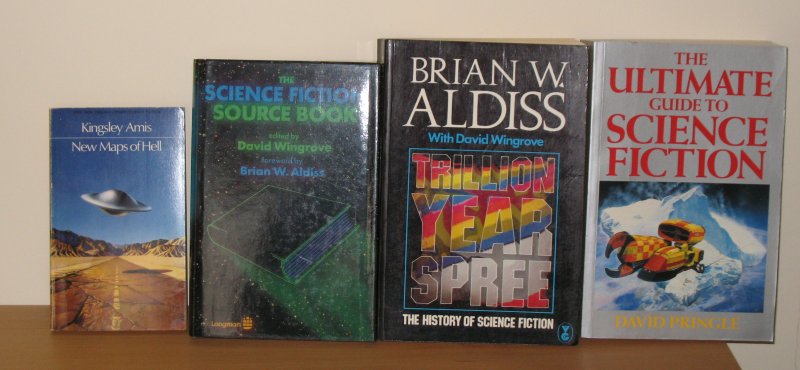
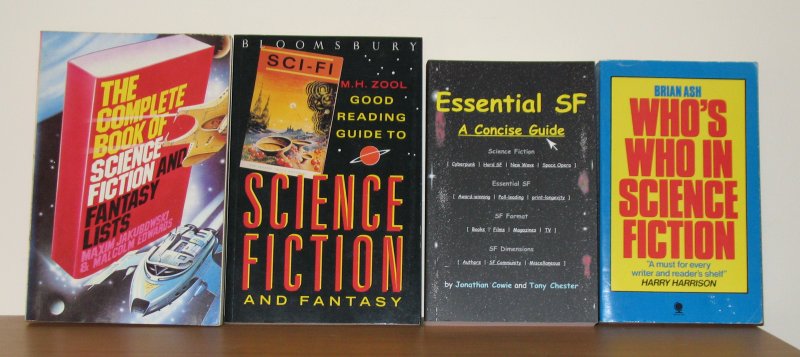
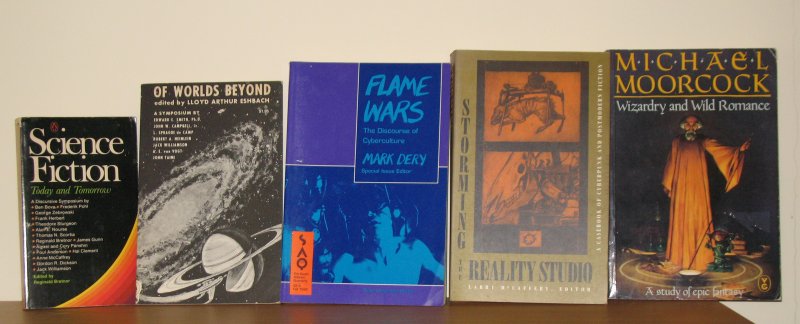
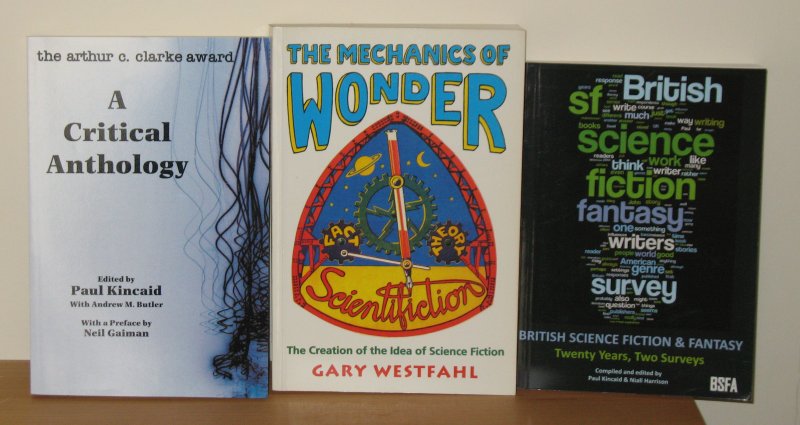
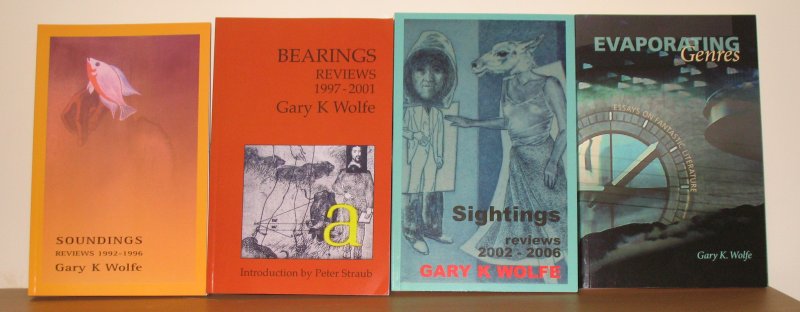
Over the years I’ve picked up a number of book about science fiction and about science fiction writers. These are books I’ve mostly dipped into, rather than read from cover to cover. Not all of them cover authors I still read, and some of them aren’t at all useful as critical works… but still I hang onto them. And here they are:


First up, four books by Gary K Wolfe: Soundings, Bearings, Sightings and Evaporating Genres. Wolfe writes sharp incisive reviews of genre books, and the first three books are collections of his reviews. Evaporating Genres is a more general critical work, and I’ve yet to read it (it was only published this year).

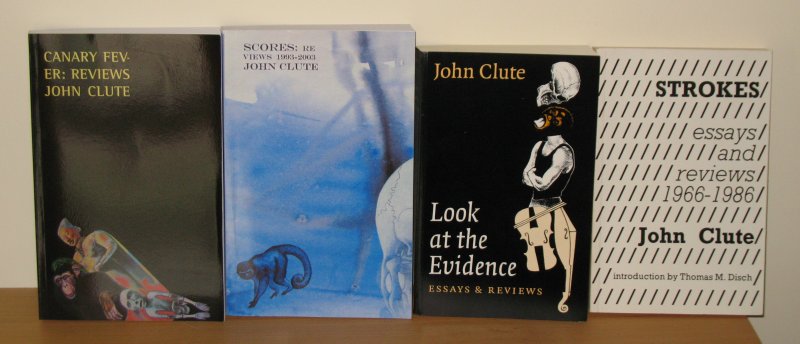
On this side of the Atlantic, we have sf critic John Clute, whose reviews are collected in these four books: Strokes, Look at the Evidence, Scores and Canary Fever. A new book of his essays has just been published, Pardon This Intrusion, but I’ve yet to buy a copy. Clute’s reviews can be difficult, if not willfully obscure, but he is also extremely sharp and clever.

These three books do exactly what it says on the tin: annotated lists of the top one hundred genre books, as chosen by the editors. Science Fiction: The 100 Best Novels and Fantasy: The 100 Best Books are sister-works; I’m guessing Pringle wanted to do both but ended up approaching another publisher for his Modern Fantasy: The Hundred Best Novels . Interesting books, but I can’t say I agree with the majority of their choices.

Two important critical works, New Maps of Hell by Kingsley Amis and Trillion Year Spree by Brian Aldiss, and a couple of general guides to sf, David Wingrove’s The Science Fiction Source Book and David Pringle’s The Ultimate Guide to Science Fiction.

I’m not sure what use is The Complete Book of Science Fiction and Fantasy Lists, but never mind. Likewise, the Good Reading Guide to Science Fiction and Fantasy (Zool is actually the Oxford SF Group). Essential SF is, well, just that – at least according to the authors. Who’s Who in Science Fiction lists the pseudonyms used by genre writers.

Four critical works. Bretnors’ Science Fiction Today and Tomorrow is a collection of essays by many big name authors of the 1970s and earlier: Frederik Pohl, Frank Herbert, Theodore Sturgeon, Jack Williamson, Gordon R Dickson, Ben Bova… Of Worlds Beyond is a series of essays on science fiction and writing science fiction by big name authors of an earlier generation: AE van Vogt, Robert Heinlein, EE ‘Doc’ smith, John W Campbell, and, er, Jack Williamson (most of the writing advice in the book is actually quite useless). Flame Wars and Storming the Reality Studio are academic studies of cyberpunk. Wizardry and Wild Romance is Michael Moorcock biting the hand that kept him in whisky for several decades.

I seem to recall Gary Westfahl’s The Mechanics of Wonder causing something of a fuss when it was published in the late 1990s. I enjoyed it and, like Westfahl, I’ve always felt science fiction began in 1926 with the publication of the first issue of Amazing Stories. The Arthur C Clarke Award: A Critical Anthology is just that, and the title of British Science Fiction and Fantasy: Twenty Years, Two Surveys pretty accurately describes its contents too.

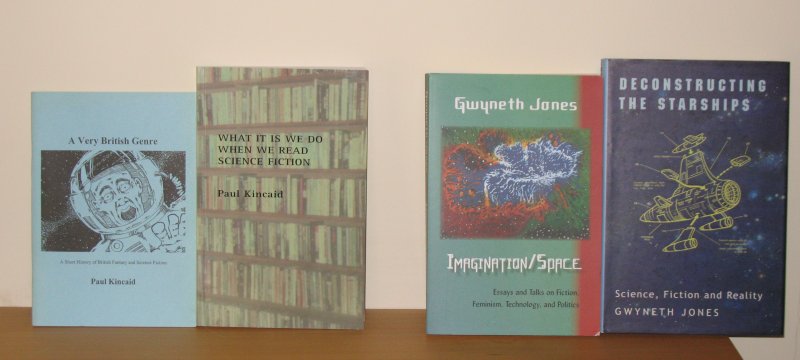
A pair of British critics: Paul Kincaid’s A Very British Genre and What It Is We Do When We Read Science Fiction; and Gwyneth Jones’ Deconstructing the Starships and Imagination / Space.

Some books about writers: Snake’s Hands is a study of the fiction of John Crowley; The Cherryh Odyssey covers CJ Cherryh’s works; Parietal Games is criticism about, and by, M John Harrison; Heinlein in Dimension is about Robert Heinlein; and The Universes of EE Smith is about the works of EE ‘Doc’ Smith.

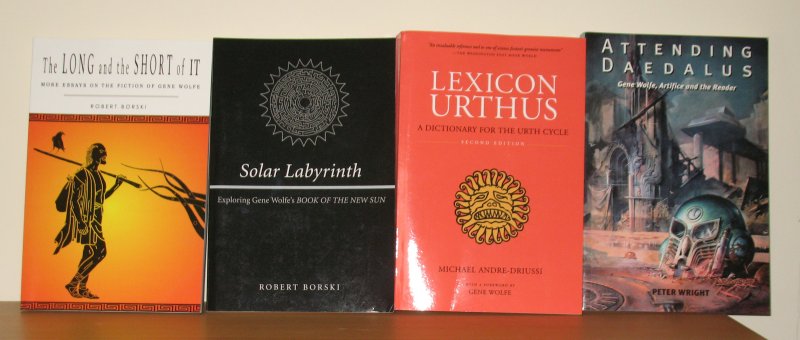
Some books about one writer: Gene Wolfe. The Long and the Short of It does not cover any specific work of Wolfe’s, unlike Solar Labyrinth, Lexicon Urthus, Second Edition and Attending Daedalus, all of which are about The Book Of The New Sun. I reviewed Lexicon Urthus, Second Edition for Interzone.

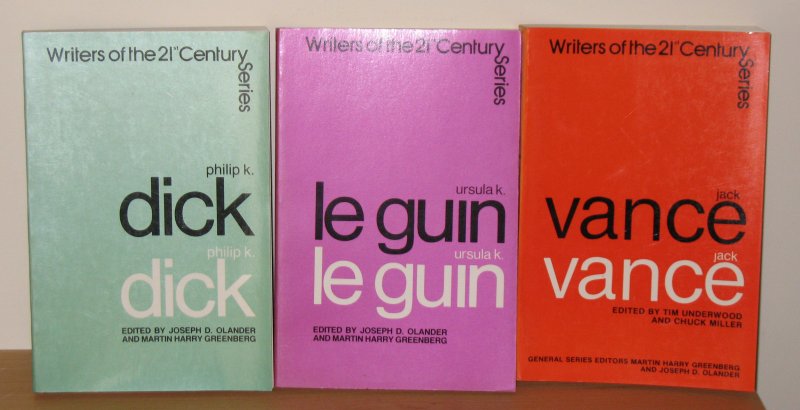
I picked these up years ago in a publishers’ clearance bookshop. I’m not sure why the series is titled Writers of the 21st Century, as only one – Le Guin – is still writing. Mind you, Philip K Dick is still being published, and having his stories adapted for the cinema, even though he died in 1982 (the book is copyrighted 1983). Jack Vance‘s last novel, Lurulu, was published in 2004, but we’re extremely unlikely to ever see anything new from him.

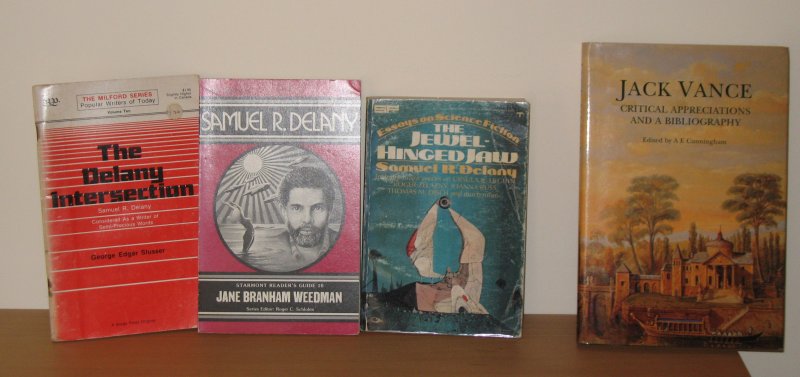
The Delany Intersection and the Starmont Reader’s Guide are both about Delany’s fiction. The Jewel-Hinged Jaw is Delany’s first and probably best-known work of criticism, though he’s written nearly a dozen such books. Jack Vance – Critical Appreciations and a Bibliography is just that.

Finally, two books about Edgar Rice Burroughs, Master Of Adventure about his fiction and A Guide to Barsoom specific to his Mars books. Who Writes Science Fiction? and Wordsmiths of Wonder are both collections of interviews with genre writers.

As well as the above books, I also have a number of science fiction and fantasy encyclopaedias and reference works. But that’s a post for another day.


9 Comments

The ethical writer

There was a bit of fuss caused last week by a nitwit post claiming that epic fantasy has degenerated since the days of Robert E Howard and Tolkien (I shall not dignify the post with a link to it). Nihilism and Decadence in populist escapist literature. Oh no! We must be in the End Times! I’ll not bother responding to the article – smarter folk than I have already done that. And done a much better job. But the subject has provoked an interesting line of thought…

There are those who say a writer’s only obligation is to be entertaining. Nothing else matters, providing the text entertains the reader. The aforementioned fantasy fuss would have you believe a writer is also obliged to be morally uplifting – or rather, to reinforce a narrowly-defined moral framework belonging to the writer of the post which started off the whole thing. Which is patently bollocks. In so many ways.

Writers do indeed have obligations above and beyond making their texts entertaining. They have an obligation to get it right.

Shoddy – or indeed a total lack of – research is inexcusable, and tantamount to artistic cowardice. This could mean, in science fiction, getting the science right, for example – something media sf is notoriously bad at doing. But it’s more a repudiation of the myth that you can “make it up as you go along”. Once, perhaps; once, when genre readers were unsophisticated. Not any more. And certainly not now that we have the Internet. Anything in a story that doesn’t seem quite right, you can look it up. You can do the research the writer should have done. And then you can decide not to read anything else written by that person ever again.

Fictionalising real-world examples is no defence. Want to make your fantasyland stand out? Why not look to the caliphates for inspiration? Yes, why not misrepresent and misinterpret someone else’s history and culture just to give your novel a little colour? Those people are unlikely to read your story, so why should you care if they get upset? And anyway, it’s all “made-up”… Except it’s not. Not if its inspiration is so obvious any reader can spot the parallels. In such cases, writers have an obligation to originality in their world-building. And a concomitant obligation to be accurate when the inspirations lie close to the surface.

There are those who claim it is immoral to use real people in fiction – public people, that is, dead or alive; not people the author actually might know. It is, they claim, an “invasion of privacy”. Except, public people rely on a public persona, it is their source of revenue, it is what they “do”. And as such it could be said it no longer belongs to them. If a writer were to use such a person in their text, then they are obliged to make their portrait, when necessary, as accurate as possible. The right places at the right time (providing the point of the story is exactly not that, of course).

Writers are certainly under no obligation to reinforce the prejudices of their readers. In fact, it is the reverse: they should challenge their readers’ prejudices. A good book should make you think about the world around you. It should not make you feel more comfortable with your attitudes; it does not exist to provide a helping hand carrying your personal baggage.

So, all that about a lack of conservatism in current epic fantasy, about these heirs to Tolkien who are spitting on JRR’s grave… It seems these degenerate, nihilistic writers are meeting their obligations: they’re challenging the worldview of the writer of the original post. He may not have responded intelligently, but that’s not their fault. Is it?


4 Comments

Looking backward from the Year 3000

I sometimes wonder if in the future they’ll look back at the 20th century as something of an aberration. During the 20th century, efforts were made, precipitated by two huge wars, to create just and fair societies for all – some using methods and ideologies more extreme than others. But the Soviet Experiment went down the pan, and most developed nations seem to be sliding down the slippery slope after it. We’re slowly returning to a world in which the privileged few callously exploit the masses in order to further enrich themselves and extend their power. In the old days, it was the royalty and nobility; now it’s the plutocrats and power-mongers.

Once they could use religion to control the great unwashed – and it still works in some places – but for many it no longer has the power in their lives it once possessed. So now they use the law. They’re putting in place legislation which undoes all those steps forward made in the past hundred years. And with the sort of bare-faced cheek only available to those for whom irony is an alien concept, they insist they’re doing it for our own good.

Which is not to say we’re not complicit. Popular culture celebrates the immoral profligacy of the rich, and heaps scorn on the poor. We admire the greed of the wealthy, when we should be angry at their squandering of resources, or their plundering of that which should belong to all of us. It’s all very well dreaming that any one of us could join their hallowed ranks – if, as they claim, we “work” hard enough – but we’re much more likely to find ourselves at the opposite end of the scale.

Science fiction and fantasy are as guilty as any other mode of entertainment. If sf can be characterised as ordinary people doing extraordinary things in extraordinary worlds, then we too often fail at the “ordinary people” part. No one is Paul Atreides; no one can be Paul Atreides. We can only escape our humdrum lives by being what we are not: empowered. And in sf and fantasy, those powers are extraordinary. They might be technological in origin, they might be magical. But it’s not a utopia unless we have them.

You could argue that there’s no drama in ordinary lives; or that the drama simply isn’t big enough or, well, dramatic enough. No one wants to read about serfs when they can read about princes, no one wants to read about a cook’s mate 3rd class when they can read about the admiral of the space fleet. But this is patently bollocks. True enough, a serf can’t change the world – not unless they’re suddenly handed magical powers – but there’s certainly room for adventure. But then fantasy is not about changing the world, it’s about maintaining the powers of the few. There’s nothing consolatory in being a serf, and nothing admirable in perpetuating their condition. But as long as they have it good in the royal castle, that’s all right then.

So, where are the fantasy genre’s Robespierres and Marats? Why must every peasant-hero be privileged at the start of the story? It’s not even as if they “work” hard for it. It’s a gift, it’s like winning the lottery. And all they do with their new-found power is… keep the privileged few in power. Among which they now number.

Sf may have a slightly better record, but there are far too many tropes in the genre’s lexicon which fail to address societies’ imbalances. Sf should not be justifying prejudices. Celebrating individualism just means you think you’re better than everyone else. And you’re not; no one is. So why are there no stories in which the Great Social Experiment of the 20th century took root? Why must we all imagine that in the future corporations will be more rapacious than they are now? Where are the stories in which there’s no need for one group of people to slaughter millions of others simply to impose their will, or co-opt their resources? Where are the stories in which corporations are carefully regulated so that they can’t “accidentally” bring the Earth, or the Galaxy, to the brink of disaster? The stories in which sacrifice is a personal choice, not an imposed one?

Yes, many authors have tried. Kim Stanley Robinson’s Mars trilogy, for example. Iain Banks and his Culture, perhaps… Except the Culture is a post-scarcity society, and has not so much redressed any inequalities as rendered them moot. Which is not the same thing at all. There are other examples. But they’re still a minority.

It’s bad enough the history of the real world is a catalogue of actions by the privileged few extending and/or abusing their privileges. I seen no reason why we should perpetuate this in genre fiction.


7 Comments

Meme goes fantasy

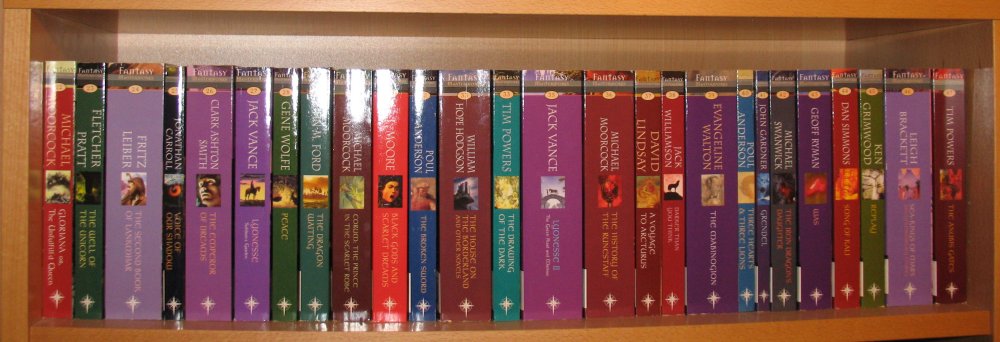
When Gollancz began publishing their SF Masterworks series, they did the same for a Fantasy Masterworks series. But it stopped after fifty books. There was also a Crime Masterworks series, but I’m not sure how long that one lasted. Anyway, usual memetic rules apply: bold those you’ve read, italicise those you own but haven’t read… which would be all of them for me: I bought each one as they were published.

1 – The Book of the New Sun, Volume 1: Shadow and Claw – Gene Wolfe
2 – Time and the Gods – Lord Dunsany
3 – The Worm Ouroboros – E.R. Eddison
4 – Tales of the Dying Earth – Jack Vance
5 – Little, Big – John Crowley
6 – The Chronicles of Amber – Roger Zelazny
7 – Viriconium – M. John Harrison
8 – The Conan Chronicles, Volume 1: The People of the Black Circle – Robert E. Howard
9 – The Land of Laughs – Jonathan Carroll
10 – The Compleat Enchanter: The Magical Misadventures of Harold Shea – L. Sprague de Camp and Fletcher Pratt

11 – Lud-in-the-Mist – Hope Mirrlees
12 – The Book of the New Sun, Volume 2: Sword and Citadel – Gene Wolfe
13 – Fevre Dream – George R. R. Martin
14 – Beauty – Sheri S. Tepper
15 – The King of Elfland’s Daughter – Lord Dunsany
16 – The Conan Chronicles, Volume 2: The Hour of the Dragon – Robert E. Howard
17 – Elric – Michael Moorcock
18 – The First Book of Lankhmar – Fritz Leiber
19 – Riddle-Master – Patricia A. McKillip
20 – Time and Again – Jack Finney

21 – Mistress of Mistresses – E.R. Eddison
22 – Gloriana or the Unfulfill’d Queen – Michael Moorcock
23 – The Well of the Unicorn – Fletcher Pratt
24 – The Second Book of Lankhmar – Fritz Leiber
25 – Voice of Our Shadow – Jonathan Carroll
26 – The Emperor of Dreams – Clark Ashton Smith
27 – Lyonesse I: Suldrun’s Garden – Jack Vance
28 – Peace – Gene Wolfe
29 – The Dragon Waiting – John M. Ford
30 – Corum: The Prince in the Scarlet Robe – Michael Moorcock

31 – Black Gods and Scarlet Dreams – C.L. Moore
32 – The Broken Sword – Poul Anderson
33 – The House on the Borderland and Other Novels – William Hope Hodgson
34 – The Drawing of the Dark – Tim Powers
35 – Lyonesse II and III: The Green Pearl and Madouc – Jack Vance
36 – The History of Runestaff – Michael Moorcock
37 – A Voyage to Arcturus – David Lindsay
38 – Darker Than You Think – Jack Williamson
39 – The Mabinogion – Evangeline Walton
40 – Three Hearts & Three Lions – Poul Anderson

41 – Grendel – John Gardner
42 – The Iron Dragon’s Daughter – Michael Swanwick
43 – WAS – Geoff Ryman
44 – Song of Kali – Dan Simmons
45 – Replay – Ken Grimwood
46 – Sea Kings of Mars and Other Worldly Stories – Leigh Brackett
47 – The Anubis Gates – Tim Powers
48 – The Forgotten Beasts of Eld – Patricia A. McKillip
49 – Something Wicked This Way Comes – Ray Bradbury
50 – The Mark of the Beast and Other Fantastical Tales – Rudyard Kipling

Not such a good showing for me there, but then I do tend to read more sf than fantasy (and, in fact, more literary fiction than fantasy). Some of the books in the series I’d have said were sf not fantasy (Beauty, The Book of the New Sun), but it remains an excellent selection. I just need to read more of them…


2 Comments

Ian bounces out of fat fantasy novel

I’ve mentioned in earlier posts for this year’s reading challenge that perhaps my choice of material perhaps wasn’t all together smart. It seemed like a good idea six months ago… Read the first book of a fantasy series each month. See what I think to it, see whether I’d want to read the rest of the series. And, having read a number of fantasy series, I didn’t think it would be that difficult.

What I’d not taken into account is that my taste in books has changed a bit since I ploughed through Robert Jordan’s Wheel of Time, or George RR Martin’s A Song of Ice and Fire…

As a result, May’s book – The One Kingdom by Sean Russell – proved a real slog and I was late finishing it (see here). And I’m running late on June’s. Which is King’s Dragon by Kate Elliott. I also very much doubt I’m going to finish it.

I’m less than 100 pages in. One narrative is about a sixteen-year-old girl who has just been forced into slavery, and it seems her “owner” engineered the situation as much because he fancies her as because he wants some sorcery book she owns.  So she’s likely to be raped. The second narrative has a youth sent to serve the local count. At present, he’s mucking out the stables.

I don’t want to read books like this. And King’s Dragon has 700 pages. It’s not a book, it’s a blunt instrument. To be fair, the writing is perfectly readable. But there’s far too much world-building, one of the narratives is offensive, and the other one is just plain dull.

So I’m giving up. I’m also giving up on the challenge. I managed it for six months, and it was too much of a chore. I’m going to try just one more book – The Wizard Hunters by Martha Wells – and then stop. I’ve got my summer reading project anyway.


7 Comments

Fantasy Challenge #5: The One Kingdom, Sean Russell

Have I mentioned before that I’m beginning to regret choosing big fat fantasy novels for my reading challenge this year? I think for next year’s challenge I’ll pick books under 100 pages, or at least something that’s predominantly short. Because secondary-world fantasies are generally big books and, at 698 pages in my Orbit paperback edition, Sean Russell’s The One Kingdom is probably not the biggest book of the dozen I’ve chosen for my challenge.

But it may well be one of the slowest.

The One Kingdom is the first book of the Swans’ War trilogy – followed by The Isle of Battle and The Shadow Road – but it’s not Russell’s first novel. He has written two earlier fantasy diptychs (one of which is apparently set in “the Kingdom of Wa”). He also writes historical naval fiction under the name Sean Thomas Russell. According to Russell’s web site (here), the Swans’ War trilogy came out of a desire to write a high fantasy, something he had avoided previously in order to “distinguish myself from the many imitators of Tolkien”. The good news is that The One Kingdom isn’t especially Tolkienesque. It’s more like Robert Jordan. Although, happily, Russell’s prose is a good deal better than Jordan’s.

The trilogy is set in the land of Ayr, which is dominated by the River Wynnd and its tributaries. The valleys formed by the tributaries are principalities in what was once known as the “One Kingdom”. But some time in the distant past, the kingdom split apart, leaving two families vying for the throne – the Wills and the Rennés. It’s the machinations of these two families which forms the plot of the trilogy…

Except it doesn’t really. Or rather, it doesn’t noticeably.

Secondary-world fantasies are typically constructed from story and world, and their appeal lies in one or the other, or both. Since story is so important, it is laid out from the start – this is the quest, this is the prophesy which must be fufilled, this is what must be done to resolve the story, this is where the characters are going and why. But not in The One Kingdom. Russell keeps his actual plot hidden, and it makes for an often frustrating read.

There are two narratives, linked by a single mysterious character. One is a travelogue; the other is an escape. In the first, the young Valemen Tam, Fynnol and Baore are travelling along the river with gypsy-like “story-finder” Cynddl to the Wold of Kern, chiefly because they’ve never left the Vale before and so it’s an adventure. Meanwhile, in the second narrative, Lady Elise, daughter of the head of the Renné family has run away from an arranged marriage because she knows the marriage is part of a plan to start a war in which the Wills will finally vanquish the Rennés.

The mysterious character who pops up in both these narratives, and prods them along, is the rogue Alaan. He meets the Valemen at the opening of the book, and saves their lives when they are attacked by black-clad soldiers (who appear to be after Alaan). He also arranges Elise’s escape from the Renné castle, and hands her over for safekeeping to a duo of minstrels.

Complicating matters is the possible reappearance of a legendary trio – although perhaps “god-like” might be a better description. Caibre, Sainth and Sianon were the three offspring of a wizard in ancient times, and they may have been reborn to fight their battles all over again. One of them seems to have taken over Eremon, counsellor to a prince ally of the Wills, and is determined to drive everyone into war.

There are some nice ideas in The One Kingdom. The best is the River Wynnd itself, which features hidden waterways and tributaries. These are magically hidden, alternate versions of the valleys of Ayr. Unfortunately, Russell has plonked this neat central conceit into a world built after watching Prince Valiant a few too many times. Bits of The One Kingdom may read in parts like the Wheel of Time, but the world-building appears to owe more to Ye Olde Hollywoode Mediaeval Englande than it does to any real attempt at creating a viable world of the required technological level and appropriate culture. The novel’s resolution, for instance, takes place at a ball in the Renné castle, and it reads like something from a Disney fairy-tale. Given all this, it’s easy to understand why the “gritty” fantasies of Abercombie and the like came as such a refreshing change…

Also problematical is the naming. Tam, Elise, Toren, Tuath… these aren’t too bad. But Cynddl is unpronounceable, and Gilbert A’brgail is always going to be misread as Abigail. Yet the place names are chiefly prosaic: Westbrook, Sweetwater, Speaking Stone…

The prose is mostly readable, and occasionally quite good; although Russell frequently tries too hard for high fantasy “authenticity”, resulting in those tortured sentences which are supposed to give the story an olde worlde feel but instead just look silly. The pacing of the novel is… languourous. Possibly even lethargic. Pages of introspection follow brief outbursts of action. Russell even flubs a couple of his big action scenes – the attack on the Fáel camp at Westbrook Fair is one example. It’s all over in a single paragraph, more or less. Whatever shock value it’s supposed to possess is completely missing.

I’m not entirely sure what to make of The One Kingdom. I liked the idea around which the world was built – the river and its magical hidden waterways. I liked the story. That the reader was forced into mapping both story and land as the book progressed struck me as interesting approach. The characters were mostly sympathetic, although a bit flat. Sadly, the villains were one-dimensionally villainous – evil with an “eeee”, in other words. Especially Eremon. Despite that, I suppose I could say I sort of enjoyed it…

Which puts me in a bit of a dilemma. I’d like to find out how the story of the Swans’ War pans out. But I’m not prepared to wade through 1500+ pages of sluggish prose to do so. A synopsis would do the trick, I think – a dozen or so pages summarising the plot of each novel. Yes, that’d work. Any volunteers to put one together for me?