It Doesn't Have To Be Right…

… it just has to sound plausible


7 Comments

Reading diary, #29

I had a couple of introductory paragraphs to this reading diary, about how at school I was often called names because of my choice in books… But I decided not to use it. Mostly because I’ve been sitting on this post for over a week as it contains negative reviews of two of the books on this year’s Clarke Award shortlist. I’ve seen other commentary on the two books, and I appear to be in a minority with my views. And we all know these days that reviews are expected to be little more than warmed-over marketing copy.

As for the Clarke shortlist itself, I’ve now read five of the six books. One of them deserves to win, two of them I suppose a case could be made for their presence (although I wouldn’t do it), and two should never have made the cut. By all accounts, the book I’ve yet to read is no better. But then every year there’s been one or two books on the shortlist whose presence is baffling. This year, it feels like a somewhat shapeless shortlist, more like fannish selections than the picks of literary judges. That may be an unintended consequence of the huge number of submitted books (ie, judges’ choices spread wider, more compromises needed to pick the final six), but that’s just speculation. The Clarke Award shortlist for 2016 is what it is. And sadly, given recent complaints in various quarters about a lack of critical commentary on the award, it’s not a shortlist that especially invites critical commentary.

But on with the books…
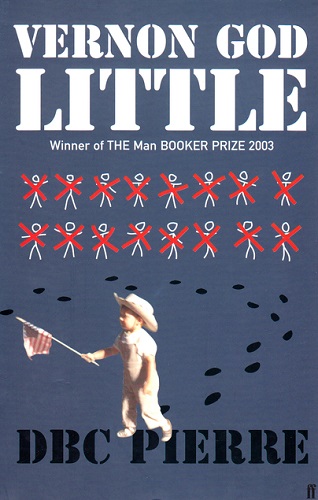
vernon_god_littleVernon God Little*, DBC Pierre (2003). You know those comic novels which are supposed to be funny but aren’t, and where the narrator’s voice is supposed to be funny but isn’t… well, this is one of them. There has been a tragedy in the Texas town of Martirio. Vernon’s best friend, Jesus, has gunned down several of his schoolmates, and Vernon is still under suspicion as an accomplice. (He’s innocent, but no one particularly cares – Jesus is dead, and Vernon makes a good scapegoat). This is one of those novels where the entire cast are white trailer trash, and that’s sufficient to present them as comedy characters. Ignorance may be fertile soil for comedy, but there’s a right way to handle it and a wrong way. There’s a meanness to the characterisations in Vernon God Little which makes for unpleasant reading. It doesn’t help that Vernon is a thoroughly unlikeable narrator, nor in fact that none of the characters in the book are at all likeable – most, in fact, are closer to caricature than character. How this book won the Booker Prize is a mystery; how it was picked for the 1001 Books You Must Read Before You Die list is an even bigger mystery. One to avoid.
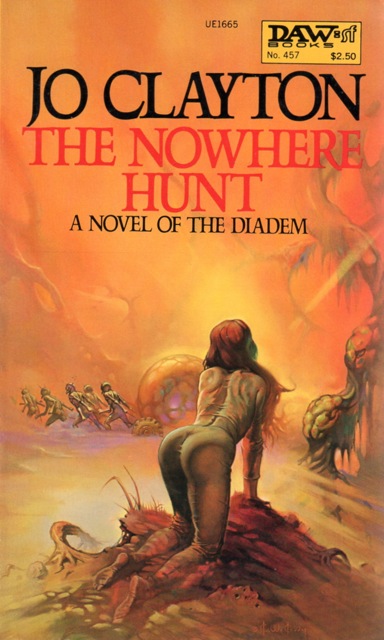
nowhere_huntThe Nowhere Hunt, Jo Clayton (1981). This is the sixth book in Clayton’s nine-book Diadem series, which also spun off a pair of trilogies about one of its minor characters. Although the series started out as peplum space opera (I’m determined to use that phrase, now that I’ve coined it), it soon drifted into standard 1970s space opera, a sort of Dumarest Saga with a female Dumarest – albeit with lots of special snowflake superpowers. Clayton seemed to have dialled back the violence and abuse as well by book four, but unfortunately this one sees a return to it. I reviewed The Nowhere Hunt on SF Mistressworks – see here.
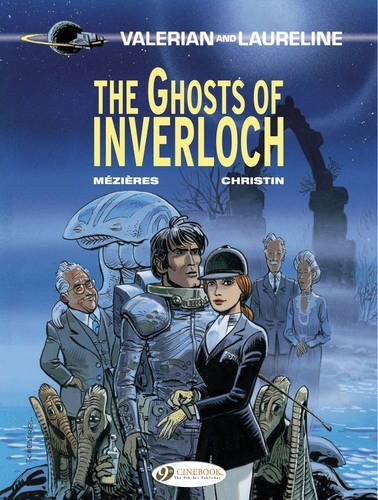
valerian_11Valerian and Laureline 11: The Ghosts of Inverloch, Jean-Claude Mézières & Pierre Christin (1983, translated 2016). I had always thought the Valérian agent spatio-temporel series comprised individual stories, but it seems there is a story-arc slowly beginning to appear. It’s not just that the previous two volumes, Métro Châtelet, Destination Cassiopeia and Brooklyn Station, Terminus Cosmos, formed a two-part story, nor that The Ghosts of Inverloch is also the first of a two-parter (with the yet-to-be-published-by-Cinebook The Wrath of Hypsis), but the story in The Ghosts of Inverloch does refer to the preceding two-parter and even to the first book in the series, The City of Shifting Waters. As it is the plot of The Ghosts of Inverloch is a bit on the thin side – Laureline is already in residence at the eponymous Scottish castle, but Valerian must first capture a Glapum’tian from the planet Glapum’t, which he manages to do within a couple of pages. He then heads – through time and space – to Inverloch Castle. Others are also making their way to the castle, including the head of the Spatio-Temporal Service, Valerian and Laureline’s boss… The reason why, unfortunately, is left to the following volume. Despite their episodic nature, the Valerian and Laureline series is superior space opera. And Luc Besson is making a film based based on it. I can’t wait.
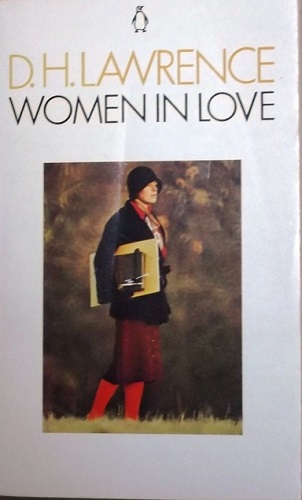
women_in_liveWomen in Love*, DH Lawrence (1920). This is a sequel of sorts to The Rainbow, inasmuch as it continues the story of Ursula and Gudrun Brangwen from that novel. Wikipedia claims the two books were planned as one big novel but split by the publisher, but the introduction to my edition of Women in Love contradicts this – in Lawrence’s own words. He was driven out of London in late 1915 by The Rainbow obscenity trial, a libel suit and his vocal opposition to the Great War (which made him a lot of enemies in London society), and settled in poverty in Cornwall. After recovering from illness, he started work on Women in Love“a sequel to The Rainbow, though quite unlike it”. Certainly, the two books are not big on rigour, and Women in Love might be better considered an entirely new novel whose leads share their names, and some background details, with the Brangwens of The Rainbow. Lawrence apparently wrote it very quickly, but it took four years before it saw print. Gudrun is an artist, returned to the family’s Nottinghamshire home village after a few bohemian years in London. Ursula is a teacher in a local school. She is attracted to school inspector Birkin (a stand-in for Lawrence himself), while Gudrun takes up with Gerald Crich, son of the local coal-mining magnate. The novel charts the two couples’ relationships through a series of (mostly) tragic incidents. You don’t read Lawrence for the plots, which is just as well as he tends to meander. And his characters usually read like they’re dialled up to eleven (so many! exclamation marks! It seems somewhat excessive to a modern reader). But there’s also lots of philosophising and discussions of Lawrence’s often bonkers ideas on art and life. Birkin especially is fond of lecturing the other characters, often at great length. And, of course, there’s Lawrence’s lovely descriptive prose. Women in Love is a… meatier novel than Sons and Lovers or The White Peacock; but it’s also a novel that disappointingly seems to treat the working-class like noble savages (and especially disappointingly so after Sons and Lovers). With its cast of minor gentry, teachers and artists, Women in Love is very middle-class, almost as if Lawrence’s years in London turned him into a social climber (and Birkin suggests as much in Women in Love). I have that absolutely enormous three-volume biography of DH Lawrence on my bookshelves. One of these days I’ll have to read it.
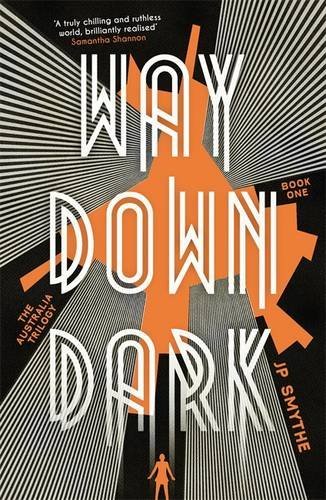
way_down_darkWay Down Dark, JP Smythe (2015). I am not in the slightest bit interested in YA – although I do like Smythe’s non-YA novels, and think they’re very good – but Way Down Dark was shortlisted for the Clarke Award this year, so I picked up a copy and read it and… I’m frankly mystified why it was shortlisted. It may well be better-written than the average YA, but it’s just one long litany of death and violence in a science-fictional setting which doesn’t hold up to a moment’s scrutiny. For a book to be on a major genre award shortlist, I expect more than just a nice turn of phrase. I’ve seen some of the commentary about Way Down Dark, and I am I admit not in the slightest bit familiar with the YA market… So perhaps it’s a YA thing that the background doesn’t make sense. It’s supposed to be a generation ship, but turns out to be a prison. In orbit. So where does the gravity come from? Not acceleration, since it’s not moving. And the decks are made of grating, so where is the artificial gravity hidden? There are “over ninety” of these open decks, and people live in cubicles they’ve made from salvaged sheets of metal and curtains. Chan, the protagonist, tells us that her mother moved them from higher up the stack to halfway down because it was nice and warm – yet the very bottom of the stack is apparently not too hot to live in. Because that’s where the Lows, who are straight out of Mad Max Central Casting, live. Then there’s the Pit, which is the floor of the well around which the decks are arranged. It’s a festering pool of dead bodies and rubbish…because people throw bodies and garbage there. As you would. The book doesn’t say how long the ship/prison has been occupied, but at least three generations are mentioned in the book, and since no one seems to remember they’re actually prisoners that suggests at least a century. In the centre of the Pit, under the rotting flesh and blood and trash, is a secret entrance to the guards’ quarters. Ignoring the fact that no sane person would go wading into a stinking soup of decomposing corpses, or even put their head under it, masked or not… there’s also the fact that initially the entrance would not have been hidden, and could not have been intended to be hidden, as who would design a prison with the expectation that inmates would throw bodies down into the Pit? The ship/prison is also called Australia… I hope there’s an explanation in a later book to explain the name (Way Down Dark is very much incomplete and the first part of a trilogy), but even so, in light of the book’s setting there’s a lot of… baggage there. This is, I believe, the third time a YA novel has made the shortlist – the other two were Monsters of Men by Patrick Ness in 2011 and The H-Bomb Girl by Stephen Baxter in 2008. Tellingly, only one of the three is by an actual YA author. Personally, I don’t think YA should be considered by the Clarke Award, and there’s nothing in this novel to cause me to reconsider that.
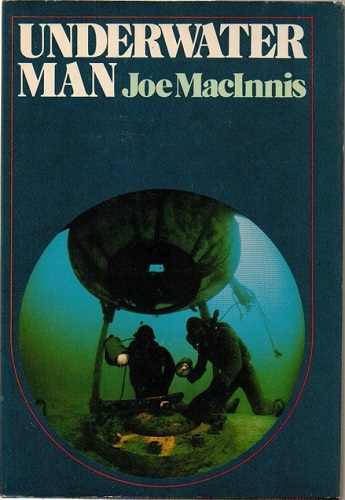
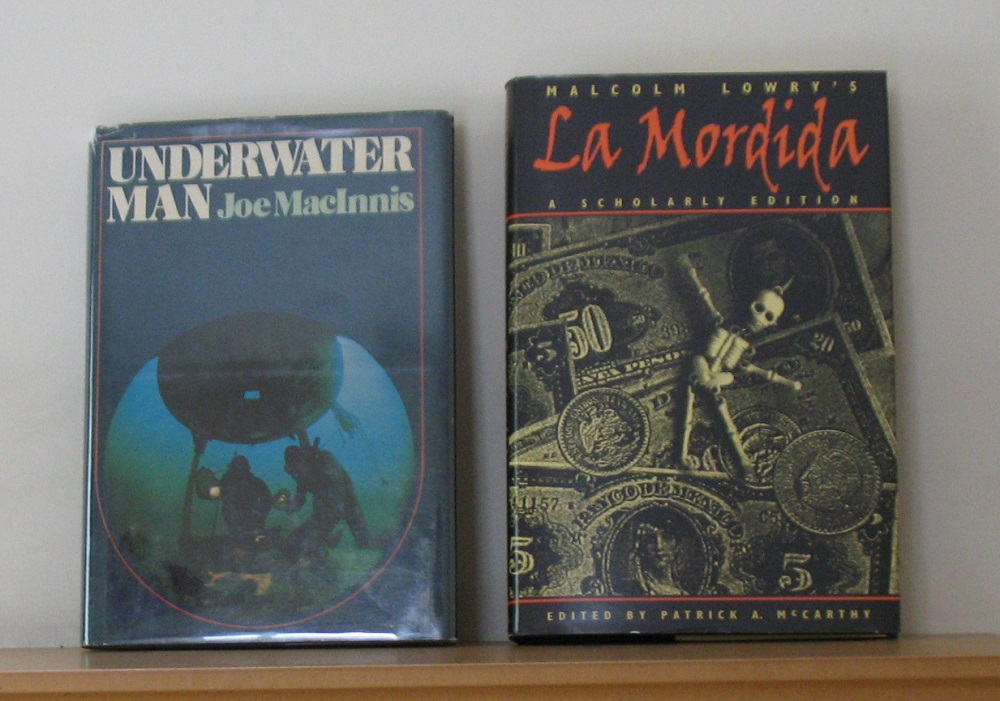
underwater_manUnderwater Man, Joe MacInnis (1974). MacInnis has been involved in diving medicine for a number of decades – first with Ed Link and his various projects, then in other places. He was part of the US Navy’s SEALAB III project, and was the first scientist to dive beneath the North Pole. This book describes eleven of MacInnis’s most memorable underwater adventures from 1963 to 1972, including the stuff with Link and the Arctic dives. MacInnis may be an excellent doctor, and an accomplished diver, but his writing is… somewhat, er, florid. Here’s a sample, about the bends:

“It is in the shallow regions that decompression sickness is most likely. We are both aware of its fierce displays. I have seen destructive pain-shells fire through proud young bodies. I recall an old friend who had succumbed to the dark winds of vertigo. A ruthless bubble lodged near his brain. He was in such distress that he threw up. I remembered the hard grey stillness locked in my gut as we nursed him slowly back from the cliff edge of shock.” (p 76)

It makes for an odd read. Fascinating stuff nonetheless, and MacInnis is an important figure in the field – he’s still going, his last book was published in 2012 (although I only have his 2004 book, Breathing Underwater, as well as Underwater Man).
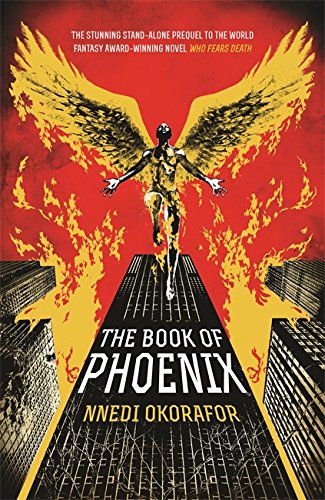
book_phoenixThe Book of Phoenix, Nnedi Okorafor (2015). And from a shortlisted book written for teenagers to one that reads as though it were written by a teenager. Okorafor seems to be having a Moment this year: ‘Binti’ was nominated for the Hugo, Nebula and BSFA Awards, and won the Nebula; and The Book of Phoenix is on the Clarke Award shortlist. This novel is apparently a prequel to 2010’s Who Fears Death, which I’ve not read – and I don’t think I’ll be bothering to do so, either. The protagonist of The Book of Phoenix is a genetically engineered “SpeciMen” (a particularly ugly coinage). Although only two years old, she has the body and mind of a forty-year-old African woman. We’re told she was called Phoenix after the city in Arizona, but the book then later says her mother gave her the name – so it’s a massive coincidence that her genetically-engineered superpower is the ability to combust and then be reborn from her ashes. Oh, and she can fly – she has wings. And later she can “slip”, which is sort of teleporting in time and space. And she can generate heat inside her body too. She starts the book as a prisoner in Tower 7, a LifeGen facility in a post-climate-crash New York. She escapes by destroying the building, and flies to Ghana. A year later, LifeGen tracks her down and, in the process of capturing her, kill her lover. They take her to a Tower in the Caribbean and… The plot of The Book of Phoenix is basically this happened and then that happened and then this happened, with no discernible structure or rigour to it. Early on, Phoenix releases an alien kept captive in Tower 7, and mentions in passing there are colonies on Mars. Both are mentioned only once more in the novel, also in passing, near the end. Ideas are just picked up by the author for world-building when needed, then put down and forgotten. As far as I know, The Book of Phoenix is not being marketed as YA, although it seems to exhibit many of the hallmarks – a heroine with super special powers that have no grounding in either story or world or science or logic, world-building with no rigour and very little sense, and a plot that jumps from one unconnected incident to the next. Would I have thought The Book of Phoenix a better book if it had been badged as YA? Unlikely – though it would have at least “explained” some elements of it. I’ve discussed Okorafor’s novel with other people, and I seem to be alone in finding it unimpressive. So it goes.

1001 Books You Must Read Before You Die count: 124

Finally, I think I’ll start including a breakdown of my reading by gender in my reading diary posts, so here’s the first – 57 books read up to 22 May this year:
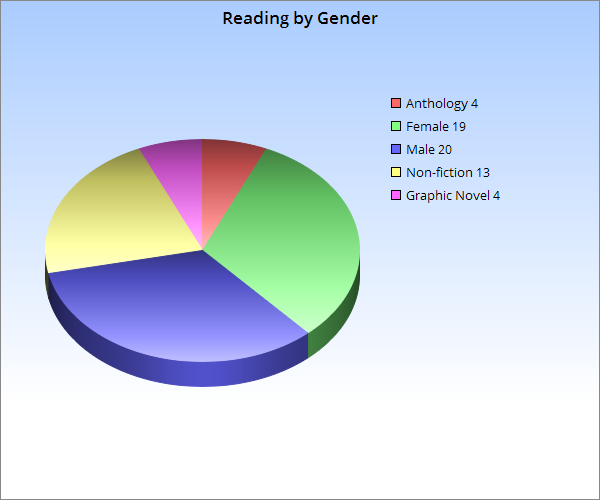
gender


Leave a comment

Triple-stacked

I’ve now got into the habit of dumping books at charity shops, or giving them away to friends, once I’ve read them, unless I have a specific reason for wanting to keeping them – such as, they’re part of a series I’m collecting; or, they were really difficult to find… Back in the day, it was: buy a book, read it, keep it. But space is finite and the desire for books is not. Some of the books below will be staying once they’ve been read, some will not. So it goes.

IMG_4150

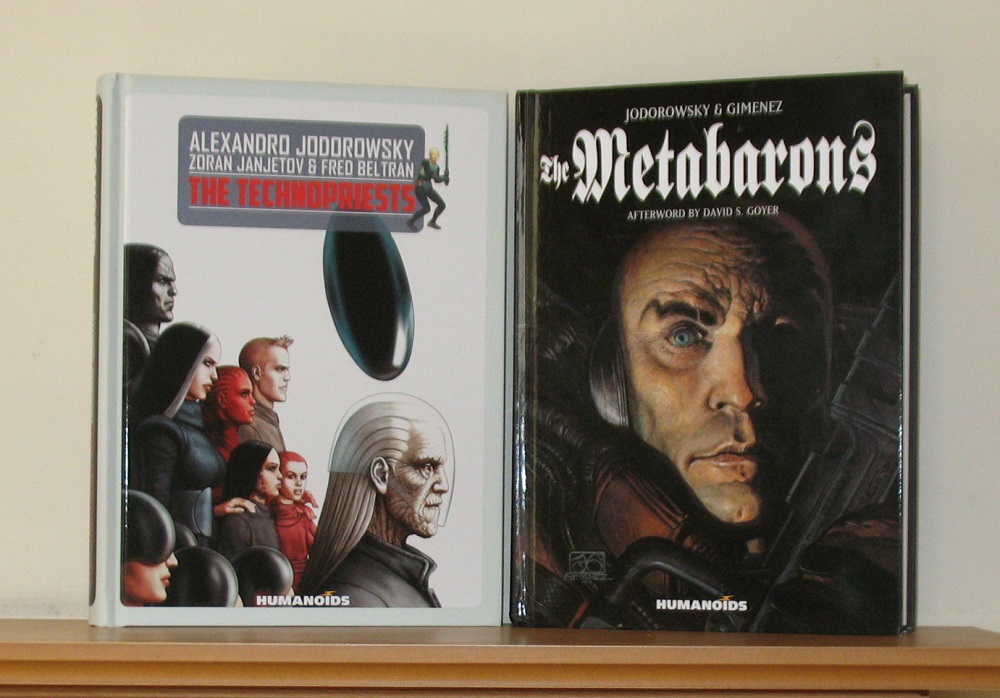
I bought the first couple of volumes of both these series a few years ago, and even bought the first volumes of The Technopriests in French… but for some reason, the series were never fully translated into English… until these omnibus editions appeared. Which I bought. I wrote here about The Metabarons; I have yet to tackle The Technopriests.

IMG_4151

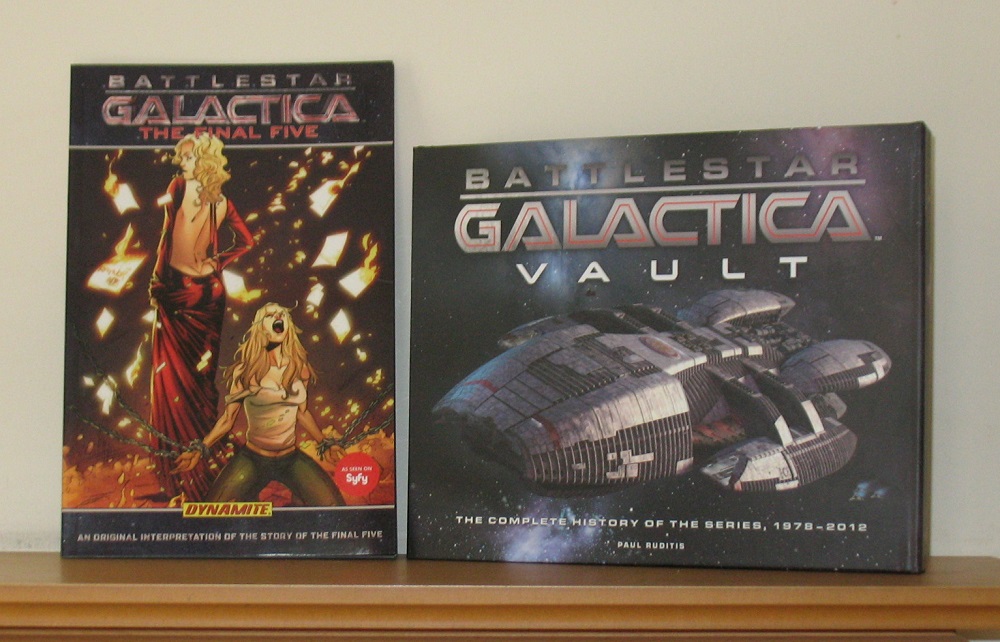
These two I bought to accompany a rewatch of Battlestar Galactica (I bought the ultimate edition on Blu-ray for a very cheap price on one of Amazon’s Prime Days). The Final Five I wrote about here – it’s confusing and not very good. Battlestar Galactica Vault I expected to be like the Alien Vault published a few years ago – lots of background info and concept designs… But it’s not. It’s just a straightforward history of the show, albeit well-illustrated.

IMG_4152

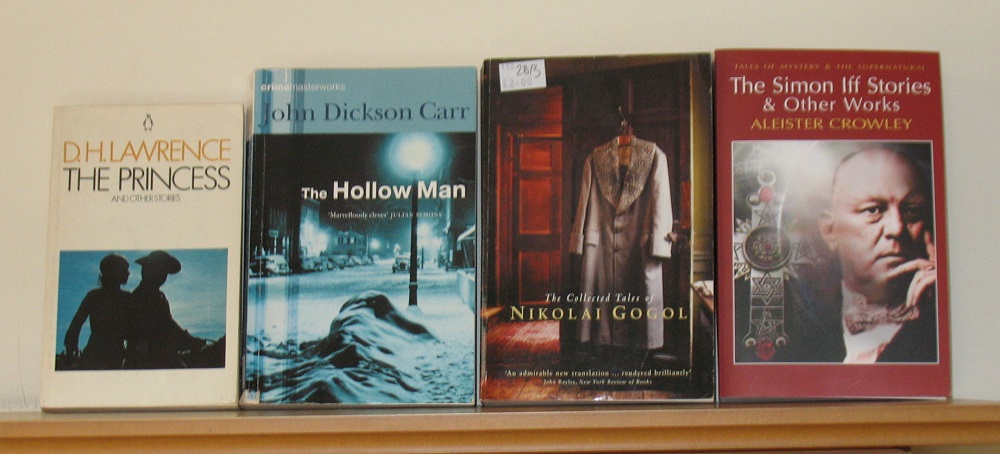
Some charity shop finds – except for The Princess and Other Stories, which I bought on eBay and which joins the other DH Lawrence Penguin paperbacks in that series I have. I hadn’t known Aleister Crowley wrote fiction, so I bought The Simon Iff Stories and Other Works to see what they were like. Sokurov references Gogol quite a lot in his films, so I picked up The Collected Works of Nikolai Gogol so I could follow them. And whenever I see a Crime Masterwork I’ve not read, even if they’re a bit tatty, I buy them – hence The Hollow Man – although I’ve been a bit slow about reading the half-dozen I’ve found so far.

IMG_4153

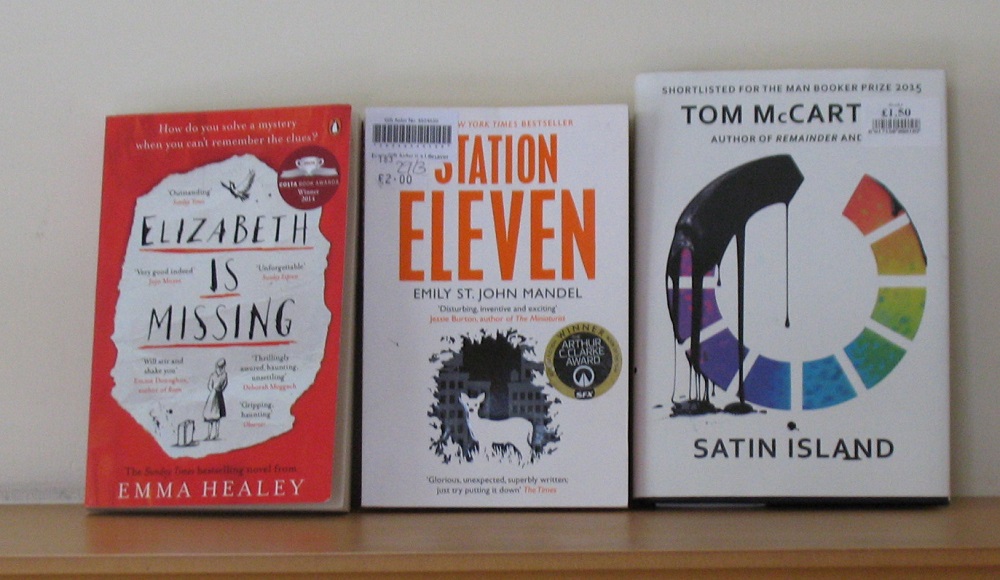
Even more charity shop finds, but more recent books this time. Satin Island was shortlisted for the Booker, Station Eleven won the Clarke. I’ve already read Elizabeth is Missing – I wrote about it here. I still can’t remember who recommended it to me and why.

IMG_4154

Underwater Man is the second of two Joe MacInnis books I bought (see here for the other), but it took a bit longer to arrive as the seller was in Canada. La Mordida is another scholarly edition of a Lowry work – it’s a draft of an unpublished novel Lowry wrote about a trip to Mexico in 1945.


1 Comment

Reading diary, #28

Occasionally, I read books. I am in fact supposed to be more of a literature fan than I am a film fan, but reading a book takes few days whereas watching a film takes only a couple of hours. Of course, if I were serious about my film criticism, I’d  be watching each movie a number of times with notebook in hand, ready to make insightful comments… instead of cobbling together a hundred words a week after watching the film while drinking wine… Still, at least I read sober. Not that I take notes while reading. But then I’ve never thought of myself, or called myself, a critic, I’ve always been a reviewer and that’s how I approach how I write about the books I’ve read. Which were…

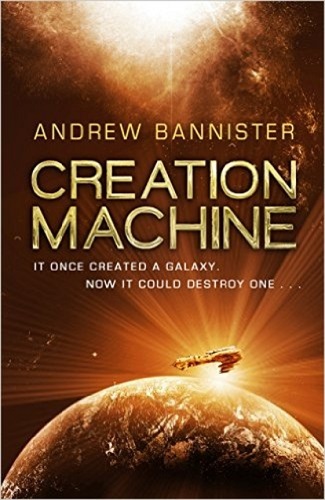
creation_mcCreation Machine, Andrew Bannister (2016). This one seems to be getting quite a push from Bantam (they were giving away free ARCs at Eastercon). First impression… well, it’s very Banksian. And that can’t be bad. The action takes place in the Spin, an “artificial galaxy”, although no real sense of the size or scale of this galaxy is apparent in the book. The heroine, Fleare Haas, who struck me as very much in a smiliar vein to Banks’s Lady Sharrow, is the daughter of the plutocrat who pretty much runs the Hegemony, the Spin’s most powerful government. She tried fighting against him in a breakaway army, but that ended badly. As the book opens, she’s a prisoner of an enigmatic ruin on one of the Spin’s worlds. She’s then rescued by an ex-colleague who is a cloud of nanobots (one of the novel’s more inventive elements), because she’s needed to prevent the Hegemony  from doing something stupid with a powerful artefact that may be left over from the machine that built the Spin. That artefact is currently in the hands of a brutal regime which occupies a handful of worlds in the centre of the artificial galaxy. It’s all very twenty-first century space opera, very readable, quite inventive, with a slight twist of Banks and a mordant, albeit far more sweary, wit… But it’s also a space opera universe in which capitalism runs everything, and slavery, torture and brutality seem the default setting… In fact, there are no redeeming features to the societies depicted in the Spin. And I have to wonder, why would someone write a book like this? It feels like an attempt to writer a grimdark space opera – but since I think grimdark is a horrible thing, I can think of no good reason why anyone would want to do the same in space opera. I suspect this book will do quite well, but I’ll not be bothering with the sequels.

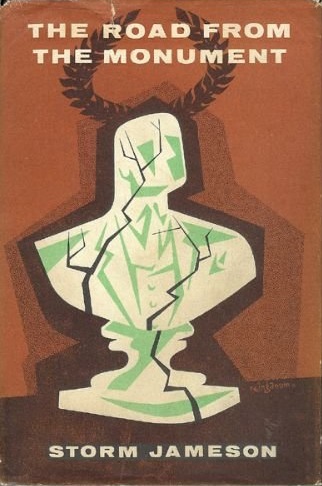
monumentThe Road from the Monument, Storm Jameson (1962). An odd book, and perhaps even more odd because Jameson is such a good writer. Greg Mott is a highly-regarded author, and the director of an artistic institute. He came from humble beginnings – his father was a destitute ex-seaman, and – the shame! – he graduated from Sheffield University – but he has made something of himself, a great man of letters, with important friends and acquaintances. I have to wonder if Mott were based on Evelyn Waugh, although Waugh went to Oxford. The Road from the Monument opens with the retirement of a public school teacher – he’s been there sixty years, wasn’t even qualified when he started, and has been paid a pittance throughout his tenure. The teacher spotted Mott’s potential early, and spoent his own money to put Mott through university. After leaving the school, he goes down to London to see what Mott has made of himself – and realises that Mott’s intelligence and wisdom pretty much skin-deep. He goes back gom edisappointed. The story then focuses on Mott’s second-in-command, Lambert Corry, his best friend at school, who went to Oxford, became a civil servant, rose through the ranks but then resigned to take up a position at the institute. Unlike Mott, he is not a successful author. Although the plot of The Road from the Monument is ostensibly about the scandal which hovers over Mott after he picks up a young woman while on holiday in Nice and gets her pregnant, it reads more like a poison pen letter from Jameson to the UK’s literary set. Most of the characters are writers of varying degrees of success, and James sticks the knife into every one. I tweeted a quote from the book while reading it, and it’s one of the mildest characterisations in the book of one of its cast: “they always gave him credit for honesty and integrity, the virtues of a moth-eaten writer. He got what he deserved – respect and neglect”. The upper class are also depicted as sociopaths (which I suspect they are, anyway; as are the plutocrats), and, in fact, no one in this novel is at all sympathetic… except perhaps the young woman who is made pregnant by Mott. Not a pleasant book to read (I’m not doing too well in that respect in this post), and Jameson does over-do the interiority… but she’s nonetheless a sharp writer, and I plan to further explore her oeuvre.

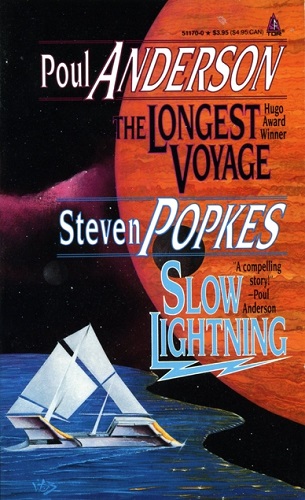
slow_lightningThe Longest Voyage / Slow Lightning, Poul Anderson / Steven Popkes (1991). Back in the late 1980s and early 1990s, Tor published a series of tête-bêche novellas, stretching to 36 books. By book #30, they’d dropped the tête-bêche format, and in fact dropped the whole double-novella thing at times, as this one is pretty much a short story followed by a short novel. Which are not at all related. And I have no idea why they were published together. Or indeed why they were published at all. ‘The Longest Journey’ originally appeared in Analog in 1960. It’s set on the moon of a gas giant, colonised by humans at some point but now they’ve regressed to a late mediaeval tech level. A Columbus-like figure sails across a vast ocean to a mythical land… and finds it is inhabited with people just like himself. They’re welcomed with open arms, trade agreements are drawn up… and then the explorer learns of a hermit and his ship that sails between the stars… This is the sort of sf story that used to appear by the hundreds back in the 1950s and 1960s. It apparently won the Hugo for best short fiction, which only goes to show the award was won by unremarkable stories even back then. ‘Slow Lightning’ is original to the double, and I’m baffled why it made it into print. It reads like half a dozen stories randomly stuck together because the author once heard the word “plot” and has a sort of vague idea what it might mean. It opens on a contemporary Earth after an alien, well, not an invasion. They came, they started trading, they pretty much overwhelmed the planet… and they turned Boston into an intergalactic port. A young orphan, whose parents died while settling an alien world, is now living with his aunt and her moody teenage son. With him he has Gray, a spatient, who is a sort of alien android thing but looks more like a six-legged rhino or something. The boy finds an alien egg in the wreck of a ferry on the bay shore. He decides to hatch it to see what comes out. Gray investigates as he’s worried what it might contain. The egg hatches, end of story. Except it isn’t. The plot now jumps back in time to the boy’s parents, to explain what they were doing and how they died, and how that ties in with the egg – which is sort of does but only peripherally. Anyway, they die, end of story. Except it isn’t. Because the story now jumps even further back in time to shortly after the aliens arrived, and describes the death of the boy’s grandparents, who were caught up in a turf war between the Boston authorities and a smuggler lord who married the boy’s grandfather’s sister. The whole thing reads like they might have been separate but linked stories, but the decision to publish them together, in reverse chronological order, was a mistake.

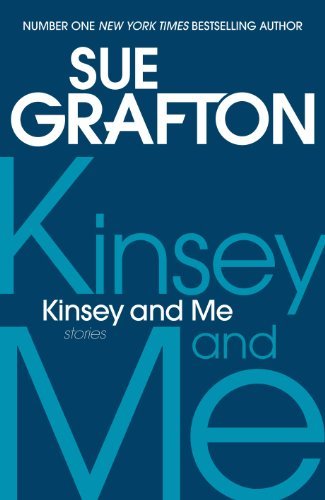
kinseyKinsey and Me: Stories, Sue Grafton (2013). I have been a fan of Grafton’s Kinsey Millhone almost as long as I’ve been a fan of Sara Paretsky’s VI Warshawski. I think Paretsky is the better writer, and Warshawski the better character, but Grafton’s Millhone still has her appeal. I especially like that Grafton decided Millhone would age one year for every two-and-a-half books, so her alphabet series – it’s up to X at the moment – is now historical fiction, given that it takes place in the late 1980s. Along the way, Grafton has banged out the odd short story, mostly for anthologies of female crime writers, and Kinsey and Me collects those, plus a series of stories about Kit Blue which appear to have been written as some sort of therapy on the death of Grafton’s alcoholic mother. The Millhone stories are entertaining but lightweight – although the constant need for Millhone to introduce herself gets a bit wearying over nine short stories. The plots pretty much follow the same formula: someone asks Millhone to investigate something, she does so, spots a single clue which reveals all is not as it seems, there’s a final showdown, and she reveals the clue and how it led her to figure out what really happened. The Kit Blue stories are uncomfortable reading because they’re plainly autobiographical, but it’s also hard to understand why Grafton made them public. Kinsey and Me adds nothing to the alphabet series, and even for fans it’s of only peripheral interest.

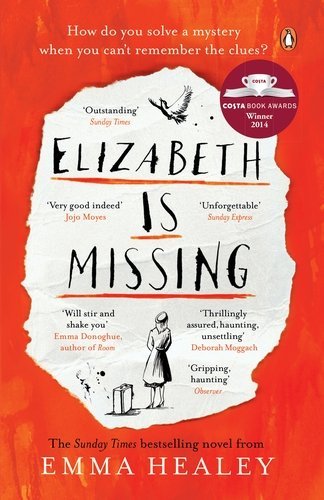
elizabethElizabeth is Missing, Emma Healey (2014). I spotted this in a charity shop and remembered that someone had recommended it, so I bought it. But I can’t recall who recommended it, or why – I suspect David Hebblethwaite. The protagonist, Maud, is in her eighties and suffers from dementia. Her best friend Elizabeth has gone missing – or, at least, so Maud thinks. In between Maud trying to find out what has happened to Elizabeth, she remembers the disappearance of her sister back in the late 1940s. It’s a clever idea, and it’s handled well. The big problem is the main character – Maud feels like an old person written by a young person. It’s small details. When you’re in your eighties, mortality looms large, but the word doesn’t appear anywhere in Elizabeth is Missing. Maud’s dementia is chiefly characterised by a lack of short term memory and an occasional inability to recognise things. The present day chapters alternate with ones set in 1946, which, of course, are told with perfect recall, and so add a spoiling note to the central conceit. It’s obvious from the start that Elizabeth isn’t really missing – or rather that there’s nothing sinister about her disappearance – but the 70-year-old mystery against which this is juxtaposed proves trivially easy to solve, and it come as a surprise no one figured it out at the time. Although generally well-written, and Healey’s choice of heroine has to be applauded, ultimately I don’t think Elizabeth is Missing quite succeeds. But it’s at least worth reading.

1001 Books You Must Read Before You Die count: 122


5 Comments

Reading diary, #27

Although I’ve been appending a count of books read from the 1001 Books You Must Read Before You Die list to these reading diary posts, I’ve not been making much of an effort to work my way through that list – certainly not to the extent I’ve been doing with the 1001 Films You See Before You Die list. Of course, reading a book requires more of an investment in time than watching a film, and I suspect there are fewer books on the book list of the sort I’d enjoy than there are films on the film list. Anyway, there are no books from the list in this post, although I do have about a dozen somewhere on the TBR. Just thought I should mention that.

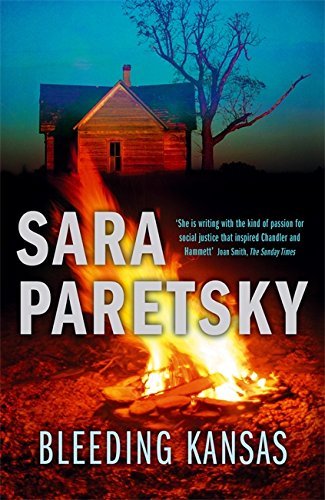
bleeding_kansasBleeding Kansas, Sara Paretsky (2008). I am a big fan of Paretsky’s Warshaski novels – my mother took me to see Paretsky being interviewed by Val McDermid at the Harrogate Crime Festival last year – although it’s taken me a while to get round to reading her non-Warshawski novels. I read Ghost Country while at Bloodstock, a metal festival, last year, and thought it very good. Bleeding Kansas is… less good. It’s apparently based in part on Paretsky’s own teen years in Kansas, before she moved to Chicago; and, I suspect, although I rather hope not, based on the people she knew from that time. Because they are pretty much all mean-minded and prejudiced Bible bashers (is there any other sort?). Especially one family, who use their faith to justify all manner of bigotry and nastiness. The story focuses on Lara Grellier, the teenage daughter of one of the farming families in the Kaw River Valley. Her mother Susan is fascinated by a Grellier ancestor, who helped slaves during the Civil War, and survived several attacks by Quantrill and other pro-slavery “Border Ruffians” (the title of the novel refers to that period), but has a mental breakdown after the death of her son in Iraq. A lesbian Wiccan from Chicago has just taken over the dilapidated mansion of the local, deceased, gentry; and the Schapen family, mean-spirited relious types to a person, have accidentally bred a pure-red heifer which an apocalyptic Jewish sect from Chicago want in order to to rebuild the Temple in Jerusalem. Meanwhile, everyone else tries to get by, without being too hateful – at which they don’t always succeed – or too liberal, which would of course see them tarred and feathered and driven out of the county. I really don’t have any sympathy for people who think their religion excuses their appalling behaviour (I’m looking at you, North Carolina), and I’m really not interested in reading about such people. It’s to Paretsky’s credit that she’s even-handed in her treatment of her caste of bigots and idiots, but that does make you wonder why she wrote the book in the first place. Yes, Warshawski is a champion and plays a champion’s role, and that’s part of the character’s appeal – so it seems self-evident that to go against type would result in characters most of Paretsky’s readers are going find unlikeable, and so create a novel most would find a less-than-enjoyable read. The Amazon reviews, interestingly, seem evenly split among the stars ratings, on both UK and US sites.

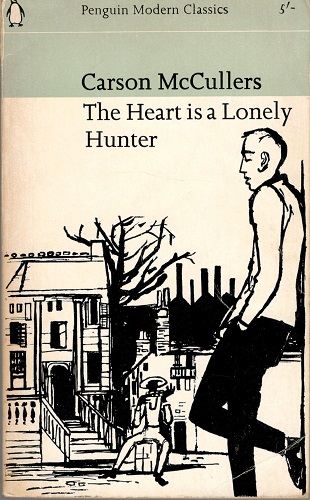
heart_hunterThe Heart is a Lonely Hunter, Carson McCullers (1940). This is one of a pile of Penguin paperbacks from the 1960s I inherited from my father. Some of his collection I wasn’t interested in, but I kept many – including four by Carson MCullers: The Member of the Wedding I read a while ago but wasn’t that impressed; The Heart is a Lonely Hunter is her first full-length novel and probably her best-known work, and I liked it a great deal more; still to come are Clock Without Hands and a collection, The Mortgaged Heart. A pair of deaf and dumb men (referred to throughout as “mutes”; actually, one is only deaf, but speaks so infrequently everyone assumes he is unable to do so), live in a small town somewhere in Georgia in the 1930s. One of the two men becomes mentally ill and is sent away to an asylum. The other, Singer, moves into a boarding-house and becomes a sort of listening post for a variety of characters, who come to talk at him and relax in his company. There’s something obviously Christ-like about Singer, although McCullers never quite makes it explicit. The novel actually focuses on four of Singer’s “friends”: a teenage girl who loves music, a drunken labour activist, the widowed owner of a local café, and a black doctor who is a communist and preaches Marxism to his family at Christmas. I enjoyed this a great deal more, and thought it much better, than the earlier MCullers novel I’d read. There was apparently a film made of it, which changed the setting to the 1960s. Not sure how that would work…

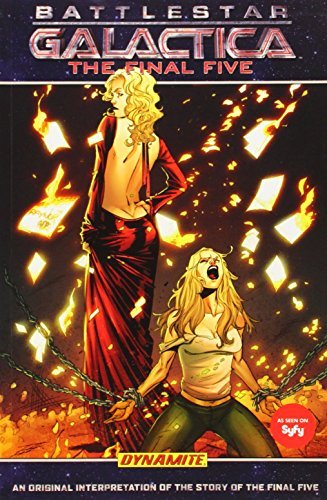
bsg_final_fiveBattlestar Galactica: The Final Five, Seamus Kevin, Fahey, David Reed & Nigel Raynor (2009) I bought this to read while rewatching Battlestar Galactia from the beginning, because it professed to tell the back-story of its titular characters (the five of the Twelve Cylon “skin jobs” whose identities were not revealed until very late in the series). As is the case with most such tie-in graphic novels, the art is pretty awful. Unfortunately, the story doesn’t make much sense either. Perhaps I should have waited until I’d finished my rewatch before reading it, maybe then it would have made more sense. I can’t remember from my previous viewing of Battlestar Galactica if Earth was supposed to have an ancient technological society which then disappeared (leaving no evidence of its existence; strange, that…), or not. From what I do remember, the Galactica arrived at Earth in its prehistory – although there was another Earth-like world in there somewhere, although that planet destroyed itself in a nuclear war. Anyway, I was put off a bit by the generally bad art, and since my comics reading these days seems to be limited to translated bandes dessinée (I’m no longer interested in reading about fascists in tights), so I’ve probably lost the knack of reading US graphic novels. But maybe if I give The Final Five a go after I’ve watched all of Battlestar Galactica again… (I bought the Blu-ray ultimate collection, £100 off, in a recent Amazon Prime Day – it includes everything… the pilot mini-series, the webisodes, Caprica, the whole lot. Totally worth what I paid for it – and yes, I still consider Battlestar Galactica the best television sf series ever made, and among the best television series ever made of any genre.)

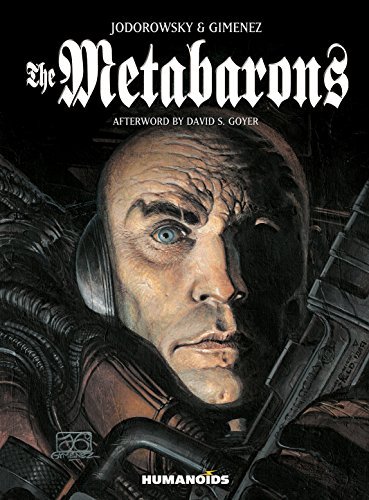
metabaronsThe Metabarons: 40th Anniversary Edition, Alejandro Jodorowsky & Juan Giménez (2015). The Metabaron bandes dessinée originally appeared between 1992 and 2003, and while the original Metabaron character appeared in The Incal in 1981, I’m still not sure how that works out to a “40th anniversary edition” in 2015. Anyway, it’s a nice hardback omnibus of all the Metabaron stories, so who cares? The story is framed as a story told by the robot Tonto to the robot Lothar, both of whom look after the Metabunker, the home of the last Metabaron, No-Name. The Metabunker is located in a deserted city-shaft on a deserted world, and No-Name is absent for much of the length of The Metabarons. There’s a reason for this framing narrative, but explaining it would constitute a spoiler, so… Tonto explains how the first Metabaron, owner of a marble planet, was forced to reveal the existence of the epiphyte, a substance which counteracted gravity, to the Emperor and Empress, and so became fabulously wealthy, and was given the title Metabaron. He was also a superlative warrior, and with his new-found enormous wealth set out to improve his skills and his killing technology. And also institute the various traditions which were carried down through five generations to No-Name: that there can only be one Metabaron, so the son (or daughter) must kill the father, and that part of the training involves some form of mutilation and replacement prostheses. Jodorowsky wrote The Incal after the failure of his Dune project, and some of his work on Herbert’s novel ended up in that bande dessinée. But there’s also a lot of Dune in The Metabarons – there’s a Bene Gesserit analogue, a pain test that copies the one undergone by Paul Atreides (but involves real physical damage), and even mentat-like advisors to the Emperor and Empress. There’s also stuff that’s pure Jodorowsky – such as the Emperor and Empress being succeeded by a pair of conjoined twins of different genders, the Emperoress. Some of it is a bit silly. The third Metabaron, for example, is Steelhead, so called because his father shoots off his head as a baby, but his mother manages to fashion a robotic one in time to save his life. Um, right. The artwork throughout is gorgeous, and the story is pretty much pure-strain space opera. Totally worth buying.

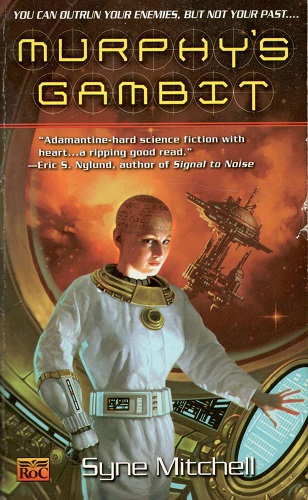
murphys_gambitMurphy’s Gambit, Syne Mitchell (2000). I read for review on SF Mistressworks. I forget where I stumbled across mention of this novel, and with a publication year of 2000 it only just sneaks into SF Mistressworks’s remit, but it looked intriguing enough for me to buy a cheap copy on eBay… which proved to be a bit tattier than expected. Ah well. Not a keeper anyway. As should be clear from my review here.

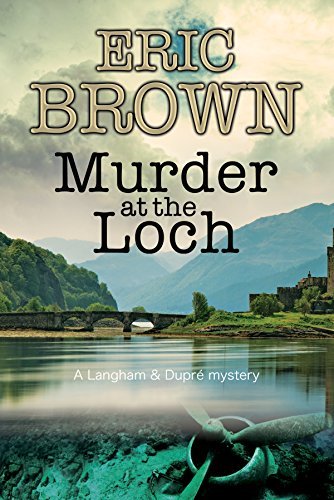
murder_lochMurder at the Loch, Eric Brown (2016). Eric is a friend of many years, although I wouldn’t read these books – Murder at the Loch is the third in the series – if I didn’t enjoy them. True, they won’t set the crime genre alight, and they might even be described as a bit “cosy”, but they’re fun undemanding reads, and it’s clear the author’s heart is in the right place. The stars are Donald Langham, a crime novelist, and his fiancée, Maria Dupré, a French immigrant, who works for his literary agent. The stories are set in the 1950s, which means the author doesn’t have to worry about mobile phones and the like generating so many plot contortions the story falls apart (in fact, part of the plot of Murder at the Loch involves the cast being cut off for several days at a Scottish castle, with no way to telephone for help). While the back-story makes mention of WWII – in fact, it triggers the plot in in this book – and there are number of small details which anchor the novel to its time and place, it does sometimes read a little like it takes place in a political and historical vacuum. But that’s a minor quibble. Langham and ex-army pal and now PI, Ryland, are called up to Scotland by their old CO, Major Gordon, who now runs a posh hotel in a renovated castle. Someone took potshots at him and a guest a couple of days previously, and he’s understandably worried. What follows is a fairly typical country house mystery plot, with a few twists. Sunk in the loch is a Dornier Do 217 from early 1945, and its presence is a mystery as the Germans had stopped bombing the UK by then. It was while attempting to salvage this that Gordon and his Dutch engineer were shot at. Also resident in the hotel, or turn up shortly after Langham and Ryland arrive, are Gordon’s Byroneseque layabout son, an aloof Hungarian countess, a German aircraft enthusiast, a retired academic investigating the castle’s ghosts, and the three staff, including a young woman who is more of a family friend. A snow storm cuts off the castle, the Dutch engineer is brutally murdered, and you can’t really get a more faithful implementation of the country house murder template than that. But if the identity of the killer isn’t all that hard to figure out, and the clues dropped along the way make the motive as plain as day, it’s all handled with a nice light touch and very readable prose. I pretty much read Murder at the Loch in an afternoon, and sometimes that’s the sort of book you want to read.

1001 Books You Must Read Before You Die count: 122


Leave a comment

Dark Orbit, Carolyn Ives Gilman

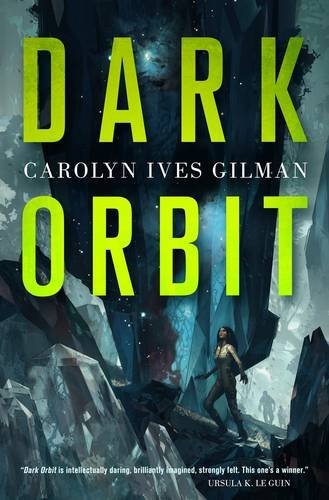
darkoribtInterstellar polities without Faster-Than-Light travel are not especially common in science fiction. Four examples spring to mind: Ursula K LeGuin’s Ekumen novels and stories, William Barton’s Dark Sky Legion, Chris Moriarty’s Spin State and sequels, and Alastair Reynolds’s Revelation Space series. And now Carolyn Ives Gilman’s Twenty Planets, in which people and materials are sent as beams of light from world to world and so experience time dilation from travelling at lightspeed. Scientists and explorers who regularly do this form “a strange sodality out of time”, and are known as “Wasters”.

Saraswati Callicot is one such Waster, an exoethnologist. Returning to Capella at the end of a five-year mission – but twenty-three years have passed on Capella – she is promptly recruited by an old mentor to join a team studying a newly-discovered planet fifty-eight light years away. The world is crystalline, so unlikely to be habitable; but it is also in a region of space containing “an odd concentration of dark matter”. Ostensibly a part of the team to research its new management techniques, Sara will actually be keeping an eye on a relative of her mentor, a woman called Thora who has only recently recovered from traumatic events on another world.

A handful of days after Sara’s arrival, one of the security guards aboard the scientists’ ship is murdered, and then Thora disappears during a trip to the planet’s surface. She has been taken by humans who live underground in lightless caves and are entirely blind. They also perceive their world – including the waves of dark matter which frequently pass through it – in a unique way. The natives speak a slightly archaic form of English, evidence they have been cut off from the mainstream of human history for a considerable time. Unfortunately, the presentation of this argot is not entirely successful, and makes it somewhat hard to take them seriously. However, life in the cave, and the solutions its inhabitants have put in place to in response to the absence of light, are ingenious and well-described. Gilman captures the claustrophobia of Thora’s stay there very effectively.

As Thora explores Torobe, the cavern village in which she is staying, she realises the villagers possess strange abilities which seem to contradict known science. The Torobians talk of visiting other settlements, yet their talk suggests they travel to other worlds and meet other races. It is through Thora’s friendship with Moth, a teenage girl from Torobe, that the central conceit of Dark Orbit is eventually revealed. In part, Thora’s ability to understand this premise is a consequence of the trauma she had experienced previously. This we learn from Thora’s journal, which forms a second narrative interwoven with Sara’s.

Thora’s discovery that the universe and its laws are a consequence of perception – albeit not a solipsistic universe per se – and that the Torobians’ blindness allows them to “manipulate” their reality, initially seems a bit wobbly for suspension of disbelief. But while attempting to duplicate the Torobians’ ability to “wend”, or travel instantaneously, even across interstellar distances, Thora realises, “Maybe it can’t be observed, because if you observe, you prevent it”. The Observer Effect, in other words. In quantum mechanics, the act of observation causes a wave function to collapse – so it seems plausible an absence of observation would suggest the laws of physics are a consequence of perception.

The scientists are obviously sceptical of Thora’s report on the Torobians’ abilities. She in turn is scared what use Capella’s corporations would make of the knowledge. But when a dark matter event damages a vital component in the lightbeam equipment aboard the scientists’ ship, Thora successfully wends to Capella to fetch a replacement.

One other aspect of Dark Orbit deserves mention: the Twenty Planets are multi-racial and multi-cultural, and relations between these are handled with sensitivity and nuance. There is none of the white monolithic universes of last century’s science fiction.

Dark Orbit is a fast read, but a substantial one. The central conceit may at times feel like borderline nonsense, but Gilman manages to keep suspension of disbelief in place for the length of the novel. This is a novel that would not look out of place on an award shortlist or two next this year.

This review originally appeared in Interzone #259, July-August 2015.


6 Comments

Reading diary, #26

Some fast reads and short books have helped me catch up on my Goodreads reading challenge, which is perhaps not the best way to choose books to read, but never mind.

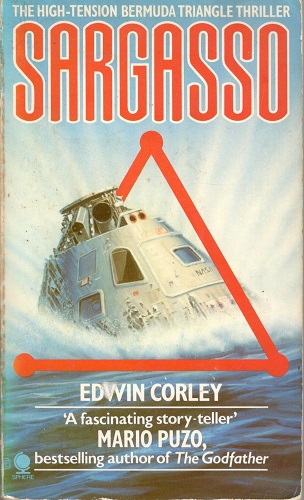
sargasso_smSargasso, Edwin Corley (1977). A 1970s technothriller is not my normal reading, but since this one features both an Apollo space mission and underwater exploration… The initial set-up is intriguing: the command module for Apollo 19 splashes down in the Atlantic after its crew have spent time aboard a Soviet spacestation in an ASTP detente-in-orbit type exercise… but when the CM is opened, it’s empty. No astronauts. And yet Mission Control was communicating with them as they left orbit and fell to Earth. After much guff about the Bermuda Triangle – as that’s where the splashdown occurs – and an ocean survey ship with a submersible which experiences a total power failure seconds before the splashdown… Not to mention a re-enactment of Flight 19, and a man who has been alive for more than a hundred years… It all turns out to be payback for a dastardly plot by those evil communistic Soviets. A back-cover quote praises the book’s research, but I thought it pretty slipshod. Not that the book made much of an effort at detail anyway. The prose barely rose to workmanlike, the cast were the usual stereotypes, and sometimes I wonder why I bother reading some books…

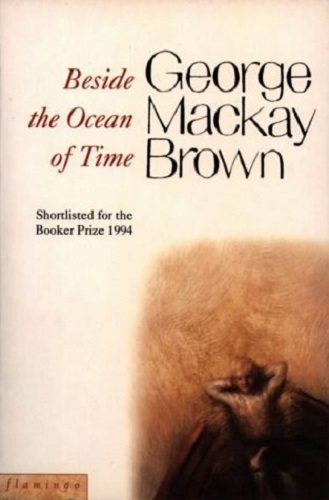
beside_oceanBeside the Ocean of Time, George Mackay Brown (1994). Thorfinn Ragnarson is an idle dreamer, the schoolboy son of a subsistence farmer on the invented Orcadian island of Norday, and considered mostly useless by all who know him. Various incidents set off daydreams, in which Thorfinn imagines himself in assorted historical roles – aboard a Viking ship which makes for Byzantium, the squire of a knight on his way to Bannockburn, a member of the people who built the brochs, press-ganged into the English fleet to fight the French republicans… But there is also a section which describes life on Norday at the time the novel is set, the 1930s, and centres around the mysterious young woman who comes to stay with the local reverend. This was my first experience of reading Mackay Brown, and I’m sure it’s my thing. I found the prose very simple and declarative, and while there were occasional  moments of lovely imagery, much of it struck me as quite sketchy. The setting, of course, had its own fascination, and I actually spent an hour or so looking up brochs after reading about them in Beside the Ocean of Time (and even considered buying a book on the topic). There are some authors, you only need to read one novel or novella, and you want to explore their oeuvre further. While I liked Beside the Ocean of Time, and may well pick up copies of Mackay Brown’s books if I see them in charity shops, I’m not minded to actively seek out his other works.

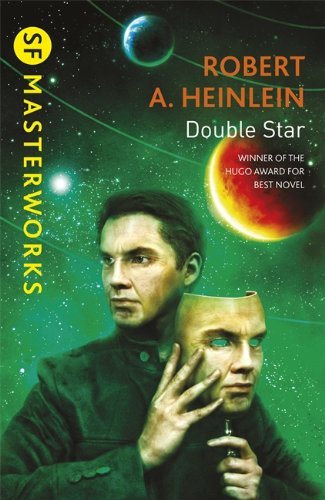
double_starDouble Star, Robert Heinlein (1956). As far as I was aware, this was one of the less objectionable novels in Heinlein’s oeuvre, and I’ve seen much praise for it which was careful to make that point. And yet I have to wonder if those people had actually bothered reading it recently. I can understand a thirteen-year-old lapping it up, and nostalgia putting even more of a shine on the book many decades later… but there’s no way Double Star stands up to scrutiny for anyone with a modicum of intelligence, taste or sensitivity. What else to think of a novel that contains the line “a woman will forgive any action, up to and including assault with violence, but is easily insulted by language”? And there is only one female named character in the entire book. And she’s the hero’s personal assistant. The world-building is also piss-poor, something at which Heinlein is normally quite good. It’s not just the idea of a Solar System-wide empire ruled by a member of the House of Orange, or Mars, Venus and Jupiter having native intelligent life, or the really clunky technology (much of which is behind the state of the art for 1955)… Everything just feels weirdly anachronistic and old-fashioned, even for sf of the 1950s – no, especially for sf of the 1950s. Then there’s the lectures on free trade, all of which are patent bollocks. (Free trade does not generate wealth, it concentrates wealth. In the hands of those who already possess wealth. History has been telling us this for centuries.) An actor is asked to impersonate an important politican who has been kidnapped, but is desperately needed at a ceremony which will result in a treaty with the Martians. The actor does so, the politician is rescued but proves too ill to return to his job, and so the impersonation continues… As far as I know, Double Star was never published as a juvenile, but it’s hard to believe it was aimed at an adult audience.

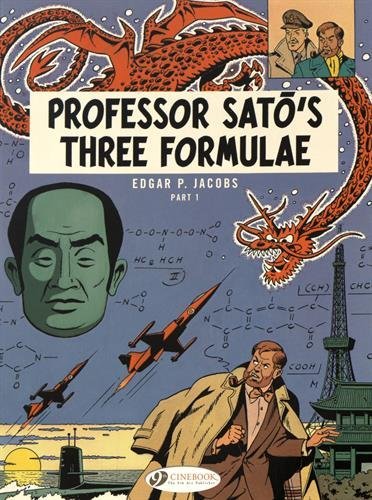
prof_satoThe Adventures of Blake & Mortimer 22: Professor Satō’s Three Formulae, Part 1, Edgar P Jacobs (1971). I first stumbled across Blake & Mortimer back in the 1990s when I lived in Abu Dhabi. If I remember correctly, it was upstairs in Card Zone, where the shop sold books – and some of their stock went back a decade or more. I found a bunch of English-language editions of some bandes dessinée from the late 1980s, one of which was Atlantis Mystery, the seventh in the Blake & Mortimer series. For whatever reason, only half a dozen of the Blake & Mortimer books where published in English… until 2007, when Cinebook began publishing the entire series in English, both Jacobs’s originals and those produced after his death by the Edgar P Jacobs Studio. However, they’ve not been following the original publication order, which is why Professor Satō’s Three Formulae, books 11 and 12 in French, has been published as books 22 and 23 in English (the latter due in May this year). I have to admit I prefer the ones written after Jacobs’s death. While Jacobs was careful to get his details right – in this one, for example, set in the early 1970s, the aircraft and cars are all shown accurately – but the science-fictional aspects are often quite silly. Those written by other hands seem to me to be more careful at making their stories plausible – even going so far as to integrate them into real history. In Professor Satō’s Three Formulae, Part 1, the eponymous scientist has invented a type of robot, which he has built in the form of a ryū. But it somehow escapes his secret laboratory and destroys two fighter jets from the Japanese Air Defence Force. Convinced there is a conspiracy afoot to steal his ideas for nefarious pruposes (there is, of course), Satō calls for his old friend Mortimer for help. Satō has also distilled his research into three formulae, which he plans to give to Mortimer for safe-keeping. Of course, it all goes wrong. Not one of the better books in the series, although I admit I’ve enjoyed reading them and have no plans to stop.

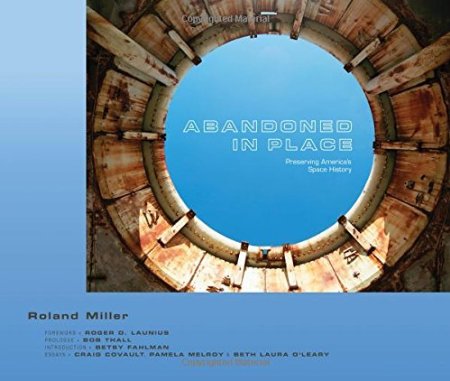
abandonedAbandoned in Place, Roland Miller (2016). Rockets, of course, need somewhere to launch from, and such structures need to be pretty damn sturdy given the beating they will take. So fifty years later, it’s no surprise to discover there are relics and ruins still scattered about the US: block houses, test stands, launch complexes… Some have been demolished since Miller photographed them, some have been repurposed, but many are simply too difficult to destroy. There’s something sadly emblematic about the photos in this book, the fact that the structures they document are all that’s left of the optimism which put twelve men on the surface of the Moon. And they’re in a state of abandonment. It has been argued that NASA’s space programme was the nearest to a socialist economic policy the USA has ever implemented, and I can see how the argument has merit – by spreading the bounty throughout the country in order to win political support, it uplifted towns and states both financially and technologically. There’s a certain level of irony in that. And yet, like the USSR, the only evidence of its existence are ruins – and the world was a better place when both were thriving.

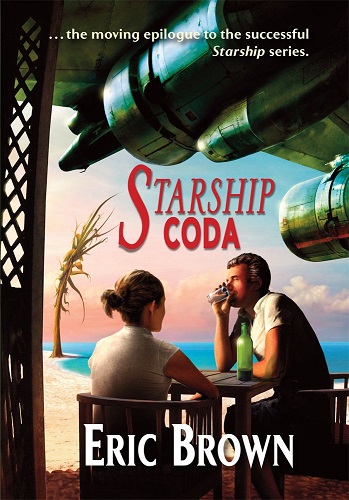
starship-coda-hc-by-eric-brown_smStarship Coda, Eric Brown (2016). Ten years after the events of the Starship Quartet, narrator David Conway is mysteriously contacted by his ex-wife, whom he left before the events of the first novella in the sequence, Starship Spring. She wants to know how he managed to get past the death of their daughter in a drowning accident – the event which drove them apart, and drove Conway from Earth to Chalcedony. The answer, of course, lies in the events of the preceding four novellas. But Conway’s ex-wife duly appears, and it seems she has undergone a drastic procedure in search of closure: Age Reversal Therapy. Which is exactly what the name says. Starship Coda successfully matches the tone of the earlier novellas, although at less than 40 pages it’s a thin book. There’s a sort of comfortable languidness to the world and story, although the focus of the prose is very much on the narrator’s emotional landscape. In fact, there’s something very relaxing about the story – it’s sort of affirming, without being cosy. And while the road to the conclusion may not be smooth, you know there’s happiness at the end of it. And I’m not embarrassed to admit I’d sooner read books like that than I would dystopias, post-apocalypses or anything which professes to be “grimdark”.

1001 Books You Must Read Before You Die count: 122


1 Comment

Easter bounty

Surprisingly, I only bought three books at this year’s Eastercon. Admittedly, the dealers’ room was was a bit lightweight compared to previous years. I also picked up four free books… Even so, that still makes it a considerably smaller book haul than I usually manage at cons. I blame online retailers… several of which I have visited in the past few weeks and made purchases…

2016-04-03 11.14.11

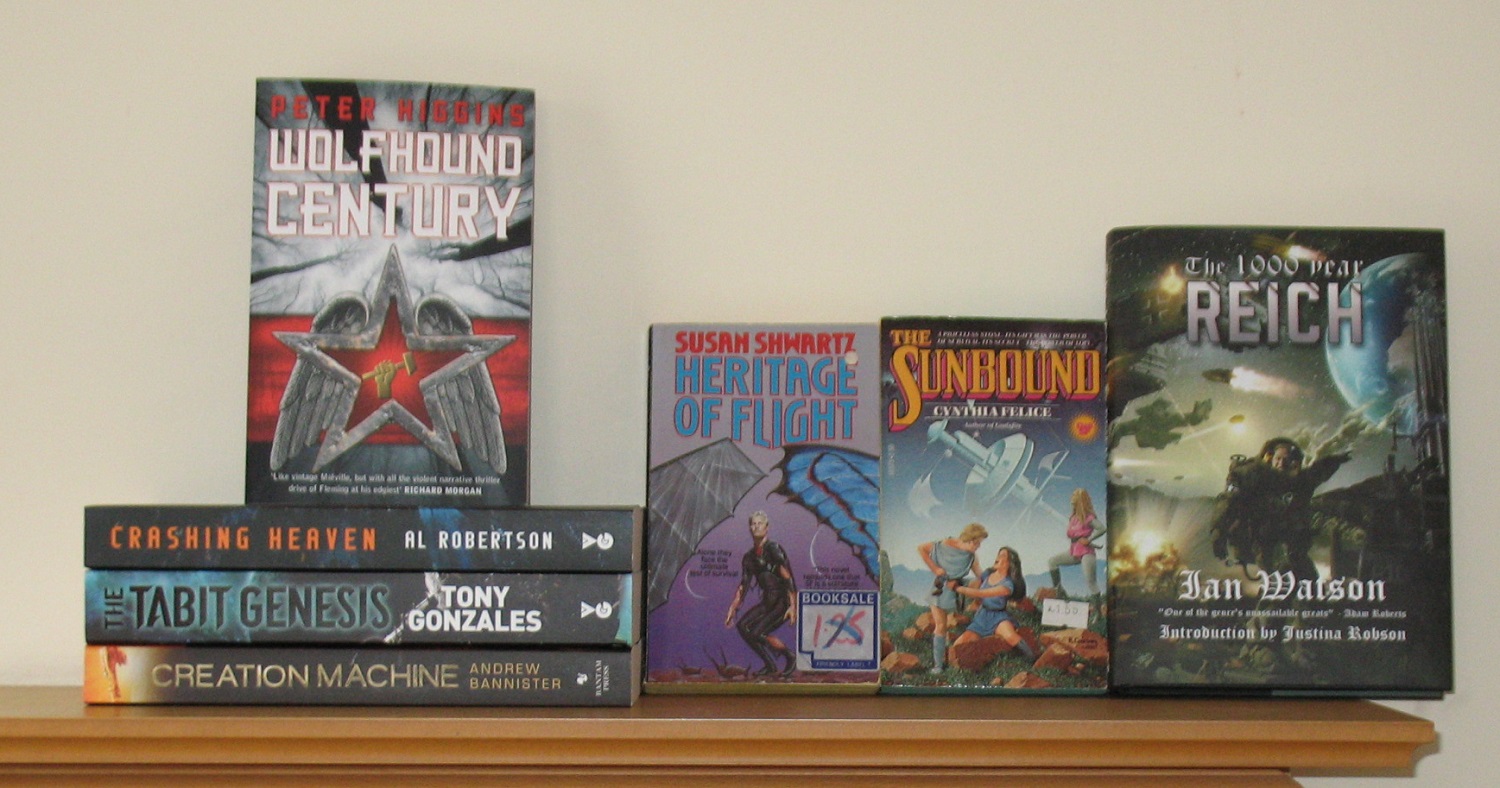
First, the Mancunicon haul: I was at the NewCon Press launch in the Presidential Suite on the twenty-second floor of the Hilton Deansgate, but I didn’t buy a copy of The 1000 Year Reich until the following day. Both The Sunbound and Heritage of Flight I bought to read for SF Mistressworks – I’ve been after a copy of the latter for a while, as I very much like the only other book by Shwartz I’ve read, The Grail of Hearts. There was also a table of giveaways from various major imprints, which is where I picked up copies of Creation Machine, The Tabit Genesis, Crashing Heaven and Wolfhound Century.

2016-04-03 11.15.31

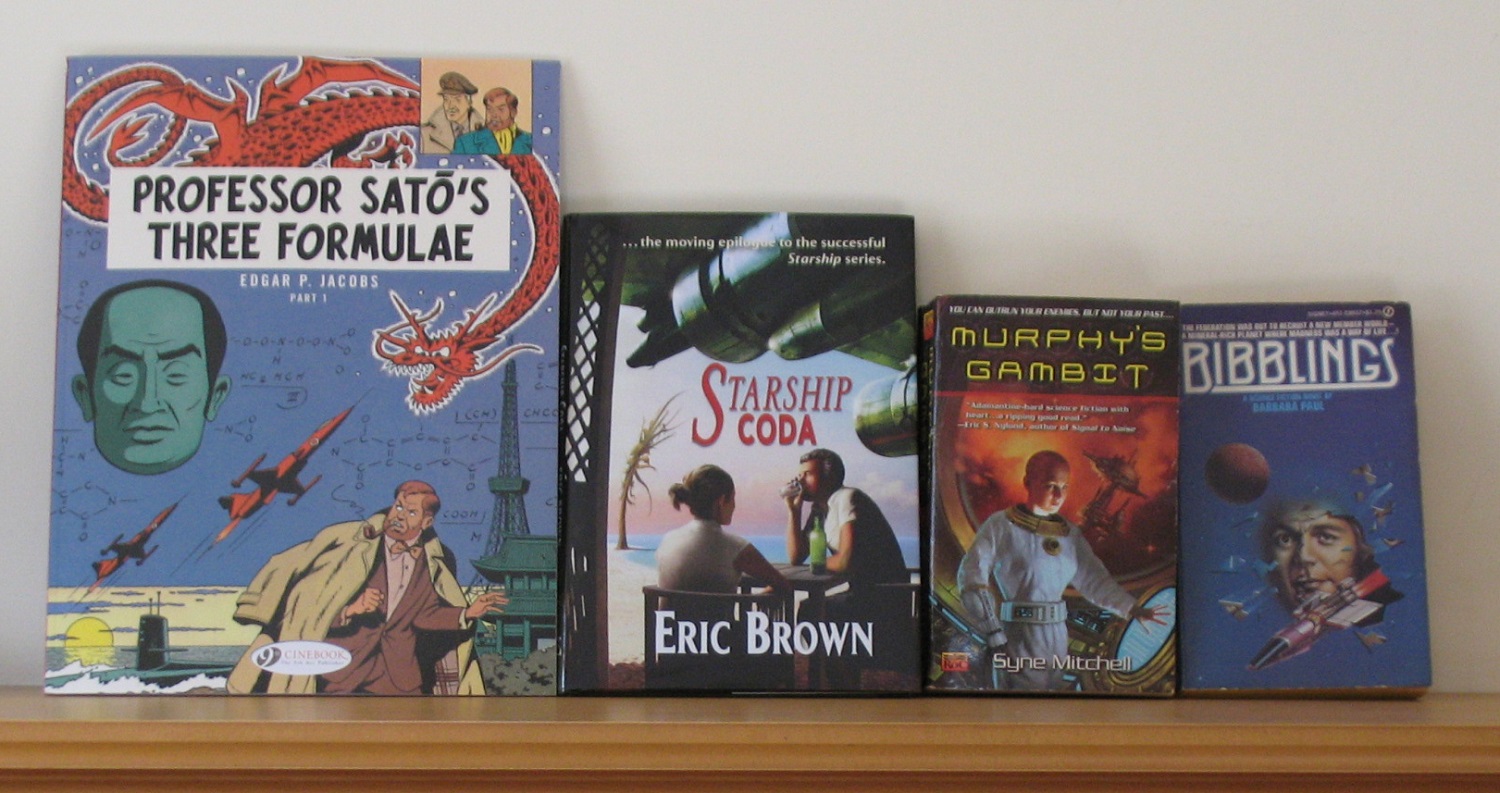
Speaking of SF Mistressworks, both Bibblings and Murphy’s Gambit were bought on eBay to review there – in fact, I’ve already Bibblings, see here. Eric sent me a copy of Starship Coda (although it was launched at Mancunicon), after I gave him a copy of Dreams of the Space Age. Professor Satō’s Three Formulae, Part 1 is the twenty-second volume in Cinebook’s English-language reprints of the Adventures of Blake and Mortimer, purchased from a large online retailer…

2016-04-03 11.17.46

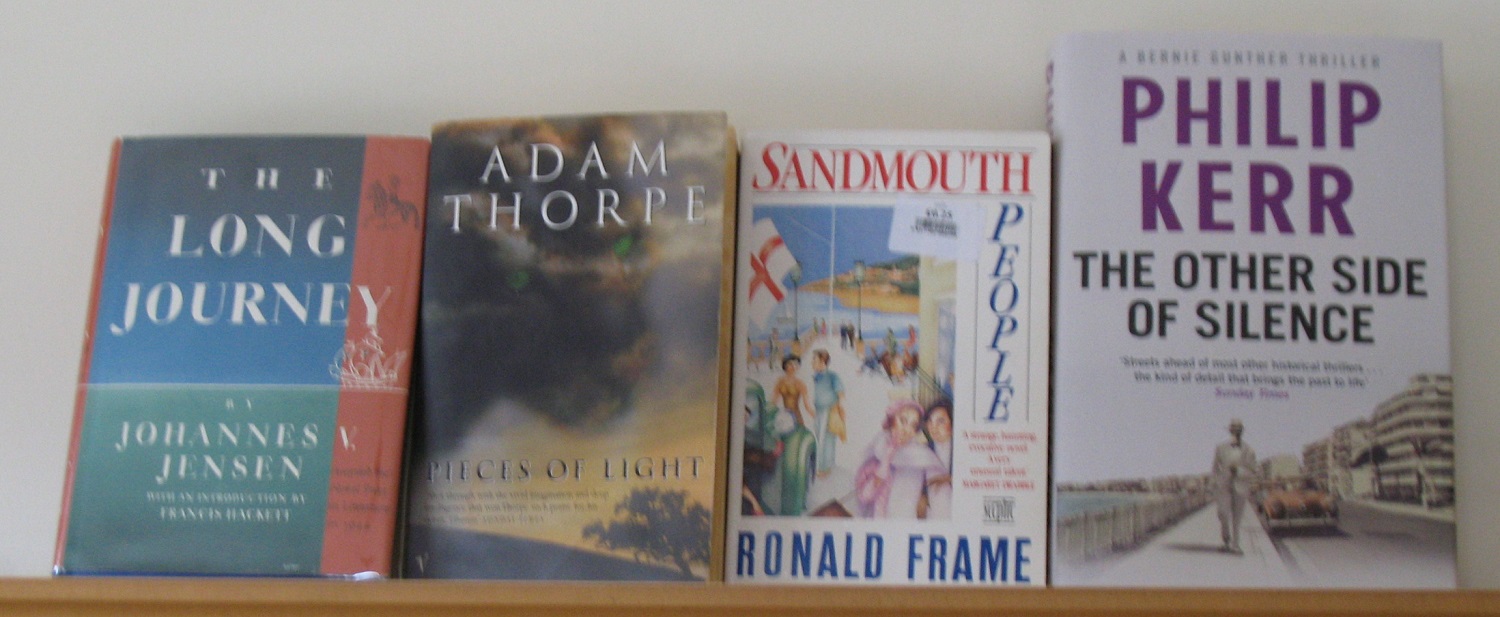
… which is also where I bought The Other Side of Silence, the eleventh book of Kerr’s Bernie Gunther series. Sandmouth People and Pieces Of Light were both charity shop finds. The Long Journey I bought from a seller on ABEbooks after reading about it, I seem to recall, in Malcolm Lowry’s In Ballast to the White Sea, and deciding it sounded really interesting. Jensen, incidentally was awarded the Nobel Prize for Literature in 1944.

2016-04-03 11.19.32

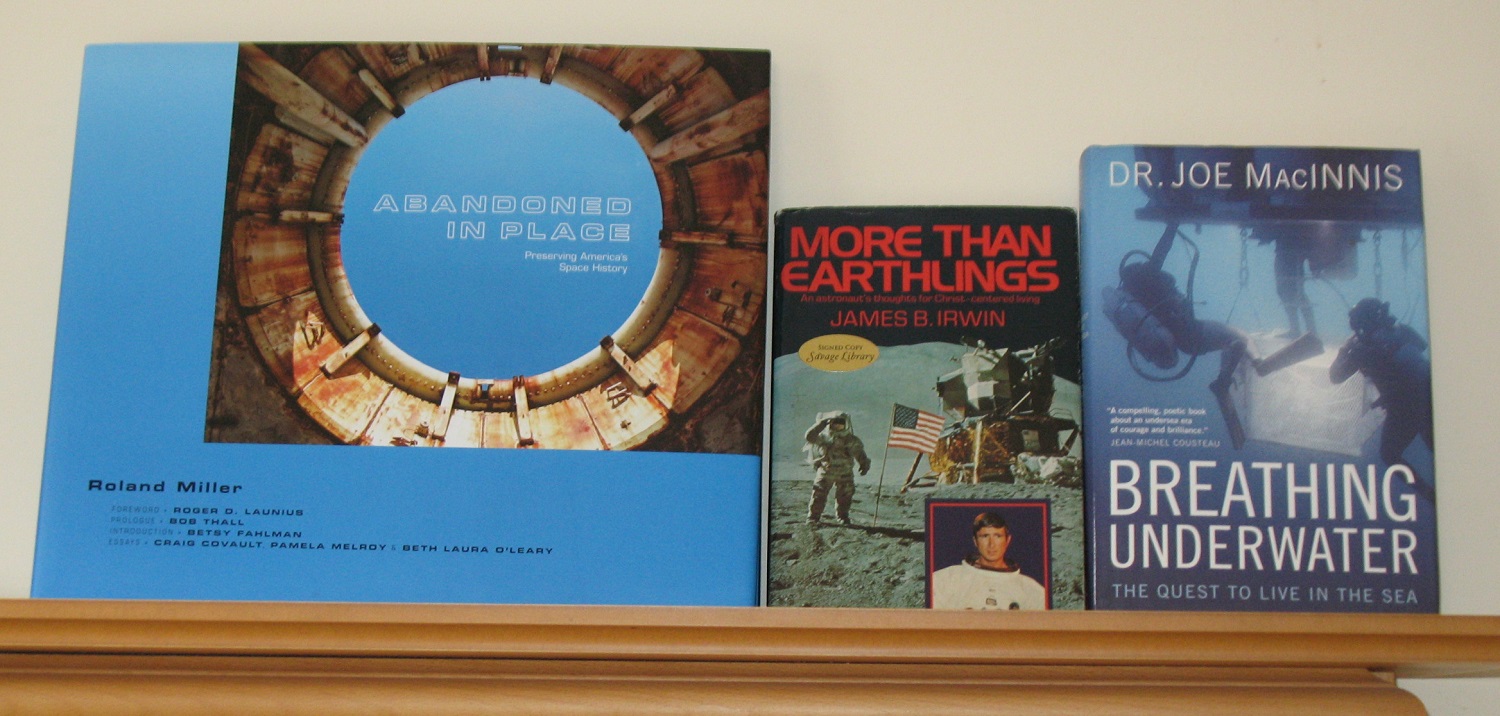
Breathing Underwater by Joe MacInnis I also bought on ABEbooks. MacInnis has been at the forefront of underwater research for several decades, ever since being taken on as doctor on Ed Link’s Sea Diver back in the 1960s. More Than Earthlings, Jim Irwin’s second book about his Moon flight, I found on eBay; it is signed. And Abandoned in Place is a photo essay on the support hardware used by the space programme, much of which has been left to rot as it’s no longer in use.


1 Comment

Reading diary, #25

I suppose you could say I’ve recently become disenchanted with modern genre fiction. I haven’t really, it’s been an ongoing thing. I suspect this comes to us all at some time. It’s not so much “putting away childish things” because I don’t consider genre a childish thing (not all of it, anyway). My tastes have changed, and most genre no longer meets those tastes. So I have to look harder to find stuff that does – I have to look harder anyway because the genre is now so much bigger, and I have access to so much more of it; but you know what I mean. I still have my favourite genre writers, of course, and I continue to read, and enjoy, their output; but unless something new really is out of the ordinary I usually find myself blithely uninterested in it.

Fortunately, there is more to literature than just genre fiction. And I’ve found that some mainstream/literary fiction does offer me what I look for in my reading. Plus, there is tons of it to explore – an entire history, in fact. I’ve learnt I really like, for example, DH Lawrence’s writing, so there’s an extensive oeuvre to work through right there. And Malcolm Lowry. And the works of recent discoveries Karen Blixen and Jenny Erpenbeck I want explore. I also have a bad habit of jotting down the titles of books that sound interesting when I come across mention of them, particularly twentieth-century ones that are hard to find… which is how I ended up with a copy of Johannes V Jensen’s The Long Journey (originally published in Danish in six volumes between 1908 and 1922; first published in English in three volumes in 1924), and I’m still looking for a copy of Nordahl Grieg’s The Ship Sails On (1924)… oh, and I’d like to read Jerzy Żuławski’s Lunar Trilogy but I don’t think it’s ever been translated into English…

Despite all that, there’s still a lot of twentieth-century science fiction I’ve not read, and I’m not about to write off the genre completely. It may well be projection on my part, but there seemed to be more of a distinction between science fiction and fantasy last century and I like that. I also like that there are a lot of well-written science fiction novels from the twentieth-century which have been pretty much ignored – mostly written by women, yes – and discovering them for SF Mistressworks does add an extra dimension to reading them.

So, anyway, reading… I did some. It is here. See below.

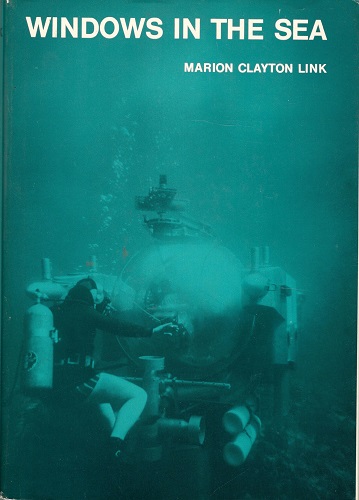
windows_sea_smallWindows in the Sea, Marion Clayton Link (1973). Ed Link made his fortune inventing the aircraft simulator, but he put a lot of time, effort and money into underwater exploration. He invented the SPID (Submersible Portable Inflatable Dwelling), which set a record when two divers stayed in it for 49 hours at a depth of 432 feet. He also invented a submersible with a lock-out chamber for divers, so they could be carried to their working depth, compressed en route, and begin their decompression while returning to the surface. And he invented the Johnson Sea Link submersible, in which the pilot and passenger sit inside a transparent acrylic sphere. Perhaps he didn’t advertise his adventures to the extent Jacques Cousteau did – in fact, this is the only book specifically about Link’s underwater exploits; other books are about people who worked for him – but he pioneered a number of important underwater technologies. Windows in the Sea thankfully sticks to more of a reportage style, rather than being hagiographic, and it’s fascinating stuff. Of course, not everything went according to plan – in an early test of the SDC (Submersible Decompression Chamber), it was catapulted out of the water with Link inside. Later, Link’s son died in a tragic accident in the Johnson Sea Link. But in a topic poorly served by non-fiction works, this book deserves to be better known.

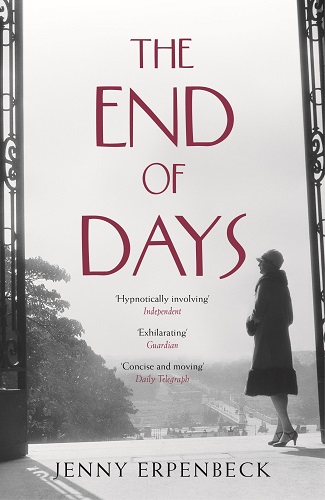
end_daysThe End of Days, Jenny Erpenbeck (2014). I think it was David Hebblethwaite who recommended this novel – and while people recommend books pretty much all the time, something about this one sounded like it might appeal. So I bunged it on my Amazon wishlist, and was subsequently given it as a Christmas present. The back-cover blurb makes explicit comparisons to Kate Atkinson’s Life After Life (a book I very much liked, and, in fact, nominated for a Hugo, during my one and only attempt at nominating for the Hugo), but the novel The End of Days reminds me of the most is Katie Ward’s Girl Reading, another book unknown to me until someone recommended it… and which turned out to the best book I read that year. Plotwise, Atkinson’s novel is certainly a closer match, given that The End of Days describes the life of a woman born in Galicia in the latter days of the Austro-Hungarian Empire, and her life throughout the twentieth century as she survives WWI, joins the Communist Party in Vienna, moves to Moscow, and then Berlin, and becomes a famous East German writer. As in, that’s it in the final section in which she lives a long and eventful life. Earlier sections cut it short at various junctures. The writing throughout is stunningly good, the structure is very carefully built up, and this is one of the most impressive books I’ve read so far this year. I fully expect it to make my best five of the half-year, if not the year. I also want to read more by Erpenbeck.

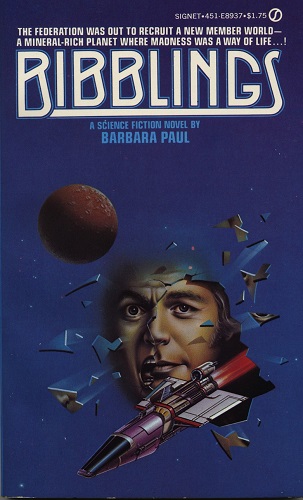
bibblingsBibblings, Barbara Paul (1979). I consider myself reasonably well-informed on women sf writers of last century, particularly novelists, but Barbara Paul was one that had completely slipped by me. She had five novels published between 1978 and 1980, and one Star Trek novelisation in 1988. Only her first novel, An Exercise for Madmen, and this one, Bibblings, were published in the UK – and the first was in hardcover only by Robert Hale (whose books are notoriously hard to find). Paul also wrote crime novels; the last was published in 1997. She has an extensive website here. My review of Bibblings is on SF Mistressworks here.

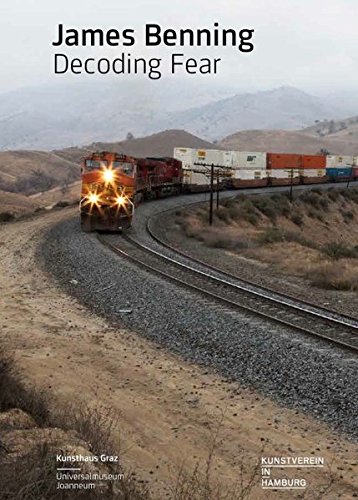
decoding_fearJames Benning: Decoding Fear, Peter Pakesch & Bettina Steinbrügge, eds. (2014). I Love Benning’s films, at least those I’ve seen so far, which is only a small portion of his oeuvre as that is all that’s to date been released on DVD (happily, he donated his archives to the Östereichisches Filmmuseum, so hopefully they will release more). James Benning: Decoding Fear was produced to accompany an exhibition of Benning’s work, and comprises a series of essays in German and English, photographs of the exhibits, and an interview, in both German and English, about one element of the exhibition – his Two Cabins, the cabins in question being those by Henry David Thoreau (of Walden fame) and Ted Kaczynski (the Unabomber). It’s an interesting insight into an artist whose work I much admire, although to be honest I had expected something a little more analytical than what is essentially a companion-piece to an exhibition.

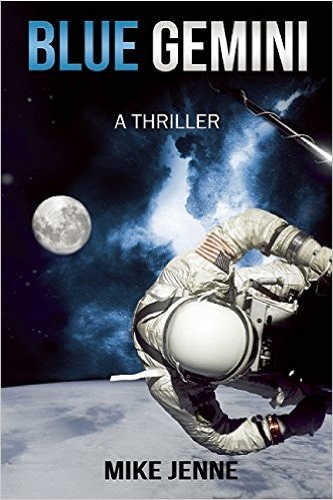
blue_geminiBlue Gemini, Mike Jenne (2015). How could I resist this? A thriller about a secret militarised Gemini programme – that’s right up my street. True, it was published by an independent publisher, and it’s not being sold as genre fiction… but I thought it worth a go. And, unsurprisingly, the book’s prose has all the style and grace of, well, a technothriller. The topic is indeed something that interests me – a Soviet plan to orbit nuclear warheads persuades the US to develop a secret USAF programme of satellite killer Gemini spacecraft, something that was actually considered in the real world. A group of sterotypically technothrillerish characters become involved in said programme and, er, well, that’s it. The research is good, and Jenne writes the technical aspect of his story with authority. But the characters are pretty much what you’d expect, the prose rarely rises above clunky, and there are a lot of pages here for the story. There are some nice set pieces – particularly those involving a black USAF airman and the racism he encounters – but there’s also a lot of ignorance shown about the rest of the world, and it’s not always clear if Jenne is trying portray the ignorance of Americans of the 1960s or if it’s twenty-first century ignorance. There are two sequels to this book – Blue Darker Than Black, published earlier this year, and Pale Blue, due in June this year. To be honest, I don’t think I’ll be bothering with them.

1001 Books You Must Read Before you Die count: 122


1 Comment

Reading diary, #24

I wish I could read as many books a year as films I watch. I did manage to complete the 150 book challenge on Goodreads last year – although I am apparently 6 books behind schedule for 2016 – but that’s not even close to 570, the number of movies I watched last year… I did try reading for 30 to 60 minutes when I got home from work, and managed to keep that up for at least a week. I really need to make it part of my daily routine. I also need to get into the habit of reading on the weekend again, too. Back when I lived in the UAE, I used to spend most of Thursday and Friday reading – in fact, it wasn’t unusual for me to catch a taxi to the Daly Community Library on a Thursday morning, take out four books… and have read two of them by that evening. Admittedly, I read quite a lot of crime and thriller novels – the library didn’t have many science fiction books – and they’re fast reads. But I also read a lot of literary fiction as well. Maybe I’m just slowing down in my old age…

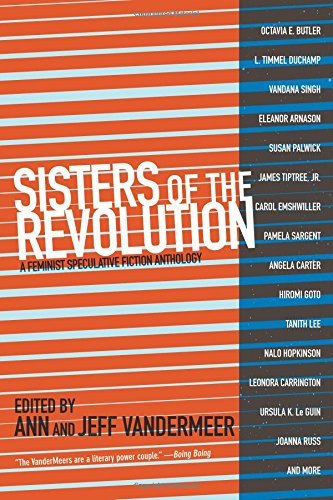
sistersSisters of the Revolution, Ann & Jeff VanderMeer (2015). I supported the kickstarter for this as it sounded like a project worth supporting and, after a period that was longer than expected, it finally arrived. And… it was worth the wait. It’s a strong and varied selection, its contents mostly new to me – around ten of the twenty-nine stories in the anthology I’d read previously. I’m amused by the back-cover blurb’s description of thr anthology as a “highly curated selection”, as if the VanderMeers put MOAR EFFORT into it than every other anthology editor. Having said that, I don’t know how many stories they read in order to make their choices. but judging by comments on Twitter, Facebook, etc, it was a hell of a lot. I don’t think every story they chose works, although that’s more a matter of personal taste – I’m not a fan of genre fiction that plays fast and loose with rigour, or indeed any mode of fiction that does, nor stories that are too allegorical or too consciously presented as fables. Which is not to say there are not some bloody good stories in Sisters of the Revolution – in fact, the opener, ‘The Forbidden Words of Margaret A.’ by L Timmel Duchamp, is one of the best stories I’ve read in a long time. And Ursula LeGuin’s ‘Sur’ was not only new to me but also one of the best by her I’ve ever read. James Tiptree Jr’s ‘The Screwfly Solution’ remains as scarily effective as it was the day I first read it. Octavia Butler’s ‘The Evening and the Morning and the Night’, Kelly Barnhill’s ‘The Men Who Live in Trees’, Angela Carter’s ‘The Fall River Axe Murders’, Joanna Russ’s ‘When It Changed’ and Eileen Gunn’s ‘Stable Strategies for Middle Management’ are all worth the price of admission. I’d definitely say Sisters of the Revolution is one of the strongest anthologies I’ve seen for quite a while.

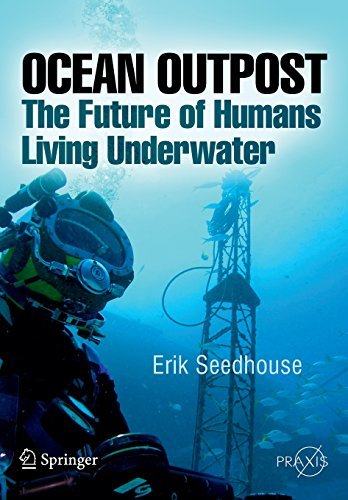
ocean_outpostOcean Outpost, Erik Seedhouse (2011). I picked up a copy of this cheap on eBay, which is good as Springer-Praxis books are not cheap. But they are interesting. The subtitle of this one reads “The future of humans living underwater”, and it covers a variety of different methods of doing so. The first section covers diving – free-diving, technical diving and saturation diving – but while the studies on free divers is interesting, the section on rebreathers reads like a technical sales brochure. The second section is about submersibles, but covers only Mir, Alvin and Shinkai before turning into an advertisement for hydrobatic submersibles (ie, ones that “fly” underwater). Section III deals with the reasons for colonising the ocean bottom, such as mineral exploitation, and the final section is about medical intervention to allow survival underwater. It’s fascinating stuff, despite the book’s tendency to read at times like it’s quoting verbatim from technical sales material; and while it’s good on the science and engineering of the current state of the art, it’s not so good on the history – the chapters on submersibles, for example, make no mention of the Trieste or Ben Franklin. But then it is a relatively slim book, only 187 pages, including appendix, epilogue and index. Nonetheless, pleasingly detailed.

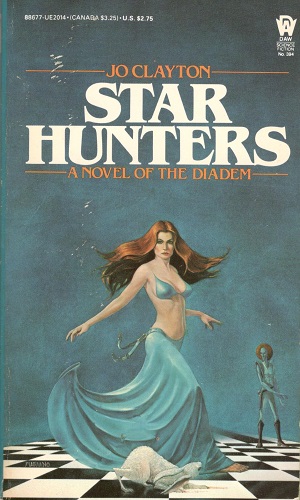
star_huntersStar Hunters, Jo Clayton (1980). This is the fifth of the seven books from the nine-book Diadem series that I bought at Fantastika in Stockholm back in 2013. I’ve been slowly working my way through them for SF Mistressworks. The first couple were a bit hard to take – the series heroine is a super-special snowflake who is subjected to an almost-constant barrage of sexual violence, but there’s an abrupt swerve in tone in the fourth book and Aleytys is presented as a much more typical competent space opera protagonist with agency. Her wardrobe, if the cover art is anything to go by, doesn’t improve, however. My review of Star Hunters is here.

louisianaLouisiana Breakdown, Lucius Shepard (2003). I went through a phase several years ago of buying Lucius Shepard books. And he produced quite a few, including many short novels and novellas from small presses. Such as Louisiana Breakdown, which was originally published by Golden Gryphon. There’s is not much, to be honest, in this short novel which makes it stand out, other than Shepard’s writing. The story feels like a well-used cliché, a story that’s been told far too often about Louisiana. A musician en route from California to Florida, well, breaks down in Louisiana, just outside some small backwards town. The local cop tries to strong-arm but is stopped by the timely arrival of the town’s Big Man, descendant of the town’s founder and rich playboy. There’s also a woman who is in magic thrall to another man – although he’s not in the town itself – and she decides that the musician is the man to break her free. It’s a story that almost writes itself, and if it weren’t by Shepard I’d not have bothered going past by the first couple of pages. Even so, it’s not one of his best.

balastIn Ballast to the White Sea, Malcolm Lowry (2014). The story goes that, after Lowry’s first novel, Ultramarine, was published, he submitted In Ballast to the White Sea, but his publisher decided not to take it. So Lowry continued to work on it. He was a notorious fiddler, forever editing and polishing his work, so it’s no real surprise he published so little. But before he could finish the next version of In Ballast to the White Sea, the wooden shack in which he and his second wife, Margerie Bonner, lived in Vancouver caught fire. The ms of In Ballast to the White Sea was almost entirely destroyed. However, a couple of years earlier, Lowry had left a copy with his mother-in-law (a copy of the earlier, rejected version, that is), but Lowry had either forgotten about it or chose not to remember its existence. In any event, he gave up on In Ballast to the White Sea and moved onto something else – and Lowry’s second novel was considered “lost”… But the ms put away for safe-keeping turned up in the 1970s and Lowry’s first wife, Jan Gabrial, set about editing it for publication (as she had done in the 1960s with Lowry’s forever-being-worked-on novella, Lunar Caustic). But In Ballast to the White Sea never saw print – until now, in this “scholarly edition” from the University of Ottawa Press. And… it’s plain it needed more work. Some chapters are entirely dialogue. The character of the captain, the father of the protagonist, Sigbjørn, doesn’t feel quite settled; and Nina, Sigbjørn’s ex-girlfriend, swoops in from nowhere, takes up a couple of intense chapters, and then vanishes. Like Ultramarine, In Ballast to the White Sea is partly autobiographical, and is based both on Lowry’s time at Cambridge and at sea – in fact, the suicide of Sigbjørn’s brother, which occurs off-stage between chapters II and IV, was based on the suicide of a friend and fellow student. And Sigbjørn’s fascination with the author of a Norwegian novel which, in broad shape, is similiar to the novel Sigbjørn is planning to write echoes Lowry’s own fascination with Skibet gaar videre (The Ship Sails On) by Nordahl Grieg, a novel he felt had “written” his life up to that point. The “A Scholarly Edition” on the cover of In Ballast to the White Sea refers to the fact the novel is copiously annotated – not just the references and allusions with which Lowry larded his prose, but also some aspects of British life and geography which may not be familiar to non-Brit readers. There’s also a couple of essays on the provenance and history of the manuscript, and on the editing undertaken by Lowry scholar Chris Ackerly. If you’re a fan of Lowry’s fiction, it’s a fascinating, perhaps even necessary, read.

invadersInvaders, Jacob Weisman, ed. (2016). You know when lit fic writers try their hand at genre, although of course their story appears in a lit fic venue not a genre one, and everyone goes on how astonishlingly inventive it is but genre fans just shake their heads sadly because they’ve seen it all before… Well, if that ever happened, and I suspect it hasn’t done for a number of decades, there’s enough proof in Invaders to demonstrate that science fiction and fantasy are now so prevalent that an author doesn’t need to be steeped in genre from the age of thirteen in order to write good genre. Which is not say every story in Invaders works, either as lit fic or as genre fic. But the anthology sets out to prove a point, and it does that pretty well. I read the book to review for Interzone.

1001 Books You Must Read Before You Die count: 122


Leave a comment

March madness

Well, not strictly March – after all, we’re less than a week into the month. Some of the following were bought during February. Obviously. So far this year I’ve managed to chip away at the TBR, by reading more books than I’ve bought each month… but I think I might have a bit trouble doing that in March. Especially since it’s the Eastercon at the end of the month… Oh well, never mind. I’m sure I’ll get around to reading them all. One day…

2016-03-05 10.26.07

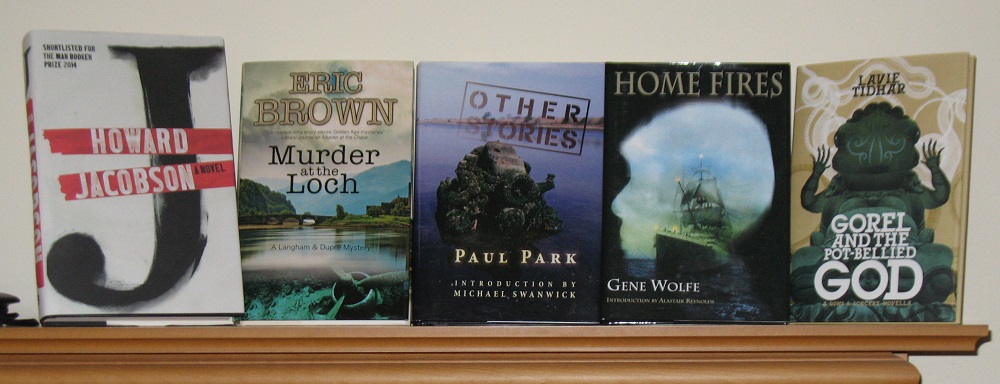
Some first editions. I’m not a huge fan of Wolfe’s novels, but PS Publishing recently set up a discount website, and they only wanted £6 for a signed and numbered edition of Home Fires. That’s also where I bought Gorel and the Pot-Bellied God. For £4. Bargain. I recommend visiting PS2. Other Stories I’ve been eagerly awaiting for more than a year as I am a fan of Park’s writing. Murder at the Loch is the third of Eric Brown’s entertaining 1950s-set murder-mysteries. And my mother found J: A Novel for me in a charity shop.

2016-03-05 10.27.32

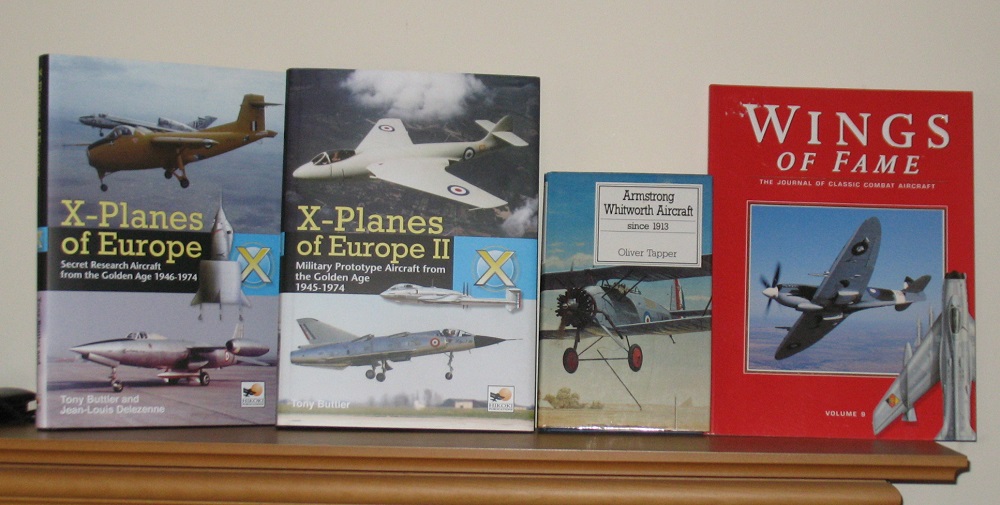
Aeroplanes… I’ve been picking up copies of Wings of Fame whenever I see good condition copies going for a reasonable price on eBay. Now that I’ve finally found a copy of Volume 9, I have eighteen of the twenty volumes. I’ve also been doing the same for Putnam’s Aircraft Since 19– series, although I forget why I began buying them in the first place. And with Armstrong Whitworth Aircraft Since 1913, I now own sixteen of them. X-Planes of Europe and X-Planes of Europe II I saw on Amazon, and I’m fascinated by the aircraft designed during the Cold War which didn’t make it into production.

2016-03-05 10.29.02

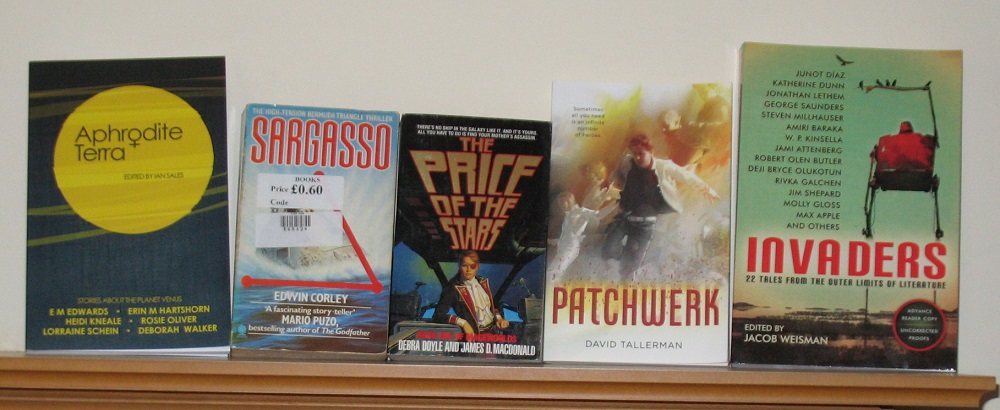
Some of yer actual science fiction. Invaders is an anthology of genre fiction by literary fiction writers; I’m reviewing it for Interzone. Patchwerk was given to me by the author; I wrote about it here. The Price of the Stars I bought to review for SF Mistressworks (it has a male co-author, but that’s no reason to ignore it). Sargasso I found in a charity shop, and looks to be a techno-thriller potboiler about an Apollo mission. And finally, Aphrodite Terra is a thing at last – a paperback thing, that is; it’s been an ebook thing since the middle of December (although Amazon have yet to figure out the two editions are of the same book…).

2016-03-05 10.29.43

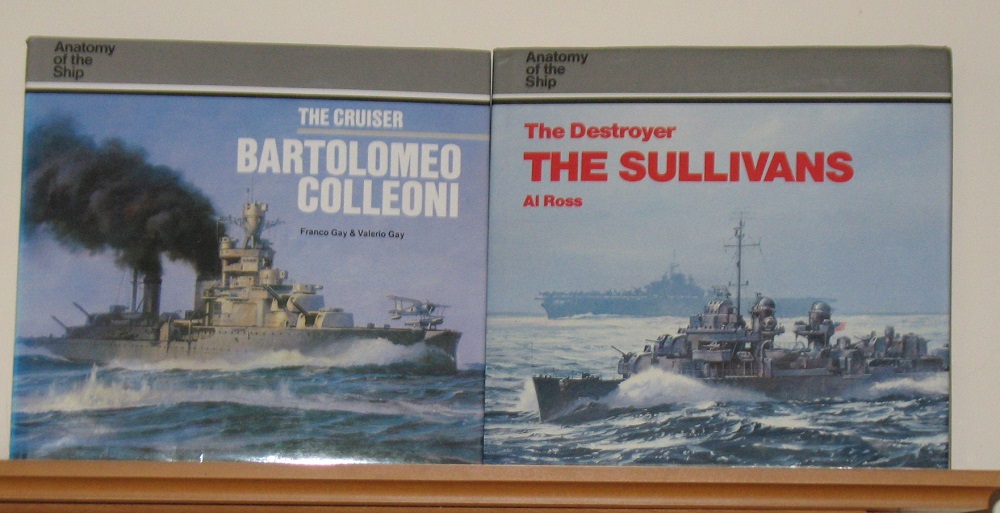
I bought a couple of these Anatomy of the Ship books as research for A Prospect of War back in the day, and ended up picking up copies whenever I saw them going cheap on eBay. Like The Cruiser Bartolomeo Coleoni and The Destroyer The Sullivans. I have more than a dozen of them.

2016-03-05 10.30.24

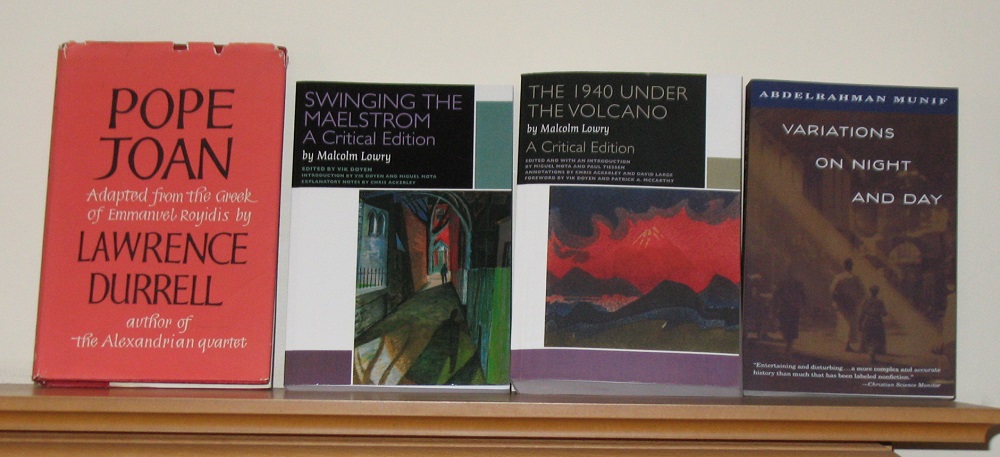
Finally, some translated fiction, some Malcolm Lowry, and a Lawrence Durrell. I read Munif’s Cities of Salt a couple of years ago and thought it very good, so I picked up the second book of the trilogy last year, and now I have the final one, Variations on Night and Day. I recently read Lowry’s In Ballast to the White Sea: A Scholarly Edition, also part of the Canadian Literature Collection series, and the first time Lowry’s “lost” second novel had seen print. So I decided to get these two critical editions, also published in the University of Ottawa’s Canadian Literature Collection series – The 1940 Under the Volcano (I’ve read Under the Volcano, the final published edition, of course), and Swinging the Maelstrom (which I read under the title Lunar Caustic, but which was apparently a version cobbled together posthumously from a number of different manuscripts). Finally, Pope Joan is for the Durrell collection. Not an easy book to find in this edition.