
Everyone loves lists. Contentious lists are even better. So here’s one: the ten absolute best science fiction novels ever published – written by sf authors, published by sf publishers. These ten books show what the genre is capable of when it aims to be more than mindless escapism. They are fiercely intelligent, beautifully written, meaningful, inventive, rigorous, and sf from the first word to the last. They are, in chronological order:
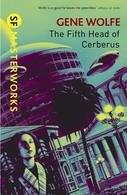 The Fifth Head of Cerberus, Gene Wolfe (1972). A collection of three novellas – but not a cheat, as the three are linked and form a novel together. This is the sort of science fiction that can be read and enjoyed, and then carefully puzzled through to determine what was really going on. Wolfe is a tricksy writer, and in The Fifth Head of Cerberus he’s at his tricksy-est.
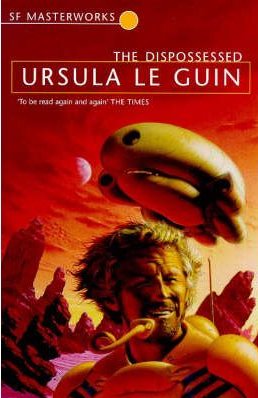 The Dispossessed, Ursula K Le Guin (1974). Donald Wollheim once claimed that the benevolent dictatorship was the government of choice of sf fans. That’s clearly what comes of reading too many space operas with interstellar empires and the like. And yet sf also has a history of documenting the road to utopia. All that benevolent dictator stuff is nonsense, of course – it’s as much fantasy as the Competent Man as hero. Thankfully, not everyone subscribes to it. The Dispossessed is a political book – it’s even subtitled “An Ambiguous Utopia” – and it’s political in a way that makes you think, that shows you what sf is really for.
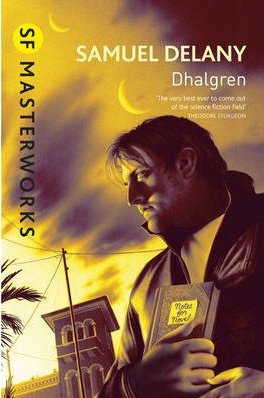 Dhalgren, Samuel R Delany (1975), is definitely science fiction – it’s in the relaunched SF Masterworks series, for a start – even though it’s proven extremely popular outside the genre. Sometimes it reads like a novel of its time, sometimes it seems almost timeless. But every time you read it, it’s different. It is also the most profoundly literary book in this list, and from an author who is steeped in genre.
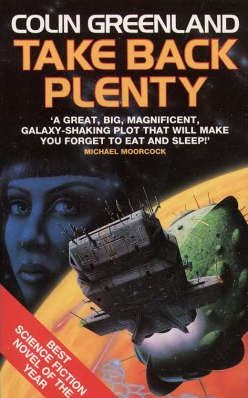 Take Back Plenty, Colin Greenland (1990). Yes, so Iain M Banks’s Consider Phlebas arguably kicked off the whole New British Space Opera thing in 1987, but to my mind the movement didn’t really gel until the appearance of Take Back Plenty three years later. I remember the buzz the book caused – and I remember on reading it discovering that it was as good as everyone said it was. I reread it a couple of years ago, and it’s still bloody good. So why is it not in the SF Masterworks series, eh?
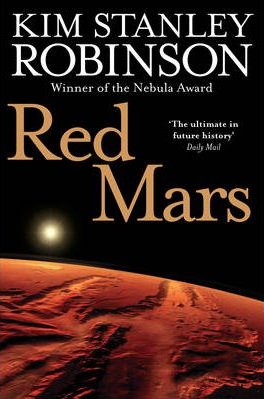 The Martian trilogy, Kim Stanley Robinson (1992 – 1996), is a bit of a cheat as it’s three books. While many are full of admiration for the first book, Red Mars, but not so keen on the sequels, Green Mars and Blue Mars, I maintain that the whole is greater than the sum of its parts. You need to read Green Mars and Blue Mars after you’ve finished Red Mars because the first book only poses a small handful of the questions the three books ask and attempt to answer.
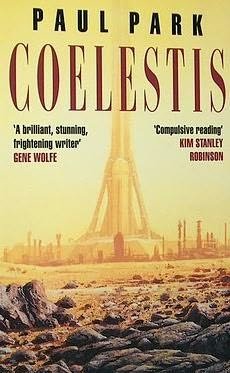 Coelestis, Paul Park (1993), was once described by John Clute as “Third World sf”, but I prefer to think of it as “post-colonial sf”. But not “post-colonial” in the same way as Ian McDonald’s River of Gods. I was an expat until only a few years ago, so it’s no surprise I’m drawn to fiction which documents the British expat experience abroad – hence my admiration for Lawrence Durrell’s Alexandria Quartet and Paul Scott’s Raj Quartet. While Park is an American, Coelestis is infused with that same atmosphere. Plus Park is one of the best prose stylists in this list. Why has this book been allowed to go out of print? Someone publish a new edition, please.
 Ash: A Secret History, Mary Gentle (2000). This is the biggest book on this list – it contains nearly a million words. It is, with Red Mars, one of the most rigorous too. Rigour is important in sf – you can’t just make shit up as you go along (but you can, of course, as Iain Banks is fond of putting it, “blow shit up”). The bulk of the story may be set in an alternate mediaeval Europe, but it is not fantasy. It is clever, it is visceral, it is also physically heavy.
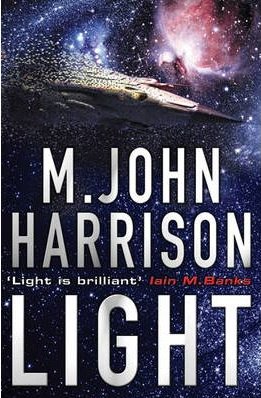 Light, M John Harrison (2002). They say Harrison is a writer’s writer, and the prose in Light certainly suggests as much. Light is also one of those novels that’s often described as one which “redefines” science fiction. Which it does. Sort of. But not by coming up with something new, only by shedding new light on those genre tropes being over-exercised at the turn of the century. They say that sf is a genre in conversation with itself, which makes Harrison one of sf’s sharpest conversationalists.
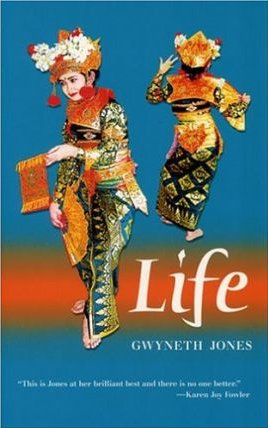 Life, Gwyneth Jones (2004). I need only repeat David Soyka from his review of this book on sfsite.com: “You can stop reading right now and go out and buy the book. Otherwise, you’ll have to endure yet another one of these diatribes about how science fiction doesn’t get any respect from the literary mainstream. Because you can’t read this book and not reflect on the fact that had this been written by, say, Margaret Atwood, Life would be receiving more of the widespread attention it deserves.”
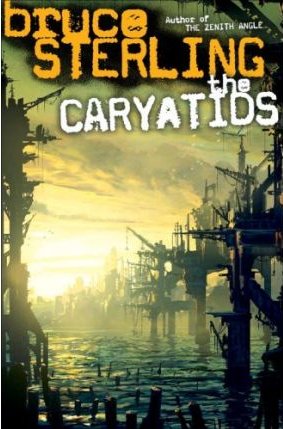 The Caryatids, Bruce Sterling (2009). I’ve never believed sf should be predictive, but if any sf writer could be called an “architect of futures” then it would be Bruce Sterling. And in The Caryatids he has produced his most inventive and meaningful conversation with the future yet. It is the best book he has written. So why hasn’t it been published in the UK? Why is there only a US edition of this excellent book?
These are not “seminal” sf novels, they are not “classics”, they are not even especially popular. But they are “best” in the true meaning of the word – i.e., “of the highest quality”. If you haven’t read them, you should do so immediately.
Now tell me which books I’ve missed off my list. No mainstream authors slumming it in the genre, please. And I don’t care what impact a book had in, or outside, the genre. It has to be, in your eyes, one of the best-written science fiction novels ever published. And that doesn’t mean the “most entertaining”, or any other excuse used to justify flat writing, cardboard characters, or simplistic plotting. I’m not talking about fit for purpose; I’m talking about excellence in writing, in prose, in literature, in genre.
 , Mary Shelley (1818)
 , HG Wells (1898)
 , Aldous Huxley (1932)
 , George Orwell (1949)
 , John Wyndham (1951)
 , JG Ballard (1973)
 , Douglas Adams (1979)
 , Iain M Banks (1987)
 , M John Harrison (2002)
 , Ian McDonald (2004)
 predates it by nearly three decades, for a start. Ballard was one of several writers – the New Wave – who revolutionised the genre, and
  in 1990. As an indication of this,
  . But crucial?
 is not about Brits in India. There has not been, as far as I’m aware, any sort of post-colonial movement in science fiction, either started by
  , HG Wells (1895)
 , Olaf Stapledon (1930)
 , John Christopher (1956)
 , Michael Moorcock (1968 – 1977)
 , Ian McDonald (1988)
 , Paul J McAuley (1995)
 , Alastair Reynolds (2000)
 , Gwyneth Jones (2001)
 , Colin Greenland
 It Doesn't Have To Be Right...