It Doesn't Have To Be Right…

… it just has to sound plausible


Leave a comment

Moving pictures 2018, #7

Things don’t change overnight, much as we’d want them to. Okay, so I did manage to post a rant about science fiction on this blog recently… but I’m still watching – more or less – a movie a night, and most of those I think worth documenting. So the Moving pictures posts haven’t quite dialled back as much as I’d expected. And I’m still a little behind with getting them up on the blog. But I hope to be in a position to basically post one a week, with content covering other topics either side. But, like everything, it’s a work in progress…
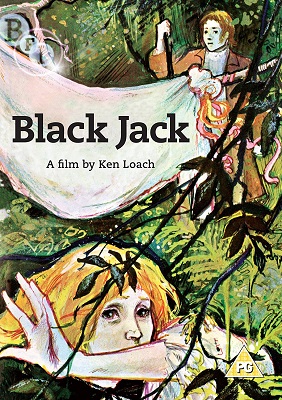
Black Jack, Ken Loach (1979, UK). I have Loach all over my rental list because I think he’s a director whose oeuvre is worth exploring, even if not every film he made is actually any good (also true of many directors, to be fair). But then David Tallerman texted me, “Have you seen Black Jack?”, and I hadn’t so I moved it up my rental list. And lo, it appeared in the next set of discs. Which happens sometimes. Black Jack is based on a 1968 children’s novel of the same title by Leon Garfield, although I’m not sure the film was aimed at children per se. It’s set in 1750 in Yorkshire. A well-off couple, Quality in other words, hand their daughter over to a pair of doctors who run a sanatorium, because the daughter is unmanageable – there are hints it’s mental illness, but in other parts of the film it seems to be behavioural. Meanwhile, a lad is paid to look after the corpse of the title character by a “Tyburn widow”, a woman who bribed the men who fetched the bodies of criminals from the gallows so she could display the dead men in her front-room and charge money for the privilege of viewing it. But Black Jack is not dead. And he escapes, taking the boy with him. After helping a stuck coach, Black Jack conceives the idea of boobytrapping a ford so travellers would require his help. For a fee. And the first coach he waylays is the one carrying the two doctors and the daughter… The boy and the daughter escape and join a travelling medicine show. Meanwhile, the rest of the cast search for the missing daughter… This is low-budget film-making at its best. Although set nearly 230 years before it was made, Loach manages to present a convincing eighteenth-century England. The main actors, who are all teenagers, are uniformly good in their roles, although none of them went on to greater fame. And yet it all feels a bit like a Children’s Film Foundation movie – no bad thing, it must be said – although I don’t believe it was made as one. It has that sort of sophisticated approach to telling a story through film coupled with a really low budget that characterised a lot of CFF films. I thought it really good – and I hope that was why David texted to me to ask if I’d seen it…
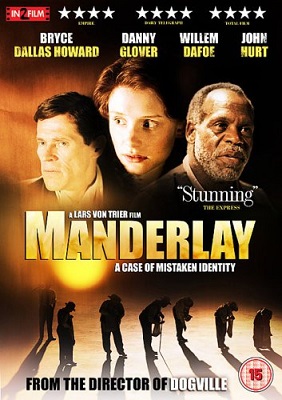
Manderlay, Lars von Trier (2005, Denmark). I really didn’t like von Trier’s Dogville, and Manderlay is the sequel to it, so why, I hear you ask, would I want to watch this film? Okay, I picked it up for 99p for a charity shop, so it was worth a punt… But… I have a lot of time for von Trier as a film-maker, even if I really don’t like some of his films. He has a very interesting oeuvre. And while I didn’t like the rape and violence in Dogville, I thought the use of black box theatre staging a fascinating way to present the story. The good news is that Manderlay uses the same black box theatre staging. The bad news is that the story is possibly even worse. Grace Mulligan, played in Dogville by Nicole Kidman but now by Bryce Dallas Howard, passes by the eponymous Alabama plantation on her way home from Dogville. A woman approaches them and tells them a man is about to be whipped for stealing a bottle of wine. They enter the plantation and discover that slavery still seems to pertain within its borders. Except not really. The owner’s ancestor had emancipated his slaves, but they chose to continuing living as slaves because… well, because… I don’t know. Is von Trier trying to say they were so unsophisticated they had no idea what emancipation meant, or that they could be hoodwinked into believing they were better off unemancipated? And that it need a crusading young female like Grace Mulligan to teach them the error of their ways? Which she fails to do, because they seem bizarrely sceptical of freedom, as if the institution of slavery were no more than the Stanford Experiment writ large, which is, quite frankly, deeply offensive. As I said earlier, von Trier is an interesting film-maker, and the staging of Manderlay as black box theatre is certainly interesting… but the story is such a bad take on slavery it’s almost impossible to watch… and you have to wonder if that was deliberate, and if so, why would someone make a film that was difficult to watch? Unless von Trier was daft enough to think that black box theatre was the only “difficult” element of the film… It’s not like Manderlay could be categorised as a noble failure. It’s an awful film, made in an interesting way – and I can’t think of a phrase that might make that description palatable, or any reason why I should think of a phrase to make it palatable. It’s a film best avoided, but you shouldn’t write off von Trier because of it.
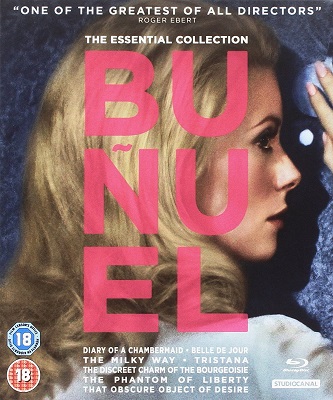
That Obscure Object of Desire, Luis Buñuel (1977, France). I’m not a big Buñuel fan, although I’ve watched a number of his films. Um… checks records, discovers it’s actually ten Buñuel movies… A few of them I thought really good. But my finger sort of slipped on a near-monopolistic online retailer just after Christmas, and I ended up buying the Buñuel: The Essential Collection because some of the movies in it I’d not seen, and some of them I wanted to see again. The most recent film in the box set – it was actually Buñuel’s final film – is That Obscure Object of Desire, which was one I’d not seen. Initially, it appeared much like his other films from the 1970s – the same actors, the same presentation, the same sort of story… But like those other 1970s films it had that, well, genius twist that made it much more than the sum of its parts. That Obscure Object of Desire opens with Fernando Rey leaving Seville by train. A young woman tries to join the train, but he throws a bucket of water over her. He explains to the passengers in his compartment that he had been seduced by a woman called Conchita. The genius element of That Obscure Object of Desire is that Conchita is played by two actresses – Caroline Bouquet and Angela Molina, who play the character entirely differently – at different random times during the film. Rey is an unreconstructed 1970s male, and the film is presented from his viewpoint, but the use of two actresses as Conchita highlights their side of the story and so demonstrates the one-sidedness of Rey’s narrative. These films by Buñuel are not especially striking in the way they are filmed – the staging seems fairly unexemplary, to be honest – but the stories Buñuel chose to tell using cinema are excellent. Some are even pure genius. Not this one, perhaps; although it makes a series of pointed observations because of its peculiar presentation. I had bought this box set on a bit of a whim, having liked some of the films in it. But now I own it, and have seen more of its contents, I’m starting to realise it’s a bloody good collection to own. These are fascinating films and worth seeing.

Die Austernprinzessin, Ernst Lubitsch (1919, Germany). I bought this collection during Eureka’s Boxing Day sale, and it seemed like a good idea at the time. Okay, so I am interested in early European silent cinema – which pretty much means early silent German cinema, and directors like Lubitsch, Lang. Murnau, and even Dreyer, who was Danish but made several silent films in Germany. The princess of the title – it translates as “The Oyster Princess” – is the heiress to a millionaire who built his fortune on oysters, and she is deeply unhappy that a rival will be married before her. So her father promises to find her a more impressive husband, and employs a matchmaker to do just that. And he finds an impoverished prince who is more than happy to marry a millionaire’s daughter… The film is apparently a comedy, although other than an element of slapstick to some of the action sequences, it’s hard to see why. True, it’s taking the piss out of the rich, and the American rich in particular, as the characters are all American – but that makes it new money which is the object of derision, as is explicitly shown in the fact an impoverished prince is seen as suitable marriage material. It feels like the film’s targets are just too obvious and over-used. I suspect even in 1919, they were obvious and over-used. The excessive consumption of the US, and its desire for validation by old world aristocracy, is lampooned to a ridiculous extent – there’s a scene, for example, in which a small carriage is pulled by ten horses, nine of which have liveried riders. The daughter is played by Ossi Oswalda, who is even more peremptory than she was in Ich möchte kein Mann sein, but it’s clear why she was such a popular star at the time – both the humour and drama are broad, and she plays them broad. But she is good on the screen, and looks to be having a great deal of fun, which is infectious. Die Austernprinzessin is probably the least satisfactory of the films I’ve watched so far from the collection – its humour felt too obvious, and there was nothing in its staging whcih made it stand out, other than a propensity to play every joke to the hilt. Watchable, certainly; but not especially memorable.
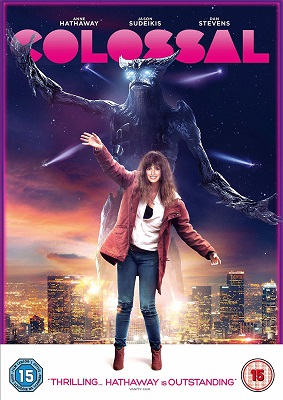
Colossal, Nacho Vigalondo (2016, Canada). I really liked Vigalondo’s Timecrimes, but I’d heard mixed reports about this one, his first film made outside Spain. And, let’s face it, the story didn’t sound like all that prepossessing – woman with a drink problem who works in a bar discovers when she walks through a playground the morning after finishing work, a monster appears in Seoul and apes her movements. I mean, how does that work? What does it mean? The answer to the first is: bizarre lightning strike. The answer to the second is: well, I suspect the only metaphor in action here is so obvious that most viewers would discount it: woman destroys Seoul like she destroys her own life. I mean, really? None of this is helped by having Anne Hathaway, a well-known actress, in the lead role. She is good, no doubt about that; but the rest of the cast are nobodies (so to speak) so she stands out. Things get complicated when the bar owner, and old friend, discovers that he materialises in Seoul as a giant robot. And he’s less concerned about hurting Koreans. So where Hathaway’s monster apologises for her actions, his robot goes on a rampage – and she is forced to fight him to stop him. To some extent, Colossal feels like an extended comedy sketch without a punchline. The fact that it’s well-played and the sections set in Seoul look really good seem immaterial. Meh.

Border, Alessio Cremonini (2013, Italy). I forget how I stumbled across this film, but it sounded like it might be interesting, so I rented it. A woman in Syria learns her husband has deserted the Syrian army and joined the rebels, meaning she is now in danger from the Secret Service and the Shahiba. So she and her sister hire a man to take them across the border into Turkey, where they hope to meet up with her husband. The man they hired introduces them to a driver, Bilal, a fugitive in his own right. But en route they are forced to abandoned their pickup truck after being followed by an army patrol. And then the two sisters are separated… Bilal and one of the sisters stumble across a village that was slaughtered by rebels. The only survivor is a young girl, who they take with them. But things do not go well for them… I’veseen a review of the film online that complains it fails “to adhere to clasic story structures”, which tells me more about the critic, and what’s wrong with the Hollywood film-making, than it does the film. The review also complains that because the two sisters wear the niqab for much of the film, and so only their eyes are visible, it makes it difficult for the viewer to identify with them. But it seems to me that’s actually one of the points Border is making, that’s it’s easier to dehumanise those suffering in wars in the Middle East, which in turn makes it easier for Westerners to ignore their complicity in creating, and fuelling, those wars in the first place. Border tell a straightforward story, in as much as the three characters head for the Turkish border and have random encounters along the way, but that reflects the arbitrary nature of survival in a war zone. I thought Border a good film.

1001 Movies You Must See Before You Die count: 895

1 Comment

Moving pictures 2018, #6

I don’t seem to have been making much traction with the 1001 Movies You Must See Before You Die list recently. True, there’s a film from the list – Alphaville – in this half-dozen, but it was a rewatch as I first saw the film many years ago.

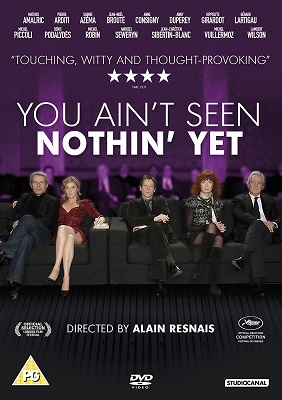
You Ain’t Seen Nothin’ Yet!, Alain Resnais (2012, France). It had never occurred to me the director of Last Year at Marienbad and Hiroshima mon amour had made films into the twenty-first century, but after stumbling across Muriel (see here), I looked further, discovered Resnais’s last film was released in 2014… and added a bunch of those available to my rental list. And the first to be sent proved to his last-but-one film, Vous n’avez encore rien vu, with its dumb Bachman Turner Overdrive title. Happily, the title is the only dumb thing about it. A famous playwright invites a dozen or so actors with whom he has worked during his career to his funeral. The actors are all billed as themselves. On arrival at the late man’s house, they are sat in front of a screen and asked to watch a performance of the playwright’s most famous play, Eurydice, put on by a young theatre collective. And as the collective act out the play, so those at the wake begin to act out the parts they took in past celebrated stagings of the play. For some of these scenes, Resnais lays in CGI scenery, intended I think to represent the scenery of the play when those actors were in it. The play-within-a-play has been around for a long time – Shakespeare even used it in Hamlet – but making the cast of the main play complicit in the staging of the embedded play is a new twist. And it’s cleverly done. Resnais apparently had another person direct the version of Eurydice watched by the cast, so that it would be different in style to his own direction. Having only seen three films by Resnais prior to this one, the distinction was lost on me. But never mind. A good film, worth seeing.

Level Five, Chris Marker (1997, France). Marker these days is probably best known for La jetée, an experimental film from 1962 which was freely adapted as Terry Gilliam’s Twelve Monkeys in 1995. Marker actually made a shitload of films, most of them short and most of them experimental. Level Five is feature-length, at 106 minutes, but very much experimental. It has a single cast member, Catherine Belkhodja, who views the world through a variety of computer screens. The Wikipedia plot summary refers to these last as “virtual reality”, but they’re not. And even for 1997, the computer graphics are crude. If anything, they remind me a little of Wim Wender’s Until the End of the World from 1991, which I first saw in 1992 or 1993 and thought a good presentation of the future at the time. Viewed from the twenty-first century, it’s not, of course. And Level Five feels somewhat similar in that regard. It’s not just the software or the hardware on display, but also the geopolitics, the social concerns… For all that it’s trying to be prophetic – deliberately so, it makes a feature of its analyses – Level Five seems to miss far more often than it hits. And having the film consist solely of either close-ups on Belkhodja or the computer graphics she is either watching or discussing doesn’t exactly make for gripping drama. I suspect this film needed another watch or two, but unfortunately it wasa rental and it’s gone back. Ah well.

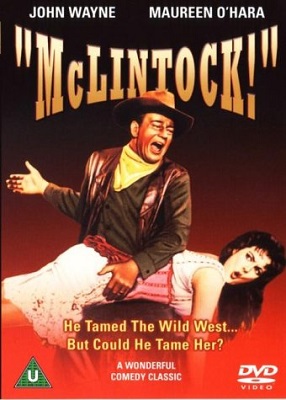
McLintock!, Andrew V McLaglen (1963, USA). Yes, that really is John Wayne spanking Maureen O’Hara on the cover art. And while art like that, and the offensive tagline, “He tamed the Wild West… but could he tame her?” might have been acceptable in 1963 (in some parts of society), they are no longer (Presidents Club notwithstanding). Even worse, a quick google shows that the film posters of the time used the same image, along with equally offensive taglines like “He’s a tender loving guy!” and “Wallops the daylight out of every Western you’ve ever seen!”. The sad thing is, is that for half of its length, McLintock! is actually an amusing comedy Western. McLintock! was a Wayne project, the first of many movies he used to promote his conservative Republicans values – although present-day Republicans may consider those values dangerously liberal in some respects. Wayne developed the script, he hand-picked the director, one of his sons played the young male lead, another son produced, and he insisted on a supporting role for Yvonne De Carlo because her husband had been injured filming How The West Was Won. The film is set in the town of McLintock, named for Wayne’s character, a local cattle baron, who owns pretty much everything in sight. His wife, Maureen O’Hara, left him two years earlier to live in New York, but now she is back – because their daughter, Stefanie Powers, is about to return from college. Meanwhile, homesteaders have arrived in McLintock, ready to settle land they’ve been given on nearby Mesa Verde. The US government has also released the chiefs of the local Comanche tribe, only for a locally-held commission to tell the tribe they must leave their land. All this is good drama, and Wayne’s character is even-handed, if overly paternalistic, and keen to see everyone is treated equally, Comanche or homesteader. But not the women. Twice in McLintock! women are spanked using coal scuttles, and on both occasions such disciplining is seen as both normal and required. In fact, Wayne and O’Hara are at loggerheads for much of the film, until he spanks her. And then she turns all loving and decides not to return to New York. Bah.

Alphaville*, Jean-Luc Godard (1963, France). Although I’d seen ten of the thirteen films in this collection before, for some reason I saved Alphaville to watch last – despite working my way through the others chronologically. I think perhaps it was because I’d last seen it nearly  a decade ago and perhaps felt I’d not appreciated it as much as I should have done… I don’t know. But I do know, however, that I liked it a great deal more this time. Eddie Constantine plays a secret agent posing as a jurnalist who visits Alphaville from the “Outer Countries”. It takes a while before his purpose there is clear, but he has been sent to bring back Professor Nosferatu, now known as Professor von Braun, the inventor of Alphaville and the Alpha-60 computer which rules it (it was not unusual in 1950s and early 1960s sf to assign AI-like capabilities to very large computers). Constantine meets up with Anna Karenina, von Braun’s daughter, and she gives him entry to the sections of Alphaville society his (fake) journalistic credentials cannot provide. None of Alphaville is filmed on sets. Godard made no effort to build a future city – and Alphaville‘s universe is implied to be galactic and not just planetary. Contemporary Paris provides the backdrop. At the time, some of the buildings used may have appeared futuristic, but now they appear mostly otherworldly, which has more or less the same effect. Some parts of the film haven’t aged so well. The seductresses, for example. Or the execution scene in the swimming pool with the sycnchronised swimmers. But there’s a lot that remains impressive. I especially liked a tracking shot following Constantine and Karenina as they travelled down in a lift, which continued in one take from them entering the lift cabin until they exited the hotel. An excellent film.

Tartuffe, FW Murnau (1925, Germany). I don’t know how many silent films I’ve watched, but I learn something new about cinematic narrative each time I watch one. I suppose I expected silent dramas to be completely different to films with sound, as if the use of intertitles laid a constraint on cinematic narrative which sound had removed from movie-making. And perhaps that’s true to some extent. But it didn’t mean silent cinema was completely unadventurous narratively. As Tartuffe demonstrates. It opens with a venal housekeeper gaslighting her employer so that he leaves his fortune to her and not to his actor grandson. Which the grandson learns on a visit to his grandfather. After being thrown out of the house, the grandson addresses the camera and insists he is not giving up. He returns to the house disguised as an impresario and puts on a private cinema screening for his grandfather and the housekeeper of… Tartuffe, the play by Molière. It’s a simplified version of the play, but the cut-down story is more than adequate to make the grandson’s point. In the film-within-a-film (explicitly so, unlike the Resnais above), Orgon returns from a trip and brings with him a religious man whom he greatly admires: Tartuffe. In fact, he admires him so much he changes every aspect of his life to accommodate Tartuffe. Orgon’s wife, Elmire, however, suspects Tartuffe is a fraud, and sets out to entrap him by seducing him. And she succeeds… I’ve seen several of Murnau’s films, and liked them, so this box set of his early works was a good buy. And a bargain too, as it was cheaper than the individual versions of the films in it.

Thor: Ragnarok, Taika Waititi (2017, USA). I am not a fan of superhero movies. The ones everyone praises, I generally think are terrible. I mean, I’d always liked the Guardians of the Galaxy since first reading them in an Marvel anthology comic back in the 1970s, but the movie wasn’t even based on those Guardians of the Galaxy but a later reboot, and, for all its hype, it was pants. And the sequel was worse. So I had pretty low expectations for Thor: Ragnarok, especially given how forgettable the two previous Thor films were… And yes, I was aware Thor: Ragnarok had been directed by Taika Waititi, a leftfield choice for a MCU film, but I wasn’t convinced the addition of Kiwi humour to MCU bombast would work. But. I was actually entertained. Which was unexpected. Thor: Ragnarok is not a great film by any means, and it’s not entirely sure what it should have been. You have the pure Kirby-vision of the Asgard sections, but the part set on Sakaar feels more like a reject from a Star wars prequel. But the film has a number of good lines and some entertaining comic set-pieces. For example, when Thor is about to leave Dr Strange’s mansion and puts out his hand for Mjolnir and you hear the sound of glass breaking, I laughed out loud. I wasn’t convinced Waititi’s rock-creature deadpan humour worked all the time, but Cate Blanchett did make an excellent villain. I could live without most of the plot, and the final battle on Bifrost went on far too long. I’d certainly describe Thor: Ragnarok as one of the better films in the MCU, although that’s not a hard bar to clear. Perhaps its success might lead Disney to experiment a little more with who they choose to direct their films… What am I thinking? It’s Disney. They’re as corporate as you can get. They’ll either flog their new formula to death, or strangle whatever creativity their chosen director tries to put into their film…

1001 Movies You Must See Before You Die count: 895


7 Comments

A reading guide for grown-ups

There’s a common misperception that as you get older, so your tastes in reading drift toward non-fiction. No more fanciful story-telling, from here on in it’s facts and figures. And I’ve certainly found that as I impinge on my sixth decade on this planet – that makes me fifty – so I find myself wanting the certainty of non-fiction and a world I can relate to. They say the Golden Age of science fiction is thirteen, which is, perhaps, a comment on the ability of the thirteen-year-old to read uncritically, given that the vast bulk of sf novels fail even the most cursory critical read… But I think it’s more generally accepted that at thirteen we as readers are more willing to be wowed, we are not so cynical, we can surf the tide of ideas generated by a science fiction text. As we age, so we need more scaffolding to those ideas – possibly because we know more about the world and so are less willing to accept unsupported the premises upon which most science fiction stories rely.

Personally, I continue to read the same sort of novels I read ten or twenty years ago. But I do find them less satisfactory– No, that’s not quite right. There are ways of telling science fiction stories, and I can now discern how they are constructed, and if that’s lacking then I see it is lacking. I can think of a number of sf novels whose flaunting of the so-called “rules” actually makes them stronger fiction, and I doubt I would have seen it that way two or three decades ago.

One of the things I have certainly noticed in my response to my reading as I get older is that I’m no longer willing to put up with world-building which creates abhorrent universes in order to either create drama or, worse, make a point about our own world. The world right now is shit and getting worse on a daily basis, so writing a novel in which human beings can sell themselves into indentured labour to pay off their debts is… so fucking mindlessly right-wing it beggars belief. Why are sf authors writing the playbook for our right-wing future, when they should be telling tales to prevent it?

Remember “cli-fi”? A horrible neologism, but the point was that writing about climate collapse – which is still going to happen, by the way – would persuade the public it was a cause worth pursuing. Except no one gave a shit. Because one mid-list novel is not equal to the PR budget of an oil company. So when science fiction sets stories in futures in which human rights have been removed, all they’re doing is normalising the political thought behind the removal of human rights. Look at how many science fiction television series show torture – in 2018! – despite the fact it is morally abhorrent and globally illegal.

Science fiction has spent the last five to ten years fighting for diversity. And it has partly won that battle. Women, and women of colour, have dominated genre awards for the past couple of years. This is a step in the right direction. However, while we’ve been celebrating those successes, science fiction has been normalising the sort of right-wing shit even the Nazis had to soft-soap the German public before they would accept it. So we have a Star Trek series in which a villain repeatedly kills the crew of the Enterprise over and over again… but that’s okay because it’s a time-loop. I’m sorry, but his way out is death for everyone? How is that right? And then there’s The Expanse, in which the nominal government of Earth, the UN, uses torture, and in which a corporation murders millions of people in the cause of research. How is this right? How is this even moral? We have been so busy celebrating our own victories in the cause of  inclusivity that we’ve allowed fascist stories to take over our genre.

I don’t want to see stories of the future in which humans are treated as slaves, in which millions are murdered to disguise the kidnap of a plot token, in which torture is treated seriously as an intelligence-gathering technique, in which violence against women is used as “character development”, in which the othering of non-white people is considered “world-building”…

I want a socially responsible science fiction, that is self-aware, that knows it is a powerful tool for affecting public opinion – and not just at the behest of corporate paymasters. I want a science fiction that scorns shit right-wing concepts like evo psych and alpha males and eugenics. I want a science fiction that tells good stories and does so responsibly. I want a science fiction that doesn’t abandon its ethics or its artistic integrity in pursuit of the bottom-line. And I want a science fiction readership that accepts partial responsibility for the shit content that is produced, that demands more reponsible content and rewards it by consuming it in sufficient numbers to make it profitable. Cli-fi, after all, had its heart in the right place. But a tendency to be too preachy, an inability to match the oil companies and their anti-global-warming lies, and an inability to find a story that resonated… told against them. Science fiction has a much wider remit, and somewhere in its countless worlds and stories, there must be something we can use to tell stories of the futures we want to see, not futures we’re afraid to see.


3 Comments

Moving pictures 2018, #5

I swore I’d wouldn’t be posting just reviews of films all this year, but I had bad flu for a week, which meant I watched a lot of films and did very little blogging. So I’ve a backlog to clear. One more of these and I’ll up to date, and hopefully after that, their frequency will decrease… and lots of other content will start appearing instead. Hopefully.

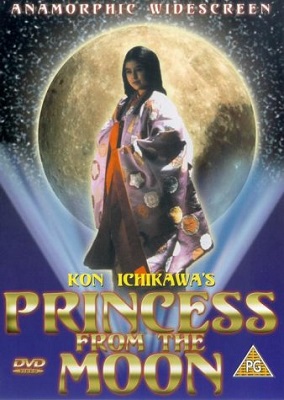
Princess from the Moon, Kon Ichikawa, (1987, Japan). The only other Ichikawa film I’d seen before watching this was The Burmese Harp, which is excellent. So I expected good things of Princess from the Moon, despite the awful title and cover art. Sadly, the latter were indicative of the contents. As the title suggests, a baby arrives myteriously – well, in a meteorite – in Japan, and a family adopt the baby and bring her up as their own. It’s the Superman origin story without the superpowers. Okay, with the superpowers. Because the young woman does have strange powers. However, unlike Superman, she is eventually reunited with her people when a UFO, in a scene somewhat reminiscent of Close Encounters of the Third Kind, or is it ET: The Extra-Terrestrial, comes to Earth and she departs on it. Meanwhile, she proves so popular among the local menfolk, and indeed further afield, that she has to set them tasks in order to manage their advances. The film aparently did not do well and, despite the presence of Toshiro Mifune as the man who discovers the “princess”, it’s not easy to see why. The tone is all over the place, and Ichikawa adds nothing to a well-used story. Apparently, the dragon was originally going to double as the Loch Ness Monster in a Hammer film but the project fell through.

Viva, Anna Biller (2007, USA). I’d rented Biller’s The Love Witch on a whim, and been impressed enough by it to add her first feature film, Viva, to my rental list. It’s nowhere near as polished a piece, and in many respects a much less subtle pastiche. Which is not necessarily a bad thing – Biller is certianly a singular talent, devoted to pastiching 1970s aesthetics and B-movies, but with feminists sensibilities. It can make for an uneasy mix. While her sensibilities are unimpeachable, her dedication to the look and feel of the films she’s spoofing does tend to place them closer to their inspirations than the twenty-first century. Biller plays a Los Angeles housewife in the early 1970s who, with a friend, is persuaded to expand her sexual horizons by moonlighting as an escort (using the name “Viva”). There are a lot of very stilted conversations between the characters, and everything is colourised to an eye-bruising degree. Later, Viva ends up at an orgy, and it’s the sort of thing you’d expect in a Russ Meyer, although without the focus on women’s chests. The end result is far less clever than The Love Witch, and embarrassingly gauche in places, but certainly shows what Biller is about and attempting to do. Seen before The Love Witch, I suspect it might misinform viewers as to Biller’s intentions; seen after it, the films feels like a work in progress. She will go on to amazing things, I’m sure of it. Viva is part of the process.

A Man Vanishes, Shohei Imamura (1967, Japan). My previous experience of Imamura, The Ballad of Narayama (see here), I really did not like, but I suspect I added A Man Vanishes to my rental list based on the description rather than the name of the director. And I’m glad I did. The film starts out as a straightforward documentary on the case of a Japanese salaryman who simply disappeared. Bu then the documentary begins to question its own remit, and in a scene toward the end, the set is demolished around the filmmakers as they discuss what they have filmed, revealing the documentary itself to have been a fictional construct. It is astonishingly meta, and astonishingly informed about its own nature. I’m not sure what to make of it – it deconstructs itself from the inside in a way that I had frankly not thought within the vocabulary of 1960s film-makers. It’s clever in a way that far too few films are, and even fewer documentaries are. I thought it excellent.

Die Puppe, Ernst Lubitsch (1919, Germany). I think it was this film, of all the ones in this box set, which persuaded me to add it to my shopping basket during Eureka’s Boxing Day Sale. Ossi Oswalda plays the daughter of a toymaker who takes the place of a life-size doll bought by the local baron’s son who needs to marry but is not interested in doing so. So he marries the doll. Which is not a doll. He only married her because he had fallen under the spell on a local friary who hoped to use the dowry to fund their gluttony. So of course they’re a bit upset when it transpires the doll is a real woman. And he falls for her, so they’ll be keeping the dowry, thank you very much. Like the previous film in this set, Ich möchte kein Mann sein (see here), Die Puppe is played strictly for laughs, and Oswalda in the title role makes the film. It’s a thin premise, and not especially plausible, but the movie totally commits to it. It’s a more stagey film than the earlier one, with the action taking place on what are clearly stage-sets – and that includes the town square which features in the opening. Fun, but one for fans of silent movies, I suspect.

Dekalog*, Krzysztof Kieślowski (1989, Poland). In terms of Polish cinema’s exposure to the English-speaking world, Kieślowski is a giant. Poland had a huge film industry, and has produced a great number of world-class directors, many of which have been released in Anglophone markets. So quite why Kieślowski has come to be seen as the quintessential Polish director is something of a mystery, especially given the paucity of his oeuvre compared to others such as Andrzej Wajda or Agnieska Holland. The same, I suppose, might also be said of Satyajit Ray and Bengali cinema – Ray is comprehensively released on DVD on the UK, but none of Mrinal Sen’s movies are available in UK releases. But then Ray had Ismail Merchant proselytising for him in the West, probably because Ray was helpful toward Merchant and Ivory during the early days of their career. I don’t know that Kieślowski did the same for an Anglophone director, but I’ve seen no evidence he did. Which does make his selection as the face of Polish cinema somewhat inexplicable. He’s good, there’s no doubt about that. But, I’ve come to feel, middle-brow and you’d expect a director with such a high profile to be more, well, cerebral. But then perhaps Kieślowski’s reputation was formed by his TV work, which this box set has shown is superior to his feature film work. The Dekalog itself, ten one-hour long episodes, each of which illustrates one of the Ten Commandments, and all of which are set in the same block of apartments in Warsaw. Some are better than others; some are even somewhat opaque, with a far from obvious link to the Commandment they are intended to illustrate. Two of the episodes, five and six, were later remade as feature films, A Short Film About Killing and A Short Film About Love. They’re probably the two strongest episodes. This box set was definitely worth getting, just as much for the TV films and special features as for the Dekalog series itself.

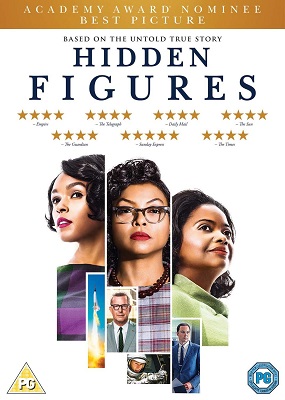
Hidden Figures, Theodore Melfi (2016, USA). The US is very good at making films that show racist it once was but which reveal how racist it still is. On the surface, Hidden Figures cannot be faulted – women of colour were involved in the US space programme and they have a story worth telling, if only to show people they were involved. But in an effort to create drama, Hidden Figures creates situations which undo the achievements of the people it is trying to celebrate. It’s not as blindingly obvious as Kevin Costner ripping down the “Whites Only” sign on the women’s toilet, an entirely invented scene since the NASA facilities were not segregated so there was no need of a white saviour… but also the fact the film’s event are implied to take place during the late 1950s when Katherine Johnson is promoted to the Mercury Task Group, but she had been made a supervisor over a decade before in 1948. There’s no doubt the contribution of women of colour, or indeed women, to the Space Race has been forgotten, if not outright written from history; but the real histories of these people are dramatic enough without having to make changes. The fact the US practiced segregation some fifty years ago is frightening, and yet not all that much has changed – hence the need for films such as this. Black people have been so written out of history – US especially – they cannot see themselves in it, despite their many and varied and important contributions to it. They are there, doing their bit, and only a racist or a fool would say otherwise. On the one hand, I think Hidden Figures‘s purpose is admirable and I welcome the film’s existence; on the other, I rue that it has to exist in the first place, and that it has to warp history to provide a narrative acceptable to the public. But it’s not a great film, and I suspect you’d get more from the book on which it was based.

1001 Movies You Must See Before You Die count: 895

5 Comments

Bondathon!

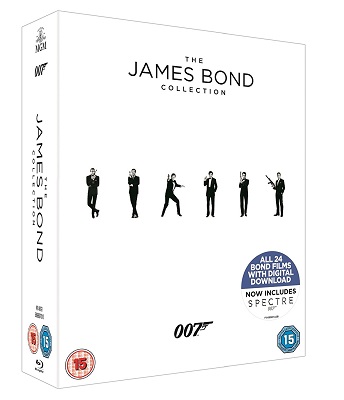
During December I watched all of the 007 films in order after buying the Blu-ray collection for a cheap price on Black Friday. That’s twenty-four films, stretching from 1962 to 2015, featuring six actors as James Bond. Most people have their favourite Bond movie, and indeed their favourite Bond actor, but opinions differ widely on which are the good ones and which are the bad ones. Some, I think, we can all agree on… But I was surprised to find my own internal ranking of the films changing considerably as I watched the movies.

So, in reverse order, from worst to best, that’s worst to best, here are the movies…

24 Moonraker, Lewis Gilbert (1979). Bafflingly, some people actually think this is a good Bond film. They’re wrong. It’s fucking awful. It’s fan service all the way through, married to a plot that sticks like glue to the Bond formula, with a central premise as dumb as the Fake Moon Landings. Hugo Drax has stolen his own Space Shuttles so he can send crew to his stealth space station, from which he plans to re-populate the Earth after he has wiped out everyone with a deadly toxin. There are more holes in the script than in a block of Gruyere. There’s a resurrected Jaws, who eventually joins forces with Bond. And Moore’s Bond is at his most sexist – Lois Chiles is supposed to a scientist and astronaut, but is treated as if such a thing were impossible for a beautiful woman to be. Truly, Bond’s worst outing.

23 Die Another Day, Lee Tamahori (2002). The Brosnan films surprisingly proved to be quite bad, which I had not expected, although Brosnan certainly looked the part. Of the four Brosnan movies, this one is easily the worst – a North Korean general who has “gene therapy” to make himself look like Toby Stephens, discovers a lucrative diamond field in Iceland, and in under a year manages to become a darling of the UK’s political set. And then there’s the invisible car, FFS. I’m not sure what killed it for me: the invisible car, Will Yun Lee “becoming” Toby Stephens, the villain with the diamonds embedded in his face, or Bond walking into a Hong Kong luxury hotel after escaping from a North Korean prison and looking like an escapee from a, well, North Korean prison, and being treated like a frequent and much-valued guest. FFS.

22 A View to a Kill, John Glen (1985). The most eighties of the 007 films, from Christopher Walken as the villain, eighties icon Grace Jones as his sidekick, and a plot that focuses on Silicon Valley. To be honest, I was  cheering for the villains. Silicon Valley is full of a lot of very horrible people and the world would be a better place without them. But back in 1985, Silicon Valley was still viewed positively. Walken wants to destroy Silicon Valley so that he can corner the market in manufacturing microchips, which Intel have pretty much done entirely legally in the decades since, and most integrated circuit foundries aren’t in Silicon Valley anyway, it’s mostly software, but never mind. It sounded plausible back in 1985. If you didn’t think too hard. What didn’t sound plausible was corporate executives falling out of the sky when Walken dumps them from the blimp in which he holds his business meetings. Tanya Roberts was a very eighties Bond girl, part TV detective, part damsel forever in distress; and the chase scene with the ladder truck was quite good if over-long. No discussion of A View to a Kill would be complete without mention of the theme tune, which was by Duran Duran… and not the worst the theme tune by a long way.

21 Skyfall, Sam Mendes (2012). There was a general atmosphere of back-to-basics with the Craig Bond films. No more silly gadgets, no more jet-setting playboy (well, okay, maybe they’d keep that), but it would be a darker, more callous, more brutal Bond, like the one in Fleming’s novels… Instead, what we got was a superhuman Bond, able to snap restraints just by pulling his hands apart, and villains who could run giant server farms without the use of airconditioners. The giant server farm is important, because it allowed the villain access to all sorts of stuff, including MI6’s highly-secure computer network. Which is, er, not how computer networking works. When you remember that Tomorrow Never Dies actually mentions secure sockets, but by Skyfall it’s back to Star Trek levels of magical abilities with computers in order to drive the plot. The title refers to a house in the middle of the Highlands, the Bond family home, long since abandoned, where 007 takes a final stand against villain Javier Bardem, who is especially villainous because he is a little bit gay. Having said all that, Skyfall accidentally served quite well as the lead-in to the total retcon job that was…

20 Spectre, Sam Mendes (2015). So the secret organisation alluded to in Casino Royale, and which drove the plot of Quantum of Solace, was called Quantum. And Skyfall was totes unrelated to that story arc. But then Eon finally resolved the rights issues over Thunderball with Kevin McConroy, and that included the use of SPECTRE (Special Executive for Counterintelligence, Terrorism, Revenge and Extortion), so they retconned all three Craig films into one story arc such that Spectre (they ditched the naff acronym) could be the Big Baddies. And that’s what this film is all about. It’s about writing Blofeld back into the Bond franchise. And, to be honest, I’m not convinced it’s better than Skyfall – in fact, the two films should probably be considered 20= except…I like the way they introduce Moneypenny, and the chase sequence in Istanbul is pretty cool. On the other hand… in From Russia With Love, Sean Connery and Robert Shaw fight aboard a train and do a bit of damage to Bond’s compartment; in The Spy Who Loved Me, Bond fights Jaws and they trash 007’s compartment; but in Spectre, Craig Daniels and Dave Batista manage to destroy the interior of an entire fucking train during their fight scene. Craig’s Bond is some kind of superpowered superhero, which ruins the character; and Spectre does not help by having a wimp of a vaillain like Oberhausen.

19 Tomorrow Never Dies, Roger Spottiswoode (1997). Michelle Yeoh was probably the best Bond girl of them all, and there’s something frighteningly plausible about a media mogul kicking off a war just so he can break into the Chinese market… but Tomorrow Never Dies committed the common Bond sin of having an extended very violent action sequence in a real place which seems to go completely unnoticed by the authorities. In this one, a convoy of black SUVs and a black helicopter shoot up Bangkok (standing in for Ho Chi Minh City) and there’s not a single police officer or soldier to be seen. Compare that with the tank scene in St Petersburg in GoldenEye. The plot of Tomorrow Never Dies also depended far too much on a single piece of gadgetry – the stealth ship. These exist, of course – the USS Zumwalt, for example – but the problem with centring the plot on a single piece of gadgetry is that the writers have to stretch denial of its existence far longer than is plausible.

18 Live and Let Die, Guy Hamilton (1973). Two things about this film stand out: the Wings theme tune, and Jane Seymour in the role of Solitaire.This should be one of the good ones. It’s moore’s first outing in the role, and Yaphet Kotto makes an excellent villain. But, for all my preference for Bond films which dial down the gadgets and supervillains, Live and Let Die leaves me feeling meh. The speedboat chase had its moments, but goes on for far too long. The redneck sheriff should have been left on the cutting-room floor (and certainly should never have made it into a second Bond film), and the voodoo stuff seems to be used chiefly for colour without much actual explanation.

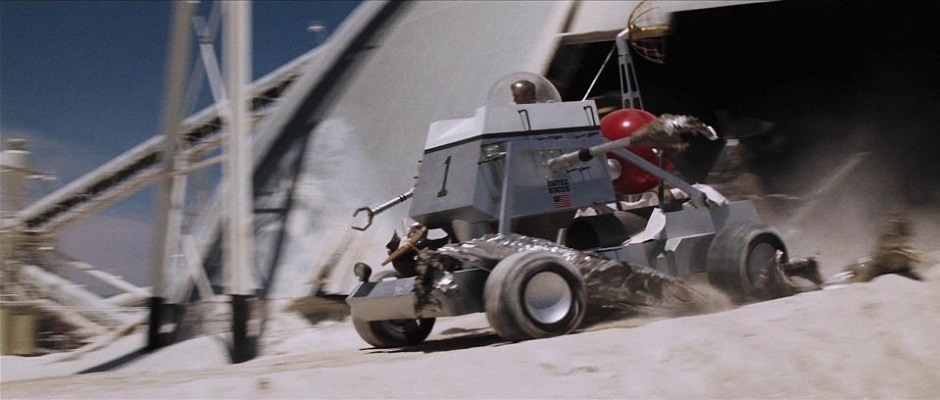
17 Diamonds Are Forever, Guy Hamilton (1971). In some respects, I think of this movie as the iconic Sean Connery Bond movie. It has it all: the silly gadgetry in that Moon Buggy, Blofeld (played by Charles Gray this time), and even a maguffin as ridiculous as a music cassette to drive the story – because of course the guidance program for a satellite launch would easily fit onto a C60… On the other hand, it all feels a bit tired, since Connery was only back after Lazenby walked away. Jill St John makes an excellent Bond girl, but villains Mr Wint and Mr Kidd are characterised as evil because they’re a little bit gay… It has that sort of emblematic, but not especially great, 007 feel to it all. It seems entirely fitting it is mostly set in Las Vegas…

16 GoldenEye, Martin Campbell (1995). This was Brosnan’s first outing as Bond, and the indications were he’d make a good fist of it. Okay, so the central premise of this film is pure bollocks – the Russians built a giant orbiting EMP gun which the US knew about, but they didn’t know about the second one they built and put into orbit? Er, right. And the control centre for this EMP gun, it has big tanks of liquid nitrogen and fuel alongside the computers. Who does that? Who puts fuel tanks in their server room? Isn’t that a recipe for disaster? Oh look, it all blows up very nicely. Sean Bean makes for a good villain, and the tank chase scene in St Petersburg at least had the advantage of being acknowledged by the authorities – even if, wierdly, no one seems to die after being crushed by a tank; shot to death, yes, but no one is killed in the chase scene from automobile accidents. There’s an optimism to GoldenEye the other Brosnan films lack, not just because there’s a new Bond but because glasnost means they can now film in Russia even if they have to look elsewhere for villains – but hey there are plenty of leftover bits of the USSR they can use… GoldenEye promised much, but Brosnan’s later outings as Bond failed to deliver. Mostly.

15 Dr No, Terence Young (1962). This was a difficult one to rank. Dr No is not an interesting villain – it’s a white actor in yellowface, FFS – but it’s the first Bond film, and that sort of gives the movie a certain cachet. It’s also a pretty stripped back story. Since it’s the first film, some of the elements of the formula had yet to become cliché, which works in its favour  – even so, there’s still a Bond girl, and Bond still has sex with an ally and a henchwoman. Ursula Andress is mostly a blank and she’s effectively written out of the story in around 30 minutes. The central premise – Dr No seizing control of US rockets after launch – is one the Bond films used several times – as indeed did Bond-spoof Matt Helm – and it has never really stood up to scrutiny. Plus, all that machinery at Crab Key… what was it for?

14 The Living Daylights, John Glen (1987). This was Timothy Dalton’s first appearance as Bond, and I vaguely remember people being unsure about his casting…. which is probably why Eon Productions went all out for this one. It even has a Harrier jump jet taking off from inside some sort of cooling tower! Dalton plays a no-nonsense Bond, who from the moment he first appears on screen takes no shit. The story has some interesting locations, but the two villains – Soviet general Jeroen Krabbé and toy soldier arms dealer Joe Don Baker – are a bit pathetic. Their tame assassin, played by Andreas Wisniewski, manages to make a completely monkey of the British secret services, which didn’t come across as all that plausible. And then, of course, there’s the theme tune, performed by A-Ha, which was a lot worse than I remembered it.

13 You Only Live Twice, Lewis Gilbert (1967). This was the first Bond film where the producers pretty much only took the title from Fleming’s novel. Not that the novel had much of a plot, it reads more like fleming showing off his research about Japan. Roald Dahl wrote the script, and kept the action in Japan, but instead threw in some SPECTRE silliness about rockets launching from a secret base inside a defunct volcano caldera in order to hijack US space capsules in orbit. Seriously? Their first rocket launch would have burnt out their entire secret hideout, and probably triggered an eruption. Also, to lift a spacecraft into orbit that could swallow the US Gemini capsule, they’d have needed a much bigger rocket. This was Connery’s fifth film as Bond, and he pretty much sleepwalks through it. In fact, he called it a day after this one, but ended up coming back for one more film after Lazenby walked away from the role. There’s some good aerial photography in the air combat scene with Little Nellie, but the formula had already pretty much taken over the franchise by this point.

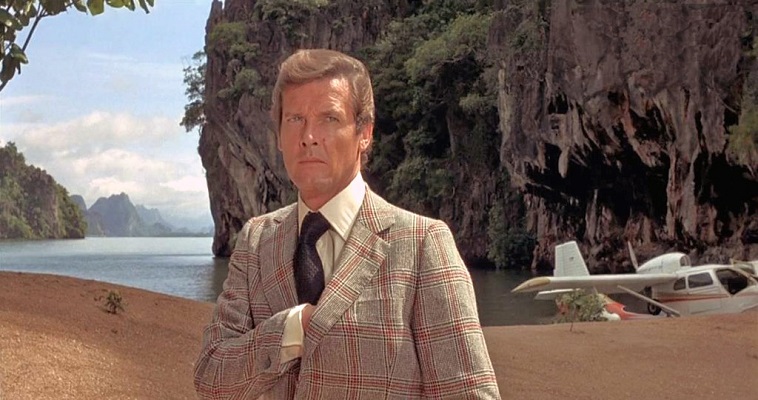
12 For Your Eyes Only, John Glen (1981). This is the Bond film everyone forgets. It’s the one where, you know, Roger Moore, and, er, the Bond girl is Caroline Bouquet, and it’s set in Greece, I think?, and oh yeah, the chase scene with the 2CV… I watched the film around a month ago, and I’m having trouble remembering the plot. There was some secret device that could track nuclear missile submarines, and something about Olympic ice-skating, and then the scenes set in that Greek monastery on the top of a rock pillar… Despite all that, I remember enjoying it. Bouquet actually made a good Bond girl, with way more agency than pretty much all the Bond girls before her. The theme tune, sadly, is insipid.

11 Casino Royale, Martin Campbell (2006). I suspect I may have placed this much higher than it actually deserves. But Casino Royale was never covered by previous Bonds, despite being the first 007 novel by Fleming. The only previous feature film version was a spoof that had had half a dozen directors and only a passing acquaintance with the story. This version, the first appearance by Daniel Craig as Bond, hews much closer to the novel. And it’s sort of impressive, in how physical Craig has made the character, right from the start with the extended parkour sequence. Of course, ten minutes in and plausibility goes out of the window, when Bond shoots up a foreign embassy – I mean, he’s a trained agent of the government, and I’m pretty sure it says somewhere in the civil service handbook that you shouldn’t shoot the shit out of foreign embassies. The fact it all comes down to a very dull game of cards is a bit unfortunate – and all the jet set playboy stuff doesn’t quite gel with Craig’s hard man government agent 007 – but at least there’s the torture scene where Bond gets repeatedly thwacked in the scrotal sac. Eva Green is excellent, possibly the best of all the female characters to appear in Bond films, although leaving in Fleming’s completely misogynistic last line was a mistake.

10 The Spy Who Loved Me, Lewis Gilbert (1977). Okay, so the underwater Lotus was cool. Totally fake. But cool. But this is Moore’s Bond on top form – charming, urbane, witty, some actually quite neat gadgets, and a villain with the coolest hideout yet. And we also got Jaws, who proved so popular they resurrected him for a second outing. Barbara Bach played an ally and henchman Bond girl, and while she may not have made a convincing Russian, her character held its own against Bond. The model work, unfortunately, was a bit crap, and shipping magnate villain Curd Jürgens was no more plausible a megalomaniac than Moonraker‘s Hugo Drax. The supertanker was a neat idea, although the battle for it stretched credulity and felt pretty much like a restaging of the final battle in You Only Live Twice. The novel, incidentally, is the best in series – and its plot couldn’t be further from the film: a young woman working at a motel out in the sticks is saved by Bond passing through when gangsters turn up to torch the motel for an insurance scam. No supertankers, no underwater bases, no KGB.

9 Quantum of Solace, Marc Forster (2008). Popular wisdom has it that this is the worst of the four, to date, Daniel Craig Bond films, except… It’s clearly the best-looking of the four. Some of the staging is quite astonishingly pretty. And the plot doesn’t ask too much of the viewer. But, crucially, Bond doesn’t go superhuman in this one. He plays it like a hard man, but they dialled back the violence and it pays off in credibility. The story is not brilliant, but it’s Craig’s most human outing as Bond. And for that reason, it beats the other Craig 007s hands down.

8 Octopussy, John Glen (1983). I remembered this as bad, from when Bond became pretty much a parody of himself, so I was somewhat surprised to discover that time has been kind to Octopussy. The section set in India comes across as a homage to Bollywood, and the later sections are not so far-fetched they ruin suspension of disbeilef. True, it’s all a bit pantomime in places, and the Cold War is presented something more like Star Wars than an actual real piece of geopolitics. Moore looks over the hill as Bond, although it doesn’t affect his performance; and Maud Adams is appealing in the title role. It’s lightweight Bond, but it’s lightweight Bond that manages to put very few feet wrong. An under-appreciated film.

7 The Man with the Golden Gun, Guy Hamilton (1974). I would have been eight when this was released, but for some reason I remember it as fondly as if it were the first ever Bond film I saw. It’s from the height of 007’s silly gadget phase – a car that turns into a plane! the Solex solar-power doohickey! the giant solar-powered laser gun! – but Moore is on fine form. And I do like Scaramanga’s secret island. The redneck sheriff should have been left on the cutting-room floor, and making Bond girl Brit Ekland a comic turn was a good move. The film is one of the best-plotted in the franchise – and it’s a franchise which has alway been strong on plot, if not on incidental details – and runs like clockwork. I suspect one of the reasons I like this film more than I should is because I probably saw it first shortly after visiting Thailand on holiday. So I had the country fresh in my memory. This is Moore’s Bond at his best.

6 Thunderball, Terence Young (1965). Okay, so this one scores higher than it really should because central to the plot is an Avro Vulcan and I love me some V-bomber. The script was a collaboration between Fleming and two scriptwriters, and when the film looked to be delayed, Fleming went ahead and turned it into a novel, infringing the copyright of the other two so much that Connery was allowed to remake the film as Never Say Never Again in 1983. It wasn’t sorted out until after Skyfall was made. It takes Bond an inordinately long time to long to find the missing nuclear bomb, and he’s out on a limb with Whitehall all the time he’s looking. Unfortunately, there’s little drama because we know Bond is in the right place. That’s probably what spoils this film – that everyone else is looking in the completely wrong place, and only Bond is on the right track. Connery always played Bond smug, but here it’s much worse because he has the perfect right to be smug.

5 The World Is Not Enough, Michael Apted (1999). I wrote above that the Brosnan films are bad but, like all of the Bond films, they worked quite well when they didn’t bother with the stupid gadgets. The World is Not Enough keeps it simple: an oil pipeline, a nuclear warhead. Okay, so the USSR didn’t have missile silos, preferring mobile launchers they could parade past the Kremlin on May Day, but never mind. But the paraglider/ski chase is a neat nod to earlier Bond films. Robert Carlyle’s villain isn’t entirely convincing – he hams it up something terrible, although his accent is quite good – and Denise Richards made a poor Bond girl. But Sophie Marceau more than makes up for both. The final scenes set in the Maiden’s Tower in Istanbul are among the best in a Bond film.

4 From Russia with Love, Terence Young (1963). After the rocket-launch-interfering Dr No, From Russia With Love went straight back to basics and the Cold War. It was Fleming’s fifth novel, and Connery’s second film, and in the book its story takes place before Dr No. Bond is sent to Turkey after a cipher clerk in the Soviet embassy there professes to have fallen in love with him. It’s all a plot, of course, to get rid of Bond, by setting Robert Shaw on him. I seem to remember it was a KGB plot in the novel, but it’s SPECTRE in the film. Istanbul makes a much more interesting setting than Dr No’s Caribbean island, and From Russia With Love makes full use of it. I visited Instabul as a kid, but remember very little of it. I do remember seeing Sean Connery while we there, however. Myself and my father were in an antique gun shop in the Grand Bazaar when Connery, dressed as Bond, entered and posed for some publicity photos. He was actually in Istanbul filming Murder on the Orient Express, which would make it 1973 or 1974, so he was still playing 007 at the time.

3 Goldfinger, Guy Hamilton (1964). Of all the Bond films adapted from novels, this is probably the most faithful (Thunderball, of course, was a novelisation of the film, so it doesn’t count). It’s mostly remembered for Shirley Eaton being murdered by Goldfinger by having her body covered in gold paint. I’m still not sure if that’s for real, the skin “needing to breathe” thing – look on Youtube and you’ll see loads of videos of people body-painted all sorts of colours. Gert Fröbe is excellent in the title role, Bond’s best villains without a doubt. I know Honor Blackman gets a lot of love for her part, but I wasn’t especially impressed. The film also introduced Bond’s most iconic car, the DB5, with its ejector seat (which, to be honest, I never understood the logic behind). And the film includes the best line ever uttered by a Bond villain: “No, Mr Bond, I expect you to die.” To be honest, Bond gets out of that one a bit too easily. Goldfinger is definitely Connery’s most, well, Bond film.

2 Licence to Kill, John Glen (1989). After The Living Daylights, which felt slightly cheap despite clearly having a substantial budget, I was surprised to discover that Licence to Kill, the second Dalton 007 movie, felt even cheaper but also managed to tell a good story. Perhaps it’s that the desire for revenge humanises Bond, but whatever the reason, the story works really well. It also has one of the best Bond girls in Carey Lowell (although Talisa Soto is a bit of a wet blanket). Bond is on the hunt for a Central American drug lord whol killed Felix Leiter’s new bride and threw Leiter to a shark, resulting in him losing a leg and an arm. The film plays like an extended episode of a US maverick PI or cop show, but that sort of works in its favour. Bond does Bond things, without really being Bond – but then even if the Dalton films had not cut back on the gadgets, Bond would not have had access to them because he’s been cut off by MI6. I hadn’t expected much of Licence to Kill, and in fact remembered very little of the film from previous viewings (probably only one viewing, to be honest), but I enjoyed it and thought Dalton made an excelllent Bond.

1 On Her Majesty’s Secret Service, Peter R Hunt (1969). I had not expected to like this. Everyone says it’s bad, and Lazenby is generally considered the worst Bond… except… really? It’s not like Connery was especially good in the first two in which he appeared. But Lazenby does actually make Bond a more sympathetic character, and his relationship with Tracy is completely believable. Best of all, however, is that Lazenby can fight. The fight scenes in OHMSS are hugely superior to any in the Connery or Moore films. When Lazenby throws a punch, he fucking punches. During a screentest, he apparently knocked out a stuntman by accident. It shows. The fourth-wall-breaking quips to camera are just gravy. This is a Bond that fits the books and the films. It’s a shame Lazenby never took it further.

So there you have it. Twenty-four films, ranked. As they should be. Anyone who disagrees is, of course, wrong-headed.


1 Comment

Moving pictures 2018, #4

I still seem to be watching a lot of films. Normal service – well, normal as of 2015 – should be resumed soon…

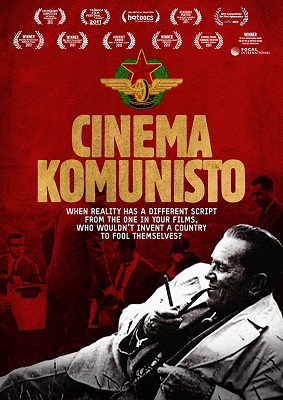
Cinema Komunisto, Mira Turajlic (2010, Serbia). Back in the day, Yugoslavia as was decided to attract foreign investment by opening up one of its state-run studios, Avala Film in Belgrade, to foreign film-makers. President Tito was a big movie-fan, so it gave him the opportunity to meet many film stars, such as Orson Welles or Kirk Douglas. Cinema Komunisto uses both archive footage and interviews with those who worked at Avala. The facilities are now pretty much ruins, but the massive wardrobe and props departments still exist. It’s interesting stuff, with lots of nice touches – like the bridge Avala helpfully blew up for a US war movie, only for the film-makers to use a model shot in the final cut; or the US film star who complimented Tito on his wonderful palace, only to be told it was the “people’s palace”. Yeah right. “Socialist” dictators and their insulting fiction of non-ownership of their wealth. Worth seeing.

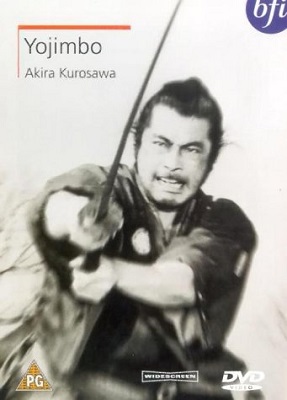
Yojimbo, Akira Kurosawa (1961, Japan). I thought I’d seen this, but it seems I think I’ve watched more Kurosawa films than I actually have. And this was one of the ones I hadn’t actually seen. That has now been remedied. Obviously. The title means “bodyguard” and refers to the character played by Toshiro Mifune, who is never named. He wanders into a town in which two rival gangs have the local populace terrorised. Mifune decides to do something about it, by playing one gang off against the other. I’m told the story is based on Dashiell Hammett’s Red Harvest, which I’ve never read, although Kurosawa claimed it was based on Hammett’s The Glass Key. Yojimbo was certainly lifted pretty much wholesale by Sergio Leone, however, transplanted to the Wild West and made as A Fistful of Dollars. Which seems entirely approproate as, despite its setting in mediaeval Japan, there is very much a Wild West air to the film. There are guns – one of the enforcers in one gang has a revolver, makes much use of it – but most of the fight scenes feature swords. The characters seem a little caricatured, much like in a spaghetti Western, including the boar-like brother of one gangster, and the seven-foot tall enfrocer of the other. Kurosawa clevery ramps up the violence as the film progresses, until the final showdown results in the destruction of the businesses of the two merchants who back each of the two gangs. I’ve stuck a load of Kurosawa on my rental list recently, as I really should watch more of his films.

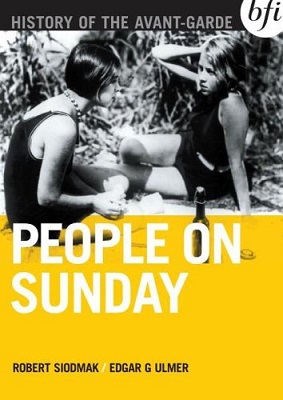
People on Sunday, Robert Siodmak & Edgar G Ulmer (1930 Germany). I had thought this was a documentary, but it isn’t. It’s actually a drama, made by a film club in Berlin, a fact the film actually makes a point of. It opens by introducing the main actors, and points out that once the film is over they will be returining to their day jobs, which it helpfully indicates. The story follows four friends on a Sunday, as they head for Wannsee to enjy the summer sun on the beach. As siilent dramas go, People on Sunday ticks all the boxes, but what makes the film remarkable – and it can hardly be “a pivotal film on the development of German cinema”, as Wikipedia puts it, if Lubitsch was making popular films in Berlin more than a decade earlier – but what is certainly remarkable about People on Sunday is the number of people involved in it who went on to have careers in Hollywood. Not only the two directors, Siodmak and Ulmer, but also Curt Siodmak, Billy Wilder and Fred Zinnemann. Worth seeing.

The Calm, Krzysztof Kieślowski (1976, Poland). One of Kieślowski’s favourite actors, Jerzy Stuhr, plays an ex-con who tries to turn his life around after being released from prison. It’s never revealed what he was sent down for, although it seems unlikely to have been a violent crime. Stuhr leaves Kraków and heads out into the country. He gets a job on a building site, where the manager seems to trust him – although not, it transpires, for necessarily the right reasons. He meets a young woman, the two marry and a baby is on the way. His has turned his life around and everything is going well. He is a model member of society. But materials keep on disappearing from the building site, and when the manager threatens to take the cost of the missing materials out of everyone’s wages, they go on strike. Stuhr ends up as an unwilling liaison between the two. And learns that the manager himself is responsible for the thefts – and that he trusts Stuhr because Stuhr, an ex-con, would make a good patsy should the scheme be uncovered. Stuhr can’t resolve the situation and his fellow workers decide he is a scab. So they beat him up. This is not a cheerful film, although it initially appears to be. It seems Kieślowski is trying to say that no matter how hard you work to improve yourself, the system will still fuck you up in the end for no good reason. And in 1970s Poland, that was likely true. So it’s a little ironic that The Calm was banned by the Polish authorities, and didn’t get shown until 1980, because it depicted a strike and strikes were illegal in Poland.

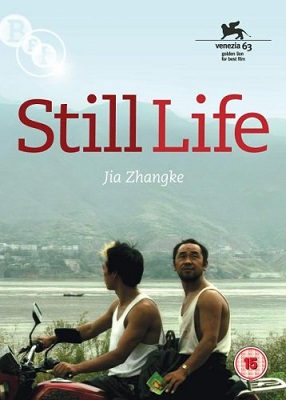
Still Life, Jia Zhangke (2006, China). That’s the last of the Christmas presents, and the last of Jia’s films until the box set containing Mountains May Depart that I’ve pre-ordered arrives. His films really are brilliant, so much so that each time I watch a new one I have to decide whether or not it is my new favourite Jia film. Still Life came close, perhaps just inching out 24 City but not managing to steal the top spot from The World. Still Life is set in the Three Gorges area and tells the story of Han Sanming (played by Han Sanming), who has returned to travelled to track down his wife and daughter who ran away sixteen years earlier. But the address he has for them is now underwater, part of the city that has been destroyed for the Three Gorges Dam project. Sanming joins a local demolition crew, who are demolishing buildings using lump hammers. The film then shifts to Shen Hong (played by Zhao Tao, who played the lead in The World, and Han Sanming played her boyfriend), a nurse who is in Fengjie to look for her husband, who it turns out has become a successful local businessman. In fact, he runs several demolition contracts, and Sanming works for him. He also has a rich girlfriend. When Shen Hong finds this out, she asks for a divorce. In the final section of the film, Sanming’s wife turns up and reveals that their daughter is now working furthe rsouth in indentured labour to pay off the wife’s brother’s debt. Sanming offers to take wife and daughter with him, but he would have to pay off the debt – and he doesn’t have the money. so he returns alone to the coal maines of Shanxi… Although a drama, Still Life plays like a documentary – it’s one of the chief appeals of Jia’s films – and some of the scenery on display is fantastic. The Three Gorges region is astonishingly beautiful, but it is also heavily built-up and, during the period the film was made, was being slowly demolished and flooded for the dam. It makes for some striking cinematography. Excellent stuff.

Ich möchte kein Mann sein, Ernst Lubitsch (1918, Germany). The title translates as “I don’t want to be a man”. Ossi Oswalda plays the high-spirited daughter of an indulgent uncle. When he leaves, she is put in the charge of a new guardian, who is far more strict. So she dresses up as a man and goes out on the town, ending up in a posh ball, where she finds it much harder to be a man than she had expected. She bumps into her new guardian, and tries to steal his date in revenge. Unfortunately, someone else has more success, and Oswalda and her guardian drown their sorrows in drink and become great friends. So much so they begin kissing each other. When they leave the ball, the cab driver drops Oswalda off at the guardian’s house, and vice versa. But it all works out in the end. Oswalda is undoubtedly the star of the film – there wouldn’t be a film without her. Her bad behaviour in the opening section of the film does an excellent job of outlining her character; and her antics when cross-dressed, most of which are based on a complete obliviousness to her disguise, display excellent comic timing. When you consider that Ich möchte kein Mann sein was made a dozen years before People on Sunday, and there’s not all that much that’s technically different between the two… it does undermine the claims to importance of People on Sunday. The latter is undoubtedly the better film – it’s longer, 73 minutes to the 41 minutes of the Lubitsch, and it’s a drama played completely straight and which makes a feature of its amateur cast. Ich möchte kein Mann sein is a flat-out comedy, although not the fall-about slapsatick comedy Hollywood was making at the time, and it makes a meal of its “fish out of water” story. A fun film, but one chiefly for fans of silent cinema.

1001 Movies You Must See Before You Die count: 895

2 Comments

Reading diary 2018, #2

Okay, we’re just about a month into 2018 and it’s already proving a better reading year than 2017. Of course, the real test is keeping it going for 12 months… One of the other things I’d like to do, reading-wise, in 2018, beside read fiction from other countries, is to try and increase that 1001 Books You Must Read Before You Die count at the bottom of each of these posts. I’m not good on the classics, I need to read more of them. Would you believe I’ve only ever read one book by Charles Dickens? And while I’ve read all of Jane Austen’s novel (except Emma), I’ve never read anything by a Brontë.

Meanwhile, some recently-published and recently-read fiction…

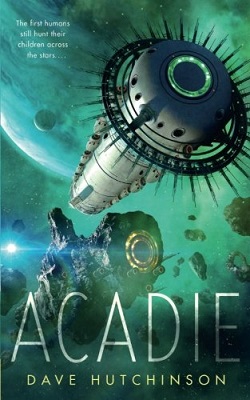
Acadie, Dave Hutchinson (2016, UK). I’m not entirely convinced by tor.com’s line of novellas if only because they like to suggest they either saved the novella or created the current market for them. Small presses have been publishing novellas for decades. Which is not to say tor.com are doing a bad thing. I like novellas so I can’t fault tor.com’s mission. True, many of the novellas they’ve published have not been to my taste – and one or two have, I feel, been lauded far more than they deserve – but … one or two of them have been entirely to my taste. Like this one. Dave Hutchinson is a friend but I also think his soon-to-be-more-than-a-trilogy of Europe books is excellent. Acadie, however, is much closer to heartland sf. The narrator is the president of the Writers, a group outlawed because of their experimentation on the human genome. He was a famous whistleblower and was recruited by them. When the Writers learn their hideout may have been discovered, they kick into action a plan to abandon the star system and settle elsewhere. The narrator is one of several people left behind to oversee the withdrawal and ensure the Writers are not tracked to their new home. But what he learns calls into question everything he knows. Okay, so the big twist isn’t that hard to spot, and while I’m no fan of first-person narratives, it’s hard to see how this story would work in third-person. If I have one complaint, it’s the depictions of the Writers’ society are both a little extreme, which undermines the point they’re trying to make. But otherwise, this is good stuff. It may well make the BSFA Award shortlist.

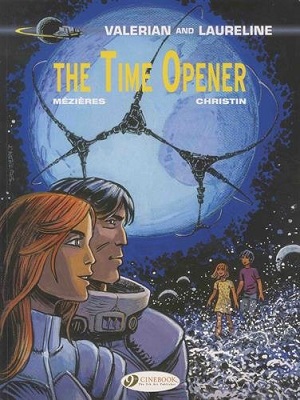
Orbital 7: Implosion, Pellé & Runberg (2017, France). Cinebook have been doing an excellent job introducing well-known bandes dessinées to the UK market, but my interest lies pretty much exclusively in the sf titles, such as Valerian and Laureline and this one, Orbital. The series follows the adventures of a human and Sandjarr, both mavericks, who were once members of their respective races’ diplomatic corps. Humanity lost a war to the Sandjarrs and hate them, so the first couple of volumes were chiefly concerned with normalising relations between the pair. But now they’re pretty much partners, and it’s a wider conspiracy seeking to undermine the human-Sandjarr alliance which provides the stories. Neuronomes, giant sentient ships which were instrumental in saving the galaxy in the previous two-volume story, have been mysteriously blowing themselves up, killing millions of people. Caleb and Mezoke are on the alien space station of Tetsuam, trying to track down a clue to what is affecting the Neuronomes. This may be the start of a new story, but it makes little or no sense without knowledge of the earlier six volumes. Which are worth reading anyway. Good stuff.

The Rift, Nina Allan (2016, UK). There’s no doubt that Allan is one of the more interesting genre writers the UK has produced in the past few years. She came out of slipstream and dark fantasy and has moved into science fiction, and her beginnings very much flavour her stories. The Rift is only her second try at novel-length, and even then her first, The Race, felt more like three novellas badly welded together than it did a novel… which sort of makes The Rift Allan’s first successful attempt at novel-length fiction. Because the one thing The Rift is… is a much more coherent narrative than The Race. (To be fair, the lack of coherence was a feature of The Race‘s narrative, it just didn’t quite work for me.) The problem I have with The Rift, and it’s fairly minor, is that I can’t decide if it’s stunningly clever, or just very clever with accidental elements of stunning cleverness. Obviously, I’d like to believe the former, but I’m also all too aware of how writers can unwittingly include more in their fiction than they realise. The plot in a nutshell: Selena’s sister, Julie, disappeared twenty years ago, assumed to have been a victim of a serial killer caught at that time, but now she has re-appeared and claims to have spent much of the two decades on an alien world she accidentally reached through a “rift”. The alien world feels like something which might have been invented for a 1970s science fiction novel, internally rigorous but also strangely familiar. It didn’t help, for me, that some of the invented names sounded like places in Denmark (Nooraspoor = Nørreport?). The big question is: did Julie really spend her time there, or has she made it up? And The Rift refuses to commit to one or the other. Is Julie perhaps an imposter? The final section of the novel seems to suggest as much, but Serena refuses to believe it, on more than sufficient evidence. The beauty of The Rift is that refusal to commit. It’s a lovely piece of writing – but that’s not unexpected for Allan – but it’s also a coherent straight-through narrative, enlivened with a few tricks such as changes of tense or person or POV, and it’s because the story is a neat contained whole, so to speak, that the narrative’s refusal to commit to a truth is so striking. It’s a novel that stays with you, not just because of the story it tells but because of the way it tells its story. It is, without a doubt, Allan’s best work yet.

My Fair Ladies, Julie Wosk (2015, USA). I nominated this for a BSFA Award in 2016 based on a read of the first few chapters… but I never got around to finishing the book off. Which I have now done. And it deserved that nomination. Which, sadly, came to nothing anyway. Inspired by the sight of a mannequin’s head in a basket of tat at a flea market, Wosk began researching female automatons, both historical and fictional. But not just mechanical ones, or indeed magical ones from mythology. She discusses Eliza Doolittle, for example, as well as several early genre stories about mechanical women. The book then goes on to cover mechanical women in films of the 1920s and 1930s, then films and television of the decades following, before moving onto actual female robots. If you consider the robot trope in science fiction as a signifier for slavery, or for at the very least for “invisible” domestics, then it’s no great stretch to see artificial women as little more than a signifier for deep misogyny. Artificial women are, after all, above all biddable. They are the ultimate in male gaze, mirrors of the male gaze in fact; so it’s little wonder they’ve proven popular in genre. Of course, there are those examples which subvert the trope – at the end of Pygmalion, Eliza is her own woman and no longer Higgins’s toy; in Metropolis, the robot Maria is used to foment revolt among the workers; in Ernst Lubitsch’s Die Puppe, Ossi Oswalda’s impersonation of a doll sees her take control of the story… If there’s a weakness to My Fair Ladies, although it is a fascinating read, it’s that it doesn’t cover much written science fiction, covering only early genre stories and then films and television. When you consider the use of artificial women in written sf since WWII, and especially in the past couple of decades… the trope is even more pernicious, such as the title character of the awful The Windup Girl. There are no female Pinocchios. At least, there are none written by men. Madeline Ashby’s vN features a female robot as a protagonist, but she’s on the run after breaking free of her safety protocols. Jennifer Pelland’s Machine is a much more interesting work, although it is about a woman who has been decanted into a robot body while her human body is treated for a fatal condition. The treatment of artificial women in science fiction is, of course, a consequence of the treatment of women in science fiction – both in narratives and in the real world. And while women have always been writing science fiction, it’s a trope they’ve not typically made use of, and so it’s been developed almost exclusively by male writers. I would like to see that change.

Four Freedoms, John Crowley (2009, USA). I bought this when it was first published, so it’s taken me nearly eight years to get around to reading it. And I’m a big fan of Crowley’s writing. Oops. Having said that, I’ve yet to read Endless Things, which I bought in 2007, chiefly because I want to reread Ægypt (AKA The Solitudes), Love & Sleep and Dæmonomania first… But: Four Freedoms, which is entirely unrelated and not even genre. The title refers to President Franklin D Roosevelt’s “four freedoms”: 1 freedom of speech, 2 freedom of worship, 3 freedom from want, and 4 freedom from fear. It is is set during WWII and chiefly concerns people who work at an aircraft factory in Ponca City, Oklahoma. The bomber these people are building is the B-30 Pax, but it’s clearly an analogue of the Convair B-36 Peacemaker, which did not see service during WWII (but from 1949 to 1959, to be precise) and was one of the great Cold War bombers of the US. Only 384 were built, but the novel claims 500 of its “B-30″s were built. Crowley mentions in an afterword that he didn’t intentionally model the B-30 on the B-36 and only later discovered the Pax / Peacemaker synchronicity and that the B-36 had been damaged by a cyclone at Fort Worth echoing events in his novel. I believe him – you don’t put “wow synchronicity!” notes in your afterword unless that’s what they were. The actual story of Four Freedoms is that of female and disabled members of the US workforce during WWII. The novel focuses on the factory which builds the B-30, but tells the story of several characters, introducing them and then telling their back-story through flashback. It’s a beautiful piece of writing – effortlessly readable, effortlessly convincing. I had forgotten how good Crowley is. I really ought to get started on my read of Endless Things

Autumn, Ali Smith (2016, UK). This was my first Ali Smith. I know her name, of course, although she has appeared on my radar more often recently as her fiction of the last few years seems to be borderline genre. Or rather, is genre but not published as such. And Autumn seems to be a case in point. Although to be fair, had it been published as genre, it would have generated no end of complaints and killed Smith’s career as a genre writer. Happily, it was published as lit fic, and those of us not so tied to space opera, mil sf, grimdark, etc. we can read nothing else, can enjoy it as genre. The novel opens with a man on a beach who appears to be in some sort of afterlife, and then abruptly shifts to the life of Elisabeth Demand, an art history lecturer. As a child she had made friends with her neighbour, an OAP called Daniel, who had been a songwriter. Years later, she discovers he is terminally ill and begins visiting him in his nursing home. At which point she realises that he is the only man she has ever loved, despite their great difference in ages, and that has affected all her relationships. The narrative bounces back and forth through time, telling each character’s story, and introducing Pauline Boty, a female British Pop artist, whose works and contributions have been criminally forgotten (in real life, that is). She was Daniel’s one great love, although she was married and did not return his feelings – but because of her, Daniel could not love Elisabeth. Much is made in reviews of the book’s post-Brexit setting, but to anyone who has lived in the North after a decade of the Tories’ criminal Austerity it seems pretty much what life in the UK is like now. I’m not sure about Smith’s prose. It seemed at first a little OTT, and some of the stream of consciousness sections seemed to serve little purpose. I’ll read more by Smith, I think, but I’m not about to dash out and read everything she has written.

1001 Books You Must Read Before You Die count: 131


1 Comment

Moving pictures 2018, #3

Moving swiftly on… This year, this blog is not going to turn into a repeat of last year. Honest. There will be content other than film reviews (or rants). But it’s going to take me time to get to that point, as I need to change a few of the bad habitds I’ve picked up over the last two years, so you’ll have to bear with me for a few weeks…

The Red Turtle, Michaël Dudok de Wit (2016, France). Sometimes, Amazon Prime really does throw up pleasant surprises. It would have thrown up more, recently, but it seems when they upgraded it they broke the subtitling thing, and they don’t show now unless they’re burned into the print. Which is fucking annoying. Streaming, eh. And people wonder why I prefer DVDs and Blu-rays… Not that the subtitle bug caused any problems with The Red Turtle, as it is notable for having no dialogue. A man is washed ashore on a deserted island. His attempts to escape on rafts are thwarted by turtles. Especially a large red turtle, which he manages to capture and drag on shore. The following morning, the red turtle has become a woman with red hair. The two live together and have a child. The child grows to a man. Who attempts to leave the island. And, okay, I admit, when the son was an adult, I spent most of the time wondering where his trousers had come from. It’s not like his father had a spare pair. But the animation in The Red Turtle is astonishingly beautiful, although not in a Makoto Shinkai way, more a ligne claire way. It’s not the most dramatic story to make it to the silver screen, true; but there’s some clever foreshadowing, and the lack of dialogue is no handicap to following the narrative. The Red Turtle has been praised by many and won a couple of awards, and Dudok de Wit won a special prize for Un Certain Regard at Cannes. The film was nominated for an Oscar but lost out to Zootopia (which I’ve not seen, but… really?). A definite candidate for my best of the year list.

Becoming Bond, Josh Greenbaum (2017, USA). My promised Bondathon blog post is still to come – that’s the one in which I rank all twenty-four official 007 films in order, after watching them over 2 to 3 weeks… It should come as no real surprise that I think the best Bond film is… On Her Majesty’s Secret Service. In fact, I thought the best Bond movies were the stripped-back ones, without the stupid gadgets or supervillains. OHMSS was George Lazenby’s sole outing as Bond and popular wisdom likes to have it the film was bad and he was fired from the role as a result. In fact, Lazenby turned down a seven-film contract and a $1 million signing bonus (this was in 1969, so it was a fuckton of money). True, the film was generally considered one of the lesser movies in the franchise, but it has since been critically re-appraised and many consider it the best. I happen to agree. Becoming Bond is Lazenby’s story. He’s interviewed by the film-makers, but parts of his life are also dramatised, with Josh Lawson playing a young Lazenby. Lazenby’s career path to Bond is pretty well-known: mechanic to car salesman to male model. At the time Connery announced his retirement from 007, Lazenby was best known for a series of adverts for Big Fry chocolate. Broccoli met Lazenby and asked him to audition for the role of Bond. When Peter Hunt, editor on previous Bond films who had been given the director’s chair for OHMSS, met Lazenby, the role was pretty much his. Filming went well, although Lazenby insisted on doing his own stunts – there are conflicting stories about relations on-set, although the one about Rigg despising Lazenby, so much so she chewed garlic before a scene in which they kissed, is apparently untrue. Once OHMSS had been released, Lazenby refused to play ball with the producers. He turned up to the premiere sporting a beard. And he refused to sign a seven-film contract, despite the $1 million signing fee, partly thanks to bad advice from his agent who told him he could probably get $500,000 a role for any film going forward. Unfortunately, his film career pretty much died. He went into real estate, and earned a very comfortable living. Lazenby made a really good Bond. True, he was a bit stiff at first, but as the film progresses he settles into the role, so much so that he’s more convincing when undercover as Pursuivant, Griffin Or Sir Hillary Bray than Connery ever was as Bond himself. And in the action scenes, Lazenby displays real physical presence. The Bond fight scenes were always a bit crap, but Lazenby throws punches like they were real punches (he actually knocked out a stunt man during his audition). The next Bond to come close to Lazenby’s physicality is Timothy Dalton. Daniel Craig may be very physical, but it’s cartoon violence – compare the fight scenes set aboard a train in From Russia with Love and Spectre. Anyway, I should be saving all this for my Bondathon post. Becoming Bond is a fascinating documentary, which cemented my view that OHMSS is the best of the 007 movies.

Pedestrian Subway, Krzysztof Kieślowski (1974, Poland). I bought this box set when it was released a year ago, and it’s sat in its shrinkwrap until now. But Cinema Paradiso and the Royal Mail were conspiring against me in the week before and after Christmas, so I dragged it out and bunged in the first  Blu-ray… And this collection is really well presented. Really well presented. I had Dekalog on DVD, on two DVDs in fact, bought back in 2002 and 2004; but when this box set appeared, I bought it, and passed on the DVDs to a friend. And I’m glad I bought the boxset, and not just because of its additional material. As well as the ten episodes from Dekalog, two per disc, there are also one TV movie per disc and one documentary. I’ve not watched all of the latter, but Pedestrian Subway is the first of the TV movies. It was shot in black and white and takes place in a subway in Warsaw which boasts a dozen or so shops. A teacher is on a school trip to Warsaw, and sneaks away to visit a shop in the subway, in which works a woman, whom he apparently knows. The dialogue reveals that she is his wife and that he threw her out after catching her in flagrante delicto with another man. But now he misses her and regrets his decision. Apparently, Kieślowski threw away all the footage he had originally shot as he wasn’t happy with it, and hurriedly reshot the film from start to finish. It’s a clever piece of work – the relationship between the man and woman is revealed piecemeal, the events in the subway are a subtle criticism of the Polish regime, and some of those who appeared in the film had professional relationships with Kieślowski over a number of years. Dekalog is good drama on its own – which was something I had forgotten until I rewatched them, and I do find Kieślowski’s feature films a bit middle-brow – but these TV movies new to me turned out to be pretty damn good, so this is definitely a collection worth having.

Bahubali: The Beginning, SS Rajamouli (2015, India). I was recommended this film by Indian colleagues at work, and I’m happy to add Bollywood film to my rental list – classic or modern. In fact, I’ve now got my mother watching Bollywood films. I lent her a couple, and now she looks for them in charity shops and has just given me Kabhi Alvida Naa Kehna to watch … But Bahubali. Or Baahubali. This is very definitely modern Indian cinema, despite being set some five hundred years ago. It’s not actually Bollywood but Tollywood – a Telugu-language film rather than Hindi, and the second Bahubali film has been been India’s biggest box office hit ever. The first one also did really well, and clearly had a huge amount of money spent on it. It is, in fact, a total CGI fest. It opens with a woman falling down a massive waterfall. She dies, but her baby survives and is brought up by local villagers. But he is super-strong and repeatedly tries to climb up the waterfall to discover the land above. When he finally does make it, he witnesses a young woman being chased by soldiers. She escapes and he follows her to a cave, and learns she is a member of a group of rebels in the Mahishmati empire, supporters of a queen who is being held by the current emperor. So the young man, called Shivudu, helps her, and discovers that he’s actually the queen’s son. The film then goes into total flashback and explains how Bhallaladeva and Shivudu’s father, Bahubali, went to war for the throne of Mahishmati. The battle scenes are fantastic – a cast of tens of thousands, almost all of which are CGI, but pretty convincing CGI. The waterfall too is CGI – it appears to be several thousand feet high, which is just ridiculous, but all in keeping with the general scale of the film. It’s like Lord of the Rings without the hobbits and elves and orcs. But turned up to eleven. And I’ve yet to watch the second film…

Side/Walk/Shuttle, Ernie Gehr (1991, USA). While hunting for a Benning film to watch on Youtube, I stumbled across this. Gehr also makes experimental films, and his career too began in the 1960s. I do like experimental films, although the most prominent examples appear to be American and I’d like to see more by other nationalities. But I’ve watched Maya Deren and Stan Brakhage and Bill Baillie, and I’d like to see more US ones too. Side/Walk/Shuttle was filmed from an outside elevator at a San Francisco hotel, and consists of footage from the lift and an unrelated soundtrack. It’s hypnotic, in the way real art can be, despite its simplicity. One of the beauties of video art is that anyone can do it, but it has to all fit together for it to be art. If you know what I mean. What differentiates random footage and art is purpose and structure, even if neither are apparent. A person locks off a camera and films ten minutes of a forest. That’s not art. But if the film-maker is trying to prove a point, or has a message, then it is. Even if not all the clues to to that point or message are evident. I’m reminded of a Turner Prize nominee from a decade or so ago which was basically a copy of the cover art of  a science fiction novel – by Tony Roberts, I seem to recall – but the art was more than just a painting. I’ve said before that video installations are my favourite form of art, and one of the beauties of video art is that you can embed the extra-textual knowledge in it. Which some do. Other make it part of the exhibit – ie, the text explaining the installation. You can’t avoid extra-textual knowledge in any artform. The alternative is “As you know, Bob,” conversations and the worst sort of exposition, which we science fiction readers know all about. On the one hand, I think art should be more than just is presented because it needs to be in dialogue with previous art and with culture; on the other, not everyone is sufficiently informed to plug into that dialogue. Catering to the latter only results in bad art.

Personnel, Krzysztof Kieślowski (1975, Poland). One of the ways in which this collection proves its worth is in the included documentaries. In KKTV, critic of Polish cinema Michael Brooke discusses Kieślowski’s career. Brooke doesn’t have much screen presence, and is clearly reading from a prepared script (and I was amused to spot the Mondo Vision editons of Żuławski’s films on the shelves behind him). But what Brooke had to say was very interesting. And when talking about Personnel, he made the film seem far more interesting than it would have initally appeared. A young man joins the staff of a local theatre in the costume department, and witnesses how the company operates on a day to day basis. He becomes involved in a denunciation of a colleague, and has to choose between loyalty to his friend or his own career… It’s a dilemma many, even in the UK or US, can likely identify with, although in communist Poland the consequences were far more severe. Brooke mentions that Personnel is partly autobiographical, that one of Kieślowski’s first job was in a theatre, and that some of the incidents in the film Kieślowski has admitted in interviews were taken from his own experiences. I don’t think the central one is, however, in which one of the performers publicly bollocks and humiliates a member of the wardrobe department on stage (the man who is eventually denounced, in fact). But I think the incident with the exploding cigarettes might have actually happened to Kieślowski.

1001 Movies You Must See Before You Die count: 895
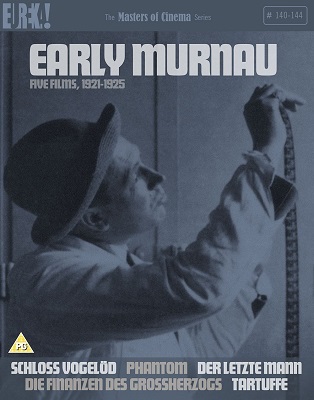

Leave a comment

Moving pictures 2018, #2

I plan to watch less films in 2018 than I did in 2017, and already I’m spending an hour reading when I get home from work, and only putting a film on afterwards. And yet I’m three dozen films in and it’s only the 17 January as I type this, and I’ve a third and fourth post, with another dozen movies already lined up… Oh well.

Nightfall, James Benning (2011, USA). I found this on Youtube, which seems to be the place to find Benning films, as the Österreichisches Filmmuseum has only released half a dozen or so DVDs of his work. Some of his films are apparently available via Mubi, but I’ve yet to subscribe to it. Meanwhile, there are (often low-quality) copies uploaded to Youtube by various fans, plus Benning’s own Youtube account. Nightfall has nothing to do with Asimov, thankfully, but is 98 minutes of a forest high in the Sierra Nevada Mountains as the sun sets. That’s it. Benning locks off his digital camera, and leaves it running. It’s about as stripped-back Benning as you can get. Unfortunately, there’s an extra-textual element to much of Benning’s work – the juxtapositon of sound and vision, for example, and the reasoning behind it – and watching one of his films on Youtube means you don’t have access to that extra-textual knowledge. You can google for it… and I did. But all I could find claimed that Nightfall was precisely what it presented to be. But, knowing Benning’s work, I suspect there’s more to it than just that. I shall have to look further.

Elle, Paul Verhoeven (2016, France). This was a Christmas present. The last I’d heard, Verhoeven was working on some project back in the Netherlands after his successful Black Book, and it seemed pretty certain his Hollywood career was on hiatus as, despite the success of his Hollywood films, I suspect he was too idiosyncratic and the sequels by other hands to his movies had seen diminishing returns. Now, the movies he made in Hollywood were (mostly) top-notch, and while the Starship Troopers live-action franchise (not to be confused with the CGI one) upped the satire with each new installment, it also lowered the audience figures. The Robocop sequels went into a death spiral in terms of both quality and commercial success. And the sequel to Basic Instinct was a Sharon Stone vanity project, and rightfully bombed. (There was also an unofficial sequel to Showgirls, made by a porn actress who had a bit part in the original; it’s absolutely fucking dreadful.) So, Verhoeven: no longer Hollywood. And now he appears to have reinvented himself as French cinema’s successor to Andrzej Żuławski. Because Elle pretty much plays like Verhoeven channelling Żuławski. Which is no bad thing, I hasten to add. Plus, it stars La Huppert. Which is also a good thing – she is probably the best actor currently making films. In Elle, she plays the CEO of a video games company which has a fairly typical testosterone-driven nerd culture. One night, she is raped by a man who breaks into her house. Afterward, she carries on as if nothing had happened – but now she is suspicious of every man in her life: employees, friends, neighbours… The violence is played flat and brutal, which is a Verhoeven trademark, but the way the story pans out feels more Żuławski… although Verhoeven doesn’t have his cast acting as emphatically as Żuławski does. It’s an odd film, a very French drama into which these violent incidents erupt. Which is, I suppose, very Verhoevenesque.

Utamaro and His Five Women, Kenji Mizoguchi (1946, Japan). David Tallerman, who likes his Mizoguchi, gave me this box set as he had upgraded his copies of the films it included. (I’ve done the same for him when I’ve upgraded from DVD to Blu-ray.) Utamaro and His Five Women is set during the Edo Period in, er, Edo. The film opens with a samurai art student taking issue with the text on a print of a painting by Utamaro. He tracks him down and challenges him to a duel. Utamaro challenges him to a drawing contest instead… which he wins so handily, the art student joins him as an apprentice. And it’s the new apprentice’s girlfriend who becomes the first of Utamaro’s women, each of whom are combinations of model and muse. The second is a famous courtesan who has him paint on her back for a tattoo artist to use as an outline (as per the box set cover art). Another of his women is a lady’s maid he spots at the beach, diving into the sea among a large group of women and bringing out fish. One of the interesting things about this film – and it’s a good film if you like Japanese historical films – is that it was made under American Occupation immediately following WWII, and the Americans didn’t like the Japanese to make historical films as they thought they were militaristic and nationalistic (according to Wikipedia). But they let Mizoguchi make this.

Mystery, Lou Ye (2012, China). Another Christmas present. Lou is a Sixth Generation director from China, and I’m a big fan of those films by the group I’ve seen. Other members include Jia Zhangke, Wang Xiaoshuai, Zhang Yuan,  whose films I’ve seen and much admire; and Lu Chuan and He Jianjun, whose movies I haven’t seen. Lou’s Suzhou River is a thriller/drama with a very clever structure; Mystery, a later film, also uses a non-linear narrative to tell its story. It also has that same documentary style approach to its narrative, which is, I freely admit, one of the real draws of Sixth Generation films. The movie opens with a young woman wandering out into a road and being hit by one of two racing sportcars. Except it may not have been an accident, as she appears to have been fatally assaulted beforehand. Lu Jie makes friends with Sang Qi at a playground where both their kids play. Sang is convinced her husband is having an affair and asks Lu to meet her at a coffee-shop to discuss the advisability of hiring a private detective. But it turns out the coffee shop overlooks the hotel where Sang’s husband meets his mistress. Except… Lu sees her own husband entering the hotel with a young woman. So Lu investigates, and discovers that Sang is also her husband’s mistress and Sang’s young son was fathered by him… You have to keep your wits about you to follow this, although the way the story is presented is deceptively simple. It’s the flashbacks, you see. The situation is complicated, and only revealed piecemeal. Definitely worth seeing.

Notre musique, Jean-Luc Godard (2004, France). I’m almost done with this Godard box set, and I’m really glad I bought it. These are films to watch again and again. Godard’s films have never been exactly traditional. Even in his early Nouvelle Vague movies, he played around with narrative forms. Later, he experimented even further. And continues to do so. Notre musique is from Godard’s phase when he mixed fact and fiction, and often played the protagonist himself. After an opening non-narrative section of documentary war footage, the film presents Godard waiting at an airport prior to flying to an arts conference in Sarajevo. He meets a man who will be an interpreter at the conference, French, but originally Israeli, whose niece will also be at the conference. Godard is interviewed by an Israeli journalist, who later interviews Mahmoud Darwish. Both interviews concern Israeli-Palestinian relations. For all his cleverness and cinimatic tricksiness, Godard was never especially subtle. His films are always about something, and if it’s not that which drives the narrative, then you can be sure the characters will discuss it a number times during the movie. Some of his films in fact are little more than discussions among members of the cast. In order to make a point, Godard not only uses language, ie, the spoken word, but also the language of narrative, and even the language of cinema. The epitome of this being, of course, his film Goodbye to Language (see here). (Although I prefer his Film Socialisme (see here), which is similar.) It’s not necessary to agree with Godard’s argument to appreciate his films, but then I don’t think he expects his films to be persuasive per se, more that they’re presented as arguments and their chief purpose is to provoke discussion (but from a sincere position). Anyway, this is by no means Godard’s best film of this sort, nor his most intriguing; but it certainly bears rewatching.

Emperor, Peter Webber (2012, USA). My mother lent me this one. I’ve watch a film about General MacArthur and Emperor Hirohito before, but it was Sokurov’s The Sun (see here), which could not be more different to this US take on the same historical events. Emperor is told from the point of view of Brigadier-General Bonner Fellers (a real person, like everyone in this film), who was a member of MacArthur’s staff and tasked with discovering Hirohito’s complicity in declaring war on the US. Before the war, Fellers had been in a relationship with a Japanese woman studying in the US, but she had returned home hurriedly for family reasons. He followed her back to Japan, weathered anti-Western sentiment from newly-militarised Japanese society, and met her father, a decorated general. As a Japanist, he’s a good choice to investigate Hirohito, although he did abuse his position during the war so that his girlfriend’s town was avoided by US Army Air Force bombers. MacArthur, meanwhile, is more concerned about using his occupation of Japan as a stepping-stone to the US presidency. To that end, he runs roughshod over Japanese imperial protocol. I happen to think humans are not gods, divine right is a con, and anyone who thinks royalty is any way different to anyone else is stupid. Despite that, Emperor was based on historical events and, as far as I can tell from some quick online research, quite accurate. Okay, Tommy Lee Jones somewhat overwhelmed MacArthur, but the remaining cast were, I guess, sufficiently unknown to me they could be seen as the historical characters they played. The CGI showing a devastated Japan was quite effective but, to be honest, the whole felt more worthy than it felt notable.

1001 Movies you Must See Before You Die count: 895
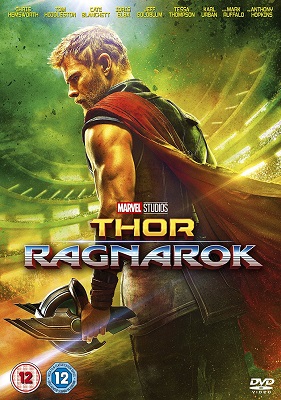

1 Comment

Reading diary 2018, #1

I seem to be keeping up with my New Year Resolution to read more books. Monday to Thursday, when I get home from work, I spend an hour reading before making dinner or putting on a DVD. And I managed to polish off five books over the first weekend of the year – true, three were bandes dessinées and one was novella, but still…

The Book of Strange New Things, Michel Faber (2014, UK). I’d expected to dislike this – so why I took with me to read over Christmas, I’ve no idea. I read Faber’s Under the Skin many years ago, and hated it (but I thought Jonathan Glazer’s film adaptation was excellent). So I had expected something similar, even if the blurb sounded more like the BBC TV series Outcasts than anything else (although I may have been getting confused because there’s apparently a TV series in development based on The Book of Strange New Things; and, to be fair, I thought Outcasts a great deal better on rewatch). Anyway, expectations relatively low. So I was surprised to find that not only did I enjoy The Book of Strange New Things, but I also thought it pretty good. Peter Leigh has been selected by corporation USIC to serve as pastor at their exoplanet settlement. His wife, unfortunately, has to remain behind in the UK. On arrival at the exoplanet, called Oasis, he finds a small colony of apathetic engineers, all of whom live mostly on foodstuffs provided by a nearby town of the planet’s low-tech and enigmatic natives. It’s the natives, in fact, who have demanded a vicar’s presence, as some of them have taken up Christianity and the company doesn’t want to jeopardise the supply of foodstuffs. Leigh decides to build a church, with the help of his “Jesus Lovers”, the Oasisan Christians. Meanwhile, Leigh writes emails to his wife back in the UK. As he tend his flock on Oasis, and gradually understands what drives them, so she describes a UK falling apart bit by bit, testing both her faith and her love for her husband. Leigh is a bit pathetic as a protagonist, and the people with which he works are no better; but the aliens are really done quite well, and aspect of their nature which has driven some of them to human religion is tragic and provides a neat twist. The Book of Strange New Things was shortlisted for the Clarke Award in 2015, but lost out to Station Eleven (see here). I thought the Faber an odd choice at the time, but it deserved its place.

The Essex Serpent, Sarah Perry (2016, UK). I bought this after seeing many positive comments about it and, happily, it met my expectations. Cora Seaborne’s husband has just died and she, an amateur palaeontologist, decides to investigate stories she’s heard of the Essex Serpent. While in Chelmsford, she bumps into friends who tell her of their friend, William Ransome, a pastor, and his family in a coastal Essex village near where the Serpent has been spotted. So Cora and her autistic son go to visit them, and they all get on famously. Meanwhile, Luke Garrett, an ambitious surgeon, has his eye on Cora – he treated her late husband, and now that she’s widowed he is keen to deepen his friendship. And his friend, George Spencer, a rich dilettante playing half-heartedly at doctor, has fallen in love with Cora’s maid, Martha, a socialist activist. It sounds like it should be a mess, a story pulling in so many different directions – Cora and her desire to solve the mystery of the Essex Serpent, not to mention her own ambivalence toward her gender and role in society; Garrett’s ambitions; Martha’s activism in the London slums; Ransome’s rational approach to his Christianity; Spencer’s failed romance with Martha… There’s a Gothic feel to the story, a likeness that’s heightened by its use in places of letter exchanges, but the prose is anything but Gothic. It’s, well, breezy – hugely readable, often funny, and with some very nice descriptive passages. The cast are drawn well, as are their relationships. And there’s plenty going on – politics, religion, science, not to mention a commentary on Victorian society. I thought The Essex Serpent very good indeed, an early possible contender for my best of the year. Recommended.

The Yellow Wallpaper & Other Writings, Charlotte Perkins Gilman (1989, USA). I knew Gilman’s name chiefly from Herland, an early novel about a feminist utopia, which I own in the Women’s Press SF edition but have yet to read. ‘The Yellow Wallpaper’ is perhaps her best known piece of short fiction. The narrator and her husband move into an old house, and the narrator becomes obsessed by the wallpaper in an attic room. She is convinced there is someone hidden inside the wallpaper who is desperate to escape and… well, it’s very atmospheric. The other stories, such as ‘If I Were a Man’ or ‘Turned’, are of their time, except for their overt feminist sensibilities. I’ve read early genre fiction by women writers, like Francis Stevens, Agatha Christie, Leslie F Stone, and, of course, CL Moore… but none them seemed to my mind to have as strong a female point of view as the stories in Gilman’s collection. The book also included an except from Herland, and a couple of excerpts from some of Gilman’s non-ficiton writing. I found the book in a charity shop a while ago, and bought it because I knew the name. But now I’m really glad I own a copy of it.

New Adventures in Sci-Fi, Sean Williams (1999, Australia). I’ve been a fan of Williams’s fiction since reading the space opera Evergence trilogy he wrote with Shane Dix back in 2003. And I’ve bought and read the sf novels written by the pair, and by Williams alone, ever since. And quite a few of Williams’s collections too. This was quite a hard one to find, I seem to remember. It’s relatively early stuff, but polished nonetheless, and even includes a favourite of mine, ‘A Map of the Mines of Barnath’ from 1995; although this time around it didn’t read quite as smoothly as I’d remembered. It’s still a bloody good sf story, though. The stories are mostly heartland sf, with a few dark fantasy. Of the sf, ‘The Soap Bubble’, in which a survey starship’s regular reports home are presented as episodes of a melodrama, at least until they meet an alien race, was quite cleverly done, and had a neat twist. ‘Reluctant Misty & the House on Burden Street’, a variation on the haunted house, was probably the best of the dark fantasy stories. The premises of some of the others felt a little secondhand and threadbare, although the stories were well told. I’m not sure what Williams is doing now – he started writing YA for a few years, and then went to Antarctica on some sort of writers’ programme. I really liked his space opera and hard sf novels, and it’s a shame he doesn’t seem to be writing them anymore.

Valerian and Laureline 20: The Order of the Stones and 21: The Time Opener, Jean-Claude Mézières & Pierre Christin (2007/2010, France). These two volumes end the Valerian and Laureline story, begun back in 1967, although I’m sceptical the story-arc was fully plotted out at that time. Anyway, midway through the series, Galaxity, Valerian and Laureline’s employer disappeared after someone meddled with history, and the Earth was destroyed. After acting as free agents for several volumes, Valerian and Laureline ended up aboard an expedition to explore the Great Void. Where the Wolochs, mysterious stone beings, have appeared and are using the Triumvirate, three heads of criminal gangs, to attack humanity. In The Order of the Stones, the Wolochs go on the offensive, and the galactic civilisation is hard pressed to fend off their attacks. But there is one hope: the Time Opener. Which contains the Earth. But it can only be opened if enough people pure of heart are gathered together. And it’s the bringing together of these which forms the story of The Time Opener. Of course, they succeed. Interestingly, there were some bits and pieces from these two installments I sort of recognised from Luc Besson’s movie adaptation, demonstrating, I suppose, that his film was based on the entire series. Not that it was a good film. Overall, Valerian and Laureline have had a good run, and if the plot got somewhat convoluted somewhere around the middle – the final volume includes a timeline which does little to make sense of it all – and the ending was a bit weak, there were some excellent episodes along the way. It was a product of its time, but it didn’t hesitate to slip in contemporary digs at the real world in each of the volumes, which worked quite well because the two characters had travelled back in time and so the stories were partyl set on contemporary Earth. But there was plenty of space opera stuff too – so much so, the series is often mistaken taken to be an inspiration for Star Wars (there are similarities but they’re apparently coincidental). Perhaps the art never approached the gorgeousness of Frank Hampson’s Dan Dare, but the scripts were considerably better, albeit often somewhat compressed since each volume was no more than 48 pages. I first stumbled across these during the 1990s after Dargaud, their French publisher, made a half-hearted attempt to introduce them to the Anglophone market and published four random volumes in English. I started reading them in French, but happily Cinebook have been banging them out in English since 2010. They’re also now available in omnibus editions. Worth getting.

1001 Books You Must Read Before You Die count: 131