It Doesn't Have To Be Right…

… it just has to sound plausible


2 Comments

Reading diary 2018, #17

Well, my reading didn’t speed up as expected, chiefly because I picked up a 700+ novel – the Goss – and then followed it with a novel by Iain Sinclair. And the latter, despite taking on my trip to Iceland, has taken me over a week to finish… but then it’s pretty dense stuff.
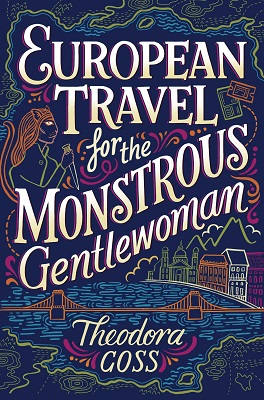
European Travels for the Monstrous Gentlewoman, Theodora Goss (2018, USA). I enjoyed the first book of this series enough to pick up the second book… And, yes, it’s more of the same. Having said that, the central conceit does seem to be wearing a bit thin, and even though Goss has been hard at work roping in all manner of characters from Victorian horror fiction, she’s rung so many changes on them they might as well have been invented by her in the first place. In summary: in The Strange Case of the Alchemist’s Daughter (see here), Mary Jekyll brought about the creation of the Athena Club – Diana Hyde, Justina Frankenstein, Catherine Moreau, Beatrice Rappaccini, plus housekeeper Mrs Poole and maid Alice – while assisting Sherlock Holmes solve a series of murders in Whitechapel… which ended up being linked to Adam Frankenstein (ie, the Monster) and the Society of Alchemists. In this second book, Mary’s old governess, Mina Harker (yes, that Mina Harker), asks for help to rescue Van Helsing’s daughter (yes, that Van Helsing and, er, his daughter) from a Viennese asylum, where she has been incarcerated after an experiment to turn her into a vampire. It’s all because Van Helsing and his cronies want to seize power in the Society of Alchemists – current president: She, AKA Ayesha – because their experiments in transmutation have been banned. The Athena Cub end up fighting Van Helsing et al. With the help of Count Dracula. Who is a good guy. I love the conceit, and Goss handles it marvellously. She drags in Victorian monsters willy-nilly and then gives them a place in the setting which fits perfectly. The way the narrative is interrupted by conversation between the characters, who explicitly refer to the narrative as a narrative – is cleverly done. But. The prose is all so very light and commercial, and at 720 pages this story is too long. Goss can write, I know she can because I’ve read some of her short fiction. But European Travels for the Monstrous Gentlewoman reads like an airport bestseller or a book to read on a train journey. The prose doesn’t try hard at all. I like the characters and I like the story, but this novel could have been so much better. I hope the third book in the series remembers that picking the right words and putting them in the right order is as important as telling the story.
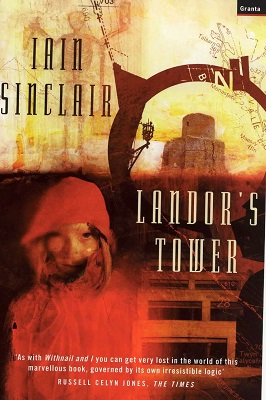
Landor’s Tower, Iain Sinclair (2001, UK). While I’ve been aware of Sinclair and his fiction for many years, I’ve never tried to reading any of it. Until now. And having now read Landor’s Tower… I’m in two minds. It’s good. Very good. And I like Sinclair’s pot pourri approach to using fiction and non-fiction, throwing in real people as characters, mixing up invented characters in real events… He does it really well, and that melange of fact and fiction, well, I’ve always found it a heady mix in book-form. But… Landor’s Tower leaps all over the place, seeming to tell a dozen different unlinked stories at the same time. It is, ostensibly, about a Victorian eccentric who built a monastery in a remote Welsh valley, based on an earlier legend. But the narrator of the book – a novelist and film-maker called Norton, who is a clear stand-in for Sinclair – bounces around the central premise, while ostensibly researching it for a project, through encounters with a variety of characters. Such as Prudence, of Hay on Wye. Who might or might not be the victim of the quarry murder, re-enacted by Karporal, or maybe real. As he was trying to solve the crime. There’s a fevered, almost hallucinatory, tone to the narrative, which makes it hard to navigate the actual story. Parts of it are brilliant – and not just because I recognised the names involved – but because they read like documentary. But then the narrative would make an abrupt swerve and, despite reference to earlier passages, I’d wonder what the fuck was going on. I wanted to like Landor’s Tower – I’m a big fan of the works of both Patrick Keiller and Adam Curtis, and this novel reminded me majorly of both. But. I felt like I was coming in halfway through a series.  Had I read more by Sinclair, perhaps reading his works in order, or seen some of his films – because this novel feels like one part of a large cross-platform work – then I suspect I might be a fan. But on its own, Landor’s Tower felt like the wrong introduction to an author’s oeuvre, an author whose work I might well esteem. I need to be serious about reading Sinclair’s novels, or it’s not worth bothering. I have two of his books on my TBR, but I’m going to ditch them and see if I can find a copy of his first novel. Then I will try reading them in order.

Inside Moebius, part 2, Moebius (2018, France). This is volumes three and four of the French release of Inside Moebius, the six volumes of which, for some reason, Dark Horse have decided to publish in English as three books. Personally, I don’t much care if it’s six books or three books, although at least doubling them up makes them a little more substantial. Which is more than can be said for their plots. And it’s especially true in this middle volume. As before, it has two iterations of Moebius wandering about “Desert B” (a pun on désherber, slang for giving up smoking, a desire to do which triggered the Inside Moebius project in the first place), along with a group of Moebius’s characters. There are lots of puns and in-jokes – and Dark Horse helpfully provide a glossary of the puns – but little in the way of plot. But then it’s not like there’s all that much need for plot anyway. Moebius is exploring his creative impulse, and using his characters and iterations of himself to do so. Oh, and bin Laden. The artwork is all over the place, some of it crude, some of it as detailed as any of the work he did, for example, in The Incal. Jean Giraud was clearly a singular talent, and a seminal one in the field of bandes dessinées, and there is good insight into his work in Inside Moebius. Which pretty much means it’s one for fans. Those expecting some sf story will be sorely disappointed.

Case of the Bedevilled Poet, Simon Clark (2017, UK). I think this is the first of the second set of NewCon Press novellas, but I bought all four at once so I’ve not been reading them in order. Not that it makes any difference, as I found the first three I read not very satisfying, and this one unfortunately is much the same. It was also full of typos, and one page completely mixed up the characters’ names. But that’s by the bye. The story is set in London during the Blitz. A man, a minor poet from Yorkshire who now works as a screenwriter for a government-sponsored film unit, a protected occupation, is attacked one night by a soldier on furlough, who threatens him for his supposed cowardice with words that sound more like an eldritch curse. Things start to happen that convince the protagonist he is indeed cursed by something or someone supernatural. Then he stumbles across two old gents in a pub who claim to be Sherlock Holmes and Dr Watson – their story is they’re real and Conan Doyle only adapted their case histories – and they offer to take on the protagonist’s case. There’s far too much here that doesn’t fit together all that well. Being hunted by some sort of demonic soldier, fine. During the Blitz? Okay, it’s a bit much, but never mind. But then throwing in Holmes and Watson? It’s too much. It weakens a story that was already strong enough on its own. Setting it during the Blitz allows for some good descriptive passages, although it’s not essential for the plot to work; and there’s a bittersweet ending to the Holmes and Watson elements, but I’m not convinced the latter was needed. Unfortunately, this does have the effect of making Case of the Bedevilled Poet feel like a short story padded out to novella length. The fact I’ve found all four of these novellas unsatisfactory is likely chiefly down to the fact it’s not my preferred reading genre. Fans of dark fantasy or horror will probably get much more out of them then I did. But at least they make a nice set.
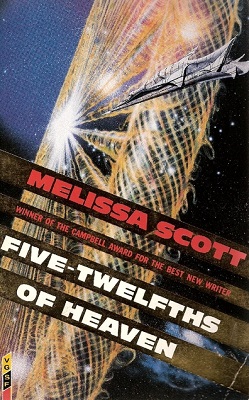
Five-Twelfths of Heaven, Melissa Scott (1985, USA). This is the first book of the Silence Leigh trilogy, followed in 1986 by Silence in Solitude and in 1987 by The Empress of the Earth. It was later released in a SFBC omnibus edition, The Roads of Heaven. But that’s a pretty naff title for the trilogy, even if it is, well, pretty accurate (it’s also used by the current small press Kindle omnibus). Because in the universe of Five-Twelfths of Heaven, it’s the music of the spheres which allows for interstellar travel. Starship have “harmoniums” (harmonia?) and it is the music they make which drives starships into orbit and pushes them into “purgatory” (ie, hyperspace) at velocities measured in “twelfths of heaven”. Most starships travel at a sixth of heaven, so five-twelfths of heaven is pretty quick. It’s also the speed of the ship, Sun-Treader, whose crew pilot Silence reluctantly joins when she finds herself trapped on a world of the Hegemon after her grandfather dies. Because her grandfather owned the starship she piloted, but her uncle had done a deal with a local merchant so the ship would need to be sold to cover grandfather’s debts and, as a woman, Silence has no legal standing… But Captain Balthasar of Sun-Treader agrees to act as her representative in probate court, and offers her a job afterwards. He needs a female pilot – and female pilots are very rare – because his engineer has fake papers, but if Silence enters into a marriage of convenience with the two of them they can get him proper papers. Polygamy, apparently, is okay, but not same-sex marriage. Silence agrees. Things go reasonably well, but then Balthasar is called to a captains’ meeting of Wrath-of-God, a major pirate combine, and it’s war against the Hegemon. But the attack fails, and Silence and her two husbands are captured by Hegemon forces, and put under geas. Except Silence manages somehow to break the geas – it seems she could well be a magus. And… well, spoilers. Obviously, the main draw of Five-Twelfths of Heaven is the mix of science fiction and magic. It’s  cleverly done. FTL is itself a metaphor, and Scott recognises this and chooses to use a metaphor typically not associated with sf instead. It works because she maintains rigour, her magic system has as many rules, and operates as logically, as some made-up “scientific” FTL drive would. Instead of computers churning out numbers, her pilots have to memorise Tarot-like symbolic diagrams. Instead of laws of physics, she writes about notes and chords and dissonances. Different words for the same things. And a good example why you can’t use tropes to differentiate between science fiction and fantasy. If I’d discovered Scott back in the 1980s, I think it likely she’d have become a writer whose work I sought out. She certainly is now. I’m looking forward to reading the rest of this trilogy.
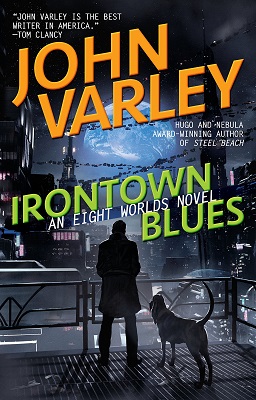
Irontown Blues, John Varley (2018, USA). Back in the early 1980s, Varley was one of my favourite science fiction writers, and I eagerly tracked down and read everything by him I could find. When he returned to his Eight Worlds universe in 1992 with Steel Beach, I was glad; and then again in 1998 with The Golden Globe… Although neither of those two books stacked up against The Ophiuchi Hotline or the many stories set in the Eight Worlds Varley had written previously. Rumours of another book, titled Irontown Blues, had been around for years, but it was only in, I think, 2016 that Varley confessed he was finally going to write it. I mean, you don’t want writers to keep on churning out the same thing over and over again, yet another volume in some interminable series – except, of course, when you do, such as EC Tubb’s Dumarest series (I’m sure everyone has their own favourite)… But it’s not like Varley over-stayed his welcome in the Eight Worlds, only four actual novels set there and each was standalone… To be honest, the other stuff wasn’t always as satisfactory – the Gaea trilogy, yes; but his Thunder and Lightning YA quartet was underwhelming. (Having said that, I do really like Millennium, the novelisation of the film of his short story ‘Air Raid’ (which was originally published under a pseudonym).) Anyway, Irontown Blues is… a cheat. Varley cheerfully confessed to retconning his Eight world universe in Steel Beach, and presented it more as a feature than a bug. And in Irontown Blues, the protagonist is Christopher Bach, offspring of Anna-Louise Bach, who is the protagonist of a bunch of stories set on Luna but not actually part of the Eight Worlds setting. At least, not until now. Bach (Christopher, that is) is a private detective with a love of 1940s noir – so much so, he acts the part and even lives in a suburb tricked out to resemble a noir version of a 1940s US city. His local diner is called the Nighthawks Diner. (But then Varley ruins it by naming his scumbag informant Hopper. Sigh.) Irontown Blues opens, as any story of its type would do, with a woman entering Bach’s office. She tells him she has been deliberately infected with a virulent form of leprosy, a heinous act in a society in which diseases are sometimes fads but are never infectious. Bach is tasked with discovering who infected the woman with “para-leprosy”. He doesn’t trust her, of course, and his attempts to find out who she really is take up half the story. When he does finally track her down, he’s kidnapped and kept prisoner. Before his kidnap, however, there’s a long flashback to the Big Glitch and the attack on the Heinleiners – the events of Steel Beach. Bach was involved and nearly died. The flashback is the reason for, well, the plot of Irontown Blues. And it’s all a bit weak, to be honest. Despite the resolution. Bach, however, is not the only narrator of Irontown Blues. The narrative is also split with his dog, a “Cybernetically Enhanced Canine” bloodhound called Sherlock. These sections are written in simplistic prose, with a deliberately simplistic attempt at humour. I freely admit I’m not a dog person, but even so these sections really didn’t work for me. I mean, there’s something old-fashioned – not, unfortunately, 1940s old-fashioned as Varley probably intended, but more 1970s original Eight Worlds stories old-fashioned – about Bach’s narrative; but Sherlock’s narrative does nothing to give the novel a twenty-first century feel. I admit that much of Varley’s appeal is nostalgia – I loved his work back when I was first exploring science fiction – so perhaps the most disappointing thing about Irontown Blues is that it doesn’t seem to be much of a progression from those earlier works. It could have been written by Varley thirty years ago. Varley has always been a resolutely commercial writer, much like his inspiration Heinlein, but that doesn’t mean he can’t do things better as the years pass – and Slow Apocalypse certainly proves he can – but there’s no evidence of that in Irontown Blues. There are some changes in order to update the setting, or to tie the Eight Worlds Luna and Anna-Louise Bach Luna together… But I’d hoped for something, well, a bit more clever, something with a bit more bang in its payload. And Irontown Blues is not that book. One for fans.

1001 Books You Must Read Before You Die count: 131

3 Comments

Moving pictures 2018, #54

Some well-known names in this movie post – I’m referring to the directors, of course, although a couple of the titles are probably also well known. A bit of a mixed bunch. Some were better than expected, others weren’t. Oh well.

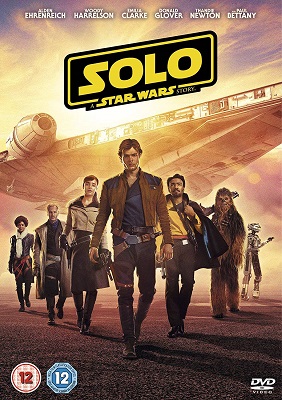
Solo: A Star Wars Story, Ron Howard (2018, USA). Let’s get the good news out of the way first: I enjoyed this. Yes, I actually enjoyed watching it. But. It didn’t feel like a Star Wars film; and this Han Solo is pretty much an entirely different character to the one played by Harrison Ford. It is, in other words, a fun space opera set in a well-realised space opera universe, that happens to share a lot of commonality with Star Wars films. So, like Rogue One then. Which I liked too. Although that film did at least manage to slot itself into current SW history (which Disney are busy rewriting and retconnning faster than Trump is the history of his disastrous presidency). But, Solo… It’s about, er, Han Solo. Who grows up as a member of a criminal gang on Corellia, but manages to escape (and chooses the name “Solo” because he’s alone – do you see what they did there?). Anyway he ends up in the Imperial infantry, but deserts and joins Woody Harrelson’s gang of thieves, bullshits his way into jobs he has no real hope of completing, fails to complete them, bullshits his way out of it, and somehow or other ends up with Lando Calrissian’s ship, the  Millennium Falcon. It’s all great fun, but all drawn with very broad strokes. There’s no complicated structure here, no weird story arcs, to fuel deep analyses of the film-maker’s intentions (if you find what you’re looking for in a Hollywood film written by committee and rewritten by a director whose strings are being pulled by a studio… what you’re finding probably only exists in your head). Star Wars has gone all diverse, and not before time, and Calrissian’s co-pilot, L3-37 (who is not at all leet, but more L7 – but perhaps the band weren’t so keen on her being called just L7), is presented as one of the highlights and deserves the role. Harrelson and his gang are entirely forgettable. Bettany puts in a quality turn as the villain, but then he’s good at his job and people seem to forget that. He played fucking Vision, FFS. To be honest, I gave up on the plot about 30 minutes in. It didn’t matter. The entire film is set-up. And minor redemption too, of course. All of Star Wars is redemption, of one form or another. But at least Solo, or Rogue One, isn’t the portentous crap George Lucas made of the prequels and Disney is now making of the sequels. It’s not like Solo/Rogue One are ignoring important subjects, like slavery or terrorism, though it’s “commentary lite” on both; but then this is space opera and when it comes to human issues and relevance, space opera has always been light on payload. Solo goes for “character and colour and cosmos” (ie, worldbuilding), which is a wise decision as those three Cs are about all that works in cinematic space opera. I enjoyed Solo. Not a great film, not a great science fiction film, but fun all the same. And not a good Star Wars film. Which is entirely in its favour.

Il Postino, Michael Radford & Massimo Troisi (1994, Italy). From the ridiculous to the, er, mawkish. I should schedule these films better, then I could actually write from “the ridiculous to the sublime” and it might even be true. Il Postino is, as far as I can tell, and I may be mistaken, one of those awful mawkish Italian films that seemed to do really well on the international circuit during the 1990s. Like Life is Beautiful and Cinema Paradiso. It’s not restricted to Italy, of course. French versions include Jean de Florette and La gloire de mon père and no doubt many others, for other nations. The central premise of Il Postino is that the local postman, an aspiring poet, becomes friends with a mystery visitor to a small Italian island, who turns out to be exiled Chilean poet Pablo Neruda. The two form an unlikely friendship. Neruda was indeed famous, but not so much outside the Hispanic-speaking world. He was also equally well-known, in the same world, as a political dissident in a far right regime. Yes, once poets were actually exiled, or worse, for their public commentary against authoritarian governments. They didn’t just write cute advertising copy for building societies. But then the UK has never had a society of intellectuals similar to that of Spanish-, French- or Italian-speaking countries. We’ve been far too class-ridden. Our intellectuals were focused on social climbing – by all accounts, Waugh was a terrible snob; and on professing a desire to write a novel, Fleming was told by some dowager duchess, “Don’t do it, Ian. You’re not clever enough.” The joke being, of course, that the British aristocracy couldn’t muster a working brain cell between the lot of them. And the chances of a British intellectual from the arts running afoul of the establishment are pretty remote because the establishment simply co-opts them. In fact, the idea of art as political seems to be fiercely opposed by the Anglophone world. We saw it in science fiction with the Sad Puppies, who were, ironically, entirely political. But in the English-speaking world satire and commentary are toothless, and we’re all the poorer for it, even it means our so-called intellectuals are unlikely to ever be exiled. And, I suppose, there’s an advantage to that inasmuch no one will make mawkish films about them. Well, not about their exile. There are plenty of mawkish UK films about recent historical figures, like the one about Stephen Hawking. Which is, now I think about it, probably worse. Fuck them all.

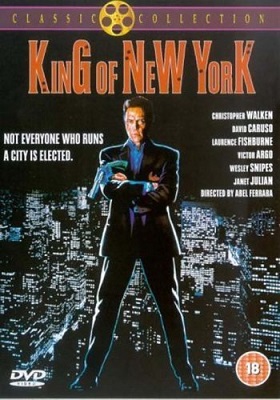
King of New York*, Abel Ferrara (1990, USA). I always get this film a bit confused with Scorsese’s King of Comedy – and it doesn’t help that both are on the 1001 Movies You Must See Before You Die list. It’s the titles, of course, because that’s about the only resemblance between the two. I had also thought I’d seen King of New York many years before, but having now watched it, I’m not so sure. It’s a straight-up mobster movie, perhaps more violent than was common in the late eighties, but it seems a bit tame when compared to twenty-first century Hollywood cinema. Walken plays a gangster who finishes his prison sentence and returns to New York determined to take over everything. Which is what he does. He shoots anyone who disagrees with him. He also mixes in posh circles because his girlfriend is a DA or something. I’m not sure. I didn’t really care. This film has fuck-all to recommend it. Walken plays Walken, the rest of the cast are forgettable, and if it had any historical impact in 1990, that has long since dissipated. It’s by no means the only film to follow the same formula, and if they’re trying to capture a point in time I have to wonder how they saw that particular point… Missable.

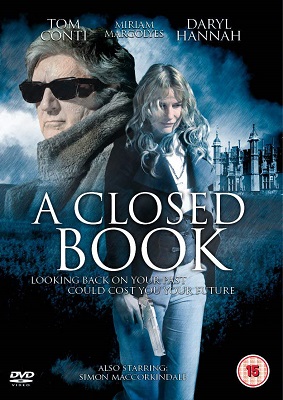
A Closed Book, Raúl Ruiz (2010, UK). Ruiz was a highly-regarded director from Chile, although this film was made in the UK, and based on a novel by UK author Gilbert Adair, which he adapted himself. It’s a two-hander – mostly – and a pretty odd one. I don’t think it works, and I’m not sure if that’s because the story is just silly or because the two leads, Tom Conti and Darryl Hannah, struggle to carry it. Conti, a reclusive art critic who lives in a stately pile recruits Hannah to be his amanuensis. He reveals he was blinded in a car crash a few years earlier and has decided it is time he wrote his autobiography. Hannah, however, plays it sneaky and gaslights Conti… and it’s all because her history is linked to his car crash, and… Yawn. This has been done a million times before. Make both of the leads female and they’d call it “grip-lit”. Not that it would make much difference as the two leads here are terrible. Ruiz apparently took a hands-off approach and then they edited the shit out of the film… But it’s hard to see how it could have been improved. The material just isn’t strong enough. Avoid.

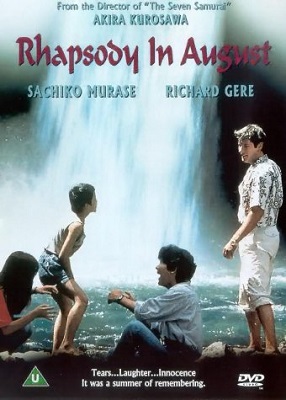
Rhapsody in August, Akira Kurosawa (1991, Japan). Kurosawa is, of course, best known for historical samurai films like, er, Seven Samurai, or Throne of Blood or Yojimbo… But he also did other stuff, like the excellent Dersu Uzala, and this one, Rhapsody in August, which I kept on thinking as “Kirosawa does Bergman”, and it sort of fits… A family have left their children with their grandmother, a survivor of Nagasaki, while they visit a dying relative in Hawaii. The grandmother was supposed to go, but refused because she has not seen the relative – her brother – since the war. So you have the culture shock of a Japanese visitor to the US, handled through video letters to the grandmother, and Japanese kids learning about Nagasaki and the very real effect the nuclear bomb had on the country. It’s all good stuff… until Richard Gere appears on the screen. He plays an American, a member of the family by marriage, and he speaks Japanese (and convincingly haltingly), but he just seems out of place. He’s clearly important to the film, and he’s certainly been used to promote it – and it’s true his character’s perspective is important to the story, an American viewing the impact of Nagasaki – but to a Western viewer he brings too much baggage, and not of a good sort. True, Japanese actors bring baggage to their roles, and Kurosawa certainly had his favourites, so Toshiro Mifune, for example, no doubt dragged around a shedload of past performances whenever he appeared in a movie (over 150, apparently, and I’ve probably seen around ten percent of them). Despite all that, the overriding impression I have of Rhapsody in August is Bergman lite. It seems the sort of story he did so much better.

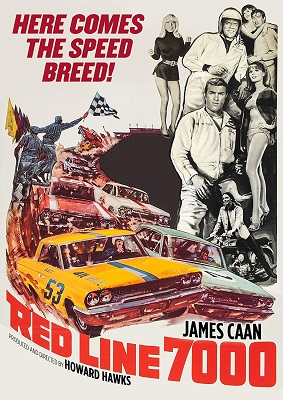
Red Line 7000, Howard Hawks (1965, USA). This is not one of Hawks’s best-known films, and for good reason. It’s all very formulaic, and while it’s set among race car drivers I doubt would many recognise the sport depicted as it’s changed so much since 1965. James Caan plays one of two drivers for an owner. The other had decided to retire and get married and, as is usual for these sorts of films, is killed in a crash in his last race. The hunt is on for a new team member to drive alongside Caan. Which ends up being: a young American man who appears to have no experience or qualifications, but some talent, and fancies the owner’s “masculine” sister (she rides a motorbike!); and a celebrated driver from Europe, who has a French girlfriend in tow. Yawn. The footage of the races uses actual real races – and accidents – which gives it all more of a patina of reality than you usually get with Hollywood films that repeatedly cut to close-ups of the stars in what are patently sets filmed against moving backdrops. And the cars are so crude! They’re just souped-up Plymouths and the like. When they crash, they burst into flames. And kill the driver. It’s watching a dangerous sport in the days when it was outright fucking lethal. And dramatising that lethality. I suspect there are good reasons why Red Line 7000 is not lauded as one of Hawks’s best. It doesn’t help that Caan mumbles his way through his part, far too many of the scenes are studio sets, the female characters are stereotypes, and the plot goes round in circles just like the race cars. Missable.

1001 Movies You Must See Before You Die count: 932


2 Comments

Moving pictures 2018, #53

I think I’m starting to suffer from Film Fatigue. I’ve watched so many movies so far this year, I find my attention wandering when I have one playing. So I tried watching television series instead. During August and September, I worked my way through all the past series of New Who, after finding them available on the BBC iPlayer. I was surprised to discover that of all the Doctors since the relaunch, I much preferred Matt Smith. I also tried watching the first season of Andromeda, but I’m not sure how much of it I can take. I like the central premise, and even one or two of the characters, but all the Nietschean bollocks is hugely annoying, not to mention the constant use of twentieth-century cultural references… But then it went and disappeared from Amazon Prime when I was only about ten episodes in. Oh well.

Anyway, here’s another half a dozen movies. I’m a bit behind on these posts, but once I’ve cleared the backlog, I think I’ll slow down a bit on them.

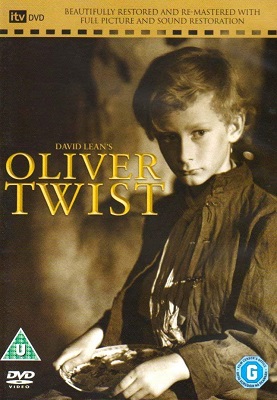
Oliver Twist, David Lean (1948, UK). Although this had been on my list to watch for many years, I’d made no effort to seek it out. So it was good it popped up on Amazon Prime. And an excellent transfer too. I don’t know the book – I’m not a Dickens fan and have read only Great Expectations – although, being English, I’m familiar with the story, as Dickens’s more popular novels are pretty much defining parts of English culture. Oliver Twist is set among the workhouses of Victorian England, and anyone who thinks we  should return to that is a total scumbag and I would quite happily knife. Just point me at them. (Quick note for the police and security services: that’s not an actual threat, although when you finally get around to criminalise thoughts I might have a few problems justifying it…). Anyway, Oliver’s mother dies in poverty and he’s given to a workhouse. After being persuaded to ask for more food – “Please, sir, I want some more.” – he’s apprenticed to a funeral director, where he’s not treated like a slave, but it’s not much better. But he attacks a fellow servant, is promptly whipped, and so runs away to London. Which is where he ends up in Fagin’s gang. The film was criticised on its release for Alec Guinness’s antisemitic portrayal of Fagin. Lean’s defence was that the make-up was intended to make Guinness resemble George Cruikshank’s illustrations from the story’s first appearance. But it doesn’t wash. Cruikshank’s illustrations may well have been antisemitic; Guinness’s portrayal certainly is. The story ends with Oliver being adopted by a family who turn out, amazingly coincidentally, to be the parents of his mother, who had run away from home after becoming pregnant. Oh, and Bill Sykes murders Nancy, but he then accidentally kills himself by falling off a roof trying to escape an enraged mob. The story relies too much on melodrama and coincidence, but Lean’s treatment of it is excellent. His Victorian London is every bit as scary as it would appear to a young boy, and deliberately so. The adult characters are caricatured, not just as written by Dickens, but also visually. I can understand why the film is so highly regarded, and I wouldn’t be surprised to learn that it’s only the depiction of Fagin that kept it off the 1001 Movies You Must See Before You Die list.

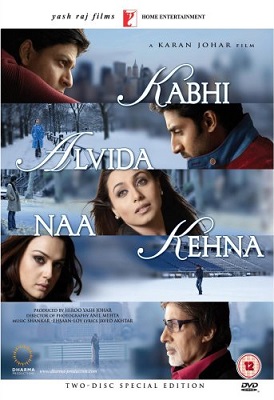
Kabhi Alvida Naa Kehna, Karan Johar (2006, India). This Bollywood film was lent to me by my mother, who has a completely uncritical approach to film watching. Our family connection to Scandinavia means she now watches a lot of films and television from that region, and she’s not at all phased by watching anything with subtitles. I’ve also recommended so many foreign films to her she tends to looks at the story first and not the language. Which, to be honest, hardly applies to Bollywood films as they all have the same plot: boy meets girl, boy loses girls, boy gets girl back again. And Kabhi Alvida Naa Kehna sort of follows the formula, except for being set in New York and being about adultery and two relationships that are consequently split apart. Shah Rukh Khan is a successful footballer in the US. He meets Rani Mukerji at her engagement party (his mother is doing the catering). Shortly after curing her of her last-minute nerves, he’s hit by a car and his football career is over. Four years later, Khan is a little league football coach, while his wife is a successful editor of a fashion magazine. Mukerji is a teacher, and her husband runs a successful PA agency. Meanwhile, his mother and her father have met up and started dating. Which brings Khan and Mukerji together, and their friendship soon turns into something else. There are many words you can use to describe Bollywood, but “bittersweet” is not a common one. But that’s what Kabhi Alvida Naa Kehna feels like. It takes a while before the two leads finally get together, and they’re all too aware of the fact they’re married to other people. Khan and Mukerji make a good couple, and the supporting roles are well played. It’s a polished piece, more so than many of the Bollywood films I’ve seen. It would probably make a good introduction to Indian cinema to those wanting to try it.

Twelve Chairs, Tomás Gutiérrez Alea (1962, Cuba). I’ve a feeling there’s a British film which covers the same territory as this, but perhaps it’s just because it’s such a familiar story. The matriarch of a wealthy Cuban family hides the last of her wealth in one of twelve “English” antique chairs. The rest of the film follows her descendants’ attempts to track down the correct chair and so recover their fortune. It smells like an Ealing comedy. But it’s not presented like one. Mostly. It’s Alea, of course, who directed a number of Cuban comedies during the 1960s, although it’s clear here where his inspirations lay. At least it was to me. But perhaps that was because I’d watched a bad British farce starring Alfred Marks – and Bob Monkhouse! And Anna Karina! – only a few days earlier. In many respects, Twelve Chairs seemed of the same comedy tradition as that which led to the UK film (and both were released in the same year). Which is obviously why I’m almost half-convinced there’s a British film with a similar plot… I’ve seen several Alea movies, but this I thought lightweight stuff compared to them. It was only his second feature-length film, and I’ve not see his first, Stories of the Revolution. But he made Death of a Bureaucrat (see here) and Memories of Underdevelopment (see here) a few years later, and they’re both excellent.

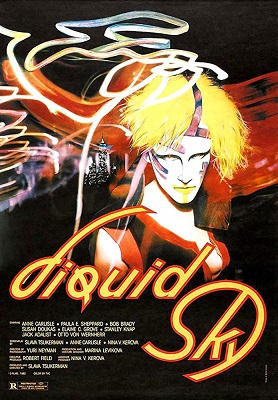
Liquid Sky, Slava Tsukerman (1982, USA). I’d heard of this film years ago but never expected to see it. But then a copy popped up on Amazon Prime for free, and it was a good – no, an excellent – transfer… And you know what, it’s actually a bloody good film. Very eighties. Amazingly eighties. I had thought the most eighties film on the planet was Andrzej Żuławski’s L’amour bracque (see here), but I was wrong. Liquid Sky is as fucking eighties as it gets. Anne Carlisle, who plays both the male and female leads, is especially impressive. It’s not like the acting is good throughout, it is in fact mostly terrible, and the plot is total nonsense. There’s a tiny flying saucer, which looks really fake, and lots of parties where people sneer at each other in a very eighties way, and lots of drugs and arguments about drugs. None of it hangs together, but then it’d be a surprise if it did. Carlisle has considerable screen presence in both of her roles. And yet… it’s the 1980s as we see it depicted in film and television, but it’s not the 1980s I remember. I mean, I was there, I even remember a lot of the cultural moments – Duran Duran first appearing on Top of the Pops, Spandau Ballet with those ridiculous rugs over their shoulders, all the “greed is good” stuff, shoulder pads, Dynasty, Bowie, all that shit. I was there. And while Liquid Sky seems to capture the decade’s essence, it isn’t really an accurate portrayal. But that, I think, is the point, and much of the appeal. They say if you can remember the 1960s, you weren’t there; but I suspect if you remember the 1980s, it’s the later depictions of it you “remember”, not the actual decade. It’s been entirely confabulated. The same will likely happen to the current decade – because, seriously, the shit that’s going down now? You could not make it up.

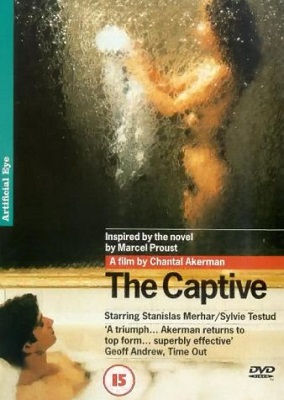
La captive, Chantal Akerman (2000, France). I need to watch more Akerman. I’m not really sure what to make of her. I mean, Jeanne Dielman, 23, Quai Du Commerce, 1080 Bruxelles, is a particular type of film and an excellent one too. But it’s almost plotless and just recounts the life of its titular character. La captive, on the other hand, is narrative cinema, with a plot… although that may be too strong a word. A young man lives with his grandmother and his girlfriend, and he is totally controlling. He follows his girlfriend, making sure she is doing what she tells him she is doing, and he is only capable of having sex with her when she is pretending to be asleep. I will admit I was not concentrating all that much as this film – a rental DVD – was playing, and so I came away from it with an impression of a movie that was much like other French dramas of its time, such as those by Godard – a personal drama, shot cheaply on a single camera, without any expansive, or expensive, shots, just the two main characters talking to, or at, each other as they performed everyday actions. In fact, now I think back on it, there was a lot that reminded me of Godard’s twenty-first century films, although perhaps not so experimental – although Akerman was certainly experimental during her career, cf the aforementioned film by her. I need to watch more Akerman. She directed around thirty feature films, but only La captive seems to have been released on DVD in the UK (Jeanne Dielman, 23, Quai Du Commerce, 1080 Bruxelles is a UK edition of the US Criterion release). I suspect she is another director, like Marguerite Duras, who, despite their reputations, have seen only limited sell-through release in the UK because of their gender. That really needs to change.

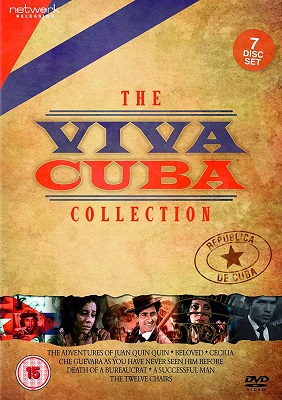
The Adventures of Juan Quin Quin, Julio García Espinosa (1967, Cuba). If there’s one thing that’s become clear about Cuban cinema from the dozen or so Cuban films I’ve watched over the last year or so, it’s that they don’t think kindly of their pre-revolutionary days and yet made numerous movies set during those times. Especially historical ones. Amada, for example, (see here) is based on a 1929 novel; two of the three sections of a favourite film, Lucía (see here), are set in the 1890s and the 1930s; and Cecilia (see here) is adapted from a novel published in 1839… On the other hand, Death of a Bureaucrat (see here) pokes fun at the apparatchiks created by the Revolution. The Adventures of Juan Quin Quin, however, is set before the Revolution, but it’s not clear exactly when. The title character is a bit of a chancer who tries a variety of ways to make money, but is eventually declared a bandit by the authorities. Although I may have that wrong. The film opens with Juan Quin Quin cornered in a wheat field by the army. They set fire to the field in order to either smoke him out or kill him. He survives and evades capture. The rest of the film may be flashback, I’m not entirely sure. Because Quin (or perhaps Quin Quin) is next at a cock fight and is inspired to open a bullring. He approaches a circus owner for a bull, ends up working for him, and steals his lion. He then bounces from career to career, at one point ending up playing Jesus Christ in a circus (and the presence of two go go dancers in this section suggest at least one reason why films set in pre-revolutionary Cuba might have been popular in post-revolutionary Cuba…). And, of course, film, especially comedy, was a perfect vehicle for political allegory. At one point during the circus section, a fakir (played by Quin) lies down on a bed of broken glass. The ringmaster asks for volunteers to stand on the fakir’s torso. A large man in military uniform volunteers himself and seems determined to jump onto the fakir’s chest. It’s not the most subtle of metaphors… Quin ends up running a plantation, which brings him into conflict with the owner, and so the authorities, leading to his final career as a bandit, which circles back to the opening sequence… The Adventures of Juan Quin Quin was apparently entered into competition at the 5th Moscow International Film Festival, but lost out to a tie between The Journalist by Sergei Gerasimov and Father by István Szabó. Also entered, incidentally, from the UK was A Man For All Seasons.

1001 Movies You Must See Before You Die count: 931


Leave a comment

A weekend in Reykjavik

Last weekend was Icecon 2, a biennial science fiction convention in Iceland. I was at the first Icecon in 2016, and had every intention then of attending again in 2018. Which I did. There’ll be a third in 2020, but I’ve no idea if I’ll be able to attend. Brexit and all that…

Thank you 17 million stupid voters for fucking up my future so comprehensively.

Anyway, Icecon 2… Which was nearly scuppered by the UK’s useless transport infrastructure. I’d ordered a taxi to take me to the railway station, and given myself forty minutes leeway – plenty of time for a car to travel about 5 kilometres. But no taxi turned up at the appointed time… Ten minutes later, I decided to take the tram, but there was no guarantee it’d get me to the station on time… Fortunately, my taxi chose that moment to appear, so I arrived at the station in plenty of time. And the train even included the coach containing my reserved seat! (Unlike on my trip to Copenhagen.) Even so, travelling by train is just getting too stressful. Fighting to get on board, the worry over your seat, the far-too-common delays… I’d built plenty of leeway into my travel schedule, but even so it came close to falling apart.

The security check – again in the basement – at Manchester was very quick, and the transit lounge was not especially busy. But when the gate for my flight was called, and I made my way there, there were hundreds of people waiting to board the aircraft. The plane was a Boeing 757, so larger than those in which I’d flown to and from Denmark two weeks earlier. And I suspect a good eighty percent of those on my flight to Reykjavik weren’t visiting the country but just transiting through Keflavik to the US and Canada.

As the minibus drove me around Reykjavik from the BSÍ bus terminal to my hotel (or rather, a bus stop around the corner from it), I spotted a lot more restaurants in the area where my hotel, and the con venue, Iðnó, were sited. Things had changed considerably since my last visit in 2016.

I arrived at my hotel – the same one as my previous visit, Hotel Apotek – around half past four. I arranged to meet up with Kisu and Carolina for something to eat before the Icecon meet & greet at Klaustur bar at eight o’clock. Since I had a couple of hours to spare, I looked up real ale bars in Reykjavik… and discovered craft beer culture had arrived in Iceland. There were four craft ale bars with five hundred metres, and even a branch of Mikkeller a couple of hundred metres further away than that. I decided to try Skúli, and had two very nice IPAs from Iceland. I was meeting the others in the American Bar but, confusingly, the Dirty Burger place next to it looked like it was part of the same establishment. And I went in there. So did Kisu. Then Carolina messaged me to say she was in the bar but couldn’t find us. By which point we’d figured out we were actually next door. Ah well.

The meet & greet was the same as it had been at the first Icecon. Although the selection of drinks in the bar had improved. This time, there was no book club occupying one room, but a jazz trio in a corner of the main bar. But they finished and packed up not long after I’d arrived. I chatted to friends I knew from other Nordic cons, talked about writing with an Icelandic fan called Birgir, and about conventions and sf with a Danish fan, Jeppe, who hadn’t attended either of the Fantasticons I’d been to.

I was up the following morning at 7:30. The Hotel Apotek’s breakfast had also improved. It now included several Icelandic delicacies. I tried the gravlax and the cold blood sausage, but gave the dried cod a miss.

I reached Iðnó a bit early – it was only a couple of minutes’ walk from my hotel – and saw that the comfy upholstered chairs from the last Icecon had been replaced with hard wooden chairs. But they had expanded the café facilities and now offered food and beer. And free coffee and tea all weekend for con attendees.

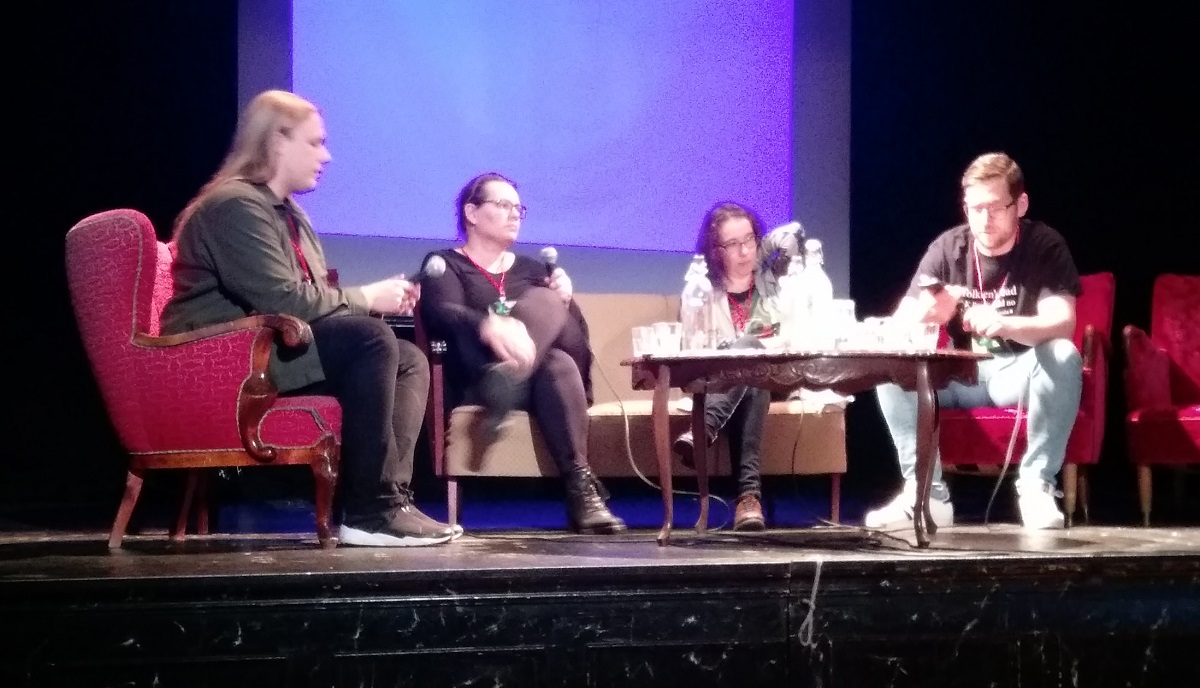
Icecon had only a single programming track and it was in English. It also holds the record – true for both Icecon 1 and 2 – for my attendance at programme items. I missed only three panels, which is astonishing for me. A couple I only caught part of, but never mind. And one, of course, on climate change, I was actually a panellist. (And yes, I mentioned Brexit, of course.) The panels were interesting, although they tended to stray from their topic – some moderators were obviously better prepared than others, which is hardly unusual. But the con had no real socialising area: Iðnó’s cafe was too small, four tables and eight chairs in a tiny room, and Klaustur was only used in the evenings. But there was plenty to explore in Reykjavik if a panel didn’t  interest me. Like the craft ale bars…

I visited one, Microbar, there was a small group of people smoking/vaping outside the entrance. One spoke to me. He had to repeat what he’d said before I understood: “Demilich”. I was wearing a Demilich hoodie. They’re an obscure Finnish death metal band, known for their singer Antti Boman’s vocal fry register growl singing. They released a single album, Nespithe, in 1993. Recently they reformed, and made some new merchandise – like the hoodie I was wearing – available. I was impressed. I’d never met anyone before who’d even heard of Demilich. At the bar, the barman saw my hoodie and asked who it was. “Demilich,” I said. “Ah, Nespithe,” he replied. “Good album.” Two people in the same bar! I suspect that may never be equalled. And I really liked Microbar too. It had an excellent selection of ales. Including two sours – blueberry and rhubarb. I immediately messaged Kisu, who had told me earlier than she only drank sour beers.

At the last Icecon, a group of about ten of us had had trouble finding somewhere to eat on the Saturday night because everywhere was fully booked. We’d ended up at a fairly ordinary Italian restaurant. Which at least managed to cater for the gluten-free member of the party. This year, expecting something similar, I’d floated the idea of booking somewhere on social media, but nothing had come together. On arrival, I’d been encouraged by the increase in eating establishments I’d seen, but that proved illusory… Five of us went looking for dinner in the area around Ingólfur Square – a Swede, an Icelander, a German, a Finn and a Brit – and the first restaurant we tried was closed for a private function, the second was fully booked, and the third, a Tapas restaurant, managed to squeeze us around a table for four. The food was excellent. I had salted cod. Carolina had the same, and complained all evening it was so salty it had made her extremely thirsty. I hadn’t noticed. I suspect I like, and eat, saltier food (ie, less healthily). At one point, Claudia and I had tried to explain to Carolina why we both thought Faulkner’s The Sound and the Fury was such an amazing novel. It wasn’t easy…

After the meal, I dragged the other four down into Microbar (it’s in a cellar) and Kisu tried the rhubarb sour. Then it was across to Klaustur to meet up with the rest of the con.

I should write something about the programme. It didn’t appear to be themed, although there were a couple of panels on Icelandic genre fiction, or “tales of wonder”, furðusögur, and mythlogy. Other panels covered international fandom, diversity in genre, disability in genre, talking animals, climate change, and gender and race. It was a good broad mix, with plenty of welcome perspectives. My own panel, the climate change one, was a man down, as an attendee had failed to make his flight from Taiwan because of a typhoon. Ironically. I’d not prepared for it, other than continually reminding myself to mention a couple of things. Which I managed to do. I’ve always believed you can tell how well a panel is going by the number of people snoring (it’s happened to me) and the number of people laughing (at your jokes, quips, witticisms, etc.) The latter is obviously better, so I always make sure to throw in a few cracks. I didn’t get a round of cheers this time, but there was plenty of appreciative laughter.

Icecon’s custom of presenting panels as four to eight panellists sitting in armchairs and sofas on a stage – dictated to them by the venue – actually works really well. Most cons I’ve attended put their panels behind a long table, so you have a line of people behind nameplates and it all looks a bit formal and intimidating. Icecon’s more informal approach works really well. True, the con is much smaller – less than a hundred attendees this year, I believe, most of which were Icelandic, but also including several Americans, a Dane, a couple of Finns, a couple of Germans, at least one Irish, and, I think, myself the only Brit (unlike the previous Icecon).

In fact, I got chatting to one of the Americans, a young woman, in Klaustur on the Saturday night. She told me she had arrived in Reykjavik with no plans – I forget where she’d flown from, but it was in Europe – and seen mention of Icecon and decided to attend. That was her life now, flitting from country to country. I asked her if she was a “digital nomad” and she seemed shocked I knew the term. “I’m not that old,” I complained. She explained she didn’t think the term was that well known among all age groups.

I left Klaustur about one-ish, I believe, and I was not the last to leave. I had plans for Sunday morning. Icecon does not programme on Sunday morning, only starting again with a lunch at noon. But this year they’d arranged for Michael Swanwick to give a writing workshop. I didn’t sign up for it. I’m told it was fully subscribed and very successful. I did see Swanwick and his partner waiting for the lift in Hotel Apotek, but never got the chance to speak to him. I’ve enjoyed his fiction for several decades and while I’ve not read any of his later novels I do rate this early ones highly. Anyway, I had plans…

After breakfast, I went for a wander around the harbour area. The area next to the concert hall was a giant hole in the ground on my last visit. Now it looks like this:

Rekjavik, in fact, seemed to be doing very well. There was a lot of construction going on, but also a lot of new places: food and drink and, er, tat, I mean tourist, shops. I revisited Hafnarhús, a modern art museum, which was half-price as only half of the galleries were open. But they were worth seeing. There was a video installation by Ósk Vilhjálmsdóttir called “Land undir fót” (take a wild guess what it means). I love video installations, and this was a good one. There was also a gallery of photographs by Ólafur Elíasson (but sadly no book on it in the shop) and an exhibit entitled ‘No Man’s Land’ that I found a bit hit and miss.

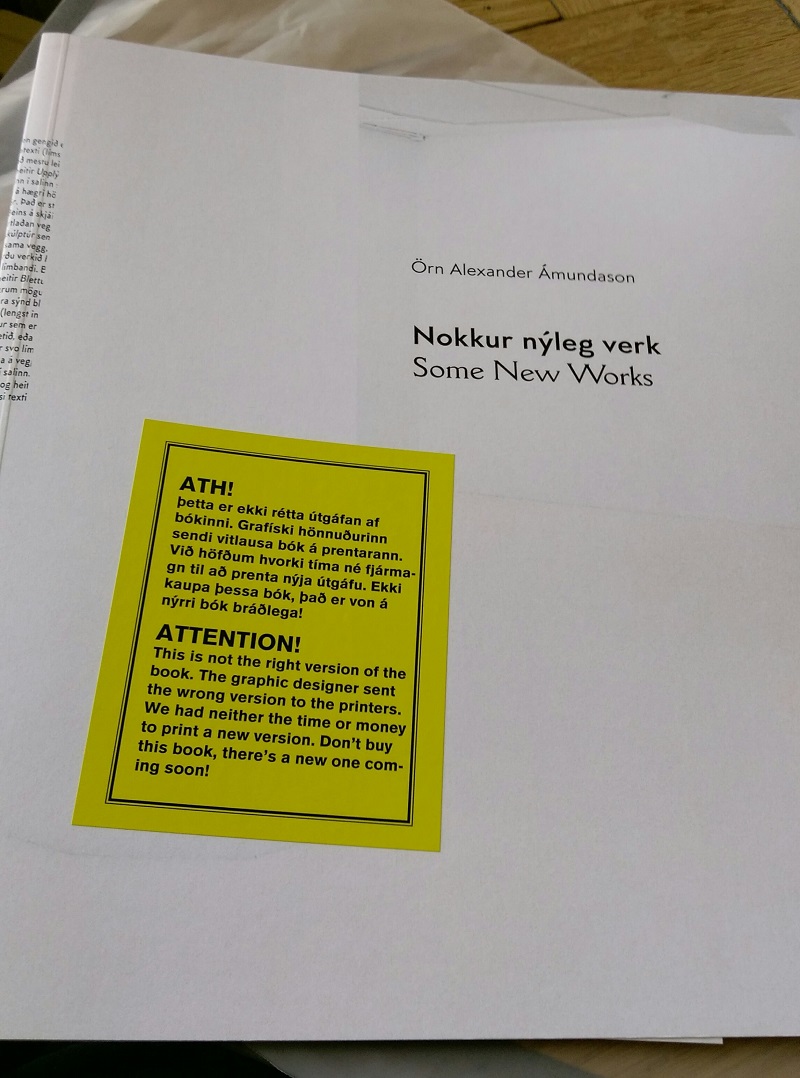
I bought myself a souvenir:

I saw the artwork the book covers on my previous visit to Reykjavik, and was much amused by the sticker on the cover.

For lunch on the Sunday, I decided to try the shawerma place I’d spotted on Ingólfur Square. I was later told there are actually two shawerma restaurants next door to each other, and they’re mortal enemies. I, unfortunately, picked the lesser of the two. Their shawerma didn’t resemble any I’d had in Abu Dhabi, and I wasn’t convinced the young woman serving understood what lactose was… And given how I felt later that afternoon, I may have been right to suspect as much…

The con wrapped at six o’clock, although there was a dead dog party, and pub quiz, at Klaustur later. I had to be up at three am to catch my bus to the airport for an eight am flight, so I’d only planned to to attend the dead dog party for an hour or so. Myself, Kisu and Carolina, on a recommendation from Einar Leif Nielsen, ate at Sjávargrillið, a seafood restaurant. The food was excellent, but something I’d eaten earlier had been contaminated and I was not feeling well. The dead dog party was out for me. I remarked at one point that I used to be able to recover from a weekend of drinking and late nights and early mornings in a day or two, but then it started taking a week or so… So what did I do? Started attending Nordic cons – so I now have to cope with jet lag on top of the drinking and late nights and early mornings…

But not for me that night. I went straight back to my hotel and straight to bed. At eight pm. Later, I discovered the Northern Lights had made a rare in-town showing, visible even outside Klaustur. Which was just bloody typical.

I left early the next morning, catching a minibus at 4:30 am, flight at 8 am… then on arrival in Manchester, a massive queue at passport control. Would it be too difficult to put in more electronic passport gates? They’re machines. You don’t have to pay them to sit there when they’re idle. Or would too many machines make the UK too welcoming for EU citizens? One day, someone will come up with a really good explanation for why we need to control our borders, and it will still be total bullshit. Border control is a nineteenth-century invention, so we managed pretty well for millennia without it. Then, to add insult to injury, the taxi I’d ordered was running twenty minutes late. Not the taxi-driver’s fault, it has to be said – his previous fare’s plane had been delayed. I don’t think any plane I’ve flown on this year has arrived on schedule (although this one actually landed twenty minutes early.)

We chatted during the drive over the Pennines. At one point, he asked me what I did for a living because “I knew a lot about a lot of things”. I was tempted to reply it was a sign of a misspent youth reading too many science fiction books. But instead I just said I worked with computers. It’s a lot easier than trying to explain science fiction. In fact, when people asked me why I visited Iceland, I told them I was visiting friends…


1 Comment

Moving pictures 2018, #52

I’ve not been chasing films from 1001 Movies You Must See Before You Die the last couple of months, so the number of films I’ve seen from the list hasn’t changed for a few weeks. I’m not entirely sure I want to complete the list. After all, it’s “Before You Die”, which sort of suggests that if you do watch them all, well… Anyway, instead it’s the usual odd mix, including two recent films from Russia, both found on Amazon Prime, a pseudo-documentary from the 1930s, a Hungarian drama, some anime, and, well, I’m not entirely sure how to describe the last film – except, perhaps, that I loved it so much after watching the rental than I bought my own copy…

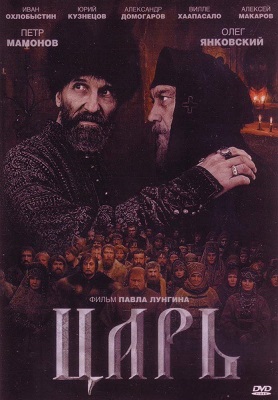
Tsar, Pavel Lungin (2009, Russia). Lungin is the director of the excellent The Island (2006), which seems to be the only film by him that’s been released on DVD in the UK (it’s currently deleted and searching for it by title on Amazon returns nothing; fortunately, I have a copy). Tsar I found on Amazon Prime, and judging by the subtitles, it’s a Russian release. I’ve found a number of Russian films on Amazon Prime, clearly from Russian distributors, from 1947’s Cinderella (see here) through Moscow Doesn’t Believe in Tears and Kin-dza-dza (both of which I already own on DVD) to Air Crew (see here) to Battle for Sevastopol (see here). The thing I remember from The Island is mostly slow cinema, beautifully-framed shots of the monastery at which the film was set. Tsar seems more traditionally framed as a Russian historical film, although there are definitely hints of Tarkovsky at times. The title refers to Ivan the Terrible – the film takes place between 1566 and 1569 – and he’s not so much terrible as completely bonkers and a total psychopath. He invites his friend, the abbot of a monastery on the Solovetsky Islands, and asks him to become Metropolitan of Moscow, ie, leader of the chief diocese of the Russian Orthodox church. The abbot initially refuses, but then agrees, hoping to temper Ivan’s cruelty. But he fails. Later, Ivan strips the Metropolitan of his rank and has him imprisoned in a monastery. This is no slow cinema. Like The Island, its story explores a clash between two views of religion; but it depicts a grim and brutal world, mostly closely-framed. And with a very convincing mise en scène. On the one hand, the tsar’s madness seems to be driven by a fear the world is about to end and the Last Judgement is imminent, and that’s why he’s instituted the oprichnina – culminating in the movie in Ivan being given a guided tour of a “torture camp”, where his enemies will be strapped to various death machines while people wander about enjoying the “spectacle”. Meanwhile, the ex-Metropolitan performs a miracle and escape his chains – and heals his jailer – but even as a saint, or even an ersatz Christ, he can’t cure the tsar of his madness, or prevail against him. Films like this are definitely two-handers. Pyotr Mamonov, who plays Ivan, is especially good, and the abbot, Oleg Yankovskiy, exudes an impressive quite dignity throughout. While Tsar didn’t grab me initially as much as The Island had done, perhaps because its setting isn’t as striking, it turned out to be engrossing. Much as I like Eisenstein’s Ivan the Terrible Part 1 and Ivan the Terrible Part 2 (the latter more, I think, than the former), they do feel a bit pantomime in comparison to Tsar. Recommended.

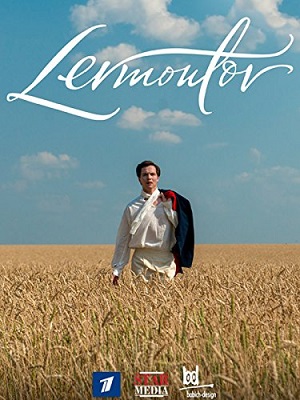
Lermontov, Maksim Bespalyy (2015, Russia). I’ve watched a film about a nineteenth-century Russian author before and ended up buying a book by said author, and after watching Lermontov I had a burning desire to read his most famous novel, A Hero of Our Time. Like Tsar, this is a Russian film I found on Amazon Prime, although it’s a made-for-TV movie so I don’t think it’s ever been released on DVD. It certainly hasn’t in this country. And yet it’s a good piece of work, telling Lermontov’s story with some clever use of graphics as intros to each new chapter of his life. It is all too easy, I’ve found, for Russian historical films to treat their subjects in much the same way the BBC does, relying on a good cast and well-dressed sets. This is not, of course, limited to either British or Russian historical dramas. Lermontov sticks mostly to this but rings a few changes inasmuch as it uses Lermontov’s own writings as a motif for graphics which advance the story, and also tries to marry together the stories of his poems and novels with the events in his life. It works really well. The graphics are cleverly done, and the interplay between fact and fiction prevents the film from becoming too dry. Lermontov, by all accounts, was privileged and arrogant, and like many talents of previous centuries whose works we continue to admire he seemed to create real art more by accident than design. He was convinced of his own superiority, so it’s no real surprise he died aged twenty-seven in a duel. Worth seeing.

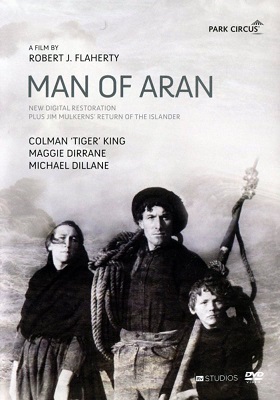
Man of Aran, Robert J Flaherty (1934, Ireland). The Aran Islands are off the west coast of Ireland, just outside Galway Bay. Man of Aran purports to document the life of those who live on the islands. Although made in the 1930s, the life it depicts actually ended some fifty years earlier – leading many to dub the film “ethnofiction”, much like the documentaries of Jean Rouch. Which sort of makes you wonder about the point of it all. There is, for example, a moment in The Epic of Everest (see here) in  which a long-distance tracking shot follows George Mallory’s second attempt on the peak of Everest. And from which he never returned. His body was not found until decades later. There’s a similar mechanism at work in Herbert Ponting’s The Great White Silence (see here), although both are actual eyewitness film chronicles (although the latter makes use of model shots to show Scott’s mission to the South Pole). My point being, I suppose, that the films of Ponting and Noel were actual footage of the historical event they depicted… while Rouch had a tendency to stage the events he wanted to depict, as did Flaherty in this film, and so were labelled “ethnofiction”, you can on the one hand acknowledge the truths they want to document while at the same time wondering just how true those “truths” are… The problem with ethnofiction, in other words, is how reliable is the narrator? Is the film-make “faking” something he knows to be true? Or otherwise. Because making a point by emphasising one aspect of something is still faking it. Did the Aran Islanders really catch sharks as depicted? By the time the film was made, almost certainly not. It’s a slippery slope and I’ve no idea how you judge it. I’m a huge fan of the work of Aleksandr Sokurov, who melds fiction and fact in his films in a way which makes any distinction between the two meaningless. Francofonia is a straight-up mix between the two, but Confession pretends to be the diary of a real person who repeatedly quotes a work of fiction. It’s one reason why I love early documentaries, which are so explicitly fact, and the films of Sokurov which are so clearly extensions of fact… but I find it hard to deal with films which are distortions of fact from early decades…

Love, Károly Makk (1971, Hungary). I have a lot of time for Second Run. They’ve released some excellent films from around the world, including some by a favourite director of mine, who also happens to be Hungarian, Miklós Jancsó. I’ve not seen as many Hungarian films, despite Jancsó – eighteen, compared to fifty-six Polish films, for example – so I’m not as well informed on the country’s cinema, although I suspect Jancsó is less typical of it than Makk, likewise Béla Tarr… although did, perversely remind me of films by Polish directors and even one or two by Czech directors (especially Ucho, see here). In Love, a woman’s husband has been arrested as a political prisoner. Afraid this will adversely affect his ill mother, the wife pretends he has been sent to New York for work, and so make up letters from him which she reads to her mother in law. At various points in the story, the film uses flashbacks to explain what is being referenced in the letters. It’s mostly a two-hander, with the wife and mother in law, and the former is especially good. It comes across as very much a film of its time, but not in the sense it’s capturing a particular zeitgeist or period of fashion, but more as a snapshot of a regime and its impact on those on which the regime was imposed. The only revolution in the UK’s history that wasn’t ruthlessly put down was the Industrial Revolution, which tends to suggest “revolution” is the wrong word to describe it. (The English Civil War was hardly a revolution, given Oliver Cromwell was born into the aristocracy.) On the other hand, neither has the UK been occupied as Hungary was by the USSR. It makes for a disconnect, but it also makes it doubly important that such films are made available to a British audience. We  take our freedoms for granted because we cannot recognise when they are being curtailed. To be fair, tanks have appeared on the streets of British cities, and decades later it’s as if it never happened… But films like Love are important because they remind us that totalitarianism is a thing and has a personal cost and that we’re only a heartbeat away from it. I would sooner popular cinema depicted the perils of fascism instead of normalising it; I would sooner Hollywood spent more time depicting the perils of our current political climate instead of convincing everyone the world was a violent place in which might was right. We’ve known now for a couple of decades that US geopolitical dominance has been bad for planet Earth, but I maintain US cultural dominance, for just under a century, has probably been more damaging. Two hundred years from now, historians will probably look back at the twentieth-century as a noble social experiment, born in two world wars, which the US managed to comprehensively fuck up, while still managing to put twelve men on the Moon….

Princess Arete, Sunao Katabuchi (2001, Japan). If you were to wonder if a friend had lent me this particular film, you’d be right. It’s not my usual fare, any any means – and while I have enjoyed many anime films, the cartoon-ish nature of the art in this movie, as displayed on the Blu-ray cover, would normally put me off. Except, of course, the actual film looks nothing like that and much more like something made by Studio Ghibli. Well, perhaps a more simplified style than that of Studio Ghibli. Some of the backgrounds appear more painted, and indeed more detailed than the characters. It’s an effective technique, and one used in my favourite Ghibli film… But this film is not by them and it’s unfair to keep on mentioning them. Story-wise, Princess Arete presents itself as fairy tale that follows the typical template – a European one, that is, not Japanese. There’s a princess whose father keeps her hidden in the castle until a suitable suitor is found for her, but who sneaks out at night for adventure. But then a suit he can’t refuse, a wizard natch, comes along and takes the princess away. And it turns out the wizard is immortal but a prophecy says a princess called Arete will kill him. As Arete tries to escape her new prison, so she discovers more about her suitor and, of course, unwittingly sets in motion the chain of events which kill him and so render the prophecy true. Princess Arete, however, rings a few changes on the template. The title character has far more agency than is usual, and it is her direct actions which bring about the resolution. There’s also a Japanese slant -story-wise and visually – to some of the events in the last act of the film. The version I watched had only French language, or Japanese language with English subtitles, versions – and while the latter is more, well, correct as it’s a Japanese film, it apes European fairy tales and fantasies so well you expect it to be in English. I have zero problem with watching films in their original language with English subtitles, even when English dubs are available (like for many giallo films), I actually prefer it in fact, but with Princess Arete there’s a slight disconnect between what you see and what you hear. Even so, a good anime and worth seeing. Nice soundtrack too.

Shirley: Visions of Reality, Gustav Deutsch (2013, Austria). What this film is, is easy to describe. But what this has resulted in, is difficult to get a handle on. Simply put, Deutsch as taken thirteen of Edward Hopper’s paintings – but not, sadly, ‘Night Hawks’ – and from them stitched together a narrative about a woman called Shirley, from the early 1930s through to the late 1960s (although she does not appear to actually age during the 30 years). As a piece of art, it works amazingly well. Stephanie Cumming in the title role does little more than play a life model, but her voiceover provides all the drama that is necessary. The mise in scène artfully copies Hopper’s paintings: sometimes only momentarily, in other scenes for several minutes at a time. It looks gorgeous, despite the artificial simplicity of the set dressing. I rented this film and loved it so much I bought myself a Blu-ray copy (actually, it’s a dual format edition). It was worth it. I suspect the film will make my top five for the year. Highly recommended.

1001 Movies You Must See Before You Die count: 931


Leave a comment

Reading diary 2018, #16

The big work project is over! Hurrah! After two and a half years! It went live on 1st September, and while there’s been some clean-up going on, and I’ve been helping out, life work-wise for me is pretty much back to what it was before. Which, hopefully, means writing again. And reading more. It’s going to take a while to renew old habits, and lose new habits, like watching films all the time… But I’m hopeful that by the end of October my reading will have picked up. Meanwhile, a recent trip to Denmark gave me some good reading time and I polished off three books in six days…

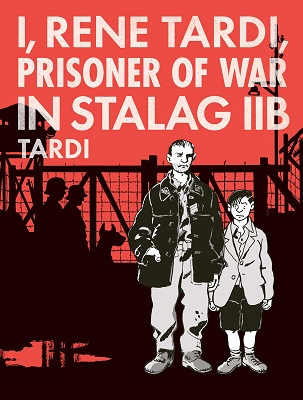
I, Rene Tardi, Prisoner of War in Stalag IIB, Jacques Tardi (2012, France). One day, I will work out why I continue to buy bandes dessinées in English when I’m perfectly capable of reading them in (my schoolboy) French (with, I admit, the help of a dictionary). I mean, given the choice between men-in-tights superhero shenanigans out of the US and French sf comics, I know which I hugely prefer. And, okay, Tardi tends not to write genre, and I, Rene Tardi, Prisoner of War in Stalag IIB is actually biography, that of his own father, with some incidents from the life of the father of his wife, the singer Dominique Grange. Buying it in French would at least allow me to keep up to date with some of my favourite series, especially those whose publication history in English has been erratic at best. They’d probably be cheaper too. Anyway, I, Rene Tardi, Prisoner of War in Stalag IIB does pretty much exactly what it says on the cover. Tardi’s father served in tanks in the French Army during WWII, was captured early and spent pretty much the entire war in a prisoner of war camp. One thing the story illustrates is the stark difference between the treatment of French and British POWs and American POWs. We’ve all seen the movies and the cheap sitcoms, and POWs breaking out of their camps… but the French were so under-fed and mistreated they’d never have succeeded had they escaped. And, of course, once back home they were likely to be immediately reported to the occupying Germans… Recommended.

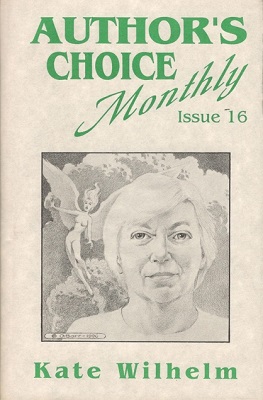
Author’s Choice Monthly 16: State of Grace, Kate Wilhelm (1991, USA). I’ve never been that much of a fan of Wilhelm’s fiction. She’s not a writer whose books I seek out. But I’ve found her novels to be generally good and worth reading, and I’ve no doubt about her stature in the genre (ie, it should be much higher). Not all of her work has been worthy of note but she’s generally produced stuff at a slight angle to what everyone else was doing and her prose was above average. I’m not sure this collection, selected by Wilhelm herself, according to some agenda which is not immediately obvious, does her reputation any favours. It contains half a dozen stories, and Wilhelm provides an intro to each which sort of acts as a very loose framing device. ‘The Book of Ylin’ uses spelling rules for some words based on English’s weirder bits of orthography, as illustrated by Shaw’s famous “ghoti”, which makes reading it a chore until it suddenly clicks, and then you wonder why Wilhelm bothered as it’s not a very amusing conceit. ‘The Downstairs’ Room’ reads like a reworking of Charlotte Perkins Gilman’s ‘The Yellow Wallpaper’, but doesn’t add anything to the original. There’s a welcome element of domesticity to the stories, something science fiction doesn’t cover very often, although Wilhelm has mined the territory in some of her novels. The stories stretch from 1963 to 1988, and there’s an impressive consistency to them. True, the earliest story, ‘Jenny with Wings’, is the least satisfactory, but then it doesn’t seem to do much and the resolution feels a little juvenile. One for fans.

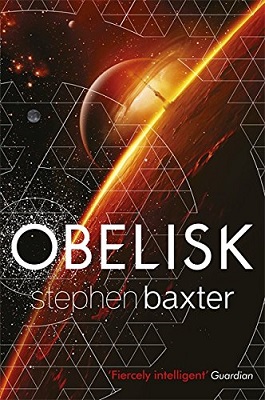
Obelisk, Stephen Baxter (2016, UK). I continue to buy Stephen Baxter books and I’m not really sure why. Oh I know what I’m getting when I start to read one, which is, I suppose, a good enough reason for many to continue to read an author… But I like to be surprised– no, impressed… And that’s only going to happen if an author writes something so much better than they have done in the past, or a writer new to me writes something so much more, well, impressive than I had expected. Cf William Faulkner (see here). Baxter sometime does impress, but all too often his fiction reads a bit juvenile. At short lengths, he’s less likely to fall into that trap, so a collection like Obelisk should prove a more satisfactory read… But at novel length, especially when opening a series, such as the novel Coalescent, the first book of the Destiny’s Children quartet, he seems to shine, only for it all to descend into YA-like science fiction that just happens to throw around big ideas. And that, in microcosm, is sort of what happens in Obelisk. There are lots of fascinating ideas in the stories in the book, but there are some that read like YA, the opening story, ‘On Chryse Plain’, being a good example. It’s one of four stories, including the title story, set in the universe of ProximaUltima (see here and here), although to be honest I couldn’t really tell. Other stories are grouped as “Other Yesterdays”, “Other Todays” and “Other Tomorrows”. All but two were previously published. Two weeks after I finished the book, I’m having trouble remembering the individual stories – although Baxter has certainly written short fiction that stands out… There just aren’t any here. One for fans, I suspect.

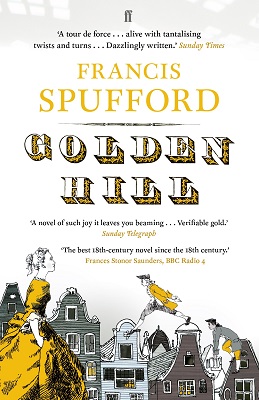
Golden Hill, Francis Spufford (2016, UK). I took this with me to read on my trip to Denmark and pretty much polished it off during the journey there. It was a much easier read than I’d expected, a very easy read, in fact, so much so I kept on thinking throughout that Spufford had attempted to write something like Golding’s Rites of Passage (see here) but hadn’t quite managed to nail down eighteenth-century prose, resulting in a much more readable prose style. Not, I  hasten to add, that I’m an expert on eighteenth-century prose, or indeed have read any books written during that century, like Gulliver’s Travels or Pamela. But Golding’s novel seems more, well, authentic than this one, although Spufford’s representation of life in 1746 New York is thoroughly convincing. A young man called Smith arrives in New-York (as it’s given throughout the novel) with a promissory note for £1000, effectively a banker’s draft, and an enormous sum in those days. He hands it over to a local merchant but is told it will take sixty days for the merchant to get together the money. So Smith has to hang around until then. He refuses to explain who he is, or what the money is for; which means most think he is a con artist and there will be no supporting credentials on the next ship. Which there isn’t. So he’s arrested. But then it turns up on the ship after that, so it seems he really does have £1000. Meanwhile, everyone has been speculating about what he is – he knows a lot about the theatre, so perhaps he’s an actor – and he’s fallen in with the governor’s private secretary, a gay man his own age, and started courting the merchant’s oldest and very prickly daughter. Spufford keeps the speculation on Smith’s identity and purpose going throughout the novel, which is an impressive achievement. But the real stand-out in the book is New-York of 1746, which feels like a living, breathing place, which, er, obviously it was. The plot is all that you would expect of a novel set then, all setbacks and set-pieces, hearts won, enemies made, lessons learned… The final revelation, when it comes, is a surprise but the foundation for it is plain to see in hindsight. I don’t think Golden Hill will make my best of the year top five but it certainly deserves an honourable mention. Recommended.

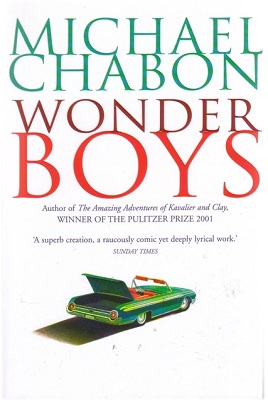
Wonder Boys, Michael Chabon (1995, USA). I first read Chabon when his The Yiddish Policeman’s Union was nominated for a sf award, but I think I might have seen the film adaptation of Wonder Boys before that. What am I saying? I have spreadsheets containing this information. I can check… So: I watched Wonder Boys on 4 June 2001 and read The Yiddish Policeman’s Union on 15 March 2008. I did indeed watch the film before reading any of Chabon’s novels. Anyway, having now read Wonder Boys, I want to rewatch the film. Argh. The one thing that struck while reading the book was that most of the film’s cast had been badly-chosen. The narrator is a failed writer of GRRM-proportions who teaches creative writing at a Pittsburgh university. He was played by Michael Douglas. His gay agent was played by Robert Downey Jr. And troubled student James Leer was played by Tobey Maguire. None of them really fit the characters has portrayed in the novel. Which is basically about a weekend at the university during a writing festival, in which the narrator’s wife leaves him, his lover, the chancellor, tells him she’s pregnant, Leer steals the chancellor’s husband’s prize possession, a jacket worn by Marilyn Monroe and shoots their dog, and… well, shit happens, in that sort of slowly inevitable One Foot in the Grave way that ends up in farce. And overshadowing it all is the narrator’s current WIP, which shares the novel’s title, and which he has been working on for seven years, has grown to gargantuan proportions and he will likely never ever finish. Literary professors/authors whose lives are slowly, and comically, unravelling is pretty much a genre on its own, and is seen by many as emblematic of literary fiction as a whole. I disagree, of course. The only people who think lit fic is all middle-class professors lusting after nubile students, disappearing into a bottle, failing to finish their magnum opus, etc, are the people who generally only read genre and almost certainly have not read widely in literary fiction/literature. I’m still not sure what to make of Chabon’s work – this novel is a bit of a bloated cliché and he has a tendency to drop the odd bit of over-writing into his prose, but there’s a curious personality that shines through, one that’s keen to experiment with the stories he tells, and there’s something very likable about that.

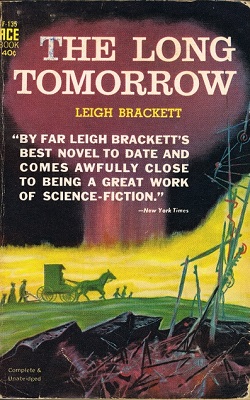
The Long Tomorrow, Leigh Brackett (1955, USA). Just about every US science fiction writer has had a go at a post-apocalypse novel – and if it was during the first 75 years of last century, it was usually a post-nuclear holocaust novel. Several of the better ones have been by women writers, although, as is usually the case, the ones by male writers – Earth Abides, A Canticle for Leibowitz – have been more celebrated. But with Judith Merril’s Shadow on the Hearth and Brackett’s The Long Tomorrow, you have two of the best American post-nuclear war sf novels written in the first half(-ish) of last century. They should be the ones that are celebrated, not Stewart or Miller. But, no matter, we know sf is male-centric, and though we do our best to show this is a false picture, women writers have been immensely successful in genre fiction the last couple of years and that tends to overshadow the achievements of women genre writers of last century. Which it should not. In The Long Tomorrow, the US has turned Mennonite after a nuclear war, and an amendment to the constitution bans towns and villages over a certain size. Cities, you see, make good targets. Of course, the rest of the world has also probably devolved to an agrarian early twentieth-century society, so who’s going to attack the US? But never mind. Len and Esau are curious teenagers in a small New Mennonite farming community, who dream of bigger things, particularly Bartorstown, a mythical town of high tech. After witnessing the stoning of a man linked with Bartorstown, they run away. And end up at the town of Refuge, where they come into conflict with some of the townsfolk because they’re start working for a trader who wants to build an extra warehouse, which will break the aforementioned amendment. This is exacerbated by a rival town across the river which is taking advantage of Refuge’s inability to grow. And then farmers descend on Refuge and put warehouses to the torch, but Len and Esau manage to escape, with the help of an old friend who proves to be from Bartorstown… There’s nothing new in the future US Brackett depicts, drawing as it does on pretty much the entire history of American literature; but the events in Refuge are unexpected, and the arguments against holding back progress, while characteristically American, are handled well. The two leads are typical for sixty year old American sf – ie, white males from comfortable backgrounds – and in fact I don’t recall any POC being mentioned anywhere in the novel. I’m a bigger fan of Brackett’s planetary romances than I am her straight-up sf, although The Long Tomorrow was better than I’d expected. It’s now in the SF Masterworks series.

1001 Book You Must Read Before You Die count: 131
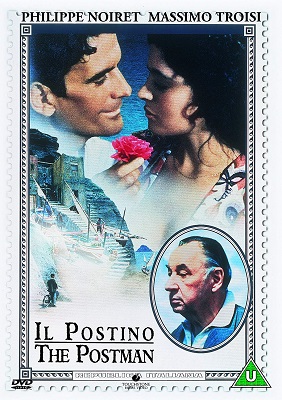

2 Comments

Raising steam in Copenhagen

Last weekend was Fantasticon, a Danish sf convention which has been running since 2004. This year the theme was Steampunk, and the two Guests of Honour were Jeanette Ng and Lavie Tidhar. It was also my second time at Fantasticon, as I went last year (see here).

The journey didn’t start well. At the railway station, no platform was given on the concourse display for the 7:08 train to Manchester Airport. Fortunately, five minutes before it was due to arrive, someone spotted a hand-written sign on the information desk which said it was arriving at platform 6. So I headed to platform 6… only to watch another train to pull in. The Manchester Airport train was now at platform 8. I had a seat booked on coach E, but when the train appeared it only had three coaches: A, B and C. FFS. So the train was packed and all seat reservation were null and void. The train also ended up stuck behind a slower train, so it was soon running ten minutes behind schedule.

Thank you, Conservative governments, for fucking up our railways so comprehensively.

The timing was tight, and if there were a massive queue at security at the airport I’d have to rush to catch my flight. And then I looked at the boarding card I’d printed out the night before… It read 12:35, not 10:15. When I’d bought my ticket months earlier, it had said 10:15. Which was why I’d booked a ticket for the 7:08 train. When I checked the Opodo website a few days earlier, it had said 10:15. I checked the SAS website. It said 12:35. Apparently, they’d rescheduled the flight and not bothered telling me. Oh well. At least it meant it didn’t matter if my train were 10 minutes late. On the other hand, I’d have three hours to kill in Manchester Airport…

I reached the airport and was directed to the security check-in in the basement. The usual one was closed for all except “fast track” passengers. I asked one of the security officers why the usual one was closed. Was it being refurbished? He laughed. Refurbished? Manchester Airport? Ha. No, it was only because it got too busy so they introduced a second security check-in downstairs. The usual one would be open later. I for one am glad they put us through all the security rigmarole. After all, think of the bombers they’ve managed to catch– oh wait, they haven’t caught any. On the other hand, they did fail to catch two bombers…

Happily, the plane stuck to the new time. It wasn’t SAS, however. I noticed the signs in the aircraft were in English and… Icelandic? Apparently not. It was Faroese. The aircraft was operated by Atlantic Airways, the national carrier of the Faroe Islands. They have an Airbus 319 and two Airbus 320s. So I have now flown on a third of their fleet…

I was sat next to an old Australian couple, who were flying to Copenhagen to join a Baltic cruise. They were due to visit Talinn, St Petersburg, Helsinki and Stockholm. They had, they told me, plenty of euros. You’ll need more than that, I told them…

This year, I’d booked a room in a hotel in Frederiksberg, 250 metres from the con venue, the Serapion Order (the same venue as last year). That proved a tactical error, as it was a 1 kilometre hike from the central railway station to the hotel. With a heavy bag. And it was pissing it down when I arrived. Still, the Hotel Sct. Thomas proved very pleasant (and convenient), although the soft-boiled eggs on Saturday morning looked like they’d only been shown a pan of boiling water…

Fantasticon seemed more, well, in evidence this year than last. The downstairs hall contained far more dealers, and there seemed to be more attendees – there were reportedly 119 in total, almost twice as many as last year. Obviously, I knew more people – not just Danish fans, but also Swedish, Finnish, Norwegian and Icelandic. And another Brit beside myself (and the two GoHs, of course, and partner). And even an American, although he lives and works in Finland. This was good, but it did mean I attended few programme items since there was always someone to hang out with. So, name-check time: Sanna, Fia, Thomas, Jukka, Bente, Sidsel, Eva, Knud, Johan, Edmund, Paul, Einar, Rolf, Dom, Carolina, Flemming, Klaus, Lise, and if I’ve forgotten anyone I apologise profusely. As for the programme, well, I’m not a steampunk fan, so I wasn’t especially interested in it. But who goes to cons for just the programme, eh?

On the Friday night, a group of us went for a meal, arranged some days earlier, to a seafood restaurant near Nørreport, called Musling. Some of the group had oysters, but I’ve never been a fan. I’ve heard them described as like “licking snot off a tortoise’s back” and that seems about right. I had ceviche for starter and monkfish for main, and it was very nice. I saw some Danes at a nearby table with a massive dish that looked like something out of Lovecraft, all hard jointed legs and antennae. After the meal, it was back to the con. The bar closed at eleven, so I took Lavie to the famous Mikkeller bar. But his idea of a good beer is apparently Carlsberg, so he wasn’t impressed. After a couple of beers there, we went looking for somewhere else, and ended up in Dudes on Vesterbros Torv, which was strangely deserted for one am on a Friday night.

Saturday was more of the same: sitting around in the Serapion Order, drinking the cheap bottled beer – and good beer it was too – and chatting to friends. The bar also served food, so I ate there for lunch. That evening, it was the banquet, which again was lactose-free. This time, they had it in the main hall on the first floor. And it was a lot more, well, Danish. Not the food – which was excellent, incidentally – but the fact that people would stand up at intervals during the meal and speak. Or sing. Yes, filk. Karl-Johan Norén led the filking. Including some song, sung to the tune of ‘Waltzing Matilda’, which used the phrase “bouncing potatoes”. It is still stuck in my head. Both Lavie and Jeanette gave speeches. Then Jeanette was persuaded to sing. It was some pirate song with lyrics composed entirely of obscene double entrendres. After the banquet, a group of us head for Dudes. I left the bar around one-ish. I wasn’t the first to leave, and I wasn’t the last.

I gave breakfast a miss on Sunday, I felt rough and had a bit of a lie-in. I had a plan, you see. I was going to grab myself a fruit juice and a sandwich and a bottle of water (as I’d managed to lose the one I bought in Manchester Airport). But I obviously wasn’t braining very well. The nearest supermarket was a Føtex. I found the fruit juice, and even a dairy-free cold coffee drink (it proved to be vile), but I couldn’t find the sandwiches and I completely forgot about the water. And when I tried to use the self-scan machine, it wouldn’t let me use my card, so I paid in cash, took my change… only to have a guy run after me because I’d left a 50 kroner note in the machine. Doh.

Despite having a bowl of chilli in the con venue, I accompanied some friends for lunch, and we ended up in a tapas – I think – bar. During the hunt for somewhere to eat, I discovered my favourite Danish word, blækspudder, which means octopus but translates literally as “ink squirter”. The bar served “orange wine” but I stuck to beer…

Sunday afternoon, Fantasticon hosted the Niels Klim Prisen for children’s fiction – genre I think – and the con had invited a class from a school to participate. So there were kids everywhere. At one point, one of the nominated writers approached myself and a few others who were sitting an chatting in the lounge to ask us about fandom. We admitted we were from several countries, that some of us had last seen each other at Swecon in Stockholm, that some of us would see each other at Icecon in Reykjavik… It feels weird to be included in this group, given I’m not actually a Nordic fan. True, I have a family connection to Denmark and I’ve visited the country about a dozen times. And the first Swecon I attended was in 2013… leading one Swede to wonder why I didn’t speak the language, until I pointed out I had spent less than a fortnight in elapsed time in Sweden… But, to be fair, I’ve been picking up bits and pieces of the language, although I do need to make a concerted effort to learn it. However, post-Brexit, once “Fortress UK” comes into effect when we lose our Freedom of Movement throughout the EU and all the flights to and from the UK are grounded, well, I may not be so regular an attendee to Nordic cons… I hope I’ll still be able to attend them, of course, but…

Thank you, Conservative government, for fucking up our economy and our future so comprehensively.

Fantasticon ended at five o’clock on the Sunday. Most went home, but several of us headed for the dead dog party in Cafe Asta in Valby, which entailed a ten-minute bus ride. Copenhagen public transport operates a similar system to London’s Oyster card (it may predate Oyster, I’m not sure). I have a Rejsekort because I visit Copenhagen regularly, but others didn’t. So I dug into my pocket, pulled out a handle of Danish coins and handed them across.

The dead dog party was fun. It wasn’t warm enough to sit outside, as it had been last year, but then Fantasticon this year took place later in the month. People slowly disappeared as the night progressed, until there was less than half a dozen of us left, including the GoHs, both of whom were staying in the hotel attached to Cafe Asta. I asked the cafe to order me a taxi. I think it was only about midnight, but I’m not sure.

The following morning, I hiked it from my hotel, with heavy bag, to the central railway station, and caught a train to Skodsborg, where my sister picked me up. She lives in a small town nearby – although they’re not really towns: Zeeland north of Copenhagen is pretty much suburbs all the way up to Helsingør, although many have town-centres, such as Lyngby, Holte and Nærum. I spent the Monday relaxing, well, recovering from a weekend of drinking.

On the Tuesday, my sister took me to see the Tekniske Museum in Helsingør. It’s in an old hangar, and contains a number of cars and aircraft, and the Soyuz capsule in which Danish ESA astronaut Andreas Mogensen returned from the ISS after a ten-day stay. As well as the Soyuz, there is a Sikorsky S-55, a Lockheed F-104, a Saab Draken, a Caravelle, a Dakota DC-3, the wreck of a Blohm & Voss BV 138 flying boat discovered in the Øresund when they were building the bridge to Sweden, an early outside broadcast TV van from Danmarks Radio, a number of electric cars, some other early jet fighters, and, apparently, as I missed it, DASK, the first Danish computer.

I love shit like that, especially when you can climb all over the exhibits, as you could at the Tekniske Museum. The Caravelle was a bit old and tired, as was the DC-3, the Draken was missing its engine and the F-104 had half of its control panel removed… I mean, it’s great seeing these things “in the flesh”, as it were, but I’d sooner they looked as they had done when they were actually in use.

After the Tekniske Museum, we drove into Helsingør, got a bite to eat in a cafe in the town centre, and then walked out to the Søfart museum. This has been built in an old drydock below ground, and to reach the entrance you walk down a ramp crossing the drydock from one side to the other and back again. The museum itself is arranged in a downward spiral underground around the drydock, and covers Denmark’s maritime trade. There are lots of models of ships, as well as film clips and artefacts from more than two hundred years of cargo transport by sea. It’s fascinating stuff, if not as visceral as clambering over and around helicopters and supersonic jets or standing next to a flown Soyuz descent module.

I’d planned to head into central Copenhagen on the Wednesday, perhaps to visit Fantask or Faraos Cigarer. But in the end we drove into Lyngby for lunch and a wander round. Lunch wasn’t especially good, a steak sandwich in a cafe we’d visited several years previously – and why do Danes put pesto in all their hot sandwiches? At 5 pm, I caught the train to Copenhagen airport for my flight back to the UK. Which this time was a wet lease operated by Air Nostrum, a Spanish airline. It was a Bombardier CRJ100, a small 100-seater jet. Not the smallest airliner I’ve flown on, but not far from it. The flight was happily uneventful, the landing very smooth, and even Manchester Airport’s passport control was virtually empty. We landed thirty minutes late and it seemed like all the major routes across the Pennines were closed, but I got home around 11 pm. And went straight to bed.

Oscar returned from the cattery the next day, and has been following me around and copying me ever since. I give it a week before he’s back to his old tricks of demanding I fight with him and scratching everything in sight.


2 Comments

Moving pictures 2018, #51

Another eclectic bunch of movies in this post. Six films and four countries, half of which are Anglophone. I’ve seen films by four of the directors – Greengrass makes good action films, but they’re not my thing, and I’ve never been a fan of Bresson’s work, for all his critical acclaim. Anyway, see below…

United 93, Paul Greengrass (2006, USA). I was living in Abu Dhabi when the World Trade Center was attacked. From what I remember, I was at home – I’d finished work a couple of hours earlier – when I heard on the radio that a plane had hit one of the towers. I turned on CNN and watched as the second plane hit the South Tower. The world changed on that day – and not for the better. And now, seventeen years later, there’s little doubt who has done more damage in the years since: the US. The Middle East is pretty much fucked up completely, and even the Arab Spring seems to have failed to improve things. Which is not to say the UK does not deserve its fair share of the blame. Wars will continue to be fought as long as people are willing to sell the combatants weapons – and it wouldn’t surprise me to learn that many of the ultra-rich are pretty much war criminals in that regard. Anyway, United 93 is the most celebrated film about the events of 9/11 (an event which has been treated surprisingly rarely in film and television, although it’s far from uncommon in literature). United 93 is named for the one flight of the four hijacked which failed to hits its target, and that was because the passengers aboard fought back against the hijackers and managed to overpower them, albeit too late to prevent them from crashing the aeroplane. United 93 uses a lot of the actual people who were part of events, and a cast of relatively unknown faces in other roles. I don’t have a problem with non-professional actors, particularly in films that are trying for a documentary feel, as this one is. In fact, often dramatisation through the use of actors robs the depicted events of their authenticity. Greengrass, however, successfully keeps everything very real. But what had not occurred to me before watching this film, and which surprised me, was quite how brutal it was. It’s not just the raw emotion of the scenes aboard the eponymous flight, but also the violence when the passengers take back control. United 93 is on one or the other of the 1001 Movies list, although I don’t recall offhand which one. I think it belongs on the list, and not just because of its subject matter. True, such an important event in world history should be represented, but United 93 does it in a way that successfully evokes the emotional turmoil of 9/11. Which is why it should be on the list.

Lancelot du Lac, Robert Bresson (1974, France). Bresson is a highly-regarded director – he’s a favourite of my favourite director Aleksandr Sokurov, for example – but even after seeing some of his most celebrated films I’m not entirely sure I “get” his work. And yet, he does things I like in other directors’ films. In Lancelot du Lac, for example, he uses a mostly non-professional cast. He’s not the first French director to do that – I’ve a feeling Jacques Rivette did, but looking up his films apparently not – but I’m pretty sure some French director, beside Bresson, made extensive use of non-professional actors. Which is, to be fair, a comment more on my bad memory than it is this movie. The film covers the main points of the Lancelot / Arthur / Guinevere legend, focusing particularly on the Lancelot’s relationship with Guinevere. A bad thing, obviously, as she was Arthur’s wife at the time, and a part of the mythos that feels more invented than the rest of it, if only because an adulterous queen feels like imposed commentary (and misogynistic commentary at that, given Guinevere is just about the only woman mentioned in the mythos). The setting doesn’t really convince – if anything, the cast look more like Larpers in a French wood than actual knights of the Round Table. King Arthur also appears a little too saturnine, and more resembles a villain than Mordred. There have been plenty of films made about the Matter of Britain, from musicals to Roman re-imaginings to Guy Ritchie’s mockney mediaeval fantasy. I don’t think any of them have been any good, or presented interesting treatments of the mythos. I think perhaps the most interesting one that comes to mind is a book, and that’s Kazuo Ishiguro’s The Buried Giant. Maybe someday someone will make a good King Arthur film. This one certainly isn’t it.

Battle for Sevastopol, Sergey Mokritskiy (2015, Russia). I’d tried half a dozen films on Amazon Prime but given up on each after ten minutes as they were either really bad or I wasn’t in the mood to watch them. But Battle for Sevastopol pretty much dragged me in from the opening minutes, and I find it slightly worrying that I should find a war film more engrossing than the other films I tried watching. Although perhaps that says more about those other films… Anyway, Battle for Sevastopol is based on the true story of Lyudmila Pavlichenko, a Soviet army sniper who killed over 300 men and survived the siege of Sevastopol. The film opens in 1957, with Eleanor Roosevelt visiting the USSR and asking her minder to let he visit an old friend. The film then flashes back to 1942where Pavlichenko is being introduced to an audience in the US. She is there to drum up support (financial, of course; also armaments) for the USSR – this is after the siege, incidentally. Eleanor Roosevelt, on meeting Pavlichenko, takes a shine to her and invites her to stay in the White House. The film then flashes back again, this time to just before the war. Pavlichenko is studying history at university. Annoyed when some male friends are trying to show off on a rifle range, she insists on having a go herself. She proves to be a crack shot. She is sent off to sniper school – even though war has yet to break out. War breaks out. She serves on the Eastern Front as a sniper. The battle scenes are done extremely well. The film flips between Pavlichenko’s wartime experiences – including the loss of her lover, and the loss of a second lover – and her time in the US. I’m not a big fan of war films, although I’ve probably seen all the big WWII ones over the years – it was a popular subject in the 1950s  and 1960s… Not only is Battle for Sevastopol told from a perspective not often seen in Anglophone cinema – if at all – although it’s a little sanitised, after all Stalin killed more Russians than Hitler did, but it also tells its story from an interesting viewpoint: a female sniper. The special effects are pretty much what you would expect for a big budget of the second decade of the twenty-first century; and if the Americans in the film mostly have weird accents, that’s hardly a deal breaker. Worth seeing.

Bright Star, Jane Campion (2009, UK). I remember years ago – back in the 1980s some time – reading a Tim Powers novel and discovering that the Romantic poets were quite fascinating people. I certainly hadn’t learnt that at school when I’d studied Wordsworth’s The Prelude for O Level. I’m not sure who led the most interesting life of them, Byron probably, or the Shelleys perhaps. But Keats is a possibility, a doctor who was also a lauded poet, and who died young, at the age of twenty-five, of tuberculosis. Literature, especially poetry, venerates creators who die young. I’ll admit I know little of Keats’s poetry – I vaguely remember ‘To Autumn’ from school – and what I read after seeing this film I thought pretty awful. I didn’t, to be honest, think much of the film either. It recounts Keats’s betrothal to Fanny Brawne, the daughter of his neighbours in Hampstead Heath. Unfortunately, Brawne is played by Abbie Cornish, who has a noticeable Australian accent. And Keats’s housemate, Charles Brown, is played by an American actor who puts on a Scottish accent, despite Brown apparently being from Lambeth. Keats, incidentally, is played by Ben Whishaw, who is of course the voice of Paddington. While Bright Star does a good job of presenting early nineteenth-century England, the cast aren’t entirely convincing, and the story is extremely dull. Meh.

French Cancan, Jean Renoir (1955, France). Jean Renoir, he made films like La grande illusion, Boudu saved from DrowningLa Règle du jeu… The last thing I’d have expected him to make is this over-colourised fluffy French mid-fifties musical. The title pretty much says it all. It’s 1890s Paris and a nightclub owner’s business is failing, and his main attraction, a belly dancer, is not pulling in the punters. But then he discovers that the cancan is still being performed in Montmartre, so he decides a cancan chorus is just what he needs. As is usually the case in these sorts of films, he manages to magic up the cash for a new nightclub – he calls it the Moulin Rouge – plus costumes and props for a chorus of cancan dancers. One of which proves to be a star and draws in the punters. It’s based on a true story, of course, but it does seem the bulk of the problems he encountered were emotional. I’m not even sure if this is one for fans of Renoir or French musicals. It’s definitely colourful, very colourful. Meh.

Letters from Baghdad, Sabine Krayenbühl (2016, UK). A few weeks ago I watched Werner Herzog’s biopic of Gertrude Bell, Queen of the Desert (see here), and was not impressed. I knew of Bell, but thought Herzog had been indulging in artistic licence when he showed Bell visiting Bedouin tribes in what is now Saudi Arabia. But, as I discovered in this documentary about Bell’s life, she did indeed go there. To Ha’il, a town in the Nejd, ruled by the House of Rashid (later deposed by ibn Saud). Letters from Baghdad has Tilda Swinton reading out Bell’s correspondence to her parents, interspersed with talking heads acting people who knew her and some archive footage of her or representative of what she experienced. It’s fascinating stuff, and a clever technique that prevents the film from being too dry. But then Bell led a fascinating life. She graduated from Oxford with a first in history, which was not awarded as women could not earn degrees, and was sent out to Baghdad to stay with her uncle, a British minister there. She fell in love with the country and travelled around it extensively. She learnt Arabic and made friends among the tribal leaders. She was not, however, the first foreign woman to visit Ha’il, as Lady Anne Blunt had done so a couple of decades earlier. Bell was one in a long line of British Arabists during the nineteenth and early twentieth century. Many of them, like Bell, provided instrumental in creating the nations which now exist there. Letters from Baghdad is an excellent film about a fascinating person.

1001 Movies You Must see Before You Die count: 931
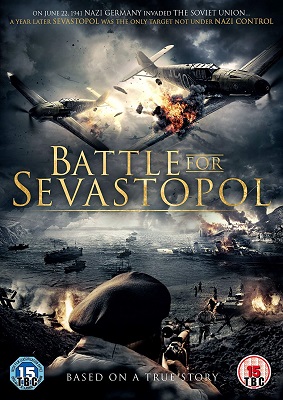

9 Comments

The megalodon in the room

A couple of nights ago, I watched The Meg, a big-budget Warner Bros attempt to cash in on the type of film normally made by The Asylum. In it, Jason Statham plays a submersible driver persuaded out of self-imposed retirement when the submersible containing his wife and two scientists is trapped at the bottom of the Mariana Trench. Well, below the bottom of the Mariana Trench. Because the trench’s bottom is actually a thermocline, a layer of near-freezing hydrogen sulphide, and beneath it is a veritable deep sea paradise, cut off from the rest of the ocean for millions of years. Which is why it contains a megalodon, a giant shark, which went extinct 2.3 million years ago.

It’s the megalodon which trashed the submersible and, after the crew is rescued, the megalodon escapes into the Pacific Ocean. Where it wreaks further carnage. Until stopped by Statham.

This is not a film that is intended to be plausible. It’s not just the existence of the megalodon… or the underwater Shangri-la beneath the thermocline… or Statham’s various encounters with the megalodon…

The Meg is, essentially, one of those films ostensibly set in the present day but the tech is much better. Like 007. It could be a few years from now, but everything looks pretty much as it does in 2018. Except for the fancy tech. You expect this in Hollywood films. And even in television series. CSI was notorious for showcasing tech which didn’t actually exist. So the research submersibles in The Meg are better than the current state of the art. Fine. At least they mostly resemble current deep-diving research submersibles. Just better. Suspension of disbelief doesn’t even blip from neutral. Okay, the “glider”, which has a clear bubble for the pilot and can apparently reach the bottom of the Mariana Trench… well, maybe materials science is way better than, er, now… although that does beg the question: why not have clear bubbles on the research submersibles?

But the problems here all fall from a single mistake by the film-makers. The Mariana Trench is 11,000 metres deep. The pressure at the bottom is about 1100 atmospheres. That’s around 7.5 tons per square inch. Only three people have ever been that deep – Jacques Piccard and Don Walsh in 1960, and James Cameron in 2012. At that depth, 100 kg of water, which is 100 litres of water at sea level, actually has a volume of 95.27 litres. Because of the pressure. When the USS Thresher, the US Navy’s first nuclear-powered attack submarine, sank in 1963 in 2,600 metres of water, it’s estimated when she imploded the two sides of her pressure hull met at a combined speed of around 75,000 kph.

The pressure in the hadal zone cannot be stressed enough (no pun intended). The effect of increasing pressure with increasing depth cannot be stressed enough. The current record – simulated on land – for a human being with saturation diving gear is 701 metres. The current freediving depth record is 253.2 metres. Nuclear-powered ballistic missile submarines and attack submarines generally do not go deeper than 300 metres. The deepest diving whale, Cuvier’s beaked whale, has been recorded reaching 2,992 metres. The sperm whale, perhaps the most impressive mammal on the planet (a personal opinion), can reach around 2,250 metres.
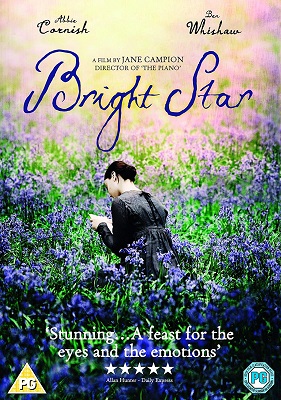
So when The Meg opens with Statham involved in a rescue of a downed USN fleet submarine on the floor of the Philippine Trench, 10,000 metres below the surface… Well, I was not impressed. Unfortunately this rescue – and Statham’s failure to save two of his colleagues – is important to the film’s plot. Because he failed to save his two colleagues, he retired. Because he’s the only person to have rescued some people from 10,000 metres, he’s the first choice to rescue the research submersible below the thermocline in the Mariana Trench…

But… but… but… That first rescue, the movie’s opening scene, is complete nonsense. An intact fleet submarine at 10,000 metres? The USS Thresher sank in a quarter of that depth and its wreckage was scattered over 13.4 hectares. But, I hear you cry, maybe this future sub – 55 years after the USS Thresher after all! – was made of much stronger materials. Given how expensive fleet submarines are – the USS Colorado, SSN-788, launched December 2016, allegedly cost $2.6 billion, and has a test depth of probably 250 to 300 metres – well, building a fleet submarine with a crew of 134 capable of reaching depths forty times deeper… would probably cost more than President Trump’s opinion of his own worth as a human being.

And yet… this is, I hear you say, completely irrelevant. It’s a film about a giant fucking prehistoric shark. Which reached lengths of 18 metres (bigger in the this film). Why cavil about submarines and submersibles and depths and pressures when the film is about a giant fucking prehistoric shark? All those facts quoted above, they mean nothing because it’s a film about a giant fucking prehistoric shark!

This is where we part company – myself, that is, and my imaginary critic(s) – because the megalodon, as the title of this post indicates, that’s the central conceit. The story is its scaffolding. Science fiction tropes work the same way. They’re either bolstered by the plot, or by exposition, or by the entire corpus of science fiction. Such as FTL. Or AI. Complete nonsense, both of them. But no one quibbles when they appear in a science fiction because the scaffolding for them has been built up over a century or more of genre publishing. There’s no willing suspension of disbelief required – it’s entirely unconscious. And yet it’s instructional what readers will willingly disbelieve. As Joe Abercrombie once tweeted (and I paraphrase as I don’t have the exact tweet to hand): “giant flying lizards who breathe fire? No problem. Female blacksmiths? INCONCEIVABLE!”. I had a similar response to my space opera, A Prospect of War. I decided my universe would not have gunpowder. Giant plasma cannons, yes; but all personal combat would be using swords. FTL? No problem. Giant plasma cannons? No problem. No gunpowder, not even bows and arrows? UNBELIEVABLE.

In every science fiction, we have a megalodon in the room. Sometimes it’s the central conceit, sometimes it’s what we have to tastefully ignore in order for the conceit not to destroy the reading experience. But that science fiction, that conceit, is embedded in a world, either of the author’s invention or recognisably the reader’s own. While space battleships can flit from star to star using FTL, stars are still stars, planets are still planets, and yes, okay, the vast distances between stars might be compressed in order for the space opera to better follow its eighteenth-century adventure template… but space is still space and vacuum is still vacuum.

So why isn’t the hadal zone still the hadal zone?

The megalodon: that’s the conceit, and the willing suspension of disbelief comes wrapped around it. Reject that and you reject the story. The rest, that’s world-building. That’s the setting for the conceit. So it requires some sparkly tech that doesn’t yet exist? Shrug. No problem. That’s what – in a movie – production design is for. And they generally do an excellent job. But that doesn’t mean the laws of physics, for example, which pertain in the world, and which are not bent out of shape in the presence of the conceit, should be flouted. It’s not trainspotting. It’s not even expecting the science in a science fiction to be accurate. (I mean, when a science fiction novel which sells itself on its absolutely correct science gets it wrong in the first chapter, who would be foolish enough to expect science fiction as a whole to get the science right?)

It’s an expectation of rigour; it’s an expectation of craft. Sometimes, these faux pas are either easily avoidable or easily justified within the text. Take the most egregious example to have occurred recently: dropping bombs in space in The Last Jedi? WTF? Bombs? In space? Did the director of the film not understand what zero gravity is? I mean, bombs? WTF? It’s just so fucking stupid. And yet… and yet…

All it took was one line: “Are we in the Star Destroyer’s gravity field yet?”

One line and… Woah! It actually makes sense.

To me, leaving out that line, failing to even think viewers would like an explanation… that smacks of contempt from the creators. They think viewers are too dumb to notice.

When failures of rigour or world-building could be explained in the story, and the creator does not do so, that’s a failure of craft. Of course, it could be deliberate. A lack of rigour could be a deliberate characteristic of the narrative. But when that’s the case, it’s generally obvious. It’s not the same as having a fleet sub survive at forty times its test depth. There are things a reader or viewer expects to have to disbelieve and things they don’t expect to have to disbelieve. And unless indicated otherwise, by signals in the text, convention dictates which is which.

There’s room to manoeuvre there, of course. Sufficient room, in fact, for some writers to have built careers in that space. But The Meg is not high literature, there’s nothing liminal or slipstream about it. It is a somewhat obvious attempt to cash in on a film genre previously occupied by mockbusters and low-budget B-movies. It does everything it needs to in order to meet the expectations which might accrue to it, given what it is and what it purports to be.

But if criticism means anything, if the study literature, or cinema, is of any worth, then no text should be considered as just “what it is” or “what it purports to be”.


3 Comments

Travelling down memory lane

I’m not sure what prompted it, but I decided recently to complete my collection of The Journal of the Travellers’ Aid Society, the in-house magazine for the Traveller role-playing game. Back in the 1980s, I’d subscribed to the magazine from issue seven until its demise with issue twenty-four. But in 1986 I’d lent my copies to a friend… and never saw them again. I’d picked up a few replacements here and there, but it had always annoyed me I’d never fully replaced what I’d lost.

So over the past few weeks, I’ve been tracking missing issues on eBay and buying them. I was using a checklist I’d made years ago but I really should have dug out my copies and seen for myself what I was missing. Because it led to this…

Obviously, I’d fallen into the same trap before. Oh well. Having said that, one Traveller supplement I’d always wanted was DGP’s Grand Survey… They’d published three supplements for Traveller in the mid-1980s, and it was the only one I didn’t own. But copies these days go for around $100, which is more than I’m prepared to pay. However, when I took all my Traveller materials down from the bookshelves, I discovered I already had a copy…

I decided I’d better catalogue all my Traveller-related books, so I wouldn’t go buying duplicates. Again. And as I did that, I was reminded how I’d got into role-playing games.

(See what I did with the title of this post now?)

I was first introduced to rpgs in my first year at college – that’s a UK public school, not a US university, so I’d have been thirteen – when a friend showed me this new game he had: Dungeons & Dragons. It was definitely in my first year there, because he showed the game to me in a classroom next to the junior common room; in the second year, four of us Removes in the house were given a study – a singular honour as only fifth formers and above had studies –  and he’d have shown me his D&D in my study had it been that year. Anyway, my friend Andrew de Salis showed me this boxed set of rulebooks he had bought, or received as a present, Basic D&D, the one with the all-blue artwork. I’ve a feeling this happened during the winter term, and it was that Christmas – ie, 1979 – I asked for and received the basic Traveller box set as a present. The following year, I received books 4 and 5, Mercenary and High Guard, as Christmas presents. On the other hand, I might have received the set and the two supplements all at once at Christmas 1980 (High Guard wasn’t published until 1980); but I don’t think so.

Wednesday afternoons at college were given over to “ASH” – Activities, Societies, Hobbies – and not being a sporty type, I’d joined the chess society. But having discovered role-playing games, de Salis and I decided to resurrect the games society. We were given a room near the kitchens. I’ve no idea what the room was originally used for – it was pretty grim, it was tiled and the tiles had been crudely painted over with red paint, it looked out over the courtyard which held the kitchen bins, and it was unheated. There was an old cupboard filled with games from the society’s former incarnation, including a couple of wargames. We were also given a small budget. We never managed to attract more than half a dozen members, and, often as not, we’d be in that room on weekends too, playing games. I remember running a Traveller campaign, mostly written by myself. We also played AD&D, Tunnels & Trolls, RuneQuest, Champions, Star Frontiers, Call of Cthulhu; wargames like Godsfire, Dune, Third Reich, Squad Leader; and boardgames such as Risk and Diplomacy. Oh, and football. We set a chair at either end of the room as goals, and used a small plastic head from some incomplete game we found in the cupboard. It got quite brutal, especially as most people wore cowboy boots at the time, and bruised shins were pretty common.

I began buying Traveller products during the holidays and half-terms when I was at home (or staying with relatives). This meant visiting the Games Workshop shop in the Broadmarsh Centre in Nottingham (yes, they used to sell games by other manufacturers back then). I focused mostly on supplements and adventures – and GDW, Traveller’s publisher, produced plenty of them – but didn’t bother with the more expensive items, such as the Traveller boardgames. I don’t recall buying Traveller products through mail order back then. We both read White Dwarf avidly, which had a regular Traveller column, Starbase, edited by Bob McWilliams (although this may not have appeared in the magazine until a few years later); but the magazine certainly published regular articles and adventures about, and for, Traveller. (Among many other role-playing games, of course.)

It was around this time I started subscribing to The Journal of the Travellers’ Aid Society, as mentioned earlier. Issue seven was published in the latter half of 1980.

I think it was in the Lower VI that de Salis and I decided to try for one of the school’s prizes by publishing a role-playing games fanzine. As far as I remember, the prize only required some project associated with a hobby, invigilated by an outside examiner. We called our fanzine TINNYORO Fanzine (This Is Not Necessarily Your Ordinary Rip-Off Fanzine; it seemed funny in 1983) and sent a copy to White Dwarf for review. I don’t remember if we won the prize. I seem to recall we won some money, chiefly because the White Dwarf reviewer had been kinder than he should have been (the review was not published in the magazine, but sent to us privately, since we’d explained it was a for a school prize). The contents of TINNYORO Fanzine were… mostly rubbish. The artwork, done entirely by myself, was worse. I’m still a little proud of the title of my expanded combat rules for Traveller, “Hit 2 Hurt”. I think we sold about a dozen copies of the zine via mail order. We never produced a second issue.

I left school and spent a year at a college in Nottingham re-taking my A levels. I bought Traveller products from Games Workshop. I scraped good enough grades to get me into Coventry Polytechnic, studying Information Systems Engineering. I joined the poly’s role-playing games society, and once a week we’d spend an evening in a classroom playing a variety of rpgs. I don’t actually remember what we played, although I suspect I had a go at running a self-penned Traveller campaign. (It was a waste of time running the published adventures, as players had usually read them.) At the end of the year, I screwed up my exams and decided to return home and spend a few years working, so I could qualify as an independent student. My Local Education Authority had decided they didn’t need to pay my fees, never mind a grant, because my parents lived abroad – even though my parents owned a house in the UK, paid rates, and lived in the house every summer.

I joined a local gaming group, which met every Sunday in a community centre in Ravenshead. I ran a Traveller campaign, and I remember playing in both a Pendragon and a RuneQuest campaign. One Sunday, two blokes turned up and told us they’d approached the parish council, who owned the community centre, concerned about our “spiritual wellbeing”. Since we played Dungeons & Dragons, we were obviously no different to practicing Satanists. Or maybe not. On the day in question, half of us were playing a WWI dogfighting wargame, with small model aircraft on sticks, which we were moving about on a ping pong table. The concerned parishioners had turned up expecting to find a group of teenagers summoning demons, not a group of twentysomethings – the average age of the group was 25 – playing with tiddly little aeroplanes on sticks. They still got the club banned from using the centre, however. I started at Coventry Polytechnic, soon to be Coventry University, a couple of months later – this time as an independent student, on a full grant – and later heard the club had pretty much disbanded.

During those years back home working for a living, I had two goes at publishing my own Traveller fanzine. The first was titled Imperial Flight (see below), and I produced a full mock-up, with artwork by someone I’d met during  my one year at Coventry Polytechnic, Nigel Dobbs. We lost touch soon after, but I believe he went on to illustrate for 2000 AD. I may have the name slightly wrong. I still have the contents for Imperial Flight #1. It includes a terrible spoof story I’d written set in the Traveller universe about a bunch of incompetents called The Zee-Team. I seem to remember writing a second instalment, but I’ve no idea what happened to it. This is probably a good thing.

Imperial Flight #1 never saw the light of day, and I cannibalised its contents a year or so later for another Traveller fanzine, Signal GK (see above, next to TINNYORO Fanzine). Which was also never published. But at least it didn’t include The Zee-Team. The name Signal GK, the title of an official adventure published by GDW, of course, was later used by another Traveller magazine, but hyphenated as Signal-GK, based in Hebden Bridge, which published thirteen issues between 1991 and 1995.

In 1987, Traveller morphed into MegaTraveller, a redesign of the game driven by DGP, a Traveller licensee who had published the three supplements mentioned earlier, and also published their own Traveller magazine, The Travellers’ Digest. This was originally the same size as GDW’s Journal of the Travellers’ Aid Society, but from issue 9 onward was produced at normal magazine size. I began buying it from issue 9. After twenty-one issues, it became The MegaTraveller Journal, which only lasted for four issues.

The Journal of the Travellers’ Aid Society also ceased around this time, and GDW instead published a normal-sized magazine called Challenge. It continued the numbering scheme from the Journal, and was initially Traveller-only, but soon branched out to feature other GDW games, and rpgs by other companies.

While at university, I’d been buying my Traveller products by mail from a gaming shop in north London – I forget its name – and by this point, they were sending me notices when anything new came out. So I bought each MegaTraveller supplement, and each issue of Challenge, pretty much as it was published.

MegaTraveller became Traveller: The New Era in 1993, and though I didn’t like the new direction I continued to buy the rulebooks and supplements and adventures. GDW closed its doors in 1996, deciding to bow out before it went bust. They’d had problems after taking on Gary Gygax and publishing his Dangerous Journeys rpg, a move that had brought them into conflict with TSR. Collectable Card Games, particularly Magic: The Gathering, had also hit the rpg industry hard. And, of course, Traveller: The New Era had been unpopular with fans.

During my university years, I’d become involved with the History of the Imperium Working Group, HIWG, a transatlantic group of Traveller fans who were keen to produce more material for the game. Although they had a newsletter, Tiffany Star, produced by one of the US members, I don’t believe they actually published anything. Some of the members were associated with the aforementioned Signal-GK. I remember spending a weekend in Hebden Bridge with some of them, but I felt like a bit of a fraud as they were all far more into the game than I was.

Around nine months after graduating from Coventry University, unable to find a job in the UK, I moved to the UAE to start work at the Higher Colleges of Technology in Abu Dhabi. I left HIWG and soon lost touch with its members. I also stopped buying Traveller: The New Era products, as it was too expensive to ship them out to the Middle East. I didn’t consider it much of a loss. In the early 1990s, I’d drifted into science fiction fandom, had attended several conventions, published my own fanzine, reviewed books for genre fanzines and small press magazines, and even co-edited a small press genre magazine. I also had ambitions of writing short stories, and saw a couple of them published. I wrote a science fiction novel, Bound by Blood, in 1993, and submitted it to Tor. I never heard back from them. It wasn’t very good.

After the collapse of GDW in 1996, the Traveller licence reverted to the game’s creator, Marc Miller, and, under the name Imperium Games, Miller published a fourth edition of Traveller. The books looked very handsome – they all had Chris Foss cover art – but they were rushed and full of typos. And not very good. I only learnt of the game when I returned to the UK in 2002.

Once back in the UK, it didn’t take me long before I discovered eBay… and all the people selling off the junk in their closets and attics. Including role-playing games. So I set about filling in the gaps in my Traveller collection – those Traveller: The New Era books I’d not bought while I was out in the UAE, the twenty books of the Imperium Games’ edition of Traveller… I also found and bought mint condition copies of classic Traveller supplements and adventures published during the late 1970s and early 1980s, by licensees such as Judges Guild and Group One. They’d probably been sitting in warehouses ever since publication – and with good reason: they were terrible. I bought the Traveller-related boardgames I hadn’t bought back in the 1980s. Some of them were even shrink-wrapped. I even started buying the GURPS Traveller books, published by Steve Jackson Games under licence but using the company’s own GURPS rules…

By this point, there were several different licensed versions of Traveller knocking about. Miller had always been relaxed about licensing, and classic Traveller had been supported by supplements and adventures from a raft of companies, such as DGP, Paranoia Press, Seeker Gaming Systems, Cargonaut Press, FASA, Judges Guild, Gamelords, Group One… Some of these I had bought at the time, mostly those published under licence in the UK by Games Workshop. But those companies had supported GDW’s game; now there were different versions of the game. Traveller 20 was based on a rule system which used only D20s. Miller himself was busy developing a fifth edition of Traveller, initially published only on CD-ROM, then in a ring binder, and finally in a massive hardback book. (I saw a copy of this last recently on eBay for £399.99.) There is a set of starship deck plans, but no adventures or supplements have to date been published for Traveller5.

A British company, Mongoose, created their own version of Traveller, based on a different rules system. They published a series of rulebooks, similar in design to GDW’s original Traveller, plus a range of adventures and supplements under the title The Third Imperium. In 2016, Mongoose published a second edition of their version of Traveller. Which is where I sort of came back into the game. Mongoose ran a couple of Kickstarter campaigns for new Traveller material, and I stumbled across mention of one. It was a box set titled The Great Rift, and it looked like it would be a quality piece of work. They wanted £10,000. They received £113,782 in pledges! The average pledge must have been about £100. It is indeed a very impressive box set. Mongoose followed up with another Kickstarter, the Element Class Cruiser box set, which managed £43,749 of a £10,000 target… It’s due some time this month or next.

Some time during all this, there was an attempt to create a setting in the Traveller universe a couple of centuries after the published setting, called Traveller 1248. I’ve seen copies of the two sourcebooks published for on eBay for £79.95. Fortunately, I bought my copies when they were published, for the much more affordable price of £15 each.

There are still gaps in my Traveller collection – the classic version, that is; I’m not overly bothered about the post-GDW versions of the game – and my collection of Traveller-related magazines. Early issues of The Journal of the Travellers’ Aid Society and The Travellers’ Digest are extremely rare and correspondingly expensive. It’s unlikely I’ll ever manage a full run of either magazine. My copies of High Passage’s five issues, and both issues of Far Traveller, Traveller magazines published by a licensee called FASA, some I bought back in the 1980s and the rest more than a decade ago. Which is fortunate as copies now vary from $20 to $60 each.

The game was also supported during the 1980s by a number of fanzines. I have all eight issues of a UK-based one, Alien Star. I even contributed to one of the early issues. And back in 1984, myself and de Salis travelled to London to attend a Games Day, and met up with one of Alien Star’s editors. But most of the fanzines were, of course, from the US, and hard to source at the time – and there was no easy way to pay overseas sellers back then. I’ve picked up a few issues here and there during the past decade or so, but fanzines are harder to find than official supplements by licensed games companies. And, to be honest, their contents were never up to much… although probably better than the contents of the two Traveller zines I put together, and almost certainly better than the contents of TINNYORO Fanzine.