They say science fiction is the literature of ideas. They say every science fiction text is about two dates: the date it is set, and the date it was written.
Yet when discussing a science fiction text, it is generally the “big themes” which are addressed: identity, the survival of the human race, the invasiveness or pervasiveness of technology in society, the nature of the physical universe, etc… While it’s true that the concerns and issues of “the date it was written” are typically present, as major themes of a work those concerns are usually sadly lacking. Tackling those issues head-on might well date a novel, although, to be honest, it seems many of the problems affecting modern-day society are, if not perennial, at least recurring. In the relatively short term, that is – say, a few centuries.
So where are the science fiction stories and novels which deal directly with the problems affecting readers today? Why must space operas be based on centuries-old political structures? Why must they refight wars long since lost or won? Why must cyberpunk novels wallow in the economics and geopolitics of the 1980s? Why must hard sf pretend the 1960s has lasted for fifty years? Why must sf ignore existing difficulties and challenges and invent entirely new and irrelevant ones?
I look around and I see that we are failing as a species. We are rendering our planet uninhabitable, and yet are making only token efforts to find solutions. We’re not even looking seriously at off-planet as a possible escape route. Thousands of years of civilisation and we have yet to eradicate wars, hunger, poverty, disease, inequality, slavery… Solutions to all these lie within our grasp, but we refuse to do anything about them. Do these not count as “ideas”? Are they not fit subjects for genre fiction?
True, science fiction is neither predictive nor didactic. It has not been since the 1920s, but I sometimes wonder if it needs to be once again. Back then, it was a marketing gimmick, a way of selling the newly-formed genre to readers of electronics and popular science magazines. Now, the genre has grown far too sophisticated for the simplistic agendas of Gernsback and his contemporaries. As a literary mode of fiction, it has evolved a vast repertoire of tropes, an extensive toolkit, and a lexicon that is in many ways peculiar to it. And along with this increase in sophistication has come a shift in viewpoint from the immediate to the abstract.
Abstract commentaries, however, often yield abstract results. Neither prediction nor didactism are useful tools in today’s fiction market, but that doesn’t mean sf should ignore the immediate. At a time when science itself is coming under attack, perhaps the genre which includes “science” in its name should take up arms once again. I see labels such as “speculative fiction” and “strange fiction”, and all I see is a move to define the genre by its aesthetics.
Science fiction is not fiction which incorporates a defined catalogue of tropes. It is not fiction which features science, or which is about science. It is fiction that once battled for science, which was once a soldier in science’s army. Science fiction is every mode of fiction, every trope, every writing tool, which was invented in order to win that struggle. And, once upon a time, it fought the good fight, inspiring generations to take up careers in science and engineering – including those who made the Apollo lunar landings a reality. Sadly, it could not sustain the offensive, and the war has long since been lost.
This is not to say the genre is as uniform as the above might suggest. Like any movement which has evolved, which has been in existence for more than eighty years, it is varied and disparate. It is a house of many rooms. And a great many people live in that house.
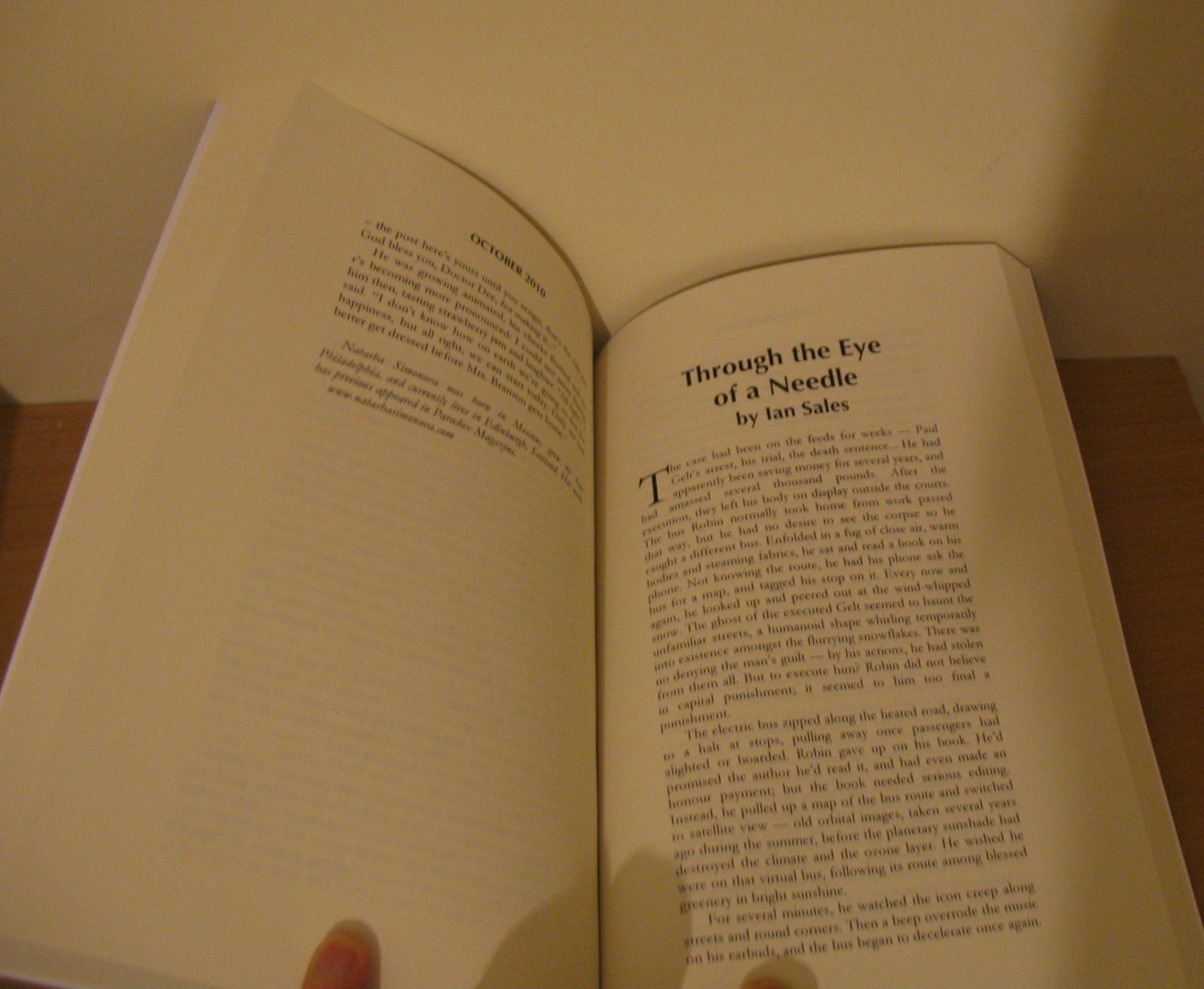
Not everyone is a spectator. I like to think I’ve done my bit, that I’ve contributed something. My story ‘Through the Eye of a Needle’ was a direct attack on climate-change deniers (see here). My Euripidean Space stories are based on the latest data on the moons of Saturn (see here). My story ‘Human Resources’ comments on capitalist economics (see here). I wrote a story to celebrate the achievement in 1960 of Jacques Piccard and Don Walsh (see here) – although the story has yet to find a home.
Des Lewis has started a “Real Time Review” of the Winter 2010 BFS Journal (see my photos of it here). So far, he’s read the first eight stories from New Horizon. Which includes mine, ‘Barker’ – about which he writes:
“A claustrophobic vision, this time in a punch-drunk comic-strip rocket. Real history and real names in retrocausality. To my hindsight surprise, I enjoyed it thoroughly as a lighter part of these movements in a dark symphony.”
I’m not entirely sure what the “dark symphony” is in reference to, but I’ll take my compliments where I find them.
Full review here. You’ll need to scroll down to see Des’s comments on ‘Barker’.
My review of Music for Another World, a themed anthology edited by Mark Harding, is now up at SFF Chronicles here. This is the anthology which contains ‘Arrhythmia’, Neil Williamson’s BSFA Award shortlisted story.
Today, postie brought me the amalgamated British Fantasy Society Journal. The three magazines – Prism, Dark Horizons and New Horizons – are now a single hardback book. And very smart it looks too. See:
And what’s this on page 22? Why, it’s a story by Yours Truly: ‘Barker’, an alt history about the Space Race.
I forget where I first came across mention of The Steerswoman by Rosemary Kirstein. It was in the last year or so, although the book was originally published in 1989. I do know that it’s not well known in the UK. But whenever, and whatever, I read about it, I decided it might appeal, and so determined to keep my eyes open for a copy. Which I found several months later in a local charity shop.
It is not a book , if I had known nothing of it, that I think I would have looked at twice. Had I not known of it when I found it in that charity shop, I would not have bought it. I’d heard it was quite good – but how often do you hear that about books, which promptly disappoint? I’d heard it read as fantasy but was really science fiction – but there’s so much room for manoeuvre in that statement, it’s hard to take it as any kind of useful description. Something brought The Steerswoman to my notice, something persuaded me it was worth reading…
And I’m glad I did. The Steerswoman is a gem. It’s by no means great literature, but it is most definitely appealing.
Rowan is the steerswoman of the title. Quite what these are, or how they came about, is never fully explained. They travel the land, observing, gathering facts, drawing and redrawing maps. Any one can ask them questions, and they must answer to the best of their ability. Should, however, they ask a question and are refused, then they can ban that person from ever being answered by a steerswoman again. There are, incidentally, steersmen, but they are greatly outnumbered. (In fact, The Steerswoman states there are three during the period the story takes place, and that it’s the largest number they’ve had in the organisation’s history.)
While investigating the origin of a strange blue jewel she has found, Rowan comes to the notice of the wizards. She is attacked by one of their soldiers but, with the help of new-found companion, Bel, a barbarian warrior woman from the Outskirts, she fights off the attacker. This only makes her more determined to solve the puzzle presented by the jewel. She returns to the steerswomen’s Archive to discuss her problem with her colleagues.
Bel has told her of a large bed of such jewels in the Outskirts. Rowan and Bel head for that bed, in disguise since the wizards are still after Rowan. En route, they are joined by William, a fourteen-year-old boy who has run away from home with the intention of being taken on as an apprentice by a wizard. He has magic of his own – charms which can do everything from crack stone to make things disappear noisily. En route, they are attacked by more soldiers, but win the fight. They trail the surviving soldier to the wizards’ keep and infiltrate it. But Rowan is captured, and subsequently learns some of the secrets behind the wizards’ powers…
The world The Steerswoman presents is a standard Dark Ages fantasy. People fight with swords, use candles to light their homes, and ride on horses when travelling great distances. There’s nothing especially original or distinctive about it. The wizards are not the rulers of the world, but they are an elite who appear to control everything. They are also split into two factions, Red and Blue, who periodically fight each other.
The Steerswoman is cleverly revealed as science fiction as the story progresses (unlike the cover art to the US paperback). There is nothing overt about this. William’s “charms”, for example, from their description are clearly chemical explosives. The magic lighting in the towns is plainly powered by electricity. The wizards, then, are a technological elite, presenting their science and technology as magic (rather than as, say, divine powers, as in Roger Zelazny’s Lord Of Light).
This slow evolution to science fiction is more subtle and immediate than in Jim Grimsley’s Kirith Kirin, which opens up its story’s universe in a series of appendices and so becomes almost a space opera; or even the hints dropped regarding the Age of Legends in Robert Jordan’s bloated Wheel of Time series.
The Steerswoman is not a novel whose prose shines; but neither does it put a foot wrong. It may resembled some sort of McCaffery sf lite/romance, but it is not in the slightest bit mushy – it features several graphically-described swordfights and a torture scene, for one thing. The protagonists are engaging and the mystery is enticing. I thoroughly enjoyed it.
Yesterday, Torque Control posted the short lists for the BSFA Awards – novel, short fiction, non-fiction, and artwork. Since I’m a member of the British Science Fiction Association, and usually attend the annual Eastercon, they’re the only awards in which I have any input. Congrats to all those short-listed.
Novel The Windup Girl, Paolo Bacigalupi (Orbit)
I bought a copy of this last week in Waterstone’s 3 for 2, so I fully expect to have read it by Easter.
Zoo City, Lauren Beukes (Angry Robot)
I’ve heard this is good; must pick up a copy.
The Dervish House, Ian McDonald (Gollancz)
Not read this. I was waiting for the paperback, and then I was almost certainly going to buy it.
Lightborn, Tricia Sullivan (Orbit)
Not read this, either.
Best Short Fiction
‘Flying in the Face of God’, Nina Allen (Interzone 227, TTA Press)
I remember reading this one and… I didn’t like it. It was about an astronaut, and the details didn’t convince in the slightest. That threw me straight out of the story, and as a result I didn’t care about the characters or the relationship between them.
‘The Shipmaker’, Aliette de Bodard (Interzone 231, TTA Press)
Have yet to read this. Will rectify that this week.
‘The Things’, Peter Watts (Clarkesworld 40)
This was one of last year’s stories in Torque Control’s Short Story Club. Most seemed to think it good, but I wasn’t so impressed. The conceit just didn’t seem strong for a story, and its unremitting grimness struck me as a poor reason to bother trying to write one.
‘Arrhythmia’, Neil Williamson (Music for Another World, Mutation Press)
The best story in a good anthology. And to my mind the only story which really belongs on this short list.
Best Non-Fiction Blogging the Hugos: Decline, Paul Kincaid (Big Other)
This series of four articles I read as they were posted, and enjoyed. I also agree with Kincaid’s conclusions. And yet… In 2009 Kincaid was short-listed, but did not win, for What it is We Do When We Read Science Fiction, a much more substantial work – in fact, the posts above would likely have been no more than a single essay in that book.
Review: With Both Feet in the Clouds, Abigail Nussbaum (Asking the Wrong Questions Blogspot)
I have not read the book of which this is a review, nor was I especially interested in doing so. I’ll read the review now, but only because it has been short-listed. Which sort of misses the point a little…
Review: Wheel of Time, Adam Roberts (Punkadiddle)
Roberts’ reviews of eleven books of Jordan’s Wheel of Time may well have changed the way many people think about the series. I remember reading the books myself. They were pretty bad – derivative, flabby, badly-written, full of dumb writing tics – but the story pulled you through Jordan’s eye-burning prose. I’ve never really understood the series’ great popularity and while Roberts’ reviews didn’t explain that, they were certainly more entertaining than the books themselves.
Red Plenty, Francis Spufford (Faber and Faber)
I must pick up a copy of this, it does sound as if it would appeal to me.
The Notes from Coode Street Podcast, Jonathan Strahan and Gary K Wolfe
An odd choice – not the podcasts themselves, but a list of the contents of the podcasts. Is that not a bit like nominating the contents page of an anthology? EDIT: apparently the nomination is for the podcasts themselves, and just wrongly titled to refer to the notes giving their contents. That makes more sense.
Best Art
Cover for Conflicts, Andy Bigwood (Newcon Press)
Cover for Fun With Rainbows by Gareth Owens, Charlie Harbour (Immersion Press)
Cover for The Cat’s Cradle by Kurt Vonnegut, Dominic Harman (Gollancz)
Cover for Zoo City, by Lauren Beukes, Joey Hi-Fi (Angry Robot)
‘A Deafened Plea for Peace’, cover for Crossed Genres 21, Ben Greene
Cover for Finch by Jeff Vandermeer, Adam Tredowski (Corvus)
And now a few thoughts: the novels show a good spread across the genre. Enough said. The short fiction… two from Interzone, one from an original (small press) anthology, and one from an online magazine. I’d have expected more from online sources. Perhaps BSFA members still prefer printed fiction. Except four of the five non-fiction short list are from the Web. Were there so few works of relevant non-fiction published in 2010 that only online reviews/articles were nominated? I would have expected something more… substantial to have made the cut.
I also think it may be time to limit BSFA nominations to UK-only published works. And perhaps even limit the number of nominations per member. But that’s a post for another day…
A couple of years ago, I posted a piece here about the photographs of Jan Kempenaers, who has taken a series of photographs of modernist monuments in the former Yugoslavia. The series is now available as a coffee-table book, Jan Kempenaers: Spomenik, and I’ve ordered myself a copy. (You can count the number of art books in my book collection on the fingers of one hand… and they’re chiefly by the likes of Chris Foss and Jim Burns…)
I came across Kempanaers’ work via the ever-excellent Dark Roasted Blend… and from there today I discovered the strangely-compelling jetpunk architecture of Swiss artist Guy Dessauges. The photos on DRB are from a blog by Andreas Angelikadis, but there are other places where pictures of Dessauges’ proposed “tube housing” from the 1960s can be found. Dessauges is also a sculptor and painter.
I can’t even remotely pretend the ten authors in this list are the “greatest” in any commonly-accepted sense. They’re not all favourites, but they’re certainly the authors whose writing I admire the most. Still, it’s a list. Everyone likes lists.
In no particular order…
Lawrence Durrell – I love the way he uses the English language. At a sentence level, I think he writes the best prose of any writer I’ve ever read. The Alexandria Quartet is required reading.
Anthony Burgess – because fiction should be clever – although, to be honest, Burgess was occasionally too clever for his own good. Once described as a great writer who never wrote a great novel… except Earthly Powersis a great novel.
John Fowles – the sheer readability of his prose disguises the depth and insight of his fiction. The French Lieutenant’s Woman is one of the great works of post-war British literature.
DH Lawrence – I came late to Lawrence, but I immediately fell in love with his prose – the level of detail, the insight, the poetry…
John Crowley – the Ægypt Sequence remains one of the best works of American literature from the second half of the twentieth century. Often it seems the height of hubris to claim Crowley as a genre writer.
M John Harrison – the finest British prose stylist who self-identifies as a genre fiction writer. Light is a touchstone work of science fiction.
Paul Park – the finest American prose stylist who self-identifies as a genre fiction writer. His books are less challenging than M John Harrison’s, but they also make more original use of genre tropes.
Gwyneth Jones – her prose is an order of magnitude better than is typical for science fiction; and her science fiction is an order of magnitude more sophisticated than is typical for the genre.
WG Sebald – because he’s such a resolutely interesting writer in the way he frames and presents narratives.
Kim Stanley Robinson – the most thoughtful science fiction writer of his generation, and extremely readable with it. The Mars trilogy is a touchstone work of science fiction.
Honourable mentions: Mary Gentle, Paul Scott, Joseph Conrad, Frank Herbert, Margaret Atwood, Kazuo Ishiguro.
Time for a list. Lists are good. People like lists, even – or especially – contentious ones. This does not make me a blogposer (see here).
I could have titled this list Ten Favourite Film Directors, because that’s sort of what it is. Except they’re not just favourites, they’re also directors whose skill and artistry I greatly admire. Just because something is a favourite, that doesn’t necessarily mean I think it’s good. Like Frank Herbert’s Dune – it’s probably the one novel I’ve reread more than any other, but I don’t think it’s an especially well-written book.
Anyway, here is a list of film directors whose films I both like a great deal and admire a great deal; in no particular order:
Alfred Hitchcock – the master of the thriller, whose films are the most consistently entertaining of all time. He has several absolute classics to his name, which is more than most directors can say: Psycho, Vertigo, Rear Window, North By Northwest, The Birds…
Douglas Sirk – was to the melodrama what Hitchcock was to the thriller. All That Heaven Allows is one of the great films of the 1950s. His films were melodramatic, but also deeply subversive. And very, very cleverly made.
Krzysztof Kieślowski – created some of the most exquisitely-made films, photography and script, in the history of cinema.
Andrei Tarkovsky – his films were unlike any other film-maker’s. Beautifully-shot, for a start. And resolutely challenging, in a medium which privileges accessibility.
Michael Haneke – because, of all the directors currently making films, he has the most interesting body of work – in the sense of his approach to telling stories using the medium.
Ingmar Bergman – if most cinema can be equated to popular written fiction, then Bergman was an accomplished writer of prize-winning literary fiction.
Terry Gilliam – because he has one of the most singular imaginations in the film-making world.
Michangelo Antonioni – another director who experimented with the narrative techniques of the form, with great success. L’Avventura remains a classic piece of cinema.
Aki Kaurismäki – Finnish cinema may be unfairly characterised as grim and depressing, but even the grimmest of Kaurismäki’s films display a sly and absurd sense of humour. He remade Hamlet, recasting the title character as the heir to an international rubber duck manufacturing concern, for example.
It’s time for the last report of 2010 from the coalfaces down the side-tunnels of the mine that is popular culture. You know the drill (see what I did there?): these are the books wot I read, these are the films wot I watched…
Books number9dream, David Mitchell (2001), is Mitchell’s second novel. It’s set in Japan. An orphaned young man is searching for his mysterious father, but inadvertently gets involved with the Yakuza. Like Cloud Atlas, the story doesn’t quite cohere, although about a third of the way in things do start to gel. The writing is excellent, the narrator is engaging, and the occasional over-the-top elements of the story are forgivable. Worth reading.
Intervention, Julian May (1987), sets the scene for her Galactic Milieu trilogy. I remember enjoying May’s Saga of the Exiles when I was in my teens, so I was surprised to discover that I hated this book. It’s basically about the development of super mind-powers among a group of Franco-Americans in New England. It’s supposed to be based on the memoirs of one of these, but breaks away from his narrative far too often for the conceit to stand up. The aliens are silly, the language is melodramatic, and the characters all come across as Mary Sues. Avoid.
Casino Royale, Ian Fleming (1953), is, as any fule kno, the first of Fleming’s James Bond novels. For reasons that continue to elude me, I am working my way through the 007 books. I know they’re not very good, I know they’re nothing like the films. But still I read them. Given the recent film of Casino Royale I had somewhat higher hopes of this novel. Sadly, it’s worse than the others I’ve read. The plot is thin: Bond plays Le Chiffre at cards, Bond wins, Le Chiffre kidnaps and tortures Bond, Bond is rescued. There’s loads of clumsy info-dumps. And Bond is even more offensively sexist than usual – the final line is “Besides, the bitch is dead”. Watch the movie, avoid the book.
Axiomatic, Greg Egan (1995), is Egan’s first collection. I’ve never really been a big fan of Egan’s fiction, but since he receives so much praise I though I’d better have another bash at him. I found this collection in a charity shop, bought it, read it and… I’m still not entirely convinced. He seems to take implausible ideas and stretch them to breaking point; and often beyond. There are some good stories in this collection, but there are many that are quite dull, whose single idea just isn’t worth the story around which it is built. There’s also a sameness to many of the stories. Still, the prose is quite polished.
Yellow Blue Tibia, Adam Roberts (2009), has a central conceit that couldn’t help but appeal: in the 1940s, Joseph Stalin asks a group of science fiction writers to design an alien invasion, as part of a plot to create an enemy for the Soviet people in order to justify greater hardships and more invasive state control. You know, like the War on Terror. But nothing comes of it. Then, in the 1980s, it begins to look as though an alien invasion, exactly as planned forty years ago, is actually happening. Unfortunately, Yellow Blue Tibia doesn’t quite meet the promise of the conceit. It’s a very good novel, and the first half is an excellent and very funny satire. But about halfway through it changes direction, and eventually ends up in some sort of metaphysical area that didn’t strike me as interesting as the satire was. Definitely worth reading, however.
Ulverton, Adam Thorpe (1992), is a book I first tried reading over a decade ago, but put down after getting about halfway through it. It’s been sat on my book-shelves ever since. I’d always intended a second go at it, since what I had read had impressed me. But Ulverton is not an easy read. The title refers to a fictional village in the south of England, and the novel is structured as a series of incidents in the history of the village, beginning in the 17th century right up to the present day. Each section is told in the prose style of the time, and Thorpe uses a variety of formats as well – personal reminiscences, a sermon, eyewitness accounts, journals, a script, etc. This is a book that stands or falls on its writing, so it’s good that Thorpe’s prose is excellent. He maintains voice superbly in each of the settings, and gives a very real feel for his invented village. Worth the wait.
Surface Detail, Iain M Banks (2010), is the latest Culture novel and I wrote about it here.
The Girls of Slender Means, Muriel Spark (1963), is a slender book. The eponymous girls are all residents of the May of Teck Club, a hostel for single women under the age of thirty. The book takes place in the year following the end of WWII. Spark introduces the girls of the top floor, before leading up to a “tragedy” involving an unexploded bomb. There’s also a framing narrative set in the 1960s, in which various of the girls discuss a man one of them invited a couple of the times to the club, and who since became a missionary and has just been murdered in Haiti. I liked the way Sparks characterised the girls, but didn’t like her overly repetitive prose style. Nor was I especially keen on the framing narrative – not that I could see why it even needed to be there. Don’t think I’ll be dashing out to read any more books by Sparks.
A Pale View of Hills, Kazuo Ishiguro (1982), is Ishiguro’s debut novel, and in no way compares to his later works. A Japanese woman, married to a Brit and resident in the UK, reminiscences about her previous marriage in Japan. Her daughter from that marriage has committed suicide, and her daughter from her second marriage is staying with her for a week. The events in Japan – in Nagasaki – revolve around an upper class Japanese woman fallen on hard times, who has an American boyfriend who has promised he’ll divorce his wife back home and take the Japanese woman to the US. This woman also has a wayward daughter, who was traumatised by something she witnessed during the bombing raids on Tokyo during WWII. The prose is not as sharp as Ishiguro’s later books – in fact, the dialogue is tin-eared throughout. And the plot sort of peters out, rather being resolved. Disappointing.
Ninety-eight point four, Christopher Hodder-Williams (1969), is one of my British SF Masterworks and I wrote a review of it here.
Long Time Coming, Robert Goddard (2010). One day I’ll work out why I continue to read Goddard’s novels (I say that every time, don’t I?). It’s probably because no thought is required – this one took me a day – and they’re usually diverting. Despite being formulaic. His last one was rubbish, but this one is a bit better. A man discovers that his uncle, who he’d been told was dead, had actually been in an Irish prison since 1940 for an unrevealed crime (the book is set in 1976). It’s all to do with some Picasso paintings, which were forged by an ex-IRA painter, used to replace the real paintings owned by a Belgian diamond merchant who dies when the ship in which he was travelling to the US was sunk by a German U-boat. There’s more to the plot than just that, and it does get a bit unbelievable in the middle, but it’s better than some of Goddard’s other novels.
U is for Undertow, Sue Grafton (2009). The central conceit driving this alphabetical series is starting to unravel: the novels are presented as the reports of cases investigated by PI Kinsey Millhone. This one is a case in point: two of the three narrative threads are in the third-person and by those involved in the crime Kinsey is investigating. Which is the disappearance in 1967 of a four-year old girl – she was kidnapped, but not returned by the kidnappers. Like Goddard’s, these books are easy reads – and this one only took a day too. Grafton has rounded out the last few with Kinsey’s complicated family history – she thought she was an orphan, but her dead mother was actually the estranged daughter of a well-to-do matriarch. Sometimes Kinsey’s familial woes feel a bit like padding; sometimes they give her depth. But at no time do they actually add to, or illuminate, the plot of the novel. Grafton is no Paretsky, but never mind.
The Battle of Forever, AE van Vogt (1971), is typical van Vogt. Which is to say: it’s complete and utter nonsense. On good days, van Vogt’s nonsense is pacey and entertaining nonsense. On bad days, it’s just too silly to suspend disbelief. The Battle of Forever was plainly written on a bad day. It doesn’t help that it clearly reads as though van Vogt made it up as he went along – well, much more so than his other novels. In the distant future, one thousand humans are all that remain of the race, and they live as giant heads with atrophied bodies in an idyllic enclave. As an experiment, one of them, Modyun, grows a proper human body and heads out into the outside world as an experiment. He finds an Earth inhabited by the humanoid descendants of animals and apparently ruled by an alien bureaucracy. The novel may have been published in the 1970s, making it late-period van Vogt, but the society depicted seems more 1940s than anything else. Modyun accompanies some new-found animal people friends onto a giant spaceship, has various run-ins with members of the alien race in which they try to out-think each other, learns all the other humans have been killed as part of the aliens’ final act of Earth subjugation and… It all gets a bit wearying after a while, as van Vogt nears the end of each scene and hunts desperately for a hook to continue the story… often manufacturing one out of nothing simply in order to bang out more words. The Battle of Forever is a logic-free freefall through a story which rarely makes sense, and which reads like it was written when movies were black and white. Even for a fan of van Vogt, it’s putdownable.
Films A Tale Of Springtime, Éric Rohmer (1990), is the first of Rohmer’s Contes des quatre saisons quartet, and the second film I’ve seen by him – the first was Triple Agent, which I thought slow but strangely involving, even though it didn’t seem to reach any sort of resolution. A Tale Of Springtime is much the same. A woman, Jeanne, attends a friend’s party and meets a young woman, Natasha, who befriends her. Jeanne doesn’t want to stay in her boyfriend’s flat while he’s away, and she’s lent her own flat to a cousin, so Natasha offers her a bed for the night and Jeanne accepts. Jeanne subsequently gets drawn into Natasha’s life, especially her father’s relationship with his new girlfriend, who Natasha does not like. This involves several trips to a house they own in a country village, which needs work done in its garden. If someone who didn’t like French cinema wanted to characterise it, they’d probably use A Tale Of Springtime as an exemplar. Yes, it’s a languorously-paced relationship drama, well-played but not dramatic. It’s unfair to describe it, as a comment on imdb.com does, as “not the for the general film-going public”, which seems such a wrong phrase on so many levels. It will not, however, be everyone’s cup of tea. I liked it.
They Flew Alone, Herbert Wilcox (1942), is a biopic of Amy Johnson. I reviewed it for Videovista here.
Brooklyn’s Finest, Anthony Fuqua (2009), is yet another bad New York cop movie. I reviewed it for Videovista here.
The Blue Gardenia, Fritz Lang (1953), is a film noir from master director Lang. The title refers to a club, where Raymond Burr (best known as Perry Mason) takes Anne Baxter, who is out drowning her sorrows after being ditched by her boyfriend. Burr is found dead the next morning, his head bashed in. Baxter can’t remember anything after leaving the club. A reporter believes her to be innocent and so tries to help find the real killer. There’a lot of evidence stacked up against Baxter, but it’s all cleverly shown to be either coincidental or a mistake on the witness’s part. There’s a lot in The Blue Gardenia that’s not dissimilar to While the City Sleeps, a 1956 film also by Fritz Lang. Both feature stalwart newsmen solving murders. I guess reporters were held in higher esteem in those days…
Comédie l’innocence, Raúl Ruiz (2000), I rented because it stars Isabelle Huppert, who is, I think, one of the best actors of her generation. The title of the film belies its somewhat unsettling story. On his ninth birthday, a young boy tells his mother that he wants to return to his “real” mother. He’s not adopted, but instead seems to believe he is the reincarnation – or has been possessed by – a young boy who died several years earlier. The boy’s mother, played by Huppert, tracks down the “real” mother, and, bizarrely, the two start sharing the boy. In parts, Comédie l’innocence is not unlike Don’t Look Now – the chills lie in what is implied, in the way something which has no rational explanation pulls apart domestic routine. The ending does resolve the plot, but it’s a taut journey there. Recommended.
Threads (1984), is a BBC two-part drama, first broadcast in 1984, about the effects of a nuclear war on Britain, and specifically on the city of Sheffield. It’s effectively done. These days, they’d CGI the nuclear explosion itself, and you’d see walls of flame ripping through the city, buildings exploding and falling over, all that sort of thing: nuclear explosion as spectacle. Threads skates quickly past that and onto the aftermath, as survivors eke out a living in the ruins, and succumb to radiation sickness, disease, violence and starvation. I missed this when it was first broadcast, but I’m glad I finally got to see it. A classic piece of British television, and much better than the inferior US takes on the same subject.
This Island Earth, Joseph M Newman (1955), is one of those films which helped define the popular perception of 1950s cinema sf, along with When Worlds Collide, Forbidden Planet, Destination Moon and The Day The Earth Stood Still. This Island Earth is based on a book of the same title by Raymond F Jones. Rex Reason – actors had proper actorly names in those days – plays a scientist who is recruited by a strange think-tank of platinum blond Tefal men. They’re interested in his research on nuclear power generation and are keen to fund his research. But it’s all a plot, because the Tefal men are really aliens from the planet Metaluna – as if their appearance wasn’t much of a clue. Reason and a female scientist played by Faith Domergue are taken by the aliens to their planet, which is at war with another race. There’s a giant mutant creature in there, too. The film was sold using stills of the mutant holding up a fainted Demorgue. This Island Earth is an entertaining piece of historical sf, although the first half of the film is better than the second. Now I have the original novel, I’ll have to see how far it deviates from the source text.
It Happened One Night, Frank Capra (1934), is on one of those Top 100 Films, but I forget which one. It was the first film to win the top five Oscars: best film, director, actor, actress and screenplay. Claudette Colbert plays a rich socialite with an overbearing father. He isn’t happy that she married a fortune-hunting aviator, so she runs away. On a Greyhound bus, she meets Clark Gable, a reporter, who recognises her and smells a story. He helps her to return to New York, although she has no money and he has very little. En route, they fall in love. It Happened One Night is your classic screwball rom com. Enough said.
Shutter Island, Martin Scorsese (2010). I’ve always thought Scorsese an over-rated director. Half the time he makes forgettable crowd-pleasers, the rest of the time he remakes Mean Streets. This falls into the former category and is based on a best-selling novel by Dennis Lehane. The island of the title is the site of a hospital for the criminally insane. One of the prisoners has disappeared, so FBI agent Leonardo DiCaprio and partner are sent to investigate. The twist in the film is obvious right from the start, the Civil War fort which forms the secure wing of the hospital looks like something out of Dracula, and Max von Sydow keeps on popping up and spouting wodges of psychobabble plainly designed to confuse the viewer. Avoidable.
The Colour Of Paradise, Majid Majidi (1999), is an Iranian film, and proved much better than I’d expected it to be. Mohammed, a young boy at the Tehran Institute for the Blind, is picked up by his widowed father and taken to their home in the mountains. The father wants to remarry, but he can’t cope with a blind son. So he takes Mohammed to visit a blind carpenter and apprentices him to him. Mohammed doesn’t understand why he can’t stay at home with his father, grandmother and sisters. He may be blind, but with his Braille books he can keep up with the sighted kids in the village school. But the father is adamant. Then things start to go wrong, and the father’s plans and life unravel… I’ve seen two Iranian films before this – Secret Ballot, which made my top five of the year, and Taste Of Cherry – and they were both very good. As is The Colour Of Paradise. I didn’t expect it to be as affecting as it was, because, let’s face it, the story sounds more “worthy” than watchable. The boy who plays Mohammed is very good, the scenery is beautiful, and the slow unfolding of the story is cleverly done. I’ve already added Majidi’s other films to my rental list.




 by Rosemary Kirstein. It was in the last year or so, although the book was originally published in 1989. I do know that it’s not well known in the UK. But whenever, and whatever, I read about it, I decided it might appeal, and so determined to keep my eyes open for a copy. Which I found several months later in a local charity shop.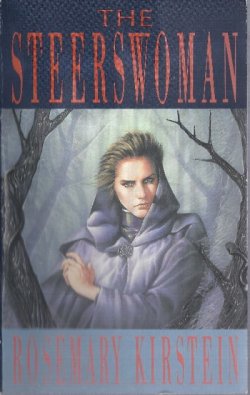
 ).
).
 , which opens up its story’s universe in a series of appendices and so becomes almost a space opera; or even the hints dropped regarding the Age of Legends in Robert Jordan’s bloated Wheel of Time series.
 ,
,  and
and  . All four are available in an omnibus volume,
  . I shall have get me that omnibus volume. (Edit: apparently the omnibus only contains the first two books. Ah well. I shall try to find all three books, then…)
 , Paolo Bacigalupi (Orbit)
 , Lauren Beukes (Angry Robot)
 , Ken MacLeod (Orbit)
 , Ian McDonald (Gollancz)
 , Tricia Sullivan (Orbit)
 , a much more substantial work – in fact, the posts above would likely have been no more than a single essay in that book.
 , Francis Spufford (Faber and Faber)
 , and I’ve ordered myself a copy. (You can count the number of art books in my book collection on the fingers of one hand… and they’re chiefly by the likes of


 – it’s probably the one novel I’ve reread more than any other, but I don’t think it’s an especially well-written book.
 ,
,  ,
,  ,
,  ,
,  …
… is one of the great films of the 1950s. His films were melodramatic, but also deeply subversive. And very, very cleverly made.
 remains a classic piece of cinema.
 ,
,  , and
, and  . And there are plenty more in their oeuvre.
 I had somewhat higher hopes of this novel. Sadly, it’s worse than the others I’ve read. The plot is thin: Bond plays Le Chiffre at cards, Bond wins, Le Chiffre kidnaps and tortures Bond, Bond is rescued. There’s loads of clumsy info-dumps. And Bond is even more offensively sexist than usual – the final line is “Besides, the bitch is dead”. Watch the movie, avoid the book.
 , Éric Rohmer (1990), is the first of Rohmer’s Contes des quatre saisons quartet, and the second film I’ve seen by him – the first was
  , which I thought slow but strangely involving, even though it didn’t seem to reach any sort of resolution.
  , Herbert Wilcox (1942), is a biopic of Amy Johnson. I reviewed it for Videovista
  , Anthony Fuqua (2009), is yet another bad New York cop movie. I reviewed it for Videovista
  , Fritz Lang (1953), is a film noir from master director Lang. The title refers to a club, where Raymond Burr (best known as Perry Mason) takes Anne Baxter, who is out drowning her sorrows after being ditched by her boyfriend. Burr is found dead the next morning, his head bashed in. Baxter can’t remember anything after leaving the club. A reporter believes her to be innocent and so tries to help find the real killer. There’a lot of evidence stacked up against Baxter, but it’s all cleverly shown to be either coincidental or a mistake on the witness’s part. There’s a lot in
  , a 1956 film also by Fritz Lang. Both feature stalwart newsmen solving murders. I guess reporters were held in higher esteem in those days…
 , Raúl Ruiz (2000), I rented because it stars Isabelle Huppert, who is, I think, one of the best actors of her generation. The title of the film belies its somewhat unsettling story. On his ninth birthday, a young boy tells his mother that he wants to return to his “real” mother. He’s not adopted, but instead seems to believe he is the reincarnation – or has been possessed by – a young boy who died several years earlier. The boy’s mother, played by Huppert, tracks down the “real” mother, and, bizarrely, the two start sharing the boy. In parts,
  – the chills lie in what is implied, in the way something which has no rational explanation pulls apart domestic routine. The ending does resolve the plot, but it’s a taut journey there. Recommended.
 (1984), is a BBC two-part drama, first broadcast in 1984, about the effects of a nuclear war on Britain, and specifically on the city of Sheffield. It’s effectively done. These days, they’d CGI the nuclear explosion itself, and you’d see walls of flame ripping through the city, buildings exploding and falling over, all that sort of thing: nuclear explosion as spectacle.
  , Joseph M Newman (1955), is one of those films which helped define the popular perception of 1950s cinema sf, along with
  ,
,  ,
,  and
and  .
.  , Frank Capra (1934), is on one of those Top 100 Films, but I forget which one. It was the first film to win the top five Oscars: best film, director, actor, actress and screenplay. Claudette Colbert plays a rich socialite with an overbearing father. He isn’t happy that she married a fortune-hunting aviator, so she runs away. On a Greyhound bus, she meets Clark Gable, a reporter, who recognises her and smells a story. He helps her to return to New York, although she has no money and he has very little. En route, they fall in love.
  , Martin Scorsese (2010). I’ve always thought Scorsese an over-rated director. Half the time he makes forgettable crowd-pleasers, the rest of the time he remakes
  . This falls into the former category and is based on a best-selling novel by Dennis Lehane. The island of the title is the site of a hospital for the criminally insane. One of the prisoners has disappeared, so FBI agent Leonardo DiCaprio and partner are sent to investigate. The twist in the film is obvious right from the start, the Civil War fort which forms the secure wing of the hospital looks like something out of Dracula, and Max von Sydow keeps on popping up and spouting wodges of psychobabble plainly designed to confuse the viewer. Avoidable.
 , Majid Majidi (1999), is an Iranian film, and proved much better than I’d expected it to be. Mohammed, a young boy at the Tehran Institute for the Blind, is picked up by his widowed father and taken to their home in the mountains. The father wants to remarry, but he can’t cope with a blind son. So he takes Mohammed to visit a blind carpenter and apprentices him to him. Mohammed doesn’t understand why he can’t stay at home with his father, grandmother and sisters. He may be blind, but with his Braille books he can keep up with the sighted kids in the village school. But the father is adamant. Then things start to go wrong, and the father’s plans and life unravel… I’ve seen two Iranian films before this –
  , which made my top five of the year, and
  – and they were both very good. As is
  It Doesn't Have To Be Right...