I love research. I take a nerdish delight in it. When I’m writing, I want everything in my story to be right. If that means digging through books, or searching the Internet, to find the information I need, then I’m more than willing to do so. I should be writing, of course. Except I can’t write if I don’t know what I need to know, if I can’t make sure it’s absolutely spot-on.
I don’t think I’m capable of writing a story in which I can “make it up as I go along”. I have come to accept that. The nearest I managed, ‘Killing the Dead’ in Postscripts 20/21 Edison’s Frankenstein, was set on an entirely invented generation starship. But I couldn’t let it go there. I had to pick a real destination for the ship, and calculate the length of time the journey would take. But even that didn’t do the trick. So I structured the story according to Dante’s Inferno, and borrowed imagery from it; which gave me a topic to spend hours happily researching.
I have in the past bought a copy of a long-out-of-print and scarce book – see here – so I could read up on something that appeared in a story I was writing. My story ‘Barker’ (see here) required a lot of research into the history and personalities of the early decades of the Space Race. Because everyone in the story except the title character was a real historical person. Fortunately the subject fascinates me and I already own a large number of books on it. See my Space Books blog. And yes, the flash fiction I posted there, ‘The Old Man of the Sea of Dreams’, also required a great deal of research too.
The story I’m currently working on – ironically, a fantasy – has had me researching Supermarine Spitfires and Vickers Wellington bombers. The protagonist is a RAF pilot during World War II, and I wanted to make sure I had all the details of flying those aircraft correct. I could have finessed it, I suppose – a few general piloting terms, perhaps, and then on with the story. But that would be cheating. It wouldn’t convince me.
And, without that research, how else would I have learnt that the the first item in the Vickers Wellington Pilot’s Notes Check list before landing is “Auto-pilot.. .. .. cock–OUT”? I kid you not. See page 25 here.
Another story, as yet unpublished, has one section featuring an Alvis Scorpion Combat Vehicle Reconnaissance (Tracked), so I hunted around until I found a copy of a book about the vehicle. Because I needed to get the terminology right.
Amanda Rutter of Floor to Ceiling Books asked on Twitter today “What book do you wish you had written?” She gave The Last Unicorn by Peter S Beagle, for its “simply gorgeous prose”, as her answer. I could have named something by Lawrence Durrell, whose prose I certainly admire the most. Or perhaps a science fiction novel that blew me away when I first read it. Or something by one of the my favourite sf writers. Instead, I picked Ascent by Jed Mercurio, because his intense and immediate, and closely-researched, style is how I’d like to write myself.
As a reader I want to know what it’s like, what it feels like, to be there. I want details. I am, after all, reading these books to explore other places, people and times – real or invented. And the last thing I want is glib one-line descriptions, or the distracting blur of authorial hand-waving. I feel novels should have bibliographies – and many novels do include a page of “Further Reading”. I have a work-in-progress which currently has twenty-five titles in its bibliography. It has, I admit, taken a long time to write. I hope it’ll be worth the effort.
I’ve wittered on about this subject before, but that’s because it’s something dear to me. True, fiction is not non-fiction. Nor should it try to be. But neither is it a failure of the imagination to research something heavily before writing about it.
I don’t write speculative fiction, I don’t write fantastic fiction. I write science fiction. Occasionally, I write fantasy. I use the so-called “marketing categories” because I expect my readers to understand what I am trying to do in my short stories, and readers that will understand are more likely to read fiction labelled as “science fiction” (or “fantasy”). They have an expectation of a certain mode of fiction when they see the label; and I have an expectation that my readers will appreciate what I am trying to achieve.
Which is not to say that science fiction is opaque to non-genre readers; nor should it be. But my primary audience is pretty much those readers who like the same sort of stuff I do. And I like science fiction. I like science fiction with rigour, deep characterisation and good prose – and just because common wisdom has it the genre is incapable of those, that does not mean it needs to be relabelled with some new and entirely arbitrary term. Because all fiction, of whatever mode or genre, is essentially “speculative”. It’s only in the nature of the speculation that differences obtain. “What if?” can be asked in many diverse ways; and there are probably more answers to each variant than there are indeed variants.
The label “science fiction” is just as much a part of the compact between writer and reader as the author’s name, the blurb, even the cover-art. Science fiction as a label may have received more than its fair share of abuse in the decades since 1926, but it remains a fairly well-understood term. To replace it with something even more nebulous, something which seems to want to disinherit the genre’s history, is neither helpful nor useful.
I want to see an end to science fiction’s bad press. This will not happen by side-stepping the criticism through renaming the genre. It will happen when it is commonly acknowledged that science fiction, like all modes of fiction, encompasses both populist escapist tales and complex literary stories. Perhaps then I will not need to label my stories as science fiction. Perhaps then labels will be irrelevant. Nor do I need literary authors slumming in the genre to improve it – whether they acknowledge that they are writing sf or not. I need only write the best science fiction I can write.
Between 1954 and 1980, Edmund Cooper published thirty novels and collections. None of his books remain in print, none have been considered for Gollancz’s SF Masterworks series. The Encyclopedia of Science Fiction says of him, Edmund Cooper “died with his reputation at a low ebb; but he was a competent and prolific writer”, which is hardly fulsome praise. In the decades since his death in 1982, Cooper has been almost forgotten. Secondhand copies of his novels are not hard to find, although it seems nothing of his was ever reprinted after 1980. Unlike many of his contemporaries, he wasn’t published much in the US (during the 1960s and 1970s, DAW had lots of UK sf writers on its list). Of Cooper’s novels, the one which is perhaps mentioned most often approvingly is A Far Sunset. This was first published in 1967, but stayed in print throughout the 1970s.
In 2032 AD, the Americans, Russians, and “United States of Europe” each built an interstellar spacecraft. The American ship was the biggest, the Russian the fastest, and the European the cheapest. This last was named the Gloria Mundi, and her destination was Altair. After twenty years of travel, spent chiefly in hibernation, the crew of twelve arrived in the Altair system… and discovered an inhabitable and inhabited world. They landed. Six went out to explore, but never returned. Three went looking for them, and also disappeared. The remaining trio had no choice but to follow… and were promptly captured by the humanoid Bayani. Only one of the three survived captivity, Paul Marlowe, the ship’s psychiatrist. As Poul Mer Lo, he went native.
The Bayani are described throughout A Far Sunset as possessing a “mediaeval” society, but it seems much more ancient than that. From the description of Baya Nor, the Bayani city, Angkor Wat was plainly an inspiration. As was early Polynesia. The Bayani are ruled by a god-king, always called Enka Ne, who rules with absolute power for one year. He is then sacrificed, and a new Enka Ne is chosen.
The current Enka Ne is intrigued by Marlowe, and visits him in disguise as Shah Shan. He asks to learn English, and Marlowe is astonished by Shah Shan’s fierce intelligence and the speed with which he learns what Marlowe has to teach. Emboldened by this, Marlowe tries to introduce the wheel to the Bayani. The priestly order are immediately against it, but only accept it reluctantly after Enka Ne kills over a hundred of them. Change, then, is not going to be easy. And the current Enka Ne’s reign is not long.
Sure enough, after a new Enka Ne becomes god-king, the school Marlowe has set up is destroyed. Determined not to give in, Marlowe decides to travel a distant mountain which may hold the secret to the Bayani’s origin. This he does, and, yes, he does find the secret of the Bayani. But it’s not enough to effect change.
But on Marlowe’s return to Baya Nor, he learns that Enka Ne has died. And the Bayani oracle has chosen Marlowe to be the new god-king…
Cooper evokes his invented world with skill, and Marlowe is a well-drawn character. A Far Sunset has not aged gracefully, but neither is it as embarrassing as many other books of its time. Some of the science and technology feels a bit 1960s, and the gender politics are definitely from that decade; but the Bayani and Baya Nor are mostly timeless. The writing throughout is solid, and occasionally good without being flashy. While the secret of the Bayani is not obvious – so the reveal does come as a surprise – the existence of a secret is perhaps introduced too late in the story to have much dramatic impact.
Having said all that, there’s not much in A Far Sunset that is actually science fiction. It could be the story of a European explorer cast adrift on a Pacific island whose inhabitants who have lived the same way for centuries. Even the secret behind the origin of the Bayani, and their god Oruri, doesn’t really need to be sf. And that makes A Far Sunset ultimately a disappointing read. It’s by no means a bad book. It’s well-written, with a well-drawn world and protagonist, but it could just have easily been a “European marooned in the South Seas” story. I suspect I shall have to find another novel by Cooper to take its place on my British SF Masterworks list.
ETA: comments have been closed, and the exchange between members of Cooper’s family and literary trust removed. This is not the venue for such a discussion, and I’ve no desire to be held responsible for what might or might not be said by either party. Please air your differences elsewhere.
There was a conversation this morning on Twitter about collecting and collectible authors. Lavie Tidhar has already given his thoughts on the subject here. I collect books by certain authors myself – just see my irregular book porn posts on this blog – but I collect those authors because I like and admire their prose. Any future value is an unlooked-for bonus. And given my taste in fiction, a not very frequent bonus…
Who knew back in 1991 that Stephen Baxter’s first novel, Raft, would one day be worth around £300? I was fortunate in that I was sent a free copy. And of his next two books, Timelike Infinity and Anti-Ice, which are also worth about £200 each.
Around the same time, I bought a first edition copy of Michael Blumlein’s first, and only, short story collection, The Brains of Rats, from Scream Press. (And it was harder in those days to buy books from US small presses.) That book is worth approximately the same now as it was twenty years ago.
Other authors whose books I collect, and own in first editions (often signed), are often worth little more than I paid for them. When it comes to choosing authors to invest in, I’m rubbish.
But then I tend to avoid popular authors – and it’s authors who have small print runs for their first few books, but then pick up a large following, whose books tend to be worth something. Authors that are hyped from the start could conceivably prove good buys – although such marketing campaigns usually involve huge print-runs of the book in question. Like Justin Cronin’s The Passage. Which isn’t very good, anyway.
For the true collectible author, you need someone whose first few books were recognised by the cognoscenti – a few approving reviews here and there – but didn’t make much of a splash. They need to be regularly published – Baxter has churned out one or two novels a year since Raft, while Blumlein has managed three novels in twenty-two years. As novelists grow in popularity, so people start to seek out those earlier disregarded works. And are willing to pay good money for them.
Paolo Bacigalupi – well, The Windup Girl caused too much of a splash, I think, and his abrupt jump to YA might have scuppered his chances. Hannu Rajaniemi’s debut may also have landed with too much noise. Though I’m not a fan of fantasy, NK Jemisin is a possibility; her first two books seem to be very popular.
Unfortunately, thanks to the success of some marketing campaigns I can’t think of other new authors whose books might prove collectible at a later date. Because, by definition, not much fuss was made about them. I’m trying to think of a few authors whose debuts were published in the past two years, garnered a few positive reviews, but didn’t otherwise set the blogosphere alight. Ian Whates, perhaps? Gareth L Powell? Chris Beckett? Aliette de Bodard? Two paperback originals, one small press, and one that’s actually a reprint of a small press edition. Perhaps that’s the problem, perhaps the blogosphere has changed things such that it’s a rare debut which can slip under the radar.
And now I’ve said that, no doubt people will think of lots of examples…
Genre fiction can be confusing, especially given the plethora of sub-genres. Here are some handy definitions, for the next time you find yourself out of your depth when contributing to the conversation about science fiction.
science fiction we can’t solve problems in the real world, so let’s invent a world and fail to solve its problems
space opera the universe is a very dangerous place… especially when human beings are around
military science fiction war is bad, and we shall demonstrate this by glorying in it
planetary romance slavery is okay if their skins are a different colour, like green
hard science fiction science and technology can be dehumanising, so we will replace everybody with computers and robots
cyberpunk corporations with the power of life or death over individuals are bad, so I shall take all that power for myself
alternate history if science fiction didn’t exist, someone would have had to invent it
steampunk the Victorian era was repressive, racist, sexist and imperialist, but at least they had giant airships
science fantasy any sufficiently advanced technology is indistinguishable from authorial wish-fulfilment
And it’s a subgenre of fantasy, but…
urban fantasy vampires are a metaphor for sexual predation, so we will make it all about sex
A month into the year, more or less, and so time for some more filler in lieu of proper content. Here are the books I’ve read and the films I’ve seen…
Books The Passage, Justin Cronin (2010). Dear me, how much did they spend on this? Nearly $4 million for the trilogy? No wonder it’s been hyped to buggery. Was it worth the money? Sadly, no. The first third is very good indeed, but then the book bogs down badly, and never quite recovers. Further, everything in it is just far too familiar, there’s almost nothing that’s new. And those borrowings are entirely from films – in no way does The Passage build on earlier vampire or post-apocalyptic written works. It’s like watching a “That’s Showbusiness” compilation, one that’s been extended to last most of the day. I can understand the book selling well – it would be strange if it hadn’t, given all the money spent on marketing it – but I’m puzzled by its inclusion on so many best of the year lists. Did I miss the memo? Was I not concentrating when we all decided as a genre that recycling tired old clichés from movies was preferable to new, innovative ideas? I wrote a bit about The Passagehere.
Genesis, Bernard Beckett (2006), I recall hearing good things about a couple of years ago. But at the time the book proved somewhat elusive. Recently, it re-appeared in a very cheap edition, so I bought a copy. It’s a not a novella, it’s a YA novel. And a thin one at that. I hated it. It’s framed as the oral examination of a candidate for the Academy, the ruling elite of an island nation which is all that remains after a plague has devastated the Earth. The first few questions of this exam are effectively, “explain the world of this story to the reader so they can follow what little plot the book possesses”. We then get pages of badly-disguised info-dumps, in which the character speaks not in dialogue but in descriptive prose. There’s an interesting twist at the end, the writing is mostly very good, the book presents complex ideas in an easily-digestible fashion, but it’s all been done before and it’s so clumsily-structured it’s almost embarrassing to read.
0.4, Mike Lancaster (2011), I actually read for review for Interzone, but it proved unsuitable as it’s aimed at eleven-year-olds. It’s another sf novel which references film and television, but not the written form. So nothing in it seems especially original. Still, I wasn’t the target audience, so it’s no surprise I found it unsatisfactory.
The Steerswoman, Rosemary Kirstein (1989), was the first book of this year’s reading challenge, and I wrote about it here.
Spreading My Wings, Diana Barnato Walker (2003), I read for research for a story I was writing. Barnato Walker was an early British aviatrix – she learnt to fly between the wars, and joined the Air Transport Auxiliary when it was formed during World War II. Later, she flew a BAC Lightning and became the first British woman to pilot an aircraft through the Sound Barrier. Spreading My Wings, despite the somewhat naff title, is a fascinating read. Barnato Walker’s voice is engaging, she has a remarkable memory for details, and she led an interesting life.
The Sodom and Gomorrah Business, Barry N Mazlberg (1974), in which Malzberg attempts to channel JG Ballard and fails. I know Malzberg was a mainstay of the US New Wave (take note: not the New Wave, which was British, but the US movement of the same name it inspired; the US New Wave needs that qualifying “US” to distinguish it from the original (British) New Wave). The Sodom and Gomorrah Business would happily have fitted into either movement on each side of the Atlantic, although I suspect it’s closer to the UK side in tone and implementation. At some indefinite point in the near-ish future, two young men from an institute which produces mercenaries play hooky and visit the nearby post-apocalyptic city. They’re captured by “savages”, who prove to be not quite as uncivilised as advertised, and one is forced into leading them in an attack on the institution. Which is run entirely by robots, who are themselves running down. It’s all very hip and nihilistic, but the prose can’t quite carry it.
Spacesuits, Amanda Young (2009), is about, well, spacesuits – specifically the Smithsonian National Air and Space Museum’s collection. I reviewed it on my Space Books blog here.
Sylvow, Douglas Thompson (2010), I reviewed for Interzone instead of 0.4. Thompson could be a name to watch, if this is any indication. Weirdly, the name of the publisher of Sylvow, Eibonvale Press, appears nowhere on this book, not even on the spine.
First on the Moon, Jeff Sutton (1958), is Sutton’s debut novel and its title pretty much tells you the plot. It’s all manly men of America and dastardly Russkies, pure pulp from start to finish, and not especially scientifically accurate, despite the author being an aviation journalist. I plan to review it on my Space Books blog.
Reflections from Earth Orbit, Winston E Scott (2005), is the short, copiously-illustrated autobiography of an astronaut who flew on two Shuttle missions. A review of it will appear on my Space Books blog soon.
Films Star Trek: Deep Space Nine – Series 6 (1997). So only one season left and I’ll have seen the lot. I’ve heard it said by many, and I was starting to believe it myself, that Deep Space Nine is the best of the Trek franchises. But, oh dear, they plumbed the depths in this season. The war with the Dominion was getting interesting, although the Vorta Weyoun is really irritating. But they resolved the war – at least as it pertains to Deep Space Nine itself – by retaking the station in one of the crappiest-looking and unconvincing space battles in Trek history. Other episodes tried hard for interesting themes, but only proved embarrassingly bad. The student crew of a battleship behind enemy lines, for example. The writers aimed for pathos, missed, and hit bathos. The episode where Quark changes sex in order to help Grand Nagus Zek back into power was cringe-inducing. The Ferengi are cringe-inducing, anyway. Who thought comedy Shylocks was a good idea? Even the better episodes in this season can’t compare with earlier seasons – O’Brian makes an unconvincing undercover cop, and the reason why he was recruited is never satisfactorily explained; the super-secret Section 31 seems completely antithetical to the philosophy of Trek; and the episodes set in the Vegas show-lounge on the holodeck just seemed really cheap. Let’s hope the final season is better.
State Of The Union, dir. Frank Capra (1948). I don’t know why Capra gets so much stick. I really enjoyed It’s A Wonderful Life, and Lost Horizon is a pretty good film. I suppose Capra was one of your original “Hollywood liberals”, and so it’s become the fashion to sneer at his output. And it’s true that State Of The Union doesn’t map onto modern US politics – and probably didn’t map onto US politics of 1948, either. Spencer Tracy plays a self-made millionaire – an aircraft manufacturer, of course – who is persuaded to run for high office. He’s estranged from his wife, played by Katherine Hepburn, but in order to secure the Republican nomination, they need to pretend to be happily wed. Cue much rapid-fire screwball rom com banter, and an eventual happy ending. By all accounts, Capra’s film stripped out much of the wit in the original play, written by Russell Crouse and Howard Lindsay. Perhaps it’s true that Capra’s films can be a little anodyne – even the politics espoused in State Of The Union is a combination of common-sense and light Hollywood liberalism. As a satire on American politics, the film has little bite. But then, I suspect it was never intended to. The title may reference the president’s annual speech, but it’s the union between Tracy and Hepburn which has precedence in the film. Capra’s reputation may have tarnished somewhat over the years, but he still made entertaining, enjoyable films… which was not always true of his contemporaries.
A Winter’s Tale, dir. Éric Rohmer (1992), is the second of Rohmer’s Contes quatre saison. Félicie fell in love with Charles while on holiday, but stupidly gave him the wrong address by mistake when the holiday ended. As he was heading off to the US, she had no way of contacting him… or of telling him that he was now the father of a daughter. Five years pass. Félicie is a hairdresser in Paris, sleeping with both Maxence, owner of the salon where she works, and librarian Loïc. But she still loves Charles. Maxence persuades her to move with him Nevers, to live with him and work in the salon he is opening there. She agrees. But she’s unable to settle down with Maxence – she can’t love him the way she loves Charles – so she returns to Paris… and entirely coincidentally bumps into Charles on a bus. So they get back together. Like the first film of the quartet, A Tale Of Springtime (see here), this is a quiet, slow but deep study of its characters – especially Félicie. She’s not especially likable – Loïc loves her, but she’s clearly not his intellectual equal and it’s hard to determine what she gets from her relationship with him. Maxence, at least, makes for a more understandable partner for her, but even then she fails to understand his expectations. Félicie comes across as a spoilt dreamer… but then Rohmer allows her dream to come true. As a result, the film lacks any real resolution.
Percy Jackson & The Lightning Thief, dir. Chris Columbus (2010), is based on a popular YA fantasy series, just like the Harry Potter films. And just like the Harry Potter films, it’s about a teenager who discovers he is not an ordinary person, but has special powers. Even more so, just like Harry Potter, Percy Jackson’s powers are more special than those of the other kids with special powers. This because he is a son of Poseidon. When someone steals Zeus’ lightning bolt, everyone suspects Percy Jackson, although he has been happily living the life of a mundane, unaware of his special Harry-Potter-like powers. This abrupt eruption of Greek godly adventure into his life, he takes with aplomb, a readiness to learn how to use his special powers, and a beady eye for a feisty young woman. The Greek pantheon is cleverly integrated into this Harry Potter clone – it is, at least, a bit more original than Jennings Goes to Wizard School – but it still feels like by-the-numbers for a target audience. Good special effects, though.
From Here To Eternity, dir. Fred Zinnemann (1953), is one of those classic 1950s films everyone knows of. Well, there’s that iconic scene with Deborah Kerr and Burt Lancaster rolling about and snogging in the surf. In fact, that was pretty much all I knew about the film. That, and Frank Sinatra was in it and won an Oscar for best supporting actor. So I was somewhat surprised to discover that it’s not really about Lancaster’s character, but about the one played by Montgomery Clift. And it’s about boxing – or rather, not boxing – in the US Army. It’s also set in Hawaii, in the year leading up to Pearl Harbour. Clift plays a bugler who has transferred to a rifle company on Oahu. He used to be a boxer, and was very good at it, but gave up when he blinded a friend during a sparring bout. The rifle company’s CO, however, won’t take no for an answer, and instructs his NCOs to begin a campaign of harassment and bullying until Clift agrees to box. Lancaster, the first sergeant, a man’s man and a soldier’s soldier, disagrees with his CO, and does his best to make sure Clift comes to no real harm. Meanwhile, Lancaster has also fallen in love with his CO’s wife, Kerr, which is a definite no-no in the armed forces. Sinatra plays Clift’s buddy in the barracks, who’s a bit of a chancer and introduces Clift to the Oahu night-life. To be honest, Lancaster should have got the Oscar – he’s the best thing in the entire film. It’s also bizarre that the film never mentions the war taking place elsewhere on the planet… until it abruptly intrudes in the final quarter of the film. I suspect there was a better film to be made of From Here To Eternity‘s script, because this one feels too ordinary for much of its length to justify the eight Oscars it won. A classic, then, but not a great classic.
The Seventh Continent, dir. Michael Haneke (1989), was Haneke’s debut film, and is apparently inspired by a true story. A young Austrian couple, solidly middle-class, with a young daughter; she works and co-owns an opthalmic practice, he’s an engineer at a chemical plant. Haneke shows us a day in their life – troubles at work, dull routine, a voice-over reading out a letter from the wife to her mother-in-law. We then see another similar day a year later. Some things have changed for the better, some for the worse. But their life together is still mostly comfortable. In the final part of the film, the couple tell all their friends and relatives they are emigrating to Australia. They empty their bank accounts, sell their half of the opthalmic practice, and spend all their money on a massive feast. They then smash everything in their house. Finally, they commit suicide. No reason is given for them taking their lives, and nothing is presented in the first two parts of the film which might explain it. So, right from the start Haneke was making films which defied easy explanation, which did not adhere to the usual rules of film narrative. Last year, I bought the Michael Haneke Collection DVD set, which contains Code Unknown, The Piano Teacher, Time Of The Wolf and Hidden. Annoyingly, Artificial Eye have now brought out the Michael Haneke Anthology DVD set, which contains ten of his films – all but The White Ribbon, in fact. And including the four I already own. Bah.
Laputa – Castle In The Sky, dir. Hayao Miyazaki (1986), is the second of Studio Ghibli’s film, which I am slowly working my way through (though I’ve seen several of the later ones). There’s lots in here that’s common to Miyazaki’s films – the feisty young girl, the bizarre steampunk-ish aesthetic, the teenage boy sidekick, a world recovering from a past unexplained catastrophe, a focus on a simple life-style, and a villain with a moustache… In the world of Laputa – Castle In The Sky, there used to be flying cities, but most have gone – all except Laputa, which is now considered near-mythical. Sheeta escapes from Colonel Muska when pirates, led by their mother Dola, attack the airship carrying her. She is found by Puza, who agrees to help her. The chase is on – both Muska and Dola after Sheeta and Puza. But it turns out Dola and her piratical sons are actually the good guys, and with their help Sheeta and Puza find the lost flying city of Laputa. Which is what Muska was after – or rather, its fabulous technology. But only Sheeta and Puza hold the secret to the city. Entertaining, with some lovely visuals, but the plot is a little too familiar and doesn’t quite hang together in a couple of places.
Certified Copy, dir. Abbas Kiarostami (2010), I reviewed for VideoVista here.
Last week, this post, Is Science Fiction Getting More Conservative?, appeared on pajamasmedia.com. The writer contacted four right-wing genre authors, and asked their opinion. The article has, at the time of writing, more than 350 comments. Almost none are dissenting opinions.
I’m not going to debate the rightness or wrongness of the article. (They’re wrong, of course.) It just strikes me as interesting how politicised commentary about the genre has become in recent years. Back in the 1970s and 1980s, when I was discovering science fiction, an author’s politics didn’t seem especially important to me. Perhaps it was just my age. I devoured Heinlein’s novels and, while I was never convinced by his bizarre politics, it didn’t put me off his books. Not that I understood quite why they were considered so good, however. The same was true for other works – all those demonisations of the Other, all that libertarian new frontier hogwash – none of it seemed to affect my enjoyment of the sf books I read. Back in the 1960s, I believe, Donald Wollheim polled sf readers and discovered that their preferred form of government was a “benevolent dictatorship” – which tells you more about the immaturity of the genre’s readers than it does their politics.
Later, after I’d discovered fandom and started attending conventions, I remember conversations about authors’ politics – laughing at rumours that David Drake wore a belt with a swastika buckle, for example. But it didn’t seem to have any bearing on the fiction I read (not that I read Drake anyway). Even when Iain M Banks started writing his – famously left-wing – Culture novels, it scarcely seemed relevant. The Culture would be a nice place to live in, yes. So too would John Varley’s Eight Worlds – the fact that Earth is forbidden, notwithstanding – and Varley is often quoted as the successor to Heinlein.
But now, the debate over politics within sf texts, and without, seems to taking up more and more bandwidth in the genre commentary space. Perhaps it’s simply because what were once private conversations have become public – it’s an artefact of the Internet. Or maybe the US’s drift further to the right over the past twenty years has made previously extremist views more mainstream. Certainly the Internet has meant that US voices are now among the loudest in genre conversations in other countries, conversations that were once protected by the Atlantic Ocean.
What makes this worse – to me – is that the right seems to be dominating the conversation. Declare that sf is becoming too “conservative” (ie, right-wing, rather than its old meaning of “reactionary”), and right-wing fans will jump in to agree. Say it’s becoming too left-wing, and they’ll jump in to disagree. It’s almost a war – except only the right are fielding troops. They’ll tell you the left is just as guilty of spreading propaganda and lies, but… where? I can’t see it. I look at the genre landscape, and the loudest voices are often those of the right. Don’t forget it’s only the right that has its own version of Wikipedia (and anyone who claims Wikipedia itself is left-wing is an idiot).
I don’t have an issue with the personal politics of authors. They are, after all, personal. If those politics flavour their output, and I disagree politically, then I probably won’t read them. It doesn’t mean I categorically won’t, however. There are some tropes in sf which seem a natural fit for right-wing sentiments – autocratic galactic empires, libertarian space pioneers, etc. – although I suspect that “fit” is more a matter of custom than the result of any real thought or speculation.
There are few consciously left-wing sf texts, and most of those are dystopian. Even Banks’ Culture is a bit of a cheat as it’s a post-scarcity civilisation. There are also few near-future novels which show a happily socialist Earth (Ken MacLeod’s springs to mind as excellent examples). It often feels like Reaganomics has cast a shadow over the next fifty years as far as science fiction is concerned. Perhaps this disparity is why conversations about science fiction often seem to gravitate rightwards – there isn’t enough critical mass on the left to counter it.
Surely it’s time to redress the balance? We live in a science-fictional world, after all, and it’s certainly not a monocultural one-party state. I would, of course, prefer to see more sf which met my own political preferences. And I’d like to see such sf discussed intelligently. By both sides. I don’t think it’s doing the genre any good to have two antagonistic camps – one of which is armed; guess which – and one is not.
But then I also believe utopias are possible. But maybe that’s more a result of my politics than my taste in literature…
It’s that time of year again when blogs fill up with pimp posts for the Hugo Awards. I disagree with such pimping in principle – it becomes about personalities and not works. Nor do I really consider the Hugo Award especially significant. After all, the winners are chosen by popular vote by a small number of people of broadly similar tastes. For example, despite being an international award, the Hugo for Best Novel was been won by only nine non-US authors throughout its fifty-seven-year history. This is not unexpected – the great majority of Worldcons, at which the Hugos are voted for, have taken place in the US.
Having said all that, I suspect it may be time to retire the Hugo Award for Best Fan Writer. Make it Best Blog, or something. Drag it into the twenty-first century, at least. Even as a catch-all term, Best Fan Writer is near-meaningless: most will take it to mean “nicest / most entertaining person related to writing about science fiction in some vague ill-defined way”. In other words, they’re voting on personalities, not writings.
The British Science Fiction Association Award, on the other hand, I hold dear. For a start, I am a member of the BSFA, and have been for more than twenty years. (The only time I have been eligible to vote for the Hugo was when I attended the 2005 Worldcon in Glasgow.) I also find that the BSFA Award shortlists align much better with my tastes in sf. However, I still think there is room for improvement.
As pimping is beginning to distort what is actually “best”, perhaps BSFA members should only be allowed five nominations per category. Given a limited number of nominations, members might be more discriminatory with them. It would certainly prevent occurences of “nominate me and I’ll nominate you”. On the other hand, this could lead to a wide spread of nominees with only small numbers of nominations, leading to difficulty in putting together short-lists.
All works, not just novels, should be UK-published only. For online fiction, non-fiction and art, this would mean the venue should to have a publication address in the UK; or, if no publication address exists, an editorial address. So, Strange Horizons – current editor-in-chief Niall Harrison is resident in the UK – is eligible. But Clarkesworld – editorial address in New Jersey, USA – is not. For non-fiction published on a blog or similar site, then perhaps the author’s residence is relevant. Nationality is always irrelevant. I also think there should be a minimum word-limit for non-fiction, say 1,500 words.
And perhaps the BSFA Award should be renamed. Arthur C Clarke casts a huge shadow over British sf, but he already has an award named for him. It occurred to me there might be a comparable British figure to Hugo Gernsback. So I googled… and found this excellent article by Rob Hansen on the beginnings of the BSFA. A few names stand out. Walter Gillings was an early editor of several early British magazines. Ken Slater did much to re-vitalise British fandom after World War 2 with his Operation Fantast. But, after some thought, I think it’s possible to commemorate two people. By renaming the BSFA Award the “Ted”, it honours the work of Edward ‘Ted’ John Carnell, editor of New Worlds, and EC ‘Ted’ Tubb, the first editor of the BSFA’s critical journal, Vector. Perhaps “winning a Ted” doesn’t quite have the same ring to it as “winning a Hugo”, but give it time…
Back in October 2009, I wrote a piece on my first Euripidean Space story, ‘Thicker than Water’ – you can find it here. ‘A Cold Dish’ was the second of my stories set in that universe, and it too was published in Jupiter magazine – in Jupiter 28, April 2010.
‘A Cold Dish’ is based on the play The Suppliants by Euripides. The play recounts how Theseus approaches the king of Thebes in order to ask for the bodies of the Seven Against Thebes, the seven leaders of an army which failed to invade the city-state. In Ancient Greece, burial rites were very important, and wars fought over dead bodies were not uncommon in the literature of the time. Unfortunately, this plot didn’t translate well to my Euripidean Space universe. It wasn’t really dramatic enough. Further, the need to bury dead heroes is not a cultural urge which translates to modern Western European culture.
In the universe of my Euripidean Space stories, the Earth has locked itself off behind a firewall for reasons unknown. This has left a number of off-planet settlements – on Mars, in the Asteroid Belt, among the moons of Jupiter and Saturn – struggling to survive. Patrolling the Solar System is an alien sentinel, origin unknown, which appears to exist solely to protect a number of alien artefacts. Unfortunately, these artefacts are not obvious – some of them could be somewhat unusual natural phenomena. In ‘Thicker Than Water’, for example, the artefact was a sea of buckminsterfullerenes on the moon of Tethys.
I’d already decided what the alien artefact would be in this, my second Euripidean Space story, and that dictated its setting. The Saturnian moon Mimas is sometimes known as the “Deathstar moon” because it features an enormous crater, Herschel, which covers a third of its face – as is obvious from the photo below. Herschel resembles a huge radio-dish, like Arecibo or Jodrell Bank. Identifying the artefact gave me part of the story’s plot – the “seven” would attack Mimas to prevent the Mimanteans from experimenting with the artefact. Herschel Crater also gave me the story’s title: ‘A Cold Dish’.
Image credit: NASA/JPL/SSI
But it still wasn’t enough. Happily, the title of the story – it was originally only a working title – provided the answer: revenge. Theseus’s mission to Mimas would be partly to retrieve the bodies of the dead heroes, but would also be driven by revenge. My Theseus analogue I named Spiro Maris – the Spiro, I suppose, from his adventures in the Labyrinth on Crete. I don’t recall why I gave him the family name Maris. The other characters in ‘A Cold Dish’ also bear names derived from their Greek counterparts. The Seven of Euripides play were Amphiaraus, Capaneus, Hippomedon, Parthenopeus, Polynices, Eteocles and Tydeus. Not all are named in ‘A Cold Dish’, but of those that are… Capaneus was known for his immense strength, so I called him Armstrong. Amphiarus means “twice-cursed”, which became Bimalison. Hippomedon… well, “hippo” is horse, so I named him Steed. The two Foote brothers are so named because their father was Oedipus, or “swollen-footed”.
As an example of “just enough information”: in ‘Thicker Than Water’, I’d named the settlement Torus for its carousel living-quarters. This phonetically aped Tauris, the name of the city where the Euripides’ play I’d based the story on had taken place. I felt I needed something similar for ‘A Cold Dish’. The Suppliants takes place in Thebes, but I couldn’t find any reference to the name’s meaning. So I decided to use the name as is for the Mimantean settlement. But I called it The BES, without actually bothering to work out what the acronym meant. The Built Environment System? It didn’t really matter.
As for “too much information”. I realised I didn’t know how large Saturn would appear in the Mimantean sky. The moon orbits at a mean distance of 185,520 kilometres, so I suppose I could work it out. Or I could finesse it, of course, and simply not mention it. But it felt like a useful detail. Instead, I went hunting on the internet, and on the JPL-NASA website found this:
Courtesy NASA/JPL-Caltech
The webpage here contains a number of artist’s impressions of the surfaces of the moons of Saturn and Jupiter.
I had a plot, a cast and a location. Now I needed an opening. I had this image in my head of figures in spacesuits encrusted with ice, so that’s what I used. Maris is inspecting the frozen bodies of the Seven, and then returns to the BES to negotiate with the Mimanteans. The rest of the story more or less wrote itself. I needed a Greek chorus. In ‘Thicker Than Water’, I’d used Saturn’s radio noise, but I wanted something different. So I decided to have all voice communication in the BES broadcast throughout the settlement. That allowed me to insert the grieving mothers, who provide the chorus in Euripides’ play, into the story and, as a bonus, gave me some pointers to the character of the Mimanteans. I also managed to include a reference to Theseus’s boat (also known as Granny’s broom).
The more I read up on the Ancient Greek characters on whom I was basing my cast, the more information I could insert into the story regarding their backgrounds. For each of the Greek city-states, I picked a moon: Athens became Rhea, Troy is Iapetus, Sparta is Hyperion, for example. Likewise with the personalities from the myths: Oedipus I renamed Rex Foote, Agamemnon is Stanovsky, Helen of Troy is, er, Helen Bright, Paris is Alexander Lek… Some of these may well make appearances in other Euripidean Space stories.
Some might say I’ve put far too much into ‘A Cold Dish’. All the references to Euripides’ play and Greek myths, which most readers won’t actually spot, some might consider those irrelevant in “a fun pure SF piece” (as Rich Horton described it on sfsite.com). But I believe stories should be more than just “fun”. I’d like to think there’s plenty to unpack in my stories, not just what appears on the surface. I feel that enriches the reading experience.



 says of him, Edmund Cooper “died with his reputation at a low ebb; but he was a competent and prolific writer”, which is hardly fulsome praise. In the decades since his death in 1982, Cooper has been almost forgotten. Secondhand copies of his novels are not hard to find, although it seems nothing of his was ever reprinted after 1980. Unlike many of his contemporaries, he wasn’t published much in the US (during the 1960s and 1970s, DAW had lots of UK sf writers on its list). Of Cooper’s novels, the one which is perhaps mentioned most often approvingly is
  . This was first published in 1967, but stayed in print throughout the 1970s.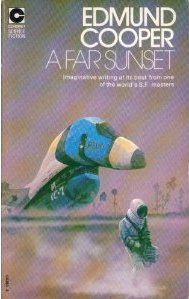
 , would one day be worth around £300? I was fortunate in that I was sent a free copy. And of his next two books,
  and
and  , which are also worth about £200 each.
 , from Scream Press. (And it was harder in those days to buy books from US small presses.) That book is worth approximately the same now as it was twenty years ago.
 . Which isn’t very good, anyway.
 caused too much of a splash, I think, and his abrupt jump to YA might have scuppered his chances. Hannu Rajaniemi’s debut may also have landed with too much noise. Though I’m not a fan of fantasy, NK Jemisin is a possibility; her first two books seem to be very popular.
 , Bernard Beckett (2006), I recall hearing good things about a couple of years ago. But at the time the book proved somewhat elusive. Recently, it re-appeared in a very cheap edition, so I bought a copy. It’s a not a novella, it’s a YA novel. And a thin one at that. I hated it. It’s framed as the oral examination of a candidate for the Academy, the ruling elite of an island nation which is all that remains after a plague has devastated the Earth. The first few questions of this exam are effectively, “explain the world of this story to the reader so they can follow what little plot the book possesses”. We then get pages of badly-disguised info-dumps, in which the character speaks not in dialogue but in descriptive prose. There’s an interesting twist at the end, the writing is mostly very good, the book presents complex ideas in an easily-digestible fashion, but it’s all been done before and it’s so clumsily-structured it’s almost embarrassing to read.
 , Rosemary Kirstein (1989), was the first book of this year’s reading challenge, and I wrote about it
  , Barry N Mazlberg (1974), in which Malzberg attempts to channel JG Ballard and fails. I know Malzberg was a mainstay of the US New Wave (take note: not the New Wave, which was British, but the US movement of the same name it inspired; the US New Wave needs that qualifying “US” to distinguish it from the original (British) New Wave).
  , Amanda Young (2009), is about, well, spacesuits – specifically the Smithsonian National Air and Space Museum’s collection. I reviewed it on my Space Books blog
  , Jeff Sutton (1958), is Sutton’s debut novel and its title pretty much tells you the plot. It’s all manly men of America and dastardly Russkies, pure pulp from start to finish, and not especially scientifically accurate, despite the author being an aviation journalist. I plan to review it on my
  , Winston E Scott (2005), is the short, copiously-illustrated autobiography of an astronaut who flew on two Shuttle missions. A review of it will appear on my
  (1997). So only one season left and I’ll have seen the lot. I’ve heard it said by many, and I was starting to believe it myself, that Deep Space Nine is the best of the Trek franchises. But, oh dear, they plumbed the depths in this season. The war with the Dominion was getting interesting, although the Vorta Weyoun is really irritating. But they resolved the war – at least as it pertains to Deep Space Nine itself – by retaking the station in one of the crappiest-looking and unconvincing space battles in Trek history. Other episodes tried hard for interesting themes, but only proved embarrassingly bad. The student crew of a battleship behind enemy lines, for example. The writers aimed for pathos, missed, and hit bathos. The episode where Quark changes sex in order to help Grand Nagus Zek back into power was cringe-inducing. The Ferengi are cringe-inducing, anyway. Who thought comedy Shylocks was a good idea? Even the better episodes in this season can’t compare with earlier seasons – O’Brian makes an unconvincing undercover cop, and the reason why he was recruited is never satisfactorily explained; the super-secret Section 31 seems completely antithetical to the philosophy of Trek; and the episodes set in the Vegas show-lounge on the holodeck just seemed really cheap. Let’s hope the final season is better.
 , dir. Frank Capra (1948). I don’t know why Capra gets so much stick. I really enjoyed
  , and
, and  is a pretty good film. I suppose Capra was one of your original “Hollywood liberals”, and so it’s become the fashion to sneer at his output. And it’s true that
  , dir. Éric Rohmer (1992), is the second of Rohmer’s Contes quatre saison. Félicie fell in love with Charles while on holiday, but stupidly gave him the wrong address by mistake when the holiday ended. As he was heading off to the US, she had no way of contacting him… or of telling him that he was now the father of a daughter. Five years pass. Félicie is a hairdresser in Paris, sleeping with both Maxence, owner of the salon where she works, and librarian Loïc. But she still loves Charles. Maxence persuades her to move with him Nevers, to live with him and work in the salon he is opening there. She agrees. But she’s unable to settle down with Maxence – she can’t love him the way she loves Charles – so she returns to Paris… and entirely coincidentally bumps into Charles on a bus. So they get back together. Like the first film of the quartet,
  (see
(see  , dir. Chris Columbus (2010), is based on a popular YA fantasy series, just like the Harry Potter films. And just like the Harry Potter films, it’s about a teenager who discovers he is not an ordinary person, but has special powers. Even more so, just like Harry Potter, Percy Jackson’s powers are more special than those of the other kids with special powers. This because he is a son of Poseidon. When someone steals Zeus’ lightning bolt, everyone suspects Percy Jackson, although he has been happily living the life of a mundane, unaware of his special Harry-Potter-like powers. This abrupt eruption of Greek godly adventure into his life, he takes with aplomb, a readiness to learn how to use his special powers, and a beady eye for a feisty young woman. The Greek pantheon is cleverly integrated into this Harry Potter clone – it is, at least, a bit more original than Jennings Goes to Wizard School – but it still feels like by-the-numbers for a target audience. Good special effects, though.
 , dir. Fred Zinnemann (1953), is one of those classic 1950s films everyone knows of. Well, there’s that iconic scene with Deborah Kerr and Burt Lancaster rolling about and snogging in the surf. In fact, that was pretty much all I knew about the film. That, and Frank Sinatra was in it and won an Oscar for best supporting actor. So I was somewhat surprised to discover that it’s not really about Lancaster’s character, but about the one played by Montgomery Clift. And it’s about boxing – or rather, not boxing – in the US Army. It’s also set in Hawaii, in the year leading up to Pearl Harbour. Clift plays a bugler who has transferred to a rifle company on Oahu. He used to be a boxer, and was very good at it, but gave up when he blinded a friend during a sparring bout. The rifle company’s CO, however, won’t take no for an answer, and instructs his NCOs to begin a campaign of harassment and bullying until Clift agrees to box. Lancaster, the first sergeant, a man’s man and a soldier’s soldier, disagrees with his CO, and does his best to make sure Clift comes to no real harm. Meanwhile, Lancaster has also fallen in love with his CO’s wife, Kerr, which is a definite no-no in the armed forces. Sinatra plays Clift’s buddy in the barracks, who’s a bit of a chancer and introduces Clift to the Oahu night-life. To be honest, Lancaster should have got the Oscar – he’s the best thing in the entire film. It’s also bizarre that the film never mentions the war taking place elsewhere on the planet… until it abruptly intrudes in the final quarter of the film. I suspect there was a better film to be made of
  , dir. Tom Reeve (2004), I reviewed for the Zone
  , dir. Juan José Campanella (2009), I reviewed for VideoVista
  , dir. Michael Haneke (1989), was Haneke’s debut film, and is apparently inspired by a true story. A young Austrian couple, solidly middle-class, with a young daughter; she works and co-owns an opthalmic practice, he’s an engineer at a chemical plant. Haneke shows us a day in their life – troubles at work, dull routine, a voice-over reading out a letter from the wife to her mother-in-law. We then see another similar day a year later. Some things have changed for the better, some for the worse. But their life together is still mostly comfortable. In the final part of the film, the couple tell all their friends and relatives they are emigrating to Australia. They empty their bank accounts, sell their half of the opthalmic practice, and spend all their money on a massive feast. They then smash everything in their house. Finally, they commit suicide. No reason is given for them taking their lives, and nothing is presented in the first two parts of the film which might explain it. So, right from the start Haneke was making films which defied easy explanation, which did not adhere to the usual rules of film narrative. Last year, I bought the
  DVD set, which contains
  ,
,  ,
,  and
and  . Annoyingly, Artificial Eye have now brought out the
  DVD set, which contains ten of his films – all but
  , in fact. And including the four I already own. Bah.
 , dir. Hayao Miyazaki (1986), is the second of Studio Ghibli’s film, which I am slowly working my way through (though I’ve seen several of the later ones). There’s lots in here that’s common to Miyazaki’s films – the feisty young girl, the bizarre steampunk-ish aesthetic, the teenage boy sidekick, a world recovering from a past unexplained catastrophe, a focus on a simple life-style, and a villain with a moustache… In the world of
  , dir. Abbas Kiarostami (2010), I reviewed for VideoVista

 It Doesn't Have To Be Right...