
I read the recently-published “restored text” – and the history of the novel and its manuscripts is as barking mad as its story. Burroughs submitted the original novel to Olympia Press in Paris, which promptly published it. But he decided to rewrite chunks for the US edition a couple of years later, but not all of the changes were delivered in time. But they were in time for the UK publication a couple of years after that. So there are three major, and different, editions of The Soft Machine (1966, USA) – and this version is based on the second, with variations from both the first and third versions. All of which are documented in several appendices.
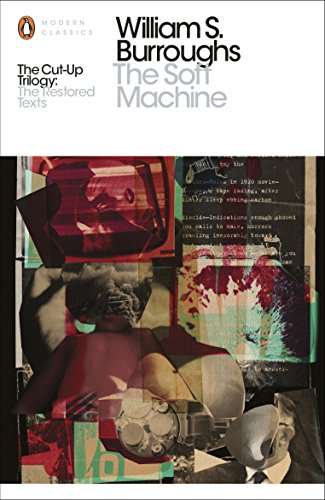
Story-wise… The Soft Machine is the first book of the Cut-Up Trilogy… because Burroughs took the text of many chapters, cut it into pieces and re-arranged it. You would think this would make it almost impossible to read, but it’s surprisingly easier than you’d expect. The plot is part science fiction, part autobiography, part thriller. There’s a secret agent, and time travel, and Mayans, and bits and pieces from the earlier Naked Lunch (1959, USA). It reads mostly like episodes from Burroughs’s life, with science fiction interludes. While the cut-up narrative is not as difficult to parse as I’d expected, the plot of the novel is less easy to follow. To be fair, it doesn’t really matter – the narrative jumps all over the place, and seems to end up somewhere that follows more or less from where it began.
The Soft Machine is surprisingly funny in places. It’s also very graphic. Burroughs was gay and promiscuous, and so too are his characters. Most of the encounters are fleeting and rough. There’s also lots of science-fictional ideas – some of which are mentioned in passing, but with pay-offs that appear later in the narrative. The cut-up chapters make them a little harder to track, however.
I’ve been a fan of William S Burroughs as, well, as a concept for several years, and I’ve dipped a couple of times into his fiction. I’d read bits of The Soft Machine before, but not the full novel – and I have to admit the “restored text” improved the reading experience, since the footnotes and appendices add a fascinating dimension to the novel.
Restored text editions of The Ticket That Exploded (1967, USA) and Nova Express (1964, USA) are also available.
 It Doesn't Have To Be Right...