
Back in the late 1990s, a friend complained that deciding to collect books by Stephen Baxter was proving more expensive than expected because he was so prolific. Baxter is still going. I’m not sure my friend’s collection is. But never mind. I later made the same mistake – and I’m still going: I buy Baxter’s books in hardback on publication. I have rather a lot of them. But I have also read rather a lot of them.
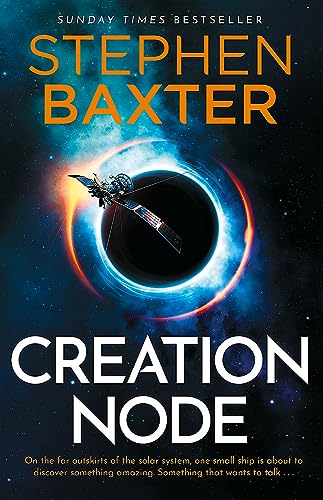
Creation Node (2023, UK) is, if I’ve counted correctly, Baxter’s forty-eighth novel (including three YA novels, one co-written with Alastair Reynolds, four with Arthur C Clarke, and five with Terry Pratchett). And then there are the collections and novellas. Creation Node is much like his other more recent novels – an exploration of some cosmological puzzle by people not far removed from ourselves, and a tendency to feel a little juvenile in places.
After a climate crash, Earth has partially colonised the solar system. There are three political blocs – Earth, the most powerful and mostly conservationist; the Lunar Consortium, which believes in exploiting whatever natural resources are available in the solar system; and the Conservers, who are hardline conservationists and refuse to use any resource that is not immediately renewable, such as sunlight. The Conservers sent a spacecraft, propelled by a solar sail, to the ninth planet, a journey which took 35 years. And they discovered the planet was actually a black hole. And it was emitting Hawking radiation that was… structured.
So they sent a message into the black hole. Which promptly expanded. Until its outer shell had a surface gravity of 1G and a 15C surface temperature. And a weird sarcophagus containing a living teenage birdlike alien…
Earth sends a ship out to Planet Nine – with a brief stopover, and much excitement, at a station orbiting Saturn, where the ship converts from a slow fission drive to a fast fusion drive. Over a decade has passed by the time representatives from Earth – and one from the Lunar Consortium, plus the Conserver’s chief legal counsel – reach Planet Nine. Which prompts the discoverers to attempt sending another message…
This triggers the appearance of an enigmatic black globe, which calls itself Terminus. It proves to be a Boltzmann Brain from the quantum substrate in which all universes are created. It gives the human ambassadors a brief lesson in speculative cosmology, and then offers the human race eternity, ie, continued existence after the heat death of our universe. For a price. It’s how Baxter’s novels tend to work – a story based around a big idea, a plot with a payload, if you will. Which often prompts a momentous decision on the part of the cast.
Baxter does his homework, and the ideas he bases his novels on are fascinating. If Creation Node’s extended timescale results in a number of longeurs, there’s still plenty to like here. Creation Node may suffer from Baxter’s typical weaknesses – that tendency to use teenage protagonists, which often drops the narrative into YA territory – but it also displays his strengths: making huge mind-expanding ideas easily palatable. Lots of sense of wonder, but the human dimension may be a little flat. On the other hand, Baxter is nothing if not consistent – which is why I probably keep on buying his books…
Incidentally, I should point out my takes on the books I review on this blog (and my other blog) are not always typical. My views may be individual, but that doesn’t mean they’re not open to question. So I welcome conversation about what I write. Feel free to leave a comment, or start a discussion.
 It Doesn't Have To Be Right...