
This was a reread, although I don’t recall when I previously read the book. Some time in the 1980s, I suspect. Everyone knows Ringworld (1970, USA), it was even No. 60 in the SF Masterworks series. Niven admits he had never intended to write a sequel, but he’d received so much correspondence about the novel – a lot of it pointing out where he’d got things wrong. Earth famously rotates the wrong way in the opening chapter of the novel (updated in later editions), but the chief complaint was that the ringworld was unstable. It needed attitude jets to keep it in orbit. So Niven decided to write The Ringworld Engineers (1979, USA), which is all about the attitude jets. Mostly.
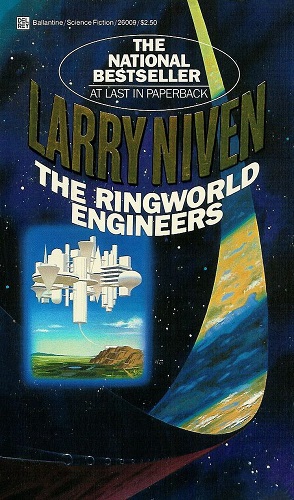
Twenty-three years after the events of Ringworld, Louis Wu is a wirehead. He and his kzinti companion on that trip, Speaker-to-Animals, now called Chmeee, are kidnapped by a Pierson’s Puppeteer. Who is actually the mate of the Pierson’s Puppeteer from Ringworld, and was the leader of the race, the Hindmost. He was ousted and now plans to win back his position by fetching a “treasure” from the ringworld, a transmutation device.
Which doesn’t exist and never existed. But that proves irrelevant because the ringworld has been knocked from its orbit and will impact the sun in a year or so. The City Builders, the most powerful race on the ringworld, had removed the attitude jets from the ringworld’s rim, the jets that kept it in orbit, in order to power their spaceships. Hence the current situation.
Wu decides there must be a Repair Centre, a sort of central control complex for the ringworld. If he can find it, then he can prevent the ringworld from being destroyed. But first he has to find it.
The humanoid races on the ringworld have created, and maintained, treaties and coalitions through “rishathra”, which is sex between people of different hominid races. Niven obviously likes writing about sex, or rather the easy availability of it to males, but this is commercial science fiction so it’s either alluded to or entirely off the page. Nevertheless, it leaves a bad taste.
The other problem is the distances – the ringworld is huge. Absolutely fucking enormous. With a surface area equivalent to three million Earths. Most of the action in The Ringworld Engineers takes place around the Great Ocean, an ocean so large it features archipelagos which are full-size maps of various planets in Known Space (including Earth, Mars and Kzin), and which are hundreds of thousands of miles apart. After a while, the distance gets wearying, it’s almost like some sort of scale fatigue sets in. It becomes meaningless, just words. Niven uses the right words, but there’s no sense of wonder attached to the vast scale of it all.
The Ringworld Engineers fixes the issue with the ringworld’s unstable orbit, and even identifies its builders – linking back to an earlier novel by Niven. He returned to the ringworld seventeen years later with The Ringworld Throne (1996, USA), and then again eight years after that with Ringworld’s Children (2004, USA). Five prequel novels, the Fleet of Worlds series, then followed.
The ringworld is a great creation, one of science fiction’s most memorable. The plot of the novel which introduced it doesn’t really matter. Same for its sequels. Dune (1965, USA) had great world-building, but its plot helped bring it to life. The plot of Ringworld is irrelevant, the Big Dumb Object exists in spite of it. And so it is for The Ringworld Engineers. Which presents a disappointing, and unconvincing, explanation as the answer to the question of who built it, and never really manages to really evoke the scale of it all.
 It Doesn't Have To Be Right...