
Winner of the Booker Prize in 1996, beating out, among others, Margaret Atwood’s Alias Grace (1996, Canada), which is an outstandingly good novel, probably her best. But Last Orders (1996, UK) is very good, and one that grows on you as you read it.
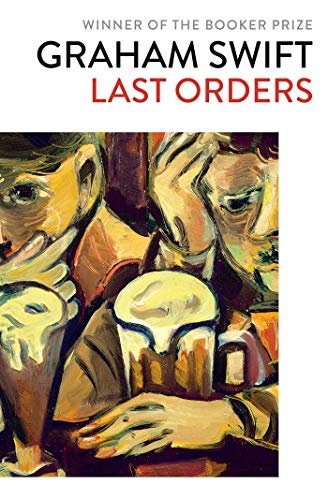
Jack Dodds has died and his adopted son and three old friends agree to take his ashes to Margate to throw them into the sea. The novel is about the journey, but it’s also about the past of the five men, their wives and daughters (although they don’t appear much in the story), and their relationships. Jack and Ray fought together in North Africa during WWII. Jack’s butcher shop was on the other side of the street to Vic’s funeral parlour. Lenny was a childhood friend, whose daughter had a relationship with Jack’s son. Who isn’t really his son, but the sole survivor of a neighbouring family whose house was hit by a bomb during the Blitz. Vic is the closest to middle-class as he’s a funeral director, he might even be lower middle class. Vince, the adopted son, is upwardly mobile (a very definite thing in the 1980s), a butcher’s son turned mechanic, but now running a car showroom specialising in top-end second-hand motors. The odd one out is Ray, who works in an office as an insurance clerk, but makes a tidy living betting on the horses.
Last Orders is set mostly in Bermondsey, south east London, during the years following World War II. Jack dies in the 1980s – the film is explicitly set in 1989. The story is told through the voices of its cast, which is East End English – not Cockney, not Estuary Speak, but the English of the London working class of the first half of last century. Swift’s control of voice is really impressive. The prose is a joy to read.
It occurred to me while reading the novel the setting had been spoiled by Guy Ritchie and all those “Mockney” movies. Last Orders is about working class culture in central London. Little of which exists anymore. For example, the novel mentions hop-picking, which was a thing up until the 1960s. Working class people from London would spend the summer in Kent, living in tents and shacks, and picking hops. It was the only holiday they had. The practice ended when farmers began using machines to pick hops.
Which suggests Last Orders is in part a paean to a lost way of life – signified, for example, by Vince’s refusal to be the son in “Dodds & Son, family butchers”. It’s in the nature of progress for ways of life to disappear. Tradition is a social brake, usually imposed for the wrong reasons. Ruing change is healthy, rolling it back is not. Last Orders makes that explicit, because disposing of Jack’s ashes also disposes of the world he knew.
Last Orders: lovely writing, with an excellent command of voice. And if it’s overly nostalgic, that’s the point. Recommended (the book more so than the film).
 It Doesn't Have To Be Right...