I still think Leckie’s Ancillary Justice (2013, USA) was a much-needed shot in the arm for space opera. It had been taking on more and more characteristics of military sf, after New British Space Opera was co-opted by US authors and editors and became New Space Opera. But that’s an argument for another day. There was lots to like in the two sequels to Leckie’s debut, as well. Also the two pendant novels published since, Provenance (2017, USA) and Translation State (2023, USA) (although less so for the latter, I thought). I’ve yet to read Leckie’s fantasy novel, The Raven Tower (2019, USA).
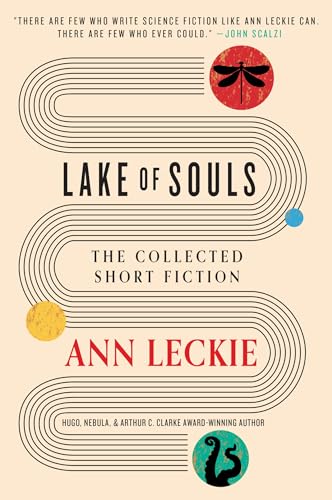
Lake of Souls (2024, USA) is Leckie’s first collection, containing stories originally published between 2006 and 2019, and including a story original to the collection. The contents are organised in three sections: stories from the Imperial Radch universe, stories from the universe of The Raven Tower, and, opening the collection, stories unconnected to either.
Collections are by definition mixed bags. It probably comes as no surprise the stories set in the universes of Leckie’s novels are (mostly) better than the unconnected ones. Having said that, of the three Imperial Radch stories, only one reads like the same universe as the novels, one could possibly be in that universe, but the third appears to have no connection at all (it’s some sort of fable).
The unconnected stories… the title story is a first contact that goes wrong, and reminded me of several similar pieces from the 1990s, two stories are based on premises that are definitely creaking at the seams these days, but ‘The Justified’, which is a very modern type of sf, and the Le Guin-ish ‘Another Word for World’ (big clue in the title there) are better.
The seven stories set in the world of The Raven Tower are more consistent, although the longest one, ‘The God of Au’, makes a jump two-thirds of the way in and nothing after that makes sense. I quite liked ‘The Unknown God’ and ‘Beloved of the Sun’, but the others are not especially memorable. Having said that, I suspect a collection of only fantasy stories might have been a better collection than Lake of Souls.
I was not really surprised on reading Lake of Souls to discover Leckie’s short fiction wasn’t up to the standard of her novels. While the world-building was generally done well, even if some of the premises were badly shop-worn, in several stories she failed to stick the ending. There are authors whose short fiction is much better than their novels, James Tiptree Jr, for example. It seems Leckie is the opposite.
 It Doesn't Have To Be Right...