
The late Eric Brown, a friend of many years, was a big fan of Coney’s fiction, but for some reason Coney was one of those authors I never seemed to pick up. The first was Hello Summer, Goodbye (1975, UK) about fifteen years ago, and I thought it quite good – and later I picked up and read Charisma (1975, UK). But stopped there. I’ve read more in the last few years, and found his Amorph trilogy of Mirror Image (1972, UK), Syzygy (1973, UK) and Brontomek! (1976, UK) good examples of a type of expatriate English science fiction of the 1970s which I find strangely appealing.
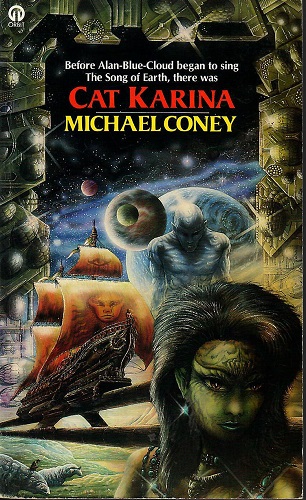
Cat Karina (1982, UK) is not that. It’s set in the far distant future, the Greataway, on an Earth populated by races that have been genetically melded with assorted animals, and in which technology is anathema – in fact, even fire is banned. The novel is explicitly framed as the telling of a legend, so much so it inserts commentary on later distortions and interpretations of the story. Also in the narrative are alternative timelines, happentracks, predicated on decisions made by Karina and others which might affect the future, or Ifalong.
There’s a prophecy, but it’s really a millennia-long plan to bring about the birth of someone who can free Starquin, “the greatest person the Earth has ever known”, who was imprisoned millennia earlier, and it involves the title character, who is a Specialist, a human with animal genes, and a felina, meaning the animal genes are from jaguars. Karina lives in a village on the sailway line, a wooden monorail with wind-powered sailcars. One section of the track is too steep for wind-power, so the sailcars must be hauled up to the summit. By teams of felinos. The chief cargo on the sailway is tortugas, a highly-prized fruit grown in the mountains on heavily-guarded farms.
A handmaiden of the Dedo, a part of the Starquin’s body “in human form”, whatever that is, tries to manipulate Karina so she follows the prophecy, but Karina has a mind of her own… The main story follows the preparations for an annual sailcar race to deliver the season’s first tortugas to the coast, and the plan to use a sailcar built using forbidden technology – ie, metal. Which could mean there will no longer be a need for gangs of felinos. Which prompts a revolution, with the Specialists overthrowing the True Humans.
There is little, to be honest, all that original about the plot of Cat Karina – it runs on rails as well-greased as those of the sailway. And, it must be said, the novel does a great deal of heavy-lifting when it comes to filling in the back-history of the universe (there’s a later trilogy set in the same universe), but it does so with some smart neologisms and an impressive economy. I don’t think Cat Karina privileges world-building over story, a common fault in science fiction and fantasy, but its world-building is certainly more original and accomplished than its story. Karina is an engaging hero and well-characterised, and it never feels like she’s being pushed and prodded by the plot, even though the narrative often details other happentracks. There’s some nice invention in parts, the secret of the tortugas, for example, an important plot-point, unlike the secret of the tumps (huge torpid meat animals), which is not.
Cat Karina is a well-crafted novel, and a good example of its particular type. To be honest, I much prefer Coney’s near-future sf, but for fans of sf set so far in the future it might as well be fantasy, Cat Karina (and, I expect, the trilogy which followed it) is a good read.
 It Doesn't Have To Be Right...
2025-04-27 at 16:07
I was not aware of this particular Coney novel. I, too, have enjoyed a lot of his SF — Hello Summer, Goodbye, various stories in Friends Come in Boxes (1973), “The Mind Prison” (1974), a few in the collection Monitor Found in Orbit (1974), “The Sharks of Pentreath” (1971), and “Those Good Old Days of Liquid Fuel” (1976).
Did not care for Syzygy (1973) at all though.