It Doesn't Have To Be Right…

… it just has to sound plausible


3 Comments

The Trigan Empire

I remember sitting in the school library back in the late 1970s, reading Look and Learn, which the school had on subscription. I chiefly read the magazine for one reason: The Trigan Empire. At that time, it was drawn by Oliver Frey and then Gerry Wood. The Trigan Empire had actually begun in Ranger in 1965, and the moved across to Look and Learn in 1966, where it remained until 1982 when the magazine ceased. It was was originally written by Mike Butterworth and drawn by Don Lawrence. The latter quit in 1976 after discovering that the strip was being syndicated throughout Europe and he was receiving nothing for it. But back when I was at school, I wasn’t aware of Lawrence’s work, and it wasn’t until my parents bought the book below one Christmas that I discovered the true Trigan Empire.
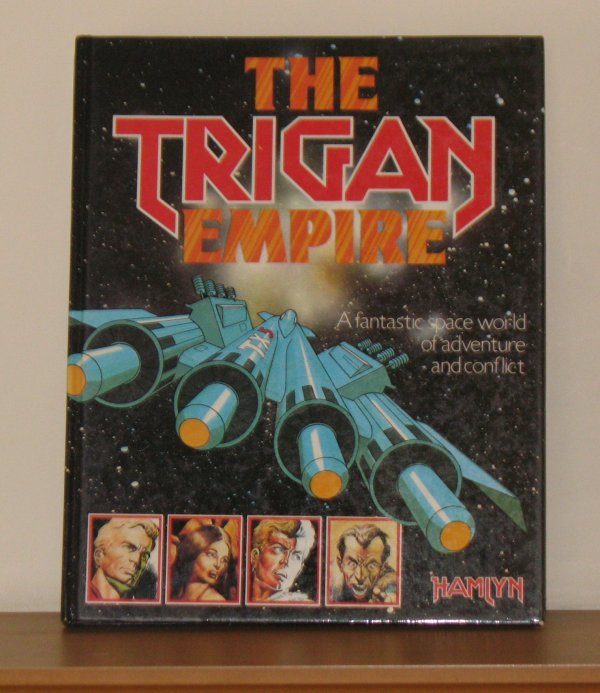
This Hamlyn omnibus reprints some of the earlier stories from the strip, including the one describing the founding of the empire. The stories, however, are not complete.

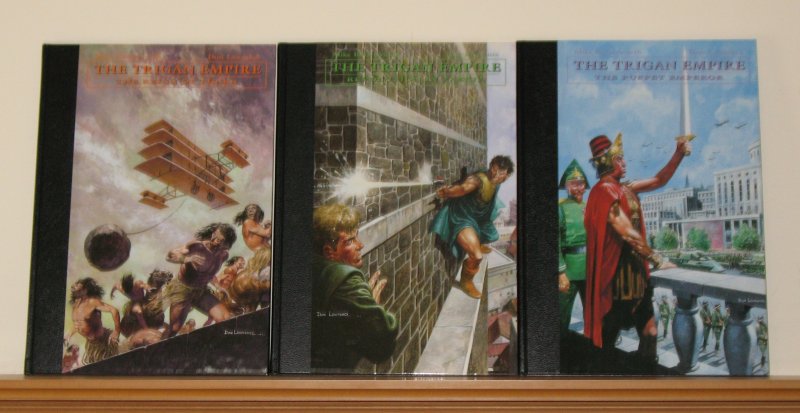
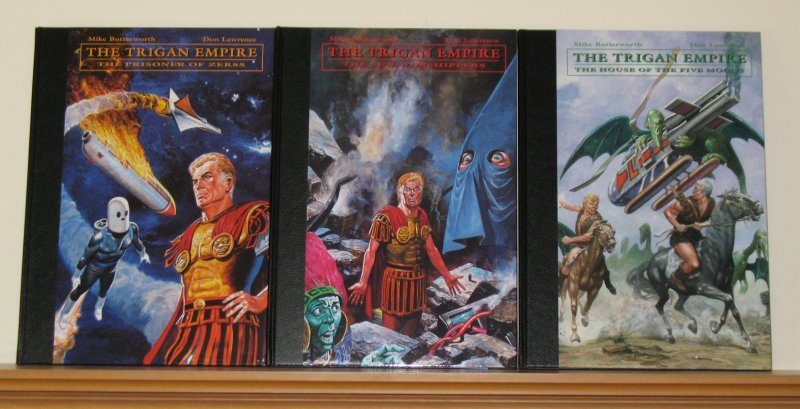
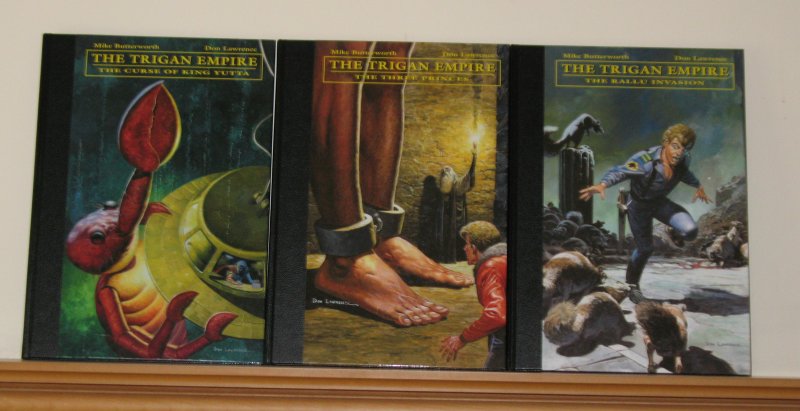
Between 2004 and 2009, the Don Lawrence Collection in the Netherlands reprinted all of Lawrence’s Trigan Empire strips in handsome leather-bound volumes. Each volume includes an essay on one aspect of the strip’s world. There are twelve volumes. To be honest, the stories are often quite crap – as they were for Dan Dare – but the art is gorgeous – again, as it was for Dan Dare. If Dan Dare inspired a generation of British boys in the 1960s to become sf fans, then the Trigan Empire did the same in the 1970s.
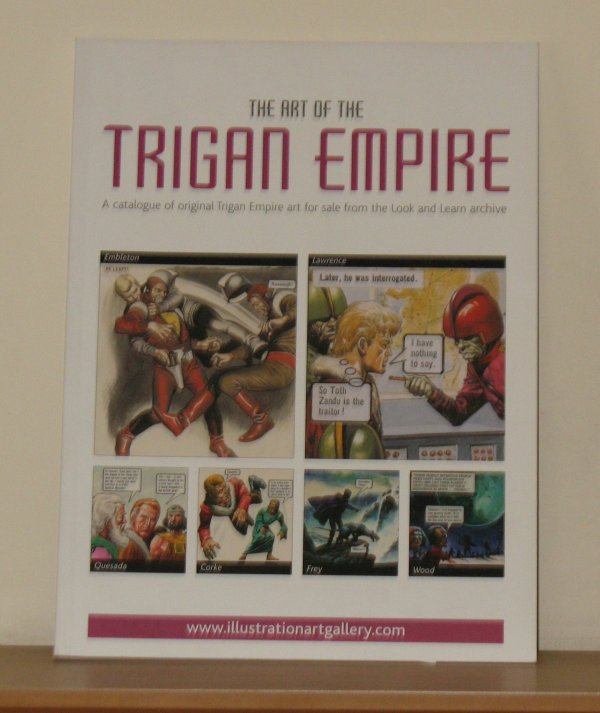
In 2008, Book Palace Books published a full-colour catalogue of Trigan Empire art from the Look and Learn archives which was available to buy. Prices ranged from £200 to £4000. I didn’t buy any, but the catalogue itself is very nice.

3 Comments

World fiction reading challenge #6: The Piano Teacher, Elfriede Jelinek

Yes, I know; this is neither the sixth month of the year, nor the sixth book I’ve read for this year’s reading challenge. In fact, the challenge has not been going very well. I got bogged down in Orhan Pamuk’s My Name is Red back in March, so gave up on it and moved onto Mariama Bâ’s So Long a Letter, which I read a month late (see here). Then I got bogged down again, but this time in Javier Marías’ Fever and Spear… And that threw me off my schedule completely – so much so that I’ve only just read June’s book, The Piano Teacher by Elfriede Jelinek, in September…

I know the story from Michael Haneke’s excellent 2001 film adaptation, and reading the novel on which a great film is based is always a hostage to fortune. Typically, books are better than the films made of them, but when the film itself is so good… Happily, the novel proved to be noticeably different to the film; unhappily, it proved a less satisfying read than the film is a viewing experience.

Erika Kohut is a piano teacher at the Vienna Conservatory. She lives with her mother, a controlling, shrewish woman. But Erika’s prim and proper demeanour hides a secret – in the evenings, she sneaks about the city, visiting peep shows and spying on prostitutes going about their business. She buys expensive clothing, which makes her mother furious as they’re supposed to be saving for a bigger and more modern apartment, but never wears it.

And then one of Erika’s students, Walter Klemmer, finds himself attracted to his teacher, and sets about seducing her. But she responds by telling him exactly how he is to woo her – it involves bondage and humiliation – but he’s not so sure he can cope with her demands. He wants to be in control, he must be in control.

The Piano Teacher was first published in 1986 in Austria, as Die Klavierspielerin, and first published in English in 1988. The edition I read, published in 2010 by Serpent’s Tail, appears to use the original Weidenfeld & Nicolson translation from 1988, which means a lot of it has been translated into idiomatic American English. It doesn’t feel right. I’ve come across this before, when a novel translated into English uses American vernacular when it’s quite clearly not set in the US nor has American characters. There must be other ways to signal that the original was written in the demotic without resorting to clichés that only apply in the US and which often date quickly.

None of this is helped by Jelinek’s propensity to jump from metaphor to metaphor within a single paragraph. It feels like a lack of control over her material, yet in all other respects Jelinek’s prose is so tightly-written and brusque that it’s plain control is one of her chief strengths. Other elements of her style I found less problematic – dialogue, for example, is not always indicated by speech marks, and is sometimes only reported. The narrative remains tightly-focused on its three main characters – Erika, her mother, and Walter – and makes for a claustrophobic read. None of the central trio are at all sympathetic. The mother is quite horrible, Walter is the embodiment of youthful male arrogance, and even Erika herself feels damaged.

The Piano Teacher is not a comfortable read, just as Haneke’s film is not comfortable viewing. It’s a book that’s easier to admire than to like. I didn’t take to it as I did to Szabó’s The Door (see here), but I do think I’d like to read more Jelinek.


3 Comments

The future we used to have – special 3

I’ve done air and land, so now it’s time for sea. Here’s ten sea- and river-going vessels from the last century whose lines possess that all-important futurism. Well, I think they look cool anyway. Trump-ish facts and figures added for extra nerdishness.


NS Savannah
Nuclear-powered cargo passenger ship (US)
length 181.66 m
displacement 9,900 tons
max speed 24 knots
crew 124
in service 1959 – 1972

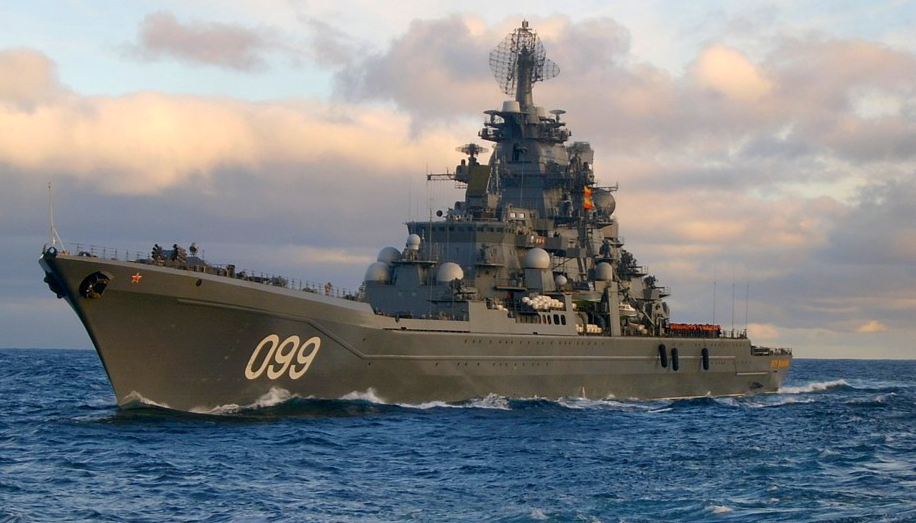
Kirov-class battlecruiser
Nuclear-powered battlecruiser (USSR)
length 252 m
displacement 24,300 tons
max speed 32 knots
crew 710
in service 1980 – present

Trieste
Bathyscaphe (Switzerland/Italy/US)
length 18.14 m
displacement 50 tons
crush depth 10,916 m*
crew 2
in service 1953 – 1966

British Hovercraft Corporation SR.N4
Passenger hovercraft (GB)
length 56.83 m
displacement 265 tons
max speed 83 knots
crew 3
in service 1968 – 2000

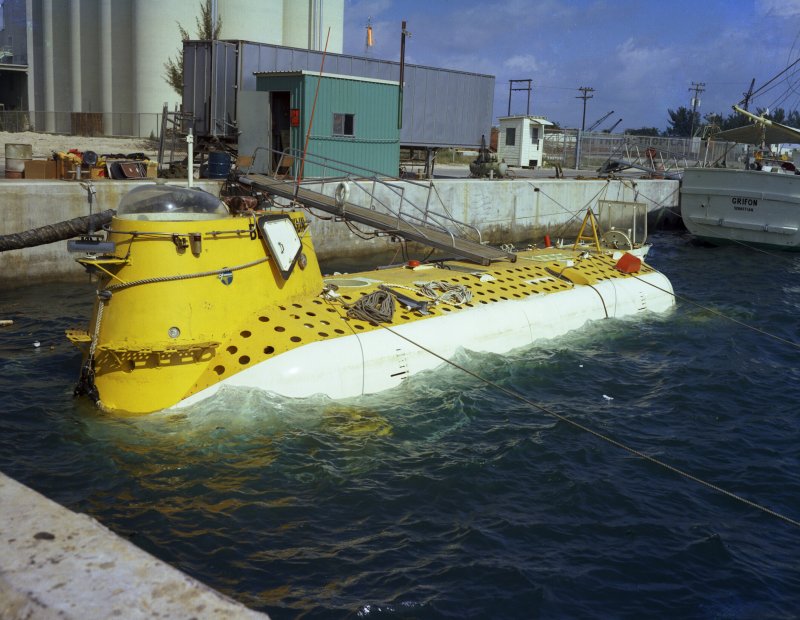
Ben Franklin (Grummman/Piccard Px-15)
Mesoscaphe (Switzerland/US)
length 14.86 m
displacement 130 tons
crush depth 1,200 m
crew 6
in service 1968 – 1971

USS Long Beach
Nuclear-powered guided missile cruiser (US)
length 219.84 m
displacement 15,540 tons
max speed 30 knots
crew 1160
in service 1959 – 1995

Kosmonaut Yuri Gagarin
Space-control monitoring ship (USSR)
length 230 m
displacement 53,500 tons
max speed 17.7 knots
crew 340
in service 1971 – 1991

Raketa Hydrofoil Burevestnik (Stormbringer)
River hydrofoil boat (USSR)
length 26.9 m
displacement 25.23 tons
max speed 38 knots
crew 4
in service 1957 – 1970s

Akula class submarine (‘Typhoon’)
Ballistic missile submarine (USSR)
length 175 m
displacement 24,500 tons
max speed 27 knots
crew 160
in service 1981 – present

SS Oriana
Ocean liner (GB)
length 245.1 m
displacement 41,923 tons
max speed 30.64 knots
crew 899
in service 1960 – 2005

Displacement is approximate, as some figures are long tons, some are metric tons, and some are actually gross weight (although for a submarine that should be the same as displacement…).

* The Trieste could not go any deeper than this, of course, as that’s the bottom of Challenger Deep.